Evaluation of Computer-Based Cognitive Training on Mild Cognitive Impairment in Parkinson’s Disease (PD-MCI): Α Review

 , ,
, ,  ,
,  ,
, 
Abstract
1. Introduction
2. Materials and Methods
2.1. Literature Search
2.2. Eligibility Criteria
2.3. Data Extraction
2.4. Risk of Bias Assessment Tool
3. Results
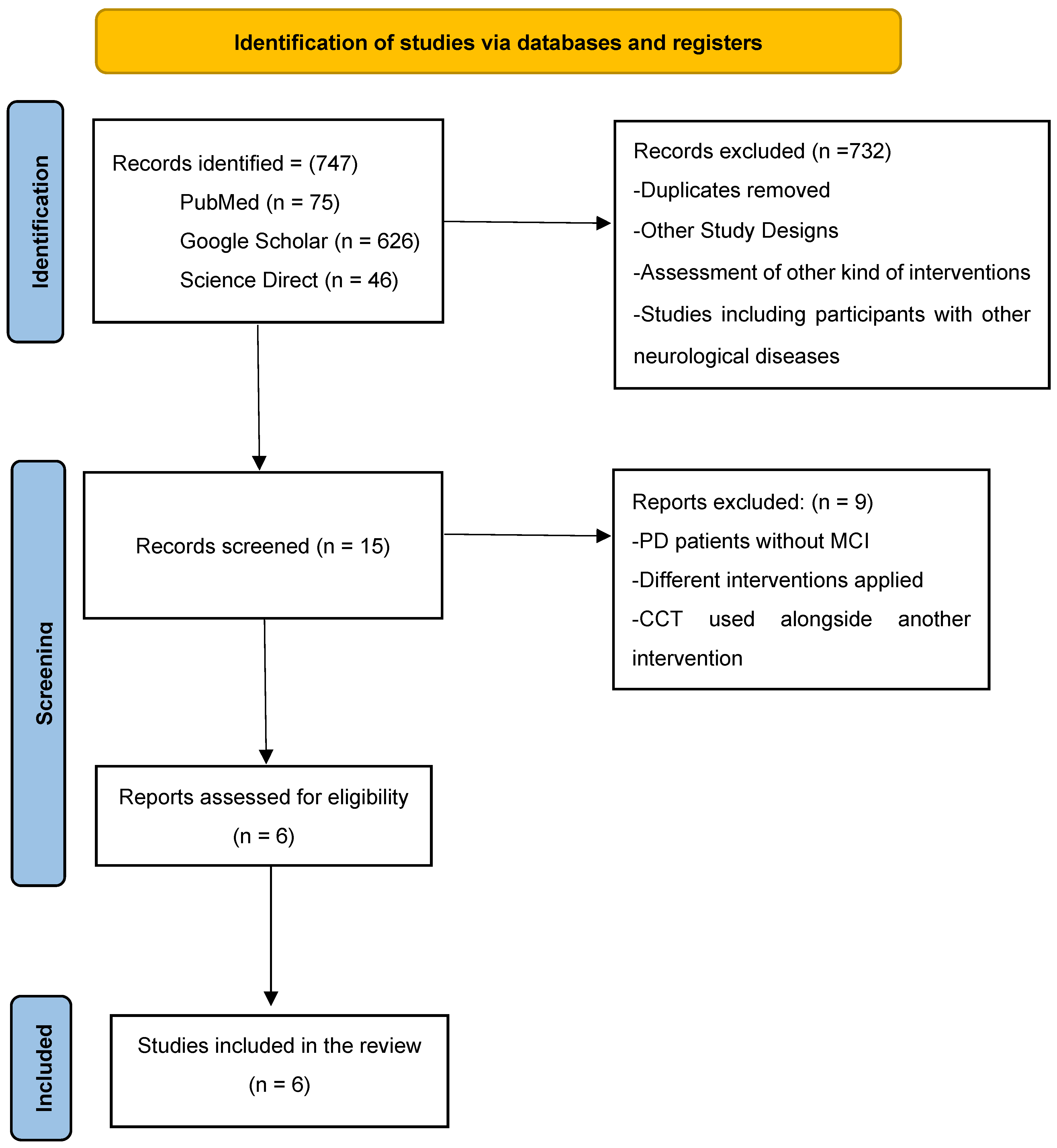
3.1. Selected Studies
3.2. Information and Main Results per Study
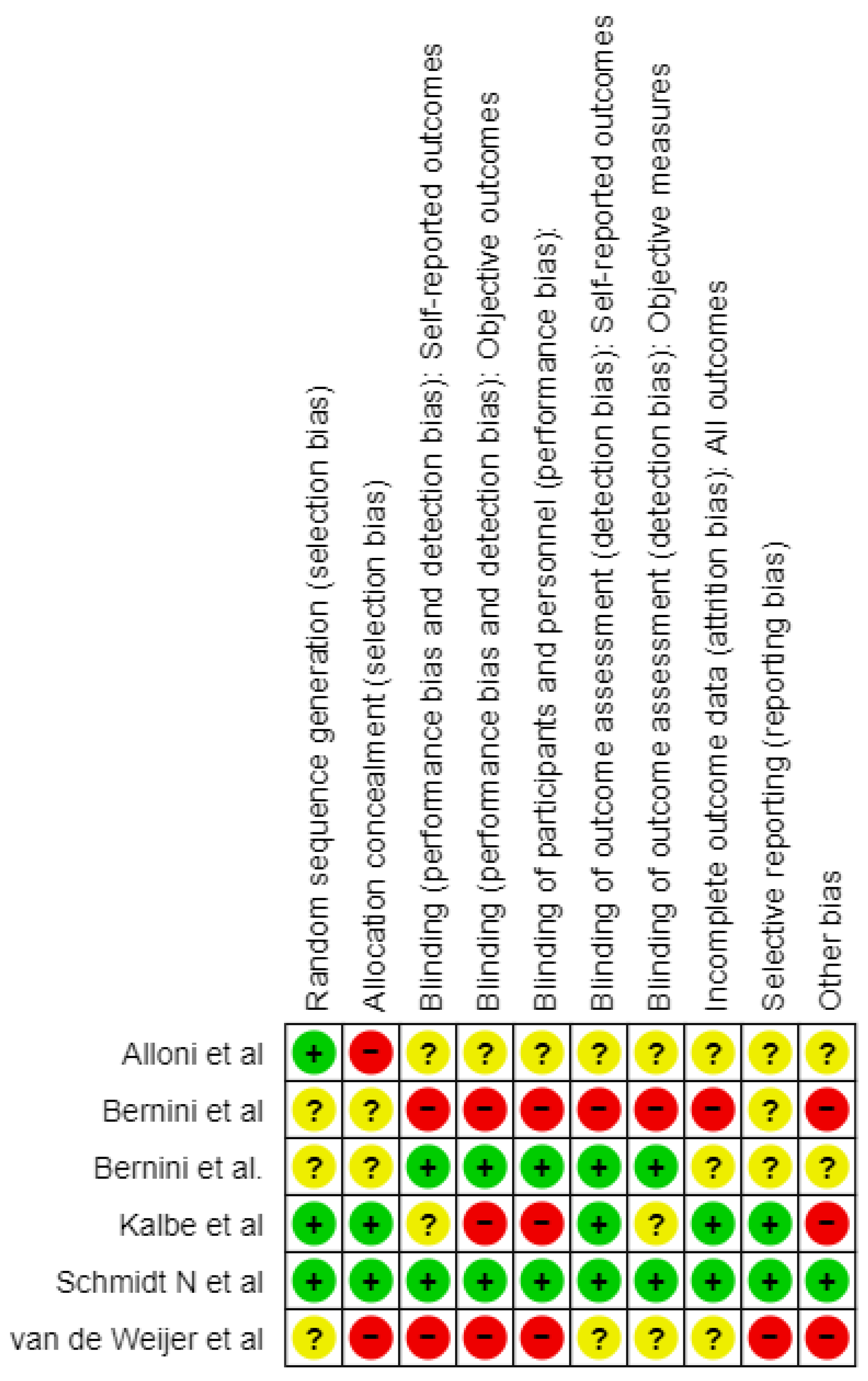
3.3. Reviewing the Risks of Bias: Comparing Methodologies
4. Discussion
5. Conclusions
Supplementary Materials
Author Contributions
Funding
Institutional Review Board Statement
Informed Consent Statement
Data Availability Statement
Conflicts of Interest
Abbreviations
| ACL | Aphasia Check List |
| ADL | Activities of Daily Living |
| ALS | Amyotrophic Lateral Sclerosis |
| BADS | Behavioural Assessment of the Dysexecutive Syndrome |
| b-adl scale | Bayer Activities of Daily Living Scale |
| BDI | Beck Depression Inventory |
| BDI-II | Beck Depression Inventory II |
| Benton JLO | Benton Judgment of Line Orientation |
| BNT | Boston Naming Test |
| CBTT | Corsi’s block-tapping test |
| CCT | Computer-Based Cognitive Training |
| CERAD | Consortium to Establish a Registry for Alzheimer’s Disease |
| CT | Cognitive Training |
| CVLT | California Verbal Learning Test |
| d2-R | d2-R Test of Attention |
| dr | Delayed Recall |
| FAB | Frontal Assessment Battery |
| FoGQ | Freezing of Gait Questionnaire |
| G1 | Intervention Group |
| G2 | Control Group |
| IADL | Instrumental Activities of Daily Living |
| ITT | Intention-to-Treat |
| ir | Immediate recall |
| M | Mean |
| MCI | Mild cognitive impairment |
| MMSE | Mini-Mental State Examination |
| MoCA | Montreal Overall Cognitive Assessment |
| MOBP | Myelin-associated Oligodendrocyte Basic Protein |
| PD | Parkinson’s disease |
| PASE | Physical Activity Scale for the Elderly |
| PDQ-39 | Parkinson’s Disease Questionnaire 39 |
| PDQ-8 | 8-Item Parkinson’s Disease Questionnaire |
| RCF | Rey Complex Figure |
| RCT | Randomized Controlled Trials |
| RM47 | Raven’s Matrices 1947 |
| ROCFT | Rey-Osterrieth Complex Figure Test |
| SPAD | Self-perceived deficits in attention questionnaire |
| TMT A and B | Trail Making Test parts A and B |
| UPDRS III | Unified Parkinson’s Disease Rating Scale III |
| WAIS-III | Wechsler Adult Intelligence Scale III |
References
- Litvan, I.; Goldman, J.G.; Tröster, A.I.; Schmand, B.A.; Weintraub, D.; Petersen, R.C.; Mollenhauer, B.; Adler, C.H.; Marder, K.; Williams-Gray, C.H.; et al. Diagnostic Criteria for Mild Cognitive Impairment in Parkinson’s Disease: Movement Disorder Society Task Force Guidelines. Mov. Disord. 2012, 27, 349–356. [Google Scholar] [CrossRef] [PubMed]
- Glizer, D.; MacDonald, P.A. Cognitive Training in Parkinson’s Disease: A Review of Studies from 2000 to 2014. Park. Dis. 2016, 2016, 9291713. [Google Scholar] [CrossRef] [PubMed]
- Biundo, R.; Weis, L.; Antonini, A. Cognitive Decline in Parkinson’s Disease: The Complex Picture. NPJ Park. Dis. 2016, 2, 1–7. [Google Scholar] [CrossRef]
- Sinani, O.; Dadouli, K.; Ntellas, P.; Kapsalaki, E.Z.; Vlychou, M.; Raptis, D.G.; Marogianni, C.; Markou, K.; Dardiotis, E.; Xiromerisiou, G. Association between White Matter Lesions and Parkinson’s Disease: An Impact on Postural/Gait Difficulty Phenotype and Cognitive Performance. Neurol. Res. 2022, 44, 1122–1131. [Google Scholar] [CrossRef]
- Goldman, J.G.; Vernaleo, B.A.; Camicioli, R.; Dahodwala, N.; Dobkin, R.D.; Ellis, T.; Galvin, J.E.; Marras, C.; Edwards, J.; Fields, J.; et al. Cognitive Impairment in Parkinson’s Disease: A Report from a Multidisciplinary Symposium on Unmet Needs and Future Directions to Maintain Cognitive Health. NPJ Park. Dis. 2018, 4, 19. [Google Scholar] [CrossRef] [PubMed]
- Broeders, M.; de Bie, R.M.A.; Velseboer, D.C.; Speelman, J.D.; Muslimovic, D.; Schmand, B. Evolution of Mild Cognitive Impairment in Parkinson Disease. Neurology 2013, 81, 346–352. [Google Scholar] [CrossRef]
- Di Biasio, F.; Vanacore, N.; Fasano, A.; Modugno, N.; Gandolfi, B.; Lena, F.; Grillea, G.; Pietracupa, S.; Caranci, G.; Ruggieri, S. Neuropsychology, Neuroimaging or Motor Phenotype in Diagnosis of Parkinson’s Disease-Dementia: Which Matters Most? J. Neural Transm. 2012, 119, 597–604. [Google Scholar] [CrossRef]
- Siokas, V.; Aloizou, A.-M.; Liampas, I.; Bakirtzis, C.; Tsouris, Z.; Sgantzos, M.; Liakos, P.; Bogdanos, D.P.; Hadjigeorgiou, G.M.; Dardiotis, E. Myelin-Associated Oligodendrocyte Basic Protein Rs616147 Polymorphism as a Risk Factor for Parkinson’s Disease. Acta Neurol. Scand. 2022, 145, 223–228. [Google Scholar] [CrossRef]
- Xiromerisiou, G.; Marogianni, C.; Androutsopoulou, A.; Ntavaroukas, P.; Mysiris, D.; Papoutsopoulou, S. Parkinson’s Disease, It Takes Guts: The Correlation between Intestinal Microbiome and Cytokine Network with Neurodegeneration. Biology 2023, 12, 93. [Google Scholar] [CrossRef]
- Watson, G.S.; Leverenz, J.B. Profile of Cognitive Impairment in Parkinson’s Disease. Brain Pathol. 2010, 20, 640–645. [Google Scholar] [CrossRef]
- Eberling, J.; Vincent, L.; Goldman, J.G.; Weintraub, D.; Kulisevsky, J.; Marras, C.; Stebbins, G.; Kieburtz, K. Therapeutic Development Paths for Cognitive Impairment in Parkinson’s Disease: Report of a Regulatory Roundtable. J. Park. Dis. 2014, 4, 585–589. [Google Scholar] [CrossRef] [PubMed]
- Nousia, A.; Martzoukou, M.; Tsouris, Z.; Siokas, V.; Aloizou, A.-M.; Liampas, I.; Nasios, G.; Dardiotis, E. The Beneficial Effects of Computer-Based Cognitive Training in Parkinson’s Disease: A Systematic Review. Arch. Clin. Neuropsychol. 2020, 35, 434–447. [Google Scholar] [CrossRef]
- Lampit, A.; Hallock, H.; Valenzuela, M. Computerized Cognitive Training in Cognitively Healthy Older Adults: A Systematic Review and Meta-Analysis of Effect Modifiers. PLoS Med. 2014, 11, e1001756. [Google Scholar] [CrossRef] [PubMed]
- Hill, N.T.M.; Mowszowski, L.; Naismith, S.L.; Chadwick, V.L.; Valenzuela, M.; Lampit, A. Computerized Cognitive Training in Older Adults With Mild Cognitive Impairment or Dementia: A Systematic Review and Meta-Analysis. Am. J. Psychiatry 2017, 174, 329–340. [Google Scholar] [CrossRef] [PubMed]
- Leung, I.H.K.; Walton, C.C.; Hallock, H.; Lewis, S.J.G.; Valenzuela, M.; Lampit, A. Cognitive Training in Parkinson Disease: A Systematic Review and Meta-Analysis. Neurology 2015, 85, 1843–1851. [Google Scholar] [CrossRef]
- Cerasa, A.; Gioia, M.C.; Salsone, M.; Donzuso, G.; Chiriaco, C.; Realmuto, S.; Nicoletti, A.; Bellavia, G.; Banco, A.; D’amelio, M.; et al. Neurofunctional Correlates of Attention Rehabilitation in Parkinson’s Disease: An Explorative Study. Neurol. Sci. 2014, 35, 1173–1180. [Google Scholar] [CrossRef]
- Costa, A.; Peppe, A.; Serafini, F.; Zabberoni, S.; Barban, F.; Caltagirone, C.; Carlesimo, G.A. Prospective Memory Performance of Patients with Parkinson’s Disease Depends on Shifting Aptitude: Evidence from Cognitive Rehabilitation. J. Int. Neuropsychol. Soc. 2014, 20, 717–726. [Google Scholar] [CrossRef] [PubMed]
- Folkerts, A.-K.; Dorn, M.E.; Roheger, M.; Maassen, M.; Koerts, J.; Tucha, O.; Altgassen, M.; Sack, A.T.; Smit, D.; Haarmann, L.; et al. Cognitive Stimulation for Individuals with Parkinson’s Disease Dementia Living in Long-Term Care: Preliminary Data from a Randomized Crossover Pilot Study. Park. Dis. 2018, 2018, 8104673. [Google Scholar] [CrossRef]
- Petrelli, A.; Kaesberg, S.; Barbe, M.T.; Timmermann, L.; Fink, G.R.; Kessler, J.; Kalbe, E. Effects of Cognitive Training in Parkinson’s Disease: A Randomized Controlled Trial. Park. Relat. Disord. 2014, 20, 1196–1202. [Google Scholar] [CrossRef]
- Lawrence, B.J.; Gasson, N.; Johnson, A.R.; Booth, L.; Loftus, A.M. Cognitive Training and Transcranial Direct Current Stimulation for Mild Cognitive Impairment in Parkinson’s Disease: A Randomized Controlled Trial. Park. Dis. 2018, 2018, 4318475. [Google Scholar] [CrossRef]
- París, A.P.; Saleta, H.G.; de la Cruz Crespo Maraver, M.; Silvestre, E.; Freixa, M.G.; Torrellas, C.P.; Pont, S.A.; Nadal, M.F.; Garcia, S.A.; Bartolomé, M.V.P.; et al. Blind Randomized Controlled Study of the Efficacy of Cognitive Training in Parkinson’s Disease. Mov. Disord. 2011, 26, 1251–1258. [Google Scholar] [CrossRef] [PubMed]
- Moher, D.; Liberati, A.; Tetzlaff, J.; Altman, D.G. Preferred Reporting Items for Systematic Reviews and Meta-Analyses: The PRISMA Statement. PLoS Med. 2009, 6, e1000097. [Google Scholar] [CrossRef] [PubMed]
- Alloni, A.; Quaglini, S.; Panzarasa, S.; Sinforiani, E.; Bernini, S. Evaluation of an Ontology-Based System for Computerized Cognitive Rehabilitation. Int. J. Med. Inform. 2018, 115, 64–72. [Google Scholar] [CrossRef]
- Bernini, S.; Alloni, A.; Panzarasa, S.; Picascia, M.; Quaglini, S.; Tassorelli, C.; Sinforiani, E. A Computer-Based Cognitive Training in Mild Cognitive Impairment in Parkinson’s Disease. NeuroRehabilitation 2019, 44, 555–567. [Google Scholar] [CrossRef]
- Kalbe, E.; Folkerts, A.-K.; Ophey, A.; Eggers, C.; Elben, S.; Dimenshteyn, K.; Sulzer, P.; Schulte, C.; Schmidt, N.; Schlenstedt, C.; et al. Enhancement of Executive Functions but Not Memory by Multidomain Group Cognitive Training in Patients with Parkinson’s Disease and Mild Cognitive Impairment: A Multicenter Randomized Controlled Trial. Park. Dis. 2020, 2020, 4068706. [Google Scholar] [CrossRef]
- van de Weijer, S.C.F.; Duits, A.A.; Bloem, B.R.; de Vries, N.M.; Kessels, R.P.C.; Köhler, S.; Tissingh, G.; Kuijf, M.L. Feasibility of a Cognitive Training Game in Parkinson’s Disease: The Randomized Parkin’Play Study. Eur. Neurol. 2020, 83, 426–432. [Google Scholar] [CrossRef] [PubMed]
- Bernini, S.; Panzarasa, S.; Barbieri, M.; Sinforiani, E.; Quaglini, S.; Tassorelli, C.; Bottiroli, S. A Double-Blind Randomized Controlled Trial of the Efficacy of Cognitive Training Delivered Using Two Different Methods in Mild Cognitive Impairment in Parkinson’s Disease: Preliminary Report of Benefits Associated with the Use of a Computerized Tool. Aging Clin. Exp. Res. 2021, 33, 1567–1575. [Google Scholar] [CrossRef]
- Schmidt, N.; Tödt, I.; Berg, D.; Schlenstedt, C.; Folkerts, A.-K.; Ophey, A.; Dimenshteyn, K.; Elben, S.; Wojtecki, L.; Liepelt-Scarfone, I.; et al. Memory Enhancement by Multidomain Group Cognitive Training in Patients with Parkinson’s Disease and Mild Cognitive Impairment: Long-Term Effects of a Multicenter Randomized Controlled Trial. J. Neurol. 2021, 268, 4655–4666. [Google Scholar] [CrossRef]
- Higgins, J.P.T.; Altman, D.G.; Gøtzsche, P.C.; Jüni, P.; Moher, D.; Oxman, A.D.; Savović, J.; Schulz, K.F.; Weeks, L.; Sterne, J.A.C. The Cochrane Collaboration’s Tool for Assessing Risk of Bias in Randomised Trials. BMJ 2011, 343, d5928. [Google Scholar] [CrossRef]


| Study | Country | Single/Multi Training | Double/Single Blind | Parallel Arm | Participants per Group |
|---|---|---|---|---|---|
| Alloni et al. (2018) [23] | Italy | Single-Training | Single Blind | YES | TG = 17; CG = 14 |
| Bernini et al. (2019) [24] | Italy | Single-Training | Single Blind | YES | TG = 17; CG = 18 |
| Kalbe et al. (2020) [25] | Germany | Multi-Training | Double Blind | YES | TG = 31; CG = 30 |
| van de Weijer et al. (2020) [26] | Netherlands | Multi-Training | Double Blind | YES | CCT = 21; CG = 20 |
| Bernini et al. (2021) [27] | Italy | Multi-Training | Double Blind | YES | TG1 = 21; TG2 = 14; CG= 18 |
| Schmidt et al. (2021) [28] | Germany | Multi-Training | Double Blind | YES | TG = 28; CG = 26 |
| Authors | n | PD Stages | Cognitive Status | Cognitive Domains Targeted | Technique/Design | Outcome Measures | Duration and Frequency | Results |
|---|---|---|---|---|---|---|---|---|
| Alloni et al. (2018) [23] | 31 | Hoehn and Yahr Scale ≤ 4 | MMSE: 25.35 ± 2.60 MOCA: 20.41 ± 3.28 | logical-executive functions, category recognition, sequencing and order, auditory-visual integration, memory and association, pattern recognition and logical thinking, attention and focus, functional planning | Training group: CoRe tool. Control group: usual care or standard treatment. | MMSE, MOCA, Verbal Span, Digit Span, CBTT, Logical Memory Test with immediate and delayed recall, Rey’s 15-words test with immediate and delayed recall and RCF-dr, RM47, Weigl’s Sorting test, FAB, FAS, TMTA—TMTB, Stroop tests), RCF-copy | Patients who performed cognitive intervention were subjected to 12 individual sittings, lasting 45 min, using the CoRe system, over 4 weeks (3 sittings/week). Patients in the control group did not perform cognitive training; they only used a sham intervention. | G1: Significant improvements in 12 out of 21 tests, including MoCA, Rey’s 15-word, Logical Memory, Stroop, etc. G2: Minimal improvement in Rey Complex Figure (delayed recall); worsening in Stroop time interference. T0 to T1: G1 showed significant cognitive improvements. G2 showed limited improvement and cognitive worsening in some tasks. T1 to T2: Significant decline observed in G1 (MoCA and FAS), while G2 showed worsening across multiple cognitive tests (MoCA, FAS, MMSE). T0 to T2: G1 maintained improvements in Rey’s 15-word test, Weigl’s Sorting, and Stroop time. G2 showed a general cognitive decline. |
| Bernini et al. (2019) [24] | 35 | Hoehn and Yahr Scale and UPDRS III | MoCA: 24.9 ± 3.5 | logical-executive functions, attention/processing speed, working memory, and episodic memory | Standard physical rehabilitation plus cognitive intervention with CoRe (intervention group—G1) or standard physical rehabilitation only (control group—G2). | PDQ-8, BDI, MMSE, MoCA, DIGIT SPAN, CBTT, VERBAL SPAN, REY’S 15 WORD TEST-ir, REY’S 15 WORD TEST-dr, LOGICAL MEMORY TEST-ir, LOGICAL MEMORY TEST-dr, RM47, WEIGL’S TEST, FAB, TMT A, TMT B, ATTENTIVE MATRICES, STROOP TEST TIME, STROOP TEST ERROR, PHONOLOGICAL FLUENCY (FAS), SEMANTIC FLUENCY, RCF copy, RCF-dr | CoRe program consisted of 12 individual sessions (3 sessions/week) each lasting 45 minutes of computer-based logical-executive tasks | G1: Medium/large improvements in cognitive performance and executive functions compared to G2. MoCA proved more sensitive than MMSE in detecting improvements. G2: Cognitive decline over 7 months; motor performance improved in both groups, but only G1 showed cognitive improvements. |
| Kalbe et al. (2020) [25] | 61 | Hoehn and Yahr Scale ≤5 and UPDRS ≤ IV | MoCA < 26 | targeting executive functions, memory, attention, and visuocognition | CT, the standardized NEUROvitalis program CG, a low-intensity physical activity program developed by a sports scientist which aimed to be beneficial for PD patients but to have minimal effects on cognition | The primary study outcomes were memory and executive functions. Secondary outcomes were attention, working memory, visuocognition, language, IADL, self-reported physical activity, depression, QoL, self-experienced attention deficits, and motor impairment including the motor score of the Unified Parkinson’s Disease Rating Scale (UPDRS-III) and freezing of gait (FOG) | Two sessions per week for 90 min over six weeks, conducted in groups of three to five individuals | G1: Improvement in executive functions, phonemic fluency, and a slight improvement in physical activity. G2: Slight improvement in digit span (backward). No significant differences were observed in other neuropsychological or motor symptoms. T0 to T1: Both groups showed slight improvement in some cognitive tasks, but the intervention group (G1) showed more substantial progress. |
| van de Weijer et al. (2020) [26] | 41 | Hoehn and Yahr stage ≤ 3 | Mild cognitive impairment according to MDS criteria | attention, working memory, episodic memory, psychomotor speed, executive function | Web-based computerized cognitive training ‘health game’ targeting multiple cognitive domains over 12 weeks (via MyCognition AquaSnap). Control group: waiting list. | Neuropsychological assessments, self-report questionnaires, and online cognitive assessment (MyCQTM) | A total of 3 weekly sessions of 30 min each, for at least 12 weeks (primary phase). Participants scheduled their own agenda, and each session duration was not fixed. Both groups could voluntarily play the gamified CT from weeks 12 to 24 (secondary phase). The waiting-list control group did not train in the primary phase but was allowed to train in the secondary phase. | G1: Positive effects in executive function and memory compared to the control group. G2: The control group showed no significant improvements during the primary phase, but similar improvements were observed during the secondary phase after voluntary engagement in cognitive training. |
| Bernini et al. (2021) [27] | 53 | UPDRS III/ Hoehn and Yahr scale score ≤ 3 | MMSE: 25.01 ± 2.62, MOCA: 19.09 ± 2.84 | global cognition, episodic long-term memory, logical-executive functions, working memory, attention/processing speed. | CCT (CoRe), PCT, or CG groups using random numbers. | MMSE, MoCA, Verbal Span, Digit Span, CBTT, Logical Memory Test (immediate and delayed recall), Rey’s 15-word test (immediate and delayed recall), RCF, RM47, Weigl’s Sorting test, FAB, Semantic fluency (animals, fruits, car brands), FAS, Attentive Matrices, TMT A-B, Stroop test, RCF-copy | The intervention lasted 3 weeks with 4 weekly 45 min sessions | G1: Significant improvements in MoCA, global cognition, executive functions, and attention/processing speed, while PCT and CG groups showed no significant changes. G2: No significant cognitive changes observed. T0 to T1: G1 showed significant improvements in multiple cognitive domains, while G2 showed no improvements. |
| Schmidt Ν et al. (2021) [28] | 54 | Movement Disorders Society task force Level-II criteria | MoCA < 26 | executive function, memory, attention, visuospatial abilities, psychoeducation | G1 received the NEUROvitalis program. G2 received a low-intensity physical therapy program focusing on improving motor function without targeting cognition. | CVLT, ROCFT, Regensburger word fluency tests, Modified card sorting test, BADS, d2-R, WAIS-III, Benton JLO, CERAD, BNT, ACL, Bayer ADL Scale, BDI-II, PASE, PDQ-39, SPAD, UPDRS III, FoGQ | Groups of three to five patients, in two 90 min sessions per week for a total duration of six weeks, were encouraged to continue engaging cognitively and physically after the end of the training phase, without undergoing new sessions until follow-up assessments. | G1: Significant improvements in verbal and nonverbal memory at 6 months, but no significant changes at 12 months. G2: No significant changes in memory or executive function. T0 to T1: Significant interaction effect for memory in the CT group, but no effect on executive function. No significant predictors for memory improvement after CT. |
Disclaimer/Publisher’s Note: The statements, opinions and data contained in all publications are solely those of the individual author(s) and contributor(s) and not of MDPI and/or the editor(s). MDPI and/or the editor(s) disclaim responsibility for any injury to people or property resulting from any ideas, methods, instructions or products referred to in the content. |
© 2025 by the authors. Licensee MDPI, Basel, Switzerland. This article is an open access article distributed under the terms and conditions of the Creative Commons Attribution (CC BY) license (https://creativecommons.org/licenses/by/4.0/).
Share and Cite
Kotsimpou, S.; Liampas, I.; Dastamani, M.; Marogianni, C.; Stamati, P.; Tsika, A.; Messinis, L.; Nasios, G.; Dardiotis, E.; Siokas, V. Evaluation of Computer-Based Cognitive Training on Mild Cognitive Impairment in Parkinson’s Disease (PD-MCI): Α Review. J. Clin. Med. 2025, 14, 3001. https://doi.org/10.3390/jcm14093001
Kotsimpou S, Liampas I, Dastamani M, Marogianni C, Stamati P, Tsika A, Messinis L, Nasios G, Dardiotis E, Siokas V. Evaluation of Computer-Based Cognitive Training on Mild Cognitive Impairment in Parkinson’s Disease (PD-MCI): Α Review. Journal of Clinical Medicine. 2025; 14(9):3001. https://doi.org/10.3390/jcm14093001
Chicago/Turabian StyleKotsimpou, Stamatia, Ioannis Liampas, Metaxia Dastamani, Chrysa Marogianni, Polyxeni Stamati, Antonia Tsika, Lampros Messinis, Grigorios Nasios, Efthimios Dardiotis, and Vasileios Siokas. 2025. "Evaluation of Computer-Based Cognitive Training on Mild Cognitive Impairment in Parkinson’s Disease (PD-MCI): Α Review" Journal of Clinical Medicine 14, no. 9: 3001. https://doi.org/10.3390/jcm14093001
APA StyleKotsimpou, S., Liampas, I., Dastamani, M., Marogianni, C., Stamati, P., Tsika, A., Messinis, L., Nasios, G., Dardiotis, E., & Siokas, V. (2025). Evaluation of Computer-Based Cognitive Training on Mild Cognitive Impairment in Parkinson’s Disease (PD-MCI): Α Review. Journal of Clinical Medicine, 14(9), 3001. https://doi.org/10.3390/jcm14093001