OpenCap vs. LESS: Sport-Specific Profiling of Dynamic Knee Valgus



Abstract
1. Introduction
2. Methods
2.1. Participation
2.2. Landing Error Scoring System (LESS)
2.3. Markerless 3D Motion Analysis (OpenCap) and Knee Valgus
2.4. Surface Electromyography (EMG)
2.5. Phase Definitions (Deceleration/Acceleration)
2.6. Statistical Analysis
3. Results
3.1. Group Comparisons
3.2. Correlations with LESS
3.3. Multiple Regression with LESS as the Dependent Variable
3.4. Multiple Regression with Right-Side Valgus as the Dependent Variable
4. Discussion
5. Conclusions
Author Contributions
Funding
Institutional Review Board Statement
Informed Consent Statement
Data Availability Statement
Conflicts of Interest
References
- Harper, D.J.; McBurnie, A.J.; Dos’ Santos, T.; Eriksrud, O.; Evans, M.; Cohen, D.D.; Rhodes, D.; Carling, C.; Kiely, J. Biomechanical and Neuromuscular Performance Requirements of Horizontal Deceleration: A Review with Implications for Random Intermittent Multi-Directional Sports. Sports Med. 2022, 52, 2321–2354. [Google Scholar] [CrossRef] [PubMed]
- Bathe, C.; Fennen, L.; Heering, T.; Greif, A.; Dubbeldam, R. Training Interventions to Reduce the Risk of Injury to the Lower Extremity Joints during Landing Movements in Adult Athletes: A Systematic Review and Meta-Analysis. BMJ Open Sport Exerc. Med. 2023, 9, e001508. [Google Scholar] [CrossRef] [PubMed]
- Hanzlíková, I.; Hébert-Losier, K. Is the Landing Error Scoring System Reliable and Valid? A Systematic Review. Sports Health 2020, 12, 181–188. [Google Scholar] [PubMed]
- Muramoto, Y.; Kuruma, H. Relationship Between the Results of the Landing Error Scoring System and Trunk Muscle Thickness. Int. J. Sports Phys. Ther. 2024, 19, 1080–1087. [Google Scholar] [CrossRef]
- Uhlrich, S.D.; Falisse, A.; Kidziński, Ł.; Muccini, J.; Ko, M.; Chaudhari, A.S.; Hicks, J.L.; Delp, S.L. 3D Human Movement Dynamics from Smartphone Videos. bioRxiv 2022. [Google Scholar] [CrossRef]
- Uhlrich, S.D.; Falisse, A.; Kidziński, Ł.; Muccini, J.; Ko, M.; Chaudhari, A.S.; Hicks, J.L.; Delp, S.L. OpenCap: Human Movement Dynamics from Smartphone Videos. PLoS Comput. Biol. 2023, 19, e1011462. [Google Scholar] [CrossRef]
- Ino, T.; Samukawa, M.; Ishida, T.; Wada, N.; Koshino, Y.; Kasahara, S.; Tohyama, H. Validity and Reliability of OpenPose-Based Motion Analysis in Measuring Knee Valgus during Drop Vertical Jump Test. J. Sports Sci. Med. 2024, 23, 515–525. [Google Scholar]
- Slovák, L.; Zahradník, D.; Land, W.M.; Sarvestan, J.; Hamill, J.; Abdollahipour, R. Response of Knee Joint Biomechanics to Landing Under Internal and External Focus of Attention in Female Volleyball Players. Mot. Control 2024, 28, 341–361. [Google Scholar]
- Dos’Santos, T.; McBurnie, A.; Donelon, T.; Thomas, C.; Comfort, P.; Jones, P.A. A Qualitative Screening Tool to Identify Athletes with ‘High-Risk’ Movement Mechanics during Cutting: The Cutting Movement Assessment Score (CMAS). Phys. Ther. Sport 2019, 38, 152–161. [Google Scholar] [CrossRef]
- Legg, L.; Donahue, T.; Peel, S.; Piland, S.; Thorsen, T. Effects of Shoe Collar Height and Limb Dominance on Landing Knee Biomechanics in Female Collegiate Volleyball Players. J. Sports Sci. 2024, 42, 247–254. [Google Scholar] [CrossRef]
- Padua, D.A.; Marshall, S.W.; Boling, M.C.; Thigpen, C.A.; Garrett, W.E.; Beutler, A.I. The Landing Error Scoring System (LESS) Is a Valid and Reliable Clinical Assessment Tool of Jump-Landing Biomechanics. Am. J. Sports Med. 2009, 37, 1996–2002. [Google Scholar] [CrossRef] [PubMed]
- Hermens, H.J.; Freriks, B.; Disselhorst-Klug, C.; Rau, G. Development of Recommendations for SEMG Sensors and Sensor Placement Procedures. J. Electromyogr. Kinesiol. 2000, 10, 361–374. [Google Scholar] [CrossRef] [PubMed]
- Arlettaz, M.E.; Dorsch, L.N.; Catalfamo-Formento, P.A.L. Landing error scoring system: A scoping review about variants, reference values and differences according to sex and sport. Phys. Ther. Sport 2024, 69, 67–75. [Google Scholar] [CrossRef] [PubMed]
- Subedi, M.; Sinsurin, K.; Suttiwong, J.; Warathanagasame, P.; Gao, Y. Validity of the modified landing error scoring system (LESS–M) for screening non-contact ACL injury risk using a lateral single-leg jump-landing task. Phys. Ther. Sport 2025, 75, 98–104. [Google Scholar] [CrossRef]
- Earl-Boehm, J.; Mach, M.; Lally, E.; O’Connor, M.; Ericksen, H. Reliability and Construct Validity of the Single-leg Landing Error Scoring System (SL-LESS) in Physically Active Females. J. Sports Med. Allied Health Sci. 2023, 9, 1–14. [Google Scholar] [CrossRef]
- Xue, B.; Yang, X.; Wang, X.; Yang, C.; Zhou, Z. Limb dominance influences landing mechanics and neuromuscular control during drop vertical jump in patients with ACL reconstruction. Front. Physiol. 2024, 15, 1488001. [Google Scholar] [CrossRef]
- Mancini, S.L.; Dickin, C.; Hankemeier, D.A.; Rolston, L.; Wang, H. Risk of Anterior Cruciate Ligament Injury in Female Soccer Athletes: A Review. J. Orthop. Surg. 2021, 2, 13–21. [Google Scholar] [CrossRef]
- Phillips, D.A.; Buckalew, B.R.; Keough, B.; Alencewicz, J.S. Preparing to Land: Hamstring Preactivation Is Higher in Females and Is Inhibited by Fatigue. J. Appl. Biomech. 2023, 39, 370–376. [Google Scholar] [CrossRef]
- Tamura, A.; Akasaka, K.; Otsudo, T. Energy Absorption Strategies in the Lower Extremities during Double-Leg Landings in Knee Valgus Alignment. Appl. Sci. 2020, 10, 8742. [Google Scholar] [CrossRef]
- Bakhtiari Khou, S.; Saki, F.; Tahayori, B. Muscle activation in the lower limb muscles in individuals with dynamic knee valgus during single-leg and overhead squats: A meta-analysis study. BMC Musculoskelet. Disord. 2024, 25, 652. [Google Scholar]
- Turner, J.A.; Chaaban, C.R.; Padua, D.A. Validation of OpenCap: A low-cost markerless motion capture system for lower-extremity kinematics during return-to-sport tasks. J. Biomech. 2024, 171, 112200. [Google Scholar] [CrossRef]
- Edriss, S.; Romagnoli, C.; Caprioli, L.; Bonaiuto, V.; Padua, E.; Annino, G. Commercial Vision Sensors and AI-Based Pose Estimation Frameworks for Markerless Motion Analysis in Sports and Exercises: A Mini Review. Front. Physiol. 2025, 16, 1649330. [Google Scholar] [CrossRef]
- Templin, T.; Riehm, C.D.; Eliason, T.; Hulburt, T.C.; Kwak, S.T.; Medjaouri, O.; Chambers, D.; Anand, M.; Saylor, K.; Myer, G.D.; et al. Evaluation of Drop Vertical Jump Kinematics and Kinetics Using 3D Markerless Motion Capture in a Large Cohort. Front. Bioeng. Biotechnol. 2024, 12, 1426677. [Google Scholar] [CrossRef]


| Variable | Soccer a | Taekwondo b | General c | f | η2 | poc | |
|---|---|---|---|---|---|---|---|
| LESS Score | 4.22 ± 1.56 | 5.25 ± 1.67 | 4.67 ± 2.81 | 0.860 | 0.056 | - | |
| Right | Valgus | −10.48 ± 6.54 | −12.23 ± 3.30 | −7.20 ± 2.21 | 0.974 | 0.063 | - |
| Right | RF Acc | 495.12 ± 226.36 | 518.68 ± 207.14 | 461.27 ± 262.24 | 0.066 | 0.005 | - |
| Right | BF Acc | 356.68 ± 188.75 | 427.58 ± 261.86 | 214.23 ± 110.55 | 1.096 | 0.07 | - |
| Right | RF Dec | 140.16 ± 150.00 | 514.77 ± 401.69 | 266.80 ± 310.42 | 4.566 * | 0.239 | a < b |
| Right | BF Dec | 262.36 ± 338.38 | 298.58 ± 326.73 | 67.70 ± 60.77 | 0.570 | 0.038 | - |
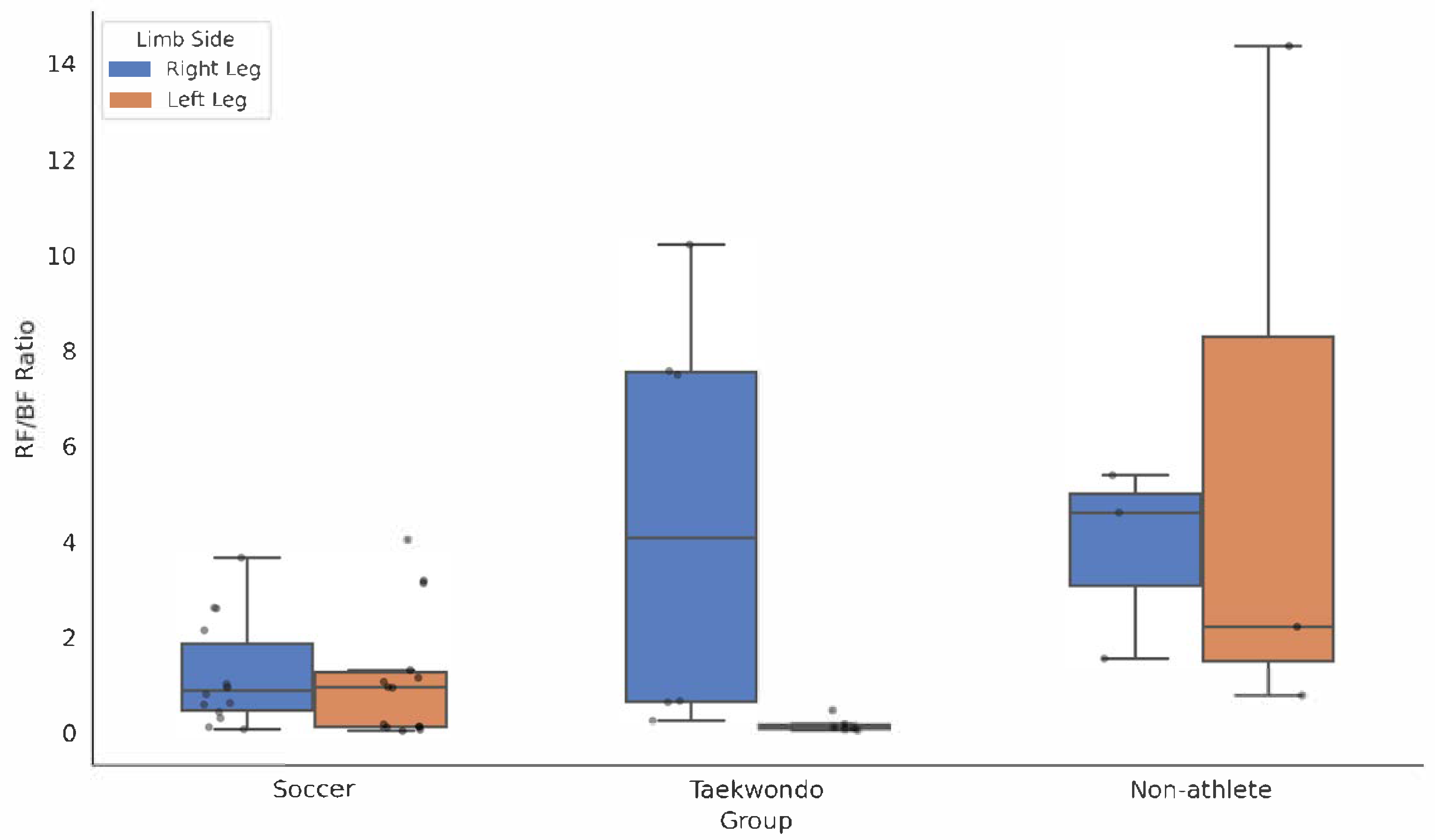
| Right | RF/BF Acc Ratio | 1.72 ± 1.33 | 1.67 ± 0.99 | 2.72 ± 1.77 | 0.782 | 0.051 | |
| Right | RF/BF Dec Ratio | 1.21 ± 1.10 | 4.47 ± 4.45 | 3.85 ± 2.03 | 4.240 * | 0.006 | a < c |
| Left | Valgus | −12.07 ± 2.44 | −11.17 ± 3.89 | −7.85 ± 2.28 | 3.705 * | 0.203 | a < c |
| Left | RF Acc | 518.57 ± 194.97 | 391.27 ± 87.96 | 514.97 ± 169.03 | 1.207 | 0.077 | - |
| Left | BF Acc | 385.26 ± 210.07 | 488.30 ± 136.12 | 177.37 ± 185.96 | 2.629 | 0.153 | b > c |
| Left | RF Dec | 114.43 ± 71.08 | 54.45 ± 18.25 | 271.83 ± 221.15 | 5.774 ** | 0.285 | a,b < c |
| Left | BF Dec | 420.21 ± 420.89 | 512.55 ± 381.00 | 147.60 ± 213.82 | 0.869 | 0.057 | - |
| Left | RF/BF Acc Ratio | 2.38 ± 2.68 | 0.84 ± 0.25 | 8.92 ± 11.75 | 3.720 * | 0.204 | a,b < c |
| Left | RF/BF Dec Ratio | 1.17 ± 1.33 | 0.17 ± 0.16 | 5.79 ± 7.46 | 5.006 * | 0.257 | a,b < c |
| Variable | r | p | |
|---|---|---|---|
| Right | Valgus | −0.453 | 0.018 * |
| Right | RF Acc | −0.358 | 0.093 |
| Right | BF Acc | 0.355 | 0.097 |
| Right | RF Dec | 0.058 | 0.792 |
| Right | BF Dec | 0.159 | 0.470 |
| Right | RF/BF Acc Ratio | −0.541 | 0.008 ** |
| Right | RF/BF Dec Ratio | 0.006 | 0.980 |
| Left | Valgus | −0.662 | 0.000 *** |
| Left | RF Acc | −0.231 | 0.289 |
| Left | BF Acc | 0.180 | 0.412 |
| Left | RF Dec | −0.073 | 0.739 |
| Left | BF Dec | 0.194 | 0.375 |
| Left | RF/BF Acc Ratio | −0.302 | 0.162 |
| Left | RF/BF Dec Ratio | −0.251 | 0.248 |
| Variable | B (95% CI) | SE | β | t | p |
|---|---|---|---|---|---|
| Right Valgus | −0.072 (−0.167, 0.023) | 0.046 | −0.245 | −1.564 | 0.131 |
| Left Valgus | −0.308 (−0.481, −0.135) | 0.084 | −0.574 | −3.668 | 0.001 *** |
| Variable | B (95% CI) | SE | β | t | p | |
|---|---|---|---|---|---|---|
| Right | ||||||
| RF Acc | −0.010 (−0.033, 0.012) | 0.010 | −0.366 | −0.989 | 0.342 | |
| BF Acc | −0.021 (−0.041, −0.001) | 0.009 | −0.698 | −2.237 | 0.045 * | |
| RF Dec | 0.010 (−0.003, 0.023) | 0.006 | 0.486 | 1.714 | 0.112 | |
| BF Dec | 0.012 (−0.003, 0.027) | 0.007 | 0.627 | 1.779 | 0.101 | |
| Left | ||||||
| RF Acc | 0.014 (−0.013, 0.042) | 0.012 | 0.408 | 1.158 | 0.269 | |
| BF Acc | −0.020 (−0.039, 0.000) | 0.009 | −0.633 | −2.211 | 0.047 * | |
| RF Dec | −0.010 (−0.038, 0.018) | 0.013 | −0.175 | −0.753 | 0.466 | |
| BF Dec | 0.000 (−0.011, 0.012) | 0.005 | 0.028 | 0.089 | 0.930 | |
Disclaimer/Publisher’s Note: The statements, opinions and data contained in all publications are solely those of the individual author(s) and contributor(s) and not of MDPI and/or the editor(s). MDPI and/or the editor(s) disclaim responsibility for any injury to people or property resulting from any ideas, methods, instructions or products referred to in the content. |
© 2025 by the authors. Licensee MDPI, Basel, Switzerland. This article is an open access article distributed under the terms and conditions of the Creative Commons Attribution (CC BY) license (https://creativecommons.org/licenses/by/4.0/).
Share and Cite
Cho, J.-H.; Lim, S.-T.; Heo, A.-S. OpenCap vs. LESS: Sport-Specific Profiling of Dynamic Knee Valgus. J. Clin. Med. 2025, 14, 8879. https://doi.org/10.3390/jcm14248879
Cho J-H, Lim S-T, Heo A-S. OpenCap vs. LESS: Sport-Specific Profiling of Dynamic Knee Valgus. Journal of Clinical Medicine. 2025; 14(24):8879. https://doi.org/10.3390/jcm14248879
Chicago/Turabian StyleCho, Ji-Hoon, Seung-Taek Lim, and An-Sik Heo. 2025. "OpenCap vs. LESS: Sport-Specific Profiling of Dynamic Knee Valgus" Journal of Clinical Medicine 14, no. 24: 8879. https://doi.org/10.3390/jcm14248879
APA StyleCho, J.-H., Lim, S.-T., & Heo, A.-S. (2025). OpenCap vs. LESS: Sport-Specific Profiling of Dynamic Knee Valgus. Journal of Clinical Medicine, 14(24), 8879. https://doi.org/10.3390/jcm14248879