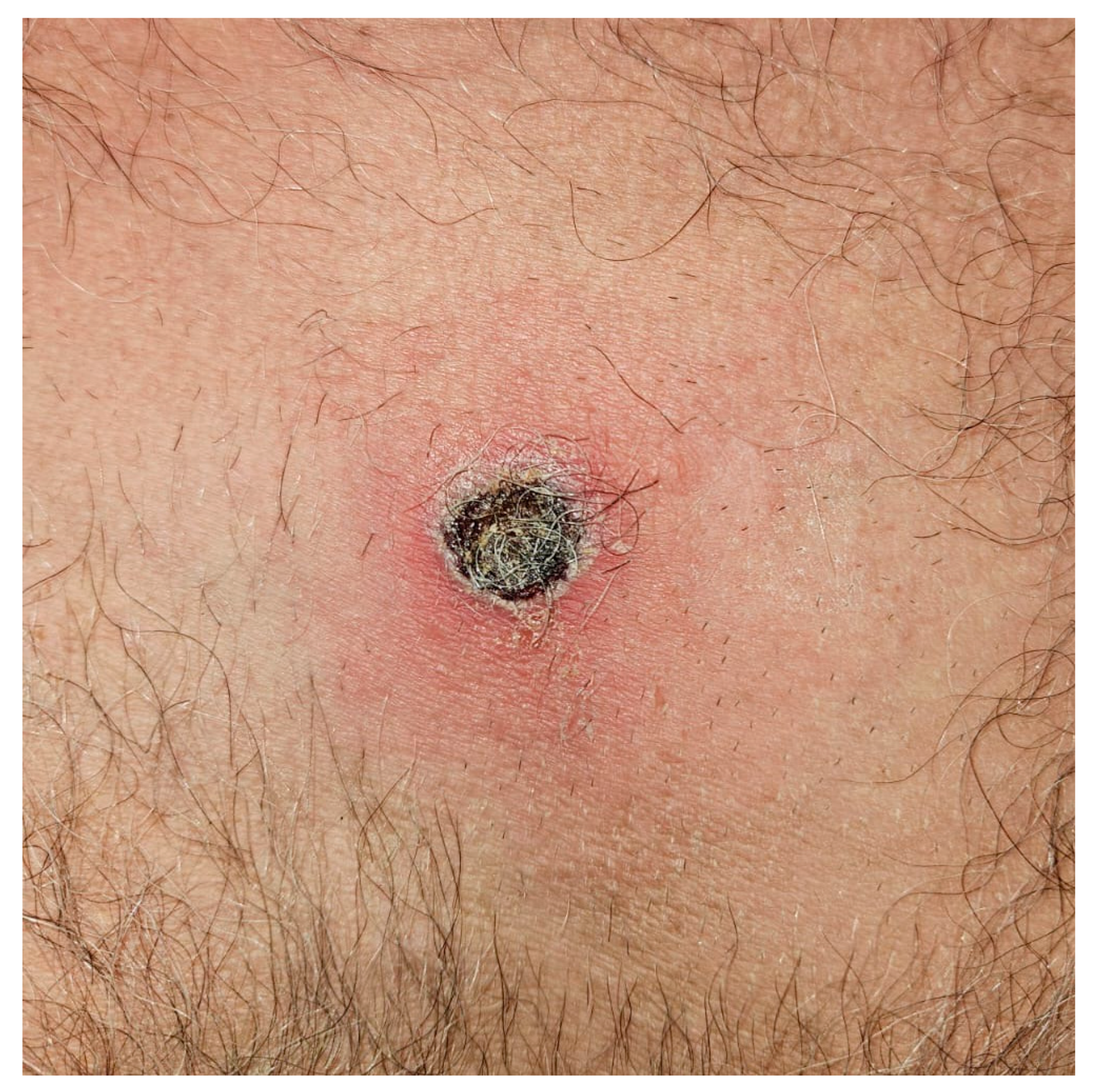
Malignant Syphilis in an Immunocompetent Patient: A Case Report and Review of the Literature
 , and
, and 
Abstract
1. Introduction
2. Materials and Methods
3. Case Presentation
4. Review of the Literature and Discussion
4.1. Epidemiology and Medical History
4.2. Clinical Features of Malignant Syphilis
4.3. Diagnostic
4.4. Treatment and Outcome
5. Conclusions
Author Contributions
Funding
Institutional Review Board Statement
Informed Consent Statement
Data Availability Statement
Conflicts of Interest
Abbreviations
| CDC | Centers for disease control and prevention |
| CNS | Central nervous system |
| CRP | C-reactive protein |
| CSF | Cerebrospinal fluid |
| HBV | Hepatitis B virus |
| HCV | Hepatitis C virus |
| HIV | Human immunodeficiency virus |
| IUSTI | International Union against Sexually Transmitted Infections |
| JHR | Jarisch-Herxheimer reaction |
| MS | Malignant syphilis |
| MSM | Men who have sex with men |
| MRI | Magnetic resonance imaging |
| PCR | Polymerase chain reaction |
| RPR | rapid plasma reagin |
| VDRL | Venereal Diseases Research Laboratory |
References
- Peeling, R.W.; Chen, X.S.; Garcìa, P.J. Syphilis. Lancet 2023, 402, 336–346. [Google Scholar] [CrossRef]
- Pipitò, L.; Gaudiano, R.; Di Figlia, F.; Mandalà, E.; Calà, C.; Capra, G.; Cascio, A. Interesting case of syphilis with atypical vegetative lesions. Sex. Transm. Infect. 2025, 101, 278–279. [Google Scholar] [CrossRef] [PubMed]
- Pipitò, L.; Piccione, M.; Trizzino, M.; Calà, C.; Cascio, A. An Uncommon Case of Syphilis with Simultaneous, Different Lesions: Moth-Eaten Alopecia, Syphilitic Keratoderma, and Psoriasiform Syphilis. Cureus 2023, 15, e49181. [Google Scholar] [CrossRef] [PubMed] [PubMed Central]
- European Centre for Disease Prevention and Control. Syphilis. In ECDC. Annual Epidemiological Report for 2023; ECDC: Stockholm, Sweden, 2025. [Google Scholar]
- Chevalier, F.J.; Bacon, O.; Johnson, K.A.; Cohen, S.E. Syphilis: A Review. JAMA 2025, 334, 1927–1940, Erratum in JAMA 2025, 334, 1925. [Google Scholar] [CrossRef] [PubMed]
- Karanfilian, K.M.; Almohssen, A.A.; Kapila, R.; Schwartz, R.A. Malignant syphilis: A new and revised definition. Int. J. Dermatol. 2023, 62, 369–375. [Google Scholar] [CrossRef] [PubMed]
- Pipitò, L.; D’Avenia, S.; Orlando, E.; Cascio, A. An Adult with Fever and Progressive Ulcerative Lesions: A Case of Malignant Syphilis. Sexes 2025, 6, 3. [Google Scholar] [CrossRef]
- Tuddenham, S.; Katz, S.S.; Ghanem, K.G. Syphilis Laboratory Guidelines: Performance Characteristics of Nontreponemal Antibody Tests. Clin. Infect. Dis. 2020, 71, S21–S42. [Google Scholar] [CrossRef] [PubMed] [PubMed Central]
- Montenegro-Idrogo, J.J.; Muñante, R.; López-Fuentes, M.; Sanz-Castro, M.; Ventura-León, A.; Chávez-Esparza, G.; García-Cortez, Y. Malignant syphilis as the presenting complaint of advanced HIV. Int. J. STD AIDS 2023, 34, 494–497. [Google Scholar] [CrossRef] [PubMed]
- Kumar, B.; Muralidhar, S. Malignant Syphilis: A Review. AIDS Patient Care STDs 1998, 12, 921–925. [Google Scholar] [CrossRef] [PubMed]
- Tanojo, N.; Murtiastutik, D.; Sari, M.; Astindari Widyantari, S.; Nurul Hidayati, A.; Indramaya, D.M. A single dose of benzathine penicillin G as an effective treatment for malignant syphilis in an HIV-positive patient: A case report. Acta Dermatovenerol. Alp. Pannonica Adriat. 2022, 31, 115–118. [Google Scholar] [CrossRef] [PubMed]
- Wibisono, O.; Idrus, I.; Djawad, K. Malignant syphilis: A systematic review of the case reports published in 2014–2018. Actas Dermo-Sifiliogr. 2021, 112, 725–734. [Google Scholar] [CrossRef]
- Rao, A.G.; Swathi, T.; Hari, S.; Kolli, A.; Reddy, U.D. Malignant Syphilis in an Immunocompetent Adult Male. Indian. J. Dermatol. 2017, 62, 524–527. [Google Scholar] [CrossRef]
- Sá Lopes, R.; Monteiro, A.S.; Saez, R.; Candeias, C.; Mendonça, C. Malignant Syphilis: A Rare Case of Early Secondary Syphilis in an Immunocompetent Patient. Eur. J. Case Rep. Intern. Med. 2023, 10, 003721. [Google Scholar] [CrossRef]
- Xará, J.; Teixeira, J.; Brites, M.M.; Cardoso, J.C. Malignant syphilis in an immunocompetent patient. BMJ Case Rep. 2024, 17, e262325. [Google Scholar] [CrossRef] [PubMed]
- Dimnik, J.; Benko, M.; Hosta, V.; Rauh, A.M.; Pagon, A.; Špik, V.C.; Battelino, S.; Vozel, D. Malignant Syphilis in a Female Patient: A Case Report and Mini-Review. Trop. Med. Infect. Dis. 2022, 7, 47. [Google Scholar] [CrossRef] [PubMed]
- Ortigosa, Y.M.; Bendazzoli, P.S.; Barbosa, A.M.; Ortigosa, L.C. Early malignant syphilis. An. Bras. Dermatol. 2016, 91, 148–150. [Google Scholar] [CrossRef]
- Requena, C.B.; Orasmo, C.R.; Ocanha, J.P.; Barraviera, S.R.; Marques, M.E.; Marques, S.A. Malignant syphilis in an immunocompetent female patient. An. Bras. Dermatol. 2014, 89, 970–972. [Google Scholar] [CrossRef]
- Barit, J.J.; Hiroyasu, S.; Yamada, K.; Tsuruta, D. Malignant syphilis in a young immunocompetent patient presenting as ulceronecrotic lesions on the lower extremities. Int. J. Dermatol. 2023, 62, 1070–1072. [Google Scholar] [CrossRef]
- Alves, J.; António, A.M.; Matos, D.; Coelho, R.; Cachão, P. Malignant lues in an immunocompetent patient. Int. J. STD AIDS 2015, 26, 518–520. [Google Scholar] [CrossRef]
- Margulies, S.; Patel, S.P.; Motaparthi, K. Ulceronecrotic rash in an immunocompetent individual. JAAD Case Rep. 2022, 27, 29–31. [Google Scholar] [CrossRef]
- de Unamuno Bustos, B.; Sánchez, R.B.; Carazo, J.L.; de Míquel, V.A. Malignant syphilis with ocular involvement in an immunocompetent patient. Int. J. Dermatol. 2014, 53, e258–e260. [Google Scholar] [CrossRef]
- García-Martínez, F.J.; Fernández-Redondo, V.; Sánchez-Aguilar, D.; Toribio, J. Sífilis maligna en un paciente inmunocompetente [Malignant syphilis in an immunocompetent patient]. Actas Dermosifiliogr. 2012, 103, 437–439. [Google Scholar] [CrossRef]
- González-Lara, L.; Vázquez-López, F.; Eiris-Salvado, N.; Pérez-Oliva, N. Sífilis maligna en un paciente inmunocompetente [Malignant syphilis in an immunocompetent patient]. Med. Clin. 2013, 140, e13. [Google Scholar] [CrossRef] [PubMed]
- Rockwood, N.; Nwokolo, N. Syphilis the great pretender: When is cancer not cancer? Sex. Transm. Infect. 2018, 94, 192–193. [Google Scholar] [CrossRef]
- Demirbaş, A.; Şikar Aktürk, A.; Odyakmaz Demirsoy, E.; Kıran, R.; Bayramgürler, D.; Sayman, N.; Açıkbaş, E.; Vural, Ç. Lues Maligna in an immunocompetent male: A case report. J. Cosmet. Dermatol. 2022, 21, 3160–3162. [Google Scholar] [CrossRef] [PubMed]
- Correia, C.; Borges-Costa, J.; Soares-de-Almeida, L.; Filipe, P. Lues Maligna in an Immunocompetent Patient. Sex. Transm. Dis. 2022, 49, 863–864. [Google Scholar] [CrossRef]
- Pradhan, S.; Sirka, C.S.; Panda, M.; Baisakh, M. Lues Maligna in an Immunocompetent Female. Indian. Dermatol. Online J. 2018, 9, 344–346. [Google Scholar] [CrossRef] [PubMed]
- Bertrand, J.; Labrecque, L.G.; Belisle, A.; Côté, B. Lues maligna and Bell’s palsy: Report of a case in a immunocompetent host. Int. J. Dermatol. 2012, 51, 1363–1365. [Google Scholar] [CrossRef]
- Duenaz-Diaz, J.E.; Paz-Luna, D.E.; Duenaz-Diaz, I.G.; Salcedo-Gomez, A.; Aguilar-Roman, G.Y.; Paredes-Solis, V.; Chavez-Guzman, S.E.; Zavala-Alvarez, E.D. Early malignant syphilis in an immunocompetent young man. Dermatol. Online J. 2025, 31. [Google Scholar] [CrossRef]
- Pipitò, L.; Trizzino, M.; Orlando, E.; Calà, C.; Cascio, A. Lepromatous nodular syphilis: A case from Italy. Travel. Med. Infect. Dis. 2023, 53, 102564. [Google Scholar] [CrossRef] [PubMed]
- Liu, M.J.; Lv, W. Malignant Syphilis. N. Engl. J. Med. 2023, 388, 1991. [Google Scholar] [CrossRef] [PubMed]
- Zhou, C.; Zhang, X.; Zhang, W.; Duan, J.; Zhao, F. PCR detection for syphilis diagnosis: Status and prospects. J. Clin. Lab. Anal. 2019, 33, e22890. [Google Scholar] [CrossRef] [PubMed] [PubMed Central]
- Pipitò, L.; Ganci, I.; Cicero, A.; Medaglia, A.A.; D’Avenia, S.; Mandalà, E.; Calà, C.; Di Carlo, P.; Cascio, A. A Case of Syphilis with Ocular Involvement: Persistent Negative Serology in a Patient with Multiple Sclerosis. Open Forum Infect. Dis. 2024, 11, ofae563. [Google Scholar] [CrossRef] [PubMed] [PubMed Central]
- Workowski, K.A.; Bachmann, L.H.; Chan, P.A.; Johnston, C.M.; Muzny, C.A.; Park, I.; Reno, H.; Zenilman, J.M.; Bolan, G.A. Sexually Transmitted Infections Treatment Guidelines, 2021. MMWR Recomm Rep. 2021, 70, 1–187. [Google Scholar] [CrossRef] [PubMed] [PubMed Central]
- Janier, M.; Unemo, M.; Dupin, N.; Tiplica, G.S.; Potočnik, M.; Patel, R. 2020 European guideline on the management of syphilis. J. Eur. Acad. Dermatol. Venereol. 2021, 35, 574–588. [Google Scholar] [CrossRef] [PubMed]
- Bettuzzi, T.; Jourdes, A.; Robineau, O.; Alcaraz, I.; Manda, V.; Molina, J.M.; Mehlen, M.; Cazanave, C.; Tattevin, P.; Mensi, S.; et al. Ceftriaxone compared with benzylpenicillin in the treatment of neurosyphilis in France: A retrospective multicentre study. Lancet Infect. Dis. 2021, 21, 1441–1447. [Google Scholar] [CrossRef]
- Wood, J.M.; Sbar, E. Jarisch-Herxheimer Reaction. In StatPearls [Internet]; StatPearls Publishing: Treasure Island, FL, USA, 2025. [Google Scholar] [PubMed]


| Author, Year | Sex/Age | Comorbidities | Lesion Type | Mucosal/Palmoplantar Involvement | Systemic Symptoms | Organ Involvement | Serology | Histopathology/PCR Findings | Therapy |
|---|---|---|---|---|---|---|---|---|---|
| Rao et al., 2017 [13] | M/35 | None | Mixed | Yes/Yes | Fever, lymphadenopathy | Skin and Genitals | VDRL+ | Endarteritis obliterans, plasma-cell infiltrate | IM BPG ×1 |
| Sá Lopes et al., 2023 [14] | F/29 | Hypothyroidism | Mixed | Yes/No | Fever, myalgia, anorexia | Skin | RPR+ | Granulomatous dermatitis | IM BPG ×3 |
| Xará et al., 2024 [15] | F/20 | None | Mixed | No/No | Fever, anorexia, lymphadenopathy | Skin and Liver | RPR+ | Granulomas, IHC+ for T. pallidum | IM BPG ×3 |
| Dimnik et al., 2022 [16] | F/41 | Chronic hepatitis | Mixed | No/Yes | Fever, lymphadenopathy | Skin, Laryngeal, nasal, gingival | RPR+ | Granulomatous dermatitis, PCR+ | IV penicillin G 14 days |
| Ortigosa et al., 2016 [17] | F/53 | Diabetes | Mixed | Yes/No | Fever, myalgia | Skin | VDRL+FTA+ | Interface dermatitis, granulomas | IM BPG ×3 + steroids |
| Requena et al., 2014 [18] | F/29 | Psoriasis | Mixed | Yes/No | Fever, anorexia | Skin | VDRL+TPPA+ | Lichenoid infiltrate, IHC+ | IM BPG ×3 |
| Barit et al., 2023 [19] | M/26 | None | Ulcerative | No/No | None | Skin | RPR+TPPA+ | Plasma-cell infiltrate, IHC+ | Amoxicillin + probenecid |
| Alves et al., 2015 [20] | M/57 | None | Mixed | No/No | Low-grade fever, asthenia | Skin | RPR+TPPA+ | Granulomatous dermatitis | IM BPG ×3 |
| Margulies et al., 2022 [21] | F/28 | None | Ulcerative | No/Yes | Lymphadenopathy | Skin and Eyes (uveitis) | RPR+IgG+ | Granulomatous lichenoid dermatitis | IV Penicillin G 14 days + steroid |
| de Unamuno Bustos et al., 2014 [22] | M/46 | Hepatitis B | Mixed | No/Yes | None | Skin, genitals, and eyes (uveitis) | VDRL+FTA+ | Inflammatory infiltrate, plasma cells | IM BPG ×3 |
| García-Martínez et al., 2012 [23] | M/26 | None | Mixed | No/No | Fever, malaise | Skin | VDRL+TPHA+ | Lymphoplasmacytic infiltrate, endarteritis | IM BPG ×3 |
| González-Lara et al., 2013 [24] | M/64 | None | Mixed | No/No | Fever, arthralgia | Skin | RPR+ | Plasma-cell infiltrate, WS+ | IM BPG ×3 weeks |
| Rockwood & Nwokolo, 2018 [25] | M/41 | None | Mixed | No/Yes | Malaise | Skin, genitals (testicular), lung, osseous | RPR+TPPA+ | IHC+ for T. pallidum | Doxycycline 200 mg twice × 28 days |
| Demirbaş et al., 2022 [26] | M/35 | None | Ulcerative | Yes/No | Asthenia, lymphadenopathy | Skin and genitals | RPR+TPHA+ | Plasma-cell infiltrate | IM BPG ×3 |
| Correia et al., 2022 [27] | M/30 | None | Mixed | Yes/No | Fatigue | Skin | VDRL+TPPA+ | Granulomas, WS+, IHC+ | IM BPG ×3 |
| Pradhan et al., 2018 [28] | F/35 | None | Mixed | Yes/Yes | Fever, arthralgia | Skin and genitals | VDRL+TPHA+ | Endarteritis obliterans | Doxycycline 100 mg twice ×21 days |
| Bertrand et al., 2012 [29] | F/43 | None | Mixed | No/No | None | Skin and Facial nerve palsy (CNS) | RPR+ | Plasma-cell infiltrate | IV penicillin G 14 days |
| Duenaz-Diaz et al., 2025 [30] | M/30 | None | Mixed | Yes/No | Fever, asthenia | Skin | VDRL−(turned positive after 4 weeks), FTA+ | Inflammatory infiltrate | IM BPG ×1 |
Disclaimer/Publisher’s Note: The statements, opinions and data contained in all publications are solely those of the individual author(s) and contributor(s) and not of MDPI and/or the editor(s). MDPI and/or the editor(s) disclaim responsibility for any injury to people or property resulting from any ideas, methods, instructions or products referred to in the content. |
© 2025 by the authors. Licensee MDPI, Basel, Switzerland. This article is an open access article distributed under the terms and conditions of the Creative Commons Attribution (CC BY) license (https://creativecommons.org/licenses/by/4.0/).
Share and Cite
Mazzola, C.V.; Bono, E.; Giacchino, I.; Calà, C.; Pipitò, L.; Cascio, A. Malignant Syphilis in an Immunocompetent Patient: A Case Report and Review of the Literature. J. Clin. Med. 2025, 14, 8839. https://doi.org/10.3390/jcm14248839
Mazzola CV, Bono E, Giacchino I, Calà C, Pipitò L, Cascio A. Malignant Syphilis in an Immunocompetent Patient: A Case Report and Review of the Literature. Journal of Clinical Medicine. 2025; 14(24):8839. https://doi.org/10.3390/jcm14248839
Chicago/Turabian StyleMazzola, Chiara Vincenza, Eleonora Bono, Ilenia Giacchino, Cinzia Calà, Luca Pipitò, and Antonio Cascio. 2025. "Malignant Syphilis in an Immunocompetent Patient: A Case Report and Review of the Literature" Journal of Clinical Medicine 14, no. 24: 8839. https://doi.org/10.3390/jcm14248839
APA StyleMazzola, C. V., Bono, E., Giacchino, I., Calà, C., Pipitò, L., & Cascio, A. (2025). Malignant Syphilis in an Immunocompetent Patient: A Case Report and Review of the Literature. Journal of Clinical Medicine, 14(24), 8839. https://doi.org/10.3390/jcm14248839