Combination Treatment of Persistent SARS-CoV-2 Infection with Dual Antiviral Therapy and Intravenous Immunoglobulin: A Novel Approach

 , , , , and
Abstract
1. Introduction
2. Materials and Methods
2.1. Study Population
2.2. Data Collection and Definitions
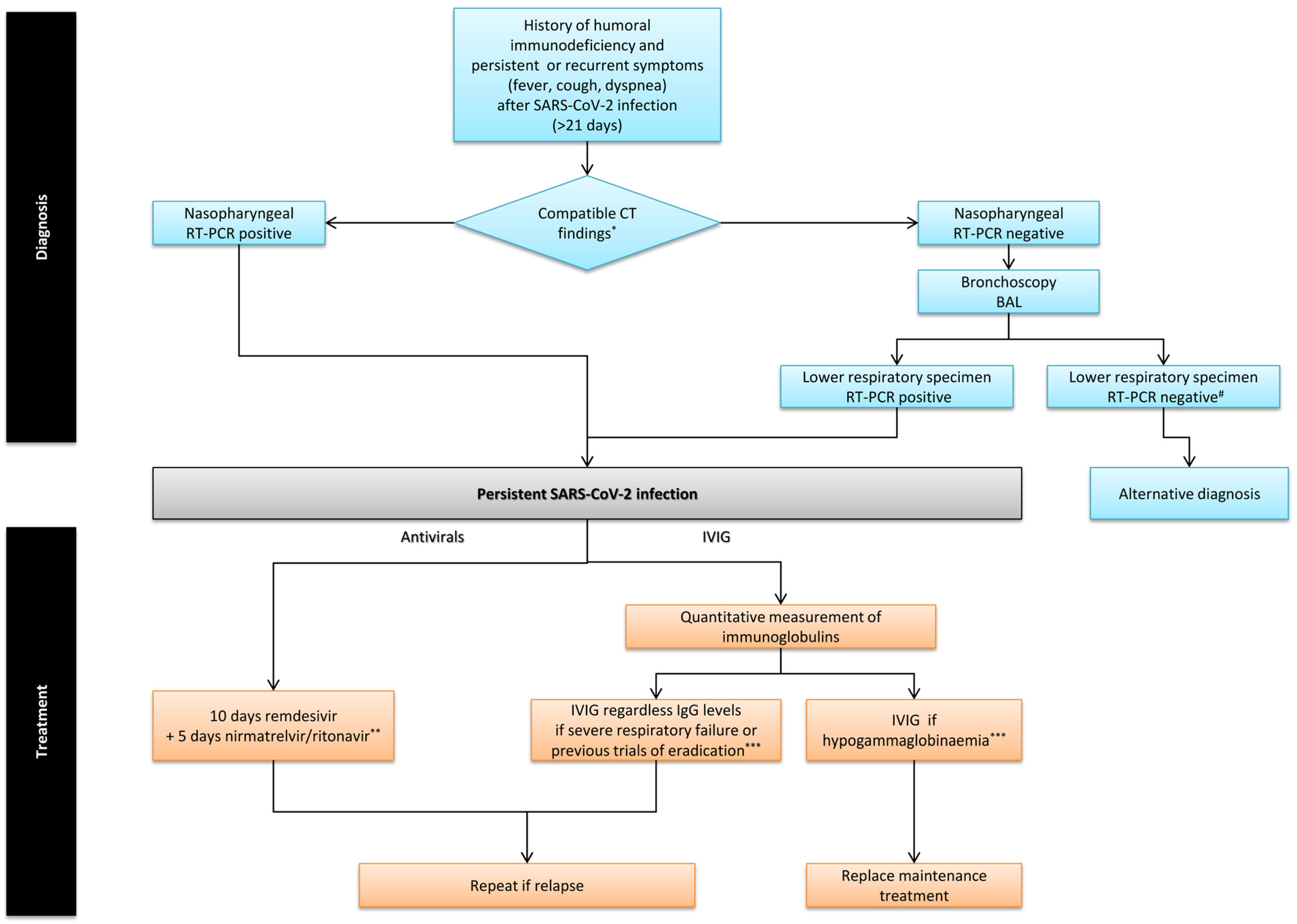
2.3. Diagnostic Criteria for Persistent SARS-CoV-2 Infection
- Presence of humoral immunodeficiency (B-cell malignancy and/or ongoing or prior B-cell-targeted therapy);
- Persistent or recurrent symptoms lasting longer than 21 days following the initial positive SARS-CoV-2 RT-PCR test;
- Imaging findings consistent with COVID-19 infection, such as bilateral ground-glass opacities and/or pulmonary consolidations;
- Persistent or intermittent SARS-CoV-2 RT-PCR positivity for more than 21 days.
2.4. Assessment of Disease Severity
2.5. Follow-Up
2.6. Treatment Protocol
2.7. Statistics
3. Results
4. Discussion
Author Contributions
Funding
Institutional Review Board Statement
Informed Consent Statement
Data Availability Statement
Conflicts of Interest
References
- World Health Organization (WHO). Coronavirus Disease (COVID-19) Dashboard. Date Last Updated 12 October 2025. Available online: https://covid19.who.int/ (accessed on 1 November 2025).
- Gulick, R.M.; Pau, A.K.; Daar, E.; Evans, L.; Gandhi, R.T.; Tebas, P.; Ridzon, R.; Masur, H.; Lane, H.C.; Panel, N.C.T.G.; et al. National Institutes of Health COVID-19 Treatment Guidelines Panel: Perspectives and Lessons Learned. Ann. Intern. Med. 2024, 177, 1547–1557. [Google Scholar] [CrossRef]
- Choi, B.; Choudhary, M.C.; Regan, J.; Sparks, J.A.; Padera, R.F.; Qiu, X.; Solomon, I.H.; Kuo, H.-H.; Boucau, J.; Bowman, K.; et al. Persistence and Evolution of SARS-CoV-2 in an Immunocompromised Host. N. Engl. J. Med. 2020, 383, 2291–2293. [Google Scholar] [CrossRef]
- Qutub, M.; Aldabbagh, Y.; Mehdawi, F.; Alraddadi, A.; Alhomsy, M.; Alnahdi, A.; Fakeeh, M.; Maghrabi, A.; Alwagdani, M.; Bahabri, N. Duration of viable SARS-CoV-2 shedding from respiratory tract in different human hosts and its impact on isolation discontinuation polices revision; a narrative review. Clin. Infect. Pract. 2022, 13, 100140. [Google Scholar] [CrossRef] [PubMed]
- Belkin, A.; Leibowitz, A.; Shargian, L.; Yahav, D. The unique presentation of SARS-CoV-2 Infection in patients with B-cell depletion: Definition of ‘persistent inflammatory sero-negative COVID’. Clin. Microbiol. Infect. 2023, 29, 1–3. [Google Scholar] [CrossRef] [PubMed]
- Nussenblatt, V.; Roder, A.E.; Das, S.; de Wit, E.; Youn, J.-H.; Banakis, S.; Mushegian, A.; Mederos, C.; Wang, W.; Chung, M.; et al. Yearlong COVID-19 Infection Reveals Within-Host Evolution of SARS-CoV-2 in a Patient with B-Cell Depletion. J. Infect. Dis. 2022, 225, 1118–1123. [Google Scholar] [CrossRef] [PubMed]
- Machkovech, H.M.; Hahn, A.M.; Garonzik Wang, J.; Grubaugh, N.D.; Halfmann, P.J.; Johnson, M.C.; E Lemieux, J.; O’COnnor, D.H.; Piantadosi, A.; Wei, W.; et al. Persistent SARS-CoV-2 infection: Significance and implications. Lancet Infect. Dis. 2024, 24, e453–e462. [Google Scholar] [CrossRef] [PubMed]
- Revel, M.-P.; Parkar, A.P.; Prosch, H.; Silva, M.; Sverzellati, N.; Gleeson, F.; Brady, A.; European Society of Radiology (ESR); The European Society of Thoracic Imaging (ESTI). COVID-19 patients and the radiology department—Advice from the European Society of Radiology (ESR) and the European Society of Thoracic Imaging (ESTI). Eur. Radiol. 2020, 30, 4903–4909. [Google Scholar]
- Mozaffari, E.; Chandak, A.; Gottlieb, R.L.; Chima-Melton, C.; Read, S.H.; Jiang, H.; Chiang, M.; Lee, E.; Gupta, R.; Berry, M.; et al. Remdesivir Reduced Mortality in Immunocompromised Patients Hospitalized for COVID-19 Across Variant Waves: Findings from Routine Clinical Practice. Clin. Infect. Dis. 2023, 77, 1626–1634. [Google Scholar] [CrossRef] [PubMed]
- Najjar-Debbiny, R.; Gronich, N.; Weber, G.; Khoury, J.; Amar, M.; Stein, N.; Goldstein, L.H.; Saliba, W. Effectiveness of Paxlovid in Reducing Severe Coronavirus Disease 2019 and Mortality in High-Risk Patients. Clin. Infect. Dis. 2023, 76, e342–e349. [Google Scholar] [CrossRef] [PubMed]
- Sun, F.; Lin, Y.; Wang, X.; Gao, Y.; Ye, S. Paxlovid in patients who are immunocompromised and hospitalised with SARS-CoV-2 infection. Lancet Infect. Dis. 2022, 22, 1279. [Google Scholar] [CrossRef] [PubMed]
- Huygens, S.; Gharbharan, A.; Serroukh, Y.; Snoek, B.; Franken, B.; Munnink, B.B.O.; Van Hagen, P.M.; Bogers, S.; Geurtsvankessel, C.H.; Rijnders, B.J.A. High-titer convalescent plasma plus nirmatrelvir/ritonavir treatment for non-resolving COVID-19 in six immunocompromised patients. J. Antimicrob. Chemother. 2023, 78, 1644–1648. [Google Scholar] [CrossRef] [PubMed]
- Mikulska, M.; Sepulcri, C.; Dentone, C.; Magne, F.; Balletto, E.; Baldi, F.; Labate, L.; Russo, C.; Mirabella, M.; Magnasco, L.; et al. Triple Combination Therapy With 2 Antivirals and Monoclonal Antibodies for Persistent or Relapsed Severe Acute Respiratory Syndrome Coronavirus 2 Infection in Immunocompromised Patients. Clin. Infect. Dis. 2023, 77, 280–286. [Google Scholar] [CrossRef] [PubMed]
- Graziani, L.; Gori, L.; Manciulli, T.; Basile, G.; Campolmi, I.; Borchi, B.; di Dio, M.; Mattei, M.; Ciurleo, G.; Ciliberti, M.; et al. Successful use of nirmatrelvir/ritonavir in immunocompromised patients with persistent and/or relapsing COVID-19. J. Antimicrob. Chemother. 2023, 78, 555–558. [Google Scholar] [CrossRef] [PubMed]
- Blennow, O.; Vesterbacka, J.; Tovatt, T.; Nowak, P. Successful Combination Treatment for Persistent Severe Acute Respiratory Syndrome Coronavirus 2 Infection. Clin. Infect. Dis. 2023, 76, 1864–1865. [Google Scholar] [CrossRef] [PubMed]
- Gandhi, S.; Klein, J.; Robertson, A.J.; Peña-Hernández, M.A.; Lin, M.J.; Roychoudhury, P.; Lu, P.; Fournier, J.; Ferguson, D.; Bakhash, S.A.K.M.; et al. De novo emergence of a remdesivir resistance mutation during treatment of persistent SARS-CoV-2 infection in an immunocompromised patient: A case report. Nat. Commun. 2022, 13, 1547. [Google Scholar] [CrossRef] [PubMed]
- Omori, K.; Kitagawa, H.; Takamori, A.; Yoshida, T.; Omoto, T.; Nomura, T.; Kubo, Y.; Shigemoto, N.; Akita, T.; Orihashi, Y.; et al. Antiviral combination therapy in severely immunocompromised patients with persistent or recurrent COVID-19. J. Infect. Chemother. 2025, 31, 102802. [Google Scholar] [CrossRef] [PubMed]
- Tieu, J.; Smith, R.M.; Gopaluni, S.; Kumararatne, D.S.; McClure, M.; Manson, A.; Houghton, S.; Jayne, D.R.W. Rituximab Associated Hypogammaglobulinemia in Autoimmune Disease. Front. Immunol. 2021, 12, 671503. [Google Scholar] [CrossRef] [PubMed]
- Upasani, V.; Townsend, K.; Wu, M.Y.; Carr, E.J.; Hobbs, A.; Dowgier, G.; Ragno, M.; Herman, L.S.; Sharma, S.; Shah, D.; et al. Commercial Immunoglobulin Products Contain Neutralizing Antibodies Against Severe Acute Respiratory Syndrome Coronavirus 2 Spike Protein. Clin. Infect. Dis. 2023, 77, 950–960. [Google Scholar] [CrossRef] [PubMed]
- Bartoletti, M.; Azap, O.; Barac, A.; Ben Selma, M.; Ergonul, O.; Gkrania-Klotsas, E.; Grossi, P.A.; Krause, R.; Nagavci, B.; Paño-Pardo, J.R.; et al. Management of COVID-19 in immunocompromised patients: An European Society of Clinical Microbiology and Infectious Diseases consensus document. Clin. Microbiol. Infect. 2025, 31, 1655–1666. [Google Scholar] [CrossRef] [PubMed]


| Case | Age/ Sex | Disease | Anti-CD20 Agent/ Last Dose | Vaccination History (Doses) | Days After 1st Positive SARS- CoV-2 Test | Previous SARS-CoV-2 Eradication Therapies (Number of Courses) * | Ct- RT- PCR | Symptoms | CT Findings (Extent, %) ** | Respiratory Failure/ Support | IgG Levels (g/L) | Therapeutic Regimen | Outcome/ Response *** | Follow-Up (Days) |
|---|---|---|---|---|---|---|---|---|---|---|---|---|---|---|
| 1 | 56/M | FCL | Rituximab/8 months | Yes (3) | 120 | RDV/CS (3) RDV/CS/Tocilizumab (1) | 22 | Fever/Dyspnea | GGOs/ Consolidations (10–25%) | No | Low (6.4) | RDV 10 days/NMV/r 5 days/ IVIG | Alive/ Complete | 180 |
| 2 | 56/M | DLBCL | Obinutuzumab/2 months | Yes (2) | 63 | NMV/r (1) RD (2) | 25 | Fever | GGOs (10–25%) | No | Normal (11.6) | RDV 10 days/NMV/r 5 days/ IVIG | Alive/ Complete | 180 |
| 3 | 78/M | RA | Rituximab/ 6 months | Yes (4) | 44 | No | 29 | Fever/Dyspnea/Cough | GGOs/ Consolidations (25–50%) | Yes/HFNC | Normal (9.1) | RDV 10 days/NMV/r 5 days/ IVIG | Alive/ Complete | 180 |
| 4 | 84/M | CLL | No | Yes (4) | 384 | RDV/CS (4) RD (1) | 26 | Fever/Dyspnea/Cough | GGOs (10–25%) | Yes/low flow oxygen therapy | Low (2.6) | RDV 10 days/NMV/r 5 days/ IVIG | Deceased | - |
| 5 | 24/F | GPA | Rituximab/ 4 months | Yes (3) | 48 | NMV/r (1) RDV/CS (1) | 27 | Fever/Cough | GGOs (10–25%) | No | Low (3.6) | RDV 10 days/NMV/r 5 days/ IVIG | Alive/ Complete | 180 |
| 6 | 48/M | NLPHL | Rituximab/1 month | Yes (3) | 60 | No | 27 | Fever/Cough | GGOs (10–25%) | No | Low (3.7) | RDV 10 days/NMV/r 5 days/ IVIG | Alive/ Complete | 180 |
| 7 | 69/F | CLL | Rituximab/ 6 months | Yes (3) | 150 | RDV/CS/ Tocilicumab (1) | 29 | Dyspnea | GGOs (25–50%) | Yes/low flow oxygen therapy | Low (4.3) | RDV 10 days/NMV/r 5 days/ IVIG | Alive/ Complete | 180 |
| 8 | 63/F | NLPHL | Rituximab/ 8 months | Yes (2) | 80 | RDV/CS (1) | 26 | Fever | GGOs (10–25%) | No | Low (2.8) | RDV 10 days/NMV/r 5 days/ IVIG | Alive/ Complete | 180 |
| 9 | 52/F | RA | Rituximab/ 8 months | Yes (2) | 180 | NMV/r (1) RDV (1) | 25 | Fever | GGOs (10–25%) | No | Low (3.9) | RDV 10 days/NMV/r 5 days/ IVIG | Alive/ Complete | 180 |
| 10 | 38/F | MS | Ocrelizumab/ 6 months | Yes (2) | 60 | NMV/r (1) | 27 | Fever | GGOs (10–25%) | No | Normal (7.1) | RDV 10 days/NMV/r 5 days/ IVIG | Alive/ Complete | 180 |
| 11 | 63/M | MCL | Rituximab/ 2 months | Yes (3) | 55 | RDV (1) | 29 | Fever/Cough | GGOs (10–25%) | No | Normal (7.2) | RDV 10 days/NMV/r 5 days/ IVIG | Alive/ Complete | 180 |
Disclaimer/Publisher’s Note: The statements, opinions and data contained in all publications are solely those of the individual author(s) and contributor(s) and not of MDPI and/or the editor(s). MDPI and/or the editor(s) disclaim responsibility for any injury to people or property resulting from any ideas, methods, instructions or products referred to in the content. |
© 2025 by the authors. Licensee MDPI, Basel, Switzerland. This article is an open access article distributed under the terms and conditions of the Creative Commons Attribution (CC BY) license (https://creativecommons.org/licenses/by/4.0/).
Share and Cite
Blizou, M.; Lampadakis, S.; Karofylakis, E.; Blizou, A.; Thomas, K.; Prountzos, S.; Papavasileiou, V.; Raptakis, T.; Manali, E.D.; Papiris, S.A.; et al. Combination Treatment of Persistent SARS-CoV-2 Infection with Dual Antiviral Therapy and Intravenous Immunoglobulin: A Novel Approach. J. Clin. Med. 2025, 14, 8831. https://doi.org/10.3390/jcm14248831
Blizou M, Lampadakis S, Karofylakis E, Blizou A, Thomas K, Prountzos S, Papavasileiou V, Raptakis T, Manali ED, Papiris SA, et al. Combination Treatment of Persistent SARS-CoV-2 Infection with Dual Antiviral Therapy and Intravenous Immunoglobulin: A Novel Approach. Journal of Clinical Medicine. 2025; 14(24):8831. https://doi.org/10.3390/jcm14248831
Chicago/Turabian StyleBlizou, Myrto, Stefanos Lampadakis, Emmanouil Karofylakis, Andromachi Blizou, Konstantinos Thomas, Spyridon Prountzos, Vasileios Papavasileiou, Thomas Raptakis, Effrosyni D. Manali, Spyros A. Papiris, and et al. 2025. "Combination Treatment of Persistent SARS-CoV-2 Infection with Dual Antiviral Therapy and Intravenous Immunoglobulin: A Novel Approach" Journal of Clinical Medicine 14, no. 24: 8831. https://doi.org/10.3390/jcm14248831
APA StyleBlizou, M., Lampadakis, S., Karofylakis, E., Blizou, A., Thomas, K., Prountzos, S., Papavasileiou, V., Raptakis, T., Manali, E. D., Papiris, S. A., Loukides, S., & Antonogiannaki, E.-M. (2025). Combination Treatment of Persistent SARS-CoV-2 Infection with Dual Antiviral Therapy and Intravenous Immunoglobulin: A Novel Approach. Journal of Clinical Medicine, 14(24), 8831. https://doi.org/10.3390/jcm14248831