Predictive Value of Preoperative Anatomical and Functional Parameters for Long-Term Visual Outcomes After Full-Thickness Macular Hole Surgery with the Inverted Flap Technique

Abstract
1. Introduction
2. Materials and Methods
2.1. Study Design
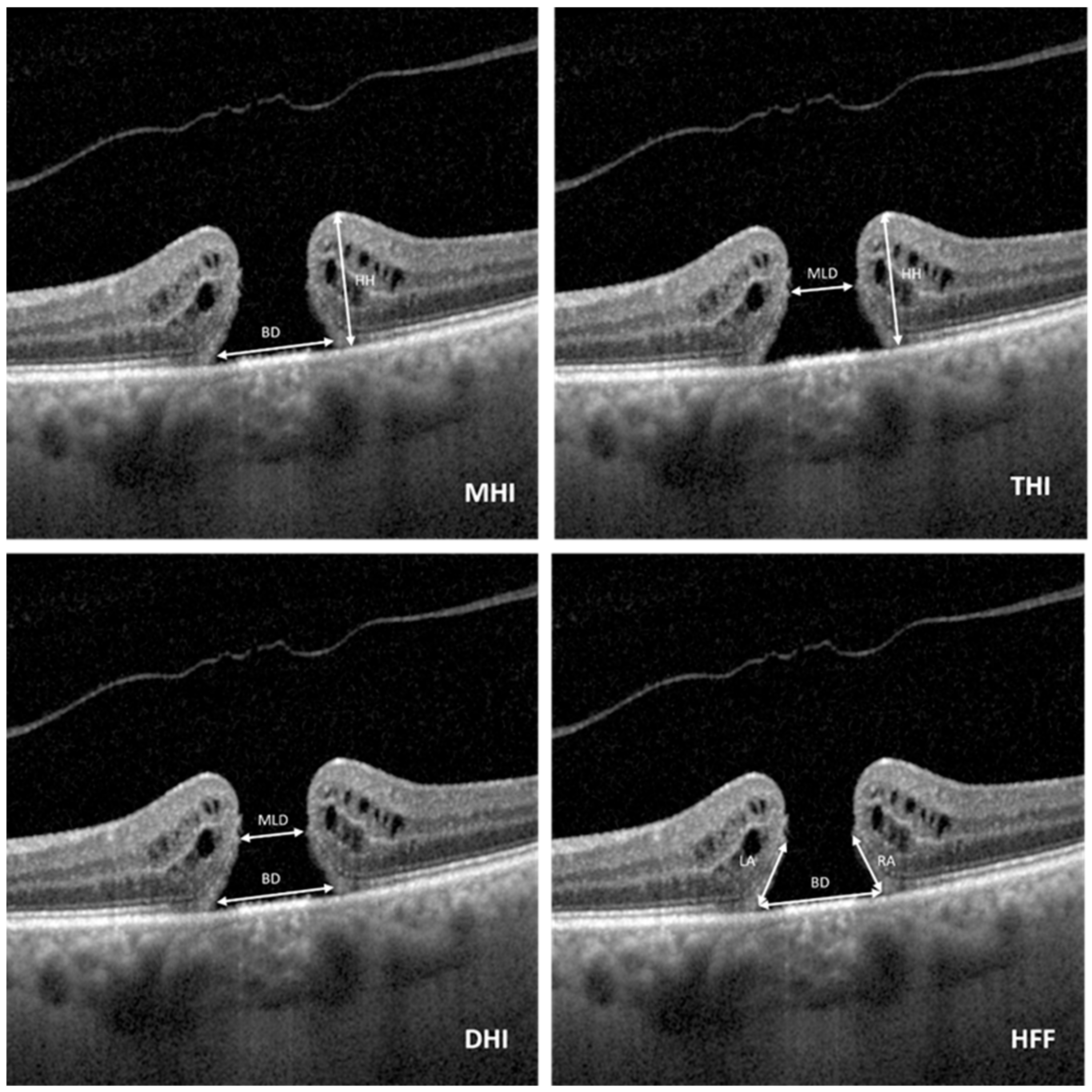
2.2. OCT Analysis
2.3. Multifocal Electroretinography (mfERG)
2.4. Microperymetry
2.5. Statistical Analysis
3. Results
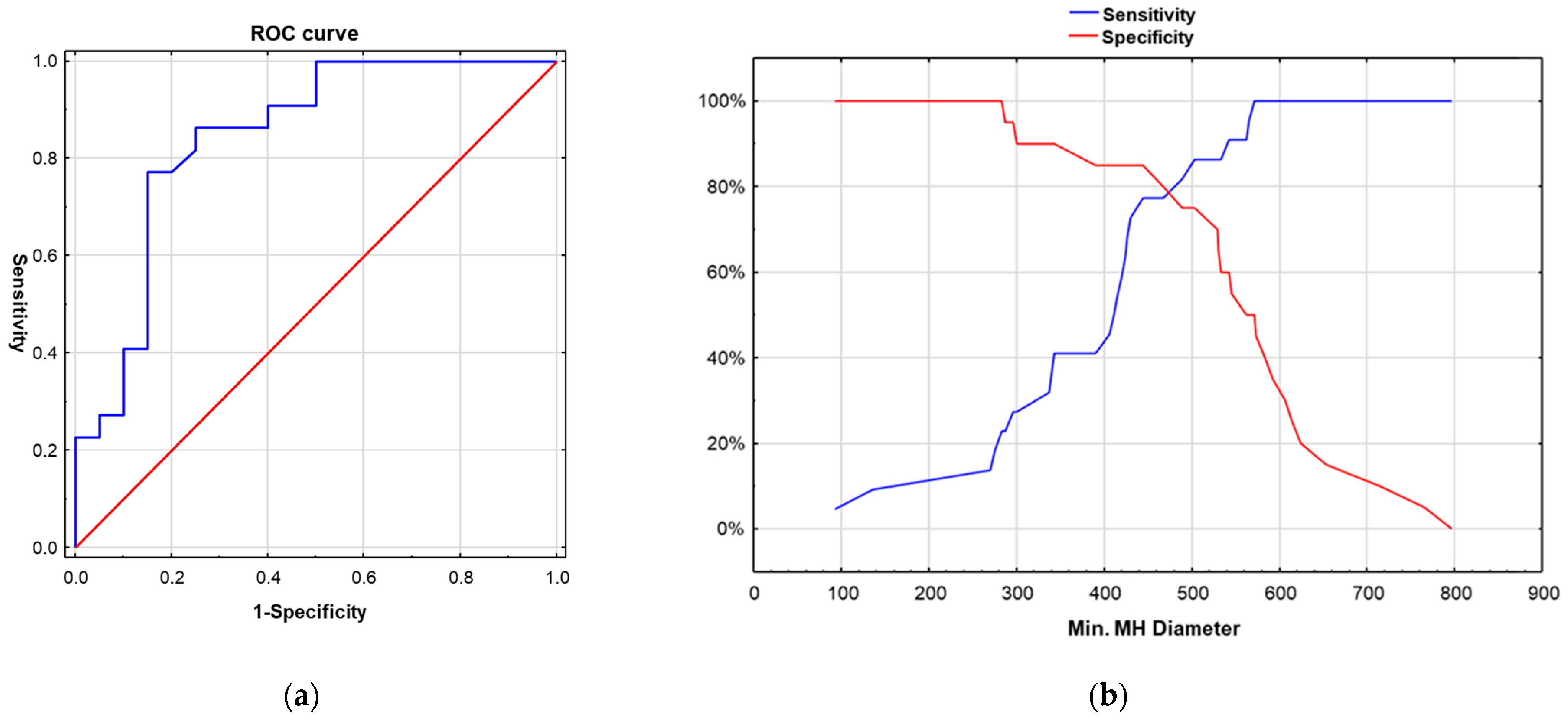
3.1. Preoperative Morphological and Functional Parameters Associated with a Final BCVA > 0.5
3.2. Relationships Between Baseline Macular Parameters and BCVA Change After Surgery
3.3. Associations Between Morphological and Functional Preoperative Hole Parameters
4. Discussion
4.1. Limitations
4.2. Future Directions
5. Conclusions
Author Contributions
Funding
Institutional Review Board Statement
Informed Consent Statement
Data Availability Statement
Conflicts of Interest
References
- McCannel, C.A.; Ensminger, J.L.; Diehl, N.N.; Hodge, D.N. Population-based incidence of macular holes. Ophthalmology 2009, 116, 1366–1369. [Google Scholar] [CrossRef]
- Kelly, N.E.; Wendel, R.T. Vitreous surgery for idiopathic macular holes: Results of a pilot study. Arch. Ophthalmol. 1991, 109, 654–659. [Google Scholar] [CrossRef]
- Michalewska, Z.; Michalewski, J.; Adelman, R.A.; Nawrocki, J. Inverted internal limiting membrane flap technique for large macular holes. Ophthalmology 2010, 117, 2018–2025. [Google Scholar] [CrossRef]
- Steel, D.H.; Donachie, P.H.J.; Aylward, G.W.; Laidlaw, D.A.; Williamson, T.H.; Yorston, D.; British Macular Hole Outcomes Group. Factors affecting anatomical and visual outcome after macular hole surgery: Findings from a large prospective UK cohort. Eye 2021, 35, 316–325. [Google Scholar] [CrossRef]
- Smiddy, W.E.; Flynn, H.W., Jr. Pathogenesis of macular holes and therapeutic implications. Am. J. Ophthalmol. 2004, 137, 525–537. [Google Scholar] [CrossRef] [PubMed]
- Bajdik, B.; Vajas, A.; Kemenes, G.; Fodor, M.; Surányi, É.; Takács, L. Prediction of long-term visual outcome of idiopathic full-thickness macular hole surgery using optical coherence tomography parameters that estimate potential preoperative photoreceptor damage. Graefes Arch. Clin. Exp. Ophthalmol. 2024, 262, 3181–3189. [Google Scholar] [CrossRef]
- Nawrocka, Z.A.; Nawrocki, J. Predictive Factors of Surgical Success with the Inverted Internal Limiting Membrane Flap Technique. Retina 2024, 44, 400–405. [Google Scholar] [CrossRef] [PubMed]
- Ziontkowska-Wrzałek, A.; Dzięciołowska, M.; Safranow, K.; Machalińska, A. Efficacy of Early Postoperative Subthreshold Micropulse Laser Therapy in Preventing Persistent Macular Oedema in Patients After Epiretinal Membrane Surgery. Biomedicines 2025, 13, 2113. [Google Scholar] [CrossRef]
- Gupta, B.; Laidlaw, D.A.; Williamson, T.H.; Shah, S.P.; Wong, R.; Wren, S. Predicting visual success in macular hole surgery. Br. J. Ophthalmol. 2009, 93, 1488–1491. [Google Scholar] [CrossRef] [PubMed]
- Essex, R.W.; Hunyor, A.P.; Moreno-Betancur, M.; Yek, J.T.O.; Kingston, Z.S.; Campbell, W.G.; Connell, P.P.; McAllister, I.L. The visual outcomes of macular hole surgery: A registry-based study by the Australian and New Zealand Society of Retinal Specialists. Ophthalmol. Retin. 2018, 2, 1143–1151. [Google Scholar] [CrossRef]
- Ullrich, S. Macular hole size as a prognostic factor in macular hole surgery. Br. J. Ophthalmol. 2002, 86, 390–393. [Google Scholar] [CrossRef] [PubMed]
- Zou, J.L.; Zeng, J. The macular microstructure repair and predictive factors of surgical outcomes after vitrectomy for idiopathic macular hole. Int. J. Ophthalmol. 2019, 12, 852–857. [Google Scholar] [CrossRef] [PubMed]
- Lachance, A.; Hébert, M.; You, E.; Rozon, J.-P.; Bourgault, S.; Caissie, M.; Tourville, É.; Dirani, A. Prognostic factors for visual outcomes in closed idiopathic macular holes after vitrectomy: Outcomes at 4 years in a monocentric study. J. Ophthalmol. 2022, 2022, 1553719. [Google Scholar] [CrossRef]
- Scoles, D.; Mahmoud, T.H. Inaccurate Measurements Confound the Study of Myopic Macular Hole. Ophthalmol. Retin. 2022, 6, 95–96. [Google Scholar] [CrossRef] [PubMed]
- Gass, J.D.M. Reappraisal of biomicroscopic classification of stages of development of a macular hole. Am. J. Ophthalmol. 1995, 119, 752–759. [Google Scholar] [CrossRef]
- Duker, J.S.; Kaiser, P.K.; Binder, S.; de Smet, M.D.; Gaudric, A.; Reichel, E.; Sadda, S.R.; Sebag, J.; Spaide, R.F.; Stalmans, P. The International Vitreomacular Traction Study Group Classification of Vitreomacular Adhesion, Traction, and Macular Hole. Ophthalmology 2013, 120, 2611–2619. [Google Scholar] [CrossRef]
- Ch’ng, S.W.; Patton, N.; Ahmed, M.; Ivanova, T.; Baumann, C.; Charles, S.; Jalil, A. The Manchester large macular hole study: Is it time to reclassify large macular holes? Am. J. Ophthalmol. 2018, 195, 36–42. [Google Scholar] [CrossRef]
- Rezende, F.A.; Ferreira, B.G.; Rampakakis, E.; Steel, D.H.; Koss, M.J.; Nawrocka, Z.A.; Bacherini, D.; Rodrigues, E.B.; Meyer, C.H.; Caporossi, T.; et al. Surgical classification for large macular hole based on different surgical techniques: The CLOSE study group. Int. J. Retin. Vitr. 2023, 9, 4. [Google Scholar] [CrossRef]
- Salter, A.B.; Folgar, F.A.; Weissbrot, J.; Wald, K.J. Macular hole surgery prognostic success rates based on macular hole size. Ophthalmic. Surg. Lasers Imaging 2012, 43, 184–189. [Google Scholar] [CrossRef]
- Ip, M.S. Anatomical outcomes of surgery for idiopathic macular hole as determined by optical coherence tomography. Arch. Ophthalmol. 2002, 120, 29–35. [Google Scholar] [CrossRef]
- Kusuhara, S.; Escaño, M.F.T.; Fujii, S.; Nakanishi, Y.; Tamura, Y.; Nagai, A.; Yamamoto, H.; Tsukahara, Y.; Negi, A. Prediction of postoperative visual outcome based on hole configuration by optical coherence tomography in eyes with idiopathic macular holes. Am. J. Ophthalmol. 2004, 138, 709–716. [Google Scholar] [CrossRef]
- Zgolli, H.; El Zarrug, H.H.K.; Meddeb, M.; Mabrouk, S.; Khlifa, N. Anatomical prognosis after idiopathic macular hole surgery: Machine learning-based prediction. Libyan J. Med. 2022, 17, 2034334. [Google Scholar] [CrossRef]
- Venkatesh, R.; Mohan, A.; Sinha, S.; Aseem, A.; Yadav, N.K. Newer indices for predicting macular hole closure in idiopathic macular holes: A retrospective, comparative study. Indian J. Ophthalmol. 2019, 67, 1857–1862. [Google Scholar] [CrossRef]
- Murphy, D.C.; Al-Zubaidy, M.; Lois, N.; Scott, N.; Steel, D.H.; Macular Hole Duration Study Group. The effect of macular hole duration on surgical outcomes: An individual participant data study of randomized controlled trials. Ophthalmology 2023, 130, 152–163. [Google Scholar] [CrossRef] [PubMed]
- Stene-Johansen, I.; Bragadottir, R.; Petrovski, B.E.; Petrovski, G. Macular hole surgery using gas tamponade: Outcomes from the Oslo retrospective cross-sectional study. J. Clin. Med. 2019, 8, 704. [Google Scholar] [CrossRef] [PubMed]
- Zhu, Y.; Zhang, T.; Wang, K.Y.; Xu, G.Z. Prognostic value of multifocal electroretinography and optical coherence tomography in eyes undergoing pan-retinal photocoagulation for diabetic retinopathy. Investig. Ophthalmol. Vis. Sci. 2014, 55, 6358–6364. [Google Scholar] [CrossRef]
- Marmor, M.F.; Kellner, U.; Lai, T.Y.Y.; Melles, R.B.; Mieler, W.F.; Ophthalmology, A.A.O. Recommendations on screening for chloroquine and hydroxychloroquine retinopathy (2016 revision). Ophthalmology 2016, 123, 1386–1394. [Google Scholar] [CrossRef]
- Hong, I.H.; Chang, I.B.; Jeon, G.S.; Han, J.R. OCT and mfERG in acute central serous chorioretinopathy. Reserarch Sq. 2020; preprints. [Google Scholar] [CrossRef]
- Moschos, M.M.; Nitoda, E. The Role of mf-ERG in the Diagnosis and Treatment of Age-Related Macular Degeneration: Electrophysiological Features of AMD. Semin Ophthalmol. 2018, 33, 461–469. [Google Scholar] [CrossRef] [PubMed]
- Khojasteh, H.; Riazi-Esfahani, H.; Pour, E.K.; Faghihi, H.; Ghassemi, F.; Bazvand, F.; Mahmoudzadeh, R.; Salabati, M.; Mirghorbani, M.; Esfahani, M.R. Multifocal electroretinogram in diabetic macular edema and its correlation with different optical coherence tomography features. Int. Ophthalmol. 2020, 40, 571–581. [Google Scholar] [CrossRef]
- Moreto, R.; De Lucca Perches, A.C.B.; Almeida, F.; Jorge, R.; Messias, A.; Gekeler, K. Central mfERG amplitude ratio as a predictor for visual outcome of macular hole surgery. Doc. Ophthalmol. 2020, 140, 23–30. [Google Scholar] [CrossRef]
- Yip, Y.W.; Fok, A.C.; Ngai, J.W.; Lai, R.Y.; Lam, D.S.; Lai, T.Y. Changes in first- and second-order multifocal electroretinography in idiopathic macular hole and their correlations with macular hole diameter and visual acuity. Graefes Arch. Clin. Exp. Ophthalmol. 2010, 248, 477–484. [Google Scholar] [CrossRef]
- Moschos, M.; Apostolopoulos, M.; Ladas, J.; Theodossiadis, P.; Malias, J.; Moschou, M.; Papaspirou, A.; Theodossiadis, G. Multifocal ERG changes before and after macular hole surgery. Doc. Ophthalmol. 2001, 102, 31–40. [Google Scholar] [CrossRef]
- Sborgia, G.; Niro, A.; Sborgia, A.; Albano, V.; Tritto, T.; Sborgia, L.; Pastore, V.; Donghia, R.; Giancipoli, E.; Recchimurzo, N.; et al. Inverted internal limiting membrane flap technique for large macular hole: A microperimetric study. Int. J. Retin. Vitr. 2019, 5, 44. [Google Scholar] [CrossRef] [PubMed]
- Bonnabel, A.; Bron, A.M.; Isaico, R.; Dugas, B.; Nicot, F.; Creuzot-Garcher, C. Long-term anatomical and functional outcomes of idiopathic macular hole surgery: The yield of spectral-domain OCT combined with microperimetry. Graefes Arch. Clin. Exp. Ophthalmol. 2013, 251, 2505–2511. [Google Scholar] [CrossRef]
- Yang, H.S.; Woo, J.E.; Kim, Y.K.; Kim, J.G.; Kim, J.T. Ellipsoid zone reflectivity after idiopathic macular hole surgery and its association with postoperative visual outcomes. PLoS ONE 2021, 16, e0259815. [Google Scholar] [CrossRef]
- Lee, S.J.; Kim, H.J.; Kim, H. Sequential recovery of outer retinal layers after full-thickness macular hole surgery: Correlation with visual outcome. Sci. Rep. 2021, 11, 11918. [Google Scholar] [CrossRef]
- Tuğan, Y.; Polat, N.; Bozkurt, E.; Aslan, S. Correlation of visual recovery and increased ellipsoid zone reflectivity after successful macular hole surgery. Turk. J. Ophthalmol. 2020, 50, 360–366. [Google Scholar] [CrossRef]
- Laishram, M.; Srikanth, K.; Rajalakshmi, A.R.; Nagarajan, S.; Ezhumalai, G. Microperimetry: A new tool for assessing retinal sensitivity in macular diseases. J. Clin. Diagn. Res. 2017, 11, NC08–NC11. [Google Scholar] [CrossRef] [PubMed]
- Leisser, C.; Palkovits, S.; Hirnschall, N.; Ullrich, M.; Hienert, J.; Zwickl, H.; Georgiev, S.; Findl, O. One-year results after internal limiting membrane flap transposition for surgical repair of macular holes with respect to microperimetry. Ophthalmic. Res. 2019, 61, 83–87. [Google Scholar] [CrossRef]
- Bacherini, D.; Savastano, M.C.; Dragotto, F.; Finocchio, L.; Lenzetti, C.; Bitossi, A.; Tartaro, R.; Giansanti, F.; Barca, F.; Savastano, A.; et al. Morpho-Functional Evaluation of Full-Thickness Macular Holes by the Integration of Optical Coherence Tomography Angiography and Microperimetry. J. Clin. Med. 2020, 9, 229. [Google Scholar] [CrossRef] [PubMed]



| Parameter | BCVA > 0.5 Group | BCVA ≤ 0.5 Group | p * |
|---|---|---|---|
| Age Median (IQR) | 69 (5) | 69 (6.5) | 0.850 |
| Gender (F/M) | 15/7 | 18/2 | 0.135 |
| Duration of disease, [n] (%) | |||
| <6 M | 15 (68.2%) | 5 (25%) | 0.002 |
| 6–12 M | 6 (27.3%) | 8 (40%) | |
| >12 M | 1 (4.5%) | 7 (35%) | |
| BCVA [Snellen charts] Median (IQR) | 0.2 (0.04) | 0.1 (0.155) | 0.015 |
| BCVA [ETDRS charts] Median (IQR) | 3.5 (6) | 1 (3) | 0.004 |
| Axial length [mm] Median (IQR) | 22.97 (2.33) | 22.91 (1.25) | 0.341 |
| Parameter | BCVA > 0.5 Group Median (IQR) | BCVA ≤ 0.5 Group Median (IQR) | p * |
|---|---|---|---|
| MH area [mm2] | 0.155 (0.12) | 0.295 (0.085) | <0.001 |
| Min. MH diameter [μm] | 413 (148) | 567.5 (110) | <0.001 |
| Max. MH diameter [μm] | 968 (375) | 1154.7 (244.5) | 0.003 |
| MH height [μm] | 470.5 (176) | 474.2 (46.5) | 0.801 |
| MHI | 0.51 (0.15) | 0.41 (0.07) | <0.001 |
| THI | 1.31 (0.3) | 0.88 (0.22) | <0.001 |
| DHI | 0.41 (0.13) | 0.47 (0.08) | 0.030 |
| HFF | 0.79 (0.15) | 0.65 (0.12) | <0.001 |
| RPE elevations (%) | 59% | 50% | 0.757 |
| Total retinal volume [mm3] | 9.385 (0.84) | 9.36 (0.62) | 0.410 |
| ETDRS retinal thickness Central [μm] | 408.5 (96) | 350 (59) | 0.017 |
| ETDRS retinal thickness Inner Superior [μm] | 398.5 (85) | 428 (78) | 0.539 |
| ETDRS retinal thickness Inner Nasal [μm] | 421.5 (93) | 427 (68) | 0.990 |
| ETDRS retinal thickness Inner Inferior [μm] | 406 (75) | 427 (68) | 0.388 |
| ETDRS retinal thickness Inner Temporal [μm] | 406.5 (49) | 418 (76) | 0.488 |
| ETDRS retinal thickness Outer Superior [μm] | 307.5 (34) | 306 (32) | 0.505 |
| ETDRS retinal thickness Outer Nasal [μm] | 325 (34) | 311 (35) | 0.027 |
| ETDRS retinal thickness Outer Inferior [μm] | 299.5 (28) | 294 (31) | 0.061 |
| ETDRS retinal thickness Outer Temporal [μm] | 299.5 (29) | 288 (33) | 0.150 |
| Choroidal thickness [μm] | 236 (70) | 229.5 (157) | 0.529 |
| Vitreomacular traction [n] (%) | |||
| 0 | 3 (13.6%) | 0 (0%) | 0.078 |
| 1 | 7 (31.8%) | 4 (20%) | |
| 2 | 8 (36.4%) | 10 (50%) | |
| 3 | 4 (18.2%) | 6 (30%) |
| Parameter | BCVA > 0.5 Group Median (IQR) | BCVA ≤ 0.5 Group Median (IQR) | p * |
|---|---|---|---|
| Average Threshold [dB] | 23.25 (3.6) | 21.35 (3.45) | 0.03 |
| Fixation Stability P1 [%] | 89 (21) | 88.5 (32) | 0.980 |
| Fixation Stability P2 [%] | 99.5 (5.5) | 100 (3) | 0.765 |
| 63% BCEA: horizontal [°] | 1.55 (0.7) | 1.45 (1.2) | 0.93 |
| 63% BCEA: vertical [°] | 1.1 (1.7) | 1.2 (0.95) | 0.63 |
| 63% BCEA: area [deg2] | 1.25 (1.4) | 1.4 (2.85) | 0.88 |
| 95% BCEA: horizontal [°] | 2.65 (1.3) | 2.55 (2.1) | 0.88 |
| 95% BCEA: vertical [°] | 1.95 (2.8) | 2.05 (1.65) | 0.687 |
| 95% BCEA: area [deg2] | 3.75 (4.1) | 4.15 (8.45) | 0.84 |
| Parameter | BCVA > 0.5 Group Median (IQR) | BCVA ≤ 0.5 Group Median (IQR) | p * |
|---|---|---|---|
| P wave amplitude in R1 [nV/degree2] | 51.575 (40.25) | 35.61 (32.35) | 0.087 |
| P wave amplitude in R2 [nV/degree2] | 46.58 (19.93) | 40.15 (23.275) | 0.07 |
| P wave amplitude in R3 [nV/degree2] | 31.445 (15.01) | 29.37 (21.065) | 0.80 |
| P wave amplitude in R4 [nV/degree2] | 22.525 (14.11) | 26.605 (15.525) | 0.65 |
| P wave amplitude in R5 [nV/degree2] | 17.715 (10.17) | 18.65 (12.572) | 0.78 |
| P wave amplitude in R6 [nV/degree2] | 16.05 (8.04) | 14.74 (10.9) | 0.61 |
| P1 wave implicit time in R1 [ms] | 45.6 (4.9) | 44.105 (7.8) | 0.69 |
| P1 wave implicit time in R2 [ms] | 42.2 (1.9) | 42.65 (1.9) | 0.35 |
| P1 wave implicit time in R3 [ms] | 41.2 (2) | 41.2 (1.45) | 0.3 |
| P1 wave implicit time in R4 [ms] | 41.2 (2) | 41.2 (2.45) | 0.51 |
| P1 wave implicit time in R5 [ms] | 41.7 (2.9) | 41.7 (2.4) | 0.80 |
| P1 wave implicit time in R6 [ms] | 41.2 (3.9) | 41.2 (2) | 0.97 |
Disclaimer/Publisher’s Note: The statements, opinions and data contained in all publications are solely those of the individual author(s) and contributor(s) and not of MDPI and/or the editor(s). MDPI and/or the editor(s) disclaim responsibility for any injury to people or property resulting from any ideas, methods, instructions or products referred to in the content. |
© 2025 by the authors. Licensee MDPI, Basel, Switzerland. This article is an open access article distributed under the terms and conditions of the Creative Commons Attribution (CC BY) license (https://creativecommons.org/licenses/by/4.0/).
Share and Cite
Lorenc, O.; Safranow, K.; Machalińska, A. Predictive Value of Preoperative Anatomical and Functional Parameters for Long-Term Visual Outcomes After Full-Thickness Macular Hole Surgery with the Inverted Flap Technique. J. Clin. Med. 2025, 14, 8757. https://doi.org/10.3390/jcm14248757
Lorenc O, Safranow K, Machalińska A. Predictive Value of Preoperative Anatomical and Functional Parameters for Long-Term Visual Outcomes After Full-Thickness Macular Hole Surgery with the Inverted Flap Technique. Journal of Clinical Medicine. 2025; 14(24):8757. https://doi.org/10.3390/jcm14248757
Chicago/Turabian StyleLorenc, Oskar, Krzysztof Safranow, and Anna Machalińska. 2025. "Predictive Value of Preoperative Anatomical and Functional Parameters for Long-Term Visual Outcomes After Full-Thickness Macular Hole Surgery with the Inverted Flap Technique" Journal of Clinical Medicine 14, no. 24: 8757. https://doi.org/10.3390/jcm14248757
APA StyleLorenc, O., Safranow, K., & Machalińska, A. (2025). Predictive Value of Preoperative Anatomical and Functional Parameters for Long-Term Visual Outcomes After Full-Thickness Macular Hole Surgery with the Inverted Flap Technique. Journal of Clinical Medicine, 14(24), 8757. https://doi.org/10.3390/jcm14248757