Prevalence of Carotid Atherosclerotic Plaques and Stenosis in Adults with Familial Hypercholesterolemia Needs Reappraisal: Systematic Review and Meta-Analysis


Abstract
1. Introduction
2. Materials and Methods
2.1. Eligibility Criteria
2.2. Information Sources and Search Strategy
2.3. Selection and Data Collection Processes
2.4. Data Items and Effect Measure
2.5. Synthesis Methods
3. Results
3.1. Carotid Plaques
3.1.1. Description of Included Studies
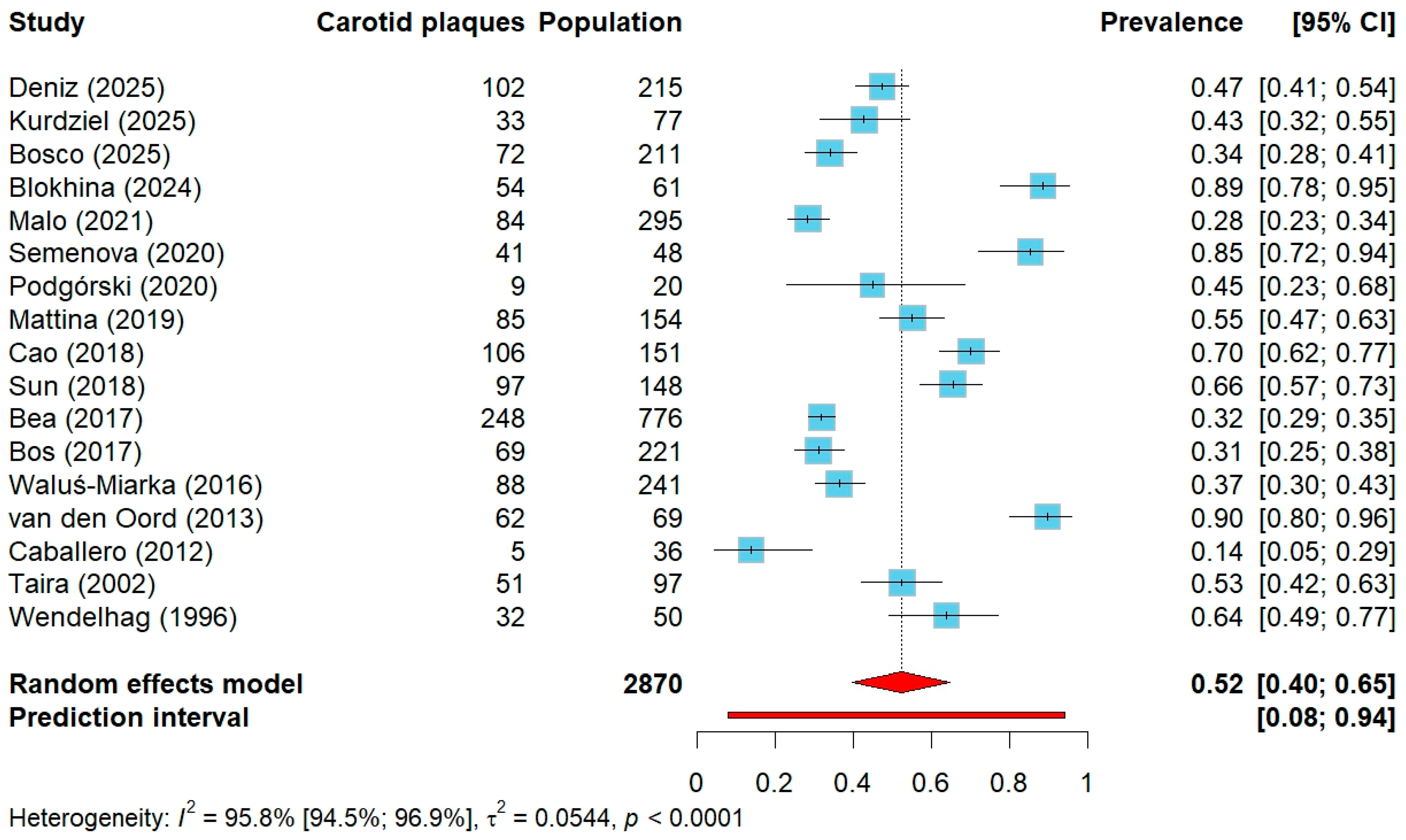
3.1.2. Prevalence of Carotid Plaques in All Included Studies
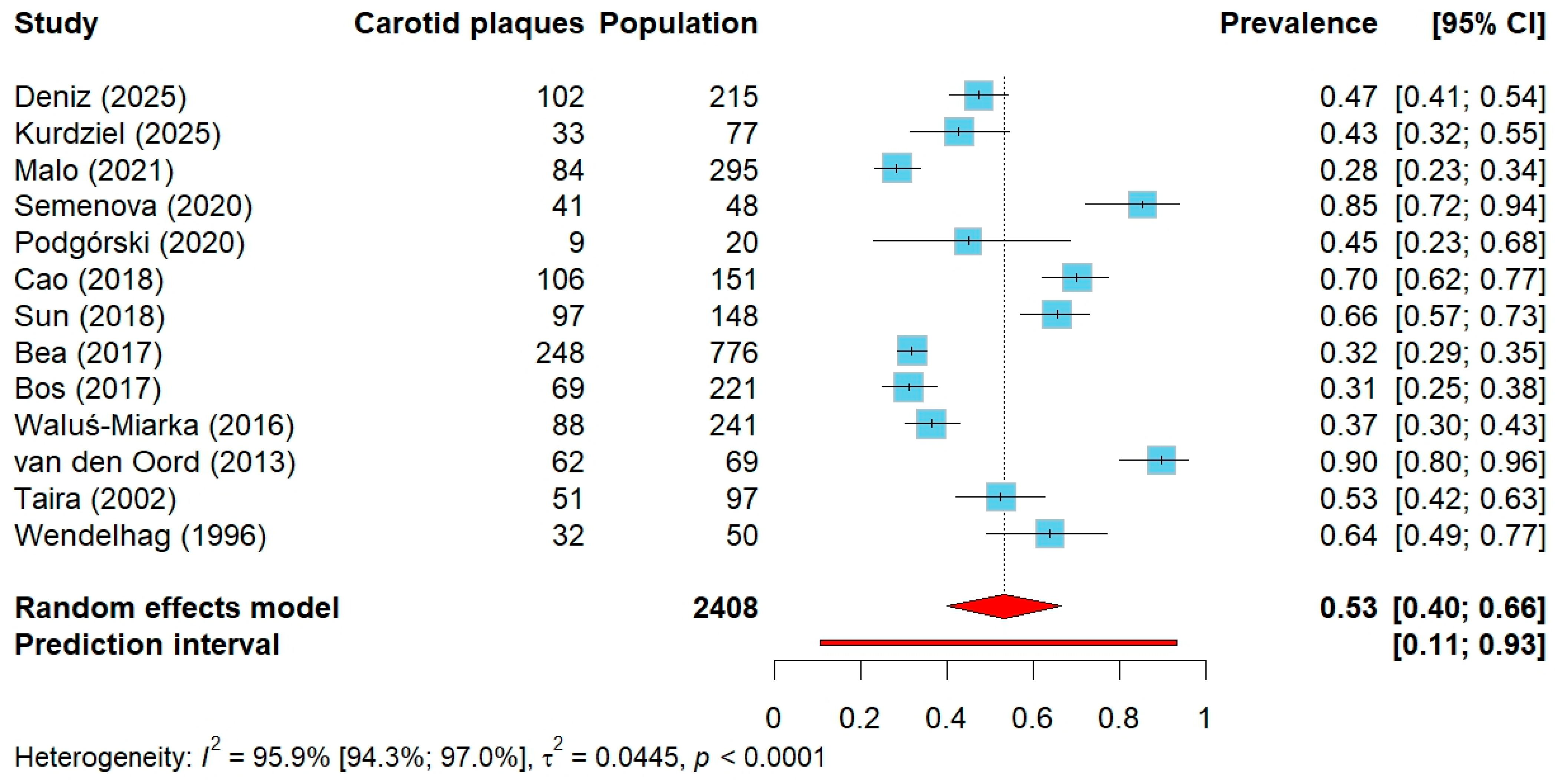
3.1.3. Prevalence of Carotid Plaques in Studies with Clinical Diagnosis of FH (Including Those with a Subset of Genetically Confirmed Cases)
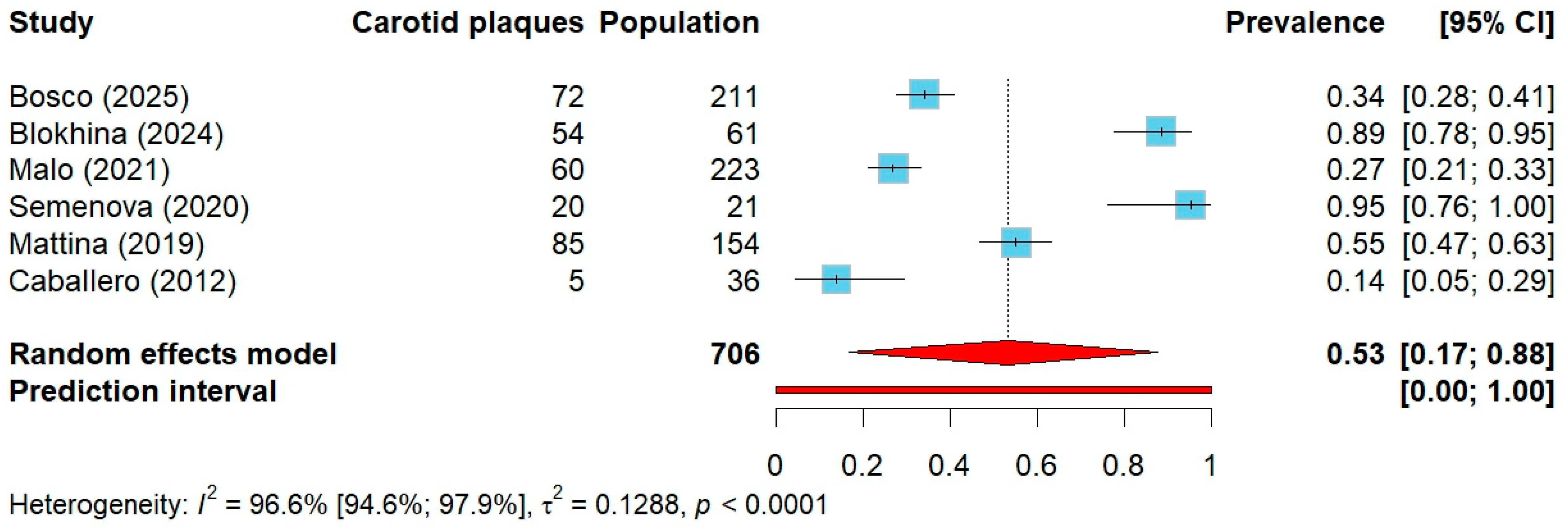
3.1.4. Prevalence of Carotid Plaques in Studies Including Only Genetically Confirmed FH
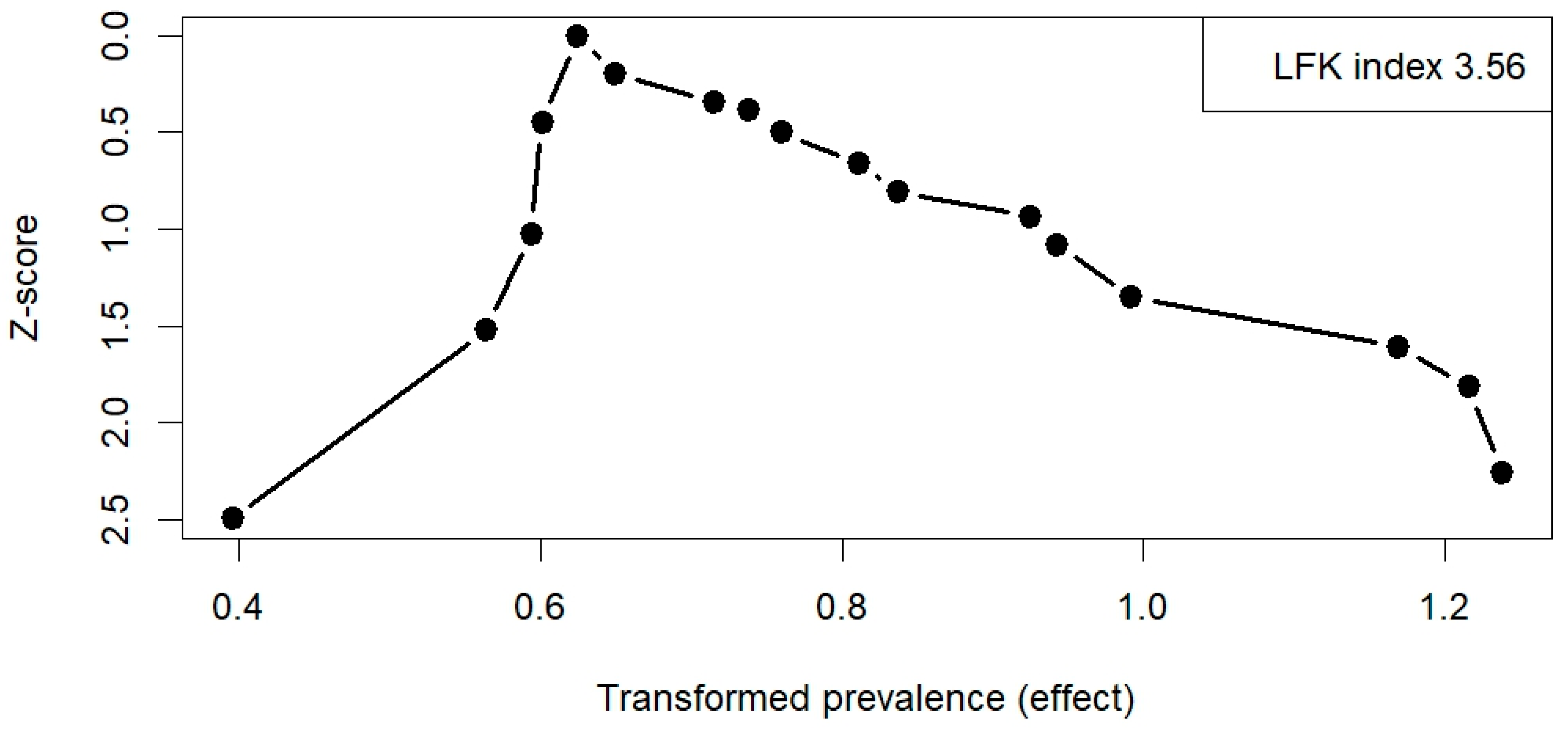
3.1.5. Publication Bias Assessment, Sensitivity Analysis, and Certainty of Evidence
3.2. Carotid Stenosis
3.2.1. Description of Included Studies
3.2.2. Prevalence of Carotid Stenosis
3.2.3. Publication Bias Assessment, Sensitivity Analysis, and Certainty of Evidence
4. Discussion
5. Limitations
6. Conclusions
Supplementary Materials
Author Contributions
Funding
Institutional Review Board Statement
Informed Consent Statement
Data Availability Statement
Conflicts of Interest
References
- Kalwick, M.; Roth, M. A Comprehensive Review of the Genetics of Dyslipidemias and Risk of Atherosclerotic Cardiovascular Disease. Nutrients 2025, 17, 659. [Google Scholar] [CrossRef]
- Hu, P.; Dharmayat, K.I.; Stevens, C.A.T.; Sharabiani, M.T.A.; Jones, R.S.; Watts, G.F.; Genest, J.; Ray, K.K.; Vallejo-Vaz, A.J. Prevalence of Familial Hypercholesterolemia Among the General Population and Patients with Atherosclerotic Cardiovascular Disease. Circulation 2020, 141, 1742–1759. [Google Scholar] [CrossRef] [PubMed]
- Beheshti, S.O.; Madsen, C.M.; Varbo, A.; Nordestgaard, B.G. Worldwide Prevalence of Familial Hypercholesterolemia. J. Am. Coll. Cardiol. 2020, 75, 2553–2566. [Google Scholar] [CrossRef] [PubMed]
- Nohara, A.; Tada, H.; Ogura, M.; Okazaki, S.; Ono, K.; Shimano, H.; Daida, H.; Dobashi, K.; Hayashi, T.; Hori, M.; et al. Homozygous Familial Hypercholesterolemia. J. Atheroscler. Thromb. 2021, 28, RV17050. [Google Scholar] [CrossRef]
- Cuchel, M.; Raal, F.J.; Hegele, R.A.; Al-Rasadi, K.; Arca, M.; Averna, M.; Bruckert, E.; Freiberger, T.; Gaudet, D.; Harada-Shiba, M.; et al. 2023 Update on European Atherosclerosis Society Consensus Statement on Homozygous Familial Hypercholesterolaemia: New Treatments and Clinical Guidance. Eur. Heart J. 2023, 44, 2277–2291. [Google Scholar] [CrossRef]
- Anagnostis, P.; Antza, C.; Florentin, M.; Kotsis, V. Familial Hypercholesterolemia and Its Manifestations: Practical Considerations for General Practitioners. Kardiol. Pol. 2023, 81, 1081–1088. [Google Scholar] [CrossRef] [PubMed]
- Dobrowolski, P.; Kabat, M.; Kępka, C.; Januszewicz, A.; Prejbisz, A. Atherosclerotic Cardiovascular Disease Burden in Patients with Familial Hypercholesterolemia: Interpretation of Data on Involvement of Different Vascular Beds. Pol. Arch. Intern. Med. 2022, 132, 16248. [Google Scholar] [CrossRef] [PubMed]
- Nordestgaard, B.G.; Chapman, M.J.; Humphries, S.E.; Ginsberg, H.N.; Masana, L.; Descamps, O.S.; Wiklund, O.; Hegele, R.A.; Raal, F.J.; Defesche, J.C.; et al. Familial Hypercholesterolaemia Is Underdiagnosed and Undertreated in the General Population: Guidance for Clinicians to Prevent Coronary Heart Disease: Consensus Statement of the European Atherosclerosis Society. Eur. Heart J. 2013, 34, 3478–3490. [Google Scholar] [CrossRef] [PubMed]
- Elshorbagy, A.; Vallejo-Vaz, A.J.; Barkas, F.; Lyons, A.R.M.; Stevens, C.A.T.; Dharmayat, K.I.; Catapano, A.L.; Freiberger, T.; Hovingh, G.K.; Mata, P.; et al. Overweight, Obesity, and Cardiovascular Disease in Heterozygous Familial Hypercholesterolaemia: The EAS FH Studies Collaboration Registry. Eur. Heart J. 2025, 46, 1127–1140. [Google Scholar] [CrossRef] [PubMed]
- Benn, M.; Watts, G.F.; Tybjaerg-Hansen, A.; Nordestgaard, B.G. Familial Hypercholesterolemia in the Danish General Population: Prevalence, Coronary Artery Disease, and Cholesterol-Lowering Medication. J. Clin. Endocrinol. Metab. 2012, 97, 3956–3964. [Google Scholar] [CrossRef]
- Pang, J.; Sullivan, D.R.; Hare, D.L.; Colquhoun, D.M.; Bates, T.R.; Ryan, J.D.M.; Bishop, W.; Burnett, J.R.; Bell, D.A.; Simons, L.A.; et al. Gaps in the Care of Familial Hypercholesterolaemia in Australia: First Report From the National Registry. Heart Lung Circ. 2021, 30, 372–379. [Google Scholar] [CrossRef] [PubMed]
- Li, S.; Zhang, H.-W.; Guo, Y.-L.; Wu, N.-Q.; Zhu, C.-G.; Zhao, X.; Sun, D.; Gao, X.-Y.; Gao, Y.; Zhang, Y.; et al. Familial Hypercholesterolemia in Very Young Myocardial Infarction. Sci. Rep. 2018, 8, 8861. [Google Scholar] [CrossRef] [PubMed]
- Marco-Benedí, V.; Bea, A.M.; Cenarro, A.; Jarauta, E.; Laclaustra, M.; Civeira, F. Current Causes of Death in Familial Hypercholesterolemia. Lipids Health Dis. 2022, 21, 64. [Google Scholar] [CrossRef] [PubMed]
- Kramer, A.I.; Akioyamen, L.E.; Lee, S.; Bélanger, A.; Ruel, I.; Hales, L.; Genest, J.; Brunham, L.R. Major Adverse Cardiovascular Events in Homozygous Familial Hypercholesterolaemia: A Systematic Review and Meta-Analysis. Eur. J. Prev. Cardiol. 2022, 29, 817–828. [Google Scholar] [CrossRef] [PubMed]
- Ajufo, E.; Cuchel, M. Recent Developments in Gene Therapy for Homozygous Familial Hypercholesterolemia. Curr. Atheroscler. Rep. 2016, 18, 22. [Google Scholar] [CrossRef]
- Acitelli, E.; Guedon, A.F.; De Liguori, S.; Gallo, A.; Maranghi, M. Peripheral Artery Disease: An Underdiagnosed Condition in Familial Hypercholesterolemia? A Systematic Review. Endocrine 2024, 85, 122–133. [Google Scholar] [CrossRef]
- Mundal, L.J.; Igland, J.; Svendsen, K.; Holven, K.B.; Leren, T.P.; Retterstøl, K. Association of Familial Hypercholesterolemia and Statin Use with Risk of Dementia in Norway. JAMA Netw. Open 2022, 5, e227715. [Google Scholar] [CrossRef]
- Emanuelsson, F.; Nordestgaard, B.G.; Benn, M. Familial Hypercholesterolemia and Risk of Peripheral Arterial Disease and Chronic Kidney Disease. J. Clin. Endocrinol. Metab. 2018, 103, 4491–4500. [Google Scholar] [CrossRef]
- Shah, N.P.; Ahmed, H.M.; Wilson Tang, W.H. Familial Hypercholesterolemia: Detect, Treat, and Ask about Family. Cleve Clin. J. Med. 2020, 87, 109–120. [Google Scholar] [CrossRef]
- Ontario Health (Quality). Genetic Testing for Familial Hypercholesterolemia: Health Technology Assessment. Ont. Health Technol. Assess. Ser. 2022, 22, 1–155. [Google Scholar]
- Boccatonda, A.; Rossi, I.; D’Ardes, D.; Cocomello, N.; Perla, F.M.; Bucciarelli, B.; Di Rocco, G.; Del Ben, M.; Angelico, F.; Guagnano, M.T.; et al. Comparison between Different Diagnostic Scores for the Diagnosis of Familial Hypercholesterolemia: Assessment of Their Diagnostic Accuracy in Comparison with Genetic Testing. Eur. Heart J. 2020, 41, ehaa946.3206. [Google Scholar] [CrossRef]
- Albuquerque, J.; Medeiros, A.M.; Alves, A.C.; Bourbon, M.; Antunes, M. Performance Comparison of Different Classification Algorithms Applied to the Diagnosis of Familial Hypercholesterolemia in Paediatric Subjects. Sci. Rep. 2022, 12, 1164. [Google Scholar] [CrossRef]
- Timoshchenko, O.; Ivanoshchuk, D.; Semaev, S.; Orlov, P.; Zorina, V.; Shakhtshneider, E. Diagnosis of Familial Hypercholesterolemia in Children and Young Adults. Int. J. Mol. Sci. 2023, 25, 314. [Google Scholar] [CrossRef]
- Scientific Steering Committee on behalf of the Simon Broome Register Group. Risk of Fatal Coronary Heart Disease in Familial Hypercholesterolaemia. Scientific Steering Committee on Behalf of the Simon Broome Register Group. BMJ 1991, 303, 893–896. [Google Scholar] [CrossRef]
- Tada, H.; Okada, H.; Nomura, A.; Usui, S.; Sakata, K.; Nohara, A.; Yamagishi, M.; Takamura, M.; Kawashiri, M. Clinical Diagnostic Criteria of Familial Hypercholesterolemia—A Comparison of the Japan Atherosclerosis Society and Dutch Lipid Clinic Network Criteria. Circ. J. 2021, 85, 891–897. [Google Scholar] [CrossRef]
- Ashfield-watt, P.; Gritzmacher, L.; McDowell, I.; Bayly, G.; Haralambos, K. A Comparison of Simon Broome and Welsh Criteria for Selecting Patients for Familial Hypercholesterolaemia (FH) Genetic Testing. Atherosclerosis 2018, 275, e181. [Google Scholar] [CrossRef]
- Ruel, I.; Brisson, D.; Aljenedil, S.; Awan, Z.; Baass, A.; Bélanger, A.; Bergeron, J.; Bewick, D.; Brophy, J.M.; Brunham, L.R.; et al. the Presence of Carotid Artery Plaque and Cardiovascular Events in Patients with Genetic Hypercholesterolemia. Simplified Canadian Definition for Familial Hypercholesterolemia. Can. J. Cardiol. 2018, 34, 1210–1214. [Google Scholar] [CrossRef] [PubMed]
- Bea, A.M.; Civeira, F.; Jarauta, E.; Lamiquiz-Moneo, I.; Pérez-Calahorra, S.; Marco-Benedí, V.; Cenarro, A.; Mateo-Gallego, R. Association Between the Presence of Carotid Artery Plaque and Cardiovascular Events in Patients with Genetic Hypercholesterolemia. Rev. Española Cardiol. 2017, 70, 551–558. [Google Scholar] [CrossRef]
- Song, P.; Fang, Z.; Wang, H.; Cai, Y.; Rahimi, K.; Zhu, Y.; Fowkes, F.G.R.; Fowkes, F.J.I.; Rudan, I. Global and Regional Prevalence, Burden, and Risk Factors for Carotid Atherosclerosis: A Systematic Review, Meta-Analysis, and Modelling Study. Lancet Glob. Health 2020, 8, e721–e729. [Google Scholar] [CrossRef] [PubMed]
- Piechocki, M.; Przewłocki, T.; Pieniażek, P.; Trystuła, M.; Podolec, J.; Kabłak-Ziembicka, A. A Non-Coronary, Peripheral Arterial Atherosclerotic Disease (Carotid, Renal, Lower Limb) in Elderly Patients—A Review: Part I—Epidemiology, Risk Factors, and Atherosclerosis-Related Diversities in Elderly Patients. J. Clin. Med. 2024, 13, 1471. [Google Scholar] [CrossRef]
- Dossabhoy, S.; Arya, S. Epidemiology of Atherosclerotic Carotid Artery Disease. Semin. Vasc. Surg. 2021, 34, 3–9. [Google Scholar] [CrossRef]
- De Weerd, M.; Greving, J.P.; De Jong, A.W.F.; Buskens, E.; Bots, M.L. Prevalence of Asymptomatic Carotid Artery Stenosis According to Age and Sex: Systematic Review and Metaregression Analysis. Stroke 2009, 40, 1105–1113. [Google Scholar] [CrossRef]
- Mechtouff, L.; Rascle, L.; Crespy, V.; Canet-Soulas, E.; Nighoghossian, N.; Millon, A. A Narrative Review of the Pathophysiology of Ischemic Stroke in Carotid Plaques: A Distinction versus a Compromise between Hemodynamic and Embolic Mechanism. Ann. Transl. Med. 2021, 9, 1208. [Google Scholar] [CrossRef] [PubMed]
- Kabłak-Ziembicka, A.; Przewłocki, T.; Stępień, E.; Pieniążek, P.; Rzeźnik, D.; Sliwiak, D.; Komar, M.; Tracz, W.; Podolec, P. Relationship between carotid intima-media thickness, cytokines, atherosclerosis extent and a two-year cardiovascular risk in patients with arteriosclerosis. Kardiol. Pol. 2011, 69, 1024–1031. [Google Scholar] [PubMed]
- Liu, W.; Zheng, Z.; Feng, Z.; Lv, K.; Cao, X.; Geng, D. Risk of acute cerebral infarction in patients with hypertension based on high-resolution MRI. Quant. Imaging Med. Surg. 2025, 15, 3000–3010. [Google Scholar] [CrossRef] [PubMed]
- Garoff, M.; Ahlqvist, J.; Levring Jäghagen, E.; Wester, P.; Johansson, E. Carotid Calcifications in Panoramic Radiographs Can Predict Vascular Risk. Dentomaxillofac. Radiol. 2025, 54, 28–34. [Google Scholar] [CrossRef]
- Lee, K.J.; Kim, S.E.; Kim, J.Y.; Kang, J.; Kim, B.J.; Han, M.K.; Choi, K.H.; Kim, J.T.; Shin, D.I.; Cha, J.K.; et al. Five-Year Risk of Acute Myocardial Infarction After Acute Ischemic Stroke in Korea. J. Am. Heart Assoc. 2021, 10, e018807. [Google Scholar] [CrossRef] [PubMed]
- Merkler, A.E.; Diaz, I.; Wu, X.; Murthy, S.B.; Gialdini, G.; Navi, B.B.; Yaghi, S.; Weinsaft, J.W.; Okin, P.M.; Safford, M.M.; et al. Duration of Heightened Ischemic Stroke Risk After Acute Myocardial Infarction. J. Am. Heart Assoc. 2018, 7, e010782. [Google Scholar] [CrossRef]
- Kablak-Ziembicka, A.; Przewlocki, T.; Pieniazek, P.; Musialek, P.; Sokolowski, A.; Drwila, R.; Sadowski, J.; Zmudka, K.; Tracz, W. The role of carotid intima-media thickness assessment in cardiovascular risk evaluation in patients with polyvascular atherosclerosis. Atherosclerosis 2010, 209, 125–130. [Google Scholar] [CrossRef]
- Ihle-Hansen, H.; Vigen, T.; Berge, T.; Walle-Hansen, M.M.; Hagberg, G.; Ihle-Hansen, H.; Thommessen, B.; Ariansen, I.; Røsjø, H.; Rønning, O.M.; et al. Carotid Plaque Score for Stroke and Cardiovascular Risk Prediction in a Middle-Aged Cohort From the General Population. J. Am. Heart Assoc. 2023, 12, e030739. [Google Scholar] [CrossRef]
- Razzouk, L.; Rockman, C.B.; Patel, M.R.; Guo, Y.; Adelman, M.A.; Riles, T.S.; Berger, J.S. Co-existence of vascular disease in different arterial beds: Peripheral artery disease and carotid artery stenosis—Data from Life Line Screening. Atherosclerosis 2015, 241, 687–691. [Google Scholar] [CrossRef] [PubMed]
- Liu, L.; Xu, Q.; Xu, X.; Peng, J.; Lin, M.; Chen, C.E.; Zhang, S. Evaluation of the ultrasonic arterial measurement and analysis system for predicting 10-year atherosclerotic cardiovascular disease risk in patients with type 2 diabetes. Quant. Imaging Med. Surg. 2025, 15, 4921–4934. [Google Scholar] [CrossRef]
- Osawa, K. Can carotid plaque assessment perform the role of a risk predictor for secondary prevention? Int. J. Cardiol. 2023, 376, 154–155. [Google Scholar] [CrossRef]
- Kabłak-Ziembicka, A.; Przewłocki, T. Clinical Significance of Carotid Intima-Media Complex and Carotid Plaque Assessment by Ultrasound for the Prediction of Adverse Cardiovascular Events in Primary and Secondary Care Patients. J. Clin. Med. 2021, 10, 4628. [Google Scholar] [CrossRef]
- Page, M.J.; McKenzie, J.E.; Bossuyt, P.M.; Boutron, I.; Hoffmann, T.C.; Mulrow, C.D.; Shamseer, L.; Tetzlaff, J.M.; Akl, E.A.; Brennan, S.E.; et al. The PRISMA 2020 Statement: An Updated Guideline for Reporting Systematic Reviews. BMJ 2021, 372, 71. [Google Scholar] [CrossRef]
- Touboul, P.-J.; Hennerici, M.G.; Meairs, S.; Adams, H.; Amarenco, P.; Bornstein, N.; Csiba, L.; Desvarieux, M.; Ebrahim, S.; Hernandez Hernandez, R.; et al. Mannheim Carotid Intima-Media Thickness and Plaque Consensus (2004–2006–2011). Cerebrovasc. Dis. 2012, 34, 290–296. [Google Scholar] [CrossRef] [PubMed]
- David, E.; Grazhdani, H.; Aliotta, L.; Gavazzi, L.M.; Foti, P.V.; Palmucci, S.; Inì, C.; Tiralongo, F.; Castiglione, D.; Renda, M.; et al. Imaging of Carotid Stenosis: Where Are We Standing? Comparison of Multiparametric Ultrasound, CT Angiography, and MRI Angiography, with Recent Developments. Diagnostics 2024, 14, 1708. [Google Scholar] [CrossRef]
- Hong, Q.N.; Fàbregues, S.; Bartlett, G.; Boardman, F.; Cargo, M.; Dagenais, P.; Gagnon, M.-P.; Griffiths, F.; Nicolau, B.; O’Cathain, A.; et al. The Mixed Methods Appraisal Tool (MMAT) Version 2018 for Information Professionals and Researchers. Educ. Inf. 2018, 34, 285–291. [Google Scholar] [CrossRef]
- Deniz, M.F.; Guven, B.; Ebeoglu, A.O.; Gul, O.B.; Nayir, A.; Ozkan, P.; Bulat, Z.; Turk, I.; Demirelce, O.; Kimyonok, H.A.; et al. Screening for Subclinical Atherosclerosis in Patients with Familial Hypercholesterolemia: Insights and Implications. J. Clin. Med. 2025, 14, 656. [Google Scholar] [CrossRef]
- Kurdziel, J.; Fedak, A.; Kawalec, E.; Miarka, P.; Micek, A.; Małecki, M.; Walus-Miarka, M. Lipoprotein(a) Concentration and Cardiovascular Disease in a Group of Patients with Familial Hypercholesterolemia—A Lipid Clinic Experience. Clin. Cardiol. 2025, 48, e70125. [Google Scholar] [CrossRef]
- Bosco, G.; Di Giacomo Barbagallo, F.; Di Marco, M.; Scilletta, S.; Miano, N.; Capuccio, S.; Musmeci, M.; Di Mauro, S.; Filippello, A.; Scamporrino, A.; et al. Evaluations of Metabolic and Innate Immunity Profiles in Subjects with Familial Hypercholesterolemia with or without Subclinical Atherosclerosis. Eur. J. Intern. Med. 2025, 132, 118–126. [Google Scholar] [CrossRef]
- Blokhina, A.V.; Ershova, A.I.; Kiseleva, A.V.; Sotnikova, E.A.; Zharikova, A.A.; Zaicenoka, M.; Vyatkin, Y.V.; Ramensky, V.E.; Kutsenko, V.A.; Litinskaya, O.A.; et al. Clinical and Biochemical Features of Atherogenic Hyperlipidemias with Different Genetic Basis: A Comprehensive Comparative Study. PLoS ONE 2024, 19, e0315693. [Google Scholar] [CrossRef]
- Malo, A.-I.; Girona, J.; Ibarretxe, D.; Rodríguez-Borjabad, C.; Amigó, N.; Plana, N.; Masana, L. Serum Glycoproteins A and B Assessed by 1H-NMR in Familial Hypercholesterolemia. Atherosclerosis 2021, 330, 1–7. [Google Scholar] [CrossRef] [PubMed]
- Semenova, A.E.; Sergienko, I.V.; García-Giustiniani, D.; Monserrat, L.; Popova, A.B.; Nozadze, D.N.; Ezhov, M.V. Verification of Underlying Genetic Cause in a Cohort of Russian Patients with Familial Hypercholesterolemia Using Targeted Next Generation Sequencing. J. Cardiovasc. Dev. Dis. 2020, 7, 16. [Google Scholar] [CrossRef]
- Podgórski, M.; Szatko, K.; Stańczyk, M.; Pawlak-Bratkowska, M.; Konopka, A.; Starostecka, E.; Tkaczyk, M.; Góreczny, S.; Rutkowska, L.; Gach, A.; et al. “Apple Does Not Fall Far from the Tree”—Subclinical Atherosclerosis in Children with Familial Hypercholesterolemia. Lipids Health Dis. 2020, 19, 169. [Google Scholar] [CrossRef]
- Mattina, A.; Giammanco, A.; Giral, P.; Rosenbaum, D.; Carrié, A.; Cluzel, P.; Redheuil, A.; Bittar, R.; Béliard, S.; Noto, D.; et al. Polyvascular Subclinical Atherosclerosis in Familial Hypercholesterolemia: The Role of Cholesterol Burden and Gender. Nutr. Metab. Cardiovasc. Dis. 2019, 29, 1068–1076. [Google Scholar] [CrossRef] [PubMed]
- Cao, Y.-X.; Liu, H.-H.; Sun, D.; Jin, J.-L.; Xu, R.-X.; Guo, Y.-L.; Wu, N.-Q.; Zhu, C.-G.; Li, S.; Zhang, Y.; et al. The Different Relations of PCSK9 and Lp(a) to the Presence and Severity of Atherosclerotic Lesions in Patients with Familial Hypercholesterolemia. Atherosclerosis 2018, 277, 7–14. [Google Scholar] [CrossRef]
- Sun, D.; Zhou, B.; Zhao, X.; Li, S.; Zhu, C.; Guo, Y.; Gao, Y.; Wu, N.; Liu, G.; Dong, Q.; et al. Lipoprotein(a) Level Associates with Coronary Artery Disease Rather than Carotid Lesions in Patients with Familial Hypercholesterolemia. J. Clin. Lab. Anal. 2018, 32, e22442. [Google Scholar] [CrossRef]
- Bos, S.; Duvekot, M.H.C.; ten Kate, G.-J.R.; Verhoeven, A.J.M.; Mulder, M.T.; Schinkel, A.F.L.; Nieman, K.; Watts, G.F.; Sijbrands, E.J.G.; Roeters van Lennep, J.E. Carotid Artery Plaques and Intima Medial Thickness in Familial Hypercholesteraemic Patients on Long-Term Statin Therapy: A Case Control Study. Atherosclerosis 2017, 256, 62–66. [Google Scholar] [CrossRef]
- Waluś-Miarka, M.; Czarnecka, D.; Wojciechowska, W.; Kloch-Badełek, M.; Kapusta, M.; Sanak, M.; Wójcik, M.; Małecki, M.T.; Starzyk, J.; Idzior-Waluś, B. Carotid Plaques Correlates in Patients with Familial Hypercholesterolemia. Angiology 2016, 67, 471–477. [Google Scholar] [CrossRef]
- van den Oord, S.C.H.; Akkus, Z.; Roeters van Lennep, J.E.; Bosch, J.G.; van der Steen, A.F.W.; Sijbrands, E.J.G.; Schinkel, A.F.L. Assessment of Subclinical Atherosclerosis and Intraplaque Neovascularization Using Quantitative Contrast-Enhanced Ultrasound in Patients with Familial Hypercholesterolemia. Atherosclerosis 2013, 231, 107–113. [Google Scholar] [CrossRef]
- Caballero, P.; Alonso, R.; Rosado, P.; Mata, N.; Fernández-Friera, L.; Jiménez-Borreguero, L.J.; Badimon, L.; Mata, P. Detection of Subclinical Atherosclerosis in Familial Hypercholesterolemia Using Non-Invasive Imaging Modalities. Atherosclerosis 2012, 222, 468–472. [Google Scholar] [CrossRef]
- Taira, K.; Bujo, H.; Kobayashi, J.; Takahashi, K.; Miyazaki, A.; Saito, Y. Positive Family History for Coronary Heart Disease and ‘Midband Lipoproteins’ Are Potential Risk Factors of Carotid Atherosclerosis in Familial Hypercholesterolemia. Atherosclerosis 2002, 160, 391–397. [Google Scholar] [CrossRef]
- Wendelhag, I.; Wiklund, O.; Wikstrand, J. On Quantifying Plaque Size and Intima-Media Thickness in Carotid and Femoral Arteries. Arterioscler. Thromb. Vasc. Biol. 1996, 16, 843–850. [Google Scholar] [CrossRef]
- Funabashi, S.; Kataoka, Y.; Hori, M.; Ogura, M.; Doi, T.; Noguchi, T.; Harada-Shiba, M. Characterization of Polyvascular Disease in Heterozygous Familial Hypercholesterolemia: Its Association with Circulating Lipoprotein(a) Levels. J. Am. Heart Assoc. 2022, 11, e025232. [Google Scholar] [CrossRef]
- Pasta, A.; Cremonini, A.L.; Formisano, E.; Fresa, R.; Bertolini, S.; Pisciotta, L. Long Term Follow-up of Genetically Confirmed Patients with Familial Hypercholesterolemia Treated with First and Second-Generation Statins and Then with PCSK9 Monoclonal Antibodies. Atherosclerosis 2020, 308, 6–14. [Google Scholar] [CrossRef]
- Soljanlahti, S.; Autti, T.; Hyttinen, L.; Vuorio, A.F.; Keto, P.; Lauerma, K. Compliance of the Aorta in Two Diseases Affecting Vascular Elasticity, Familial Hypercholesterolemia and Diabetes: A MRI Study. Vasc. Health Risk Manag. 2008, 4, 1103–1109. [Google Scholar] [CrossRef] [PubMed]
- Koga, N.; Watanabe, K.; Kurashige, Y.; Sato, T.; Hiroki, T. Long-term Effects of LDL Apheresis on Carotid Arterial Atherosclerosis in Familial Hypercholesterolaemic Patients. J. Intern. Med. 1999, 246, 35–43. [Google Scholar] [CrossRef] [PubMed]
- de Weerd, M.; Greving, J.P.; Hedblad, B.; Lorenz, M.W.; Mathiesen, E.B.; O’Leary, D.H.; Rosvall, M.; Sitzer, M.; Buskens, E.; Bots, M.L. Prevalence of Asymptomatic Carotid Artery Stenosis in the General Population. Stroke 2010, 41, 1294–1297. [Google Scholar] [CrossRef] [PubMed]
- Tsioulos, G.; Kounatidis, D.; Vallianou, N.G.; Poulaki, A.; Kotsi, E.; Christodoulatos, G.S.; Tsilingiris, D.; Karampela, I.; Skourtis, A.; Dalamaga, M. Lipoprotein(a) and Atherosclerotic Cardiovascular Disease: Where Do We Stand? Int. J. Mol. Sci. 2024, 25, 3537. [Google Scholar] [CrossRef]
- Park, J.-I.; Park, K.-H.; Kim, U.; Kim, H.-J.; Choi, K.-U.; Nam, J.-H.; Lee, C.-H.; Son, J.-W.; Park, J.-S. Contributing Factors to the Short-Term Progression of Carotid Plaque and Its Relation to Cardiovascular Outcomes. J. Clin. Lipidol. 2025, 19, 878–887. [Google Scholar] [CrossRef]
- Gacoń, J.; Przewłocki, T.; Podolec, J.; Badacz, R.; Pieniażek, P.; Mleczko, S.; Ryniewicz, W.; Żmudka, K.; Kabłak-Ziembicka, A. Prospective Study on the Prognostic Value of Repeated Carotid Intima-Media Thickness Assessment in Patients with Coronary and Extra Coronary Steno-Occlusive Arterial Disease. Pol. Arch. Intern. Med. 2018, 129, 808–817. [Google Scholar] [CrossRef]
- Ray, K.K.; Pillas, D.; Hadjiphilippou, S.; Khunti, K.; Seshasai, S.R.K.; Vallejo-Vaz, A.J.; Neasham, D.; Addison, J. Premature Morbidity and Mortality Associated with Potentially Undiagnosed Familial Hypercholesterolemia in the General Population. Am. J. Prev. Cardiol. 2023, 15, 100580. [Google Scholar] [CrossRef]
- Tada, H.; Kawashiri, M.; Okada, H.; Nakahashi, T.; Sakata, K.; Nohara, A.; Inazu, A.; Mabuchi, H.; Yamagishi, M.; Hayashi, K. Assessments of Carotid Artery Plaque Burden in Patients With Familial Hypercholesterolemia. Am. J. Cardiol. 2017, 120, 1955–1960. [Google Scholar] [CrossRef]
- Shibayama, J.; Tada, H.; Sakata, K.; Usui, S.; Takamura, M.; Kawashiri, M. The Assessment of Carotid Atherosclerotic Plaque among Young Patients with Familial Hypercholesterolemia. Intern. Med. 2022, 61, 3165–3169. [Google Scholar] [CrossRef]
- Spengel, F.A.; Kaess, B.; Keller, C.; Kröner, K.K.; Schreiber, M.; Schuster, H.; Zöllner, N. Atherosclerosis of the Carotid Arteries in Young Patients with Familial Hypercholesterolemia. Klin. Wochenschr. 1988, 66, 65–68. [Google Scholar] [CrossRef]
- Tonstad, S.; Joakimsen, O.; Bugge, S.; Ose, L.; Bønaa, K.H.; Leren, T.P. Carotid Intima–Media Thickness and Plaque in Patients with Familial Hypercholesterolaemia Mutations and Control Subjects. Eur. J. Clin. Investig. 1998, 28, 971–979. [Google Scholar] [CrossRef] [PubMed]
- Hedman, M.; Matikainen, T.; Föhr, A.; Lappi, M.; Piippo, S.; Nuutinen, M.; Antikainen, M. Efficacy and Safety of Pravastatin in Children and Adolescents with Heterozygous Familial Hypercholesterolemia: A Prospective Clinical Follow-Up Study. J. Clin. Endocrinol. Metab. 2005, 90, 1942–1952. [Google Scholar] [CrossRef] [PubMed]
- Rodríguez-Borjabad, C.; Ibarretxe, D.; Girona, J.; Ferré, R.; Feliu, A.; Amigó, N.; Guijarro, E.; Masana, L.; Plana, N.; Fèlix, A.; et al. Lipoprotein Profile Assessed by 2D-1H-NMR and Subclinical Atherosclerosis in Children with Familial Hypercholesterolaemia. Atherosclerosis 2018, 270, 117–122. [Google Scholar] [CrossRef]
- de Boer, L.M.; Hutten, B.A.; Tsimikas, S.; Yeang, C.; Zwinderman, A.H.; Kroon, J.; Revers, A.; Kastelein, J.J.P.; Wiegman, A. Lipoprotein(a) Levels and Carotid Intima-Media Thickness in Children: A 20-Year Follow-up Study. J. Clin. Lipidol. 2024, 18, e290–e294. [Google Scholar] [CrossRef] [PubMed]
- Ijäs, P.; Kemppainen, K.; Häppölä, P.; Eriksson, H.; Sebastian, R.; Palta, P.; Nuotio, K.; Vikatmaa, P.; Soinne, L.; Lindsberg, P.J.; et al. Familial Hypercholesterolaemia and LDL-C Polygenic Risk in Patients with Severe Carotid Artery Stenosis. Atherosclerosis 2021, 331, e48. [Google Scholar] [CrossRef]
- Perica, D.; Paponja, K.; Leskovar, D.; Šućur, N.; Hauptman, A.G.; Ljevak, J.; Reiner, Ž.; Pećin, I. Screening for Familial Hypercholesterolemia among Patients with Internal Carotid Artery Stenosis. Atherosclerosis 2023, 379, S120–S121. [Google Scholar] [CrossRef]
- Gacoń, J.; Przewlocki, T.; Podolec, J.; Badacz, R.; Pieniazek, P.; Ryniewicz, W.; Żmudka, K.; Kabłak-Ziembicka, A. The Role of Serial Carotid Intima-Media Thickness Assessment as a Surrogate Marker of Atherosclerosis Control in Patients with Recent Myocardial Infarction. Postepy Kardiol. Interwencyjnej 2019, 15, 74–80. [Google Scholar] [CrossRef]
- Iyen, B.; Qureshi, N.; Kai, J.; Akyea, R.K.; Leonardi-Bee, J.; Roderick, P.; Humphries, S.E.; Weng, S. Risk of Cardiovascular Disease Outcomes in Primary Care Subjects with Familial Hypercholesterolaemia: A Cohort Study. Atherosclerosis 2019, 287, 8–15. [Google Scholar] [CrossRef] [PubMed]
- Beheshti, S.; Madsen, C.M.; Varbo, A.; Nordestgaard, B.G. 2.6-Fold Risk of Ischemic Stroke in Individuals with Clinical Familial Hypercholesterolemia: The Copenhagen General Population Study with 102,961 Individuals. Atherosclerosis 2017, 263, e235. [Google Scholar] [CrossRef]
- Toft-Nielsen, F.; Emanuelsson, F.; Benn, M. Familial Hypercholesterolemia Prevalence Among Ethnicities—Systematic Review and Meta-Analysis. Front. Genet. 2022, 13, 840797. [Google Scholar] [CrossRef] [PubMed]
- Svendsen, K.; Olsen, T.; Vinknes, K.J.; Mundal, L.J.; Holven, K.B.; Bogsrud, M.P.; Leren, T.P.; Igland, J.; Retterstøl, K. Risk of Stroke in Genetically Verified Familial Hypercholesterolemia: A Prospective Matched Cohort Study. Atherosclerosis 2022, 358, 34–40. [Google Scholar] [CrossRef]
- Beheshti, S.; Madsen, C.M.; Varbo, A.; Benn, M.; Nordestgaard, B.G. Relationship of Familial Hypercholesterolemia and High Low-Density Lipoprotein Cholesterol to Ischemic Stroke. Circulation 2018, 138, 578–589. [Google Scholar] [CrossRef]
- Hovland, A.; Mundal, L.J.; Igland, J.; Veierød, M.B.; Holven, K.B.; Bogsrud, M.P.; Tell, G.S.; Leren, T.P.; Retterstøl, K. Risk of Ischemic Stroke and Total Cerebrovascular Disease in Familial Hypercholesterolemia. Stroke 2019, 50, 172–174. [Google Scholar] [CrossRef]
- Akioyamen, L.E.; Tu, J.V.; Genest, J.; Ko, D.T.; Coutin, A.J.S.; Shan, S.D.; Chu, A. Risk of Ischemic Stroke and Peripheral Arterial Disease in Heterozygous Familial Hypercholesterolemia: A Meta-Analysis. Angiology 2019, 70, 726–736. [Google Scholar] [CrossRef]
- Pérez de Isla, L.; Alonso, R.; Mata, N.; Saltijeral, A.; Muñiz, O.; Rubio-Marin, P.; Diaz-Diaz, J.L.; Fuentes, F.; de Andrés, R.; Zambón, D.; et al. Coronary Heart Disease, Peripheral Arterial Disease, and Stroke in Familial Hypercholesterolaemia. Arterioscler. Thromb. Vasc. Biol. 2016, 36, 2004–2010. [Google Scholar] [CrossRef] [PubMed]
- Piechocki, M.; Przewłocki, T.; Pieniążek, P.; Trystuła, M.; Podolec, J.; Kabłak-Ziembicka, A. A Non-Coronary, Peripheral Arterial Atherosclerotic Disease (Carotid, Renal, Lower Limb) in Elderly Patients—A Review PART II—Pharmacological Approach for Management of Elderly Patients with Peripheral Atherosclerotic Lesions outside Coronary Territory. J. Clin. Med. 2024, 13, 1508. [Google Scholar]
- Robinson, K.; Katzenellenbogen, J.M.; Kleinig, T.J.; Kim, J.; Budgeon, C.A.; Thrift, A.G.; Nedkoff, L. Large Burden of Stroke Incidence in People with Cardiac Disease: A Linked Data Cohort Study. Clin. Epidemiol. 2023, 15, 203–211. [Google Scholar] [CrossRef] [PubMed]
- Scheldeman, L.; Sinnaeve, P.; Albers, G.W.; Lemmens, R.; Van de Werf, F. Acute Myocardial Infarction and Ischaemic Stroke: Differences and Similarities in Reperfusion Therapies—A Review. Eur. Heart J. 2024, 45, 2735–2747. [Google Scholar] [CrossRef] [PubMed]
- Badacz, R.; Przewłocki, T.; Legutko, J.; Żmudka, K.; Kabłak-Ziembicka, A. microRNAs Associated with Carotid Plaque Development and Vulnerability: The Clinician’s Perspective. Int. J. Mol. Sci. 2022, 23, 15645. [Google Scholar] [CrossRef] [PubMed]
- Widimsky, P.; Coram, R.; Abou-Chebl, A. Reperfusion Therapy of Acute Ischaemic Stroke and Acute Myocardial Infarction: Similarities and Differences. Eur. Heart J. 2014, 35, 147–155. [Google Scholar] [CrossRef] [PubMed]



| First Author (Year) | Country | FH Diagnosis | ASCVD 1 [Yes/No] | Carotid Plaque 2 | Sample Size n | Males n (%) | Females n (%) | HT n (%) | DM n (%) | CAD n (%) | Age [Years] 3 | LDL-C 3,4 [mg/dL] | Genetic Diagnosis n (%) | Plaque Prevalence n (%) | Quality Assessment |
|---|---|---|---|---|---|---|---|---|---|---|---|---|---|---|---|
| Deniz (2025) [49] | Turkey | genetic, DLCN | No | 1, 2, 3 | 215 | 79 (36.7%) | 136 (63.3%) | 89 (41.5%) | 29 (13.5%) | 0 (0.0%) | 54 (43–62) | 244 (210–277) | 46 (21.4%) | 102 (47.4%) | high |
| Kurdziel (2025) [50] | Poland | genetic, Simon Broome | Yes | 2, 3 | 77 | NR | NR | NR | NR | NR | NR | NR | NR | 33 (42.9%) | low |
| Bosco (2025) [51] | Italy | genetic | No | 3 | 211 | 99 (46.9%) | 112 (53.1%) | 73 (34.6%) | 7 (3.3%) | 0 (0.0%) | 54.73 ± 7.93 | 274.76 ± 23.62 | 211 (100%) | 72 (34.1%) | high |
| Blokhina (2024) [52] | Russia | genetic | Yes | 1, 2, 3 | 61 | 28 (45.9%) | 33 (54.1%) | 28 (45.9%) | 4 (6.6%) | 18 (29.5%) | 50 (40–61) | median: 310.5 | 61 (100%) | 54 (88.5%) | low |
| Malo (2021) [53] | Spain | genetic, DLCN | Yes | 1, 2, 3 | 295 | 156 (52.9%) | 139 (47.1%) | 30 (10.2%) | 3 (1.0%) | 7 (2.4%) | 40 (32–49) | 243 (206–293.44) | 223 (75.6%) | 84 (28.5%) | high |
| Malo 5 (2021) [53] | Spain | genetic | Yes | 1, 2, 3 | 223 | 114 (51.1%) | 109 (48.9%) | 19 (8.5%) | 3 (1.3%) | 4 (1.8%) | 37 (30–49) | 259.65 (216–312.36) | 223 (100%) | 60 (26.9%) | high |
| Semenova (2020) [54] | Russia | genetic, DLCN | Yes | 1, 2, 3 | 48 | 25 (52.1%) | 23 (47.9%) | 29 (60.4%) | NR | 25 (52.1%) | NR | NR | 21 (43.8%) | 41 (85.4%) | low |
| Semenova 5 (2020) [54] | Russia | genetic | Yes | 1, 2, 3 | 21 | 11 (52.4%) | 10 (47.6%) | 14 (66.7%) | NR | 13 (61.9%) | 48 (42–55) | 363.5 (321.0–433.1) | 21 (100%) | 20 (95.2%) | low |
| Podgórski (2020) [55] | Poland | genetic, DLCN, Simon Broome | No | 2 | 20 | 10 (50.0%) | 10 (50.0%) | 7 (35.0%) | 0 (0.0%) | 0 (0.0%) | 37.5 ± 7.4 | 217.50 ± 53.47 | NR | 9 (45.0%) | low |
| Mattina (2019) [56] | France | genetic | No | 3 | 154 | 70 (45.5%) | 84 (54.5%) | 19 (12.3%) | 0 (0.0%) | 0 (0.0%) | 48.3 ± 13.8 | 176.0 ± 64.6 | 154 (100%) | 85 (55.2%) | high |
| Cao (2018) [57] | China | genetic, DLCN | Yes | 1, 2, 3 | 151 | 88 (58.3%) | 63 (41.7%) | 55 (36.4%) | 22 (14.6%) | 101 (66.9%) | 47.21 ± 13.57 | 217.3 ± 92.0 | 132 (87.4%) | 106 (70.2%) | high |
| Sun (2018) [58] | China | DLCN | Yes | 2, 3 | 148 | 77 (52.0%) | 71 (48.0%) | 53 (36.8%) | 22 (15.3%) | 87 (58.8%) | 49 ± 13 | 199.2 ± 65.7 | NR | 97 (65.5%) | low |
| Bea (2017) [28] | Spain | genetic, clinical | Yes | 1, 2, 3 | 776 | 367 (47.3%) | 409 (52.7%) | 130 (27.2%) | 18 (2.4%) | 74 (9.6%) | 46 (35–55) | 228 (199–277) | NR | 248 (32.0%) | low |
| Bos (2017) [59] | Netherlands | genetic, DLCN | No | 2, 3 | 221 | 107 (48.4%) | 114 (51.6%) | 46 (20.8%) | 6 (2.7%) | 0 (0.0%) | 46 ± 15 | 127.6 ± 38.7 | 170 (76.9%) | 69 (31.2%) | high |
| Waluś- Miarka (2016) [60] | Poland | genetic, Simon Broome | Yes | 1, 2, 3 | 241 | 98 (40.7%) | 143 (59.3%) | 71 (29.5%) | 15 (6.2%) | 42 (17.4%) | 41 (18.4) | 178.3 ± 61.5 | 60 (24.9%) | 88 (36.5%) | high |
| van den Oord (2013) [61] | Netherlands | genetic, van Aalst-Cohen | No | 1, 2, 3 | 69 | 36 (52.2%) | 33 (47.8%) | 11 (15.9%) | 2 (2.9%) | 0 (0.0%) | 55 ± 8 | 143.1 ± 65.7 | 19 (27.5%) | 62 (89.9%) | high |
| Caballero (2012) [62] | Spain | genetic | No | 2, 3 | 36 | 18 (50.0%) | 18 (50.0%) | 3 (8.3%) | 0 (0.0%) | 0 (0.0%) | 45.7 ± 10.9 | 171.9 ± 74.8 | 36 (100%) | 5 (13.9%) | low |
| Taira (2002) [63] | Japan | clinical | Yes | 2 | 97 | 34 (35.1%) | 63 (64.9%) | 20 (20.6%) | NR | NR | NR | NR | NR | 51 (52.6%) | low |
| Wendelhag (1996) [64] | Sweden | clinical | Yes | 2 | 50 | 29 (58.0%) | 21 (42.0%) | NR | NR | NR | 56.9 ± 12.0 | 129.2 ± 29.4 | NR | 32 (64.0%) | low |
| Weighted proportion/mean | 47.3% | 52.7% | 24.2% | 4.9% | 13.4% | 47.2 ± 13.4 | 216.0 ± 73.4 5 |
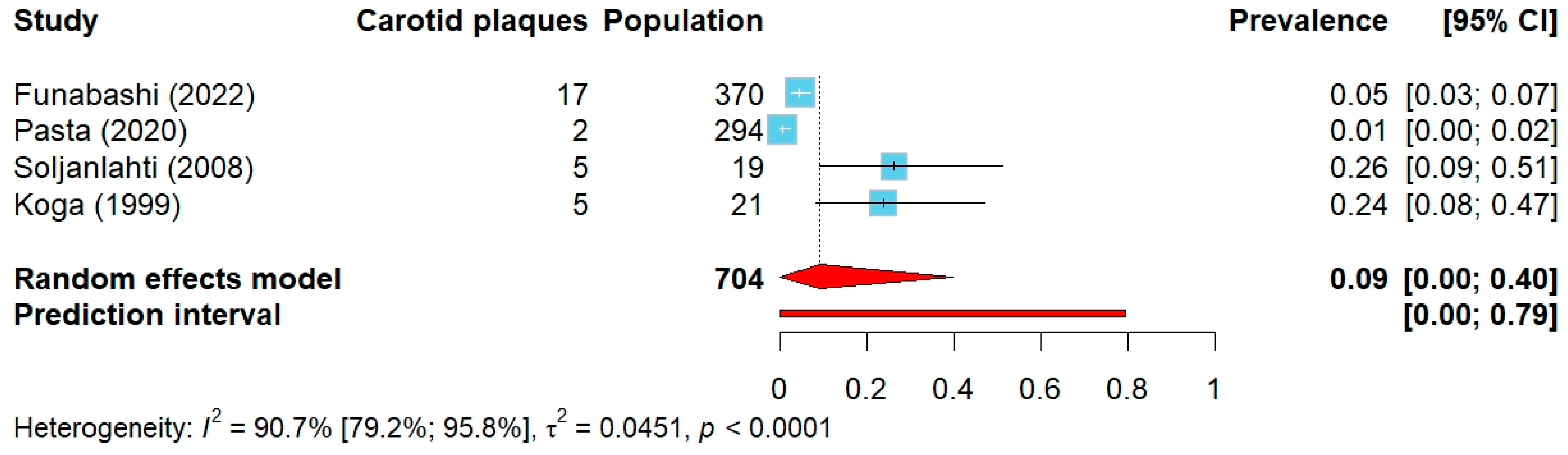
| First Author (Year) | Country | FH Diagnosis | Stenosis Diagnosis | Stenosis Cut-Off | Sample Size n | Males n (%) | Females n (%) | HT n (%) | DM n (%) | CAD n (%) | Age [years] 1 | LDL-C 1,2 [mg/dL] | Genetic Diagnosis n (%) | Stenosis Prevalence n (%) | Quality Assessment |
|---|---|---|---|---|---|---|---|---|---|---|---|---|---|---|---|
| Funabashi (2022) [65] | Japan | genetic, JAS | ultrasound, NASCET | >50% | 370 | 159 (43.0%) | 211 (57.0%) | 94 (25.4%) | 9 (2.4%) | 99 (26.8%) | NR | NR | 260 (70.3%) | 17 (4.6%) | high |
| Pasta (2020) [66] | Italy | genetic | ultrasound | ≥60% | 294 | 130 (44.2%) | 164 (55.8%) | 51 (17.3%) | NR | NR | NR | 293.6 ± 71.6 | 294 (100%) | 2 (0.7%) | low |
| Soljanlahti (2008) [67] | Finland | genetic | ultrasound | ≥70% | 19 | 8 (42.1%) | 11 (57.9%) | NR | 0 (0.0%) | 19 (100%) | 57.9 ± 3.7 | 158.5 ± 34.8 | 19 (100%) | 5 (26.3%) | low |
| Koga (1999) [68] | Japan | clinical | ultrasound | ≥50% | 21 | 11 (52.4%) | 10 (47.6%) | 5 (23.8%) | 2 (9.5%) | 20 (95.2%) | NR | NR | 0 (0.0%) | 5 (23.8%) | low |
Disclaimer/Publisher’s Note: The statements, opinions and data contained in all publications are solely those of the individual author(s) and contributor(s) and not of MDPI and/or the editor(s). MDPI and/or the editor(s) disclaim responsibility for any injury to people or property resulting from any ideas, methods, instructions or products referred to in the content. |
© 2025 by the authors. Licensee MDPI, Basel, Switzerland. This article is an open access article distributed under the terms and conditions of the Creative Commons Attribution (CC BY) license (https://creativecommons.org/licenses/by/4.0/).
Share and Cite
Piechocki, M.; Kaźnica-Wiatr, M.; Kabłak-Ziembicka, A. Prevalence of Carotid Atherosclerotic Plaques and Stenosis in Adults with Familial Hypercholesterolemia Needs Reappraisal: Systematic Review and Meta-Analysis. J. Clin. Med. 2025, 14, 8676. https://doi.org/10.3390/jcm14248676
Piechocki M, Kaźnica-Wiatr M, Kabłak-Ziembicka A. Prevalence of Carotid Atherosclerotic Plaques and Stenosis in Adults with Familial Hypercholesterolemia Needs Reappraisal: Systematic Review and Meta-Analysis. Journal of Clinical Medicine. 2025; 14(24):8676. https://doi.org/10.3390/jcm14248676
Chicago/Turabian StylePiechocki, Marcin, Magdalena Kaźnica-Wiatr, and Anna Kabłak-Ziembicka. 2025. "Prevalence of Carotid Atherosclerotic Plaques and Stenosis in Adults with Familial Hypercholesterolemia Needs Reappraisal: Systematic Review and Meta-Analysis" Journal of Clinical Medicine 14, no. 24: 8676. https://doi.org/10.3390/jcm14248676
APA StylePiechocki, M., Kaźnica-Wiatr, M., & Kabłak-Ziembicka, A. (2025). Prevalence of Carotid Atherosclerotic Plaques and Stenosis in Adults with Familial Hypercholesterolemia Needs Reappraisal: Systematic Review and Meta-Analysis. Journal of Clinical Medicine, 14(24), 8676. https://doi.org/10.3390/jcm14248676