Comparative Safety and Efficacy of Patient-Specific Versus Hand-Molded Implants in Cranioplasty: A Systematic Review and Meta-Analysis

 , ,
, ,  , , ,
, , , 
Abstract
1. Introduction
2. Materials and Methods
2.1. Eligibility Criteria
2.2. Selection Process and Search Strategy
2.3. Data Collection Process and Extracted Variables
2.4. Assessment of the Risk of Bias and Certainty of the Evidence
2.5. Synthesis Methods
3. Results
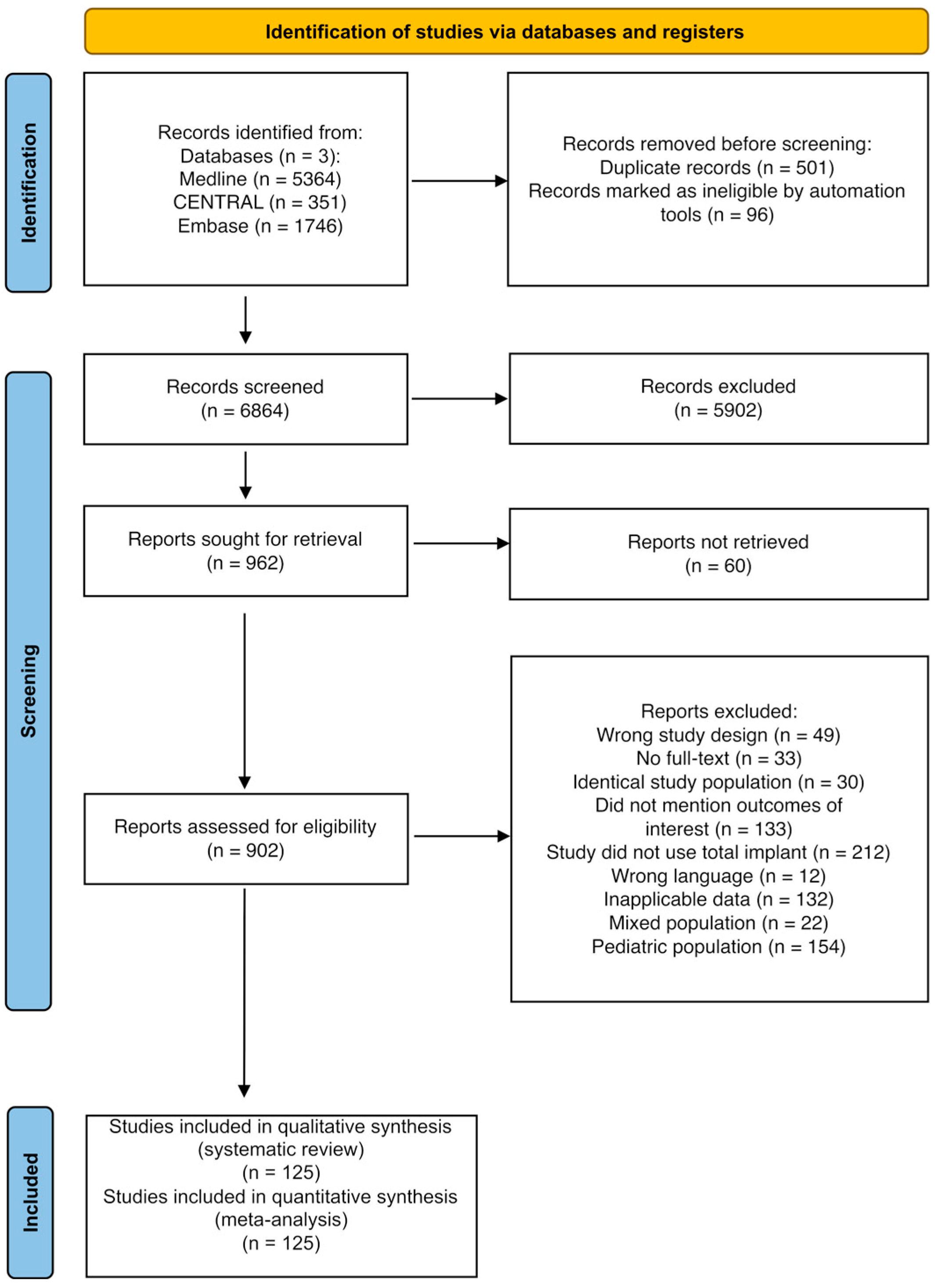
3.1. Search and Selection
3.2. Risk of Bias Assessment
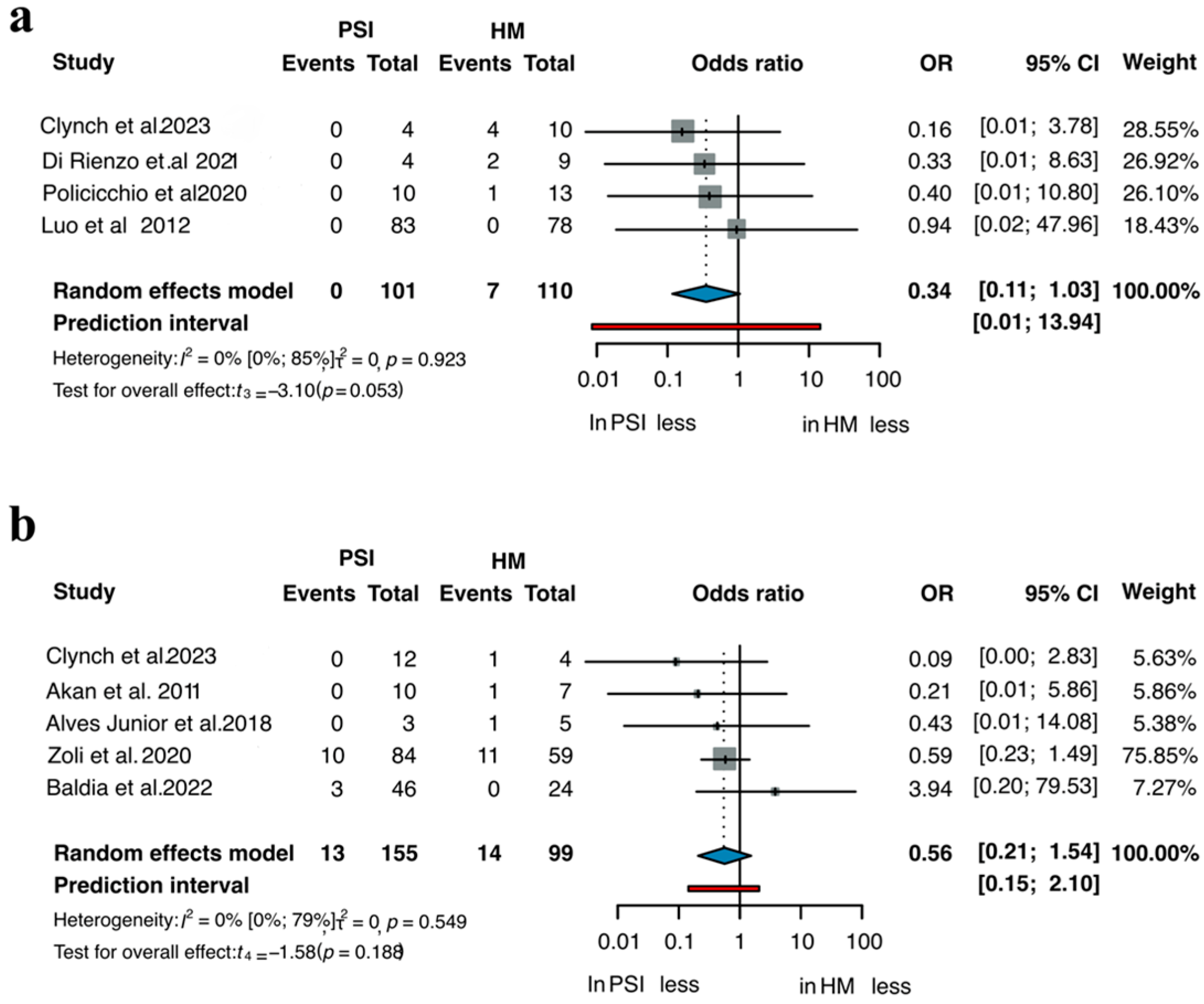
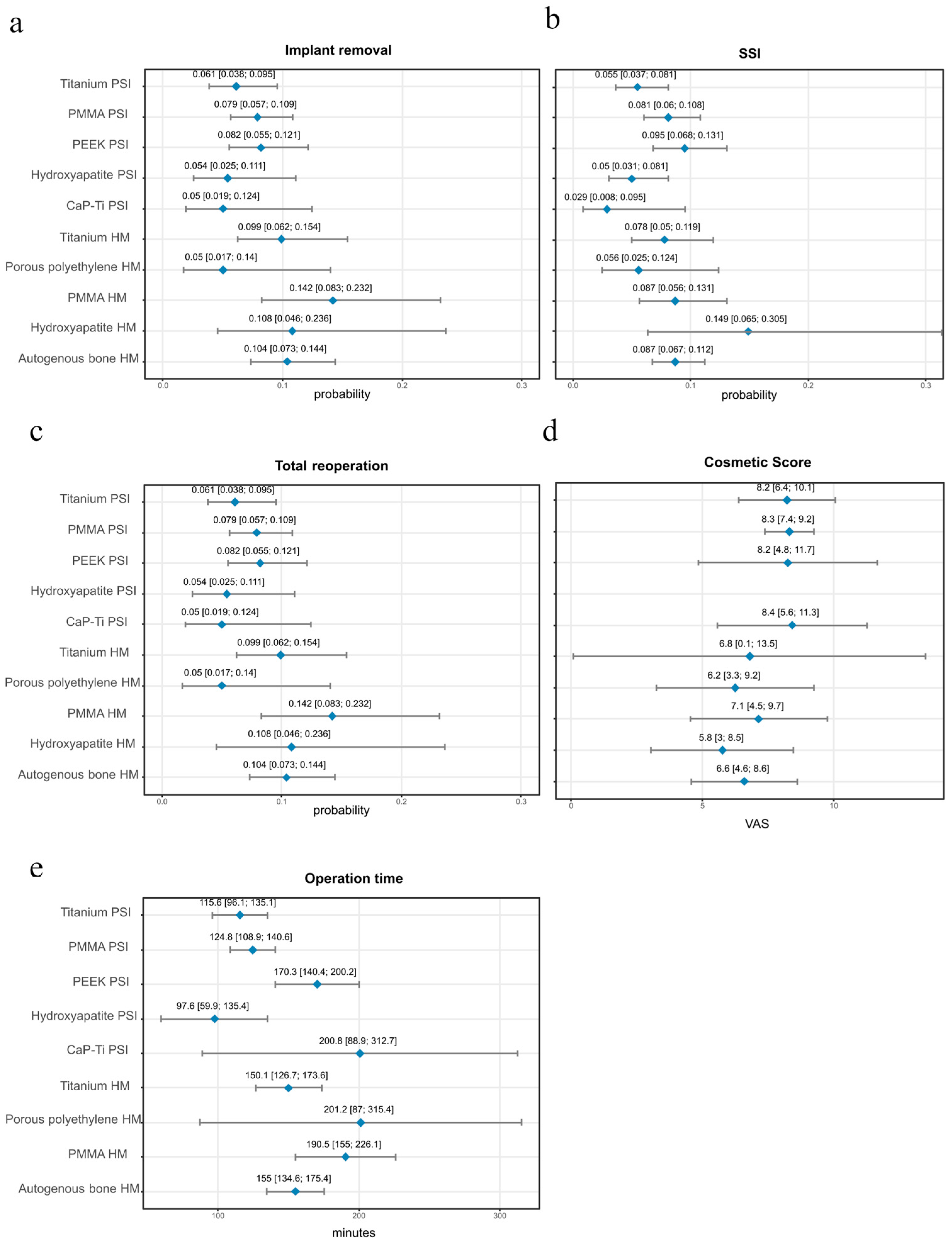
3.3. Implant Removal
3.4. SSI
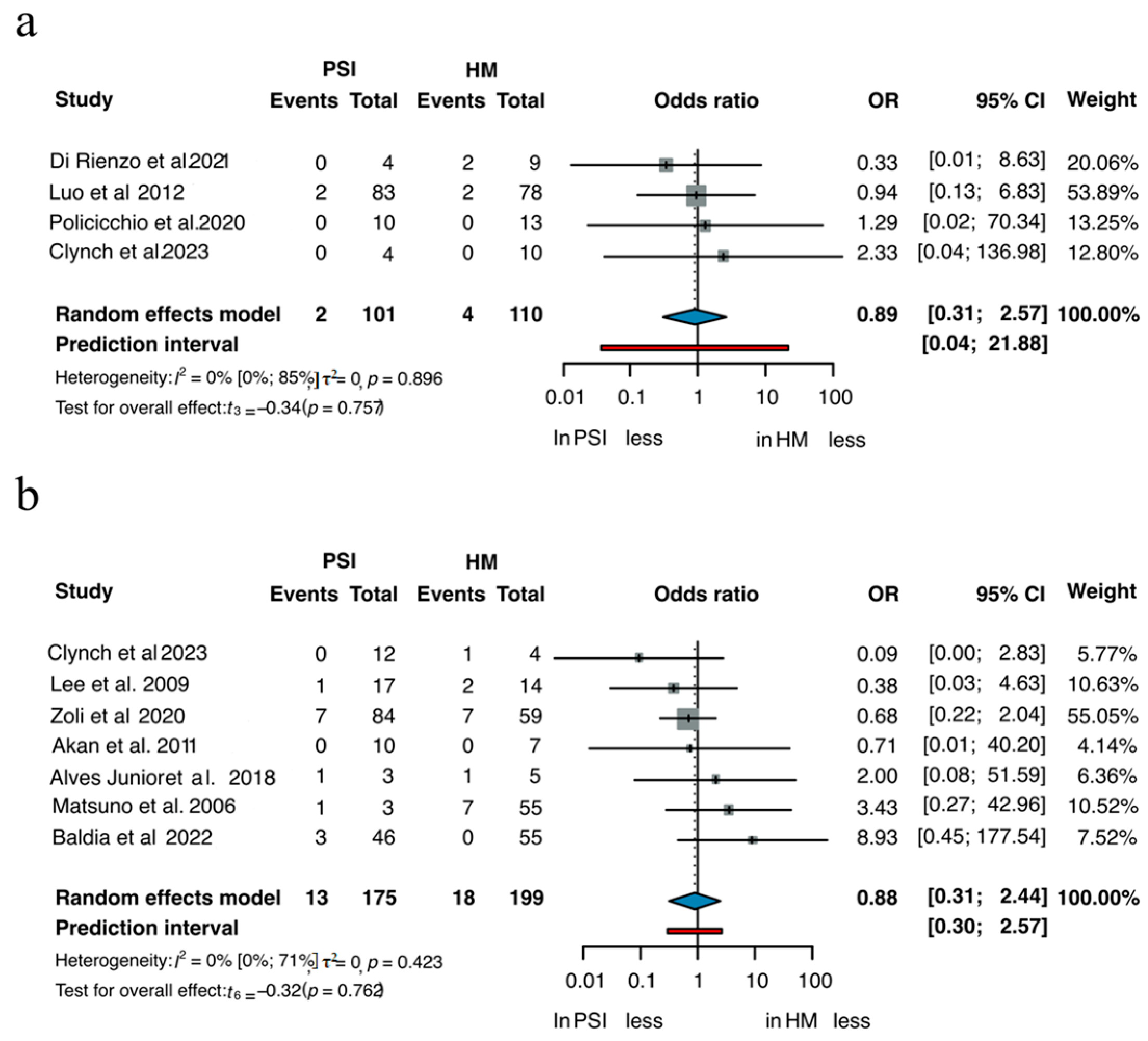
3.5. Total Reoperation
3.6. Operation Time
3.7. Cosmetic Score
3.8. Implant Price
3.9. Certainty of Evidence
4. Discussion
4.1. Summary of Key Findings
4.2. Material-Specific Considerations
4.3. Influence of Surgical and Patient Factors
4.4. Biological and Biomechanical Factors Underlying Outcomes
4.5. Economic Considerations
4.6. Strengths and Limitations
4.7. Implications for Practice and Implications for Research
5. Conclusions
Supplementary Materials
Author Contributions
Funding
Institutional Review Board Statement
Informed Consent Statement
Data Availability Statement
Acknowledgments
Conflicts of Interest
References
- Zegers, T.; Ter Laak-Poort, M.; Koper, D.; Lethaus, B.; Kessler, P. The therapeutic effect of patient-specific implants in cranioplasty. J. Craniomaxillofac. Surg. 2017, 45, 82–86. [Google Scholar] [CrossRef]
- Binhammer, A.; Jakubowski, J.; Antonyshyn, O.; Binhammer, P. Comparative Cost-Effectiveness of Cranioplasty Implants. Plast. Surg. 2020, 28, 29–39. [Google Scholar] [CrossRef]
- Alves Junior, A.C.; Hamamoto Filho, P.T.; Gonçalves, M.P.; Palhares Neto, A.A.; Zanini, M.A. Cranioplasty: An Institutional Experience. J. Craniofac. Surg. 2018, 29, 1402–1405. [Google Scholar] [CrossRef]
- Khalid, S.I.; Thomson, K.B.; Maasarani, S.; Wiegmann, A.L.; Smith, J.; Adogwa, O.; Mehta, A.I.; Dorafshar, A.H. Materials Used in Cranial Reconstruction: A Systematic Review and Meta-Analysis. World Neurosurg. 2022, 164, e945–e963. [Google Scholar] [CrossRef] [PubMed]
- Lindner, D.; Schlothofer-Schumann, K.; Kern, B.C.; Marx, O.; Müns, A.; Meixensberger, J. Cranioplasty using custom-made hydroxyapatite versus titanium: A randomized clinical trial. J. Neurosurg. 2017, 126, 175–183. [Google Scholar] [CrossRef] [PubMed]
- Yoon, H.G.; Ko, Y.; Kim, Y.S.; Bak, K.H.; Chun, H.J.; Na, M.K.; Yang, S.; Yi, H.J.; Choi, K.S. Efficacy of 3D-Printed Titanium Mesh-Type Patient-Specific Implant for Cranioplasty. Korean J. Neurotrauma 2021, 17, 91–99. [Google Scholar] [CrossRef] [PubMed]
- Saxena, V.; Sahoo, N.K.; Rangarajan, H.; Sehgal, A. “Bridging the Breach”: Cranioplasties Using Different Reconstruction Materials-An Institutional Experience. J. Maxillofac. Oral Surg. 2023, 22, 37–43. [Google Scholar] [CrossRef] [PubMed]
- Nagarjuna, M.; Ganesh, P.; Srinivasaiah, V.S.; Kumar, K.; Shetty, S.; Salins, P.C. Fabrication of Patient Specific Titanium Implants for Correction of Cranial Defects: A Technique to Improve Anatomic Contours and Accuracy. J. Craniofac. Surg. 2015, 26, 2409–2411. [Google Scholar] [CrossRef]
- Moellmann, H.L.; Mehr, V.N.; Karnatz, N.; Wilkat, M.; Riedel, E.; Rana, M. Evaluation of the Fitting Accuracy of CAD/CAM-Manufactured Patient-Specific Implants for the Reconstruction of Cranial Defects-A Retrospective Study. J. Clin. Med. 2022, 11, 2045. [Google Scholar] [CrossRef]
- Iaccarino, C.; Kolias, A.; Adelson, P.D.; Rubiano, A.M.; Viaroli, E.; Buki, A.; Cinalli, G.; Fountas, K.; Khan, T.; Signoretti, S.; et al. Consensus statement from the international consensus meeting on post-traumatic cranioplasty. Acta Neurochir. 2021, 163, 423–440. [Google Scholar] [CrossRef]
- Nolden, E.L.; Carvalho, B.K.G.; Wenning, A.S.; Kiss-Dala, S.; Hegyi, P.; Bródy, A.; Rózsa, N.K.; Végh, D.; Köles, L.; Vaszilkó, M. Comparative efficacy of patient-specific and stock implants in temporomandibular joint replacement: A systematic review and meta-analysis. Int. J. Oral Maxillofac. Surg. 2025; in press. [Google Scholar] [CrossRef]
- Henry, J.; Amoo, M.; Taylor, J.; O’Brien, D.P. Complications of Cranioplasty in Relation to Material: Systematic Review, Network Meta-Analysis and Meta-Regression. Neurosurgery 2021, 89, 383–394. [Google Scholar] [CrossRef]
- Cerveau, T.; Rossmann, T.; Clusmann, H.; Veldeman, M. Infection-related failure of autologous versus allogenic cranioplasty after decompressive hemicraniectomy—A systematic review and meta-analysis. Brain Spine 2023, 3, 101760. [Google Scholar] [CrossRef]
- Page, M.J.; McKenzie, J.E.; Bossuyt, P.M.; Boutron, I.; Hoffmann, T.C.; Mulrow, C.D.; Shamseer, L.; Tetzlaff, J.M.; Akl, E.A.; Brennan, S.E.; et al. The PRISMA 2020 statement: An updated guideline for reporting systematic reviews. BMJ 2021, 372, n71. [Google Scholar] [CrossRef]
- Higgins, J.P.T.; Thomas, J.; Chandler, J.; Cumpston, M.; Li, T.; Page, M.J.; Welch, V.A. Cochrane Handbook for Systematic Reviews of Interventions Version 6.5. Available online: www.training.cochrane.org/handbook (accessed on 12 December 2024).
- Hegyi, P.; Varró, A. Systems education can train the next generation of scientists and clinicians. Nat. Med. 2024, 30, 3399–3400. [Google Scholar] [CrossRef]
- Slim, K.; Nini, E.; Forestier, D.; Kwiatkowski, F.; Panis, Y.; Chipponi, J. Methodological index for non-randomized studies (minors): Development and validation of a new instrument. ANZ J. Surg. 2003, 73, 712–716. [Google Scholar] [CrossRef] [PubMed]
- Schünemann, H.; Brożek, J.; Guyatt, G.; Oxman, A. GRADE Handbook for Grading Quality of Evidence and Strength of Recommendations. Available online: https://gdt.gradepro.org/app/handbook/handbook.html (accessed on 5 March 2024).
- GRADEpro GDT: GRADEpro Guideline Development Tool [Software]. McMaster University and Evidence Prime. 2023. Available online: https://www.gradepro.org/ (accessed on 1 October 2025).
- Harrer, M.; Cuijpers, P.; Furukawa, T.; Ebert, D. Doing Meta-Analysis with R: A Hands-On Guide; Chapman and Hall/CRC: Boca Raton, FL, USA, 2021. [Google Scholar]
- Higgins, J.P.; Thompson, S.G. Quantifying heterogeneity in a meta-analysis. Stat. Med. 2002, 21, 1539–1558. [Google Scholar] [CrossRef] [PubMed]
- Akan, M.; Karaca, M.; Eker, G.; Karanfil, H.; Aköz, T. Is polymethylmethacrylate reliable and practical in full-thickness cranial defect reconstructions? J. Craniofac. Surg. 2011, 22, 1236–1239. [Google Scholar] [CrossRef] [PubMed]
- Al Alawi, K.; Al Furqani, A.; Al Shaqsi, S.; Shummo, M.; Al Jabri, A.; Al Balushi, T. Cranioplasty in Oman: Retrospective review of cases from the National Craniofacial Center 2012–2022. Sultan Qaboos Univ. Med. J. 2024, 24, 250–258. [Google Scholar] [CrossRef]
- Amin, M.R.; Islam, K.T.; Haque, M. Preoperative planning of craniectomy and reconstruction using three-dimension-printed cranioplasty for treatment of calvarial lesion. Surg. Neurol. Int. 2024, 15, 241. [Google Scholar] [CrossRef]
- Anele, C.O.; Balogun, S.A.; Ezeaku, C.O.; Ajekwu, T.O.; Omon, H.E.; Ejembi, G.O.; Komolafe, E.O. Titanium mesh cranioplasty for cosmetically disfiguring cranio-facial tumours in a resource limited setting. World Neurosurg. X 2024, 23, 100362. [Google Scholar] [CrossRef] [PubMed]
- Anto, D.; Manjooran, R.P.; Aravindakshan, R.; Lakshman, K.; Morris, R. Cranioplasty Using Autoclaved Autologous Skull Bone Flaps Preserved at Ambient Temperature. J. Neurosci. Rural. Pract. 2017, 8, 595–600. [Google Scholar] [CrossRef]
- Ashraf, M.; Choudhary, N.; Kamboh, U.A.; Raza, M.A.; Sultan, K.A.; Ghulam, N.; Hussain, S.S.; Ashraf, N. Early experience with patient-specific low-cost 3D-printed polymethylmethacrylate cranioplasty implants in a lower-middle-income-country: Technical note and economic analysis. Surg. Neurol. Int. 2022, 13, 270. [Google Scholar] [CrossRef] [PubMed]
- Baldia, M.; Joseph, M.; Sharma, S.; Kumar, D.; Retnam, A.; Koshy, S.; Karuppusami, R. Customized cost-effective polymethylmethacrylate cranioplasty: A cosmetic comparison with other low-cost methods of cranioplasty. Acta Neurochir. 2022, 164, 655–667. [Google Scholar] [CrossRef] [PubMed]
- Basu, B.; Bhaskar, N.; Barui, S.; Sharma, V.; Das, S.; Govindarajan, N.; Hegde, P.; Perikal, P.J.; Antharasanahalli Shivakumar, M.; Khanapure, K.; et al. Evaluation of implant properties, safety profile and clinical efficacy of patient-specific acrylic prosthesis in cranioplasty using 3D binderjet printed cranium model: A pilot study. J. Clin. Neurosci. 2021, 85, 132–142. [Google Scholar] [CrossRef]
- Bianchi, F.; Signorelli, F.; Di Bonaventura, R.; Trevisi, G.; Pompucci, A. One-stage frame-guided resection and reconstruction with PEEK custom-made prostheses for predominantly intraosseous meningiomas: Technical notes and a case series. Neurosurg. Rev. 2019, 42, 769–775. [Google Scholar] [CrossRef]
- Brandicourt, P.; Delanoé, F.; Roux, F.E.; Jalbert, F.; Brauge, D.; Lauwers, F. Reconstruction of Cranial Vault Defect with Polyetheretherketone Implants. World Neurosurg. 2017, 105, 783–789. [Google Scholar] [CrossRef]
- Brie, J.; Chartier, T.; Chaput, C.; Delage, C.; Pradeau, B.; Caire, F.; Boncoeur, M.P.; Moreau, J.J. A new custom made bioceramic implant for the repair of large and complex craniofacial bone defects. J. Craniomaxillofac. Surg. 2013, 41, 403–407. [Google Scholar] [CrossRef]
- Cabraja, M.; Klein, M.; Lehmann, T.N. Long-term results following titanium cranioplasty of large skull defects. Neurosurg. Focus. 2009, 26, E10. [Google Scholar] [CrossRef]
- Caro-Osorio, E.; De la Garza-Ramos, R.; Martínez-Sánchez, S.R.; Olazarán-Salinas, F. Cranioplasty with polymethylmethacrylate prostheses fabricated by hand using original bone flaps: Technical note and surgical outcomes. Surg. Neurol. Int. 2013, 4, 136. [Google Scholar] [CrossRef]
- Champeaux, C.; Froelich, S.; Caudron, Y. Titanium Three-Dimensional Printed Cranioplasty for Fronto-Nasal Bone Defect. J. Craniofac. Surg. 2019, 30, 1802–1805. [Google Scholar] [CrossRef] [PubMed]
- Chen, S.T.; Chang, C.J.; Su, W.C.; Chang, L.W.; Chu, I.H.; Lin, M.S. 3-D titanium mesh reconstruction of defective skull after frontal craniectomy in traumatic brain injury. Injury 2015, 46, 80–85. [Google Scholar] [CrossRef]
- Chen, H.; Sun, J.; Wang, J.C. Clinical Outcomes of Digital Three-Dimensional Hydroxyapatite in Repairing Calvarial Defects. J. Craniofac. Surg. 2018, 29, 618–621. [Google Scholar] [CrossRef]
- Cheng, Y.K.; Weng, H.H.; Yang, J.T.; Lee, M.H.; Wang, T.C.; Chang, C.N. Factors affecting graft infection after cranioplasty. J. Clin. Neurosci. 2008, 15, 1115–1119. [Google Scholar] [CrossRef]
- Cheng, C.H.; Chuang, H.Y.; Lin, H.L.; Liu, C.L.; Yao, C.H. Surgical results of cranioplasty using three-dimensional printing technology. Clin. Neurol. Neurosurg. 2018, 168, 118–123. [Google Scholar] [CrossRef]
- Clynch, A.L.; Norrington, M.; Mustafa, M.A.; Richardson, G.E.; Doherty, J.A.; Humphries, T.J.; Gillespie, C.S.; Keshwara, S.M.; McMahon, C.J.; Islim, A.I.; et al. Cranial meningioma with bone involvement: Surgical strategies and clinical considerations. Acta Neurochir. 2023, 165, 1355–1363. [Google Scholar] [CrossRef] [PubMed]
- Couldwell, W.T.; Chen, T.C.; Weiss, M.H.; Fukushima, T.; Dougherty, W. Cranioplasty with the Medpor porous polyethylene flexblock implant. Technical note. J. Neurosurg. 1994, 81, 483–486. [Google Scholar] [CrossRef] [PubMed]
- Csámer, L.; Csernátony, Z.; Novák, L.; Kővári, V.Z.; Kovács, Á.; Soósné Horváth, H.; Manó, S. Custom-made 3D printing-based cranioplasty using a silicone mould and PMMA. Sci. Rep. 2023, 13, 11985. [Google Scholar] [CrossRef]
- da Silva Júnior, E.B.; de Aragão, A.H.; de Paula Loureiro, M.; Lobo, C.S.; Oliveti, A.F.; de Oliveira, R.M.; Ramina, R. Cranioplasty with three-dimensional customised mould for polymethylmethacrylate implant: A series of 16 consecutive patients with cost-effectiveness consideration. 3D Print Med. 2021, 7, 4. [Google Scholar] [CrossRef]
- Desai, J.B. Cost-Effective Technique of Fabrication of Polymethyl Methacrylate Based Cranial Implant Using Three-Dimensional Printed Moulds and Wax Elimination Technique. J. Craniofac. Surg. 2019, 30, 1259–1263. [Google Scholar] [CrossRef]
- Di Rienzo, A.; Colasanti, R.; Gladi, M.; Dobran, M.; Della Costanza, M.; Capece, M.; Veccia, S.; Iacoangeli, M. Timing of cranial reconstruction after cranioplasty infections: Are we ready for a re-thinking? A comparative analysis of delayed versus immediate cranioplasty after debridement in a series of 48 patients. Neurosurg. Rev. 2021, 44, 1523–1532. [Google Scholar] [CrossRef]
- Đurić, K.S.; Barić, H.; Domazet, I.; Barl, P.; Njirić, N.; Mrak, G. Polymethylmethacrylate cranioplasty using low-cost customised 3D printed moulds for cranial defects—A single Centre experience: Technical note. Br. J. Neurosurg. 2019, 33, 376–378. [Google Scholar] [CrossRef]
- Eom, K.S. Single-Stage Reconstruction with Titanium Mesh for Compound Comminuted Depressed Skull Fracture. J. Korean Neurosurg. Soc. 2020, 63, 631–639. [Google Scholar] [CrossRef]
- Eufinger, H.; Wehmöller, M. Individual prefabricated titanium implants in reconstructive craniofacial surgery: Clinical and technical aspects of the first 22 cases. Plast. Reconstr. Surg. 1998, 102, 300–308. [Google Scholar] [CrossRef]
- Fong, A.J.; Lemelman, B.T.; Lam, S.; Kleiber, G.M.; Reid, R.R.; Gottlieb, L.J. Reconstructive approach to hostile cranioplasty: A review of the University of Chicago experience. J. Plast. Reconstr. Aesthet. Surg. 2015, 68, 1036–1043. [Google Scholar] [CrossRef]
- Fountain, D.M.; Henry, J.; Honeyman, S.; O’Connor, P.; Sekhon, P.; Piper, R.J.; Edlmann, E.; Martin, M.; Whiting, G.; Turner, C.; et al. First Report of a Multicenter Prospective Registry of Cranioplasty in the United Kingdom and Ireland. Neurosurgery 2021, 89, 518–526. [Google Scholar] [CrossRef] [PubMed]
- Francaviglia, N.; Maugeri, R.; Odierna Contino, A.; Meli, F.; Fiorenza, V.; Costantino, G.; Giammalva, R.G.; Iacopino, D.G. Skull Bone Defects Reconstruction with Custom-Made Titanium Graft shaped with Electron Beam Melting Technology: Preliminary Experience in a Series of Ten Patients. Acta Neurochir. Suppl. 2017, 124, 137–141. [Google Scholar] [CrossRef] [PubMed]
- Ganau, M.; Cebula, H.; Fricia, M.; Zaed, I.; Todeschi, J.; Scibilia, A.; Gallinaro, P.; Coca, A.; Chaussemy, D.; Ollivier, I.; et al. Surgical preference regarding different materials for custom-made allograft cranioplasty in patients with calvarial defects: Results from an internal audit covering the last 20 years. J. Clin. Neurosci. 2020, 74, 98–103. [Google Scholar] [CrossRef]
- Giese, H.; Meyer, J.; Engel, M.; Unterberg, A.; Beynon, C. Polymethylmethacrylate patient-matched implants (PMMA-PMI) for complex and revision cranioplasty: Analysis of long-term complication rates and patient outcomes. Brain Inj. 2020, 34, 269–275. [Google Scholar] [CrossRef] [PubMed]
- Gilardino, M.S.; Karunanayake, M.; Al-Humsi, T.; Izadpanah, A.; Al-Ajmi, H.; Marcoux, J.; Atkinson, J.; Farmer, J.P. A comparison and cost analysis of cranioplasty techniques: Autologous bone versus custom computer-generated implants. J. Craniofac. Surg. 2015, 26, 113–117. [Google Scholar] [CrossRef]
- Goh, R.C.; Chang, C.N.; Lin, C.L.; Lo, L.J. Customised fabricated implants after previous failed cranioplasty. J. Plast. Reconstr. Aesthet. Surg. 2010, 63, 1479–1484. [Google Scholar] [CrossRef]
- Hamböck, M.; Hosmann, A.; Seemann, R.; Wolf, H.; Schachinger, F.; Hajdu, S.; Widhalm, H. The impact of implant material and patient age on the long-term outcome of secondary cranioplasty following decompressive craniectomy for severe traumatic brain injury. Acta Neurochir. 2020, 162, 745–753. [Google Scholar] [CrossRef]
- He, Z.; Ma, Y.; Yang, C.; Hui, J.; Mao, Q.; Gao, G.; Jiang, J.; Feng, J. A Perioperative Paradigm of Cranioplasty with Polyetheretherketone: Comprehensive Management for Preventing Postoperative Complications. Front. Surg. 2022, 9, 856743. [Google Scholar] [CrossRef] [PubMed]
- Heissler, E.; Fischer, F.S.; Bolouri, S.; Lehmann, T.; Mathar, W.; Gebhardt, A.; Lanksch, W.; Bier, J. Custom-made cast titanium implants produced with CAD/CAM for the reconstruction of cranium defects. Int. J. Oral Maxillofac. Surg. 1998, 27, 334–338. [Google Scholar] [CrossRef] [PubMed]
- Hoffmann, B.; Sepehrnia, A. Taylored implants for alloplastic cranioplasty--clinical and surgical considerations. Acta Neurochir. Suppl. 2005, 93, 127–129. [Google Scholar] [CrossRef] [PubMed]
- Honeybul, S.; Ho, K.M. How “successful” is calvarial reconstruction using frozen autologous bone? Plast. Reconstr. Surg. 2012, 130, 1110–1117. [Google Scholar] [CrossRef]
- Hosameldin, A.; Osman, A.; Hussein, M.; Gomaa, A.F.; Abdellatif, M. Three dimensional custom-made PEEK cranioplasty. Surg. Neurol. Int. 2021, 12, 587. [Google Scholar] [CrossRef]
- Huang, G.J.; Zhong, S.; Susarla, S.M.; Swanson, E.W.; Huang, J.; Gordon, C.R. Craniofacial reconstruction with poly(methyl methacrylate) customized cranial implants. J. Craniofac. Surg. 2015, 26, 64–70. [Google Scholar] [CrossRef]
- Iaccarino, C.; Viaroli, E.; Fricia, M.; Serchi, E.; Poli, T.; Servadei, F. Preliminary Results of a Prospective Study on Methods of Cranial Reconstruction. J. Oral Maxillofac. Surg. 2015, 73, 2375–2378. [Google Scholar] [CrossRef]
- Inoue, A.; Satoh, S.; Sekiguchi, K.; Ibuchi, Y.; Katoh, S.; Ota, K.; Fujimori, S. Cranioplasty with split-thickness calvarial bone. Neurol. Med. Chir. 1995, 35, 804–807. [Google Scholar] [CrossRef]
- Iratwar, S.; Roy Chowdhury, S.; Pisulkar, S.; Das, S.; Agarwal, A.; Bagde, A.; Paikrao, B.; Quazi, S.; Basu, B. Comprehensive functional outcome analysis and importance of bone remodelling on personalized cranioplasty treatment using Poly(methyl methacrylate) bone flaps. J. Biomater. Appl. 2024, 38, 975–988. [Google Scholar] [CrossRef]
- Jaberi, J.; Gambrell, K.; Tiwana, P.; Madden, C.; Finn, R. Long-term clinical outcome analysis of poly-methyl-methacrylate cranioplasty for large skull defects. J. Oral Maxillofac. Surg. 2013, 71, e81–e88. [Google Scholar] [CrossRef]
- Jin, Y.; Jiang, J.; Zhang, X. Effect of Reflection of Temporalis Muscle During Cranioplasty with Titanium Mesh After Standard Trauma Craniectomy. J. Craniofac. Surg. 2016, 27, 145–149. [Google Scholar] [CrossRef]
- Jonkergouw, J.; van de Vijfeijken, S.E.; Nout, E.; Theys, T.; Van de Casteele, E.; Folkersma, H.; Depauw, P.R.; Becking, A.G. Outcome in patient-specific PEEK cranioplasty: A two-center cohort study of 40 implants. J. Craniomaxillofac. Surg. 2016, 44, 1266–1272. [Google Scholar] [CrossRef]
- Kim, B.J.; Hong, K.S.; Park, K.J.; Park, D.H.; Chung, Y.G.; Kang, S.H. Customized cranioplasty implants using three-dimensional printers and polymethyl-methacrylate casting. J. Korean Neurosurg. Soc. 2012, 52, 541–546. [Google Scholar] [CrossRef] [PubMed]
- Kim, J.K.; Lee, S.B.; Yang, S.Y. Cranioplasty Using Autologous Bone versus Porous Polyethylene versus Custom-Made Titanium Mesh: A Retrospective Review of 108 Patients. J. Korean Neurosurg. Soc. 2018, 61, 737–746. [Google Scholar] [CrossRef]
- Kim, Y.C.; Lee, S.J.; Woo, S.H.; Yang, S.; Choi, J.W. A Comparative Study of Titanium Cranioplasty for Extensive Calvarial Bone Defects: Three-Dimensionally Printed Titanium Implants Versus Premolded Titanium Mesh. Ann. Plast. Surg. 2023, 91, 446–455. [Google Scholar] [CrossRef] [PubMed]
- Kiyokawa, K.; Hayakawa, K.; Tanabe, H.Y.; Inoue, Y.; Tai, Y.; Shigemori, M.; Tokutomi, T. Cranioplasty with split lateral skull plate segments for reconstruction of skull defects. J. Craniomaxillofac. Surg. 1998, 26, 379–385. [Google Scholar] [CrossRef]
- Kohan, E.; Roostaeian, J.; Yuan, J.T.; Fan, K.L.; Federico, C.; Kawamoto, H.; Bradley, J.P. Customized bilaminar resorbable mesh with BMP-2 promotes cranial bone defect healing. Ann. Plast. Surg. 2015, 74, 603–608. [Google Scholar] [CrossRef] [PubMed]
- Kung, W.M.; Lin, F.H.; Hsiao, S.H.; Chiu, W.T.; Chyau, C.C.; Lu, S.H.; Hwang, B.; Lee, J.H.; Lin, M.S. New reconstructive technologies after decompressive craniectomy in traumatic brain injury: The role of three-dimensional titanium mesh. J. Neurotrauma 2012, 29, 2030–2037. [Google Scholar] [CrossRef]
- Kung, W.M.; Lin, M.S. A simplified technique for polymethyl methacrylate cranioplasty: Combined cotton stacking and finger fracture method. Brain Inj. 2012, 26, 1737–1742. [Google Scholar] [CrossRef]
- Kwiecien, G.J.; Rueda, S.; Couto, R.A.; Hashem, A.; Nagel, S.; Schwarz, G.S.; Zins, J.E.; Gastman, B.R. Long-term Outcomes of Cranioplasty: Titanium Mesh Is Not a Long-term Solution in High-risk Patients. Ann. Plast. Surg. 2018, 81, 416–422. [Google Scholar] [CrossRef]
- Lee, S.C.; Wu, C.T.; Lee, S.T.; Chen, P.J. Cranioplasty using polymethyl methacrylate prostheses. J. Clin. Neurosci. 2009, 16, 56–63. [Google Scholar] [CrossRef] [PubMed]
- Lee, C.H.; Chung, Y.S.; Lee, S.H.; Yang, H.J.; Son, Y.J. Analysis of the factors influencing bone graft infection after cranioplasty. J. Trauma. Acute Care Surg. 2012, 73, 255–260. [Google Scholar] [CrossRef] [PubMed]
- Lee, S.H.; Yoo, C.J.; Lee, U.; Park, C.W.; Lee, S.G.; Kim, W.K. Resorption of Autogenous Bone Graft in Cranioplasty: Resorption and Reintegration Failure. Korean J. Neurotrauma 2014, 10, 10–14. [Google Scholar] [CrossRef] [PubMed]
- Lemée, J.M.; Petit, D.; Splingard, M.; Menei, P. Autologous bone flap versus hydroxyapatite prosthesis in first intention in secondary cranioplasty after decompressive craniectomy: A French medico-economical study. Neurochirurgie 2013, 59, 60–63. [Google Scholar] [CrossRef]
- Lethaus, B.; Bloebaum, M.; Koper, D.; Poort-Ter Laak, M.; Kessler, P. Interval cranioplasty with patient-specific implants and autogenous bone grafts--success and cost analysis. J. Craniomaxillofac. Surg. 2014, 42, 1948–1951. [Google Scholar] [CrossRef]
- Kihlström Burenstam Linder, L.; Birgersson, U.; Lundgren, K.; Illies, C.; Engstrand, T. Patient-Specific Titanium-Reinforced Calcium Phosphate Implant for the Repair and Healing of Complex Cranial Defects. World Neurosurg. 2019, 122, e399–e407. [Google Scholar] [CrossRef]
- Luo, J.; Liu, B.; Xie, Z.; Ding, S.; Zhuang, Z.; Lin, L.; Guo, Y.; Chen, H.; Yu, X. Comparison of manually shaped and computer-shaped titanium mesh for repairing large frontotemporoparietal skull defects after traumatic brain injury. Neurosurg. Focus. 2012, 33, E13. [Google Scholar] [CrossRef]
- Maenhoudt, W.; Hallaert, G.; Kalala, J.P.; Baert, E.; Dewaele, F.; Bauters, W.; Van Roost, D. Hydroxyapatite cranioplasty: A retrospective evaluation of osteointegration in 17 cases. Acta Neurochir. 2018, 160, 2117–2124. [Google Scholar] [CrossRef]
- Marbacher, S.; Andereggen, L.; Erhardt, S.; Fathi, A.R.; Fandino, J.; Raabe, A.; Beck, J. Intraoperative template-molded bone flap reconstruction for patient-specific cranioplasty. Neurosurg. Rev. 2012, 35, 527–535; discussion 535. [Google Scholar] [CrossRef]
- Maricevich, J.; Cezar-Junior, A.B.; de Oliveira-Junior, E.X.; Veras, E.S.J.A.M.; da Silva, J.V.L.; Nunes, A.A.; Almeida, N.S.; Azevedo-Filho, H.R.C. Functional and aesthetic evaluation after cranial reconstruction with polymethyl methacrylate prostheses using low-cost 3D printing templates in patients with cranial defects secondary to decompressive craniectomies: A prospective study. Surg. Neurol. Int. 2019, 10, 1. [Google Scholar] [CrossRef] [PubMed]
- Marlier, B.; Kleiber, J.C.; Bannwarth, M.; Theret, E.; Eap, C.; Litre, C.F. Reconstruction of cranioplasty using medpor porouspolyethylene implant. Neurochirurgie 2017, 63, 468–472. [Google Scholar] [CrossRef]
- Matsuno, A.; Tanaka, H.; Iwamuro, H.; Takanashi, S.; Miyawaki, S.; Nakashima, M.; Nakaguchi, H.; Nagashima, T. Analyses of the factors influencing bone graft infection after delayed cranioplasty. Acta Neurochir. 2006, 148, 535–540; discussion 540. [Google Scholar] [CrossRef]
- Moles, A.; Heudes, P.M.; Amelot, A.; Cristini, J.; Salaud, C.; Roualdes, V.; Riem, T.; Martin, S.A.; Raoul, S.; Terreaux, L.; et al. Long-Term Follow-Up Comparative Study of Hydroxyapatite and Autologous Cranioplasties: Complications, Cosmetic Results, Osseointegration. World Neurosurg. 2018, 111, e395–e402. [Google Scholar] [CrossRef]
- Morales-Gómez, J.A.; Garcia-Estrada, E.; Leos-Bortoni, J.E.; Delgado-Brito, M.; Flores-Huerta, L.E.; De La Cruz-Arriaga, A.A.; Torres-Díaz, L.J.; de León, Á.R.M. Cranioplasty with a low-cost customized polymethylmethacrylate implant using a desktop 3D printer. J. Neurosurg. 2018, 130, 1721–1727. [Google Scholar] [CrossRef]
- Moreira-Gonzalez, A.; Jackson, I.T.; Miyawaki, T.; Barakat, K.; DiNick, V. Clinical outcome in cranioplasty: Critical review in long-term follow-up. J. Craniofac. Surg. 2003, 14, 144–153. [Google Scholar] [CrossRef] [PubMed]
- Morina, A.; Kelmendi, F.; Morina, Q.; Dragusha, S.; Ahmeti, F.; Morina, D.; Gashi, K. Cranioplasty with subcutaneously preserved autologous bone grafts in abdominal wall-Experience with 75 cases in a post-war country Kosova. Surg. Neurol. Int. 2011, 2, 72. [Google Scholar] [CrossRef] [PubMed]
- Morton, R.P.; Abecassis, I.J.; Hanson, J.F.; Barber, J.; Nerva, J.D.; Emerson, S.N.; Ene, C.I.; Chowdhary, M.M.; Levitt, M.R.; Ko, A.L.; et al. Predictors of infection after 754 cranioplasty operations and the value of intraoperative cultures for cryopreserved bone flaps. J. Neurosurg. 2016, 125, 766–770. [Google Scholar] [CrossRef]
- Moser, M.; Schmid, R.; Schindel, R.; Hildebrandt, G. Patient-specific polymethylmethacrylate prostheses for secondary reconstruction of large calvarial defects: A retrospective feasibility study of a new intraoperative moulding device for cranioplasty. J. Craniomaxillofac. Surg. 2017, 45, 295–303. [Google Scholar] [CrossRef]
- Mrad, M.A.; Murrad, K.; Antonyshyn, O. Analyzing the Cost of Autogenous Cranioplasty Versus Custom-Made Patient-Specific Alloplastic Cranioplasty. J. Craniofac. Surg. 2017, 28, 1260–1263. [Google Scholar] [CrossRef] [PubMed]
- Ng, Z.Y.; Ang, W.J.; Nawaz, I. Computer-designed polyetheretherketone implants versus titanium mesh (±acrylic cement) in alloplastic cranioplasty: A retrospective single-surgeon, single-center study. J. Craniofac. Surg. 2014, 25, e185–e189. [Google Scholar] [CrossRef]
- Nguyen, B.; Ashraf, O.; Richards, R.; Tra, H.; Huynh, T. Cranioplasty Using Customized 3-Dimensional-Printed Titanium Implants: An International Collaboration Effort to Improve Neurosurgical Care. World Neurosurg. 2021, 149, 174–180. [Google Scholar] [CrossRef]
- O’Reilly, E.B.; Barnett, S.; Madden, C.; Welch, B.; Mickey, B.; Rozen, S. Computed-tomography modeled polyether ether ketone (PEEK) implants in revision cranioplasty. J. Plast. Reconstr. Aesthet. Surg. 2015, 68, 329–338. [Google Scholar] [CrossRef]
- Ou, C.; Chen, Y.; Mo, J.; Wang, S.; Gai, S.; Xing, R.; Wang, B.; Wu, C. Cranioplasty Using Polymethylmethacrylate Cement Following Retrosigmoid Craniectomy Decreases the Rate of Cerebrospinal Fluid Leak and Pseudomeningocele. J. Craniofac. Surg. 2019, 30, 566–570. [Google Scholar] [CrossRef]
- Pfnür, A.; Tosin, D.; Petkov, M.; Sharon, O.; Mayer, B.; Wirtz, C.R.; Knoll, A.; Pala, A. Exploring complications following cranioplasty after decompressive hemicraniectomy: A retrospective bicenter assessment of autologous, PMMA and CAD implants. Neurosurg. Rev. 2024, 47, 72. [Google Scholar] [CrossRef]
- Piitulainen, J.M.; Kauko, T.; Aitasalo, K.M.; Vuorinen, V.; Vallittu, P.K.; Posti, J.P. Outcomes of cranioplasty with synthetic materials and autologous bone grafts. World Neurosurg. 2015, 83, 708–714. [Google Scholar] [CrossRef] [PubMed]
- Policicchio, D.; Casu, G.; Dipellegrini, G.; Doda, A.; Muggianu, G.; Boccaletti, R. Comparison of two different titanium cranioplasty methods: Custom-made titanium prostheses versus precurved titanium mesh. Surg. Neurol. Int. 2020, 11, 148. [Google Scholar] [CrossRef] [PubMed]
- Pöppe, J.P.; Spendel, M.; Schwartz, C.; Winkler, P.A.; Wittig, J. The “springform” technique in cranioplasty: Custom made 3D-printed templates for intraoperative modelling of polymethylmethacrylate cranial implants. Acta Neurochir. 2022, 164, 679–688. [Google Scholar] [CrossRef] [PubMed]
- Rammos, C.K.; Cayci, C.; Castro-Garcia, J.A.; Feiz-Erfan, I.; Lettieri, S.C. Patient-specific polyetheretherketone implants for repair of craniofacial defects. J. Craniofac. Surg. 2015, 26, 631–633. [Google Scholar] [CrossRef]
- Ridwan-Pramana, A.; Idema, S.; Te Slaa, S.; Verver, F.; Wolff, J.; Forouzanfar, T.; Peerdeman, S. Polymethyl Methacrylate in Patient-Specific Implants: Description of a New Three-Dimension Technique. J. Craniofac. Surg. 2019, 30, 408–411. [Google Scholar] [CrossRef]
- Rosenthal, G.; Ng, I.; Moscovici, S.; Lee, K.K.; Lay, T.; Martin, C.; Manley, G.T. Polyetheretherketone implants for the repair of large cranial defects: A 3-center experience. Neurosurgery 2014, 75, 523–529; discussion 528–529. [Google Scholar] [CrossRef] [PubMed]
- Rosinski, C.L.; Patel, S.; Geever, B.; Chiu, R.G.; Chaker, A.N.; Zakrzewski, J.; Rosenberg, D.M.; Parola, R.; Shah, K.; Behbahani, M.; et al. A Retrospective Comparative Analysis of Titanium Mesh and Custom Implants for Cranioplasty. Neurosurgery 2020, 86, E15–E22. [Google Scholar] [CrossRef]
- Rotaru, H.; Stan, H.; Florian, I.S.; Schumacher, R.; Park, Y.T.; Kim, S.G.; Chezan, H.; Balc, N.; Baciut, M. Cranioplasty with custom-made implants: Analyzing the cases of 10 patients. J. Oral Maxillofac. Surg. 2012, 70, e169–e176. [Google Scholar] [CrossRef]
- Sahoo, N.; Roy, I.D.; Desai, A.P.; Gupta, V. Comparative evaluation of autogenous calvarial bone graft and alloplastic materials for secondary reconstruction of cranial defects. J. Craniofac. Surg. 2010, 21, 79–82. [Google Scholar] [CrossRef]
- Sahoo, N.K.; Thakral, A.; Janjani, L. Cranioplasty with Autogenous Frozen and Autoclaved Bone: Management and Treatment Outcomes. J. Craniofac. Surg. 2019, 30, 2069–2072. [Google Scholar] [CrossRef]
- Schoekler, B.; Trummer, M. Prediction parameters of bone flap resorption following cranioplasty with autologous bone. Clin. Neurol. Neurosurg. 2014, 120, 64–67. [Google Scholar] [CrossRef] [PubMed]
- Schön, S.N.; Skalicky, N.; Sharma, N.; Zumofen, D.W.; Thieringer, F.M. 3D-Printer-Assisted Patient-Specific Polymethyl Methacrylate Cranioplasty: A Case Series of 16 Consecutive Patients. World Neurosurg. 2021, 148, e356–e362. [Google Scholar] [CrossRef] [PubMed]
- Sharavanan, G.M.; Jayabalan, S.; Rajasukumaran, K.; Veerasekar, G.; Sathya, G. Cranioplasty using presurgically fabricated presterilised polymethyl methacrylate plate by a simple, cost-effective technique on patients with and without original bone flap: Study on 29 patients. J. Maxillofac. Oral. Surg. 2015, 14, 378–385. [Google Scholar] [CrossRef]
- Shay, T.; Mitchell, K.A.; Belzberg, M.; Zelko, I.; Mahapatra, S.; Qian, J.; Mendoza, L.; Huang, J.; Brem, H.; Gordon, C. Translucent Customized Cranial Implants Made of Clear Polymethylmethacrylate: An Early Outcome Analysis of 55 Consecutive Cranioplasty Cases. Ann. Plast. Surg. 2020, 85, e27–e36. [Google Scholar] [CrossRef]
- Shi, H.; Li, Y.; Zhang, K.; Wen, X.; Shi, H.; Qian, T. Application value of calcium phosphate cement in complete cranial reconstructions of microvascular decompression craniectomies. J. Plast. Reconstr. Aesthet. Surg. 2023, 85, 210–216. [Google Scholar] [CrossRef]
- Soto, E.; Restrepo, R.D.; Grant, J.H., 3rd; Myers, R.P. Outcomes of Cranioplasty Strategies for High-Risk Complex Cranial Defects: A 10-Year Experience. Ann. Plast. Surg. 2022, 88, S449–S454. [Google Scholar] [CrossRef]
- Splavski, B.; Lakicevic, G.; Kovacevic, M.; Godec, D. Customized alloplastic cranioplasty of large bone defects by 3D-printed prefabricated mold template after posttraumatic decompressive craniectomy: A technical note. Surg. Neurol. Int. 2022, 13, 169. [Google Scholar] [CrossRef]
- Staffa, G.; Nataloni, A.; Compagnone, C.; Servadei, F. Custom made cranioplasty prostheses in porous hydroxy-apatite using 3D design techniques: 7 years experience in 25 patients. Acta Neurochir. 2007, 149, 161–170; discussion 170. [Google Scholar] [CrossRef]
- Stefini, R.; Zanotti, B.; Nataloni, A.; Martinetti, R.; Scafuto, M.; Colasurdo, M.; Tampieri, A. The efficacy of custom-made porous hydroxyapatite prostheses for cranioplasty: Evaluation of postmarketing data on 2697 patients. J. Appl. Biomater. Funct. Mater. 2015, 13, e136–e144. [Google Scholar] [CrossRef] [PubMed]
- Stieglitz, L.H.; Gerber, N.; Schmid, T.; Mordasini, P.; Fichtner, J.; Fung, C.; Murek, M.; Weber, S.; Raabe, A.; Beck, J. Intraoperative fabrication of patient-specific moulded implants for skull reconstruction: Single-centre experience of 28 cases. Acta Neurochir. 2014, 156, 793–803. [Google Scholar] [CrossRef] [PubMed]
- Sun, Y.; Hu, Y.; Yuan, Q.; Yu, J.; Wu, X.; Du, Z.; Wu, X.; Hu, J. Association between metal hypersensitivity and implant failure in patients who underwent titanium cranioplasty. J. Neurosurg. 2019, 131, 40–46. [Google Scholar] [CrossRef] [PubMed]
- Sundseth, J.; Berg-Johnsen, J. Prefabricated patient-matched cranial implants for reconstruction of large skull defects. J. Cent. Nerv. Syst. Dis. 2013, 5, 19–24. [Google Scholar] [CrossRef]
- Tehli, O.; Kirmizigoz, S.; Evleksiz, D.; Izci, Y.; Kutlay, M.; Balci, I.; Ayyildiz, S. Simultaneous Closure of Bilateral Cranial Defects Using Custom-Made 3D Titanium Implants: A Single Institution Series. Turk. Neurosurg. 2023, 33, 386–392. [Google Scholar] [CrossRef]
- Tel, A.; Tuniz, F.; Sembronio, S.; Costa, F.; Bresadola, V.; Robiony, M. Cubik system: Maximizing possibilities of in-house computer-guided surgery for complex craniofacial reconstruction. Int. J. Oral Maxillofac. Surg. 2021, 50, 1554–1562. [Google Scholar] [CrossRef]
- Thien, A.; King, N.K.; Ang, B.T.; Wang, E.; Ng, I. Comparison of polyetheretherketone and titanium cranioplasty after decompressive craniectomy. World Neurosurg. 2015, 83, 176–180. [Google Scholar] [CrossRef]
- Unterhofer, C.; Wipplinger, C.; Verius, M.; Recheis, W.; Thomé, C.; Ortler, M. Reconstruction of large cranial defects with poly-methyl-methacrylate (PMMA) using a rapid prototyping model and a new technique for intraoperative implant modeling. Neurol. Neurochir. Pol. 2017, 51, 214–220. [Google Scholar] [CrossRef] [PubMed]
- van Gool, A.V. Preformed polymethylmethacrylate cranioplasties: Report of 45 cases. J. Maxillofac. Surg. 1985, 13, 2–8. [Google Scholar] [CrossRef]
- Vargo, J.D.; Przylecki, W.; Andrews, B.T. Surgical Decision-Making in Microvascular Reconstruction of Composite Scalp and Skull Defects. J. Craniofac. Surg. 2020, 31, 1895–1899. [Google Scholar] [CrossRef]
- Velnar, T.; Bosnjak, R.; Gradisnik, L. Clinical Applications of Poly-Methyl-Methacrylate in Neurosurgery: The In Vivo Cranial Bone Reconstruction. J. Funct. Biomater. 2022, 13, 156. [Google Scholar] [CrossRef]
- Vince, G.H.; Kraschl, J.; Rauter, H.; Stein, M.; Grossauer, S.; Uhl, E. Comparison between autologous bone grafts and acrylic (PMMA) implants—A retrospective analysis of 286 cranioplasty procedures. J. Clin. Neurosci. 2019, 61, 205–209. [Google Scholar] [CrossRef]
- Vlok, A.J.; Naidoo, S.; Kamat, A.S.; Lamprecht, D. Evaluation of locally manufactured patient-specific custom made implants for cranial defects using a silicone mould. S. Afr. J. Surg. 2018, 56, 38–42. [Google Scholar] [CrossRef] [PubMed]
- Wang, J.C.; Wei, L.; Xu, J.; Liu, J.F.; Gui, L. Clinical outcome of cranioplasty with high-density porous polyethylene. J. Craniofac. Surg. 2012, 23, 1404–1406. [Google Scholar] [CrossRef] [PubMed]
- Wesp, D.; Krenzlin, H.; Jankovic, D.; Ottenhausen, M.; Jägersberg, M.; Ringel, F.; Keric, N. Analysis of PMMA versus CaP titanium-enhanced implants for cranioplasty after decompressive craniectomy: A retrospective observational cohort study. Neurosurg. Rev. 2022, 45, 3647–3655. [Google Scholar] [CrossRef]
- Williams, L.R.; Fan, K.F.; Bentley, R.P. Custom-made titanium cranioplasty: Early and late complications of 151 cranioplasties and review of the literature. Int. J. Oral Maxillofac. Surg. 2015, 44, 599–608. [Google Scholar] [CrossRef]
- Yao, S.; Zhang, Q.; Mai, Y.; Yang, H.; Li, Y.; Zhang, M.; Zhang, R. Outcome and risk factors of complications after cranioplasty with polyetheretherketone and titanium mesh: A single-center retrospective study. Front. Neurol. 2022, 13, 926436. [Google Scholar] [CrossRef] [PubMed]
- Zhang, J.; Long, J.; Yang, X.; Lei, S.; Xiao, M.; Fan, P.; Qi, M.; Tan, W. Customized Titanium Mesh for Repairing Cranial Defects: A Method with Comprehensive Evaluation. J. Craniofac. Surg. 2015, 26, e758–e761. [Google Scholar] [CrossRef] [PubMed]
- Zhang, Q.; Yuan, Y.; Li, X.; Sun, T.; Zhou, Y.; Yu, H.; Guan, J. A Large Multicenter Retrospective Research on Embedded Cranioplasty and Covered Cranioplasty. World Neurosurg. 2018, 112, e645–e651. [Google Scholar] [CrossRef] [PubMed]
- Zoli, M.; Di Gino, M.; Cuoci, A.; Palandri, G.; Acciarri, N.; Mazzatenta, D. Handmade Cranioplasty: An Obsolete Procedure or a Surgery That Is Still Useful? J. Craniofac. Surg. 2020, 31, 966–972. [Google Scholar] [CrossRef]
- Las, D.E.; Verwilghen, D.; Mommaerts, M.Y. A systematic review of cranioplasty material toxicity in human subjects. J. Cranio-Maxillofac. Surg. 2021, 49, 34–46. [Google Scholar] [CrossRef]
- Marchac, D.; Greensmith, A. Long-term experience with methylmethacrylate cranioplasty in craniofacial surgery. J. Plast. Reconstr. Aesthet. Surg. 2008, 61, 744–752; discussion 753. [Google Scholar] [CrossRef]
- Csókay, G.; Würsching, T.; Szentpéteri, S.; Nolden, E.L.; Vaszilkó, M.; Bogdán, S. The use of patientspecific implants in maxillofacial reconstruction. Orv. Hetil. 2024, 165, 1594–1600. [Google Scholar] [CrossRef]
- Malcolm, J.G.; Rindler, R.S.; Chu, J.K.; Grossberg, J.A.; Pradilla, G.; Ahmad, F.U. Complications following cranioplasty and relationship to timing: A systematic review and meta-analysis. J. Clin. Neurosci. 2016, 33, 39–51. [Google Scholar] [CrossRef]
- Reddy, S.; Khalifian, S.; Flores, J.M.; Bellamy, J.; Manson, P.N.; Rodriguez, E.D.; Dorafshar, A.H. Clinical outcomes in cranioplasty: Risk factors and choice of reconstructive material. Plast. Reconstr. Surg. 2014, 133, 864–873. [Google Scholar] [CrossRef]
- Phan, K.; Kim, J.S.; Kim, J.H.; Somani, S.; Di’Capua, J.; Dowdell, J.E.; Cho, S.K. Anesthesia Duration as an Independent Risk Factor for Early Postoperative Complications in Adults Undergoing Elective ACDF. Global Spine J. 2017, 7, 727–734. [Google Scholar] [CrossRef]
- Hegyi, P.; Petersen, O.H.; Holgate, S.; Erőss, B.; Garami, A.; Szakács, Z.; Dobszai, D.; Balaskó, M.; Kemény, L.; Peng, S.; et al. Academia Europaea Position Paper on Translational Medicine: The Cycle Model for Translating Scientific Results into Community Benefits. J. Clin. Med. 2020, 9, 1532. [Google Scholar] [CrossRef] [PubMed]
- Hegyi, P.; Erőss, B.; Izbéki, F.; Párniczky, A.; Szentesi, A. Accelerating the translational medicine cycle: The Academia Europaea pilot. Nat. Med. 2021, 27, 1317–1319. [Google Scholar] [CrossRef] [PubMed]



| First Author and Year | Country | Patient Number and Material | Reported Outcomes for Meta-Analysis | ||
|---|---|---|---|---|---|
| Postoperative Complications | Surgery Time | Cosmetic Score | |||
| Akan et al., 2011 [22] | Turkey | 10 a, 7 b PMMA | Yes | No | No |
| Alawi et al., 2024 [23] | Oman | 28 AB; 14 PEEK | Yes | No | No |
| Alves Junior et al., 2018 [3] | Brazil | 11 AB; 3 a, 5 b PMMA | Yes | Yes | No |
| Amin et al., 2024 [24] | Bangladesh | 11 PEEK | Yes | No | No |
| Anele et al., 2024 [25] | Nigeria | 8 b Ti | Yes | No | No |
| Anto et al., 2017 [26] | India | 72 AB | Yes | No | No |
| Ashraf et al., 2022 [27] | Pakistan | 10 a PMMA | Yes | No | Yes |
| Baldia et al., 2022 [28] | India | 46 a, 24 b PMMA | Yes | No | Yes |
| Basu et al., 2021 [29] | India | 10 a PMMA | Yes | Yes | No |
| Bianchi et al., 2019 [30] | Italy | 6 PEEK | Yes | Yes | No |
| Binhammer et al., 2020 [2] | Canada | 23 a, 25 b Ti; 26 a PMMA; 13 AB; 11 PEEK | Yes | Yes | No |
| Brandicourt et al., 2017 [31] | France | 37 PEEK | Yes | No | Yes |
| Brie et al., 2013 [32] | France | 8 a HA | Yes | Yes | No |
| Cabraja et al., 2009 [33] | Germany | 26 a Ti | Yes | Yes | No |
| Caro-Osorio et al., 2013 [34] | Mexico | 26 a PMMA | Yes | Yes | No |
| Champeaux et al., 2019 [35] | France | 19 a Ti | Yes | No | No |
| Chen et al., 2015 [36] | Taiwan | 7 a Ti | Yes | Yes | No |
| Chen et al., 2018 [37] | China | 57 a HA | Yes | No | No |
| Cheng et al., 2008 [38] | Taiwan | 52 AB; 23 b PMMA | Yes | No | No |
| Cheng et al., 2018 [39] | Taiwan | 10 a PMMA | Yes | Yes | No |
| Clynch et al., 2023 [40] | United Kingdom | 12 a, 4 b PMMA; 4 a, 10 b Ti; 2 a HA | Yes | No | No |
| Couldwell et al., 1994 [41] | USA | 25 PP | Yes | No | No |
| Csámer et al., 2023 [42] | Hungary | 52 a PMMA | Yes | No | No |
| Da Silva Júnior et al., 2021 [43] | Brazil | 16 a PMMA | Yes | No | No |
| Desai et al., 2019 [44] | India | 30 a PMMA | Yes | Yes | Yes |
| Di Rienzo et al., 2021 [45] | Italy | 4 a, 9 b Ti; 9 a PMMA; 5 b HA; 21 PEEK | Yes | No | No |
| Duric et al., 2019 [46] | Croatia | 29 a PMMA | Yes | Yes | Yes |
| Eom et al., 2020 [47] | South Korea | 19 b Ti | Yes | No | No |
| Eufinger et al., 1998 [48] | Germany | 22 a Ti | Yes | No | No |
| Fong et al., 2015 [49] | USA | 13 AB | Yes | No | No |
| Fountain et al., 2021 [50] | United Kingdom | 35 AB; 17 PEEK; 8 PP | Yes | Yes | No |
| Francaviglia et al., 2017 [51] | Italy | 10 a Ti | Yes | No | No |
| Ganau et al., 2020 [52] | France | 92 a HA; 89 a PMMA | Yes | No | No |
| Giese et al., 2020 [53] | Germany | 67 a PMMA | Yes | No | Yes |
| Gilardino et al., 2015 [54] | Canada | 7 PEEK | Yes | No | No |
| Goh et al., 2010 [55] | Taiwan | 31 a PMMA | Yes | No | No |
| Hamböck et al., 2020 [56] | Austria | 119 AB; 37 b PMMA | Yes | No | No |
| He et al., 2022 [57] | China | 104 PEEK | Yes | No | No |
| Heissler et al., 1998 [58] | Germany | 15 a Ti | Yes | No | No |
| Hoffmann et al., 2005 [59] | Germany | 15 a Ti | Yes | Yes | No |
| Honeybul et al., 2012 [60] | Australia | 156 AB | Yes | No | No |
| Hosameldin et al., 2021 [61] | Egypt | 33 PEEK; 33 b HA | Yes | Yes | Yes |
| Huang et al., 2015 [62] | USA | 20 a PMMA | Yes | No | No |
| Iaccarino et al., 2015 [63] | Italy | 31 AB; 50 a HA; 13 a PMMA; 2 PEEK | Yes | No | No |
| Inoue et al., 1995 [64] | Japan | 8 AB | Yes | No | No |
| Iratwar et al., 2024 [65] | India | 10 a PMMA | Yes | Yes | No |
| Jaberi et al., 2013 [66] | USA | 70 a PMMA | Yes | No | No |
| Jin et al., 2016 [67] | China | 39 a Ti | Yes | Yes | No |
| Jonkergouw et al., 2016 [68] | Netherlands | 38 PEEK | Yes | Yes | No |
| Kim et al., 2012 [69] | South Korea | 16 a PMMA | Yes | Yes | No |
| Kim et al., 2018 [70] | South Korea | 45 AB; 31 a Ti; 32 PP | Yes | Yes | Yes |
| Kim et al., 2023 [71] | South Korea | 35 a Ti | Yes | Yes | No |
| Kiyokawa et al., 1998 [72] | Japan | 12 AB | Yes | No | No |
| Kohan et al., 2015 [73] | USA | 28 AB; 11 b Ti; 13 PEEK | Yes | Yes | No |
| Kung et al., 2012a [74] | Taiwan | 40 a Ti | Yes | Yes | No |
| Kung et al., 2012b [75] | Taiwan | 9 b PMMA | Yes | Yes | No |
| Kwiecien et al., 2018 [76] | USA | 36 AB; 130 b Ti | Yes | No | No |
| Lee et al., 2009 [77] | Taiwan | 91 AB; 17 a, 23 b PMMA | Yes | Yes | No |
| Lee et al., 2012 [78] | South Korea | 118 AB | Yes | Yes | No |
| Lee et al., 2014 [79] | South Korea | 18 AB | Yes | No | No |
| Lemée et al., 2013 [80] | France | 5 AB; 7 a HA | Yes | No | No |
| Lethaus et al., 2014 [81] | Netherlands | 16 AB | Yes | Yes | No |
| Linder et al., 2019 [82] | Sweden | 50 CaP-Ti | Yes | No | No |
| Lindner et al., 2017 [5] | Germany | 24 a Ti; 26 a HA | Yes | Yes | No |
| Luo et al., 2012 [83] | China | 83 a, 78 b Ti | Yes | Yes | No |
| Maenhoudt et al., 2018 [84] | Belgium | 16 a HA | Yes | No | No |
| Marbacher et al., 2012 [85] | Switzerland | 27 a PMMA | Yes | No | No |
| Maricevich et al., 2019 [86] | Brazil | 63 a PMMA | Yes | No | No |
| Marlier et al., 2017 [87] | France | 23 PP | Yes | No | No |
| Matsuno et al., 2006 [88] | Japan | 54 AB; 3 a, 55 b PMMA; 77 a Ti | Yes | No | No |
| Moellmann et al., 2022 [9] | Germany | 39 PEEK | Yes | Yes | No |
| Moles et al., 2018 [89] | France | 44 AB; 48 a HA | Yes | Yes | Yes |
| Morales-Gómez et al., 2018 [90] | Mexico | 22 a PMMA | Yes | Yes | No |
| Moreira-Gonzalez et al., 2003 [91] | USA | 312 AB; 58 b HA; 75 b PMMA | Yes | No | No |
| Morina et al., 2011 [92] | Kosovo | 75 AB | Yes | No | No |
| Morton et al., 2016 [93] | USA | 532 AB; 151 PEEK; 23 PP | Yes | No | No |
| Moser et al., 2017 [94] | Switzerland | 17 a PMMA | Yes | Yes | No |
| Mrad et al., 2017 [95] | Canada | 10 AB; 9 PEEK | Yes | Yes | No |
| Nagarjuna et al., 2015 [8] | India | 5 a Ti | Yes | No | No |
| Ng et al., 2014 [96] | Singapore | 7 b PMMA; 5 b Ti; 12 PEEK | Yes | Yes | No |
| Nguyen et al., 2021 [97] | Vietnam | 35 a Ti | Yes | No | No |
| O Reilly et al., 2015 [98] | USA | 19 PEEK | Yes | No | No |
| Ou et al., 2019 [99] | China | 107 AB; 136 b PMMA | Yes | No | No |
| Pfnür et al., 2024 [100] | Germany | 25 AB; 35 PEEK; 2 a HA; 21 CaP-Ti | Yes | Yes | No |
| Piitulainen et al., 2015 [101] | Finland | 20 AB; 31 b HA; 11 b PMMA | Yes | No | No |
| Policicchio et al., 2020 [102] | Italy | 10 a, 13 b Ti | Yes | Yes | Yes |
| Pöppe et al., 2022 [103] | Austria | 14 a PMMA | Yes | Yes | No |
| Rammos et al., 2015 [104] | USA | 11 PEEK | Yes | No | No |
| Ridwan-Pramana et al., 2019 [105] | Netherlands | 16 a PMMA | Yes | No | No |
| Rosenthal et al., 2014 [106] | Israel | 65 PEEK | Yes | No | No |
| Rosinski et al., 2020 [107] | USA | 21 PEEK; 61 b Ti | Yes | Yes | No |
| Rotaru et al., 2012 [108] | Romania | 10 a PMMA | Yes | No | No |
| Sahoo et al., 2010 [109] | India | 11 AB; 6 b Ti; 5 a PMMA | Yes | No | No |
| Sahoo et al., 2019 [110] | India | 12 AB | Yes | No | No |
| Saxena et al., 2023 [7] | India | 5 AB; 5 a Ti; 5 PEEK | Yes | No | No |
| Schoekler et al., 2014 [111] | Austria | 45 AB | Yes | No | No |
| Schön et al., 2021 [112] | Switzerland | 16 a PMMA | Yes | Yes | No |
| Sharavanan et al., 2015 [113] | India | 29 a PMMA | Yes | No | No |
| Shay et al., 2020 [114] | USA | 55 a PMMA | Yes | No | No |
| Shi et al., 2023 [115] | China | 89 b Ti; 66 CaP-Ti | Yes | No | No |
| Soto et al., 2022 [116] | USA | 27 AB | Yes | No | No |
| Splavski et al., 2022 [117] | Croatia | 5 a PMMA | Yes | Yes | No |
| Staffa et al., 2007 [118] | Italy | 25 a HA | Yes | Yes | No |
| Stefini et al., 2015 [119] | Italy | 2489 a HA | Yes | No | No |
| Stieglitz et al., 2014 [120] | Switzerland | 28 a PMMA | Yes | No | No |
| Sun et al., 2019 [121] | China | 207 a Ti | Yes | No | No |
| Sundseth et al., 2013 [122] | Norway | 13 PP | Yes | Yes | No |
| Tehli et al., 2023 [123] | Turkey | 26 a Ti | Yes | No | No |
| Tel et al., 2021 [124] | Italy | 7 a PMMA | Yes | No | No |
| Thien et al., 2015 [125] | Singapore | 24 PEEK; 108 a Ti | Yes | No | No |
| Unterhofer et al., 2017 [126] | Austria | 46 a PMMA | Yes | No | Yes |
| Van Gool et al., 1985 [127] | Netherlands | 45 a PMMA | Yes | No | No |
| Vargo et al., 2020 [128] | USA | 11 PEEK; 10 b Ti | Yes | No | No |
| Velnar et al., 2022 [129] | Slovenia | 12 b PMMA | Yes | No | No |
| Vince et al., 2019 [130] | Germany | 221 AB; 65 b PMMA | Yes | No | No |
| Vlok et al., 2018 [131] | South Africa | 30 a PMMA | Yes | No | No |
| Wang et al., 2012 [132] | China | 23 PP | Yes | No | No |
| Wesp et al., 2022 [133] | Germany | 43 a PMMA; 39 CaP-Ti | Yes | No | No |
| Williams et al., 2015 [134] | United Kingdom | 149 a Ti | Yes | No | No |
| Yao et al., 2022 [135] | China | 106 PEEK; 105 b Ti | Yes | Yes | No |
| Yoon et al., 2021 [6] | South Korea | 40 a Ti | Yes | Yes | No |
| Zegers et al., 2017 [1] | Netherlands | 8 a Ti; 21 PEEK | Yes | No | Yes |
| Zhang et al., 2015 [136] | China | 8 a Ti | Yes | No | No |
| Zhang et al., 2018 [137] | China | 75 PEEK; 110 b Ti | Yes | Yes | No |
| Zoli et al., 2020 [138] | Italy | 84 a, 59 b PMMA | Yes | No | No |
Disclaimer/Publisher’s Note: The statements, opinions and data contained in all publications are solely those of the individual author(s) and contributor(s) and not of MDPI and/or the editor(s). MDPI and/or the editor(s) disclaim responsibility for any injury to people or property resulting from any ideas, methods, instructions or products referred to in the content. |
© 2025 by the authors. Licensee MDPI, Basel, Switzerland. This article is an open access article distributed under the terms and conditions of the Creative Commons Attribution (CC BY) license (https://creativecommons.org/licenses/by/4.0/).
Share and Cite
Nolden, E.-L.; Guimarães Carvalho, B.K.; Barkovskij-Jakobsen, K.S.; Wenning, A.S.; Szentes, B.L.; Agócs, G.; Németh, Z.; Kivovics, M.; Hegyi, P.; Köles, L.; et al. Comparative Safety and Efficacy of Patient-Specific Versus Hand-Molded Implants in Cranioplasty: A Systematic Review and Meta-Analysis. J. Clin. Med. 2025, 14, 8655. https://doi.org/10.3390/jcm14248655
Nolden E-L, Guimarães Carvalho BK, Barkovskij-Jakobsen KS, Wenning AS, Szentes BL, Agócs G, Németh Z, Kivovics M, Hegyi P, Köles L, et al. Comparative Safety and Efficacy of Patient-Specific Versus Hand-Molded Implants in Cranioplasty: A Systematic Review and Meta-Analysis. Journal of Clinical Medicine. 2025; 14(24):8655. https://doi.org/10.3390/jcm14248655
Chicago/Turabian StyleNolden, Elias-Leon, Bruna Katherine Guimarães Carvalho, Katarina Sofia Barkovskij-Jakobsen, Alexander Schulze Wenning, Boglárka Lilla Szentes, Gergely Agócs, Zsolt Németh, Márton Kivovics, Péter Hegyi, László Köles, and et al. 2025. "Comparative Safety and Efficacy of Patient-Specific Versus Hand-Molded Implants in Cranioplasty: A Systematic Review and Meta-Analysis" Journal of Clinical Medicine 14, no. 24: 8655. https://doi.org/10.3390/jcm14248655
APA StyleNolden, E.-L., Guimarães Carvalho, B. K., Barkovskij-Jakobsen, K. S., Wenning, A. S., Szentes, B. L., Agócs, G., Németh, Z., Kivovics, M., Hegyi, P., Köles, L., & Vaszilkó, M. (2025). Comparative Safety and Efficacy of Patient-Specific Versus Hand-Molded Implants in Cranioplasty: A Systematic Review and Meta-Analysis. Journal of Clinical Medicine, 14(24), 8655. https://doi.org/10.3390/jcm14248655