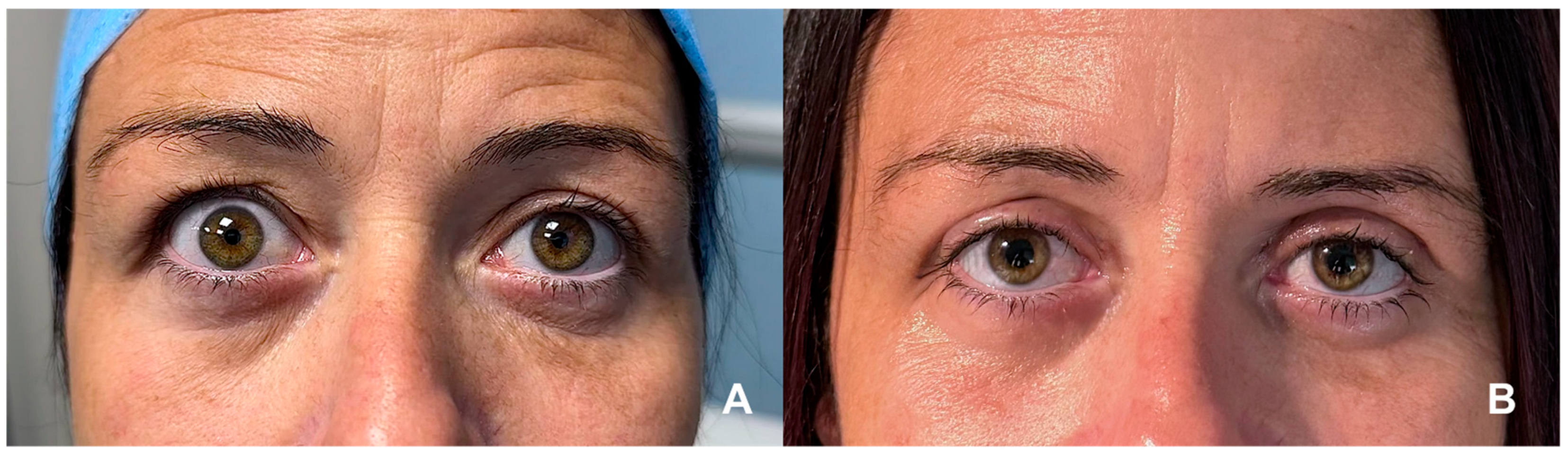
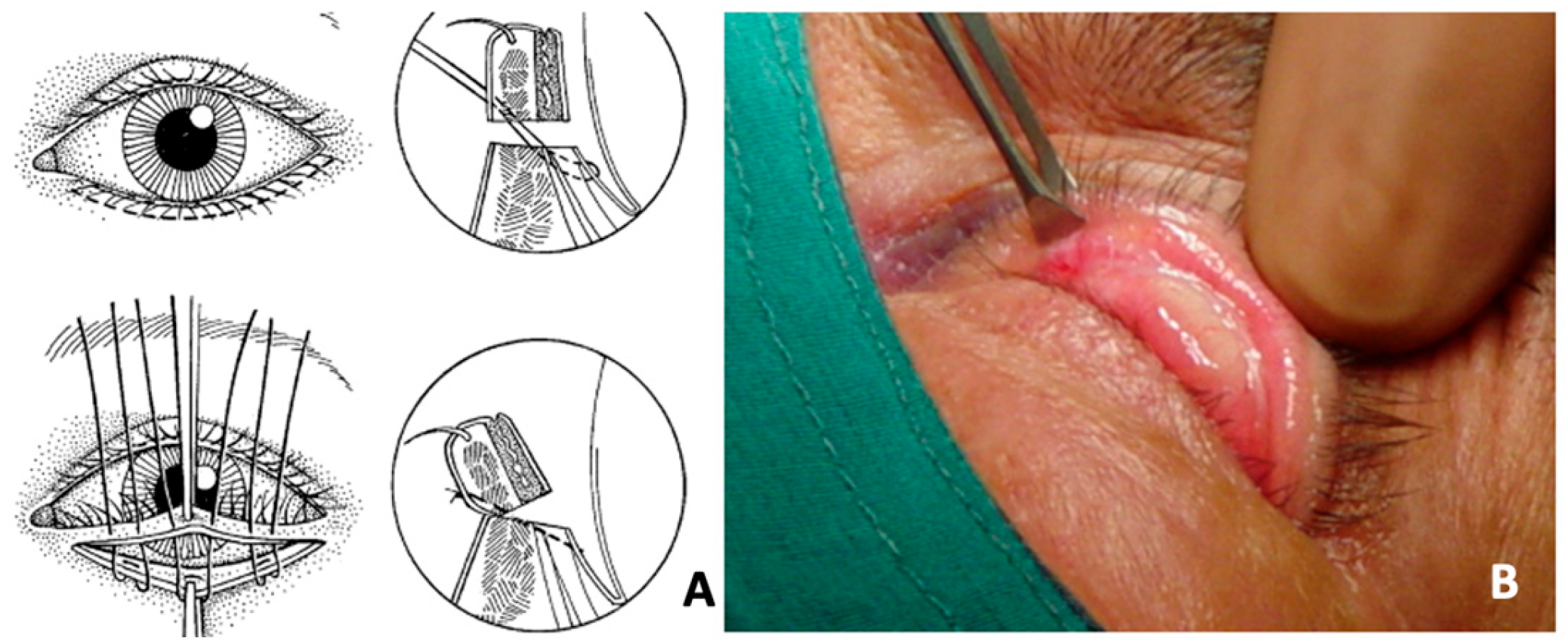
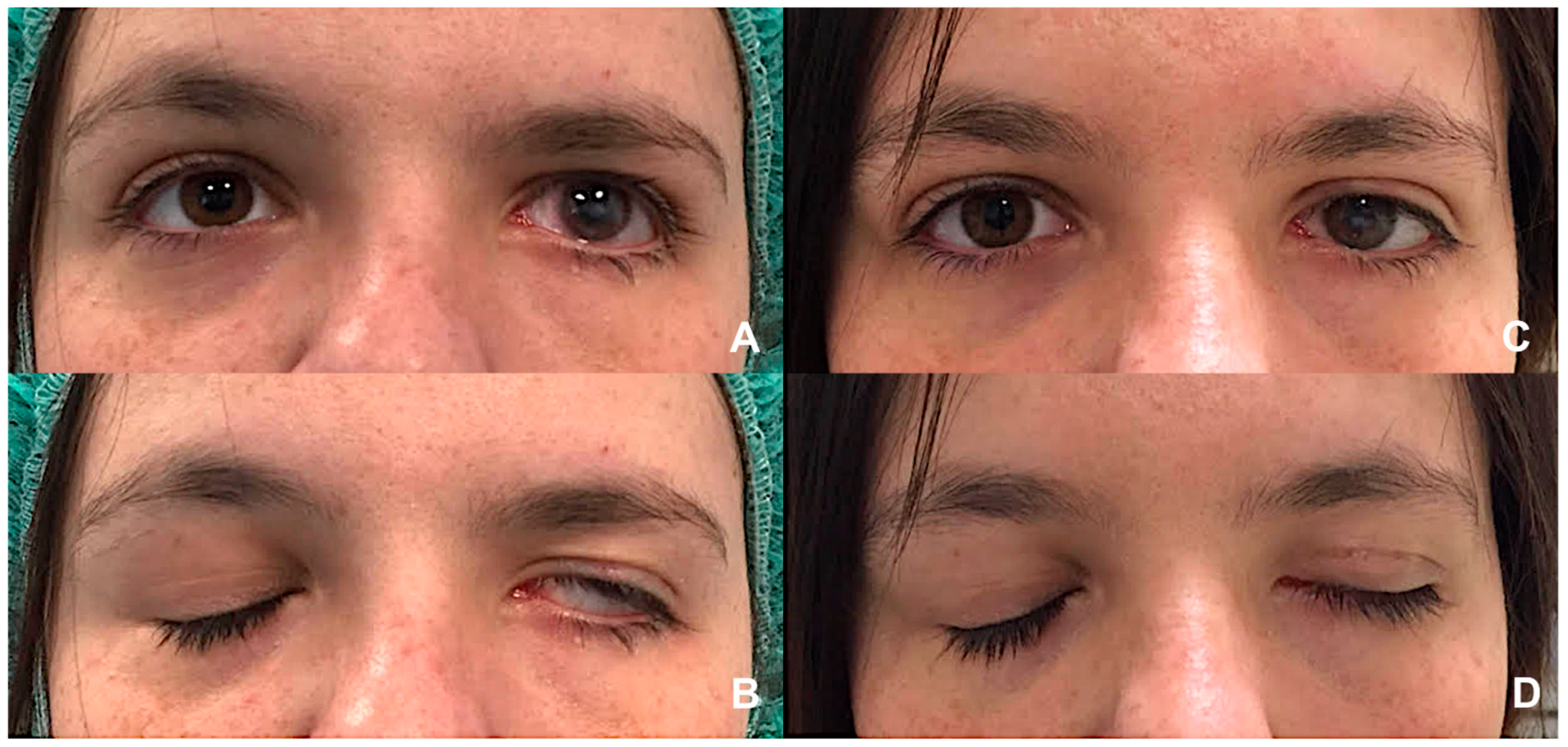
Eyelid Malpositions and Ocular Surface Disease: Clinical Correlations and Management Strategies
 ,
,
Abstract
1. Introduction
2. Methods
3. Ocular Surface Implications of Eyelid Retraction in Thyroid Eye Disease
3.1. Pathophysiology
3.2. Management of Eyelid Retraction in TED
4. Cicatricial Entropion and Ocular Surface Considerations
4.1. Etiology and Pathophysiology
4.2. Medical Management
4.3. Surgical Options
4.4. Evidence Summary and Outcomes
5. Oculoplastic Management of Facial Nerve Palsy
5.1. Pathophysiology
5.2. Medical Management
5.3. Surgical Options
5.4. Functional Epiphora
5.5. Evidence Summary and Outcomes
6. Discussion
7. Conclusions
Author Contributions
Funding
Institutional Review Board Statement
Informed Consent Statement
Conflicts of Interest
References
- Rana, H.S.; Akella, S.S.; Clabeaux, C.E.; Skurski, Z.P.; Aakalu, V.K. Ocular surface disease in thyroid eye disease: A narrative review. Ocul. Surf. 2022, 24, 67–73. [Google Scholar] [CrossRef]
- Huang, D.; Xu, N.; Song, Y.; Wang, P.; Yang, H. Inflammatory cytokine profiles in the tears of thyroid-associated ophthalmopathy. Graefes Arch. Clin. Exp. Ophthalmol. 2012, 250, 619–625. [Google Scholar] [CrossRef]
- Naik, M.N.; Walvekar, P.; Vasanthapuram, V.H.; Shankar, L. Eyelid Surgery in Thyroid Eye Disease. Ophthalmic Plast. Reconstr. Surg. 2023, 39, S92–S104. [Google Scholar] [CrossRef]
- Feldon, S.E.; Levin, L. Graves’ ophthalmopathy: V. Aetiology of upper eyelid retraction. Br. J. Ophthalmol. 1990, 74, 484–485. [Google Scholar] [CrossRef]
- Cruz, A.A.; Ribeiro, S.F.; Garcia, D.M.; Akaishi, P.M.; Pinto, C.T. Graves upper eyelid retraction. Surv. Ophthalmol. 2013, 58, 63–76. [Google Scholar] [CrossRef]
- Kozaki, A.; Inoue, R.; Yaji, N.; Nishiyama, K.; Inoue, T. Subcutaneous Injections of Triamcinolone Acetonide for Upper Eyelid Retraction and Swelling Associated with Thyroid Eye Disease: A Retrospective Case Series Study. Clin. Ophthalmol. 2024, 18, 2147–2154. [Google Scholar] [CrossRef]
- Chng, C.L.; Zheng, K.; Kwee, A.K.; Ming-Han, H.L.; Ting, D.; Wong, C.P.; Hu, G.; Ooi, B.C.; Kheok, S.W. Application of artificial intelligence in the assessment of thyroid eye disease (TED): A scoping review. Front. Endocrinol. 2023, 14, 1300196. [Google Scholar] [CrossRef]
- Khurana, A.K.; Sunder, S.; Ahluwalia, B.K.; Malhotra, K.C. Tear film profile in Graves’ ophthalmopathy. Acta Ophthalmol. 1992, 70, 346–349. [Google Scholar] [CrossRef]
- Pinas, D.; De Keizer, R.O.B.; Wubbels, R.J.; van den Bosch, W.A.; Paridaens, D. Results of surgical correction of upper eyelid retraction in Graves’ Orbitopathy. Acta Ophthalmol. 2021, 99, e608–e613. [Google Scholar] [CrossRef]
- Kakizaki, H.; Malhotra, R.; Madge, S.N.; Selva, D. Lower eyelid anatomy: An update. Ann. Plast. Surg. 2009, 63, 344–351. [Google Scholar] [CrossRef]
- Burch, H.B.; Perros, P.; Bednarczuk, T.; Cooper, D.S.; Dolman, P.J.; Leung, A.M.; Mombaerts, I.; Salvi, M.; Stan, M.N. Management of Thyroid Eye Disease: Consensus Statement. Thyroid 2022, 32, 1439–1470. [Google Scholar] [CrossRef]
- Lee, D.C.; Young, S.M.; Kim, Y.D.; Woo, K.I. Course of upper eyelid retraction in thyroid eye disease. Br. J. Ophthalmol. 2020, 104, 254–259. [Google Scholar] [CrossRef] [PubMed]
- Young, S.M.; Kim, Y.D.; Lang, S.S.; Woo, K.I. Transconjunctival Triamcinolone Injection for Upper Lid Retraction in TED. Ophthalmic Plast. Reconstr. Surg. 2018, 34, 587–593. [Google Scholar] [CrossRef]
- Morgenstern, K.E.; Evanchan, J.; Foster, J.A.; Cahill, K.V.; Burns, J.A.; Holck, D.E.E.; Perry, J.D.; Wulc, A.E. Botulinum toxin type A for dysthyroid upper eyelid retraction. Ophthalmic Plast. Reconstr. Surg. 2004, 20, 181–185. [Google Scholar] [CrossRef]
- Costa, P.G.; Saraiva, F.P.; Pereira, I.C.; Monteiro, M.L.R.; Matayoshi, S. Comparative study of Botox injection for upper eyelid retraction. Eye 2009, 23, 767–773. [Google Scholar] [CrossRef]
- Kohn, J.C.; Rootman, D.B.; Liu, W.; Goh, A.S.; Hwang, C.J.; Goldberg, R.A. Hyaluronic acid gel injection for upper eyelid retraction in thyroid eye disease. Ophthalmic Plast. Reconstr. Surg. 2014, 30, 400–404. [Google Scholar] [CrossRef]
- Goldberg, R.A.; Lee, S.; Jayasundera, T.; Tsirbas, A.; Douglas, R.S.; McCann, J.D. Treatment of lower eyelid retraction by expansion with hyaluronic acid gel. Ophthalmic Plast. Reconstr. Surg. 2007, 23, 343–348. [Google Scholar] [CrossRef]
- Mancini, R.; Khadavi, N.M.; Goldberg, R.A. Nonsurgical management of upper eyelid margin asymmetry using HA filler. Ophthalmic Plast. Reconstr. Surg. 2011, 27, 1–3. [Google Scholar] [CrossRef]
- Ugradar, S.; Braun, J.; Wang, Y.; Zimmerman, E.; Douglas, R.S. Facial and Eyelid Changes in TED Are Reversed by Teprotumumab. Plast. Reconstr. Surg. Glob. Open 2021, 9, e3809. [Google Scholar] [CrossRef]
- Rosenblatt, T.R.; Chiou, C.A.; Yoon, M.K.; Lee, N.G.; Wolkow, N.; Freitag, S.K. Change in upper eyelid position after teprotumumab treatment for TED. Orbit 2024, 43, 337–343. [Google Scholar] [CrossRef]
- Al-Sharif, E.M.; Zhou, J.; Shoji, M.K.; Acuff, K.; Liu, C.Y.; Korn, B.S.; Kikkawa, D.O. Effects of Teprotumumab on Eyelid Retraction in TED. Ophthalmic Plast. Reconstr. Surg. 2025, 41, 22–27. [Google Scholar] [CrossRef]
- Quaranta Leoni, F.M.; Verity, D.H.; Paridaens, D. Management of Eyelid Retraction. In Oculoplastic, Lacrimal and Orbital Surgery; Quaranta Leoni, F.M., Verity, D.H., Paridaens, D., Eds.; Springer: Cham, Switzerland, 2024. [Google Scholar] [CrossRef]
- Uccello, G.; Strianese, D.; Vassallo, P.; Bonavolonta, G. Free Levator complex recession in Graves’ Ophthalmopathy our experience. Orbit 1994, 13, 119–123. [Google Scholar] [CrossRef]
- Sales-Sanz, M.; Huelin, F.J.; Ye-Zhu, C.; Cruz, A.V.; Muñoz-Negrete, F.J.; Rebolleda, G. Müllerotomy with anterior graded levator disinsertion for upper eyelid retraction. Graefes Arch. Clin. Exp. Ophthalmol. 2023, 261, 1141–1149. [Google Scholar] [CrossRef]
- Gonçalves, A.C.P.; Nogueira, T.; Silva, L.D.; Matayoshi, S.; Mário, L.R.; Monteiro, M.L.R. A Comparative Study of Full-Thickness Blepharotomy Versus Transconjunctival Eyelid Lengthening in the Correction of Upper Eyelid Retraction in Graves’ Orbitopathy. Aesthetic Plast. Surg. 2018, 42, 215–223. [Google Scholar] [CrossRef]
- Quaranta-Leoni, F.M.; Di Marino, M.; Leonardi, A.; Verrilli, S.; Romeo, R. Single-stage Orbital Decompression, Strabismus and Eyelid Surgery in Moderate to Severe Thyroid Associated Orbitopathy. Orbit 2022, 41, 184–192. [Google Scholar] [CrossRef] [PubMed]
- Park, E.; Lewis, K.; Alghoul, M.S. Comparison of efficacy and complications among various spacer grafts in the treatment o lower eyelid retraction: A systematic review. Aesthetic Surg. J. 2017, 37, 743–754. [Google Scholar] [CrossRef]
- Tao, J.P.; Wladis, E.J.; Yen, M.T.; Sobel, R.K.; Freitag, S.K.; Foster, J.A.; Yen, M.T. Bioengineered Acellular Dermal Matrix Spacer Grafts for Lower Eyelid Retraction Repair. Ophthalmology 2020, 127, 689–695. [Google Scholar] [CrossRef]
- Norris, J.H.; Ross, J.J.; O’Reilly, P.; Malhotra, R. Combined orbital decompression and lower eyelid recession for retraction in TED. Br. J. Ophthalmol. 2011, 95, 1664–1669. [Google Scholar] [CrossRef]
- Kazim, M.; Gold, K.G. Surgical techniques to correct upper eyelid retraction in TED. Curr. Opin. Ophthalmol. 2011, 22, 391–393. [Google Scholar] [CrossRef]
- Golan, S.; Rootman, D.B.; Goldberg, R.A. Success rate of TED upper eyelid retraction reoperations. Orbit 2016, 35, 335–338. [Google Scholar] [CrossRef]
- Narang, P.; D’Souza, S. Chronic Ocular Sequelae of Stevens-Johnson Syndrome: Recent Advances in Understanding of Patho-Physiology and Management. Semin Ophthalmol. 2025, 1–11, Epub ahead of print. [Google Scholar] [CrossRef] [PubMed]
- Singh, S.; Donthineni, P.R.; Shanbhag, S.S.; Senthil, S.; Ong, H.S.; Dart, J.K.; Basu, S. Drug-induced cicatrizing conjunctivitis: Case series and review. Ocul. Surf. 2022, 24, 83–92. [Google Scholar] [CrossRef]
- Branisteanu, D.C.; Stoleriu, G.; Branisteanu, D.E.; Boda, D.; Branisteanu, C.I.; Maranduca, M.A.; Moraru, A.; Stanca, H.T.; Zemba, M.; Balta, F. Ocular cicatricial pemphigoid. Exp. Ther. Med. 2020, 20, 3379–3382. [Google Scholar] [CrossRef]
- Li, H.; Ezra, D.G.; Burton, M.J.; Bailly, M. Doxycycline prevents matrix remodeling and contraction by trichiasis-derived conjunctival fibroblasts. Investig. Ophthalmol. Vis. Sci. 2013, 54, 4675–4682. [Google Scholar] [CrossRef] [PubMed] [PubMed Central]
- Deshmukh, R.; Ting, D.S.J.; Elsahn, A.; Mohammed, I.; Said, D.G.; Dua, H.S. Real-world experience of using ciclosporin-A 0.1% in the management of ocular surface inflammatory diseases. Br. J. Ophthalmol. 2022, 106, 1087–1092. [Google Scholar] [CrossRef] [PubMed] [PubMed Central]
- Joseph, V.H.T.M.; Medina, N.H.; Lopes, M.F.C.; de Guimarães, J.A.; e Cruz, A.A.V. Surgical treatment of eyelid sequelae due to trachoma. Arq. Bras. Oftalmol. 2025, 88, e20240279. [Google Scholar] [CrossRef]
- Malhotra, R.; Yau, C.; Norris, J.H. Outcomes of lower eyelid cicatricial entropion repair. Ophthalmic Plast. Reconstr. Surg. 2012, 28, 134–139. [Google Scholar] [CrossRef]
- Bouazza, M.; Elbelhadji, M.; Cherkaoui, S.; Mchachi, A.; Benhmidoune, L.; Chakib, A.; Rachid, R.; Amraoui, A. Marginoplastie par recul de la lamelle antérieure dans le traitement de l’entropion trichiasis trachomateux de la paupière supérieure [Anterior lamellar resection with lid margin split of the upper eyelid in the treatment of trachomatous entropion]. J. Fr. Ophtalmol. 2017, 40, 453–459. (In French) [Google Scholar] [CrossRef] [PubMed]
- Chi, M.; Kim, H.J.; Vagefi, R.; Kersten, R.C. Modified tarsotomy for severe cicatricial entropion. Eye 2016, 30, 992–997. [Google Scholar] [CrossRef]
- Diab, M.M.; Allen, R.C. Recurrent upper eyelid trachomatous entropion repair: Long-term efficacy. Eye 2021, 35, 2781–2786. [Google Scholar] [CrossRef]
- Zhang, L.; Hou, Z.; Li, Y.; Li, D. Combined surgical strategies for severe upper eyelid cicatricial entropion. J. Craniofac. Surg. 2023, 34, 764–767. [Google Scholar] [CrossRef]
- Anklesaria, V.; Ogbu, N.; Singh, S. Long-term outcomes of eyelash-sparing technique for severe cicatricial entropion. Eur. J. Ophthalmol. 2025, 35, 1117–1122. [Google Scholar] [CrossRef] [PubMed]
- Lee, S.; Lew, H. Ophthalmologic clinical features of facial nerve palsy patients. Korean J. Ophthalmol. 2019, 33, 1–7. [Google Scholar] [CrossRef] [PubMed]
- Lee, V.; Currie, Z.; Collin, J.R.O. Ophthalmic management of facial nerve palsy. Eye 2004, 18, 1225–1234. [Google Scholar] [CrossRef] [PubMed]
- Hohman, M.H.; Hadlock, T.A. Etiology, diagnosis, and management of facial palsy: 2000 patients at a facial nerve center. Laryngoscope 2014, 124, E283–E293. [Google Scholar] [CrossRef]
- Yao, A.; Malhotra, R. Ophthalmic and periocular management of facial nerve palsy. Saudi. J. Ophthalmol. 2025, 39, 117–124. [Google Scholar] [CrossRef]
- Pereira, M.V.C.; Glória, A.L.F. Lagophthalmos. Semin. Ophthalmol. 2010, 25, 72–78. [Google Scholar] [CrossRef]
- Guerrero-de Ferran, C.; Bastán-Fabián, D.; Del Castillo-Morales, A.; Rivera-Alvarado, I.J.; Valdez García, J.E. Epidemiology, Tear Film, and Meibomian Gland Dysfunction in Facial Palsy: A Comparative Analysis. Clin. Ophthalmol. 2025, 19, 93–100. [Google Scholar] [CrossRef] [PubMed] [PubMed Central]
- Alicandri-Ciufelli, M.; Pavesi, G.; Presutti, L. Facial nerve grading scales: Systematic review and suggestion for uniformity. Plast. Reconstr. Surg. 2015, 135, 929e–930e. [Google Scholar] [CrossRef]
- Mengi, E.; Orhan Kara, C.; Necdet Ardıç, F.; Topuz, B.; Metin, U.; Alptürk, U.; Aydemir, G.; Şenol, H. Comparison of the Reliability of the House- Brackmann, Facial Nerve Grading System 2.0, and Sunnybrook Facial Grading System for the Evaluation of Patients with Peripheral Facial Paralysis. J. Int. Adv. Otol. 2024, 20, 14–18. [Google Scholar] [CrossRef] [PubMed] [PubMed Central]
- Yao, A.; Jayawickrema, N.; Malhotra, R. CADS as a decision-making tool. Ophthalmic Plast. Reconstr. Surg. 2025, 41, 143–147. [Google Scholar] [CrossRef] [PubMed]
- Lim, C.S.; Nagendran, S.; Neville, C.; Nduka, C.; Kannan, R.; Malhotra, R. The Effectiveness of Facial Exercise Therapy in Ophthalmic Complications of Facial Nerve Palsy and the CADS Grading Scale as an Ophthalmic-Specific Grading System. Ophthalmic Plast. Reconstr. Surg. 2024, 40, 685–695. [Google Scholar] [CrossRef] [PubMed]
- Wolkow, N.; Chodosh, J.; Freitag, S.K. Innovations in treatment of lagophthalmos and exposure keratopathy. Int. Ophthalmol. Clin. 2017, 57, 85–103. [Google Scholar] [CrossRef] [PubMed]
- Yu, X.Y.; Xue, L.Y.; Zhou, Y.; Shen, J.; Yin, L. Management of corneal ulceration with a moisture chamber due to temporary lagophthalmos in a brain injury patient: A case report. World J. Clin. Cases 2021, 9, 1127–1131. [Google Scholar] [CrossRef] [PubMed] [PubMed Central]
- Stevens, S. Taping an eyelid closed. Community Eye Health 2012, 25, 36. [Google Scholar] [PubMed] [PubMed Central]
- Yoshimura, A.; Araki-Sasaki, K.; Toyokawa, N.; Ryo Fujiwara, R.; Takahashi, K.; Gomi, F. Synthetic rubber sheet to manage exposure keratopathy. Am. J. Ophthalmol. Case Rep. 2021, 23, 101185. [Google Scholar] [CrossRef]
- Schrom, T.; Habermann, A. Temporary ectropion therapy by adhesive taping. Head Face Med. 2008, 4, 12. [Google Scholar] [CrossRef]
- Coulson, S.; Francis, F. Patients’ perspectives of ophthalmic management of facial nerve paralysis. BMJ Open Ophthalmol. 2025, 10, e001933. [Google Scholar] [CrossRef] [PubMed] [PubMed Central]
- Lim, C.S.; Neville, C.; Nduka, C.; Kannan, R.; Malhotra, R. Periocular Management of Pediatric Facial Nerve Palsy. Am. J. Ophthalmol. 2025, 278, 292–304. [Google Scholar] [CrossRef] [PubMed]
- Harthan, J.S.; Shorter, E. Therapeutic uses of scleral lenses. Clin. Optom. 2018, 10, 65–74. [Google Scholar] [CrossRef]
- Özbek, Z.; Kefeli, I. Scleral lens in chronic lagophthalmos to preserve a corneal graft. Turk. J. Ophthalmol. 2024, 54, 103–105. [Google Scholar] [CrossRef]
- Weyns, M.; Koppen, C.; Tassignon, M.J. Scleral lenses vs tarsorrhaphy in exposure/neurotrophic keratopathy. Cornea 2013, 32, 359–361. [Google Scholar] [CrossRef] [PubMed]
- Latkany, R.; Lock, B.; Speaker, M. Nocturnal lagophthalmos: Overview and classification. Ocul. Surf. 2006, 4, 44–53. [Google Scholar] [CrossRef] [PubMed]
- Shanmuganathan, V.S.; Kethees, A.; Chang, S.H.; Papageorgiou, K. External eyelid weights in acute facial palsy. Oxf. Med. Case. Rep. 2018, 2018, omx087. [Google Scholar] [CrossRef] [PubMed]
- Seiff, S.R.; Boerner, M.; Carter, S.R. External eyelid weights for facial palsies. Am. J. Ophthalmol. 1995, 120, 652–657. [Google Scholar] [CrossRef]
- Yücel, Ö.E.; Artürk, N. Protective ptosis with botulinum toxin-A in FNP. Ophthalmic Plast. Reconstr. Surg. 2012, 28, 256–260. [Google Scholar] [CrossRef]
- Robinson, C.; Tantri, A.; Shriver, E.; Oetting, T. Temporary eyelid closure appliqué. Arch. Ophthalmol. 2006, 124, 546–549. [Google Scholar] [CrossRef]
- Wiener, A.; Touloei, K.; Glick, B.P. A Novel Long-term Therapy of Facial Synkinesis with Botulinum Neurotoxins Type A and Fillers. J. Clin. Aesthet. Dermatol. 2011, 4, 45–49. [Google Scholar] [PubMed Central]
- Toffola, E.D.; Furini, F.; Redaelli, C.; Prestifilippo, E.; Bejor, M. Botulinum toxin for synkinesis after FNP. Disabil. Rehabil. 2010, 32, 1414–1418. [Google Scholar] [CrossRef]
- Lu, T.J.; Nguyen, J.; Kossler, A.L.; Fay, A.; Homer, N.A. Positional lagophthalmos variability in facial nerve palsy with and without upper eyelid loading. Orbit 2025, 44, 390–394. [Google Scholar] [CrossRef] [PubMed]
- Bladen, J.C.; Norris, J.H.; Malhotra, R. Cosmetic comparison: Gold vs platinum loading. Ophthalmic Plast. Reconstr. Surg. 2012, 28, 171–175. [Google Scholar] [CrossRef] [PubMed]
- Siah, W.F.; Nagendran, S.; Tan, P.; Ahmad, S.M.A.; Litwin, A.S.; Malhotra, R. Late outcomes of gold weights and platinum chains. Br. J. Ophthalmol. 2018, 102, 164–168. [Google Scholar] [CrossRef] [PubMed]
- Ben Artsi, E.; Ullrich, K.; Brusasco, L.; Malhotra, R. Platinum segment chains: Long-term outcomes. Am. J. Ophthalmol. 2020, 214, 188–195. [Google Scholar] [CrossRef]
- Nowak-Gospodarowicz, I.; Koktysz, R.; Rękas, M. Impact of implantation site in gold weight loading. Sci. Rep. 2022, 12, 11869. [Google Scholar] [CrossRef]
- Elahi, E.; Afshin, E.E.; Guthrie, A.J.; Lo, C. Sutureless transconjunctival eyelid weight insertion. Ophthalmic Plast. Reconstr. Surg. 2022, 38, 87–89. [Google Scholar] [CrossRef]
- Bladen, J.C.; Norris, J.H.; Malhotra, R. Indications and outcomes for revision of gold implants. Br. J. Ophthalmol. 2012, 96, 485–489. [Google Scholar] [CrossRef]
- Shapira, Y.; Ullrich, K.; Masqood, S.; Okafor, L.; Malhoyta, R. Eyelid skin grafting in young FNP. J. Clin. Med. 2024, 13, 2142. [Google Scholar] [CrossRef]
- Rajabi, M.T.; Shadravan, M.; Mazloumi, M.; Tabatabaje, S.Z.; Hosseini, S.S.; Rajabi, R.B. Bupivacaine injection for long-standing idiopathic FNP lagophthalmos. Ophthalmic Plast. Reconstr. Surg. 2015, 31, 459–462. [Google Scholar] [CrossRef]
- Korteweg, S.F.S.; Stenekes, M.W.; Van Zyl, F.E.; Werker, P.M.N. Lateral periosteal flap canthoplasty for paralytic ectropion; ectropion severity score. Plast. Reconstr. Surg. Glob. Open 2014, 2, e151. [Google Scholar] [CrossRef]
- Kim, M.J.; Choi, Y.M.; Kim, N.; Choung, H.-K.; Khwarg, S.I. Spacer grafts for lower-lid retraction in FNP. Eur. J. Ophthalmol. 2022, 32, 2072–2077. [Google Scholar] [CrossRef]
- Keilani, C.; Sahel, J.A.; Nordmann, J.P.; Boumendil, J. Dermis spacer graft + canthopexy + subperiosteal midface lift. J. Maxillofac. Oral. Surg. 2022, 21, 1–8. [Google Scholar] [CrossRef]
- Tao, B.K.; Dhivagaran, T.; Butt, F.R.; Balas, M.; Hussain, A.; Nijhawan, N.; Nassralla, G.; Ing, E. Ectropion repair techniques; role of superotemporal skin transposition. J. Clin. Med. 2025, 14, 827. [Google Scholar] [CrossRef] [PubMed]
- Chung, J.E.; Yen, M.T. Midface lifting as adjunct in ectropion repair. Ann. Plast. Surg. 2007, 59, 635–640. [Google Scholar] [CrossRef] [PubMed]
- Rose, E.H. Autogenous fascia lata in facial reanimation. Plast. Reconstr. Surg. 2005, 116, 20–32. [Google Scholar] [CrossRef]
- Bartholomew, R.A.; Ein, L.; Jowett, N. Lower eyelid sling for paralytic lagophthalmos. Facial Plast. Surg. Aesthet. Med. 2023, 25, 226–231. [Google Scholar] [CrossRef]
- Pandey, N.; Jayaprakasam, A.; Feldman, I.; Malhotra, R. Upper eyelid levator-recession and anterior lamella repositioning through the grey-line: Avoiding a skin-crease incision. Indian J. Ophthalmol. 2018, 66, 273–277. [Google Scholar] [CrossRef] [PubMed] [PubMed Central]
- Siah, W.F.; Boboridis, K.; Tan, P.; Litwin, A.S.; Dają, S.M.; Malhotra, R. Meibomian gland inversion: Under-recognized entity. Acta Ophthalmol. 2019, 97, e1116–e1122. [Google Scholar] [CrossRef]
- Butler, D.P.; Nagendran, S.; Malhotra, R. Direct brow lift in facial palsy: Four key modifications. Ophthalmic Plast. Reconstr. Surg. 2021, 37, 179–182. [Google Scholar] [CrossRef]
- Ducic, Y.; Adelson, R. Endoscopic forehead lift in persistent facial paralysis. Arch. Facial Plast. Surg. 2005, 7, 51–54. [Google Scholar] [CrossRef]
- Pool, C.D.; Lighthall, J.G. Modified mini direct bone-anchored browlift. Oper. Tech. Otolaryngol. Head Neck Surg. 2023, 34, e20–e22. [Google Scholar] [CrossRef]
- Siah, W.F.; Litwin, A.S.; Nduka, C.; Malhotra, R. Periorbital autologous fat grafting in FNP. Ophthalmic Plast. Reconstr. Surg. 2017, 33, 202–208. [Google Scholar] [CrossRef] [PubMed]
- Lim, C.; Martin, P.; Benger, R.; Kourt, G.; Gabrial, R. Jones-tube lacrimal canalicular bypass. Am. J. Ophthalmol. 2004, 137, 101–108. [Google Scholar] [CrossRef] [PubMed]
- Peng, G.L.; Azizzadeh, B. Cross-facial nerve grafting for reanimation. Facial Plast. Surg. 2015, 31, 128–133. [Google Scholar] [CrossRef] [PubMed]
- Kim, I.A.; Maxim, T.; Echanique, K. Modern cross-facial nerve grafting. Oper. Tech. Otolaryngol. Head Neck Surg. 2022, 33, 20–28. [Google Scholar] [CrossRef]
- Telich-Tarriba, J.E.; Navarro-Barquin, D.F.; Pineda-Aldana, G.; Cardenas-Mejia, A. Triple nerve transfers for early unilateral facial palsy. J. Plast. Surg. Hand Surg. 2023, 58, 62–66. [Google Scholar] [CrossRef]
- Giannaccare, G.; Bolognesi, F.; Fogagnolo, P.; Allevi, F.; Ruggiero, F.; Filipov, I.; Marchetti, C.; Scorcia, V.; Biglioli, F. Sural-nerve vertical cross-face graft for lacrimal neurotization. Cornea 2022, 42, 121–126. [Google Scholar] [CrossRef]
- Okafor, L.; Mavrikakis, I.; Malhotra, R. Facial Palsy. In Oculoplastic, Lacrimal and Orbital Surgery; Quaranta Leoni, F.M., Verity, D.H., Paridaens, D., Eds.; Springer: Cham, Switzerland, 2024. [Google Scholar] [CrossRef]
- Varelas, E.A.; Gidumal, S.; Verma, H.; Vujovic, D.; Rosenberg, J.D.; Gray, M. Physical therapy for idiopathic facial paralysis: Systematic review. Am. J. Otolaryngol. 2025, 46, 104511. [Google Scholar] [CrossRef]
- Khan, A.J.; Szczepura, A.; Palmer, S.; Bark, C.; Naville, C.; Thomson, D.; Martin, H.; Nduka, C. Facial exercise therapy in Bell’s palsy: Updated systematic review. Clin. Rehabil. 2022, 36, 1424–1443. [Google Scholar] [CrossRef]
- Nicastri, M.; Mancini, P.; De Seta, D.; Bertoli, G.; Prosperini, L.; Toni, D.; Inghilleri, M.; Filipo, R. Early physical therapy in severe Bell’s palsy: RCT. Neurorehabilit. Neural Repair. 2013, 27, 542–551. [Google Scholar] [CrossRef]
- Tai, E.L.M.; Lee, A.L.; Kueh, Y.C.; Abdullah, B.; Chang, B. Interventions in functional epiphora-a systematic review. Int J Ophthalmol. 2025, 18, 937–950. [Google Scholar] [CrossRef] [PubMed] [PubMed Central]
- Madge, S.N.; Selva, D.; Leibovitch, I.; Davis, G.; Malhotra, R. Lacrimal bypass tube for pump failure due to facial palsy. Am. J. Otolaryngol. 2010, 31, 441–444. [Google Scholar] [CrossRef]
- Ziahosseini, K.; Al-Abbadi, Z.; Malhotra, R. Botulinum toxin for epiphora from lacrimal outflow obstruction. Eye 2015, 29, 565–661. [Google Scholar] [CrossRef] [PubMed]
- Shams, P.N.; Chen, P.G.; Wormald, P.J.; Sloan, B.; Wilcsek, G.; McNab, A.; Selva, D. Management of functional epiphora in patients with an anatomically patent dacryocystorhinostomy. JAMA Ophthalmol. 2014, 132, 1127–1132. [Google Scholar] [CrossRef] [PubMed]
- Fiorino, M.G.; Quaranta-Leoni, C.; Quaranta-Leoni, F.M. Proximal lacrimal obstructions: A review. Acta Ophthalmol. 2021, 99, 701–711. [Google Scholar] [CrossRef] [PubMed]
- Quaranta-Leoni, F.M.; Fiorino, M.G.; Serricchio, F.; Quaranta-Leoni, F. Management of proximal lacrimal obstructions: A rationale. Acta Ophthalmol. 2021, 99, e569–e575. [Google Scholar] [CrossRef] [PubMed]
- Madge, S.N.; Malhotra, R.; Desousa, J.; McNab, A.; O’Donnell, B.; Dolman, P.; Selva, D. Lacrimal bypass tube for pump failure due to facial palsy. Am. J. Ophthalmol. 2010, 149, 155–159. [Google Scholar] [CrossRef]
- StatPearls. Crocodile Tears Syndrome; StatPearls Publishing: Treasure Island, FL, USA, 2025. [Google Scholar]
- Singh, S.; Ali, M.J.; Kaliki, S.; Naik, M.N. Lacrimal gland botulinum toxin for functional vs non-functional epiphora. Ophthalmic Plast. Reconstr. Surg. 2019, 35, 382–386. [Google Scholar] [CrossRef]
- Wojno, T.H.; Freitag, S.K. Lacrimal gland botulinum toxin injection for epiphora. Ophthalmology 2011, 118, 1921–1926. [Google Scholar] [CrossRef]
- Krivda, K.; Clabeaux, C.; Yakopson, V. Crocodile tear syndrome treated with lacrimal gland incobotulinum toxin A injection: A report of two cases. Digit J Ophthalmol. 2023, 29, 97–1000. [Google Scholar] [CrossRef] [PubMed] [PubMed Central]
- Riemann, R.; Pfennigsdorf, S.; Riemann, E.; Naumann, M. Successful treatment of crocodile tears by injection of botulinum toxin into the lacrimal gland: A case report. Ophthalmology 1999, 106, 2322–2324. [Google Scholar] [CrossRef]
- Singh, S.; Bothra, N.; Ali, M.J. Lacrimal gland targeted therapies for refractory epiphora: Quantitative changes in the gland activity. Orbit 2024, 43, 74–79. [Google Scholar] [CrossRef] [PubMed]
- Quaranta Leoni, F.; Panariello, S.; Quaranta Leoni, F.M. Is Lacrimal Gland Excision a Viable Alternative for the Treatment of Epiphora in Canalicular Obstruction? In Proceedings of the 43° ESOPRS Meeting, Prague, Czech Republic, 11–13 September 2025.



| Approach | Treatment/ Procedure | Mechanism of Action/Target | Indication/ Clinical Phase | Advantages/ Outcomes | Limitations/ Complications |
|---|---|---|---|---|---|
| Non-Surgical | Subconjunctival Triamcinolone Acetonide | Corticosteroid-induced reduction in inflammation and levator hypertrophy | Active inflammatory TED; early retraction | Decreases levator thickness; improves eyelid position | IOP elevation, vascular events; requires monitoring [12] |
| Subconjunctival Betamethasone | Anti-inflammatory corticosteroid effect with longer duration | Active phase TED | Comparable or superior efficacy to TA with fewer injections | Limited long-term data [13] | |
| Botulinum Toxin Type A | Temporary chemodenervation of levator or Müller muscle | Mild retraction; early or transient cases | Minimally invasive; reversible; lasts 1–6 months | Transient ptosis, diplopia; repeated sessions needed [14,15] | |
| Hyaluronic Acid Fillers | Mechanical posterior lamellar lengthening and volumetric expansion | Mild–moderate retraction or contour asymmetry (active phase) | Immediate improvement; outpatient treatment | Transient edema, ecchymosis; temporary duration [16,17,18] | |
| Teprotumumab (IGF-1R Inhibitor) | Reduces orbital inflammation, fibrosis, and proptosis | Active inflammatory TED with eyelid retraction | Improves upper and lower eyelid position indirectly via decreased inflammatory tone | High cost; infusion-related effects [19,20,21] | |
| Surgical | Posterior Approach Müllerectomy/ Müller Muscle Recession | Partial excision or recession of Müller’s muscle via conjunctival route | Mild retraction (<2.5 mm) in stable phase | Predictable lowering; minimal external scar | Under/overcorrection; worsened dryness [23] |
| Anterior Levator Disinsertion or Reinsertion | Graded disinsertion and reattachment of levator aponeurosis | Moderate–severe retraction (>2.5 mm) | Adjustable intraoperatively; restores symmetry | Secondary ptosis; contour irregularity [24,25] | |
| Full-Thickness Blepharotomy Combined Upper-Lid Techniques | Complete release of eyelid retractors and anterior lamella | Severe retraction or revision cases | Provides large correction range | Secondary ptosis; contour irregularity; longer recovery [25] | |
| Single-Stage Orbital Decompression with Eyelid Surgery | Concurrent decompression and retraction correction | Severe proptosis with eyelid retraction | Improves globe position and symmetry; reduces staged procedures | Technically complex; higher operative time [26] | |
| Lower Eyelid Retraction Correction (with or without Spacer) | Lower-lid retractor recession + lengthening of posterior lamella | Stable TED with significant lower eyelid retraction | May incorporate hard-palate mucosa, autologous dermis, or alloplastic spacer materials | Graft-related bulkiness or resorption; may require revision [27,28,29,30] |
| Clinical Problem | Surgical Procedure | Surgical Technique | Advantages/Outcomes | Limitations/ Complications |
|---|---|---|---|---|
| Posterior Lamellar Contraction (Autoimmune, Infectious, Traumatic) | Gray-Line Splitting with Anterior Lamellar Recession and Posterior Advancement | Separation of anterior and posterior lamellae along the gray line; recession of retractors; everting sutures from superior tarsal border to skin near lash line. | Restores eyelid margin alignment; reduces lash-cornea contact. | Possible under- or over-correction; persistent keratinization [38,39]. |
| Keratinized or Thickened Tarsal Margin | Tarsal Margin Excision/Wedge Resection or Rotation | Excision (2–3 mm) of anterior lamella or wedge resection of tarsus; rotation to correct inversion; may include cryotherapy, electrolysis, or lash excision. | Removes abnormal tarsal tissue; re-establishes lid contour. | Margin irregularity, scarring, or recurrence of trichiasis [39,40,41]. |
| Mild-to-Moderate Cicatricial Entropion | Tarsotomy with Eyelid Margin Rotation/Eversion | Horizontal incision 2–3 mm below lash line through conjunctiva and tarsus; adhesions released; everting sutures rotate the margin outward. | Restores normal margin position; short recovery period. | Limited correction for advanced fibrosis; recurrence possible [40,41,42]. |
| Severe or Recurrent Cicatricial Entropion (e.g., Stevens–Johnson, Pemphigoid, Trachoma, Chemical Injury) | Posterior Lamellar Lengthening with Mucosal Graft | Posterior lamella dissected; autologous (hard palate, buccal mucosa) or allogeneic (amniotic membrane, donor sclera) graft sutured to tarsus and fornix. | Restores vertical height; improves ocular surface protection. | Graft contraction or failure; donor-site morbidity; recurrence [32,33,34,36,37,42,43]. |
| Procedure | Primary Indication/Objective | Technical Highlights | Advantages | Limitations/ Complications | |
|---|---|---|---|---|---|
| Upper Eyelid Procedures | Gold or Platinum Weight Implantation | Paralytic lagophthalmos; incomplete blink closure | Transcutaneous or transconjunctival fixation. | Provides dynamic eyelid closure and corneal protection | Implant prominence, migration, extrusion, allergic reaction [71,72,73,74,75,76,77] |
| Levator Recession ± Müllerectomy | Lagophthalmos with upper-lid retraction or nocturnal exposure | Recession of levator aponeurosis ± Müllerectomy | Reduces upper-lid retraction; avoids excessive loading | Risk of postoperative ptosis if overcorrected [78] | |
| Full-Thickness Skin Grafting | Anterior lamellar deficiency | Autografts from upper eyelid, retroauricular, or supraclavicular donor sites | Restores anterior lamellar coverage and contour | Graft contracture; delayed cosmetic maturation [78] | |
| Bupivacaine Injection | Chronic palsy with poor orbicularis tone | Targeted injection into paretic orbicularis | Temporary improvement in eyelid closure and tearing | Transient effect; variable response [79] | |
| Lower Eyelid Procedures | Lateral Tarsal Strip | Paralytic ectropion; horizontal laxity | Shortening and fixation of lateral tarsus to orbital rim | Reliable horizontal tightening and lid reapposition | Possible overcorrection or canthal rounding [80] |
| Medial Canthal Plication | Medial canthal laxity | Retrocaruncular approach with tendon plication | Restores medial support while preserving contour | Limited efficacy in severe laxity [80] | |
| Lateral Periosteal Flap Canthoplasty | Recurrent or severe ectropion | Creation of periosteal flap for canthal reconstruction | Durable, anatomically stable correction | Technically demanding [80] | |
| Spacer Graft Placement | Vertical lid shortening or retraction | Hard-palate mucosa, auricular cartilage, dermis-fat, or acellular dermal matrix | Restores vertical height and tarsal support | Donor-site morbidity; graft resorption [81,82] | |
| Midface Lift/ Cheek Elevation | Lid malposition with midface descent | Subperiosteal elevation and fixation | Restores lid–globe apposition and tone | Facial edema; recurrence [83,84] | |
| Fascia Lata or Temporalis Sling | Severe or recurrent ectropion | Autologous fascial suspension | Provides durable horizontal and vertical stabilization | Harvest-site morbidity [85,86] | |
| Lash and Lid Margin Procedures | Gray-Line Split and Tarsoplasty | Lash ptosis or cicatricial entropion | Anterior lamellar repositioning with selective sphincterotomy | Redirects lashes; improves corneal protection and cosmesis | Scarring or undercorrection [87,88] |
| Brow and Periorbital Procedures | Direct or Endoscopic Brow Lift | Brow ptosis or asymmetry | Direct excision or endoscopic elevation with periosteal fixation | Restores symmetry and visual field | Visible scarring (direct) or recurrence [89,90,91] |
| Periorbital Volume Augmentation | Periorbital hollowing or asymmetry | Autologous fat transfer or temporary fillers | Improves symmetry and blink mechanics | Reabsorption; contour irregularity [92,93] | |
| Dynamic Reanimation | Hypoglossal–Facial Transfer/Cross-Face Nerve Graft | Complete facial paralysis | Microsurgical nerve transfer or grafting | Restores active blink and tone | Delayed reinnervation; donor morbidity [94,95,96] |
| Free Muscle Transposition | Long-standing paralysis | Free muscle (e.g., gracilis) transfer with neural input | Enables dynamic eyelid and facial movement | Technically complex; variable functional gain [94,95,96,97] | |
| Lacrimal and Tear-Pump Surgery | Eyelid Tightening ± Punctal Repositioning | Functional epiphora from pump failure | Combined medial/lateral tightening, medial spindle procedure | Restores punctal apposition and improves pump efficiency | May require adjunct procedures [102,103,104,105] |
| External or Endoscopic DCR | Persistent tearing with pump dysfunction | Allows concurrent intranasal correction | Enhances lacrimal outflow | Ostium stenosis; granulation tissue [102,103,104,105] | |
| CDCR | Complete pump failure | Placement of Lester Jones tube | Provides definitive drainage bypass; long-term symptom relief | Tube extrusion, obstruction, migration, maintenance requirements [106,107,108] | |
| Adjunctive Procedures | Botulinum Toxin Injection (Lacrimal Gland) | Persistent tearing; crocodile tears syndrome | Injection into palpebral lobe of lacrimal gland | 70–80% response rate; minimally invasive | Transient dryness, ptosis; repeat injections required [110,111,112,113,114] |
Disclaimer/Publisher’s Note: The statements, opinions and data contained in all publications are solely those of the individual author(s) and contributor(s) and not of MDPI and/or the editor(s). MDPI and/or the editor(s) disclaim responsibility for any injury to people or property resulting from any ideas, methods, instructions or products referred to in the content. |
© 2025 by the authors. Licensee MDPI, Basel, Switzerland. This article is an open access article distributed under the terms and conditions of the Creative Commons Attribution (CC BY) license (https://creativecommons.org/licenses/by/4.0/).
Share and Cite
Quaranta Leoni, F.M.; Marabottini, N.; Iuliano, A.; Strianese, D.; Savino, G. Eyelid Malpositions and Ocular Surface Disease: Clinical Correlations and Management Strategies. J. Clin. Med. 2025, 14, 8523. https://doi.org/10.3390/jcm14238523
Quaranta Leoni FM, Marabottini N, Iuliano A, Strianese D, Savino G. Eyelid Malpositions and Ocular Surface Disease: Clinical Correlations and Management Strategies. Journal of Clinical Medicine. 2025; 14(23):8523. https://doi.org/10.3390/jcm14238523
Chicago/Turabian StyleQuaranta Leoni, Francesco M., Nazareno Marabottini, Adriana Iuliano, Diego Strianese, and Gustavo Savino. 2025. "Eyelid Malpositions and Ocular Surface Disease: Clinical Correlations and Management Strategies" Journal of Clinical Medicine 14, no. 23: 8523. https://doi.org/10.3390/jcm14238523
APA StyleQuaranta Leoni, F. M., Marabottini, N., Iuliano, A., Strianese, D., & Savino, G. (2025). Eyelid Malpositions and Ocular Surface Disease: Clinical Correlations and Management Strategies. Journal of Clinical Medicine, 14(23), 8523. https://doi.org/10.3390/jcm14238523