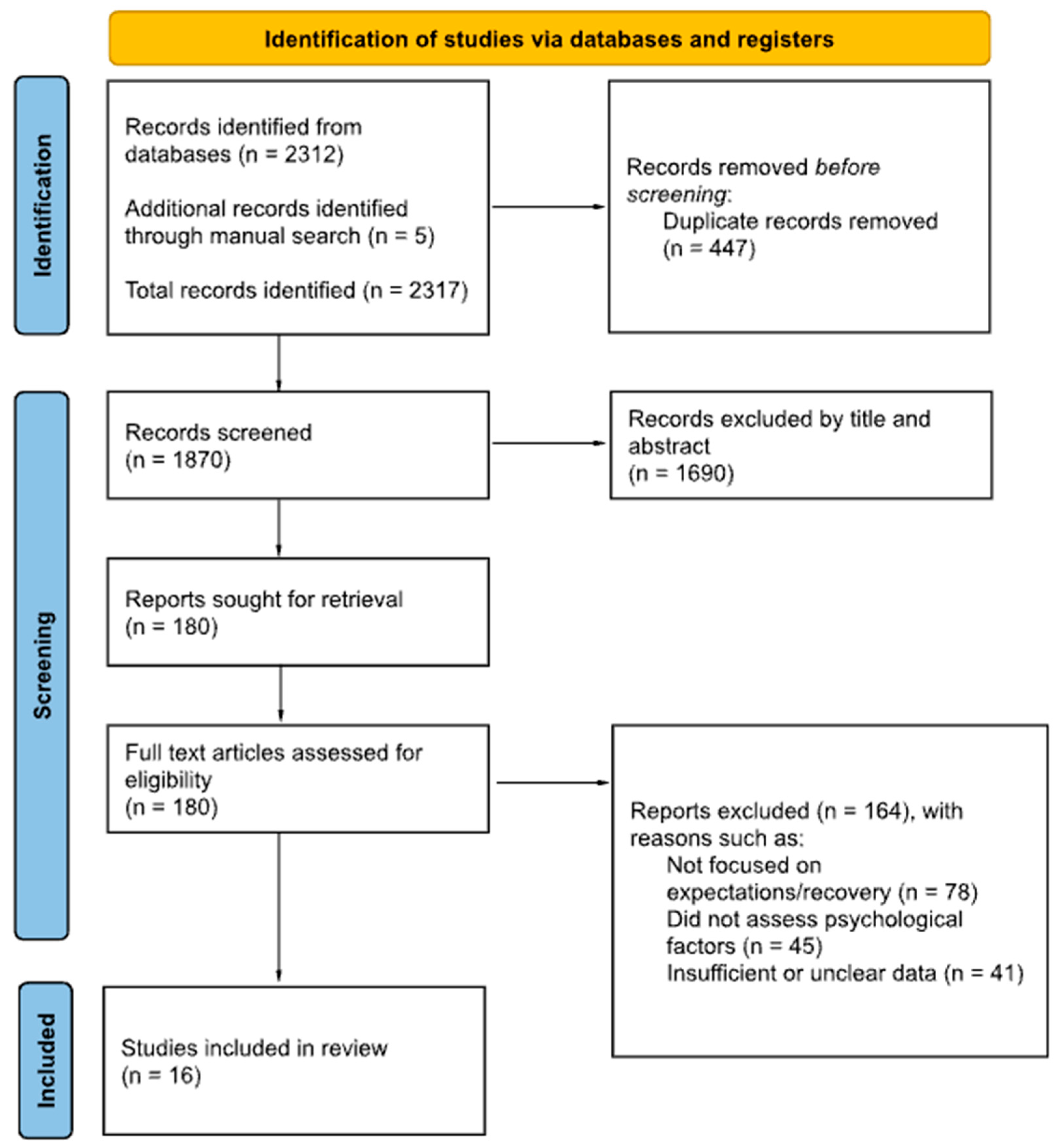
The Role of Patient Expectations in Treatment Outcome and Satisfaction in Osteoarthritis: A Scoping and Mapping Review



Abstract
1. Introduction
2. Materials and Methods
2.1. Eligibility Criteria
2.2. Search Strategy
2.3. Selection of Studies
2.4. Data Charting Process

2.5. Synthesis of Results
3. Results
3.1. Expectations About Surgery
3.2. Expectations About Non-Surgical Management
3.3. Expectations About Patients’ Ability to Cope or Self-Efficacy
4. Discussion
5. Conclusions
Supplementary Materials
Author Contributions
Funding
Institutional Review Board Statement
Informed Consent Statement
Data Availability Statement
Acknowledgments
Conflicts of Interest
Abbreviations
| OA | Osteoarthritis |
| KOA | Knee Osteoarthritis |
| HOA | Hip Osteoarthritis |
| TKA | Total Knee Arthroplasty |
| THA | Total Hip Arthroplasty |
| OARSI | Osteoarthritis Research Society International |
| AAOS | American Academy of Orthopaedic Surgeons |
| ESCEO | European Society for Clinical and Economic Aspects of Osteoporosis, Osteoarthritis and Musculoskeletal Diseases |
| NICE | National Institute for Health and Care Excellence |
| KOOS | Knee injury and Osteoarthritis Outcome Score |
| OKS | Oxford Knee Score |
| HOOS | Hip disability and Osteoarthritis Outcome Score |
References
- Hunter, D.J.; Bierma-Zeinstra, S. Osteoarthritis. Lancet 2019, 393, 1745–1759. [Google Scholar] [CrossRef] [PubMed]
- Safiri, S.; Kolahi, A.A.; Smith, E.; Hill, C.; Bettampadi, D.; Mansournia, M.A.; Hoy, D.; Ashrafi-Asgarabad, A.; Sepidarkish, M.; Almasi-Hashiani, A.; et al. Global, Regional and National Burden of Osteoarthritis 1990–2017: A Systematic Analysis of the Global Burden of Disease Study 2017. Ann. Rheum. Dis. 2020, 79, 819–828. [Google Scholar] [CrossRef]
- Cross, M.; Smith, E.; Hoy, D.; Nolte, S.; Ackerman, I.; Fransen, M.; Bridgett, L.; Williams, S.; Guillemin, F.; Hill, C.L.; et al. The Global Burden of Hip and Knee Osteoarthritis: Estimates from the Global Burden of Disease 2010 Study. Ann. Rheum. Dis. 2014, 73, 1323–1330. [Google Scholar] [CrossRef]
- Wallis, J.A.; Taylor, N.F.; Bunzli, S.; Shields, N. Experience of Living with Knee Osteoarthritis: A Systematic Review of Qualitative Studies. BMJ Open 2019, 9, e030060. [Google Scholar] [CrossRef]
- Bannuru, R.R.; Osani, M.C.; Vaysbrot, E.E.; Arden, N.K.; Bennell, K.; Bierma-Zeinstra, S.M.A.; Kraus, V.B.; Lohmander, L.S.; Abbott, J.H.; Bhandari, M.; et al. OARSI Guidelines for the Non-Surgical Management of Knee, Hip, and Polyarticular Osteoarthritis. Osteoarthr. Cartil. 2019, 27, 1578–1589. [Google Scholar] [CrossRef]
- Bruyère, O.; Honvo, G.; Veronese, N.; Arden, N.K.; Branco, J.; Curtis, E.M.; Al-Daghri, N.M.; Herrero-Beaumont, G.; Martel-Pelletier, J.; Pelletier, J.P.; et al. An Updated Algorithm Recommendation for the Management of Knee Osteoarthritis from the European Society for Clinical and Economic Aspects of Osteoporosis, Osteoarthritis and Musculoskeletal Diseases (ESCEO). Semin. Arthritis Rheum. 2019, 49, 337–350. [Google Scholar] [CrossRef]
- Jevsevar, D.S.; Brown, G.A.; Jones, D.L.; Matzkin, E.G.; Manner, P.A.; Mooar, P.; Schousboe, J.T.; Stovitz, S.; Sanders, J.O.; Bozic, K.J.; et al. The American Academy of Orthopaedic Surgeons Evidence-Based Guideline on: Treatment of Osteoarthritis of the Knee, 2nd Edition. J. Bone Joint Surg. Am. 2013, 95, 1885–1886. [Google Scholar] [CrossRef]
- National Clinical Guideline Centre (UK). Osteoarthritis: Care and Management in Adults; National Institute for Health and Care Excellence (UK): London, UK, 2014. [Google Scholar]
- Barker, K.L.; Toye, F.; Seers, K. A Synthesis of Qualitative Research to Understand the Complexity behind Treatment Decision-Making for Osteoarthritis. Osteoarthr. Cartil. Open 2023, 5, 100355. [Google Scholar] [CrossRef]
- Toye, F.; Seers, K.; Barker, K.L. Qualitative Evidence Synthesis Using Meta-Ethnography to Understand the Experience of Living with Osteoarthritis Pain. Pain 2022, 163, E1169–E1183. [Google Scholar] [CrossRef] [PubMed]
- Mancuso, C.A.; Salvati, E.A.; Johanson, N.A.; Peterson, M.G.E.; Charlson, M.E. Patients’ Expectations and Satisfaction with Total Hip Arthroplasty. J. Arthroplast. 1997, 12, 387–396. [Google Scholar] [CrossRef] [PubMed]
- Lim, W.Z.; Noviani, M.; Yeo, S.J.; Wong, S.B.S.; Wylde, V.; Tan, M.H.; Pang, H.N.; Tay, D.; Thumboo, J.; Leung, Y.Y. Expectation Fulfillment Is Associated with Good Outcomes and Patient Satisfaction after Knee Arthroplasty: A Prospective Study in a Multi-Ethnic Asian Population. Sci. Rep. 2025, 15, 15133. [Google Scholar] [CrossRef]
- Tilbury, C.; Haanstra, T.M.; Leichtenberg, C.S.; Verdegaal, S.H.M.; Ostelo, R.W.; de Vet, H.C.W.; Nelissen, R.G.H.H.; Vliet Vlieland, T.P.M. Unfulfilled Expectations After Total Hip and Knee Arthroplasty Surgery: There Is a Need for Better Preoperative Patient Information and Education. J. Arthroplast. 2016, 31, 2139–2145. [Google Scholar] [CrossRef]
- Barlow, T.; Clark, T.; Dunbar, M.; Metcalfe, A.; Griffin, D. The Effect of Expectation on Satisfaction in Total Knee Replacements: A Systematic Review. Springerplus 2016, 5, 167. [Google Scholar] [CrossRef]
- Bennell, K.L.; Hinman, R.S. A Review of the Clinical Evidence for Exercise in Osteoarthritis of the Hip and Knee. J. Sci. Med. Sport 2011, 14, 4–9. [Google Scholar] [CrossRef]
- Noble, P.C.; Conditt, M.A.; Cook, K.F.; Mathis, K.B. The John Insall Award: Patient Expectations Affect Satisfaction with Total Knee Arthroplasty. Clin. Orthop. Relat. Res. 2006, 452, 35–43. [Google Scholar] [CrossRef] [PubMed]
- Mondloch, M.V.; Cole, D.C.; Frank, J.W. Does How You Do Depend on How You Think You’ll Do? A Systematic Review of the Evidence for a Relation between Patients’ Recovery Expectations and Health Outcomes. Can. Med. Assoc. J. 2001, 165, 174–179. [Google Scholar]
- Colloca, L.; Barsky, A.J. Placebo and Nocebo Effects. N. Engl. J. Med. 2020, 382, 554–561. [Google Scholar] [CrossRef] [PubMed]
- Wager, T.D.; Atlas, L.Y. The Neuroscience of Placebo Effects: Connecting Context, Learning and Health. Nat. Rev. Neurosci. 2015, 16, 403–418. [Google Scholar] [CrossRef]
- Bandura, A. Self-Efficacy: Toward a Unifying Theory of Behavioral Change. Psychol. Rev. 1977, 84, 191–215. [Google Scholar] [CrossRef] [PubMed]
- Jackson, T.; Wang, Y.; Wang, Y.; Fan, H. Self-Efficacy and Chronic Pain Outcomes: A Meta-Analytic Review. J. Pain 2014, 15, 800–814. [Google Scholar] [CrossRef]
- Lorig, K.R.; Sobel, D.S.; Ritter, P.L.; Laurent, D.; Hobbs, M. Effect of a Self-Management Program on Patients with Chronic Disease. Eff. Clin. Pract. 2001, 4, 256–262. [Google Scholar] [CrossRef] [PubMed]
- Brosseau, L.; Wells, G.A.; Kenny, G.P.; Reid, R.; Maetzel, A.; Tugwell, P.; Huijbregts, M.; McCullough, C.; De Angelis, G.; Chen, L. The Implementation of a Community-Based Aerobic Walking Program for Mild to Moderate Knee Osteoarthritis (OA): A Knowledge Translation (KT) Randomized Controlled Trial (RCT): Part I: The Uptake of the Ottawa Panel Clinical Practice Guidelines (CPGs). BMC Public Health 2012, 12, 871. [Google Scholar] [CrossRef] [PubMed]
- Rajabiyazdi, F.; Alam, R.; Pal, A.; Montanez, J.; Law, S.; Pecorelli, N.; Watanabe, Y.; Chiavegato, L.D.; Falconi, M.; Hirano, S.; et al. Understanding the Meaning of Recovery to Patients Undergoing Abdominal Surgery. JAMA Surg. 2021, 156, 758–765. [Google Scholar] [CrossRef] [PubMed]
- Bunzli, S.; O’Brien Bhealthsci, P.; Ayton, D.; Dowsey, M.; Gunn, J.; Choong, P.; Manski-Nankervis, J.A. Misconceptions and the Acceptance of Evidence-Based Nonsurgical Interventions for Knee Osteoarthritis. A Qualitative Study. Clin. Orthop. Relat. Res. 2019, 477, 1975–1983. [Google Scholar] [CrossRef]
- Mancuso, C.A.; Graziano, S.; Briskie, L.M.; Peterson, M.G.E.; Pellicci, P.M.; Salvati, E.A.; Sculco, T.P. Randomized Trials to Modify Patients’ Preoperative Expectations of Hip and Knee Arthroplasties. Clin. Orthop. Relat. Res. 2008, 466, 424–431. [Google Scholar] [CrossRef]
- Tricco, A.C.; Lillie, E.; Zarin, W.; O’Brien, K.K.; Colquhoun, H.; Levac, D.; Moher, D.; Peters, M.D.J.; Horsley, T.; Weeks, L.; et al. PRISMA Extension for Scoping Reviews (PRISMA-ScR): Checklist and Explanation. Ann. Intern. Med. 2018, 169, 467–473. [Google Scholar] [CrossRef]
- Mannion, A.F.; Kämpfen, S.; Munzinger, U.; Kramers-de Quervain, I. The Role of Patient Expectations in Predicting Outcome after Total Knee Arthroplasty. Arthritis Res. Ther. 2009, 11, R139. [Google Scholar] [CrossRef]
- Yapp, L.Z.; Clement, N.D.; Macdonald, D.J.; Howie, C.R.; Scott, C.E.H. Changes in Expectation Fulfillment Following Total Knee Arthroplasty: A 10-Year Follow-Up Study. J. Arthroplast. 2020, 35, 1826–1832. [Google Scholar] [CrossRef]
- Sullivan, M.; Tanzer, M.; Reardon, G.; Amirault, D.; Dunbar, M.; Stanish, W. The Role of Presurgical Expectancies in Predicting Pain and Function One Year Following Total Knee Arthroplasty. Pain 2011, 152, 2287–2293. [Google Scholar] [CrossRef]
- Mancuso, C.A.; Jout, J.; Salvati, E.A.; Sculco, T.P. Fulfillment of Patients’ Expectations for Total Hip Arthroplasty. J. Bone Joint Surg. Am. 2009, 91, 2073–2078. [Google Scholar] [CrossRef] [PubMed]
- Hafkamp, F.J.; Gosens, T.; de Vries, J.; den Oudsten, B.L. Do Dissatisfied Patients Have Unrealistic Expectations? A Systematic Review and Best-Evidence Synthesis in Knee and Hip Arthroplasty Patients. EFORT Open Rev. 2020, 5, 226–240. [Google Scholar] [CrossRef]
- Foster, N.E.; Thomas, E.; Hill, J.C.; Hay, E.M. The Relationship between Patient and Practitioner Expectations and Preferences and Clinical Outcomes in a Trial of Exercise and Acupuncture for Knee Osteoarthritis. Eur. J. Pain 2010, 14, 402–409. [Google Scholar] [CrossRef] [PubMed]
- Hawker, G.A. Who, When, and Why Total Joint Replacement Surgery? The Patient’s Perspective. Curr. Opin. Rheumatol. 2006, 18, 526–530. [Google Scholar] [CrossRef] [PubMed]
- Wojcieszek, A.; Kurowska, A.; Majda, A.; Kołodziej, K.; Liszka, H.; Gądek, A. Relationship between Optimism, Self-Efficacy and Quality of Life: A Cross-Sectional Study in Elderly People with Knee Osteoarthritis. Geriatrics 2023, 8, 101. [Google Scholar] [CrossRef]
- Degerstedt, Å.; Alinaghizadeh, H.; Thorstensson, C.A.; Olsson, C.B. High Self-Efficacy—A Predictor of Reduced Pain and Higher Levels of Physical Activity among Patients with Osteoarthritis: An Observational Study. BMC Musculoskelet. Disord. 2020, 21, 380. [Google Scholar] [CrossRef]
- Page, M.J.; McKenzie, J.E.; Bossuyt, P.M.; Boutron, I.; Hoffmann, T.C.; Mulrow, C.D.; Shamseer, L.; Tetzlaff, J.M.; Akl, E.A.; Brennan, S.E.; et al. The PRISMA 2020 statement: An updated guideline for reporting systematic reviews. BMJ 2021, 372, n71. [Google Scholar] [CrossRef]
- Wallis, J.A.; Taylor, N.F. Pre-Operative Interventions (Non-Surgical and Non-Pharmacological) for Patients with Hip or Knee Osteoarthritis Awaiting Joint Replacement Surgery—A Systematic Review and Meta-Analysis. Osteoarthr. Cartil. 2011, 19, 1381–1395. [Google Scholar] [CrossRef]
- Nicolson, P.J.A.; Holden, M.A. Patient Preferences and Osteoarthritis Care: What Do We Know About What Patients Want from Osteoarthritis Treatment? Curr. Treat. Options Rheumatol. 2023, 9, 120–131. [Google Scholar] [CrossRef]
- Marszalek, J.; Price, L.L.; Harvey, W.F.; Driban, J.B.; Wang, C. Outcome Expectations and Osteoarthritis: Association of Perceived Benefits of Exercise with Self-Efficacy and Depression. Arthritis Care Res. 2017, 69, 491–498. [Google Scholar] [CrossRef]
- Harris, I.A.; Harris, A.M.; Naylor, J.M.; Adie, S.; Mittal, R.; Dao, A.T. Discordance Between Patient and Surgeon Satisfaction After Total Joint Arthroplasty. J. Arthroplast. 2013, 28, 722–727. [Google Scholar] [CrossRef] [PubMed]
- Barker, K.L.; Minns Lowe, C.J.; Toye, F. “It Is a Big Thing”: Exploring the Impact of Osteoarthritis from the Perspective of Adults Caring for Parents—The Sandwich Generation. Musculoskelet. Care 2017, 15, 49–58. [Google Scholar] [CrossRef] [PubMed]
- Edwards, R.R.; Dworkin, R.H.; Sullivan, M.D.; Turk, D.C.; Wasan, A.D. The Role of Psychosocial Processes in the Development and Maintenance of Chronic Pain. J. Pain 2016, 17, T70–T92. [Google Scholar] [CrossRef]
- Eippert, F.; Bingel, U.; Schoell, E.D.; Yacubian, J.; Klinger, R.; Lorenz, J.; Büchel, C. Activation of the Opioidergic Descending Pain Control System Underlies Placebo Analgesia. Neuron 2009, 63, 533–543. [Google Scholar] [CrossRef] [PubMed]
- Bingel, U.; Wanigasekera, V.; Wiech, K.; Mhuircheartaigh, R.N.; Lee, M.C.; Ploner, M.; Tracey, I. The Effect of Treatment Expectation on Drug Efficacy: Imaging the Analgesic Benefit of the Opioid Remifentanil. Sci. Transl. Med. 2011, 3, 70ra14. [Google Scholar] [CrossRef]
- Atlas, L.Y.; Wager, T.D. How Expectations Shape Pain. Neurosci. Lett. 2012, 520, 140–148. [Google Scholar] [CrossRef]
- Tracey, I. Neuroimaging of Pain Mechanisms. Curr. Opin. Support. Palliat. Care 2007, 1, 109–116. [Google Scholar] [CrossRef]
- Toye, F.; Belton, J.; Hannink, E.; Seers, K.; Barker, K. A Healing Journey with Chronic Pain: A Meta-Ethnography Synthesizing 195 Qualitative Studies. Pain Med. 2021, 22, 1333–1344. [Google Scholar] [CrossRef]
- Hoogendam, L.; van der Oest, M.J.W.; Wouters, R.M.; Andrinopoulou, E.R.; Vermeulen, G.M.; Slijper, H.P.; Porsius, J.T.; Selles, R.W. Patients With Higher Treatment Outcome Expectations Are More Satisfied With the Results of Nonoperative Treatment for Thumb Base Osteoarthritis: A Cohort Study. Arch. Phys. Med. Rehabil. 2021, 102, 1533–1540. [Google Scholar] [CrossRef]
- Carrière, J.S.; Donayre Pimentel, S.; Bou Saba, S.; Boehme, B.; Berbiche, D.; Coutu, M.F.; Durand, M.J. Recovery Expectations Can Be Assessed with Single-Item Measures: Findings of a Systematic Review and Meta-Analysis on the Role of Recovery Expectations on Return-to-Work Outcomes after Musculoskeletal Pain Conditions. Pain 2022, 164, e190. [Google Scholar] [CrossRef] [PubMed]

| Author (Year) | Design and Population | Expectations Assessed | Main Findings |
|---|---|---|---|
| Barker et al. (2023) [9] | Qualitative synthesis, HOA | Expectations about surgery (THA) | 10–15% of patients remain dissatisfied due to unfulfilled expectations about the persistence of pain and ongoing functional limitations. |
| Mancuso et al. (1997) [11] | Prospective cohort, HOA | Expectations about surgery (THA) | Patients with expectations of improvements in nonessential activities reported lower rates of satisfaction. |
| Tilbury et al. (2016) [13] | Prospective cohort, HOA and KOA | Expectations about surgery | In THA, >30% of patients with unfulfilled expectations about “improvement in walking ability”: long distances” (31%), “walking stairs” (33%), and “improve ability to cut toenails” (38%). In TKA, >40% of patients with unfulfilled expectations about “walking middle long distances (up to 1.5 km’s)” (40%), “being able to kneel down” (44%) and “being able to squat” (47%). |
| Mannion et al. (2009) [28] | Prospective cohort, KOA | Expectations about surgery | Patients were overly optimistic about the likelihood of being pain-free (85% expected it, and 43% were pain-free; p < 0.05) and of not being limited in usual activities (52% expected it, and 20% experienced it; p < 0.05) |
| Noble et al. (2006) [16] | Prospective cohort, KOA | Expectations about surgery (TKA) | 50% of dissatisfied patients reported they were not as active as they expected (OR = 0.17, p < 0.001). 32% of dissatisfied patients reported they were less active after surgery (OR = 0.35, p = 0.013). 53% of dissatisfied patients reported that their knee kept them from doing activities they wanted to do (OR = 0.42, p = 0.016). |
| Lim et al. (2025) [12] | Prospective cohort, KOA | Expectations about surgery (TKA) | Expectation fulfillment was consistently associated with improvements in pain and function at 6 and 12 months (ß: 0.38, 95% CI: 0.35 to 0.40, p < 0.001) but baseline patient expectations were not. |
| Yapp et al. (2020) [29] | Prospective cohort, KOA | Expectations about surgery (TKA) | Higher risk of long-term dissatisfaction in patients with high preoperative expectations of kneeling (RR 2.2, 95% CI 0.9–5.5) and walking without aids (RR 2.4, 95% CI 0.7–7.6). |
| Sullivan et al. (2011) [30] | Prospective cohort, KOA | Expectations about surgery (TKA) | Expectations about the future resumption of household and social/recreational activities mediated the relation between catastrophizing and follow-up pain severity (accounted for 12% of the variance); and follow-up physical function (accounted for 19% of the variance). |
| Mancuso et al. (2009) [31] | Prospective cohort, HOA | Expectations about surgery (THA) | Patients with better preoperative scores were more likely to have fulfillment of function-related expectations (with the exceptions of daytime pain, transfer, exercise and cut toenails) (0.01; p = 0.05) |
| Hafkamp et al. (2020) [32] | Systematic review, HOA and KOA | Expectations about surgery | Both high and low expectations could lead to satisfaction when expectations are fulfilled, as patients might change their preoperative expectations postoperatively in order to diminish imbalance between expectations and outcomes to prevent dissatisfaction. However, high expectations have an advantage over low expectations. |
| Wallis et al. (2019) [4] | Qualitative review, KOA | Expectations about treatment | People with low expectations of treatment ended up having limited contact with health professionals. |
| Foster et al. (2010) [33] | Prospective cohort, KOA | Expectations about treatment (exercise or acupuncture) | No evidence of a relationship between patients’ baseline treatment expectations and pain reduction at 6 or 12 months. Patients who received the treatment for which they had high expectations were almost twice as likely to be classified as a treatment responder at 6 months (OR = 1.7, 1.06, 2.79) and 12 months (OR = 1.9, 1.13, 3.13). |
| Hawker et al. (2006) [34] | Review, KOA | Expectations about surgery (TKA) and self-efficacy | Positive patient expectations related to better postoperative pain and disability. Self-efficacy is associated with greater improvements in pain and disability. |
| Bennell et al. (2011) [15] | Review, HOA and KOA | Expectations about exercise and self-efficacy | Higher expectations about exercise related to better adherence, with high-intensity training expected to result in greater strength gains. Higher self-efficacy is also associated with higher adherence and better pain and function outcomes. |
| Wojcieszek et al. (2023) [35] | Cross-sectional, KOA | Self-efficacy | A higher sense of self-competence was associated with better quality of life (α = 0.84, p < 0.001). |
| Degerstedt et al. (2020) [36] | Prospective cohort, HOA and KOA | Self-efficacy | High self-efficacy for pain management at baseline resulted in reduced pain (37.43 ± 0.40, p < 0.01) and increased physical activity (5.05 ± 0.07; p < 0.01) at the follow-ups; High self-efficacy for management of other symptoms resulted in lower pain (35.78 ± 0.71, p < 0.01) and higher physical activity (5.08 ± 0.05, p < 0.01) at 3 and 12 months. |
Disclaimer/Publisher’s Note: The statements, opinions and data contained in all publications are solely those of the individual author(s) and contributor(s) and not of MDPI and/or the editor(s). MDPI and/or the editor(s) disclaim responsibility for any injury to people or property resulting from any ideas, methods, instructions or products referred to in the content. |
© 2025 by the authors. Licensee MDPI, Basel, Switzerland. This article is an open access article distributed under the terms and conditions of the Creative Commons Attribution (CC BY) license (https://creativecommons.org/licenses/by/4.0/).
Share and Cite
Flores-Cortés, M.; Stanton, T.R.; Cuenca-Martínez, F. The Role of Patient Expectations in Treatment Outcome and Satisfaction in Osteoarthritis: A Scoping and Mapping Review. J. Clin. Med. 2025, 14, 8440. https://doi.org/10.3390/jcm14238440
Flores-Cortés M, Stanton TR, Cuenca-Martínez F. The Role of Patient Expectations in Treatment Outcome and Satisfaction in Osteoarthritis: A Scoping and Mapping Review. Journal of Clinical Medicine. 2025; 14(23):8440. https://doi.org/10.3390/jcm14238440
Chicago/Turabian StyleFlores-Cortés, Mar, Tasha R. Stanton, and Ferran Cuenca-Martínez. 2025. "The Role of Patient Expectations in Treatment Outcome and Satisfaction in Osteoarthritis: A Scoping and Mapping Review" Journal of Clinical Medicine 14, no. 23: 8440. https://doi.org/10.3390/jcm14238440
APA StyleFlores-Cortés, M., Stanton, T. R., & Cuenca-Martínez, F. (2025). The Role of Patient Expectations in Treatment Outcome and Satisfaction in Osteoarthritis: A Scoping and Mapping Review. Journal of Clinical Medicine, 14(23), 8440. https://doi.org/10.3390/jcm14238440