

Updates in the Diagnosis and Treatment of BK Viraemia in Kidney Transplant Recipients: Current and Future Insights
Abstract
1. Introduction
2. Viral Structure and Mechanism
3. Epidemiology
4. Clinical Presentation
5. Diagnosis and Histology
- Urinary-derived mitochondrial cell-free DNA was utilised to aid in the diagnosis of BKPyVAN [63]. Mitochondrial dysfunction is often seen in BK-associated nephropathy. In a cohort of 60 kidney transplant recipients, it was shown that the ratio of urinary-derived cell-free mitochondrial DNA to donor-derived cell-free DNA had a sensitivity of 71.4% and a specificity of 97.1% [63]. Given the increasing use of donor-derived cell-free DNA in clinical practice this may be a useful adjunct in guiding clinicians in adjusting immunosuppression whilst also avoiding the risk of an invasive procedure such as a biopsy [64,65]. However, given the small cohort, further studies will be needed to validate this method.
- Urine lateral flow assays are another tool under consideration as they may offer a more cost-effective solution than quantitative nucleic acid testing and be of use in a paediatric cohort where blood sampling may be more challenging. Current limitations of BK virus QNAT testing include under-quantification and false negatives. It has been well-established that high-level BK viraemia precedes DNAemia making it a potentially useful biological source to screen for early BK virus activity [66]. A urine lateral flow test for BKPyV VP1 antigen has been developed and shown to be effective in vitro [67]. However, further multi-centre data is awaited to elicit if it will be beneficial in clinical practice.
- Urinary micro-RNA is another tool under consideration to improve the accuracy of screening for early evidence of BK virus. Two micro RNAs of interest were examined in a small cohort of kidney transplant recipients in Japan. Both demonstrated value as a screening tool; however, further research is required in larger cohorts prior to clinical application [68].
- Single-cell DNA studies aim to define the unique molecular signature of BK nephropathy to improve the understanding of the pathogenesis and to allow for the development of future diagnostic methods. A recent single-cell study demonstrated the unique cell populations and dynamics between T cell-mediated rejection and BK nephropathy [69]. It demonstrated a predominant rise in T cells with the main cell differences occurring in the proximal tubule, principal cells and thick ascending limb as well as the medulla in BK nephropathy compared to T cell-mediated rejection. Whilst this is unlikely to be used as a diagnostic method, it offers further targets for research into new methodology.
- In situ hybridisation (ISH) targeting nucleic acids is of particular interest for kidney biopsy specimens as it may offer improved diagnostic specificity over established methods. Established methods for kidney biopsy assessment can mean that it is difficult to distinguish rejection in certain cases and there may be overlap with SV40-positive viruses. A research group in China utilised a ViewRNA ISH system to detect the conserved sequences within the large T cell antigen of BK virus to improve diagnostic accuracy. They demonstrated a 93.75% accuracy using this model [70].
- Risk prediction models would offer better stratification of at-risk transplant recipients and may allow for a more tailored approach to screening. Despite the well-established risk factors for BKPyVAN outlined above, risk prediction remains an ongoing challenge, as does the impact of various risk factors. Attempts have been made to develop risk prediction models; however, their predictability is limited. One recent study developed a three-item model performed at the time of transplant with a scoring system ranging from 0–4 based on factors including age, sex and previous kidney transplantation [71]. Notably, it did have some predictive value, but its area under the curve was only 0.66 at one-year post-transplant.
6. Treatment
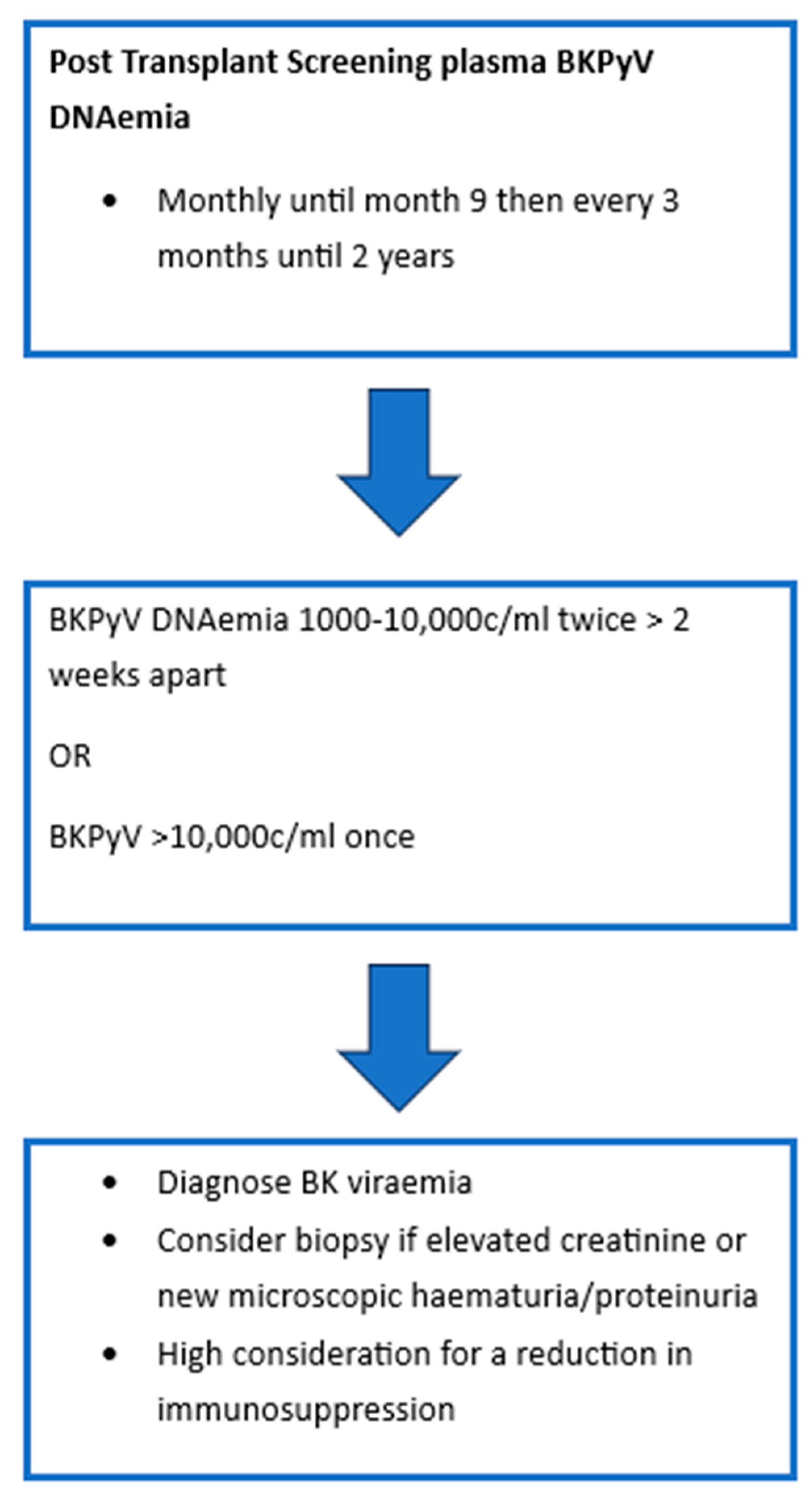
- Confirmed BK viraemia demonstrated by titres of 1000–10,000 copies/mL on two measurements 2–3 weeks apart.
- Confirmed BK viraemia demonstrated by titres of >10,000 copies/mL on one measurement.
- Biopsy-proven BK nephropathy.
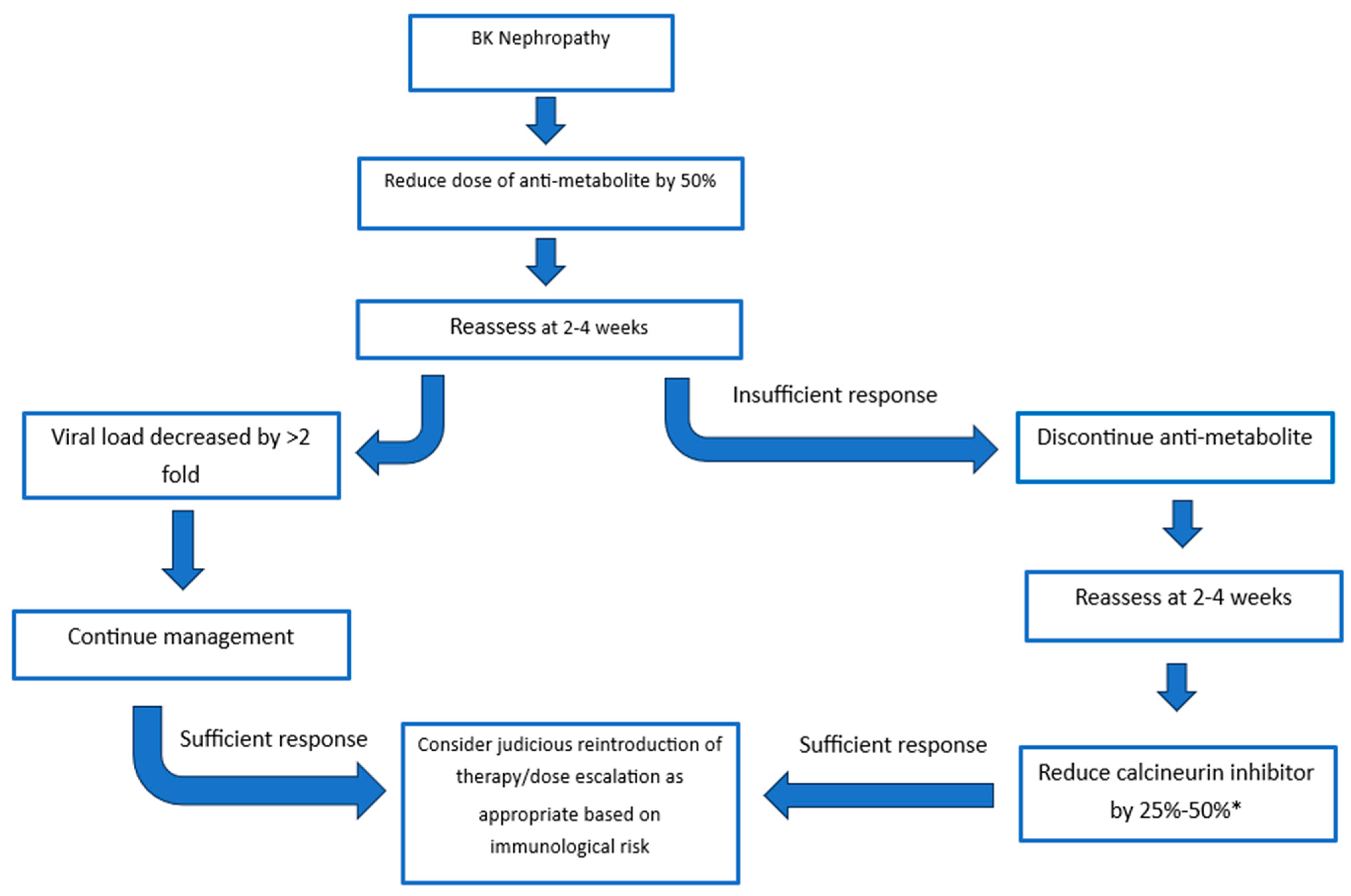
- IVIg may be used with an inappropriate response to immunosuppression reduction to facilitate viral clearance or to prevent rejection in those with a high immunological risk requiring immunosuppression reduction for clearance.
- In steroid free regimens, the addition of steroids should be considered to avoid CNI monotherapy
7. Re-Transplant
8. Emerging Therapies
8.1. Cellular Immunotherapy
- Viral-specific T cell therapy (VST) seeks to selectively increase the BK virus T cell subset without compromising overall immunosuppression [95]. One product currently in research is Posoleucel which is an off-the-shelf allogeneic, multivirus-specific T cell therapy [96]. It is manufactured from peripheral blood mononuclear cells obtained from healthy donors with confirmed seropositivity to BK virus, CMV, adenovirus or Epstein–Barr virus, as well as human herpes virus 6. It was initially of interest in the treatment of cytomegalovirus, but has since been used in several clinical trials evaluating it as a treatment option in BK infection particularly in stem-cell transplant recipients and now in solid-organ transplant recipients. Adverse events have been reported with this therapy in previous trials including cytokine release syndrome and graft-versus-host disease. It is also a costly, labour-intensive therapy, and studies have yet to establish the necessary cell type and infusion frequency for the best therapeutic response [55,81,96,97,98,99]. Alternative VST treatments with different methods of manufacturing have demonstrated safety in kidney transplant patients in initial clinical trials [100]. VST has been used to treat patients with haemorrhagic cystitis, BKPyV viraemia and nephritis, with the majority of patients having a complete or partial response to therapy. VST is a promising therapy requiring further research [95,99].
- Extracorporeal photophoresis (ECP) has been used clinically since 1988 in the treatment of cutaneous T cell lymphoma. It has evolved as a therapeutic strategy used in solid-organ transplantation in the treatment of acute and chronic graft rejection, mainly in the field of lung and cardiac transplantation [101]. ECP is an immunomodulatory therapy that involves the infusion of autologous cellular products obtained via leukaphoresis and exposure to ultraviolet light [102]. Initially, it was thought its immunomodulating benefits were from apoptosis of leukocytes. However, it is likely more complex, involving initiation of tolerogenic dendritic cells that phagocytise apoptotic cells, release soluble factors, and promote regulatory T cell responses and anti-inflammatory mediators, thereby reducing proinflammatory cytokines [101]. ECP is a favourable treatment of rejection as it appears efficacious and does not increase the risk of infection [103]. ECP has been used in case reports as a successful therapy that allowed for immunosuppression minimisation to treat BK nephropathy whilst limiting the risk of rejection [104]. Given the lack of guidelines for ECP in kidney transplantation, and without an effective strategy for patient selection for treatment, it is unlikely to be a standard therapy for BK nephropathy in the near future. However, there is significant interest in developing the research behind this therapy to eventually conduct a multi-centre study [102].
8.2. Antibody-Based Therapy
- Potravitug blocks the interaction of the viral capsid VP1 with the cell surface and, as a result, inhibits viral infection of cells. An initial phase 1 trial has demonstrated a safe dosing of 1000 mg given four times weekly across four weeks produces antibody levels sufficient to maintain VP1 receptor occupancy above 95% [108]. The SAFE Kidney II trial is a phase II and III placebo-controlled trial that has completed recruitment to assess for safety and efficacy of Potravitug [109]. Results of the phase II component of this trial have yet to be published.
- MAU868 is a novel human IgG1 monoclonal high-affinity neutralising antibody against BKVAN. An initial phase I study has demonstrated that MAU868 is safe and well-tolerated [110]. The results of a phase II trial conducted in kidney transplant patients to examine the safety and efficacy of this drug are currently awaited [111].
8.3. Vaccination
8.4. Novel Therapies and Targets
- Agnoprotein has been postulated as a potential therapeutic drug target as it is an important small, positively charged protein with a pivotal role in the assembly, maturation and release of the BK virus. Initial studies have identified specific binding peptides against agnoprotein that may lead to targeted binding peptide therapeutics in the future and they may also have exciting potential in drug pharmacokinetics and diagnostic applications [114].
- AIC468, a first-in-class antisense oligonucleotide designed to inhibit the splicing process of a viral mRNA encoding protein that is essential for BKV replication, is undergoing its first in-human phase 1 trial [115].

| Therapy | Mechanism | Trial Phase | Current Limitations |
|---|---|---|---|
| VST | Allogeneic T cells targeting BK virus. | Posoleucel completed phase 2 trial [96]. | Expensive, labour-intensive, risk of cytokine storm. |
| Immunomodulation via antigen specificity. | |||
| ECP | Induces regulatory immune cells via UV-treated | No clinical trials. | Expensive, labour-intensive, lack of guidelines |
| autologous leukocyte; reduces inflammation. | Used in case reports [104]. | for use. | |
| Potravitug | Neutralizing antibody blocks VP1–host receptor | Phase 1 completed [108]. | Unclear duration of effect, no trial data in |
| interaction, blocking viral entry. | Phase 2/3 underway [109]. | kidney transplant cohort. | |
| MAU 868 | High-affinity IgG1 antibody targeting VP1, blocking | Phase 1 completed [110]. | Unclear duration of effect, no trial data in |
| viral entry. | Phase 2 underway [111]. | kidney transplant cohort. | |
| Vaccine | Induces neutralizing antibodies pre-transplant. | Pre-clinical studies [112,113]. | Likely most efficacious in pre-transplant period. |
| Evidence in animal models. | No clinical trials yet. | ||
| AIC468 | Inhibits splicing of essential viral mRNA | Phase 1 underway [115]. | First in-human trial, safety data awaited. |
| to block replication. |
9. Conclusions
10. Search Strategy
Author Contributions
Funding
Conflicts of Interest
References
- Gardner, S.; Field, A.; Coleman, D.; Hulme, B. New Human Papovavirus (B.K.) Isolated from Urine After Renal Transplantation. Lancet 1971, 297, 1253–1257. [Google Scholar] [CrossRef] [Scilit] [PubMed]
- Chatterjee, M.; Weyandt, T.B.; Frisque, R.J. Identification of archetype and rearranged forms of BK virus in leukocytes from healthy individuals. J. Med. Virol. 2000, 60, 353–362. [Google Scholar] [CrossRef]
- Takasaka, T.; Goya, N.; Tokumoto, T.; Tanabe, K.; Toma, H.; Ogawa, Y.; Hokama, S.; Momose, A.; Funyu, T.; Fujioka, T.; et al. Subtypes of BK virus prevalent in Japan and variation in their transcriptional control region. J. Gen. Virol. 2004, 85 Pt 10, 2821–2827. [Google Scholar] [CrossRef] [Scilit]
- Ambalathingal, G.R.; Francis, R.S.; Smyth, M.J.; Smith, C.; Khanna, R. BK Polyomavirus: Clinical Aspects, Immune Regulation, and Emerging Therapies. Clin. Microbiol. Rev. 2017, 30, 503–528. [Google Scholar] [CrossRef] [Scilit]
- Teunissen, E.A.; de Raad, M.; Mastrobattista, E. Production and biomedical applications of virus-like particles derived from polyomaviruses. J. Control. Release 2013, 172, 305–321. [Google Scholar] [CrossRef] [Scilit]
- Henriksen, S.; Hansen, T.; Bruun, J.A.; Rinaldo, C.H. The Presumed Polyomavirus Viroporin VP4 of Simian Virus 40 or Human BK Polyomavirus Is Not Required for Viral Progeny Release. J. Virol. 2016, 90, 10398–10413. [Google Scholar] [CrossRef] [Scilit]
- Randhawa, P.; Ramos, E. BK viral nephropathy: An overview. Transplant. Rev. 2007, 21, 77–85. [Google Scholar] [CrossRef] [Scilit]
- Johnsen, J.I.; Seternes, O.M.; Johansen, T.; Moens, U.; Mäntyjärvi, R.; Traavik, T. Subpopulations of non-coding control region variants within a cell culture-passaged stock of BK virus: Sequence comparisons and biological characteristics. J. Gen. Virol. 1995, 76 Pt 7, 1571–1581. [Google Scholar] [CrossRef] [Scilit]
- Zou, W.; Imperiale, M.J. Regulation of Virus Replication by BK Polyomavirus Small T Antigen. J. Virol. 2023, 97, e0007723. [Google Scholar] [CrossRef] [Scilit]
- Suzuki, T.; Orba, Y.; Makino, Y.; Okada, Y.; Sunden, Y.; Hasegawa, H.; Hall, W.W.; Sawa, H. Viroporin activity of the JC polyomavirus is regulated by interactions with the adaptor protein complex 3. Proc. Natl. Acad. Sci. USA 2013, 110, 18668–18673. [Google Scholar] [CrossRef] [Scilit]
- Suzuki, T.; Orba, Y.; Okada, Y.; Sunden, Y.; Kimura, T.; Tanaka, S.; Nagashima, K.; Hall, W.W.; Sawa, H. The human polyoma JC virus agnoprotein acts as a viroporin. PLoS Pathog. 2010, 6, e1000801. [Google Scholar] [CrossRef] [Scilit]
- Myhre, M.R.; Olsen, G.H.; Gosert, R.; Hirsch, H.H.; Rinaldo, C.H. Clinical polyomavirus BK variants with agnogene deletion are non-functional but rescued by trans-complementation. Virology 2010, 398, 12–20. [Google Scholar] [CrossRef] [Scilit] [PubMed]
- Panou, M.M.; Prescott, E.L.; Hurdiss, D.L.; Swinscoe, G.; Hollinshead, M.; Caller, L.G.; Morgan, E.L.; Carlisle, L.; Müller, M.; Antoni, M.; et al. Agnoprotein Is an Essential Egress Factor during BK Polyomavirus Infection. Int. J. Mol. Sci. 2018, 19, 902. [Google Scholar] [CrossRef] [Scilit] [PubMed]
- Kant, S.; Dasgupta, A.; Bagnasco, S.; Brennan, D.C. BK Virus Nephropathy in Kidney Transplantation: A State-of-the-Art Review. Viruses 2022, 14, 1616. [Google Scholar] [CrossRef] [Scilit] [PubMed]
- Needham, J.M.; Perritt, S.E.; Thompson, S.R. Single-cell analysis reveals host S phase drives large T antigen expression during BK polyomavirus infection. PLoS Pathog. 2024, 20, e1012663. [Google Scholar] [CrossRef] [Scilit]
- Hillenbrand, C.A.; Akbari Bani, D.; Follonier, O.; Kaur, A.; Weissbach, F.H.; Wernli, M.; Wilhelm, M.; Leuzinger, K.; Binet, I.; Bochud, P.Y.; et al. BK polyomavirus serotype-specific antibody responses in blood donors and kidney transplant recipients with and without new-onset BK polyomavirus-DNAemia: A Swiss Transplant Cohort Study. Am. J. Transplant. 2025, 25, 985–1001. [Google Scholar] [CrossRef] [Scilit]
- Burek Kamenaric, M.; Ivkovic, V.; Kovacevic Vojtusek, I.; Zunec, R. The Role of HLA and KIR Immunogenetics in BK Virus Infection after Kidney Transplantation. Viruses 2020, 12, 1417. [Google Scholar] [CrossRef] [Scilit]
- Aberger, S.; Schuller, M.; Mooslechner, A.A.; Klötzer, K.A.; Prietl, B.; Pfeifer, V.; Kirsch, A.H.; Rosenkranz, A.R.; Artinger, K.; Eller, K. T cell Activation Marker HLA-DR Reflects Tacrolimus-Associated Immunosuppressive Burden and BK Viremia Risk After Kidney Transplantation—An Observational Cohort Study. Transpl. Int. 2025, 38, 14443. [Google Scholar] [CrossRef] [Scilit]
- Mora-Buch, R.; Tomás-Marín, M.; Pasamar, H.; Enrich, E.; Peña-Gómez, C.; Rudilla, F. BK Virus-Specific T Cell Response Associated with HLA Genotypes, RhD Status, and CMV or EBV Serostatus in Healthy Donors for Optimized Cell Therapy. J. Clin. Immunol. 2025, 45, 109. [Google Scholar] [CrossRef] [Scilit]
- Stolt, A.; Sasnauskas, K.; Koskela, P.; Lehtinen, M.; Dillner, J. Seroepidemiology of the human polyomaviruses. J. Gen. Virol. 2003, 84 Pt 6, 1499–1504. [Google Scholar] [CrossRef] [Scilit]
- Hirsch, H.H.; Steiger, J. Polyomavirus BK. Lancet Infect. Dis. 2003, 3, 611–623. [Google Scholar] [CrossRef] [Scilit]
- Goudsmit, J.; Wertheim-van Dillen, P.; van Strien, A.; van der Noordaa, J. The role of BK virus in acute respiratory tract disease and the presence of BKV DNA in tonsils. J. Med. Virol. 1982, 10, 91–99. [Google Scholar] [CrossRef] [Scilit]
- Helle, F.; Brochot, E.; Handala, L.; Martin, E.; Castelain, S.; Francois, C.; Duverlie, G. Biology of the BKPyV: An Update. Viruses 2017, 9, 327. [Google Scholar] [CrossRef] [Scilit] [PubMed]
- Flægstad, T.; Rönne, K.; Filipe, A.R.; Traavik, T. Prevalence of Anti BK Virus Antibody in Portugal and Norway. Scand. J. Infect. Dis. 1989, 21, 145–147. [Google Scholar] [CrossRef] [Scilit] [PubMed]
- Kean, J.M.; Rao, S.; Wang, M.; Garcea, R.L. Seroepidemiology of human polyomaviruses. PLoS Pathog. 2009, 5, e1000363. [Google Scholar] [CrossRef] [Scilit] [PubMed]
- Knowles, W.A.; Pipkin, P.; Andrews, N.; Vyse, A.; Minor, P.; Brown, D.W.; Miller, E. Population-based study of antibody to the human polyomaviruses BKV and JCV and the simian polyomavirus SV40. J. Med. Virol. 2003, 71, 115–123. [Google Scholar] [CrossRef] [Scilit]
- Manzano Sánchez, D.; Jimeno García, L.; Manzano Sánchez, D.; López Jiménez, I.; Saura Luján, I.M.; González Soriano, M.J.; Llorente Viñas, S.; Gil Muñoz, M.; Carbajo Mateo, T. Renal Function Impairment in Kidney Transplantation: Importance of Early BK Virus Detection. Transplant. Proc. 2019, 51, 350–352. [Google Scholar] [CrossRef] [Scilit]
- Gately, R.; Milanzi, E.; Lim, W.; Teixeira-Pinto, A.; Clayton, P.; Isbel, N.; Johnson, D.W.; Hawley, C.; Campbell, S.; Wong, G. Incidence, Risk Factors, and Outcomes of Kidney Transplant Recipients with BK Polyomavirus-Associated Nephropathy. Kidney Int. Rep. 2023, 8, 531–543. [Google Scholar] [CrossRef] [Scilit]
- Wong, G.; Marsh, J.; Howell, M.; Lim, W.H.; Chadban, S.; Coates, T.; Hawley, C.; Campbell, S.; Larkins, N.; Snelling, T.; et al. Screening and Management Practices for Polyoma (BK) Viremia and Nephropathy in Kidney Transplant Recipients From the Lands Down Under: Addressing the Unknowns and Rationale for a Multicenter Clinical Trial. Kidney Int. Rep. 2020, 5, 1777–1780. [Google Scholar] [CrossRef] [Scilit]
- Brennan, D.C.; Agha, I.; Bohl, D.L.; Schnitzler, M.A.; Hardinger, K.L.; Lockwood, M.; Torrence, S.; Schuessler, R.; Roby, T.; Gaudreault-Keener, M.; et al. Incidence of BK with tacrolimus versus cyclosporine and impact of preemptive immunosuppression reduction. Am. J. Transplant. 2005, 5, 582–594. [Google Scholar] [CrossRef] [Scilit]
- Seifert, M.E.; Mannon, R.B.; Nellore, A.; Young, J.; Wiseman, A.C.; Cohen, D.J.; Peddi, V.R.; Brennan, D.C.; Morgan, C.J.; Peri, K.; et al. A multicenter prospective study to define the natural history of BK viral infections in kidney transplantation. Transpl. Infect. Dis. 2024, 26, e14237. [Google Scholar] [CrossRef] [Scilit]
- Kotton, C.N.; Kamar, N.; Wojciechowski, D.; Eder, M.; Hopfer, H.; Randhawa, P.; Sester, M.; Comoli, P.; Tedesco Silva, H.; Knoll, G.; et al. The Second International Consensus Guidelines on the Management of BK Polyomavirus in Kidney Transplantation. Transplantation 2024, 108, 1834–1866. [Google Scholar] [CrossRef] [Scilit]
- Eder, M.; Schrag, T.A.; Havel, E.F.; Kainz, A.; Omic, H.; Doberer, K.; Kozakowski, N.; Körmöczi, G.F.; Schönbacher, M.; Fischer, G.; et al. Polyomavirus Nephropathy in ABO Blood Group-Incompatible Kidney Transplantation: Torque Teno Virus and Immunosuppressive Burden as an Approximation to the Problem. Kidney Int. Rep. 2024, 9, 1730–1741. [Google Scholar] [CrossRef] [Scilit] [PubMed]
- Rampersad, C.; Wiebe, C.; Balshaw, R.; Bullard, J.; Gibson, I.W.; Trachtenberg, A.; Shaw, J.; Villalobos, A.P.C.; Karpinski, M.; Goldberg, A.; et al. Association of BKV viremia and nephropathy with adverse alloimmune outcomes in kidney transplant recipients. Clin. Transplant. 2024, 38, e15329. [Google Scholar] [CrossRef] [Scilit] [PubMed]
- Eder, M.; Kainz, A.; Omic, H.; Aigner, C.; Copic, D.; Kotton, C.N.; Kamar, N.; Wojciechowski, D.; Hirsch, H.H.; Oberbauer, R. A systematic literature review and meta-analysis evaluated modifiable risk factors for the development of BK polyoma virus-associated complications. Kidney Int. 2025, 108, 669–685. [Google Scholar] [CrossRef] [Scilit] [PubMed]
- Heritage, J.; Chesters, P.M.; McCance, D.J. The persistence of papovavirus BK DNA sequences in normal human renal tissue. J. Med. Virol. 1981, 8, 143–150. [Google Scholar] [CrossRef] [Scilit]
- Egli, A.; Infanti, L.; Dumoulin, A.; Buser, A.; Samaridis, J.; Stebler, C.; Gosert, R.; Hirsch, H.H. Prevalence of polyomavirus BK and JC infection and replication in 400 healthy blood donors. J. Infect. Dis. 2009, 199, 837–846. [Google Scholar] [CrossRef] [Scilit]
- Nankivell, B.J.; Renthawa, J.; Sharma, R.N.; Kable, K.; O’Connell, P.J.; Chapman, J.R. BK Virus Nephropathy: Histological Evolution by Sequential Pathology. Am. J. Transplant. 2017, 17, 2065–2077. [Google Scholar] [CrossRef] [Scilit]
- Vasudev, B.; Hariharan, S.; Hussain, S.A.; Zhu, Y.R.; Bresnahan, B.A.; Cohen, E.P. BK virus nephritis: Risk factors, timing, and outcome in renal transplant recipients. Kidney Int. 2005, 68, 1834–1839. [Google Scholar] [CrossRef] [Scilit]
- Black, A.J.; Harriman, D.; Nguan, C. Contemporary risk factors for ureteral stricture following renal transplantation. Can. Urol. Assoc. J. 2022, 16, E321–E327. [Google Scholar] [CrossRef] [Scilit]
- Saade, A.; Gras, J.; Darmon, M.; Michonneau, D.; Dhedin, N.; Feghoul, L.; Le Goff, J.; Xhaard, A.; De Latour, R.P.; Socié, G.; et al. Incidence, risk factors and outcome of BK virus hemorrhagic cystitis following allogenic hematopoietic cell transplantation: A retrospective cohort study. Bone Marrow Transplant. 2022, 57, 1287–1294. [Google Scholar] [CrossRef] [Scilit] [PubMed]
- Abend, J.R.; Jiang, M.; Imperiale, M.J. BK virus and human cancer: Innocent until proven guilty. Semin. Cancer Biol. 2009, 19, 252–260. [Google Scholar] [CrossRef] [Scilit] [PubMed]
- Bialasiewicz, S.; Cho, Y.; Rockett, R.; Preston, J.; Wood, S.; Fleming, S.; Shepherd, B.; Barraclough, K.; Sloots, T.P.; Isbel, N. Association of micropapillary urothelial carcinoma of the bladder and BK viruria in kidney transplant recipients. Transpl. Infect. Dis. 2013, 15, 283–289. [Google Scholar] [CrossRef] [Scilit] [PubMed]
- Sirohi, D.; Vaske, C.; Sanborn, Z.; Smith, S.C.; Don, M.D.; Lindsey, K.G.; Federman, S.; Vankalakunti, M.; Koo, J.; Bose, S.; et al. Polyoma virus-associated carcinomas of the urologic tract: A clinicopathologic and molecular study. Mod. Pathol. 2018, 31, 1429–1441. [Google Scholar] [CrossRef] [Scilit]
- Gupta, G.; Kuppachi, S.; Kalil, R.S.; Buck, C.B.; Lynch, C.F.; Engels, E.A. Treatment for presumed BK polyomavirus nephropathy and risk of urinary tract cancers among kidney transplant recipients in the United States. Am. J. Transplant. 2018, 18, 245–252. [Google Scholar] [CrossRef] [Scilit]
- Group, B.B.G.W.; Baker, S.C.; Popoola, J. UK Guideline on Management of BK Polyomavirus (BKPyV) Infection and Disease Following Kidney Transplantation; British Transplantation Society: Sheffield, UK, 2024. [Google Scholar]
- Maung Myint, T.; Chong, C.H.; von Huben, A.; Attia, J.; Webster, A.C.; Blosser, C.D.; Craig, J.C.; Teixeira-Pinto, A.; Wong, G. Serum and urine nucleic acid screening tests for BK polyomavirus-associated nephropathy in kidney and kidney-pancreas transplant recipients. Cochrane Database Syst. Rev. 2024, 11, Cd014839. [Google Scholar]
- Hirsch, H.H.; Randhawa, P.S. BK polyomavirus in solid organ transplantation—Guidelines from the American Society of Transplantation Infectious Diseases Community of Practice. Clin. Transplant. 2019, 33, e13528. [Google Scholar] [CrossRef] [Scilit]
- Menter, T.; Mayr, M.; Schaub, S.; Mihatsch, M.J.; Hirsch, H.H.; Hopfer, H. Pathology of resolving polyomavirus-associated nephropathy. Am. J. Transplant. 2013, 13, 1474–1483. [Google Scholar] [CrossRef] [Scilit]
- Kable, K.; Davies, C.D.; O’Connell, P.J.; Chapman, J.R.; Nankivell, B.J. Clearance of BK Virus Nephropathy by Combination Antiviral Therapy with Intravenous Immunoglobulin. Transplant. Direct 2017, 3, e142. [Google Scholar] [CrossRef] [Scilit]
- Drachenberg, C.B.; Papadimitriou, J.C.; Chaudhry, M.R.; Ugarte, R.; Mavanur, M.; Thomas, B.; Cangro, C.; Costa, N.; Ramos, E.; Weir, M.R.; et al. Histological Evolution of BK Virus-Associated Nephropathy: Importance of Integrating Clinical and Pathological Findings. Am. J. Transplant. 2017, 17, 2078–2091. [Google Scholar] [CrossRef] [Scilit]
- Nickeleit, V.; Singh, H.K.; Randhawa, P.; Drachenberg, C.B.; Bhatnagar, R.; Bracamonte, E.; Chang, A.; Chon, W.J.; Dadhania, D.; Davis, V.G.; et al. The Banff Working Group Classification of Definitive Polyomavirus Nephropathy: Morphologic Definitions and Clinical Correlations. J. Am. Soc. Nephrol. 2018, 29, 680–693. [Google Scholar] [CrossRef] [Scilit]
- Lusco, M.A.; Fogo, A.B.; Najafian, B.; Alpers, C.E. AJKD Atlas of Renal Pathology: Polyomavirus Nephropathy. Am. J. Kidney Dis. 2016, 68, e37–e38. [Google Scholar] [CrossRef] [Scilit]
- Iwahara, N.; Hotta, K.; Hirose, T.; Okada, H.; Shinohara, N. Protocol biopsy of kidney allograft enables early detection of BK virus nephropathy to preserve kidney allograft function. Transpl. Infect. Dis. 2024, 26, e14338. [Google Scholar] [CrossRef] [Scilit]
- Al-Talib, M.; Welberry-Smith, M.; Macdonald, A.; Griffin, S. BK Polyomavirus-associated nephropathy—Diagnostic and treatment standard. Nephrol. Dial. Transplant. 2025, 40, 651–661. [Google Scholar] [CrossRef] [Scilit] [PubMed]
- Nili, F.; Mohammadhoseini, M.; Khatami, S.M.; Seirafi, G.; Haghzare, M. Routine immunohistochemistry study for polyomavirus BK nephropathy in transplanted kidney biopsies, is it recommended? BMC Nephrol. 2021, 22, 226. [Google Scholar] [CrossRef] [Scilit] [PubMed]
- Costigliolo, F.; Lombardo, K.; Arend, L.J.; Rosenberg, A.Z.; Matoso, A.; Carter-Monroe, N.; Bagnasco, S.M. BK Virus RNA in Renal Allograft Biopsies. J. Histochem. Cytochem. 2020, 68, 319–325. [Google Scholar] [CrossRef] [Scilit] [PubMed]
- Wu, T.; Guo, F.; Yang, S.; Jiang, Z.; He, X.; Wang, Q.; Huang, Z.; Wang, J.; Xu, Z.; Song, M.; et al. A Novel Perspective on Tubular C4d Positivity in BK Polyomavirus Nephropathy. Kidney Int. Rep. 2025, 10, 2369–2383. [Google Scholar] [CrossRef] [Scilit]
- Stokes, M.B. Complement Activation in BK Polyoma Virus Nephropathy: What’s the Story? Kidney Int. Rep. 2025, 10, 2110–2112. [Google Scholar] [CrossRef] [Scilit]
- Haq, K.; Malvica, S.; Rosenberg, A.; Kant, S. Nephrology picture: C4d positive tubules in severe BK virus nephropathy. J. Nephrol. 2024, 37, 501–503. [Google Scholar] [CrossRef] [Scilit]
- Nickeleit, V.; Singh, H.K.; Dadhania, D.; Cornea, V.; El-Husseini, A.; Castellanos, A.; Davis, V.G.; Waid, T.; Seshan, S.V. The 2018 Banff Working Group classification of definitive polyomavirus nephropathy: A multicenter validation study in the modern era. Am. J. Transplant. 2021, 21, 669–680. [Google Scholar] [CrossRef] [Scilit]
- Kopp, J.B. Banff Classification of Polyomavirus Nephropathy: A New Tool for Research and Clinical Practice. J. Am. Soc. Nephrol. 2018, 29, 354–355. [Google Scholar] [CrossRef] [Scilit] [PubMed]
- Guo, L.; Luo, S.; Wang, X.; Zhang, N.; Cheng, Y.; Shen, J.; Chen, J.; Wang, R. Cell-Free Mitochondrial DNA: An Upcoming Non-Invasive Tool for Diagnosis of BK Polyomavirus-Associated Nephropathy. Biomolecules 2024, 14, 348. [Google Scholar] [CrossRef] [Scilit] [PubMed]
- Kant, S.; Bromberg, J.; Haas, M.; Brennan, D. Donor-derived Cell-free DNA and the Prediction of BK Virus-associated Nephropathy. Transplant. Direct 2020, 6, e622. [Google Scholar] [CrossRef] [Scilit] [PubMed]
- Sexton, D.J.; Bagnasco, S.; Kant, S. Transplant Nephrology. Adv. Kidney Dis. Health 2024, 31, 566–573. [Google Scholar] [CrossRef] [Scilit]
- Babel, N.; Fendt, J.; Karaivanov, S.; Bold, G.; Arnold, S.; Sefrin, A.; Lieske, E.; Hoffzimmer, M.; Dziubianau, M.; Bethke, N.; et al. Sustained BK viruria as an early marker for the development of BKV-associated nephropathy: Analysis of 4128 urine and serum samples. Transplantation 2009, 88, 89–95. [Google Scholar] [CrossRef] [Scilit]
- Brochot, E.; Fourdinier, O.; Demey, B.; Aubry, A.; Collet, L.; Descamps, V.; Morel, V.; Gaboriaud, P.; Castelain, S.; Helle, F.; et al. Development of a urinary antigen test for BK Polyomavirus to help clinicians in patients’ follow-up. J. Virol. Methods 2025, 333, 115113. [Google Scholar] [CrossRef] [Scilit]
- Nakamura, Y.; Chikaraishi, T.; Marui, Y.; Miki, K.; Yokoyama, T.; Kamiyama, M.; Ishii, Y. BK Virus Nephropathy After Kidney Transplantation and Its Diagnosis Using Urinary Micro RNA. Transplant. Proc. 2024, 56, 1967–1975. [Google Scholar] [CrossRef] [Scilit]
- Zhou, J.; Wu, H.; Zhou, Q.; Fu, X.; Chen, J. Single-cell chromatin accessibility landscape of T cell-mediated rejection and BK polyomavirus-associated nephropathy after kidney transplantation. Ren. Fail. 2025, 47, 2526722. [Google Scholar] [CrossRef] [Scilit]
- Hu, C.; Zhang, X.; Zhu, T.; Hou, Y.; Shi, Y.; Sun, J.; Wu, N. High-sensitivity BK virus detection system using viewRNA in situ hybridization. Diagn. Microbiol. Infect. Dis. 2025, 112, 116790. [Google Scholar] [CrossRef] [Scilit]
- Yamauchi, J.; Fornadi, K.; Raghavan, D.; Jweehan, D.; Oygen, S.; Marineci, S.; Buff, M.; Fenlon, M.; Selim, M.; Zimmerman, M.; et al. Development of BK polyomavirus-associated nephropathy risk prediction in kidney transplant recipients. Ren. Fail. 2025, 47, 2509785. [Google Scholar] [CrossRef] [Scilit]
- Breyer, I.; Ptak, L.; Stoy, D.; Mandelbrot, D.; Parajuli, S. Early clearance of BK polyomavirus-DNAemia among kidney transplant recipients may lead to better graft survival. Transpl. Infect. Dis. 2024, 26, e14371. [Google Scholar] [CrossRef] [Scilit]
- Hardinger, K.L.; Koch, M.J.; Bohl, D.J.; Storch, G.A.; Brennan, D.C. BK-virus and the impact of pre-emptive immunosuppression reduction: 5-year results. Am. J. Transplant. 2010, 10, 407–415. [Google Scholar] [CrossRef] [Scilit]
- Seifert, M.E.; Gunasekaran, M.; Horwedel, T.A.; Daloul, R.; Storch, G.A.; Mohanakumar, T.; Brennan, D.C. Polyomavirus Reactivation and Immune Responses to Kidney-Specific Self-Antigens in Transplantation. J. Am. Soc. Nephrol. 2017, 28, 1314–1325. [Google Scholar] [CrossRef] [Scilit]
- Bischof, N.; Hirsch, H.H.; Wehmeier, C.; Amico, P.; Dickenmann, M.; Hirt-Minkowski, P.; Steiger, J.; Menter, T.; Helmut, H.; Schaub, S. Reducing calcineurin inhibitor first for treating BK polyomavirus replication after kidney transplantation: Long-term outcomes. Nephrol. Dial. Transplant. 2019, 34, 1240–1250. [Google Scholar] [CrossRef] [Scilit] [PubMed]
- Kim, J.M.; Kwon, H.E.; Han, A.; Ko, Y.; Shin, S.; Kim, Y.H.; Lee, K.W.; Park, J.B.; Kwon, H.; Min, S. Risk Prediction and Management of BKPyV-DNAemia in Kidney Transplant Recipients: A Multicenter Analysis of Immunosuppressive Strategies. Transpl. Int. 2025, 38, 14738. [Google Scholar] [CrossRef] [Scilit] [PubMed]
- Eichenberger, E.M.; Magua, W.; Rickert, J.B.; Karadkhele, G.; Fallahzadeh, M.K.; Vasanth, P.; Larsen, C. Belatacept-based immunosuppression does not confer increased risk of BK polyomavirus-DNAemia relative to tacrolimus-based immunosuppression. Transpl. Infect. Dis. 2024, 26, e14298. [Google Scholar] [CrossRef] [Scilit] [PubMed]
- Divard, G.; Aubert, O.; Debiais-Deschamp, C.; Raynaud, M.; Goutaudier, V.; Sablik, M.; Sayeg, C.; Legendre, C.; Obert, J.; Anglicheau, D.; et al. Long-Term Outcomes after Conversion to a Belatacept-Based Immunosuppression in Kidney Transplant Recipients. Clin. J. Am. Soc. Nephrol. 2024, 19, 628–637. [Google Scholar] [CrossRef] [Scilit]
- Johnston, O.; Jaswal, D.; Gill, J.S.; Doucette, S.; Fergusson, D.A.; Knoll, G.A. Treatment of polyomavirus infection in kidney transplant recipients: A systematic review. Transplantation 2010, 89, 1057–1070. [Google Scholar] [CrossRef] [Scilit]
- Wajih, Z.; Karpe, K.M.; Walters, G.D. Interventions for BK virus infection in kidney transplant recipients. Cochrane Database Syst. Rev. 2024, 10, Cd013344. [Google Scholar]
- Gorriceta, J.H.; Lopez Otbo, A.; Uehara, G.; Posadas Salas, M.A. BK viral infection: A review of management and treatment. World J. Transplant. 2023, 13, 309–320. [Google Scholar] [CrossRef] [Scilit]
- Imlay, H.; Gnann, J.W., Jr.; Rooney, J.; Peddi, V.R.; Wiseman, A.C.; Josephson, M.A.; Kew, C.; Young, J.H.; Adey, D.B.; Samaniego-Picota, M.; et al. A randomized, placebo-controlled, dose-escalation phase I/II multicenter trial of low-dose cidofovir for BK polyomavirus nephropathy. Transpl. Infect. Dis. 2024, 26, e14367. [Google Scholar] [CrossRef] [Scilit] [PubMed]
- Carrillo, J.; Del Bello, A.; Sallusto, F.; Delas, A.; Colombat, M.; Mansuy, J.M.; Izopet, J.; Kamar, N.; Belliere, J. Effect of steroid pulses in severe BK virus allograft nephropathy with extensive interstitial inflammation. Transpl. Infect. Dis. 2024, 26, e14260. [Google Scholar] [CrossRef] [Scilit] [PubMed]
- Sato, N.; Shiraki, A.; Mori, K.P.; Sakai, K.; Takemura, Y.; Yanagita, M.; Imoto, S.; Tanabe, K.; Shiraki, K. Preemptive intravenous human immunoglobulin G suppresses BK polyomavirus replication and spread of infection in vitro. Am. J. Transplant. 2024, 24, 765–773. [Google Scholar] [CrossRef] [Scilit] [PubMed]
- Moon, J.; Chang, Y.; Shah, T.; Min, D.I. Effects of intravenous immunoglobulin therapy and Fc gamma receptor polymorphisms on BK virus nephropathy in kidney transplant recipients. Transpl. Infect. Dis. 2020, 22, e13300. [Google Scholar] [CrossRef] [Scilit]
- Pollack, S.; Plonsky-Toder, M.; Tibi, R.; Yakubov, R.; Libinson-Zebegret, I.; Magen, D. Protocolized polyoma BK viral load monitoring and high-dose immunoglobulin treatment in children after kidney transplant. Clin. Kidney J. 2024, 17, sfad293. [Google Scholar] [CrossRef] [Scilit]
- Dharnidharka, V.R.; Cherikh, W.S.; Abbott, K.C. An OPTN analysis of national registry data on treatment of BK virus allograft nephropathy in the United States. Transplantation 2009, 87, 1019–1026. [Google Scholar] [CrossRef] [Scilit]
- Caillard, S.; Meyer, N.; Solis, M.; Bertrand, D.; Jaureguy, M.; Anglicheau, D.; Ecotiere, L.; Buchler, M.; Bouvier, N.; Schvartz, B.; et al. Insights from the BKEVER Trial comparing everolimus versus mycophenolate mofetil for BK Polyomavirus infection in kidney transplant recipients. Kidney Int. 2025, 107, 338–347. [Google Scholar] [CrossRef] [Scilit]
- Leeaphorn, N.; Thongprayoon, C.; Chon, W.J.; Cummings, L.S.; Mao, M.A.; Cheungpasitporn, W. Outcomes of kidney retransplantation after graft loss as a result of BK virus nephropathy in the era of newer immunosuppressant agents. Am. J. Transplant. 2020, 20, 1334–1340. [Google Scholar] [CrossRef] [Scilit]
- Geetha, D.; Sozio, S.M.; Ghanta, M.; Josephson, M.; Shapiro, R.; Dadhania, D.; Hariharan, S. Results of repeat renal transplantation after graft loss from BK virus nephropathy. Transplantation 2011, 92, 781–786. [Google Scholar] [CrossRef] [Scilit]
- Womer, K.L.; Meier-Kriesche, H.U.; Patton, P.R.; Dibadj, K.; Bucci, C.M.; Foley, D.; Fujita, S.; Croker, B.P.; Howard, R.J.; Srinivas, T.R.; et al. Preemptive retransplantation for BK virus nephropathy: Successful outcome despite active viremia. Am. J. Transplant. 2006, 6, 209–213. [Google Scholar] [CrossRef] [Scilit]
- Huang, J.; Danovitch, G.; Pham, P.T.; Bunnapradist, S.; Huang, E. Kidney retransplantation for BK virus nephropathy with active viremia without allograft nephrectomy. J. Nephrol. 2015, 28, 773–777. [Google Scholar] [CrossRef] [Scilit] [PubMed]
- Hirsch, H.H.; Ramos, E. Retransplantation after polyomavirus-associated nephropathy: Just do it? Am. J. Transplant. 2006, 6, 7–9. [Google Scholar] [CrossRef] [Scilit] [PubMed]
- Del Bello, A.; Congy-Jolivet, N.; Sallusto, F.; Guilbeau-Frugier, C.; Cardeau-Desangles, I.; Fort, M.; Esposito, L.; Guitard, J.; Cointault, O.; Lavayssière, L.; et al. Donor-specific antibodies after ceasing immunosuppressive therapy, with or without an allograft nephrectomy. Clin. J. Am. Soc. Nephrol. 2012, 7, 1310–1319. [Google Scholar] [CrossRef] [Scilit] [PubMed]
- Schweitzer, L.; Muranski, P. Virus-specific T cell therapy to treat refractory viral infections in solid organ transplant recipients. Am. J. Transplant. 2024, 24, 1558–1566. [Google Scholar] [CrossRef] [Scilit]
- Chandraker, A.; Regmi, A.; Gohh, R.; Sharma, A.; Woodle, E.S.; Ansari, M.J.; Nair, V.; Chen, L.X.; Alhamad, T.; Norman, S.; et al. Posoleucel in Kidney Transplant Recipients with BK Viremia: Multicenter, Randomized, Double-Blind, Placebo-Controlled Phase 2 Trial. J. Am. Soc. Nephrol. 2024, 35, 618–629. [Google Scholar] [CrossRef] [Scilit]
- Olson, A.; Lin, R.; Marin, D.; Rafei, H.; Bdaiwi, M.H.; Thall, P.F.; Basar, R.; Abudayyeh, A.; Banerjee, P.; Aung, F.M.; et al. Third-Party BK Virus-Specific Cytotoxic T Lymphocyte Therapy for Hemorrhagic Cystitis Following Allotransplantation. J. Clin. Oncol. 2021, 39, 2710–2719. [Google Scholar] [CrossRef] [Scilit]
- Dadwal, S.S.; Bansal, R.; Schuster, M.W.; Yared, J.A.; Myers, G.D.; Matzko, M.; Adnan, S.; McNeel, D.; Ma, J.; Gilmore, S.A.; et al. Final outcomes from a phase 2 trial of posoleucel in allogeneic hematopoietic cell transplant recipients. Blood Adv. 2024, 8, 4740–4750. [Google Scholar] [CrossRef] [Scilit]
- Alkan, B.; Tuncer, M.A.; İnkaya, A. Advances in virus-specific T-cell therapy for polyomavirus infections: A comprehensive review. Int. J. Antimicrob. Agents 2024, 64, 107333. [Google Scholar] [CrossRef] [Scilit]
- Ptak, L.; Meyers, R.O.; Radko-Ganz, O.; McDowell, K.A.; Jorgenson, M.; Chilsen, M.; Mandelbrot, D.; Galipeau, J.; Parajuli, S. A Phase I Study Evaluating Safety and Tolerability of Viral-Specific T Cells Against BK-Virus in Adult Kidney Transplant Recipients. J. Med. Virol. 2025, 97, e70357. [Google Scholar] [CrossRef] [Scilit]
- Cho, A.; Jantschitsch, C.; Knobler, R. Extracorporeal Photopheresis—An Overview. Front. Med. 2018, 5, 236. [Google Scholar] [CrossRef] [Scilit]
- Nicoli, M.; Rovira, J.; Diekmann, F. Exploring the Role of Extracorporeal Photopheresis in Kidney Transplant Management. Transplant. Direct 2025, 11, e1809. [Google Scholar] [CrossRef] [Scilit]
- Benazzo, A.; Bagnera, C.; Ius, F.; Del Fante, C.; Gottlieb, J.; Hoetzenecker, K.; Meloni, F.; Jaksch, P.; Greer, M. A European Multi-Center Analysis of Extracorporeal Photopheresis as Therapy for Chronic Lung Allograft Dysfunction. Transpl. Int. 2023, 36, 11551. [Google Scholar] [CrossRef] [Scilit]
- Gregorini, M.; Del Fante, C.; Islami, T.; Grignano, M.A.; Serpieri, N.; Perotti, C.; Viarengo, G.; Locurcio, A.; Lanotte, G.; Tragni, A.; et al. Case Report: Extracorporeal photopheresis for BK virus nephropathy as a novel treatment for high-risk rejection kidney transplant recipient. Front. Nephrol. 2025, 5, 1625060. [Google Scholar] [CrossRef] [Scilit]
- Solis, M.; Velay, A.; Porcher, R.; Domingo-Calap, P.; Soulier, E.; Joly, M.; Meddeb, M.; Kack-Kack, W.; Moulin, B.; Bahram, S.; et al. Neutralizing Antibody-Mediated Response and Risk of BK Virus-Associated Nephropathy. J. Am. Soc. Nephrol. 2018, 29, 326–334. [Google Scholar] [CrossRef] [Scilit]
- Neu, U.; Allen, S.A.; Blaum, B.S.; Liu, Y.; Frank, M.; Palma, A.S.; Ströh, L.J.; Feizi, T.; Peters, T.; Atwood, W.J.; et al. A structure-guided mutation in the major capsid protein retargets BK polyomavirus. PLoS Pathog. 2013, 9, e1003688. [Google Scholar] [CrossRef] [Scilit] [PubMed]
- Dugan, A.S.; Gasparovic, M.L.; Tsomaia, N.; Mierke, D.F.; O’Hara, B.A.; Manley, K.; Atwood, W.J. Identification of amino acid residues in BK virus VP1 that are critical for viability and growth. J. Virol. 2007, 81, 11798–11808. [Google Scholar] [CrossRef] [Scilit] [PubMed]
- May, M.; Bialek-Waldmann, J.K.; Wright, A.; Gruver, S.; Grant, J.; Eicher, B.; Seidenberg, J.; Parzmair, G.P.; Beck, J. First-In-Human, Randomized, Placebo-Controlled, SAD and MAD Trial to Evaluate Safety, Tolerability, and PK/PD Modeling of Potravitug in Healthy Adults. Clin. Transl. Sci. 2025, 18, e70316. [Google Scholar] [CrossRef] [Scilit] [PubMed]
- Memo Therapeutics, A.G. Safety, Tolerability and Efficacy of AntiBKV as Treatment of BKV Infection in Kidney Transplant Recipients (SAFE KIDNEY II). 2025. Available online: https://www.clinicaltrials.gov/study/NCT05769582 (accessed on 30 June 2025).
- Abend, J.R.; Sathe, A.; Wrobel, M.B.; Knapp, M.; Xu, L.; Zhao, L.; Kim, P.; Desai, S.; Nguyen, A.; Leber, X.C.; et al. Nonclinical and clinical characterization of MAU868, a novel human-derived monoclonal neutralizing antibody targeting BK polyomavirus VP1. Am. J. Transplant. 2024, 24, 1994–2006. [Google Scholar] [CrossRef] [Scilit]
- Vera Therapeutics. A Safety, Pharmacokinetics, Pharmacokinetics and Efficacy Study of MAU868 for the Treatment of BK Viremia in Kidney Transplant Recipients. 2023. Available online: https://clinicaltrials.gov/study/NCT04294472?intr=MAU868&rank=1 (accessed on 30 June 2025).
- Peretti, A.; Scorpio, D.G.; Kong, W.P.; Pang, Y.S.; McCarthy, M.P.; Ren, K.; Jackson, M.; Graham, B.S.; Buck, C.B.; McTamney, P.M.; et al. A multivalent polyomavirus vaccine elicits durable neutralizing antibody responses in macaques. Vaccine 2023, 41, 1735–1742. [Google Scholar] [CrossRef] [Scilit]
- Mohammadi, Y.; Nezafat, N.; Negahdaripour, M.; Eskandari, S.; Zamani, M. In silico design and evaluation of a novel mRNA vaccine against BK virus: A reverse vaccinology approach. Immunol. Res. 2023, 71, 422–441. [Google Scholar] [CrossRef] [Scilit]
- Xing, X.; Han, J.; Wang, K.; Tian, F.; Jiang, C.; Liang, W.; Qi, L.; Yue, X.; Wen, Y.; Hu, Y.; et al. Target-specific peptides for BK virus agnoprotein identified through phage display screening: Advancing antiviral therapeutics. Sci. Rep. 2025, 15, 2718. [Google Scholar] [CrossRef] [Scilit]
- AiCuris. AiCuris Commences Phase I Trial of AIC468 for BK Virus Treatment. 2025. Available online: https://www.clinicaltrialsarena.com/news/aicuris-phase-i-trial-aic468-bk/ (accessed on 30 June 2025).


| Component | Type | Function |
|---|---|---|
| VP1 | Structural (major capsid protein) | Exposed on outside of the virion and essential for attachment to host cell receptors. |
| Mediates capsid assembly and viral attachment to susceptible cells [5]. | ||
| VP2 and VP3 | Structural (minor capsid proteins) | VP1 binding region, a DNA binding region and a nuclear localisation signal. |
| Not required for viral assembly/stability but removal reduces infectivity [6]. | ||
| VP3 leads to activation of ADP ribose polymerase, depleting ATP and cell death [7]. | ||
| LTAg | Non-structural (regulatory) | Has a propensity to bind to p53 and protein Rb, commencing host cell cycle [8]. |
| Important roles in oncogenicity, viral replication and cellular recognition. | ||
| stAg | Non-structural (regulatory) | Modulates expression of LTAg, viral gene expression and DNA replication [9]. |
| Agnoprotein | Non-structural (regulatory) | Viral channel protein that augments membrane permeability and |
| facilitates viral particle release [10,11]. Deletion leads to failure to produce | ||
| infectious progeny [12]. Furthermore, BK virus fails to release from host cells [13]. | ||
| NCCR | Regulatory DNA | Contains the origin of replication and enhancer elements that modulate transcription. |
| Mutations result in permissitivity, cell tropism and altered rates of replication [14]. |
| BKPyV DNAemia | BKPyVAN | |
|---|---|---|
| Donor | ||
| Urinary BKPyV shedding | √ | √ |
| High donor antibody levels against BKPyV capsid protein VP1 | √ | |
| BKPyV genotypes different from the recipient | √ | √ |
| Certain donor BKPyV genotypes | √ | √ |
| Recipient | ||
| Older recipient age | √ | √ |
| Male patient | √ | √ |
| Seronegative BKPyV if donor is positive | √ | |
| Previous kidney transplantation | √ | |
| HLA class I (absence of A2, B7, B8, B51, B44, B13, CW7) | √ | |
| HLA class II (DR15) | √ | |
| Interferon gamma gene rs2435061 | √ | |
| Younger paediatric recipient | √ | |
| Obstructive uropathy as primary renal disease in paedatric recipient | √ | |
| Low recipient neutralising antibody levels against donor BKPyV | √ | √ |
| Transplant | ||
| Tacrolimus compared to cyclosporine | √ | √ |
| Lymphocyte-depleting agents | √ | √ |
| Acute rejection | √ | √ |
| Corticosteroids | √ | √ |
| mTor inhibitors | √ | √ |
| Ureteric stents | √ | √ |
| ABOi transplants | √ | |
| BKPyV genome with rearranged NCCR | √ |
| Banff Class | Viral-Induced Tubular Change | Fibrosis |
|---|---|---|
| Class I | pvl 1 | ci 0–1 |
| Class II | pvl 1 | ci 2–3 |
| pvl 2 | ci 0–3 | |
| pvl 3 | ci 0–1 | |
| Class III | pvl 3 | ci 2–3 |
Disclaimer/Publisher’s Note: The statements, opinions and data contained in all publications are solely those of the individual author(s) and contributor(s) and not of MDPI and/or the editor(s). MDPI and/or the editor(s) disclaim responsibility for any injury to people or property resulting from any ideas, methods, instructions or products referred to in the content. |
© 2025 by the authors. Licensee MDPI, Basel, Switzerland. This article is an open access article distributed under the terms and conditions of the Creative Commons Attribution (CC BY) license (https://creativecommons.org/licenses/by/4.0/).
Share and Cite
Reidy, D.; Ni Cathain, D.; Kant, S. Updates in the Diagnosis and Treatment of BK Viraemia in Kidney Transplant Recipients: Current and Future Insights. J. Clin. Med. 2025, 14, 7759. https://doi.org/10.3390/jcm14217759
Reidy D, Ni Cathain D, Kant S. Updates in the Diagnosis and Treatment of BK Viraemia in Kidney Transplant Recipients: Current and Future Insights. Journal of Clinical Medicine. 2025; 14(21):7759. https://doi.org/10.3390/jcm14217759
Chicago/Turabian StyleReidy, Donnchadh, Dearbhail Ni Cathain, and Sam Kant. 2025. "Updates in the Diagnosis and Treatment of BK Viraemia in Kidney Transplant Recipients: Current and Future Insights" Journal of Clinical Medicine 14, no. 21: 7759. https://doi.org/10.3390/jcm14217759
APA StyleReidy, D., Ni Cathain, D., & Kant, S. (2025). Updates in the Diagnosis and Treatment of BK Viraemia in Kidney Transplant Recipients: Current and Future Insights. Journal of Clinical Medicine, 14(21), 7759. https://doi.org/10.3390/jcm14217759