


Aortic Stent Graft Treatment in a Medium-Size Aortic Center Performed by a Cardiac Surgeon Only—The 9 Years Experience in Poland

 , ,
, ,  and
and
Abstract
1. Introduction
2. Materials and Methods
2.1. Patients’ Characteristics
2.2. Procedure
2.3. Definitions
2.4. Statistical Analysis
3. Results
3.1. Characteristics of the Patients
3.1.1. Characteristics of the Patients—Sex Comparison
3.1.2. Characteristics of the Patients—Surgery Urgency
3.1.3. Characteristics of the Patients—Surgery Indication
3.2. Intraoperative and Postoperative Outcomes
3.2.1. Intraoperative and Postoperative Outcomes—Sex Comparison
3.2.2. Intraoperative and Postoperative Outcomes—Surgery Urgency
3.2.3. Intraoperative and Postoperative Outcomes—Surgery Indication
4. Discussion
4.1. Results Discussion
4.2. Thoracic Endovascular Aortic Repair Indications
4.2.1. Acute Aortic Dissection
4.2.2. Descending Aortic Aneurysms
4.2.3. Intramural Hematomas and Penetrating Aortic Ulcers
4.2.4. Traumatic Aortic Injuries
4.3. Preoperative Imaging
4.4. Postoperative Aftercare
4.5. Limitations
5. Conclusions
Author Contributions
Funding
Institutional Review Board Statement
Informed Consent Statement
Data Availability Statement
Conflicts of Interest
Appendix A

| Planned (n = 33) | Urgent (n = 27) | Immediate Surgery (n = 30) | p | ||
|---|---|---|---|---|---|
| Age (years) | 63 (56–68) | 67 (61–74) | 58.5 (53–66) | 0.036 | |
| Male | 27 (81.8%) | 17 (63%) | 21 (70%) | 0.254 | |
| BMI (kg/m2) | 28.1 (25.9–33.6) | 26.5 (24.1–33.7) | 26.6 (24.2–30.7) | 0.254 | |
| CCS Class | 1 | 26 (21.2%) | 17 (7.4%) | 20 (16.7%) | 0.622 |
| 2 | 6 (18.2%) | 8 (29.6%) | 8 (26.7%) | ||
| 3 | 0 (0%) | 2 (7.4%) | 1 (3.3%) | ||
| 4 | 1 (3%) | 0 (0%) | 1 (3.3%) | ||
| NYHA class | 1 | 22 (6.1%) | 15 (7.4%) | 19 (20%) | 0.281 |
| 2 | 10 (30.3%) | 7 (25.9%) | 6 (20%) | ||
| 3 | 1 (3%) | 2 (7.4%) | 1 (3.3%) | ||
| 4 | 0 (0%) | 3 (11.1%) | 4 (13.3%) | ||
| Eversmoker | actual | 5 (15.2%) | 8 (29.6%) | 12 (40%) | 0.191 |
| previous | 14 (42.4%) | 10 (37%) | 12 (40%) | ||
| Diabetes mellitus type 2 | diet | 0 (0%) | 0 (0%) | 1 (3.3%) | 0.067 |
| pharmacological | 2 (6.1%) | 2 (7.4%) | 1 (3.3%) | ||
| insulin | 2 (6.1%) | 6 (22.2%) | 0 (0%) | ||
| Hypertension | treated | 27 (81.8%) | 24 (88.9%) | 15 (50%) | <0.001 |
| untreated | 0 (0%) | 2 (7.4%) | 9 (30%) | ||
| Hyperlipidemia | 9 (27.3%) | 14 (51.9%) | 10 (33.3%) | 0.130 | |
| TIA | 0 (0%) | 3 (11.1%) | 0 (0%) | - | |
| Peripheral vascular disease | 7 (21.2%) | 14 (51.9%) | 7 (23.3%) | 0.001 | |
| Renal impairment | GFR > 85 | 20 (60.6%) | 10 (37%) | 18 (60%) | 0.102 |
| 50 < GFR < 86 | 12 (36.4%) | 11 (40.7%) | 6 (20%) | ||
| GFR < 50 | 1 (3%) | 6 (22.2%) | 5 (16.7%) | ||
| dialysis | 0 (0%) | 0 (0%) | 1 (3.3%) | ||
| Poor mobility | 1 (3%) | 6 (22.2%) | 18 (60%) | <0.001 | |
| Chronic lung disease | 1 (3%) | 3 (11.1%) | 3 (10%) | 0.436 | |
| Critical preoperative condition | 0 (0%) | 5 (18.5%) | 17 (56.7%) | - | |
| Preoperative mechanical ventilation | 0 (0%) | 0 (0%) | 5 (16.7%) | - | |
| Cardiogenic shock | 0 (0%) | 0 (0%) | 9 (30%) | - | |
| Previous thoraflex implantation | 6 (18.2%) | 0 (0%) | 0 (0%) | - | |
| Time from thoraflex implantation (months) | 2.5 (1.6–4.1) | 0 (0–0) | 0 (0–0) | - | |
| Acute Aortic Dissection (n = 41) | Chronic Aortic Dissection (n = 17) | Aortic Aneurysm (n = 30) | Penetrating Trauma (n = 2) | p | ||
|---|---|---|---|---|---|---|
| Age (years) | 65 (53–72) | 64 (57–68) | 63 (59–69) | 34.5 (25–44) | 0.2 | |
| Male | 28 (68.3%) | 13 (76.5%) | 22 (73.3%) | 2 (100%) | 0.740 | |
| BMI (kg/m2) | 26.5 (24.3–30) | 27 (23.7–34.2) | 27.6 (26–33.7) | 27.5 (24.2–30.7) | 0.452 | |
| CCS Class | 1 | 25 (12.2%) | 13 (17.6%) | 23 (16.7%) | 2 (50%) | 0.883 |
| 2 | 13 (31.7%) | 3 (17.6%) | 6 (20%) | 0 (0%) | ||
| 3 | 2 (4.9%) | 1 (5.9%) | 0 (0%) | 0 (0%) | ||
| 4 | 1 (2.4%) | 0 (0%) | 1 (3.3%) | 0 (0%) | ||
| NYHA class | 1 | 25 (19.5%) | 11 (0%) | 19 (6.7%) | 1 (0%) | 0.056 |
| 2 | 8 (19.5%) | 6 (35.3%) | 9 (30%) | 0 (0%) | ||
| 3 | 2 (4.9%) | 0 (0%) | 2 (6.7%) | 0 (0%) | ||
| 4 | 6 (14.6%) | 0 (0%) | 0 (0%) | 1 (50%) | ||
| Eversmoker | actual | 11 (26.8%) | 6 (35.3%) | 7 (23.3%) | 1 (50%) | 0.287 |
| previous | 21 (51.2%) | 6 (35.3%) | 9 (30%) | 0 (0%) | ||
| Diabetes mellitus type 2 | diet | 1 (2.4%) | 0 (0%) | 0 (0%) | 0 (0%) | 0.795 |
| pharmacological | 1 (2.4%) | 2 (11.8%) | 2 (6.7%) | 0 (0%) | ||
| insulin | 2 (4.9%) | 2 (11.8%) | 4 (13.3%) | 0 (0%) | ||
| Hypertension | treated | 26 (63.4%) | 13 (76.5%) | 26 (86.7%) | 1 (50%) | 0.03 |
| untreated | 10 (24.4%) | 0 (0%) | 1 (3.3%) | 0 (0%) | ||
| Hyperlipidemia | 16 (39%) | 7 (41.2%) | 10 (33.3%) | 0 (0%) | - | |
| TIA | 0 (0%) | 1 (5.9%) | 2 (6.7%) | 0 (0%) | - | |
| Peripheral vascular disease | 20 (48.8%) | 4 (23.5%) | 3 (10%) | 1 (50%) | 0.024 | |
| Renal impairment | GFR > 85 | 20 (48.8%) | 10 (58.8%) | 17 (56.7%) | 1 (50%) | 0.874 |
| 50 < GFR < 86 | 12 (29.3%) | 5 (29.4%) | 11 (36.7%) | 1 (50%) | ||
| GFR < 50 | 8 (19.5%) | 2 (11.8%) | 2 (6.7%) | 0 (0%) | ||
| dialysis | 1 (2.4%) | 0 (0%) | 0 (0%) | 0 (0%) | ||
| Poor mobility | 17 (41.5%) | 3 (17.6%) | 3 (10%) | 2 (100%) | 0.002 | |
| Chronic lung disease | 6 (14.6%) | 0 (0%) | 1 (3.3%) | 0 (0%) | - | |
| Critical preoperative condition | 20 (48.8%) | 0 (0%) | 1 (3.3%) | 1 (50%) | - | |
| Preoperative mechanical ventilation | 4 (9.8%) | 1 (5.9%) | 0 (0%) | 0 (0%) | - | |
| Cardiogenic shock | 6 (14.6%) | 1 (5.9%) | 0 (0%) | 2 (100%) | - | |
| Previous thoraflex implantation | 2 (4.9%) | 3 (17.6%) | 1 (3.3%) | 0 (0%) | - | |
| Time from thoraflex implantation (months) | 1.6 (1.6–1.6) | 4.1 (3.5–19.6) | 1.2 (1.2–1.2) | 0 (0–0) | 0.11 | |
| Acute Aortic Dissection (n = 41) | Chronic Aortic Dissection (n = 17) | Aortic Aneurysm (n = 30) | Penetrating Trauma (n = 2) | p | ||
|---|---|---|---|---|---|---|
| Euroscore | 8.3 (3.9–25.1) | 3.2 (1.6–4.3) | 2.5 (1.3–4.1) | 5.8 (2.4–9.1) | <0.001 | |
| Procedure urgency | planned | 4 (9.8%) | 9 (52.9%) | 20 (66.7%) | 0 (0%) | <0.001 |
| urgent | 12 (29.3%) | 6 (35.3%) | 9 (30%) | 0 (0%) | ||
| immediate surgery | 25 (61%) | 2 (11.8%) | 1 (3.3%) | 2 (100%) | ||
| Aortic segments involved | thoracic descending | 29 (70.7%) | 13 (76.5%) | 21 (70%) | 2 (100%) | 0.983 |
| thoracic and abdominal | 3 (7.3%) | 1 (5.9%) | 2 (6.7%) | 0 (0%) | ||
| distal arch and thoracic | 9 (22%) | 3 (17.6%) | 7 (23.3%) | 0 (0%) | ||
| Type of anesthesia | general | 38 (95%) | 14 (82.4%) | 26 (86.7%) | 2 (100%) | 0.427 |
| sedation | 2 (5%) | 3 (17.6%) | 4 (13.3%) | 0 (0%) | ||
| Surgery time (min) | 90 (69–120) | 90 (70–120) | 92.5 (70–115) | 117.5 (115–120) | 0.697 | |
| Intubation time (h) | 3.8 (1.9–9.2) | 5.5 (2–7.7) | 3.6 (1.4–5.2) | 18.8 (3.5–34.1) | 0.313 | |
| Postoperative transfusion | 18 (43.9%) | 8 (47.1%) | 4 (13.3%) | 2 (100%) | 0.006 | |
| ICU stay (days) | 0.9 (0.2–1.7) | 1 (0.4–1.4) | 0.6 (0.1–1) | 1.5 (0.1–3) | 0.340 | |
| Hospitalization time (days) | 9 (6–12) | 8 (6–16) | 7 (5–9) | 2 (0–4) | 0.081 | |
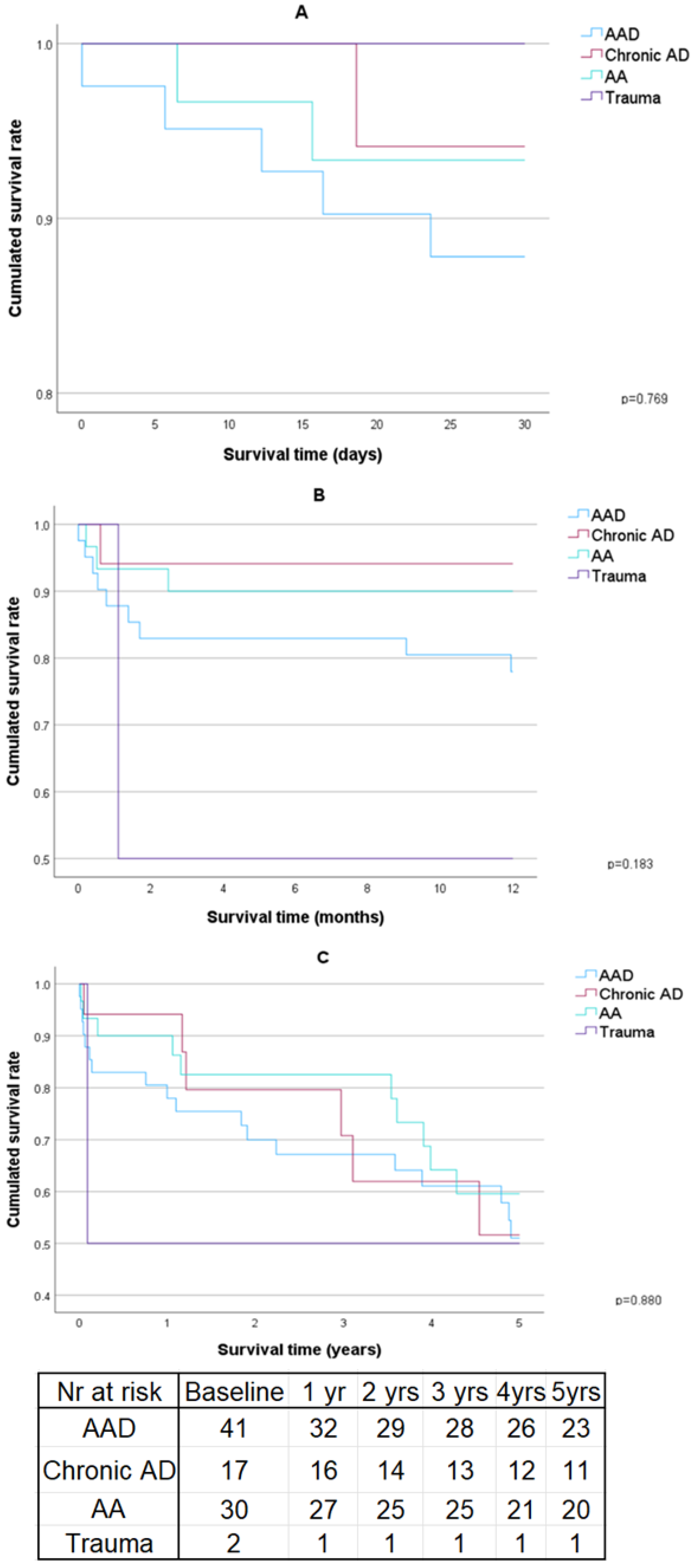
| 30-day mortality | 5 (12.2%) | 1 (5.9%) | 2 (6.7%) | 0 (0%) | - | |
| 1-year mortality | 9 (22%) | 1 (5.9%) | 3 (10%) | 1 (50%) | 0.172 | |
| 5-year mortality | 18 (43.9%) | 6 (35.3%) | 10 (33.3%) | 1 (50%) | 0.797 | |
| Postoperative complications | 7 (17.1%) | 1 (5.9%) | 1 (3.3%) | 0 (0%) | - | |
| Reoperation | 0 (0%) | 0 (0%) | 1 (3.3%) | 0 (0%) | - | |
| Fresh miocardial infarction | 1 (2.4%) | 0 (0%) | 0 (0%) | 0 (0%) | - | |
| Hemodialysis | 1 (2.4%) | 0 (0%) | 0 (0%) | 0 (0%) | - | |
| Respiratory system complications | 3 (7.3%) | 1 (5.9%) | 0 (0%) | 0 (0%) | - | |
| Renal complications | 3 (7.3%) | 0 (0%) | 0 (0%) | 0 (0%) | - | |
| Neurological complications | 3 (7.3%) | 0 (0%) | 0 (0%) | 0 (0%) | - | |
| Tamponade | 2 (4.9%) | 0 (0%) | 1 (3.3%) | 0 (0%) | - | |

References
- Gouveia e Melo, R.; Silva Duarte, G.; Lopes, A.; Alves, M.; Caldeira, D.; e Fernandes, R.F.; Pedro, L.M. Incidence and Prevalence of Thoracic Aortic Aneurysms: A Systematic Review and Meta-analysis of Population-Based Studies. Semin. Thorac. Cardiovasc. Surg. 2022, 34, 1–16. [Google Scholar] [CrossRef] [PubMed]
- Isselbacher, E.M.; Preventza, O.; Hamilton Black, J.; Augoustides, J.G.; Beck, A.W.; Bolen, M.A.; Braverman, A.C.; Bray, B.E.; Brown-Zimmerman, M.M.; Chen, E.P.; et al. 2022 ACC/AHA Guideline for the Diagnosis and Management of Aortic Disease: A Report of the American Heart Association/American College of Cardiology Joint Committee on Clinical Practice Guidelines. Circulation 2022, 80, e223–e393. [Google Scholar] [CrossRef] [PubMed]
- Rizza, A.; Trimarchi, G.; Di Sibio, S.; Bastiani, L.; Murzi, M.; Palmieri, C.; Foffa, I.; Berti, S. Preliminary Outcomes of Zone 2 Thoracic Endovascular Aortic Repair Using Castor Single-Branched Stent Grafts: A Single-Center Experience. J. Clin. Med. 2023, 12, 7593. [Google Scholar] [CrossRef]
- Volodos’, N.L.; Karpovich, I.P.; Shekhanin, V.E.; Troian, V.I.; Iakovenko, L.F. A case of distant transfemoral endoprosthesis of the thoracic artery using a self-fixing synthetic prosthesis in traumatic aneurysm. Grudn. Khir. 1988, 84–86. [Google Scholar] [PubMed]
- Coselli, J.S. Endovascular repair of aortic aneurysm: Complications and mitigating strategies. Tex. Heart Inst. J. 2010, 37, 669–671. [Google Scholar] [PubMed]
- Berezowski, M.; Morlock, J.; Beyersdorf, F.; Jasinski, M.; Plonek, T.; Siepe, M.; Czerny, M.; Rylski, B. Inaccurate aortic stent graft deployment in the distal landing zone: Incidence, reasons and consequences. Eur. J. Cardiothorac. Surg. 2018, 53, 1158–1164. [Google Scholar] [CrossRef]
- Rylski, B.; Mayer, F.; Beyersdorf, F.; Kondov, S.; Kolowca, M.; Kreibich, M.; Czerny, M. How to minimize air embolisms during thoracic endovascular aortic repair with Relay Pro? Interact. Cardiovasc. Thorac. Surg. 2020, 30, 293–295. [Google Scholar] [CrossRef]
- Aucoin, V.J.; Bolaji, B.; Novak, Z.; Spangler, E.L.; Sutzko, D.C.; McFarland, G.E.; Pearce, B.J.; Passman, M.A.; Scali, S.T.; Beck, A.W. Trends in the use of cerebrospinal drains and outcomes related to spinal cord ischemia after thoracic endovascular aortic repair and complex endovascular aortic repair in the Vascular Quality Initiative database. J. Vasc. Surg. 2021, 74, 1067–1078. [Google Scholar] [CrossRef]
- Maier, S.; Shcherbakova, M.; Beyersdorf, F.; Benk, C.; Kari, F.A.; Siepe, M.; Czerny, M.; Rylski, B. Benefits and Risks of Prophylactic Cerebrospinal Fluid Catheter and Evoked Potential Monitoring in Symptomatic Spinal Cord Ischemia Low-Risk Thoracic Endovascular Aortic Repair. Thorac. Cardiovasc. Surg. 2019, 67, 379–384. [Google Scholar] [CrossRef]
- Kari, F.A.; Saravi, B.; Krause, S.; Puttfarcken, L.; Scheumann, J.; Förster, K.; Rylski, B.; Maier, S.; Göbel, U.; Siepe, M.; et al. New insights into spinal cord ischaemia after thoracic aortic procedures: The importance of the number of anterior radiculomedullary arteries for surgical outcome. Eur. J. Cardiothorac. Surg. 2018, 54, 149–156. [Google Scholar] [CrossRef]
- Luehr, M.; Etz, C.D.; Berezowski, M.; Nozdrzykowski, M.; Jerkku, T.; Peterss, S.; Borger, M.A.; Czerny, M.; Banafsche, R.; Pichlmaier, M.A.; et al. Outcomes After Thoracic Endovascular Aortic Repair with Overstenting of the Left Subclavian Artery. Ann. Thorac. Surg. 2019, 107, 1372–1379. [Google Scholar] [CrossRef] [PubMed]
- Jing, Z.; Lu, Q.; Feng, J.; Zhou, J.; Feng, R.; Zhao, Z.; Bao, J.; Jiang, W.; Zhang, X.; Shu, C.; et al. Endovascular Repair of Aortic Dissection Involving the Left Subclavian Artery by Castor Stent Graft: A Multicentre Prospective Trial. Eur. J. Vasc. Endovasc. Surg. 2020, 60, 854–861. [Google Scholar] [CrossRef] [PubMed]
- Vallerio, P.; Maloberti, A.; D’Alessio, I.; Lista, A.; Varrenti, M.; Castelnuovo, S.; Marone, M.; Piccinelli, E.; Grassi, G.; Palmieri, B.; et al. Cardiovascular Remodeling after Endovascular Treatment for Thoracic Aortic Injury. Ann. Vasc. Surg. 2019, 61, 134–141. [Google Scholar] [CrossRef] [PubMed]
- Kreibich, M.; Morlock, J.; Beyersdorf, F.; Berger, T.; Allweier, S.; Kondov, S.; Pingpoh, C.; Czerny, M.; Siepe, M.; Rylski, B. Decreased biventricular function following thoracic endovascular aortic repair. Interact. Cardiovasc. Thorac. Surg. 2020, 30, 600–604. [Google Scholar] [CrossRef]
- Khayat, M.; Cooper, K.J.; Khaja, M.S.; Gandhi, R.; Bryce, Y.C.; Williams, D.M. Endovascular management of acute aortic dissection. Cardiovasc. Diagn. Ther. 2018, 8, S97–S107. [Google Scholar] [CrossRef]
- Ma, Y.; Qi, Y.; Li, Q.; Zhao, W.; Zhu, S.; Zhang, Y.; Chen, X. Endovascular repair versus best medical treatment for uncomplicated acute type B acute aorta dissection: A meta-analysis. Adv. Interv. Cardiol. 2023, 19, 311–317. [Google Scholar]
- Fairman, R.M.; Criado, F.; Farber, M.; Kwolek, C.; Mehta, M.; White, R.; Lee, A.; Tuchek, J.M. Pivotal results of the Medtronic Vascular Talent Thoracic Stent Graft System: The VALOR Trial. J. Vasc. Surg. 2008, 48, 546–554.e2. [Google Scholar] [CrossRef]
- Czerny, M.; Pacini, D.; Aboyans, V.; Al-Attar, N.; Eggebrecht, H.; Evangelista, A.; Grabenwöger, M.; Stabile, E.; Kolowca, M.; Lescan, M.; et al. Current options and recommendations for the use of thoracic endovascular aortic repair in acute and chronic thoracic aortic disease: An expert consensus document of the European Society for Cardiology (ESC) Working Group of Cardiovascular Surgery, the ESC Working Group on Aorta and Peripheral Vascular Diseases, the European Association of Percutaneous Cardiovascular Interventions (EAPCI) of the ESC and the European Association for Cardio-Thoracic Surgery (EACTS). Eur. J. Cardio-Thorac. Surg. 2021, 59, 65–73. [Google Scholar]
- Spanos, K.; Nana, P.; Behrendt, C.-A.; Kouvelos, G.; Panuccio, G.; Heidemann, F.; Matsagkas, M.; Debus, E.S.; Giannoukas, A.; Kölbel, T. Management of Descending Thoracic Aortic Diseases: Similarities and Differences Among Cardiovascular Guidelines. J. Endovasc. Ther. 2021, 28, 323–331. [Google Scholar] [CrossRef]
- Jiang, X.; Pan, T.; Zou, L.; Chen, B.; Jiang, J.; Shi, Y.; Ma, T.; Lin, C.; Guo, D.; Xu, X.; et al. Outcomes of endovascular stent graft repair for penetrating aortic ulcers with or without intramural hematoma. J. Vasc. Surg. 2021, 73, 1541–1548. [Google Scholar] [CrossRef]
- Harky, A.; Bleetman, D.; Chan, J.S.K.; Eriksen, P.; Chaplin, G.; MacCarthy-Ofosu, B.; Theologou, T.; Ambekar, S.; Roberts, N.; Oo, A. A systematic review and meta-analysis of endovascular versus open surgical repair for the traumatic ruptured thoracic aorta. J. Vasc. Surg. 2020, 71, 270–282. [Google Scholar] [CrossRef] [PubMed]
- Burysz, M.; Batko, J.; Bartuś, K.; Ogorzeja, W.; Litwinowicz, R.A. Hybrid treatment of penetrating aortic trauma. Pol. J. Cardio-Thorac. Surg. 2024, 21, 65–66. [Google Scholar] [CrossRef] [PubMed]
- Rams, D.; Batko, J.; Bartuś, K.; Filip, G.; Kowalewski, M.; Litwinowicz, R. Left Internal Mammary Artery Operative Topography for MIDCAB and TECAB Procedures. Innov. Technol. Tech. Cardiothorac. Vasc. Surg. 2022, 17, 499–505. [Google Scholar] [CrossRef] [PubMed]
- Burysz, M.; Batko, J.; Olejek, W.; Piotrowski, M.; Litwinowicz, R.; Słomka, A.; Kowalewski, M.; Suwalski, P.; Bartuś, K.; Rams, D. Morphology and Anatomical Classification of Pericardial Cavities: Oblique and Transverse Sinuses. J. Clin. Med. 2023, 12, 4320. [Google Scholar] [CrossRef]
- Kölbel, T.; Rohlffs, F.; Wipper, S.; Carpenter, S.W.; Debus, E.S.; Tsilimparis, N. Carbon Dioxide Flushing Technique to Prevent Cerebral Arterial Air Embolism and Stroke During TEVAR. J. Endovasc. Ther. 2016, 23, 393–395. [Google Scholar] [CrossRef]


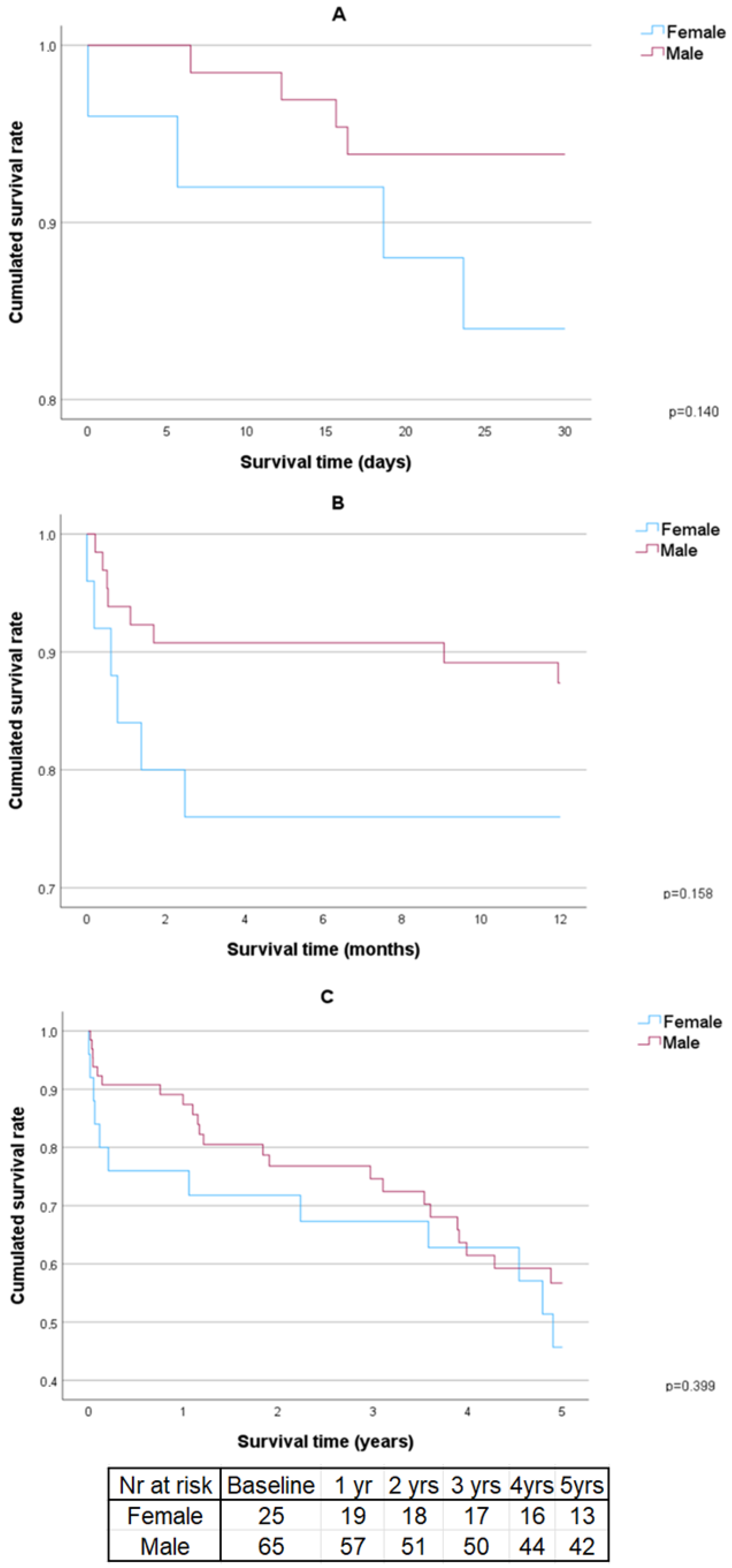
| Female (n = 25) | Male (n = 65) | General | p | ||
|---|---|---|---|---|---|
| Age (years) | 66 (59–73) | 63 (55–68) | 64 (55–70) | 0.168 | |
| BMI (kg/m2) | 29.4 (26–33.7) | 26.6 (24.5–30.8) | 27 (24.7–32.7) | 0.340 | |
| CCS Class | 1 | 15 (60%) | 48 (73.8%) | 63 (15.6%) | 0.346 |
| 2 | 9 (36%) | 13 (20%) | 22 (24.4%) | ||
| 3 | 1 (4%) | 2 (3.1%) | 3 (3.3%) | ||
| 4 | 0 (0%) | 2 (3.1%) | 2 (2.2%) | ||
| NYHA class | 1 | 12 (48%) | 44 (67.7%) | 56 (11.1%) | 0.481 |
| 2 | 8 (32%) | 15 (23.1%) | 23 (25.6%) | ||
| 3 | 2 (8%) | 2 (3.1%) | 4 (4.4%) | ||
| 4 | 3 (12%) | 4 (6.2%) | 7 (7.8%) | ||
| Eversmoker | actual | 6 (24%) | 19 (29.2%) | 25 (27.8%) | 0.853 |
| previous | 11 (44%) | 25 (38.5%) | 36 (40%) | ||
| Diabetes mellitus type 2 | diet | 0 (0%) | 1 (1.5%) | 1 (1.1%) | 0.134 |
| pharmacological | 3 (12%) | 2 (3.1%) | 5 (5.6%) | ||
| insulin | 4 (16%) | 4 (6.2%) | 8 (8.9%) | ||
| Hypertension | treated | 19 (76%) | 47 (72.3%) | 66 (73.3%) | 0.488 |
| untreated | 4 (16%) | 7 (10.8%) | 11 (12.2%) | ||
| Hyperlipidemia | 10 (40%) | 23 (35.4%) | 33 (36.7%) | 0.684 | |
| TIA | 1 (4%) | 2 (3.1%) | 3 (3.3%) | 0.239 | |
| Peripheral vascular disease | 11 (44%) | 17 (26.2%) | 28 (31.1%) | 0.248 | |
| Renal impairment | GFR > 85 | 13 (52%) | 35 (53.8%) | 48 (53.3%) | 0.067 |
| 50 < GFR < 86 | 5 (20%) | 24 (36.9%) | 29 (32.2%) | ||
| GFR < 50 | 6 (24%) | 6 (9.2%) | 12 (13.3%) | ||
| dialysis | 1 (4%) | 0 (0%) | 1 (1.1%) | ||
| Poor mobility | 10 (40%) | 15 (23.1%) | 25 (27.8%) | 0.108 | |
| Chronic lung disease | 3 (12%) | 4 (6.2%) | 7 (7.8%) | 0.354 | |
| Critical preoperative condition | 7 (28%) | 15 (23.1%) | 22 (24.4%) | 0.626 | |
| Preoperative mechanical ventilation | 0 (0%) | 5 (7.7%) | 5 (5.6%) | 0.317 | |
| Cardiogenic shock | 2 (8%) | 7 (10.8%) | 9 (10%) | 1.000 | |
| Previous thoraflex implantation | 0 (0%) | 6 (9.2%) | 6 (6.7%) | 0.181 | |
| Time from thoraflex implantation (months) | 0 (0–0) | 2.5 (1.6–4.1) | 2.5 (1.6–4.1) | - | |
| Female (n = 25) | Male (n = 65) | General | p | ||
|---|---|---|---|---|---|
| Euroscore | 6.7 (3.7–16.8) | 3.5 (1.7–7.2) | 4 (2.1–9) | 0.011 | |
| Procedure urgency | planned | 6 (24%) | 27 (41.5%) | 33 (36.7%) | 0.254 |
| urgent | 10 (40%) | 17 (26.2%) | 27 (30%) | ||
| immediate surgery | 9 (36%) | 21 (32.3%) | 30 (33.3%) | ||
| Surgery indication | acute aortic dissection | 13 (52%) | 28 (43.1%) | 41 (45.6%) | 0.740 |
| chronic aortic dissection | 4 (16%) | 13 (20%) | 17 (18.9%) | ||
| aortic aneurysm | 8 (32%) | 22 (33.8%) | 30 (33.3%) | ||
| penetrating trauma | 0 (0%) | 2 (3.1%) | 2 (2.2%) | ||
| Aortic segments involved | thoracic descending | 17 (68%) | 48 (73.8%) | 65 (72.2%) | 0.854 |
| thoracic and abdominal | 2 (8%) | 4 (6.2%) | 6 (6.7%) | ||
| distal arch and thoracic | 6 (24%) | 13 (20%) | 19 (21.1%) | ||
| Type of anesthesia | general | 21 (84%) | 59 (90.8%) | 80 (89.9%) | 0.698 |
| sedation | 3 (12%) | 6 (9.2%) | 9 (10.1%) | ||
| Surgery time (min) | 95 (80–120) | 90 (70–120) | 90 (70–120) | 0.658 | |
| Intubation time (h) | 5.7 (3.3–8.3) | 3.5 (1.8–8.3) | 3.9 (1.9–8.3) | 0.152 | |
| Postoperative transfusion | 7 (28%) | 25 (38.5%) | 32 (35.6%) | 0.353 | |
| ICU stay (days) | 0.9 (0.2–1.1) | 0.8 (0.1–1.1) | 0.9 (0.1–1.1) | 0.432 | |
| Hospitalization time (days) | 9 (6–12.5) | 7 (5–11.5) | 7.5 (5–11.5) | 0.321 | |
| 30 days mortality | 4 (16%) | 4 (6.2%) | 8 (8.9%) | 0.211 | |
| 1 year mortality | 6 (24%) | 8 (12.3%) | 14 (15.6%) | 0.200 | |
| 5 years mortality | 12 (48%) | 23 (35.4%) | 35 (38.9%) | 0.272 | |
| Postoperative complications | 3 (12%) | 6 (9.2%) | 9 (10%) | 0.695 | |
| Reoperation | 0 (0%) | 1 (1.5%) | 1 (1.1%) | - | |
| Fresh miocardial infarction | 0 (0%) | 1 (1.5%) | 1 (1.1%) | - | |
| Hemodialysis | 0 (0%) | 1 (1.5%) | 1 (1.1%) | - | |
| Respiratory system complications | 1 (4%) | 3 (4.6%) | 4 (4.4%) | 1.000 | |
| Renal complications | 1 (4%) | 2 (3.1%) | 3 (3.3%) | 1.000 | |
| Neurological complications | 2 (8%) | 1 (1.5%) | 3 (3.3%) | 0.186 | |
| Tamponade | 1 (4%) | 2 (3.1%) | 3 (3.3%) | 1.000 | |
| Planned (n = 33) | Urgent (n = 27) | Immediate Surgery (n = 30) | p | ||
|---|---|---|---|---|---|
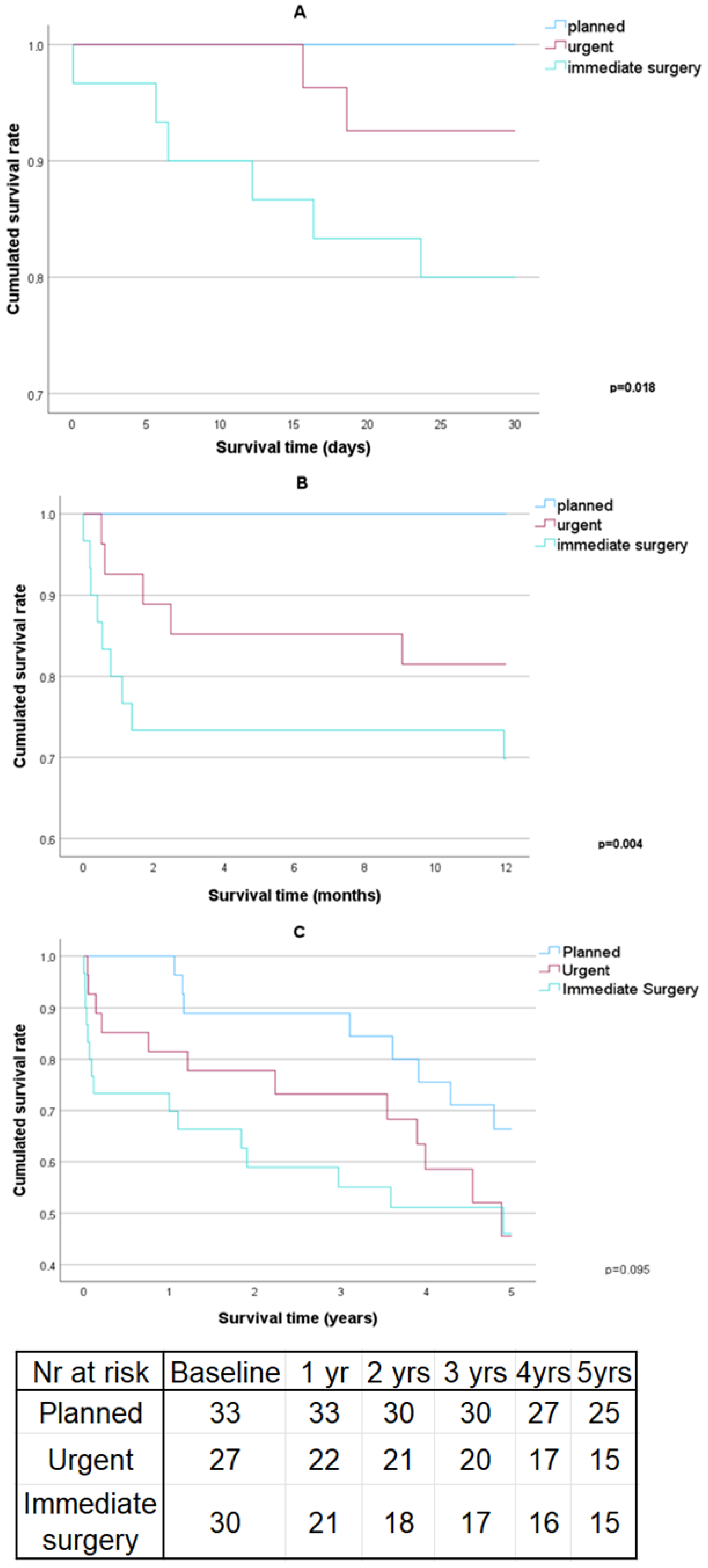
| Euroscore | 1.7 (1.3–3.4) | 4.5 (3.3–13.8) | 7.5 (4.1–16.8) | <0.001 | |
| Surgery indication | acute aortic dissection | 4 (12.1%) | 12 (44.4%) | 25 (83.3%) | <0.001 |
| chronic aortic dissection | 9 (27.3%) | 6 (22.2%) | 2 (6.7%) | ||
| aortic aneurysm | 20 (60.6%) | 9 (33.3%) | 1 (3.3%) | ||
| penetrating trauma | 0 (0%) | 0 (0%) | 2 (6.7%) | ||
| Aortic segments involved | thoracic descending | 24 (72.7%) | 20 (74.1%) | 21 (70%) | 0.299 |
| thoracic and abdominal | 3 (9.1%) | 3 (11.1%) | 0 (0%) | ||
| distal arch and thoracic | 6 (18.2%) | 4 (14.8%) | 9 (30%) | ||
| Type of anesthesia | general | 27 (81.8%) | 26 (96.3%) | 27 (93.1%) | 0.141 |
| sedation | 6 (18.2%) | 1 (3.7%) | 2 (6.9%) | ||
| Surgery time (min) | 90 (75–120) | 90 (60–120) | 95 (69–150) | 0.582 | |
| Intubation time (h) | 2.6 (1.8–6.5) | 2.8 (1.3–5.1) | 8.3 (3.3–33.9) | 0.008 | |
| Postoperative transfusion | 10 (30.3%) | 8 (29.6%) | 14 (46.7%) | 0.297 | |
| ICU stay (days) | 0.9 (0–1.1) | 0.9 (0.1–1.1) | 0.9 (0.4–3) | 0.115 | |
| Hospitalization time (days) | 7 (5–9) | 11 (6–15) | 7 (4–11.5) | 0.196 | |
| 30 days mortality | 0 (0%) | 2 (7.4%) | 6 (20%) | 0.020 | |
| 1 year mortality | 0 (0%) | 5 (18.5%) | 9 (30%) | 0.004 | |
| 5 years mortality | 8 (24.2%) | 12 (44.4%) | 15 (50%) | 0.087 | |
| Postoperative complications | 1 (3%) | 3 (11.1%) | 5 (16.7%) | 0.192 | |
| Reoperation | 1 (3%) | 0 (0%) | 0 (0%) | - | |
| Fresh miocardial infarction | 0 (0%) | 0 (0%) | 1 (3.3%) | - | |
| Hemodialysis | 0 (0%) | 0 (0%) | 1 (3.3%) | - | |
| Respiratory system complications | 0 (0%) | 2 (7.4%) | 2 (6.7%) | - | |
| Renal complications | 0 (0%) | 0 (0%) | 3 (10%) | - | |
| Neurological complications | 0 (0%) | 0 (0%) | 3 (10%) | - | |
| Tamponade | 1 (3%) | 1 (3.7%) | 1 (3.3%) | 0.990 | |
Disclaimer/Publisher’s Note: The statements, opinions and data contained in all publications are solely those of the individual author(s) and contributor(s) and not of MDPI and/or the editor(s). MDPI and/or the editor(s) disclaim responsibility for any injury to people or property resulting from any ideas, methods, instructions or products referred to in the content. |
© 2024 by the authors. Licensee MDPI, Basel, Switzerland. This article is an open access article distributed under the terms and conditions of the Creative Commons Attribution (CC BY) license (https://creativecommons.org/licenses/by/4.0/).
Share and Cite
Burysz, M.; Batko, J.; Greberski, K.; Słomka, A.; Litwinowicz, R. Aortic Stent Graft Treatment in a Medium-Size Aortic Center Performed by a Cardiac Surgeon Only—The 9 Years Experience in Poland. J. Clin. Med. 2024, 13, 6517. https://doi.org/10.3390/jcm13216517
Burysz M, Batko J, Greberski K, Słomka A, Litwinowicz R. Aortic Stent Graft Treatment in a Medium-Size Aortic Center Performed by a Cardiac Surgeon Only—The 9 Years Experience in Poland. Journal of Clinical Medicine. 2024; 13(21):6517. https://doi.org/10.3390/jcm13216517
Chicago/Turabian StyleBurysz, Marian, Jakub Batko, Krzysztof Greberski, Artur Słomka, and Radosław Litwinowicz. 2024. "Aortic Stent Graft Treatment in a Medium-Size Aortic Center Performed by a Cardiac Surgeon Only—The 9 Years Experience in Poland" Journal of Clinical Medicine 13, no. 21: 6517. https://doi.org/10.3390/jcm13216517
APA StyleBurysz, M., Batko, J., Greberski, K., Słomka, A., & Litwinowicz, R. (2024). Aortic Stent Graft Treatment in a Medium-Size Aortic Center Performed by a Cardiac Surgeon Only—The 9 Years Experience in Poland. Journal of Clinical Medicine, 13(21), 6517. https://doi.org/10.3390/jcm13216517