


The Effect of Conservative vs. Radical Treatment of Ameloblastoma on Recurrence Rate and Quality of Life: An Umbrella Review

 ,
,  , ,
, ,  and
and
Abstract
1. Introduction
2. Materials and Methods
2.1. Literature Search
2.2. Data Extraction
2.3. Methodological Quality of Included Reviews
2.4. Statistical Analysis
3. Results
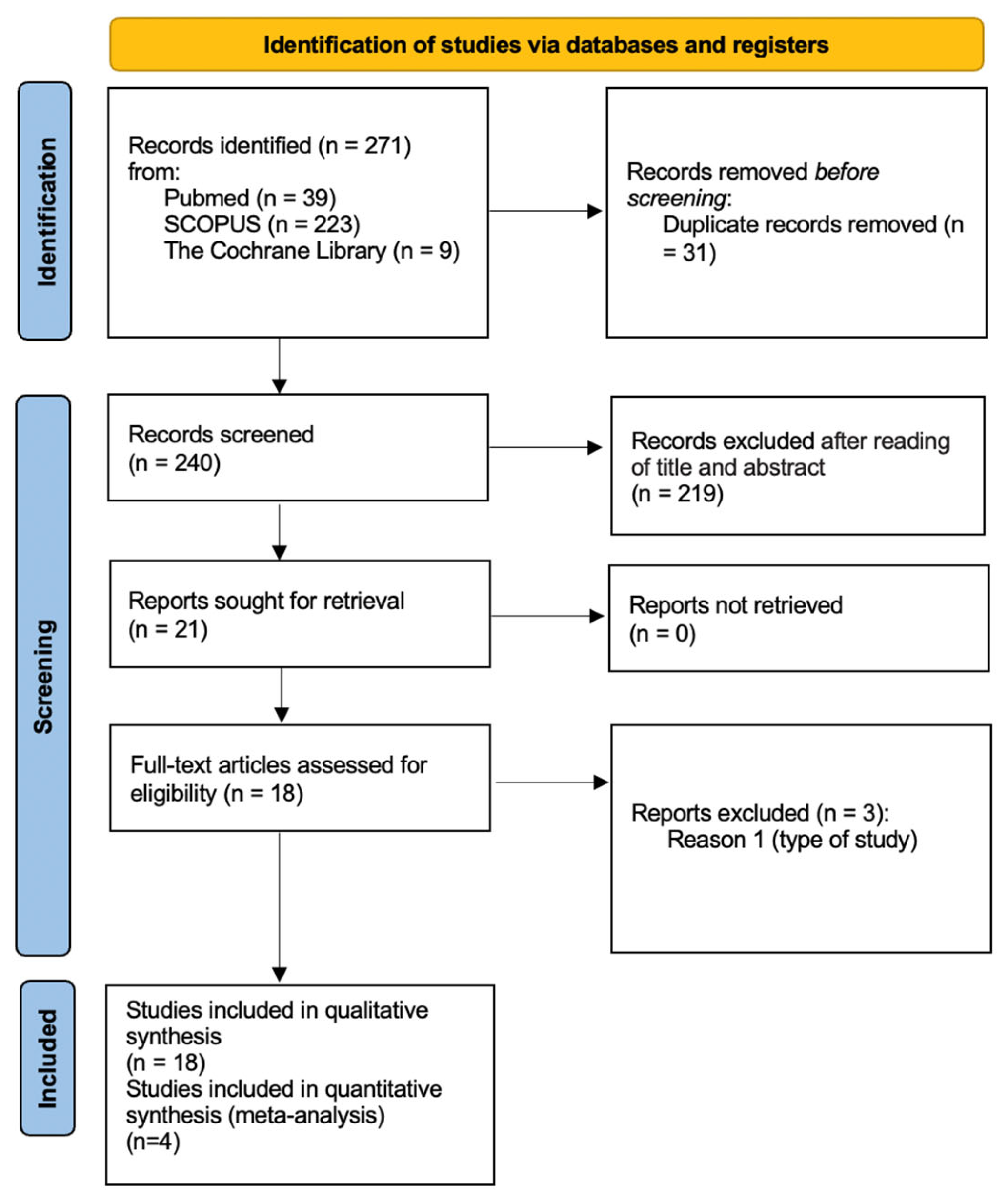
3.1. Search Results
3.2. Characteristics of Included Reviews
3.3. Methodological Quality Results
3.4. Clinical Results
3.5. Meta-Analysis Results
4. Discussion
4.1. Clinical Management
4.2. Future Perspectives
4.3. Strengths and Limitations
5. Conclusions
Author Contributions
Funding
Data Availability Statement
Conflicts of Interest
References
- Masthan, K.M.; Anitha, N.; Krupaa, J.; Manikkam, S. Ameloblastoma. J. Pharm. Bioallied Sci. 2015, 7 (Suppl. S1), S167–S170. [Google Scholar] [PubMed]
- Ghai, S. Ameloblastoma: An Updated Narrative Review of an Enigmatic Tumor. Cureus 2022, 14, e27734. [Google Scholar] [CrossRef] [PubMed]
- Hendra, F.N.; Van Cann, E.M.; Helder, M.N.; Ruslin, M.; de Visscher, J.G.; Forouzanfar, T.; de Vet, H.C.W. Global incidence and profile of ameloblastoma: A systematic review and meta-analysis. Oral Dis. 2020, 26, 12–21. [Google Scholar] [CrossRef] [PubMed]
- El-Naggar, A.K.; Chan, J.K.C.; Takata, T.; Grandis, J.R.; Slootweg, P.J. The fourth edition of the head and neck World Health Organization blue book: Editors’ perspectives. Hum. Pathol. 2017, 66, 10–12. [Google Scholar] [CrossRef]
- Gasparro, R.; Calabria, E.; Coppola, N.; Marenzi, G.; Sammartino, G.; Aria, M.; Mignogna, M.D.; Adamo, D. Sleep Disorders and Psychological Profile in Oral Cancer Survivors: A Case-Control Clinical Study. Cancers 2021, 13, 1855. [Google Scholar] [CrossRef]
- Chandu, A.; Smith, A.C.; Rogers, S.N. Health-related quality of life in oral cancer: A review. J. Oral Maxillofac. Surg. 2006, 64, 495–502. [Google Scholar] [CrossRef]
- Vered, M.; Wright, J.M. Update from the 5th Edition of the World Health Organization Classification of Head and Neck Tumors: Odontogenic and Maxillofacial Bone Tumours. Head Neck Pathol. 2022, 16, 63–75. [Google Scholar] [CrossRef]
- Correa-Arzate, L.; Portilla-Robertson, J.; Ramírez-Jarquín, J.O.; Jacinto-Alemán, L.F.; Mejía-Velázquez, C.P.; Villanueva-Sánchez, F.G.; Rodríguez-Vázquez, M. LRP5, SLC6A3, and SOX10 Expression in Conventional Ameloblastoma. Genes 2023, 14, 1524. [Google Scholar] [CrossRef]
- Augustine, D.; Rao, R.S.; Surendra, L.; Patil, S.; Yoithapprabhunath, T.R.; Albogami, S.; Shamsuddin, S.; Basheer, S.A.; Sainudeen, S. Histopathologic Feature of Hyalinization Predicts Recurrence of Conventional/Solid Multicystic Ameloblastomas. Diagnostics 2022, 12, 1114. [Google Scholar] [CrossRef]
- Yang, R.; Lin, X.; Zhang, W.; Gokavarapu, S.; Lin, C.; Ren, Z.; Hu, Y.; Cao, W.; Ji, T. Unicystic ameloblastoma: A retrospective study on recurrent factors from a single institute database. Oral Dis. 2024, 30, 1475–1482. [Google Scholar] [CrossRef]
- Arora, S. Unicystic Ameloblastoma: A Perception for the Cautious Interpretation of Radiographic and Histological Findings. J. Coll. Physician. Surg. Park 2015, 25, 761–764. [Google Scholar]
- Ide, F.; Ito, Y.; Miyazaki, Y.; Nishimura, M.; Kusama, K.; Kikuchi, K. A New Look at the History of Peripheral Ameloblastoma. Head Neck Pathol. 2020, 14, 1052–1057. [Google Scholar] [CrossRef]
- AlAli, A.M.; Hawkins, D.; Glass, S. Peripheral ameloblastoma underlying squamous cell papilloma after a third molar extraction. Oral Surg. Oral Med. Oral Radiol. 2024, 137, e53–e56. [Google Scholar] [CrossRef] [PubMed]
- Adeel, M.; Rajput, M.S.A.; Arain, A.A.; Baloch, M.; Khan, M. Ameloblastoma: Management and Outcome. Cureus 2018, 10, e3437. [Google Scholar] [CrossRef] [PubMed]
- Elo, J.A.; Tandon, R.; Allen, C.N.; Murray, M.D. Hemimaxillectomy for desmoplastic ameloblastoma with immediate temporalis flap reconstruction. Oral Surg. Oral Med. Oral Pathol. Oral Radiol. 2014, 118, e33–e39. [Google Scholar] [CrossRef] [PubMed]
- Kitisubkanchana, J.; Reduwan, N.H.; Poomsawat, S.; Pornprasertsuk-Damrongsri, S.; Wongchuensoontorn, C. Odontogenic keratocyst and ameloblastoma: Radiographic evaluation. Oral Radiol. 2021, 37, 55–65. [Google Scholar] [CrossRef] [PubMed]
- Di Lauro, A.E.; Romeo, G.; Scotto, F.; Guadagno, E.; Gasparro, R.; Sammartino, G. Odontogenic keratocystic can be misdiagnosed for a lateral periodontal cyst when the clinical and radiographical findings are similar. Minerva Dent. Oral Sci. 2022, 71, 293–297. [Google Scholar] [CrossRef]
- Liu, Z.; Liu, J.; Zhou, Z.; Zhang, Q.; Wu, H.; Zhai, G.; Han, J. Differential diagnosis of ameloblastoma and odontogenic keratocyst by machine learning of panoramic radiographs. Int. J. Comput. Assist. Radiol. Surg. 2021, 16, 415–422. [Google Scholar] [CrossRef]
- Dandriyal, R.; Gupta, A.; Pant, S.; Baweja, H.H. Surgical management of ameloblastoma: Conservative or radical approach. Natl. J. Maxillofac. Surg. 2011, 2, 22–27. [Google Scholar] [CrossRef]
- Giraddi, G.B.; Arora, K.; Saifi, A.M. Ameloblastoma: A retrospective analysis of 31 cases. J. Oral Biol. Craniofac. Res. 2017, 7, 206–211. [Google Scholar] [CrossRef]
- Ruslin, M.; Hendra, F.N.; Vojdani, A.; Hardjosantoso, D.; Gazali, M.; Tajrin, A.; Wolff, J.; Forouzanfar, T. The Epidemiology, treatment, and complication of ameloblastoma in East-Indonesia: 6 years retrospective study. Med. Oral Patol. Oral Cir. Bucal 2018, 23, e54–e58. [Google Scholar] [CrossRef] [PubMed]
- Laino, L.; Cicciù, M.; Russo, D.; Cervino, G. Surgical Strategies for Multicystic Ameloblastoma. J. Craniofac. Surg. 2020, 31, e116–e119. [Google Scholar] [CrossRef]
- Yang, Z.; Liang, Q.; Yang, L.; Zheng, G.S.; Zhang, S.E.; Lao, X.M.; Liang, Y.J.; Liao, G.Q. Marsupialization of mandibular cystic ameloblastoma: Retrospective study of 7 years. Head Neck 2018, 40, 2172–2180. [Google Scholar] [CrossRef] [PubMed]
- Shea, B.J.; Reeves, B.C.; Wells, G. AMSTAR 2: A critical appraisal tool for systematic reviews that include randomised or non-randomised studies of healthcare interventions, or both. Br. Med. J. 2017, 358, j4008. [Google Scholar] [CrossRef] [PubMed]
- Gosling, C.J.; Solanes, A.; Fusar-Poli, P.; Radua, J. Metaumbrella: The first comprehensive suite to perform data analysis in umbrella reviews with stratification of the evidence. BMJ Ment. Health 2023, 26, e300534. [Google Scholar] [CrossRef] [PubMed]
- Almeida Rde, A.; Andrade, E.S.; Barbalho, J.C.; Vajgel, A.; Vasconcelos, B.C. Recurrence rate following treatment for primary multicystic ameloblastoma: Systematic review and meta-analysis. Int. J. Oral Maxillofac. Surg. 2016, 45, 359–367. [Google Scholar] [CrossRef]
- Anand, R.; Sarode, G.S.; Sarode, S.C.; Reddy, M.; Unadkat, H.V.; Mushtaq, S.; Deshmukh, R.; Choudhary, S.; Gupta, N.; Ganjre, A.P.; et al. Clinicopathological characteristics of desmoplastic ameloblastoma: A systematic review. J. Investig. Clin. Dent. 2018, 9, e12282. [Google Scholar] [CrossRef]
- Anpalagan, A.; Tzortzis, A.; Twigg, J.; Wotherspoon, R.; Chengot, P.; Kanatas, A. Current practice in the management of peripheral ameloblastoma: A structured review. Br. J. Oral Maxillofac. Surg. 2021, 59, e1–e8. [Google Scholar] [CrossRef]
- Antonoglou, G.N.; Sándor, G.K. Recurrence rates of intraosseous ameloblastomas of the jaws: A systematic review of conservative versus aggressive treatment approaches and meta-analysis of non-randomized studies. J. Craniomaxillofac. Surg. 2015, 43, 149–157. [Google Scholar] [CrossRef]
- Berretta, L.M.; Melo, G.; Mello, F.W.; Lizio, G.; Rivero, E.R.C. Effectiveness of marsupialisation and decompression on the reduction of cystic jaw lesions: A systematic review. Br. J. Oral Maxillofac. Surg. 2021, 59, E17–E42. [Google Scholar] [CrossRef]
- de Campos, W.G.; Alkmin Paiva, G.L.; Esteves, C.V.; Rocha, A.C.; Gomes, P.; Lemos Júnior, C.A. Surgical Treatment of Ameloblastoma: How Does It Impact the Oral Health-Related Quality of Life? A Systematic Review. J. Oral Maxillofac. Surg. 2022, 80, 1103–1114. [Google Scholar] [CrossRef] [PubMed]
- de Farias Morais, H.G.; Gonçalo, R.I.C.; de Oliveira Costa, C.S.; de Figueiredo Pires, H.; Mafra, R.P.; de Morais, E.F.; da Costa Miguel, M.C.; de Almeida Freitas, R. A Systematic Review of Adenoid Ameloblastoma: A Newly Recognized Entity. Head Neck Pathol. 2023, 17, 688–696. [Google Scholar] [CrossRef] [PubMed]
- Hendra, F.N.; Natsir Kalla, D.S.; Van Cann, E.M.; de Vet, H.C.W.; Helder, M.N.; Forouzanfar, T. Radical vs conservative treatment of intraosseous ameloblastoma: Systematic review and meta-analysis. Oral Dis. 2019, 25, 1683–1696. [Google Scholar] [CrossRef]
- Hendra, F.N.; Helder, M.N.; Ruslin, M.; Van Cann, E.M.; Forouzanfar, T. A network meta-analysis assessing the effectiveness of various radical and conservative surgical approaches regarding recurrence in treating solid/multicystic ameloblastomas. Sci. Rep. 2023, 13, 8445. [Google Scholar] [CrossRef]
- Lal, B.; Kumar, R.D.; Alagarsamy, R.; Shanmuga Sundaram, D.; Bhutia, O.; Roychoudhury, A. Role of Carnoy’s solution as treatment adjunct in jaw lesions other than odontogenic keratocyst: A systematic review. Br. J. Oral Maxillofac. Surg. 2021, 59, 729–741. [Google Scholar] [CrossRef]
- Lau, S.L.; Samman, N. Recurrence related to treatment modalities of unicystic ameloblastoma: A systematic review. Int. J. Oral Maxillofac. Surg. 2006, 35, 681–690. [Google Scholar] [CrossRef] [PubMed]
- Mehta, V.; Sarode, G.S.; Obulareddy, V.T.; Sharma, T.; Kokane, S.; Cicciù, M.; Minervini, G. Clinicopathologic Profile, Management and Outcome of Sinonasal Ameloblastoma—A Systematic Review. J. Clin. Med. 2023, 12, 381. [Google Scholar] [CrossRef] [PubMed]
- Netto, R.; Peralta-Mamani, M.; de Freitas-Filho, S.A.; Moura, L.L.; Rubira, C.M.; Rubira-Bullen, I.R. Segmental resection vs. partial resection on treating solid multicystic ameloblastomas of the jaws—Recurrence rates: A systematic review and meta-analysis. J. Clin. Exp. Dent. 2023, 15, e518–e525. [Google Scholar] [CrossRef]
- Qiao, X.; Shi, J.; Liu, J.; Liu, J.; Guo, Y.; Zhong, M. Recurrence Rates of Intraosseous Ameloblastoma Cases with Conservative or Aggressive Treatment: A Systematic Review and Meta-Analysis. Front. Oncol. 2021, 11, 647200. [Google Scholar] [CrossRef]
- Seintou, A.; Martinelli-Kläy, C.P.; Lombardi, T. Unicystic ameloblastoma in children: Systematic review of clinicopathological features and treatment outcomes. Int. J. Oral Maxillofac. Surg. 2014, 43, 405–412. [Google Scholar] [CrossRef]
- Slusarenko da Silva, Y.; Tartaroti, N.A.; Sendyk, D.I.; Deboni, M.C.Z.; Naclério-Homem, M.D.G. Is conservative surgery a better choice for the solid/multicystic ameloblastoma than radical surgery regarding recurrence? A systematic review. Oral Maxillofac. Surg. 2018, 22, 349–356. [Google Scholar] [CrossRef]
- Troiano, G.; Dioguardi, M.; Cocco, A.; Laino, L.; Cervino, G.; Cicciu, M.; Ciavarella, D.; Lo Muzio, L. Conservative vs Radical Approach for the Treatment of Solid/Multicystic Ameloblastoma: A Systematic Review and Meta-analysis of the Last Decade. Oral Health Prev. Dent. 2017, 15, 421–426. [Google Scholar]
- Vidya, A.; Shruthi, H. Ameloblastomas vs recurrent ameloblastomas: A systematic review. J. Oral Med. Oral Surg. 2022, 28, 11. [Google Scholar]
- Effiom, O.A.; Ogundana, O.M.; Akinshipo, A.O.; Akintoye, S.O. Ameloblastoma: Current etiopathological concepts and management. Oral Dis. 2018, 24, 307–316. [Google Scholar] [CrossRef] [PubMed]
- Leite-Lima, F.; Martins-Chaves, R.R.; Fonseca, F.P.; Brennan, P.A.; de Castro, W.H.; Gomez, R.S. A conservative approach for unicystic ameloblastoma: Retrospective clinic-pathologic analysis of 12 cases. J. Oral Pathol. Med. 2023, 52, 654–659. [Google Scholar] [CrossRef]
- Titinchi, F.; Brennan, P.A. Unicystic ameloblastoma: Analysis of surgical management and recurrence risk factors. Br. J. Oral Maxillofac. Surg. 2022, 60, 337–342. [Google Scholar] [CrossRef] [PubMed]
- Goh, Y.C.; Siriwardena, B.S.M.S.; Tilakaratne, W.M. Association of clinicopathological factors and treatment modalities in the recurrence of ameloblastoma: Analysis of 624 cases. J. Oral Pathol. Med. 2021, 50, 927–936. [Google Scholar] [CrossRef]
- Gupta, K.; Chaturvedi, T.P.; Gupta, J.; Agrawal, R. Cell proliferation proteins and aggressiveness of histological variants of ameloblastoma and keratocystic odontogenic tumor. Biotech. Histochem. 2019, 94, 348–351. [Google Scholar] [CrossRef]
- Troiano, G.; Inghingolo, A.; Serpico, R.; Ciavarella, D.; Lo Muzio, L.; Cervino, G.; Cicciù, M.; Laino, L. Rate of Relapse After Enucleation of Solid/Multicystic Ameloblastoma Followed by Piezoelectric or Conventional Peripheral Ostectomy. J. Craniofac. Surg. 2018, 29, e291–e293. [Google Scholar] [CrossRef]
- Rullo, R.; Festa, V.M.; Rullo, F.; Trosino, O.; Cerone, V.; Gasparro, R.; Laino, L.; Sammartino, G. The Use of Piezosurgery in Genioplasty. J. Craniofac. Surg. 2016, 27, 414–415. [Google Scholar] [CrossRef]
- De Silva, I.; Rozen, W.M.; Ramakrishnan, A.; Mirkazemi, M.; Baillieu, C.; Ptasznik, R.; Leong, J. Achieving adequate margins in ameloblastoma resection: The role for intra-operative specimen imaging. Clinical report and systematic review. PLoS ONE 2012, 7, e47897. [Google Scholar] [CrossRef] [PubMed]
- Abbate, V.; Togo, G.; Committeri, U.; Zarone, F.; Sammartino, G.; Valletta, A.; Elefante, A.; Califano, L.; Dell’Aversana Orabona, G. Full Digital Workflow for Mandibular Ameloblastoma Management: Showcase for Technical Description. J. Clin. Med. 2023, 12, 5526. [Google Scholar] [CrossRef] [PubMed]
- Petrovic, I.D.; Migliacci, J.; Ganly, I.; Patel, S.; Xu, B.; Ghossein, R.; Huryn, J.; Shah, J. Ameloblastomas of the mandible and maxilla. Ear Nose Throat J. 2018, 97, E26–E32. [Google Scholar]
- Sammartino, G.; Zarrelli, C.; Urciuolo, V.; di Lauro, A.E.; di Lauro, F.; Santarelli, A.; Giannone, N.; Lo Muzio, L. Effectiveness of a new decisional algorithm in managing mandibular ameloblastomas: A 10-years experience. Br. J. Oral Maxillofac. Surg. 2007, 45, 306–310. [Google Scholar] [CrossRef]
- Yiannis, C.; Mascolo, M.; Mignogna, M.D.; Varricchio, S.; Natella, V.; De Rosa, G.; Lo Giudice, R.; Galletti, C.; Paolini, R.; Celentano, A. Expression Profile of Stemness Markers CD138, Nestin and Alpha-SMA in Ameloblastic Tumours. Int. J. Environ. Res. Public Health 2021, 18, 3899. [Google Scholar] [CrossRef] [PubMed]
- Ebeling, M.; Scheurer, M.; Sakkas, A.; Pietzka, S.; Schramm, A.; Wilde, F. BRAF inhibitors in BRAF V600E-mutated ameloblastoma: Systematic review of rare cases in the literature. Med. Oncol. 2023, 40, 163. [Google Scholar] [CrossRef] [PubMed]
- Proietti, I.; Skroza, N.; Michelini, S.; Mambrin, A.; Balduzzi, V.; Bernardini, N.; Marchesiello, A.; Tolino, E.; Volpe, S.; Maddalena, P.; et al. BRAF Inhibitors: Molecular Targeting and Immunomodulatory Actions. Cancers 2020, 12, 1823. [Google Scholar] [CrossRef]
- Mamat Yusof, M.N.; Ch’ng, E.S.; Radhiah Abdul Rahman, N. BRAF V600E Mutation in Ameloblastoma: A Systematic Review and Meta-Analysis. Cancers 2022, 14, 5593. [Google Scholar] [CrossRef]
- Singh, A.K.; Alagarsamy, R.; Chaulagain, R.; Singh, A.; Sapkota, D.; Thavaraj, S.; Singh, R.P. Does BRAF mutation status and related clinicopathological factors affect the recurrence rate of ameloblastoma? A systematic review, meta-analysis and metaregression. J. Oral Pathol. Med. 2023, 52, 895–903. [Google Scholar] [CrossRef]

| Databases | Search Strategy |
|---|---|
| Pubmed | (“ameloblastoma” [All Fields]) AND (“surgical treatment”[All Fields] OR “conservative treatment” [All Fields] OR “demolitive treatment” [All Fields] OR “radical treatment” [All Fields] OR “invasive treatment” [All Fields] OR “enucleation” [All Fields] OR “marsupialization” [All Fields] OR “resection”[All Fields] OR “maxillectomy” [All Fields] OR “mandibulectomy” [All Fields] OR “retreatment” [All Fields] OR “recurrence” [All Fields] OR “recurrence rate” [All Fields]) AND (“systematic review”[Publication Type] OR “meta analysis” [Publication Type]) |
| Scopus | TITLE-ABS-KEY (ameloblastoma) AND (TITLE-ABS-KEY (surgical AND treatment) OR TITLE-ABS-KEY (conservative AND treatment) OR TITLE-ABS-KEY (demolitive AND treatment) OR TITLE-ABS-KEY (radical AND treatment) OR TITLE-ABS-KEY (invasive AND treatment) OR TITLE-ABS-KEY (enucleation) OR TITLE-ABS-KEY (marsupialization) OR TITLE-ABS-KEY (resection) OR TITLE-ABS-KEY (maxillectomy) OR TITLE-ABS-KEY (mandibulectomy) OR TITLE-ABS-KEY (recurrence) OR TITLE-ABS-KEY (recurrence AND rate) OR TITLE-ABS-KEY (retreatment)) AND (LIMIT-TO (DOCTYPE, “re”)) |
| Cochrane | (Surgical treatment of ameloblastoma):ti,ab,kw |
| Author, Year of Publication, Country | Search Period | Databases | Study Design | Diagnosis | Intervention | Control | Quality Tool and Quality of the Studies | Outcomes | Results | Conclusions |
|---|---|---|---|---|---|---|---|---|---|---|
| Almeida Rde et al., 2016 Brazil [26] | Up to January 2014 | Ovid Medline and Embase | SR of 7 studies | Primary multicystic ameloblastoma | Marginal and segmental resection | Enucleation, enucleation + Carnoy’s, curettage, curettage + cryotherapy, marsupialization + enucleation | Modified scale of the Agency for Healthcare Research and Quality. Low-moderate risk of bias | Recurrence rate | The relative risk of recurrence was 3.15-fold greater (55–90%) when conservative treatment was performed on primary multicystic ameloblastoma in comparison to radical treatment (15–25%). Therefore, the risk of recurrence of the marginal resection is lower than segmental one | Significant results favouring radical treatment with bone resection for primary multicystic ameloblastoma |
| Anand R. et al., 2017 India [27] | From 1987 to May 2017 | PubMed, Medline, Scopus, Web of Science and Google Scholar | SR of 76 case reports and case series | Primary desmoplastic ameloblastoma | Resection, resection + bone graft | Curettage | Not reported | Recurrence rate, size of lesion, patient’s age | The duration of the recurrence ranged from 2 to 6 years. In most of cases lesions < 3 mm were treated by curettage. Curettage was chosen mainly for young people | The type of surgery depended on the size of lesion rather than patient’s age |
| Anpalagana A. et al., 2020 England [28] | Not reported | Medline, EMBASE, Ovid Evidence-Based Medicine | Structured review of 34 case report, 2 case series, 1 retrospective case review, 1 case study, 5 review, 1 systematic review | Primary peripheral ameloblastoma | Radical surgical excision | Conservative surgical excision, radiotherapy | Not reported | Recurrence rate, recurrence presentation time | Overall, recurrence rate from 9% to 20% for supraperiosteal excision. Recurrence presentation time varied from 2 months to 7 years | The management of peripheral ameloblastoma appears to favour conservative excision with narrow margins of normal tissue |
| Antonoglou G. N. et al., 2014 Finland [29] | Up to December 2013 | Medline, Scopus, LILACS, BBO, IBECS, ISI Web of Knowledge, Cochrane Database | SR of 7 case series | Primary unicystic and solid or multicystic ameloblastoma lesions | Enucleation with peripheral ostectomy, marginal and segmental resection, resection + cryosurgery, resection with encompassing dentoalveolar | Enucleation, enucleation + curettage, enucleation + cryotherapy, marsupialization | Risk of bias was assessed by Quality Appraisal Tool for Case Series, Grade Approach. The risk of bias was moderate | Recurrence rate | The recurrence rate of ameloblastomas for the unicystic and solid or multicystic variants ranged from 0.2% to 12% and 0.8% to 38% respectively | Resection may be preferable in both unicystic and solid or multicystic ameloblastomas |
| Berretta L.M. et al., 2021 Brazil [30] | Not reported | Embase, LILACS, PubMed, Scopus, The Cochrane Library, and Web of Science. Google Scholar, ProQuest | SR of 31 studies of which 8 are about ameloblastomas | Primary unicystic ameloblastomas | Marsupialisation and/or decompression | Not reported | Joanna Briggs Institute Critical Appraisal Checklist: low: 70%, moderate: 50% to 69%, high: 49% | Radiographic reduction measures of unicystic ameloblastomas | No significant differences were found regarding relative and absolute speeds of reduction considering lesion types | Lesion reduction was generally considered insufficient for these techniques to be used as definitive therapies, although benefits concerning the diminished invasiveness of the secondary surgery were often proposed |
| de Campos W.G. et al., 2022 Brazil [31] | Up to February 2021 | PubMed, Science Direct, LILACS, EMBASE, and Web of Science; Google Scholar | SR of 10 case series | Primary solid/multicystic or unicystic ameloblastoma | Segmental resection + bone reconstruction, segmental mandibulectomy + bone reconstruction | Not reported | The Joanna Briggs Institute Critical Appraisal Checklist for Case Series: low-moderate | Recurrence rate, complications, quality of life | Recurrence rate was 0.7%; main complications were infections, fracture of cortical bone and graft loss; Quality of life was impaired due to functional limitation, physical pain, psychological discomfort | In addition to decreasing recurrence rates, the complete rehabilitation of patients after radical treatment of ameloblastoma should be a primary objective |
| de Farias Morais H.G. et al., 2023 Brazil [32] | From July to August 2022 | PubMed, Web of Science, Scopus, EMBASE, Cochrane | RS of 15 case reports/series | Primary adenoid ameloblastoma | Surgical resection, Surgical resection + radiotherapy with or without neck dissection | Enucleation | CARE guidelines showed a low-moderate risk of bias | Recurrence rate; clinical, radiographical and histopathological findings | Recurrence rate was 30%; Swelling, pain and paresthesia were observed in 53.3%, 13.3%, 10% of cases respectively; radiografically, a well-defined radiolucency in 33,4% of the cases was observed; histologically, adenoid ameloblastoma showed a cribriform areas and duct-like structure in in 93.3% and 100% of the cases, respectively. | The adoption of initial conserva-tive management make it difficult to determine whether adenoid ameloblastoma has a higher risk of recurrence or more aggressive biological behavior than conventional ameloblastomas |
| Hendra F.N., 2019 The Netherlands [33] | From January 1969 until March 2018 | PubMed, Embase, Scopus, and Web of Science | RS of 20 case series | Pimary solid/multicystic and unicystic ameloblastoma | Segmental/marginal resection | Enucleation, enucleation + Carnoy’s solution, enucleation + curettage, enucleation after marsupialization, curettage, curettage + criotherapy | Quality Appraisal of Case Series Studies Checklist (QACSS) | Recurrence rate | Multicystic ameloblastoma showed a recurrence rate of 8% after radical treatment, while it was 41% after conservative treatment. Unicystic ameloblastoma showed 3% e 21%, respectively | Statistically significant differences were found in recurrence favoring radical treatment for both unicystic and solid/multicystic ameloblastoma |
| Hendra F.N., 2023 The Netherlands [34] | Up to August 2021 | PubMed, ScienceDirect, Scopus and Web of Science | SR of 7 case series | Primary solid/multicystic ameloblastoma | Segmental/marginal resection | Enucleation, enucleation + curettage, curettage + criotherpay, enucleation + Carnoy’s solution | Risk of bias in non-randomized studies-of exposure (ROBINS-E) showed a medium risk of bias | Recurrence rate | Segmental resection ranked highest for reducing the recurrence rate followed by curettage with cryotherapy and marginal resection | Segmental resection seemed to be the most effective treatment approach for minimizing recurrence in solid/multicystic ameloblastoma patients |
| Lal B. et al., 2021, India [35] | From 1980 to March 2020 | PubMed, Google Scholar, Semantic Scholar, and Cochrane Library | SR of 39 case reports/series, retrospective and prospective studies | Primary mulcisystic/unicystic ameloblastoma | Resection + curettage | Enucleation + peripheral osteotomy + curettage, enucleation + curettage Carnoy’s solution | Not reported | Recurrence rate | Unicystic ameloblastome showed a recurrence rate of 10.98%, while multicystic ameloblastoma 18.18%; | There was no strong evidence for the use of Carnoy’s solutions as an adjuvant in the surgical treatment of ameloblastoma |
| Lau S.L., 2006 China [36] | Not reported | PubMed and Ovid, Embase and Cochrane Library | RS of 6 retrospective studies | Primary and recurrent ameloblastoma | Marginal/segmental resection | Enucleation, enucleation + Carnoy’s, marsupialization, marsupialization + enucleation + curettage | Cochrane reviewers’ handbook Section showed a low risk of bias | Recurrence rate | Recurrence rate was 3.6% for resection, 30.5% for enucleation alone, 16% for enucleation followed by application of Carnoy’s solution and 18% for marsupialization with/without other treatment in a second phase | Jaw resection resulted in the lowest recurrence rate, followed by enucleation with application of Carnoy’s solution |
| Mehta V. et al., 2023, India [37] | From 1998 to 2022 | PubMed, Embase, Scopus, Google Scholar | RS of 15 case reports/series | Sinonasal ameloblastoma | Resection, maxillectomy + radiotherapy, endoscopic turbinectomy and medical maxillectomy | Enucleation | CARE guidelines checklist showed a low-moderate risk of bias | Recurrence rates, complication, mortality | Recurrence rate was 21% after surgical excision in one study; no post-operative complication after treatment except that numbness of tooth in one study; 0% mortality rate in all cases | Sinonasal ameloblastoma has a better outcome in terms of recurrence and complications after conservative and radical treatment compared to gnathic ameloblastomas |
| Netto R. et al., 2023 Brazil [38] | Up to July 2022 | PubMed, ScienceDirect, Web of Science, Scopus, Embase, Google Scholar | SR of 8 case series | Primary solid/multicystic ameloblastomas | Segmental/marginal resection | Not reported | Joanna Briggs Institute Critical Appraisal Checklist for Case Series showed a moderate risk of bias | Recurrence rate | Recurrence rate after marginal resection ranged from 15.6 to 100% after segmental resection ranged from 5.6% to 25.0% | There was not statistically significant difference between the two groups in all studies |
| Qiao X. et al., 2021 China [39] | Up to October 2020 | PubMed, Medline, Cochrane Library, and Embase, Google Scholar | SR of 20 studies | Primary solid/mulcisystic and unicystic ameloblastoma | Marginal/segmental resection, segmental resection, resection with bone margin, enucleation + peripheral ostectomy | Enucleation + cryosurgery | Newcastle-Ottawa Scale (NOS) scale showed a high quality in five studies, moderate quality in fifty studies | Recurrence rate | Recurrence rates of 0.08 and 0.41 for patients using aggressive and conservative treatments, respectively | Aggressive treatment might lead to a lower recurrence rate than conservative treatment |
| Seintou A. et al., 2014 Switzerland [40] | From1992 to 2012 | PubMed | RS of 25 case series | Primary unicystic ameloblastoma | Resection | Enucleation + curettage, decompression before enucleation, excision before enucleation, marsupialization before enucleation, enucleation + Carnoy’s solution | Not reported | Recurrence rate | Recurrence rate was 29.4% in all cases treated with enucleation or excision. Luminal unicystic ameloblastomas are less respond better to conservative treatment. Plexiform and mural types frequently result in recurrence | Conservative treatment appears to be preferable in the younger age groups as it offers better quality of life, but the recurrence rate remains high |
| Slusarenko da Silva Y. et al., 2018 Brazil [41] | Up to May 2017 | PubMed, Web of Science, Scopus and Cochrane Library | RS of 7 restrospective observational case controls, retrospective observational case, prospective case series | Primary solid/multicystic ameloblastoma | Segmental/marginal resection, subtotal maxillectomy/maxillectomy, enucleation + peripheral ostectomy | Enucleation, Enucleation + Carnoy, | Joanna Briggs Institute showed a low risk of bias | Recurrence rate | Conservative surgery is neither comparable nor lower than the radical surgery (p = 0.28) | Conservative surgery does not reduce the recurrence rate as efficiently as radical surgery for primary ameloblastomas |
| Troiano G, 2016 Italy [42] | From January 2005 to September 2015 | PubMed, Ovid, EMBASE and Web of Science | SR of 4 non-randomized observational restrospective cohorts | Solid/multicistic ameloblastomas | Segmental/marginal resection, emimandibulectomy, segmental resection of the mandible | Enucleation, curettage, marsupialization, decompression | Cochrane collaboration tool showed a medium/high quality | Recurrence rate | Recurrence rate was 40% for the conservative and 10% for the radical treatment | A lower possibility of recurrence after radical treatment of solid/multicystic ameloblastoma was found |
| Vidya Ajila, 2022 India [43] | Between 2010 and 2020 | Pubmed | RS of 16 case studies | Solid/multicystic and unicystic ameloblastomas | Surgical resection, segmental resection, emimandibulectomy + bone reconstruction | Enucleation, enucleation + curettage, enucleation + peripheral osteotomy | Not reported | Recurrence rate | Recurrence rate after conservative treatment was 64.9% and after radical treatment was 12%. | Radical management is recommended for solid/multicystic ameloblastomas in order to decrease the recurrence rate |
| Almeida Rde. et al., 2016 [26] | Rahul Anand et al., 2017 [27] | Anpalagan A. et al., 2020 [28] | Antonoglou G.N. et al., 2014 [29] | Berretta L.M. et al., 2021 [30] | De Campos W.G. et al., 2022 [31] | de Farias Morais H.G. et al., 2023 [32] | Hendra F.N. et al., 2019 [33] | Hendra F.N. et al., 2023 [34] | B. Lal et al., 2021 [35] | Lau S.L. et al., 2006 [36] | |
|---|---|---|---|---|---|---|---|---|---|---|---|
| Did the research questions and inclusion criteria for the review include the components of PICO? | N | N | N | Y | Y | Y | Y | N | Y | Y | N |
| Did the report of the review contain an explicit statement that the review methods were established prior to the conduct of the review and did the report justify any significant deviations from the protocol? | N | N | N | N | N | N | N | N | N | N | N |
| Did the review authors explain their selection of the study designs for inclusion in the review? | N | Y | Y | Y | N | Y | Y | Y | Y | Y | Y |
| Did the review authors use a comprehensive literature search strategy? | Y | Y | Y | Y | Y | Y | Y | Y | Y | Y | Y |
| Did the review authors perform study selection in duplicate? | Y | N | Y | Y | Y | NR | Y | Y | Y | Y | Y |
| Did the review authors perform data extraction in duplicate? | Y | N | Y | Y | Y | NR | Y | Y | Y | Y | Y |
| Did the review authors provide a list of excluded studies and justify the exclusions? | Y | N | N | PY | N | Y | PY | Y | Y | Y | Y |
| Did the review authors describe the included studies in adequate detail? | Y | Y | Y | Y | Y | Y | PY | Y | Y | Y | Y |
| Did the review authors use a satisfactory technique for assessing the risk of bias (RoB) in individual studies that were included in the review? | Y | N | NR | Y | Y | Y | Y | Y | Y | N | Y |
| Did the review authors report on the sources of funding for the studies included in the review? | Y | N | N | Y | Y | N | Y | Y | Y | N | N |
| If meta-analysis was performed did the review authors use appropriate methods for statistical combination of results? | Y | Nm | Nm | Y | Nm | Nm | Nm | Y | Y | Nm | Nm |
| If meta-analysis was performed did the review authors assess the potential impact of RoB in individual studies on the results of the meta-analysis or other evidence synthesis? | Y | Nm | Nm | Y | Nm | Nm | Nm | Y | Y | Nm | Nm |
| Did the review authors account for RoB in individual studies when interpreting/discussing the results of the review? | Y | N | N | Y | Y | Y | Y | Y | Y | N | Y |
| Did the review authors provide a satisfactory explanation for, and discussion of, any heterogeneity observed in the results of the review? | Y | Y | N | Y | Y | Y | Y | Y | Y | Y | Y |
| If they performed quantitative synthesis did the review authors carry out an adequate investigation of publication bias (small study bias) and discuss its likely impact on the results of the review? | N | Nm | Nm | N | Nm | Nm | Nm | Y | Y | Nm | Nm |
| Did the review authors report any potential sources of conflict of interest, including any funding they received for conducting the review? | Y | N | Y | Y | Y | Y | Y | Y | Y | Y | N |
| Overall Quality Assessment | H | CL | CL | H | M | M | M | H | H | L | M |
| Mehta V. et al., 2022 [37] | Rafael Netto et al., 2023 [38] | Xue Qiao et al., 2021 [39] | Seintau A. et al., 2014 [40] | da Silva Y.S. et al., 2018 [41] | Troiano G. et al., 2017 [42] | Vidya Ajila et al., 2021 [43] | |||||
| Did the research questions and inclusion criteria for the review include the components of PICO? | Y | Y | N | N | N | Y | N | ||||
| Did the report of the review contain an explicit statement that the review methods were established prior to the conduct of the review and did the report justify any significant deviations from the protocol? | N | N | N | N | N | N | N | ||||
| Did the review authors explain their selection of the study designs for inclusion in the review? | Y | Y | Y | Y | Y | Y | Y | ||||
| Did the review authors use a comprehensive literature search strategy? | Y | Y | Y | PY | Y | Y | PY | ||||
| Did the review authors perform study selection in duplicate? | Y | Y | Y | N | Y | Y | Y | ||||
| Did the review authors perform data extraction in duplicate? | Y | Y | Y | N | Y | Y | Y | ||||
| Did the review authors provide a list of excluded studies and justify the exclusions? | N | Y | N | N | Y | Y | N | ||||
| Did the review authors describe the included studies in adequate detail? | Y | Y | Y | Y | Y | Y | Y | ||||
| Did the review authors use a satisfactory technique for assessing the risk of bias (RoB) in individual studies that were included in the review? | Y | Y | Y | N | Y | Y | N | ||||
| Did the review authors report on the sources of funding for the studies included in the review? | Y | N | Y | Y | N | N | Y | ||||
| If meta-analysis was performed did the review authors use appropriate methods for statistical combination of results? | Nm | Y | Y | Nm | Y | Y | Nm | ||||
| If meta-analysis was performed did the review authors assess the potential impact of RoB in individual studies on the results of the meta-analysis or other evidence synthesis? | Nm | Y | Y | Nm | Y | Y | Nm | ||||
| Did the review authors account for RoB in individual studies when interpreting/discussing the results of the review? | Y | Y | Y | N | Y | Y | PY | ||||
| Did the review authors provide a satisfactory explanation for, and discussion of, any heterogeneity observed in the results of the review? | Y | Y | Y | Y | Y | Y | Y | ||||
| If they performed quantitative synthesis did the review authors carry out an adequate investigation of publication bias (small study bias) and discuss its likely impact on the results of the review? | Nm | Y | Y | Nm | N | Y | Nm | ||||
| Did the review authors report any potential sources of conflict of interest, including any funding they received for conducting the review? | Y | Y | Y | Y | Y | N | Y | ||||
| Overall Quality Assessment | M | H | H | CL | H | H | L | ||||
| Factor | n_Studies | Total_n | n_Cases | RR [95% CI] | p_Value | I2 | 95% PI | Egger_p | ESB_p |
|---|---|---|---|---|---|---|---|---|---|
| ConservativeVs.Radical | 15 | 998 | 269 | 3.02 [2.02; 4.51] | <0.001 | 28% | [1.092, 8.352] | 0.03 | 0.177 |
Disclaimer/Publisher’s Note: The statements, opinions and data contained in all publications are solely those of the individual author(s) and contributor(s) and not of MDPI and/or the editor(s). MDPI and/or the editor(s) disclaim responsibility for any injury to people or property resulting from any ideas, methods, instructions or products referred to in the content. |
© 2024 by the authors. Licensee MDPI, Basel, Switzerland. This article is an open access article distributed under the terms and conditions of the Creative Commons Attribution (CC BY) license (https://creativecommons.org/licenses/by/4.0/).
Share and Cite
Gasparro, R.; Giordano, F.; Campana, M.D.; Aliberti, A.; Landolfo, E.; Dolce, P.; Sammartino, G.; di Lauro, A.E. The Effect of Conservative vs. Radical Treatment of Ameloblastoma on Recurrence Rate and Quality of Life: An Umbrella Review. J. Clin. Med. 2024, 13, 5339. https://doi.org/10.3390/jcm13175339
Gasparro R, Giordano F, Campana MD, Aliberti A, Landolfo E, Dolce P, Sammartino G, di Lauro AE. The Effect of Conservative vs. Radical Treatment of Ameloblastoma on Recurrence Rate and Quality of Life: An Umbrella Review. Journal of Clinical Medicine. 2024; 13(17):5339. https://doi.org/10.3390/jcm13175339
Chicago/Turabian StyleGasparro, Roberta, Francesco Giordano, Maria Domenica Campana, Angelo Aliberti, Elena Landolfo, Pasquale Dolce, Gilberto Sammartino, and Alessandro E. di Lauro. 2024. "The Effect of Conservative vs. Radical Treatment of Ameloblastoma on Recurrence Rate and Quality of Life: An Umbrella Review" Journal of Clinical Medicine 13, no. 17: 5339. https://doi.org/10.3390/jcm13175339
APA StyleGasparro, R., Giordano, F., Campana, M. D., Aliberti, A., Landolfo, E., Dolce, P., Sammartino, G., & di Lauro, A. E. (2024). The Effect of Conservative vs. Radical Treatment of Ameloblastoma on Recurrence Rate and Quality of Life: An Umbrella Review. Journal of Clinical Medicine, 13(17), 5339. https://doi.org/10.3390/jcm13175339

