Safety and Efficacy of Combined Coronary and Peripheral Percutaneous Revascularization: A Proof-of-Concept Study
 , , , , , ,
Abstract
1. Introduction
2. Methods
2.1. Patient Population and Data Collection
2.2. Indication to Procedure
2.3. Clinical Follow-Up and Study Endpoints
2.4. Statistical Analysis
3. Results
3.1. Baseline Characteristics
3.2. Coronary and Peripheral Periprocedural Features
3.3. Laboratory Assessment
3.4. Clinical Outcomes
4. Discussion
5. Limitations
6. Conclusions
Author Contributions
Funding
Institutional Review Board Statement
Informed Consent Statement
Data Availability Statement
Conflicts of Interest
Abbreviations
| ACC | American College of Cardiology |
| AHA | American Heart Association |
| ASCVD | atherosclerotic cardiovascular disease |
| CAD | coronary artery disease |
| CKD | chronic kidney disease |
| CI | confidence intervals |
| CIN | contrast induced nephropathy |
| CTO | chronic total occlusion |
| CV | cardiovascular |
| DM | diabetes mellitus |
| eGFR | estimated glomerulation filtration rate |
| ESC | European Society of Cardiology |
| LEPAD | lower extremity peripheral artery disease |
| LER | lower extremity revascularization |
| MACE | major adverse cardiovascular events |
| MALE | major adverse limb events |
| MI | myocardial infarction |
| MVD | multisite vascular disease |
| PCI | percutaneous coronary intervention |
| PTA | percutaneous transluminal angioplasty |
| UFH | unfractionated heparin |
References
- Aboyans, V.; Ricco, J.B.; Bartelink, M.-L.E.L.; Björck, M.; Brodmann, M.; Cohnert, T.; Collet, J.-P.; Czerny, M.; De Carlo, M.; Debus, S.; et al. 2017 ESC Guidelines on the Diagnosis and Treatment of Peripheral Arterial Diseases, in collaboration with the European Society for Vascular Surgery (ESVS): Document covering atherosclerotic disease of extracranial carotid and vertebral, mesenteric, renal, upper and lower extremity arteries. Endorsed by: The European Stroke Organization (ESO)The Task Force for the Diagnosis and Treatment of Peripheral Arterial Diseases of the European Society of Cardiology (ESC) and of the European Society for Vascular Surgery (ESVS). Eur. Heart J. 2018, 39, 763–816. [Google Scholar] [PubMed]
- Aday, A.W.; Matsushita, K. Epidemiology of Peripheral Artery Disease and Polyvascular Disease. Circ. Res. 2021, 128, 1818–1832. [Google Scholar] [CrossRef] [Scilit] [PubMed]
- Canonico, M.E.; Piccolo, R.; Avvedimento, M.; Leone, A.; Esposito, S.; Franzone, A.; Giugliano, G.; Gargiulo, G.; Hess, C.N.; Berkowitz, S.D.; et al. Antithrombotic Therapy in Peripheral Artery Disease: Current Evidence and Future Directions. J. Cardiovasc. Dev. Dis. 2023, 10, 164. [Google Scholar] [CrossRef] [Scilit] [PubMed]
- Morrison, J.T.; Canonico, M.E.; Anand, S.S.; Patel, M.R.; Debus, E.S.; Nehler, M.R.; Hess, C.N.; Hsia, J.; Capell, W.H.; Muehlhofer, E.; et al. Low-Dose Rivaroxaban Plus Aspirin in Patients with Peripheral Artery Disease Undergoing Lower Extremity Revascularization with and without Concomitant Coronary Artery Disease: Insights from VOYAGER PAD. Circulation 2024, 149, 1536–1539. [Google Scholar] [CrossRef] [Scilit] [PubMed]
- Gornik, H.L.; Aronow, H.D.; Goodney, P.P.; Arya, S.; Brewster, L.P.; Byrd, L.; Chandra, V.; Drachman, D.E.; Eaves, J.M.; Ehrman, J.K.; et al. 2024 ACC/AHA/AACVPR/APMA/ABC/SCAI/SVM/SVN/SVS/SIR/VESS Guideline for the Management of Lower Extremity Peripheral Artery Disease: A Report of the American College of Cardiology/American Heart Association Joint Committee on Clinical Practice Guidelines. Circulation 2024, 149, e1313–e1410. [Google Scholar] [CrossRef] [Scilit] [PubMed]
- Knuuti, J.; Wijns, W.; Saraste, A.; Capodanno, D.; Barbato, E.; Funck-Brentano, C.; Prescott, E.; Storey, R.F.; Deaton, C.; Cuisset, T.; et al. 2019 ESC Guidelines for the diagnosis and management of chronic coronary syndromes. Eur. Heart J. 2020, 41, 407–477, Erratum in Eur. Heart J. 2020, 41, 4242. [Google Scholar] [CrossRef] [Scilit] [PubMed]
- Lawton, J.S.; Tamis-Holland, J.E.; Bangalore, S.; Bates, E.R.; Beckie, T.M.; Bischoff, J.M.; Bittl, J.A.; Cohen, M.G.; DiMaio, J.M.; Don, C.W.; et al. 2021 ACC/AHA/SCAI Guideline for Coronary Artery Revascularization: A Report of the American College of Cardiology/American Heart Association Joint Committee on Clinical Practice Guidelines. Circulation 2022, 145, e18–e114, Erratum in Circulation 2022, 145, e772. [Google Scholar] [CrossRef] [Scilit] [PubMed]
- Mehran, R.; Rao, S.V.; Bhatt, D.L.; Gibson, C.M.; Caixeta, A.; Eikelboom, J.; Kaul, S.; Wiviott, S.D.; Menon, V.; Nikolsky, E.; et al. Standardized bleeding definitions for cardiovascular clinical trials: A consensus report from the Bleeding Academic Research Consortium. Circulation 2011, 123, 2736–2747. [Google Scholar] [CrossRef] [Scilit] [PubMed]
- Farber, A.; Menard, M.T.; Conte, M.S.; Kaufman, J.A.; Powell, R.J.; Choudhry, N.K.; Hamza, T.H.; Assmann, S.F.; Creager, M.A.; Cziraky, M.J.; et al. Surgery or Endovascular Therapy for Chronic Limb-Threatening Ischemia. N. Engl. J. Med. 2022, 387, 2305–2316. [Google Scholar] [CrossRef] [Scilit]
- Thygesen, K.; Alpert, J.S.; Jaffe, A.S.; Chaitman, B.R.; Bax, J.J.; Morrow, D.A.; White, H.D.; Executive Group on behalf of the Joint European Society of Cardiology (ESC)/American College of Cardiology (ACC)/American Heart Association (AHA)/World Heart Federation (WHF) Task Force for the Universal Definition of Myocardial Infarction. Fourth Universal Definition of Myocardial Infarction (2018). J. Am. Coll. Cardiol. 2018, 72, 2231–2264. [Google Scholar] [CrossRef] [Scilit]
- Ilardi, F.; Gargiulo, G.; Paolillo, R.; Ferrone, M.; Cimino, S.; Giugliano, G.; Schiattarella, G.G.; Verde, N.; Stabile, E.; Perrino, C.; et al. Impact of chronic kidney disease on platelet aggregation in patients with acute coronary syndrome. J. Cardiovasc. Med. 2020, 21, 660–666. [Google Scholar] [CrossRef] [Scilit] [PubMed]
- Scudiero, F.; Canonico, M.E.; Sanna, G.D.; Dossi, F.; Silverio, A.; Galasso, G.; Esposito, G.; Porto, I. Dual Antiplatelet Therapy with 3rd Generation P2Y12 Inhibitors in STEMI Patients: Impact of Body Mass Index on Loading Dose-Response. Cardiovasc. Drugs Ther. 2023, 37, 695–703. [Google Scholar] [CrossRef] [Scilit] [PubMed]
- Bonaca, M.P.; Bauersachs, R.M.; Anand, S.S.; Debus, E.S.; Nehler, M.R.; Patel, M.R.; Fanelli, F.; Capell, W.H.; Diao, L.; Jaeger, N.; et al. Rivaroxaban in Peripheral Artery Disease after Revascularization. N. Engl. J. Med. 2020, 382, 1994–2004. [Google Scholar] [CrossRef] [Scilit] [PubMed]
- Weitz, J.I.; Byrne, J.; Clagett, G.P.; Farkouh, M.E.; Porter, J.M.; Sackett, D.L.; Strandness, D.E., Jr.; Taylor, L.M. Diagnosis and treatment of chronic arterial insufficiency of the lower extremities: A critical review. Circulation 1996, 94, 3026–3049. [Google Scholar] [CrossRef] [Scilit]
- King, R.W.; Canonico, M.E.; Bonaca, M.P.; Hess, C.N. Management of Peripheral Arterial Disease: Lifestyle Modifications and Medical Therapies. J. SCAI 2022, 1, 100513. [Google Scholar] [CrossRef] [Scilit]
- Bonaca, M.P.; Bhatt, D.L.; Storey, R.F.; Steg, P.G.; Cohen, M.; Kuder, J.; Goodrich, E.; Nicolau, J.C.; Parkhomenko, A.; López-Sendón, J.; et al. Ticagrelor for Prevention of Ischemic Events After Myocardial Infarction in Patients with Peripheral Artery Disease. J. Am. Coll. Cardiol. 2016, 67, 2719–2728. [Google Scholar] [CrossRef] [Scilit] [PubMed]
- Koren, O.; Abu Rajab Saaida, R.; Rozner, E.; Turgeman, Y. Outcomes and safety of concurrent coronary and peripheral catheterization (REVascularization in concomitant PERIpheral artery disease and coronary artery disease REV-PERICAD Study). Catheter. Cardiovasc. Interv. 2020, 96, E317–E323. [Google Scholar] [CrossRef] [Scilit] [PubMed]
- Qamar, A.; Morrow, D.A.; Creager, M.A.; Scirica, B.M.; Olin, J.W.; Beckman, J.A.; Murphy, S.A.; Bonaca, M.P. Effect of vorapaxar on cardiovascular and limb outcomes in patients with peripheral artery disease with and without coronary artery disease: Analysis from the TRA 2°P-TIMI 50 trial. Vasc. Med. 2020, 25, 124–132. [Google Scholar] [CrossRef] [Scilit] [PubMed]
- Chiarito, M.; Cao, D.; Nicolas, J.; Roumeliotis, A.; Power, D.; Chandiramani, R.; Sartori, S.; Camaj, A.; Goel, R.; Claessen, B.E.; et al. Radial versus femoral access for coronary interventions: An updated systematic review and meta-analysis of randomized trials. Catheter. Cardiovasc. Interv. 2021, 97, 1387–1396. [Google Scholar] [CrossRef] [Scilit]
- Hetrodt, J.; Engelbertz, C.; Gebauer, K.; Stella, J.; Meyborg, M.; Freisinger, E.; Reinecke, H.; Malyar, N. Access Site Related Vascular Complications following Percutaneous Cardiovascular Procedures. J. Cardiovasc. Dev. Dis. 2021, 8, 136. [Google Scholar] [CrossRef] [Scilit]
- Mehran, R.; Dangas, G.D.; Weisbord, S.D. Contrast-Associated Acute Kidney Injury. N. Engl. J. Med. 2019, 380, 2146–2155. [Google Scholar] [CrossRef] [Scilit] [PubMed]
- Abe, M.; Morimoto, T.; Nakagawa, Y.; Furukawa, Y.; Ono, K.; Kato, T.; Kadota, K.; Ando, K.; Ishii, M.; Masunaga, N.; et al. Impact of Transient or Persistent Contrast-induced Nephropathy on Long-term Mortality After Elective Percutaneous Coronary Intervention. Am. J. Cardiol. 2017, 120, 2146–2153. [Google Scholar] [CrossRef] [Scilit] [PubMed]
- Ueki, Y.; Otsuka, T.; Bär, S.; Koskinas, K.C.; Heg, D.; Häner, J.; Siontis, G.C.M.; Praz, F.; Hunziker, L.; Lanz, J.; et al. Frequency and Outcomes of Periprocedural MI in Patients With Chronic Coronary Syndromes Undergoing PCI. J. Am. Coll. Cardiol. 2022, 79, 513–526. [Google Scholar] [CrossRef] [Scilit] [PubMed]
- Piccolo, R.; Leone, A.; Avvedimento, M.; Simonetti, F.; Ippolito, D.; Angellotti, D.; Verde, N.; Manzi, L.; Cirillo, P.; Serafino, L.D.; et al. Impact of biomarker type on periprocedural myocardial infarction in patients undergoing elective PCI. Eur. Heart J. Qual. Care Clin. Outcomes 2023, 9, 680–690. [Google Scholar] [CrossRef] [Scilit]
- Piccolo, R.; Leone, A.; Simonetti, F.; Avvedimento, M.; Angellotti, D.; Manzi, L.; Verde, N.; Spaccarotella, C.A.M.; Di Serafino, L.; Cirillo, P.; et al. Periprocedural myocardial infarction in patients undergoing complex versus noncomplex percutaneous coronary intervention. Catheter. Cardiovasc. Interv. 2023, 102, 212–220. [Google Scholar] [CrossRef] [Scilit]



| Inclusion Criteria | Exclusion Criteria |
|---|---|
| 1. Patients > 18 years old. | 1. Patient who did not sign the informed consent. |
| 2. Patients affected by LEAD and CAD underwent coronary and peripheral percutaneous revascularization. | 2. Patient with not-significant coronary or peripheral artery disease. |
| 3. Patients underwent primary or urgent PCI. | |
| 4. Patients underwent urgent PTA. | |
| 5. Pregnant woman. | |
| 6. Period of deferred percutaneous intervention > 1 year. |
| Total Population n = 135 | Concomitant Group n = 45 | Deferred Group n = 90 | p Value | |
|---|---|---|---|---|
| Age, years | 66 ± 10 | 65.3 ± 10.1 | 66.6 ± 9.4 | 0.48 |
| Female sex | 23 (17) | 10 (22.2) | 13 (14.4) | 0.33 |
| Height (cm) | 170 ± 8 | 168.9 ± 9 | 169.8 ± 7.4 | 0.58 |
| Weight (kg) | 78 ± 13 | 77.1 ± 12.6 | 78.4 ± 13.5 | 0.57 |
| BMI * | 27 ± 4 | 26.9 ± 4 | 27.1 ± 4.4 | 0.82 |
| Family history of CAD | 40 (29.6) | 8 (17.8) | 32 (35.6) | 0.04 |
| Diabetes Mellitus | 79 (58.5) | 30 (66.7) | 49 (54.4) | 0.20 |
| Oral treatment | 30 (38.0) | 10 (33.3) | 20 (40.8) | 0.63 |
| Insulin dependent | 47 (59.5) | 20 (66.7) | 27 (55.1) | 0.35 |
| Diet | 2 (2.5) | 0 (0.0) | 2 (4.1) | 0.52 |
| Smoking | ||||
| Non smoker | 21 (15.6) | 6 (13.3) | 15 (16.7) | 0.80 |
| Current | 53 (39.3) | 16 (35.6) | 37 (41.1) | 0.58 |
| Former | 61 (45.2) | 23 (51.1) | 38 (42.2) | 0.36 |
| Hypertension | 117 (86.7) | 40 (88.9) | 77 (85.6) | 0.79 |
| Hypercholesterolemia | 110 (81.5) | 36 (82.2) | 73 (81.1) | 1 |
| Previous Myocardial Infarction | 38 (28.1) | 11 (24.4) | 27 (30.0) | 0.55 |
| Left Ventricular Ejection Fraction † | 54 ± 9 | 54.6 ± 6.5 | 53.2 ± 9.9 | 0.33 |
| Congestive Heart Failure | 18 (13.3) | 5 (11.1) | 13 (14.4) | 0.79 |
| Previous PCI | 51 (37.8) | 16 (35.6) | 35 (38.9) | 0.85 |
| Previous CABG | 10 (7.4) | 1 (2.2) | 9 (10.0) | 0.16 |
| CKD (eGFR ‡ < 60 mL/min) | 40 (29.6) | 14 (33.3) | 25 (27.8) | 0.55 |
| Chronic Obstructive Pulmonary Disease | 33 (24.4) | 8 (17.8) | 25 (27.8) | 0.29 |
| Anemia | 63 (46.7) | 23 (51.1) | 40 (44.4) | 0.47 |
| Prior Stroke or TIA | 13 (9.6) | 5 (11.1) | 8 (8.9) | 0.76 |
| Hystory of AF/atrial flutter | 8 (5.9) | 3 (6.7) | 5 (5.6) | 1 |
| History of TIMI bleeding | 8 (5.9) | 3 (6.7) | 5 (5.6) | 1 |
| TIMI Major bleeding | 5 (3.7) | 1 (2.2) | 4 (4.4) | 0.66 |
| TIMI Minor bleeding | 3 (2.2) | 2 (4.4) | 1 (1.1) | 0.26 |
| Total Population n = 135 | Concomitant Group n = 45 | Deferred Group n = 90 | p Value | |
|---|---|---|---|---|
| Aspirin | 104 (77.0) | 31 (68.9) | 73 (81.1) | 0.13 |
| P2Y12 inhibitors | ||||
| None | 51 (37.8) | 21 (46.7) | 30 (33.3) | 0.14 |
| Clopidogrel | 77 (57.0) | 24 (53.3) | 53 (58.9) | 0.58 |
| Ticagrelor | 7 (5.2) | 0 (0.0) | 7 (7.8) | 0.09 |
| Beta Blockers | 75 (55.6) | 25 (55.6) | 50 (55.6) | 1 |
| Statin | 109 (80.7) | 33 (73.3) | 76 (84.4) | 0.16 |
| Other lipid lowering drug | 14 (10.4) | 5 (11.1) | 9 (10.0) | 1 |
| Calcium channel blockers | 47 (34.8) | 17 (37.8) | 30 (33.3) | 0.70 |
| ACE/ARB inhibitors | 92 (68.1) | 33 (73.3) | 59 (65.6) | 0.44 |
| Sacubitril/Valsartan | 1 (0.7) | 0 (0.0) | 1 (1.1) | 1 |
| Diuretics | 44 (32.6) | 14 (31.1) | 30 (33.3) | 0.85 |
| Oral Anti-Coagulation | ||||
| None | 130 (96.3) | 44 (97.8) | 85 (95.6) | 0.66 |
| DOAC | 4 (3.0) | 1 (2.2) | 3 (3.3) | 1 |
| VKA | 1 (0.7) | 0 (0.0) | 1 (1.1) | 1 |
| Oral antidiabetic drugs | 42 (31.1) | 15 (33.3) | 27 (30.0) | 0.70 |
| Insulin | 42 (31.1) | 20 (44.4) | 22 (24.4) | 0.03 |
| Pump Proton Inhibitor | 92 (68.1) | 23 (51.1) | 69 (76.7) | 0.003 |
| Total Population n = 135 | Concomitant Group n = 45 | Deferred Group n = 90 | p Value | |
|---|---|---|---|---|
| Number of treated lesions | 1.35 ± 0.7 | 1.1 ± 0.3 | 1.5 ± 0.8 | <0.0001 |
| 1 | 98 (72.6) | 40 (88.9) | 58 (64.4) | 0.002 |
| 2 | 30 (22.2) | 5 (11.1) | 25 (27.8) | 0.03 |
| 3 | 5 (3.7) | 0 (0.0) | 5 (5.6) | 0.17 |
| 4 | 1 (0.7) | 0 (0.0) | 1 (1.1) | 1 |
| 5 | 1 (0.7) | 0 (0.0) | 1 (1.1) | 1 |
| Multivessel disease | 94 (69.6) | 26 (57.8) | 68 (75.6) | 0.05 |
| Target lesion | ||||
| RCA | 49 (36.3) | 13 (28.9) | 36 (40.0) | 0.26 |
| LAD | 70 (51.9) | 27 (60.0) | 43 (47.8) | 0.20 |
| LCx | 32 (23.7) | 7 (15.6) | 25 (27.8) | 0.14 |
| LM, | 8 (5.9) | 0 (0.0) | 8 (8.9) | 0.05 |
| 3 vessel treated | 3 (2.2) | 0 (0.0) | 3 (3.3) | 0.55 |
| 2 vessel treated | 21 (15.6) | 2 (4.4) | 19 (21.1) | 0.01 |
| 1 vessel treated | 112 (83.0) | 43 (95.6) | 69 (76.7) | 0.01 |
| At least one restenotic lesion | 22 (16.3) | 5 (11.1) | 17 (18.9) | 0.33 |
| At least one type B2/C lesion * | 50 (37.0) | 14 (31.1) | 36 (40.0) | 0.35 |
| ≥3 stent implanted | 22 (16.3) | 2 (4.4) | 20 (22.2) | 0.01 |
| Total stent length | 35 ± 22.9 | 27.6 ± 14.9 | 38.7 ± 25.2 | 0.00 |
| Invasive imaging assessment | ||||
| None | 121 (89.6) | 41 (91.1) | 80 (88.9) | 0.77 |
| IVUS | 8 (5.9) | 2 (4.4) | 6 (6.7) | 0.72 |
| OCT | 6 (4.4) | 2 (4.4) | 4 (4.4) | 1 |
| Invasive assessment of ischemia † | 21 (15.6) | 9 (20.0) | 12 (13.3) | 0.32 |
| Periprocedural Medications | ||||
| Aspirin load | 34 (25.2) | 19 (42.2) | 15 (16.7) | 0.003 |
| Clopidogrel | 72 (53.3) | 37 (82.2) | 35 (38.9) | 0.002 |
| Loading dose | ||||
| None | 66 (48.9) | 10 (22.2) | 56 (62.2) | 0.01 |
| 300 mg | 32 (23.7) | 16 (35.6) | 16 (17.8) | 0.03 |
| 600 mg | 37 (27.4) | 19 (42.2) | 18 (20.0) | 0.01 |
| Cangrelor | 3 (2.2) | 0 (0.0) | 3 (3.3) | 0.55 |
| UFH dose (IU) | 5659.3 ± 1408.5 | 6322.2 ± 1696.1 | 5327.8 ± 1109.6 | <0.0001 |
| GP IIb/IIIa Inhibitor (Tirofiban) | 1 (0.7) | 0 (0.0) | 1 (1.1) | 1 |
| Access site | ||||
| Femoral | 90 (66.7) | 43 (95.6) | 47 (52.2) | <0.0001 |
| Radial | 45 (33.3) | 2 (4.4) | 43 (47.8) | <0.0001 |
| Treatment of heavily calcified lesion | 18 (13.3) | 3 (6.7) | 15 (16.7) | 0.18 |
| Rotational atherectomy | 0 (0.0) | 0 (0.0) | 0 (0.0) | 1 |
| Shockwave | 1 (0.7) | 0 (0.0) | 1 (1.1) | 1 |
| Chronic total occlusion | 5 (3.7) | 0 (0.0) | 5 (5.6) | 0.17 |
| Treatment of bifurcation lesion | 26 (19.3) | 3 (6.7) | 23 (25.6) | 0.01 |
| Bifurcation with 2 stents | 7 (5.2) | 0 (0.0) | 7 (7.8) | 0.09 |
| Total Population n = 135 | Concomitant Group n = 45 | Deferred Group n = 90 | p Value | |
|---|---|---|---|---|
| Femoral access | 134 (99.3) | 44 (97.8) | 90 (100.0) | 0.33 |
| Bilateral femoral access | 25 (18.5) | 12 (26.7) | 13 (14.4) | 0.1 |
| Radial access | 9 (6.7) | 6 (13.3) | 3 (3.3) | 0.06 |
| Sheath size (Fr) | 5.7 ± 0.7 | 5.7 ± 0.8 | 5.7 ± 0.7 | 0.62 |
| Number of lesions | 2 ± 0.8 | 1.4 ± 0.8 | 1.4 ± 0.6 | 0.93 |
| 1 | 93 (68.9) | 32 (71.1) | 61 (67.8) | 0.84 |
| 2 | 34 (25.2) | 10 (22.2) | 24 (26.7) | 0.68 |
| 3 | 6 (4.4) | 2 (4.4) | 4 (4.4) | 1 |
| 4 | 1 (0.7) | 0 (0.0) | 1 (1.1) | 1 |
| 5 | 1 (0.7) | 1 (2.2) | 0 (0.0) | 0.33 |
| Aorto-iliac lesion | 36 (26.7) | 11 (24.4) | 25 (27.8) | 0.84 |
| Femoro-popliteal lesion | 93 (68.9) | 28 (62.2) | 65 (72.2) | 0.24 |
| Below the knee lesion | 29 (21.5) | 12 (26.7) | 17 (18.9) | 0.37 |
| Restenotic lesion | 4 (3.0) | 3 (6.7) | 1 (1.1) | 0.11 |
| Chronic total occlusion | 36 (26.7) | 4 (8.9) | 32 (35.6) | 0.001 |
| Thrombus | 3 (2.2) | 0 (0.0) | 3 (3.3) | 0.55 |
| Severe calcification | 11 (8.1) | 4 (8.9) | 7 (7.8) | 1 |
| Target lesion lenght (mm) | 62.5 ± 51.2 | 48 ± 30 | 70 ± 58.1 | 0.002 |
| Reference vessel diameter (mm) | 5 ± 1.7 | 5 ± 1.9 | 5 ± 1.6 | 0.90 |
| MLD (mm) before PTA | 1.2 ± 1.2 | 1.4 ± 1 | 1.1 ± 1.3 | 0.10 |
| MLD (mm) after PTA | 3.8 ± 1.4 | 3.7 ± 1.4 | 3.9 ± 1.4 | 0.44 |
| Target lesion stenosis | 86.3 ± 14.4 | 82.5 ± 13.9 | 88.2 ± 14.4 | 0.01 |
| Pre-dilatation | 40 (24.2) | 7 (12.7) | 33 (30.0) | 0.01 |
| POBA | 80 (59.3) | 28 (62.2) | 52 (57.8) | 0.71 |
| Drug Eluting Balloon | 48 (35.6) | 16 (35.6) | 32 (35.6) | 1 |
| Drug Eluting Stent | 17 (12.6) | 2 (4.4) | 15 (16.7) | 0.05 |
| Bare Metal Stent | 31 (23.0) | 11 (24.4) | 20 (22.2) | 0.83 |
| Post-dilatation | 36 (26.7) | 10 (22.2) | 26 (28.9) | 0.42 |
| Maximum device diameter (mm) | 5.2 ± 1.5 | 4.8 ± 1.5 | 5.4 ± 1.4 | 0.04 |
| Maximum device length (mm) | 62.6 ± 52.4 | 40 ± 32 | 74 ± 57.1 | 0.02 |
| Thrombus aspiration | 2 (1.5) | 0 (0.0) | 2 (2.2) | 0.55 |
| Atherectomy | 1 (0.7) | 1 (2.2) | 0 (0.0) | 0.33 |
| Post-procedural dissection | 13 (9.6) | 3 (6.7) | 10 (11.1) | 0.54 |
| Dissection type * | ||||
| Dissection type AC | 7 (58.3) | 2 (66.7) | 5 (55.6) | 1 |
| Dissection type DF | 6 (50.0) | 1 (33.3) | 5 (55.6) | 1 |
| Procedural success | 133 (98.5) | 45 (100.0) | 88 (97.8) | 0.55 |
| Contrast medium (mL) | 238.4 ± 102.6 | 293.2 ± 100.3 | 211 ± 92.6 | 0.01 |
| Procedure time (min) | 79.8 ± 42.5 | 86.1 ± 36 | 76.6 ± 45.2 | 0.19 |
| Fluoroscopy time (min) | 29.4 ± 17.9 | 33.2 ± 19.5 | 27.6 ± 16.8 | 0.1 |
| Femoral manual compression | 85 (63.9) | 32 (71.1) | 53 (60.2) | 0.25 |
| Femoral access closure device | ||||
| Proglide | 13 (9.8) | 4 (8.9) | 9 (10.2) | 1 |
| AngioSeal | 38 (28.6) | 9 (20.0) | 29 (33.0) | 0.16 |
| Total Population n = 135 | Concomitant Group n = 45 | Deferred Group n = 90 | p Value | |
|---|---|---|---|---|
| Pre-PCI | ||||
| cTn-I (ng/L) * | 12.92 ± 16.38 | 14.63 ± 19.47 | 12.07 ± 14.64 | 0.44 |
| CK-MB (ng/mL) † | 2.77 ± 4.20 | 2.46 ± 1.67 | 2.92 ± 5.01 | 0.43 |
| Creatinine (g/dL) | 1.42 ± 1.45 | 1.42 ± 1.36 | 1.42 ± 1.50 | 0.98 |
| Hb (g/dL) | 12.92 ± 1.81 | 12.66 ± 1.72 | 13.05 ± 1.86 | 0.23 |
| 24 h after PCI | ||||
| cTn-I peak (ng/L) | 3293.12 ± 21,345.25 | 568.91 ± 971.64 | 4655.23 ± 26,074.78 | 0.0005 |
| CK-MB peak (ng/mL) | 9.36 ± 30.49 | 4.47 ± 4.09 | 11.81 ± 37.06 | 0.07 |
| Creatinine peak (mg/dL) | 1.53 ± 1.45 | 1.58 ± 1.38 | 1.51 ± 1.49 | 0.80 |
| Hb (g/dL) | 11.90 ± 1.85 | 11.27 ± 1.78 | 12.21 ± 1.81 | 0.004 |
| Total Population n = 135 | Concomitant PCI/PTA n = 45 | Deferred PCI/PTA n = 90 | p Value | |
|---|---|---|---|---|
| Cardiac arrest | 0 (0.0) | 0 (0.0) | 0 (0.0) | 1 |
| Periprocedural MI * | 19 (14.1) | 2 (4.4) | 17 (18.9) | 0.04 |
| Myocardial injury * | 91 (67.4) | 35 (77.8) | 56 (62.2) | 0.07 |
| Contrast Induced Nephropathy * | 13 (9.6) | 5 (11.1) | 8 (8.9) | 0.68 |
| Vascular Access Complications | 12 (8.9) | 6 (13.3) | 6 (6.7) | 0.21 |
| Total Population n = 135 | Concomitant Group n = 45 | Deferred Group n = 90 | p Value | |
|---|---|---|---|---|
| One month | ||||
| All-cause death | 1 (0.7) | 0 (0.0) | 1 (1.1) | 1 |
| Spontaneous MI | 3 (2.2) | 2 (4.4) | 1 (1.1) | 0.25 |
| Any PTA | 7 (5.2) | 2 (4.4) | 5 (5.6) | 0.79 |
| Amputation | 3 (2.2) | 3 (6.7) | 0 (0.0) | 0.03 |
| Any PCI | 4 (3.0) | 4 (8.9) | 0 (0.0) | 0.01 |
| Ischemic Stroke | 0 (0.0) | 0 (0.0) | 0 (0.0) | 1 |
| MALE | 10 (7.4) | 5 (11.1) | 5 (5.6) | 0.22 |
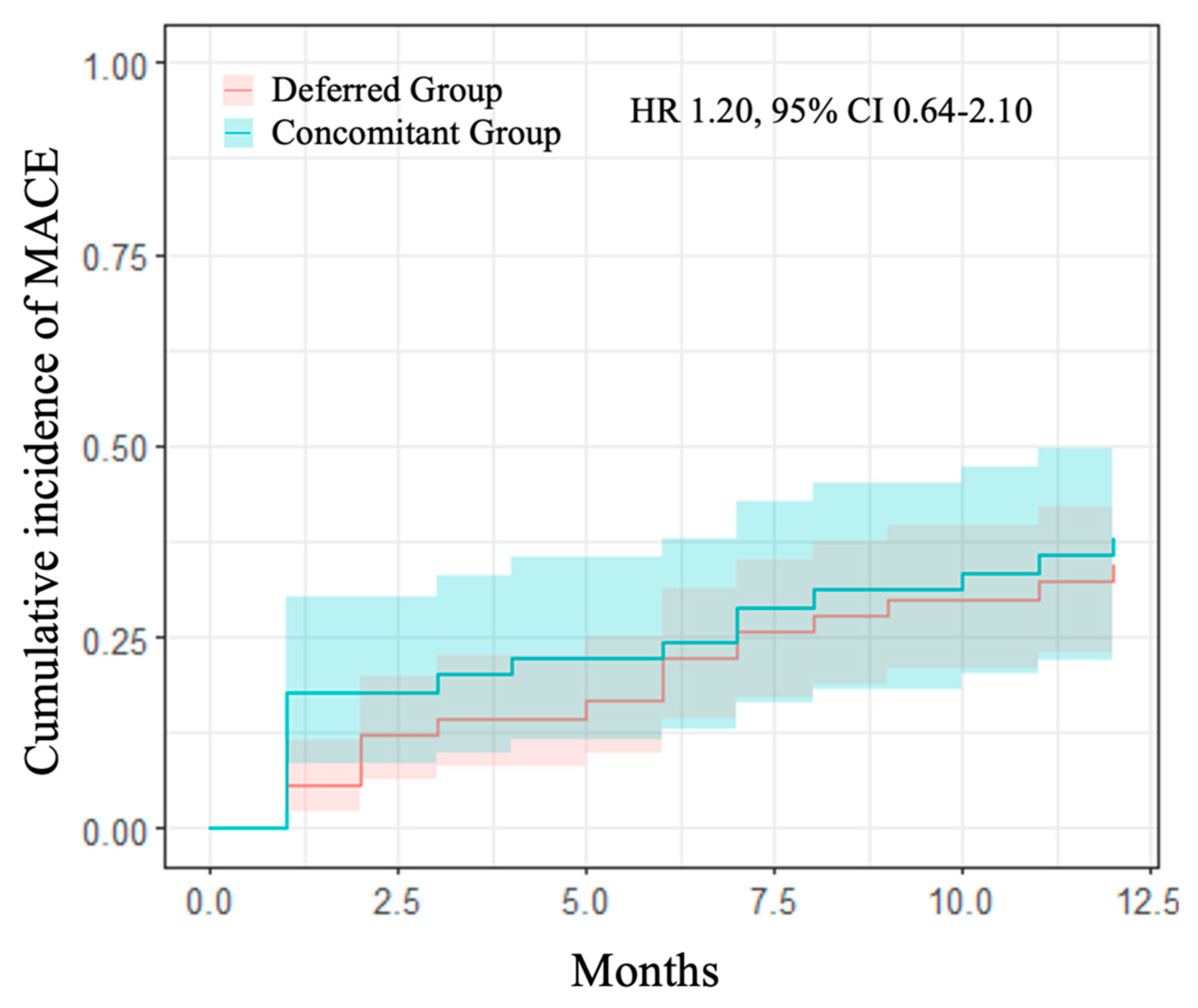
| MACE | 15 (11.1) | 9 (20.0) | 6 (6.7) | 0.02 |
| One year | ||||
| All-cause death | 5 (3.7) | 3 (6.7) | 2 (2.2) | 0.21 |
| Spontaneous MI | 5 (3.7) | 2 (4.4) | 3 (3.3) | 0.74 |
| Any PTA | 34 (25.2) | 9 (20.0) | 25 (27.8) | 0.31 |
| Amputation | 3 (2.2) | 3 (6.7) | 0 (0.0) | 0.03 |
| Any PCI | 11 (8.1) | 4 (8.9) | 7 (7.8) | 0.79 |
| Ischemic Stroke | 0 (0.0) | 0 (0.0) | 0 (0.0) | 1 |
| MALE | 36 (26.7) | 11 (24.4) | 25 (27.8) | 0.77 |
| MACE | 48 (35.6) | 17 (37.8) | 31 (34.4) | 0.61 |
Disclaimer/Publisher’s Note: The statements, opinions and data contained in all publications are solely those of the individual author(s) and contributor(s) and not of MDPI and/or the editor(s). MDPI and/or the editor(s) disclaim responsibility for any injury to people or property resulting from any ideas, methods, instructions or products referred to in the content. |
© 2024 by the authors. Licensee MDPI, Basel, Switzerland. This article is an open access article distributed under the terms and conditions of the Creative Commons Attribution (CC BY) license (https://creativecommons.org/licenses/by/4.0/).
Share and Cite
Canonico, M.E.; Verde, N.; Avvedimento, M.; Leone, A.; Cutillo, M.; Simonetti, F.; Esposito, S.; Bardi, L.; Giugliano, G.; Stabile, E.; et al. Safety and Efficacy of Combined Coronary and Peripheral Percutaneous Revascularization: A Proof-of-Concept Study. J. Clin. Med. 2024, 13, 4516. https://doi.org/10.3390/jcm13154516
Canonico ME, Verde N, Avvedimento M, Leone A, Cutillo M, Simonetti F, Esposito S, Bardi L, Giugliano G, Stabile E, et al. Safety and Efficacy of Combined Coronary and Peripheral Percutaneous Revascularization: A Proof-of-Concept Study. Journal of Clinical Medicine. 2024; 13(15):4516. https://doi.org/10.3390/jcm13154516
Chicago/Turabian StyleCanonico, Mario Enrico, Nicola Verde, Marisa Avvedimento, Attilio Leone, Maria Cutillo, Fiorenzo Simonetti, Salvatore Esposito, Luca Bardi, Giuseppe Giugliano, Eugenio Stabile, and et al. 2024. "Safety and Efficacy of Combined Coronary and Peripheral Percutaneous Revascularization: A Proof-of-Concept Study" Journal of Clinical Medicine 13, no. 15: 4516. https://doi.org/10.3390/jcm13154516
APA StyleCanonico, M. E., Verde, N., Avvedimento, M., Leone, A., Cutillo, M., Simonetti, F., Esposito, S., Bardi, L., Giugliano, G., Stabile, E., Piccolo, R., & Esposito, G. (2024). Safety and Efficacy of Combined Coronary and Peripheral Percutaneous Revascularization: A Proof-of-Concept Study. Journal of Clinical Medicine, 13(15), 4516. https://doi.org/10.3390/jcm13154516