Epidemiology and Outcomes of Hypernatraemia in Patients with COVID-19—A Territory-Wide Study in Hong Kong


 , , , , ,
  , and
, and
Abstract
1. Introduction
2. Materials and Methods
2.1. Study Design and Patient Selection
2.2. Outcomes
2.3. Statistical Analysis
3. Results
3.1. Patient Characteristics
3.2. Predictors of Hypernatraemia in COVID-19 Patients
3.3. Mortality
3.4. Impact on Healthcare Utilization
4. Discussion
5. Conclusions
Supplementary Materials
Author Contributions
Funding
Institutional Review Board Statement
Informed Consent Statement
Data Availability Statement
Conflicts of Interest
References
- Turgutalp, K.; Ozhan, O.; Gok Oguz, E.; Yilmaz, A.; Horoz, M.; Helvaci, I.; Kiykim, A. Community-acquired hypernatremia in elderly and very elderly patients admitted to the hospital: Clinical characteristics and outcomes. Med. Sci. Monit. 2012, 18, CR729–CR734. [Google Scholar] [CrossRef]
- Bozkurt Babus, S.; Kose, A.; Erdogan, S.; Kiraz, M.; Iyikesici, F. Risk factors and mortality in elderly patients with severe hyponatremia admitted to the emergency department. Ir. J. Med. Sci. 2022, 1–10. [Google Scholar] [CrossRef] [PubMed]
- Castello, L.M.; Gavelli, F.; Baldrighi, M.; Salmi, L.; Mearelli, F.; Fiotti, N.; Patrucco, F.; Bellan, M.; Sainaghi, P.P.; Ronzoni, G.; et al. Hypernatremia and moderate-to-severe hyponatremia are independent predictors of mortality in septic patients at emergency department presentation: A sub-group analysis of the need-speed trial. Eur. J. Intern. Med. 2021, 83, 21–27. [Google Scholar] [CrossRef]
- Lindner, G.; Herschmann, S.; Funk, G.C.; Exadaktylos, A.K.; Gygli, R.; Ravioli, S. Sodium and potassium disorders in patients with COPD exacerbation presenting to the emergency department. BMC Emerg. Med. 2022, 22, 49. [Google Scholar] [CrossRef] [PubMed]
- Wester, C.; Zhang, T.S.; Harrington, M.A.; Halawi, M.J. Sodium Abnormalities Are an Independent Predictor of Complications in Total Joint Arthroplasty: A Cautionary Tale! J. Arthroplast. 2021, 36, 3859–3863. [Google Scholar] [CrossRef]
- Chand, R.; Chand, R.; Goldfarb, D.S. Hypernatremia in the intensive care unit. Curr. Opin. Nephrol. Hypertens. 2022, 31, 199–204. [Google Scholar] [CrossRef] [PubMed]
- Chassagne, P.; Druesne, L.; Capet, C.; Menard, J.F.; Bercoff, E. Clinical presentation of hypernatremia in elderly patients: A case control study. J. Am. Geriatr. Soc. 2006, 54, 1225–1230. [Google Scholar] [CrossRef]
- Ruiz-Sanchez, J.G.; Nunez-Gil, I.J.; Cuesta, M.; Rubio, M.A.; Maroun-Eid, C.; Arroyo-Espliguero, R.; Romero, R.; Becerra-Munoz, V.M.; Uribarri, A.; Feltes, G.; et al. Prognostic Impact of Hyponatremia and Hypernatremia in COVID-19 Pneumonia. A HOPE-COVID-19 (Health Outcome Predictive Evaluation for COVID-19) Registry Analysis. Front. Endocrinol. 2020, 11, 599255. [Google Scholar] [CrossRef]
- Akbar, M.R.; Pranata, R.; Wibowo, A.; Irvan; Sihite, T.A.; Martha, J.W. The Prognostic Value of Hyponatremia for Predicting Poor Outcome in Patients with COVID-19: A Systematic Review and Meta-Analysis. Front. Med. 2021, 8, 666949. [Google Scholar] [CrossRef]
- De Carvalho, H.; Letellier, T.; Karakachoff, M.; Desvaux, G.; Caillon, H.; Papuchon, E.; Bentoumi-Loaec, M.; Benaouicha, N.; Canet, E.; Chapelet, G.; et al. Hyponatremia is associated with poor outcome in COVID-19. J. Nephrol. 2021, 34, 991–998. [Google Scholar] [CrossRef]
- Islam, M.K.; Hasan, P.; Sharif, M.M.; Khan, T.D.; Ratul, R.H.; Hossain, F.S.; Molla, M.M.A. Hyponatremia in COVID-19 patients: Experience from Bangladesh. Health Sci. Rep. 2022, 5, e565. [Google Scholar] [CrossRef]
- Song, H.; Chia, A.Z.Q.; Tan, B.K.J.; Teo, C.B.; Lim, V.; Chua, H.R.; Samuel, M.; Kee, A. Electrolyte imbalances as poor prognostic markers in COVID-19: A systemic review and meta-analysis. J. Endocrinol. Investig. 2022, 46, 235–259. [Google Scholar] [CrossRef] [PubMed]
- Hirsch, J.S.; Uppal, N.N.; Sharma, P.; Khanin, Y.; Shah, H.H.; Malieckal, D.A.; Bellucci, A.; Sachdeva, M.; Rondon-Berrios, H.; Jhaveri, K.D.; et al. Prevalence and outcomes of hyponatremia and hypernatremia in patients hospitalized with COVID-19. Nephrol. Dial. Transpl. 2021, 36, 1135–1138. [Google Scholar] [CrossRef] [PubMed]
- Liu, D.; Mowrey, W.; Fisher, M.; Basalely, A.; McCarthy, J.; Kumar, N.; Thakkar, J.; Azzi, Y.; Brogan, M.; Golestaneh, L.; et al. Associations of Dysnatremia with COVID-19 Status and Mortality. Kidney360 2022, 3, 1323–1331. [Google Scholar] [CrossRef] [PubMed]
- Skarbinski, J.; Wood, M.S.; Chervo, T.C.; Schapiro, J.M.; Elkin, E.P.; Valice, E.; Amsden, L.B.; Hsiao, C.; Quesenberry, C.; Corley, D.A.; et al. Risk of severe clinical outcomes among persons with SARS-CoV-2 infection with differing levels of vaccination during widespread Omicron (B.1.1.529) and Delta (B.1.617.2) variant circulation in Northern California: A retrospective cohort study. Lancet Reg. Health Am. 2022, 12, 100297. [Google Scholar] [CrossRef] [PubMed]
- Ma, A.; Parry, J. When Hong Kong’s “dynamic zero” covid-19 strategy met omicron, low vaccination rates sent deaths soaring. BMJ 2022, 377, o980. [Google Scholar] [CrossRef]
- Chen, L.L.; Abdullah, S.M.U.; Chan, W.M.; Chan, B.P.; Ip, J.D.; Chu, A.W.; Lu, L.; Zhang, X.; Zhao, Y.; Chuang, V.W.; et al. Contribution of low population immunity to the severe Omicron BA.2 outbreak in Hong Kong. Nat. Commun. 2022, 13, 3618. [Google Scholar] [CrossRef]
- Cheung, K.S.; Chan, E.W.; Wong, A.Y.S.; Chen, L.; Wong, I.C.K.; Leung, W.K. Long-term proton pump inhibitors and risk of gastric cancer development after treatment for Helicobacter pylori: A population-based study. Gut 2018, 67, 28–35. [Google Scholar] [CrossRef] [PubMed]
- Cheung, K.S.; Chen, L.; Chan, E.W.; Seto, W.K.; Wong, I.C.K.; Leung, W.K. Statins reduce the progression of non-advanced adenomas to colorectal cancer: A postcolonoscopy study in 187 897 patients. Gut 2019, 68, 1979–1985. [Google Scholar] [CrossRef] [PubMed]
- Tuty Kuswardhani, R.A.; Henrina, J.; Pranata, R.; Anthonius Lim, M.; Lawrensia, S.; Suastika, K. Charlson comorbidity index and a composite of poor outcomes in COVID-19 patients: A systematic review and meta-analysis. Diabetes Metab. Syndr. 2020, 14, 2103–2109. [Google Scholar] [CrossRef]
- To, K.K.; Chan, W.M.; Ip, J.D.; Chu, A.W.; Tam, A.R.; Liu, R.; Wu, A.K.; Lung, K.C.; Tsang, O.T.; Lau, D.P.; et al. Unique Clusters of Severe Acute Respiratory Syndrome Coronavirus 2 Causing a Large Coronavirus Disease 2019 Outbreak in Hong Kong. Clin. Infect. Dis. 2021, 73, 137–142. [Google Scholar] [CrossRef]
- Chan, W.M.; Ip, J.D.; Chu, A.W.; Tse, H.; Tam, A.R.; Li, X.; Kwan, M.Y.; Yau, Y.S.; Leung, W.S.; Chik, T.S.; et al. Phylogenomic analysis of COVID-19 summer and winter outbreaks in Hong Kong: An observational study. Lancet Reg. Health West Pac. 2021, 10, 100130. [Google Scholar] [CrossRef] [PubMed]
- Kwok, W.C.; Wong, C.K.; Ma, T.F.; Ho, K.W.; Fan, L.W.; Chan, K.F.; Chan, S.S.; Tam, T.C.; Ho, P.L. Modelling the impact of travel restrictions on COVID-19 cases in Hong Kong in early 2020. BMC Public Health 2021, 21, 1878. [Google Scholar] [CrossRef]
- Bihari, S.; Prakash, S.; Dixon, D.L.; Cavallaro, E.; Bersten, A.D. Induced hypernatremia in patients with moderate-to-severe ARDS: A randomized controlled study. Intensive Care Med. Exp. 2021, 9, 33. [Google Scholar] [CrossRef]
- Bihari, S.; Dixon, D.L.; Lawrence, M.D.; Bersten, A.D. Induced hypernatraemia is protective in acute lung injury. Respir. Physiol. Neurobiol. 2016, 227, 56–67. [Google Scholar] [CrossRef] [PubMed]
- Safdar, Z.; Wang, P.; Ichimura, H.; Issekutz, A.C.; Quadri, S.; Bhattacharya, J. Hyperosmolarity enhances the lung capillary barrier. J. Clin. Investig. 2003, 112, 1541–1549. [Google Scholar] [CrossRef] [PubMed]
- Quadri, S.K.; Bhattacharjee, M.; Parthasarathi, K.; Tanita, T.; Bhattacharya, J. Endothelial barrier strengthening by activation of focal adhesion kinase. J. Biol. Chem. 2003, 278, 13342–13349. [Google Scholar] [CrossRef]
- Safdar, Z.; Yiming, M.; Grunig, G.; Bhattacharya, J. Inhibition of acid-induced lung injury by hyperosmolar sucrose in rats. Am. J. Respir Crit. Care Med. 2005, 172, 1002–1007. [Google Scholar] [CrossRef]
- Sarahian, S.; Pouria, M.M.; Ing, T.S.; Sam, R. Hypervolemic hypernatremia is the most common type of hypernatremia in the intensive care unit. Int. Urol. Nephrol. 2015, 47, 1817–1821. [Google Scholar] [CrossRef]
- Yanagawa, Y.; Omori, K.; Obinata, M.; Ohsaka, H.; Ishikawa, K.; Kitamura, S.; Kitagawa, Y.; Ihara, Y. Significance of hypernatremia following the correction of severe hyperglycemia. Am. J. Emerg. Med. 2014, 32, 800–801. [Google Scholar] [CrossRef]


| Antiviral Therapy | Immunomodulatory Therapy |
|---|---|
| Interferon beta-1b Lopinavir/Ritonavir Molnupiravir Nirmatrelvir/Ritonavir Ribavirin Remdesivir | Baricitinib Dexamethasone Tocilizumab |
| Wave | Time Period | Dominant SARS-CoV-2 Variant |
|---|---|---|
| 2nd | 1–30 April 2020 | D614G [21] |
| 3rd | 15 June–30 September 2020 | B.1.1.63 [22] |
| 4th | 1 November 2022–28 February 2021 | B.1.36.27 [22] |
| 5th | 1 January–31 March 2022 | Omicron BA.2 |
| Hypernatraemia (n = 2688) | Normonatraemia (n = 36,182) | p-Value | |
|---|---|---|---|
| Age | 86.3 ± 10.5 | 62.4 ± 22.0 | <0.001 a |
| Age older than 65, No. (%) | 2550 (94.9%) | 17,679 (48.9%) | <0.001 b |
| Male, No. (%) | 1300 (48.4%) | 18,103 (50.0%) | 0.095 b |
| Institutionalized, No. (%) | 1823 (67.8%) | 6533 (18.1%) | <0.001 b |
| Charlson Comorbidity Index | 2.71 ± 2.20 | 1.41 ± 1.92 | <0.001 a |
| Major comorbidities | |||
| Diabetes mellitus | 793 (29.5%) | 7184 (19.9%) | <0.001 b |
| Hypertension | 1691 (62.9%) | 13,618 (37.6%) | <0.001 b |
| Ischaemic heart disease | 452 (16.8%) | 3724 (10.3%) | <0.001 b |
| Cerebrovascular accident | 544 (20.2%) | 2847 (7.9%) | <0.001 b |
| Cardiac arrhythmia | 497 (18.5%) | 3858 (10.7%) | <0.001 b |
| Congestive heart failure | 367 (13.7%) | 2676 (7.4%) | <0.001 b |
| Chronic obstructive airway disease | 159 (5.9%) | 1604 (4.4%) | <0.001 b |
| Asthma | 50 (1.9%) | 593 (1.6%) | 0.4 b |
| Pneumoconiosis | 38 (1.4%) | 242 (0.7%) | <0.001 b |
| Dementia | 1072 (39.9%) | 3380 (9.3%) | <0.001 b |
| Chronic liver disease | 208 (7.7%) | 2026 (5.6%) | <0.001 b |
| Active malignancy | 576 (17.7%) | 5517 (15.2%) | 0.001 b |
| Chronic kidney disease | <0.001 b | ||
| Stage 1 | 67 (2.5%) | 12,037 (33.3%) | |
| Stage 2 | 842 (31.3%) | 16,915 (46.7%) | |
| Stage 3 | 715 (26.6%) | 4860 (13.4%) | |
| Stage 4 | 616 (22.9%) | 1435 (4.0%) | |
| Stage 5 | 448 (16.7%) | 934 (2.6%) | |
| Laboratory parameters | |||
| SARS-CoV-2 RT-PCR Ct value on admission | 23.0 ± 6.4 | 23.5 ± 6.8 | 0.006 a |
| Haemoglobin (g/dL) | 11.8 ± 2.6 | 12.8 ± 2.2 | <0.001 a |
| White cell count (109/L) | 11.3 ± 7.4 | 7.0 ± 4.0 | <0.001 a |
| Neutrophil (109/L) | 7.3 ± 4.5 | 4.9 ± 3.4 | <0.001 a |
| Lymphocyte (109/L) | 1.0 ± 1.4 | 1.3 ± 1.0 | <0.001 a |
| Neutrophil to lymphocyte ratio | 13.5 ± 13.1 | 5.6 ± 7.2 | <0.001 a |
| Platelet (109/L) | 231 ± 104 | 223 ± 88 | 0.05 a |
| Sodium (mmol/L) | 153.2 ± 7.0 | 138.6 ± 2.3 | <0.001 a |
| Potassium (mmol/L) | 4.1 ± 0.9 | 3.9 ± 0.5 | <0.001 a |
| Urea (mmol/L) | 21.8 ± 13.6 | 6.7 ± 6.1 | <0.001 a |
| Creatinine (µmol/L) | 188 ± 167 | 103 ± 124 | <0.001 a |
| eGFR (by CKD-EPI equation) (mL/min/1.73 m2) | 43.6 ± 26.5 | 79.7 ± 31.1 | <0.001 a |
| Albumin (g/L) | 29.3 ± 6.2 | 36.8 ± 6.4 | <0.001 a |
| C-reactive protein (mg/L) | 11.0 ± 8.7 | 3.7 ± 5.9 | <0.001 a |
| Calcium (mmol/L) | 2.25 ± 0.23 | 2.23 ± 0.15 | <0.001 a |
| Phosphate (mmol/L) | 1.26 ± 0.57 | 1.09 ± 0.37 | <0.001 a |
| Plasma osmolality (mOsm/kg) | 354 ± 29 | 302 ± 33 | <0.001 a |
| Thyroid-stimulating hormone (mIU/L) | 1.3 ± 2.9 | 1.7 ± 3.8 | 0.049 a |
| Creatine kinase (U/L) | 405 ± 1527 | 250 ± 1599 | <0.001 a |
| D-dimer (ng/mL) | 1886 ± 2594 | 862 ± 1567 | <0.001 a |
| Urine sodium (mmol/L) | 47.7 ± 32.2 | 50.3 ± 40.7 | 0.7 a |
| Urine osmolality (mOsm/kg) | 559 ± 148 | 438 ± 196 | <0.001 a |
| Univariate Model | Multivariate Model | |||
|---|---|---|---|---|
| OR (95% CI) | p-Value | OR (95% CI) | p-Value | |
| Demographics | ||||
| Age | 1.09 (1.08–1.09) | <0.001 | 1.03 (1.03–1.04) | <0.001 |
| Institutionalization | 9.57 (8.78–10.42) | <0.001 | 2.37 (2.00–2.82) | <0.001 |
| SARS-CoV-2 RT-PCR Ct value | 0.99 (0.99–0.99) | 0.006 | 1.04 (1.02–1.05) | <0.001 |
| Comorbidities | ||||
| CHF | 1.98 (1.76–2.23) | <0.001 | 0.76 (0.59–0.97) | 0.03 |
| Dementia | 6.44 (5.91–7.01) | <0.001 | 1.80 (1.50–2.14) | <0.001 |
| Laboratory parameters | ||||
| Haemoglobin | 0.84 (0.83–0.86) | <0.001 | 1.15 (1.11–1.20) | <0.001 |
| White cell count | 1.17 (1.16–1.18) | <0.001 | 1.06 (1.04–1.07) | <0.001 |
| eGFR (by CKD-EPI equation) | 0.96 (0.96–0.96) | <0.001 | 0.97 (0.97–0.97) | <0.001 |
| C-reactive protein | 1.11 (1.11–1.12) | <0.001 | 1.02 (1.01–1.03) | <0.001 |
| Albumin | 0.86 (0.85–0.86) | <0.001 | 0.92 (0.91–0.94) | <0.001 |
| Hypernatraemia (n = 2688) | Normonatraemia (n = 36,182) | p-Value | |
|---|---|---|---|
| Charlson Comorbidity Index Score | 2.71 ± 2.20 | 1.41 ± 1.92 | <0.001 a |
| Components of Charlson Comorbidity Index | |||
| Acute myocardial infarction | 452 (16.8%) | 3724 (10.3%) | <0.001 b |
| Congestive heart failure | 367 (13.7%) | 2676 (7.4%) | <0.001 b |
| Peripheral vascular disease | 16 (0.6%) | 102 (0.3%) | 0.004 b |
| Cerebrovascular disease | 544 (20.2%) | 2847 (7.9%) | <0.001 b |
| Dementia | 1072 (39.9%) | 3380 (9.3%) | <0.001 b |
| Chronic lung disease | 159 (5.9%) | 1604 (4.4%) | <0.001 b |
| Rheumatic disease | 362 (13.5%) | 3743 (10.3%) | <0.001 b |
| Peptic ulcer | 253 (9.4%) | 1662 (4.6%) | <0.001 b |
| Mild liver disease | 191 (7.1%) | 1833 (5.1%) | <0.001 b |
| Moderate to serious liver disease | 19 (0.7%) | 217 (0.6%) | 0.5 b |
| Mild to moderate diabetes | 793 (29.5%) | 7184 (19.9%) | <0.001 b |
| Diabetes with chronic complications | 341 (12.7%) | 2338 (6.5%) | <0.001 b |
| Hemiplegia or paraplegia | 156 (5.8%) | 803 (2.2%) | <0.001 b |
| Kidney disease | 460 (17.1%) | 1041 (2.9%) | <0.001 b |
| Malignancy | 451 (16.8%) | 5090 (14.1%) | <0.001 b |
| Solid, metastatic tumour | 24 (0.9%) | 433 (1.2%) | 0.2 b |
| Leukaemia | 5 (0.2%) | 54 (0.1%) | 0.6 b |
| Lymphoma | 7 (0.3%) | 104 (0.3%) | 0.8 b |
| AIDS | 4 (0.1%) | 23 (0.1%) | 0.1 b |
| Hypernatraemia (n = 2688) | Normonatraemia (n = 36,182) | p-Value | |
|---|---|---|---|
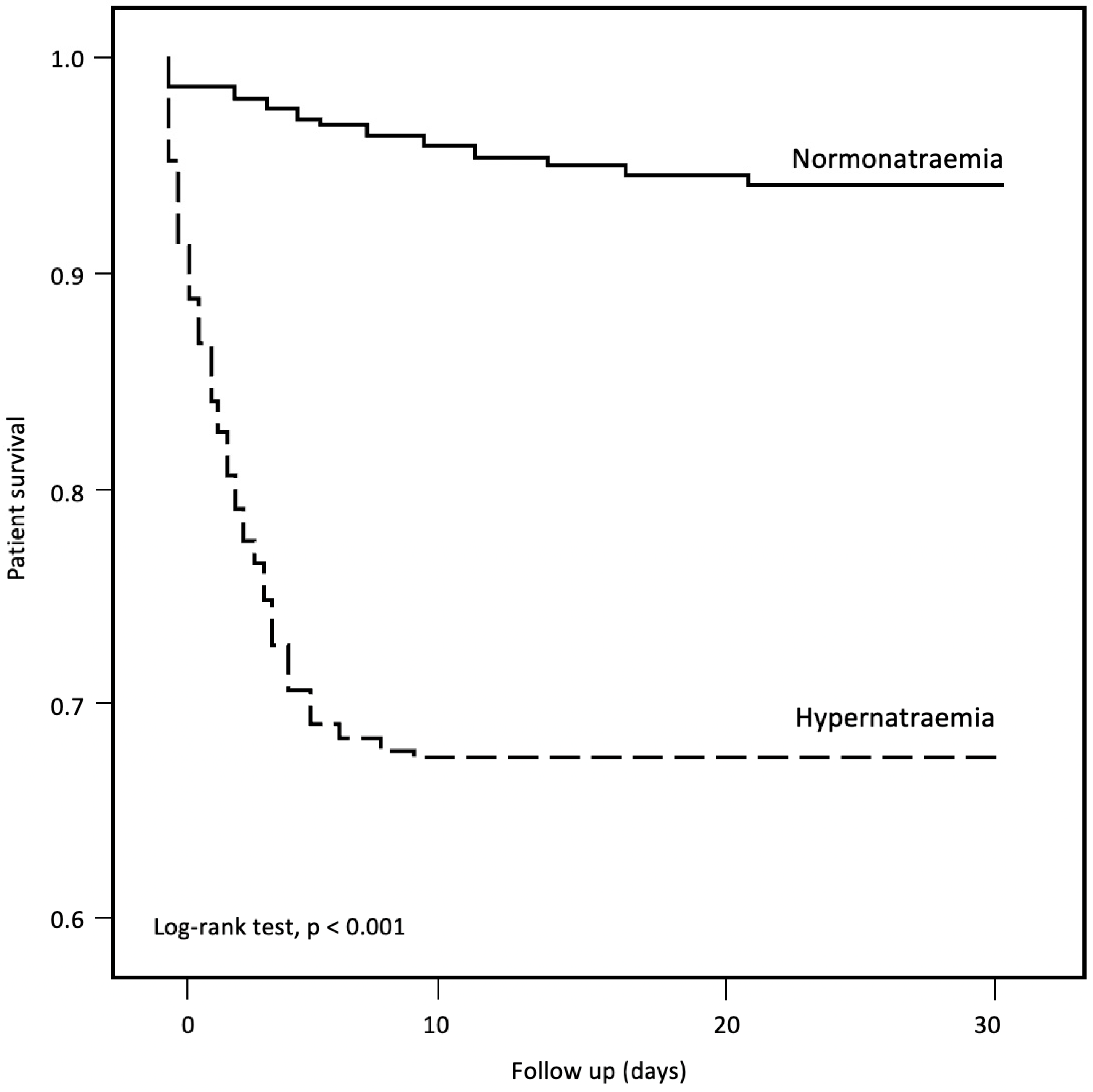
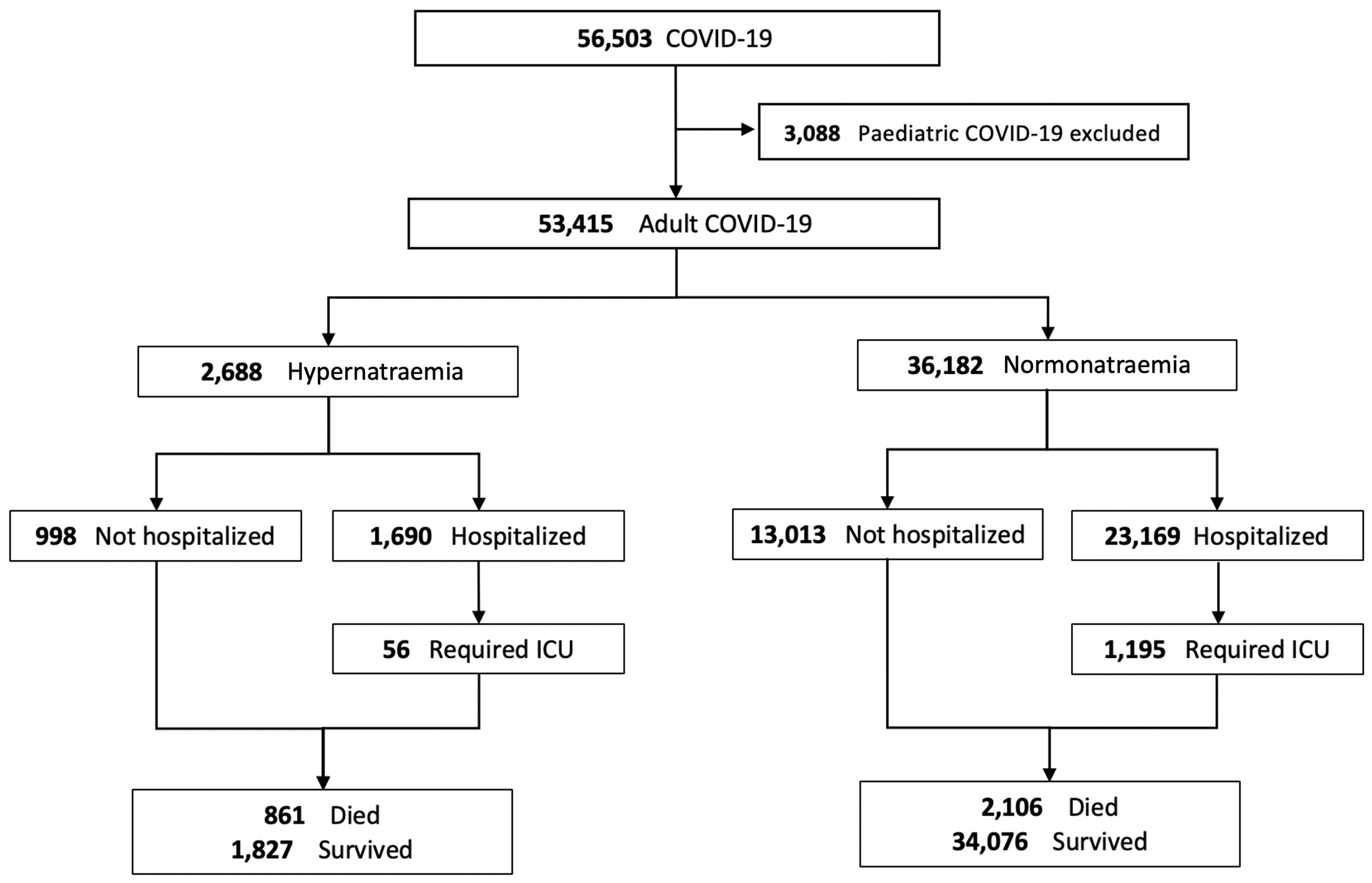
| Death within 30 days | 860 (32.0%) | 2051 (5.7%) | <0.001 b |
| Local wave (Time periods; dominant SARS-CoV-2 variant) | <0.001 b | ||
| 2nd wave (1 to 30 April 2020; D614G [21]) | 1 (0.1%) | 746 (92.7%) | |
| 3rd wave (15 June–30 September 2020; B.1.1.63 [22]) | 12 (0.4%) | 2808 (90.1%) | |
| 4th wave (1st November 2020–28 February 2021; B.1.36.27 [22]) | 7 (0.1%) | 4514 (88.9%) | |
| 5th wave (1 January–31 March 2022; Omicron BA.2) | 2667 (6.2%) | 26,484 (66.2%) | |
| COVID-19 Treatments | |||
| Antiviral therapy | 584 (21.7%) | 9168 (25.3%) | <0.001 b |
| Immunomodulatory therapy | 1577 (58.7%) | 8333 (23.0%) | <0.001 b |
| Healthcare utilization in surviving patients | Hypernatraemia (n = 1827) | Normonatraemia (n = 34,076) | p-Value |
| Duration of hospitalization | 12.9 ± 10.9 | 11.5 ± 12.1 | <0.001 a |
| Hospitalization for > 14 days | 334 (35.2%) | 5540 (26.2%) | <0.001 b |
| ICU admission | 40 (4.2%) | 1043 (4.9%) | 0.3 b |
| Duration of ICU admission | 7.9 ± 19.5 | 7.8 ± 13.0 | 0.9 a |
| ICU hospitalization for > 7 days (%, among hospitalized in ICU) | 9 (22.5%) | 294 (28.2%) | 0.4 b |
| 2nd Wave (n = 1) | 3rd Wave (n = 12) | 4th Wave (n = 7) | 5th Wave (n = 2667) | p-Value | |
|---|---|---|---|---|---|
| Age | 75 | 68.3 ± 15.8 | 82.4 ± 15.2 | 86.4 ± 10.3 | <0.001 a |
| Age older than 65, No. (%) | 1 (100%) | 7 (58.3%) | 6 (85.7%) | 2536 (95.1%) | <0.001 b |
| Male, No. (%) | 0 (0%) | 5 (41.7%) | 3 (42.9%) | 1292 (48.4%) | 0.7 b |
| Institutionalized, No. (%) | 0 (0%) | 4 (33.3%) | 3 (42.9%) | 1816 (68.1%) | 0.01 b |
| SARS-CoV-2 RT-PCR Ct value | 34.7 | 25.1 ± 7.9 | 25.6 ± 6.2 | 23.1 ± 6.4 | 0.1 a |
| Charlson Comorbidity Index | 0 | 2.33 ± 2.77 | 3.14 ± 2.41 | 2.71 ± 2.19 | 0.5 a |
| Comorbidities, No. (%) | |||||
| Diabetes mellitus | 0 (0%) | 3 (25.0%) | 2 (28.6%) | 788 (29.6%) | 0.9 b |
| Hypertension | 0 (0%) | 6 (50.0%) | 4 (57.1%) | 1681 (63.0%) | 0.4 b |
| Ischaemic heart disease | 0 (0%) | 1 (8.3%) | 4 (57.1%) | 447 (16.8%) | 0.06 b |
| Cerebrovascular accident | 0 (0%) | 2 (16.7%) | 0 (0%) | 542 (20.3%) | 0.7 b |
| Cardiac arrhythmia | 0 (0%) | 1 (8.3%) | 2 (28.6%) | 494 (18.5%) | 0.8 b |
| Congestive heart failure | 0 (0%) | 0 (0%) | 2 (28.6%) | 365 (13.7%) | 0.5 b |
| COAD | 0 (0%) | 0 (0%) | 0 (0%) | 159 (6.0%) | 0.9 b |
| Asthma | 0 (0%) | 0 (0%) | 0 (0%) | 50 (1.9%) | 1.0 b |
| Pneumoconiosis | 0 (0%) | 0 (0%) | 0 (0%) | 38 (1.4%) | 1.0 b |
| Dementia | 0 (0%) | 2 (16.7%) | 1 (14.3%) | 1069 (40.1%) | 0.2 b |
| Chronic liver disease | 0 (0%) | 1 (8.3%) | 2 (28.6%) | 129 (4.8%) | 0.07 b |
| Active malignancy | 0 (0%) | 3 (25.0%) | 2 (28.6%) | 470 (17.6%) | 0.8 b |
| Chronic kidney disease, No. (%) | <0.001 b | ||||
| Stage 1 | 0 (0%) | 6 (50.0%) | 0 (0%) | 60 (2.2%) | |
| Stage 2 | 0 (0%) | 3 (25.0%) | 2 (28.6%) | 837 (31.4%) | |
| Stage 3 | 1 (100%) | 1 (8.3%) | 2 (28.6%) | 711 (26.7%) | |
| Stage 4 | 0 (0%) | 1 (8.3%) | 3 (42.9%) | 612 (22.9%) | |
| Stage 5 | 0 (0%) | 1 (8.3%) | 0 (0%) | 447 (16.8%) | |
| Laboratory parameters | |||||
| Haemoglobin (g/dL) | 10.4 | 12.9 ± 2.4 | 11.5 ± 2.2 | 11.8 ± 2.6 | 0.6 a |
| White cell count (109/L) | 18.7 | 6.8 ± 1.8 | 9.6 ± 5.1 | 11.3 ± 7.5 | 0.2 a |
| Neutrophil (109/L) | 15.7 | 4.3 ± 1.5 | 6.5 ± 3.2 | 9.5 ± 5.7 | 0.006 a |
| Lymphocyte (109/L) | 0.7 | 1.8 ± 0.9 | 1.3 ± 1.4 | 1.0 ± 1.4 | 0.4 a |
| Neutrophil to lymphocyte ratio | 23.1 | 3.4 ± 3.1 | 18.3 ± 18.9 | 13.6 ± 13.1 | 0.05 a |
| Platelet (109/L) | 183 | 246 ± 78 | 186 ± 66 | 231 ± 104 | 0.8 a |
| Potassium (mmol/L) | 4.0 | 3.8 ± 0.6 | 4.2 ± 1.0 | 4.1 ± 0.9 | 0.7 a |
| Urea (mmol/L) | 22.2 | 8.3 ± 5.8 | 19.0 ± 12.2 | 21.9 ± 13.6 | 0.007 a |
| Creatinine (umol/L) | 118.0 | 92.7 ± 64.7 | 142.1 ± 54.7 | 188.5 ± 167.9 | 0.3 a |
| eGFR (by CKD-EPI) (mL/min/1.73 m2) | 39.0 | 76.9 ± 31.5 | 41.7 ± 24.7 | 43.5 ± 26.4 | <0.001 a |
| Albumin (g/L) | 21.0 | 37.8 ± 5.8 | 30.5 ± 6.0 | 29.3 ± 6.1 | <0.001 a |
| C-reactive protein (mg/L) | 8.4 | 2.5 ± 4.0 | 6.6 ± 7.8 | 11.1 ± 8.7 | 0.008 a |
| Calcium (mmol/L) | 2.26 | 2.28 ± 0.14 | 2.07 ± 0.14 | 2.25 ± 0.23 | 0.3 a |
| Phosphate (mmol/L) | 1.30 | 0.99 ± 0.15 | 1.51 ± 1.04 | 1.27 ± 0.57 | 0.5 a |
| Plasma osmolality (mOsm/kg) | 355 | 357 ± 26 | 361 ± 28 | 354 ± 29 | 0.8 a |
| Thyroid stimulating hormone (mIU/L) | 2.8 | 3.8 ± 7.4 | 1.3 ± 1.7 | 1.3 ± 2.8 | 0.09 a |
| D-dimer (ng/mL) | 253 | 247 ± 116 | 315 ± 625 | 1892 ± 2597 | 0.3 a |
| Died (n = 4318) | Survived (n = 49,025) | p-Value | |
|---|---|---|---|
| Age | 83.2 ± 11.5 | 65.4 ± 21.3 | <0.001 a |
| Age older than 65, No. (%) | 3979 (92.1%) | 27,137 (55.3%) | <0.001 b |
| Male, No. (%) | 2596 (60.1%) | 25,044 (51.0%) | <0.001 b |
| Institutionalized, No. (%) | 1972 (45.7%) | 10,099 (20.6%) | <0.001 b |
| Serum sodium (mmol/L) | 138.7 ± 10.2 | 136.8 ± 6.1 | <0.001 a |
| Hypernatraemia, No. (%) | 860 (29.5%) | 1828 (5.1%) | <0.001 b |
| Charlson Comorbidity Index | 2.8 ± 2.3 | 1.6 ± 2.0 | <0.001 a |
| Comorbidities | |||
| Diabetes mellitus | 1470 (34.0%) | 11,475 (23.4%) | <0.001 b |
| Hypertension | 2707 (62.7%) | 20,512 (41.8%) | <0.001 b |
| Ischaemic heart disease | 859 (19.9%) | 5562 (11.3%) | <0.001 b |
| Cerebrovascular accident | 822 (19.0%) | 4395 (9.0%) | <0.001 b |
| Cardiac arrhythmia | 986 (22.8%) | 5610 (11.4%) | <0.001 b |
| Congestive heart failure | 760 (17.6%) | 3755 (7.6%) | <0.001 b |
| Chronic obstructive airway disease | 414 (9.6%) | 2303 (4.7%) | <0.001 b |
| Asthma | 72 (1.7%) | 850 (1.7%) | 0.8 b |
| Pneumoconiosis | 111 (2.6%) | 370 (0.8%) | 0.001 b |
| Dementia | 1093 (25.3%) | 5091 (10.4%) | <0.001 b |
| Chronic liver disease | 376 (8.7%) | 2891 (5.9%) | <0.001 b |
| Active malignancy | 905 (21.0%) | 8090 (16.5%) | <0.001 b |
| Chronic kidney disease | <0.001b | ||
| Stage 1 | 244 (5.7%) | 14,401 (29.3%) | |
| Stage 2 | 1513 (35.0%) | 23,548 (48.0%) | |
| Stage 3 | 1192 (27.6%) | 7252 (14.8%) | |
| Stage 4 | 762 (17.6%) | 2205 (4.5%) | |
| Stage 5 | 607 (14.1%) | 1691 (3.4%) | |
| COVID-19 treatments | |||
| Antiviral therapy | 1200 (27.8%) | 13,220 (26.9%) | 0.02 b |
| Immunomodulatory therapy | 2919 (67.6%) | 12,375 (26.2%) | <0.001 b |
| Univariate Model | Multivariate Model | |||
|---|---|---|---|---|
| HR (95% CI) | p-Value | Adjusted HR (95% CI) | p-Value | |
| Hypernatraemia | 6.97 (6.44–7.55) | <0.001 | 1.32 (1.14–1.53) | <0.001 |
| Demographics | ||||
| Age | 1.06 (1.06–1.06) | <0.001 | 1.03 (1.02–1.04) | <0.001 |
| Male sex | 1.35 (1.27–1.43) | <0.001 | 1.18 (1.04–1.34) | 0.01 |
| Comorbidities | ||||
| Charlson Comorbidity Index | 1.26 (1.24–1.27) | <0.001 | ||
| Diabetes mellitus | 1.71 (1.61–1.83) | <0.001 | ||
| Hypertension | 2.37 (2.22–2.52) | <0.001 | ||
| Ischaemic heart disease | 1.97 (1.83–2.12) | <0.001 | ||
| Cerebrovascular accident | 2.31 (2.15–2.50) | <0.001 | ||
| COAD | 2.07 (1.87–2.29) | <0.001 | 1.50 (1.22–1.83) | <0.001 |
| Active malignancy | 1.56 (1.45–1.68) | <0.001 | ||
| Dementia | 2.62 (2.45–2.81) | <0.001 | ||
| Congestive heart failure | 2.48 (2.29–2.68) | <0.001 | ||
| Arrhythmia | 2.28 (2.13–2.45) | <0.001 | 1.22 (1.05–1.42) | 0.01 |
| Chronic liver disease | 1.50 (1.35–1.67) | <0.001 | ||
| Laboratory parameters | ||||
| SARS-CoV-2 RT-PCR Ct value | 0.97 (0.96–0.97) | <0.001 | 0.98 (0.97–0.99) | <0.001 |
| Haemoglobin | 0.79 (0.78–0.80) | <0.001 | 0.96 (0.93–0.99) | 0.004 |
| White cell count | 1.02 (1.02–1.02) | <0.001 | 1.01 (1.00–1.02) | 0.006 |
| eGFR (by CKD-EPI) | 0.97 (0.97–0.97) | <0.001 | 0.99 (0.99–0.99) | <0.001 |
| Albumin | 0.88 (0.87–0.88) | <0.001 | 0.96 (0.95–0.97) | <0.001 |
| C-reactive protein | 1.10 (1.10–1.11) | <0.001 | 1.05 (1.05–1.06) | <0.001 |
| D-dimer (every 1000 units rise) | 1.22 (1.20–1.23) | <0.001 | 1.03 (1.00–1.06) | 0.04 |
| COVID-19 Treatment | ||||
| Antiviral therapy | 0.75 (0.70–0.80) | <0.001 | ||
| Immunomodulatory therapy | 4.43 (4.15–4.72) | <0.001 | 2.20 (1.88–2.58) | <0.001 |
| Univariate Model | Multivariate Model | |||
|---|---|---|---|---|
| OR (95% CI) | p-Value | Adjusted OR (95% CI) | p-Value | |
| Hypernatraemia | 1.44 (1.24–1.66) | <0.001 | 1.55 (1.17–2.05) | 0.002 |
| Demographics | ||||
| Age | 0.99 (0.99–1.00) | 0.007 | ||
| Male sex | 1.17 (1.11–1.23) | <0.001 | ||
| Institutionalization | 1.16 (1.09–1.24) | <0.001 | 1.27 (1.06–1.52) | 0.009 |
| SARS-CoV-2 RT-PCR Ct value | 0.93 (0.93–0.93) | <0.001 | 0.94 (0.93–0.94) | <0.001 |
| Comorbidities | ||||
| Dementia | 1.15 (1.06–1.26) | 0.001 | ||
| Chronic liver disease | 1.02 (1.92–1.14) | 0.7 | 1.45 (1.13–1.86) | 0.004 |
| Laboratory parameters | ||||
| Haemoglobin | 1.06 (1.05–1.07) | <0.001 | ||
| White cell count | 0.97 (0.97–0.98) | <0.001 | 0.97 (0.95–0.98) | <0.001 |
| eGFR (by CKD-EPI) | 0.99 (0.99–1.00) | 0.02 | 0.99 (0.99–0.99) | 0.001 |
| Albumin | 1.01 (1.00–1.01) | 0.002 | 1.02 (1.01–1.03) | 0.002 |
| C-reactive protein | 1.02 (1.02–1.03) | <0.001 | 1.04 (1.03–1.06) | <0.001 |
| Treatment for COVID-19 | ||||
| Antiviral therapy | 1.98 (1.88–2.09) | <0.001 | 1.44 (1.27–1.64) | <0.001 |
| Immunomodulatory therapy | 1.93 (1.82–2.05) | <0.001 | 1.57 (1.35–1.82) | <0.001 |
Disclaimer/Publisher’s Note: The statements, opinions and data contained in all publications are solely those of the individual author(s) and contributor(s) and not of MDPI and/or the editor(s). MDPI and/or the editor(s) disclaim responsibility for any injury to people or property resulting from any ideas, methods, instructions or products referred to in the content. |
© 2023 by the authors. Licensee MDPI, Basel, Switzerland. This article is an open access article distributed under the terms and conditions of the Creative Commons Attribution (CC BY) license (https://creativecommons.org/licenses/by/4.0/).
Share and Cite
So, B.Y.F.; Wong, C.K.; Chan, G.C.K.; Ng, J.K.C.; Lui, G.C.Y.; Szeto, C.C.; Hung, I.F.N.; Tse, H.F.; Tang, S.C.W.; Chan, T.M.; et al. Epidemiology and Outcomes of Hypernatraemia in Patients with COVID-19—A Territory-Wide Study in Hong Kong. J. Clin. Med. 2023, 12, 1042. https://doi.org/10.3390/jcm12031042
So BYF, Wong CK, Chan GCK, Ng JKC, Lui GCY, Szeto CC, Hung IFN, Tse HF, Tang SCW, Chan TM, et al. Epidemiology and Outcomes of Hypernatraemia in Patients with COVID-19—A Territory-Wide Study in Hong Kong. Journal of Clinical Medicine. 2023; 12(3):1042. https://doi.org/10.3390/jcm12031042
Chicago/Turabian StyleSo, Benjamin Y. F., Chun Ka Wong, Gordon Chun Kau Chan, Jack Kit Chung Ng, Grace Chung Yan Lui, Cheuk Chun Szeto, Ivan Fan Ngai Hung, Hung Fat Tse, Sydney C. W. Tang, Tak Mao Chan, and et al. 2023. "Epidemiology and Outcomes of Hypernatraemia in Patients with COVID-19—A Territory-Wide Study in Hong Kong" Journal of Clinical Medicine 12, no. 3: 1042. https://doi.org/10.3390/jcm12031042
APA StyleSo, B. Y. F., Wong, C. K., Chan, G. C. K., Ng, J. K. C., Lui, G. C. Y., Szeto, C. C., Hung, I. F. N., Tse, H. F., Tang, S. C. W., Chan, T. M., Chow, K. M., & Yap, D. Y. H. (2023). Epidemiology and Outcomes of Hypernatraemia in Patients with COVID-19—A Territory-Wide Study in Hong Kong. Journal of Clinical Medicine, 12(3), 1042. https://doi.org/10.3390/jcm12031042