


Patterns and Outcomes of Obesity Using Body Mass Index in Patients Hospitalized with Acute Cardiovascular Disorders: A Retrospective Analysis of 7284 Patients in a Middle Eastern Country
 , ,
, ,
Abstract
1. Introduction
2. Materials and Methods
3. Results
4. Discussion
5. Conclusions
Author Contributions
Funding
Institutional Review Board Statement
Informed Consent Statement
Data Availability Statement
Acknowledgments
Conflicts of Interest
References
- Di Cesare, M.; Bixby, H.; Gaziano, T.; Hadeed, L.; Kabudula, C.; McGhie, D.V.; Mwangi, J.; Pervan, B.; Perel, P.; Piñeiro, D.; et al. World Heart Report 2023: Confronting the World’s Number One Killer; World Heart Federation: Geneva, Switzerland, 2023. [Google Scholar]
- Poirier, P.; Giles, T.D.; Bray, G.A.; Hong, Y.; Stern, J.S.; Pi-Sunyer, F.X.; Eckel, R.H. Obesity and cardiovascular disease: Pathophysiology, evaluation, and effect of weight loss: An update of the 1997 American Heart Association Scientific Statement on Obesity and Heart Disease from the Obesity Committee of the Council on Nutrition, Physical Activity, and Metabolism. Circulation 2006, 113, 898–918. [Google Scholar] [PubMed]
- Hales, C.M.; Carroll, M.D.; Fryar, C.D.; Ogden, C.L. Prevalence of obesity and severe obesity among adults: United States, 2017–2018. NCHS Data Brief 2020, 360, 1–8. [Google Scholar]
- Berghöfer, A.; Pischon, T.; Reinhold, T.; Apovian, C.M.; Sharma, A.M.; Willich, S.N. Obesity prevalence from a European perspective: A systematic review. BMC Public Health 2008, 8, 200. [Google Scholar] [CrossRef] [PubMed]
- Okati-Aliabad, H.; Ansari-Moghaddam, A.; Kargar, S.; Jabbari, N. Prevalence of Obesity and Overweight among Adults in the Middle East Countries from 2000 to 2020: A Systematic Review and Meta-Analysis. J. Obes. 2022, 2022, 8074837. [Google Scholar] [CrossRef] [PubMed]
- Minutello, R.M.; Chou, E.T.; Hong, M.K.; Bergman, G.; Parikh, M.; Iacovone, F.; Wong, S.C. Impact of body mass index on in-hospital outcomes following percutaneous coronary intervention (report from the New York State Angioplasty Registry). Am. J. Cardiol. 2004, 93, 1229–1232. [Google Scholar] [CrossRef]
- Lovren, F.; Teoh, H.; Verma, S. Obesity and atherosclerosis: Mechanistic insights. Can. J. Cardiol. 2015, 31, 177–183. [Google Scholar] [CrossRef]
- Berenson, G.S.; Srinivasan, S.R.; Bao, W.; Newman, W.P.I.I.I.; Tracy, R.E.; Wattigney, W.A. Association between multiple cardiovascular risk factors and atherosclerosis in children and young adults. The Bogalusa Heart Study. N. Engl. J. Med. 1998, 338, 1650–1656. [Google Scholar] [CrossRef]
- Saydah, S.; Bullard, K.M.; Cheng, Y.; Ali, M.K.; Gregg, E.W.; Geiss, L.; Imperatore, G. Trends in cardiovascular disease risk factors by obesity level in adults in the United States, NHANES 1999–2010. Obesity 2014, 22, 1888–1895. [Google Scholar] [CrossRef]
- Cho, E.; Manson, J.E.; Stampfer, M.J.; Solomon, C.G.; Colditz, G.A.; Speizer, F.E.; Willett, W.C.; Hu, F.B. A prospective study of obesity and risk of coronary heart disease among diabetic women. Diabetes Care 2002, 25, 1142–1148. [Google Scholar] [CrossRef]
- Bogers, R.P.; Bemelmans, W.J.E.; Hoogenveen, R.T.; Boshuizen, H.C.; Woodward, M.; Knekt, P.; van Dam, R.M.; Hu, F.B.; Visscher, T.L.S.; Menotti, A.; et al. Association of overweight with increased risk of coronary heart disease partly independent of blood pressure and cholesterol levels: A meta-analysis of 21 cohort studies including more than 300 000 persons. Arch. Intern. Med. 2007, 167, 1720–1728. [Google Scholar] [CrossRef]
- Wilson, P.W.F.; D’Agostino, R.B.; Sullivan, L.; Parise, H.; Kannel, W.B. Overweight and obesity as determinants of cardiovascular risk: The Framingham experience. Arch. Intern. Med. 2002, 162, 1867–1872. [Google Scholar] [CrossRef]
- Abdullah, A.; Wolfe, R.; Stoelwinder, J.U.; De Courten, M.; Stevenson, C.; Walls, H.L.; Peeters, A. The number of years lived with obesity and the risk of all-cause and cause-specific mortality. Int. J. Epidemiol. 2011, 40, 985–996. [Google Scholar] [CrossRef]
- Khan, S.S.; Ning, H.; Wilkins, J.T.; Allen, N.; Carnethon, M.; Berry, J.D.; Sweis, R.N.; Lloyd-Jones, D.M. Association of body mass index with lifetime risk of cardiovascular disease and compression of morbidity. JAMA Cardiol. 2018, 3, 280–287. [Google Scholar] [CrossRef]
- Lavie, C.J.; Sharma, A.; Alpert, M.A.; De Schutter, A.; Lopez-Jimenez, F.; Milani, R.V.; Ventura, H.O. Update on obesity and obesity paradox in heart failure. Prog. Cardiovasc. Dis. 2016, 58, 393–400. [Google Scholar] [CrossRef]
- Sierra-Johnson, J.; Romero-Corral, A.; Somers, V.K.; Lopez-Jimenez, F.; Thomas, R.J.; Squires, R.W.; Allison, T.G. Prognostic importance of weight loss in patients with coronary heart disease regardless of initial body mass index. Eur. J. Cardiovasc. Prev. Rehabil. 2008, 15, 336–340. [Google Scholar] [CrossRef]
- Lavie, C.J.; Milani, R.V.; Ventura, H.O. Obesity and cardiovascular disease. Risk factor, paradox, and impact of weight loss. J. Am. Coll. Cardiol. 2009, 53, 1925–1932. [Google Scholar] [CrossRef]
- Romero-Corral, A.; Montori, V.M.; Somers, V.K.; Korinek, J.; Thomas, R.J.; Allison, T.G.; Mookadam, F.; Lopez-Jimenez, F. Association of bodyweight with total mortality and with cardiovascular events in coronary artery disease: A systematic review of cohort studies. Lancet 2006, 368, 666–678. [Google Scholar] [CrossRef]
- Butt, J.H.; Petrie, M.C.; Jhund, P.S.; Sattar, N.; Desai, A.S.; Køber, L.; Rouleau, J.L.; Swedberg, K.; Zile, M.R.; Solomon, S.D.; et al. Anthropometric measures and adverse outcomes in heart failure with reduced ejection fraction: Revisiting the obesity paradox. Eur. Heart J. 2023, 44, 1136–1153. [Google Scholar] [CrossRef]
- Kwaśny, A.; Łokieć, K.; Uchmanowicz, B.; Młynarska, A.; Smereka, J.; Czapla, M. Sex-related differences in the impact of nutritional status on in-hospital mortality in acute coronary syndrome: A retrospective cohort study. Nutr. Metab. Cardiovasc. Dis. 2023, 33, 2242–2250. [Google Scholar] [CrossRef]
- Niedziela, J.; Hudzik, B.; Niedziela, N.; Gąsior, M.; Gierlotka, M.; Wasilewski, J.; Myrda, K.; Lekston, A.; Poloński, L.; Rozentryt, P. The obesity paradox in acute coronary syndrome: A meta-analysis. Eur. J. Epidemiol. 2014, 29, 801–812. [Google Scholar] [CrossRef] [PubMed]
- Purnell, J.Q. Definitions, Classification, and Epidemiology of Obesity [Updated 4 May 2023]. In Endotext [Internet]; Feingold, K.R., Anawalt, B., Blackman, M.R., Boyce, A., Chrousos, G., Corpas, E., de Herder, W.W., Dhatariya, K., Dungan, K., Hofland, J., Eds.; MDText.com, Inc.: South Dartmouth, MA, USA, 2000. Available online: https://www.ncbi.nlm.nih.gov/books/NBK279167/ (accessed on 25 August 2023).
- Oreopoulos, A.; Padwal, R.; Kalantar-Zadeh, K.; Fonarow, G.C.; Norris, C.M.; McAlister, F.A. Body mass index and mortality in heart failure: A meta-analysis. Am. Heart J. 2008, 156, 13–22. [Google Scholar] [CrossRef]
- Sharma, A.; Lavie, C.J.; Borer, J.S.; Vallakati, A.; Goel, S.; Lopez-Jimenez, F.; Arbab-Zadeh, A.; Mukherjee, D.; Lazar, J.M. Meta-analysis of the relation of body mass index to all-cause and cardiovascular mortality and hospitalization in patients with chronic heart failure. Am. J. Cardiol. 2015, 115, 1428–1434. [Google Scholar] [CrossRef] [PubMed]
- El-Menyar, A.; Asim, M.; Al-Thani, H. Obesity Paradox in Patients with Deep Venous Thrombosis. Clin. Appl. Thromb./Hemost. 2018, 24, 986–992. [Google Scholar] [CrossRef] [PubMed]
- García-Raso, A.; Llamas Sillero, P. Elevated body fat is a risk factor for venous thromboembolism and thrombotic complications. Epidemiol. Rep. 2014, 2, 3. [Google Scholar] [CrossRef][Green Version]
- Powell-Wiley, T.M.; Poirier, P.; Burke, L.E.; Després, J.P.; Gordon-Larsen, P.; Lavie, C.J.; Lear, S.A.; Ndumele, C.E.; Neeland, I.J.; Sanders, P.; et al. Obesity and Cardiovascular Disease: A Scientific Statement From the American Heart Association. Circulation 2021, 143, e984–e1010. [Google Scholar] [CrossRef] [PubMed]
- Donini, L.M.; Pinto, A.; Giusti, A.M.; Lenzi, A.; Poggiogalle, E. Obesity or BMI Paradox? Beneath the Tip of the Iceberg. Front. Nutr. 2020, 7, 53. [Google Scholar] [CrossRef]
- Din-Dzietham, R.; Liu, Y.; Bielo, M.V.; Shamsa, F. High blood pressure trends in children and adolescents in national surveys, 1963 to 2002. Circulation 2007, 116, 1488–1496. [Google Scholar] [CrossRef]
- Madala, M.C.; Franklin, B.A.; Chen, A.Y.; Berman, A.D.; Roe, M.T.; Peterson, E.D.; Ohman, E.M.; Smith, S.C.; Gibler, W.B.; McCullough, P.A.; et al. Obesity and age of first non-ST-segment elevation myocardial infarction. J. Am. Coll. Cardiol. 2008, 52, 979–985. [Google Scholar] [CrossRef]
- Das, S.R.; Alexander, K.P.; Chen, A.Y.; Powell-Wiley, T.M.; Diercks, D.B.; Peterson, E.D.; Roe, M.T.; de Lemos, J.A. Impact of body weight and extreme obesity on the presentation, treatment, and in-hospital outcomes of 50,149 patients with ST-segment elevation myocardial infarction results from the NCDR (National Cardiovascular Data Registry). J. Am. Coll. Cardiol. 2011, 58, 2642–2650. [Google Scholar] [CrossRef]
- Jamil, G.; Jamil, M.; Alkhazraji, H.; Haque, A.; Chedid, F.; Balasubramanian, M.; Khairallah, B.; Qureshi, A. Risk factor assessment of young patients with acute myocardial infarction. Am. J. Cardiovasc. Dis. 2013, 3, 170–174. [Google Scholar]
- Park, D.-W.; Kim, Y.-H.; Yun, S.-C.; Ahn, J.-M.; Lee, J.-Y.; Kim, W.-J.; Kang, S.-J.; Lee, S.-W.; Lee, C.W.; Park, S.-W.; et al. Association of body mass index with major cardiovascular events and with mortality after percutaneous coronary intervention. Circ. Cardiovasc. Interv. 2013, 6, 146–153. [Google Scholar] [CrossRef]
- Momin, A.U.; Melikian, N.; Shah, A.M.; Grieve, D.J.; Wheatcroft, S.B.; John, L.; El Gamel, A.; Desai, J.B.; Nelson, T.; Driver, C.; et al. Leptin is an endothelial-independent vasodilator in humans with coronary artery disease: Evidence for tissue specificity of leptin resistance. Eur. Heart J. 2006, 27, 2294–2299. [Google Scholar] [CrossRef] [PubMed]
- Wang, Z.J.; Zhou, Y.J.; Galper, B.Z.; Gao, F.; Yeh, R.W.; Mauri, L. Association of body mass index with mortality and cardiovascular events for patients with coronary artery disease: A systematic review and meta-analysis. Heart 2015, 101, 1631–1638. [Google Scholar] [CrossRef] [PubMed]
- Pandey, A.; Patel, K.V.; Vaduganathan, M.; Sarma, S.; Haykowsky, M.J.; Berry, J.D.; Lavie, C.J. Physical activity, fitness, and obesity in heart failure with preserved ejection fraction. JACC Heart Fail. 2018, 6, 975–982. [Google Scholar] [CrossRef] [PubMed]
- Loehr, L.R.; Rosamond, W.D.; Poole, C.; McNeill, A.M.; Chang, P.P.; Folsom, A.R.; Chambless, L.E.; Heiss, G. Association of multiple anthropometrics of overweight and obesity with incident heart failure: The Atherosclerosis Risk in Communities Study. Circ. Heart Fail. 2009, 2, 18–24. [Google Scholar] [CrossRef] [PubMed]
- Levitan, E.B.; Yang, A.Z.; Wolk, A.; Mittleman, M.A. Adiposity and incidence of heart failure hospitalization and mortality: A population-based prospective study. Circ. Heart Fail. 2009, 2, 202–208. [Google Scholar] [CrossRef] [PubMed]
- Shah, R.; Gayat, E.; Januzzi, J.L.; Sato, N.; Cohen-Solal, A.; diSomma, S.; Fairman, E.; Harjola, V.-P.; Ishihara, S.; Lassus, J.; et al. Body mass index and mortality in acutely decompensated heart failure across the world: A global obesity paradox. J. Am. Coll. Cardiol. 2014, 63, 778–785. [Google Scholar] [CrossRef] [PubMed]
- Vest, A.R.; Wu, Y.; Hachamovitch, R.; Young, J.B.; Cho, L.S. The heart failure overweight/obesity survival paradox: The missing sex link. JACC Heart Fail. 2015, 3, 917–926. [Google Scholar] [CrossRef]
- Lavie, C.J.; Milani, R.V.; Ventura, H.O. Adipose composition and heart failure prognosis: Paradox or not? J. Am. Coll. Cardiol. 2017, 70, 2750–2751. [Google Scholar] [CrossRef]
- Pandey, A.; LaMonte, M.; Klein, L.; Ayers, C.; Psaty, B.M.; Eaton, C.B.; Allen, N.B.; de Lemos, J.A.; Carnethon, M.; Greenland, P.; et al. Relationship between physical activity, body mass index, and risk of heart failure. J. Am. Coll. Cardiol. 2017, 69, 1129–1142. [Google Scholar] [CrossRef]
- Pandey, A.; Cornwell, W.K.; Willis, B.; Neeland, I.J.; Gao, A.; Leonard, D.; DeFina, L.; Berry, J.D. Body mass index and cardiorespiratory fitness in mid-life and risk of heart failure hospitalization in older age: Findings from the cooper center longitudinal study. JACC Heart Fail. 2017, 5, 367–374. [Google Scholar] [CrossRef] [PubMed]
- Kwaśny, A.; Uchmanowicz, I.; Juárez-Vela, R.; Młynarska, A.; Łokieć, K.; Czapla, M. Sex-Related Differences in the Impact of Nutritional Status on In-Hospital Mortality in Heart Failure: A Retrospective Cohort Study. Eur. J. Cardiovasc. Nurs. 2023, zvad050. [Google Scholar] [CrossRef]
- Wanahita, N.; Messerli, F.H.; Bangalore, S.; Gami, A.S.; Somers, V.K.; Steinberg, J.S. Atrial fibrillation and obesity: Results of a meta-analysis. Am. Heart J. 2008, 155, 310–315. [Google Scholar] [CrossRef] [PubMed]
- Wang, T.J.; Parise, H.; Levy, D.; D’Agostino, R.B.; Wolf, P.A.; Vasan, R.S.; Benjamin, E.J. Obesity and the risk of new-onset atrial fibrillation. JAMA 2004, 292, 2471–2477. [Google Scholar] [CrossRef] [PubMed]
- Tsang, T.S.; Barnes, M.E.; Miyasaka, Y.; Cha, S.S.; Bailey, K.R.; Verzosa, G.C.; Seward, J.B.; Gersh, B.J. Obesity as a risk factor for the progression of paroxysmal to permanent atrial fibrillation: A longitudinal cohort study of 21 years. Eur. Heart J. 2008, 29, 2227–2233. [Google Scholar] [CrossRef] [PubMed]
- Lavie, C.J.; McAuley, P.A.; Church, T.S.; Milani, R.V.; Blair, S.N. Obesity and cardiovascular diseases: Implications regarding fitness, fatness, and severity in the obesity paradox. J. Am. Coll. Cardiol. 2014, 63, 1345–1354. [Google Scholar] [CrossRef] [PubMed]
- Tutor, A.W.; Lavie, C.J.; Kachur, S.; Milani, R.V.; Ventura, H.O. Updates on obesity and the obesity paradox in cardiovascular diseases. Prog. Cardiovasc. Dis. 2023, 78, 2–10. [Google Scholar] [CrossRef] [PubMed]
- Elbaz-Greener, G.; Rozen, G.; Carasso, S.; Kusniec, F.; Marai, I.; Sud, M.; Strauss, B.; Smart, F.W.; Planer, D.; Amir, O. The Relationship between Body Mass Index and In-Hospital Mortality in the Contemporary Era of an Acute Myocardial Infarction Management. Vasc. Health Risk Manag. 2021, 17, 551–559. [Google Scholar] [CrossRef]
- Valavanis, I.K.; Mougiakakou, S.G.; Grimaldi, K.A.; Nikita, K.S. A multifactorial analysis of obesity as CVD risk factor: Use of neural network based methods in a nutrigenetics context. BMC Bioinform. 2010, 11, 453. [Google Scholar] [CrossRef]
- Grundy, S.M. Metabolic syndrome update. Trends Cardiovasc. Med. 2016, 26, 364–373. [Google Scholar] [CrossRef]
- El-Menyar, A.; Rizk, N.; Al Nabti, A.D.; Hassira, S.A.; Singh, R.; Abdel Rahman, M.O.; Suwaidi, J.A. Total and high molecular weight adiponectin in patients with coronary artery disease. J. Cardiovasc. Med. 2009, 10, 310–315. [Google Scholar] [CrossRef]
- Rizk, N.M.; El-Menyar, A.; Marei, I.; Sameer, M.; Musad, T.; Younis, D.; Farag, F.; Basem, N.; Al-Ali, K.; Al Suwaidi, J. Association of adiponectin gene polymorphism (+T45G) with acute coronary syndrome and circulating adiponectin levels. Angiology 2013, 64, 257–265. [Google Scholar] [CrossRef] [PubMed]
- Elagizi, A.; Kachur, S.; Lavie, C.J.; Carbone, S.; Pandey, A.; Ortega, F.B.; Milani, R.V. An overview and update on obesity and the obesity paradox in cardiovascular diseases. Prog. Cardiovasc. Dis. 2018, 61, 142–150. [Google Scholar] [CrossRef] [PubMed]
- Razak, F.; Anand, S.S.; Shannon, H.; Vuksan, V.; Davis, B.; Jacobs, R.; Teo, K.K.; McQueen, M.; Yusuf, S.; The SHARE Investigators. Defining obesity cut points in a multiethnic population. Circulation 2007, 115, 2111–2118. [Google Scholar] [CrossRef] [PubMed]
- El-Menyar, A.A.; Gomaa, M.M.; Arafa, S.E. Obesity: A risk factor for acute myocardial infarction with angiographically patent epicardial coronary vessels in an adolescent. Med. Princ. Pract. 2006, 15, 449–452. [Google Scholar] [CrossRef]
- Frisbee, J.C. Vascular dysfunction in obesity and insulin resistance. Microcirculation 2007, 14, 269–271. [Google Scholar] [CrossRef]
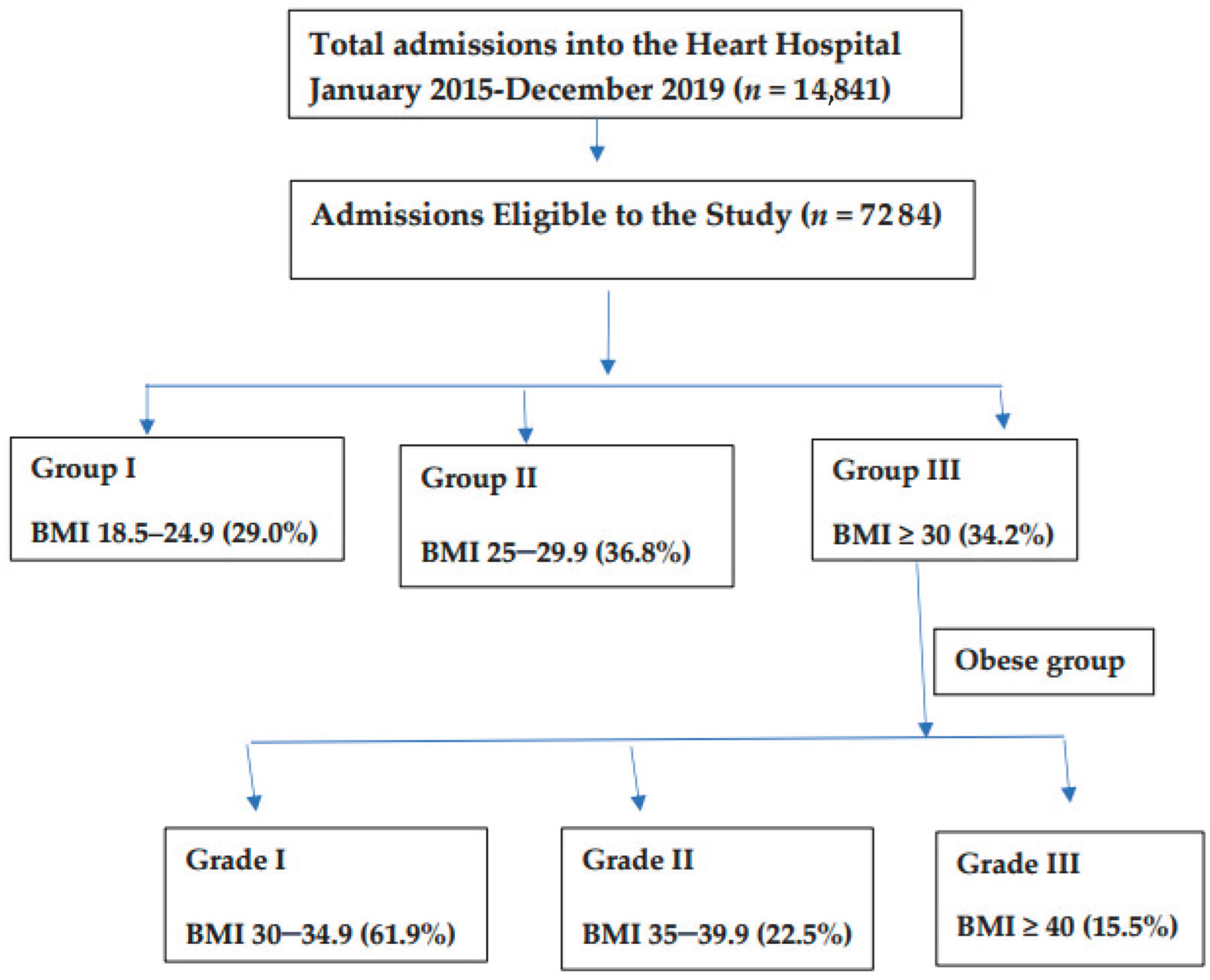

| Characteristics | Group I (BMI 18.5–24.9) n = 2111 (29.0%) | Group II (BMI 25–29.9) n = 2679 (36.8%) | Group III (BMI ≥ 30) n = 2494 (34.2%) | p Value |
|---|---|---|---|---|
| Mean age in years | 57.8 ± 15.1 | 58.2 ± 13.6 | 62.1 ± 13.7 | 0.001 |
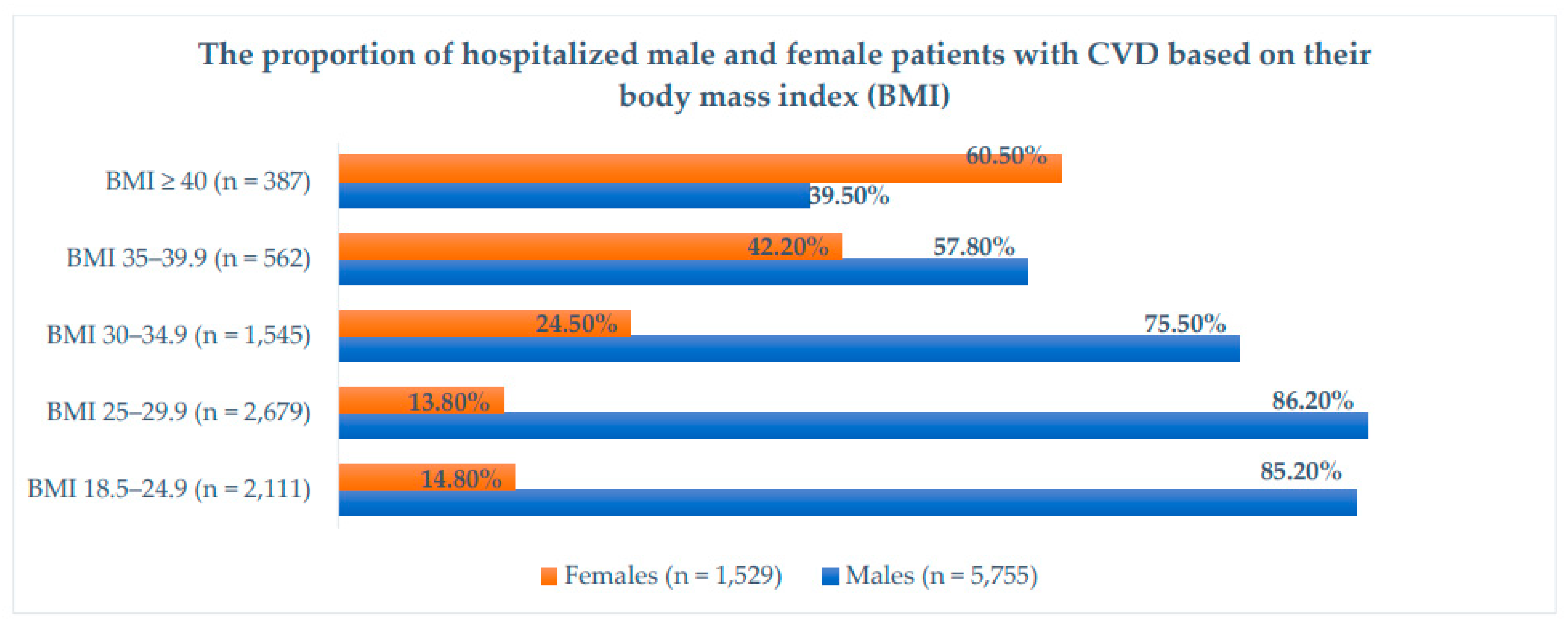
| Females/males; n (%) | 312 (15%)/1799 (85%) | 369 (14%)/2310(86%) | 848 (34%)/1646 (66%) | 0.001 |
| Risk factors | ||||
| Diabetes mellitus | 934 (44.2%) | 1313 (44.0%) | 1534 (61.6%) | 0.001 |
| Hypertension | 942 (44.6%) | 1433 (53.5%) | 1657 (66.4%) | 0.001 |
| Dyslipidemia | 763 (36.1%) | 1096 (40.9%) | 1418 (56.9%) | 0.001 |
| Smoking | 586 (27.8%) | 564 (28.5%) | 517 (20.7%) | 0.001 |
| Old myocardial infarction | 376 (17.8%) | 549 (20.5%) | 552 (22.1%) | 0.001 |
| Chronic renal failure | 215 (10.2%) | 290 (10.8%) | 416 (16.7%) | 0.001 |
| Peripheral artery disease | 10 (0.5%) | 10 (0.4%) | 19 (0.8%) | 0.14 |
| Symptoms at the time of admission | ||||
| Chest pain | 139 (66.0%) | 1863 (69.5%) | 1409 (56.5%) | 0.001 |
| Dyspnea | 533 (25.2%) | 614 (22.9%) | 892 (35.8%) | 0.001 |
| Palpitation | 118 (5.6%) | 118 (4.4%) | 182 (7.3%) | 0.001 |
| Dizziness | 123 (5.8%) | 133 (5.0%) | 104 (4.2%) | 0.04 |
| Lab Parameter | Group I | Group II | Group III | p Value |
|---|---|---|---|---|
| Hemoglobin gm/dl median (IQR) | 13.3 (11.4–14.7) | 13.5 (11.8–14.8) | 12.6 (10.8–14.2) | 0.001 |
| FBS mmol/L (IQR) | 6.6 (5.5–9.3) | 6.7 (5.6–9.3) | 7.4 (5.8–10.8) | 0.11 |
| Creatinine umol/L (IQR) | 92 (79–116) | 93 (79–115) | 95 (78–131) | 0.07 |
| Serum BNP pg/mL (IQR) | 1649 (282–6266) | 949 (130–3909) | 1175 (277–3358) | 0.001 |
| C-reactive protein mg/L (IQR) | 27 (7.5–90.0) | 16.8 (5–63) | 17 (7–73) | 0.22 |
| Total cholesterol mmol/L (IQR) | 4.3 (3.4–5.3) | 4.3 (3.5–5.2) | 4.1 (3.3–5.0) | 0.03 |
| Triglyceride mmol/L (IQR) | 1.4 (0.97–2.0) | 1.5 (1.1–2.3) | 1.5 (1.1–2.2) | 0.001 |
| LDL mmol/L (IQR) | 2.6 (1.8–3.4) | 2.6 (1.8–3.4) | 2.3 (1.6–3.0) | 0.16 |
| Troponin ng/L (IQR) | 55 (16.0–260) | 49 (16.6–185) | 36 (14–102) | 0.003 |
| Troponin peak ng/L (IQR) | 427 (49–3188) | 471 (50–3114) | 118 (29–1296) | 0.001 |
| CK-MB peak U/L (IQR) | 13 (5–103) | 11 (5–104) | 5 (5–31) | 0.29 |
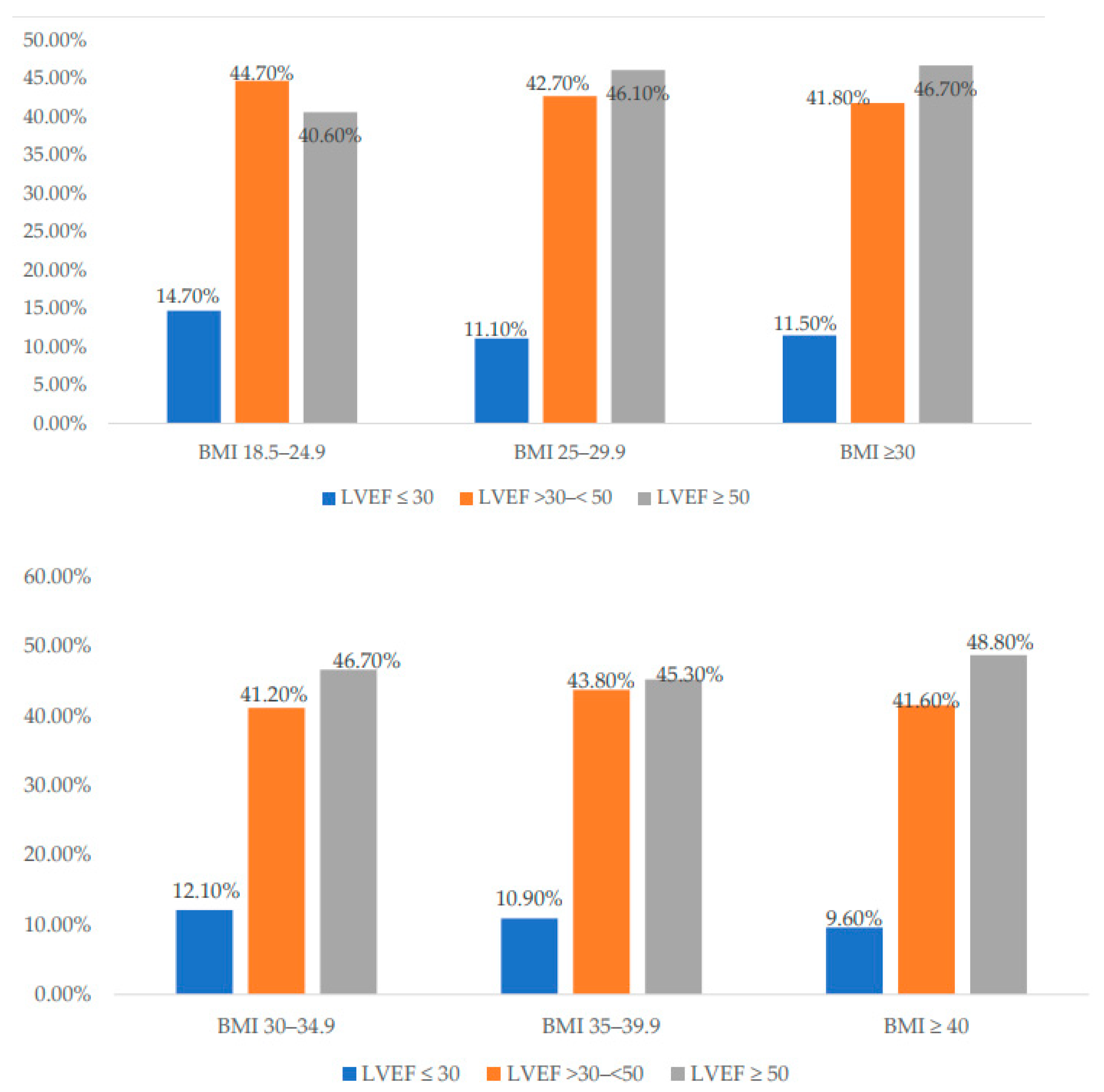
| LVEF median, range | 45 (35–54) | 47 (38–55) | 47 (37–54) | 0.001 |
| Diagnosis | Group I | Group II | Group III | p Value |
|---|---|---|---|---|
| Unstable angina | 150 (7.1%) | 244 (9.1%) | 221 (8.4%) | 0.03 |
| NSTEMI | 563 (26.7%) | 746 (27.8%) | 590 (23.7%) | 0.002 |
| STEMI | 1211 (57.4%) | 1563 (58.3%) | 1037 (41.6%) | 0.001 |
| Anterior MI | 306 (14.5%) | 378 (14.1%) | 180 (7.2%) | 0.001 |
| Lateral MI | 73 (3.5%) | 93 (3.5%) | 51 (2.0%) | 0.003 |
| Inferior MI | 127 (6.0%) | 351 (13.1%) | 328 (13.1%) | 0.001 |
| Posterior MI | 50 (2.4%) | 55 (2.1%) | 34 (1.4%) | 0.04 |
| Atrial fibrillation | 81 (3.8%) | 95 (3.5%) | 182 (7.3%) | 0.001 |
| Stent restenosis | 7 (0.3%) | 27 (1.0%) | 16 (0.6%) | 0.02 |
| Stent thrombosis | 8 (0.4%) | 12 (0.4%) | 5 (0.2%) | 0.30 |
| Congestive heart failure | 281 (13.3%) | 305 (11.4%) | 475 (19.0%) | 0.001 |
| Cardiomyopathy | 207 (9.8%) | 195 (7.3%) | 231 (9.3%) | 0.004 |
| Shock | 33 (1.6%) | 28 (1.0%) | 26 (1.0%) | 0.18 |
| Cardiac arrest | 34 (1.6%) | 30 (1.1%) | 29 (1.2%) | 0.27 |
| Aortic regurgitation | 8 (0.4%) | 3 (0.3%) | 2 (0.1%) | 0.03 |
| Aortic stenosis | 26 (1.2%) | 40 (1.5%) | 55 (2.2%) | 0.03 |
| Mitral regurgitation | 29 (1.4%) | 29 (1.1%) | 22 (0.9%) | 0.28 |
| Mitral stenosis | 15 (0.7%) | 8 (0.3%) | 20 (0.8%) | 0.04 |
| Coronary angiograhic results | ||||
| Single vessel disease | 391 (18.5%) | 542 (20.2%) | 355 (14.2%) | 0.001 |
| Two vessel disease | 289 (13.7%) | 392 (14.6%) | 247 (9.9%) | 0.001 |
| Three vessel disease | 374 (17.7%) | 457 (17.1%) | 326 (13.1%) | 0.001 |
| PCI at admission | 508 (24.1%) | 672 (25.1)% | 384 (15.4%) | 0.001 |
| PCI before discharge | 397 (18.8%) | 572 (21.4%) | 442 (17.7%) | 0.003 |
| Variable | Group I | Group II | Group III | p Value |
|---|---|---|---|---|
| Atrial fibrillation | 41 (1.9%) | 56 (2.1%) | 81 (3.2%) | 0.006 |
| Ventricular tachycardia | 45 (2.1%) | 43 (1.6%) | 39 (1.6%) | 0.27 |
| Ventricular fibrillation | 37 (1.8%) | 29 (1.1%) | 23 (0.9%) | 0.03 |
| Cardiac arrest | 48 (2.3%) | 43 (1.6%) | 41 (1.6%) | 0.17 |
| Left bundle branch block | 5 (0.2%) | 7 (0.3%) | 13 (0.5%) | 0.17 |
| Right bundle branch block | 9 (0.4%) | 8 (0.3%) | 13 (0.5%) | 0.46 |
| Congestive heart failure | 51 (2.4%) | 56 (2.1%) | 54 (2.2%) | 0.74 |
| Intubation | 48 (2.3%) | 45 (1.7%) | 50 (2.0%) | 0.33 |
| Cerebrovascular accident | 7 (0.3%) | 3 (0.1%) | 3 (0.1%) | 0.14 |
| Shock | 41 (1.9%) | 49 (1.8%) | 25 (1.0%) | 0.02 |
| Hospital stay in days, median (interquartile range) | 4 (2.5–5.0) | 3 (2–5) | 4 (2–5) | 0.06 |
| Mortality | 161 (7.6%) | 205 (7.7%) | 272 (10.9%) | 0.001 |
| Characteristics | Grade I (BMI 30–34.9) n = 1545 (61.9%) | Grade II (BMI 35–39.9) n = 562 (22.5%) | Grade III (BMI ≥ 40) n = 387 (15.5%) | p Value |
|---|---|---|---|---|
| Mean age in years | 61.1 ± 13.9 | 63.0 ± 13.3 | 64.4 ± 13 | 0.001 |
| Females/males | 378/1167 | 237/325 | 233/154 | |
| Risk factors | ||||
| Smoking | 373 (24.1%) | 111 (19.8%) | 33 (8.5%) | 0.001 |
| Diabetes mellitus | 885 (57.3%) | 374 (66.5%) | 275 (71.1%) | 0.001 |
| Hypertension | 940 (60.8%) | 404 (71.9%) | 313 (80.9%) | 0.001 |
| Dyslipidemia | 805 (52.1%) | 368 (65.5%) | 245 (63.3%) | 0.001 |
| Chronic renal failure | 223 (14.4%) | 97 (17.3%) | 96 (24.8%) | 0.001 |
| Old myocardial infarction | 331 (21.4%) | 132 (23.5%) | 89 (23.0%) | 0.54 |
| Peripheral artery disease | 13 (0.8%) | 3 (0.5%) | 3 (0.8%) | 0.77 |
| Symptoms at the time of admission | ||||
| Chest pain | 941 (60.9%) | 299 (53.2%) | 169 (43.7%) | 0.001 |
| Dyspnea | 456 (29.5%) | 240 (42.7%) | 196 (50.6%) | 0.001 |
| Parameter | Grade I | Grade II | Grade III | p Value |
|---|---|---|---|---|
| Hemoglobin value gm/dl (IQR) | 13 (11–15) | 12 (11–14) | 11.6 (10–13) | 0.001 |
| Fasting blood sugar mmol/L (IQR) | 7 (6–11) | 7.4 (6–11) | 8 (6–11.5) | 0.51 |
| Serum Creatinine umol/L (IQR) | 94 (79–124) | 96 (77–136) | 100 (76–161) | 0.30 |
| Serum Brain natriuretic peptide (IQR) | 1029 (215–3378) | 1184 (319–3270) | 1550 (494–3430) | 0.30 |
| C-reactive protein mg/L (IQR) | 17 (7–83) | 15.5 (7–42) | 20 (8–72) | 0.05 |
| Total cholesterol value mmol/L (IQR) | 4 (3–5) | 4 (3.4–4.9) | 4 (3.1–4.7) | 0.001 |
| Triglyceride value mmol/L (IQR) | 1.9 (1.1–2.3) | 1.5 (1.1–2.2) | 1.4 (1.0–2.0) | 0.16 |
| Low-density lipoprotein value mmol/L (IQR) | 2.4 (1.7–3.2) | 2.2 (1.6–3.0) | 1.9 (1.4–2.8) | 0.02 |
| Troponin value ng/L (IQR) | 40 (15–132) | 31 (13–84) | 31 (11–76) | 0.07 |
| Troponin peak ng/L (IQR) | 158 (35–1917) | 100 (27–758) | 59 (18–387) | 0.007 |
| Creatine kinase-MB U/L peak (IQR) | 5 (5–48) | 5 (5–17) | 5 (5–15) | 0.15 |
| LV Ejection fraction (EF) (IQR) | 47 (37–54) | 46 (37–55) | 48 (39–54) | 0.71 |
| Final Diagnosis | Grade I | Grade II | Grade III | p Value |
|---|---|---|---|---|
| Unstable angina | 144 (9.3%) | 52 (9.3%) | 25 (6.5%) | 0.20 |
| NSTEMI | 392 (25.4%) | 130 (23.1%) | 68 (17.6%) | 0.005 |
| STEMI | 729 (47.2%) | 209 (37.2%) | 99 (25.6%) | 0.001 |
| Anterior MI | 139 (9.0%) | 33 (5.9%) | 8 (2.1%) | 0.001 |
| Lateral MI | 38 (2.5%) | 10 (1.8%) | 3 (0.8%) | 0.10 |
| Inferior MI | 227 (14.7%) | 56 (10.0%) | 45 (11.4%) | 0.009 |
| Posterior MI | 27 (1.7%) | 5 (0.9%) | 2 (0.5%) | 0.09 |
| Atrial fibrillation | 95 (6.1%) | 42 (7.5%) | 44 (11.6%) | 0.001 |
| Stent restenosis | 12 (0.8%) | 2 (0.4%) | 2 (0.5%) | 0.53 |
| Stent thrombosis | 2 (0.1%) | 1 (0.2%) | 2 (0.5%) | 0.31 |
| Cardiomyopathy | 134 (8.7%) | 55 (9.8%) | 42 (10.9%) | 0.37 |
| Shock | 12 (0.8%) | 8 (1.4%) | 6 (1.6%) | 0.25 |
| Cardiac arrest | 14 (0.9%) | 9 (1.6%) | 6 (1.6%) | 0.31 |
| Congestive heart failure | 247 (16%) | 121 (12.5%) | 107 (27.6%) | 0.001 |
| Aortic regurgitation | 1 (0.1%) | 0 (0%) | 1 (0.3%) | 0.36 |
| Aortic stenosis | 28 (1.8%) | 13 (2.3%) | 14 (3.6%) | 0.10 |
| Mitral regurgitation | 9 (0.6%) | 10 (1.8%) | 3 (0.9%) | 0.03 |
| Mitral stenosis | 12 (0.8%) | 6 (1.1%) | 2 (0.5%) | 0.64 |
| Coronary angiographic findings | ||||
| Single vessel disease | 251 (16.2%) | 74 (13.2%) | 30 (7.8%) | 0.001 |
| Two vessel disease | 193 (12.5%) | 42 (7.5%) | 12 (3.1%) | 0.001 |
| Three vessel disease | 227 (14.7%) | 62 (11.0%) | 37 (9.6%) | 0.007 |
| PCI at admission | 286 (18.5%) | 76 (13.5%) | 22 (5.7%) | 0.001 |
| PCI before discharge | 317 (20.5%) | 81 (14.4%) | 44 (11.4%) | 0.001 |
| Complications | Grade I | Grade II | Grade III | p Value |
|---|---|---|---|---|
| Atrial fibrillation | 46 (3.0%) | 20 (3.6%) | 15 (3.9%) | 0.60 |
| Ventricular tachycardia | 27 (1.7%) | 12 (2.1%) | 0 (0%) | 0.02 |
| Ventricular fibrillation | 16 (1.0%) | 5 (0.9%) | 2 (0.5%) | 0.63 |
| Cardiac arrest | 21 (1.4%) | 13 (2.3%) | 7 (1.8%) | 0.30 |
| Left bundle branch block | 9 (0.6%) | 3 (0.5%) | 1 (0.3%) | 0.73 |
| Right bundle branch block | 11 (0.7%) | 2 (0.4%) | 0 (0%) | 0.18 |
| Congestive heart failure | 35 (2.3%) | 13 (2.3%) | 6 (1.8%) | 0.66 |
| Intubation | 28 (1.8%) | 13 (2.3%) | 9 (2.3%) | 0.68 |
| Cerebrovascular accident | 1 (0.1%) | 1 (0.2%) | 1 (0.3%) | 0.56 |
| Shock | 15 (1.0%) | 6 (1.1%) | 4 (1.0%) | 0.98 |
| Hospital stay in days (IQR) | 3 (2–5) | 3 (2–5) | 4 (2–9) | 0.53 |
| Mortality | 143 (9.3%) | 63 (11.2%) | 66 (17.1%) | 0.001 |
| Variable | Crude Odds Ratio | 95% Confidence Interval | Adjusted Odds Ratio | 95% Confidence Interval | p Value |
|---|---|---|---|---|---|
| Age in years | 1.08 | 1.07–1.09 | 1.06 | 1.05–1.08 | 0.001 |
| Gender (male vs. female) | 0.40 | 0.36–0.44 | 0.88 | 0.67–1.15 | 0.09 |
| Diabetes mellitus | 3.34 | 2.94–3.80 | 1.75 | 1.23–2.50 | 0.001 |
| Hypertension | 3.36 | 2.94–3.83 | 1.27 | 0.86–1.87 | 0.23 |
| * BMI >= 30 | 1.0 | 0.99–1.0 | 1.0 | 0.99–1.004 | 0.92 |
| Variable | |||||
| Age in years | 1.08 | 1.07–1.09 | 1.07 | 1.06–1.08 | 0.001 |
| Gender (male vs. female) | 0.40 | 0.36–0.44 | 0.85 | 0.70–1.04 | 0.11 |
| Diabetes mellitus | 3.34 | 2.94–3.80 | 1.67 | 1.34–2.06 | 0.001 |
| Hypertension | 3.36 | 2.94–3.83 | 1.30 | 1.04–1.64 | 0.02 |
| ** BMI >= 30 vs. < 30 | 1.47 | 1.25–1.74 | 1.04 | 0.87–1.25 | 0.67 |
Disclaimer/Publisher’s Note: The statements, opinions and data contained in all publications are solely those of the individual author(s) and contributor(s) and not of MDPI and/or the editor(s). MDPI and/or the editor(s) disclaim responsibility for any injury to people or property resulting from any ideas, methods, instructions or products referred to in the content. |
© 2023 by the authors. Licensee MDPI, Basel, Switzerland. This article is an open access article distributed under the terms and conditions of the Creative Commons Attribution (CC BY) license (https://creativecommons.org/licenses/by/4.0/).
Share and Cite
Abid, A.R.; El-Menyar, A.; Singh, R.; Gomaa, M.; Habib, S.; Abdelrahman, A.S.; Asaad, N.; AlQahtani, A.; Al-Thani, H.; AlBinali, H.; et al. Patterns and Outcomes of Obesity Using Body Mass Index in Patients Hospitalized with Acute Cardiovascular Disorders: A Retrospective Analysis of 7284 Patients in a Middle Eastern Country. J. Clin. Med. 2023, 12, 7263. https://doi.org/10.3390/jcm12237263
Abid AR, El-Menyar A, Singh R, Gomaa M, Habib S, Abdelrahman AS, Asaad N, AlQahtani A, Al-Thani H, AlBinali H, et al. Patterns and Outcomes of Obesity Using Body Mass Index in Patients Hospitalized with Acute Cardiovascular Disorders: A Retrospective Analysis of 7284 Patients in a Middle Eastern Country. Journal of Clinical Medicine. 2023; 12(23):7263. https://doi.org/10.3390/jcm12237263
Chicago/Turabian StyleAbid, Abdul Rehman, Ayman El-Menyar, Rajvir Singh, Mohamed Gomaa, Said Habib, Ahmed Shaaban Abdelrahman, Nidal Asaad, Awad AlQahtani, Hassan Al-Thani, Hajar AlBinali, and et al. 2023. "Patterns and Outcomes of Obesity Using Body Mass Index in Patients Hospitalized with Acute Cardiovascular Disorders: A Retrospective Analysis of 7284 Patients in a Middle Eastern Country" Journal of Clinical Medicine 12, no. 23: 7263. https://doi.org/10.3390/jcm12237263
APA StyleAbid, A. R., El-Menyar, A., Singh, R., Gomaa, M., Habib, S., Abdelrahman, A. S., Asaad, N., AlQahtani, A., Al-Thani, H., AlBinali, H., & Al Suwaidi, J. (2023). Patterns and Outcomes of Obesity Using Body Mass Index in Patients Hospitalized with Acute Cardiovascular Disorders: A Retrospective Analysis of 7284 Patients in a Middle Eastern Country. Journal of Clinical Medicine, 12(23), 7263. https://doi.org/10.3390/jcm12237263

