The Effectiveness of Interventions for the Prevention or Treatment of Paternal Perinatal Anxiety: A Systematic Review


Abstract
1. Background
2. Methods
2.1. Aims
2.2. Registration and Reporting
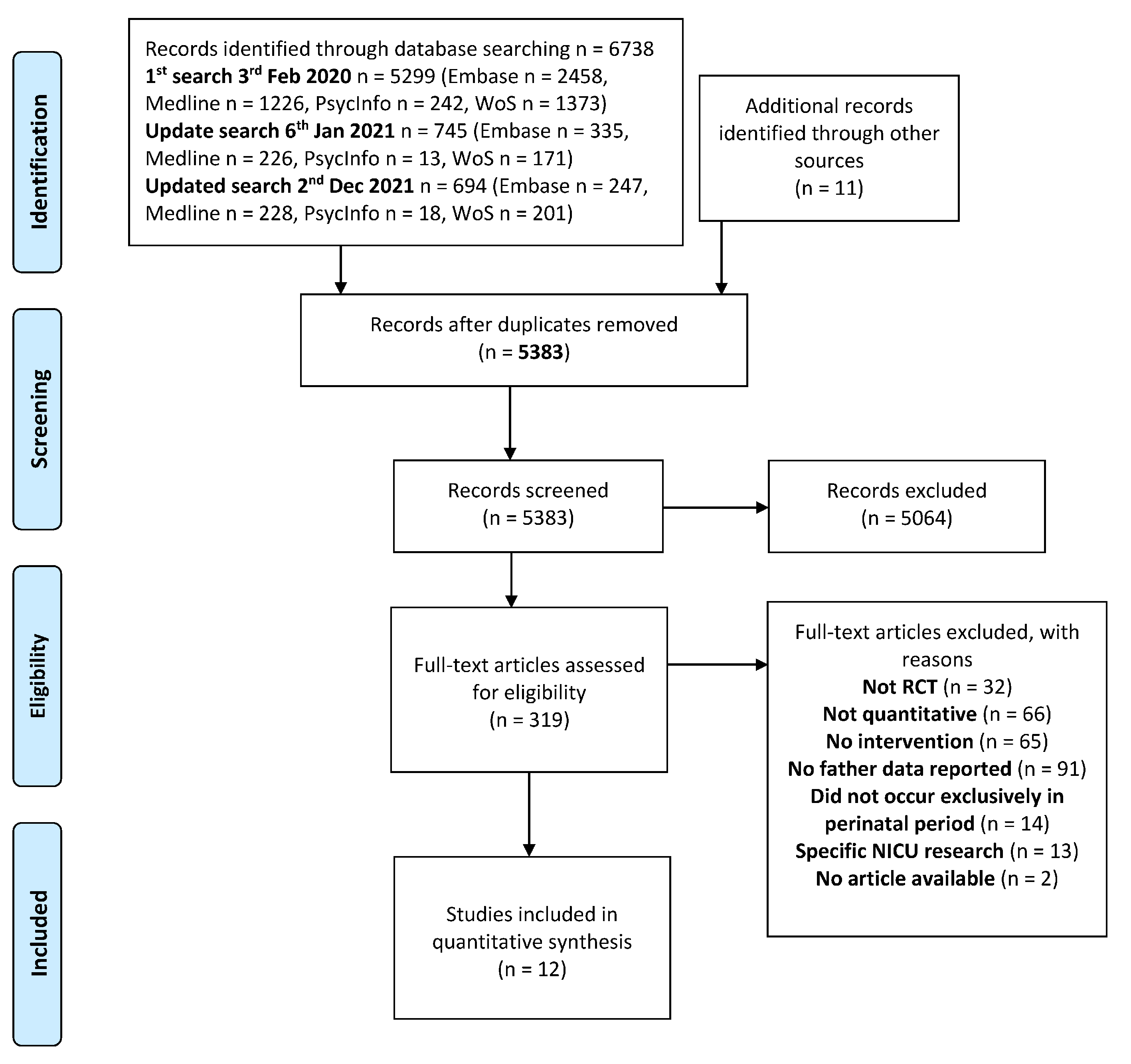
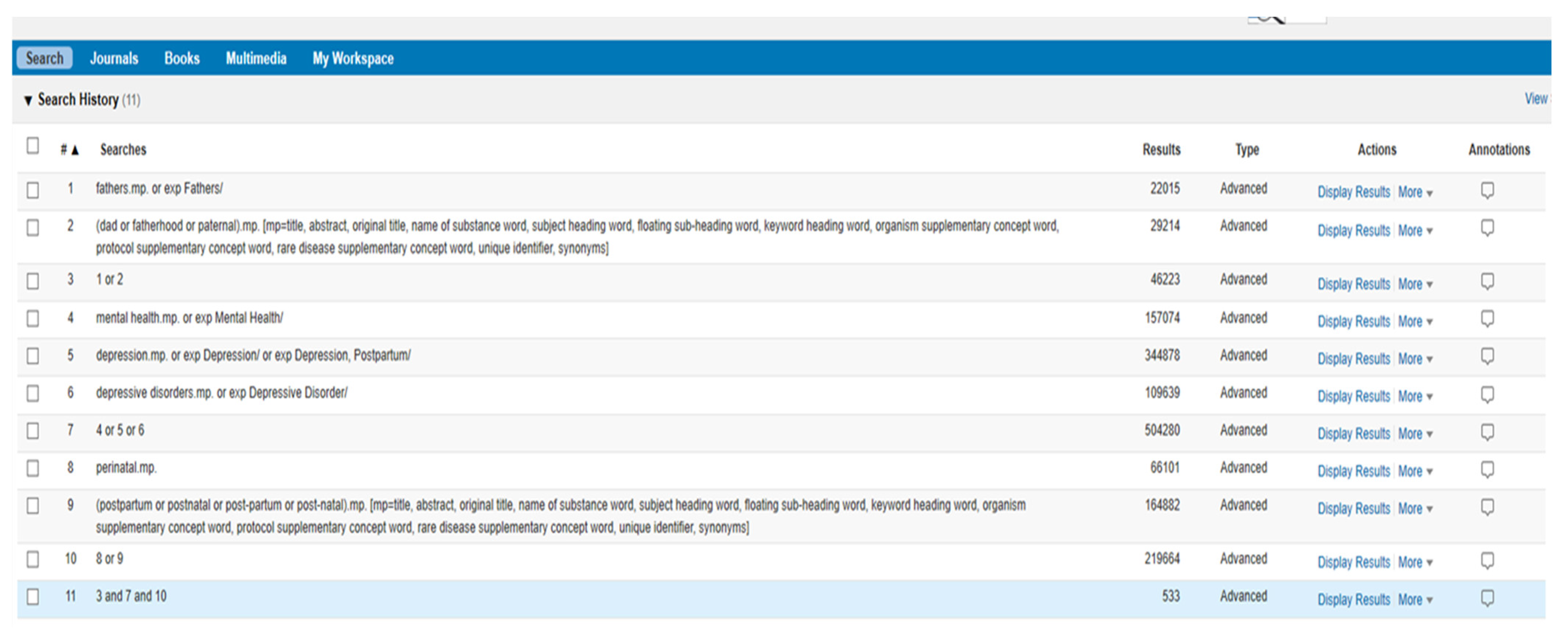
2.3. Search Strategy
2.4. Risk of Bias
2.5. Data Synthesis
3. Results
3.1. Study Characteristics
Patient Demographics
3.2. Interventions
3.2.1. Psychoeducational
3.2.2. Practical Skills
3.3. Comparators
3.4. Outcomes
3.4.1. Psychoeducational Intervention Outcomes
- Educational child-rearing and lifestyle App reported significant effect on PPA compared to control, at one-month (OR = −3.40, 95% CI (3.93 to −2.86), p < 0.001), and three-months postnatal (OR = −1.09, 95% CI (−1.57 to −0.61), p < 0.001) [44].
- Face-to-face child-rearing education and telephone emotional wellbeing support reported no significant effect (ten-weeks postnatal = intervention M 5.64 SD (2.77); control M 5.50 SD (2.56)) [45].
3.4.2. Practical Skills Intervention Outcomes
- Pregnancy massage therapy (t = 3.61, p < 0.01) reduced self-reported PPA compared to care as usual [37].
- Antenatal partner massage or relaxation interventions outcomes showed a negative relationship from baseline to five-weeks post-intervention, compared to care as usual (r = 0.31, p < 0.01) [42]. At five-weeks post-intervention, correcting for multiple testing revealed partner massage was significantly effective in reducing PPA compared to relaxation (4.03, SE = 0.78, p = 0.001) [42].
3.4.3. Technology
- Psychoeducational intervention using telephone-consultation and App education (one-month postnatal (OR = −3.40, 95% CI (3.93 to −2.86), p < 0.001); three-months postnatal (OR = −1.09, 95% CI (−1.57 to −0.61), p < 0.001)) [44].
- Psychoeducational telephone-consultation (State Anxiety = OR −7.5 95% CI (−11.6 to −3.4), Trait Anxiety = OR −8.3 95% CI (−12.2 to −4.4)) [38].
- Pregnancy massage therapy: training delivered by DVD (t = 3.61, p < 0.01) [37].

| First Author/Ref | Intervention Type | N Used at Final Analysis | Delivery Time | Timepoints | Outcome Measure | Intervention Outcomes |
|---|---|---|---|---|---|---|
| Psychoeducational | ||||||
| Fathers only | ||||||
| Charandabi (2017)/[38] | (prenatal lifestyle-based education) | N = 125 IG = 62 CG = 63 | Antenatal to postnatal | T1—Baseline (24–28 weeks gestation) T2—8 weeks post training (32–36 weeks gestation) T3—6 weeks postnatal | STAI | Treatment effect Adjusted odds ratio, Baseline (24–28 weeks gestation)—State Anxiety = OR 1.1 95% CI (−2.1 to 4.5) Trait Anxiety = OR 2.7 95% CI (−1.6 to 6.5); T2 (8 weeks post training)—State Anxiety = OR −5.7 95% CI (−8.6 to −2.9) Trait Anxiety = OR −5.0 95% CI (−7.8 to −2.2); T3 (6 weeks postnatal)—State Anxiety = OR −7.5 95% CI (−11.6 to −3.4) Trait Anxiety = OR −8.3 95% CI (−12.2 to −4.4) ** Narrative report Compared with the control group, there was a significant reduction in self-reported state and trait anxiety scores at 8 weeks post intervention. Implementation of antenatal training interventions was reported as being easy. |
| Li (2009)/[43] | Birth Education Program for Expectant Fathers Who Plan to Accompany Their Partners Through Labour (childbirth classes) | N = 87 IG n = 45CG n = 42 | Antenatal | T1—Baseline (34–36 weeks gestation) T2—1 day postnatal | STAI | Treatment effect Postnatal state anxiety analysis of covariance, F = 3.38, p = 0.001 ** Narrative report No statistical significance was self-reported between the intervention and control groups of fathers in trait anxiety. ** When analysis of covariance was implemented, correcting for education level, sources of childbirth information, attendance at Lamaze childbirth classes, and childbirth expectations at baseline, the effect of the intervention on postnatal state anxiety scores was significant. |
| Mohammadpour (2021)/[46] | Counselling sessions (4 weeks) to familiarize fathers with changes in pregnancy and their role in maternal and foetal health. | N = 102 IG n = 51 CG n = 51 | Antenatal | T1—Baseline (20–24 weeks gestation) T2—4 weeks post-intervention | STAI | Treatment effect MD: −2.4; 95% CI: −4.7 to −0.2; p = 0.03 ** Narrative report State anxiety in the intervention group decreased significantly 4 weeks after the intervention compared to the control group. No significant difference was found between the two groups for trait anxiety. |
| Group-based couple dyads | ||||||
| Feinberg (2016)/[41] | Family foundations (parenting education program) | N = 608 (women = 304, men = 304) IG = 152 CG = 152 | Antenatal to postnatal | T1—Baseline T2—10 months postnatal | STAI | Treatment effect T2 (10 months postnatal) intervention, M 16.83 SD (4.52), control M 17.62 SD (5.4) Narrative report Paternal No significant intervention effects were found. Infant ** Significant intervention effects were also reported for infant soothability; b = 0.19; p < 0.05, and reductions in sleep problems—difficulty falling back to sleep and number of wakings during the night—were reported. |
| Feinberg (2008)/[36] | Family foundations (parenting education program) | N = 304 (women = 152, men = 152) IG = 79 CG = 73 | Antenatal to postnatal | T1—Baseline T2—6 months postnatal | Taylor Manifest Anxiety Scale | Treatment effect B = 0.816, SE = 0.51, p > 0.1 Narrative report Paternal No significant intervention effect on anxiety outcomes were self-reported Maternal ** Significant intervention effects were described for maternal anxiety, and distress in the parent–infant relationship. Infant * Intervention group infants had a greater level of soothability by father report; B = 0.312, SE = 0.16, p < 0.1; effect size 0.35 |
| Mihelic (2018)/[39] | Baby Triple p (parenting education program) | N = 224 (women = 112, men = 112), IG = 55 CG = 57 | Antenatal | T1—Baseline T2—post-intervention T3—6 months postnatal | DASS-anxiety | Treatment effect Time effect, B = −0.20, F (1, 85.25) = 2.59, p = 0.111, Group effect, B = −0.16, F (1108.44) = 0.14, p = 0.709 Narrative report Paternal No significant intervention effects were self-reported at post-intervention or 6 months follow-up. Fathers in both intervention and control groups self-reported significant increases in their parenting confidence and self-efficacy. Infant No significant effect on father-infant bonding difficulties (d = 0.02, 95% CI (−0.35–0.39)), or parental responsiveness (d = −0.12, 95% CI (−0.49–0.24)) |
| Tohotoa (2012)/[28] | (antenatal education) | N = 556 IG = 303 CG = 253 | Antenatal to postnatal | T1—Baseline T2—6 weeks postnatal | HADS | Treatment effect Participants recording a reduction N(%), ~p is significant at 0.015 using McNemar-Bowker test, T2 (6 weeks postnatal) = intervention = 36(12.4%~), control = 28(11.4%) * Narrative report Paternal Fathers in the intervention group self-reported lower anxiety scores compared to fathers in the control group from baseline to post-intervention, however this was not a significant difference. |
| Individual couple dyads | ||||||
| Missler (2020)/[45] | (psychoeducational parenting intervention) | N = 189 (women = 120, men = 69), IG = 31 CG = 38 | Antenatal to postnatal | T1—Baseline (26–34 wks gestation) T2—34–36 weeks gestation T3—6 weeks postnatal T4—10 weeks postnatal | HADS | Treatment effect T4 (10 weeks postnatal) intervention M 5.64 SD (2.77), control M 5.50 SD (2.56) Narrative report Paternal No between group differences were observed on anxiety. The intervention was rated as useful by parents, and the information booklet was considered the most useful part of the intervention. Intervention and control groups showed an increase in self-reported distress after birth |
| Shorey (2019)/[44] | (technology-based supportive educational parenting program) | N = 236 (women = 118, men = 118) IG = 59 CG = 59 | Antenatal to postnatal | T2—2 days postnatal T3—1 month postnatal T4—3 months postnatal | STAI | Treatment effect Adjusted odds ratio, T2 (2 days postnatal) OR = 0.13, 95% CI (−0.18 to 0.44), p = 0.4, T3 (1 month postnatal) OR = −3.40, 95% CI (3.93 to −2.86), p < 0.001, T4 (3 months postnatal) OR = −1.09, 95% CI (−1.57 to −0.61), p < 0.001 ** Narrative report Paternal The mean difference of self-reported anxiety scores were significantly lower at 1 and 3 months postnatal compared to the control group. Maternal ** The mean difference of self-reported anxiety scores were significantly lower at 1 and 3 months postnatal compared to the control group. |
| Practical skills | ||||||
| Field (2008)/[37] | (pregnancy massage therapy) | N = 114 (women = 57, men = 57) IG = 29 CG = 28 | Antenatal | T1—Baseline T2—6 months postnatal | STAI | Treatment effect Independent samples t tests, t = 3.61, p < 0.01 ** Narrative report Paternal Fathers in the intervention group self-reported decreased anxiety, compared to the control group. Maternal * Mothers in the intervention group reported decreased depression, anxiety, and anger compared to the control group. |
| Huang (2019)/[40] | (paternal skin to skin contact) | N = 100 IG n = 50 CG n = 50 | Postnatal | T1—Baseline T2—Directly after intervention | SAS | Treatment effect Independent samples t tests, t = −1.321, p < 0.05 ** Narrative report Paternal Fathers in the intervention group had significantly lower self-reported scores of anxiety and better role attainment than those in the control group. Maternal ** Duration of breastfeeding after SSC in the intervention group was significantly longer than the control group. Infant * Infants in the intervention group had a more stable heart rate and forehead temperature, less duration of crying, and started feeding behaviour earlier. |
| Latifses (2005)/[42] | (1. relaxation) (2. partner massage) | N = 278 (women = 139, men = 139) IG1 = 46 IG2 = 47 CG n = 46 | Antenatal | T1—Baseline T2—5 weeks follow-up | STAI | Treatment effect one way repeated measures analysis of variance T1-T2, Wilks’ = 0.77; F (2, 170) = 25.85, p = 0.001 * correlation coefficient, r = 0.31, p < 0.01 Bonferroni adjustment massage-relaxation, 4.03, SE = 0.78, p = 0.001 ** Narrative report Paternal Partner massage therapy lowered fathers’ self-reported anxiety levels. Infant * Fathers who reported low anxiety also reported high foetal attachment (this is a high predictor of infant attachment). |
3.4.4. Core Outcome Set Findings
- Self-assessed symptoms: All studies assessed outcomes through self-reporting, all outcome measures were validated for general population.
- Parent-infant bonding: Three interventions recorded outcomes for father-infant bonding.
- I.
- Family foundations (second iteration) reported significant intervention effect on father-reported infant soothability (b = 0.19; p < 0.05) [41];
- II.
- Family foundations (first iteration) noted some intervention effect on father-reported infant soothability (B = 0.312, SE = 0.16, p < 0.1; effect size 0.35) [36];
- III.
- SSC intervention reported physical health differences in infants related to bonding and reduced stress—the intervention group recorded decreased infant heart rates (heartrate (bps) at 5 min/30 min (M(sd)): intervention = 145.61(3.21)/140.33(8.29); control = 146.07(4.83)/143.81(5.63)) [40].
- I.
- Participants self-reporting anxiety scores at a cut-off suggesting severe anxiety were referred to a ‘clinical nurse specialist’ [28];
- II.
- Limiting participants to 3–4 couples to manage/deter adverse events in psychoeducational groupwork [43]. No studies considered the risk or management of suicidal thoughts.
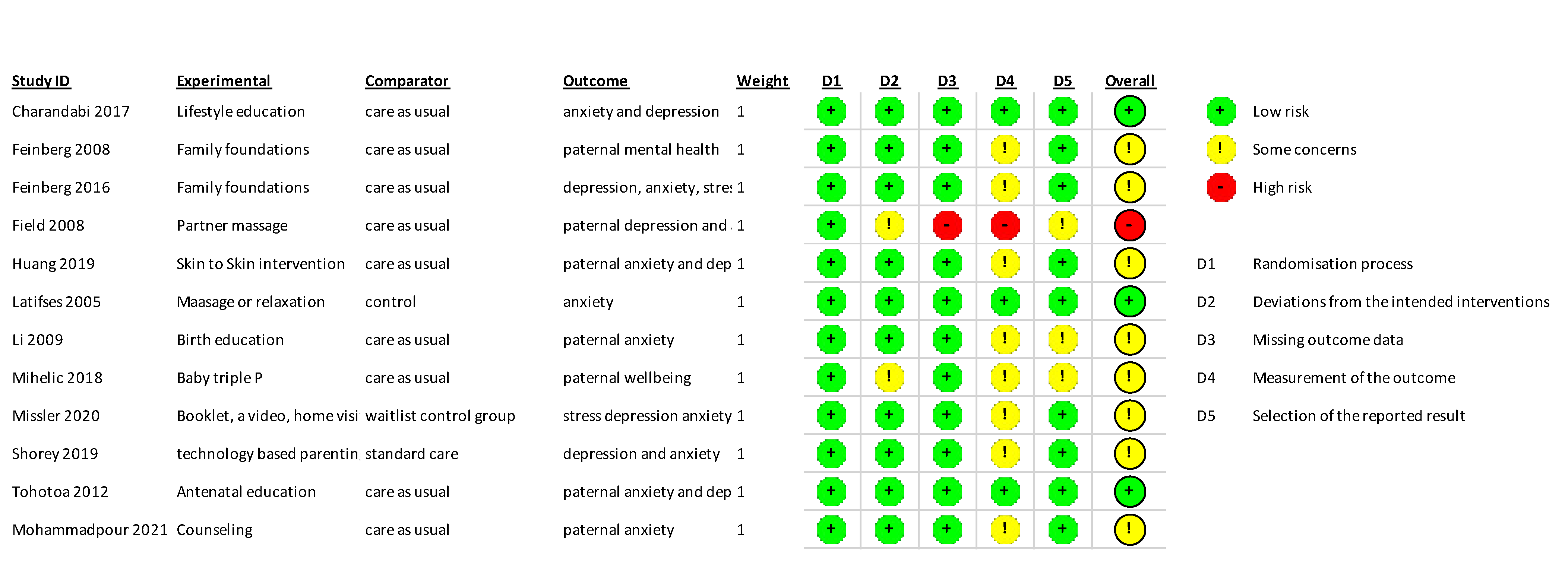
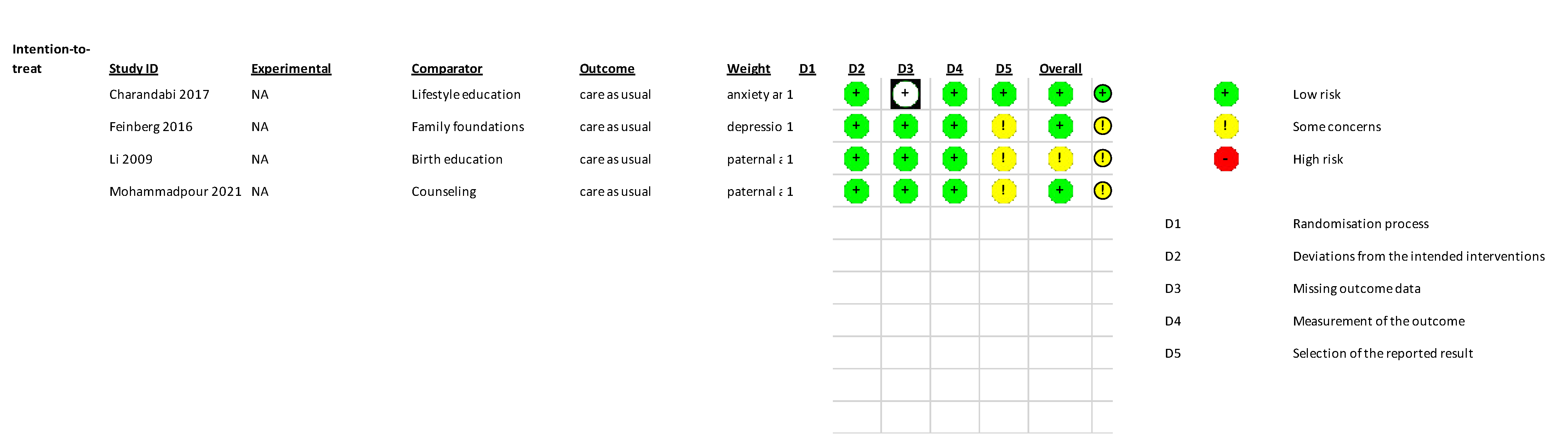
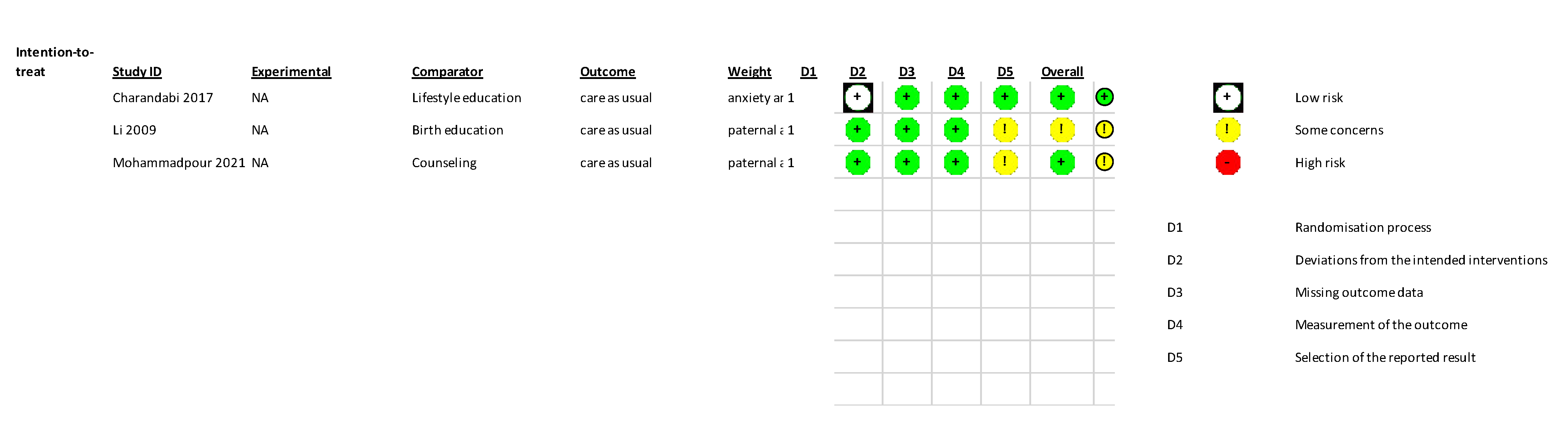
3.5. Risk of Bias Assessment
Post Hoc Subgroup Analysis
4. Discussion
4.1. Interpretation
4.2. Future Research
Implications for Practice
4.3. Strengths and Limitations
5. Conclusions
Author Contributions
Funding
Institutional Review Board Statement
Informed Consent Statement
Data Availability Statement
Acknowledgments
Conflicts of Interest
References
- NHS England. Perinatal Mental Health. Available online: https://www.england.nhs.uk/mental-health/perinatal/ (accessed on 26 October 2021).
- Irving, C.B.; Saylan, M. Mother and baby units for schizophrenia. Cochrane Database Syst. Rev. 2007, 1, CD006333. [Google Scholar] [CrossRef] [PubMed]
- Molyneaux, E.; Howard, L.M.; McGeown, H.R.; Karia, A.M.; Trevillion, K. Antidepressant treatment for postnatal depression. Cochrane Database Syst. Rev. 2021, 2, CD013560. [Google Scholar]
- Molyneaux, E.; Telesia, L.A.; Henshaw, C.; Boath, E.; Bradley, E.; Howard, L.M. Antidepressants for preventing postnatal depression. Cochrane Database Syst. Rev. 2018, 4, CD004363. [Google Scholar] [CrossRef] [PubMed]
- Bastos, M.H.; Furuta, M.; Small, R.; McKenzie-McHarg, K.; Bick, D. Debriefing interventions for the prevention of psychological trauma in women following childbirth. Cochrane Database Syst. Rev. 2015, 4, CD007194. [Google Scholar] [CrossRef]
- Taylor Miller, P.G.; Sinclair, M.; Gillen, P.; McCullough, J.E.M.; Miller, P.W.; Farrell, D.P.; Slater, P.F.; Shapiro, E.; Klaus, P. Early psychological interventions for prevention and treatment of post-traumatic stress disorder (PTSD) and post-traumatic stress symptoms in post-partum women: A systematic review and meta-analysis. PLoS ONE 2021, 16, e0258170. [Google Scholar] [CrossRef]
- Cameron, E.E.; Sedov, I.D.; Tomfohr-Madsen, L.M. Prevalence of paternal depression in pregnancy and the postpartum: An updated meta-analysis. J. Affect. Disord. 2016, 206, 189–203. [Google Scholar] [CrossRef]
- Bakermans-Kranenburg, M.J.; Lotz, A.; Alyousefi-van Dijk, K.; van IJzendoorn, M. Birth of a Father: Fathering in the First 1000 Days. Child Dev. Perspect. 2019, 13, 247–253. [Google Scholar]
- Ramchandani, P.G.; Stein, A.; O’Connor, T.G.; Heron, J.; Murray, L.; Evans, J. Depression in men in the postnatal period and later child psychopathology: A population cohort study. J. Am. Acad. Child Adolesc. Psychiatry 2008, 47, 390–398. [Google Scholar] [CrossRef]
- Wee, K.Y.; Skouteris, H.; Pier, C.; Richardson, B.; Milgrom, J. Correlates of ante- and postnatal depression in fathers: A systematic review. J. Affect. Disord. 2011, 130, 358–377. [Google Scholar] [CrossRef]
- ONS. Suicides in the UK: 2018 Registrations. 2019. Available online: https://www.ons.gov.uk/peoplepopulationandcommunity/birthsdeathsandmarriages/deaths/bulletins/suicidesintheunitedkingdom/2018registrations (accessed on 10 June 2021).
- Swain, J.E.; Dayton, C.J.; Kim, P.; Tolman, R.M.; Volling, B.L. Progress on the paternal brain: Theory, animal models, human brain research, and mental health implications. Infant Ment. Health J. 2014, 35, 394–408. [Google Scholar] [CrossRef]
- Kokras, N.; Dalla, C.; Sideris, A.C.; Dendi, A.; Mikail, H.G.; Antoniou, K.; Papadopoulou-Daifoti, Z. Behavioral sexual dimorphism in models of anxiety and depression due to changes in HPA axis activity. Neuropharmacology 2012, 62, 436–445. [Google Scholar] [CrossRef] [PubMed]
- Philpott, L.F.; Savage, E.; FitzGerald, S.; Leahy-Warren, P. Anxiety in fathers in the perinatal period: A systematic review. Midwifery 2019, 76, 54–101. [Google Scholar] [CrossRef] [PubMed]
- Edition, F. Diagnostic and statistical manual of mental disorders. Am. Psychiatr. Assoc. 2013, 21, 591–643. [Google Scholar]
- Korja, R.; Nolvi, S.; Kataja, E.-L.; Scheinin, N.; Junttila, N.; Lahtinen, H.; Saarni, S.; Karlsson, L.; Karlsson, H. The courses of maternal and paternal depressive and anxiety symptoms during the prenatal period in the FinnBrain Birth Cohort study. PLoS ONE 2018, 13, e0207856-e. [Google Scholar] [CrossRef]
- Smith, H.R.; Eryigit-Madzwamuse, S.; Barnes, J. Paternal Postnatal and Subsequent Mental Health Symptoms and Child Socio-Emotional and Behavioural Problems at School Entry. Infant Child Dev. 2013, 22, 335–348. [Google Scholar] [CrossRef]
- Ayano, G.; Lin, A.; Betts, K.; Tait, R.; Dachew, B.A.; Alati, R. Risk of conduct and oppositional defiant disorder symptoms in offspring of parents with mental health problems: Findings from the Raine Study. J. Psychiatr. Res. 2021, 138, 53–59. [Google Scholar] [CrossRef]
- Chhabra, J.; McDermott, B.; Li, W. Risk factors for paternal perinatal depression and anxiety: A systematic review and meta-analysis. Psychol. Men Masc. 2020, 21, 593–611. [Google Scholar] [CrossRef]
- D’Souza, S.; Waldie, K.E.; Peterson, E.R.; Underwood, L.; Morton, S.M.B. Antenatal and Postnatal Determinants of Behavioural Difficulties in Early Childhood: Evidence from Growing Up in New Zealand. Child Psychiatry Hum. Dev. 2019, 50, 45–60. [Google Scholar] [CrossRef]
- Figueiredo, B.; Canario, C.; Tendais, I.; Pinto, T.M.; Kenny, D.A.; Field, T. Couples’ relationship affects mothers’ and fathers’ anxiety and depression trajectories over the transition to parenthood. J. Affect. Disord. 2018, 238, 204–212. [Google Scholar] [CrossRef]
- Singley, D.B.; Edwards, L.M. New fatherhood: An overview of men’s perinatal mental health. In Perinatal Mental Health and the Military Family: Identifying and Treating Mood and Anxiety Disorders; Thiam, M.A., Ed.; Routledge/Taylor & Francis Group: New York, NY, USA, 2017; pp. 48–66. [Google Scholar]
- Haller, H.; Cramer, H.; Lauche, R.; Gass, F.; Dobos, G.J. The prevalence and burden of subthreshold generalized anxiety disorder: A systematic review. BMC Psychiatry 2014, 14, 128. [Google Scholar] [CrossRef]
- Matvienko-Sikar, K.; Flannery, C.; Redsell, S.; Hayes, C.; Kearney, P.M.; Huizink, A. Effects of interventions for women and their partners to reduce or prevent stress and anxiety: A systematic review. Women Birth J. Aust. Coll. Midwives 2021, 34, e97–e117. [Google Scholar] [CrossRef] [PubMed]
- Rominov, H.; Pilkington, P.D.; Giallo, R.; Whelan, T.A. A systematic review of interventions targeting paternal mental health in the perinatal period. Infant Ment. Health J. 2016, 37, 289–301. [Google Scholar] [CrossRef] [PubMed]
- Goldstein, Z.; Rosen, B.; Howlett, A.; Anderson, M.; Herman, D. Interventions for paternal perinatal depression: A systematic review. J. Affect. Disord. 2020, 265, 505–510. [Google Scholar] [CrossRef] [PubMed]
- Rodrigues, A.L.; Ericksen, J.; Watson, B.; Gemmill, A.W.; Milgrom, J. Interventions for Perinatal Depression and Anxiety in Fathers: A Mini-Review. Front. Psychol. 2021, 12, 744921. [Google Scholar] [CrossRef]
- Tohotoa, J.; Maycock, B.; Hauck, Y.L.; Dhaliwal, S.; Howat, P.; Burns, S.; Binns, C.W. Can father inclusive practice reduce paternal postnatal anxiety? A repeated measures cohort study using the hospital anxiety and depression scale. BMC Pregnancy Childbirth 2012, 12, 1–8. [Google Scholar] [CrossRef]
- Mind.org. Postnatal Depression and Perinatal Mental Health 2020. Available online: https://www.mind.org.uk/information-support/types-of-mental-health-problems/postnatal-depression-and-perinatal-mental-health/perinatal-anxiety/#SignsAndSymptomsOfPerinatalAnxiety (accessed on 10 June 2021).
- Hellberg, C.; Österberg, M.; Jonsson, A.; Fundell, S.; Trönnberg, F.; Jonsson, M.; Skalkidou, A. Important research outcomes for treatment studies of perinatal depression: Systematic overview and development of a core outcome set. BJOG Int. J. Obstet. Gynaecol. 2021, 128, 2141–2149. [Google Scholar] [CrossRef]
- Moher, D.; Liberati, A.; Tetzlaff, J.; Altman, D.G.; PRISMA Group. Preferred Reporting Items for Systematic Reviews and Meta-Analyses: The PRISMA Statement. Ann. Intern. Med. 2009, 151, 264–269. [Google Scholar] [CrossRef]
- Muller, J.J. The Role of Partnership Status and Relationship Satisfaction in Inpatient Mother-Child Treatment in Postpartum Mental Disorders. Praxis Kinderpsychol. Kinderpsychiatr. 2021, 70, 134–153. [Google Scholar]
- Higgins, J.P.; Altman, D.G.; Gøtzsche, P.C.; Jüni, P.; Moher, D.; Oxman, A.D.; Savović, J.; Schulz, K.F.; Weeks, L.; Sterne, J.A. The Cochrane Collaboration’s tool for assessing risk of bias in randomised trials. BMJ 2011, 343, d5928. [Google Scholar] [CrossRef]
- Spielberger, C.; Gorsuch, R.; Lushene, R.; Vagg, P.; Jacobs, G. Manual for the State-Trait Anxiety Inventory; Consulting Psychologists Press: Palo Alto, CA, USA, 1983. [Google Scholar]
- Mercer, R.; Ferketich, S.; May, K.; DeJoseph, J.; Sollid, D. Further exploration of maternal and paternal attachment. Res. Nurs. Health 1988, 11, 83–95. [Google Scholar] [CrossRef]
- Feinberg, M.E.; Kan, M.L. Establishing family foundations: Intervention effects on coparenting, parent/infant well-being, and parent-child relations. J. Fam. Psychol. 2008, 22, 253–263. [Google Scholar] [CrossRef] [PubMed]
- Field, T.; Figueiredo, B.; Hernandez-Reif, M.; Diego, M.; Deeds, O.; Ascencio, A. Massage therapy reduces pain in pregnant women, alleviates prenatal depression in both parents and improves their relationships. J. Bodyw. Mov. Ther. 2008, 12, 146–150. [Google Scholar] [CrossRef] [PubMed]
- Charandabi, S.M.; Mirghafourvand, M.; Sanaati, F. The Effect of Life Style Based Education on the Fathers’ Anxiety and Depression During Pregnancy and Postpartum Periods: A Randomized Controlled Trial. Community Ment. Health J. 2017, 53, 482–489. [Google Scholar] [CrossRef]
- Mihelic, M.; Morawska, A.; Filus, A. Does a Perinatal Parenting Intervention Work for Fathers? A Randomized Controlled Trial. Infant Ment. Health J. 2018, 39, 687–698. [Google Scholar] [CrossRef]
- Huang, X.; Chen, L.; Zhang, L. Effects of paternal skin-to-skin contact in newborns and fathers after cesarean delivery. J. Perinat. Neonatal Nurs. 2019, 33, 68–73. [Google Scholar] [CrossRef]
- Feinberg, M.E.; Jones, D.E.; Hostetler, M.L.; Roettger, M.E.; Paul, I.M.; Ehrenthal, D.B. Couple-Focused Prevention at the Transition to Parenthood, a Randomized Trial: Effects on Coparenting, Parenting, Family Violence, and Parent and Child Adjustment. Prev. Sci. Off. J. Soc. Prev. Res. 2016, 17, 751–764. [Google Scholar] [CrossRef]
- Latifses, V.; Bendell Estroff, D.; Field, T.; Bush, J.P. Fathers massaging and relaxing their pregnant wives lowered anxiety and facilitated marital adjustment. J. Bodyw. Mov. Ther. 2005, 9, 277–282. [Google Scholar] [CrossRef]
- Li, H.T.; Lin, K.C.; Chang, S.C.; Kao, C.H.; Liu, C.Y.; Kuo, S.C. A birth education program for expectant fathers in Taiwan: Effects on their anxiety. Birth 2009, 36, 289–296. [Google Scholar] [CrossRef]
- Shorey, S.; Ng, Y.P.M.; Ng, E.D.; Siew, A.L.; Morelius, E.; Yoong, J.; Gandhi, M. Effectiveness of a Technology-Based Supportive Educational Parenting Program on Parental Outcomes (Part 1): Randomized Controlled Trial. J. Med. Internet Res. 2019, 21, e10816. [Google Scholar] [CrossRef]
- Missler, M.; van Straten, A.; Denissen, J.; Donker, T.; Beijers, R. Effectiveness of a psycho-educational intervention for expecting parents to prevent postpartum parenting stress, depression and anxiety: A randomized controlled trial. BMC Pregnancy Childbirth 2020, 20, 1–18. [Google Scholar] [CrossRef]
- Mohammadpour, M.; Charandabi, S.M.A.; Malakouti, J.; Mohammadi, M.N.; Mirghafourvand, M. The effect of counseling on fathers’ stress and anxiety during pregnancy: A randomized controlled clinical trial. BMC Psychiatry 2021, 21, 1–8. [Google Scholar] [CrossRef] [PubMed]
- Zung, W.W. Self-rating anxiety scale. Arch. Gen. Psychiatry 1971, 26, 112–118. [Google Scholar]
- Lovibond, P.F.; Lovibond, S.H. The structure of negative emotional states: Comparison of the Depression Anxiety Stress Scales (DASS) with the Beck Depression and Anxiety Inventories. Behav. Res. Ther. 1995, 33, 335–343. [Google Scholar] [CrossRef]
- Snaith, R.P. The hospital anxiety and depression scale. Health Qual. Life Outcomes 2003, 1, 1–4. [Google Scholar] [CrossRef] [PubMed]
- Taylor, J.A. The Taylor Manifest Anxiety Scale and intelligence. J. Abnorm. Soc. Psychol. 1955, 51, 347. [Google Scholar] [CrossRef] [PubMed]
- Review Manager (RevMan) [Computer Program]. Version 5.4. The Cochrane Collaboration, 2020. 5.4.1. ed. Available online: https://training.cochrane.org/online-learning/core-software/revman/revman-5-download (accessed on 1 May 2022).
- Riley, R.D.; Higgins, J.P.T.; Deeks, J.J. Interpretation of random effects meta-analyses. BMJ 2011, 342, d549. [Google Scholar] [CrossRef] [PubMed]
- Rouse, M.H.; Goodman, S.H. Perinatal depression influences on infant negative affectivity: Timing, severity, and co-morbid anxiety. Infant Behav. Dev. 2014, 37, 739–751. [Google Scholar] [CrossRef]
- Harrison, V.; Moore, D.; Lazard, L. Supporting perinatal anxiety in the digital age; a qualitative exploration of stressors and support strategies. BMC Pregnancy Childbirth 2020, 20, 363. [Google Scholar] [CrossRef]
- Cohen, S.; Wills, T.A. Stress, social support, and the buffering hypothesis. Psychol. Bull. 1985, 98, 310. [Google Scholar] [CrossRef]
- Marks, N.; Cordon, C.; Aked, J.; Thompson, S. Five Ways to Wellbeing. nef (the New Economics Foundation). 2008; pp. 1–23. Available online: https://neweconomics.org/uploads/files/d80eba95560c09605d_uzm6b1n6a.pdf (accessed on 20 June 2021).



| Subject | Concepts |
|---|---|
| Population | Adult males:Studies with samples involving males over the age of 18 who are partners of pregnant women or with a baby up to one year of age. |
| Intervention | Any form of preventative or treatment intervention will be included, for example: Educational, pharmaceutical, parenting, therapeutic, psychosocial and practical skills training. Interventions must report the baseline and post-intervention outcomes of anxiety for fathers specifically. |
| Comparator | Any standard care provision or control arm activity:This includes standard care provision for prevention or treatment of adult mental health issues in the UK, as there is no standard care provision specific to paternal mental health. |
| Outcomes | Primary outcome:Reduction in reported anxiety scores using any validated assessment scales for measuring mental health. For example: Generalized Anxiety Disorder Severity Scale (GADSS), State-Trait anxiety inventory (STAI)Secondary outcome:If the necessary data are available, we will implement additional analysis of the following core outcomes;
|
| First Author (Year)/(Ref Number) | Locality | Intervention Title (Type) | Intervention Summary | Comparator | Delivery Mode | N Used at Final Analysis | Delivery Time |
|---|---|---|---|---|---|---|---|
| Psychoeducational | |||||||
| Group-based couples | |||||||
| Feinberg (2016)/[41] | USA | Family foundations (parenting education program) | 9 sessions: five classes before birth (3 h each) and four after birth (2 h each), focusing on co-parental conflict resolution and problem solving, communication, and mutual support strategies | Care as usual | Face to face | N = 608 (women = 304, men = 304) IG = 152 CG = 152 | Antenatal to postnatal |
| Feinberg (2008)/[36] | USA | Family foundations (parenting education program) | 8 sessions: consisting of four prenatal and four postnatal sessions, focusing on co-parental conflict resolution and problem solving, communication, and mutual support strategies | mailed a brochure about selecting quality childcare | Face to face | N = 304 (women = 152, men = 152) IG = 79 CG = 73 | Antenatal to postnatal |
| Mihelic (2018)/[39] | Australia | Baby Triple P (parenting education program) | 8 sessions—4 2 h groups sessions, 4 telephone consultations: 1. Positive Parenting, 2. Responding to your Baby, 3. Individual Survival Skills, 4. Partner Support, 5–8. Telephone Consultations | Care as usual | Face to face + Tele | N = 224 (women = 112, men = 112), IG = 55 CG = 57 | Antenatal |
| Tohotoa (2012)/[28] | Australia | (antenatal education) | 1 session: antenatal education session led by a male facilitator, followed by a six-week postnatal social support/education intervention consisting of education and support materials | Standard antenatal education | Face to face | N = 556 IG = 303 CG = 253 | Antenatal to postnatal |
| Individual couples | |||||||
| Missler (2020)/[45] | Netherlands | (psychoeducational parenting intervention) | (1) an information booklet; (2) an online video, (3) a prenatal home visit; and (4) a postnatal phone call | Waitlist control group | Face to face + Tele | N = 189 (women = 120, men = 69), IG = 31 CG = 38 | Antenatal to postnatal |
| Shorey (2019)/[44] | Singapore | (technology-based supportive educational parenting program) | (1) a 30-min telephone-based antenatal educational session, (2) a 60-min telephone-based immediate postnatal educational session, and (3) a mobile health (mHealth) app follow-up educational session made available for 4 weeks postpartum. | Care as usual | Tele + App | N = 236 (women = 118, men = 118) IG = 59 CG = 59 | Antenatal to postnatal |
| Fathers only | |||||||
| Charandabi (2017)/[38] | Iran | (prenatal lifestyle-based education) | 2 sessions: sleep health, nutrition, physical and sports activity, self- image and sexual problems, + weekly telephone counselling up to 6 weeks postnatal | Care as usual | Group Face to fac e+Tele | N = 125 IG = 62 CG = 63 | Antenatal to postnatal |
| Li (2009)/[43] | Taiwan | Birth Education Program for Expectant Fathers Who Plan to Accompany Their Partners Through Labour (childbirth classes) | 1 session: Labour and delivery, discussed the concerns of expectant fathers, and demonstrated how each expectant father could support and assist with his partner’s labour pain and relax himself | Care as usual | Individual Face to face | N = 87 IG n = 45 CG n = 42 | Antenatal |
| Mohammadpour (2021)/[46] | Iran | Counselling sessions (4 weeks) to familiarize fathers with changes in pregnancy and their role in maternal and foetal health. |
| Care as usual | Group Face to face | N = 102 IG n = 51 CG n = 51 | Antenatal |
| Practical skills | |||||||
| Field (2008)/[37] | USA | (pregnancy massage therapy) | Single Session + DVD: instruction to massage twice per week, 16 weeks | Care as usual | Individual Couples Face to face + DVD | N = 114 (women = 57, men = 57) IG = 29 CG = 28 | Antenatal |
| Huang (2019)/[40] | China | (paternal skin to skin contact) | 1 session (30 min): provision of special caregiving training and explained the benefits of SSC | Care as usual | Individual Fathers only Face to face | N = 100 IG n = 50 CG n = 50 | Postnatal |
| Latifses (2005)/[42] | USA | (1. partner massage) (2. relaxation) | Antenatal classes, 1 taught session: 1. Fathers were taught to massage their pregnant wives, provided with a handout, and instructed to massage their partner twice weekly for 5 weeks. 2. Both the father and mother were taught a 20-min relaxation program and instructed to listen to an audiotape of the program twice weekly for 5 weeks. | Care as usual | Individual Couples Face to face | N = 278 (women = 139, men = 139) IG1 = 47 IG2 = 46 CG n = 46 | Antenatal |
Publisher’s Note: MDPI stays neutral with regard to jurisdictional claims in published maps and institutional affiliations. |
© 2022 by the authors. Licensee MDPI, Basel, Switzerland. This article is an open access article distributed under the terms and conditions of the Creative Commons Attribution (CC BY) license (https://creativecommons.org/licenses/by/4.0/).
Share and Cite
Fisher, M.L.; Sutcliffe, P.; Southern, C.; Grove, A.L.; Tan, B.K. The Effectiveness of Interventions for the Prevention or Treatment of Paternal Perinatal Anxiety: A Systematic Review. J. Clin. Med. 2022, 11, 6617. https://doi.org/10.3390/jcm11226617
Fisher ML, Sutcliffe P, Southern C, Grove AL, Tan BK. The Effectiveness of Interventions for the Prevention or Treatment of Paternal Perinatal Anxiety: A Systematic Review. Journal of Clinical Medicine. 2022; 11(22):6617. https://doi.org/10.3390/jcm11226617
Chicago/Turabian StyleFisher, Michelle L., Paul Sutcliffe, Charlotte Southern, Amy L. Grove, and Bee K. Tan. 2022. "The Effectiveness of Interventions for the Prevention or Treatment of Paternal Perinatal Anxiety: A Systematic Review" Journal of Clinical Medicine 11, no. 22: 6617. https://doi.org/10.3390/jcm11226617
APA StyleFisher, M. L., Sutcliffe, P., Southern, C., Grove, A. L., & Tan, B. K. (2022). The Effectiveness of Interventions for the Prevention or Treatment of Paternal Perinatal Anxiety: A Systematic Review. Journal of Clinical Medicine, 11(22), 6617. https://doi.org/10.3390/jcm11226617