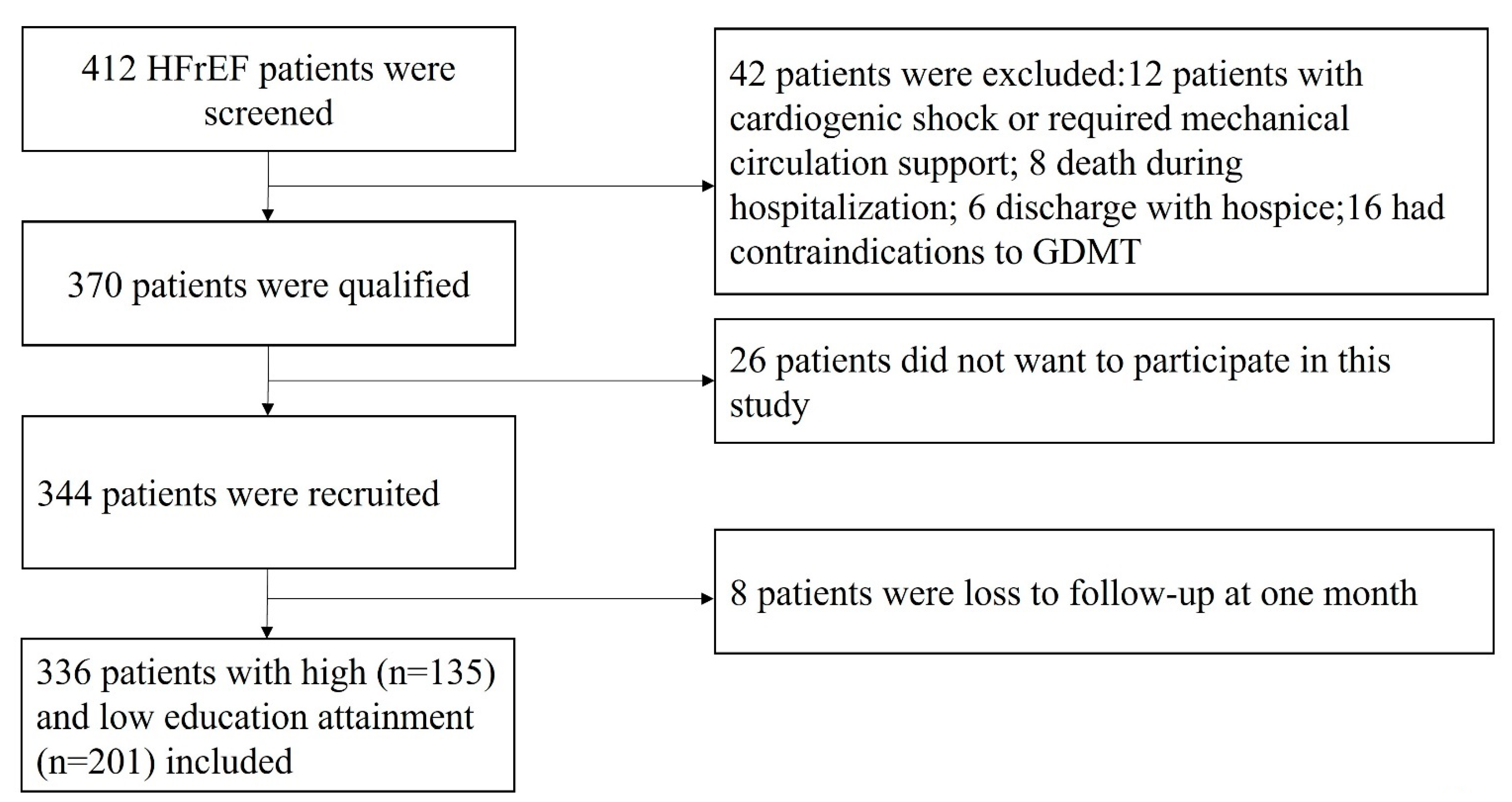
Association between Education Attainment and Guideline-Directed Medication Therapy in Patients with Heart Failure and Reduced Ejection Fraction

Abstract
1. Introduction
2. Methods
2.1. Participants’ Enrollment
2.2. Data Collection
2.3. Study Objectives
2.4. Statistical Analysis
3. Results
3.1. Comparisons of Baseline Characteristics by Education Attainment
3.2. Comparisons GDMT Used by Education Attainment
3.3. Associations between Education Attainment and GDMT Use at Discharge and Follow-up
4. Discussion
5. Conclusions
Author Contributions
Funding
Institutional Review Board Statement
Informed Consent Statement
Data Availability Statement
Conflicts of Interest
References
- Benjamin, E.J.; Virani, S.S.; Callaway, C.W.; Chamberlain, A.M.; Chang, A.R.; Cheng, S.; Chiuve, S.E.; Cushman, M.; Delling, F.N.; Deo, R.; et al. Heart Disease and Stroke Statistics-2018 Update: A Report from the American Heart Association. Circulation 2018, 137, e67–e492. [Google Scholar] [CrossRef]
- Cleland, J.G.F.; van Veldhuisen, D.J.; Ponikowski, P. The year in cardiology 2018: Heart failure. Eur. Heart J. 2019, 40, 651–661. [Google Scholar] [CrossRef]
- Khan, S.S.; Ning, H.; Shah, S.J.; Yancy, C.W.; Carnethon, M.; Berry, J.D.; Mentz, R.J.; O’Brien, E.; Correa, A.; Suthahar, N.; et al. 10-Year Risk Equations for Incident Heart Failure in the General Population. J. Am. Coll. Cardiol. 2019, 73, 2388–2397. [Google Scholar] [CrossRef]
- Balmforth, C.; Simpson, J.; Shen, L.; Jhund, P.S.; Lefkowitz, M.; Rizkala, A.R.; Rouleau, J.L.; Shi, V.; Solomon, S.D.; Swedberg, K.; et al. Outcomes and Effect of Treatment According to Etiology in HFrEF: An Analysis of PARADIGM-HF. JACC Heart Fail. 2019, 7, 457–465. [Google Scholar] [CrossRef]
- Yancy, C.W.; Jessup, M.; Bozkurt, B.; Butler, J.; Casey, D.E., Jr.; Colvin, M.M.; Drazner, M.H.; Filippatos, G.S.; Fonarow, G.C.; Givertz, M.M.; et al. 2017 ACC/AHA/HFSA Focused Update of the 2013 ACCF/AHA Guideline for the Management of Heart Failure: A Report of the American College of Cardiology/American Heart Association Task Force on Clinical Practice Guidelines and the Heart Failure Society of America. J. Card. Fail. 2017, 23, 628–651. [Google Scholar]
- Butler, J.; Yang, M.; Manzi, M.A.; Hess, G.P.; Patel, M.J.; Rhodes, T.; Givertz, M.M. Clinical Course of Patients with Worsening Heart Failure with Reduced Ejection Fraction. J. Am. Coll. Cardiol. 2019, 73, 935–944. [Google Scholar] [CrossRef]
- Conrad, N.; Judge, A.; Tran, J.; Mohseni, H.; Hedgecott, D.; Crespillo, A.P.; Allison, M.; Hemingway, H.; Cleland, J.G.; McMurray, J.J.V.; et al. Temporal trends and patterns in heart failure incidence: A population-based study of 4 million individuals. Lancet 2018, 391, 572–580. [Google Scholar] [CrossRef]
- Carlsson, A.C.; Li, X.; Holzmann, M.J.; Wändell, P.; Gasevic, D.; Sundquist, J.; Sundquist, K. Neighbourhood socioeconomic status and coronary heart disease in individuals between 40 and 50 years. Heart 2016, 102, 775–782. [Google Scholar] [CrossRef]
- Orth-Gomér, K.; Deter, H.-C.; Grün, A.-S.; Herrmann-Lingen, C.; Albus, C.; Bosbach, A.; Ladwig, K.-H.; Ronel, J.; Söllner, W.; de Zwaan, M.; et al. Socioeconomic factors in coronary artery disease-Results from the SPIRR-CAD study. J. Psychosom. Res. 2018, 105, 125–131. [Google Scholar] [CrossRef]
- Schmucker, J.; Seide, S.; Wienbergen, H.; Fiehn, E.; Stehmeier, J.; Gunther, K.; Ahrens, W.; Hambrecht, R.; Pohlabeln, H.; Fach, A. Socially disadvantaged city districts show a higher incidence of acute ST-elevation myocardial infarctions with elevated cardiovascular risk factors and worse prognosis. BMC Cardiovasc. Disord. 2017, 17, 254. [Google Scholar] [CrossRef]
- Schroder, S.L.; Fink, A.; Hoffmann, L.; Schumann, N.; Martin, O.; Frantz, S.; Richter, M. Socioeconomic differences in the pathways to diagnosis of coronary heart disease: A qualitative study. Eur. J. Public Health 2017, 27, 1055–1060. [Google Scholar] [CrossRef][Green Version]
- Schroder, S.L.; Fink, A.; Richter, M. Socioeconomic differences in experiences with treatment of coronary heart disease: A qualitative study from the perspective of elderly patients. BMJ Open 2018, 8, e024151. [Google Scholar] [CrossRef]
- Schroder, S.L.; Richter, M.; Schroder, J.; Frantz, S.; Fink, A. Socioeconomic inequalities in access to treatment for coronary heart disease: A systematic review. Int. J. Cardiol. 2016, 219, 70–78. [Google Scholar] [CrossRef]
- Wiernik, E.; Meneton, P.; Empana, J.P.; Siemiatycki, J.; Hoertel, N.; Vulser, H.; Nabi, H.; Limosin, F.; Czernichow, S.; Goldberg, M.; et al. Cardiovascular risk goes up as your mood goes down: Interaction of depression and socioeconomic status in determination of cardiovascular risk in the CONSTANCES cohort. Int. J. Cardiol. 2018, 262, 99–105. [Google Scholar] [CrossRef]
- Liu, S.; Li, Y.; Zeng, X.; Wang, H.; Yin, P.; Wang, L.; Liu, Y.; Liu, J.; Qi, J.; Ran, S.; et al. Burden of Cardiovascular Diseaeducation attainment in China, 1990–2016: Findings From the 2016 Global Burden of Disease Study. JAMA Cardiol. 2019, 4, 342–352. [Google Scholar] [CrossRef]
- Zhou, M.; Wang, H.; Zhu, J.; Chen, W.; Wang, L.; Liu, S.; Li, Y.; Wang, L.; Liu, Y.; Yin, P.; et al. Cause-specific mortality for 240 caueducation attainment in China during 1990–2013: A systematic subnational analysis for the Global Burden of Disease Study 2013. Lancet 2016, 387, 251–272. [Google Scholar] [CrossRef]
- Wang, W.; Hu, S.S.; Kong, L.Z.; Gao, R.L.; Zhu, M.L.; Wang, W.Y.; Wu, Z.S.; Chen, W.W.; Yang, J.G.; Ma, L.Y.; et al. Summary of report on cardiovascular diseaeducation attainment in China, 2012. Biomed. Environ. Sci. 2014, 27, 552–558. [Google Scholar]
- Lawrence, W.F.; Fleishman, J.A. Predicting EuroQoL EQ-5D preference scores from the SF-12 Health Survey in a nationally representative sample. Med. Decis. Mak. 2004, 24, 160–169. [Google Scholar] [CrossRef]
- Selvaraj, S.; Claggett, B.; Shah, S.J.; Anand, I.S.; Rouleau, J.L.; Desai, A.S.; Lewis, E.F.; Vaduganathan, M.; Wang, S.Y.; Pitt, B.; et al. Utility of the Cardiovascular Physical Examination and Impact of Spironolactone in Heart Failure with Preserved Ejection Fraction. Circ. Heart Fail. 2019, 12, e006125. [Google Scholar] [CrossRef]
- Ziaeian, B.; Kominski, G.F.; Ong, M.K.; Mays, V.M.; Brook, R.H.; Fonarow, G.C. National Differences in Trends for Heart Failure Hospitalizations by Sex and Race/Ethnicity. Circ. Cardiovasc. Qual. Outcomes 2017, 10, e003552. [Google Scholar] [CrossRef]
- Fermann, G.J.; Levy, P.D.; Pang, P.; Butler, J.; Ayaz, S.I.; Char, D.; Dunn, P.; Jenkins, C.A.; Kampe, C.; Khan, Y.; et al. Design and Rationale of a Randomized Trial of a Care Transition Strategy in Patients with Acute Heart Failure Discharged from the Emergency Department: GUIDED-HF (Get with the Guidelines in Emergency Department Patients with Heart Failure). Circ. Heart Fail. 2017, 10, e003581. [Google Scholar] [CrossRef]
- Roa, L.; Monreal, M.; Carmona, J.A.; Aguilar, E.; Coll, R.; Suarez, C. Treatment inertia in secondary prevention of cardiovascular disease. FRENA registry. Med. Clin. 2010, 134, 57–63. [Google Scholar] [CrossRef]


| Variables | Low Education Attainment (n = 201) | High Education Attainment (n = 135) |
|---|---|---|
| Age (years) | 51.6 ± 10.7 * | 44.5 ± 11.6 |
| Female, n (%) | 123 (61.2) * | 70 (51.9) |
| Obese, n (%) | 58 (28.9) * | 34 (25.2) |
| Systolic blood pressure (mm Hg) | 124 ± 16 | 125 ± 15 |
| Diastolic blood pressure (mm Hg) | 79 ± 10 | 77 ± 10 |
| Heart rate (beat per minute) | 84 ± 13 * | 78 ± 12 |
| Current smoker, n (%) | 60 (29.9) * | 30 (22.2) |
| Diabetes mellitus, n (%) | 40 (19.9) | 25 (18.5) |
| Hypertension, n (%) | 110 (54.7) * | 60 (44.4) |
| Dyslipidemia, n (%) | 62 (30.8) | 42 (31.1) |
| Atrial fibrillation, n (%) | 95 (47.3) | 64 (47.4) |
| Chronic kidney disease, n (%) | 28 (13.9) | 18 (13.3) |
| Coronary heart disease, n (%) | 64 (31.8) | 44 (32.6) |
| Valvular heart disease, n (%) | 88 (43.8) * | 48 (35.6) |
| Idiopathic dilated cardiomyopathy | 40 (19.9) | 28 (20.7) |
| Ischemic stroke, n (%) | 53 (26.4) | 37 (27.4) |
| Physical component score | 50.5 ± 6.4 * | 56.3 ± 7.8 |
| Mental component score | 48.4 ± 6.0 * | 54.7 ± 5.6 |
| Glycated hemoglobin A1c (%) | 6.6 ± 1.2 | 6.5 ± 1.1 |
| Total cholesterol (mmol/L) | 5.0 ± 0.9 | 5.0 ± 1.0 |
| Sodium (mEq/L) | 134.2 ± 4.6 | 133.6 ± 4.2 |
| Potassium (mEq/L) | 3.8 ± 0.9 | 3.9 ± 0.7 |
| Creatinine (umol/L) | 66.5 ± 21.8 | 67.8 ± 20.7 |
| eGFR (ml/min/1.73 m2) | 74.5 ± 15.8 | 75.8 ± 16.6 |
| NT-proBNP (pg/mL) | 1148.6 ± 233.4 * | 1050.8 ± 205.6 |
| LVEF (%) | 32.5 ± 6.7 | 33.8 ± 5.5 |
| Medications | Low Education Attainment (n = 201) | High Education Attainment (n = 135) |
|---|---|---|
| At admission | ||
| ACEi/ARB | 137 (68.2) | 95 (70.4) |
| Beta-blocker, n (%) | 95 (47.3) * | 76 (56.3) |
| MRA, n (%) | 50 (24.9) | 33 (24.4) |
| Combined | 30 (14.9) | 20 (14.8) |
| Furosemide, n (%) | 148 (73.6) | 101 (74.8) |
| Hydrochlorothiazide, n (%) | 66 (32.8) | 42 (31.1) |
| Digoxin, n (%) | 87 (43.3) | 62 (45.9) |
| Anti-platelet, n (%) | 68 (33.8) | 47 (34.8) |
| Statins, n (%) | 54 (26.9) | 36 (26.7) |
| Anti-diabetes, n (%) | 36 (17.9) | 23 (17) |
| At discharge | ||
| ACEi/ARB | 140 (69.7) * | 118 (87.4) |
| Beta-blocker, n (%) | 114 (56.7) * | 92 (68.1) |
| MRA, n (%) | 53 (26.4) | 38 (28.1) |
| Combined, n (%) | 42 (20.9) * | 37 (27.4) |
| Furosemide, n (%) | 196 (97.5) | 130 (96.3) |
| Hydrochlorothiazide, n (%) | 60 (29.9) | 38 (28.1) |
| Digoxin | 100 (49.8) | 70 (51.9) |
| Anti-platelet | 67 (33.3) | 47 (34.8) |
| Statins | 54 (26.9) | 34 (25.2) |
| Anti-diabetes | 36 (17.9) | 24 (17.8) |
| At one-month follow-up | ||
| ACEi/ARB | 128 (63.7) * | 115 (85.2) |
| Beta-blocker, n (%) | 99 (49.3) * | 80 (59.3) |
| MRA, n (%) | 51 (25.4) | 37 (27.4) |
| Combined, n (%) | 36 (16.7) * | 33 (24.4) |
| Furosemide, n (%) | 182 (90.5) | 121 (89.6) |
| Hydrochlorothiazide, n (%) | 52 (25.9) | 33 (24.4) |
| Digoxin | 100 (49.8) | 70 (51.9) |
| Anti-platelet | 67 (33.3) | 46 (34.1) |
| Statins | 54 (26.9) | 34 (25.2) |
| Anti-diabetes | 36 (17.9) | 23 (17) |
| Models | Odds Ratio | 95% Confidence Interval |
|---|---|---|
| GDMT prescription at discharge | ||
| Unadjusted | 1.96 | 1.65–2.48 |
| Model 1 | 1.78 | 1.51–2.17 |
| Model 2 | 1.64 | 1.43–1.86 |
| Model 3 | 1.45 | 1.29–1.63 |
| Model 4 | 1.22 | 1.14–1.39 |
| GDMT use at follow-up | ||
| Unadjusted | 1.87 | 1.70–2.27 |
| Model 1 | 1.72 | 1.50–2.03 |
| Model 2 | 1.53 | 1.25–1.76 |
| Model 3 | 1.35 | 1.14–1.50 |
| Model 4 | 1.13 | 1.08–1.28 |
Publisher’s Note: MDPI stays neutral with regard to jurisdictional claims in published maps and institutional affiliations. |
© 2022 by the authors. Licensee MDPI, Basel, Switzerland. This article is an open access article distributed under the terms and conditions of the Creative Commons Attribution (CC BY) license (https://creativecommons.org/licenses/by/4.0/).
Share and Cite
Long, J.; Zeng, F.; Wang, L.; Zhao, H. Association between Education Attainment and Guideline-Directed Medication Therapy in Patients with Heart Failure and Reduced Ejection Fraction. J. Clin. Med. 2022, 11, 4235. https://doi.org/10.3390/jcm11144235
Long J, Zeng F, Wang L, Zhao H. Association between Education Attainment and Guideline-Directed Medication Therapy in Patients with Heart Failure and Reduced Ejection Fraction. Journal of Clinical Medicine. 2022; 11(14):4235. https://doi.org/10.3390/jcm11144235
Chicago/Turabian StyleLong, Juan, Fanfang Zeng, Lili Wang, and Honglei Zhao. 2022. "Association between Education Attainment and Guideline-Directed Medication Therapy in Patients with Heart Failure and Reduced Ejection Fraction" Journal of Clinical Medicine 11, no. 14: 4235. https://doi.org/10.3390/jcm11144235
APA StyleLong, J., Zeng, F., Wang, L., & Zhao, H. (2022). Association between Education Attainment and Guideline-Directed Medication Therapy in Patients with Heart Failure and Reduced Ejection Fraction. Journal of Clinical Medicine, 11(14), 4235. https://doi.org/10.3390/jcm11144235