Effects of Ultrasound-Guided Nerve Stimulation Targeting Peripheral Nerve Tissue on Pain and Function: A Scoping Review

 ,
,  and
and
Abstract
1. Introduction
2. Methods
2.1. Study Design
2.2. Identifying the Research Question
2.3. Identifying the Relevant Studies
2.4. Selecting the Studies
2.5. Charting the Data
2.6. Mapping the Data
2.7. Methodological Quality Assessment
3. Results
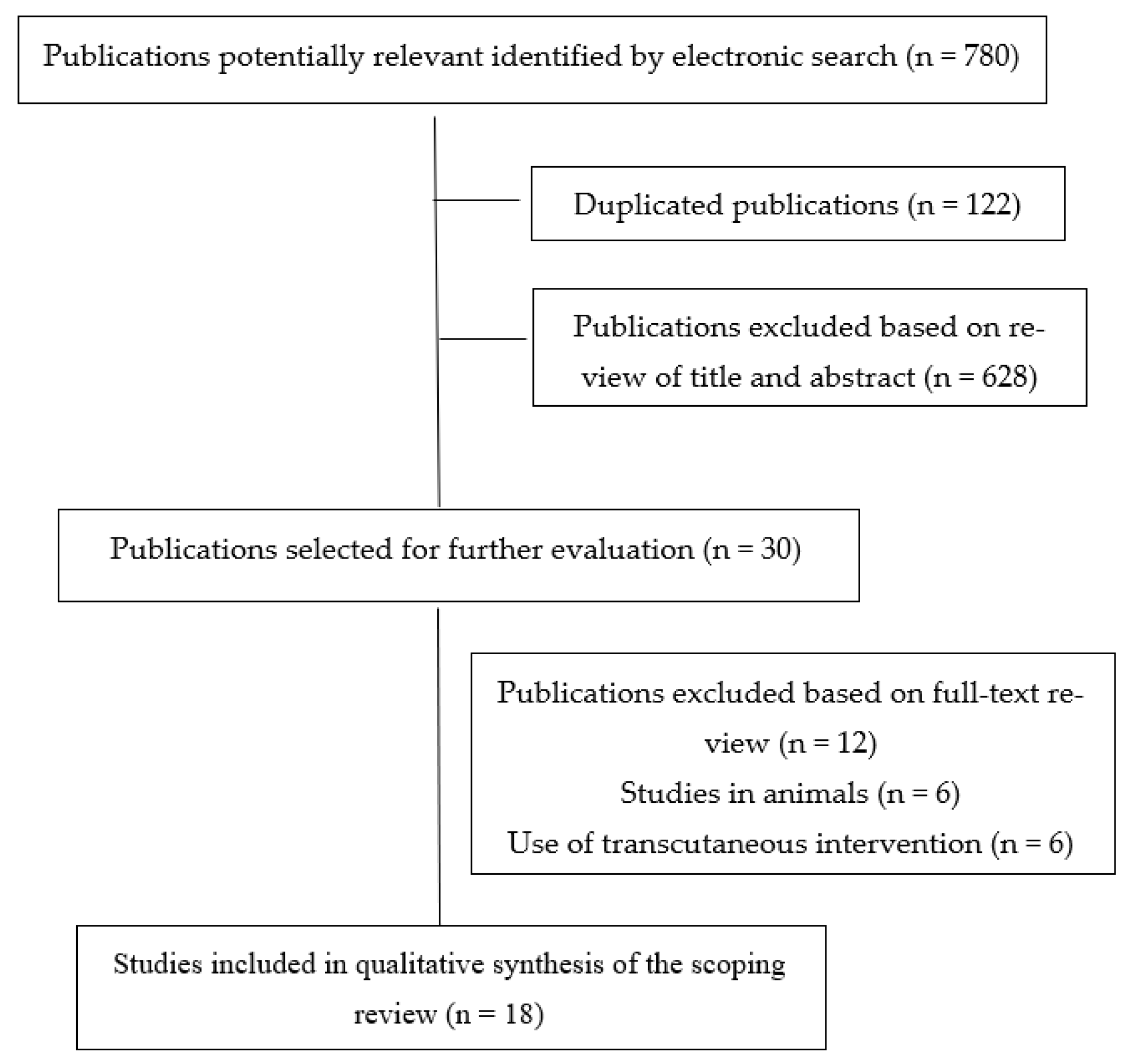
3.1. Study Selection
3.2. Study Designs
3.3. Methodological Quality
3.4. Summarizing Findings
4. Discussion
4.1. Literature Mapping
4.2. Strengths and Limitations of the Review
5. Conclusions
Author Contributions
Funding
Institutional Review Board Statement
Informed Consent Statement
Data Availability Statement
Conflicts of Interest
References
- Minaya Muñoz, F.; Valera Garrido, F. (Eds.) Neuromodulación percutánea ecoguiada. In Fisioterapia Invasive, 2nd ed.; Elsevier: Barcelona, Spain, 2016; pp. 283–294. [Google Scholar]
- Dunning, J.; Butts, R.; Henry, N.; Mourad, F.; Brannon, A.; Rodriguez, H.; Young, I.; Arias-Buría, J.L.; Fernández-De-Las-Peñas, C. Electrical dry needling as an adjunct to exercise, manual therapy and ultrasound for plantar fasciitis: A multi-center randomized clinical trial. PLoS ONE 2018, 13, e0205405. [Google Scholar] [CrossRef] [Scilit] [PubMed]
- Hernández, J.V.L.; Martín-Pintado-Zugasti, A.; Frutos, L.G.; Alguacil-Diego, I.M.; de la Llave, A.I.; Fernandez-Carnero, J. Immediate and short-term effects of the combination of dry needling and percutaneous TENS on post-needling soreness in patients with chronic myofascial neck pain. Braz. J. Phys. Ther. 2016, 20, 422–431. [Google Scholar] [CrossRef] [Scilit] [PubMed]
- Kawakita, K.; Okada, K. Mechanisms of Action of Acupuncture for Chronic Pain Relief—Polymodal Receptors Are the Key Candidates. Acupunct. Med. 2006, 24, 58–66. [Google Scholar] [CrossRef] [Scilit]
- Plaza-Manzano, G.; Gómez-Chiguano, G.F.; Cleland, J.A.; Arías-Buría, J.L.; Fernández-De-Las-Peñas, C.; Santana, M.N. Effectiveness of percutaneous electrical nerve stimulation for musculoskeletal pain: A systematic review and meta-analysis. Eur. J. Pain 2020, 24, 1023–1044. [Google Scholar] [CrossRef] [Scilit]
- Gibson, W.; Wand, B.M.; O’Connell, N.E. Transcutaneous Electrical Nerve Stimulation (TENS) for neuropathic pain in adults. Cochrane Database Syst. Rev. 2017, 9, CD011976. [Google Scholar] [CrossRef] [Scilit]
- Ketterl, W.; Kierse, H.; Tischler, R. A new electromedical method to control pain in preparation of dental cavities; electroanalgesia with oscillator by MACH method. Zahnarztl. Rundsch. 1952, 61, 498–502. [Google Scholar]
- White, J.C.; Sweet, W.H. Pain and the neurosurgeon: A forty-year experience. JAMA 1969, 210, 1766. [Google Scholar]
- Steude, U. Percutaneous Electro Stimulation of the Trigeminal Nerve in Patients with Atypical Trigeminal Neuralgia. Neurochirurgia 1978, 21, 66–69. [Google Scholar] [CrossRef] [Scilit]
- Cohen, S.; Gilmore, C.; Kapural, L.; Hanling, S.; Plunkett, A.; McGee, M.; Boggs, J. Percutaneous Peripheral Nerve Stimulation for Pain Reduction and Improvements in Functional Outcomes in Chronic Low Back Pain. Mil. Med. 2019, 184 (Suppl. S1), 537–541. [Google Scholar] [CrossRef] [Scilit]
- Gilmore, C.; Ilfeld, B.; Rosenow, J.; Li, S.; Desai, M.; Hunter, C.; Rauck, R.; Kapural, L.; Nader, A.; Mak, J.; et al. Percutaneous peripheral nerve stimulation for the treatment of chronic neuropathic postamputation pain: A multicenter, randomized, placebo-controlled trial. Reg. Anesth. Pain Med. 2019, 44, 637–645. [Google Scholar] [CrossRef] [Scilit]
- Ilfeld, B.M.; Plunkett, A.; Vijjeswarapu, A.M.; Hackworth, R.; Dhanjal, S.; Turan, A.; Cohen, S.P.; Eisenach, J.C.; Griffith, S.; Hanling, S.; et al. Percutaneous Peripheral Nerve Stimulation (Neuromodulation) for Postoperative Pain: A Randomized, Sham-controlled Pilot Study. Anesthesiology 2021, 135, 95–110. [Google Scholar] [CrossRef] [Scilit] [PubMed]
- Lin, T.; Gargya, A.; Singh, H.; Sivanesan, E.; Gulati, A. Mechanism of Peripheral Nerve Stimulation in Chronic Pain. Pain Med. 2020, 21 (Suppl. S1), S6–S12. [Google Scholar] [CrossRef] [Scilit] [PubMed]
- Yakovlev, A.; Karasev, S.A.; Resch, B.E.; Yakovleva, V.; Strutsenko, A. Treatment of a typical facial pain using peripheral nerve stimulation. Neuromodulation 2011, 14, 553. [Google Scholar] [CrossRef] [Scilit] [PubMed]
- McRoberts, W.P.; Cairns, K. A Retrospective Study Evaluating the Effects of Electrode Depth and Spacing for Peripheral Nerve Field Stimulation in Patients with Back Pain. In Proceedings of the 14th Annual Meeting of North American Neuromodulation Society—Neuromodulation: Vision 2010, Las Vegas, NV, USA, 2–5 December 2010. [Google Scholar]
- Rossi, M.; Decarolis, G.; Liberatoscioli, G.; Iemma, D.; Nosella, P.; Nardi, L.F. A Novel Mini-invasive Approach to the Treatment of Neuropathic Pain: The PENS Study. Pain Physician 2016, 19, E121–E128. [Google Scholar] [PubMed]
- Rozand, V.; Grosprêtre, S.; Stapley, P.J.; Lepers, R. Assessment of Neuromuscular Function Using Percutaneous Electrical Nerve Stimulation. J. Vis. Exp. 2015, 103, e52974. [Google Scholar] [CrossRef] [Scilit]
- Reverberi, C.; Dario, A.; Barolat, G. Spinal Cord Stimulation (SCS) in Conjunction with Peripheral Nerve Field Stimulation (PNfS) for the Treatment of Complex Pain in Failed Back Surgery Syndrome (FBSS). Neuromodulation 2013, 16, 78–83. [Google Scholar] [CrossRef] [Scilit]
- Kumar, K.; Rizvi, S. Historical and Present State of Neuromodulation in Chronic Pain. Curr. Pain Headache Rep. 2014, 18, 387. [Google Scholar] [CrossRef] [Scilit]
- Hsieh, R.L.; Lee, W.C. One-shot percutaneous electrical nerve stimulation vs. transcutaneous electrical nerve stimulation for low back pain: Comparison of therapeutic effects. Am. J. Phys. Med. Rehabil. 2002, 81, 838–843. [Google Scholar] [CrossRef] [Scilit]
- Kopsky, D.J.; Ettema, F.W.L.; Van Der Leeden, M.; Dekker, J.; Stolwijk-Swüste, J.M. Percutaneous Nerve Stimulation in Chronic Neuropathic Pain Patients due to Spinal Cord Injury: A Pilot Study. Pain Pract. 2014, 14, 252–259. [Google Scholar] [CrossRef] [Scilit]
- Katayama, Y.; Kamibeppu, T.; Nishii, R.; Mukai, S.; Wakeda, H.; Kamoto, T. Ct Evaluation of Acupuncture Needles Inserted into Sacral Foramina. Acupunct. Med. 2016, 34, 20–26. [Google Scholar] [CrossRef] [Scilit]
- Requena, B.; Ereline, J.; Gapeyeva, H.; Pääsuke, M. Posttetanic Potentiation in Knee Extensors after High-Frequency Submaximal Percutaneous Electrical Stimulation. J. Sport Rehabil. 2005, 14, 249–257. [Google Scholar] [CrossRef] [Scilit]
- Requena, B.; Gapeyeva, H.; Ereline, J.; Pääsuke, M. Acute effect of percutaneous electrical stimulation of knee extensor muscles on isokinetic torque and power production performance. Isokinet. Exerc. Sci. 2007, 15, 203–209. [Google Scholar] [CrossRef] [Scilit]
- Regina Dias Da Silva, S.; Neyroud, D.; Maffiuletti, N.A.; Gondin, J.; Place, N. Twitch potentiation induced by two different modalities of neuromuscular electrical stimulation: Implications for motor unit recruitment. Muscle Nerve 2015, 51, 412–418. [Google Scholar] [CrossRef] [Scilit] [PubMed]
- Pham, M.T.; Rajić, A.; Greig, J.D.; Sargeant, J.M.; Papadopoulos, A.; McEwen, S.A. A scoping review of scoping reviews: Advancing the approach and enhancing the consistency. Res. Synth. Methods 2014, 5, 371–385. [Google Scholar] [CrossRef] [Scilit]
- Munn, Z.; Peters, M.D.J.; Stern, C.; Tufanaru, C.; McArthur, A.; Aromataris, E. Systematic review or scoping review? Guidance for authors when choosing between a systematic or scoping review approach. BMC Med. Res. Methodol. 2018, 18, 143. [Google Scholar] [CrossRef]
- Arksey, H.; O’Malley, L. Scoping studies: Towards a methodological framework. Int. J. Soc. Res. Methodol. 2005, 8, 19–32. [Google Scholar] [CrossRef] [Scilit]
- Tricco, A.C.; Lillie, E.; Zarin, W.; O’Brien, K.K.; Colquhoun, H.; Levac, D.; Moher, D.; Peters, M.D.; Horsley, T.; Weeks, L.; et al. PRISMA Extension for Scoping Reviews (PRISMA-ScR): Checklist and Explanation. Ann. Intern. Med. 2018, 169, 467–473. [Google Scholar] [CrossRef] [Scilit]
- Dhammi, I.K.; Haq, R.U. How to Write Systematic Review or Metaanalysis. Indian J. Orthop. 2018, 52, 575–577. [Google Scholar] [CrossRef] [Scilit]
- Levac, D.; Colquhoun, H.; O’Brien, K.K. Scoping studies: Advancing the methodology. Implement. Sci. 2010, 5, 69. [Google Scholar] [CrossRef] [Scilit]
- Moseley, A.M.; Elkins, M.R.; Van der Wees, P.J.; Pinheiro, M.B. Using research to guide practice: The Physiotherapy Evidence Database (PEDro). Braz. J. Phys. Ther. 2019, 24, 384–391. [Google Scholar] [CrossRef] [Scilit]
- Moola, S.; Munn, Z.; Tufanaru, C.; Aromataris, E.; Sfetcu, R. Systematic reviews of etiology and risk. In JBI Manual for Evidence Synthesis; Aromataris, E., Munn, Z., Eds.; JBI: Adelaide, Australia, 2020; Chapter 7. [Google Scholar]
- Munn, Z.; Barker, T.H.; Moola, S.; Tufanaru, C.; Stern, C.; McArthur, A.; Stephenson, M.; Aromataris, E. Methodological quality of case series studies: An introduction to the JBI critical appraisal tool. JBI Evid. Synth. 2020, 18, 2127–2133. [Google Scholar] [CrossRef] [Scilit]
- Ilfeld, B.M.; Iv, J.J.F.; Gabriel, R.A.; Said, E.T.; Nguyen, P.L.; Abramson, W.B.; Khatibi, B.; Sztain, J.F.; Swisher, M.W.; Jaeger, P.; et al. Ultrasound-guided percutaneous peripheral nerve stimulation: Neuromodulation of the suprascapular nerve and brachial plexus for postoperative analgesia following ambulatory rotator cuff repair. A proof-of-concept study. Reg. Anesthesia Pain Med. 2019, 44, 310–318. [Google Scholar] [CrossRef] [Scilit] [PubMed]
- De-La-Cruz-Torres, B.; Carrasco-Iglesias, C.; Minaya-Muñoz, F.; Romero-Morales, C. Crossover effects of ultrasound-guided percutaneous neuromodulation on contralateral hamstring flexibility. Acupunct. Med. 2021, 39, 512–521. [Google Scholar] [CrossRef] [Scilit] [PubMed]
- García-Bermejo, P.; De-La-Cruz-Torres, B.; Romero-Morales, C. Ultrasound-Guided Percutaneous Neuromodulation in Patients with Unilateral Anterior Knee Pain: A Randomized Clinical Trial. Appl. Sci. 2020, 10, 4647. [Google Scholar] [CrossRef] [Scilit]
- Ferreira-Dos-Santos, G.; Hurdle, M.F.B.; Gupta, S.; Clendenen, S.R. Ultrasound-Guided Percutaneous Peripheral Nerve Stimulation for the Treatment of Lower Extremity Pain: A Rare Case Report. Pain Pract. 2019, 19, 861–865. [Google Scholar] [CrossRef] [Scilit] [PubMed]
- Ilfeld, B.M.; Gabriel, R.A.; Said, E.T.; Monahan, A.M.; Sztain, J.F.; Abramson, W.B.; Khatibi, B.; Finneran, J.J.; Jaeger, P.T.; Schwartz, A.K.; et al. Ultrasound-Guided Percutaneous Peripheral Nerve Stimulation: Neuromodulation of the Sciatic Nerve for Postoperative Analgesia Following Ambulatory Foot Surgery, a Proof-of-Concept Study. Reg. Anesth. Pain Med. 2018, 43, 580–589. [Google Scholar] [CrossRef] [Scilit]
- Kim, J.H.; Shin, S.H.; Lee, Y.R.; Lee, H.S.; Chon, J.Y.; Sung, C.H.; Hong, S.J.; Lee, J.Y.; Moon, H.S. Ultrasound-guided peripheral nerve stimulation for neuropathic pain after brachial plexus injury: Two case reports. J. Anesth. 2017, 31, 453–457. [Google Scholar] [CrossRef] [Scilit]
- Ilfeld, B.M.; Said, E.T.; Finneran, J.J.; Sztain, J.F.; Abramson, W.B.; Gabriel, R.A.; Khatibi, B.; Swisher, M.W.; Jaeger, P.; Covey, D.C.; et al. Ultrasound-Guided Percutaneous Peripheral Nerve Stimulation: Neuromodulation of the Femoral Nerve for Postoperative Analgesia Following Ambulatory Anterior Cruciate Ligament Reconstruction: A Proof of Concept Study. Neuromodulation 2019, 22, 621–629. [Google Scholar] [CrossRef] [Scilit]
- Álvarez-Prats, D.; Carvajal-Fernández, O.; Pérez-Mallada, N.; Minaya-Muñoz, F. Changes in Maximal Isometric Quadriceps Strength after the Application of Ultrasound-Guided Percutaneous Neuromodulation of the Femoral Nerve: A Case Series. J. Invasive Tech. Phys. Ther. 2019, 2, 39–45. [Google Scholar] [CrossRef] [Scilit]
- Sanmartin-Enriquez, F.; Valera-Garrido, F.; Álvarez-Prats, D.; Carvajal-Fernández, O. Ultrasound-Guided percutaneous neuromodulation in non-radiating low back pain. J. Invasive Tech. Phys. Ther. 2019, 2, 124. [Google Scholar]
- Arias-Buría, J.L.; Cleland, J.A.; El Bachiri, Y.R.; Manzano, G.P.; Fernández-De-Las-Peñas, C. Ultrasound-Guided Percutaneous Electrical Nerve Stimulation of the Radial Nerve for a Patient with Lateral Elbow Pain: A Case Report with a 2-Year Follow-up. J. Orthop. Sports Phys. Ther. 2019, 49, 347–354. [Google Scholar] [CrossRef] [Scilit] [PubMed]
- Rodríguez-Rosal, M.; Sánchez-Sixto, A.; Álvarez-Barbosa, F.; Yáñez-Álvarez, A. Effect of ultrasound-guided percutaneous neuromodulation in ankle instability: A case study. J. Invasive Tech. Phys. Ther. 2019, 2, 100–101. [Google Scholar]
- Gilmore, C.A.; Kapural, L.; McGee, M.J.; Boggs, J.W. Percutaneous Peripheral Nerve Stimulation (PNS) for the Treatment of Chronic Low Back Pain Provides Sustained Relief. Neuromodulation 2019, 22, 615–620. [Google Scholar] [CrossRef] [Scilit]
- Gallego-Sendarrubias, G.; Arias-Buría, J.; Úbeda-D’Ocasar, E.; Hervás-Pérez, J.; Rubio-Palomino, M.; Fernández-De-Las-Peñas, C.; Valera-Calero, J. Effects of Percutaneous Electrical Nerve Stimulation on Countermovement Jump and Squat Performance Speed in Male Soccer Players: A Pilot Randomized Clinical Trial. J. Clin. Med. 2021, 10, 690. [Google Scholar] [CrossRef] [Scilit]
- Ilfeld, B.M.; Gilmore, C.A.; Grant, S.A.; Bolognesi, M.P.; Del Gaizo, D.J.; Wongsarnpigoon, A.; Boggs, J. Ultrasound-guided percutaneous peripheral nerve stimulation for analgesia following total knee arthroplasty: A prospective feasibility study. J. Orthop. Surg. Res. 2017, 12, 4. [Google Scholar] [CrossRef] [Scilit]
- De-La-Cruz-Torres, B.; Abuín-Porras, V.; Navarro-Flores, E.; Calvo-Lobo, C.; Romero-Morales, C. Ultrasound-Guided Percutaneous Neuromodulation in Patients with Chronic Lateral Epicondylalgia: A Pilot Randomized Clinical Trial. Int. J. Environ. Res. Public Health 2021, 18, 4877. [Google Scholar] [CrossRef] [Scilit]
- Úbeda-D’Ocasar, E.; Valera-Calero, J.; Hervás-Pérez, J.; Caballero-Corella, M.; Ojedo-Martín, C.; Gallego-Sendarrubias, G. Pain Intensity and Sensory Perception of Tender Points in Female Patients with Fibromyalgia: A Pilot Study. Int. J. Environ. Res. Public Health 2021, 18, 1461. [Google Scholar] [CrossRef] [Scilit] [PubMed]


| PubMed Search Formula #1 “Ultrasound guided percutaneous neuromodulation” [Title/Abstract] OR “Percutaneous Electrical Nerve Stimulation” [Title/Abstract] OR “Nerve Tissue Stimulation” [Title/Abstract] #2 “Pain” [Mesh] OR “Related-disability” [Title/Abstract] OR “Function” [Title/Abstract] OR “Mobility” [Title/Abstract] #3 #1 AND #2 |
| Medline (via EBSCO) Search Formula #1 “Ultrasound guided percutaneous neuromodulation” OR “Percutaneous Electrical Nerve Stimulation” OR “Nerve Tissue Stimulation” #2 “Pain” OR “Related-disability” OR “Function” OR “Mobility” #3 #1 AND #2 |
| WOS (EMBASE, AMED) Search Formula (“Ultrasound guided percutaneous neuromodulation” OR “Percutaneous Electrical Nerve Stimulation” OR “Nerve Tissue Stimulation”) AND (“Pain” OR “Related-disability” OR “Function” OR “Mobility”) |
| Reference | Study Type | PEDro Scale Items | Score | ||||||||||
|---|---|---|---|---|---|---|---|---|---|---|---|---|---|
| 1 | 2 | 3 | 4 | 5 | 6 | 7 | 8 | 9 | 10 | 11 | |||
| Ilfeld et al., 2019 [11] | RCT | + | + | + | + | + | - | + | + | - | + | + | 8 |
| Ilfeld et al., 2020 [12] | RCT-P | + | + | − | − | + | + | + | - | - | - | - | 4 |
| De-la-Cruz-Torres et al., 2021 [36] | RCT | + | + | + | + | - | - | + | + | - | + | + | 7 |
| García-Bermejo et al., 2020 [37] | RCT | + | + | - | + | - | - | + | + | - | + | + | 6 |
| Gallego-Sendarrubias et al., 2021 [47] | RCT | + | + | + | + | - | - | + | + | + | + | + | 8 |
| De-la-Cruz-Torres et al., 2021 [49] | RCT | + | + | - | + | - | - | + | + | - | + | + | 6 |
| Reference | JBI’s Tool for Assessing Case Series | |||||||
|---|---|---|---|---|---|---|---|---|
| 1 | 2 | 3 | 4 | 5 | 6 | 7 | 8 | |
| Ferreira-Dos-Santos et al., 2019 [38] | Y | Y | Y | Y | Y | Y | N | Y |
| Kim et al., 2017 [40] | Y | Y | Y | Y | Y | Y | N | Y |
| Arias-Buría et al., 2019 [44] | Y | Y | Y | Y | Y | Y | N | Y |
| Reference | JBI’s Tool for Assessing Case Series | |||||||||
|---|---|---|---|---|---|---|---|---|---|---|
| 1 | 2 | 3 | 4 | 5 | 6 | 7 | 8 | 9 | 10 | |
| Cohen et al., 2019 [10] | Y | Y | Y | N | Y | Y | Y | Y | Y | Y |
| Ilfeld et al., 2019 [35] | Y | Y | Y | N | Y | Y | Y | Y | Y | Y |
| Ilfeld et al., 2018 [39] | Y | Y | Y | N | Y | Y | Y | Y | Y | Y |
| Ilfeld et al., 2019 [41] | Y | Y | Y | N | Y | Y | Y | Y | Y | Y |
| Álvarez-Prats et al., 2019 [42] | Y | Y | Y | N | Y | Y | Y | Y | Y | Y |
| Sanmartin-Enriquez et al., 2019 [43] | N | Y | Y | Y | Y | N | N | Y | Y | N |
| Rodríguez-Rosal et al., 2019 [45] | N | Y | Y | N | Y | Y | Y | Y | Y | Y |
| Gilmore et al., 2019 [46] | Y | Y | Y | N | Y | Y | Y | Y | Y | Y |
| Ilfeld et al., 2017 [48] | Y | Y | Y | N | Y | Y | Y | Y | Y | Y |
| Reference | Population | Intervention | Outcomes | Results Summary |
|---|---|---|---|---|
| Álvarez-Prats et al., 2019 [42] | 13 Subjects with history of unilateral knee pathology and were in the stage of recovery of quadriceps strength. 11 males 2 females | Target: Femoral nerve Description: A single intervention consisting of 10 stimulations with a duration of 10 s, with a 10-s rest period between each stimulation | Pre- and post-intervention Quadriceps dynamometry | Significant changes were obtained in the maximal isometric strength of the quadriceps of the affected knee |
| Arias-Buría et al., 2019 [44] | 1 Male with lateral elbow pain | Target: Radial nerve Description: 2 sessions of ultrasound-guided PENS and 4-weeks of a low-load concentric-eccentric exercise program of the wrist extensors | 2 years follow-up Pain intensity (Numeric Pain Rate Scale), function (Patient-Rated Tennis Elbow 45 Evaluation), and related disability (Disabilities of the Arm, Shoulder and Hand Outcome Measure) | The patient progressively exhibited complete resolution of pain and function, which was maintained at 2 years |
| Cohen et al., 2019 [10] | 9 Subjects with chronic low back pain 1 male 8 females | Target: Medial branches of the dorsal primary ramus Description: 1 month of duration, 6 h per day Single group | 7 months follow-up Disability (Oswestry Disability Index), Pain Interference (BPI-9) Patient Global Impression of Change, Pain Intensity (BPI-5), Analgesics intake | The intervention induced significant reductions in pain intensity, disability, pain interference and medication intake from the first month to the seventh month compared with baseline |
| De-la-Cruz-Torres et al., 2021 [36] | 80 participants with reduced hamstring flexibility 40 males 40 females | Target: Sciatic nerve Description: A single intervention of 1.5 min PENS single intervention versus stretching, neurodynamic and dry needling | Pre- and post-intervention assessment Bilateral straight leg raise test Tensiomyography | The PENS and needle groups obtained higher values for the SLR test in the non-intervention limb compared with the other groups. There were statistically significant differences for mean SLR measures between limbs pre- and post-intervention for all groups except the PENS group, suggesting crossover effects for PENS but not the other techniques studied. No differences in tensiomyographic assessments between groups or between sides were seen. |
| De-la-Cruz-Torres et al., 2021 [49] | 24 Subjects with chronic lateral Epicondylalgia 12 males 12 females | Target: Radial nerve Description: A single intervention of PENS vs. no intervention | 1 month follow-up Pain intensity, functionality, electrophysiologic excitability, and nerve morphology | After 1 month, PENS group improved their values compared to their baseline values (pain intensity and nerve cross-sectional area values showed a significant decrease while the patient-rated tennis elbow evaluation scores showed a significant improvement. Thus, the PENS group showed significant improvement for the electrophysiologic nerve excitability pattern, reporting normal function in all radial nerves after treatment. However, chronaxie values always reported similar values with no differences between groups |
| Ferreira-Dos-Santos et al., 2019 [38] | A single male case with a medical history significant for multiple lumbar surgeries with multiple complications | Target: Superficial peroneal nerve Description: The treatment duration was 3 months | 3 months follow-up Pain intensity | Two weeks after implantation of the percutaneous PENS, the patient reported he was walking 5 times farther than his typical morning walk and experienced a reduction of pain from 8 to 1 in the numeric rating scale. After 3 months, the patient reported maintenance of improvements. |
| Gallego-Sendarrubias et al., 2021 [47] | 23 Semiprofessional male soccer players | Target: Femoral nerve Description: One group received a training program while the other group received two PENS interventions. | 1-month follow-up Countermovement jump and squat performance speed | Male soccer players receiving PENS intervention before the training session experienced greater increases in flight time, and in vertical jump height, after both sessions, but not one month after than those who did not receive PENS intervention. Similarly, soccer players receiving the PENS intervention experienced a greater increase in the squat performance speed after the second session, but not after the first session or one month after the intervention |
| García-Bermejo et al., 2020 [37] | 28 Subjects with Unilateral Anterior Knee Pain 14 males 16 females (It should be noted that 2 participants withdrawn the study and the authors did not report the gender) | Target: Femoral nerve Description: A single intervention of 1.5 min Asymptomatic and patients with pain received the same PENS intervention | 1-week follow-up Numeric rating score, range of motion, Kujala and Victorian Institute of Sport Assessment-Patella | Both groups showed an increase immediately at 24 h, and at 1 week for the knee flexion ROM variable. The symptomatic knee group showed an increase for the Kujala score and a decrease for the numeric rating scale (NRS) variable from baseline to 1 week. VISA-P score did not show significant differences. After the intervention, there were no differences between the groups in any measured time |
| Gilmore et al., 2019 [46] | 9 Subjects with chronic low back pain 1 male 8 females | Target: Medial branch of the dorsal ramus Description: All subjects received the same PENS intervention. Percutaneous fine-wire leads remained in place for the duration of the 30-day therapy | 4 months follow-up Medication intake, disability (Oswestry Disability Index), pain interference (BPI-9), patient global impression of change | Most subjects reported significant reductions in pain intensity with PENS treatment, which continued four-months after. Subject also reported concomitant reductions in analgesic medication usage and significant reductions in patient-centric outcomes of disability, pain interference, and patient global impression of change. |
| Ilfeld et al., 2017 [48] | 5 Subjects with history of total knee arthroplasty 2 males 3 females | Target: Femoral and sciatic nerves Description: All subjects received the same PENS intervention | ON-OFF comparison Pain intensity at rest and passive and active knee motion and range of movement | Percutaneous peripheral nerve stimulation decreased pain an average of 93% at rest, with 4 of 5 subjects experiencing complete resolution of pain. During passive and active knee motion pain decreased an average of 27 and 30%, respectively. Neither maximum passive nor active knee range-of-motion was consistently affected. |
| Ilfeld et al., 2018 [39] | 7 Subjects undergoing ambulatory foot surgery 1 male 6 females | Target: Sciatic nerve Description: Subjects received 5 min of either stimulation or sham in a randomized, double-masked fashion followed by a 5-min crossover period and then continuous stimulation until lead removal on postoperative days 14 to 28 | 28 days follow-up Pain intensity, sensory deficits and the ability to move the ipsilateral great toe | During the initial 5-min treatment period, the stimulation induced a downward trajectory in their pain over the 5 min of treatment, whereas sham intervention resulted in no such change until their subsequent 5-min stimulation cross- over. During the subsequent 30 min of stimulation, pain scores decreased to 52% of baseline. |
| Ilfeld et al., 2019 [11] | 26 Subjects with chronic postamputation pain 3 males 23 females | Target: Femoral and sciatic nerves Description: 2 months Placebo group and Intervention group crossed after 4 weeks | 12 months follow-up Average residual limb pain Phantom limb pain | A significantly greater proportion of subjects receiving PNS (58%) demonstrated ≥50% reductions in average postamputation pain during weeks 1–4 compared with subjects receiving placebo (14%). Significantly greater proportions of PENS subjects also reported ≥50% reductions in pain (67%) and pain interference (80%) after 8 weeks of therapy compared with subjects receiving placebo (pain: 14%; pain interference: 15%).; Four of five PNS subjects who have completed 12-month follow-up to date reported ≥50% pain relief. |
| Ilfeld et al., 2019 [35] | 14 subjects following unilateral rotator cuff repair 12 males 2 females | Target: Brachial plexus (5 posterior to the superior brachial plexus trunk, 6 adjacent to the C5 nerve root, and 3 posterior to the distal middle trunk) Description: Subjects received 5 min of either stimulation or sham in a randomized, double-masked fashion followed by a 5 min crossover period, and then continuous stimulation until lead removal postoperative days 14–28 PENS intervention versus placebo | 90 days follow-up Average and maximum pain at rest Average and maximum pain with movement Opioids consumption | Stimulation did not decrease pain scores during the first 40 min of the subjects with brachial plexus leads, regardless of which treatment subjects were randomized to initially. Seven subjects required a single-injection interscalene nerve block for rescue analgesia prior to discharge. However, subsequent average resting and dynamic pain scores postoperative days 1–14 had a median of 1 or less on the Numeric Rating Scale, and opioid requirements averaged less than 1 tablet daily with active stimulation. |
| Ilfeld et al., 2019 [41] | 10 Subjects with Ambulatory Anterior Cruciate Ligament Reconstruction 5 males 5 females | Target: Femoral nerve Description: Subjects received 5 min of either stimulation or sham followed by a 5-min crossover period, and then continuous active stimulation until lead removal postoperative Day 14–28. | 3 months follow up Medication intake and pain intensity (at rest and with movement, average and maximum intensity) | During the initial 5-min treatment period, subjects randomized to stimulation experienced a decrease of 7% in their pain over the 5 min of treatment, while those receiving sham reported a slight increase of 4% until their subsequent 5-min stimulation crossover, during which time they also experienced a decrease of 11% from baseline. The median daily opioid consumption was less than 1 tablet. |
| Ilfeld et al., 2020 [12] | Subjects with postoperative pain after rotator cuff repair, hallux valgus correction, and ankle arthrodesis or arthroplasty | Target: Brachial plexus (shoulder) Sub-gluteal sciatic nerve (foot and ankle) Description: 14 days PENS intervention versus interscalene (shoulder) or a popliteal sciatic (foot and ankle) nerve block with ropivacaine 0.5% and epinephrine | 12 months follow-up Opioid consumption Surgical pain Physical and emotional functioning | This is a protocol and therefore no results are currently reported |
| Kim et al., 2017 [40] | 2 Males with severe neuropathic pain after incomplete brachial plexus injury | Target: Radial nerve | 1 year follow-up Pain intensity and sleep and life quality | Their pain was relieved by more than 50% over the course of 1 year. Both patients were satisfied with their improved sleep and quality of life |
| Rodríguez-Rosal et al., 2019 [45] | 5 Males with chronic ankle instability | Target: Tibial nerve Description: The process was performed on three occasions during 30 s, with an intensity that was acknowledged by the patient but which did not go beyond a score of 3 in the visual analog scale | The duration was not reported Body balance (The displacement of the center of pressure was determined based on the distances of its antero-posterior axes and medio-lateral. The amplitudes of anteroposterior and medio- lateral displacement were also evaluated) | A decrease was found in the antero-posterior amplitude |
| Sanmartin-Enriquez et al., 2019 [43] | 10 Subjects with non- radiating low back pain 5 males 5 females | Target: Medial branch of a L2 posterior ramus and the iliohypogastric and ilioinguinal nerves Description: All subjects received 3 sessions, once a week | 3 weeks follow-up Lumbar disability and pain intensity | 80% of patients improved after the treatment protocol. A decrease in activity limitations was observed, from 14 to 4.35/1000 points on the Oswestry questionnaire, and a decrease of 6.8 to 2.15/10 points was observed on the Visual Analogue Scale. |
Publisher’s Note: MDPI stays neutral with regard to jurisdictional claims in published maps and institutional affiliations. |
© 2022 by the authors. Licensee MDPI, Basel, Switzerland. This article is an open access article distributed under the terms and conditions of the Creative Commons Attribution (CC BY) license (https://creativecommons.org/licenses/by/4.0/).
Share and Cite
García-Collado, A.; Valera-Calero, J.A.; Fernández-de-las-Peñas, C.; Arias-Buría, J.L. Effects of Ultrasound-Guided Nerve Stimulation Targeting Peripheral Nerve Tissue on Pain and Function: A Scoping Review. J. Clin. Med. 2022, 11, 3753. https://doi.org/10.3390/jcm11133753
García-Collado A, Valera-Calero JA, Fernández-de-las-Peñas C, Arias-Buría JL. Effects of Ultrasound-Guided Nerve Stimulation Targeting Peripheral Nerve Tissue on Pain and Function: A Scoping Review. Journal of Clinical Medicine. 2022; 11(13):3753. https://doi.org/10.3390/jcm11133753
Chicago/Turabian StyleGarcía-Collado, Agustín, Juan A. Valera-Calero, César Fernández-de-las-Peñas, and José L. Arias-Buría. 2022. "Effects of Ultrasound-Guided Nerve Stimulation Targeting Peripheral Nerve Tissue on Pain and Function: A Scoping Review" Journal of Clinical Medicine 11, no. 13: 3753. https://doi.org/10.3390/jcm11133753
APA StyleGarcía-Collado, A., Valera-Calero, J. A., Fernández-de-las-Peñas, C., & Arias-Buría, J. L. (2022). Effects of Ultrasound-Guided Nerve Stimulation Targeting Peripheral Nerve Tissue on Pain and Function: A Scoping Review. Journal of Clinical Medicine, 11(13), 3753. https://doi.org/10.3390/jcm11133753