Qualitative Study on Vaccinations for Travelers

 , , , , and
Abstract
1. Introduction
2. Methods
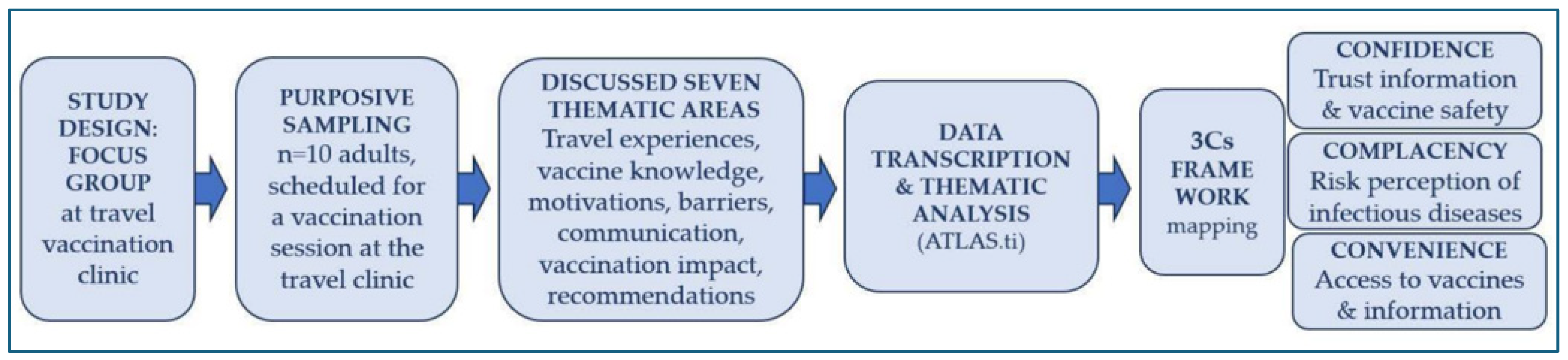
- Previous Travel Experiences
- ○
- Destinations visited and motivations for choosing them.
- ○
- Sources of information regarding necessary vaccinations.
- General Knowledge about Vaccinations
- ○
- Perceived importance of vaccinations for international travel.
- ○
- Knowledge of recommended and mandatory vaccinations.
- ○
- Access to information from official entities [12].
- Motivations for Vaccination
- ○
- Factors influencing the decision to get vaccinated.
- ○
- Sources of information considered most reliable.
- ○
- Opinions on mandatory vaccinations for entry into certain countries.
- Barriers and Uncertainties
- ○
- Obstacles to accessing vaccinations.
- ○
- Perception of the safety and effectiveness of vaccines [13].
- ○
- Influence of cost on vaccination decisions.
- Communication and Advice
- ○
- Ease of obtaining information about vaccinations.
- ○
- Experiences with healthcare professionals and official sources.
- ○
- Strategies to improve communication in the healthcare field.
- Impact of Vaccinations on Health
- ○
- Experiences of diseases contracted while travelling that could have been prevented by vaccination.
- ○
- Perception of the effectiveness of vaccinations in protecting health.
- Conclusions and Recommendations
- ○
- Importance of vaccinations in the health prevention of travelers.
- ○
- Suggestions for improving adherence to vaccination recommendations.
2.1. Integration of the 3Cs Model
- Confidence: Confidence in the information provided and the safety of vaccines. It was explored how travelers who rely on official sources (e.g., healthcare professionals and government bodies) tend to have more positive attitudes towards vaccination.
- Complacency: The perception of the risk associated with infectious diseases. The tendency of some travelers to underestimate the risk of contracting diseases, especially in destinations considered low-risk, was investigated.
- Convenience: The ease of access to vaccinations and health information. Factors related to the availability and accessibility of information, including healthcare advice and digital platforms, were explored to facilitate the adoption of vaccination behaviors.
2.2. Statistical Analysis
3. Results
3.1. Confidence
- ○
- Socio-cultural adaptation: Participants tended to trust the information received from travel agencies or doctors without conducting independent research, but this happened primarily when the source was considered reliable. This trust in institutional sources facilitated their vaccination preparation.
- ▪
- Example quote: “I booked the trip through an agency that told me there would be no issues with vaccinations. I didn’t worry too much.” (Dialogue 1)
- ○
- Emotions: Emotions played a crucial role in strengthening confidence in vaccinations. Participants felt calmer and safer after being vaccinated, seeing vaccination as a way to reduce anxiety.
- ▪
- Example quote: “When I had the vaccinations for the trip, I felt more relaxed. Now I’m not afraid of getting sick because I know I’m protected.” (Dialogue 4)
3.2. Complacency
- ○
- Travel: Vaccination was perceived as less necessary for trips to European destinations, which is a clear sign of complacency regarding the risk of diseases in these areas.
- ▪
- Example quote: “For Hungary, I didn’t worry about getting vaccinated. There was nothing that made me think it was necessary.” (Dialogue 3)
- ○
- Lack of information: Insufficient accurate information contributed to risk of misperception and reduced motivation to get vaccinated. Many participants reported difficulties finding clear and timely information on required vaccinations, contributing to complacency.
- ▪
- Example quote: “I never know who to turn to for detailed information on vaccines. Neither my doctor nor the pharmacy gives me clear answers.” (Dialogue 7)
3.3. Convenience
- ○
- Empowerment: Participants who took the initiative to independently research information, through sources such as the Internet, expressed a greater sense of control over their health and a stronger inclination to get vaccinated.
- ▪
- Example quote: “Before I leave, I always check online to see what type of vaccine I need. I don’t completely trust the information I get only from my doctor.” (Dialogue 8)
- ○
- Healthcare & COVID-19: The COVID-19 pandemic highlighted the importance of convenience in accessing vaccinations. Growing mistrust of vaccines and increased resistance to vaccination were exacerbated by difficulties accessing clear information during the health crisis.
- ▪
- Example quote: “Before the pandemic, I didn’t question vaccines much. Now, I question everything.”
3.4. Other Factors
- ○
- Holistic development: Vaccination is seen as part of a comprehensive well-being strategy while travelling. Participants often consider vaccination as one of many necessary precautions, alongside other preventive measures.
- ○
- Example sentence: “Vaccination is important, but it is just one part of how I take care of my health when travelling. I also make sure to take digestive medicine because I know my body can react differently in other countries.” (Dialogue 10)
4. Discussion
5. Limitations
5.1. Sample Composition and Representativeness
5.2. Social Desirability and Groupthink
- Cronbach’s alpha indicated excellent internal consistency for overall positive responses (α = 0.906); alpha remained high after removing each dimension (range α = 0.855–0.898), suggesting the scale was reliable and not driven by any single dimension.
- Response distribution analysis: the proportion of positive responses showed substantial heterogeneity (range 0–1.0, mean = 0.42 ± 0.40), with participants stratifying into three distinct groups: 30% expressed entirely negative responses, 40% showed mixed responses, and 30% predominantly positive responses. This wide distribution contradicts the clustering toward socially favorable endpoints expected under social desirability bias.
- Kruskal–Wallis permutation testing revealed no significant association between individual travelers and positive response counts (χ2 = 8.727, p = 1.0000).
- Chi-square tests for independence confirmed no relationship between traveler identity and positive responses (χ2 = 60.0, p = 0.267) or negative/neutral responses (χ2 = 50.0, p = 0.281), indicating that response patterns were random rather than systematically biased toward favorable or negative endpoints.
- Responses revealed variation across domains (socio-cultural dimension variance = 0.62 ± 0.79; psychological = 0.18 ± 0.42; information access = 1.16 ± 1.07; well-being = 0.54 ± 0.74). The limited psychological dimension variance (0.18) could reflect groupthink, whereby individuals may conceal their emotional expressions in group settings [35]. However, the substantially higher variance in the information access dimension (1.16) indicates that homogeneity was not uniformly distributed across all domains, suggesting dimension-specific rather than global groupthink.
- Modest age-related variation was observed in psychological responses, with younger participants scoring 2.0 while middle-aged groups ranged from 1.67–1.75, suggesting responses were not entirely uniform across demographic subgroups.
- Kruskal–Wallis permutation testing found no significant association between individuals and overall response patterns (χ2 = 8.782, p = 1.0000), indicating no single participant or subgroup monopolized the discussion.
- Substantive response diversity: response counts across dimensions ranged widely (mean positive responses 4.40 ± 4.33; mean negative responses 4.30 ± 2.91), indicating disagreement on substantive issues.
6. Future Research
7. Conclusions
Author Contributions
Funding
Institutional Review Board Statement
Informed Consent Statement
Data Availability Statement
Conflicts of Interest
References
- World Health Organization. Vaccinations: A Cornerstone of Global Public Health; WHO: Geneva, Switzerland, 2022. [Google Scholar]
- Ebi, K.L.; Boyer, C.; Bowen, K.J.; Frumkin, H.; Hess, J. Monitoring and Evaluation Indicators for Climate Change-Related Health Impacts, Risks, Adaptation, and Resilience. Int. J. Environ. Res. Public Health 2018, 15, 1943. [Google Scholar] [CrossRef]
- Anagnostopoulos, A.; Fehr, J. Rebound and steep increase of international travel after the COVID-19 pandemic: Where are we going from here? J. Travel. Med. 2024, 31, taad158. [Google Scholar] [CrossRef]
- Italian Ministry of Health. Piano Nazionale di Prevenzione Vaccinale 2023–2025 (PNPV). Available online: https://www.salute.gov.it/portala/vaccinazioni/dettaglioContenutiVaccinazioni.jsp?id=4828&area=vaccinazioni&menu=vuoto (accessed on 20 December 2024).
- World Health Organization. Immunization and Travel Health; WHO: Geneva, Switzerland, 2020. [Google Scholar]
- Larson, H.J.; de Figueiredo, A.; Xiahong, Z.; Schulz, W.S.; Verger, P.; Johnston, I.G.; Cook, A.R.; Jones, N.S. The State of Vaccine Confidence 2016: Global Insights Through a 67-Country Survey. eBioMedicine 2016, 13, 295–301. [Google Scholar] [CrossRef]
- Betsch, C.; Schmid, P.; Heinemeier, D.; Korn, L.; Holtmann, C.; Böhm, R. Beyond confidence: Development of a measure assessing the 5C psychological antecedents of vaccination. PLoS ONE 2018, 13, e0208601. [Google Scholar] [CrossRef] [PubMed]
- Larson, H.J.; Gakidou, E.; Murray, C.J.L. The vaccine-hesitant moment. N. Engl. J. Med. 2022, 387, 58–65. [Google Scholar] [CrossRef] [PubMed]
- Milionis, C.; Ilias, I.; Tselebis, A.; Pachi, A. Psychological and social aspects of vaccination hesitancy—Implications for travel medicine in the aftermath of the COVID-19 crisis: A narrative review. Medicina 2023, 59, 1744. [Google Scholar] [CrossRef]
- Krueger, R.A.; Casey, M.A. Focus Groups: A Practical Guide for Applied Research, 5th ed.; Sage Publications: Thousand Oaks, CA, USA, 2015. [Google Scholar]
- Braun, V.; Clarke, V. Using thematic analysis in psychology. Qual. Res. Psychol. 2006, 3, 77–101. [Google Scholar] [CrossRef]
- Elo, S.; Kyngäs, H. The qualitative content analysis process. J. Adv. Nurs. 2008, 62, 107–115. [Google Scholar] [CrossRef]
- European Centre for Disease Prevention and Control. Guidance for Travel Health and Vaccination Recommendations; ECDC: Stockholm, Sweden, 2021. [Google Scholar]
- MacDonald, N.E.; The SWGoV. Vaccine hesitancy: Definition, scope and determinants. Vaccine 2015, 33, 4161–4164. [Google Scholar] [CrossRef] [PubMed]
- Larson, H.J. Vaccine Hesitancy: A Global Challenge; Oxford University Press: Oxford, UK, 2020. [Google Scholar]
- Gary, L. Kreps, The value of health communication scholarship: New directions for health communication inquiry. Int. J. Nurs. Sci. 2020, 7, S4–S7. [Google Scholar] [CrossRef]
- Vederhus, S.; Myhre, E.; Diaz, E.; Kvalvik, L.G. Cultural factors influencing COVID-19-related perceptions and behavior, seen from immigrants’ own perspective—A qualitative study in Norway. Arch. Public Health 2024, 82, 110. [Google Scholar] [CrossRef] [PubMed]
- Bechini, A.; Zanobini, P.; Zanella, B.; Ancillotti, L.; Moscadelli, A.; Bonanni, P.; Boccalini, S. Travelers’ attitudes, behaviors, and practices on the prevention of infectious diseases: A study for non-European destinations. Int. J. Environ. Res. Public Health 2021, 18, 3110. [Google Scholar] [CrossRef]
- Leventhal, H.; Brissette, I.; Leventhal, E.A. The common-sense model of self-regulation of health and illness. In The Handbook of Health Psychology; Cameron, L.D., Leventhal, H., Eds.; Lawrence Erlbaum: Mahwah, NJ, USA, 2003; pp. 42–61. [Google Scholar]
- Cohen, S.; Wills, T.A. Stress, social support, and the buffering hypothesis. Psychol. Bull. 2007, 98, 310–357. [Google Scholar] [CrossRef]
- Betsch, C.; Böhm, R.; Chapman, G.B. Using behavioral insights to increase vaccination policy effectiveness. Policy Insights Behav. Brain Sci. 2015, 2, 61–73. [Google Scholar] [CrossRef]
- Larson, H.J.; Jarrett, C.; Schulz, W.S.; Chaudhuri, M.; Zhou, Y.; Dube, E.; Schuster, M.; MacDonald, N.E.; Wilson, R. SAGE Working Group on Vaccine Hesitancy. Measuring vaccine hesitancy: The development of a survey tool. Vaccine 2015, 33, 4165–4175. [Google Scholar] [CrossRef] [PubMed]
- Adhikari, B.; Cheah, P.Y.; von Seidlein, L. Trust is the common denominator for COVID-19 vaccine acceptance: A literature review. Vaccine X 2022, 12, 100213. [Google Scholar] [CrossRef]
- Kickbusch, I.; Gleicher, D. Governance for Health in the 21st Century; World Health Organization Regional Office for Europe: Geneva, Switzerland, 2012. Available online: https://iris.who.int/handle/10665/326429 (accessed on 28 December 2025).
- Lorini, C.; Del Riccio, M.; Zanobini, P.; Biasio, R.L.; Bonanni, P.; Giorgetti, D.; Ferro, V.A.; Guazzini, A.; Maghrebi, O.; Lastrucci, V.; et al. Vaccination as a social practice: Towards a definition of personal, community, population, and organizational vaccine literacy. BMC Public Health 2023, 23, 1501. [Google Scholar] [CrossRef]
- Lu, Y.; Wang, Q.; Zhu, S.; Xu, S.; Kadirhaz, M.; Zhang, Y.; Zhao, N.; Fang, Y.; Chang, J. Lessons learned from COVID-19 vaccination implementation: How psychological antecedents of vaccinations mediate the relationship between vaccine literacy and vaccine hesitancy. Soc. Sci. Med. 2023, 336, 116270. [Google Scholar] [CrossRef]
- Biasio, L.R.; Zanobini, P.; Lorini, C.; Bonaccorsi, G. Perspectives in the development of tools to assess vaccine literacy. Vaccines 2024, 12, 422. [Google Scholar] [CrossRef] [PubMed]
- Kaufman, J.; Ryan, R.; Hill, S. Qualitative focus groups with stakeholders identify new potential outcomes related to vaccination communication. PLoS ONE 2018, 13, e0201145. [Google Scholar] [CrossRef] [PubMed]
- World Health Organization. A Field Guide to Qualitative Research for New Vaccine Introduction; WHO: Geneva, Switzerland, 2018. Available online: https://www.who.int/docs/librariesprovider2/default-document-library/eiw2018_fieldguide_vaccineintro.pdf?sfvrsn=918a7d38_1 (accessed on 20 December 2024).
- Hennink, M.M.; Kaiser, B.N.; Weber, M.B. What influences saturation? Estimating sample sizes in focus group research. Qual. Health Res. 2019, 29, 1483–1496. [Google Scholar] [CrossRef] [PubMed]
- Hiratsuka, T. The volunteer participation paradox: Ethical tensions between self-selection and targeted sampling. Res. Methods Appl. Linguist. 2025, 4, 100206. [Google Scholar] [CrossRef]
- Banca d’Italia. Turismo Internazionale. Available online: https://www.bancaditalia.it/statistiche/tematiche/rapporti-estero/turismo-internazionale/distribuzione-microdati/file-dati/index.html (accessed on 20 December 2024).
- Onwuegbuzie, A.J.; Dickinson, W.B.; Leech, N.L.; Zoran, A.G. A qualitative framework for collecting and analyzing data in focus group research. Int. J. Qual. Methods 2009, 8, 1–21. [Google Scholar] [CrossRef]
- Rana, K.; Chimoriya, R. A Guide to a Mixed-Methods Approach to Healthcare Research. Encyclopedia 2025, 5, 51. [Google Scholar] [CrossRef]
- Nyumba, T.O.; Wilson, K.; Derrick, C.J.; Mukherjee, N. The use of focus group discussion methodology: Insights from two decades of application in conservation. Methods Ecol. Evol. 2018, 9, 20–32. [Google Scholar] [CrossRef]


| Model Factor | Key Themes | Summary of Findings |
|---|---|---|
| Confidence | Trust in official and institutional sources | Participants primarily rely on official sources (such as travel agencies and doctors). Trust in these sources facilitates adherence to vaccinations. |
| Impact of emotions on vaccination decision | Emotions link vaccination to a sense of protection, reducing anxiety and increasing confidence in vaccinations. | |
| Complacency | Perception of risk and destinations | Traveling to destinations perceived as low-risk (e.g., Europe) leads to underestimating the importance of vaccination, resulting in low motivation to vaccinate. |
| Convenience | Independent information search | Online research and self-information allow participants to feel more in control of their health, leading to more informed vaccination decisions. |
| Experience during the COVID-19 pandemic | The pandemic highlighted the importance of easy and quick access to vaccinations but also generated more distrust towards vaccines and health information. | |
| Access to and clarity of information | Difficulty accessing accurate information has contributed to a distorted perception of risk, reducing the urgency to vaccinate. | |
| Other Factors | Holistic approach to health during travel | Vaccination is viewed as part of an overall health plan, integrated with other preventive measures such as digestive medication or adapting to new environments. |
Disclaimer/Publisher’s Note: The statements, opinions and data contained in all publications are solely those of the individual author(s) and contributor(s) and not of MDPI and/or the editor(s). MDPI and/or the editor(s) disclaim responsibility for any injury to people or property resulting from any ideas, methods, instructions or products referred to in the content. |
© 2025 by the authors. Licensee MDPI, Basel, Switzerland. This article is an open access article distributed under the terms and conditions of the Creative Commons Attribution (CC BY) license.
Share and Cite
Nuccetelli, F.; Ciampini, S.; Gabellone, V.; Zanobini, P.; Lopalco, P.; Biasio, L.R. Qualitative Study on Vaccinations for Travelers. Vaccines 2026, 14, 47. https://doi.org/10.3390/vaccines14010047
Nuccetelli F, Ciampini S, Gabellone V, Zanobini P, Lopalco P, Biasio LR. Qualitative Study on Vaccinations for Travelers. Vaccines. 2026; 14(1):47. https://doi.org/10.3390/vaccines14010047
Chicago/Turabian StyleNuccetelli, Fabiana, Sara Ciampini, Valeria Gabellone, Patrizio Zanobini, Pierluigi Lopalco, and Luigi Roberto Biasio. 2026. "Qualitative Study on Vaccinations for Travelers" Vaccines 14, no. 1: 47. https://doi.org/10.3390/vaccines14010047
APA StyleNuccetelli, F., Ciampini, S., Gabellone, V., Zanobini, P., Lopalco, P., & Biasio, L. R. (2026). Qualitative Study on Vaccinations for Travelers. Vaccines, 14(1), 47. https://doi.org/10.3390/vaccines14010047