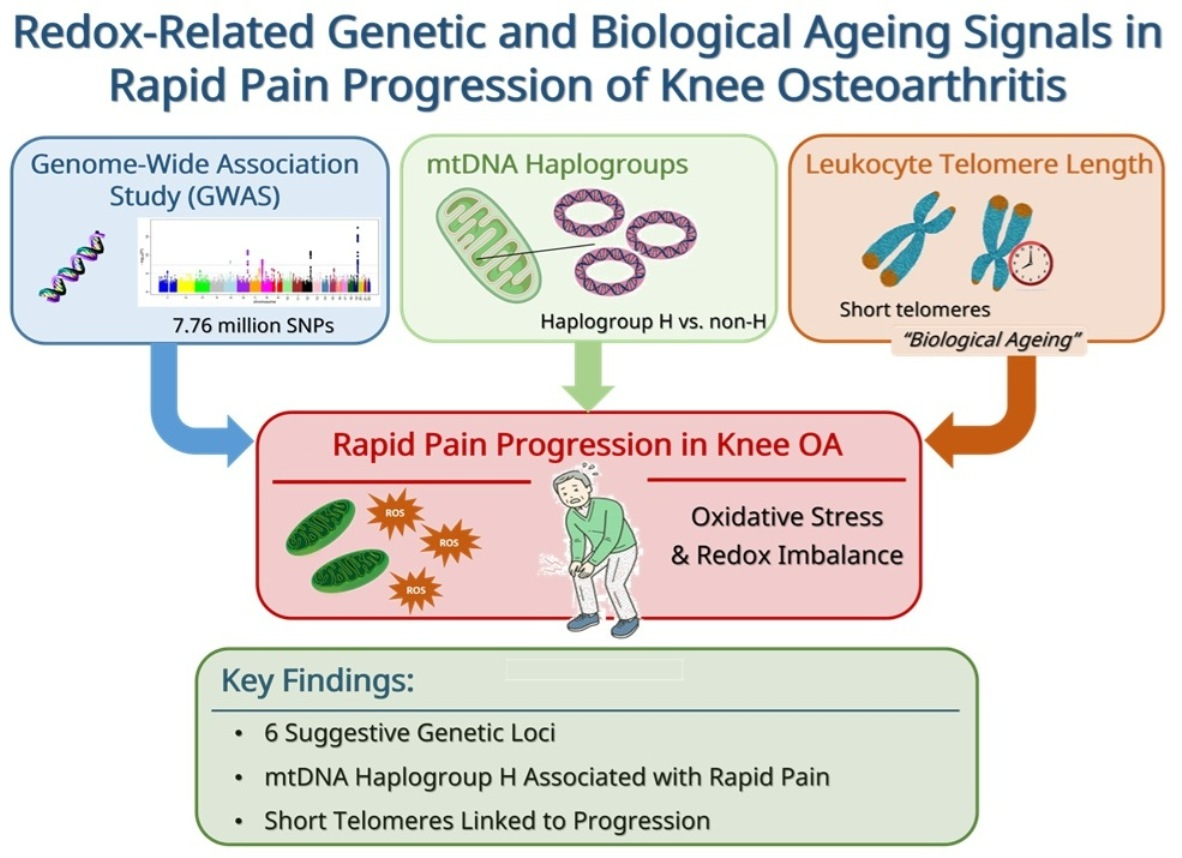
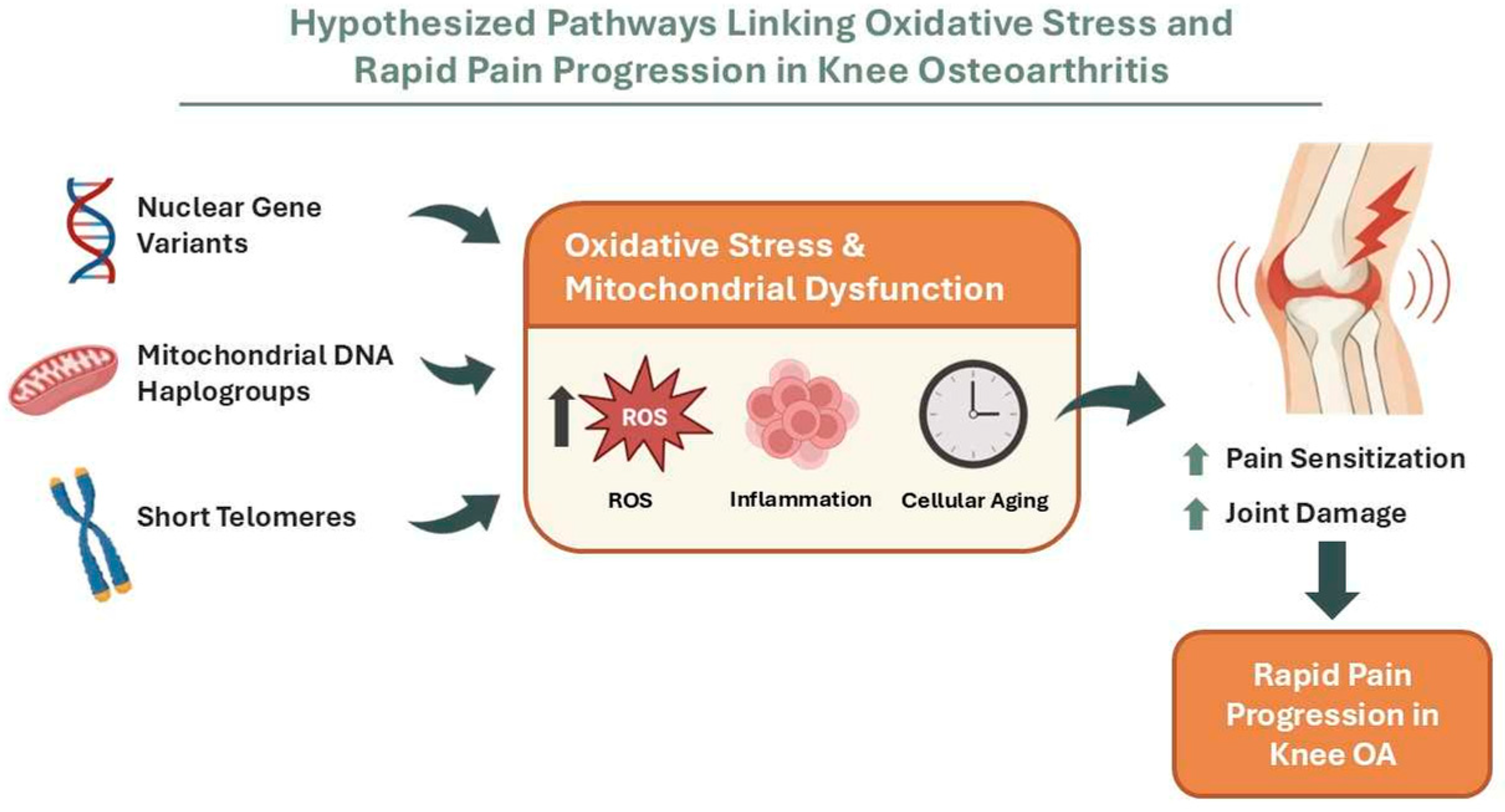
Redox-Related Genetic and Biological Ageing Signals in Rapid Pain Progression of Knee Osteoarthritis: A Hypothesis-Generating Analysis in the Osteoarthritis Initiative

 , , , , ,
  and
and
Abstract
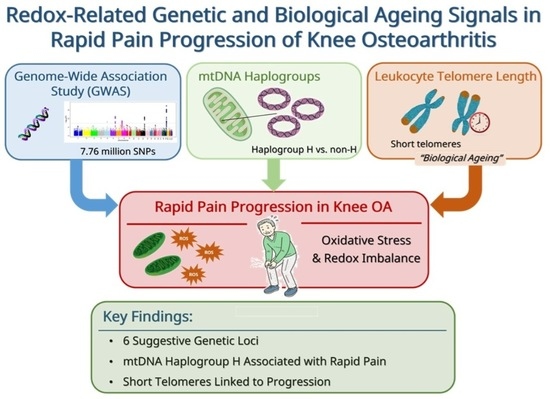
1. Introduction
2. Materials and Methods
2.1. Cohort Description
2.2. Rapid Pain Progression Criteria
- Increase of at least 10 points over 24 months and substantial pain at the end of the window (WOMAC pain ≥ 40);
- Increase of at least 20 points over 24 months with end pain ≥ 35;
- Sustained substantial pain (WOMAC pain ≥ 40 at both the beginning and end of the 24-month window).
2.3. Genetic Analyses
2.3.1. Nuclear Genome-Wide Data
2.3.2. Mitochondrial Data
2.4. Telomere Length Assay
2.5. Statistical Analyses
2.6. Declaration of Generative AI and AI-Assisted Technologies in the Writing Process
3. Results
3.1. Study Population
3.2. Nuclear Genome-Wide Analysis
3.3. Mitochondrial DNA Analysis
3.4. Telomere Length Analysis
4. Discussion
5. Conclusions
Supplementary Materials
Author Contributions
Funding
Institutional Review Board Statement
Informed Consent Statement
Data Availability Statement
Acknowledgments
Conflicts of Interest
Correction Statement
Abbreviations
| BMI | Body mass index |
| CI | Confidence interval |
| COL11A2 | Collagen type XI alpha 2 chain |
| COL27A1 | Collagen type XXVII alpha 1 chain |
| COMT | Catechol-O-methyltransferase |
| dbGaP | Database of Genotypes and Phenotypes |
| DNA | Deoxyribonucleic acid |
| DUX4 | Double homeobox 4 |
| DUXA | Double homeobox A |
| eQTL | Expression Quantitative Trait Locus |
| GDF5 | Growth differentiation factor 5 |
| GeCKO | Genetic Components of Knee Osteoarthritis |
| GTEx | Genotype-Tissue Expression |
| GWAS | Genome-wide association study |
| HWE | Hardy–Weinberg equilibrium |
| IL-1 | Interleukin-1 |
| IL-6 | Interleukin-6 |
| IL-8 | Interleukin-8 |
| IL-36 | Interleukin-36 |
| IL-36γ | Interleukin-36 gamma |
| IL-36R | Interleukin-36 receptor |
| IL36B | Interleukin 36 beta |
| IQR | Interquartile range |
| LD | Linkage disequilibrium |
| LMCD1-AS1 | LMCD1 antisense RNA 1 |
| lncRNA | Long non-coding RNA |
| LOC105378178 | Uncharacterised non-coding RNA locus |
| LOC124907827 | Uncharacterised non-coding RNA locus |
| MAF | Minor allele frequency |
| Minimac4 | Minimac4 imputation software |
| mtDNA | Mitochondrial DNA |
| OA | Osteoarthritis |
| OAI | Osteoarthritis Initiative |
| OR | Odds ratio |
| PBL | Peripheral blood leukocytes |
| PCA | Principal component analysis |
| PC | Principal component |
| PCR | Polymerase chain reaction |
| QC | Quality control |
| Quantile–quantile | |
| RAI1 | Retinoic acid induced 1 |
| ROS | Reactive oxygen species |
| r2 | Squared correlation coefficient |
| RNA | Ribonucleic acid |
| Rsq | Imputation quality metric |
| SBE | Single base extension |
| SCN9A | Sodium voltage-gated channel alpha subunit 9 |
| SD | Standard deviation |
| SNP | Single nucleotide polymorphism |
| SPSS | Statistical Package for the Social Sciences |
| sQTL | Splicing quantitative trait locus |
| TACR1 | Tachykinin receptor 1 |
| TRPV1 | Transient receptor potential vanilloid 1 |
| VCF | Variant call format |
| WOMAC | Western Ontario and McMaster Universities Osteoarthritis Index |
References
- Collaborators, G.O. Global, regional, and national burden of osteoarthritis, 1990–2020 and projections to 2050: A systematic analysis for the Global Burden of Disease Study 2021. Lancet Rheumatol. 2023, 5, e508–e522. [Google Scholar] [CrossRef] [PubMed]
- Blanco, F.J.; Silva-Díaz, M.; Quevedo Vila, V.; Seoane-Mato, D.; Pérez Ruiz, F.; Juan-Mas, A.; Pego-Reigosa, J.M.; Narváez, J.; Quilis, N.; Cortés, R.; et al. Prevalence of symptomatic osteoarthritis in Spain: EPISER2016 study. Reumatol. Clin. (Engl. Ed.) 2021, 17, 461–470. [Google Scholar] [CrossRef] [PubMed]
- Leifer, V.P.; Katz, J.N.; Losina, E. The burden of OA-health services and economics. Osteoarthr. Cartil. 2022, 30, 10–16. [Google Scholar] [CrossRef]
- Collins, J.E.; Katz, J.N.; Dervan, E.E.; Losina, E. Trajectories and risk profiles of pain in persons with radiographic, symptomatic knee osteoarthritis: Data from the osteoarthritis initiative. Osteoarthr. Cartil. 2014, 22, 622–630. [Google Scholar] [CrossRef]
- Lee, A.C.; Harvey, W.F.; Han, X.; Price, L.L.; Driban, J.B.; Bannuru, R.R.; Wang, C. Pain and functional trajectories in symptomatic knee osteoarthritis over up to 12 weeks of exercise exposure. Osteoarthr. Cartil. 2018, 26, 501–512. [Google Scholar] [CrossRef]
- Radojčić, M.R.; Arden, N.K.; Yang, X.; Strauss, V.Y.; Birrell, F.; Cooper, C.; Kluzek, S.; Investigators, V.T. Pain trajectory defines knee osteoarthritis subgroups: A prospective observational study. Pain 2020, 161, 2841–2851. [Google Scholar] [CrossRef]
- Johnson, A.J.; Vasilopoulos, T.; Booker, S.Q.; Cardoso, J.; Terry, E.L.; Powell-Roach, K.; Staud, R.; Kusko, D.A.; Addison, A.S.; Redden, D.T.; et al. Knee pain trajectories over 18 months in non-Hispanic Black and non-Hispanic White adults with or at risk for knee osteoarthritis. BMC Musculoskelet. Disord. 2021, 22, 415. [Google Scholar] [CrossRef]
- Widera, P.; Welsing, P.M.J.; Ladel, C.; Loughlin, J.; Lafeber, F.P.F.J.; Petit Dop, F.; Larkin, J.; Weinans, H.; Mobasheri, A.; Bacardit, J. Multi-classifier prediction of knee osteoarthritis progression from incomplete imbalanced longitudinal data. Sci. Rep. 2020, 10, 8427. [Google Scholar] [CrossRef]
- Castagno, S.; Birch, M.; van der Schaar, M.; McCaskie, A. Predicting rapid progression in knee osteoarthritis: A novel and interpretable automated machine learning approach, with specific focus on young patients and early disease. Ann. Rheum. Dis. 2025, 84, 124–135. [Google Scholar] [CrossRef]
- Thakur, M.; Dawes, J.M.; McMahon, S.B. Genomics of pain in osteoarthritis. Osteoarthr. Cartil. 2013, 21, 1374–1382. [Google Scholar] [CrossRef] [PubMed]
- Aubourg, G.; Rice, S.J.; Bruce-Wootton, P.; Loughlin, J. Genetics of osteoarthritis. Osteoarthr. Cartil. 2021, 30, 636–649. [Google Scholar] [CrossRef]
- Valdes, A.M.; De Wilde, G.; Doherty, S.A.; Lories, R.J.; Vaughn, F.L.; Laslett, L.L.; Maciewicz, R.A.; Soni, A.; Hart, D.J.; Zhang, W.; et al. The Ile585Val TRPV1 variant is involved in risk of painful knee osteoarthritis. Ann. Rheum. Dis. 2011, 70, 1556–1561. [Google Scholar] [CrossRef]
- Malfait, A.M.; Seymour, A.B.; Gao, F.; Tortorella, M.D.; Le Graverand-Gastineau, M.P.; Wood, L.S.; Doherty, M.; Doherty, S.; Zhang, W.; Arden, N.K.; et al. A role for PACE4 in osteoarthritis pain: Evidence from human genetic association and null mutant phenotype. Ann. Rheum. Dis. 2012, 71, 1042–1048. [Google Scholar] [CrossRef]
- Neogi, T.; Soni, A.; Doherty, S.A.; Laslett, L.L.; Maciewicz, R.A.; Hart, D.J.; Zhang, W.; Muir, K.R.; Wheeler, M.; Cooper, C.; et al. Contribution of the COMT Val158Met variant to symptomatic knee osteoarthritis. Ann. Rheum. Dis. 2014, 73, 315–317. [Google Scholar] [CrossRef] [PubMed]
- Oreiro-Villar, N.; Raga, A.C.; Rego-Pérez, I.; Pértega, S.; Silva-Diaz, M.; Freire, M.; Fernández-López, C.; Blanco, F.J. PROCOAC (PROspective COhort of A Coruña) description: Spanish prospective cohort to study osteoarthritis. Reumatol. Clin. (Engl. Ed.) 2020, 18, 100–104. [Google Scholar] [CrossRef] [PubMed]
- Warner, S.C.; Walsh, D.A.; Laslett, L.L.; Maciewicz, R.A.; Soni, A.; Hart, D.J.; Zhang, W.; Muir, K.R.; Dennison, E.M.; Leaverton, P.; et al. Pain in knee osteoarthritis is associated with variation in the neurokinin 1/substance P receptor (TACR1) gene. Eur. J. Pain 2017, 21, 1277–1284. [Google Scholar] [CrossRef] [PubMed]
- Ho, K.W.D.; Wallace, M.R.; Sibille, K.T.; Bartley, E.J.; Cruz-Almeida, Y.; Glover, T.L.; King, C.D.; Goodin, B.R.; Addison, A.; Edberg, J.C.; et al. Single Nucleotide Polymorphism in the COL11A2 Gene Associated with Heat Pain Sensitivity in Knee Osteoarthritis. Mol. Pain 2017, 13, 1744806917724259. [Google Scholar] [CrossRef]
- Reimann, F.; Cox, J.J.; Belfer, I.; Diatchenko, L.; Zaykin, D.V.; McHale, D.P.; Drenth, J.P.; Dai, F.; Wheeler, J.; Sanders, F.; et al. Pain perception is altered by a nucleotide polymorphism in SCN9A. Proc. Natl. Acad. Sci. USA 2010, 107, 5148–5153. [Google Scholar] [CrossRef]
- Klein, C.J.; Wu, Y.; Kilfoyle, D.H.; Sandroni, P.; Davis, M.D.; Gavrilova, R.H.; Low, P.A.; Dyck, P.J. Infrequent SCN9A mutations in congenital insensitivity to pain and erythromelalgia. J. Neurol. Neurosurg. Psychiatry 2013, 84, 386–391. [Google Scholar] [CrossRef]
- Meng, W.; Adams, M.J.; Palmer, C.N.A.; Shi, J.; Auton, A.; Ryan, K.A.; Jordan, J.M.; Mitchell, B.D.; Jackson, R.D.; Yau, M.S.; et al. Genome-wide association study of knee pain identifies associations with. Commun. Biol. 2019, 2, 321. [Google Scholar] [CrossRef]
- Rego-Perez, I.; Fernandez-Moreno, M.; Fernandez-Lopez, C.; Arenas, J.; Blanco, F.J. Mitochondrial DNA haplogroups: Role in the prevalence and severity of knee osteoarthritis. Arthritis Rheum. 2008, 58, 2387–2396. [Google Scholar] [CrossRef]
- Soto-Hermida, A.; Fernandez-Moreno, M.; Oreiro, N.; Fernandez-Lopez, C.; Pertega, S.; Cortes-Pereira, E.; Rego-Perez, I.; Blanco, F.J. Mitochondrial DNA (mtDNA) haplogroups influence the progression of knee osteoarthritis. Data from the Osteoarthritis Initiative (OAI). PLoS ONE 2014, 9, e112735. [Google Scholar] [CrossRef]
- Fernandez-Moreno, M.; Soto-Hermida, A.; Vazquez-Mosquera, M.E.; Cortes-Pereira, E.; Pertega, S.; Relano, S.; Oreiro-Villar, N.; Fernandez-Lopez, C.; Blanco, F.J.; Rego-Perez, I. A replication study and meta-analysis of mitochondrial DNA variants in the radiographic progression of knee osteoarthritis. Rheumatology 2017, 56, 263–270. [Google Scholar] [CrossRef] [PubMed]
- Durán-Sotuela, A.; Fernandez-Moreno, M.; Suárez-Ulloa, V.; Vázquez-García, J.; Relaño, S.; Hermida-Gómez, T.; Balboa-Barreiro, V.; Lourido-Salas, L.; Calamia, V.; Fernandez-Puente, P.; et al. A meta-analysis and a functional study support the influence of mtDNA variant m.16519C on the risk of rapid progression of knee osteoarthritis. Ann. Rheum. Dis. 2023, 82, 974–984. [Google Scholar] [CrossRef] [PubMed]
- Gavriilidis, C.; Miwa, S.; von Zglinicki, T.; Taylor, R.W.; Young, D.A. Mitochondrial dysfunction in osteoarthritis is associated with down-regulation of superoxide dismutase 2. Arthritis Rheum. 2013, 65, 378–387. [Google Scholar] [CrossRef]
- Wang, Y.; Zhao, X.; Lotz, M.; Terkeltaub, R.; Liu-Bryan, R. Mitochondrial Biogenesis Is Impaired in Osteoarthritis Chondrocytes but Reversible via Peroxisome Proliferator-Activated Receptor γ Coactivator 1α. Arthritis Rheumatol. 2015, 67, 2141–2153. [Google Scholar] [CrossRef]
- Liu, D.; Cai, Z.J.; Yang, Y.T.; Lu, W.H.; Pan, L.Y.; Xiao, W.F.; Li, Y.S. Mitochondrial quality control in cartilage damage and osteoarthritis: New insights and potential therapeutic targets. Osteoarthr. Cartil. 2022, 30, 395–405. [Google Scholar] [CrossRef] [PubMed]
- Carrasco, C.; Naziroǧlu, M.; Rodríguez, A.B.; Pariente, J.A. Neuropathic Pain: Delving into the Oxidative Origin and the Possible Implication of Transient Receptor Potential Channels. Front. Physiol. 2018, 9, 95. [Google Scholar] [CrossRef]
- Silva Santos Ribeiro, P.; Willemen, H.L.D.M.; Eijkelkamp, N. Mitochondria and sensory processing in inflammatory and neuropathic pain. Front. Pain Res. 2022, 3, 1013577. [Google Scholar] [CrossRef]
- Sibille, K.T.; Langaee, T.; Burkley, B.; Gong, Y.; Glover, T.L.; King, C.; Riley, J.L.; Leeuwenburgh, C.; Staud, R.; Bradley, L.A.; et al. Chronic pain, perceived stress, and cellular aging: An exploratory study. Mol. Pain 2012, 8, 12. [Google Scholar] [CrossRef]
- Mosquera, A.; Rego-Pérez, I.; Blanco, F.J.; Fernández, J.L. Leukocyte Telomere Length in Patients with Radiographic Knee Osteoarthritis. Environ. Mol. Mutagen. 2019, 60, 298–301. [Google Scholar] [CrossRef]
- Vaiserman, A.; Krasnienkov, D. Telomere Length as a Marker of Biological Age: State-of-the-Art, Open Issues, and Future Perspectives. Front. Genet. 2020, 11, 630186. [Google Scholar] [CrossRef]
- Wesseling, J.; Dekker, J.; van den Berg, W.B.; Bierma-Zeinstra, S.M.; Boers, M.; Cats, H.A.; Deckers, P.; Gorter, K.J.; Heuts, P.H.; Hilberdink, W.K.; et al. CHECK (Cohort Hip and Cohort Knee): Similarities and differences with the Osteoarthritis Initiative. Ann. Rheum. Dis. 2009, 68, 1413–1419. [Google Scholar] [CrossRef]
- Yerges-Armstrong, L.M.; Yau, M.S.; Liu, Y.; Krishnan, S.; Renner, J.B.; Eaton, C.B.; Kwoh, C.K.; Nevitt, M.C.; Duggan, D.J.; Mitchell, B.D.; et al. Association analysis of BMD-associated SNPs with knee osteoarthritis. J. Bone Miner. Res. 2014, 29, 1373–1379. [Google Scholar] [CrossRef]
- Chang, C.C.; Chow, C.C.; Tellier, L.C.; Vattikuti, S.; Purcell, S.M.; Lee, J.J. Second-generation PLINK: Rising to the challenge of larger and richer datasets. Gigascience 2015, 4, 7. [Google Scholar] [CrossRef] [PubMed]
- Tamayo, M.; Mosquera, A.; Ignacio Rego, J.; Luis Fernandez-Sueiro, J.; Blanco, F.J.; Luis Fernandez, J. Differing patterns of peripheral blood leukocyte telomere length in rheumatologic diseases. Mutat. Res.-Fundam. Mol. Mech. Mutagen. 2010, 683, 68–73. [Google Scholar] [CrossRef]
- Zhan, X.; Hu, Y.; Li, B.; Abecasis, G.R.; Liu, D.J. RVTESTS: An efficient and comprehensive tool for rare variant association analysis using sequence data. Bioinformatics 2016, 32, 1423–1426. [Google Scholar] [CrossRef]
- Tachmazidou, I.; Hatzikotoulas, K.; Southam, L.; Esparza-Gordillo, J.; Haberland, V.; Zheng, J.; Johnson, T.; Koprulu, M.; Zengini, E.; Steinberg, J.; et al. Identification of new therapeutic targets for osteoarthritis through genome-wide analyses of UK Biobank data. Nat. Genet. 2019, 51, 230–236. [Google Scholar] [CrossRef] [PubMed]
- Boer, C.G.; Hatzikotoulas, K.; Southam, L.; Stefánsdóttir, L.; Zhang, Y.; Coutinho de Almeida, R.; Wu, T.T.; Zheng, J.; Hartley, A.; Teder-Laving, M.; et al. Deciphering osteoarthritis genetics across 826,690 individuals from 9 populations. Cell 2021, 184, 6003–6005. [Google Scholar] [CrossRef] [PubMed]
- Hatzikotoulas, K.; Southam, L.; Stefansdottir, L.; Boer, C.G.; McDonald, M.L.; Pett, J.P.; Park, Y.C.; Tuerlings, M.; Mulders, R.; Barysenka, A.; et al. Translational genomics of osteoarthritis in 1,962,069 individuals. Nature 2025, 641, 1217–1224. [Google Scholar] [CrossRef]
- Magne, D.; Palmer, G.; Barton, J.L.; Mézin, F.; Talabot-Ayer, D.; Bas, S.; Duffy, T.; Noger, M.; Guerne, P.A.; Nicklin, M.J.; et al. The new IL-1 family member IL-1F8 stimulates production of inflammatory mediators by synovial fibroblasts and articular chondrocytes. Arthritis Res. Ther. 2006, 8, R80. [Google Scholar] [CrossRef] [PubMed]
- Queen, D.; Ediriweera, C.; Liu, L. Function and Regulation of IL-36 Signaling in Inflammatory Diseases and Cancer Development. Front. Cell Dev. Biol. 2019, 7, 317. [Google Scholar] [CrossRef] [PubMed]
- Chen, W.J.; Yu, X.; Yuan, X.R.; Chen, B.J.; Cai, N.; Zeng, S.; Sun, Y.S.; Li, H.W. The Role of IL-36 in the Pathophysiological Processes of Autoimmune Diseases. Front. Pharmacol. 2021, 12, 727956. [Google Scholar] [CrossRef] [PubMed]
- Li, Q.; Liu, S.; Li, L.; Ji, X.; Wang, M.; Zhou, J. Spinal IL-36γ/IL-36R participates in the maintenance of chronic inflammatory pain through astroglial JNK pathway. Glia 2019, 67, 438–451. [Google Scholar] [CrossRef]
- Wang, P.; Yang, W.; Guo, H.; Dong, H.P.; Guo, Y.Y.; Gan, H.; Wang, Z.; Cheng, Y.; Deng, Y.; Xie, S.; et al. IL-36γ and IL-36Ra Reciprocally Regulate NSCLC Progression by Modulating GSH Homeostasis and Oxidative Stress-Induced Cell Death. Adv. Sci. 2021, 8, e2101501. [Google Scholar] [CrossRef]
- Girirajan, S.; Patel, N.; Slager, R.E.; Tokarz, M.E.; Bucan, M.; Wiley, J.L.; Elsea, S.H. How much is too much? Phenotypic consequences of Rai1 overexpression in mice. Eur. J. Hum. Genet. 2008, 16, 941–954. [Google Scholar] [CrossRef]
- Elsea, S.H.; Girirajan, S. Smith-Magenis syndrome. Eur. J. Hum. Genet. 2008, 16, 412–421. [Google Scholar] [CrossRef]
- Mullin, B.H.; Zhu, K.; Brown, S.J.; Mullin, S.; Dudbridge, F.; Pavlos, N.J.; Richards, J.B.; Grundberg, E.; Bell, J.T.; Zeggini, E.; et al. Leveraging osteoclast genetic regulatory data to identify genes with a role in osteoarthritis. Genetics 2023, 225. [Google Scholar] [CrossRef]
- Turco, E.M.; Giovenale, A.M.G.; Sireno, L.; Mazzoni, M.; Cammareri, A.; Marchioretti, C.; Goracci, L.; Di Veroli, A.; Marchesan, E.; D’Andrea, D.; et al. Retinoic acid-induced 1 gene haploinsufficiency alters lipid metabolism and causes autophagy defects in Smith-Magenis syndrome. Cell Death Dis. 2022, 13, 981. [Google Scholar] [CrossRef]
- Leidenroth, A.; Hewitt, J.E. A family history of DUX4: Phylogenetic analysis of DUXA, B, C and Duxbl reveals the ancestral DUX gene. BMC Evol. Biol. 2010, 10, 364. [Google Scholar] [CrossRef]
- Tihaya, M.S.; Mul, K.; Balog, J.; de Greef, J.C.; Tapscott, S.J.; Tawil, R.; Statland, J.M.; van der Maarel, S.M. Facioscapulohumeral muscular dystrophy: The road to targeted therapies. Nat. Rev. Neurol. 2023, 19, 91–108. [Google Scholar] [CrossRef] [PubMed]
- Karpukhina, A.; Galkin, I.; Ma, Y.; Dib, C.; Zinovkin, R.; Pletjushkina, O.; Chernyak, B.; Popova, E.; Vassetzky, Y. Analysis of genes regulated by DUX4 via oxidative stress reveals potential therapeutic targets for treatment of facioscapulohumeral dystrophy. Redox Biol. 2021, 43, 102008. [Google Scholar] [CrossRef]
- Shao, J.; Xu, Y.; Li, H.; Chen, L.; Wang, W.; Shen, D.; Chen, J. LMCD1 antisense RNA 1 (LMCD1-AS1) potentiates thyroid cancer cell growth and stemness via a positive feedback loop of LMCD1-AS1/miR-1287-5p/GLI2. Ann. Transl. Med. 2020, 8, 1508. [Google Scholar] [CrossRef]
- Fernandez-Moreno, M.; Soto-Hermida, A.; Vazquez-Mosquera, M.E.; Cortes-Pereira, E.; Relano, S.; Hermida-Gomez, T.; Pertega, S.; Oreiro-Villar, N.; Fernandez-Lopez, C.; Garesse, R.; et al. Mitochondrial DNA haplogroups influence the risk of incident knee osteoarthritis in OAI and CHECK cohorts. A meta-analysis and functional study. Ann. Rheum. Dis. 2017, 76, 1114–1122. [Google Scholar] [CrossRef]
- Zhao, Z.; Li, Y.; Wang, M.; Jin, Y.; Liao, W.; Fang, J. Mitochondrial DNA haplogroups participate in osteoarthritis: Current evidence based on a meta-analysis. Clin. Rheumatol. 2020, 39, 1027–1037. [Google Scholar] [CrossRef]
- Tan, S.; Sun, Y.; Li, S.; Wu, H.; Ding, Y. The impact of mitochondrial dysfunction on osteoarthritis cartilage: Current insights and emerging mitochondria-targeted therapies. Bone Res. 2025, 13, 77. [Google Scholar] [CrossRef]
- Willemen, H.L.D.M.; Santos Ribeiro, P.S.; Broeks, M.; Meijer, N.; Versteeg, S.; Tiggeler, A.; de Boer, T.P.; Małecki, J.M.; Falnes, P.; Jans, J.; et al. Inflammation-induced mitochondrial and metabolic disturbances in sensory neurons control the switch from acute to chronic pain. Cell Rep. Med. 2023, 4, 101265. [Google Scholar] [CrossRef] [PubMed]
- Guillén, R.; Otero, F.; Mosquera, A.; Vázquez-Mosquera, M.; Rego-Pérez, I.; Blanco, F.J.; Fernández, J.L. Association of accelerated dynamics of telomere sequence loss in peripheral blood leukocytes with incident knee osteoarthritis in Osteoarthritis Initiative cohort. Sci. Rep. 2021, 11, 15914. [Google Scholar] [CrossRef]
- Sibille, K.T.; Chen, H.; Bartley, E.J.; Riley, J.; Glover, T.L.; King, C.D.; Zhang, H.; Cruz-Almeida, Y.; Goodin, B.R.; Sotolongo, A.; et al. Accelerated aging in adults with knee osteoarthritis pain: Consideration for frequency, intensity, time, and total pain sites. Pain Rep. 2017, 2, e591. [Google Scholar] [CrossRef] [PubMed]



| Rapid Pain Progressors (n = 1260) | Non-Rapid Pain Progressors (n = 2135) | p-Value | |
|---|---|---|---|
| Age at baseline (years) | 61.82 ± 9.05 | 61.33 ± 9.32 | 0.116 * |
| Sex: | <0.001 # | ||
| Male | 494 (39.2) | 995 (46.6) | |
| Female | 766 (60.8) | 1140 (53.4) | |
| BMI (kg/m2) | 29.43 ± 4.90 | 27.25 ± 4.31 | <0.001 * |
| rsID | Chr. | Ref. | Alt. | Nearest Gene | OR (95% CI) | p-Value |
|---|---|---|---|---|---|---|
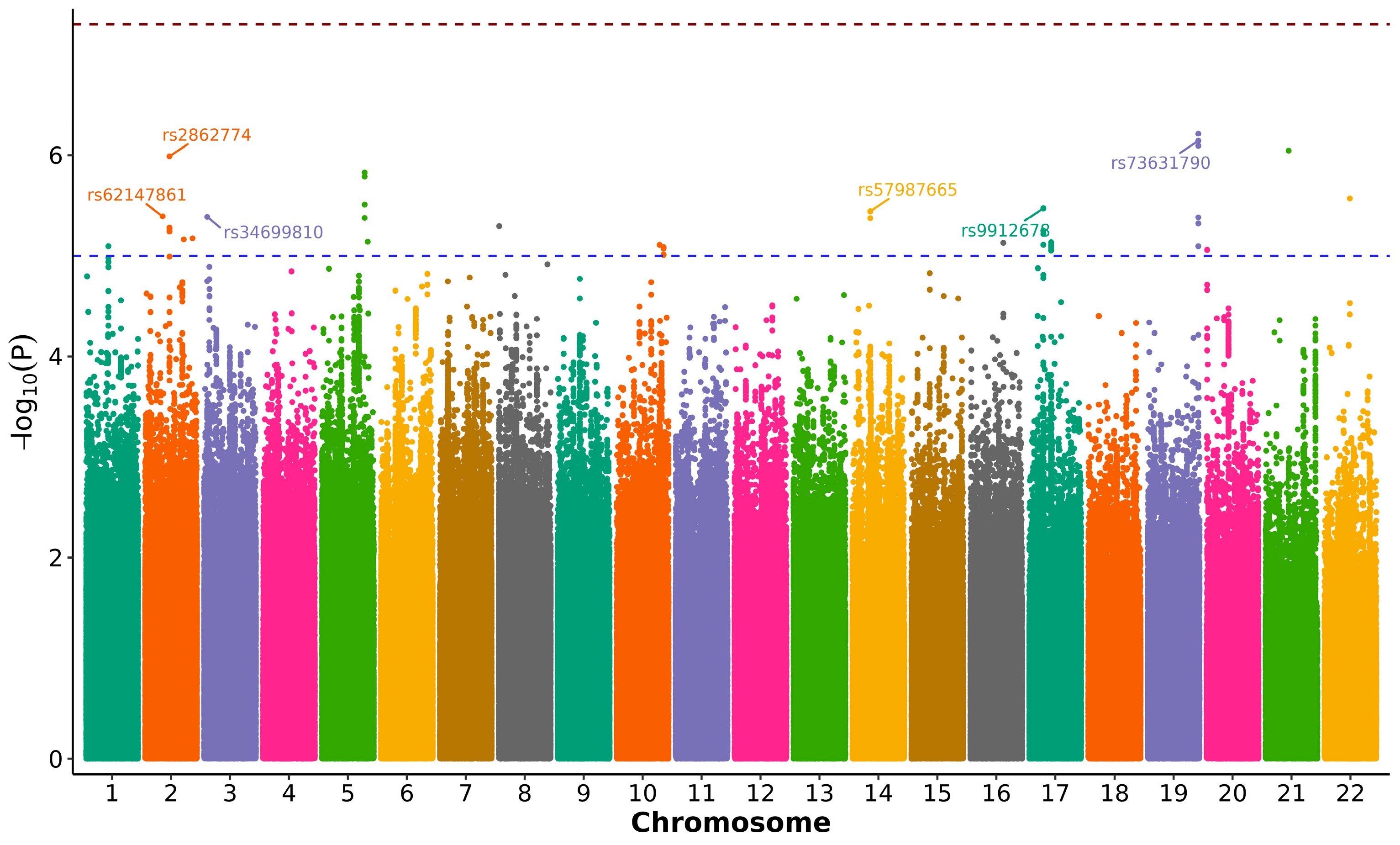
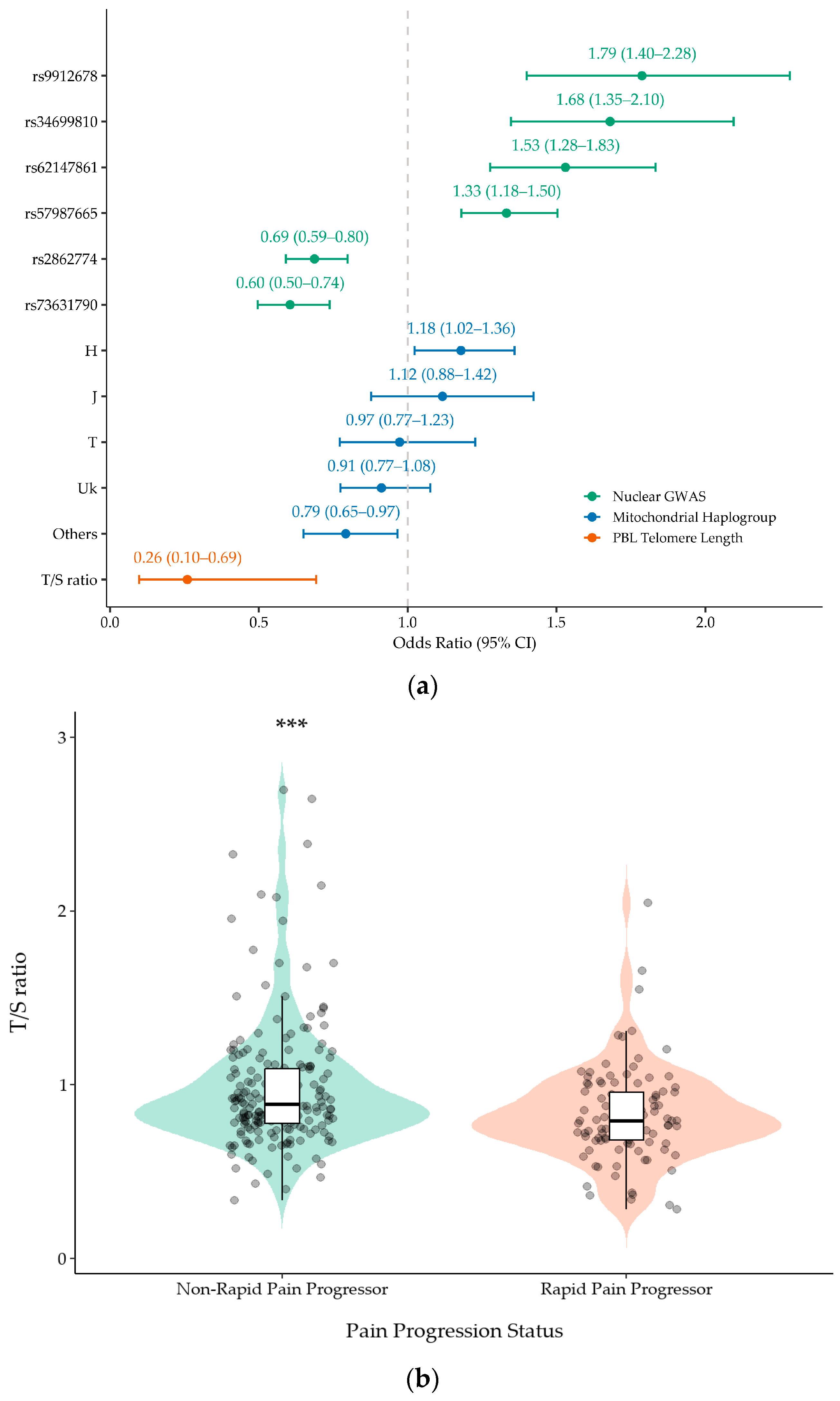
| rs73631790 | 19 | G | A | DUXA | 0.605 (0.496–0.738) | 7.195 × 10⁻⁷ |
| rs9912678 | 17 | A | T | RAI1 | 1.787 (1.400–2.284) | 3.374 × 10⁻⁶ |
| rs57987665 | 14 | A | G | LOC105378178 | 1.332 (1.180–1.503) | 3.618 × 10⁻⁶ |
| rs34699810 | 3 | A | G | LMCD1-AS1 | 1.680 (1.347–2.095) | 4.107 × 10⁻⁶ |
| rs2862774 | 2 | A | C | IL36B | 0.687 (0.591–0.798) | 1.027 × 10⁻⁶ |
| rs62147861 | 2 | C | A | LOC124907827 | 1.530 (1.277–1.833) | 4.059 × 10⁻⁶ |
| Haplogroups | Rapid Pain Progressors | Non-Rapid Pain Progressors | Total | 95% CI | ||||
|---|---|---|---|---|---|---|---|---|
| (n = 1239) | (n = 2118) | (n = 3357) | OR | Lower CI | Upper CI | p-Value | q-Value & | |
| H | 538 (43.4) | 835 (39.4) | 1373 (40.9) | 1.179 | 1.023 | 1.359 | 0.023 # | 0.115 |
| Uk | 287 (23.2) | 526 (24.8) | 813 (24.2) | 0.912 | 0.774 | 1.076 | 0.275 | 1.000 |
| T | 125 (10.1) | 219 (10.3) | 344 (10.2) | 0.973 | 0.772 | 1.227 | 0.817 | 1.000 |
| J | 119 (9.6) | 184 (8.7) | 303 (9.0) | 1.117 | 0.877 | 1.423 | 0.371 | 1.000 |
| Others * | 170 (13.7) | 354 (16.7) | 524 (15.6) | 0.792 | 0.650 | 0.966 | 0.021 # | 0.105 |
| Variable | B | Adjusted OR | 95% CI | p-Value |
|---|---|---|---|---|
| Sex (female) | 0.402 | 1.494 | 1.289–1.732 | <0.001 |
| Age | 0.009 | 1.009 | 1.001–1.017 | 0.031 |
| BMI | 0.107 | 1.113 | 1.095–1.131 | <0.001 |
| Haplogroup H | 0.159 | 1.172 | 1.012–1.357 | 0.034 |
| Variable | B | Adjusted OR | 95% CI | p-Value |
|---|---|---|---|---|
| Sex (female) | 0.140 | 1.150 | 0.688–1.923 | 0.593 |
| Age | 0.012 | 1.012 | 0.982–1.042 | 0.449 |
| BMI | 0.132 | 1.141 | 1.076–1.211 | <0.001 |
| T/S ratio * | −1.347 | 0.260 | 0.098–0.693 | 0.007 |
Disclaimer/Publisher’s Note: The statements, opinions and data contained in all publications are solely those of the individual author(s) and contributor(s) and not of MDPI and/or the editor(s). MDPI and/or the editor(s) disclaim responsibility for any injury to people or property resulting from any ideas, methods, instructions or products referred to in the content. |
© 2026 by the authors. Licensee MDPI, Basel, Switzerland. This article is an open access article distributed under the terms and conditions of the Creative Commons Attribution (CC BY) license.
Share and Cite
Blanco, F.J.; Oreiro, N.; Vázquez-García, J.; Morano-Torres, A.; Relaño, S.; Martínez-Sotodosos, L.; Noriega-Cobo, D.M.; Otero-Fariña, F.; Mosquera, A.; Fernández, J.L.; et al. Redox-Related Genetic and Biological Ageing Signals in Rapid Pain Progression of Knee Osteoarthritis: A Hypothesis-Generating Analysis in the Osteoarthritis Initiative. Antioxidants 2026, 15, 266. https://doi.org/10.3390/antiox15020266
Blanco FJ, Oreiro N, Vázquez-García J, Morano-Torres A, Relaño S, Martínez-Sotodosos L, Noriega-Cobo DM, Otero-Fariña F, Mosquera A, Fernández JL, et al. Redox-Related Genetic and Biological Ageing Signals in Rapid Pain Progression of Knee Osteoarthritis: A Hypothesis-Generating Analysis in the Osteoarthritis Initiative. Antioxidants. 2026; 15(2):266. https://doi.org/10.3390/antiox15020266
Chicago/Turabian StyleBlanco, Francisco J., Natividad Oreiro, Jorge Vázquez-García, Antonio Morano-Torres, Sara Relaño, Laura Martínez-Sotodosos, Diana M. Noriega-Cobo, Fátima Otero-Fariña, Alejandro Mosquera, Jose L. Fernández, and et al. 2026. "Redox-Related Genetic and Biological Ageing Signals in Rapid Pain Progression of Knee Osteoarthritis: A Hypothesis-Generating Analysis in the Osteoarthritis Initiative" Antioxidants 15, no. 2: 266. https://doi.org/10.3390/antiox15020266
APA StyleBlanco, F. J., Oreiro, N., Vázquez-García, J., Morano-Torres, A., Relaño, S., Martínez-Sotodosos, L., Noriega-Cobo, D. M., Otero-Fariña, F., Mosquera, A., Fernández, J. L., & Rego-Pérez, I. (2026). Redox-Related Genetic and Biological Ageing Signals in Rapid Pain Progression of Knee Osteoarthritis: A Hypothesis-Generating Analysis in the Osteoarthritis Initiative. Antioxidants, 15(2), 266. https://doi.org/10.3390/antiox15020266