Centrally Acting Skeletal Muscle Relaxants Sharing Molecular Targets with Drugs for Neuropathic Pain Management
 ,
,  , , and
Abstract
1. Introduction
2. Centrally Acting Skeletal Muscle Relaxants Sharing Molecular Targets with Current Neuropathic Pain Medications
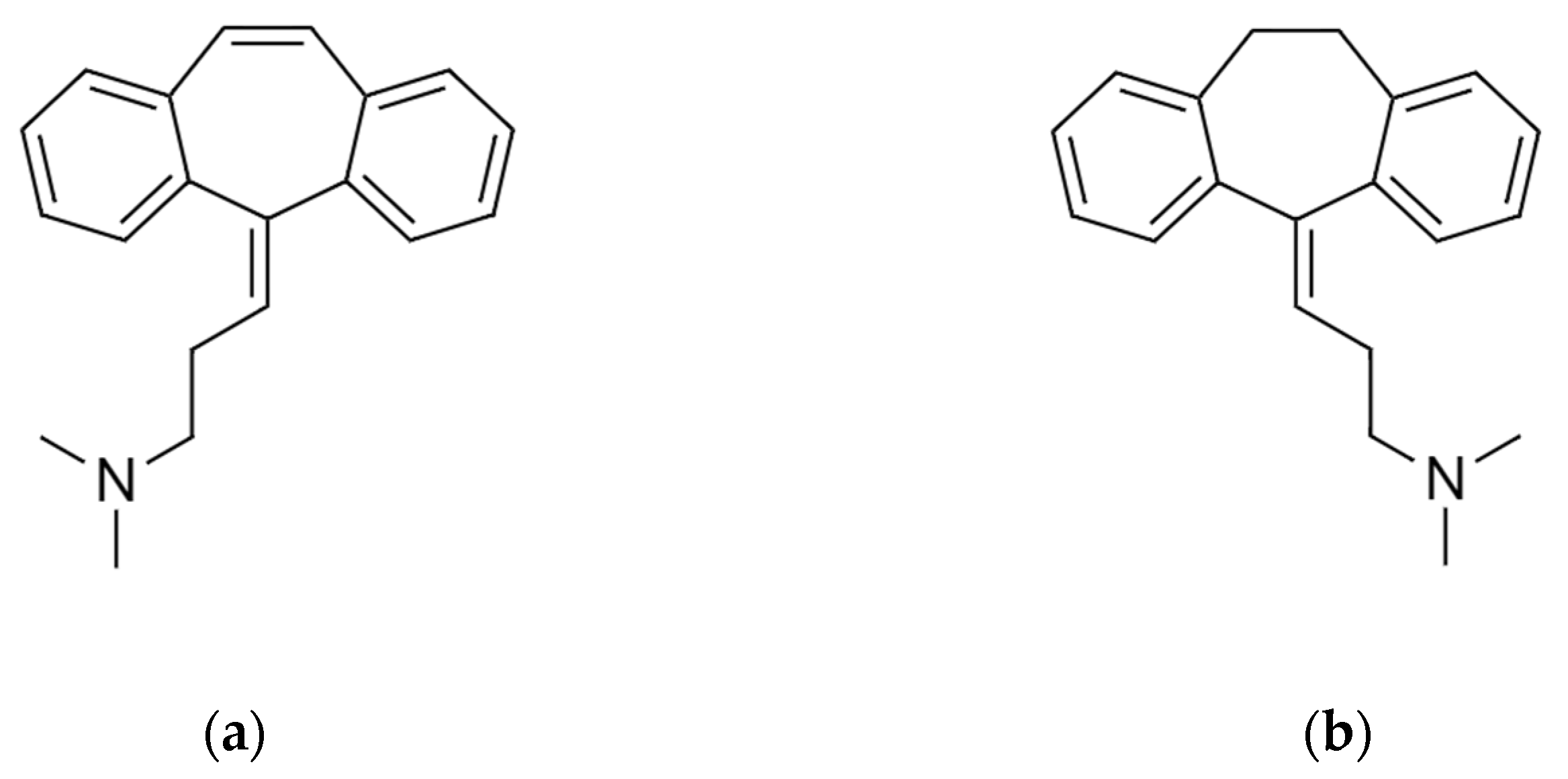
2.1. Cyclobenzaprine
2.2. Tizanidine
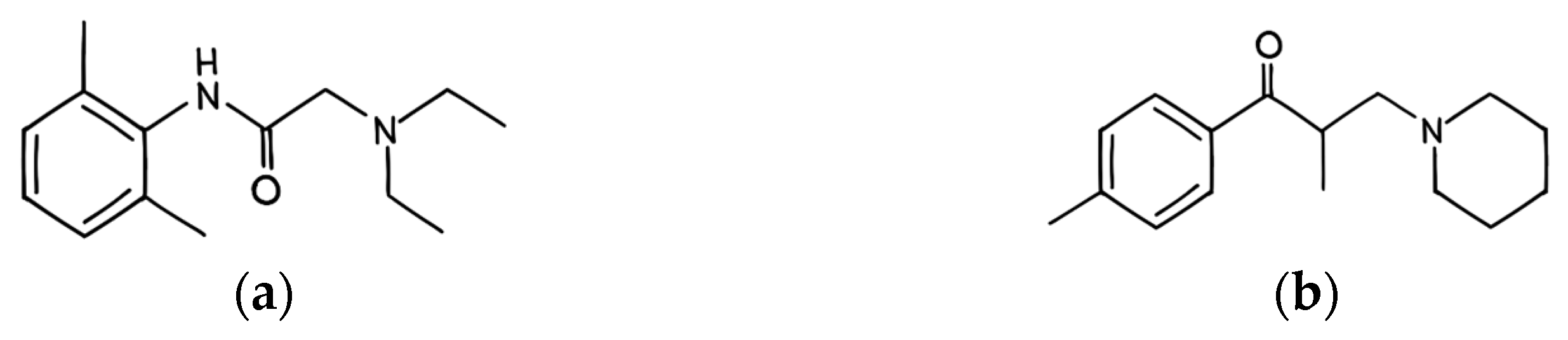
2.3. Tolperisone

| Type | Channel | Voltage Activation | Peripheral Primary Afferents/Dorsal Root Ganglia | Spinal Dorsal Horn | Thalamus | Somatosensory Cortex | References |
|---|---|---|---|---|---|---|---|
| L | Cav1.1 | HVA | No | No | No | No | [147,148,149,150,151,152,153,154,155,156,157,158,159] |
| Cav1.2 | HVA | Yes (Low) | Yes | Yes | Yes | ||
| Cav1.3 | HVA | No | Yes | Yes | Yes | ||
| Cav1.4 | HVA | No | No | No | No | ||
| P/Q | Cav2.1 | HVA | Yes | Yes * | Yes | Not enough data | [157,158,159] |
| N | Cav2.2 | HVA | Yes | Yes | No | No | [159,160,161,162,163] |
| R | Cav2.3 | HVA | Yes | Yes | Yes | Yes (debated) | [164,165,166,167,168,169,170,171,172,173,174] |
| T | Cav3.1 | LVA | No | Yes | Yes | Yes | [175,176,177] |
| Cav3.2 | LVA | Yes | Yes | No | Yes | ||
| Cav3.3 | LVA | No | Yes (Low) | Yes | Yes |
3. Current Knowledge on the Efficacy of CMRs in Neuropathic Pain Management
4. Future Perspectives and Conclusions
Author Contributions
Funding
Data Availability Statement
Conflicts of Interest
Abbreviations
| AR | Adrenoceptor |
| CCI | Chronic constriction injury |
| CINP | Chemotherapy-induced neuropathic pain |
| CMR | Centrally acting skeletal muscle relaxant |
| CNS | Central nervous system |
| DRG | Dorsal root ganglion |
| ECG | Electrocardiogram |
| GABABR | gamma-aminobutyric acid B receptor |
| GPCR | G-protein coupled receptor |
| HERG | Human ether-a-go-go-related gene |
| h | Hour |
| HVA | High-voltage-activated |
| IC50 | Half-maximal inhibitory concentration |
| IKr | Rapid delayed rectifier potassium current |
| Ip. | Intraperitoneal |
| Iv. | Intravenous |
| LVA | Low-voltage-activated |
| MAPD90 | Monophasic action potential duration at 90% repolarization |
| NMDAR | N-methyl-D-aspartate-receptor |
| NP | Neuropathic pain |
| NSAID | Non-steroidal anti-inflammatory drug |
| PHN | postherpetic neuralgia |
| PN | Peripheral neuropathy |
| Po. | Per os |
| SCI | Spinal cord injury |
| SNI | Spared nerve injury |
| SNL | Spinal nerve ligation |
| TCA | Tricyclic antidepressant |
| TGN | Trigeminal neuralgia |
| TRPV1 | Transient Receptor Potential Vanilloid 1 |
| TTX-R | Tetrodotoxin-resistant |
| TTX-S | Tetrodotoxin-sensitive |
| VGCC | Voltage-gated calcium channel |
| VGSC | Voltage-gated sodium channel |
| WDR | Wide dynamic range |
References
- Witenko, C.; Moorman-Li, R.; Motycka, C.; Duane, K.; Hincapie-Castillo, J.; Leonard, P.; Valaer, C. Considerations for the Appropriate Use of Skeletal Muscle Relaxants for the Management of Acute Low Back Pain. Pharm. Ther. 2014, 39, 427. [Google Scholar]
- Zhu, L.L.; Wang, Y.H.; Zhou, Q. Tizanidine: Advances in Pharmacology & Therapeutics and Drug Formulations. J. Pain Res. 2024, 17, 1257–1271. [Google Scholar] [CrossRef]
- Oldfield, B.J.; Gleeson, B.; Morford, K.L.; Adams, Z.; Funaro, M.C.; Becker, W.C.; Merlin, J.S. Long-Term Use of Muscle Relaxant Medications for Chronic Pain: A Systematic Review. JAMA Netw. Open 2024, 7, e2434835. [Google Scholar] [CrossRef]
- Nielsen, R.V.; Fomsgaard, J.S.; Siegel, H.; Martusevicius, R.; Mathiesen, O.; Dahl, J.B. The Effect of Chlorzoxazone on Acute Pain after Spine Surgery. A Randomized, Blinded Trial. Acta Anaesthesiol. Scand. 2016, 60, 1152–1160. [Google Scholar] [CrossRef]
- Borenstein, D.G.; Lacks, S.; Wiesel, S.W. Cyclobenzaprine and Naproxen versus Naproxen Alone in the Treatment of Acute Low Back Pain and Muscle Spasm. Clin. Ther. 1990, 12, 125–131. [Google Scholar]
- Tüzün, F.; Ünalan, H.; Öner, N.; Özgüzel, H.; Kirazli, Y.; Içaǧasioǧlu, A.; Kuran, B.; Tüzün, Ş.; Başar, G. Multicenter, Randomized, Double-Blinded, Placebo-Controlled Trial of Thiocolchicoside in Acute Low Back Pain. Jt. Bone Spine 2003, 70, 356–361. [Google Scholar] [CrossRef]
- Pillastrini, P.; Gardenghi, I.; Bonetti, F.; Capra, F.; Guccione, A.; Mugnai, R.; Violante, F.S. An Updated Overview of Clinical Guidelines for Chronic Low Back Pain Management in Primary Care. Jt. Bone Spine 2012, 79, 176–185. [Google Scholar] [CrossRef]
- Rao, R.; Panghate, A.; Chandanwale, A.; Sardar, I.; Ghosh, M.; Roy, M.; Banerjee, B.; Goswami, A.; Kotwal, P.P. Clinical Comparative Study: Efficacy and Tolerability of Tolperisone and Thiocolchicoside in Acute Low Back Pain and Spinal Muscle Spasticity. Asian Spine J. 2012, 6, 115–122. [Google Scholar] [CrossRef] [PubMed]
- Soonawalla, D.F.; Joshi, N. Efficacy of Thiocolchicoside in Indian Patients Suffering from Low Back Pain Associated with Muscle Spasm. J. Indian Med. Assoc. 2008, 106, 331–335. [Google Scholar] [PubMed]
- Hoiriis, K.T.; Pfleger, B.; McDuffie, F.C.; Cotsonis, G.; Elsangak, O.; Hinson, R.; Verzosa, G.T. A Randomized Clinical Trial Comparing Chiropractic Adjustments to Muscle Relaxants for Subacute Low Back Pain. J. Manip. Physiol. Ther. 2004, 27, 388–398. [Google Scholar] [CrossRef] [PubMed]
- Quasthoff, S.; Möckel, C.; Zieglgänsberger, W.; Schreibmayer, W. Tolperisone: A Typical Representative of a Class of Centrally Acting Muscle Relaxants with Less Sedative Side Effects. CNS Neurosci. Ther. 2008, 14, 107–119. [Google Scholar] [CrossRef] [PubMed]
- Dillon, C.; Paulose-Ram, R.; Hirsch, R.; Gu, Q. Skeletal Muscle Relaxant Use in the United States: Data from the Third National Health and Nutrition Examination Survey (NHANES III). Spine 2004, 29, 892–896. [Google Scholar] [CrossRef]
- Finnerup, N.B. Neuropathic Pain and Spasticity: Intricate Consequences of Spinal Cord Injury. Spinal Cord 2017, 55, 1046–1050. [Google Scholar] [CrossRef] [PubMed]
- Sun, W.M.; Ma, C.L.; Xu, J.; He, J.P. Reduction in Post-Spinal Cord Injury Spasticity by Combination of Peripheral Nerve Grafting and Acidic Fibroblast Growth Factor Infusion in Monkeys. J. Int. Med. Res. 2021, 49, 03000605211022294. [Google Scholar] [CrossRef]
- Cabahug, P.; Pickard, C.; Edmiston, T.; Lieberman, J.A. A Primary Care Provider’s Guide to Spasticity Management in Spinal Cord Injury. Top. Spinal Cord Inj. Rehabil. 2020, 26, 157–165. [Google Scholar] [CrossRef]
- Stamenova, P.; Koytchev, R.; Kuhn, K.; Hansen, C.; Horvath, F.; Ramm, S.; Pongratz, D. A Randomized, Double-Blind, Placebo-Controlled Study of the Efficacy and Safety of Tolperisone in Spasticity Following Cerebral Stroke. Eur. J. Neurol. 2005, 12, 453–461. [Google Scholar] [CrossRef]
- Dulin, J.; Kovacs, L.; Ramm, S.; Horvath, F.; Ebeling, L.; Kohnen, R. Evaluation of Sedative Effects of Single and Repeated Doses of 50 Mg and 150 Mg Tolperisone Hydrochloride. Results of a Prospective, Randomized, Double-Blind, Placebo-Controlled Trial. Pharmacopsychiatry 1998, 31, 137–142. [Google Scholar] [CrossRef]
- Pratzel, H.G.; Alken, R.G.; Ramm, S. Efficacy and Tolerance of Repeated Oral Doses of Tolperisone Hydrochloride in the Treatment of Painful Reflex Muscle Spasm: Results of a Prospective Placebo-Controlled Double-Blind Trial. Pain 1996, 67, 417–425. [Google Scholar] [CrossRef] [PubMed]
- Chong, M.S.; Bahra, A.; Zakrzewska, J.M. Guidelines for the Management of Trigeminal Neuralgia. Clevel. Clin. J. Med. 2023, 90, 355–362. [Google Scholar] [CrossRef]
- Zhao, X.; Ge, S. The Efficacy and Safety of Gabapentin vs. Carbamazepine in Patients with Primary Trigeminal Neuralgia: A Systematic Review and Meta-Analysis. Front. Neurol. 2023, 14, 1045640. [Google Scholar] [CrossRef]
- Nickel, F.T.; Seifert, F.; Lanz, S.; Maihöfner, C. Mechanisms of Neuropathic Pain. Eur. Neuropsychopharmacol. 2012, 22, 81–91. [Google Scholar] [CrossRef]
- Zeng, L.; Alongkronrusmee, D.; van Rijn, R.M. An Integrated Perspective on Diabetic, Alcoholic, and Drug-Induced Neuropathy, Etiology, and Treatment in the US. J. Pain Res. 2017, 10, 219–228. [Google Scholar] [CrossRef]
- Mendlik, M.T.; Uritsky, T.J. Treatment of Neuropathic Pain. Curr. Treat. Options Neurol. 2015, 17, 50. [Google Scholar] [CrossRef]
- Al-Khrasani, M.; Mohammadzadeh, A.; Balogh, M.; Király, K.; Barsi, S.; Hajnal, B.; Köles, L.; Zádori, Z.S.; Harsing, L.G., Jr. Glycine Transporter Inhibitors: A New Avenue for Managing Neuropathic Pain. Brain Res. Bull. 2019, 152, 143–158. [Google Scholar] [CrossRef]
- Finnerup, N.B.; Attal, N.; Haroutounian, S.; McNicol, E.; Baron, R.; Dworkin, R.H.; Gilron, I.; Haanpää, M.; Hansson, P.; Jensen, T.S.; et al. Pharmacotherapy for Neuropathic Pain in Adults: A Systematic Review and Meta-Analysis. Lancet Neurol. 2015, 14, 162–173. [Google Scholar] [CrossRef] [PubMed]
- Di Stefano, G.; La Cesa, S.; Truini, A.; Cruccu, G. Natural History and Outcome of 200 Outpatients with Classical Trigeminal Neuralgia Treated with Carbamazepine or Oxcarbazepine in a Tertiary Centre for Neuropathic Pain. J. Headache Pain 2014, 15, 34. [Google Scholar] [CrossRef] [PubMed]
- Zavvarian, M.M.; Hong, J.; Fehlings, M.G. The Functional Role of Spinal Interneurons Following Traumatic Spinal Cord Injury. Front. Cell. Neurosci. 2020, 14, 127. [Google Scholar] [CrossRef] [PubMed]
- Kopach, O.; Medvediev, V.; Krotov, V.; Borisyuk, A.; Tsymbaliuk, V.; Voitenko, N. Opposite, Bidirectional Shifts in Excitation and Inhibition in Specific Types of Dorsal Horn Interneurons Are Associated with Spasticity and Pain Post-SCI. Sci. Rep. 2017, 7, 5884. [Google Scholar] [CrossRef]
- Woolf, C.J.; Mannion, R.J. Neuropathic Pain: Aetiology, Symptoms, Mechanisms, and Management. Lancet 1999, 353, 1959–1964. [Google Scholar] [CrossRef]
- Al-Khrasani, M.; Essmat, N.; Boldizsár, I.; Varga, B.T.; Chalabiani, Y.; Abbood, S.K.; Ernyey, A.J.; Király, K.; Máté, A.; Riba, P.; et al. Do Vitamins Halt the COVID-19-Evoked pro-Inflammatory Cytokines Involved in the Development of Neuropathic Pain? Biomed. Pharmacother. 2025, 189, 118346. [Google Scholar] [CrossRef]
- Waldman, H.J.; Waldman, S.D.; Kidder, K.A. Centrally Acting Skeletal Muscle Relaxants and Associated Drugs. In Pain Management, 2nd ed.; National Library of Medicine: Bethesda, MD, USA, 2011. [Google Scholar]
- Share, N.N.; McFarlane, C.S. Cyclobenzaprine: A Novel Centrally Acting Skeletal Muscle Relaxant. Neuropharmacology 1975, 14, 675–684. [Google Scholar] [CrossRef]
- Spiller, H.A.; Winter, M.L.; Mann, K.V.; Borys, D.J.; Muir, S.; Krenzelok, E.P. Five-Year Multicenter Retrospective Review of Cyclobenzaprine Toxicity. J. Emerg. Med. 1995, 13, 781–785. [Google Scholar] [CrossRef]
- Browning, R.; Jackson, J.L.; O’Malley, P.G. Cyclobenzaprine and Back Pain: A Meta-Analysis. Arch. Intern. Med. 2001, 161, 1613–1620. [Google Scholar] [CrossRef] [PubMed]
- Bebarta, V.S.; Maddry, J.; Borys, D.J.; Morgan, D.L. Incidence of Tricyclic Antidepressant-like Complications after Cyclobenzaprine Overdose. Am. J. Emerg. Med. 2011, 29, 645–649. [Google Scholar] [CrossRef] [PubMed][Green Version]
- Kobayashi, H.; Hasegawa, Y.; Ono, H. Cyclobenzaprine, a Centrally Acting Muscle Relaxant, Acts on Descending Serotonergic Systems. Eur. J. Pharmacol. 1996, 311, 29–35. [Google Scholar] [CrossRef]
- Sayers, A.C.; Bürki, H.R.; Eichenberger, E. The Pharmacology of 5-Chloro-4-(2-Imidazolin-2-Yl-Amino)-2,1,3-Benzothiadiazole (DS 103-282), a Novel Myotonolytic Agent. Arzneimittelforschung 1980, 30, 793–803. [Google Scholar]
- Sie, O.G.; Lakke, J.P.W.F. The Spasmolytic Properties of 5-Chloro-4-(2-Imidazolin-2-Yl-Amino)-2, 1, 3-Benzothiadiazole Hydrochloride (DS 103-282): A Pilot Study. Clin. Neurol. Neurosurg. 1980, 82, 273–279. [Google Scholar] [CrossRef] [PubMed]
- Kameyama, T.; Nabeshima, T.; Matsuno, K.; Sugimoto, A. Comparison of α-Adrenoceptor Involvement in the Antinociceptive Action of Tizanidine and Clonidine in the Mouse. Eur. J. Pharmacol. 1986, 125, 257–264. [Google Scholar] [CrossRef]
- Klimscha, W.; Chiari, A.; Krafft, P.; Plattner, O.; Taslimi, R.; Mayer, N.; Weinstabl, C.; Schneider, B.; Zimpfer, M. Hemodynamic and Analgesic Effects of Clonidine Added Repetitively to Continuous Epidural and Spinal Blocks. Anesth. Analg. 1995, 80, 322–327. [Google Scholar] [CrossRef]
- Wagstaff, A.J.; Bryson, H.M. Tizanidine: A Review of Its Pharmacology, Clinical Efficacy and Tolerability in the Management of Spasticity Associated with Cerebral and Spinal Disorders. Drugs 1997, 53, 435–452. [Google Scholar] [CrossRef]
- Ono, H.; Fukuda, H.; Kudo, Y. Mechanisms of Depressant Action of Muscle Relaxants on Spinal Reflexes: Participation of Membrane Stabilizing Action. J. Pharmacobio-Dyn. 1984, 7, 171–176. [Google Scholar] [CrossRef]
- Novales-Li, P.; Sun, X.-P.; Takeuchi, H. Suppression of Calcium Current in a Snail Neurone by Eperisone and Its Analogues. Eur. J. Pharmacol. 1989, 168, 299–305. [Google Scholar] [CrossRef]
- Melka, A.; Tekle-Haimanot, R.; Lambien, F. Symptomatic Treatment of Neurolathyrism with Tolperisone HCL (Mydocalm): A Randomized Double Blind and Placebo Controlled Drug Trial. Ethiop. Med. J. 1997, 35, 77–91. [Google Scholar]
- Hinck, D.; Koppenhöfer, E. Tolperisone-A Novel Modulator of Ionic Currents in Myelinated Axons. Gen. Physiol. Biophys. 2001, 20, 413–429. [Google Scholar] [PubMed]
- Vaughan, S.A.; Torres, K.; Kaye, R. RESUME-1: A Phase III Study of Tolperisone in the Treatment of Painful, Acute Muscle Spasms of the Back. Pain Manag. 2021, 12, 25–33. [Google Scholar] [CrossRef]
- Bae, J.W.; Kim, M.J.; Park, Y.S.; Myung, C.S.; Jang, C.G.; Lee, S.Y. Considerable Interindividual Variation in the Pharmacokinetics of Tolperisone HC. Int. J. Clin. Pharmacol. Ther. 2007, 45, 110–113. [Google Scholar] [CrossRef] [PubMed]
- Wuis, E.W.; Dirks, M.J.M.; Vree, T.B.; Van der Kleijn, E. Pharmacokinetics of Baclofen in Spastic Patients Receiving Multiple Oral Doses. Pharm. Weekbl. Sci. 1990, 12, 71–74. [Google Scholar] [CrossRef] [PubMed]
- Bowery, N.G.; Hill, D.R.; Hudson, A.L.; Doble, A.; Middlemiss, D.N.; Shaw, J.; Turnbull, M. (-)Baclofen Decreases Neurotransmitter Release in the Mammalian CNS by an Action at a Novel GABA Receptor. Nature 1980, 283, 92–94. [Google Scholar] [CrossRef]
- Hulme, A.; MacLennan, W.J.; Ritchie, R.T.; John, V.A.; Shotton, P.A. Baclofen in the Elderly Stroke Patient Its Side-Effects and Pharmacokinetics. Eur. J. Clin. Pharmacol. 1985, 29, 467–469. [Google Scholar] [CrossRef]
- Fromm, G.H.; Terrence, C.F.; Chattha, A.S. Baclofen in the Treatment of Trigeminal Neuralgia: Double-blind Study and Long-term Follow-up. Ann. Neurol. 1984, 15, 240–244. [Google Scholar] [CrossRef]
- Attal, N. Pharmacological Treatments of Neuropathic Pain: The Latest Recommendations. Rev. Neurol. 2019, 175, 46–50. [Google Scholar] [CrossRef]
- Bennett, M.I.; Simpson, K.H. Gabapentin in the Treatment of Neuropathic Pain. Palliat. Med. 2004, 18, 5–11. [Google Scholar] [CrossRef]
- Serpell, M.G. Gabapentin in Neuropathic Pain Syndromes: A Randomised, Double-Blind, Placebo-Controlled Trial. Pain 2002, 99, 557–566. [Google Scholar] [CrossRef] [PubMed]
- Kukkar, A.; Bali, A.; Singh, N.; Jaggi, A.S. Implications and Mechanism of Action of Gabapentin in Neuropathic Pain. Arch. Pharm. Res. 2013, 36, 237–251. [Google Scholar] [CrossRef] [PubMed]
- Martins, D.F.; Prado, M.R.B.; Daruge-Neto, E.; Batisti, A.P.; Emer, A.A.; Mazzardo-Martins, L.; Santos, A.R.S.; Piovezan, A.P. Caffeine Prevents Antihyperalgesic Effect of Gabapentin in an Animal Model of CRPS-I: Evidence for the Involvement of Spinal Adenosine A1 Receptor. J. Peripher. Nerv. Syst. 2015, 20, 403–409. [Google Scholar] [CrossRef] [PubMed]
- Dworkin, R.H.; O’Connor, A.B.; Backonja, M.; Farrar, J.T.; Finnerup, N.B.; Jensen, T.S.; Kalso, E.A.; Loeser, J.D.; Miaskowski, C.; Nurmikko, T.J.; et al. Pharmacologic Management of Neuropathic Pain: Evidence-Based Recommendations. Pain 2007, 132, 237–251. [Google Scholar] [CrossRef]
- Gupta, S.; Nihalani, N.; Masand, P. Duloxetine: Review of Its Pharmacology, and Therapeutic Use in Depression and Other Psychiatric Disorders. Ann. Clin. Psychiatry 2007, 19, 125–132. [Google Scholar] [CrossRef]
- Lunn, M.P.T.; Hughes, R.A.C.; Wiffen, P.J. Duloxetine for Treating Painful Neuropathy, Chronic Pain or Fibromyalgia. Cochrane Database Syst. Rev. 2014, 2014, CD007115. [Google Scholar] [CrossRef]
- Bryson, H.M.; Wilde, M.I. Amitriptyline. A Review of Its Pharmacological Properties and Therapeutic Use in Chronic Pain States. Drugs Aging 1996, 8, 459–476. [Google Scholar] [CrossRef]
- Hofer, D.; Lohberger, B.; Steinecker, B.; Schmidt, K.; Quasthoff, S.; Schreibmayer, W. A Comparative Study of the Action of Tolperisone on Seven Different Voltage Dependent Sodium Channel Isoforms. Eur. J. Pharmacol. 2006, 538, 5–14. [Google Scholar] [CrossRef]
- Mao, J.; Chen, L.L. Systemic Lidocaine for Neuropathic Pain Relief. Pain 2000, 87, 7–17. [Google Scholar] [CrossRef]
- Haeseler, G.; Foadi, N.; Ahrens, J.; Dengler, R.; Hecker, H.; Leuwer, M. Tramadol, Fentanyl and Sufentanil but Not Morphine Block Voltage-Operated Sodium Channels. Pain 2006, 126, 234–244. [Google Scholar] [CrossRef]
- Marincsák, R.; Tóth, B.I.; Czifra, G.; Szabó, T.; Kovács, L.; Bíró, T. The Analgesic Drug, Tramadol, Acts as an Agonist of the Transient Receptor Potential Vanilloid-1. Anesth. Analg. 2008, 106, 1890–1896. [Google Scholar] [CrossRef] [PubMed]
- Hara, K.; Minami, K.; Sata, T. The Effects of Tramadol and Its Metabolite on Glycine, γ-Aminobutyric AcidA, and N-Methyl-D-Aspartate Receptors Expressed in Xenopus Oocytes. Anesth. Analg. 2005, 100, 1400–1405. [Google Scholar] [CrossRef] [PubMed]
- Ambrósio, A.F.; Soares-da-Silva, P.; Carvalho, C.M.; Carvalho, A.P. Mechanisms of Action of Carbamazepine and Its Derivatives, Oxcarbazepine, BIA 2-093, and BIA 2-024. Neurochem. Res. 2002, 27, 121–130. [Google Scholar] [CrossRef] [PubMed]
- Fung, S.J.; Manzoni, D.; Chan, J.Y.H.; Pompeiano, O.; Barnes, C.D. Locus Coeruleus Control of Spinal Motor Output. Prog. Brain Res. 1991, 88, 395–409. [Google Scholar]
- Commissiong, J.W.; Karoum, F.; Reiffenstein, R.J.; Neff, N.H. Cyclobenzaprine: A Possible Mechanism of Action for Its Muscle Relaxant Effect. Can. J. Physiol. Pharmacol. 1981, 59, 37–44. [Google Scholar] [CrossRef]
- Hirayama, T.; Ono, H.; Fukuda, H. Effects of Adrenergic Agents on Ventral Horn Cells in Rat Spinal Cord Slices. Biomed. Res. 1988, 9, 343–351. [Google Scholar] [CrossRef]
- Fung, S.J.; Chan, J.Y.H.; Manzoni, D.; White, S.R.; Lai, Y.Y.; Strahlendorf, H.K.; Zhuo, H.; Liu, R.H.; Reddy, V.K.; Barnes, C.D. Cotransmitter-Mediated Locus Coeruleus Action on Motoneurons. Brain Res. Bull. 1994, 35, 423–432. [Google Scholar] [CrossRef]
- Tartas, M.; Morin, F.; Barrière, G.; Goillandeau, M.; Lacaille, J.C.; Cazalets, J.R.; Bertrand, S.S. Noradrenergic Modulation of Intrinsic and Synaptic Properties of Lumbar Motoneurons in the Neonatal Rat Spinal Cord. Front. Neural Circuits 2010, 4, 1243. [Google Scholar] [CrossRef]
- Rank, M.M.; Murray, K.C.; Stephens, M.J.; D’Amico, J.; Gorassini, M.A.; Bennett, D.J. Adrenergic Receptors Modulate Motoneuron Excitability, Sensory Synaptic Transmission and Muscle Spasms after Chronic Spinal Cord Injury. J. Neurophysiol. 2011, 105, 410–422. [Google Scholar] [CrossRef]
- Olson, D.E. Psychoplastogens: A Promising Class of Plasticity-Promoting Neurotherapeutics. J. Exp. Neurosci. 2018, 12, 1179069518800508. [Google Scholar] [CrossRef]
- Vizcarra, V.S.; Barber, K.R.; Franca-Solomon, G.; Majuta, L.; Smith, A.; Langlais, P.R.; Largent-Milnes, T.M.; Vanderah, T.W.; Riegel, A.C. Targeting 5-HT2A Receptors and Kv7 Channels in PFC to Attenuate Chronic Neuropathic Pain in Rats Using a Spared Nerve Injury Model. Neurosci. Lett. 2022, 789, 136864. [Google Scholar] [CrossRef]
- Perrier, J.-F.; Rasmussen, H.; Christensen, R.; Petersen, A. Modulation of the Intrinsic Properties of Motoneurons by Serotonin. Curr. Pharm. Des. 2013, 19, 4371–4384. [Google Scholar] [CrossRef] [PubMed]
- Perrier, J.F.; Cotel, F. Serotonergic Modulation of Spinal Motor Control. Curr. Opin. Neurobiol. 2015, 33, 1–7. [Google Scholar] [CrossRef] [PubMed]
- Bayliss, D.A.; Umemiya, M.; Berger, A.J. Inhibition of N- and P-type Calcium Currents and the After-hyperpolarization in Rat Motoneurones by Serotonin. J. Physiol. 1995, 485, 635–647. [Google Scholar] [CrossRef]
- Nadeson, R.; Goodchild, C.S. Antinociceptive Role of 5-HT1A Receptors in Rat Spinal Cord. Br. J. Anaesth. 2002, 88, 679–684. [Google Scholar] [CrossRef] [PubMed]
- Cortes-Altamirano, J.L.; Olmos-Hernandez, A.; Jaime, H.B.; Carrillo-Mora, P.; Bandala, C.; Reyes-Long, S.; Alfaro-Rodríguez, A. Review: 5-HT1, 5-HT2, 5-HT3 and 5-HT7 Receptors and Their Role in the Modulation of Pain Response in the Central Nervous System. Curr. Neuropharmacol. 2018, 16, 210–221. [Google Scholar] [CrossRef]
- Brenchat, A.; Nadal, X.; Romero, L.; Ovalle, S.; Muro, A.; Sánchez-Arroyos, R.; Portillo-Salido, E.; Pujol, M.; Montero, A.; Codony, X.; et al. Pharmacological Activation of 5-HT7 Receptors Reduces Nerve Injury-Induced Mechanical and Thermal Hypersensitivity. Pain 2010, 149, 483–494. [Google Scholar] [CrossRef]
- Bardin, L. The Complex Role of Serotonin and 5-HT Receptors in Chronic Pain. Behav. Pharmacol. 2011, 22, 390–404. [Google Scholar] [CrossRef]
- Okamoto, K.; Imbe, H.; Morikawa, Y.; Itoh, M.; Sekimoto, M.; Nemoto, K.; Senba, E. 5-HT2A Receptor Subtype in the Peripheral Branch of Sensory Fibers Is Involved in the Potentiation of Inflammatory Pain in Rats. Pain 2002, 99, 133–143. [Google Scholar] [CrossRef]
- Van Steenwinckel, J.; Brisorgueil, M.J.; Fischer, J.; Vergé, D.; Gingrich, J.A.; Bourgoin, S.; Hamon, M.; Bernard, R.; Conrath, M. Role of Spinal Serotonin 5-HT2A Receptor in 2′,3′-Dideoxycytidine-Induced Neuropathic Pain in the Rat and the Mouse. Pain 2008, 137, 66–80. [Google Scholar] [CrossRef]
- Wang, D.; Gao, Y.; Ji, H.; Hong, Y. Topical and Systemic Administrations of Ketanserin Attenuate Hypersensitivity and Expression of CGRP in Rats with Spinal Nerve Ligation. Eur. J. Pharmacol. 2010, 627, 124–130. [Google Scholar] [CrossRef] [PubMed]
- Nitanda, A.; Yasunami, N.; Tokumo, K.; Fujii, H.; Hirai, T.; Nishio, H. Contribution of the Peripheral 5-HT2A Receptor to Mechanical Hyperalgesia in a Rat Model of Neuropathic Pain. Neurochem. Int. 2005, 47, 394–400. [Google Scholar] [CrossRef]
- Dupuis, A.; Wattiez, A.S.; Pinguet, J.; Richard, D.; Libert, F.; Chalus, M.; Aissouni, Y.; Sion, B.; Ardid, D.; Marin, P.; et al. Increasing Spinal 5-HT2A Receptor Responsiveness Mediates Anti-Allodynic Effect and Potentiates Fluoxetine Efficacy in Neuropathic Rats. Evidence for GABA Release. Pharmacol. Res. 2017, 118, 93–103. [Google Scholar] [CrossRef] [PubMed]
- Day, L.T.; Jeanmonod, R.K. Serotonin Syndrome in a Patient Taking Lexapro and Flexeril: A Case Report. Am. J. Emerg. Med. 2008, 26, 1069.e1–1069.e3. [Google Scholar] [CrossRef] [PubMed]
- Mestres, J.; Seifert, S.A.; Oprea, T.I. Linking Pharmacology to Clinical Reports Cyclobenzaprine and Its Possible Association with Serotonin Syndrome. Clin. Pharmacol. Ther. 2011, 90, 662–665. [Google Scholar] [CrossRef]
- Keegan, M.T.; Brown, D.R.; Rabinstein, A.A. Serotonin Syndrome from the Interaction of Cyclobenzaprine with Other Serotoninergic Drugs. Anesth. Analg. 2006, 103, 1466–1468. [Google Scholar] [CrossRef]
- Herman, C.R.; Schiffman, E.L.; Look, J.O.; Rindal, D.B. The Effectiveness of Adding Pharmacologic Treatment with Clonazepam or Cyclobenzaprine to Patient Education and Self-Care for the Treatment of Jaw Pain upon Awakening: A Randomized Clinical Trial. J. Orofac. Pain 2002, 16, 1. [Google Scholar]
- Furtado, R.N.V.; Carazzato, S.; Farias, C.A.; Chamlian, T.R.; Masiero, D. Myofascial Syndrome: Comparison between Infiltration of Trigger Points Treatment and Oral Medication (Cyclobenzaprine). Acta Fisiátr. 2002, 9, 117–126. [Google Scholar] [CrossRef]
- Leite, F.M.G.; Atallah, Á.N.; El Dib, R.; Grossmann, E.; Januzzi, E.; Andriolo, R.B.; Da Silva, E.M.K. Cyclobenzaprine for the Treatment of Myofascial Pain in Adults. Cochrane Database Syst. Rev. 2009, 2017, CD006830. [Google Scholar] [CrossRef]
- Friedman, B.W.; Dym, A.A.; Davitt, M.; Holden, L.; Solorzano, C.; Esses, D.; Bijur, P.E.; Gallagher, E.J. Naproxen with Cyclobenzaprine, Oxycodone/Acetaminophen, or Placebo for Treating Acute Low Back Pain: A Randomized Clinical Trial. JAMA-J. Am. Med. Assoc. 2015, 314, 1572–1580. [Google Scholar] [CrossRef]
- Cohen, S.P.; Mullings, R.; Abdi, S. The Pharmacologic Treatment of Muscle Pain. Anesthesiology 2004, 101, 495–526. [Google Scholar] [CrossRef]
- Chua-Tuan, J.L.; Cao, D.; Iwanicki, J.L.; Hoyte, C.O. Cardiac Sodium Channel Blockade after an Intentional Ingestion of Lacosamide, Cyclobenzaprine, and Levetiracetam: Case Report. Clin. Toxicol. 2015, 53, 565–568. [Google Scholar] [CrossRef]
- Tu, J.; Zhang, C.; Xie, S.; He, J.; Zhang, H. Cyclobenzaprine-Related Adverse Events: A Comprehensive Pharmacovigilance Analysis Using the FDA Adverse Event Reporting System. Front. Med. 2025, 12, 1574395. [Google Scholar] [CrossRef] [PubMed]
- Kameyama, T.; Nabeshima, T.; Sugimoto, A.; Matsuno, K.; Yamada, S. Antinociceptive Action of Tizanidine in Mice and Rats. Naunyn Schmiedebergs Arch. Pharmacol. 1985, 330, 93–96. [Google Scholar] [CrossRef] [PubMed]
- Pei, W.; Zou, Y.; Wang, W.; Wei, L.; Zhao, Y.; Li, L. Tizanidine Exerts Anti-Nociceptive Effects in Spared Nerve Injury Model of Neuropathic Pain through Inhibition of TLR4/NF-ΚB Pathway. Int. J. Mol. Med. 2018, 42, 3209–3219. [Google Scholar] [CrossRef] [PubMed]
- McCarthy, R.J.; Kroin, J.S.; Lubenow, T.R.; Penn, R.D.; Ivankovich, A.D. Effect of Intrathecal Tizanidine on Antinociception and Blood Pressure in the Rat. Pain 1990, 40, 333–338. [Google Scholar] [CrossRef]
- Kawamata, T.; Omote, K.; Kawamata, M.; Iwasaki, H.; Namiki, A. Antinociceptive Interaction of Intrathecal A2-Adrenergic Agonists, Tizanidine and Clonidine, with Lidocaine in Rats. Anesthesiology 1997, 87, 436–448. [Google Scholar] [CrossRef]
- Hord, A.H.; Chalfoun, A.G.; Denson, D.D.; Azevedo, M.I. Systemic Tizanidine Hydrochloride (ZanaflexTM) Relieves Thermal Hyperalgesia in Rats with an Experimental Mononeuropathy. Anesth. Analg. 2001, 93, 1310–1315. [Google Scholar] [CrossRef]
- Semenchuk, M.R.; Sherman, S. Effectiveness of Tizanidine in Neuropathic Pain: An Open-Label Study. J. Pain 2000, 1, 285–292. [Google Scholar] [CrossRef] [PubMed]
- Young, W.S.; Kuhar, M.J. Noradrenergic A1 and A2 Receptors: Light Microscopic Autoradiographic Localization. Proc. Natl. Acad. Sci. USA 1980, 77, 1696–1700. [Google Scholar] [CrossRef]
- Brightwell, J.J.; Taylor, B.K. Noradrenergic Neurons in the Locus Coeruleus Contribute to Neuropathic Pain. Neuroscience 2009, 160, 174–185. [Google Scholar] [CrossRef] [PubMed]
- Buerkle, H.; Yaksh, T.L. Pharmacological Evidence for Different Alpha2-Adrenergic Receptor Sites Mediating Analgesia and Sedation in the Rat. Br. J. Anaesth. 1998, 81, 208–215. [Google Scholar] [CrossRef] [PubMed]
- Gyires, K.; Zádori, Z.S.; Török, T.; Mátyus, P. A2-Adrenoceptor Subtypes-Mediated Physiological, Pharmacological Actions. Neurochem. Int. 2009, 55, 447–453. [Google Scholar] [CrossRef]
- Bylund, D.B. Sub Types of A2-Adrenoceptors: Pharmacological and Molecular Biological Evidence Converg. Trends Pharmacol. Sci. 1988, 9, 356–361. [Google Scholar] [CrossRef]
- Hein, L.; Kobilka, B.K. Adrenergic Receptor Signal Transduction and Regulation. Neuropharmacology 1995, 34, 357–366. [Google Scholar] [CrossRef]
- Shujaa, N.; Al-Khrasani, M.; Zádori, Z.S.; Rossi, M.; Mátyus, P.; Németh, J.; Hein, L.; Gyires, K. α(2)-Adrenoceptor Agonist-Induced Inhibition of Gastric Motor Activity Is Mediated by α(2A)-Adrenoceptor Subtype in the Mouse. Neurochem. Int. 2011, 58, 708–713. [Google Scholar] [CrossRef]
- Michel, A.D.; Loury, D.N.; Whiting, R.L. Assessment of Imiloxan as a Selective α(2B)-Adrenoceptor Antagonist. Br. J. Pharmacol. 1990, 99, 560–564. [Google Scholar] [CrossRef]
- Sallinen, J.; Höglund, I.; Engström, M.; Lehtimäki, J.; Virtanen, R.; Sirviö, J.; Wurster, S.; Savola, J.M.; Haapalinna, A. Pharmacological Characterization and CNS Effects of a Novel Highly Selective α 2C-Adrenoceptor Antagonist JP-1302. Br. J. Pharmacol. 2007, 150, 391–402. [Google Scholar] [CrossRef]
- Nicholas, A.P.; Pieribone, V.; Hökfelt, T. Distributions of MRNAs for Alpha-2 Adrenergic Receptor Subtypes in Rat Brain: An in Situ Hybridization Study. J. Comp. Neurol. 1993, 328, 575–594. [Google Scholar] [CrossRef]
- Bahari, Z.; Meftahi, G.H. Spinal A2-Adrenoceptors and Neuropathic Pain Modulation; Therapeutic Target. Br. J. Pharmacol. 2019, 176, 2366–2381. [Google Scholar] [CrossRef]
- Malmberg, A.B.; Hedley, L.R.; Jasper, J.R.; Hunter, J.C.; Basbaum, A.I. Contribution of a 2 Receptor Subtypes to Nerve Injury-Induced Pain and Its Regulation by Dexmedetomidine. Br. J. Pharmacol. 2001, 132, 1827–1836. [Google Scholar] [CrossRef]
- Pertovaara, A. The Noradrenergic Pain Regulation System: A Potential Target for Pain Therapy. Eur. J. Pharmacol. 2013, 716, 2–7. [Google Scholar] [CrossRef] [PubMed]
- Costa-Pereira, J.T.; Ribeiro, J.; Martins, I.; Tavares, I. Role of Spinal Cord A2-Adrenoreceptors in Noradrenergic Inhibition of Nociceptive Transmission During Chemotherapy-Induced Peripheral Neuropathy. Front. Neurosci. 2020, 13, 1413. [Google Scholar] [CrossRef]
- Sudo, R.T.; do Amaral, R.V.; da Silva Monteiro, C.E.; Pitta, I.d.R.; Lima, M.d.C.; Montes, G.C.; Ririe, D.G.; Hayashida, K.; Zapata-Sudo, G. Antinociception Induced by a Novel A2A Adrenergic Receptor Agonist in Rodents Acute and Chronic Pain Models. Eur. J. Pharmacol. 2017, 815, 210–218. [Google Scholar] [CrossRef] [PubMed]
- Limbird, L.E. Receptors Linked to Inhibition of Adenylate Cyclase: Additional Signaling Mechanisms. FASEB J. 1988, 2, 2686–2695. [Google Scholar] [CrossRef]
- Gilsbach, R.; Hein, L. Are the Pharmacology and Physiology of α 2adrenoceptors Determined by α 2-Heteroreceptors and Autoreceptors Respectively? Br. J. Pharmacol. 2012, 165, 90–102. [Google Scholar] [CrossRef] [PubMed]
- Im, S.T.; Jo, Y.Y.; Han, G.; Jo, H.J.; Kim, Y.H.; Park, C.K. Dexmedetomidine Inhibits Voltage-Gated Sodium Channels via α 2-Adrenoceptors in Trigeminal Ganglion Neurons. Mediat. Inflamm. 2018, 2018, 1782719. [Google Scholar] [CrossRef]
- Kaddar, N.; Vigneault, P.; Pilote, S.; Patoine, D.; Simard, C.; Drolet, B. Tizanidine (Zanaflex): A Muscle Relaxant That May Prolong the QT Interval by Blocking I Kr. J. Cardiovasc. Pharmacol. Ther. 2012, 17, 102–109. [Google Scholar] [CrossRef]
- Svensson, P.; Wang, K.; Arendt-Nielsen, L. Effect of Muscle Relaxants on Experimental Jaw-Muscle Pain and Jaw-Stretch Reflexes: A Double-Blind and Placebo-Controlled Trial. Eur. J. Pain 2003, 7, 449–456. [Google Scholar] [CrossRef] [PubMed]
- Taylor, A.; McLeod, G. Basic Pharmacology of Local Anaesthetics. BJA Educ. 2020, 20, 34–41. [Google Scholar] [CrossRef]
- Yu, F.H.; Catterall, W.A. Overview of the Voltage-Gated Sodium Channel Family. Genome Biol. 2003, 4, 207. [Google Scholar] [CrossRef]
- Xie, Y.F. Nav1.8 and Chronic Pain: From Laboratory Animals to Clinical Patients. Biomolecules 2025, 15, 694. [Google Scholar] [CrossRef]
- Lai, J.; Porreca, F.; Hunter, J.C.; Gold, M.S. Voltage-Gated Sodium Channels and Hyperalgesia. Annu. Rev. Pharmacol. Toxicol. 2004, 44, 371–397. [Google Scholar] [CrossRef]
- Dib-Hajj, S.D.; Cummins, T.R.; Black, J.A.; Waxman, S.G. Sodium Channels in Normal and Pathological Pain. Annu. Rev. Neurosci. 2010, 33, 325–347. [Google Scholar] [CrossRef]
- Bertoch, T.; D’Aunno, D.; McCoun, J.; Solanki, D.; Taber, L.; Urban, J.; Oswald, J.; Swisher, M.W.; Tian, S.; Miao, X.; et al. Suzetrigine, a Nonopioid NaV1.8 Inhibitor for Treatment of Moderate-to-Severe Acute Pain: Two Phase 3 Randomized Clinical Trials. Anesthesiology 2025, 142, 1085–1099. [Google Scholar] [CrossRef] [PubMed]
- Cha, K.I.; Kim, G.E.; Seol, J.H.; Kim, D.W.; Lee, S. Enhancing Chemical Stability and Bioavailability of Aneratrigine Capsules via Dry Granulation: Addressing Stability Challenges in Sodium Bicarbonate-Containing Formulations for Clinical Development. Pharmaceutics 2025, 17, 1047. [Google Scholar] [CrossRef] [PubMed]
- Niu, H.L.; Liu, Y.N.; Xue, D.Q.; Dong, L.Y.; Liu, H.J.; Wang, J.; Zheng, Y.L.; Zou, A.R.; Shao, L.M.; Wang, K.W. Inhibition of Nav1.7 Channel by a Novel Blocker QLS-81 for Alleviation of Neuropathic Pain. Acta Pharmacol. Sin. 2021, 42, 1235–1247. [Google Scholar] [CrossRef]
- Zhang, B.; Shi, X.; Liu, X.; Liu, Y.; Li, X.; Wang, Q.; Huang, D.; Zhao, W.; Cui, J.; Cao, Y.; et al. Discovery of E0199: A Novel Compound Targeting Both Peripheral NaV and KV7 Channels to Alleviate Neuropathic Pain. J. Pharm. Anal. 2025, 15, 101132. [Google Scholar] [CrossRef]
- Jarvis, M.F.; Honore, P.; Shieh, C.C.; Chapman, M.; Joshi, S.; Zhang, X.F.; Kort, M.; Carroll, W.; Marron, B.; Atkinson, R.; et al. A-803467, a Potent and Selective Nav1.8 Sodium Channel Blocker, Attenuates Neuropathic and Inflammatory Pain in the Rat. Proc. Natl. Acad. Sci. USA 2007, 104, 8520–8525. [Google Scholar] [CrossRef]
- McGaraughty, S.; Chu, K.L.; Scanio, M.J.C.; Kort, M.E.; Faltynek, C.R.; Jarvis, M.F. A Selective Nav1.8 Sodium Channel Blocker, A-803467 [5-4-Chlorophenyl-N-(3,5-Dimethoxyphenyl)Furan-2-Carboxamide], Attenuates Spinal Neuronal Activity in Neuropathic Rats. J. Pharmacol. Exp. Ther. 2008, 324, 1204–1211. [Google Scholar] [CrossRef]
- Gilchrist, J.M.; Yang, N.D.; Jiang, V.; Moyer, B.D. Pharmacologic Characterization of LTGO-33, a Selective Small Molecule Inhibitor of the Voltage-Gated Sodium Channel NaV1.8 with a Unique Mechanism of ActionS. Mol. Pharmacol. 2024, 105, 233–249. [Google Scholar] [CrossRef]
- Su, M.; Ouyang, X.; Zhou, P.; Dong, L.; Shao, L.; Wang, K.; Liu, Y. Inhibition of TTX-S Na+ Currents by a Novel Blocker QLS-278 for Antinociception. J. Pharmacol. Exp. Ther. 2025, 392, 100030. [Google Scholar] [CrossRef]
- Xue, D.; Liu, Y.; Zheng, Y.; Niu, H.; Dong, L.; Ouyang, X.; Song, S.; Zhang, D.; Ge, Q.; Wang, K.; et al. Design and Synthesis of Novel α-Aminoamides Derivatives as Nav1.7 Inhibitors for Antinociception. Chin. Chem. Lett. 2022, 33, 1643–1646. [Google Scholar] [CrossRef]
- McCoun, J.; Winkle, P.; Solanki, D.; Urban, J.; Bertoch, T.; Oswald, J.; Swisher, M.W.; Taber, L.A.; Healey, T.; Jazic, I.; et al. Suzetrigine, a Non-Opioid NaV1.8 Inhibitor With Broad Applicability for Moderate-to-Severe Acute Pain: A Phase 3 Single-Arm Study for Surgical or Non-Surgical Acute Pain. J. Pain. Res. 2025, 18, 1569–1576. [Google Scholar] [CrossRef] [PubMed]
- Zakrzewska, J.M.; Palmer, J.; Morisset, V.; Giblin, G.M.; Obermann, M.; Ettlin, D.A.; Cruccu, G.; Bendtsen, L.; Estacion, M.; Derjean, D.; et al. Safety and Efficacy of a Nav1.7 Selective Sodium Channel Blocker in Patients with Trigeminal Neuralgia: A Double-Blind, Placebo-Controlled, Randomised Withdrawal Phase 2a Trial. Lancet Neurol. 2017, 16, 291–300. [Google Scholar] [CrossRef] [PubMed]
- Mueller, A.; Starobova, H.; Morgan, M.; Dekan, Z.; Cheneval, O.; Schroeder, C.I.; Alewood, P.F.; Deuis, J.R.; Vetter, I. Antiallodynic Effects of the Selective NaV1.7 Inhibitor Pn3a in a Mouse Model of Acute Postsurgical Pain: Evidence for Analgesic Synergy with Opioids and Baclofen. Pain 2019, 160, 1766–1780. [Google Scholar] [CrossRef]
- Deuis, J.R.; Wingerd, J.S.; Winter, Z.; Durek, T.; Dekan, Z.; Sousa, S.R.; Zimmermann, K.; Hoffmann, T.; Weidner, C.; Nassar, M.A.; et al. Analgesic Effects of GpTx-1, PF-04856264 and CNV1014802 in a Mouse Model of NaV1.7-Mediated Pain. Toxins 2016, 8, 78. [Google Scholar] [CrossRef] [PubMed]
- Lakatos, P.P.; Karádi, D.Á.; Galambos, A.R.; Essmat, N.; Király, K.; Laufer, R.; Geda, O.; Zádori, Z.S.; Tábi, T.; Al-Khrasani, M.; et al. The Acute Antiallodynic Effect of Tolperisone in Rat Neuropathic Pain and Evaluation of Its Mechanism of Action. Int. J. Mol. Sci. 2022, 23, 9564. [Google Scholar] [CrossRef]
- Essmat, N.; Galambos, A.R.; Lakatos, P.P.; Karádi, D.Á.; Mohammadzadeh, A.; Abbood, S.K.; Geda, O.; Laufer, R.; Király, K.; Riba, P. Pregabalin–Tolperisone Combination to Treat Neuropathic Pain: Improved Analgesia and Reduced Side Effects in Rats. Pharmaceuticals 2023, 16, 1115. [Google Scholar] [CrossRef]
- Field, M.J.; Cox, P.J.; Stott, E.; Melrose, H.; Offord, J.; Su, T.Z.; Bramwell, S.; Corradini, L.; England, S.; Winks, J.; et al. Identification of the A2-δ-1 Subunit of Voltage-Calcium Calcium Channels as a Molecular Target for Pain Mediating the Analgesic Actions of Pregabalin. Proc. Natl. Acad. Sci. USA 2006, 103, 17537–17542. [Google Scholar] [CrossRef]
- Moore, R.A.; Straube, S.; Wiffen, P.J.; Derry, S.; McQuay, H.J.; Moore, M. Pregabalin for Acute and Chronic Pain in Adults. Cochrane Database Syst. Rev. 2009, CD007076. [Google Scholar] [CrossRef] [PubMed]
- Hahm, T.S.; Ahn, H.J.; Ryu, S.; Gwak, M.S.; Choi, S.J.; Kim, J.K.; Yu, J.M. Combined Carbamazepine and Pregabalin Therapy in a Rat Model of Neuropathic Pain. Br. J. Anaesth. 2012, 109, 968–974. [Google Scholar] [CrossRef] [PubMed]
- Mariam, A.; Tahir, N.; Rasheed, N.; Khan, N.; Fazal, S.; Naseer, R. Comparison of Carbamazepine Alone and in Combination with Gabapentin as Medical Therapy to Control Pain Associated with Trigeminal Neuralgia. Found. Univ. J. Dent. 2024, 4, 37–41. [Google Scholar] [CrossRef]
- Striessnig, J.; Pinggera, A.; Kaur, G.; Bock, G.; Tuluc, P. L-Type Ca2+ Channels in Heart and Brain. Wiley Interdiscip. Rev. Membr. Transp. Signal. 2014, 3, 15–38. [Google Scholar] [CrossRef]
- Isensee, J.; van Cann, M.; Despang, P.; Araldi, D.; Moeller, K.; Petersen, J.; Schmidtko, A.; Matthes, J.; Levine, J.D.; Hucho, T. Depolarization Induces Nociceptor Sensitization by Cav1.2-Mediated PKA-II Activation. J. Cell Biol. 2021, 220, e202002083. [Google Scholar] [CrossRef]
- Antunes, F.T.T.; Campos, M.M.; Carvalho, V.d.P.R.; da Silva Junior, C.A.; Magno, L.A.V.; de Souza, A.H.; Gomez, M.V. Current Drug Development Overview: Targeting Voltage-Gated Calcium Channels for the Treatment of Pain. Int. J. Mol. Sci. 2023, 24, 9223. [Google Scholar] [CrossRef]
- Radwani, H.; Lopez-Gonzalez, M.J.; Cattaert, D.; Roca-Lapirot, O.; Dobremez, E.; Bouali-Benazzouz, R.; Eiríksdóttir, E.; Langel, Ü.; Favereaux, A.; Errami, M.; et al. Cav1.2 and Cav1.3 L-Type Calcium Channels Independently Control Short- and Long-Term Sensitization to Pain. J. Physiol. 2016, 594, 6607–6626. [Google Scholar] [CrossRef] [PubMed]
- Ertel, E.A.; Campbell, K.P.; Harpold, M.M.; Hofmann, F.; Mori, Y.; Perez-Reyes, E.; Schwartz, A.; Snutch, T.P.; Tanabe, T.; Birnbaumer, L.; et al. Nomenclature of Voltage-Gated Calcium Channels. Neuron 2000, 25, 533–535. [Google Scholar] [CrossRef]
- Hell, J.W.; Westenbroek, R.E.; Warner, C.; Ahlijanian, M.K.; Prystay, W.; Gilbert, M.M.; Snutch, T.P.; Catterall, W.A. Identification and Differential Subcellular Localization of the Neuronal Class C and Class D L-Type Calcium Channel A1 Subunits. J. Cell Biol. 1993, 123, 949–962. [Google Scholar] [CrossRef]
- Hetzenauer, A.; Sinnegger-Brauns, M.J.; Striessnig, J.; Singewald, N. Brain Activation Pattern Induced by Stimulation of L-Type Ca2+-Channels: Contribution of CaV1.3 and CaV1.2 Isoforms. Neuroscience 2006, 139, 1005–1015. [Google Scholar] [CrossRef]
- Zanetti, L.; Kilicarslan, I.; Netzer, M.; Babai, N.; Seitter, H.; Koschak, A. Function of Cone and Cone-Related Pathways in CaV1.4 IT Mice. Sci. Rep. 2021, 11, 2732. [Google Scholar] [CrossRef] [PubMed]
- Bibollet, H.; Kramer, A.; Bannister, R.A.; Hernández-Ochoa, E.O. Advances in CaV1.1 Gating: New Insights into Permeation and Voltage-Sensing Mechanisms. Channels 2023, 17, 2167569. [Google Scholar] [CrossRef] [PubMed]
- Alves, V.S.; Alves-Silva, H.S.; Orts, D.J.B.; Ribeiro-Silva, L.; Arcisio-Miranda, M.; Oliveira, F.A. Calcium Signaling in Neurons and Glial Cells: Role of Cav1 Channels. Neuroscience 2019, 421, 95–111. [Google Scholar] [CrossRef]
- Llinás, R.R.; Choi, S.; Urbano, F.J.; Shin, H.S. γ-Band Deficiency and Abnormal Thalamocortical Activity in P/Q-Type Channel Mutant Mice. Proc. Natl. Acad. Sci. USA 2007, 104, 17819–17824. [Google Scholar] [CrossRef]
- Meuth, S.; Budde, T.; Pape, H.C. Differential Control of High-Voltage Activated Ca2+ Current Components by a Ca2+-Dependent Inactivation Mechanism in Thalamic Relay Neurons. Thalamus Relat. Syst. 2001, 1, 31–38. [Google Scholar] [CrossRef]
- Ferron, L.; Harding, E.K.; Gandini, M.A.; Brideau, C.; Stys, P.K.; Zamponi, G.W. Functional Remodeling of Presynaptic Voltage-Gated Calcium Channels in Superficial Layers of the Dorsal Horn during Neuropathic Pain. iScience 2024, 27, 109973. [Google Scholar] [CrossRef]
- Nieto-Rostro, M.; Ramgoolam, K.; Pratt, W.S.; Kulik, A.; Dolphin, A.C. Ablation of α 2 δ-1 Inhibits Cell-Surface Trafficking of Endogenous N-Type Calcium Channels in the Pain Pathway in Vivo. Proc. Natl. Acad. Sci. USA 2018, 115, E12043–E12052. [Google Scholar] [CrossRef]
- Ohashi, N.; Uta, D.; Ohashi, M.; Hoshino, R.; Baba, H. Omega-Conotoxin MVIIA Reduces Neuropathic Pain after Spinal Cord Injury by Inhibiting N-Type Voltage-Dependent Calcium Channels on Spinal Dorsal Horn. Front. Neurosci. 2024, 18, 1366829. [Google Scholar] [CrossRef]
- Smith, M.T.; Cabot, P.J.; Ross, F.B.; Robertson, A.D.; Lewis, R.J. The Novel N-Type Calcium Channel Blocker, AM336, Produces Potent Dose-Dependent Antinociception after Intrathecal Dosing in Rats and Inhibits Substance P Release in Rat Spinal Cord Slices. Pain 2002, 96, 119–127. [Google Scholar] [CrossRef]
- Nebe, J.; Vanegas, H.; Schaible, H.G. Spinal Application of ω-Conotoxin GVIA, an N-Type Calcium Channel Antagonist, Attenuates Enhancement of Dorsal Spinal Neuronal Responses Caused by Intra-Articular Injection of Mustard Oil in the Rat. Exp. Brain Res. 1998, 120, 61–69. [Google Scholar] [CrossRef]
- de Amorim Ferreira, M.; Ferreira, J. Role of Cav2.3 (R-Type) Calcium Channel in Pain and Analgesia: A Scoping Review. Curr. Neuropharmacol. 2023, 22, 1909–1922. [Google Scholar] [CrossRef]
- Le Pichon, C.E.; Chesler, A.T. The Functional and Anatomical Dissection of Somatosensory Subpopulations Using Mouse Genetics. Front. Neuroanat. 2014, 8, 21. [Google Scholar] [CrossRef] [PubMed]
- Fang, Z.; Hwang, J.H.; Kim, J.S.; Jung, S.J.; Oh, S.B. R-Type Calcium Channel Isoform in Rat Dorsal Root Ganglion Neurons. Korean J. Physiol. Pharmacol. 2010, 14, 45–49. [Google Scholar] [CrossRef] [PubMed][Green Version]
- Fang, Z.; Park, C.K.; Hai, Y.L.; Hyun, Y.K.; Park, S.H.; Sung, J.J.; Joong, S.K.; Monteil, A.; Seog, B.O.; Miller, R.J. Molecular Basis of Cav2.3 Calcium Channels in Rat Nociceptive Neurons. J. Biol. Chem. 2007, 282, 4757–4764. [Google Scholar] [CrossRef]
- Murakami, M.; Suzuki, T.; Nakagawasai, O.; Murakami, H.; Murakami, S.; Esashi, A.; Taniguchi, R.; Yanagisawa, T.; Tan-No, K.; Miyoshi, I.; et al. Distribution of Various Calcium Channel A1 Subunits in Murine DRG Neurons and Antinociceptive Effect of ω-Conotoxin SVIB in Mice. Brain Res. 2001, 903, 231–236. [Google Scholar] [CrossRef] [PubMed]
- Martin, L.; Ibrahim, M.; Gomez, K.; Yu, J.; Cai, S.; Chew, L.A.; Bellampalli, S.S.; Moutal, A.; Largent-Milnes, T.; Porreca, F.; et al. Conotoxin Contulakin-G Engages a Neurotensin Receptor 2/R-Type Calcium Channel (Cav2.3) Pathway to Mediate Spinal Antinociception. Pain 2022, 163, 1751–1762. [Google Scholar] [CrossRef]
- Saegusa, H.; Kurihara, T.; Zong, S.; Minowa, O.; Kazuno, A.A.; Han, W.; Matsuda, Y.; Yamanaka, H.; Osanai, M.; Noda, T.; et al. Altered Pain Responses in Mice Lacking A1E Subunit of the Voltage-Dependent Ca2+ Channel. Proc. Natl. Acad. Sci. USA 2000, 97, 6132–6137. [Google Scholar] [CrossRef]
- Westenbroek, R.E.; Hoskins, L.; Catterall, W.A. Localization of Ca2+ Channel Subtypes on Rat Spinal Motor Neurons, Interneurons, and Nerve Terminals. J. Neurosci. 1998, 18, 6319–6330. [Google Scholar] [CrossRef]
- Yang, L.; Zhang, F.X.; Huang, F.; Lu, Y.J.; Li, G.D.; Bao, L.; Xiao, H.S.; Zhang, X. Peripheral Nerve Injury Induces Trans-Synaptic Modification of Channels, Receptors and Signal Pathways in Rat Dorsal Spinal Cord. Eur. J. Neurosci. 2004, 19, 871–883. [Google Scholar] [CrossRef] [PubMed]
- Yokoyama, C.T.; Westenbroek, R.E.; Hell, J.W.; Soong, T.W.; Snutch, T.P.; Catterall, W.A. Biochemical Properties and Subcellular Distribution of the Neuronal Class E Calcium Channel A1 Subunit. J. Neurosci. 1995, 15, 6419–6432. [Google Scholar] [CrossRef]
- Tadic, V.P.; Timic Stamenic, T.; Todorovic, S.M. CaV2.3 Channels in the Mouse Central Medial Thalamic Nucleus Are Essential for Thalamocortical Oscillations and Spike Wave Discharges. Sci. Rep. 2025, 15, 4966. [Google Scholar] [CrossRef]
- Talley, E.M.; Cribbs, L.L.; Lee, J.H.; Daud, A.; Perez-Reyes, E.; Bayliss, D.A. Differential Distribution of Three Members of a Gene Family Encoding Low Voltage-Activated (T-Type) Calcium Channels. J. Neurosci. 1999, 19, 1895–1911. [Google Scholar] [CrossRef]
- Zhang, Y.; Mori, M.; Burgess, D.L.; Noebels, J.L. Mutations in High-Voltage-Activated Calcium Channel Genes Stimulate Low-Voltage-Activated Currents in Mouse Thalamic Relay Neurons. J. Neurosci. 2002, 22, 6362–6371. [Google Scholar] [CrossRef]
- Na, H.S.; Choi, S.; Kim, J.; Park, J.; Shin, H.S. Attenuated Neuropathic Pain in CaV3.1 Null Mice. Mol. Cells 2008, 25, 242–246. [Google Scholar] [CrossRef]
- Fels, G. Tolperisone: Evaluation of the Lidocaine-like Activity by Molecular Modeling. Arch. Pharm. 1996, 329, 171–178. [Google Scholar] [CrossRef] [PubMed]
- Yokoyama, T.S.; Fukuda, K.I.; Mori, S.; Ogawa, M.; Nagasawa, K. Determination of Tolperisone Enantiomers in Plasma and Their Disposition in Rats. Chem. Pharm. Bull. 1992, 40, 272–274. [Google Scholar] [CrossRef][Green Version]
- Kumar, M.; Kumar, M.; Freund, J.M.; Dillon, G.H. A Single Amino Acid Residue at Transmembrane Domain 4 of the α Subunit Influences Carisoprodol Direct Gating Efficacy at GABAa Receptors. J. Pharmacol. Exp. Ther. 2017, 362, 395–404. [Google Scholar] [CrossRef]
- Reeves, R.R.; Burke, R.S. Carisoprodol: Abuse Potential and Withdrawal Syndrome. Curr. Drug Abuse. Rev. 2010, 3, 33–38. [Google Scholar] [CrossRef] [PubMed]
- Reeves, R.R.; Pinkofsky, H.B.; Carter, O.S. Carisoprodol: A Drug of Continuing Abuse. J. Am. Osteopath. Assoc. 1997, 97, 723. [Google Scholar] [CrossRef]
- Terrence, C.F.; Fromm, G.H.; Tenicela, R. Baclofen as an Analgesic in Chronic Peripheral Nerve Disease. Eur. Neurol. 1985, 24, 380–385. [Google Scholar] [CrossRef]
- Barton, D.L.; Wos, E.J.; Qin, R.; Mattar, B.I.; Green, N.B.; Lanier, K.S.; Bearden, J.D.; Kugler, J.W.; Hoff, K.L.; Reddy, P.S.; et al. A Double-Blind, Placebo-Controlled Trial of a Topical Treatment for Chemotherapy-Induced Peripheral Neuropathy: NCCTG Trial N06CA. Support. Care Cancer 2011, 19, 833–841. [Google Scholar] [CrossRef]
- Boccella, S.; De Filippis, L.; Giorgio, C.; Brandolini, L.; Jones, M.; Novelli, R.; Amorizzo, E.; Leoni, M.L.G.; Terranova, G.; Maione, S.; et al. Combination Drug Therapy for the Management of Chronic Neuropathic Pain. Biomolecules 2023, 13, 1802. [Google Scholar] [CrossRef]
- Rodríguez-Palma, E.J.; Castelo-Flores, D.G.; Caram-Salas, N.L.; Salinas-Abarca, A.B.; Centurión, D.; De la Luz-Cuellar, Y.E.; Granados-Soto, V. Sex-Dependent Antiallodynic Effect of A2 Adrenergic Receptor Agonist Tizanidine in Rats with Experimental Neuropathic Pain. Eur. J. Pharmacol. 2022, 920, 174855. [Google Scholar] [CrossRef]
- Belfer, I. Pain Genetics and Personalized Spine Care. Glob. Spine J. 2014, 4, s-0034-1376743. [Google Scholar] [CrossRef]
- Kwon, M.; Kim, K.; Eum, Y.J.; Nan, G.; Kim, L.; Park, H.; Kim, U.J.; Sohn, J.H.; Cheong, C.; Cho, J.H.; et al. Sex Differences in Pain Perception and Modulation in the Brain: Effects of Insular Cortex Stimulation on Chronic Pain Relief. Brain Commun. 2025, 7, fcaf362. [Google Scholar] [CrossRef]
- Marchesini, M.; Fornasari, D.; Natoli, S.; Vegni, E.; Cuomo, A. Sex-Related Differences in Chronic Pain: A Narrative Review by a Multidisciplinary Task Force. Medicina 2025, 61, 1172. [Google Scholar] [CrossRef]
- Minett, M.S.; Falk, S.; Santana-Varela, S.; Bogdanov, Y.D.; Nassar, M.A.; Heegaard, A.M.; Wood, J.N. Pain without Nociceptors? Nav1.7-Independent Pain Mechanisms. Cell Rep. 2014, 6, 301–312. [Google Scholar] [CrossRef] [PubMed]
- Diaz, M.M.; Caylor, J.; Strigo, I.; Lerman, I.; Henry, B.; Lopez, E.; Wallace, M.S.; Ellis, R.J.; Simmons, A.N.; Keltner, J.R. Toward Composite Pain Biomarkers of Neuropathic Pain—Focus on Peripheral Neuropathic Pain. Front. Pain Res. 2022, 3, 869215. [Google Scholar] [CrossRef] [PubMed]


| Compound | Molecular Targets/Effect | Clinical Use | Onset of Action | Side Effects | Clinical Considerations | References | |
|---|---|---|---|---|---|---|---|
| CMRs | Cyclobenzaprine |
| Adjunctive treatment of acute painful musculoskeletal conditions associated with muscle spasm | 1 h (single dose) | Drowsiness, dry mouth, blurred vision, increased intraocular pressure, urinary retention, constipation, confusion, dyspepsia, serotonin syndrome, TCA-like toxicity | Cannot be used with monoamine-oxidase inhibitors. Withdrawal symptoms may arise upon prompt discontinuation. | [31,32,33,34,35,36] |
| Tizanidine | α2-AR agonist | Used in a wide range of conditions involving muscle spasticity | 1–2 h (single dose) | Drowsiness, vertigo, hypotension, dry mouth, asthenia, slurred speech | The common side effect of sedation taken together with the short half-life and the need for multiple daily administrations may limit its use. | [37,38,39,40,41] | |
| Tolperisone | Inhibition of VGSCs and VGCCs | Painful muscle spasms, post-stroke spasticity, and other conditions involving muscle spasticity | 1 h (single dose), may need a longer treatment period for maximal benefit | Well-tolerated, minor adverse effects include dry mouth, nausea, sleep disturbances | Lacks the common side effect of sedation seen with all other CMRs. | [17,18,42,43,44,45,46,47] | |
| Baclofen | GABABR agonist | Management of muscle spasticity associated with spinal lesions or multiple sclerosis | Highly variable (hours-weeks) | Drowsiness, confusion, headache, nausea, hypotension, hypothermia | Dangerous withdrawal symptoms (including seizures) may arise upon prompt discontinuation. May be useful in the treatment of trigeminal neuralgia. | [31,48,49,50,51] | |
| Medications for NP | Gabapentin/Pregabalin | Inhibition of VGCCs containing α2δ1 subunit, A1 receptor agonism | 1st-line recommendation in NP, best established in PN | Maximum plasma concentration is reached after 3.2 h, but analgesic onset against NP is slow- weeks | Well-tolerated, drowsiness, dizziness, peripheral edema, weight gain | Highly variable NNT for 50% pain reduction in different NP syndromes. Using a symptom rather than syndrome-based approach, NNT of gabapentin is between 7.2 (95% CI 5.9–9.1) and 14 according to different sources. | [25,52,53,54,55,56,57] |
| Duloxetine | SNRI, weak inhibition of dopamine reuptake | 1st-line recommendation in NP | 1–2 weeks, may take up to 4–6 weeks for maximal benefit | Nausea, dry mouth, dizziness, somnolence or insomnia, constipation, increased blood pressure, sweating | Best established in diabetic neuropathy, where NNT for 50% pain reduction is 5. For mixed-syndromes NP 6.4 (95% CI 5.2–8.4). Caution is needed in patients with hepatic impairment or uncontrolled hypertension. | [52,58,59] | |
| Amitryptiline (TCAs) |
| 1st-line recommendation in NP | 1–2 weeks, may take up to 4–6 weeks for maximal benefit | Sedation, dry mouth, constipation, urinary retention, orthostatic hypotension, weight gain, cardiac conduction abnormalities | NNT for 50% pain reduction (mixed NP syndromes) is 3.6 (95% CI 3.0–4.4), which includes peripheral nerve injury, radiculopathy and CPSP, among others. While the NNT is the lowest, the tolerability is also poor, owning to several off-target CNS effects. | [25,52,57,60] | |
| Lidocaine |
| 2nd-line recommendation in NP | Min to hours (topical) | Local skin irritation (topical), local anesthetic systemic toxicity (LAST, incl. paresthesias, cardiac arrythmias, seizures, coma) at high systemic doses | Most commonly used as topical 5% patch for localized PN pain; favorable safety profile compared to systemic agents. The NNT for 50% pain reduction is undetermined owning to low-quality evidence. | [25,52,61,62] | |
| Tramadol |
| 2nd-line recommendation in NP | Approx. 1 h after oral administration | Nausea, dizziness, constipation, sedation, risk of seizures, serotonin syndrome | Based on moderate-quality evidence from short-term trials, the NNT for 50% pain reduction in NP (mixed-syndromes) is 4.7 (95% CI 3.6–6.7). Dependence potential and interaction risk limit its use. | [52,63,64,65] | |
| Carbamazepine |
| 1st-line recommendation in lancinating and neuritic pain syndromes (e.g., TGN or glossopharyngeal neuralgia) | Days to 1–2 weeks for NP relief | Sedation, vertigo, ataxia, blurred vision, rash, aplastic anemia, hyponatremia | High incidence of serious unwanted effects necessitates strict monitoring regime for those on carbamazepine therapy. | [52,66] |
| Drug | Nav Subtype | Subject | Pain Model | Findings | Reference |
|---|---|---|---|---|---|
| QLS-81 | Nav1.7 | Mice | SNI-induced NP |
| [130] |
| E0199 | Nav1.7, Nav1.8, Nav1.9 (Kv7.2/7.3, Kv7.2, and Kv7.5) | Rats (DRG) Mice (pain behavior studies) | CCI |
| [131] |
| A-803467 | Nav1.8 (100-fold selective than Nav1.2, 1.3, 1.5 and 1.7) [human] | Rats (DRG, pain models) Human (recombinant Nav channels) Mice (abdominal constriction assay) | SNL, CCI sciatic nerve injury, capsaicin-induced allodynia, vincristine model of CINP (+ rat DRG firing patterns, recombinant human Nav-s) |
| [132] |
| A-803467 | Nav1.8 | Rats | SNL |
| [133] |
| LTGO-33 | Nav1.8 | Human and rat Nav Rat, mouse, beagle dog, cynomolgus monkey, human DRG | - |
| [134] |
| QLS-278 | Nav1.7, (TTX-S Nav1.4, TTX-R Nav1.5, and TTX-R Nav1.8 with lower potency) | Mice, cell line | SNI model of NP |
| [135] |
| 19h | Nav1.7 | Mice | SNI |
| [136] |
| Suzetrigine | Nav1.8 | Phase 3 clinical trial | Moderate-to-severe acute pain after abdominoplasty or bunionectomy |
| [128] |
| Suzetrigine | Nav1.8 | Phase 3 clinical trial | Pain after surgical procedures or non-surgical pain of new origin |
| [137] |
| Vixotrigine | Nav1.7 | Phase 2A clinical trial | TGN |
| [138] |
| Vixotrigine | Nav1.7 | Mice | Model of acute postsurgical pain (incision of the plantar skin and underlying muscle of the hind paw) |
| [139] |
| Raxatrigine | Nav (non-selective) | Mice | OD1 toxin model (mostly selective Nav1.7 activator) |
| [140] |
Disclaimer/Publisher’s Note: The statements, opinions and data contained in all publications are solely those of the individual author(s) and contributor(s) and not of MDPI and/or the editor(s). MDPI and/or the editor(s) disclaim responsibility for any injury to people or property resulting from any ideas, methods, instructions or products referred to in the content. |
© 2025 by the authors. Licensee MDPI, Basel, Switzerland. This article is an open access article distributed under the terms and conditions of the Creative Commons Attribution (CC BY) license.
Share and Cite
Kirchlechner-Farkas, J.M.; Karadi, D.A.; Boldizsár, I., Jr.; Essmat, N.; Galambos, A.R.; Lincmajer, Z.P.; Abbood, S.K.; Király, K.; Szökő, É.; Tábi, T.; et al. Centrally Acting Skeletal Muscle Relaxants Sharing Molecular Targets with Drugs for Neuropathic Pain Management. Brain Sci. 2026, 16, 67. https://doi.org/10.3390/brainsci16010067
Kirchlechner-Farkas JM, Karadi DA, Boldizsár I Jr., Essmat N, Galambos AR, Lincmajer ZP, Abbood SK, Király K, Szökő É, Tábi T, et al. Centrally Acting Skeletal Muscle Relaxants Sharing Molecular Targets with Drugs for Neuropathic Pain Management. Brain Sciences. 2026; 16(1):67. https://doi.org/10.3390/brainsci16010067
Chicago/Turabian StyleKirchlechner-Farkas, Judit Mária, David Arpad Karadi, Imre Boldizsár, Jr., Nariman Essmat, Anna Rita Galambos, Zoltán Patrik Lincmajer, Sarah Kadhim Abbood, Kornél Király, Éva Szökő, Tamás Tábi, and et al. 2026. "Centrally Acting Skeletal Muscle Relaxants Sharing Molecular Targets with Drugs for Neuropathic Pain Management" Brain Sciences 16, no. 1: 67. https://doi.org/10.3390/brainsci16010067
APA StyleKirchlechner-Farkas, J. M., Karadi, D. A., Boldizsár, I., Jr., Essmat, N., Galambos, A. R., Lincmajer, Z. P., Abbood, S. K., Király, K., Szökő, É., Tábi, T., & Al-Khrasani, M. (2026). Centrally Acting Skeletal Muscle Relaxants Sharing Molecular Targets with Drugs for Neuropathic Pain Management. Brain Sciences, 16(1), 67. https://doi.org/10.3390/brainsci16010067