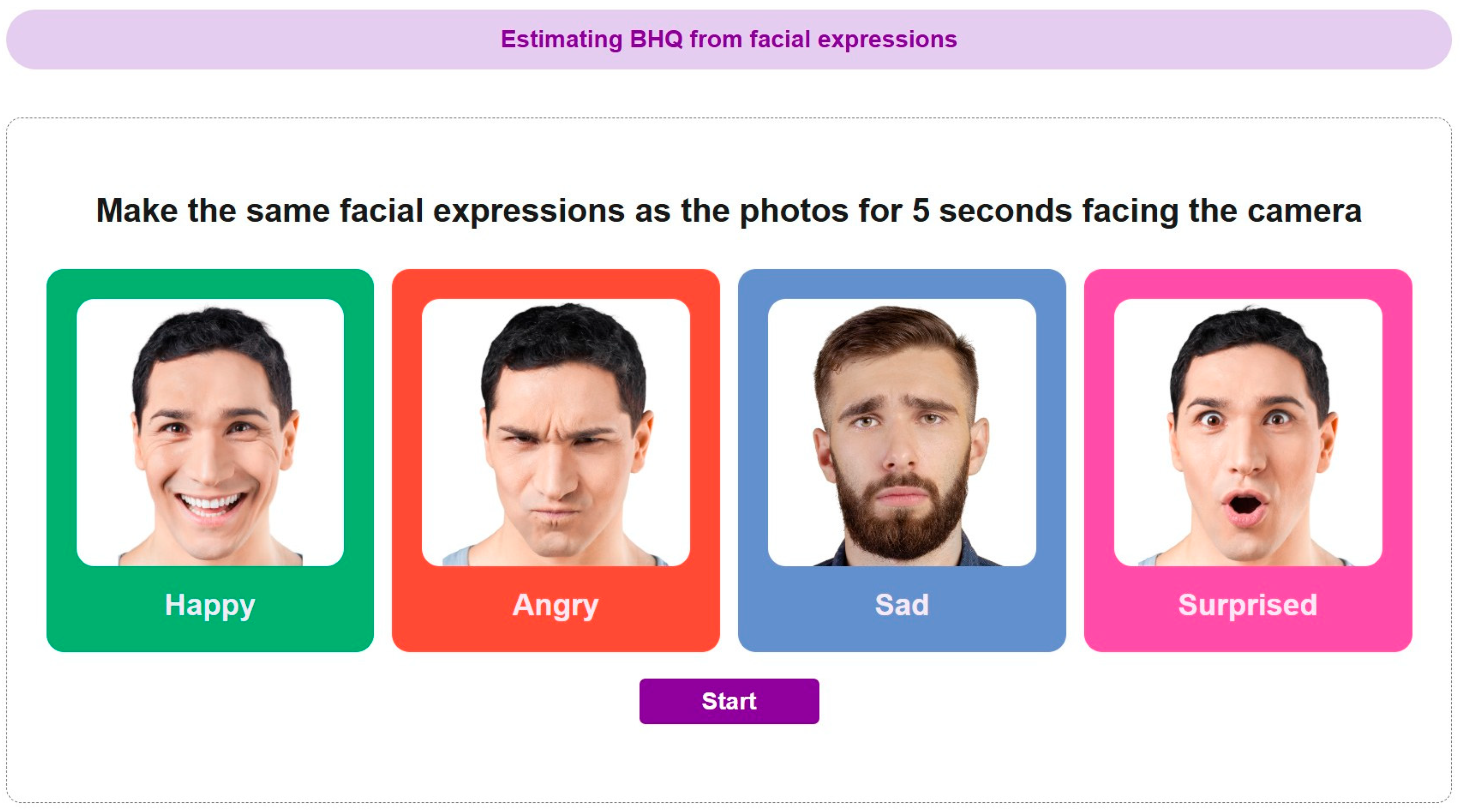
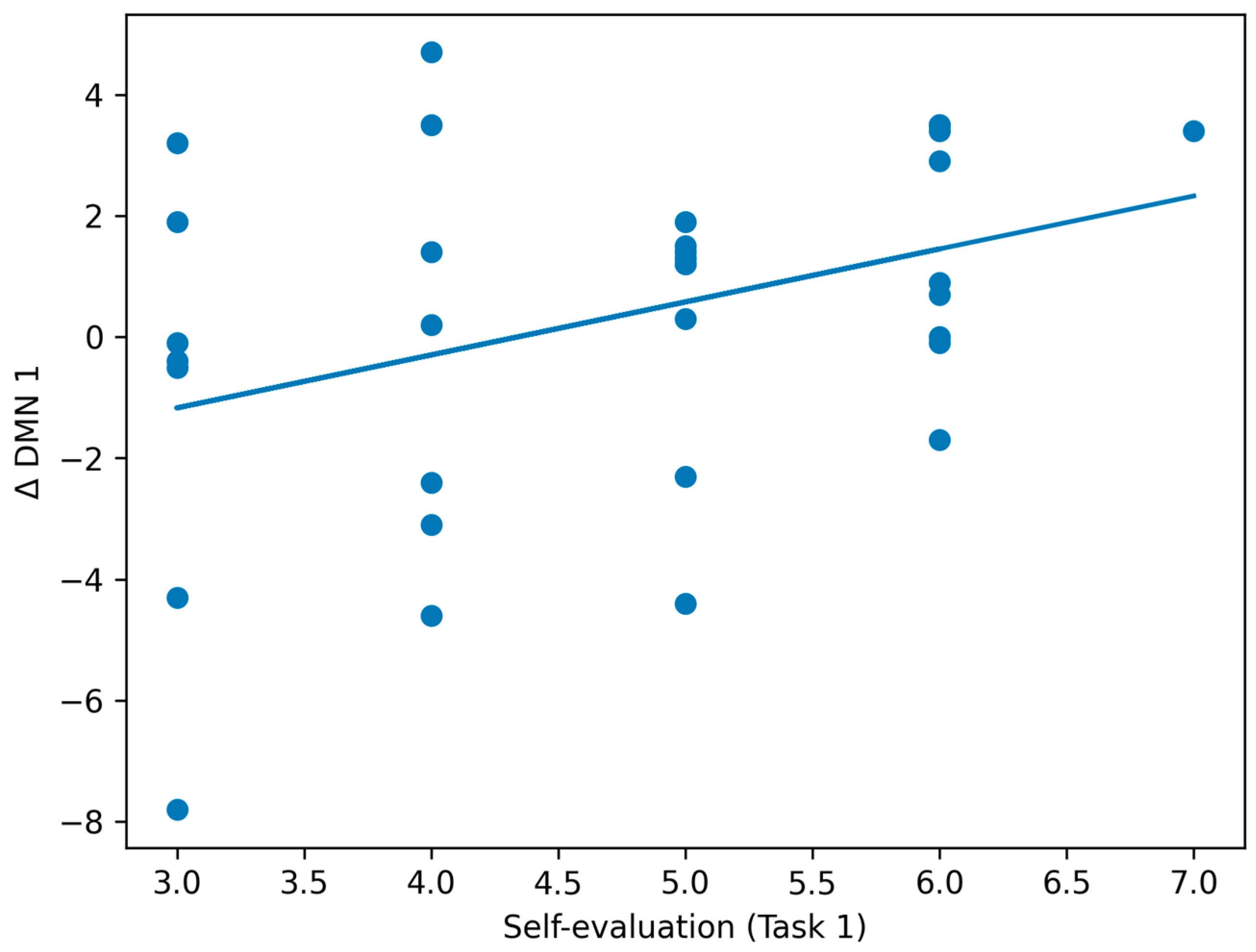
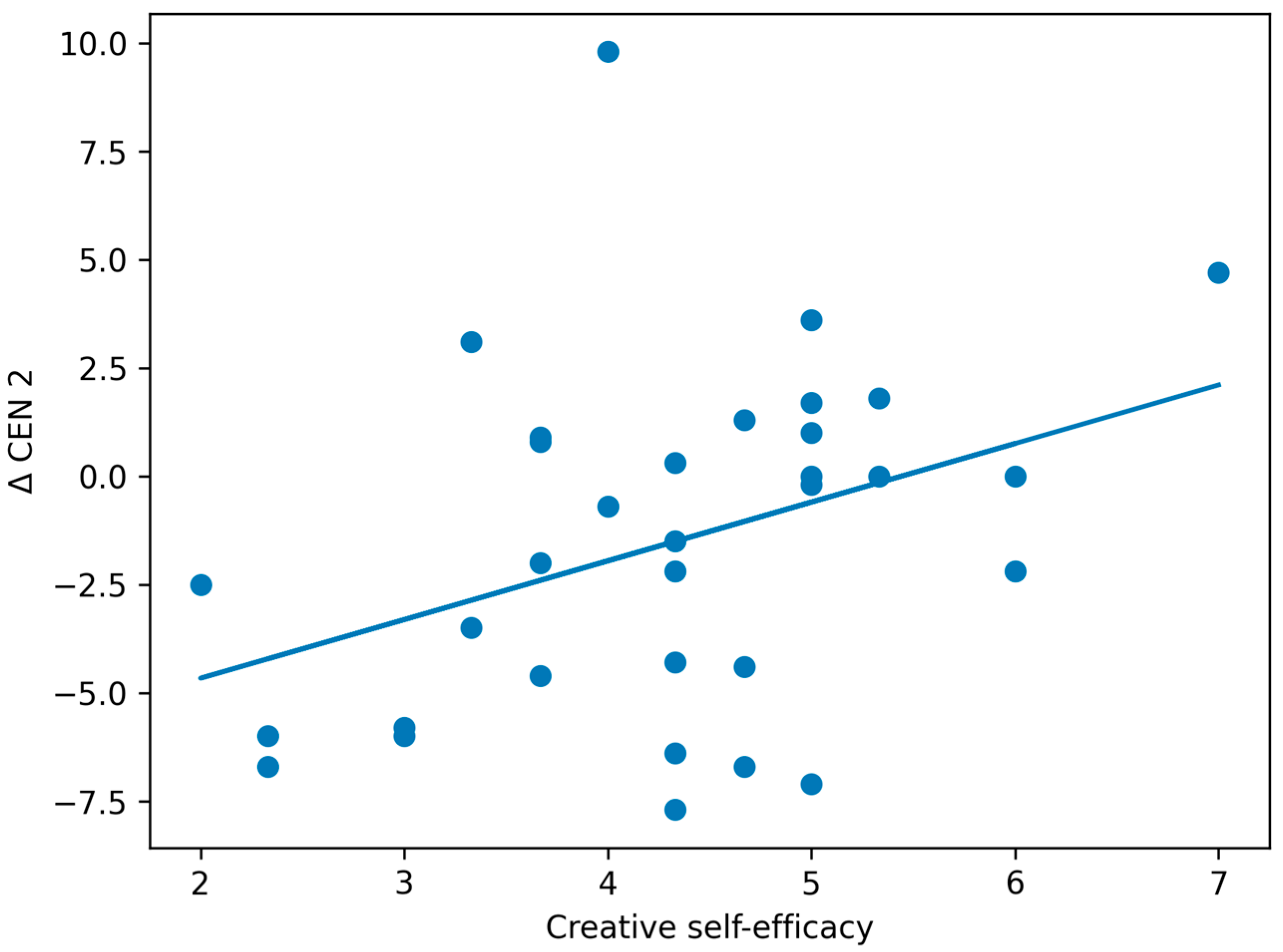
Associations Between Generative AI Use and Facial Expression-Derived Central Executive Network Indices: A Pilot Study

Abstract
1. Introduction
2. Materials and Methods
2.1. Participants
2.2. Task
“Let us explore new business ideas leveraging brain health, using generative AI (Chat PwC). Please write down your top three ideas from the ones generated. The format of your response is free.”
- Interactive Cognitive Gaming Platform: Interactive games represent an innovative form of cognitive training. Through gameplay that leverages users’ knowledge and provides real-time feedback, they can promote brain health in an enjoyable way.
- Mental Resilience Enhancement Plan: This plan offers a novel form of education and experiential learning that simultaneously strengthens stress management and problem-solving abilities. Given the growing demand for mental toughness in modern society, a program centered on this theme offers clear originality.
- Relaxation Retreat: A relaxation retreat emphasizes comfort and peace, offering a new form of experiential program. It represents an innovative approach that provides specialized retreats designed to heal the mind and brain through coexistence with nature.
“From the ideas you listed earlier, please select one. Using generative AI (Chat PwC), examine its business potential and summarize the result in approximately 300 Japanese characters.”
“The Interactive Cognitive Gaming Platform addresses a promising demand in the educational gaming market, which is expected to grow by 15% annually. The overall market size is approximately 200 billion USD, and we aim to capture a 0.1% to 0.5% share. The revenue model adopts a monthly subscription, with projected first-year revenue ranging from 500,000 to 2 million USD and an anticipated profit margin of about 15%. Furthermore, by targeting over 70% user satisfaction and more than 50% monthly retention, the platform seeks to enhance customer experience and build long-term user loyalty.”(289 characters)
“Based on the idea and its business potential you considered earlier, please use generative AI (Chat PwC) to create a catchphrase for the idea and a key message (within 100 Japanese characters) that explains it.”
- Title: Brain Adventure: A Health Revolution through Interactive Gaming
- Key Message: “Brain Adventure” is a platform that enhances cognitive abilities while having fun with interactive games. Targeting a share in the rapidly growing educational gaming market, it ensures profitability through a subscription model and aims for high user satisfaction and retention. (130 characters)
2.3. Psychological Measures
2.4. Facial Expression Information
2.5. Data Analysis
3. Results
4. Discussion
5. Limitations
6. Conclusions
Author Contributions
Funding
Institutional Review Board Statement
Informed Consent Statement
Data Availability Statement
Acknowledgments
Conflicts of Interest
References
- Lee, H.-P.; Sarkar, A.; Tankelevitch, L.; Drosos, I.; Rintel, S.; Banks, R.; Wilson, N. The impact of generative AI on critical thinking: Self-reported reductions in cognitive effort and confidence effects from a survey of knowledge workers. In Proceedings of the CHI Conference on Human Factors in Computing Systems, Yokohama, Japan, 26 April–1 May 2025; ACM: New York, NY, USA, 2025. [Google Scholar] [CrossRef]
- Stadler, M.; Bannert, M.; Sailer, M. Cognitive ease at a cost: LLMs reduce mental effort but compromise depth in student scientific inquiry. Comput. Hum. Behav. 2024, 160, 108386. [Google Scholar] [CrossRef]
- Schmidhuber, J.; Schlögl, S.; Ploder, C.; Kaber, D.; Fortino, G.; Guerrieri, A.; Nürnberger, A.; Mendonca, D.; Yu, Z.; Schilling, M. Cognitive load and productivity implications in human–chatbot interaction. In Proceedings of the IEEE 2nd International Conference on Human–Machine Systems, Magdeburg, Germany, 8–10 September 2021; pp. 1–6. [Google Scholar] [CrossRef]
- Fan, Y.; Tang, L.; Le, H.; Shen, K.; Tan, S.; Zhao, Y.; Shen, Y.; Li, X.; Gašević, D. Beware of metacognitive laziness: Effects of generative artificial intelligence on learning motivation, processes, and performance. Br. J. Educ. Technol. 2024, 56, 489–530. [Google Scholar] [CrossRef]
- Niloy, A.C.; Akter, S.; Sultana, N.; Sultana, J.; Rahman, S.I.U. Is ChatGPT a menace for creative writing ability? An experiment. J. Comput. Assist. Learn. 2024, 40, 919–930. [Google Scholar] [CrossRef]
- Bai, L.; Liu, X.; Su, J. ChatGPT: The cognitive effects on learning and memory. Brain-X 2023, 1, e30. [Google Scholar] [CrossRef]
- Pedró, F.; Subosa, M.; Rivas, A.; Valverde, P. Artificial Intelligence in Education: Challenges and Opportunities for Sustainable Development; UNESCO: Paris, France, 2019. [Google Scholar]
- Risko, E.F.; Gilbert, S.J. Cognitive offloading. Trends Cogn. Sci. 2016, 20, 676–688. [Google Scholar] [CrossRef]
- Shanmugasundaram, M.; Tamilarasu, A. The impact of digital technology, social media, and artificial intelligence on cognitive functions: A review. Front. Cogn. 2023, 2, 1203077. [Google Scholar] [CrossRef]
- Gerlich, M. AI tools in society: Impacts on cognitive offloading and the future of critical thinking. Societies 2025, 15, 6. [Google Scholar] [CrossRef]
- Yang, T.C.; Hsu, Y.C.; Wu, J.Y. The effectiveness of ChatGPT in assisting high school students in programming learning: Evidence from a quasi-experimental research. Interact. Learn. Environ. 2025, 33, 3726–3743. [Google Scholar] [CrossRef]
- Zhang, S.; Zhao, X.; Zhou, T.; Kim, J.H. Do you have AI dependency? The roles of academic self-efficacy, academic stress, and performance expectations on problematic AI usage behavior. Int. J. Educ. Technol. High Educ. 2024, 21, 34. [Google Scholar] [CrossRef]
- Jelson, A.; Manesh, D.; Jang, A.; Dunlap, D.; Lee, S.W. An empirical study to understand how students use ChatGPT for writing essays. arXiv 2025, arXiv:2501.10551. [Google Scholar] [CrossRef]
- Wang, J.; Fan, W. The effect of ChatGPT on students’ learning performance, learning perception, and higher-order thinking: Insights from a meta-analysis. Humanit. Soc. Sci. Commun. 2025, 12, 621. [Google Scholar] [CrossRef]
- Moos, D.C.; Azevedo, R. Self-regulated learning with hypermedia: The role of prior domain knowledge. Contemp. Educ. Psychol. 2008, 33, 270–298. [Google Scholar] [CrossRef]
- Willoughby, T.; Anderson, S.A.; Wood, E.; Mueller, J.; Ross, C. Fast searching for information on the Internet to use in a learning context: The impact of domain knowledge. Comput. Educ. 2009, 52, 640–648. [Google Scholar] [CrossRef]
- Yang, Y.; Shin, A.; Kang, M.; Kang, J.; Song, J.Y. Can we delegate learning to automation? A comparative study of LLM chatbots, search engines, and books. arXiv 2024, arXiv:2410.01396. [Google Scholar] [CrossRef]
- Small, G.W.; Moody, T.D.; Siddarth, P.; Bookheimer, S.Y. Your brain on Google: Patterns of cerebral activation during Internet searching. Am. J. Geriatr. Psychiatry 2009, 17, 116–126. [Google Scholar] [CrossRef]
- Bromberg-Martin, E.S.; Monosov, I.E. Neural circuitry of information seeking. Curr. Opin. Behav. Sci. 2020, 35, 62–70. [Google Scholar] [CrossRef]
- Kosmyna, N.; Hauptmann, E.; Yuan, Y.T.; Situ, J.; Liao, X.H.; Beresnitzky, A.V.; Maes, P. Your brain on ChatGPT: Accumulation of cognitive debt when using an AI assistant for essay writing tasks. arXiv 2025, arXiv:2506.08872. [Google Scholar] [CrossRef]
- Causse, M.; Lepron, E.; Mandrick, K.; Peysakhovich, V.; Berry, I.; Callan, D.; Rémy, F. Facing successfully high mental workload and stressors: An fMRI study. Hum. Brain Mapp. 2022, 43, 1011–1031. [Google Scholar] [CrossRef]
- Raichle, M.E. The restless brain: How intrinsic activity organizes brain function. Philos. Trans. R. Soc. B 2015, 370, 20140172. [Google Scholar] [CrossRef]
- Ellamil, M.; Dobson, C.; Beeman, M.; Christoff, K. Evaluative and generative modes of thought during the creative process. NeuroImage 2012, 59, 1783–1794. [Google Scholar] [CrossRef]
- Beaty, R.E.; Benedek, M.; Silvia, P.J.; Schacter, D.L. Creative cognition and brain network dynamics. Trends Cogn. Sci. 2016, 20, 87–95. [Google Scholar] [CrossRef] [PubMed]
- Chen, Q.; Yang, W.; Li, W.; Wei, D.; Li, H.; Lei, Q.; Qiu, J. Association of creative achievement with cognitive flexibility: A combined voxel-based morphometry and resting-state functional connectivity study. NeuroImage 2014, 102, 474–483. [Google Scholar] [CrossRef] [PubMed]
- Pinho, A.L.; de Manzano, Ö.; Fransson, P.; Eriksson, H.; Ullén, F. Connecting to create: Expertise in musical improvisation is associated with increased functional connectivity between premotor and prefrontal areas. J. Neurosci. 2014, 34, 6156–6163. [Google Scholar] [CrossRef] [PubMed]
- Jung, R.E. Evolution, creativity, intelligence, and madness: “Here be dragons”. Front. Psychol. 2014, 5, 784. [Google Scholar] [CrossRef] [PubMed]
- De Pisapia, N.; Bacci, F.; Parrott, D.; Melcher, D. Brain networks for visual creativity: A functional connectivity study of planning a visual artwork. Sci. Rep. 2016, 6, 39185. [Google Scholar] [CrossRef]
- Christoff, K.; Irving, Z.C.; Fox, K.C.R.; Spreng, R.N.; Andrews-Hanna, J.R. Mind-wandering as spontaneous thought: A dynamic framework. Nat. Rev. Neurosci. 2016, 17, 718–731. [Google Scholar] [CrossRef]
- Beaty, R.E.; Benedek, M.; Kaufman, S.B.; Silvia, P.J. Default and executive network coupling supports creative idea production. Sci. Rep. 2015, 5, 10964. [Google Scholar] [CrossRef]
- Bendetowicz, D.; Urbanski, M.; Garcin, B.; Foulon, C.; Levy, R.; Bréchemier, M.-L.; Volle, E. Two critical brain networks for generation and combination of remote associations. Brain 2018, 141, 217–233. [Google Scholar] [CrossRef]
- Kenett, Y.N.; Medaglia, J.D.; Beaty, R.E.; Chen, Q.; Betzel, R.F.; Thompson-Schill, S.L.; Qiu, J. Driving the brain towards creativity and intelligence: A network control theory analysis. Neuropsychologia 2018, 118, 79–90. [Google Scholar] [CrossRef]
- Cohen, J. Statistical Power Analysis for the Behavioral Sciences, 2nd ed.; Erlbaum: Hillsdale, NJ, USA, 1988. [Google Scholar]
- Yin, M.; Jiang, S.; Niu, X. Can AI really help? The double-edged sword effect of AI assistant on employees’ innovation behavior. Comput. Hum. Behav. 2024, 150, 107987. [Google Scholar] [CrossRef]
- Abe, K.; Kurata, T.; Sato, Y.; Namba, Y.; Kokubun, K.; Nemoto, K.; Okamoto, M.; Yamakawa, Y. Development of digital technology to estimate standardized brain health from facial expressions and its application to neuroaesthetics research. Res. Sq. 2025. [Google Scholar] [CrossRef]
- Namba, Y.; Takada, K.; Abe, K.; Sawaki, T. Development of a BHQ estimation algorithm using facial expression analysis technology and efforts to promote awareness of brain health status among local residents. In Proceedings of the 13th National Conference of the Society of Service Sciences, Tokyo, Japan, 6 March 2025. [Google Scholar]



| Mean | SD | t | p | Cohen’s d | 90% CI (Mean) | |
|---|---|---|---|---|---|---|
| Changes after Task 1 | ||||||
| Δ whole-brain 1 | 1.14 | 3.37 | 1.942 | 0.061 * | 0.34 | [0.146, 2.133] |
| Δ DMN 1 | 0.31 | 2.854 | 0.628 | 0.534 | 0.11 | [−0.529, 1.154] |
| Δ CEN 1 | 0.85 | 4.208 | 1.162 | 0.254 | 0.2 | [−0.389, 2.092] |
| Changes after Task 2 | ||||||
| Δ whole-brain 2 | −0.580 | 3.814 | −0.881 | 0.385 | −0.15 | [−1.709, 0.540] |
| Δ DMN 2 | −0.790 | 2.636 | −1.730 | 0.093 * | −0.30 | [−1.571, −0.017] |
| Δ CEN 2 | −1.560 | 3.995 | −2.244 | 0.032 *,† | −0.39 | [−2.739, −0.383] |
| Changes after Task 3 | ||||||
| Δ whole-brain 3 | −0.420 | 3.24 | −0.736 | 0.467 | −0.13 | [−1.371, 0.540] |
| Δ DMN 3 | −0.040 | 3.215 | −0.076 | 0.94 | −0.01 | [−0.990, 0.905] |
| Δ CEN 3 | 0.33 | 3.885 | 0.484 | 0.632 | 0.09 | [−0.818, 1.473] |
Disclaimer/Publisher’s Note: The statements, opinions and data contained in all publications are solely those of the individual author(s) and contributor(s) and not of MDPI and/or the editor(s). MDPI and/or the editor(s) disclaim responsibility for any injury to people or property resulting from any ideas, methods, instructions or products referred to in the content. |
© 2025 by the authors. Licensee MDPI, Basel, Switzerland. This article is an open access article distributed under the terms and conditions of the Creative Commons Attribution (CC BY) license.
Share and Cite
Kokubun, K.; Yamakawa, Y.; Yoshida, A.; Sanji, S. Associations Between Generative AI Use and Facial Expression-Derived Central Executive Network Indices: A Pilot Study. Brain Sci. 2026, 16, 58. https://doi.org/10.3390/brainsci16010058
Kokubun K, Yamakawa Y, Yoshida A, Sanji S. Associations Between Generative AI Use and Facial Expression-Derived Central Executive Network Indices: A Pilot Study. Brain Sciences. 2026; 16(1):58. https://doi.org/10.3390/brainsci16010058
Chicago/Turabian StyleKokubun, Keisuke, Yoshinori Yamakawa, Anna Yoshida, and Shinichiro Sanji. 2026. "Associations Between Generative AI Use and Facial Expression-Derived Central Executive Network Indices: A Pilot Study" Brain Sciences 16, no. 1: 58. https://doi.org/10.3390/brainsci16010058
APA StyleKokubun, K., Yamakawa, Y., Yoshida, A., & Sanji, S. (2026). Associations Between Generative AI Use and Facial Expression-Derived Central Executive Network Indices: A Pilot Study. Brain Sciences, 16(1), 58. https://doi.org/10.3390/brainsci16010058