Application of Artificial Intelligence Tools for Social and Psychological Enhancement of Students with Autism Spectrum Disorder: A Systematic Review


Abstract
1. Introduction
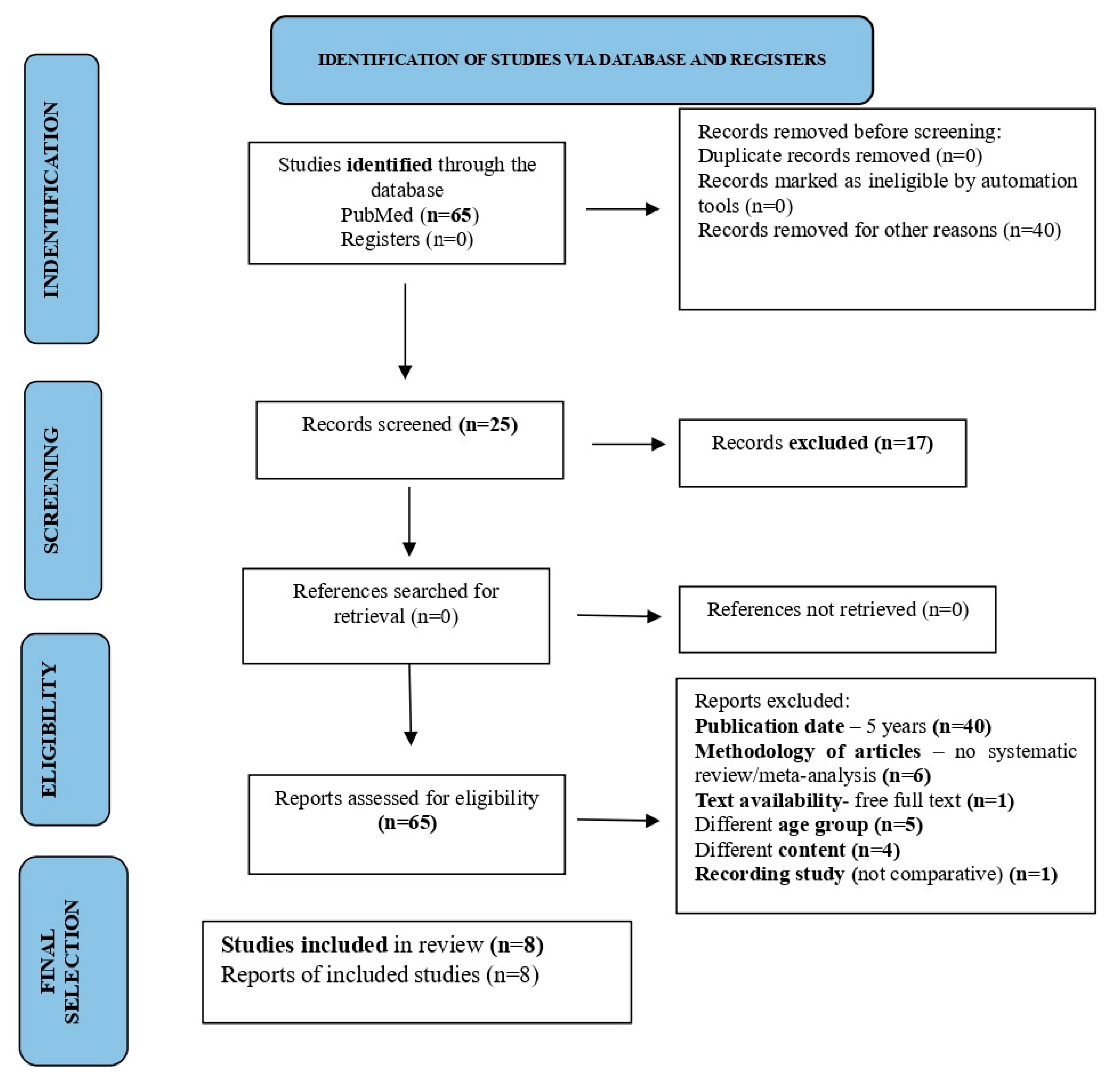
2. Methodology
3. Exclusion Stages and Criteria
4. Results
5. Settings
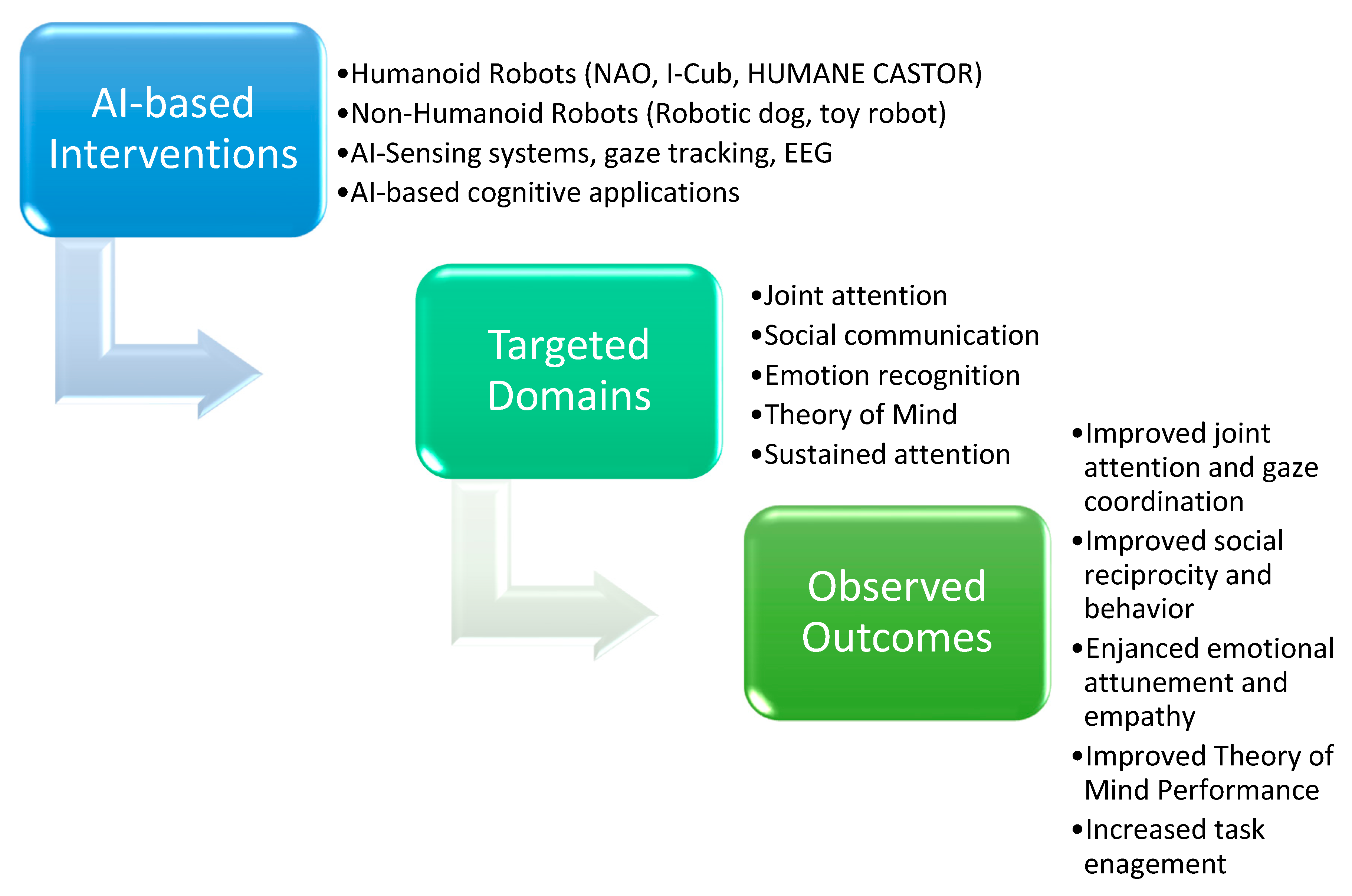
6. Interventions
7. Outcomes
8. Discussion
9. Conclusions
Supplementary Materials
Author Contributions
Funding
Institutional Review Board Statement
Informed Consent Statement
Data Availability Statement
Conflicts of Interest
References
- Volkmar, F.; McPartland, J. From Kanner to DSM-5:Autism as an Evolving Diagnostic Concept. Annu. Rev. Clin. Psychol. 2014, 10, 193–212. [Google Scholar] [CrossRef]
- Ford, T.; Jeon, B.; Lee, H.; Kim, W.-Y. Dendritic spine and synapse pathology in chromatin modifier-associated autism spectrum disorders and intellectual disability. Front. Mol. Neurosci. 2013, 15, 1048713. [Google Scholar] [CrossRef]
- Centers for Disease Control and Prevention. Data and Statistics on Autism Spectrum Disorder. U.S. from Centers for Disease Control and Prevention. 2020. Available online: https://www.cdc.gov/autism/data-research/?CDC_AAref_Val=https://www.cdc.gov/ncbddd/autism/data.html (accessed on 5 May 2025).
- Kanner, L. Autistic disturbances of affective contact. Nervous Child 1943, 2, 217–250. [Google Scholar]
- Rice, C. Prevalence of autism spectrum disorders--autism and developmental disabilities monitoring network, six sites, United States, 2000. MMWR Surveill. Summ. 2007, 56, 1–11. [Google Scholar]
- Maenner, M.; Shaw, K.; Bakian, A.; Bilder, D.; Durkin, M.; Esler, A.; Cogswell, M.; Hallas, L.; Hall-Lande, J.; Hudson, A.; et al. Prevalence and Characteristics of Autism Spectrum Disorder Among Children Aged 8 Years—Autism and Developmental Disabilities Monitoring Network, 11 Sites, United States, 2018. MMWR Surveill. Summ. 2021, 70, 1–16. [Google Scholar] [CrossRef] [PubMed]
- American Psychiatric Association. Diagnostic and Statistical Manual of Mental Disorders, 5th ed.; American Psychiatric Publishing: Washington, DC, USA, 2013. [Google Scholar]
- Sanchack, K.; Thomas, C. Autism Spectrum Disorder: Primary Care Principles. Am. Fam. Physician 2016, 94, 972A–979A. [Google Scholar]
- Pennisi, P.; Tonacci, A.; Tartarisco, G.; Billeci, L.; Ruta, L.; Gangemi, S.; Pioggia, G. Autism and social robotics: A systematic review. Autism Res. 2015, 9, 165–183. [Google Scholar] [CrossRef]
- Bhat, S.; Acharya, U.; Adeli, H.; Bairy, G.; Adeli, A. Autism: Cause factors, early diagnosis and therapies. Rev. Neurosci. 2014, 25, 841–850. [Google Scholar] [CrossRef]
- Jeste, S.S.; Geschwind, D.H. Disentangling the heterogeneity of autism spectrum disorder through genetic findings. Nat. Rev. Neurol. 2014, 10, 74–81. [Google Scholar] [CrossRef]
- Happé, F.; Ronald, A.; Plomin, R. Time to give up on a single explanation for autism. Nat. Neurosci. 2006, 9, 1218–1220. [Google Scholar] [CrossRef]
- Ruble, L.; Dalrymple, N.J.; Mcgrew, J.H. Collaborative Model for Promoting Competence and Success for Students with ASD, 1st ed.; Springer: Berlin/Heidelberg, Germany, 2012. [Google Scholar] [CrossRef]
- Cerasa, A.; Ruta, L.; Marino, F.; Biamonti, G.; Pioggia, G. Brief Report: Neuroimaging Endophenotypes of Social Robotic Applications in Autism Spectrum Disorder. J. Autism Dev. Disord. 2021, 51, 2538–2542. [Google Scholar] [CrossRef] [PubMed]
- Kumazaki, H.; Muramatsu, T.; Yoshikawa, Y.; Matsumoto, Y.; Ishiguro, H.; Kikuchi, M.; Sumiyoshi, T.; Mimura, M. Optimal robot for intervention for individuals with autism spectrum disorders. Psychiatry Clin. Neurosci. 2020, 74, 581–586. [Google Scholar] [CrossRef] [PubMed]
- Korneder, J.; Louie, W.-Y.; Pawluk, C.M.; Abbas, I.; Brys, M.; Rooney, F. Robot-mediated interventions for teaching children with ASD: A new intraverbal skill. Assist. Technol. 2022, 34, 707–716. [Google Scholar] [CrossRef]
- Robins, B.; Dautenhahn, K. Kaspar, the social robot and ways it may help children with autism—An overview. Enfance 2018, 1, 91–102. [Google Scholar] [CrossRef]
- Dautenhahn, K.; Werry, I.P. Towards Interactive Robots in Autism Therapy: Background, Motivation and Challenges. Pragmat. Cogn. 2004, 12, 1–35. [Google Scholar] [CrossRef]
- Chung, E.-H. Robotic Intervention Program for Enhancement of Social Engagement among Children with Autism. J. Dev. Phys. Disabil. 2018, 31, 419–434. [Google Scholar] [CrossRef]
- Chung, E.-H.; Sin, K.-F.; Chow, D.-K. Effectiveness of Robotic Intervention on Improving Social Development and Participation of Children with Autism Spectrum Disorder—A Randomised Controlled Trial. J. Autism Dev. Disord. 2024, 55, 449–456. [Google Scholar] [CrossRef]
- Fine, A.H.; Beck, A.M.; Ng, Z. The State of Animal-Assisted Interventions: Addressing the Contemporary Issues that will Shape the Future. Int. J. Environ. Res. Public Health 2019, 16, 3997. [Google Scholar] [CrossRef]
- Steen, S.; Heineman, M.M.; Ernst, M.J. Evaluating Animal-Assisted Interventions: An Empirical Illustration of Differences between Outcome Measures. Animals 2019, 9, 645. [Google Scholar] [CrossRef]
- Steen, S.; Kamphorst, E.; Griffioen, R.E. A randomized controlled trial of the effects of dog-assisted versus robot dog-assisted therapy for children with autism or Down syndrome. PLoS ONE 2025, 20, e0319939. [Google Scholar] [CrossRef]
- Ghiglino, D.; Floris, F.; Tommaso, D.D.; Kompatsiari, K.; Priolo, T.; Wykowska, A. Artificial scaffolding: Augmenting social cognition by means of robot technology. Autism Res. 2023, 16, 997–1008. [Google Scholar] [CrossRef] [PubMed]
- Giannopulu, I.; Terada, K.; Watanabe, T. Communication using robots: A Perception-action scenario in moderate ASD. J. Exp. Theor. Artif. Intell. 2018, 30, 603–613. [Google Scholar] [CrossRef]
- So, W.-C.; Cheng, C.-H.; Law, W.-W.; Wong, T.; Lee, C.; Kwok, F.-Y.; Lee, S.-H.; Lam, K.-Y. Robot dramas may improve joint attention of Chinese-speaking low-functioning children with autism: Stepped wedge trials. Disabil. Rehabil. Assist. Technol. 2020, 18, 195–204. [Google Scholar] [CrossRef] [PubMed]
- Gaitan-Padilla, M.; Cifuentes, C.A.; Munera, M. Three Study Cases of Social Robotics in Autism Spectrum Disorder Treatment: Personalization and Usability of CASTOR Robot. In Proceedings of the 2022 International Conference on Rehabilitation Robotics (ICORR), Rotterdam, The Netherlands, 25–29 July 2022; pp. 1–6. [Google Scholar]
- Holeva, V.; Nikopoulou, V.A.; Lytridis, C.; Bazinas, C.; Kechayas, P.; Sidiropoulos, G.; Papadopoulou, M.; Kerasidou, M.D.; Karatsioras, C.; Geronikola, N.; et al. Effectiveness of a Robot-Assisted Psychological Intervention for Children with Autism Spectrum Disorder. J. Autism Dev. Disord. 2022, 54, 577–593. [Google Scholar] [CrossRef]
- Silva, B.; Santos, L.; Barata, C.; Geminiani, A.; Fassina, G.; Gonzalez, A.R.; Ferreira, S.; Barahona-Corrêa, B.; Olivieri, I.; Pedrocchi, A.; et al. Attention Analysis in Robotic-Assistive Therapy for Children with Autism. IEEE Trans. Neural Syst. Rehabil. Eng. 2024, 32, 2220–2229. [Google Scholar] [CrossRef]



| Year | Author | Title | Country | Study Design | Sample Size | Age Group | Population Characteristics |
|---|---|---|---|---|---|---|---|
| 2020 | So et al. [26] | Effectiveness of a Robot Drama Paradigm on Joint Attention in Children with ASD | Hong Kong | Randomized controlled trial | 30 | 6–12 years | Children diagnosed with ASD |
| 2018 | Giannopulu et al. [25] | Emotional Empathy as a Mechanism of Synchronisation in Child-Robot Interaction | France and Japan | Experimental cross-cultural study | 40 | 6–15 years | Children with ASD |
| 2022 | Holeva et al. [28] | Robot-Assisted Psychoeducational Intervention for Children with ASD | Greece | Randomized controlled trial | 51 | 6–12 years | Children with ASD, IQ within normal range |
| 2022 | Gaitán-Padilla et al. [27] | Socially-Assistive Robotics for Improving Social Participation in ASD | Colombia | Non-randomized intervention study | 20 | 5–10 years | Children with ASD |
| 2023 | Ghiglino et al. [24] | Artificial Scaffolding of Social Cognition Using Humanoid Robots | Italy | Randomized controlled trial | 45 | 7–14 years | Children with ASD, moderate–high IQ |
| 2024 | Chung, Sin and Chow [20] | Robotic Intervention to Improve Social Communication in ASD | Hong Kong | Randomized controlled trial | 60 | 6–10 years | Children with ASD |
| 2024 | Silva et al. [29] | AI-Based Gaze and EEG Monitoring During Robot-Assisted Therapy | Portugal and Italy | Pilot exploratory study | 5 | 8–16 years | Children with ASD |
| 2025 | Van der Steen et al. [23] | Dog-Assisted vs. Robot Dog-Assisted Therapy in Neurodevelopmental Disorders | Netherlands | Randomized controlled trial | 65 | 6–14 years | Children with ASD and Down syndrome |
| AI Intervention Type | Outcome Domain | Key Findings | Strengths | Limitations | |||
| Humanoid robots (e.g., NAO, iCub, HUMANE, CASTOR) | Joint attention, social communication | Improvements in joint attention, social reciprocity, and emotion recognition | High engagement; structured and predictable interaction | Small samples; limited long-term follow-up | |||
| Humanoid robots (iCub) | Theory of mind | Improved theory of mind and prosocial behaviors | Use of standardized assessments | Participants are often high-functioning; limited generalizability | |||
| Non-humanoid robots (robotic dog, toy/plant robot) | Emotional regulation, empathy | Enhanced emotional attunement and affective engagement | Reduced social complexity; lower anxiety | Mixed effectiveness compared to live agents | |||
| AI sensing systems (gaze-tracking, EEG, HR/HRV) | Attention, engagement | Increased task engagement and attention during sessions | Objective, real-time measurements | Technical complexity; very small samples | |||
| AI-based cognitive applications (ToM tasks) | Social cognition | Improved social understanding in structured settings | Targeted cognitive training | Limited evidence for transfer to daily life | |||
| Study (Year) | Country/Sample | Type of Robot/AI Tool | Targeted Skills | Main Outcomes | Measurement Methods |
|---|---|---|---|---|---|
| So et al. (2020) [26] | Hong Kong/30 children | Humanoid robot (HUMANE) | Joint attention | ↑ Response to joint attention (RJA) and initiation of joint attention (IJA) | Video recordings |
| Holeva et al. (2022) [28] | Greece/51 children | NAO humanoid robot | Emotion recognition, social interaction | ↑ Psychosocial skills, better emotion recognition vs. human-only group | Therapists’ recordings |
| Ghiglino et al. (2023) [24] | Italy/45 children | iCub (humanoid) vs. Cozmo (toy robot) | Theory of mind, social cognition | iCub: ↑ Theory of mind and prosocial behaviors; Cozmo: no significant change | Standardized tests (NEPSY-II) |
| Gaitán-Padilla et al. (2022) [27] | Colombia/20 children | CASTOR humanoid robot | Social participation, imitation | ↑ maintained social skills | Therapists’ evaluations |
| Silva et al. (2024) [29] | Portugal and Italy/5 children | NAO + Gaze-tracking + EEG sensors | Attention, engagement | ↑ Overall attention but gradual decline in focus on robot | EEG data, gaze-tracking |
| Chung, Sin and Chow (2024) [20] | Hong Kong/60 children | NAO humanoid robot | Social communication | ↑ Social reciprocity and ↓ non-functional behaviors | Parent questionnaires |
| Van Der Steen et al. (2025) [23] | Netherlands/65 children (ASD + DS) | Robotic dog (WowWee CHiP) | Emotional regulation, confidence | ↑ Emotional attunement, live dog > robot dog for emotional regulation | Parent reports |
| Giannopulu et al. (2018) [25] | France and Japan/40 children | Plant robot “Pekkopa” | Emotional empathy, synchrony | ↑ Emotional synchrony with robot vs. human partner | HR and HRV sensors |
Disclaimer/Publisher’s Note: The statements, opinions and data contained in all publications are solely those of the individual author(s) and contributor(s) and not of MDPI and/or the editor(s). MDPI and/or the editor(s) disclaim responsibility for any injury to people or property resulting from any ideas, methods, instructions or products referred to in the content. |
© 2025 by the authors. Licensee MDPI, Basel, Switzerland. This article is an open access article distributed under the terms and conditions of the Creative Commons Attribution (CC BY) license.
Share and Cite
Tsapanou, A.; Bouka, A.; Papadopoulou, A.; Vamvatsikou, C.; Mikrouli, D.; Theofila, E.; Dionysopoulou, K.; Kortseli, K.; Lytaki, P.; Spyridonidi, T.M.; et al. Application of Artificial Intelligence Tools for Social and Psychological Enhancement of Students with Autism Spectrum Disorder: A Systematic Review. Brain Sci. 2026, 16, 56. https://doi.org/10.3390/brainsci16010056
Tsapanou A, Bouka A, Papadopoulou A, Vamvatsikou C, Mikrouli D, Theofila E, Dionysopoulou K, Kortseli K, Lytaki P, Spyridonidi TM, et al. Application of Artificial Intelligence Tools for Social and Psychological Enhancement of Students with Autism Spectrum Disorder: A Systematic Review. Brain Sciences. 2026; 16(1):56. https://doi.org/10.3390/brainsci16010056
Chicago/Turabian StyleTsapanou, Angeliki, Anastasia Bouka, Angeliki Papadopoulou, Christina Vamvatsikou, Dionisia Mikrouli, Eirini Theofila, Kassandra Dionysopoulou, Konstantina Kortseli, Panagiota Lytaki, Theoni Myrto Spyridonidi, and et al. 2026. "Application of Artificial Intelligence Tools for Social and Psychological Enhancement of Students with Autism Spectrum Disorder: A Systematic Review" Brain Sciences 16, no. 1: 56. https://doi.org/10.3390/brainsci16010056
APA StyleTsapanou, A., Bouka, A., Papadopoulou, A., Vamvatsikou, C., Mikrouli, D., Theofila, E., Dionysopoulou, K., Kortseli, K., Lytaki, P., Spyridonidi, T. M., & Plotas, P. (2026). Application of Artificial Intelligence Tools for Social and Psychological Enhancement of Students with Autism Spectrum Disorder: A Systematic Review. Brain Sciences, 16(1), 56. https://doi.org/10.3390/brainsci16010056