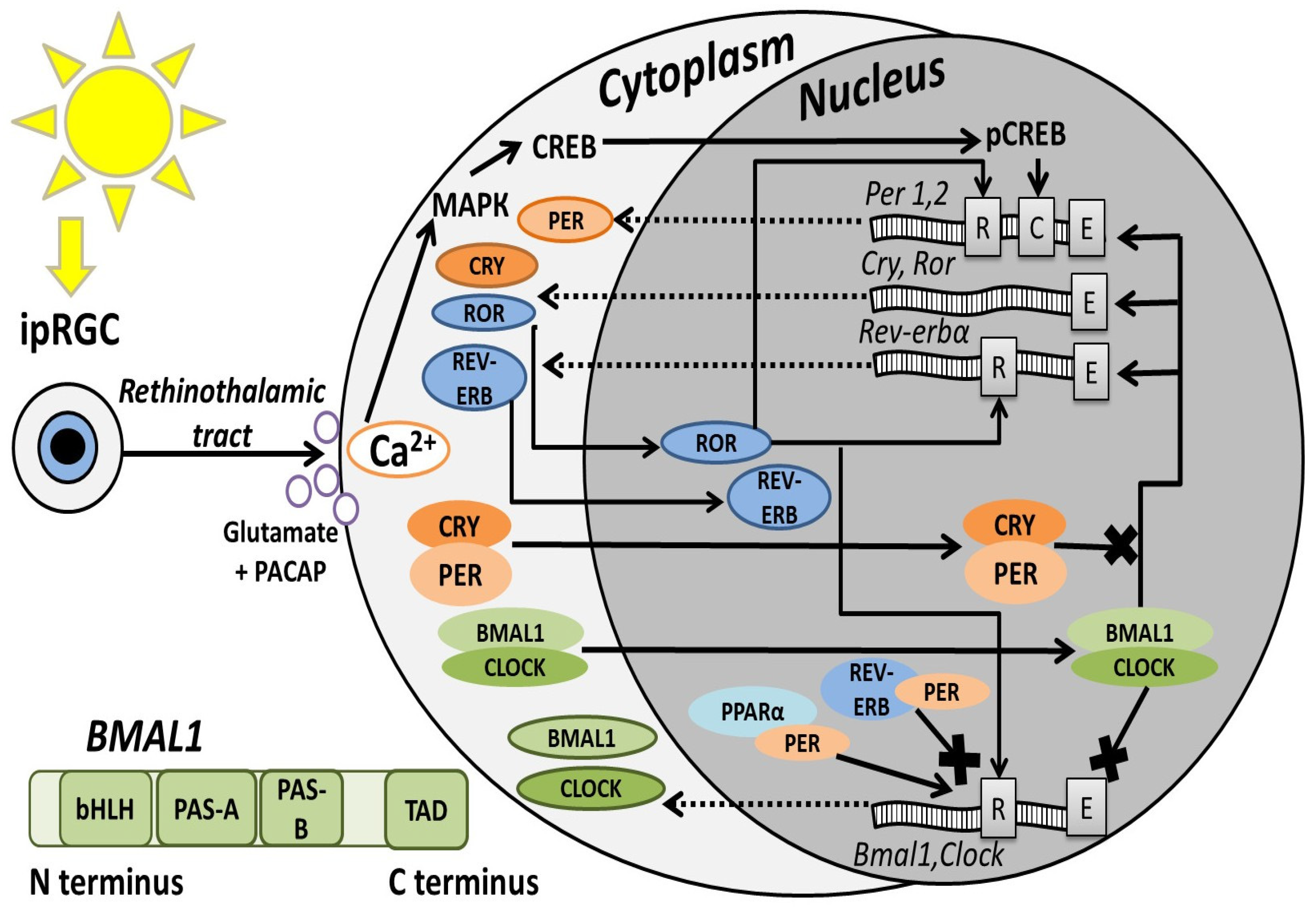
Core Circadian Protein BMAL1: Implication for Nervous System Functioning and Its Diseases


Abstract
1. Introduction
2. BMAL1 Molecular Regulation

3. Physiological BMAL1 Functions in the CNS
3.1. BMAL1 in Inflammation, Oxidative Stress, and Neuroprotection Processes
3.2. BMAL1 in Neurodevelopment and Myelinization
3.3. BMAL1 in Neurosignaling Synaptic Plasticity and Cognitive Functions
4. BMAL1 in CNS Pathologies
4.1. BMAL1 in CNS Organic Lesions
4.2. Developmental Disorders and Myelinization Disturbances
4.3. Neurodegeneration
4.4. Mood and Addictive Disorders
5. BMAL1 as a Therapeutic Target for CNS Disorders
6. Sex Differences in BMAL1 Functions
7. Conclusions
Author Contributions
Funding
Institutional Review Board Statement
Informed Consent Statement
Data Availability Statement
Conflicts of Interest
Abbreviations
| ACTH | Adrenocorticotropic Hormone |
| AD | Alzheimer’s Disease |
| ASD | Autism Spectrum Disorders |
| BBB | Blood–Brain Barrier |
| bHLH | Basic Helix-Loop-Helix |
| BMAL1 | Brain and Muscle ARNT-Like1 |
| CaMK | Calmodulin-Dependent Protein Kinase |
| CLOCK | Circadian Locomotor Output Cycles Kaput |
| CNS | Central Nervous System |
| CRY | Cryptochrome |
| D1/2 | Dopamine 1/2 Receptor |
| DA | Dopamine |
| DG | Dentate Gyrus |
| Glu | Glutamate |
| HPA | Hypothalamic-Pituitary-Adrenal Axis |
| IL | Interleukin |
| KD | Knockdown |
| KO | Knockout |
| LHb | Lateral Habenula |
| LPS | Lipopolysaccharide |
| MAPK | Mitogen Activated Protein Kinase |
| mTOR | Mammalian Target of Rapamycin |
| NF-κB | Nuclear Factor Kappa-Light-Chain-Enhancer of Activated B Cells |
| NPAS | Neuronal PAS Domain |
| NPC | Neuronal Precursor Cells |
| NRF2 | Nuclear factor erythroid 2-related factor 2 |
| OL | Oligodendrocytes |
| OPC | Oligodendrocyte Precursor Cells |
| PAS | Per-ARNT-Sim |
| PD | Parkinson’s Disease |
| Per | Period |
| PFC | Prefrontal Cortex |
| ROS | Reactive Oxygen Species |
| SCN | Suprachiasmatic Nucleus |
| SIRT1 | Silent Information Regulator 1 |
| SNP | Single Nucleotide Polymorphism |
| SVZ | Subventricular Zone |
| TAD | Transactivation Domain |
| TH | Tyrosine Hydroxylase |
| TSC | Tuberous Sclerosis |
| αSyn | Alpha-Synuclein |
| Aβ | Beta-Amyloid |
| 5-HT | Serotonin |
Appendix A

| BMAL1 Changing | Model Information | Effects | Reference |
|---|---|---|---|
| Genetic overexpression of BMAL1 | Human recombinant BMAL1 + Rat with traumatic brain injury | ↓ IL-4 and TNFα ↓ cerebral edema, severity of somatosensory disorders, necrosis of nerve cells; normalizes behavior | [79] |
| Lentiviral Bmal1 overexpression and antagomir-155 treatments + Rat with intracerebral hemorrhage | ↓ oxidative stress, inflammation, brain edema, BBB damage, neuron death, and neurological dysfunction; activation of the NRF2 pathway | [23] | |
| Human recombinant BMAL1 + Sleep deprivation in mice | ↓ anxiety; ↑ cognitive functions; ↓ oxidative stress in hippocampus; ↑ BDNF | [106] | |
| BMAL1 enhancement as a result of model creation | Mice with a stroke model created at midnight | ↓ cerebral edema, neuralgic deficiency and apoptosis ↑ AKT and ERK-1/2 | [81] |
| Circadian misalignment in mice and on the OPC cell culture (Oli-Neu) | ↓ AKT/mTOR signaling and expression of OL differentiation genes | [60] | |
| Circadian misalignment via long-term variable photoperiod in mice | Anxiety and depression-like behavior; ↓ mature OL in the medial prefrontal cortex and CA1 area of the hippocampus; ↓ AKT/mTOR signaling | ||
| LPS stimulated rat (Bmal1 ↑ in hippocampus but ↓ in hyppothalamus) | Depression-like behaviors; hyperactivity of the hypothalamic-pituitary-adrenal axis; hyperactivation of astrocyte and microglia; ↑ peripheral and central abundance of TNF-α, IL-6, and C-reactive protein; ↓ BDNF, TREM-1 receptor, Copine6, and Synaptotagmin1 but ↑ TREM-2 Alteration in the fluctuation of temperature, serum concentration of melatonin and corticosterone; ↓ CLOCK, PER2, CRY2 in the hippocampus | [47] | |
| Genetic global KO | Mice GAG-CreERT2+; Bmal1f/f; P301S; (+tautopathy and α-synucleopathy) | Prevents aggregation of tau protein, reduces microglia and atrophy of nerve fibers | [90] |
| Mice Arntltm1Bra/tm1Bra + spinal cord injury | Preservation of OL in the epicenter of damage; ↑ restoration of locomotor function; ↓ BBB damage, neuroinflammation, and bleeding during the first 7 days after injury | [83] | |
| Female mice Bmal1−/− + spinal cord injury | ↓ Pyroptosis-related proteins (NLRP3, caspase-1, ASC protein, gasdermine-N) ↓ NF-kB activity and MMP9 expression ↓ secondary damage | [44] | |
| Crab-eating macaque with BMAL1-KO | Dysregulation of β- and γ-oscillations of the electroencephalogram day and night; self-harm and delusion-like behavior; ↑ nighttime activity; ↓ and disruption of the rhythmic production of melatonin, testosterone, cortisol and dehydroepiandrosterone, systemic inflammation, anxiety and depressive—like and schizophrenia-like behavior | [109] | |
| Mice CAG-CreERT2; Bmal1f/f | Cell-autonomous loss of TH+ neurons in the compact part of the substantia nigra | [94] | |
| Mice Bmal1−/− | ↓ hippocampal NPC pools, their scattered distribution; ↑ NPC survival rate ↑ differentiation of NPC into cells of the astroglial lineage; ↑ oxidative stress proteins (SIRT1, PMP70 and Waf1/CIP1); accelerated aging of the neurogenic niche of the hippocampus | [56] | |
| violation of spatial memory and memory of fear ↓ long-term potentiation in the hippocampus and memory consolidation; ↓ MAPK and cAMP signaling and loss of its daily fluctuations | [64] | ||
| Cognitive impairment ↑ astrocyte soma, oxidative stress; ↓ small astrocytic processes; ↓ Cortactin | [50] | ||
| anhedonia; ↓ the level of corticosterone; ↓ transcription of cholesterol transport genes in the adrenal cortex | [77] | ||
| ↓ sensitization, incentive effects of cocaine; ↓ drug-seeking behaviors; absence of rhythmic expression of the D2 receptor gene in the prefrontal cortex, ↓ TH, and ↑MAO-B in the striatum after a single dose of cocaine; ↓ GluA1 in the prefrontal cortex after chronic cocaine use | [62] | ||
| Female mice Arntltm1Bra/tm1Bra | ↑ plasma estradiol level ↑ Gonadotropin releasing hormone-immunoreactive fibers in both the preoptic area | [82] | |
| Female mice Arntltm1Bra/tm1Bra + Photothrombosis | ↓ brain damage and astrogliosis in at 14 day after stroke than in wild type females ↓ volume of packed microglia at 14 day after stroke in than in wild type; vanished sex differences | [82] | |
| Mice Bmal1−/− + MPTP | ↑ motor disfunction; ↑ loss of DA neurons in the compact part of the substantia nigra, ↓ DA signaling; activation of microglia, expression of proinflammatory cytokines and astrocytes in the striatum | [46] | |
| Female mice CBA/N + Bmal1−/− | Depressive-like behavior | [110] | |
| Astrocyte culture from CAG-CreERT2; Bmal1f/f mice | Cell-autonomous activation of astrocytes; ↑ expression of inflammatory genes; ↓ signaling of glutathione-S-transferase; neuronal death | [51] | |
| KO in brain cells | Mice NestinCre+; Bmal1f/f | ↑ proliferation and differentiation of cells in the SVZ | [55] |
| ↑ Oxidative stress, activation of astroglia and microglia, degeneration of synaptic endings, disruption of cortical functional connections | [41] | ||
| pericyte dysfunction and hyper permeability of the BBB; ↓ regulation of PDGFRß | [49] | ||
| Mice Bmal1fl/fl + stereotaxis administration of AAV2/5-CAG-CRE-EGFP to turn off genes in the NAc or LHb | ↑ alcohol consumption and preferences (KO in the nucleus accumbens) | [115] | |
| ↑ voluntary alcohol consumption in males; ↓ aversive alcohol solution consumption and alcohol consumption after abstinence in females | [117] | ||
| KO in neurons | Mice CaMK2a-Cre; Bmal1f/f | Cell-autonomous loss of TH+ neurons in the compact part of the substantia nigra | [94] |
| ↓ assimilation and memorization of spatial information depending on the time of day | [63] | ||
| Mice CaMK2a-CreT29−1Stl/J; B6.129S4(Cg)-Arntltm1Weit/J (KO in the forebran); NPC culture from these mice | ↓ proliferation and acceleration of NPC migration to the olfactory bulb; ↑reelin concentrations in olfactory bulbs, astrogliosis; isolated NCPs: ↓ catalase and ROS detoxification gene expression | [42] | |
| Mice Emx1-Cre+; Bmal1f/f (KO in the cortex) | The rhythmic proteomic composition of the neocortex and hippocampus is disrupted; ↑ GFAP and FABP7; ↑ PLXND1 and CaMKV; ↑ ENTPD2 | [57] | |
| depressive-like behavior; ↓ NA in the cortex | [41] | ||
| Mice Gpr88-Cre+; Bmal1 -/f (KO in the spiny neurons of the striatum) | Motor disfunction ↓ DA-signaling through D1 receptors | [93] | |
| Mice Bmal1f/f:L7-Cre; Bmal1f/f (KO in Purkinje cells) | ASD-like behavior; abnormal density of Purkinje cerebellar cells and immature morphology of their dendritic spines; ↑ excitatory and inhibitory synaptic transmission, ↓ frequencies of Purkinje cells firing; the regulation of the mTORC1 signaling pathway is disrupted | [87] | |
| Cell culture mHypoA-BMAL1-WT/F and mHypoA-BMAL1-KO/F + palmitate | Increases expression Il-6 Suppresses basal expression Nf-κb | [43] | |
| KO in myeloid cells/microglia | Mice Bmal1LoxP/LoxP Lys-MCre | ↓ NRF2; ↑ ROS and IL-1β | [41] |
| Aged mice Cd11bcre; Bmallox/lox | ↓ hippocampus-dependent memory; In the CA1 region of the hippocampus: ↓ Long-term signal potentiation, ↓ GluA1, ↑ SNAP25 and PSD95, ↓ C1q, lysosomal microglial dysfunction ↑ synaptic density due to the preservation of immature synapses | [2] | |
| Mice Bmal1LoxP/LoxP; Lyz2Cre | Inflammation in the CNS: ↑ IL-1β- secreting monocytes, ↑ T cells with the IL-17+/IFN-γ+ phenotype | [88] | |
| KO in myeloid cells/silencing | BV2 cells + LPS or palmitate | ↑ phosphorilation of IκBα and p65, ↑ ROS ↓ IL-6 и TNF-α | [46,47] |
| ↓ Il-1b and Nox2 ↑ Gsr and Hmox1 ↑ glucose consumption and phagocytosis | [45] | ||
| Microglial haplodeficiency | Mice Bmal1lox/-Cx3cr1CreER + The high-fat diet | ↑ cognitive functions; ↑ formation of mature spines in the hippocampus during learning; ↑ phagocytic ability of microglia during learning in the hippocampus | [65] |
| KO in astrocytes | Mice Gfap-cre; Bmal1f/f + Cuprizone | ↑ oligodendrogenesis and neurogenesis; disruption of OL transport from the SVZ to the lesion site | [58] |
| Mice Aldh1l1-CreERT2+; Bmal1f/f | ↑ endocytosis; lysosomal breakdown of proteins; ↑ autophagosome-like structures inside astrocytes | [52] | |
| Cell-autonomous loss of TH+ neurons in the compact part of the substantia nigra | [94] | ||
| Mice Aldh1l1-CreERT2+; Bmal1f/f; P301S+ (on background of tautophaty genetic model) | ↓ αSyn and Tau-protein; ↑ activation of astrocytes; ↑ phagocytosis of pathological proteins | [90] | |
| Mice Glast-CreERT2; Bmal1f/f | Circadian rhythm and spatial memory disorders; ↓ GABA transporters in astrocytes of the cortex ↑ inhibition of learning and memory circuits | [71] | |
| Mice Aldh1l1-CreERT2; Bmal1f/f + fast and slow accumulation model Aβ (APP/PS1-21 and APPNL-GF) | Increased activation of astrocytes around Aß plaques, however, this astrogliosis does not affect plaque accumulation or neuron dystrophy in any of the models | [91] | |
| KO in OPC | Mice NG2:Cre+; Bmal1f/f | Disrupts the expression of genes associated with circadian rhythms, proliferation, density, morphology, and migration; thinning of myelin, impaired cognitive and motor functions, fragmentation of sleep; ↓ remyelination in adulthood | [59] |
| Silencing | Mice with SCN-specific BMAL1-KD | Circadian rhythm disorders, including corticosterone; attenuated increase in corticosterone levels in response to stress; helplessness, behavioral despair, anxiety | [75] |
| BV2 Cells + LPS + siRNA | ↑ survival rate ↓ phagocytic activity Reverse LPS-stimulated protein changes | [47] | |
| Culture of cortical cells from mice E17 C57/BL6 + LV-shBMAL1 + H2O2 | Spontaneous neurite degeneration and increased cell death | [41] | |
| Haplodeficiency | Mice Bmal1+/– | ↑ mTOR activity in the cerebellum and forebrain ASD-like behavior | [84] |
| violation of the formation of fear memory; in the prefrontal cortex: ↑ 5-HT ↓ DA, GABA, Glu, NA ↑ SIRT1, 5-HT2C and DAT ↓ IDO, TPH2 and TH; neuroinflammation and mitochondrial dysfunction | [68] | ||
| Mice Bmal1+/– + 3-nitroproprionic acid | Severe damage to the striatum | [41] | |
| Mice Bmal1+/−; Tsc2+/− | Normalization of the circadian rhythm of behavior | [28] | |
| Model induced decrease in BMAL1 | Mice + high-fat diet + streptozocin | ↓ preferences of the new object and the Y-maze sleeve; ↓ BDNF, synapsin1, synaptotagmin1, MT1B in the hippocampus | [100] |
| Mice SPF + blue light irradiation (10 min/day during 6 months) | Formation of the proinflammatory phenotype of microglia; ↑ hippocampal macrophages; ↑ neurodegeneration and memory impairment | [66] | |
| Rats with postoperative brain damage | ↑ lipid peroxidation, apoptosis; neuronal disorders in the area of injury | [78] | |
| HT-22 cells + palmitate | Deficit in lipid metabolism ↓ proteins of synaptic plasticity | [100] |
References
- Bhadra, U.; Thakkar, N.; Das, P.; Pal Bhadra, M. Evolution of Circadian Rhythms: From Bacteria to Human. Sleep Med. 2017, 35, 49–61. [Google Scholar] [CrossRef]
- Iweka, C.A.; Seigneur, E.; Hernandez, A.L.; Paredes, S.H.; Cabrera, M.; Blacher, E.; Pasternak, C.T.; Longo, F.M.; de Lecea, L.; Andreasson, K.I. Myeloid Deficiency of the Intrinsic Clock Protein BMAL1 Accelerates Cognitive Aging by Disrupting Microglial Synaptic Pruning. J. Neuroinflammation 2023, 20, 48. [Google Scholar] [CrossRef]
- Zheng, Y.; Pan, L.; Wang, F.; Yan, J.; Wang, T.; Xia, Y.; Yao, L.; Deng, K.; Zheng, Y.; Xia, X.; et al. Neural Function of Bmal1: An Overview. Cell Biosci. 2023, 13, 1. [Google Scholar] [CrossRef]
- Huang, N.; Chelliah, Y.; Shan, Y.; Taylor, C.A.; Yoo, S.-H.; Partch, C.; Green, C.B.; Zhang, H.; Takahashi, J.S. Crystal Structure of the Heterodimeric CLOCK:BMAL1 Transcriptional Activator Complex. Science 2012, 337, 189–194. [Google Scholar] [CrossRef]
- Yan, J.; Ma, Z.; Xu, X.; Guo, A.-Y. Evolution, Functional Divergence and Conserved Exon–Intron Structure of BHLH/PAS Gene Family. Mol. Genet. Genom. 2014, 289, 25–36. [Google Scholar] [CrossRef] [PubMed]
- Gustafson, C.L.; Parsley, N.C.; Asimgil, H.; Lee, H.-W.; Ahlbach, C.; Michael, A.K.; Xu, H.; Williams, O.L.; Davis, T.L.; Liu, A.C.; et al. A Slow Conformational Switch in the BMAL1 Transactivation Domain Modulates Circadian Rhythms. Mol. Cell 2017, 66, 447–457.e7. [Google Scholar] [CrossRef] [PubMed]
- Haque, S.N.; Booreddy, S.R.; Welsh, D.K. Effects of BMAL1 Manipulation on the Brain’s Master Circadian Clock and Behavior. Yale J. Biol. Med. 2019, 92, 251–258. [Google Scholar]
- Herzog, E.D.; Hermanstyne, T.; Smyllie, N.J.; Hastings, M.H. Regulating the Suprachiasmatic Nucleus (SCN) Circadian Clockwork: Interplay between Cell-Autonomous and Circuit-Level Mechanisms. Cold Spring Harb. Perspect. Biol. 2017, 9, a027706. [Google Scholar] [CrossRef] [PubMed]
- Gompf, H.S.; Fuller, P.M.; Hattar, S.; Saper, C.B.; Lu, J. Impaired Circadian Photosensitivity in Mice Lacking Glutamate Transmission from Retinal Melanopsin Cells. J. Biol. Rhythm. 2015, 30, 35–41. [Google Scholar] [CrossRef]
- Koyanagi, S.; Hamdan, A.M.; Horiguchi, M.; Kusunose, N.; Okamoto, A.; Matsunaga, N.; Ohdo, S. CAMP-Response Element (CRE)-Mediated Transcription by Activating Transcription Factor-4 (ATF4) Is Essential for Circadian Expression of the Period2 Gene. J. Biol. Chem. 2011, 286, 32416–32423. [Google Scholar] [CrossRef]
- Lindberg, P.T.; Mitchell, J.W.; Burgoon, P.W.; Beaulé, C.; Weihe, E.; Schäfer, M.K.-H.; Eiden, L.E.; Jiang, S.Z.; Gillette, M.U. Pituitary Adenylate Cyclase-Activating Peptide (PACAP)-Glutamate Co-Transmission Drives Circadian Phase-Advancing Responses to Intrinsically Photosensitive Retinal Ganglion Cell Projections by Suprachiasmatic Nucleus. Front. Neurosci. 2019, 13, 1281. [Google Scholar] [CrossRef]
- Ashton, A.; Foster, R.; Jagannath, A. Photic Entrainment of the Circadian System. Int. J. Mol. Sci. 2022, 23, 729. [Google Scholar] [CrossRef] [PubMed]
- Takeda, Y.; Jothi, R.; Birault, V.; Jetten, A.M. RORγ Directly Regulates the Circadian Expression of Clock Genes and Downstream Targets in Vivo. Nucleic Acids Res. 2012, 40, 8519–8535. [Google Scholar] [CrossRef] [PubMed]
- Ye, R.; Selby, C.P.; Chiou, Y.-Y.; Ozkan-Dagliyan, I.; Gaddameedhi, S.; Sancar, A. Dual Modes of CLOCK:BMAL1 Inhibition Mediated by Cryptochrome and Period Proteins in the Mammalian Circadian Clock. Genes Dev. 2014, 28, 1989–1998. [Google Scholar] [CrossRef] [PubMed]
- Bozek, K.; Relógio, A.; Kielbasa, S.M.; Heine, M.; Dame, C.; Kramer, A.; Herzel, H. Regulation of Clock-Controlled Genes in Mammals. PLoS ONE 2009, 4, e4882. [Google Scholar] [CrossRef]
- Yu, W.; Nomura, M.; Ikeda, M. Interactivating Feedback Loops within the Mammalian Clock: BMAL1 Is Negatively Autoregulated and Upregulated by CRY1, CRY2, and PER2. Biochem. Biophys. Res. Commun. 2002, 290, 933–941. [Google Scholar] [CrossRef]
- Schmutz, I.; Ripperger, J.A.; Baeriswyl-Aebischer, S.; Albrecht, U. The Mammalian Clock Component PERIOD2 Coordinates Circadian Output by Interaction with Nuclear Receptors. Genes Dev. 2010, 24, 345–357. [Google Scholar] [CrossRef]
- Hulme, B.; Didikoglu, A.; Bradburn, S.; Robinson, A.; Canal, M.; Payton, A.; Pendleton, N.; Murgatroyd, C. Epigenetic Regulation of BMAL1 with Sleep Disturbances and Alzheimer’s Disease. J. Alzheimer’s Dis. 2020, 77, 1783–1792. [Google Scholar] [CrossRef]
- Sato, F.; Kohsaka, A.; Bhawal, U.; Muragaki, Y. Potential Roles of Dec and Bmal1 Genes in Interconnecting Circadian Clock and Energy Metabolism. Int. J. Mol. Sci. 2018, 19, 781. [Google Scholar] [CrossRef]
- Shen, Y.; Endale, M.; Wang, W.; Morris, A.R.; Francey, L.J.; Harold, R.L.; Hammers, D.W.; Huo, Z.; Partch, C.L.; Hogenesch, J.B.; et al. NF-ΚB Modifies the Mammalian Circadian Clock through Interaction with the Core Clock Protein BMAL1. PLoS Genet. 2021, 17, e1009933. [Google Scholar] [CrossRef]
- Chen, D.; Li, Y.; Yu, Y.; Zhou, T.; Liu, C.; Fei, E.; Gao, F.; Mu, C.; Ren, H.; Wang, G. Dendritic Cell Nuclear Protein-1 Regulates Melatonin Biosynthesis by Binding to BMAL1 and Inhibiting the Transcription of N-Acetyltransferase in C6 Cells. Acta Pharmacol. Sin. 2018, 39, 597–606. [Google Scholar] [CrossRef] [PubMed]
- Shende, V.R.; Neuendorff, N.; Earnest, D.J. Role of MiR-142-3p in the Post-Transcriptional Regulation of the Clock Gene Bmal1 in the Mouse SCN. PLoS ONE 2013, 8, e65300. [Google Scholar] [CrossRef] [PubMed]
- Gong, Y.; Zhang, G.; Li, B.; Cao, C.; Cao, D.; Li, X.; Li, H.; Ye, M.; Shen, H.; Chen, G. BMAL1 Attenuates Intracerebral Hemorrhage-Induced Secondary Brain Injury in Rats by Regulating the Nrf2 Signaling Pathway. Ann. Transl. Med. 2021, 9, 1617. [Google Scholar] [CrossRef]
- Lee, J.; Park, E.; Kim, G.H.; Kwon, I.; Kim, K. A Splice Variant of Human Bmal1 Acts as a Negative Regulator of the Molecular Circadian Clock. Exp. Mol. Med. 2018, 50, 1–10. [Google Scholar] [CrossRef]
- Sahar, S.; Zocchi, L.; Kinoshita, C.; Borrelli, E.; Sassone-Corsi, P. Regulation of BMAL1 Protein Stability and Circadian Function by GSK3β-Mediated Phosphorylation. PLoS ONE 2010, 5, e8561. [Google Scholar] [CrossRef]
- Yin, L.; Wang, J.; Klein, P.S.; Lazar, M.A. Nuclear Receptor Rev-Erbα Is a Critical Lithium-Sensitive Component of the Circadian Clock. Science 2006, 311, 1002–1005. [Google Scholar] [CrossRef]
- Li, H.; Ou, J.; Li, Y.; Xu, N.; Li, Q.; Wu, P.; Peng, C.; Tang, Y.-C.; Chang, H.-C. ISX-9 Potentiates CaMKIIδ-Mediated BMAL1 Activation to Enhance Circadian Amplitude. Commun. Biol. 2022, 5, 750. [Google Scholar] [CrossRef]
- Lipton, J.O.; Boyle, L.M.; Yuan, E.D.; Hochstrasser, K.J.; Chifamba, F.F.; Nathan, A.; Tsai, P.T.; Davis, F.; Sahin, M. Aberrant Proteostasis of BMAL1 Underlies Circadian Abnormalities in a Paradigmatic MTOR-Opathy. Cell Rep. 2017, 20, 868–880. [Google Scholar] [CrossRef]
- Lipton, J.O.; Yuan, E.D.; Boyle, L.M.; Ebrahimi-Fakhari, D.; Kwiatkowski, E.; Nathan, A.; Güttler, T.; Davis, F.; Asara, J.M.; Sahin, M. The Circadian Protein BMAL1 Regulates Translation in Response to S6K1-Mediated Phosphorylation. Cell 2015, 161, 1138–1151. [Google Scholar] [CrossRef]
- Chang, H.-C.; Guarente, L. SIRT1 Mediates Central Circadian Control in the SCN by a Mechanism That Decays with Aging. Cell 2013, 153, 1448–1460. [Google Scholar] [CrossRef] [PubMed]
- Nakahata, Y.; Sahar, S.; Astarita, G.; Kaluzova, M.; Sassone-Corsi, P. Circadian Control of the NAD + Salvage Pathway by CLOCK-SIRT1. Science 2009, 324, 654–657. [Google Scholar] [CrossRef]
- Asher, G.; Gatfield, D.; Stratmann, M.; Reinke, H.; Dibner, C.; Kreppel, F.; Mostoslavsky, R.; Alt, F.W.; Schibler, U. SIRT1 Regulates Circadian Clock Gene Expression through PER2 Deacetylation. Cell 2008, 134, 317–328. [Google Scholar] [CrossRef] [PubMed]
- Marri, D.; Filipovic, D.; Kana, O.; Tischkau, S.; Bhattacharya, S. Prediction of Mammalian Tissue-Specific CLOCK–BMAL1 Binding to E-Box DNA Motifs. Sci. Rep. 2023, 13, 7742. [Google Scholar] [CrossRef] [PubMed]
- Doi, M.; Hirayama, J.; Sassone-Corsi, P. Circadian Regulator CLOCK Is a Histone Acetyltransferase. Cell 2006, 125, 497–508. [Google Scholar] [CrossRef] [PubMed]
- Menet, J.S.; Pescatore, S.; Rosbash, M. CLOCK:BMAL1 Is a Pioneer-like Transcription Factor. Genes Dev. 2014, 28, 8–13. [Google Scholar] [CrossRef]
- Mesgar, S.; Jameie, S.B.; Aliaghaei, A.; Parvardeh, S.; Torabi, A.; Haghparast, A. Dopamine D1 Receptor-Mediated Regulation of Per1, Per2, CLOCK, and BMAL1 Expression in the Suprachiasmatic Nucleus in Adult Male Rats. J. Mol. Neurosci. 2022, 72, 618–625. [Google Scholar] [CrossRef]
- Saunders, A.; Macosko, E.Z.; Wysoker, A.; Goldman, M.; Krienen, F.M.; de Rivera, H.; Bien, E.; Baum, M.; Bortolin, L.; Wang, S.; et al. Molecular Diversity and Specializations among the Cells of the Adult Mouse Brain. Cell 2018, 174, 1015–1030.e16. [Google Scholar] [CrossRef]
- Mure, L.S.; Le, H.D.; Benegiamo, G.; Chang, M.W.; Rios, L.; Jillani, N.; Ngotho, M.; Kariuki, T.; Dkhissi-Benyahya, O.; Cooper, H.M.; et al. Diurnal Transcriptome Atlas of a Primate across Major Neural and Peripheral Tissues. Science 2018, 359, eaao0318. [Google Scholar] [CrossRef]
- Smirnova, K.V.; Chizhova, N.D.; Gerasimova, E.V.; Kalueff, A.V.; Amstislavskaya, T.G. Molecular Genetic Mechanisms of Circadian Rhythm Regulation and Their Role in Psychopathology. J. Evol. Biochem. Physiol. 2023, 59, 2033–2054. [Google Scholar] [CrossRef]
- Early, J.O.; Menon, D.; Wyse, C.A.; Cervantes-Silva, M.P.; Zaslona, Z.; Carroll, R.G.; Palsson-McDermott, E.M.; Angiari, S.; Ryan, D.G.; Corcoran, S.E.; et al. Circadian Clock Protein BMAL1 Regulates IL-1β in Macrophages via NRF2. Proc. Natl. Acad. Sci. USA 2018, 115, E8460–E8468. [Google Scholar] [CrossRef]
- Musiek, E.S.; Lim, M.M.; Yang, G.; Bauer, A.Q.; Qi, L.; Lee, Y.; Roh, J.H.; Ortiz-Gonzalez, X.; Dearborn, J.T.; Culver, J.P.; et al. Circadian Clock Proteins Regulate Neuronal Redox Homeostasis and Neurodegeneration. Int. J. Mol. Sci. 2013, 123, 5389–5400. [Google Scholar] [CrossRef]
- Ali, A.A.H.; Tundo-Lavalle, F.; Hassan, S.A.; Pfeffer, M.; Stahr, A.; von Gall, C. Impact of Targeted Deletion of the Circadian Clock Gene Bmal1 in Excitatory Forebrain Neurons on Adult Neurogenesis and Olfactory Function. Int. J. Mol. Sci. 2020, 21, 1394. [Google Scholar] [CrossRef]
- Tran, A.; He, W.; Jiang, N.; Chen, J.T.C.; Belsham, D.D. NAMPT and BMAL1 Are Independently Involved in the Palmitate-Mediated Induction of Neuroinflammation in Hypothalamic Neurons. Front. Endocrinol. 2020, 11, 351. [Google Scholar] [CrossRef]
- Li, D.; Liu, S.; Lu, X.; Gong, Z.; Wang, H.; Xia, X.; Lu, F.; Jiang, J.; Zhang, Y.; Xu, G.; et al. The Circadian Clock Gene Bmal1 Regulates Microglial Pyroptosis After Spinal Cord Injury via NF-ΚB/MMP9. CNS Neurosci. Ther. 2024, 30, e70130. [Google Scholar] [CrossRef]
- Wang, X.-L.; Wolff, S.E.C.; Korpel, N.; Milanova, I.; Sandu, C.; Rensen, P.C.N.; Kooijman, S.; Cassel, J.-C.; Kalsbeek, A.; Boutillier, A.-L.; et al. Deficiency of the Circadian Clock Gene Bmal1 Reduces Microglial Immunometabolism. Front. Immunol. 2020, 11, 586399. [Google Scholar] [CrossRef] [PubMed]
- Liu, W.; Wei, S.; Huang, G.; Liu, L.; Gu, C.; Shen, Y.; Wang, X.; Xia, S.; Xie, A.; Hu, L.; et al. BMAL1 Regulation of Microglia-mediated Neuroinflammation in MPTP-induced Parkinson’s Disease Mouse Model. FASEB J. 2020, 34, 6570–6581. [Google Scholar] [CrossRef] [PubMed]
- Xu, D.-D.; Hou, Z.-Q.; Xu, Y.-Y.; Liang, J.; Gao, Y.-J.; Zhang, C.; Guo, F.; Huang, D.-D.; Ge, J.-F.; Xia, Q.-R. Potential Role of Bmal1 in Lipopolysaccharide-Induced Depression-Like Behavior and Its Associated “Inflammatory Storm”. J. Neuroimmune Pharmacol. 2024, 19, 4. [Google Scholar] [CrossRef] [PubMed]
- Orihuela, R.; McPherson, C.A.; Harry, G.J. Microglial M1/M2 Polarization and Metabolic States. Br. J. Pharmacol. 2016, 173, 649–665. [Google Scholar] [CrossRef] [PubMed]
- Nakazato, R.; Kawabe, K.; Yamada, D.; Ikeno, S.; Mieda, M.; Shimba, S.; Hinoi, E.; Yoneda, Y.; Takarada, T. Disruption of Bmal1 Impairs Blood–Brain Barrier Integrity via Pericyte Dysfunction. J. Neurosci. 2017, 37, 10052–10062. [Google Scholar] [CrossRef]
- Ali, A.A.H.; Schwarz-Herzke, B.; Rollenhagen, A.; Anstötz, M.; Holub, M.; Lübke, J.; Rose, C.R.; Schnittler, H.; von Gall, C. Bmal1-deficiency Affects Glial Synaptic Coverage of the Hippocampal Mossy Fiber Synapse and the Actin Cytoskeleton in Astrocytes. Glia 2020, 68, 947–962. [Google Scholar] [CrossRef]
- Lananna, B.V.; Nadarajah, C.J.; Izumo, M.; Cedeño, M.R.; Xiong, D.D.; Dimitry, J.; Tso, C.F.; McKee, C.A.; Griffin, P.; Sheehan, P.W.; et al. Cell-Autonomous Regulation of Astrocyte Activation by the Circadian Clock Protein BMAL1. Cell Rep. 2018, 25, 1–9.e5. [Google Scholar] [CrossRef] [PubMed]
- McKee, C.A.; Polino, A.J.; King, M.W.; Musiek, E.S. Circadian Clock Protein BMAL1 Broadly Influences Autophagy and Endolysosomal Function in Astrocytes. Proc. Natl. Acad. Sci. USA 2023, 120, e2220551120. [Google Scholar] [CrossRef]
- Li, F.; Huang, Q.Y.; Liu, S.J.; Guo, Z.; Xiong, X.X.; Gui, L.; Shu, H.J.; Huang, S.M.; Tan, G.; Liu, Y.Y. The Role of Bmal1 in Neuronal Radial Migration and Axonal Projection of the Embryonic Mouse Cerebral Cortex. Yi Chuan Hered. 2019, 41, 524–533. [Google Scholar] [CrossRef]
- Aimone, J.B.; Wiles, J.; Gage, F.H. Computational Influence of Adult Neurogenesis on Memory Encoding. Neuron 2009, 61, 187–202. [Google Scholar] [CrossRef]
- Zhang, X.; Huang, S.; Kim, J.Y. Cell-Type Specific Circadian Transcription Factor BMAL1 Roles in Excitotoxic Hippocampal Lesions to Enhance Neurogenesis. iScience 2024, 27, 108829. [Google Scholar] [CrossRef]
- Ali, A.A.H.; Schwarz-Herzke, B.; Stahr, A.; Prozorovski, T.; Aktas, O.; von Gall, C. Premature Aging of the Hippocampal Neurogenic Niche in Adult Bmal1- Deficient Mice. Aging 2015, 7, 435–449. [Google Scholar] [CrossRef]
- Bering, T.; Gadgaard, C.; Vorum, H.; Honoré, B.; Rath, M.F. Diurnal Proteome Profile of the Mouse Cerebral Cortex: Conditional Deletion of the Bmal1 Circadian Clock Gene Elevates Astrocyte Protein Levels and Cell Abundance in the Neocortex and Hippocampus. Glia 2023, 71, 2623–2641. [Google Scholar] [CrossRef]
- Huang, S.; Choi, M.H.; Huang, H.; Wang, X.; Chang, Y.C.; Kim, J.Y. Demyelination Regulates the Circadian Transcription Factor BMAL1 to Signal Adult Neural Stem Cells to Initiate Oligodendrogenesis. Cell Rep. 2020, 33, 108394. [Google Scholar] [CrossRef] [PubMed]
- Rojo, D.; Dal Cengio, L.; Badner, A.; Kim, S.; Sakai, N.; Greene, J.; Dierckx, T.; Mehl, L.C.; Eisinger, E.; Ransom, J.; et al. BMAL1 Loss in Oligodendroglia Contributes to Abnormal Myelination and Sleep. Neuron 2023, 111, 3604–3618.e11. [Google Scholar] [CrossRef]
- Zuo, Y.; Hou, Y.; Wang, Y.; Yuan, L.; Cheng, L.; Zhang, T. Circadian Misalignment Impairs Oligodendrocyte Myelination via Bmal1 Overexpression Leading to Anxiety and Depression-like Behaviors. J. Pineal Res. 2024, 76, e12935. [Google Scholar] [CrossRef] [PubMed]
- Barone, I.; Gilette, N.M.; Hawks-Mayer, H.; Handy, J.; Zhang, K.J.; Chifamba, F.F.; Mostafa, E.; Johnson-Venkatesh, E.M.; Sun, Y.; Gibson, J.M.; et al. Synaptic BMAL1 Phosphorylation Controls Circadian Hippocampal Plasticity. Sci. Adv. 2023, 9, adj1010. [Google Scholar] [CrossRef]
- Castro-Zavala, A.; Alegre-Zurano, L.; Cantacorps, L.; Gallego-Landin, I.; Welz, P.-S.; Benitah, S.A.; Valverde, O. Bmal1-Knockout Mice Exhibit Reduced Cocaine-Seeking Behaviour and Cognitive Impairments. Biomed. Pharmacother. 2022, 153, 113333. [Google Scholar] [CrossRef]
- Price, K.H.; Dziema, H.; Aten, S.; Loeser, J.; Norona, F.E.; Hoyt, K.; Obrietan, K. Modulation of Learning and Memory by the Targeted Deletion of the Circadian Clock Gene Bmal1 in Forebrain Circuits. Behav. Brain Res. 2016, 308, 222–235. [Google Scholar] [CrossRef] [PubMed]
- Wardlaw, S.M.; Phan, T.X.; Saraf, A.; Chen, X.; Storm, D.R. Genetic Disruption of the Core Circadian Clock Impairs Hippocampus-Dependent Memory. Learn. Mem. 2014, 21, 417–423. [Google Scholar] [CrossRef]
- Wang, X.-L.; Kooijman, S.; Gao, Y.; Tzeplaeff, L.; Cosquer, B.; Milanova, I.; Wolff, S.E.C.; Korpel, N.; Champy, M.-F.; Petit-Demoulière, B.; et al. Microglia-Specific Knock-down of Bmal1 Improves Memory and Protects Mice from High Fat Diet-Induced Obesity. Mol. Psychiatry 2021, 26, 6336–6349. [Google Scholar] [CrossRef] [PubMed]
- Hiramoto, K.; Kubo, S.; Tsuji, K.; Sugiyama, D.; Hamano, H. Decreased Memory and Learning Ability Mediated by Bmal1/M1 Macrophages/Angptl2/Inflammatory Cytokine Pathway in Mice Exposed to Long-Term Blue Light Irradiation. Curr. Issues Mol. Biol. 2024, 46, 4924–4934. [Google Scholar] [CrossRef] [PubMed]
- Khezri, M.R.; Esmaeili, A.; Ghasemnejad-Berenji, M. Role of Bmal1 and Gut Microbiota in Alzheimer’s Disease and Parkinson’s Disease Pathophysiology: The Probable Effect of Melatonin on Their Association. ACS Chem. Neurosci. 2023, 14, 3883–3893. [Google Scholar] [CrossRef]
- Li, W.; Mou, S.; Ali, T.; Li, T.; Liu, Y.; Li, S.; Yu, X.; Yu, Z.-J. Bmal1 Haploinsufficiency Impairs Fear Memory and Modulates Neuroinflammation via the 5-HT2C Receptor. Front. Pharmacol. 2024, 15, 1422693. [Google Scholar] [CrossRef]
- Hasegawa, S.; Fukushima, H.; Hosoda, H.; Serita, T.; Ishikawa, R.; Rokukawa, T.; Kawahara-Miki, R.; Zhang, Y.; Ohta, M.; Okada, S.; et al. Hippocampal Clock Regulates Memory Retrieval via Dopamine and PKA-Induced GluA1 Phosphorylation. Nat. Commun. 2019, 10, 5766. [Google Scholar] [CrossRef]
- Ferretti, V.; Perri, V.; Cristofoli, A.; Vetere, G.; Fragapane, P.; Oliverio, A.; Teule, M.A.; Mele, A. Phosphorylation of S845 GluA1 AMPA Receptors Modulates Spatial Memory and Structural Plasticity in the Ventral Striatum. Brain Struct. Funct. 2015, 220, 2653–2661. [Google Scholar] [CrossRef]
- Barca-Mayo, O.; Pons-Espinal, M.; Follert, P.; Armirotti, A.; Berdondini, L.; De Pietri Tonelli, D. Astrocyte Deletion of Bmal1 Alters Daily Locomotor Activity and Cognitive Functions via GABA Signalling. Nat. Commun. 2017, 8, 14336. [Google Scholar] [CrossRef]
- Brancaccio, M.; Patton, A.P.; Chesham, J.E.; Maywood, E.S.; Hastings, M.H. Astrocytes Control Circadian Timekeeping in the Suprachiasmatic Nucleus via Glutamatergic Signaling. Neuron 2017, 93, 1420–1435.e5. [Google Scholar] [CrossRef]
- de Quervain, D.; Schwabe, L.; Roozendaal, B. Stress, Glucocorticoids and Memory: Implications for Treating Fear-Related Disorders. Nat. Rev. Neurosci. 2017, 18, 7–19. [Google Scholar] [CrossRef]
- Han, D.-H.; Lee, Y.-J.; Kim, K.; Kim, C.-J.; Cho, S. Modulation of Glucocorticoid Receptor Induction Properties by Core Circadian Clock Proteins. Mol. Cell. Endocrinol. 2014, 383, 170–180. [Google Scholar] [CrossRef] [PubMed]
- Landgraf, D.; Long, J.E.; Proulx, C.D.; Barandas, R.; Malinow, R.; Welsh, D.K. Genetic Disruption of Circadian Rhythms in the Suprachiasmatic Nucleus Causes Helplessness, Behavioral Despair, and Anxiety-like Behavior in Mice. Biol. Psychiatry 2016, 80, 827–835. [Google Scholar] [CrossRef] [PubMed]
- Akladious, A.; Azzam, S.; Hu, Y.; Feng, P. Bmal1 Knockdown Suppresses Wake and Increases Immobility without Altering Orexin A, Corticotrophin-releasing Hormone, or Glutamate Decarboxylase. CNS Neurosci. Ther. 2018, 24, 549–563. [Google Scholar] [CrossRef]
- Leliavski, A.; Shostak, A.; Husse, J.; Oster, H. Impaired Glucocorticoid Production and Response to Stress in Arntl-Deficient Male Mice. Endocrinology 2014, 155, 133–142. [Google Scholar] [CrossRef]
- Yu, J.; Wu, M.; Shi, M.; Gong, Y.; Gao, F.; Gu, H.; Dang, B. Up-Regulation of BMAL1 by Epigallocatechin-3-Gallate Improves Neurological Damage in SBI Rats. Brain Res. Bull. 2024, 215, 111033. [Google Scholar] [CrossRef] [PubMed]
- Li, B.; Li, D.; Ni, H.; Liu, C.; Xiong, J.; Liu, H.; Gao, R.; Zhang, L.; Chen, G. The Circadian Clock Regulator Bmal1 Affects Traumatic Brain Injury in Rats through the P38 MAPK Signalling Pathway. Brain Res. Bull. 2022, 178, 17–28. [Google Scholar] [CrossRef]
- Shi, J.; Li, W.; Ding, X.; Zhou, F.; Hao, C.; He, M.; Wang, F.; Li, X. The Role of the SIRT1-BMAL1 Pathway in Regulating Oxidative Stress in the Early Development of Ischaemic Stroke. Sci. Rep. 2024, 14, 1773. [Google Scholar] [CrossRef]
- Beker, M.C.; Caglayan, B.; Yalcin, E.; Caglayan, A.B.; Turkseven, S.; Gurel, B.; Kelestemur, T.; Sertel, E.; Sahin, Z.; Kutlu, S.; et al. Time-of-Day Dependent Neuronal Injury After Ischemic Stroke: Implication of Circadian Clock Transcriptional Factor Bmal1 and Survival Kinase AKT. Mol. Neurobiol. 2018, 55, 2565–2576. [Google Scholar] [CrossRef]
- Lembach, A.; Stahr, A.; Ali, A.A.H.; Ingenwerth, M.; Von Gall, C. Sex-Dependent Effects of Bmal1-Deficiency on Mouse Cerebral Cortex Infarction in Response to Photothrombotic Stroke. Int. J. Mol. Sci. 2018, 19, 3124. [Google Scholar] [CrossRef] [PubMed]
- Slomnicki, L.P.; Myers, S.A.; Saraswat Ohri, S.; Parsh, M.V.; Andres, K.R.; Chariker, J.H.; Rouchka, E.C.; Whittemore, S.R.; Hetman, M. Improved Locomotor Recovery after Contusive Spinal Cord Injury in Bmal1−/− Mice Is Associated with Protection of the Blood Spinal Cord Barrier. Sci. Rep. 2020, 10, 14212. [Google Scholar] [CrossRef]
- Singla, R.; Mishra, A.; Lin, H.; Lorsung, E.; Le, N.; Tin, S.; Jin, V.X.; Cao, R. Haploinsufficiency of a Circadian Clock Gene Bmal1 (Arntl or Mop3) Causes Brain-Wide MTOR Hyperactivation and Autism-like Behavioral Phenotypes in Mice. Int. J. Mol. Sci. 2022, 23, 6317. [Google Scholar] [CrossRef]
- Bralten, J.; Mota, N.R.; Klemann, C.J.H.M.; De Witte, W.; Laing, E.; Collier, D.A.; de Kluiver, H.; Bauduin, S.E.E.C.; Arango, C.; Ayuso-Mateos, J.L.; et al. Genetic Underpinnings of Sociability in the General Population. Neuropsychopharmacology 2021, 46, 1627–1634. [Google Scholar] [CrossRef]
- Yang, Z.; Matsumoto, A.; Nakayama, K.; Jimbo, E.F.; Kojima, K.; Nagata, K.; Iwamoto, S.; Yamagata, T. Circadian-Relevant Genes Are Highly Polymorphic in Autism Spectrum Disorder Patients. Brain Dev. 2016, 38, 91–99. [Google Scholar] [CrossRef]
- Liu, D.; Nanclares, C.; Simbriger, K.; Fang, K.; Lorsung, E.; Le, N.; Amorim, I.S.; Chalkiadaki, K.; Pathak, S.S.; Li, J.; et al. Autistic-like Behavior and Cerebellar Dysfunction in Bmal1 Mutant Mice Ameliorated by MTORC1 Inhibition. Mol. Psychiatry 2023, 28, 3727–3738. [Google Scholar] [CrossRef]
- Sutton, C.E.; Finlay, C.M.; Raverdeau, M.; Early, J.O.; DeCourcey, J.; Zaslona, Z.; O’Neill, L.A.J.; Mills, K.H.G.; Curtis, A.M. Loss of the Molecular Clock in Myeloid Cells Exacerbates T Cell-Mediated CNS Autoimmune Disease. Nat. Commun. 2017, 8, 1923. [Google Scholar] [CrossRef]
- Wu, H.; Liu, Y.; Liu, L.; Meng, Q.; Du, C.; Li, K.; Dong, S.; Zhang, Y.; Li, H.; Zhang, H. Decreased Expression of the Clock Gene Bmal1 Is Involved in the Pathogenesis of Temporal Lobe Epilepsy. Mol. Brain 2021, 14, 113. [Google Scholar] [CrossRef]
- Sheehan, P.W.; Nadarajah, C.J.; Kanan, M.F.; Patterson, J.N.; Novotny, B.; Lawrence, J.H.; King, M.W.; Brase, L.; Inman, C.E.; Yuede, C.M.; et al. An Astrocyte BMAL1-BAG3 Axis Protects against Alpha-Synuclein and Tau Pathology. Neuron 2023, 111, 2383–2398.e7. [Google Scholar] [CrossRef]
- McKee, C.A.; Lee, J.; Cai, Y.; Saito, T.; Saido, T.; Musiek, E.S. Astrocytes Deficient in Circadian Clock Gene Bmal1 Show Enhanced Activation Responses to Amyloid-Beta Pathology without Changing Plaque Burden. Sci. Rep. 2022, 12, 1796. [Google Scholar] [CrossRef]
- Li, H.; Song, S.; Wang, Y.; Huang, C.; Zhang, F.; Liu, J.; Hong, J.-S.; Mesgar, S.; Jameie, S.B.; Aliaghaei, A.; et al. Low-Grade Inflammation Aggravates Rotenone Neurotoxicity and Disrupts Circadian Clock Gene Expression in Rats. Neurotox. Res. 2019, 72, 618–625. [Google Scholar] [CrossRef]
- Schoettner, K.; Alonso, M.; Button, M.; Goldfarb, C.; Herrera, J.; Quteishat, N.; Meyer, C.; Bergdahl, A.; Amir, S. Characterization of Affective Behaviors and Motor Functions in Mice With a Striatal-Specific Deletion of Bmal1 and Per2. Front. Physiol. 2022, 13, 922080. [Google Scholar] [CrossRef]
- Kanan, M.F.; Sheehan, P.W.; Haines, J.N.; Gomez, P.G.; Dhuler, A.; Nadarajah, C.J.; Wargel, Z.M.; Freeberg, B.M.; Nelvagal, H.R.; Izumo, M.; et al. Neuronal Deletion of the Circadian Clock Gene Bmal1 Induces Cell-Autonomous Dopaminergic Neurodegeneration. J. Clin. Investig. 2024, 9, 162771. [Google Scholar] [CrossRef]
- Yoo, I.D.; Park, M.W.; Cha, H.W.; Yoon, S.; Boonpraman, N.; Yi, S.S.; Moon, J.-S. Elevated CLOCK and BMAL1 Contribute to the Impairment of Aerobic Glycolysis from Astrocytes in Alzheimer’s Disease. Int. J. Mol. Sci. 2020, 21, 7862. [Google Scholar] [CrossRef]
- Bellanti, F.; Iannelli, G.; Blonda, M.; Tamborra, R.; Villani, R.; Romano, A.; Calcagnini, S.; Mazzoccoli, G.; Vinciguerra, M.; Gaetani, S.; et al. Alterations of Clock Gene RNA Expression in Brain Regions of a Triple Transgenic Model of Alzheimer’s Disease. J. Alzheimer’s Dis. 2017, 59, 615–631. [Google Scholar] [CrossRef]
- Luengo-Mateos, M.; González-Vila, A.; Vicente Dragano, N.R.; Ohinska, N.; Silveira-Loureiro, M.; González-Domínguez, M.; Estévez-Salguero, Á.; Novelle-Rodríguez, P.; López, M.; Barca-Mayo, O. Hypothalamic Astrocytic-BMAL1 Regulates Energy Homeostasis in a Sex-Dependent Manner. Cell Rep. 2023, 42, 112949. [Google Scholar] [CrossRef]
- Mendoza-Viveros, L.; Marmolejo-Gutierrez, C.; Cid-Castro, C.; Escalante-Covarrubias, Q.; Montellier, E.; Carreño-Vázquez, E.; Noriega, L.G.; Velázquez-Villegas, L.A.; Tovar, A.R.; Sassone-Corsi, P.; et al. Astrocytic Circadian Clock Control of Energy Expenditure by Transcriptional Stress Responses in the Ventromedial Hypothalamus. Glia 2023, 71, 1626–1647. [Google Scholar] [CrossRef]
- Barca-Mayo, O.; Boender, A.J.; Armirotti, A.; De Pietri Tonelli, D. Deletion of Astrocytic BMAL1 Results in Metabolic Imbalance and Shorter Lifespan in Mice. Glia 2020, 68, 1131–1147. [Google Scholar] [CrossRef]
- Gao, X.; Wei, Y.; Sun, H.; Hao, S.; Ma, M.; Sun, H.; Zang, D.; Qi, C.; Ge, J. Role of Bmal1 in Type 2 Diabetes Mellitus-Related Glycolipid Metabolic Disorder and Neuropsychiatric Injury: Involved in the Regulation of Synaptic Plasticity and Circadian Rhythms. Mol. Neurobiol. 2023, 60, 4595–4617. [Google Scholar] [CrossRef]
- Rybakowski, J.K.; Dmitrzak-Weglarz, M.; Dembinska-Krajewska, D.; Hauser, J.; Akiskal, K.K.; Akiskal, H.H. Polymorphism of Circadian Clock Genes and Temperamental Dimensions of the TEMPS-A in Bipolar Disorder. J. Affect. Disord. 2014, 159, 80–84. [Google Scholar] [CrossRef]
- Jankowski, K.S.; Dmitrzak-Weglarz, M. ARNTL, CLOCK and PER3 Polymorphisms—Links with Chronotype and Affective Dimensions. Chronobiol. Int. 2017, 34, 1105–1113. [Google Scholar] [CrossRef]
- Kim, H.-I.; Lee, H.-J.; Cho, C.-H.; Kang, S.-G.; Yoon, H.-K.; Park, Y.-M.; Lee, S.-H.; Moon, J.-H.; Song, H.-M.; Lee, E.; et al. Association of CLOCK, ARNTL, and NPAS2 Gene Polymorphisms and Seasonal Variations in Mood and Behavior. Chronobiol. Int. 2015, 32, 785–791. [Google Scholar] [CrossRef]
- Daudali, H.; Anderson, J.; Bailey, M.E.S.; Fradera, A.; Niedzwiedz, C.L.; Lyall, D.; Lyall, L.M.M.; Strawbridge, R.J. Genetic Variation in Circadian Regulator Gene BMAL1 in Psychiatric, Psychological and Cardiometabolic Traits: A Trans-Ancestry UK Biobank Study. BMJ Ment. Heal. 2024, 27, e301267. [Google Scholar] [CrossRef]
- Gafarov, V.V.; Gromova, E.A.; Gagulin, I.V.; Panov, D.O.; Maksimov, V.N.; Gafarova, A.V. Association of the Circadian Rhythm Gene ARNTL/BMAL1 with Personal Anxiety among People Aged 25–64 (WHO International Program “MONICA-Psychosocial (MOPSY)”). Neurol. Neuropsychiatry Psychosom. 2023, 15, 16–21. [Google Scholar] [CrossRef]
- Qi, L.; Cheng, Y.; Sun, S.; Wan, H. The Administration of RhBmal1 Reduces Sleep Deprivation-Induced Anxiety and Cognitive Impairment in Mice. World J. Biol. Psychiatry 2024, 25, 43–53. [Google Scholar] [CrossRef]
- Smirnova, K.; Amstislavskaya, T.; Smirnova, L. BMAL1—Potential Player of Aberrant Stress Response in Q31L Mice Model of Affective Disorders: Pilot Results. Int. J. Mol. Sci. 2024, 25, 12468. [Google Scholar] [CrossRef]
- Sun, Y.; Zhong, M.; Xu, N.; Zhang, X.; Sun, H.; Wang, Y.; Lu, Y.; Nie, Y.; Li, Q.; Sun, Q.; et al. High-Frequency Neural Activity Dysregulation Is Associated with Sleep and Psychiatric Disorders in BMAL1-Deficient Animal Models. iScience 2024, 27, 109381. [Google Scholar] [CrossRef]
- Qiu, P.; Jiang, J.; Liu, Z.; Cai, Y.; Huang, T.; Wang, Y.; Liu, Q.; Nie, Y.; Liu, F.; Cheng, J.; et al. BMAL1 Knockout Macaque Monkeys Display Reduced Sleep and Psychiatric Disorders. Natl. Sci. Rev. 2019, 6, 87–100. [Google Scholar] [CrossRef]
- Ren, L.; Okimura, K.; Ishikawa, A.; Kon, N.; Shimba, S.; Yoshimura, T. The Role of Circadian Clock Gene Arntl in the Winter Depression-like Behavior in Melatonin-Proficient Female CBA/N Mice. Biochem. Biophys. Res. Commun. 2024, 734, 150790. [Google Scholar] [CrossRef]
- Bering, T.; Carstensen, M.B.; Wörtwein, G.; Weikop, P.; Rath, M.F. The Circadian Oscillator of the Cerebral Cortex: Molecular, Biochemical and Behavioral Effects of Deleting the Arntl Clock Gene in Cortical Neurons. Cereb. Cortex 2017, 28, 644–657. [Google Scholar] [CrossRef]
- Castillo-Carniglia, A.; Keyes, K.M.; Hasin, D.S.; Cerdá, M. Psychiatric Comorbidities in Alcohol Use Disorder. Lancet Psychiatry 2019, 6, 1068–1080. [Google Scholar] [CrossRef]
- Evans, B.E.; Greaves-Lord, K.; Euser, A.S.; Thissen, S.; Tulen, J.H.M.; Franken, I.H.A.; Huizink, A.C. Stress Reactivity as a Prospective Predictor of Risky Substance Use During Adolescence. J. Stud. Alcohol Drugs 2016, 77, 208–219. [Google Scholar] [CrossRef] [PubMed]
- Maremmani, A.G.I.; Pani, P.P.; Rovai, L.; Bacciardi, S.; Maremmani, I. Toward the Identification of a Specific Psychopathology of Substance Use Disorders. Front. Psychiatry 2017, 8, 68. [Google Scholar] [CrossRef] [PubMed]
- Herrera, J.; Button, M.; Doherty-Haigh, P.; Goldfarb, C.; Quteishat, N.; Amir, S.; Schoettner, K. Circadian Clock Genes Bmal1 and Per2 in the Nucleus Accumbens Are Negative Regulators of Alcohol-Drinking Behavior in Mice 2023. bioRxiv 2023. [Google Scholar] [CrossRef]
- de Zavalia, N.; Schoettner, K.; Goldsmith, J.A.; Solis, P.; Ferraro, S.; Parent, G.; Amir, S. Bmal1 in the Striatum Influences Alcohol Intake in a Sexually Dimorphic Manner. Commun. Biol. 2021, 4, 1227. [Google Scholar] [CrossRef]
- Goldfarb, C.; Hasenhundl, V.; Menasce, A.; Amir, S.; Schöttner, K. Circadian Gene Bmal1 in the Lateral Habenula Regulates Alcohol Drinking Behavior in a Sex Specific Manner 2024. bioRxiv 2024. [Google Scholar] [CrossRef]
- Roy, K.; Deb, I. Clock and Bmal1: The Positive Arm Proteins of Circadian Rhythm Are Not Regulated by Tyrosine Phosphorylation in Morphine Dependence. Neurochem. J. 2024, 18, 813–823. [Google Scholar] [CrossRef]
- Delgado-Lara, D.L.; González-Enríquez, G.V.; Torres-Mendoza, B.M.; González-Usigli, H.; Cárdenas-Bedoya, J.; Macías-Islas, M.A.; de la Rosa, A.C.; Jiménez-Delgado, A.; Pacheco-Moisés, F.; Cruz-Serrano, J.A.; et al. Effect of Melatonin Administration on the PER1 and BMAL1 Clock Genes in Patients with Parkinson’s Disease. Biomed. Pharmacother. 2020, 129, 110485. [Google Scholar] [CrossRef]
- Liu, H.; Yang, C.; Wang, X.; Yu, B.; Han, Y.; Wang, X.; Wang, Z.; Zhang, M.; Wang, H. Propofol Improves Sleep Deprivation-induced Sleep Structural and Cognitive Deficits via Upregulating the BMAL1 Expression and Suppressing Microglial M1 Polarization. CNS Neurosci. Ther. 2024, 30, e14798. [Google Scholar] [CrossRef]
- Su, H.-C.; Sun, Y.-T.; Yang, M.-Y.; Wu, C.-Y.; Hsu, C.-M. Dihydroisotanshinone I and BMAL-SIRT1 Pathway in an In Vitro 6-OHDA-Induced Model of Parkinson’s Disease. Int. J. Mol. Sci. 2023, 24, 11088. [Google Scholar] [CrossRef] [PubMed]
- Pu, H.; Bailey, L.C.; Bauer, L.G.; Voronkov, M.; Baxter, M.; Huber, K.V.M.; Khorasanizadeh, S.; Ray, D.; Rastinejad, F. Pharmacological Targeting of BMAL1 Modulates Circadian and Immune Pathways. Nat. Chem. Biol. 2025, 21, 736–745. [Google Scholar] [CrossRef]
- Huang, S.; Jiao, X.; Lu, D.; Pei, X.; Qi, D.; Li, Z. Recent Advances in Modulators of Circadian Rhythms: An Update and Perspective. J. Enzyme Inhib. Med. Chem. 2020, 35, 1267–1286. [Google Scholar] [CrossRef]
- Roby, D.A.; Ruiz, F.; Kermath, B.A.; Voorhees, J.R.; Niehoff, M.; Zhang, J.; Morley, J.E.; Musiek, E.S.; Farr, S.A.; Burris, T.P. Pharmacological Activation of the Nuclear Receptor REV-ERB Reverses Cognitive Deficits and Reduces Amyloid-β Burden in a Mouse Model of Alzheimer’s Disease. PLoS ONE 2019, 14, e0215004. [Google Scholar] [CrossRef]
- Sion, B.; Bégou, M. Can Chronopharmacology Improve the Therapeutic Management of Neurological Diseases? Fundam. Clin. Pharmacol. 2021, 35, 564–581. [Google Scholar] [CrossRef]
- Lee, Y.; Field, J.M.; Sehgal, A. Circadian Rhythms, Disease and Chronotherapy. J. Biol. Rhythms 2021, 36, 503–531. [Google Scholar] [CrossRef]
- Kolbe, I.; Leinweber, B.; Brandenburger, M.; Oster, H. Circadian Clock Network Desynchrony Promotes Weight Gain and Alters Glucose Homeostasis in Mice. Mol. Metab. 2019, 30, 140–151. [Google Scholar] [CrossRef]
- Pinto, A.P.; Muñoz, V.R.; Tavares, M.E.A.; dos Santos, J.R.; Rebelo, M.A.; Alberici, L.C.; Simabuco, F.M.; Teixeira, G.R.; Pauli, J.R.; de Moura, L.P.; et al. Combined Physical Exercise Reverses the Reduced Expression of Bmal1 in the Liver of Aged Mice. Life Sci. 2023, 312, 121175. [Google Scholar] [CrossRef]
- Arey, R.; McClung, C.A. An Inhibitor of Casein Kinase 1 ε/δ Partially Normalizes the Manic-like Behaviors of the ClockΔ19 Mouse. Behav. Pharmacol. 2012, 23, 392–396. [Google Scholar] [CrossRef] [PubMed]
- Lee, H.K. Sex/Gender Differences in Addictive Disorders. In Sex/Gender-Specific Medicine in Clinical Areas; Springer Nature: Singapore, 2024; pp. 381–388. [Google Scholar]
- Napolitano, A.; Schiavi, S.; La Rosa, P.; Rossi-Espagnet, M.C.; Petrillo, S.; Bottino, F.; Tagliente, E.; Longo, D.; Lupi, E.; Casula, L.; et al. Sex Differences in Autism Spectrum Disorder: Diagnostic, Neurobiological, and Behavioral Features. Front. Psychiatry 2022, 13, 889636. [Google Scholar] [CrossRef] [PubMed]
- Reddy, D.S.; Thompson, W.; Calderara, G. Molecular Mechanisms of Sex Differences in Epilepsy and Seizure Susceptibility in Chemical, Genetic and Acquired Epileptogenesis. Neurosci. Lett. 2021, 750, 135753. [Google Scholar] [CrossRef]
- Weber, C.M.; Clyne, A.M. Sex Differences in the Blood–Brain Barrier and Neurodegenerative Diseases. APL Bioeng. 2021, 5, 011509. [Google Scholar] [CrossRef]
- Mohammadi, S.; Seyedmirzaei, H.; Salehi, M.A.; Jahanshahi, A.; Zakavi, S.S.; Dehghani Firouzabadi, F.; Yousem, D.M. Brain-Based Sex Differences in Depression: A Systematic Review of Neuroimaging Studies. Brain Imaging Behav. 2023, 17, 541–569. [Google Scholar] [CrossRef] [PubMed]
- Pigoni, A.; Delvecchio, G.; Squarcina, L.; Bonivento, C.; Girardi, P.; Finos, L.; Crisanti, C.; Balestrieri, M.; D’Agostini, S.; Stanley, J.A.; et al. Sex Differences in Brain Metabolites in Anxiety and Mood Disorders. Psychiatry Res. Neuroimaging 2020, 305, 111196. [Google Scholar] [CrossRef] [PubMed]
- Talamanca, L.; Gobet, C.; Naef, F. Sex-Dimorphic and Age-Dependent Organization of 24-Hour Gene Expression Rhythms in Humans. Science 2023, 379, 478–483. [Google Scholar] [CrossRef] [PubMed]
- Chun, L.E.; Woodruff, E.R.; Morton, S.; Hinds, L.R.; Spencer, R.L. Variations in Phase and Amplitude of Rhythmic Clock Gene Expression across Prefrontal Cortex, Hippocampus, Amygdala, and Hypothalamic Paraventricular and Suprachiasmatic Nuclei of Male and Female Rats. J. Biol. Rhythms 2015, 30, 417–436. [Google Scholar] [CrossRef]
- Arellanes-Licea, E.D.C.; Pérez-Mendoza, M.; Carmona-Castro, A.; Díaz-Muñoz, M.; Miranda-Anaya, M. Obese Neotomodon Alstoni Mice Exhibit Sexual Dimorphism in the Daily Profile of Circulating Melatonin and Clock Proteins PER1 and BMAL1 in the Hypothalamus and Peripheral Oscillators. Chronobiol. Int. 2021, 38, 584–597. [Google Scholar] [CrossRef]
- Ćorić, L.; Gadže, Ž.P.; Hodžić, A.; Bošnjak, J.; Papić, K. Sex Differences in the Pharmacotherapy of Neurological Patients. Egypt. J. Neurol. Psychiatry Neurosurg. 2025, 61, 59. [Google Scholar] [CrossRef]
- Moderie, C.; Nuñez, N.; Fielding, A.; Comai, S.; Gobbi, G. Sex Differences in Responses to Antidepressant Augmentations in Treatment-Resistant Depression. Int. J. Neuropsychopharmacol. 2022, 25, 479–488. [Google Scholar] [CrossRef]
| Regulator | Effect |
|---|---|
| Transcription factors | |
| DEC1/DEC2 | Bind to BMAL1 and/or compete with CLOCK:BMAL1 for E-boxes. Provides additional stabilization of circadian rhythms [19]. |
| NF-κB | Suppresses CLOCK: BMAL1 activity, competes with CRY1 and the coactivator CBP/p300 for TAD binding. Provides a connection between circadian rhythms and inflammation [20]. |
| DCNP1 | Interacts with BMAL1 on the E-box of N-acetyltransferase gene, blocks its BMAL1-mediated transcription. Affects melatonin synthesis and involved in the development of depression [21]. |
| Post-transcriptional modulators | |
| MiR-142-3p/miR-155 | Repression of Bmal1 mRNA translation by binding to 3′ untranslated region [22,23] |
| Alternative splicing (BMAL1a variant) | Dimerizes with CLOCK or BMAL1b and blocks their transport to the nucleus because BMAL1a have no N-terminal signal of nuclear localization [24] |
| Post-translational modulators | |
| GSK-3 | Ser17/Tyr21 phosphorylation stimulates ubiquitination and BMAL1 proteasomal degradation. Stabilizes REV-ERBα and promotes its translocation into the nucleus, suppressing transcription of the Bmal1 gene. [25,26]. |
| CaMKIIδ | Phosphorylation at Ser513/515/516 enhances BMAL1 activity in response to Ca2+ influx [27]. |
| TSC1/TSC2 (Tuberous sclerosis 1/2) | Inhibit the mTOR pathway and enhance BMAL1 translation, ubiquitination, and degradation or transport to the nucleus [28]. |
| S6K1 (ribosomal protein S6 kinase beta-1) | Phosphorylation of Ser42 residue attracts BMAL1 to the ribosome during protein synthesis, ensuring BMAL1function as a translational factor [29]. |
| SIRT1 | Providing circadian transcription of Bmal1. Stimulation of CLOCK-dependent acetylation of Lys537 in the BMAL1 protein and repression of CLOCK:BMAL1 complex activity. Deacetylation of BMAL1 in response to a change in NAD+ concentration, reducing its ability to bind the E-box. In the SCN, it activates the transcription of Bmal1 and Clock through PGC-1α (peroxisome proliferator-activated receptor gamma coactivator 1α). [30,31,32]. |
| Other | |
| Cyclophilins (peptide prolyl isomerases) | Cis-trans isomerization of TAD around the Trp-Pro imide bond [6]. |
| E-box motif CACGTG | Most preferred for binding to BMAL1, it is present in different amounts in different tissues [33]. |
| Methylation of CpG sites on the BMAL1 promoter | Epigenetic gene silencing [18] |
| CLOCK:BMAL1 complex | Promotes chromatin opening through the acetyltransferase activity of CLOCK, the recruitment of some additional transcription factors, and the insertion of a histone variant into the H2AZ nucleosome, which enhances the transcriptional activity of the complex [34,35]. |
| Dopamine 1 receptor (D1) agonists | Reduces Bmal1 expression in the SCN both during the day and at night [36]. |
| CNS Cell Type | BMAL1 Functions | Reference |
|---|---|---|
| Neurons | BMAL1-NRF2 pathway increases resistance to oxidative stress. Involved in monoamines and other neurotransmitters metabolism. Involved mitochondrial functions via 5-HT signaling. | [41,68] |
| Hypothalamic neurons | Associated with basal Nf-κb and Il-6 mRNA expression. Involved in memory retrieval, via DA-cAMP signaling, including decreases in the levels of DA receptors (D1-R and D5-R) and GluA1-S845 phosphorylation by PKA. | [43,69,70] |
| Pyramidal CA1 neurons | Regulates synaptic plasticity in a circadian manner through interaction with CaMKIIa. Rhythmicity of MAPK and cAMP signaling. | [61,64,66] |
| Cerebral cortex neuron | Regulates the rhythmic expression of proteins involved in synapse structure formation (PLXND1 and CAMKV) in the mouse neocortex. | [57] |
| NPC | Regulates the expression of genes involved in ROS detoxification, including catalase, and enzymes involved in reduction in reactive quinones and oxidized proteins such as Aldh2 and Nqo1. | [41,42] |
| Involved in NPC survival via SIRT1, 70 kDa peroxisomal membrane protein (PMP70), Waf1/CIP1 and oxidative stress regulation. Determines differentiation vector between astroglia and neuronal in adults via regulation of proteome composition and its rhythmicity in the neocortex and hippocampus. Involved in protein expression of ENTPD2, which is involved in extracellular signaling during neurogenesis. | [56,57] | |
| Promoting radial neuronal migration in the embryonic cortex and proliferation of axonal projections. Decrease in DG and subsequently in SVZ is a signal for NPC proliferation in adults, stimulate transformation of NPC into OPC, whereas lack of BMAL1 in forebrain neurons decrease NPC proliferation but accelerates NPC migration in the rostral migration stream from the SVZ to the olfactory bulb, indicating a region-specific role in CNS development. | [42,53,55,58] | |
| OPC | Regulate expression of genes related to the proliferation, density, morphology and migration of these cells and also OL differentiation genes. Circadian-dependent suppression of BMAL1 synthesis via the Wnt pathway inhibitors SFRP1 and SFRP5 (Secreted frizzled-related protein) produced by astrocytes stimulates oligodendrogenesis in the SVZ. | [58,59,60] |
| Astrocytes | Partially involved in glutathione-S-transferase signaling, suppresses cell-autonomous astrocyte activation and the expression of inflammatory genes. Play a part in processes of astrocyte autophagia: endocytosis, lysosomal protein degradation, and the accumulation of LAMP1- and RAB7-positive organelles via a TFEB-independent mechanism. May regulate astrocyte morphology by binding to the E-box element on the promoter of the Cortactin (Cttn) gene, which encodes an actin-binding protein. GABA signaling and cognitive functions. | [50,51,52,71,72] |
| Myeloid cells | ROS detoxification via NRF2. | [40] |
| Microglia cell | Regulate balance between pro- and anti-inflammatory microglial phenotype via regulation of proinflammatory, anti-inflammatory and antioxidant genes expression, as well as NF-κB inflammatory pathway proteins (IκBα and p65), glucose metabolism, phagocytic activity. | [45,46,47] |
| Microglia cell in the hippocampus and the arcuate nucleus | Regulate phagocytic microglial activity and cellular apoptosis, affect lisosomal proteins (CD68, p62 and LAMP1), thereby involved in synaptic microenvironment creation. Regulate synaptic morphology and AMPA-signaling via microglia-dependent mechanism. | [2,65] |
| Pericytes | controls permeability and integrity via the regulation of PDGFRß. | [49] |
Disclaimer/Publisher’s Note: The statements, opinions and data contained in all publications are solely those of the individual author(s) and contributor(s) and not of MDPI and/or the editor(s). MDPI and/or the editor(s) disclaim responsibility for any injury to people or property resulting from any ideas, methods, instructions or products referred to in the content. |
© 2025 by the authors. Licensee MDPI, Basel, Switzerland. This article is an open access article distributed under the terms and conditions of the Creative Commons Attribution (CC BY) license (https://creativecommons.org/licenses/by/4.0/).
Share and Cite
Smirnova, K.V.; Smirnova, L.P.; Amstislavskaya, T.G. Core Circadian Protein BMAL1: Implication for Nervous System Functioning and Its Diseases. Brain Sci. 2025, 15, 1321. https://doi.org/10.3390/brainsci15121321
Smirnova KV, Smirnova LP, Amstislavskaya TG. Core Circadian Protein BMAL1: Implication for Nervous System Functioning and Its Diseases. Brain Sciences. 2025; 15(12):1321. https://doi.org/10.3390/brainsci15121321
Chicago/Turabian StyleSmirnova, Kristina V., Liudmila P. Smirnova, and Tamara G. Amstislavskaya. 2025. "Core Circadian Protein BMAL1: Implication for Nervous System Functioning and Its Diseases" Brain Sciences 15, no. 12: 1321. https://doi.org/10.3390/brainsci15121321
APA StyleSmirnova, K. V., Smirnova, L. P., & Amstislavskaya, T. G. (2025). Core Circadian Protein BMAL1: Implication for Nervous System Functioning and Its Diseases. Brain Sciences, 15(12), 1321. https://doi.org/10.3390/brainsci15121321