Effects of a Distributed Form of Constraint-Induced Movement Therapy for Clinical Application: The Keys Treatment Protocol †


Abstract
1. Introduction
2. Materials and Methods
2.1. Study Design
2.2. Participants
2.3. Intervention
2.4. Outcome Measures
3. Results
4. Discussion
4.1. Limitations
4.2. Future Directions
5. Conclusions
Author Contributions
Funding
Institutional Review Board Statement
Informed Consent Statement
Data Availability Statement
Acknowledgments
Conflicts of Interest
References
- Tsao, C.W.; Aday, A.W.; Almarzooq, Z.I.; Anderson, C.A.M.; Arora, P.; Avery, C.L.; Baker-Smith, C.M.; Beaton, A.Z.; Boehme, A.K.; Buxton, A.E.; et al. Heart Disease and Stroke Statistics—2023 Update: A Report from the American Heart Association. Circulation 2023, 147, E93–E621. [Google Scholar] [CrossRef] [PubMed]
- World Health Organization. How to Use the ICF A Practical Manual for Using the International Classification of Functioning, Disability and Health (ICF) How to Use the ICF A Practical Manual for Using the International Classification of Functioning, Disability and Health (ICF) Exposure Draft for Comment; WHO: Geneva, Switzerland, 2013; Available online: https://cdn.who.int/media/docs/default-source/classification/icf/drafticfpracticalmanual2.pdf?sfvrsn=8a214b01_4&download=true (accessed on 26 November 2024).
- Scott, C.A.; Li, L.; Rothwell, P.M. Diverging Temporal Trends in Stroke Incidence in Younger vs Older People: A Systematic Review and Meta-Analysis. JAMA Neurol. 2022, 79, 1036–1048. [Google Scholar] [CrossRef] [PubMed]
- Winstein, C.J.; Stein, J.; Arena, R.; Bates, B.; Cherney, L.R.; Cramer, S.C.; Deruyter, F.; Eng, J.J.; Fisher, B.; Harvey, R.L.; et al. Guidelines for Adult Stroke Rehabilitation and Recovery: A Guideline for Healthcare Professionals from the American Heart Association/American Stroke Association. Stroke 2016, 47, e98–e169. [Google Scholar] [CrossRef]
- Hildebrand, M.W.; Geller, D.; Proffitt, R. Occupational Therapy Practice Guidelines for Adults with Stroke. Am. J. Occup. Ther. 2023, 77, 7705397010. [Google Scholar] [CrossRef]
- Morris, D.M.; Taub, E.; Mark, V.W. Constraint-Induced Movement Therapy: Characterizing the Intervention Protocol. Eur. Medicophysica 2006, 42, 257–268. [Google Scholar]
- Kwakkel, G.; Veerbeek, J.M.; van Wegen, E.E.H.; Wolf, S.L. Constraint-Induced Movement Therapy after Stroke. Lancet Neurol. 2015, 14, 224–234. [Google Scholar] [CrossRef]
- Pedlow, K.; Lennon, S.; Wilson, C. Application of Constraint-Induced Movement Therapy in Clinical Practice: An Online Survey. Arch. Phys. Med. Rehabil. 2014, 95, 276–282. [Google Scholar] [CrossRef] [PubMed]
- Viana, R.; Teasell, R. Barriers to the Implementation of Constraint-Induced Movement Therapy into Practice. Top. Stroke Rehabil. 2012, 19, 104–114. [Google Scholar] [CrossRef] [PubMed]
- Daniel, L.; Howard, W.; Braun, D.; Page, S.J. Opinions of Constraint-Induced Movement Therapy Among Therapists in Southwestern Ohio. Top. Stroke Rehabil. 2012, 19, 268–275. [Google Scholar] [CrossRef]
- Cahill, L.S.; Carey, L.M.; Mak-Yuen, Y.; McCluskey, A.; Neilson, C.; O’Connor, D.A.; Lannin, N.A. Factors Influencing Allied Health Professionals’ Implementation of Upper Limb Sensory Rehabilitation for Stroke Survivors: A Qualitative Study to Inform Knowledge Translation. BMJ Open 2021, 11, e042879. [Google Scholar] [CrossRef]
- Christie, L.J.; McCluskey, A.; Lovarini, M. Constraint-Induced Movement Therapy for Upper Limb Recovery in Adult Neurorehabilitation: An International Survey of Current Knowledge and Experience. Aust. Occup. Ther. J. 2019, 66, 401–412. [Google Scholar] [CrossRef] [PubMed]
- Weerakkody, A.; White, J.; Hill, C.; Godecke, E.; Singer, B. Delivering Constraint-Induced Movement Therapy in Stroke Rehabilitation Requires Informed Stakeholders, Sufficient Resources and Organisational Buy-in: A Mixed-Methods Systematic Review. J. Physiother. 2023, 69, 249–259. [Google Scholar] [CrossRef] [PubMed]
- Reiss, A.P.; Wolf, S.L.; Hammel, E.A.; McLeod, E.L.; Williams, E.A. Constraint-Induced Movement Therapy (CIMT): Current Perspectives and Future Directions. Stroke Res. Treat. 2012, 2012, 159391. [Google Scholar] [CrossRef] [PubMed]
- Walker, J.; Pink, M.J. Occupational Therapists and the Use of Constraint-Induced Movement Therapy in Neurological Practice. Aust. Occup. Ther. J. 2009, 56, 436–437. [Google Scholar] [CrossRef]
- Gao, Q.; Zhang, Y.; Long, J.; Pan, M.; Wang, J.; Yang, F. Effect of Different Constraint-Induced Movement Therapy Protocols on Recovery of Stroke Survivors with Upper Extremity Dysfunction: A Systematic Review and Network Meta-Analysis. Int. J. Rehabil. Res. 2023, 46, 133–150. [Google Scholar] [CrossRef]
- Gauthier, L.V.; Taub, E.; Perkins, C.; Ortmann, M.; Mark, V.W.; Uswatte, G. Remodeling the Brain: Plastic Structural Brain Changes Produced by Different Motor Therapies after Stroke. Stroke 2008, 39, 1520–1525. [Google Scholar] [CrossRef]
- Taub, E.; Uswatte, G.; Mark, V.W.; Morris, D.M.; Barman, J.; Bowman, M.H.; Bryson, C.; Delgado, A.; Bishop-Mckay, S. Method for Enhancing Real-World Use of a More Affected Arm in Chronic Stroke: Transfer Package of Constraint-Induced Movement Therapy. Stroke 2013, 44, 1383–1388. [Google Scholar] [CrossRef]
- Sterr, A.; Elbert, T.; Berthold, I.; Koölbel, S.; Rockstroh, B.; Taub, E. Longer versus Shorter Daily Constraint-Induced Movement Therapy of Chronic Hemiparesis: An Exploratory Study. Arch. Phys. Med. Rehabil. 2002, 83, 1374–1377. [Google Scholar] [CrossRef]
- Uswatte, G.; Taub, E.; Morris, D.; Barman, J.; Crago, J. Contribution of the Shaping and Restraint Components of Constraint-Induced Movement Therapy to Treatment Outcome. NeuroRehabilitation 2006, 21, 147–156. [Google Scholar] [CrossRef]
- dos Anjos, S.; Bowman, M.; Morris, D. Preliminary Results of a Pilot Clinical Trial Using a Reimbursable Form of Constraint-Induced Movement Therapy: The Keys Treatment Protocol. Arch. Phys. Med. Rehabil. 2024, 105, e37. [Google Scholar] [CrossRef]
- Uswatte, G.; Taub, E.; Morris, D.; Light, K.; Thompson, P.A. The Motor Activity Log-28: Assessing Daily Use of the Hemiparetic Arm after Stroke. Neurology 2006, 67, 1189–1194. [Google Scholar] [CrossRef] [PubMed]
- Uswatte, G.; Taub, E.; Morris, D.; Vignolo, M.; McCulloch, K. Reliability and Validity of the Upper-Extremity Motor Activity Log-14 for Measuring Real-World Arm Use. Stroke 2005, 36, 2493–2496. [Google Scholar] [CrossRef] [PubMed]
- van der Lee, J.H.; Beckerman, H.; Knol, D.L.; de Vet, H.C.W.; Bouter, L.M. Clinimetric Properties of the Motor Activity Log for the Assessment of Arm Use in Hemiparetic Patients. Stroke 2004, 35, 1410–1414. [Google Scholar] [CrossRef]
- Wolf, S.L.; Thompson, P.A.; Morris, D.M.; Rose, D.K.; Winstein, C.J.; Taub, E.; Giuliani, C.; Pearson, S.L. The EXCITE Trial: Attributes of the Wolf Motor Function Test in Patients with Subacute Stroke. Neurorehabil. Neural Repair 2005, 19, 194–205. [Google Scholar] [CrossRef] [PubMed]
- Duff, S.V.; He, J.; Nelsen, M.A.; Lane, C.J.; Rowe, V.T.; Wolf, S.L.; Dromerick, A.W.; Winstein, C.J. Interrater Reliability of the Wolf Motor Function Test-Functional Ability Scale: Why It Matters. Neurorehabil. Neural Repair 2015, 29, 436–443. [Google Scholar] [CrossRef]
- Fritz, S.L.; Blanton, S.; Uswatte, G.; Taub, E.; Wolf, S.L. Minimal Detectable Change Scores for the Wolf Motor Function Test. Neurorehabil. Neural Repair 2009, 23, 662–667. [Google Scholar] [CrossRef]
- Morris, D.M.; Uswatte, G.; Crago, J.E.; Cook, E.W.; Taub, E. The Reliability of the Wolf Motor Function Test for Assessing Upper Extremity Function after Stroke. Arch. Phys. Med. Rehabil. 2001, 82, 750–755. [Google Scholar] [CrossRef]
- Duncan, P.W.; Lai, S.M.; Bode, R.K.; Perera, S.; DeRosa, J. Stroke Impact Scale-16: A Brief Assessment of Physical Function. Neurology 2003, 60, 291–296. [Google Scholar] [CrossRef]
- Duncan, P.W.; Bode, R.K.; Min Lai, S.; Perera, S. Rasch Analysis of a New Stroke-Specific Outcome Scale: The Stroke Impact Scale. Arch. Phys. Med. Rehabil. 2003, 84, 950–963. [Google Scholar] [CrossRef]
- Duncan, P.W.; Wallace, D.; Lai, S.M.; Johnson, D.; Embretson, S.; Laster, L.J. The Stroke Impact Scale Version 2.0 Evaluation of Reliability, Validity, and Sensitivity to Change. Stroke 1999, 30, 2131–2140. [Google Scholar]
- Biggs, J.T.; Wylie, L.T.; Ziegler, V.E. Validity of the Zung Self Rating Depression Scale. Br. J. Psychiatry 1978, 132, 381–385. [Google Scholar] [CrossRef]
- Dunstan, D.A.; Scott, N. Clarification of the Cut-off Score for Zung’s Self-Rating Depression Scale. BMC Psychiatry 2019, 19, 177. [Google Scholar] [CrossRef] [PubMed]
- Lin, K.C.; Fu, T.; Wu, C.Y.; Wang, Y.H.; Liu, J.S.; Hsieh, C.J.; Lin, S.F. Minimal Detectable Change and Clinically Important Difference of the Stroke Impact Scale in Stroke Patients. Neurorehabil. Neural Repair 2010, 24, 486–492. [Google Scholar] [CrossRef] [PubMed]
- Wolf, S.L.; Winstein, C.J.; Miller, J.P.; Morris, D. Effect of Constraint-Induced Movement on Upper Extremity Function 3 to 9 Months after Stroke: The EXCITE Randomized Cinical Trial. Jama 2006, 296, 2095–2104. [Google Scholar] [CrossRef] [PubMed]
- McIntyre, A.; Viana, R.; Janzen, S.; Mehta, S.; Pereira, S.; Teasell, R. Systematic Review and Meta-Analysis of Constraint-Induced Movement Therapy in the Hemiparetic Upper Extremity More than Six Months Post Stroke. Top. Stroke Rehabil. 2012, 19, 499–513. [Google Scholar] [CrossRef] [PubMed]
- Page, S.J.; Sisto, S.A.; Levine, P.; McGrath, R.E. Efficacy of Modified Constraint-Induced Movement Therapy in Chronic Stroke: A Single-Blinded Randomized Controlled Trial. Arch. Phys. Med. Rehabil. 2004, 85, 14–18. [Google Scholar] [CrossRef]
- Page, S.J.; Levine, P.; Leonard, A.; Szaflarski, J.P.; Kissela, B.M. Modified Constraint-Induced Therapy in Chronic Stroke: Results of a Single-Blinded Randomized Controlled Trial Background and Purpose. Phys. Ther. 2008, 88, 333–340. [Google Scholar] [CrossRef]
- Taub, E. Harnessing Brain Plasticity through Behavioral Techniques to Produce New Treatments in Neurorehabilitation. Am. Psychol. 2004, 59, 692–704. [Google Scholar] [CrossRef]
- Uswatte, G.; Taub, E. Constraint-Induced Movement Therapy: A Method for Harnessing Neuroplasticity to Treat Motor Disorders. Prog. Brain Res. 2013, 207, 379–401. [Google Scholar] [CrossRef]
- de Azevedo, J.A.; Barbosa, F.D.S.; Seixas, V.M.; da Silva Scipioni, K.R.D.; Sampaio, P.Y.S.; da Cruz, D.M.C.; Piscitelli, D.; Chui, K.K.; de Freitas Zanona, A. Effects of Constraint-Induced Movement Therapy on Activity and Participation after a Stroke: Systematic Review and Meta-Analysis. Front. Hum. Neurosci. 2022, 16, 987061. [Google Scholar] [CrossRef]
- Sterr, A.; Saunders, A. CI Therapy Distribution: Theory, Evidence and Practice. NeuroRehabilitation 2006, 21, 97–105. [Google Scholar] [CrossRef]
- Sterr, A. Training-Based Interventions in Motor Rehabilitation After Stroke: Theoretical and Clinical Considerations. Behav. Neurol. 2004, 15, 55–63. [Google Scholar] [CrossRef] [PubMed]
- Imoisili, O.E.; Chung, A.; Tong, X.; Hayes, D.K.; Loustalot, F. Prevalence of Stroke—Behavioral Risk Factor. Surveillance System, United States, 2011–2022. MMWR Morb. Mortal. Wkly. Rep. 2024, 73, 449–455. [Google Scholar] [CrossRef] [PubMed]
- Ferreira, I.S.; Pinto, C.B.; Saleh Velez, F.G.; Leffa, D.T.; Vulcano de Toledo Piza, P.; Fregni, F. Recruitment Challenges in Stroke Neurorecovery Clinical Trials. Contemp. Clin. Trials Commun. 2019, 15, 100404. [Google Scholar] [CrossRef] [PubMed]
- McGill, K.; Sackley, C.M.; Godwin, J.; McGarry, J.; Brady, M.C. A Systematic Review of the Efficiency of Recruitment to Stroke Rehabilitation Randomised Controlled Trials. Trials 2020, 21, 68. [Google Scholar] [CrossRef]
- Heye, A.L.; Kersting, C.; Kneer, M.; Barzel, A. Suitability of Accelerometry as an Objective Measure for Upper Extremity Use in Stroke Patients. BMC Neurol. 2022, 22, 220. [Google Scholar] [CrossRef]
- Kim, G.J.; Parnandi, A.; Eva, S.; Schambra, H. The Use of Wearable Sensors to Assess and Treat the Upper Extremity after Stroke: A Scoping Review. Disabil. Rehabil. 2022, 44, 6119–6138. [Google Scholar] [CrossRef]
- Wolff, A.L.; Kwasnicki, R.M.; Farnebo, S.; Horwitz, M.D. Dynamic Assessment of the Upper Extremity: A Review of Available and Emerging Technologies. J. Hand Surg. Eur. Vol. 2023, 48, 404–411. [Google Scholar] [CrossRef]
- Uswatte, G.; Foo, W.L.; Olmstead, H.; Lopez, K.; Holand, A.; Simms, L.B. Ambulatory Monitoring of Arm Movement Using Accelerometry: An Objective Measure of Upper-Extremity Rehabilitation in Persons with Chronic Stroke. Arch. Phys. Med. Rehabil. 2005, 86, 1498–1501. [Google Scholar] [CrossRef]



| CIMT Components | Signature CIMT | Keys Protocol | Purpose/Intent |
|---|---|---|---|
| Parameters of the Intervention Protocols | |||
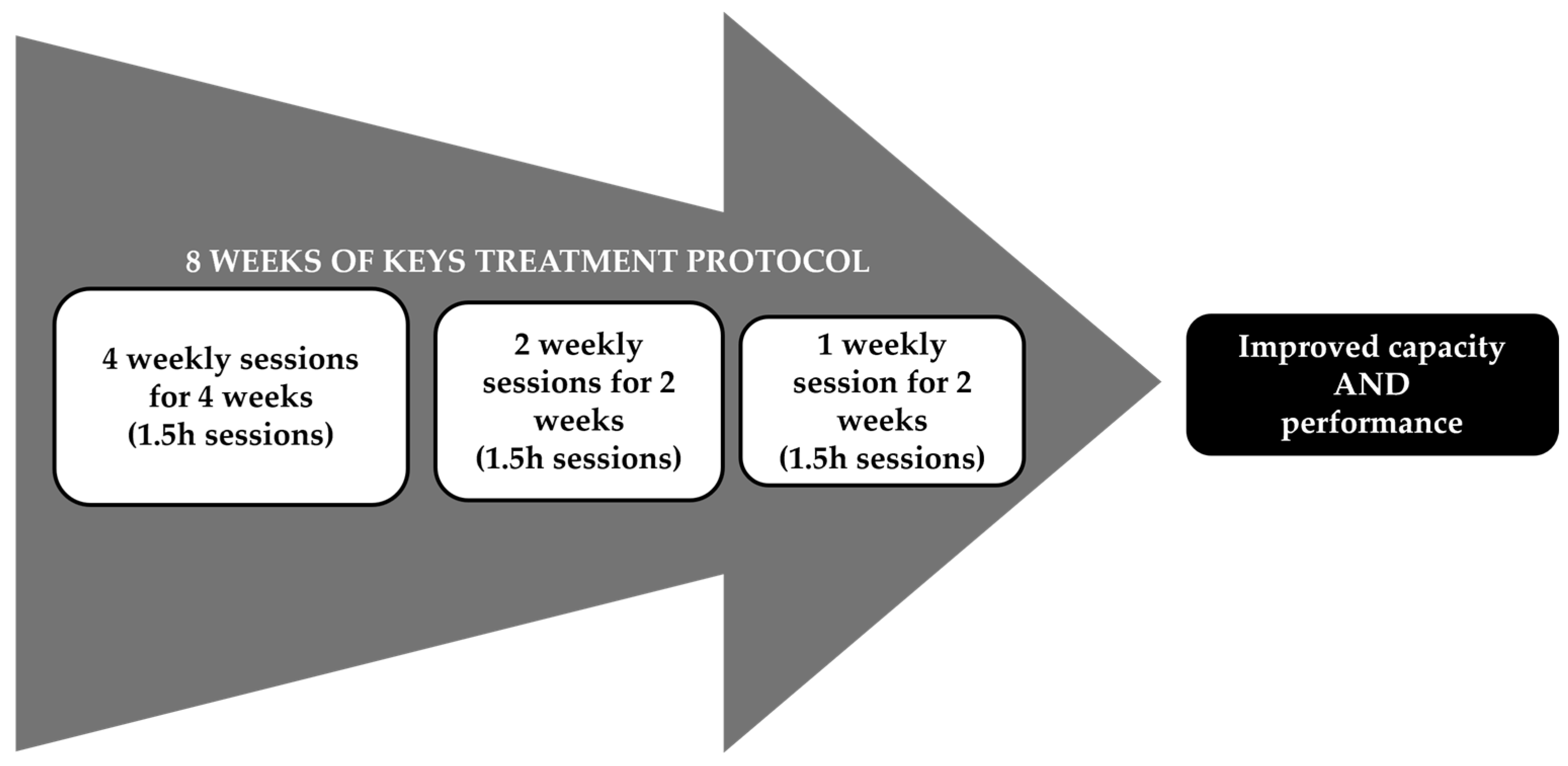
| Frequency and duration of in-clinic sessions | 3.5 h daily sessions for 10 consecutive weekdays (total of 35 h) | 1.5 h sessions distributed in 8 weeks: four sessions weekly for 4 weeks, two sessions weekly for 2 weeks, and one session weekly for 2 weeks (total of 33 h) | All components of CIMT are delivered throughout the treatment period. The Keys treatment protocol allows patients to interact with the protocol components over an extended period in a distributed format. This approach maintains a similar total number of hours as the signature protocol. The treatment includes strategies to enhance self-efficacy, patient education, and structured interactions, providing multiple problem-solving opportunities for both therapist and patient. |
| Overall engagement duration (therapist/patient) | 6 weeks: 2 weeks of in-clinic sessions and four weekly follow-up calls for MAL administration | 12 weeks: 8 weeks of in-clinic sessions, and four weekly follow-up calls for MAL administration | The engagement with the components of the CIMT protocol includes supervised training, tasks performed at home, and interaction with the Transfer Package not only during the treatment days but also during follow-up throughout the first month after the end of the treatment sessions. |
| Component 1: Movement Training | |||
| Shaping | TD1–TD10 | TD1–TD22 | Shaping in CIMT is a systematic approach to movement training with repeated timed trials in which progress is made in small steps.
|
| Task practice | TD1–TD10 | TD1–TD22 | Task practice is movement training that focuses on continuous movement throughout the 10–30 min functional activity.
|
| Component 2: Transfer Package | |||
| Behavioral contract | TD1 and TD6 | TD1; reviewed as needed | An agreement between the patient, caregiver, and therapist that addresses mitt use and more-affected UE use within the patient’s current routine.
|
| Daily schedule | TD1–TD10 | TD1–TD22 | A document that serves as an account of daily activities in the clinic setting by the therapist.
|
| Home diary | TD1–TD10, including weekends | TD1–TD 22, including weekends | A daily diary kept by the patient or caregiver detailing mitt usage outside of the clinic setting.
|
| Home skill assignment (HSA) | TD2–TD10, including weekends | TD2–TD22, including weekends | A set of 10 activities is selected daily in a process with the patient and therapist (and caregiver if present) to be performed outside of the clinic setting, with five easier activities and five more challenging activities selected.
|
| Daily administration of the HW Scale of the MAL | TD1–TD10 30 items of HW Scale on TD1 and TD6 and ½ of MAL HW on the remaining TDs. | TD1–TD22 ½ of MAL HW Scale each TD | Administration of MAL HW Scale daily to track progress through treatment.
|
| Problem solving | TD1–TD10 | TD1–TD22 | A process of finding ways to use of the more-affected UE better in tasks the patient already performs and for new tasks the patient is trying.
|
| Home practice after treatment | Developed over treatment and trained on the TD9 and TD10, to be carried out indefinitely | Developed over the treatment and trained on TD22, to be carried out indefinitely | A document-based home skill assignment that outlines use of the more-affected UE in daily life for eight activities and practicing skills for two activities, with instructions provided for use of the more-affected UE, addressing safe continued progress.
|
| Weekly administration of the MAL | Weekly for 4 weeks after discharge | Weekly for 4 weeks after discharge | Administration of the MAL by telephone or video call to monitor progress with the use of the more-affected UE.
|
| Component 3: Constraint (Encourage Use) of the More-Affected UE | |||
| Mitt use on less-affected UE | TD1–TD10 for 90% of waking hours | TD1–TD22 for 90% of waking hours | A mitt restraint is worn on the less-affected hand for 90% of waking hours to encourage use of the more-affected UE.
|
| Any other methods for reminding the patient to use the more-affected UE | TD1–TD10 | TD1–TD22 | The use of reminders, apps, and any visual aids to encourage the use of the more-affected UE.
|
| Participant | Sex | Age (y) | Ethnicity/Race | Type of Stroke | Time Since Onset (m) | Affected Side | Pre-Morbid Handedness |
|---|---|---|---|---|---|---|---|
| 1001 | M | 49 | AA | I | 20 | R | R |
| 1002 | M | 64 | W | I | 19 | R | R |
| 1003 | F | 46 | AA | I | 20 | R | R |
| 1004 | F | 71 | W | H | 50 | R | R |
| 1005 | F | 65 | W | I | 11 | L | R |
| 1006 | F | 58 | AA | U | 56 | L | R |
| 1007 | M | 61 | W | U | 24 | L | R |
| 1008 | M | 72 | W | I | 9 | R | L |
| 1009 | M | 67 | AA | U | 54 | L | L |
| Outcome Measures | Overall Scores | Difference in Scores Since Pre-Treatment | |||||
|---|---|---|---|---|---|---|---|
| Pre-Treatment | During Treatment (4 Weeks) | Posttreatment (8 Weeks) | 3-Month Follow-Up | Difference 4 Weeks–Pre | Difference Post–Pre | Difference 3-Month Follow-Up–Pre | |
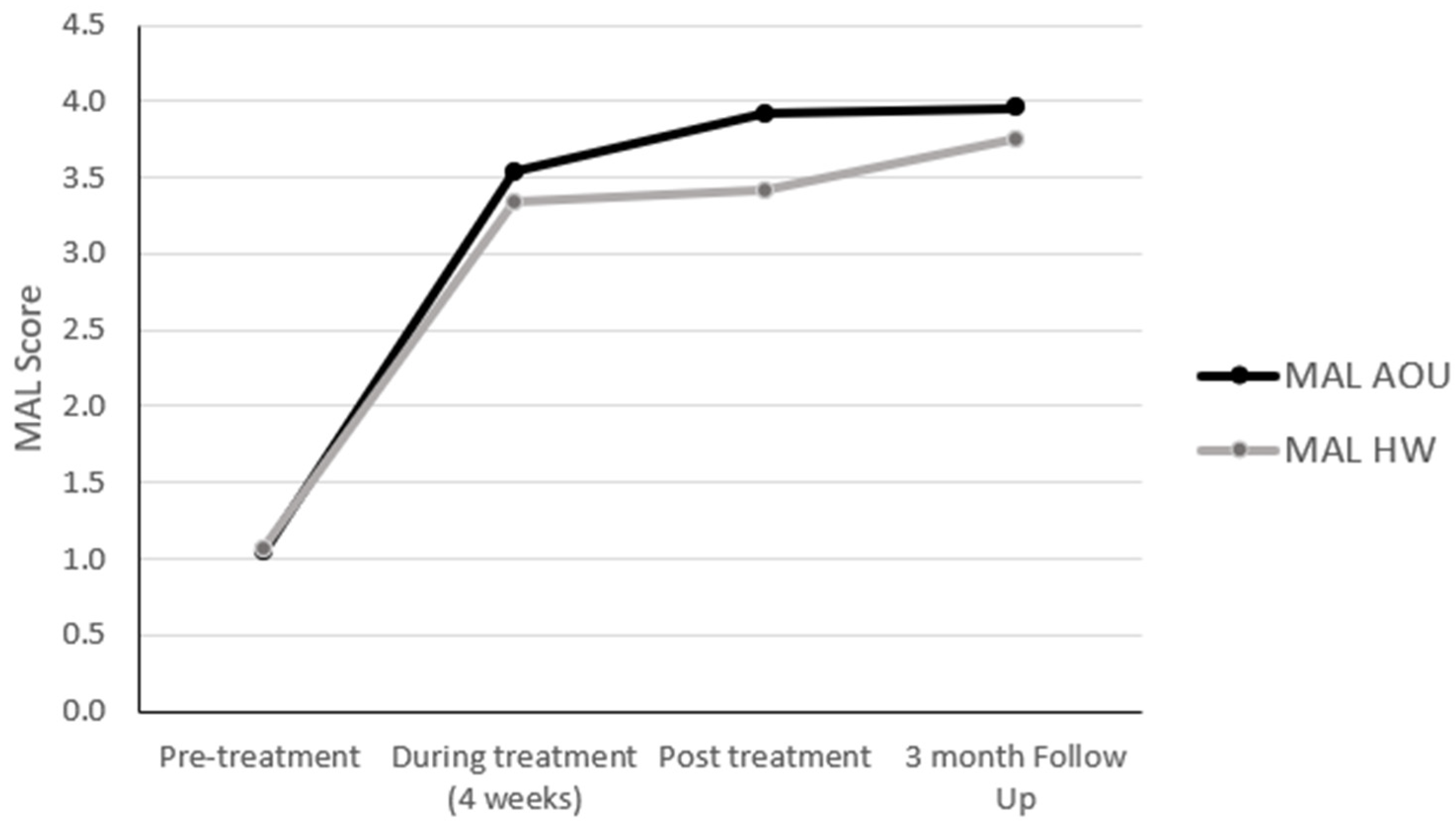
| MAL AOU | 1 | 3.5 | 3.9 | 4 | 2.5 * | 2.9 * | 3 * |
| MAL QOM | 1.1 | 3.3 | 3.4 | 3.7 | 2.2 * | 2.3 * | 2.6 * |
| WMFT—Median Performance Time (s) | 5.32 | 3.82 | 3.23 | . | −1.5 * | −2.09 * | . |
| WMFT—Median Functional Ability score | 3 | 3 | 3 | . | 0 | 0 | . |
| WMFT—Number of Non-Completed Tasks | 3 | 1 | 2 | . | −2 | −1 | . |
| SIS—Strength | 51.8 | 59.8 | 65.2 | 65.2 | 8 | 13.4 * | 13.4 * |
| SIS—Memory | 59.8 | 63.9 | 61.6 | 67.7 | 4.1 | 1.8 | 7.9 |
| SIS—Mood | 64.2 | 63.9 | 65.5 | 69 | −0.3 | 1.3 | 4.8 |
| SIS—Communication | 90.5 | 91.8 | 90.3 | 93.4 | 1.3 | −0.2 | 2.9 |
| SIS—ADLs/IADLs | 56.8 | 70.4 | 77.1 | 81.1 | 13.6 * | 20.3 * | 24.3 * |
| SIS—Mobility | 77 | 79.4 | 82.9 | 84.1 | 2.4 | 5.9 * | 7.1 * |
| SIS—Hand Function | 36.1 | 60.7 | 65 | 70.7 | 24.6 * | 28.9 * | 34.6 * |
| SIS—Participation | 56.4 | 69.6 | 75 | 76.8 | 13.2 | 18.6 | 20.4 |
| SIS—Recovery | 58.9 | 59.3 | 70 | 76.4 | 0.4 | 11.1 | 17.5 |
| ZDS | 34.1 | 32.1 | 30.4 | 31 | −2 | −3.7 | −3.1 |
Disclaimer/Publisher’s Note: The statements, opinions and data contained in all publications are solely those of the individual author(s) and contributor(s) and not of MDPI and/or the editor(s). MDPI and/or the editor(s) disclaim responsibility for any injury to people or property resulting from any ideas, methods, instructions or products referred to in the content. |
© 2025 by the authors. Licensee MDPI, Basel, Switzerland. This article is an open access article distributed under the terms and conditions of the Creative Commons Attribution (CC BY) license (https://creativecommons.org/licenses/by/4.0/).
Share and Cite
dos Anjos, S.; Bowman, M.; Morris, D. Effects of a Distributed Form of Constraint-Induced Movement Therapy for Clinical Application: The Keys Treatment Protocol. Brain Sci. 2025, 15, 87. https://doi.org/10.3390/brainsci15010087
dos Anjos S, Bowman M, Morris D. Effects of a Distributed Form of Constraint-Induced Movement Therapy for Clinical Application: The Keys Treatment Protocol. Brain Sciences. 2025; 15(1):87. https://doi.org/10.3390/brainsci15010087
Chicago/Turabian Styledos Anjos, Sarah, Mary Bowman, and David Morris. 2025. "Effects of a Distributed Form of Constraint-Induced Movement Therapy for Clinical Application: The Keys Treatment Protocol" Brain Sciences 15, no. 1: 87. https://doi.org/10.3390/brainsci15010087
APA Styledos Anjos, S., Bowman, M., & Morris, D. (2025). Effects of a Distributed Form of Constraint-Induced Movement Therapy for Clinical Application: The Keys Treatment Protocol. Brain Sciences, 15(1), 87. https://doi.org/10.3390/brainsci15010087