


Brexpiprazole—Pharmacologic Properties and Use in Schizophrenia and Mood Disorders



Abstract
1. Pharmacological Profile of Brexipiprazole
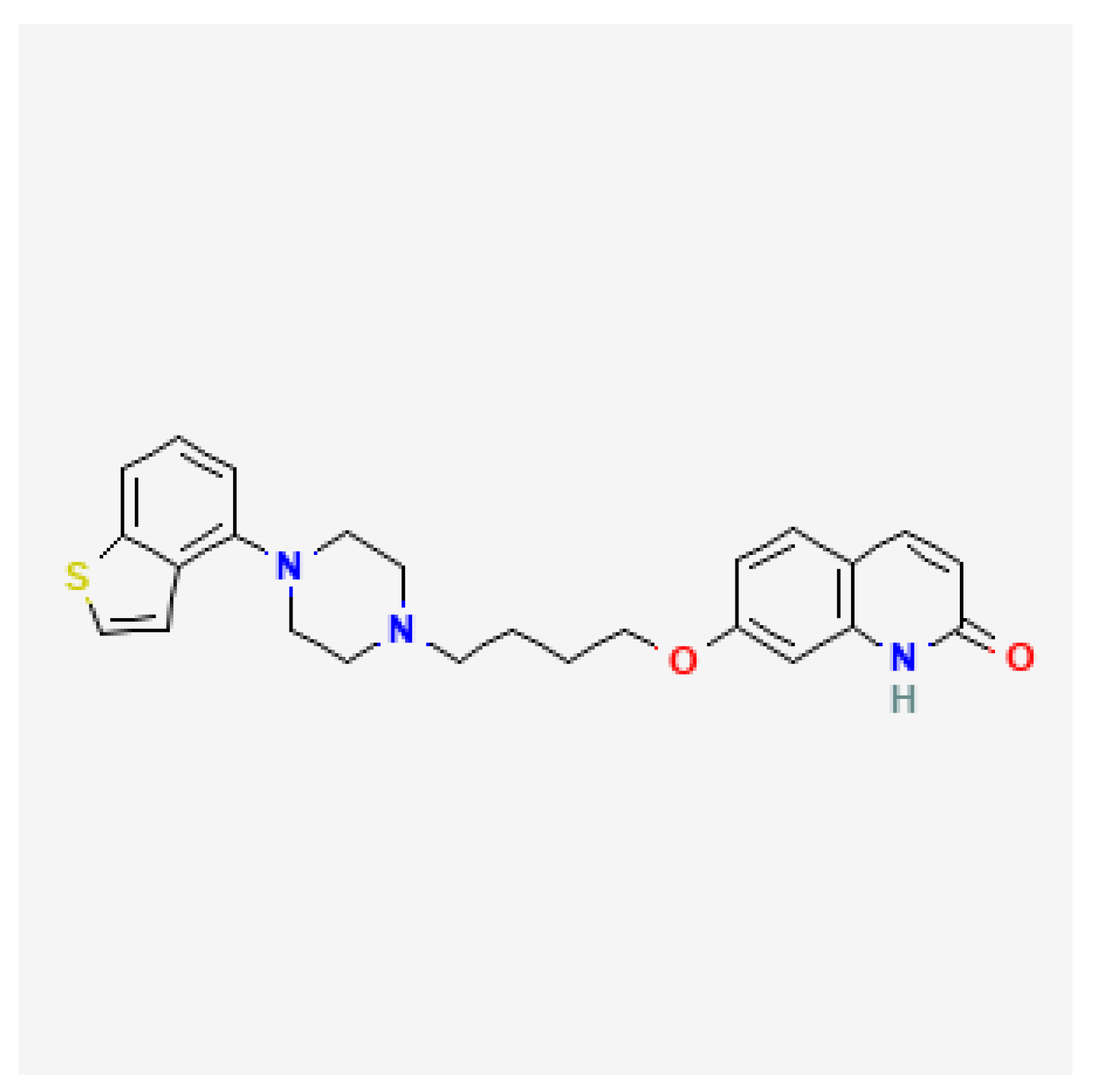
1.1. Structure and Class
1.2. Pharmacodynamics
1.3. Pharmacokinetics
2. Clinical Use
2.1. Schizophrenia—Acute Episode (up to 6 Weeks)
2.2. Schizophrenia—Long-Term Treatment
2.3. Treatment-Resistant Depression (TRD)
2.4. Bipolar Disorder
3. Safety and Tolerance
3.1. Weight Increase and Metabolic Syndrome
3.2. EPS
3.3. hPRL and Sexual Functions
3.4. Other AE
3.5. Gaps in Knowledge Regarding Brexpiprazole
4. Conclusions
Author Contributions
Funding
Institutional Review Board Statement
Informed Consent Statement
Data Availability Statement
Conflicts of Interest
References
- National Center for Biotechnology Information. PubChem Compound Summary for CID 11978813, Brexpiprazole. 2023. Available online: https://pubchem.ncbi.nlm.nih.gov/compound/Brexpiprazole (accessed on 14 February 2023).
- Kikuchi, T.; Maeda, K.; Suzuki, M.; Hirose, T.; Futamura, T.; Mcquade, R.D. Discovery research and development history of the dopamine D 2 receptor partial agonists, aripiprazole and brexpiprazole. Neuropsychopharmacol. Rep. 2021, 41, 134–143. [Google Scholar] [CrossRef] [Scilit] [PubMed]
- Aftab, A.; Gao, K. The preclinical discovery and development of brexpiprazole for the treatment of major depressive disorder. Expert Opin. Drug Discov. 2017, 12, 1067–1081. [Google Scholar] [CrossRef] [Scilit] [PubMed]
- Maeda, K.; Sugino, H.; Akazawa, H.; Amada, N.; Shimada, J.; Futamura, T.; Yamashita, H.; Ito, N.; McQuade, R.D.; Mørk, A.; et al. Brexpiprazole I: In Vitro and In Vivo Characterization of a Novel Serotonin-Dopamine Activity Modulator. J. Pharmacol. Exp. Ther. 2014, 350, 589–604. [Google Scholar] [CrossRef] [Scilit] [PubMed]
- Stahl, S.M. Mechanism of action of cariprazine. CNS Spectrums 2016, 21, 123–127. [Google Scholar] [CrossRef] [Scilit] [PubMed]
- Wong, D.F.; Raoufinia, A.; Bricmont, P.; Brašić, J.R.; McQuade, R.D.; Forbes, R.A.; Kikuchi, T.; Kuwabara, H. An open-label, positron emission tomography study of the striatal D2/D3 receptor occupancy and pharmacokinetics of single-dose oral brexpiprazole in healthy participants. Eur. J. Clin. Pharmacol. 2021, 77, 717–725. [Google Scholar] [CrossRef] [Scilit]
- Siwek, M.; Wojtasik-Bakalarz, K. Leki Przeciwpsychotyczne; Rybakowski, J., Ed.; PWN: Warsaw, Poland, 2022; pp. 109–174. [Google Scholar]
- Siwek, M.; Wasik, A.; Krupa, A.; Gorostowicz, A. Nowe Leki Przeciwpsychotyczne; Medical Education: Warsaw, Poland, 2020. [Google Scholar]
- Siwek, M.; Krupa, A.J.; Wasik, A. Lurasidone–pharmacodynamic and pharmacokinetic properties, clinical potential and interaction risk. Pharmacother. Psychiatry Neurol. 2020, 34, 117–134. [Google Scholar] [CrossRef] [Scilit]
- Eaves, S.; Rey, J.A. Brexipiprazole (Rexulti): A new monotherapy for schizophrenia and adjunctive therapy for major depressive disorder. Pharm. Ther. 2016, 41, 418–422. [Google Scholar]
- Oosterhof, C.A.; El Mansari, M.; Blier, P. Acute Effects of Brexpiprazole on Serotonin, Dopamine, and Norepinephrine Systems: An In Vivo Electrophysiologic Characterization. J. Pharmacol. Exp. Ther. 2014, 351, 585–595. [Google Scholar] [CrossRef] [Scilit]
- Misiak, B.; Bieńkowski, P.; Samochowiec, J. Cariprazine—A novel antipsychotic drug and its place in the treatment of schizophrenia. Psychiatr. Polska 2018, 52, 971–981. [Google Scholar] [CrossRef] [Scilit]
- Miyamoto, S.; Miyake, N.; Jarskog, L.F.; Fleischhacker, W.W.; Lieberman, J.A. Pharmacological treatment of schizophrenia: A critical review of the pharmacology and clinical effects of current and future therapeutic agents. Mol. Psychiatry 2012, 17, 1206–1227. [Google Scholar] [CrossRef] [Scilit]
- Wasik, A.; Krupa, A.; Siwek, M. Interactions of antidepressants, mood-stabilisers and antipsychotics with food. Pharmacother. Psychiatry Neurol. 2019, 35, 51–74. [Google Scholar] [CrossRef] [Scilit]
- Bruno, C.D.; Elmokadem, A.; Housand, C.; Jordie, E.B.; Chow, C.R.; Laughren, T.P.; Greenblatt, D.J. Impact of Obesity on Brexpiprazole Pharmacokinetics: Proposal for Improved Initiation of Treatment. J. Clin. Pharmacol. 2022, 62, 55–65. [Google Scholar] [CrossRef] [Scilit]
- Frankel, J.S.; Schwartz, T.L. Brexpiprazole and cariprazine: Distinguishing two new atypical antipsychotics from the original dopamine stabilizer aripiprazole. Ther. Adv. Psychopharmacol. 2016, 7, 29–41. [Google Scholar] [CrossRef] [Scilit] [PubMed]
- Correll, C.U.; Jain, R.; Meyer, J.; Periclou, A.; Carrothers, T.; Barabássy, Á.; Patel, M.; Earley, W. Relationship between the timing of relapse and plasma drug levels following discontinuation of cariprazine treatment in patients with schizophrenia: Indirect comparison with other second-generation antipsychotics after treatment discontinuation. Neuropsychiatr. Dis. Treat. 2019, 15, 2537–2550. [Google Scholar] [CrossRef] [Scilit] [PubMed]
- Otsuka Pharmaceuticals Co., Ltd. REXULTI Product Monograph 2020. Available online: https://www.lundbeck.com/content/dam/lundbeck-com/americas/canada/products/files/rexulti_product_monograph_english.pdf (accessed on 18 February 2023).
- Mauri, M.C.; Paletta, S.; Di Pace, C.; Reggiori, A.; Cirnigliaro, G.; Valli, I.; Altamura, A.C. Clinical Pharmacokinetics of Atypical Antipsychotics: An Update. Clin. Pharmacokinet. 2018, 57, 1493–1528. [Google Scholar] [CrossRef] [Scilit] [PubMed]
- Schoretsanitis, G.; Kane, J.M.; Correll, C.U.; Marder, S.R.; Citrome, L.; Newcomer, J.W.; Robinson, D.G.; Goff, D.C.; Kelly, D.L.; Freudenreich, O.; et al. Blood levels to optimize antipsychotic treatment in clinical practice: A joint consensus statement of the American society of clinical psychopharmacology and the therapeutic drug monitoring task force of the arbeitsgemeinschaft für neuropsychopharmakologie und pharmakopsychiatrie. J. Clin. Psychiatry 2020, 81, 3649. [Google Scholar]
- Elmokadem, A.; Bruno, C.D.; Housand, C.; Jordie, E.B.; Chow, C.R.; Lesko, L.J.; Greenblatt, D.J. Brexpiprazole Pharmacokinetics in CYP2D6 Poor Metabolizers: Using Physiologically Based Pharmacokinetic Modeling to Optimize Time to Effective Concentrations. J. Clin. Pharmacol. 2022, 62, 66–75. [Google Scholar] [CrossRef] [Scilit] [PubMed]
- Thakkar, D.; Kate, A.S. Investigation of the impact of grapefruit juice, pomegranate juice and tomato juice on pharmacokinetics of brexpiprazole in rats using UHPLC–QTOF–MS. Biomed. Chromatogr. 2021, 35, e5201. [Google Scholar] [CrossRef] [Scilit]
- Sasabe, H.; Koga, T.; Furukawa, M.; Matsunaga, M.; Sasahara, K.; Hashizume, K.; Oozone, Y.; Amunom, I.; Torii, M.; Umehara, K.; et al. In vitro evaluations for pharmacokinetic drug-drug interactions of a novel serotonin-dopamine activity modulator, brexpiprazole. Xenobiotica 2021, 51, 522–535. [Google Scholar] [CrossRef] [Scilit]
- Citrome, L. Brexpiprazole for schizophrenia and as adjunct for major depressive disorder: A systematic review of the efficacy and safety profile for this newly approved antipsychotic—What is the number needed to treat, number needed to harm and likelihood to be hel. Int. J. Clin. Pract. 2015, 69, 978–997. [Google Scholar] [CrossRef] [Scilit]
- Sabe, M.; Zhao, N.; Crippa, A.; Kaiser, S. Antipsychotics for negative and positive symptoms of schizophrenia: Dose-response meta-analysis of randomized controlled acute phase trials. Schizophrenia 2021, 7, 43. [Google Scholar] [CrossRef] [Scilit] [PubMed]
- Correll, C.U.; Skuban, A.; Hobart, M.; Ouyang, J.; Weiller, E.; Weiss, C.; Kane, J.M. Efficacy of brexpiprazole in patients with acute schizophrenia: Review of three randomized, double-blind, placebo-controlled studies. Schizophr. Res. 2016, 174, 82–92. [Google Scholar] [CrossRef] [Scilit]
- Kane, J.M.; Skuban, A.; Hobart, M.; Ouyang, J.; Weiller, E.; Weiss, C.; Correll, C.U. Overview of short- and long-term tolerability and safety of brexpiprazole in patients with schizophrenia. Schizophr. Res. 2016, 174, 93–98. [Google Scholar] [CrossRef] [Scilit] [PubMed]
- Correll, C.U.; Skuban, A.; Ouyang, J.; Hobart, M.; Pfister, S.; McQuade, R.D.; Nyilas, M.; Carson, W.H.; Sanchez, R.; Eriksson, H. Efficacy and Safety of Brexpiprazole for the Treatment of Acute Schizophrenia: A 6-Week Randomized, Double-Blind, Placebo-Controlled Trial. Am. J. Psychiatry 2015, 172, 870–880. [Google Scholar] [CrossRef] [Scilit] [PubMed]
- Marder, S.R.; Eriksson, H.; Zhao, Y.; Hobart, M. Post-hoc analysis of a randomized, placebo-controlled, active-reference 6-week study of brexpiprazole in acute schizophrenia. Acta Neuropsychiatr. 2020, 32, 153–158. [Google Scholar] [CrossRef] [Scilit]
- Ishigooka, J.; Iwashita, S.; Tadori, Y. Efficacy and safety of brexpiprazole for the treatment of acute schizophrenia in Japan: A 6-week, randomized, double-blind, placebo-controlled study. Psychiatry Clin. Neurosci. 2018, 72, 692–700. [Google Scholar] [CrossRef] [Scilit]
- Citrome, L.; Ota, A.; Nagamizu, K.; Perry, P.; Weiller, E.; Baker, R.A. The effect of brexpiprazole (OPC-34712) and aripiprazole in adult patients with acute schizophrenia: Results from a randomized, exploratory study. Int. Clin. Psychopharmacol. 2016, 31, 192–201. [Google Scholar] [CrossRef] [Scilit] [PubMed]
- van Erp, T.G.; Baker, R.A.; Cox, K.; Okame, T.; Kojima, Y.; Eramo, A.; Potkin, S.G. Effect of brexpiprazole on control of impulsivity in schizophrenia: A randomized functional magnetic resonance imaging study. Psychiatry Res. Neuroimaging 2020, 301, 111085. [Google Scholar] [CrossRef] [Scilit]
- Correll, C.U.; He, Y.; Therrien, F.; MacKenzie, E.; Meehan, S.R.; Weiss, C.; Hefting, N.; Hobart, M. Effects of Brexpiprazole on Functioning in Patients with Schizophrenia: Post Hoc Analysis of Short- And Long-term Studies. J. Clin. Psychiatry 2022, 83, 39942. [Google Scholar] [CrossRef] [Scilit]
- Meade, N.; Shi, L.; Meehan, S.R.; Weiss, C.; Ismail, Z. Efficacy and safety of brexpiprazole in patients with schizophrenia presenting with severe symptoms: Post-hoc analysis of short- and long-term studies. J. Psychopharmacol. 2020, 34, 829–838. [Google Scholar] [CrossRef] [Scilit]
- Citrome, L.; Ouyang, J.; Shi, L.; Meehan, S.R.; Baker, R.A.; Weiss, C. Effect of Brexpiprazole on Agitation and Hostility in Patients with Schizophrenia: Post Hoc Analysis of Short- and Long-Term Studies. J. Clin. Psychopharmacol. 2019, 39, 597–603. [Google Scholar] [CrossRef] [Scilit] [PubMed]
- Antoun Reyad, A.; Girgis, E.; Mishriky, R. Efficacy and safety of brexpiprazole in acute management of psychiatric disorders: A meta-analysis of randomized controlled trials. Int. Clin. Psychopharmacol. 2020, 35, 119–128. [Google Scholar] [CrossRef] [Scilit] [PubMed]
- Zhou, C.; Nutt, D.J.; Davies, S.J.C. Visualizing classification of drugs used in psychotic disorders: A ‘subway map’ representing mechanisms, established classes and informal categories. J. Psychopharmacol. 2022, 36, 1007–1015. [Google Scholar] [CrossRef] [Scilit] [PubMed]
- Kishi, T.; Ikuta, T.; Matsuda, Y.; Sakuma, K.; Iwata, N. Aripiprazole vs. brexpiprazole for acute schizophrenia: A systematic review and network meta-analysis. Psychopharmacology 2020, 237, 1459–1470. [Google Scholar] [CrossRef] [Scilit] [PubMed]
- Citrome, L. Schizophrenia relapse, patient considerations, and potential role of lurasidone. Patient Prefer. Adherence 2016, 10, 1529–1537. [Google Scholar] [CrossRef] [Scilit] [PubMed]
- Fleischhacker, W.W.; Hobart, M.; Ouyang, J.; Forbes, A.; Pfister, S.; McQuade, R.D.; Carson, W.H.; Sanchez, R.; Nyilas, M.; Weiller, E. Efficacy and Safety of Brexpiprazole (OPC-34712) as Maintenance Treatment in Adults with Schizophrenia: A Randomized, Double-Blind, Placebo-Controlled Study. Int. J. Neuropsychopharmacol. 2016, 20, 11–21. [Google Scholar] [CrossRef] [Scilit]
- Ishigooka, J.; Iwashita, S.; Tadori, Y. Long-term safety and effectiveness of brexpiprazole in Japanese patients with schizophrenia: A 52-week, open-label study. Psychiatry Clin. Neurosci. 2018, 72, 445–453. [Google Scholar] [CrossRef] [Scilit]
- Inada, K.; Yamada, S.; Akiyoshi, H.; Kojima, Y.; Iwashita, S.; Ishigooka, J. Long-Term Efficacy and Safety of Brexpiprazole in Elderly Japanese Patients with Schizophrenia: A Subgroup Analysis of an Open-Label Study. Neuropsychiatr. Dis. Treat. 2020, 16, 2267–2275. [Google Scholar] [CrossRef] [Scilit]
- Forbes, A.; Hobart, M.; Ouyang, J.; Shi, L.; Pfister, S.; Hakala, M. A Long-Term, Open-Label Study to Evaluate the Safety and Tolerability of Brexpiprazole as Maintenance Treatment in Adults with Schizophrenia. Int. J. Neuropsychopharmacol. 2018, 21, 433–441. [Google Scholar] [CrossRef] [Scilit]
- Hishimoto, A.; Yasui-Furukori, N.; Sekine, D.; Matsukawa, M.; Yamada, S. Treatment Discontinuation Among Patients with Schizophrenia Treated with Brexpiprazole and Other Oral Atypical Antipsychotics in Japan: A Retrospective Observational Study. Adv. Ther. 2022, 39, 4299–4314. [Google Scholar] [CrossRef] [Scilit]
- Corponi, F.; Fabbri, C.; Bitter, I.; Montgomery, S.; Vieta, E.; Kasper, S.; Pallanti, S.; Serretti, A. Novel antipsychotics specificity profile: A clinically oriented review of lurasidone, brexpiprazole, cariprazine and lumateperone. Eur. Neuropsychopharmacol. 2019, 29, 971–985. [Google Scholar] [CrossRef] [Scilit]
- Vázquez, G.H.; Bahji, A.; Undurraga, J.; Tondo, L.; Baldessarini, R.J. Efficacy and Tolerability of Combination Treatments for Major Depression: Antidepressants plus Second-Generation Antipsychotics vs. Esketamine vs. Lithium. J. Psychopharmacol. 2021, 35, 890–900. [Google Scholar] [CrossRef] [Scilit] [PubMed]
- Thase, M.E.; Youakim, J.M.; Skuban, A.; Hobart, M.; Augustine, C.; Zhang, P.; McQuade, R.D.; Carson, W.H.; Nyilas, M.; Sanchez, R.; et al. Efficacy and safety of adjunctive brexpiprazole 2 mg in major depressive disorder: A phase 3, randomized, placebo-controlled study in patients with inadequate response to antidepressants. J. Clin. Psychiatry 2015, 76, 1224–1231. [Google Scholar] [CrossRef] [Scilit] [PubMed]
- Thase, M.E.; Youakim, J.M.; Skuban, A.; Hobart, M.; Zhang, P.; McQuade, R.D.; Nyilas, M.; Carson, W.H.; Sanchez, R.; Eriksson, H. Adjunctive brexpiprazole 1 and 3 mg for patients with major depressive disorder following inadequate response to antidepressants: A phase 3, randomized, double-blind study. J. Clin. Psychiatry 2015, 76, 1232–1240. [Google Scholar] [CrossRef] [Scilit] [PubMed]
- Hobart, M.; Skuban, A.; Zhang, P.; Augustine, C.; Brewer, C.; Hefting, N.; Sanchez, R.; McQuade, R.D. A Randomized, Placebo-Controlled Study of the Efficacy and Safety of Fixed-Dose Brexpiprazole 2 mg/d as Adjunctive Treatment of Adults with Major Depressive Disorder. J. Clin. Psychiatry 2018, 79, 5950. [Google Scholar] [CrossRef] [Scilit] [PubMed]
- Hobart, M.; Skuban, A.; Zhang, P.; Josiassen, M.K.; Hefting, N.; Augustine, C.; Brewer, C.; Sanchez, R.; McQuade, R.D. Efficacy and safety of flexibly dosed brexpiprazole for the adjunctive treatment of major depressive disorder: A randomized, active-referenced, placebo-controlled study. Curr. Med. Res. Opin. 2018, 34, 633–642. [Google Scholar] [CrossRef] [Scilit]
- Bauer, M.; Hefting, N.; Lindsten, A.; Josiassen, M.K.; Hobart, M. A randomised, placebo-controlled 24-week study evaluating adjunctive brexpiprazole in patients with major depressive disorder. Acta Neuropsychiatr. 2018, 31, 27–35. [Google Scholar] [CrossRef] [Scilit] [PubMed]
- Hobart, M.; Zhang, P.; Weiss, C.; Meehan, S.R.; Eriksson, H. Adjunctive Brexpiprazole and Functioning in Major Depressive Disorder: A Pooled Analysis of Six Randomized Studies Using the Sheehan Disability Scale. Int. J. Neuropsychopharmacol. 2018, 22, 173–179. [Google Scholar] [CrossRef] [Scilit]
- Katzman, M.A.; Therrien, F.; MacKenzie, E.M.; Wang, F.; de Jong-Laird, A.; Boucher, M. Efficacy of adjunctive brexpiprazole on symptom clusters of major depressive disorder: A post hoc analysis of four clinical studies. J. Affect. Disord. 2022, 316, 201–208. [Google Scholar] [CrossRef] [Scilit]
- Thase, M.E.; Weiller, E.; Zhang, P.; Weiss, C.; McIntyre, R.S. Adjunctive brexpiprazole in patients with major depressive disorder and anxiety symptoms: Post hoc analyses of three placebo-controlled studies. Neuropsychiatr. Dis. Treat. 2018, 15, 37–45. [Google Scholar] [CrossRef] [Scilit]
- Nelson, J.C.; Weiller, E.; Zhang, P.; Weiss, C.; Hobart, M. Efficacy of adjunctive brexpiprazole on the core symptoms of major depressive disorder: A post hoc analysis of two pooled clinical studies. J. Affect. Disord. 2018, 227, 103–108. [Google Scholar] [CrossRef] [PubMed]
- Hobart, M.; Zhang, P.; Skuban, A.; Brewer, C.; Hefting, N.; Sanchez, R.; McQuade, R.D. A Long-Term, Open-Label Study to Evaluate the Safety and Tolerability of Brexpiprazole as Adjunctive Therapy in Adults with Major Depressive Disorder. J. Clin. Psychopharmacol. 2019, 39, 203–209. [Google Scholar] [CrossRef] [Scilit] [PubMed]
- Fava, M.; Mard, F.; Davidsen, C.K.; Baker, R.A. Adjunctive brexpiprazole in patients with major depressive disorder and irritability: An exploratory study. J. Clin. Psychiatry 2016, 77, 1695–1701. [Google Scholar] [CrossRef] [Scilit] [PubMed]
- Davis, L.L.; Ota, A.; Perry, P.; Tsuneyoshi, K.; Weiller, E.; Baker, R.A. Adjunctive brexpiprazole in patients with major depressive disorder and anxiety symptoms: An exploratory study. Brain Behav. 2016, 6, e00520. [Google Scholar] [CrossRef] [Scilit]
- Brown, E.S.; Khaleghi, N.; Van Enkevort, E.; Ivleva, E.; Nakamura, A.; Holmes, T.; Mason, B.L.; Escalante, C. A pilot study of brexpiprazole for bipolar depression. J. Affect. Disord. 2019, 249, 315–318. [Google Scholar] [CrossRef] [Scilit]
- Vieta, E.; Sachs, G.; Chang, D.; Hellsten, J.; Brewer, C.; Peters-Strickland, T.; Hefting, N. Two randomized, double-blind, placebo-controlled trials and one open-label, long-term trial of brexpiprazole for the acute treatment of bipolar mania. J. Psychopharmacol. 2021, 35, 971–982. [Google Scholar] [CrossRef] [Scilit]
- Lepola, U.; Hefting, N.; Zhang, D.; Hobart, M. Adjunctive brexpiprazole for elderly patients with major depressive disorder: An open-label, long-term safety and tolerability study. Int. J. Geriatr. Psychiatry 2018, 33, 1403–1410. [Google Scholar] [CrossRef] [Scilit]
- Barton, B.B.; Segger, F.; Fischer, K.; Obermeier, M.; Musil, R. Update on weight-gain caused by antipsychotics: A systematic review and meta-analysis. Expert Opin. Drug Saf. 2020, 19, 295–314. [Google Scholar] [CrossRef] [Scilit]
- Ichinose, M.; Miura, I.; Horikoshi, S.; Yamamoto, S.; Kanno-Nozaki, K.; Watanabe, K.; Yabe, H. Effect of Switching to Brexpiprazole on Plasma Homovanillic Acid Levels and Antipsychotic-Related Side Effects in Patients with Schizophrenia or Schizoaffective Disorder. Neuropsychiatr. Dis. Treat. 2021, 17, 1047–1053. [Google Scholar] [CrossRef] [Scilit]
- Ishigooka, J.; Inada, K.; Niidome, K.; Aoki, K.; Kojima, Y.; Iwashita, S.; Yamada, S. Safety of switching to brexpiprazole in Japanese patients with schizophrenia: A post-hoc analysis of a long-term open-label study. Hum. Psychopharmacol. Clin. Exp. 2021, 36, e2777. [Google Scholar] [CrossRef] [Scilit]
- Ivkovic, J.; Lindsten, A.; George, V.; Eriksson, H.; Hobart, M. Effect of Brexpiprazole on Prolactin: An Analysis of Short-and Long-Term Studies in Schizophrenia. J. Clin. Psychopharmacol. 2019, 39, 13–19. [Google Scholar] [CrossRef] [Scilit] [PubMed]
- Clayton, A.H.; Ivkovic, J.; Chen, D.; George, V.; Hobart, M. Effect of Brexpiprazole on Prolactin and Sexual Functioning: An Analysis of Short- And Long-Term Study Data in Major Depressive Disorder. J. Clin. Psychopharmacol. 2020, 40, 560–567. [Google Scholar] [CrossRef] [Scilit]
- Okayasu, H.; Shinozaki, T.; Takano, Y.; Sugawara, N.; Fujii, K.; Yasui-Furukori, N.; Ozeki, Y.; Shimoda, K. Effects of Antipsychotics on Arrhythmogenic Parameters in Schizophrenia Patients: Beyond Corrected QT Interval. Neuropsychiatr. Dis. Treat. 2021, 17, 239–249. [Google Scholar] [CrossRef] [Scilit]
- Wichniak, A.; Siwek, M.; Rymaszewska, J.; Janas-Kozik, M.; Wolańczyk, T.; Bieńkowski, P.; Dudek, D.; Heitzman, J.; Szulc, A.; Samochowiec, J. The position statement of the Working Group of the Polish Psychiatric Association on the use of D2/D3 dopamine receptor partial agonists in special populations. Psychiatr Pol. 2021, 55, 967–987. [Google Scholar] [CrossRef] [Scilit] [PubMed]
- Wichniak, A.; Samochowiec, J.; Szulc, A.; Dudek, D.; Heitzman, J.; Janas-Kozik, M.; Wolańczyk, T.; Rymaszewska, J.; Siwek, M.; Bieńkowski, P. The position statement of the Working Group of the Polish Psychiatric Association on the use of D2/D3 dopamine receptor partial agonists in the treatment of mental disorders. Psychiatr Pol. 2021, 55, 941–966. [Google Scholar] [CrossRef] [Scilit]
- Citrome, L. Activating and sedating adverse effects of second-generation antipsychotics in the treatment of schizophrenia and major depressive disorder: Absolute risk increase and number needed to harm. J Clin Psychopharmacol. 2017, 37, 138–147. [Google Scholar] [CrossRef] [Scilit] [PubMed]
- Yoshimura, Y.; Shimizu, H.; Yamashita, R.; Washida, K.; Takeda, T.; Aoki, S. Association between previous high-dose antipsychotic therapy and brexpiprazole discontinuation after the initiation of brexpiprazole in patients with schizophrenia or schizoaffective disorder. Int. Clin. Psychopharmacol. 2020, 35, 98–104. [Google Scholar] [CrossRef] [Scilit] [PubMed]

| Effects of Receptors Agonism/Partrial Agonists | Effects of Receptors Antagonism, Reversed Agonism | Brexpiprazole | Aripiprazole | Cariprazine | |
|---|---|---|---|---|---|
| D2 | Partial agonism: reduction in EPS and hPRL, anticonvulsive effect. | Antipsychotic and antimanic effect, decrease in agitation and aggressive behaviors. Increase in EPS, PRL levels, cognitive impairements, severity of negative symptoms. Proconvulcive effect and possible weight gain. | 0.30 # | 0.34 # | 0.49 # |
| D3 | Reduction of negative symptoms. | Possible antipsychotic, antidepressant, procognitive effect. | 1.1 # | 0.8 # | 0.085 # |
| 5HT1a | Antidepressant, anxiolytic, and procognitive effect. Reduction in EPS and sexual impairements associated with serotonin reuptake inhibition. | ? | 0.12 # | 1.7 # | 2.6 # |
| 5HT2a | Propsychotic and possible antipsychotic effects. Increased severity of impulsive behaviours, insomnia, neuroplasticity, and prolactive release. The risk of inducing serotonin syndrome. | Antipsychotic, anxiolytic, and non-rapid eye movement sleep-promoting effect. Reduction of PRL, EPS, and impulsive behaviours. Potentialization of the serotonin reuptake inhibition effects. Increased sedation and insulin resistance. | 0.47 * | 3.4 * | 18.8 * |
| 5HT2c | Anorectic effect. Reduction of impulsive behaviours. | Procognitive and antidepressant effects. Increased weight gain. | 34 * | 15 # | 134 * |
| 5HT7 | ? | Anidepressant, antipsychotic, and procognitivive effect. Decreased severity of negative sumptoms and duration of rapid eye movement sleep. | 3.7 * | 29 # | 111 * |
| α1 | Hypertension | Hypotonia (including orthostatic hypotonia), tachycardia, nasal swelling, ejaculation impairements, sedation, weight gain, increased risk of metabolic syndrome, priapism, urinary incontinance, proconvulsive effect. | 3.8 * | 57 * | 6.88 * |
| α2 | Procognitive and analgesic effect. Increased sedation, hypotonia. Pro- or anticonvulsive effect dependent on the drug dose. | Antidepressant and possible procognitive effect. Increased nightmares. | 0.59 * | 37.9 * | ? |
| ? | Sedation, weight gain. Possible proconvulsive effect. | 19 * | 61 * | 23.2 * | |
| M | Procognitive proconvulsive and possible antipsychotic effect. Increased EPS. Possible sialorhea. | Reduction of EPS. Increased cognitive impairement, agitation, possible propsychotic effect. Peripheral anticholinergic symptoms. | >1000 | >1000 | >1000 |
| Study | Methodology | Results |
|---|---|---|
| RCT, Correl et al. [26] | N = 459; SZ; BRX * 0.25 mg, 1 ± 0.5 mg, 2.5 ± 0.5 mg, 5 ± 1 mg vs. ARI 15 ± 5 mg vs. placebo | ARI and BRX > placebo; p = ns |
| RCT Beacon, Kane et al. [27] | N = 674; SZ; BRX * 1 mg, 2 mg and 4 mg vs. placebo | PANSS: BRX 4 mg > placebo, p = s; BRX 1 mg and 2 mg > placebo, p = ns |
| RCT Vector, Correl et al. [28] | N = 636; SZ; BRX * 0.25 mg, 2 mg and 4 mg vs. placebo | PANSS: BRX 2 and 4 mg > placebo (total score, agitation, positive and negative symptoms subscales), p = s; CGI-I and CGI-S: BRX 2 mg and 4 mg > placebo, p = s PSP: BRX 2 mg > placebo, p = s; BRX 0.25 mg = placebo |
| RCT Lighthouse, Marder et al. [29] | N = 468; SZ; BRX * 3 mg and 4 mg vs. QUE XR 600 mg and 800 mg vs. placebo | PANSS: BRX > placebo, p = ns; QUE > placebo, p = s; BRX and QUE > placebo in a post hoc analysis of covariance |
| RCT, Ishigooka et al. [30] | N = 459; SZ; BRX * 1 mg, 2 mg and 4 mg vs. placebo | PANSS: BRX 2 mg > placebo, p = s; disorganized thinking: BRX 2 mg > placebo, p = s; negative symptoms BRX 1 mg > placebo, p = s BRX 4 mg > placebo, p = ns |
| RCT, Citrome et al. [31] | N = 97; SZ; BRX * 3–4 mg vs. ARI 10–20 mg | PANSS, CGI-S: ▼ BRX > ▼ ARI; SLOF: ▼ BRX > ▼ ARI; BIS-11; ▼ BRX > ▲ ARI; n-back: ▲ BRX > ▼ ARI |
| RCT, van Erp et al. [32] | N = 38; SZ; BRX * 2 mg vs. BRX 4 mg | BIS-11: BRX 0; ▼ activity VLPFC in fMRI BRX 4 mg > 2 mg |
| Post hoc analysis, Correl, Meade et al. [33,34] | N = 952; SZ; BRX * vs. placebo | PSP (total score and specific domains): BRX > placebo (functional improvement NNT 9; better functioning at the outset NNT 17 vs. 8); functional remission 11% BRX vs. 6.7% placebo (NNT 24); size of improvement and occurrence of treatment response ~severity of symptoms at the outset measured in PANSS |
| Post hoc analysis, Citrome et al. [35] | N = 1094; SZ; BRX * 2 mg and 4 mg vs. placebo | PANSS, P7 ≥ 3: BRX 4 mg > placebo, p =s, BRX 2 mg > placebo, p = ns; PANSS, P7: BRX 2 mg and 4 mg > placebo; regardless of the positive symptoms and akathisia |
| Meta-analysis, Reyad et al. [36] | SZ and TRD; BRX * vs. placebo | BRX > placebo in PANSS, CGI-I and PSP; BRX2 mg = BRX4 mg |
| Meta-analysis, Zhou et al. [37] | N = 2178; SZ; BRX * < 2 mg vs. placebo | BRX < 2 mg = placebo; BRX < 2 mg < BRX 2–4 mg |
| Network meta-analysis, Kishi et al. [38] | N = 3740; BRX * 2–4 mg vs. ARI 10–30 mg vs. placebo | Treatment response: BRX > ARI and placebo |
| Study | Methodology | Results |
|---|---|---|
| III-phase RCT Equator, Fleischihacker et al. [40] and its post hoc analysis, Correl et al. [33] | N stabilization = 524 N observation = 202 SZ 1–4 treatment weeks; 12 stabilization weeks; 52 observations weeks: discontinuation before the planned end of the study BRX * 1–4 mg in the acute treatment and stabilization; next BRX vs. placebo | Stabilization phase: ▲ PANSS, GAF and PSP Observation phase: relapse BRX 13 vs. 40 placebo (OR 0.29); time to discontinuation 169 vs. 111 (BRX vs. placebo); PANSS: placebo ▼ BRX 0 GAF, PSP, cognitive functions BRX > placebo Post hoc: functional improvement 70.5% BRX vs. 49% placebo (NNT 5), functional remission BRX 63.9% vs. 55% placebo (NNT 6) |
| Open-label, Ishigooka et al. [41] and its post hoc analysis, Inada et al. [42] | N = 279; SZ; 98 treatment continuation; 183 de novo; 52 weeks.; BRX * 1–4 mg | PANSS: BRX continuation 0, de novo ▼. Post hoc: <65 y.o. improvement 4–6 week vs. 4–12 > 65 y.o. faster improvement in participants <65 y.o. vs. >65 y.o. (4–6 week vs. 4–12 week); response: 38.9% vs. 28.6%, size of the response: −13.8 vs. −9.0 w PANSS (< 65 y.o. vs. >65 y.o.) |
| Open-label, Forbes et al. [43] and its post hoc analyses [33,34] | N = 1044; SZ; continuation and de novo; 52 weeks.; BRX * 1–4 mg | PANSS: ▼ BRX continuation and de novo; 34.3% treatment response, 4.2% inefficacy, 10.5% relapse and hospitalization Post hoc: ▲ PSP 80.9–86.2% functional improvement (more often participants with worse initial functioning); 40.4–44.1% functional remission (more often participants with better initial functioning); ▼ hostility weeks 6–10, then continuation |
| restrospective cohort study, Hishimoto et al. [44] | N = 5260; SZ; 180 days BRX * vs. OLA/QUE/ARI/RIS | BRX 49.1% discontinued treatment, t = 57.7 ± 46.6 days; other antipsychotics 55.2%, t = 51.9 ± 43.3 days; OR BRX 0.86 |
| Study | Methodology | Results |
|---|---|---|
| RCT Pyxis, Thase et al. [47] | N = 379; TRD; 6 weeks; BRX * 2 mg vs. placebo | ▼ MADRS, from the 1st week on, SDS (work/school, social/family life), CGI-I and HDRS-17; treatment response in MADRS 23.5% vs. 14.7%, in CGI-I 44.4% vs. 27.7% |
| RCT Polaris, Thase et al. [48] | N = 677; TRD; 6 weeks; BRX * 1 mg or 3 mg vs. placebo | ▼ MADRS BRX 3 mg > placebo ▼ SDS BRX 1 and 3 mg > placebo; treatment response MADRS and CGI-I BRX 1 and 3 mg > placebo; BRX 3 mg > BRX 1 mg |
| RCT Sirius, Hobart et al. [49] | N = 392, TRD; 6 weeks; BRX * 2 mg vs. placebo | ▼ MADRS BRX > placebo; BRX > placebo in anxious distress or with previous improvement <25% |
| RCT Delphinus, Hobart et al. [50] | N = 501; TRD; 6 weeks; BRX * 2–3 mg vs. QUE XR 100–300 mg vs. placebo | MADRS: BRX > placebo, QUE > placebo, p = ns; SDS: BRX > QUE and placebo, p = ns (p = s for family/social life); CGI-S BRX > placebo, QUE = placebo; treatment response BRX > placebo, p = ns |
| RCT, Bauer et al. [51] | N = 1986, TRD 8 weeks + 24 weeks BRX * 1–3 mg vs. placebo | BRX = placebo |
| Post hoc analysis, Hobart et al. [52] | N = 2066; TRD; 6 weeks; BRX * 1–3 mg, 2 mg and 3 mg vs. placebo | ▼ SDS: BRX > placebo; subscales: ▼ social/family life and school/work |
| Post hoc analysis, Katzman et al. [53] | TRD; 6 weeks; BRX * vs. placebo | ▼ depression symptoms—core (ES 0.36), dysphoria (0.27), psychomotor retardation (0.32), vegetative (0.29), anhedonia (0.43), and fatigue (0.33) |
| Post hoc analysis, Thase et al. [54] | N = 678; TRD and anxiety 6 weeks BRX * 1 mg, 2 mg or 3 mg | BRX 2 and 3 mg ▼ MADRS with concomitant anxiety, effects from the 1st week on |
| Post hoc analysis, Nelson et al. [55] | N = 1056, TRD; 6 weeks; BRX * vs. placebo | BRX > placebo in core depression symptoms in MADRS after 6 weeks; improvement after 2 weeks apart from pessimistic thoughts |
| Open-label Orion, Hobart et al. [56] | N = 2944; TRD; Polaris, Pyxis and Delphinus; 52 weeks, shortened to 26 weeks; BRX * 0.5 mg–3 mg | ▼ CGI-S and SDS after 26 and 52 weeks |
| Open-label, Fava et al. [57] | N = 50; TRD; 6 weeks; BRX * 1–3 mg | ▼ anger in KSQ and irritability in IDS-C30; no further bouts of anger in 15 of 17 subjects; ▼ MADRS, CGI-I, CGI-S, exacerbation after discontinuation |
| Open-label, Davis et al. [58] | N = 37, TRD; 6 weeks; BRX * 2 mg | ▼ HAM-A from the 1st week on ▼ anxiety and anger/hostility in KSQ; ▼ MADRS, CGI-S and SDS |
| Study | Methodology | Results |
|---|---|---|
| Open-lable, Brown et al. [59] | N = 19; BD I and II D; 8 weeks BRX * | ▼ MADRS and IDS-SR30 after 4 and 8 and improvement of the quality of life; 68.4% treatment response after 4 weeks, 73.6% after 8 weeks |
| 2 RCT, Vieta et al. [60] | N = 322, 333; N = 381; BD I M; 3 weeks; 26 week extension; BRX ** 2–4 mg | BRX = placebo |
| Study | Methodology | Results |
|---|---|---|
| RTC analysis, Kane et al. [27] | SZ, N = 1769, BRX 2–4 mg 6 weeks; | TAE 59.2% SAE 2.3%, discontinuation due to AE 7.4%; NNH akathisia 84, somnolence 60, weight increase 40. No TAE with an incidence of ≥5% and twice that of placebo in patients treated with BRX |
| Open-label, Forbes et al. [43] | SZ, N= 1031 BRX 1–4 mg 52 weeks | TAE 60.4%, SAE 8%, discontinuation due to AE 14,6%; 18,6% weight increase >7%, on average 2.1 kg, 9.2% weight decrease >7%, 11.6% SZ exacerbation, 8.6% insomnia, 6.4% headache, 1 seizure linked to treatment |
| Open-label, Hobart et al. [56] | TRD, N = 2938 BRX * 0.5–3 mg 52 weeks | TAE 72.3%, SAE 7.3%, discontinuation due to AE 8.6%; weight increase >7% 17.7%, on average 3.2 kg, somnolence 8%, headache 7.2%, akathisia 6.7%, increased appetite 6.3%, fatigue 6.1%, nasopharyngitis 5.4%, anxiety 5.2%; 1 completed suicide potentially linked to treatment |
| Open-label, Lepola et al. [61] | TRD, >65 y.o., N = 132 BRX * 0.5–2 mg 26 weeks | TAE 77.3%, SAE 8.3%, discontinuation due to AE 18.9%; fatigue 15.2%, restlessness 12.9%, increased appetite 9.8%, akathisia 8.3%, weight increase 8.3%, anxiety 7.6%, tremor 6.8%, insomnia 6.1%, nasopharyngitis 6.1%, headache 5.3% |
| EPS Other than Akathisia | Akathisia | Hyperprolactinemia | Preganany | Lactiation | Weight Increase and Metabolic Risk | Prolonged QTc Interval | Anticholinergic | Hepatotoxicity | Sedation | Hematologic Adverse Effects | Seizures | Hypotonia | Glaucoma | |
| Aripiprazole | + | ++/+++ | 0/− | ++ | ++ | 0 * | 0 | 0 | 0 | 0/+ | + | 0 ? | + | + ? |
| Brexpiprazole | + | + | 0/+ * | ++ | ++ | +/++ | 0 ? | 0 | 0 | + | 0 ? | + | + | 0/+ ? |
| Cariprazine | + | ++/ +++ | 0 ? | ? | +++ | 0/+ | 0 | 0 | 0/+ | 0 | 0 ? | 0 ? | + | 0/+ ? |
| Akathisia | Somnolence | Weight Increase | |
|---|---|---|---|
| Aripiprazole | 25 | 20 | 21 |
| Brexipiprazole | 112 | 50 | 17 |
| Cariprazine | 15 | 100 | 34 |
| Lurasidone | 11 | 20 | 43–150 |
Disclaimer/Publisher’s Note: The statements, opinions and data contained in all publications are solely those of the individual author(s) and contributor(s) and not of MDPI and/or the editor(s). MDPI and/or the editor(s) disclaim responsibility for any injury to people or property resulting from any ideas, methods, instructions or products referred to in the content. |
© 2023 by the authors. Licensee MDPI, Basel, Switzerland. This article is an open access article distributed under the terms and conditions of the Creative Commons Attribution (CC BY) license (https://creativecommons.org/licenses/by/4.0/).
Share and Cite
Siwek, M.; Wojtasik-Bakalarz, K.; Krupa, A.J.; Chrobak, A.A. Brexpiprazole—Pharmacologic Properties and Use in Schizophrenia and Mood Disorders. Brain Sci. 2023, 13, 397. https://doi.org/10.3390/brainsci13030397
Siwek M, Wojtasik-Bakalarz K, Krupa AJ, Chrobak AA. Brexpiprazole—Pharmacologic Properties and Use in Schizophrenia and Mood Disorders. Brain Sciences. 2023; 13(3):397. https://doi.org/10.3390/brainsci13030397
Chicago/Turabian StyleSiwek, Marcin, Krzysztof Wojtasik-Bakalarz, Anna Julia Krupa, and Adrian Andrzej Chrobak. 2023. "Brexpiprazole—Pharmacologic Properties and Use in Schizophrenia and Mood Disorders" Brain Sciences 13, no. 3: 397. https://doi.org/10.3390/brainsci13030397
APA StyleSiwek, M., Wojtasik-Bakalarz, K., Krupa, A. J., & Chrobak, A. A. (2023). Brexpiprazole—Pharmacologic Properties and Use in Schizophrenia and Mood Disorders. Brain Sciences, 13(3), 397. https://doi.org/10.3390/brainsci13030397

