


Abstract
The incorporation of the elderly into digital leisure has been especially driven by the development of games and applications that link the experience of play with beneficial effects for the user. Some of these benefits arise at a cognitive level, fostering intellectual activity of adults through playful experiences that combine audio-visual entertainment with brain training. Seniors are also engaged by active video games that use control interfaces to perform physical actions or activities, encouraging motor play. In this paper, we present the application of HybridPLAY for the elderly, a self-developed technology initially thought to transform playgrounds into scenarios for a set of interactive digital games. In this paper, we show that, although HybridPLAY was initially developed for children and teenagers, the versatile features of this technology make it appropriate also for the elderly. After having tested HybridPLAY with a small group of seniors who completed a usability test and a satisfaction questionnaire, we show that it is possible to combine playful entertainment with physical and mental activities in outdoor environments for the elderly.
1. Introduction
It is a fact that overall life expectancy in developed countries is constantly increasing. According to the World Health Organization (WHO), populations around the world are rapidly aging [1]. The aging of the population has personal and social direct implications, as it affects and has an impact on issues, such as family organization, pension systems, health systems, etc. To address the challenges of these transformations, different sectors are working to re-define the concept of old age in order to adapt it to the new political, social, economic and cultural space resulting from the increase of older people. This is the context where the philosophy of active aging appears, a term adopted at the end of the 90’s by the WHO as a re-formulation of what it means to be old in today’s society from the perspective of the rights of the elderly. The WHO also identifies strategies for people to successfully address this stage of their lives. Among the different aspects identified as positive for aging actively, we can point out the following ones according to the interests of this research: The benefits of taking physical exercise, the benefits of nature and outdoor activities and the benefits of continuous learning and the acquisition of skills, especially in Information and Communications Technology (ICT). This approach completely transforms the social and personal perception of old age and debunks the myth that at this age it is too late to adopt a healthy lifestyle, to go on learning and to have an active social life.
A plethora of research has proven that regular physical activity contributes to maintaining health in older adults providing physiological, psychological, and cognitive benefits [2] that can be both preventive and recuperative. For this reason, this article does not explore the quantification of the benefits of exercise in health.
Besides, being exposed to nature and spending time outdoors has also beneficial effects for health; years of study have proven that nature offers physical, social and psychological benefits that range from reducing mortality, due to cardiovascular diseases to improving one’s own sense of well-being and cognitive performance [3,4]. As a result of these effects, evidence starts to emerge suggesting that physical activity in outdoor natural environments provides benefits that go beyond what is expected from the same activity performed in gyms or indoor spaces [5,6].
However, the majority of older people have sedentary lifestyles and habits. According to the WHO, in 2016, 39% of adults over 18 were overweight, and 13% were obese [7]. Among the elderly, there is a high reluctance to physical activity, due to the lack of interest and access, and also to motor impairments, that are common on these ages. A number of environmental barriers have also been identified that make it difficult for older people to take exercise outdoors, such as the weather or insecurity, but also the perception of the elderly on their physical abilities and the conditions of outdoor spaces [8]. Therefore, it is necessary to boost initiatives and projects that make physical exercise attainable for older people, providing tools and scenarios where physical activity and social/cognitive development are combined.
In this article, we introduce HybridPLAY, a self-developed technology that, from the field of video games and audio-visual entertainment, is aimed at facilitating outdoor physical activity by introducing a system that transforms Outdoor Fitness Equipment (OFE) in interfaces for interactive digital game, favouring in this way motor activity and social relations in an outdoor natural environment.
HybridPLAY consists of a sensing device that can be attached to OFEs and that is connected with a mobile phone that contains a set of mini-games. One of the aims of HybridPLAY is to provide a collaborative environment that it is established with verbal communication between a user handling the mobile device and other user doing exercise with the OFE. This means that HybridPLAY is purposely designed not to be played by a single person, although the technology would allow stand-alone play. In this sense, HybridPLAY addresses the three aspects previously identified as positive for aging actively: Exercise, outdoor activity, and being in contact with new skills and ICT.
This technology was initially developed for children and has been previously introduced and evaluated in Reference [9] for the group of ages of children and young adults. In this paper, we aim at laying the foundations to apply the tools, strategies and methodologies of HybridPLAY for the elderly. Based on the evaluation results, we will also describe the potential applications and benefits of its implementation for this group of ages. However, it is important to point out that the aim of this work is not to evaluate how much health and exercise could be improved with HybridPLAY, but to demonstrate the applicability of this technology for its use with senior people.
2. Related Work
2.1. Physical Activity through Video Games
Nowadays, there is a huge variety of new interactive technologies that foster gaming, from traditional video games, to augmented and mixed reality applications [10,11], or to pervasive games [12,13]. Physical activity through video games is also an increasing trend with the so-called active video games or fitness games, which have recently become popular. According to the various terms found in the literature on the subject, and as Gonzalez and Adelantado [14] point out, they are also known as exergames (combination of video games and exercise), exertion games (effort video games), exertainment (combination of effort and entertainment), simulated dance video games, physical video games and kinaesthetic video games.
These video games combine digital games with physical activity and they are controlled by gestures and movements through the use of control interfaces, controllers or sensors, which combined with a graphical interface, involve physical activity for their development. Some examples of this form of entertainment are the popular Wii console and the Wii Sport games, where one can virtually practice sports like tennis or golf through the physical movement of the controller (Wiimote), or the Wii Fit platform and its applications for personal training or yoga. Another example is the well-known Dance Dance Revolution, where players dance on a physical dance floor following the rhythm of music and the pattern that appears on the screen. Finally, the Kinect system, which recognizes the user’s gestures and movements, can be also used as a physical controller.
The appearance of these entertainment systems implied an expansion of the range of video game users (including adults) promoting a family and social game environment [15]. This ability to attract players is due, among other factors, to the fact that they combine, in a balanced way, Piaget’s three stages of play: Functional play (based on motor activity), symbolic play (based on symbolic representations) and games with rules [14].
Differently from some of the aforementioned platforms, it is worth pointing out that the research here presented is based on a non-commercial solution, as HybridPLAY is a self-developed technology initially designed to facilitate outdoor physical activity, verbal communication and teamwork [9]. In addition, the concept provided by HybridPLAY does not involve the use of a controller to play the games. Instead, natural motion is what really allows users to complete the games. Because of the singularity of this technology, its evaluation might bring new insights to the field.
2.2. Active Video Games for Adults
Recent research has analyzed the increasing popularity of active video games in older adults as a means to improve different tasks and processes [16,17]. Motion controllers, such as Wii or Kinect provide old people with natural ways to manipulate the elements of the game while they perform semi-structured routines of exercises and they involve the elderly in the game through virtual rewards (e.g., with score or verbal motivation) [18].
A systematic study on the therapeutic use of these games showed promising results in the improvement of health, in some respects even with higher rates than traditional care. Thus, they seem a promising tool for balance, rehabilitation and illness management [19]. Therefore, it appears that active video games can be an attractive way to introduce healthy life styles in the lives of older people, because they have the physical and cognitive benefits of traditional physical activity and also the intrinsic appeal of video games.
If traditional video games are associated with a sedentary life, active video games counteract this perception, because they require and involve motor play, whether they are directly focused on taking physical exercise and sports activities (Wii Sport and Wii Fit) or they use movements as a strategy of interaction in symbolic scenarios with different purposes. A recent investigation confirmed that playing with the new generation of active video games involves using more energy than when playing sedentary video games [20]. Other authors point out that the time spent playing activities of effort video games corresponds to the daily amount of recommended exercise [17].
Within this context of active videogames, in this paper we bring a proof of concept in that it is feasible for the elderly to use HybridPLAY, a technology that involves active gaming, and that has previously been evaluated for other group of ages with satisfactory results [9] However, it is important to emphasize again that the aim of this work is not to evaluate HybridPLAY in terms of health/exercise improvement.
2.3. Outdoor Fitness Equipment and the Elderly
Open public spaces, such as parks, represent a potential social and health resource. A review of recent literature allows defining parks as one of the most suitable facilities to increase the amount of time devoted to physical activity, recreation and social interaction. In the last decade, there has been a clear need to join forces to increase exercise and the use of parks for that end, particularly through multidisciplinary research [21].
Facilities known as OFE for the elderly or seniors, outdoor gyms or biohealthy circuits are also oriented in this direction. These facilities are green spaces, located in cities and they are made up of different equipment to exercise. They offer a new philosophy of life for our elders, so that they can enjoy their leisure time in a healthy way [22].
Outdoor fitness equipment for the elderly has a great potential as a tool to increase active leisure and physical exercise, since it is aimed at people of all ages and levels to do exercise for free. The various fixed mechanical devices that can be found in playgrounds are targeted at training strength and balance by helping to develop kinesiotherapy, a branch of physiotherapy that prevents or treats diseases through movement. In the playgrounds for the elderly, movement is performed with the help of mechanical devices; that is why it is called mechanotherapy [23]. The use of this equipment involves all aspects of the human body, including balance, coordination, strength, elasticity, mobility and agility. OFE for the elderly is useful to treat specific injuries and to provide rehabilitation that was previously only available in gyms and clinics [22]. In addition, the location of these outdoor facilities, placed in squares and/or gardens not only contributes to promoting physical health, but also social and psychological health, because parks are frequently used as meeting points and they facilitate verbal and physical interaction among older people [24].
Although we have not found scientific evidence on the impact of OFE for the elderly in the physical activity of older people, its acceptance among the elderly is wide and they point out different reasons for using them: It encourages social participation, improves physical and mental health and favors contact with the natural environment [2]. In this regard, HybridPLAY combines a mobile phone and a sealed sensing device specifically designed for its use in parks, because the sensor can be attached to OFEs thanks to its design that integrates a clip.
3. Materials and Methods
3.1. Description and Benefits of the HybridPLAY Technology
HybridPLAY is a concept that combines traditional game and digital video games, creating a new kind of game especially designed to be used in urban spaces and mainly made up of physical activity and social interaction. The main element of HybridPLAY is a sensor (see Figure 1) that consists of an electronic circuit and a plastic casing that is connected by means of a clamp mechanism to the equipment of public playgrounds, such as seesaws, swings, slides, etc., and it turns them into physical interfaces to control video games in our mobile phones. This sensor captures the data (acceleration, speed, inclination, etc.) of the movements on these elements and it sends the data to the mobile phone where they are analyzed and transformed into actions that control the various video games: Jump, run, turn, hit, etc. The main components of the HybridPLAY sensor are: An ATmega32U4-AU processor (compatible with Arduino), a micro-USB connector, a three-axis accelerometer and gyroscope, an infrared proximity sensor, a LED button and a sound component. The mini-games were developed for both smartphone and tablet devices, and for both Android and iOS platforms. We initially used the game engines Cocos2-dx and Unity. Therefore, any mobile device with iOS 7.0 or higher or with Android 5.0 or higher—which means almost all of current mobile devices—is enough to run the mini-games. The connectivity of the sensor with the mobile phone is achieved with Bluetooth LE. The batteries of the sensor can last up to 20 h, while the duration of the batteries of the mobile phone depends on the one used. No cloud services are need, since HybridPLAY involves just the sensor and a mobile device connected to it, with a software application running on this latter device. More details on the technological aspect of HybridPLAY can be found in Reference [9] (refer to version 3 of the sensor).
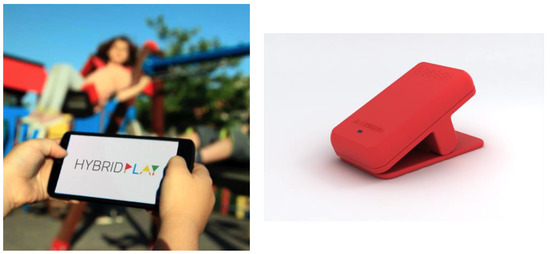
Figure 1.
Descriptive image of the HybridPLAY system.
HybridPLAY combines digital and physical interaction to create experiences of outdoor game where the dynamics of digital video games are combined with game strategies in the street, verbal and body communication and group play (Figure 2).
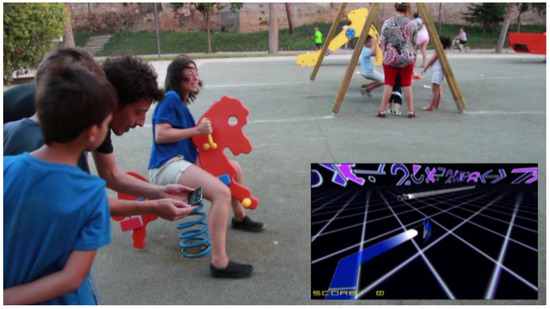
Figure 2.
Parents and children playing with HybridPLAY, for the original version of the system [9].
The system has been tested and evaluated in different game situations, offering very satisfactory results, due to its mechanical versatility, as it adapts to a wide range of surfaces and materials, facilitating its use in equipment with a tubular structure and/or made of wood. It also provides different levels of complexity through the combination of a digital and a physical experience. The system combines the dynamics of video games with those of motor play, understood as motion systems that involve the combination of intention, decision and adjustment of the motor functions to the different logical contexts and situations [14].
HybridPLAY falls within the category of the so-called active video games, but it has differentiating features that extend the possibilities of interaction of these games and their mechanics, both in the strictly physical and symbolic aspect. These differences refer to:
- Outdoor play. The system is designed to be played in outdoor playgrounds so that it implies a number of benefits related to the use of these places, such as socialization, the benefits of outdoor activities and being in touch with nature, etc. Whereas active video games are also tools for group participation and they facilitate physical exercise, their implementation in indoor spaces of the domestic sphere limits interaction and prevents spontaneous interaction with other people.
- Mobility. The system, unlike most common active video games, is designed to be easily carried and played in different places, given its small size and its energy autonomy. It is also combined with the personal mobile phone of players, something that allows taking the gaming experience to different places easily.
- Spatial transformation. The system, unlike the usual spatial screen-sofa configuration found in traditional video games, is not restricted to a particular space organization. Its physical organization depends on the spatial distribution of playgrounds, as each site has different combinations of game elements. Each park is a different physical game scenario and this transforms the game experience completely.
- Motion range. Physical video games are designed for the user to perform different movements, usually those associated to a sport or the use of an instrument. To play tennis on Wii we perform similar movements to those with a tennis racket in real life. However, experience with these games leads to a greater control of the controller that involves greater economy of movement. After a few sessions, we can play tennis sitting on the sofa with slight twists of the wrist. On the contrary, with HybridPLAY, the movements necessary for the game do not mimic the movements of real situations, but they are actual movements converted into a game. The different dynamics of the games involve going down the slide, swinging or riding on the horse. These movements imply the use of the whole playground and make users be continuously moving from one element to another. Therefore, all the body is exercised as a whole with greater freedom of movement, and the practice does not imply less activity.
- Team play. The gameplay is organized in such a way that two or more people need to collaborate. To play properly it is necessary to collaborate with other players, because while a person performs the movements, the other one sees the effects on the screen and coordinates his/her partner’s actions. Although it is possible to play alone in certain situations, it is more difficult, and it perverts the objectives of the system. Team experience is much more enriching as physical, cognitive and social factors come into play: Coordination, synchronization, communication and concentration.
- Verbal communication. The group play that the HybridPLAY system proposes is mainly based on verbal communication. To advance properly in the game, a continuous and effective communication among the players is essential, both by the one who moves and by the one who gives instructions for the other player to move.
- Physical coordination. The HybridPLAY players also have, when used in certain elements of the playground, such as those based on swinging, to coordinate their physical movements in order to move forward. Therefore, the game requires physical contact and motor coordination among its participants.
3.2. Application of HybridPLAY in Outdoor Fitness Equipment for the Elderly
Although the system was initially designed for children from 4 to 12 years old, during the user tests for those ages we realized that, in many cases, parents and grandparents actively and voluntarily took part in the game [9]. From these observations, we conducted a detailed assessment of the possible applications of the system to outdoor fitness equipment for the elderly and its potential benefits, and we carried out different experiences in this direction.
Playgrounds for the elderly, as well as the ones for children, are made up of a series of elements, built with round cross-section tube, securely anchored to the ground. These elements are designed to promote physical exercise, and each of them focuses in a specific movement of the body: Waist rotation, arm rotation, opening and closing legs, stretching and contracting legs, etc.
The HybridPLAY system, adapted to these elements, allows obtaining their usage data (activation, movement, tilt, turn and speed), which can be used to trigger different game dynamics. Users, while playing with other people, need to perform a series of movements in a certain order, speed and number to achieve the goals of the game. In this way, verbal and nonverbal communication and social interaction are activated, while physical activity of older people is also promoted. Figure 3 shows an example of how a HybridPLAY device is placed in different elements of a park, where a person is doing exercise while his companion checks the activity on the mobile phone and gives him/her verbal instructions to complete the proposed tasks.
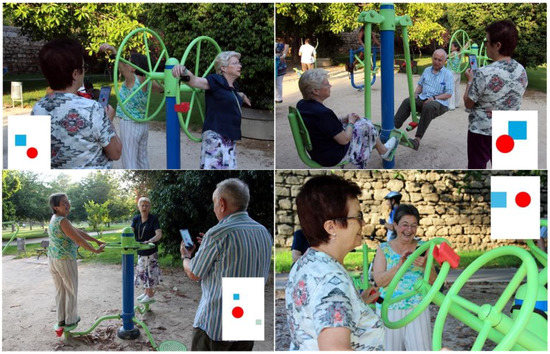
Figure 3.
Example of the HybridPLAY sensor location on different Outdoor Fitness Equipment (OFE). Images of the corresponding game (mobile application) are also shown on top of each photograph.
Up to date, several experiments have been carried out to gather inputs from the elderly and to observe, through a first approach, the development possibilities to adapt our technology to these scenarios. To carry out these tests, we developed demo versions of a set of simple mini-games. Differently from the games previously built for children and adolescents, in this case we used simplified graphics with basic geometric shapes and bright colors. We did these simplifications in order for the elderly not to get confused by complex and realistic graphics as, among others, this population is commonly affected by vision disabilities, such as presbyopia, cataracts or vision deficiency [25,26]. Examples of these basic geometries are depicted as part of Figure 3. We also limited the game dynamics to very simple tasks, which basically consisted in collecting a series of squares by moving left/right or up/down.
In comparison with the gaming proposed for children and adolescents, in this case we have used as graphic elements basic 2D geometries, such as circles or squares, with primary colors (as shown in Figure 3 and Figure 4). A red circle represents the player who has to dodge or collect different geometric shapes that appear on the screen according to the different mini-games. The demo mini-games are completed when users collect an established number of blue squares. In Figure 4, we show the different dynamics adapted to five OFE and the specific mini-game developed for each one of them. For instance, for the wheel OFE, the user has to move the wheel to make the red circle move either in the right or left directions. The person with the mobile phone has to communicate with the person using the wheel OFE to complete the given task, which in this case consists of collecting a series of blue squares.
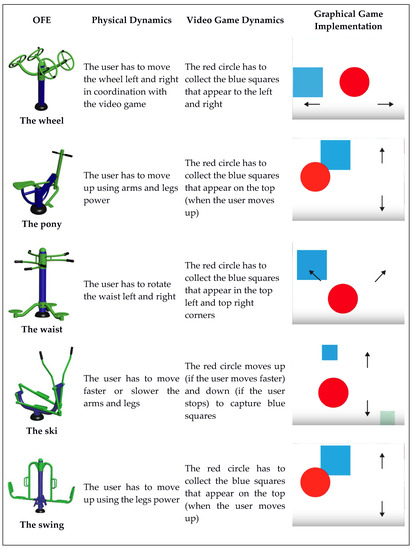
Figure 4.
Game dynamics and graphic design implementation.
It is worth mentioning that the mini-games in HybridPLAY can be used with different types of OFEs, regardless of the manufacturer. This is possible because OFEs are based on a number of reduced movements of rotations and translations. For instance, the wheel and the waist involve rotations, while in the swing and the pony users have to move up. The OFEs that share the same type and similar range of movement can use the same mini-game. Therefore, a single mini-game can be played on different types of OFEs (as shown in Figure 4 with “the pony” and “the swing”, which share the same mini-game). The only limitation is that the sensor can be attached to a given OFE. It would also be possible to attach the sensor to a person’s clothes.
4. Evaluation and Results
A quantitative user evaluation of the adaptation of the HybridPLAY system for the elderly was carried out during the month of June 2018. A total of 8 seniors tested the system, who were recruited by verbal communication through the neighborhood of the El Pilar area in Valencia (Spain). Each person played each of the proposed mini-game twice; for the purpose of this experiment, we established that the mini-games were completed when the user collected five squares. Before that, we explained them the dynamics of the mini-games and showed them how to interact with the platform, highlighting the relevance of the verbal communication to succeed fulfilling the given objectives (collecting squares). We provided them with the sensor and with the mobile phone (a Motorola G4 plus), which included the mini-games. We also explained how to clamp the sensor, but users decided where to place it, and in which order they wanted to test the different OFEs. After testing the system, they filled out a pair of questionnaires that were related to the usability of the system and to the individual’s satisfaction with the proposed activity. The System Usability Scale (SUS) [27] was chosen to measure usability, whereas a customized satisfaction questionnaire was used to assess several aspects of how users perceived the system, including how HybridPLAY could affect their desire to take exercise. The complete session took about 2 h.
The participants were senior adults (+50 years old). In Table 1, the socio-demographic data of the participants is provided, showing their mean age, standard deviation (s.d.) and minimum and maximum age. Other parameters shown are gender, how often they use video games and how often they use the park elements, where the range 0–4 for the frequency (f.) means—0: never or almost never; 4: every day. As can be seen, most participants were not regular users neither of video games nor of park elements, although a small percentage of users reported some previous regular experience with OFE.

Table 1.
Socio-demographic data of the participants.
The results of the SUS questionnaire are listed in Table 2. In questions 1 to 10 the range 0–4 means—0: strongly disagree, 4: strongly agree. The values of the SUS score, which are calculated according to [27], however, range from 0 to 100, with 100 being the best possible result. In this case, the score reaches 69.38 points, meaning that the system is above average and is perceived as usable and acceptable. This result can be compared to the group of children and younger adults that previously tested the system and that was presented in Reference [9], where a very similar experiment was carried out for that group, also fulfilling a SUS and a satisfaction questionnaire. In that case, the obtained SUS scores were of 84.92 points for adults and 91.23 points for children. In any case, the results of the current study show that HybridPLAY could be successfully adapted for senior adults, taking into account the fact that a minimum score of 68 would be deemed acceptable for a tool [28,29]. Nevertheless, it becomes evident that the scores provided by the SUS test reveal that significant further efforts need to be applied in order to fully engage senior people, who are more reluctant to adapt to this technology. The difference with the SUS score obtained with the previous experience with children and younger adults can be explained, among other factors, by the socio-cultural differences that exist between these different generations with respect to technology.
Table 2.
Results of System Usability Scale (SUS) questionnaire (mean, standard deviation, minimum and maximum).
The results of the individuals’ satisfaction questionnaires are given in Table 3. Questions 1–6 are the same as those performed in our previous research [9], while questions 7–10 are specific for this new evaluation. These new four questions are related to the three aspects identified in the Introduction section as positive for active aging: Exercise, going to the park and being in touch with new technologies. The scores also range from 0 to 4, meaning—0: strongly disagree, 4: strongly agree.
Table 3.
Results of the individuals’ satisfaction questionnaires (mean, standard deviation, minimum and maximum).
The scores for the satisfaction questionnaire are higher than in the usability questionnaire and all questions receive mean responses whose values are higher than 2.0 (middle point of the questions’ range). Furthermore, all questions receive mean values above 2.5, except from question 8, in which, despite having a mean value of 2.25, some users acknowledge that it will not be likely that they will exercise more because of HybridPLAY. Questions 7 and 10, however, reveal that the tested users do generally agree that this technology could be a way to increase their desire to go to the park and increase their use of new technologies. Question 9 reveals that HybridPLAY is perceived as an interesting tool for performing collaborative exercise. These results are in line with the three aspects identified as positive for active aging.
Although the satisfaction questionnaire gives positive results, in comparison with the previous results with children and young adults presented in Reference [9], we can state that senior people are fairly demanding in some specific questions. In particular, there are noticeable differences between some of the questions (compare the results of questions 4 and 5, for instance), whereas children and young adults seem to provide very similar mean values for the different questions, which were also higher than for older adults. The difference in the size sample between the two experiments could have some influence in this effect. Nevertheless, we can see that senior users perceive HybridPLAY as a useful tool to collaborate, interact with friends and be more in touch with new technologies. It is particularly remarkable that question 4, which deals with the collaboration capabilities of HybridPLAY, gets very high results with a minimum value of 2 and a mean value of 3.13, highlighting the potential of this system in this area.
Additionally, we asked users to give us further feedback on the tool. Most of them highlighted that it was a very interesting idea. Some of them acknowledged that it may help them exercise and socialize, fostering their desire for performing outdoor activities. Regarding to the complexity of the mini-games, they found all of them easy to follow, although some users had a few problems with the right/left indications, either when giving instructions (the person holding the mobile phone) or while doing the exercise (the person interacting with the OFE). Overall, we had the feeling that they really enjoyed the experience.
5. Discussion and Future Developments
The results obtained through the evaluation—both the tests and the direct observation of users—lead us to suggest the added value of HybridPLAY as a tool for the physical and cognitive activation of older people, with the potential of encouraging their involvement and improving the playful aspects of the system in accordance with their interests and possibilities. However, the results of the questionnaires reveal that the perception of usability has decreased with respect to a previous study carried out with children and young adults in Reference [, and that not all users expect to do more exercise because of the HybridPLAY system. In this regard, it is important to highlight that, unlike other groups of ages, it is quite common that senior people suffer from minor, but painful traumatological problems, which somehow reduce their desire to do exercise. Vision impairments are also more common in seniors than in younger people. Although we did not collect direct evidence that the lack of brightness or the size of the screen has a more dramatic effect in seniors than in children, the games are shown on a mobile phone, which has the disadvantage of being difficult to see in outdoor environments. In addition, technology acceptance is sometimes a problem for some senior adults, who may feel disengaged with respect to new devices and technologies. Therefore, it would be unrealistic to expect the same degree of enthusiasm for exercise and technology observed in children, a statement that is aligned with the results obtained with the experiments, both at the quantitative and qualitative levels. In addition, the users who participated in the experience reported very low previous experience with video games and OFE, something that may explain some of the responses. In any case, the tool obtains a mean level of acceptance in terms of usability and a good level of acceptance in terms of satisfaction. This suggests that further research in this area is worth doing.
These first approximations about the use of HybridPLAY with senior adults have revealed interesting aspects we hope to deepen in future research, because of their potential as a tool to promote outdoor exercise among the elderly. The preliminary indications obtained so far suggest us that:
- The system is well perceived by part of older people and they generally recommend it (question 6 in Table 3), although there are some cases where the technology is not perceived in a completely positive way.
- The system has the potential to favor exercise and cognitive training of the elderly through coordination (body-speaking, body-listening) and concentration. Users agree that the collaboration with other people is very easy with HybridPLAY (question 4 in Table 3).
- The system has a potential use in rehabilitation programs in the case of injuries and training plans that can be monitored through the mobile application.
- The system has the potential to establish gamification strategies that encourage the elderly to go to the park and exercise.
- The system can be used, for instance, by children accompanied by their elders in children’s playgrounds and by the elderly in collaboration with younger people in OFE for the elderly. As shown in Figure 5, HybridPLAY can be used by persons of different ages.
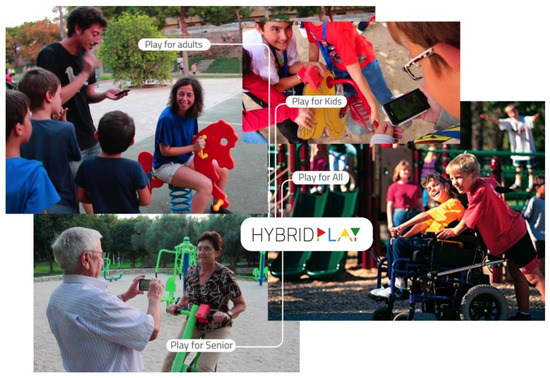 Figure 5. HybridPLAY for all.
Therefore, we propose the following future actions in our research:
- A study to adapt the sensor to the various OFE for the elderly. This study should include an analysis of possible hardware and installation complications that could potentially jeopardize the use of the system because of technology rejection. The system should be as simple as possible to avoid any possible negative perception.
- Developing a specific training game with different phases and levels, incorporating gamification, reward systems and even communication strategies in social media (e.g., including the score, unlocking games as training progresses, etc.). The developed games should be designed with a steep and fast learning curve, so that older people, who may sometimes refuse this technology and perceive it as something they do not belong to, can learn how to use the system fast and do not feel intimidated by it. Additionally, it can be investigated how long elders will keep their interest in using the HybridPLAY system.
- Designing a user test for a wide and diverse sample of the elderly, and use scientific and rigorous tools for observation and to extract results regarding the potential aspects that we have detected in the current study. In particular, it could be interesting to carry out health-related studies, such as the analysis of the positive impact that this technology might have regarding the prevention of overweight. To that end, detailed experiments have to be built, including the monitoring of users for long periods of time and randomized controlled trials.
6. Conclusions
Although the implementation of the HybridPLAY system in outdoor fitness equipment for the elderly is at an early stage, previous experiences with the system in children along with the evidence collected in this research suggest that the combination of digital game with outdoor physical activity has a great potential to promote active life among older people. Hybrid experiences that combine digital interaction in real contexts and the use of the body are presented in this paper as a promising application in the field of video games. However, this is just the beginning of a wider area in which video games have many possibilities in gerontology and in all the fields that imply improving the quality of life of the elderly, their physical and mental well-being and social participation.
Having tested HybridPLAY with a small population of senior users, preliminary results show that the adaptation of this technology to the senior population is more than feasible and users find the concept of HybridPLAY attractive and an easy way to collaborate and socialize with other people. This is the most important conclusion of the experiments performed. Nevertheless, the results obtained with this piece of research show that, despite being positively accepted by users, HybridPLAY has not the same high level of acceptance that it achieves with children. Although this is not a surprise, since older people do not react to technology in the same way as children do, future actions should take this result as the primary source of information, keeping nevertheless in mind that it would be unrealistic to expect the same degree of enthusiasm achieved with children.
7. Patents
Clara Boj and Diego J. Díaz., Sistema y método para la interacción digital con parques infantiles. ES Patent No. P201530331, 16 March 2015. https://patents.google.com/patent/ES2535550A1/es.
Author Contributions
Conceptualization, C.B. and D.J.D.; Methodology, C.B. and D.J.D.; Software, C.B. and D.J.D.; Validation, C.B., D.J.D., C.P. and S.C.; Formal Analysis, C.B., D.J.D., C.P. and S.C.; Investigation, C.B., D.J.D., C.P. and S.C.; Resources, C.B. and D.J.D.; Data Curation, C.B. and D.J.D.; Writing-Original Draft Preparation, C.B., D.J.D., C.P. and S.C.; Writing-Review & Editing, C.P. and S.C.
Funding
This work has been carried out in the context of the research project “game technologies for the creation of digital content, management, visualization and sounding” TIN2016-75866-c3-1-r, funded by MINECO, Spain.
Conflicts of Interest
The authors declare no conflict of interest.
References
- WHO. Ageing and Life Course. Available online: http://www.who.int/ageing/en/ (accessed on 12 July 2018).
- Chow, H.-W. Outdoor fitness equipment in parks: A qualitative study from older adults’ perceptions. BMC Public Health 2013, 13, 1216. [Google Scholar] [CrossRef] [PubMed]
- Kerr, J.; Marshall, S.; Godbole, S.; Neukam, S.; Crist, K.; Wasilenko, K.; Golshan, S.; Buchner, D. The relationship between outdoor activity and health in older adults using gps. Int. J. Environ. Res. Public Health 2012, 9, 4615. [Google Scholar] [CrossRef] [PubMed]
- Shanahan, D.F.; Franco, L.; Lin, B.B.; Gaston, K.J.; Fuller, R.A. The benefits of natural environments for physical activity. Sports Med. 2016, 46, 989–995. [Google Scholar] [CrossRef] [PubMed]
- Thompson Coon, J.; Boddy, K.; Stein, K.; Whear, R.; Barton, J.; Depledge, M.H. Does participating in physical activity in outdoor natural environments have a greater effect on physical and mental wellbeing than physical activity indoors? A systematic review. Environ. Sci. Technol. 2011, 45, 1761–1772. [Google Scholar] [CrossRef] [PubMed]
- Tremblay, M.; Gray, C.; Babcock, S.; Barnes, J.; Bradstreet, C.; Carr, D.; Chabot, G.; Choquette, L.; Chorney, D.; Collyer, C.; et al. Position statement on active outdoor play. Int. J. Environ. Res. Public Health 2015, 12, 6475. [Google Scholar] [CrossRef] [PubMed]
- WHO. Obesity and Overweight. Available online: http://www.who.int/news-room/fact-sheets/detail/obesity-and-overweight (accessed on 11 July 2018).
- Eronen, J.; von Bonsdorff, M.B.; Törmäkangas, T.; Rantakokko, M.; Portegijs, E.; Viljanen, A.; Rantanen, T. Barriers to outdoor physical activity and unmet physical activity need in older adults. Prev. Med. 2014, 67, 106–111. [Google Scholar] [CrossRef] [PubMed]
- Díaz, D.; Boj, C.; Portalés, C. Hybridplay: A new technology to foster outdoors physical activity, verbal communication and teamwork. Sensors 2016, 16, 586. [Google Scholar] [CrossRef] [PubMed]
- Kasapakis, V.; Dzardanova, E.; Paschalidis, C. Conceptual and technical aspects of full-body motion support in virtual and mixed reality. In Augmented Reality, Virtual Reality and Computer Graphics, Proceedings of the International Conference on Augmented Reality, Virtual Reality and Computer Graphics; Otranto, Italy, 24–27 June 2018; De Paolis, L.T., Bourdot, P., Eds.; Springer: Cham, Switzerland, 2018; pp. 668–682. [Google Scholar]
- Vera, L.; Gimeno, J.; Casas, S.; García-Pereira, I.; Portalés, C. A hybrid virtual-augmented serious game to improve driving safety awareness. In Advances in Computer Entertainment Technology, Proceedings of the International Conference on Advances in Computer Entertainment, London, UK, 14–16 December 2017; Cheok, A.D., Inami, M., Romao, T., Eds.; Springer: Cham, Switzerland; pp. 293–310.
- Chatzigiannakis, I.; Mylonas, G.; Kokkinos, P.; Akribopoulos, O.; Logaras, M.; Mavrommati, I. Implementing multiplayer pervasive installations based on mobile sensing devices: Field experience and user evaluation from a public showcase. J. Syst. Softw. 2011, 84, 1989–2004. [Google Scholar] [CrossRef]
- Kasapakis, V.; Gavalas, D. Pervasive gaming: Status, trends and design principles. J. Netw. Comput. Appl. 2015, 55, 213–236. [Google Scholar] [CrossRef]
- González, C.S.G.; Adelantado, V.N. A structural theoretical framework based on motor play to categorize and analyze active video games. Games Cult. 2016, 11, 690–719. [Google Scholar] [CrossRef]
- Voida, A.; Greenberg, S. Wii all play: The console game as a computational meeting place. In Human Factors in Computing Systems, Proceedings of the SIGCHI Conference on Human Factors in Computing Systems, Boston, MA, USA, 4–9 April 2009; Grinter, R., Rodden, T., Aoki, P., Cutrell, E., Jeffries, R., Olson, G., Eds.; ACM: New York, NY, USA, 2009; pp. 1559–1568. [Google Scholar]
- Maillot, P.; Perrot, A.; Hartley, A. Effects of interactive physical-activity video-game training on physical and cognitive function in older adults. Psychol. Aging 2012, 27, 589. [Google Scholar] [CrossRef] [PubMed]
- Vandoni, M.; Arpesella, M.; Magnani, B.; Baldari, C. Can active video games be a good alternative to real exercise for adults? A cross-sectional study. Braz. J. Sports Exerc. Res. 2010, 1, 1–4. [Google Scholar]
- Cornejo, R.; Hernández, D.; Favela, J.; Tentori, M.; Ochoa, S. Persuading older adults to socialize and exercise through ambient games. In Pervasive Computing Technologies for Healthcare (PervasiveHealth) and Workshops, Proceedings of the IEEE 6th International Conference on Pervasive Computing Technologies for Healthcare (PervasiveHealth), San Diego, CA, USA, 21–24 May 2012; IEEE: Piscataway, NJ, USA; pp. 215–218.
- Staiano, A.E.; Flynn, R. Therapeutic uses of active videogames: A systematic review. Games Health J. 2014, 3, 351–365. [Google Scholar] [CrossRef] [PubMed]
- Stratton, G.; Ridgers, N. Energy expenditure in adolescents playing new generation computer games. Br. J. Sports Med. 2008, 42, 592–594. [Google Scholar]
- Leirós-Rodríguez, R.; García-Soidán, J.L. Los programas de revitalización geriátrica: Posibilidades de los parques públicos para promocionar la actividad física saludable en personas mayores. Revisión bibliográfica. Fisioterapia 2012, 34, 267–274. [Google Scholar] [CrossRef]
- Hernández Aparicio, E. Estudio de los circuitos biosaludables para la tercera edad en españa. Revista Internacional de Medicina y Ciencias de la Actividad Fisica y del Deporte 2009, 9, 33. [Google Scholar]
- Martín, R.; Raúl, C.; Lara, S.; Belén, C.; López Liria, R. El parque geriátrico: Fisioterapia para nuestros mayores. Gerokomos 2007, 18, 31–35. [Google Scholar]
- Acar, I.; Torquati, J. The power of nature: Developing prosocial behavior toward nature and peers through nature-based activities. Young Child. 2015, 70, 62–71. [Google Scholar]
- Kovanen, J.; Oksanen, J.; Sarjakoski, L.; Sarjakoski, T. Simple maps—A concept of plain cartography within a mobile context for elderly users. In Proceedings of the GIS Research UK 20th Annual Conference, Lancaster, UK, 11–13 April 2012. [Google Scholar]
- Abbaszadeh, M. Smartdevices Development for Visual Impairment and Colour Vision Deficiency. Master’s Thesis, Middlesex University, London, UK, 2016. [Google Scholar]
- Brooke, J. Sus: A “quick and dirty” usability scale. In Usability Evaluation in Industry; Jordan, P.W., Thomas, B., McClelland, I.L., Weerdmeester, B., Eds.; Taylor and Francis: London, UK, 1996. [Google Scholar]
- Brooke, J. Sus: A retrospective. J. Usability Stud. 2013, 8, 29–40. [Google Scholar]
- Bangor, A.; Kortum, P.; Miller, J. Determining what individual sus scores mean: Adding an adjective rating scale. J. Usability Stud. 2009, 4, 114–123. [Google Scholar]
© 2018 by the authors. Licensee MDPI, Basel, Switzerland. This article is an open access article distributed under the terms and conditions of the Creative Commons Attribution (CC BY) license (http://creativecommons.org/licenses/by/4.0/).