


Abstract
The global lithium supply balance has been under pressure since the recent increase in demand for electric vehicles. Conventional techniques for lithium extraction from natural resources are solar evaporation and hard-rock mining, which both have their limitations in view of sustainability. The question arises whether these methods will suffice for a responsible supply to provide the necessary materials for the emerging green economy. While new technologies for the valorization of lithium from unconventional resources like geothermal brines, salt lakes and seawater are in the pipeline, they are yet to be proven on an industrial scale. Membrane technology, ion-exchange adsorption and electrochemical methods are the current focus of several players in the pilot stage of their announced lithium carbonate or hydroxide production process. These technologies have various advantages and disadvantages in terms of energy consumption, selectivity and process costs, and the optimal choice remains dependent on local factors such as brine composition, energy availability and reagent cost. There are currently several DLE projects in the pilot phase, which is a significant step towards more sustainable lithium supply. Proving the economic and technical viability of these methods for extracting lithium from unconventional sources would increase the amount of globally proven reserves while diversifying and de-risking the supply chain, which is currently heavily dominated by a small number of countries.
1. Introduction
Lithium owes its relevance in the materials industry to its specific location in the periodic table. Situated in the top-left corner, this implies that it has the smallest radius and the most negative electronegativity of all alkali metals (−3.04 V). Other properties like a low atomic weight, a low thermal expansion coefficient and a high specific heat coefficient make it stand out on several levels compared to the other alkali metals, and in fact all elements in general [1,2,3,4]. It is no coincidence that there are multiple industrial applications for compounds that consist of an element with extreme properties such as lithium.
One of the first applications for lithium was found in the glass and ceramics industry, where it was used as a fluxing agent with the purpose of lowering production temperatures and reducing melt viscosity. Usually, ore concentrates rather than pure lithium compounds are used for this purpose. Adding 0.17% LiO2 as a flux in glass production reduces the energy consumption of the process by 5–10% due to the decrease in operating temperature [5,6].
Lithium is also used in lithium-based oils to improve the temperature resistance of lubricants used in metal-on-metal mechanisms in automotive applications [5,7]. The hygroscopic nature of lithium chloride makes it an ideal dehumidification agent or adsorbent in industrial adsorption air conditioning [8,9]. It is used in the pharmaceutical industry as a treatment for depression and suicide prevention [10].
The Lithium-Ion rechargeable Battery (LIB) was invented by John B. Goodenough, S. Whittingham and A. Yoshino through their combined efforts in solid-state chemistry. Their discoveries of reversible intercalation of Li into the solid matrix of several intercalation electrodes, the development of LiCoO2, LiMnO2 and LiFePO4 as cathodes and graphite as an anode [11,12,13] led to the first lithium-ion-based rechargeable battery. The high electrochemical potential of Li, its low weight and small ionic radius result in multiple advantages for LIBs over the conventional lead-acid, Nickel-Cadmium and Nickel-metal-hydride batteries, such as higher energy density and faster charge rate. The commercial entrance of LIBs started with consumer electronics, first in video recorders and later in mobile phones and laptops [14,15,16,17], and eventually also in electric vehicles in the 2010s [18,19]. Current research on LIBs is mainly, but not exclusively, focused on the cathode material, as this is the most expensive and most performance-determining element in LIBs. The state of the art battery technology applies multiple cathode materials, e.g., LiCoO (LCO), LiMnO (LMO), NiCoAl (NCA), NiMnCo (NMC) and LiFePO4 (LFP). Each of these cathodes have their own advantages and disadvantages regarding cost, energy-density, thermal stability, power capability and cycle life [18,19,20].
According to U.S. Geological Survey (USGS) data [21,22,23,24,25], the LIB market surpassed the glass and ceramics industry for the first time in 2015 in terms of its share in the global lithium demand, with 35% vs. 32%. At that point yearly extraction of lithium amounted to around 200 ktpa LCE. At some point in 2023, the milestone of 1000 kilo tonne per annum (ktpa) LCE production capacity was reached, of which at least 80% was used for the production of LIBs [26]. It is expected that the share of LIBs in the total global demand of lithium will keep increasing, especially with the recent take-off of the EV market [27]. The recent exponential growth of the lithium market, driven by demand coming from clean energy technologies, raises the question of whether supply will be able to keep up with demand during the maturing phase of the global lithium industry [28,29]. This review evaluates the current supply-demand balance in Section 2.
Historically, the lithium industry has relied on two primary “conventional” pillars: solar evaporation from high-grade salars and hard-rock mining of spodumene ores. While these methods provided a stable supply for industrial applications such as glass, ceramics, and lubricants, they are increasingly viewed as insufficient to meet the exponential demand surge driven by the Electric Vehicle (EV) market [30,31]. Solar evaporation is geographically limited to arid regions, characterized by long lead times of up to two years, and faces growing scrutiny regarding its impact on local water tables. Conversely, hard-rock mining, while faster, is energy-intensive and carries a carbon footprint more than six times higher than brine operations [32].
The development history of lithium extraction from “unconventional” aqueous resources—such as geothermal brines, oilfield produced waters, and seawater—represents a shift toward diversifying the global supply chain and de-risking the current market dominance of a few select countries. In the early stages of the industry, these resources were considered economically unviable due to their lower lithium concentrations (typically < 500 ppm) and high concentrations of competing ions like magnesium and calcium. However, the emergence of Direct Lithium Extraction (DLE) technologies, which will be the focus of Section 3 of this paper, has fundamentally altered this outlook [33].
In Section 4, a final conclusion is given that summarizes the findings of this paper.
2. Economic Context
2.1. Current Global Supply
The current production of lithium can easily be divided into two major extraction methods based on the type of resource. Lithium is mainly extracted from aqueous sources referred to as brines, and from hard-rock sources or ores. Both types of resources imply substantially different ways of extraction and processing to eventually produce refined lithium in the form of lithium carbonate or lithium hydroxide. This results in very different process economics, process durations and carbon footprints of produced lithium depending on the type of resource. In this section, the two major sources of lithium and the main processing route for each source are discussed and compared in terms of resource availability, production cost and environmental impact. The goal of this section is to evaluate the state of the art of industrial-scale lithium extraction. Alternative sources for lithium extraction exist, both in aqueous (seawater, geothermal brines, oilfield brines) and solid (clays, jadarite) form, but are not yet proven to be economically viable for recovery on an industrial scale, although some are currently under intensive investigation for future extraction. For the alternative aqueous resources, Direct Lithium Extraction (DLE) is required to extract lithium, as the conditions for conventional methods are not met in these cases. This is extensively covered in Section 3. Alternative hard-rock sources are not included in this report. An overview of the different types of lithium resources can be found in Table 1.
Hard-rock resources for lithium extraction are mineral deposits where lithium is present in the form of ores like spodumene, lepidolite, petalite and others, mainly found in pegmatite rock formations [34]. Of these ores, spodumene is currently the most important hard-rock source, with the largest extraction in the Greenbushes mine in Australia, where a Li content of around 2% is reported [35,36]. Total hard-rock reserves have been estimated to be around 3.9 Mt Li by Kesler et al. (2012) and 4.4 Mt Li by Yaksic and Tilton (2009) [37,38].
Aqueous lithium resources are brines that contain a certain amount of lithium, usually coexisting with other cations in solution. Current reserves of this form have a lithium concentration typically ranging from 230 ppm to as much as 1500 ppm [39]. Kesler et al. have estimated the total amount of aqueous lithium resources to be around 21.6 Mt Li [37], but higher numbers have been reported elsewhere [34,40]. Although this total number is up for interpretation depending on the inclusion of low-grade resources in the list, it is widely agreed upon that total brine resources are more abundant than hard-rock resources [30,36,38,41,42,43,44,45]. However, this does not have implications for the relative reserves of the two sources, as these are dependent on process economics.
Table 1.
A list of the different kinds of lithium resources, divided by their resource type and technology of extraction, appended with examples.
2.1.1. Hard-Rock Mining and Processing of Spodumene Ore
Considering hard-rock sources, the extraction of lithium from spodumene is by far the most important method. The process starts at the ore, with classical mining activities like drilling, blasting, loading, sorting and hauling of the mined rock. These solid pegmatites contain 1–3% (w/w) lithium, and are further processed by comminution processes like milling, crushing, grinding and screening operations and then separated through filtration or dense media separation techniques to produce spodumene concentrate, with an upgraded Li content of about 5–7% (w/w) [56,61,62]. Australia is by far the largest producer of spodumene concentrate, but currently does not have the infrastructure and expertise to process this product into battery-grade materials. The concentrate is shipped to Chinese producers, where it is further processed by several possible methods. The most widely used method for conversion is the sulfuric acid method. First, the α-spodumene is to be converted into β-spodumene to be susceptible to acid roasting via sulfuric acid [35]. This involves heating the α-spodumene to 950–1100 °C [61]. Then, the β-spodumene is treated with concentrated sulfuric acid in a rotary kiln at elevated temperature to form water-soluble lithium sulfate. This method is referred to as acid roasting and is the most used method to produce lithium sulfate from β-spodumene. Other leaching methods are, however, also possible, but not further specified in this work. The lithium sulfate is then water-leached out of the solid matrix, after which the mixture is neutralized with lime to adjust pH and remove iron and aluminum. Then lime milk is added to remove most of the magnesium and to elevate pH to 11–12 [63]. Then, the removal of magnesium and calcium is completed by the addition of soda ash. After evaporation and concentration of the solution, a mixture with 20% Li sulfate is obtained. At this point, Li2CO3 can easily be precipitated by the addition of soda ash, which is then recovered by filtration, washing and drying [56]. A schematic overview of this process is given in Figure 1a.
Figure 1.
Generic flowsheets for the conversion of hard rock (a) and brine (b) resources to battery-grade lithium carbonate or lithium hydroxide. Adjusted using information from Garrett et al. (2004) [35].
2.1.2. Solar Evaporation from Salars
Before the substantial increase in lithium extraction from Australian spodumene in 2017, the largest share of global lithium extraction was achieved through salar evaporation from brines in Chile and Argentina [21,25]. The largest sources of lithium extraction via this method are located in the Salar de Atacama (Chile), Salar del Hombre Muerto (Argentina) and Salar de Olaroz (Argentina) [30,31]. The brines contain huge amounts of competing cations, most importantly Na, Ca, K and Mg, from which the lithium must be isolated before final crystallization of pure lithium carbonate. Solar evaporation aims to achieve this separation and further concentration. Solar evaporation refers to the use of large evaporation ponds in the extraction process, where the salty brine, or salar, rich in lithium, is left to evaporate under the dry and hot conditions imposed by the sun. These conditions imply that this process is limited to locations where solar radiation is high and precipitation is both low and predictable. Combined with the availability of a brine with sufficient lithium content and concentration, these prerequisites are only optimally fulfilled in a handful of cases, as is the case for the aforementioned salars. Other examples of such salars exist in Nevada (USA) and the Tibet region (China) [39]. Although the conditions in these regions are less favorable, they are still sufficient for a minor amount of lithium extraction through the use of solar evaporation ponds, leveraging free solar energy for the separation of lithium from co-existing cations and the subsequent concentration for further processing.
Although the specific brine chemistry of each source requires a tailor-made process for the extraction of lithium from the specified salar, solar evaporation follows some generic purification and separation steps. In general, the brine is first pumped up from the underground salar into a series of ponds where it is left for evaporation. Throughout the evaporation process, lithium concentration increases while other cations crystallize as they reach their saturation point. Halite is the first salt to precipitate, followed by potassium salts such as sylvinite and calcium salts such as gypsum in subsequent ponds [30]. The salts are regularly harvested and further processed or sent to disposal stockpiles. Eventually, a concentrated lithium brine with about 5–7% (w/w) Li leaves the final evaporation pond [35,64]. Main impurities at this stage are magnesium (1–4%) and boron (0.5–1.5%) [64], while sodium and potassium concentrations are reduced to under 0.15% and 0.02%, respectively [65]. From the pumping stage to the final brine concentrate, this process takes a few months to two years, depending on the climate [30,35,39,40].
Further processing of the resulting concentrated lithium brine involves the removal of the remaining impurities from the brine in order to reduce their interference in the final precipitation step. Depending on the source, boron removal may be necessary, which is achieved through solvent-extraction [35,65]. Then, generally Mg and sulfates need to be removed by first adding lime to precipitate magnesium hydroxide and calcium sulfate [35]. The removal of Mg through lime addition is the cost-determining step in the overall process to produce LiCO3 from continental brines due to the cost of the reagent, which increases proportionally with the amount of Mg present in the brine. Also, the crystallized Mg(OH)2 shows slow settling behavior, and a fraction of the lithium-rich brine tends to get entrapped and lost in the precipitate. This slows down the process while simultaneously lowering the overall recovery. For these reasons, the Mg/Li ratio in brines is an important indicator for the economic feasibility of lithium extraction from a certain asset. This can be seen from the currently operating brine projects, which are all focused on low Mg/Li brines, such as Salar de Hombre Muerto (Livent) and Salar de Atacama (SQM, Albemarle), with a Mg/Li ratio of 1.46 and 6.4, respectively [66]. For the same reason, other high-grade resources such as Salar de Uyuni (Bolivia) and Da Quaidam (China), with respective Mg/Li ratios of 20.8 and 65, have thus far not been deemed economically feasible for commercial exploitation, despite numerous efforts in research [62,67,68,69]. Finally, the purified lithium chloride brine is precipitated with soda ash at an elevated temperature, as the solubility of lithium chloride decreases with temperature. The precipitate is filtered, washed and dried. The filtrate is recycled back to the process. The whole process can be summarized, in general, by the flowsheet given in Figure 1b.
2.1.3. Recycling
When discussing recycling, it is convenient to consider the recycling rate of a metal, which is defined as the ratio of the percentage of successfully recovered metal from waste streams. Global End-Of-Life (EOL) recycling rate of lithium has been reported to be lower than 1% of global demand in 2011 [70] and has remained so in 2022, according to a report by the International Energy Agency (IEA), where the EOL recycling rate of lithium is compared to various other critical metals (Figure 2) [71]. The reason for this can be found in its relatively low historical price leading to a poor economic incentive for recycling, and the high tendency for Li to occur in an oxidized state, needing very high temperatures to reduce Li2O to Li metal in a typical pyrometallurgical metal recovery process [72]. This can easily be seen from the Ellingham diagram for lithium compared to other key components in battery materials such as Co, Ni and Mn (Figure 3) [73].
Figure 2.
End of life recycling rates percentage of selected metals—from IEA, End-of-life recycling rates for selected metals, IEA, Paris https://www.iea.org/data-and-statistics/charts/end-of-life-recycling-rates-for-selected-metals (accessed on 12 October 2023), IEA. License: CC BY 4.0./.
Figure 3.
Ellingham diagram of NMC battery components: Ni, Co, Mn and Li. Adapted from [59].
Although recycling of spent LIBs is not an uncommon practice, Li is seldom recovered as a product due to its lower value and more complex recovery process compared to Co and Ni [72]. Liu et al. (2019) summarized the 14 major commercial projects for the recycling of spent LIBS, of which only two were claimed to recover lithium in the process [59]. In their report, LIB recycling processes are categorized as hydrometallurgy or pyrometallurgy-based. It is found that lithium usually ends up as a waste product in the slag of the pyrometallurgical processes. Hydrometallurgy is more suitable for the integration of lithium recovery in the process but is characterized by a higher chemical complexity and higher cost compared to the energy-intensive pyrometallurgical alternative. For a complete review of hydrometallurgical and pyrometallurgical processes for lithium recycling, the reader is referred to more specialized review papers on the subject [74,75,76,77]
To meet future demand, the EOL recycling rate of lithium (especially in LIBs) is expected to increase in importance. Both form an ecological, economic and Security-of-Supply (SoS) point of view, addressing secondary resources as an additional source for lithium will become attractive in an undersupplied market, according to the supply-demand analysis conducted by Greim et al. (2020) [29]. This is also apparent from the recent emphasis of research directed towards the subject of Li recovery from waste LIBs [77,78,79,80]. Regarding LIB recycling, a useful precedent is found in lead-acid batteries, where 98% is collected and recycled [60]. The high EOL recycling rate for lead-acid batteries was highly enabled by government incentives, which might also be necessary to achieve the same success for LIB recycling. The basis for a regulatory framework in view of LIB recycling is laid in the EU battery regulation, an extension of the EU Strategic Action Plan on Batteries [81]. A cornerstone of this framework is the establishment of mandatory material recovery targets. For instance, the regulation stipulates that lithium recovery from waste batteries must reach 50% by 2027 and 80% by 2031, forcing a shift toward more advanced hydrometallurgical or pyrometallurgical processing.
2.1.4. Environmental Impact
When referring to lithium in this report, Lithium Carbonate Equivalent (LCE) is used as a metric for referring to mass amounts. This ratio is often used to convert Li metal weight units to LCE weight units when necessary, where 1 kg lithium metal corresponds to 5.3 kg LCE, based on molecular weights. It is important to mention, however, that this factor of 5.3 does not take into account losses when converting extracted Li-concentrates to LiCO3 in refineries. These losses would be dependent on the source from which the concentrate was produced (brine, ore, clay, …) and the exact refining method applied in the conversion process. Although this leads to certain inaccuracies, applying LCE as a functional unit allows a uniform analysis and ease of comparison of mass amounts across the LIB value chain.
Although hard-rock resources for lithium extraction usually imply a low investment risk, high grades, quick process durations and high recovery rates, the mining damages and thermochemical conversion processes are costly and environmentally inferior to brine operations [34]. Considering the environmental implications, the production of Li2CO3 from ore produces more than six times the amount of GHG emissions (20.4 ton CO2-equivalent per ton Li2CO3) compared to Li2CO3 produced from brine (2.7–3.1 ton CO2-equivalent per ton Li2CO3), according to an LCA conducted by Kelly et al. (2021) [82]. This large difference can be, for the largest part, attributed to the energy consumption associated with the conversion of spodumene concentrate (Li2O) to Li2CO3 at high temperature supplied by coal-based energy in China, and to the large use of chemicals for the acid roasting process [56]. Another study even reports a ratio of 47.7 for the global warming potential of hard-rock-based sources compared to brine-based sources [83]. Weinand et al. (2023) state that the emissions associated with LCE from Australian hard-rock mines amount to 15.8 kg CO2 eq per kg lithium carbonate, compared to 0.3 kg CO2 eq per lithium carbonate for South-American brine projects [83,84,85]. Other sources claim an amount of 3.2–5 kg CO2 eq per kg lithium carbonate for brines [82,86]. Most LCA studies conclude that brine operations have a lower environmental impact, due to their lower energy intensities compared to hard-rock mining [41]. However, the study conducted by Stamp et al. [87] concludes that the differences in Global Warming Potential (GWP) between the two extraction methods are negligible in the case of favorable conditions and highly in favor of hard-rock mining in unfavorable conditions. Another study reports similar conclusions, because it may have used the same assumptions and based its data on the study by Stamp et al. [88]. However, this conclusion is improbable given the assumptions made and the number of studies coming to a different conclusion [56,86].
Another important aspect regarding the environmental impact of lithium extraction is water use, which is the source of much discussion in the case of solar evaporation [89]. The evaporation of large amounts of water in a region where water is scarce has led to concerns and protests from the local communities and environmentalists and comments from the local governments. These concerns are not unjust, as physical proof of the lowering of the water table at the Atacama desert, where the largest solar evaporation plant is located, is present [46]. In addition, apart from the evaporation of brine water in the case of solar evaporation, freshwater is consumed for the further processing of LiCl to Li2CO3. This amounts to 601 L of freshwater per kg LiCO3 product in the case of solar evaporation, while 1077 L of freshwater are required per kg Li2CO3 produced from spodumene assets [90].
The difference in environmental impact of both processes must be taken into account when evaluating the overall impact of the manufacturing of lithium-containing products such as LIBs. It is necessary to account for the impact of both brine and hard-rock sources in the evaluation of downstream processes to correctly assess the overall impact of downstream processes and products, in contrast to only basing the impact on lithium production from brines, as some studies do [91].
2.2. Emerging Demand and Lithium Intensity
The global lithium consumption in 2020 (close to 400 ktpa LCE) has highly outpaced several forecasted scenarios [92], such as the one conducted by Martin et al. (2015), even in the most optimistic scenario, where a yearly demand of around 280 ktpa was estimated [6,26]. The surge in EV demand has led to a 600% increase in global lithium production between 2016 and 2023, from 200 ktpa to 1200 ktpa. The reason for this recent surge in demand for Li can be found in the large increase in electric vehicle sales. Figure 4 illustrates how recent global LCE production drastically increased under the driving force of EV market penetration, which has reached a 14% share of global vehicle sales in 2022.
Figure 4.
Historical data on EV market penetration (in percentage of global market sales, left axis) and global lithium production (in kt LCE, right axis). LCE production data adapted from USGS 2010–2020 [8,9,10,11,12] with added data from [30]. EV market penetration data from IEA global EV outlook 2022 and 2023E (2023 Expected) [43,44].
When Li containing chemicals, being Li2CO3 or LiOH, are converted into battery packs, one could define the material requirements, in kg LCE, per amount of battery capacity, in GWh, as follows:
where LiGWh refers to the amount of lithium metal content per kWh battery capacity, for which values of between 80 and 160 g per kWh have been reported, depending on the cathode material [20,93,94]. The factor 5.3 is used to convert Li metal content to an LCE basis, and %Loss is used to consider production losses during the conversion of lithium chemicals into battery materials. These losses could occur during the production of cathode material, battery assembly or during further manufacturing of battery packs and vary according to the manufacturer as well as the type of battery material used [95]. Although some studies report on data for the lithium metal content per GWh battery capacity, reliable numbers on %Loss are difficult to find, as they are not reported by cathode producers. However, in their 2023 EV outlook, the International Energy Agency (IEA) has provided recent numbers on the production volumes of electric vehicles, as well as the resulting demand for lithium and the share of the EV sector in this demand [96]. From this data, the lithium material intensity of EV batteries can be estimated based on historical production numbers. In Figure 5 and Table 2, these data are presented.
Figure 5.
Global battery demand for EV’s in GWh per year and lithium demand from EV sector. These data were taken from the IEA report on Global EV outlook [96].
Table 2.
Calculation of lithium intensity using data from IEA EV outlook 2023.
Figure 6 illustrates the data for lithium intensity, which has been calculated in Table 2. This value shows a large variability from 2016 to 2019. This can partly be explained by the fact that the battery production for EVs in these years was very low, so small errors in the data (due to material stockpiling or lack of industrial reporting) could lead to large errors in the calculated value. In the last three years, a more stable value can be seen, ranging from 0.72 to 0.84. Average values for the period of 2016–2022 and 2020–2022 are also shown, which are 0.72 and 0.77, respectively, with the latter probably being the most representative for current lithium intensity. This is in fair agreement with the value of 0.75 (6.75 kg Li for 9 kWh) reported by Yaksic and Tilton (2009) [38] and 0.85 (160 g Li per kWh) proposed by Kushnir and Sandén [97]. Using these values for back-calculating the loss percentage of lithium during conversion of lithium chemicals to EV-battery capacity, assuming a lithium content of 120 g [20,93] Li metal per kWh, leads to 13–21%, which seem like realistic values.
Figure 6.
Results for calculated lithium intensity from IEA EV production and lithium demand data in a historical data plot. The red line represents the average through 2016–2022, while the green line gives the average over the last three years, when the EV production gained momentum. (GWh weighted).
The importance of the value for lithium intensity in the production of EV-batteries cannot be underestimated in view of estimating future lithium production demands. It is clear that the share of the EV-battery sector in the total lithium demand will continue to increase sharply for the rest of the decade, as it has for the past few years. Looking at the data from IEA [27,96], it can be seen that this share has already reached approximately 60% in 2022, up from less than 30% in 2020. Looking at the projected EV-demand, it is clear that this will be more than 90% in 2030, meaning that the lithium demand will mostly follow EV-demand. Lithium intensity provides a direct conversion factor to translate between EV-battery and LCE demand.
2.3. LCE Production Cost Curve
The emergence of lithium extraction from highly concentrated salars in 1997 led to the closure of several hard-rock-exploiting sites [34]. In fact, when SQM started its solar evaporation process in the Atacama desert in Chile, this even led to the closure of other brine processes, such as FMC’s (now Livent) operation in the Salar del Hombre Muerto in 1998 [35]. However, the latter resumed their operations in the following decade due to an increase in demand. This partly illustrates the operational cost hierarchy of brine and hard-rock operations. In contrast to the energy-intensive processes involved in hard rock lithium mining, such as crushing, grinding, and dense medium separations, there has been a growing focus on lithium recovery from aqueous sources. This shift in attention is due to the more energy-efficient and cost-effective nature of aqueous extraction methods [98].
From the literature, it is clear that the cost of producing lithium from salars is between 30 and 70% of the cost in open pit mines [7,41,45,63,99]. Although solar evaporation is more cost-competitive in terms of operating costs (price per ton LCE), hard-rock mining projects have a shorter pay-back period, due to their low capital investment cost [100]. Also, according to Grosjean et al. (2012), hard-rock mining is more secure in terms of lithium grades, recovery rates and quick process durations, making it more suitable to respond to market changes [34]. Additionally, the proven reserves for lithium extraction from brines are limited to certain locations in South America and China. For these reasons, especially during periods of high inflation, hard-rock mining projects are preferred over brine projects for the development of new lithium projects. Grosjean et al. (2012) also point out that mining operations are more suitable for increasing production volume, as this only requires an increase in excavators and trucks [34]. This is in contrast with evaporation ponds, which require a large increase in land space to process more brine. All these factors lead to a large increase in the share of hard-rock mining in the global lithium production, compared to brine processing. This has a negative implication on both the cost and the environmental footprint associated with global lithium production from primary resources [100].
Ambrose et al. (2020) [101] estimate and compare the production costs per LCE for brines and hard-rock ores. According to their estimations, high-grade brines are the cheapest source of lithium, with an estimated cost of $2869 per ton LCE, compared to low-grade brines with $3746. The hard-rock pegmatites are estimated at $4283 and $5080 per ton LCE for high- and low grades, respectively. The low-grade rock minerals, such as lepidolite, represent the right-hand side of the cost curve, with $6517 per ton LCE. A production cost curve is illustrated in Figure 7. As Gao et al. point out, the cost of processing spodumene to produce lithium carbonate is highly dependent on the cost of the spodumene concentrate, which is produced by Australian mines and shipped to Chinese processing companies [56]. If the demand increases and the prices of spodumene concentrate increase, the overall cost of producing LCE from spodumene increases rapidly, and lepidolite becomes more competitive [56].
Figure 7.
Production cost curve for lithium (LCE) allocated per resource. Cost data from Ambrose et al. (2020) [88,101]. Cumulative share data from other sources [86,102]. The gray area indicates cost ranges as found in different sources.
Although lithium is the most important and only non-interchangeable component in LIBs from a technical point of view, it only accounts for 3–7% [59,92,103] of the material used and 4–5% of the material costs for manufacturing LIBs, depending on the cathode material [104]. Therefore, the LCE price will have limited effects on the price and manufacturing of LIBs.
2.4. EU Perspective
Although the lithium supply and demand balance problem is a global one, special attention in this work is directed towards the position of the EU in the lithium market. After China, the EU is the leading producer of EV’s, and has the greatest ambitions in the coming decades in terms of penetration rate of EV’s in their overall fleet. Combined with the fact that the EU has close to no domestic lithium production and refining, this leads to the conclusion that great efforts will be needed in the coming years to ensure a secure supply chain for a robust LIB production infrastructure. Since LIBs will be the dominant battery technology for the coming EV generations, ensuring that the necessary raw materials for LIB production are accessible to the EU will be a crucial aspect in the process of reaching the goals set by the European Green Deal.
2.4.1. Planned LIB Production
Both the US and EU are aiming to build a robust supply chain for domestic LIB production, a goal which is formalized in the IRA for the US [105] and the ECM act for the EU [106,107]. Both prominent economic entities are making efforts to regionalize their supply of critical materials that are necessary to make the transition towards a green economy.
A recent report by Carrara et al. (2023) contains a supply chain analysis of several critical raw materials for fifteen crucial technologies, identifying bottlenecks in the process towards a greener European industry [108]. It contains a list of the planned LIB manufacturing capacity, based on announcements of production commissioning and expansion of various companies in the LIB space. Figure 8 summarizes this list in a graph, showing the rapid increase in GWh of battery production capacity.
Figure 8.
Planned LIB production capacity in the EU, based on announced plans of various companies. Produced from data provided by Carrara et al. [108].
2.4.2. EU Green Deal Industrial Plan and Its Implications on Lithium
CRM from the EU report 2023 show difference between the extraction and processing stages. Although Australia is the leader in the extraction of lithium, it does not possess the infrastructure for the refining of spodumene concentrate towards purified lithium chemicals. Extracted lithium oxide from the spodumene mines, called Direct Shipping Ore (DSO) or a further concentrated spodumene product, is shipped to China, where the Li2O content is further purified and processed into LiCO3.
Lithium has been taken up in the CRM evaluation methodology since 2011. The first two CRM assessments (2011 and 2014) resulted in a non-CRM classification. In the following two revisions, lithium was classified as a CRM. In the most recent assessment, lithium was classified as both a CRM and a strategic raw material.
The Critical Raw Materials Act introduced the concept of SRMs in addition to the CRMs. A SRM, in contrast to a CRM, not only carries a significant risk of supply disruption and plays a crucial role in the European Union’s economy but is also distinguished by its pivotal role in key sectors like renewable energy, digital technology, aerospace, and defense. It is further identified by its anticipated increase in demand compared to current supply levels and the challenges associated with expanding production capacity [108].
Compared to 2020, both criticality indicators—Supply Risk (SR) and Economic Importance (EI)—increased in 2023, from 1.6 to 1.9 and from 3.1 to 3.9, respectively. The EU is 100% reliant on imports for lithium, and the domestic end-of-life recycling input rate is 0%.
The EU will need lithium to supply its green economy in the future. One could ask the question where the lithium will come from [5]. The EU Critical Materials Act states its goal in extracting at least 10% and processing at least 40% of these critical materials, including lithium, on European grounds [107,109].
While there are about 10 countries that extract raw lithium, there are only 4 refined lithium producers, being China (56.2%), Chile (32.1%), Argentina (10.5%) and the US (1.2%). The extractors are Australia (53.3%), Chile (24.1%), China (10.2%), Argentina (7.9%), Zimbabwe (1.3%), Canada (1.2%), Brazil (0.9%), United states (0.9%), Portugal (0.3%), Namibia (0.1%), Bolivia (0.1%) and Nigeria (0.1%) [6,107]. Although 56% percent of global lithium at a processing stage is produced in China, 79% of the EU’s lithium is sourced in Chile [107].
2.5. Future Demand Outlook
In the clean energy transition, lithium will play an increasingly important role due to its crucial function in LIBs. A recent study estimates that the demand for lithium in 2050 will be 2109% of the amount needed in 2020 [110]. Compared to all other critical raw materials, this is by far the largest relative increase. To exemplify, dysprosium comes second with a 433% relative increase [110]. This study will estimate lithium demand with a 2030 horizon. A 5-fold growth from 2022 to 2030 is forecasted by Albemarle in their latest 2023 strategic update [111]. With a 3.7 Mtpa LCE demand for 2030, a 15% increase from their previous forecast due to the IRA leading to higher EV demand, a supply deficit of 800 ktpa LCE capacity is forecasted, corresponding to a 20% global demand shortage [112]. Regarding the approaching supply shortage for lithium, similar conclusions were found by the conservative estimation conducted by Schmidt et al. (2023) [113], where the scenario with the highest predicted growth rate for EV demand (22.4% CAGR) leads to a supply deficit of as much as 1800 kt LCE in 2030. Only under the conditions of the most optimistic lithium supply scenario, where all projects currently in the pipeline would be achieved on time (which is highly unlikely and historically unprecedented), and the slowest predicted growth rate of EV demand (15.6% CAGR), would the demand for lithium be met, according to their assessment.
A straightforward way to assess LCE demand is possible using the concept of lithium intensity, discussed in 2.3. The IEA discusses projected LIB demand based on three scenarios related to the progress towards net zero emissions by 2050. The Stated Policies Scenario (STEPS) is the least ambitious, and only reflects currently existing policies and measures, firm policy ambitions legislated by governments and current market trends. It could be viewed as a business-as-usual scenario that will certainly not suffice for reaching climate goals [96]. Secondly, the Announced Pledges Scenario (APS) assumes that all currently announced promises made by governments are fully met at the targeted time [71]. For example, for countries that have signed the COP26 declaration, this includes reaching an EV penetration rate of 100% by 2040 at the latest and by 2035 for leading markets [114,115]. Finally, the Net Zero Emissions by 2050 (NZE) scenario sets out the pathway to limit the global warming temperature rise to 1.5 °C [115]. The IEA has estimated the LIB demand in 2030 that results from the projected EV penetration corresponding to each scenario. This results in 3.1 TWh, 3.5 TWh and 5.6 TWh for STEPS, APS and NZE, respectively. Assuming a capacity utilization rate (UR) of 85%, the LIB manufacturing infrastructure necessary to answer these demand numbers is also calculated. Using the concept of lithium intensity, these values for LIB demand can be easily converted to project future LCE demand. Using a value of 0.75 Mt/TWh, the resulting values for LCE demand in 2030 are 2.3 MT, 2.6 Mt and 4.2 Mt in the STEPS, APS and NZE scenarios, respectively. The IEA also reports on the capacity for LIB manufacturing announced by private EV manufacturing companies, which amounts to 6.8 TWh, barely covering the NZE scenario. Using the same values for UR (85%) and lithium intensity (0.75 Mt/TWh), this results in an LCE demand of 4.34 Mt in 2030. These results are summarized in Figure 9. It is to be acknowledged that the way of assessing the lithium intensity of the battery industry does not take into account future battery technologies. The value is estimated based on the global production of batteries and the consumption of lithium over the past few years. This value is used to project future Li demands, and does not take into consideration that new battery technologies will emerge. Sodium batteries are an important subject of research and might become an important substitute for lithium in the future. This would drastically lower the lithium intensity of the global battery industry and would indeed lower lithium demand.
Figure 9.
Required and announced expansions of battery manufacturing capacity by scenario, by 2030. Demand and capacity adapted from IEA (2023), Global EV Outlook 2023 [96]. LCE demand (in Gt) calculated using conversion of 0.75 Gt LCE demand per TWh.
3. Direct Lithium Extraction
Direct Lithium Extraction has received global attention recently, and is the focus of numerous projects, both for new players in the lithium industry and for established producers. Most of these projects are currently in their pilot scale phase, aiming for production somewhere between 2025 and 2030.
DLE is an umbrella term that is used to refer to a process that selectively extracts lithium from aqueous resources. Although it is used in different ways, the term most importantly points to an integrated chemical process that is able to extract lithium from brines and separate it from the competing cations present in the brine (usually Na, K, Ca and Mg) without the use of solar evaporation, either as a concentrated step or as an evaporative crystallization step for the removal of competing ions. This distinction is important to make because the commercial feasibility of DLE has thus far not been proven on an industrial scale. It is sometimes falsely claimed that the extraction process used by Livent (former FMC) at Hombre Muerto or Chinese companies in the Tibet region use DLE in their high-grade brines [116]. This is claimed because in these cases, adsorption is used as a first step to capture lithium from the brine. However, after desorption, the brine is still too diluted and the concentration of competing ions is still too high to be fed into a LiCO3 refining plant. Consequently, a solar evaporation step follows the adsorption step to further concentrate and purify the lithium-containing brine.
One could ask where the line is drawn for where a process would be “pure DLE”. In this paper, DLE means that the use of solar evaporation ponds is absent in the entire process. In this way, proving that pure DLE is feasible would mean that a significant amount of alternative resources would become unlocked for the extraction of battery-grade lithium. These resources would then not only be limited to arid regions where precipitation is low and solar radiation is high. New resources like geothermal brines, oilfield brines, industrial waste streams or battery recycling streams would then become potential reserves for the extraction of lithium, leading to a geographically more diversified supply. Subsequently, in the specific case of the EU, geothermal brines (URG, Italy, Belgium) or oilfield brines (UK) could be exploited to supply the planned gigafactories for their required lithium to produce LIBs, eliminating the need to import LiCO3 or LiOH from China (currently 11% percent) or Chile (currently 79% percent).
3.1. Geothermal Brines
Geothermal brines are underground water reservoirs at elevated temperatures. They are currently used to extract geothermal energy, which stands out as a sustainable and dependable energy source, generating minimal greenhouse gas emissions and offering a consistent baseload of energy. However, the expansion of large-scale geothermal energy faces obstacles such as substantial initial development expenses, extended project timelines, and heightened risks in the early exploration stages. Additionally, challenges arise from the fragmented nature of statistics on geothermal energy and the inadequate mapping of geothermal resources. The European Union’s dedication to the geothermal sector is firmly embedded in the principles of the European Green Deal and the IRA incentivizes the construction of new geothermal power plants through tax credits [117,118].
Geothermal plants pump up hot fluids from deep underground aquifer wells and extract thermal energy from it by isothermal steam flashing. After converting the enthalpy in the fluid to electrical energy via turbines, it is reinjected back into the underground well to keep the water content of the well in balance. Since the infrastructure for brine extraction and reinjection is already in place in the case of a geothermal power plant, it makes sense to consider the potential valuable resource recovery from the brine before reinjection. The origin of such geothermal brines is often related to interactions with underground magmatic activity, which accumulated thermal energy essentially from radioactive decay inside the earth’s crust through fluid-rock interactions [119]. Interestingly, the conditions that led to the high-grade lithium brines in the lithium triangle and others are very similar to geothermal waters, as described in detail by Garrett et al. (2004) [35]. Both the leaching of lithium from the earth’s crust by very hot fluids and the subsequent concentration by underground evaporation processes are processes that led to the high grade of sources like Salar de Atacama [39] and are also met in geothermal energy sources. Therefore, it makes sense to consider the eligibility of geothermal fluids across the world for lithium exploitation.
Sanjuan et al. report on six main geothermal areas with a lithium concentration between 125 and 480 ppm in Italy, Germany, France and the United Kingdom. The main water-rock interaction processes that lie on the basis of the formation of these sub-surface reservoirs are discussed [120]. An overview of the discussed areas is given in Figure 10.
Figure 10.
Sources of Li-rich brines across Europe, from Sanjuan et al. 2022 [120].
Of these Li-rich fluids, the URG geothermal area on the German-French border is probably the most promising due to its high Li concentration, low Mg/Li ratio and the fact that geothermal plants are already operating in the region. However, the Italian geothermal areas, especially the Cesano area, also show high potential with concentrations up to 380 ppm and even lower Mg/Li ratios [121,122].
It is, however, plausible that the list of geothermal sources with a meaningful Li concentration presented by Sanjuan et al. is not exhaustive, as new geothermal sources have recently been discovered with a 100 ppm grade [123]. Another report assesses Turkish geothermal brines for their eligibility for lithium extractions, although the measured concentrations for lithium are low (max 35 ppm) [124]. In the literature, a minimum value of 100 ppm lithium is stated as the minimum concentration for unconventional resources to be feasible for DLE [125,126].
Mohr et al. (2012) [30] have identified a total of six common characteristics of the environments for different basins and their respective brines with elevated Li concentration, starting from 10 ppm. These characteristics are (1) arid climate, (2) closed basin containing a salar (salt crust) or saline lake, (3) associated igneous or geothermal activity, (4) tectonically driven subsidence, (5) suitable Li source(s), and (6) ample time to concentrate brine. Identifying these characteristics in other environments might lead to the discovery of new geothermal brines with potential for direct lithium extraction.
The Mg/Li ratio in brines is an important indicator for the economic viability of liquid lithium assets due to Mg’s similar behavior in brines compared to lithium, causing interferences in the brine purification process and is therefore the most looked at to determine if a brine is feasible for the extraction of lithium [28,98,127]. It is reported that a Mg/Li ratio of lower than 6–8 is required with current evaporation pond-based technologies for viable process economics [45,68].
3.2. Technologies
The industrial implementation of DLE requires the development of a new process that is able to selectively extract lithium from aqueous sources without the use of solar evaporation ponds. These aqueous sources are, in general, of lower grade compared to the currently exploited brines in the lithium triangle, in terms of lithium concentration and competing ions. The lower lithium concentrations associated with these alternative sources mean that the process is required to achieve high recoveries and high throughputs in order to realize meaningful amounts of capacities in terms of tons of LCE produced per annum. Meanwhile, the process must be sufficiently selective in capturing and isolating lithium from other cations, such as Mg, K, Na, and Ca, and be able to increase the concentration of Li to a sufficient amount to enable final purification. DLE techniques cannot rely on abundant solar heat to directly supply the process with its energy requirements, in contrast to evaporation ponds, so process efficiency becomes increasingly important.
This section discusses the most promising technological approaches that are widely researched to achieve such goals. An extensive review on this subject has been previously reported on by both Stringfellow and Dobson (2021) [98] and Sun et al. (2021) [45], but other meaningful attempts have also been made to summarize these technologies [46,128]. The reader is referred to these works for a more detailed description of these technologies, as opposed to the brief description given in this study. Here, the technologies are discussed in view of process engineering by comparing selectivity, throughput, energy efficiency and sustainability. Due to the dilute and high-impurity character of alternative aqueous lithium sources, selectivity is particularly important, especially towards magnesium, as mentioned in 3.2.3. The selectivity of a process can be determined through Equation (2):
where Ci,p and Ci,f refer to the concentrations of component i (magnesium or lithium) in the product and feed, respectively [129]. This metric can be used for a cross-technological comparison for the selectivity of the process.
3.2.1. Adsorption
Adsorption is probably the most promising technique for direct lithium extraction from aqueous sources [28,42,98]. The use of adsorption as an extraction method for lithium from aqueous solutions involves the use of a solid adsorption material (adsorbent) that has a high affinity for lithium. When the lithium-containing brine is brought into contact with the adsorbent, which is usually performed in adsorption columns, lithium ions enter the solid structure of the adsorbent while other compounds, like sodium or magnesium ions, remain in solution. In a second step, referred to as the desorption or elution step, the lithium is recovered from the adsorbent by contacting it with a recovery solution, while simultaneously regenerating the adsorbent. An illustration of the process is given in Figure 11.
Figure 11.
An illustration of the adsorption approach for lithium extraction from brines using columns with adsorption and adsorbent regeneration phases. The red circles represent lithium ions.
The efficiency of the process is dependent on operating conditions and the composition of the feed brine solution. Another important factor is the type of adsorbent used in the process. Current research is focused on two types, being lithium ion sieves (LIS) and Alumina-based Layered Double Hydroxides (ALDH) [45]. Both types of adsorbents have a specific composition and structure, leading to different mechanisms of adsorption. The advantages and drawbacks are discussed in this section, as well as the current research conducted on the subject.
Lithium Ion Sieves
Adsorption via lithium ion sieves (LIS) is one of the most promising techniques for direct lithium extraction from aqueous sources [28,42,98]. Lithium ion sieves employ the ion exchange mechanism to selectively extract lithium from competing cations like Mg, Na, K, etc. The reaction mechanism can be written as in Equation (3), where X represents the specific ion sieve.
An important consideration when discussing the ion exchange mechanism is the dehydration of the hydrated ion necessary for the cation to enter the crystalline lattice of the adsorbent. This can be explained by comparing the dimensions of the lattice window (~2.1 Å) to the hydrated Li ion radius (~6.8–9.0 Å), while the bare Li+ ion radius (~1.2–1.52 Å) is small enough for the ion to enter the lattice, leading to steric hindrance [2,130,131]. The selective adsorption induced by this mechanism results from a combination of steric hindrance and the difference in hydration free energies of the competing cations. An overall illustration of the ion exchange process is given in Figure 12.
Figure 12.
An illustration of the ion-exchange mechanism for the selective adsorption of lithium from brines using lithium ion sieves. In the illustration, Mg is taken as an example of a competing cation, but this applies to other alkali and alkali-earth metals like Na, K and Ca.
Most research on this topic is focused on spinel-type materials based on heavy metal oxides like MnO or TiO. These spinel materials have been studied extensively for the selective adsorption of Li from seawater, geothermal brines or salt lakes [55,132,133,134,135] and exhibit excellent absorption capacities for lithium, while also being very selective towards lithium compared to competing ions. The selective adsorption of LIS compounds can be attributed to the presence of lithium transferring channels in the spinel or layered structures of the crystal phase, matching the size of Li+ ions while excluding bigger cations like Na+, K+ and Ca2+. Mg2+ ions are also excluded from entering the channels despite having a similar ionic size to Li+, due to their higher hydration energy [136]. Of these materials, the Mn-based spinels show the most promising results in terms of capacity and kinetics. However, a downside to this material is its poor cycling behavior, because it loses Mn to the dilute acid solution, which is used for sorbent regeneration, as a result of Jahn-Teller distortion [42,129] MnO and TiO spinels are easily synthesized in labs using various methods, which can be characterized in two main procedures. The first are solid state processes, where calcination of MnCO3 and Li2CO3, or other Mn- and Li-salts is usually performed at high temperatures (400–800 °C) in the presence or absence of oxygen [137]. The second procedure class contains hydrothermal methods and is usually solvent-based [137,138]. After calcination, the resulting Lithium Manganese Oxides (LMO) and Lithium Titanium Oxides (LTO), which are synthesized in different stoichiometries and crystal structures [139,140], are treated with acid to exchange lithium ions for protons. This effectively results in HMOs or HTOs, which represent the two main classes of LIS materials. These methods usually result in the spinel being in powder form. Powders have a large contact area, which is beneficial for ion transport. However, they are not easily handled in industrial-scale absorbent processes. Hence, for an application in industrial processes, an important aspect of this technology is the immobilization of the LIS materials into granules or other forms (sheets [141], foams [53,142], nanofibers [51]). This is often performed in polymer materials such as PVC [141,143], PAN [51] or chitosan [55,134,144,145], but the list of possibilities is non-exhaustive. The most important aspect of LIS immobilization is to embed the powders into a structural form without loss of adsorption capacity and with minimization of detrimental effects on adsorption kinetics. A second difficulty in the use of LIS materials for selective Li adsorption arises during the regeneration step, which is achieved by using an acidic solution as a regeneration solution to desorb Li from the adsorbent. Elevated pH is desirable for regeneration because LIS materials use an ion-exchange mechanism to trade protons for Li+ ions and vice versa during the adsorption/desorption cycle. An acidic pH will ensure maximum recovery of lithium from the adsorbent and improve the kinetics of the regeneration step, but has the downside of deteriorating the crystal structure of the LIS materials, dissolving Mn or Ti into solution [145]. This results in poor cyclability, as the LIS materials lose their adsorption capacity over time. To resolve this issue, stabilization of the LIS material is necessary, which is accomplished through two main methods: (1) doping the LIS materials with several metals such as Fe, Zn, Mg, Al or others (source) to improve the crystal susceptibility to acid deterioration or (2) embedding the LIS material in a protective (often polymer) layer to reduce direct contact of the LIS materials with acid [136,145,146]. Both immobilization and stabilization of LIS are currently the main research topics for improving LIS in order to resolve their shortcomings and bring their huge potential for direct lithium extraction into practice. If their susceptibility to acid attack and powder handling difficulties are resolved, the high selectivity and adsorption capacity of LIS could be leveraged to efficiently capture lithium from brines.
Aluminum-Based Layered Double Hydroxides
The mechanism by which Aluminum-based Lithium Layered Double Hydroxide (ALDH) strips lithium from brine is fundamentally different from the ion-exchange mechanism seen in LIS. Instead of swapping a proton for a lithium ion, these adsorbents function through selective intercalation into a 2D layered vacancy created by the layered structure of ALDH involving lithium chloride and water [147]. Although a lot of research has been conducted on the use and optimization of ALDH for DLE, the exact mechanism for the entry of LiCl in the layered structures remains vague and seems to be very dependent on the exact composition of the ALDH.
ALDH have been widely studied and are, to date, the only ones with a history of commercial use for lithium extraction. Ryabtsev et al. (2002) synthesized an adsorbent with formula LiCl2 × 2Al(OH)3 × mH2O and claimed it had a layered structure with molecular-sieving effects that were selective for lithium [148]. This work was based on research patented by Bauman et al. in 1995 [149]. Garrett et al. (2004) describe how alumina-based adsorbents were also tested in European geothermal brines, geothermal powerplant discharges, Dead Sea potash production concentrates and Salton Sea geothermal brine streams [35]. Dow (now DuPont) issued a patent in 1978 describing the synthesis and properties of LiCl2Al(OH)3 embedded in resins of various polymers [150,151]. One of the main advantages of this adsorbent material over alternatives is that it does not require strong acids or bases to recover the lithium adsorbed into the resins, as Boroumand and Razmjou (2024) correctly summarize [125]. Due to the properties of the aluminate structure, varying the temperature between adsorption and desorption and the use of pure water is sufficient for regeneration [152,153]. This is because, in contrast to Mn and Ti-based adsorption, the LDH-based adsorption does not employ ion-exchange as its mechanism, but intercalation. This could potentially make the alumina-based LDH adsorbents more cost-effective and more eco-friendly.
Comparing ALDH and LIS, both adsorbents have their pros and cons in terms of applications for DLE from geothermal brines. Due to the intercalation mechanism, the brine chemistry is not altered aside from the reduction in Li-salts in the aqueous solution. In contrast, the ion-exchange approach results in a net exchange of Li-ions in the brine for protons, leading to a decrease in the brine pH. This has environmental implications in terms of brine-reinjection after the heat recovery and DLE process, which is necessary to limit alterations of the sub-surface water table. This gives the heat-driven sorption process an operational advantage. However, it is to be mentioned that most geothermal processes require a slight alteration of the brine chemistry anyway, to manage scale development-prone species such as silica.
Another favorable property of ALDH is that their adsorption–desorption cycle is usually heat-driven [154], which means that the sorption and regeneration process is based on a temperature swing, eliminating the need for acid reagents to elute Li from the adsorbent material. This again lowers the brine chemistry alteration before re-injection, and also leverages the synergy of geothermal brines and DLE, enabling the use of process heat recovered from the hot brine as a driving force for the sorption process. The ion-exchange processes are pH dependent due to the interchange of Li with protons, which results in acid regeneration being the most efficient way to recover the captured lithium from the ion-exchange sorbent, again increasing the reagent use of the process.
On the other hand, the superior sorption capacity and selectivity towards lithium compared to competing cations like Mg, Na, K, … that the ion-exchange mechanism shows compared to sorption would imply higher Li recoveries per cycle of sorption/desorption, which also affects operating cost in a major way. It is hard to say which mechanism is superior, and this probably depends on the specific brine chemistry at hand.
3.2.2. Membrane Processes
Membrane separation processes are an emerging technology in the separation process industries. In general, membrane processes employ a membrane with certain lithium-selective properties. The specific membrane property and separation mechanism depend on the type of membrane process. The process results in a purified lithium solution with a higher lithium concentration compared to the feed and a lower amount of impurities. The reject solution contains the impurities rejected by the lithium-selective membrane. The general process is illustrated in Figure 13.
Figure 13.
A General overview of the use of membrane processes to extract lithium from brines using a lithium-selective membrane.
Membrane technology poses an elegant solution for sustainable separation processes but is still in an early development stage [155]. Certain issues, such as membrane scaling and fouling (the blocking of membrane pores and deterioration of the membrane structure due to adhering molecules from the solution), still pose problems for their use in industrial environments [156]. Development of more efficient and fouling-prone membranes paves the way towards simple, modular and efficient separation of both liquid and gas phase solutions [157]. The high throughput combined with low energy consumption achievable in membrane processes, exemplified by seawater desalination for the production of potable water, appears promising in view of DLE applications, where high throughput is important to achieve sufficient production capacities of lithium despite the low lithium contents of brines. Additionally, the fact that no chemicals are needed to alter the brine chemistry grants an additional advantage in view of brine reinjection. A general challenge in membrane technology is to increase the operational lifetime of the membranes, which is limited due to fouling issues in the state-of-the-art research. Regarding DLE, the selectivity towards lithium over other cations achieved in membrane processes might pose the main challenge for membrane processes, as literature indicates that these are, in general, much lower than those achieved with adsorption processes [98]. Nevertheless, if fouling issues could be resolved and selectivity could be improved, membrane processes have the potential to become a low-cost, sustainable and energy-efficient technology to perform DLE.
Nanofiltration
Nanofiltration uses a pressure gradient to filter a solution, using a membrane with a pore size of 1–10 nm. If the pore size is optimized, the separation of Li and competing ions becomes possible [158]. Additionally, the membranes can be functionalized by a charged layer to enhance separation between certain ions, especially between monovalent and divalent ions [159]. Through the difference in (hydrated) ionic radii and ionic charge of the different cations and pressure as a driving force, NF has the potential to separate ions in aqueous solutions. Especially, the separation of Mg2+ and Li+ could be achieved effectively through NF, as the Donnan effect is suitable to separate monovalent from multivalent ions [160]. Several studies have explored the potential of NF for the separation of lithium from competing cations, both in synthetic brines [161] and in real geothermal, oilfield and RO brines as well as seawater.
Generally, NF membranes consist of a porous support layer, which is usually a polymer like polyethersulfone (PES), polysulfone (PSf), polyvinylidene fluoride (PVDF) or polyacrylonitrile (PAN) [129]. Through various fabrication methods, a thin layer is chemically or physically deposited on the support layer, which exhibits the selective properties in order to separate certain components. Such membranes are referred to as Thin Film Composite (TFC) NF membranes, where polyamide (PA) is generally the most used material to use as a selective layer [162,163]. Several PA TFC membranes have been commercialized for brackish and seawater desalination applications and wastewater treatment purposes [164], and some of them have been tested for their application in Mg2+/Li+ separation in brines for lithium extraction [160,165]. Although these commercial membranes show an excellent performance for their designed applications, their negative surface charge is not conducive to Mg2+/Li+ separation, as electrostatic repulsion is needed to leverage the Donnan exclusion effect [129,160]. Therefore, to improve SLi/Mg, research is focused on positively charged membranes, which are synthesized through several techniques such as interfacial polymerization and surface functionalization. An overview of the performance of these membranes is given in Table 3.
Table 3.
List of available commercial NF membranes and their performance for Mg Li separation, adapted from [160].
Most studies on NF for the extraction of lithium from aqueous sources focus on Mg2+/Li+ separation. Although a substantial reduction in the Mg/Li ratio in brines is achieved in most cases, selectivity is still low, even for the positively charged membranes. In addition, the separation of Li+ from other monovalent cations like Na+ and K+ is often poor due to similar charge densities, which limits the effect of Donnan exclusion for separation. Therefore, it is unlikely that NF could be developed as a stand-alone process for DLE. Nevertheless, it could be part of a separation train as a concentrating step or final Mg2+/Li+ separation step.
Selective Electrodialysis
Electrodialysis (ED) is a membrane-based separation process driven by an electrical potential. Electrically charged ions migrate through the aqueous solution under the electrical driving force, which directs cations and anions in opposite directions. The alignment of an alternating series of Cation Exchange Membranes (CEM) and Anion Exchange Membranes (AEM), which allow for the passage of cations and anions, respectively, leading to the separation of the feed stream into a concentrate and a dilute stream. This process is widely applied for the desalination of brackish water or seawater, wastewater treatment and other applications [62,171]. Although ED is a proven process for desalination purposes, selectivity is needed for other resource recovery applications. When only certain components are selectively removed from the feed, this points to selective electrodialysis (SED). Selectivity is then introduced by selective cation- and anion exchange membranes. An example of such an approach involves the use of monovalent-selective membranes, created by introducing additional charged layers onto the cation or anion exchange membranes that induce a Donnan exclusion effect [172]. If a monovalent-selective CEM is used, only monovalent cations can pass the CEM, which allows for the separation of monovalent and multivalent species in the aqueous feed. This SED process could be efficient in the separation of Mg and Li in brine streams, and has received increasing attention for this purpose in recent research [62,68].
In a study by Nie et al. (2017a) [62], commercial monovalent-selective CEMs (Selemion CSO) and AEMs (Selemion ASA) from Asahi Glass (Tokyo, Japan) were applied in an SED process for the separation of lithium and magnesium. A near 100% recovery of lithium was achieved after 3 h, while reducing the Mg/Li from 150 to below 10, leading to a selectivity of more than 15. Ji et al. (2017) [66] used membranes from the ASTOM company Japan, being CIMS and ACS as CEM and AEM, respectively. Their SED process was successful in lowering the Mg/Li ratio from 60 to 7 in two hours, while increasing the Li concentration from 149 to 210 ppm. Rögener and Tetampel (2022) [173] investigated the effectiveness of ED for the concentration of synthetic Li-containing brines with commercial membranes supplied by PCCell GmbH (Heusweiler, Germany). A concentration factor of more than 17 was achieved, and it was concluded that this approach was more effective for LiCl compared to LiOH solutions. On the other hand, no selectivity towards competing ions was achieved. Nevertheless, the up-concentration of Li in brines is also necessary to further process lithium towards its carbonate or hydroxide salt, which was effectively achieved [173].
In a study by Wen et al. (2006) [167], SED and NF are compared for their performance in view of Mg2+/Li+ separation. Both the SED and NF processes used commercially developed membranes. For the case of SED, Selemion CSV and Selemion ASC were used as CEM and AEM membranes, respectively, while their study for NF employed a Desal-5 DL 2540C model for the separation of Li and Mg in water [167,174]. Their study concluded that SED was superior compared to NF in terms of SLi/Mg (9 vs. 3.5), lithium flux (12.5 vs. 1.43 g m−2 h−1), specific energy consumption (0.02 vs. 5.47 kWh g(Li)−1) and water consumption. In general, SED can be considered as energetically superior compared to NF for resource recovery from highly saline brines because energy consumption generally decreases with feed salinity due to higher conductivity, whereas the opposite is true for NF. In the latter case, energy consumption generally increases with salinity because the osmotic pressure of the feed increases with salinity, and this governs the required operating pressure. Selectivity and permeability mainly depend on the applied membrane, and usually suffer from a trade-off towards each other, both in the case of SED and NF.
The use of monovalent-selective cation and anion exchange membranes is an effective way to selectively extract lithium from brines while retaining divalent ions in the feed solution. However, separation from other monovalent ions like Na or K is not achieved in this way, as they permeate the MCAMs in parallel with Li. To solve this, novel CAMs with additional functionalities that focus on the selective permeation of Li are being explored. Two common methods to achieve this are (1) Ionic liquid Impregnated Membranes (ILIM) and (2) mixed-matrix membranes (MMM). As the term suggests, the former method involves the use of Ionic liquids that impregnate the pores of a pristine CAM, which exhibits selective passage towards Li. Hoshino (2013) [175] has applied this method by impregnating Selemion CSO membranes with N,N,N-trimethyl-N-propylammonium–bis(trifluoromethanesulfonyl) imide (TMPA–TFSI) to prevent Li permeation while allowing the passage of other monovalent cations. This was successfully applied to seawater that was pretreated by an SED process to first remove divalent ions. The use of MMMs has also been studied in the context of SED for DLE. In this case, solid additives like zeolites [176], Metal Organic Frameworks (MOFs) [177] or other (nano)particles [136,178,179,180] are added into a CEM matrix to improve ion exchange capacity for lithium over competing ions. Interestingly, some of the latter studies use LMO materials (discussed in Section 3.2.1) as the solid additive in CEMs with the aim of combining the superior selectivity of LMO with the operational advantages of ED. This might be a promising approach to strive for a highly selective ED process capable of separating Li from competing ions and simultaneously increasing the concentration towards a value high enough for subsequent LiCO3 precipitation with soda ash.
Reverse Osmosis
Reverse Osmosis (RO) is widely used in seawater desalination for the production of potable water. RO membranes have the most dense structure of all membranes, with an average pore size of 0.1–1 nm, compared to the slightly larger pores of NF membranes (1–2 nm) [163]. The dense structure only allows for the passage of water molecules, while all dissolved components are rejected. This does not make RO directly useful for the selective extraction of lithium from brines, as lithium is rejected together with all other impurities, leaving all dissolved components in the retentate stream. It may, however, be useful as a concentration step in the processing train towards lithium carbonate or hydroxide production [50]. The widespread application of RO for seawater desalination also leads us to think about lithium extraction from seawater reverse osmosis (SWRO) brines, which is, to date, considered a waste byproduct stream of seawater desalination with harmful effects on the environment [181]. Considering the 40–50% [182] pure water recovery rate achieved in seawater desalination using RO and the near-complete rejection of all dissolved species in the feed, the concentrations of all ions in the SWRO brine can be assumed to be double the amount in seawater. Resulting in a 0.34 ppm average concentration, this still implies a very low grade as a lithium resource. However, it is higher than seawater, and the solution is already running inside the infrastructure built for seawater desalination. One could start to imagine a subsequent process train that further purifies the SWRO brine to recover Li and other valuable materials.
3.2.3. Electrochemical Methods
The application of electrochemical methods for Direct Lithium Extraction (DLE) leverages the “rocking-chair” principle fundamental to lithium-ion batteries (LIBs). The core mechanism involves the reversible intercalation and deintercalation of Li+ ions into and out of a solid crystalline host [12,13]. The Li+ cation is able to reversibly enter and exit the solid matrix, both in the graphite anodes and in the cathode of varying compositions. The key difficulty to leverage this mechanism for selective lithium extraction from brines is to achieve this selectively over competing cations and ensure stability of the electrode materials, which will be in contact with corrosive brines. To achieve selectivity, the electrode material needs a specific crystal structure that only allows for the entrance of the small monovalent Li+ ions while blocking other ions. To increase stability, the active electrode material powder is often embedded in a polymer matrix [183,184]. Since the mechanism is closely related to LIBs, it should not be surprising that the used materials are also closely related to commercially used LIBs. The two mainly researched materials are spinel structured LMO’s (Section 3.2.1) and olivine-structured LiFePO4 (LFP) [184]. Although the latter suffers from reduced kinetics and Li adsorption capacity, the superior cycling stability of LFP compared to LMO has ensured its attention in recent research [185]. A thorough review of different materials and setups is given by Zhao et al. (2023), to which the reader is referred for more detailed information [184]. These electrochemical methods can be compared to ion-exchange adsorption methods using lithium ion sieves. Both rely on crystalline active materials, which selectively adsorb Li+-cations into their solid matrix. Regarding DLE, the major advantage of the electrochemical methods is the fact that they do not require the addition of acid solutions for the desorption of lithium, as this is achieved via an electrochemical potential. Also, the electric driving force used makes electrochemical methods compatible with electric power generated from renewable energy sources. The downside is the higher complexity and capital cost of the infrastructure needed to achieve electrochemical lithium extraction on an industrial scale.
Capacitive De-Ionization
The most straightforward operation mode for the electrochemical capture of lithium from brines is Capacitive De-Ionization (CDI), also referred to as electrosorption. A cathode and an anode are placed in parallel, facing each other. The Li-containing brine flows in between the electrodes, where an electric field guides the anions and cations in opposite directions. Using a selective cathode, lithium is adsorbed onto the cathode surface, leaving the competing cations in the brine solution. After the capture step, a recovery solution is obtained when the electric potential is inverted to recover the adsorbed lithium. This approach was applied by Pasta et al. (2012), who successfully converted sodium-rich brine (Li–Na = 1:100) to a lithium-rich solution (Li–Na = 5:1) at a 0.144 kWh energy consumption per kg Li, using an LFP cathode and a Ag anode [186]. Notably, this system demonstrated high selectivity against divalent ions; while the initial brine contained a high concentration of magnesium, the LFP crystal structure’s size-selective channels effectively blocked the larger hydrated Mg2+ ions, allowing for a high degree of Li/Mg separation even in complex salt lake compositions. Jang et al. (2021) developed an LMO/activated carbon system to achieve an adsorption capacity of 24.3 mg/g at an energy consumption of 0.54 kWh/kg Li from a waste LIB leachate containing Ni, Mn, Co and other elements [187]. In this study, the LMO electrode acted as an “ion sieve,” exhibiting a high separation factor for Li over Mg and other transition metals. Because Mg2+ has a much higher hydration energy and a larger hydrated radius than Li+, the LMO framework selectively intercalated lithium, reducing the Mg content in the final recovered solution to negligible levels despite the acidic and metal-heavy nature of the leachate.
3.3. Industrial Feasibility
In an assessment based on simulations of the local energy costs in the URG region, Weinand et al. concluded that adding direct lithium extraction improves the competitiveness of geothermal plants drastically [84]. Model parameters included brine flow rate, Maximum wellhead temperature, DLE OPEX, DLE CAPEX, lithium concentration, DLE efficiency and lithium market price. Based on data averages from geothermal wells throughout the URG region, a sensitivity analysis was performed for these parameters. It was concluded that geothermal plants with lithium extraction remain competitive across the entire range of the individually varied parameters. Brine flow rate, lithium carbonate price and the lithium concentration in the brine were found as the parameters having the most impact on the modeled economics. Furthermore, even without DLE, deep geothermal systems are competitive in 46% of the 330 cases in the region due to their high-enthalpy hydrothermal conditions. The additions of DLE to these geothermal systems make them cost-competitive in all 330 cases [84]. Simulations such as these show that DLE has, in theory, the potential to become a commercially viable method to produce lithium from geothermal brines. However, DLE is thus far commercially unproven for lithium production from brines, but there are several companies across the globe showing interest in changing this. In this section, a number of promising projects are listed that are all focused on DLE. These projects are all in the pilot stage, and some of these have already published their Definitive Feasibility Study (DFS) as a final step towards commissioning of their first operation. The interest from industrial players shows the significance of DLE as a possible additional source for lithium, which might partially account for the large increase in upcoming demand in the coming years.
3.3.1. Smackover—Arkansas, USA
The Smackover brine is an oilfield brine in the United States, which is reported to contain around 50–572 mg/L of lithium [28]. It is reported to be one of the largest resources eligible for DLE in the U.S. [188]. The Smackover brine is currently being exploited by Lanxess for bromine production. In 2020, standard lithium started conducting bench-scale tests with several types of adsorbents to assess the feasibility of DLE. Currently, a pilot-scale plant is operating successfully, aiming at commercial production in 2025 [49].
Standard Lithium (SL) released the DFS for their DLE process for lithium recovery from the Tail Brine produced by Lanxess’ bromine extraction process [49]. From 2020 to 2023, SL tested two sorption-based technologies for their DLE process [28].
Until 2022, a proprietary sorbent based on LTO was used in a Lithium Stirred Tank Reactor (LiSTR). The process involved a decantation step, where the LTO sorbent added to the brine was left to settle and the treated brine was decanted, after which the settled sorption material was treated with an acid to recover the adsorbed lithium [49].
From 2022 onwards, a sorbent material developed by Koch Industries based on alumina was tested in a standard series of adsorption columns, which is referred to as LSS. Although no elaboration on the choice of change in sorbent was present in the DFS, it is probable that the performance of the LTO material was insufficient, or the acid regeneration step was too costly compared to the freshwater regeneration step that is used for alumina-based resins. The recovery of lithium from the tail-brine is reported to be greater than 95%, whereas the rejection efficiencies for Mg, Ca and Na were all greater than 99% [49].
Before the DLE process, pre-treatment steps were applied to remove solids and adjust pH, as the pH from the tail brine from the LANXESS process is low. Further processing steps after DLE involved reverse osmosis as a concentrating step. Then, a magnesium and calcium removal step followed, with the addition of lime, a pH increase to 11 and soda ash for Ca and Mg precipitation. To remove the final amounts of Ca and Mg without having to add excess lime and soda ash in the precipitation process, a final ion-exchange process is added. The ion-exchange process is reported to be known from water-softening processes [49].
Final lithium carbonate crystallization is achieved by adding soda-ash to the purified LiCl solution. Battery-grade lithium carbonate is then obtained by filtering and drying the resulting precipitate [49].
In November 2023, oil and gas giant ExxonMobil also announced its own DLE project in the same region, as it acquired 120,000 gross acres of the Smackover formation. The start of commercial lithium production using DLE is planned to be sometime in 2027 [189]. Although this project is still in early-stage development with few data reported, the interest of a company like ExxonMobil to join in efforts for DLE exemplifies the significance that DLE could represent in future lithium production. Moreover, it is not a coincidence that a player from the oil and gas industry is investing in DLE, as underground brine extraction and reinjection are common practices there. Their expertise in these processes could certainly give these companies an advantage over other DLE companies.
3.3.2. Upper Rhine Graben—Germany
Vulcan Energy Resources (VES) is an Australia-based company, engaged in the production of geothermal energy and aiming to extract lithium as a co-product in the process. Their project in Germany, called the Zero Carbon Lithium Project, aims to extract lithium from the Upper Rhine Graben geothermal water basin, while simultaneously producing geothermal energy [190].
VES would be the first producer of lithium with a net-zero carbon footprint. In addition, it would also directly become the largest producer of domestic lithium for Europe, since Europe’s current domestic lithium production is close to zero (an idle lithium mine in Portugal). This could possibly reduce the EU’s lithium dependence on China and pave the way for ramping up domestic battery production, for which gigafactories are planned [191].
In September 2023, the commissioning of their lithium extraction optimization plant started, where the DLE process will be optimized, personnel will be trained for operation, and preparation for commercial operational readiness will be performed.
The DLE process developed by VES is based on adsorption–desorption, in order to isolate and concentrate the Li ions from the URG brine, which is reported to contain 181 mg/L (Vulcan). This is confirmed by Sanjuan et al. (2022), who also state that the Mg concentrations are between 80 and 100 mg/L, resulting in a Mg/Li ratio of around 0.5 [120].
Their 2022 annual report also mentions their successful claim on permits to explore the Italian geothermal wells of Cesano, which show even more promising statistics, with 12–17 mg/L Mg and 250–350 mg/L Li, leading to a Mg/Li ratio of 0.05. Comparing these with the ratios of Hombre Muerto (~1) and Atacama (~6), the slightly lower ppms of lithium in the URG brine might be compensated. Compared to the Salton Sea, Vulcan’s URG resource also contains significantly less sodium, chloride and potassium ions, overall having much less competing ions when looking for lithium extraction [120].
3.3.3. Salton Sea—California, USA
The Salton Sea is a saline aquifer in California that is reported to contain a significant amount of lithium, at concentrations up to 440 ppm [47,48]. It is connected to an underground geothermal basin, which hosts several geothermal plants for a total maximum capacity of 708 MW, accounting for 18.2% of the total 3889 MW maximum geothermal power capacity in the US [192]. As the awareness of the necessity of lithium for the global energy transition has increased, several companies have gained interest in lithium extraction from these spent geothermal brines.
Energy Source Minerals is one of the interested entities and is currently operating the 55 MW Featherstone geothermal plant near the southeast border of the Salton Sea. With their DLE partner ILiAD (integrated lithium adsorption–desorption), their aim is to produce lithium from the brine exiting their geothermal power plant before reinjecting it back into the underground well. As stated in their patent, ILiAD designed a countercurrent adsorption–desorption process, with the possibility of using both ion-exchange resins, such as manganese or titanium oxides, as well as sorption resins such as alumina double-layered oxides [193]. The possible addition of subsequent membrane filtration steps, such as nanofiltration or reverse osmosis, is also included. Similarly, Controlled Thermal Resources (CTR) is another example of a company aiming to co-produce geothermal energy and lithium from the Salton Sea. Their technological partner, Lilac, issued a patent in 2019 with a similar design, including a proprietary moving bed adsorption–desorption process, specifically stating the use of inorganic ion-exchange resins. The resins have a porous manganese or titanium oxide active core coated by a ZrO layer and are transported through the adsorption or recovery columns via conveyor belts [194].
3.3.4. Puna Plateau—Salta, Argentina
In the north of Argentina, where evaporation ponds of Salar de Hombre Muerto are already in commercial operation, there is also a DLE project in the pilot stage. Eramet is a French multinational metallurgical and mining company that recently started showing interest in lithium mining [195]. They developed a process, described by Zhang et al. (2023), involving an unspecified method for DLE and a nanofiltration approach for further purification of the resulting mixture [129]. This project, which is referred to as the Centenario project, is aiming to start commercial production somewhere in 2024, with a nameplate capacity of 24 Ktpa. The proposed process is given in Figure 14.
Figure 14.
Eramet’s proposed DLE process, for which a pilot stage project has been operational since 2020. Taken from [129].
4. Conclusions
The world needs critical raw materials to develop infrastructure for the green industrial revolution, and lithium may be one of the most important ones. However, the current lithium industry is still immature and is required to multiply by roughly 20 before 2050 to provide enough raw materials to the green economy, the largest relative increase in all raw materials [110]. The rapidly increasing demand in the coming years will require the lithium industry to increase exponentially in size. Both the increase in capacity that is currently already in place, as well as the exploration and commercialization of new resources, will be necessary to meet these demands. If the current trend continues, the rising price of lithium will incentivize extraction from lower-grade ores, such as lepidolite in China [61,196]. This situation is similar to the copper industry, where a decrease in average copper ore grade from over 12% to below 1% was accompanied by an immense increase in energy consumption from the copper extraction industry. This also means that a larger fraction of these ores is waste, and the larger mining facilities that handle these materials also produce more tailings and emissions. Overall, a decrease in ore grade to satisfy demand may have serious implications on the footprint of the process [88,197,198].
DLE has the potential to provide the emerging EV industry with lithium that is produced with environmental responsibility while being cost-competitive with regard to conventional spodumene and brine operations. The DFSs of several projects estimate that the production cost of lithium produced via DLE would fall between USD3500—4500/kg LCE, which would place their operations in the middle of the production cost curve, between brine operations via evaporation ponds and spodumene mining [188]. This would imply a widening, rather than a steepening, of the production cost curve. This means that DLE has the potential to increase lithium supply without necessarily increasing LCE cost, implying additional feedstock for battery materials at a competitive price. In short, DLE could provide the green industry with environmentally responsible lithium, which is necessary to achieve the climate goals and reduce global warming.
While adsorption is the most commercially proven method (currently used in Argentina and China), it typically requires large amounts of freshwater or dilute acids to wash the lithium off the sorbent. In contrast, CDI is an electrochemical ion pump that uses electrons rather than chemical reagents to drive the capture and release of ions. This makes CDI more environmentally friendly, as it significantly reduces the chemical footprint and waste brine volume.
Membrane processes (like Nanofiltration) excel at high-throughput pre-treatment, quickly removing divalent ions like Mg2+ from large volumes of brine. However, membranes are prone to fouling and scaling, which increases maintenance costs. CDI operates at lower pressures and can handle high-salinity brines more efficiently than membranes, which often struggle with osmotic pressure limits. While CDI’s throughput is currently lower due to its batch-like cycle (adsorption/desorption), its extremely low energy consumption—often under 1.0 kWh/kg Li—makes it a highly attractive technology in terms of specific energy consumption for the next generation of DLE.
The various technologies considered for DLE have various pros and cons, so it remains a difficult task to rank them in order of effectiveness. A lot of parameters are to be taken into consideration, such as brine composition, location, energy cost, reagent cost, … This is also confirmed by several DLE projects around the globe that are currently in the pilot stage, as they all use different technologies depending on the specific conditions at hand. Although these DLE projects seem promising, it is to be seen which ones will be proven to be effective.
Author Contributions
Conceptualization, methodology, investigation and original draft preparation by E.V.; writing—review and editing, B.V.d.B. and E.V.; supervision, project administration and funding acquisition, B.V.d.B. All authors have read and agreed to the published version of the manuscript.
Funding
This research received no external funding.
Institutional Review Board Statement
Not applicable.
Informed Consent Statement
Not applicable.
Data Availability Statement
Data used in this document can be found in the citations used.
Conflicts of Interest
The authors declare no conflicts of interest. The funders had no role in the design of the study; in the collection, analyses, or interpretation of data; in the writing of the manuscript; or in the decision to publish the results.
References
- Tansel, B.; Sager, J.; Rector, T.; Garland, J.; Strayer, R.F.; Levine, L.; Roberts, M.; Hummerick, M.; Bauer, J. Significance of hydrated radius and hydration shells on ionic permeability during nanofiltration in dead end and cross flow modes. Sep. Purif. Technol. 2006, 51, 40–47. [Google Scholar] [CrossRef] [Scilit]
- Marcus, Y. Thermodynamics of solvation of ions. Part 5—Gibbs free energy of hydration at 298.15 K. J. Chem. Soc. Faraday Trans. 1991, 87, 2995–2999. [Google Scholar] [CrossRef] [Scilit]
- Siekierka, A. Lithium and magnesium separation from brines by hybrid capacitive deionization. Desalination 2022, 527, 115569. [Google Scholar] [CrossRef] [Scilit]
- Tansel, B. Significance of thermodynamic and physical characteristics on permeation of ions during membrane separation: Hydrated radius, hydration free energy and viscous effects. Sep. Purif. Technol. 2012, 86, 119–126. [Google Scholar] [CrossRef] [Scilit]
- Kavanagh, L.; Keohane, J.; Cabellos, G.G.; Lloyd, A.; Cleary, J. Global lithium sources-industrial use and future in the electric vehicle industry: A review. Resources 2018, 7, 57. [Google Scholar] [CrossRef] [Scilit]
- Martin, G.; Rentsch, L.; Höck, M.; Bertau, M. Lithium market research—Global supply, future demand and price development. Energy Storage Mater. 2017, 6, 171–179. [Google Scholar] [CrossRef] [Scilit]
- Zavahir, S.; Elmakki, T.; Gulied, M.; Ahmad, Z.; Al-Sulaiti, L.; Shon, H.; Chen, Y.; Park, H.; Bathcelor, B.; Han, D. A review on lithium recovery using electrochemical capturing systems. Desalination 2021, 500, 114883. [Google Scholar] [CrossRef] [Scilit]
- SQM. SQM—Air Conditioning. Blog and Media Center. Available online: https://sqmlitio.com/en/sustainability-a/sustainable-production/ (accessed on 2 February 2023).
- Li, X.; Mo, Y.; Qing, W.; Shao, S.; Tang, C.Y.; Li, J. Membrane-based technologies for lithium recovery from water lithium resources: A review. J. Membr. Sci. 2019, 591, 117317. [Google Scholar] [CrossRef] [Scilit]
- Cipriani, A.; Hawton, K.; Stockton, S.; Geddes, J.R. Lithium in the prevention of suicide in mood disorders: Updated systematic review and meta-analysis. BMJ 2013, 346, f3646. [Google Scholar] [CrossRef] [Scilit] [PubMed]
- Yoshino, A. Development of the Lithium-Ion Battery and Recent Technological Trends. In Lithium-Ion Batteries: Advances and Applications; Elsevier: Amsterdam, The Netherland, 2014; pp. 1–20. [Google Scholar] [CrossRef] [Scilit]
- Goodenough, J.B.; Park, K.S. The Li-ion rechargeable battery: A perspective. J. Am. Chem. Soc. 2013, 135, 1167–1176. [Google Scholar] [CrossRef] [Scilit]
- Goodenough, J.B.; Kim, Y. Challenges for rechargeable Li batteries. Chem. Mater. 2010, 22, 587–603. [Google Scholar] [CrossRef] [Scilit]
- Karabelli, D.; Kiemel, S.; Sing, S.; Koller, J.; Ehrenberger, S.; Miehe, R.; Weeber, M.; Birke, K. Tackling xEV Battery Chemistry in View of Raw Material Supply Shortfalls. Front. Energy Res. 2020, 8, 594857. [Google Scholar] [CrossRef] [Scilit]
- Chen, Y.; Kang, Y.; Zhao, Y.; Wang, L.; Liu, J.; Li, Y.; Liang, Z.; He, X.; Li, X.; Tavajohi, N.; et al. A review of lithium-ion battery safety concerns: The issues, strategies, and testing standards. J. Energy Chem. 2021, 59, 83–99. [Google Scholar] [CrossRef] [Scilit]
- Duh, Y.S.; Lin, K.H.; Kao, C.S. Experimental investigation and visualization on thermal runaway of hard prismatic lithium-ion batteries used in smart phones. J. Therm. Anal. Calorim. 2018, 132, 1677–1692. [Google Scholar] [CrossRef] [Scilit]
- Sachdev, K. History of Lithium-Ion Battery. Su-Vastika Technology Blogs. Available online: https://suvastika.com/history-of-lithium-ion-battery/ (accessed on 26 October 2023).
- Pillot, C. The rechargeable battery market and main trends 2016–2025. In Proceedings of the 33rd Annual International Battery Seminar & Exhibit, Fort Lauderdale, FL, USA, 21–24 March 2016. [Google Scholar]
- Blomgren, G.E. The Development and Future of Lithium Ion Batteries. J. Electrochem. Soc. 2017, 164, A5019. [Google Scholar] [CrossRef] [Scilit]
- Leader, A.; Gaustad, G.; Babbitt, C. The effect of critical material prices on the competitiveness of clean energy technologies. Mater. Renew. Sustain. Energy 2019, 8, 8. [Google Scholar] [CrossRef] [Scilit]
- U.S. Geological Survey National Minerals Information Center. USGS Mineral Report. 2016. Available online: https://d9-wret.s3.us-west-2.amazonaws.com/assets/palladium/production/mineral-pubs/mcs/mcs2016.pdf (accessed on 26 February 2024).
- U.S. Geological Survey National Minerals Information Center. USGS Mineral Report. 2013. Available online: https://d9-wret.s3.us-west-2.amazonaws.com/assets/palladium/production/mineral-pubs/mcs/mcs2013.pdf (accessed on 26 February 2024).
- U.S. Geological Survey National Minerals Information Center. USGS Mineral Report. 2014. Available online: https://d9-wret.s3.us-west-2.amazonaws.com/assets/palladium/production/mineral-pubs/mcs/mcs2014.pdf (accessed on 26 February 2024).
- U.S. Geological Survey National Minerals Information Center. USGS Mineral Report. 2012. Available online: https://d9-wret.s3.us-west-2.amazonaws.com/assets/palladium/production/mineral-pubs/mcs/mcs2012.pdf (accessed on 26 February 2024).
- U.S. Geological Survey National Minerals Information Center. USGS Mineral Report. 2015. Available online: https://d9-wret.s3.us-west-2.amazonaws.com/assets/palladium/production/mineral-pubs/mcs/mcs2015.pdf (accessed on 26 February 2024).
- Thurtell, D.; Mornement, C.; Clark, C.; Qin, C.; Chen, P. Resources and Energy Quarterly; Office of the Chief Economist: Canberra, Australia, 2023; Volume 13, pp. 143–153. Available online: https://www.industry.gov.au/sites/default/files/2023-07/resources-and-energy-quarterly-june-2023.pdf (accessed on 9 October 2023).
- International Energy Agency. Global EV Outlook 2022 Securing Supplies for an Electric Future. 2022. Available online: https://iea.blob.core.windows.net/assets/ad8fb04c-4f75-42fc-973a-6e54c8a4449a/GlobalElectricVehicleOutlook2022.pdf (accessed on 2 February 2023).
- Knapik, E.; Rotko, G.; Marszałek, M. Recovery of Lithium from Oilfield Brines—Current Achievements and Future Perspectives: A Mini Review. Energies 2023, 16, 6628. [Google Scholar] [CrossRef] [Scilit]
- Greim, P.; Solomon, A.A.; Breyer, C. Assessment of lithium criticality in the global energy transition and addressing policy gaps in transportation. Nat. Commun. 2020, 11, 4570. [Google Scholar] [CrossRef] [Scilit] [PubMed]
- Mohr, S.H.; Mudd, G.M.; Giurco, D. Lithium resources and production: Critical assessment and global projections. Minerals 2012, 2, 65–84. [Google Scholar] [CrossRef] [Scilit]
- Schenker, V.; Pfister, S. Current and Future Impacts of Lithium Carbonate from Brines: A Global Regionalized Life Cycle Assessment Model. Environ. Sci. Technol. 2025, 59, 6543–6555. [Google Scholar] [CrossRef] [Scilit]
- Razmjou, A. Direct Lithium Extraction (DLE): An Introduction; International Lithium Association: London, UK, 2024. [Google Scholar]
- Manning, M. Direct Lithium Extraction from Oil and Gas Production—An Initial Assessment. 2024. Available online: https://www.spglobal.com/content/dam/spglobal/ci/en/documents/products/pdf/CI_1124_Lithiumfromproducedwater.pdf (accessed on 2 February 2023).
- Grosjean, C.; Miranda, P.H.; Perrin, M.; Poggi, P. Assessment of world lithium resources and consequences of their geographic distribution on the expected development of the electric vehicle industry. Renew. Sustain. Energy Rev. 2012, 16, 1735–1744. [Google Scholar] [CrossRef] [Scilit]
- Garrett, D.E. Part 1—Lithium. In Handbook of Lithium and Natural Calcium Chloride; Garrett, D.E., Ed.; Academic Press: Oxford, UK, 2004; pp. 1–235. [Google Scholar] [CrossRef] [Scilit]
- Gruber, P.W.; Medina, P.A.; Keoleian, G.A.; Kesler, S.E.; Everson, M.P.; Wallington, T.J. Global Lithium Availability. J. Ind. Ecol. 2011, 15, 760–775. [Google Scholar] [CrossRef] [Scilit]
- Kesler, S.E.; Gruber, P.W.; Medina, P.A.; Keoleian, G.A.; Everson, M.P.; Wallington, T.J. Global lithium resources: Relative importance of pegmatite, brine and other deposits. Ore Geol. Rev. 2012, 48, 55–69. [Google Scholar] [CrossRef] [Scilit]
- Yaksic, A.; Tilton, J.E. Using the cumulative availability curve to assess the threat of mineral depletion: The case of lithium. Resour. Policy 2009, 34, 185–194. [Google Scholar] [CrossRef] [Scilit]
- Flexer, V.; Baspineiro, C.F.; Galli, C.I. Lithium recovery from brines: A vital raw material for green energies with a potential environmental impact in its mining and processing. Sci. Total Environ. 2018, 639, 1188–1204. [Google Scholar] [CrossRef] [Scilit]
- Vikström, H.; Davidsson, S.; Höök, M. Lithium availability and future production outlooks. Appl. Energy 2013, 110, 252–266. [Google Scholar] [CrossRef] [Scilit]
- Butt, F.S.; Lewis, A.; Chen, T.; Mazlan, N.; Wei, X.; Hayer, J.; Chen, S.; Han, J.; Yang, Y.; Yang, S.; et al. Lithium Harvesting from the Most Abundant Primary and Secondary Sources: A Comparative Study on Conventional and Membrane Technologies. Membranes 2022, 12, 373. [Google Scholar] [CrossRef] [Scilit]
- Xu, X.; Chen, Y.; Wan, P.; Gasem, K.; Wang, K.; He, T.; Adidharma, H.; Fan, M. Extraction of lithium with functionalized lithium ion-sieves. Prog. Mater. Sci. 2016, 84, 276–313. [Google Scholar] [CrossRef] [Scilit]
- Evans, R.K. Lithium reserves and resources. Energy 1978, 3, 379–385. [Google Scholar] [CrossRef] [Scilit]
- Tahil, W. The Trouble with Lithium Implications of Future PHEV Production for Lithium Demand. January 2007. Available online: https://liionbms.com/pdf/lithium_shortage.pdf (accessed on 2 February 2023).
- Sun, Y.; Wang, Q.; Wang, Y.; Yun, R.; Xiang, X. Recent advances in magnesium/lithium separation and lithium extraction technologies from salt lake brine. Sep. Purif. Technol. 2021, 256, 117807. [Google Scholar] [CrossRef] [Scilit]
- Vera, M.L.; Torres, W.R.; Galli, C.I.; Chagnes, A.; Flexer, V. Environmental impact of direct lithium extraction from brines. Nat. Rev. Earth Environ. 2023, 4, 149–165. [Google Scholar] [CrossRef] [Scilit]
- Neupane, G.; Wendt, D.S. Potential economic values of minerals in brines of identified hydrothermal systems in the US. In Proceedings of the GRC Annual Meeting, Salt Lake City, UT, USA, 1–4 October 2017. [Google Scholar]
- Toba, A.L.; Nguyen, R.T.; Cole, C.; Neupane, G.; Paranthaman, M.P. U.S. lithium resources from geothermal and extraction feasibility. Resour. Conserv. Recycl. 2021, 169, 105514. [Google Scholar] [CrossRef] [Scilit]
- Brush, R.M.; Campbell, C.D.; Gay, F.; Patton, S.B.; Rockandel, M.; Williams, R.E. NI 43-101 Technical Report for the Definitive Feasibility Study for Commercial Lithium Extraction Plant at Lanxess South Plant; Standard Lithium Ltd.: Vancouver, BC, Canada, 2023; Available online: https://d1io3yog0oux5.cloudfront.net/_d852b67273ae5ac7f7e2762c66a562a8/standardlithium/files/pages/standardlithium/db/369/description/Phase1A_-_Definitive_Feasibility_Study_2023.10.18.pdf (accessed on 14 February 2024).
- Somrani, A.; Hamzaoui, A.H.; Pontie, M. Study on lithium separation from salt lake brines by nanofiltration (NF) and low pressure reverse osmosis (LPRO). Desalination 2013, 317, 184–192. [Google Scholar] [CrossRef] [Scilit]
- Park, M.J.; Nisola, G.; Beltran, A.; Torrejos, R.; Seo, J.; Lee, S.; Kim, H.; Chung, W. Recyclable composite nanofiber adsorbent for Li+ recovery from seawater desalination retentate. Chem. Eng. J. 2014, 254, 73–81. [Google Scholar] [CrossRef] [Scilit]
- Liu, L.; Zhang, H.; Zhang, Y.; Cao, D.; Zhao, X. Lithium extraction from seawater by manganese oxide ion sieve MnO2·0.5H2O. Colloids Surf. A Physicochem. Eng. Asp. 2015, 468, 280–284. [Google Scholar] [CrossRef] [Scilit]
- Han, Y.; Kim, H.; Park, J. Millimeter-sized spherical ion-sieve foams with hierarchical pore structure for recovery of lithium from seawater. Chem. Eng. J. 2012, 210, 482–489. [Google Scholar] [CrossRef] [Scilit]
- Park, M.J.; Nisola, G.; Vivas, E.; Limjuco, L.; Lawgon, C.; Seo, J.; Kim, H.; Shon, H.; Chung, W. Mixed matrix nanofiber as a flow-through membrane adsorber for continuous Li+ recovery from seawater. J. Membr. Sci. 2016, 510, 141–154. [Google Scholar] [CrossRef] [Scilit]
- Hong, H.J.; Park, I.S.; Ryu, T.; Ryu, J.; Kim, B.G.; Chung, K.S. Granulation of Li1.33Mn1.67O4 (LMO) through the use of cross-linked chitosan for the effective recovery of Li+ from seawater. Chem. Eng. J. 2013, 234, 16–22. [Google Scholar] [CrossRef] [Scilit]
- Gao, T.M.; Fan, N.; Chen, W.; Dai, T. Lithium extraction from hard rock lithium ores (spodumene, lepidolite, zinnwaldite, petalite): Technology, resources, environment and cost. China Geol. 2023, 6, 137–153. [Google Scholar] [CrossRef] [Scilit]
- Tinto, R. Rio Tinto Commits Funding for Jadar Lithium Project. Press Release. Available online: https://www.riotinto.com/news/releases/2021/Rio-Tinto-commits-funding-for-Jadar-lithium-project (accessed on 21 February 2024).
- Lithium Americas. THACKER PASS. Company Website. Available online: https://lithiumamericas.com/thacker-pass/overview/default.aspx (accessed on 21 February 2024).
- Liu, C.; Lin, J.; Cao, H.; Zhang, Y.; Sun, Z. Recycling of spent lithium-ion batteries in view of lithium recovery: A critical review. J. Clean. Prod. 2019, 228, 801. [Google Scholar] [CrossRef] [Scilit]
- Gaines, L. The future of automotive lithium-ion battery recycling: Charting a sustainable course. Sustain. Mater. Technol. 2014, 1–2, 2–7. [Google Scholar] [CrossRef] [Scilit]
- Meshram, P.; Pandey, B.D.; Mankhand, T.R. Extraction of lithium from primary and secondary sources by pre-treatment, leaching and separation: A comprehensive review. Hydrometallurgy 2014, 150, 192–208. [Google Scholar] [CrossRef] [Scilit]
- Nie, X.Y.; Sun, S.Y.; Sun, Z.; Song, X.; Yu, J.G. Ion-fractionation of lithium ions from magnesium ions by electrodialysis using monovalent selective ion-exchange membranes. Desalination 2017, 403, 128–135. [Google Scholar] [CrossRef] [Scilit]
- Meng, F.; McNeice, J.; Zadeh, S.S.; Ghahreman, A. Review of Lithium Production and Recovery from Minerals, Brines, and Lithium-Ion Batteries. Miner. Process. Extr. Metall. Rev. 2021, 42, 123–141. [Google Scholar] [CrossRef] [Scilit]
- Tran, T.; Luong, V.T. Lithium Production Processes. In Lithium Process Chemistry: Resources, Extraction, Batteries, and Recycling; Elsevier: Amsterdam, The Netherlands, 2015; pp. 81–124. [Google Scholar] [CrossRef] [Scilit]
- Wilkomirsky, I. Process for Removing Boron from Brines. US5939038A, 17 August 1999. [Google Scholar]
- Ji, Z.-Y.; Chen, Q.-B.; Yuan, J.-S.; Liu, J.; Zhao, Y.-Y.; Feng, W.-X. Preliminary study on recovering lithium from high Mg2+/Li+ ratio brines by electrodialysis. Sep. Purif. Technol. 2017, 172, 168–177. [Google Scholar] [CrossRef] [Scilit]
- Li, Y.; Zhao, Y.J.; Wang, H.; Wang, M. The application of nanofiltration membrane for recovering lithium from salt lake brine. Desalination 2019, 468, 114081. [Google Scholar] [CrossRef] [Scilit]
- Guo, Z.Y.; Ji, Z.; Chen, Q.; Liu, J.; Zhao, Y.; Li, F.; Liu, Z.; Yuan, J. Prefractionation of LiCl from concentrated seawater/salt lake brines by electrodialysis with monovalent selective ion exchange membranes. J. Clean. Prod. 2018, 193, 338–350. [Google Scholar] [CrossRef] [Scilit]
- Gu, D.; Sun, W.; Han, G.; Cui, Q.; Wang, H. Lithium ion sieve synthesized via an improved solid state method and adsorption performance for West Taijinar Salt Lake brine. Chem. Eng. J. 2018, 350, 474–483. [Google Scholar] [CrossRef] [Scilit]
- Swain, B. Recovery and recycling of lithium: A review. Sep. Purif. Technol. 2017, 172, 388–403. [Google Scholar] [CrossRef] [Scilit]
- IEA. The Role of Critical World Energy Outlook Special Report Minerals in Clean Energy Transitions; IEA: Paris, France, 2021; Available online: https://www.iea.org/reports/the-role-of-critical-minerals-in-clean-energy-transitions (accessed on 7 November 2023).
- Sonoc, A.; Jeswiet, J.; Soo, V.K. Opportunities to Improve Recycling of Automotive Lithium Ion Batteries. Procedia CIRP 2015, 29, 752–757. [Google Scholar] [CrossRef] [Scilit]
- Liu, G.; Zhao, Z.; Ghahreman, A. Novel approaches for lithium extraction from salt-lake brines: A review. Hydrometallurgy 2019, 187, 81–100. [Google Scholar] [CrossRef] [Scilit]
- King, S.; Boxall, N.J. Lithium battery recycling in Australia: Defining the status and identifying opportunities for the development of a new industry. J. Clean. Prod. 2019, 215, 1279. [Google Scholar] [CrossRef] [Scilit]
- Butylskii, D.Y.; Troitskiy, V.A.; Smirnova, N.V.; Pismenskaya, N.D.; Wang, Y.; Jiang, C.; Xu, T.; Nikonenko, V.V. Review of recent progress on lithium recovery and recycling from primary and secondary sources with membrane-based technologies. Desalination 2024, 586, 117826. [Google Scholar] [CrossRef] [Scilit]
- Harper, G.; Sommerville, R.; Kendrick, E.; Driscoll, L.; Slater, P.; Stolkin, R.; Walton, A.; Christensen, P.; Heidrich, O.; Lambert, S.; et al. Recycling lithium-ion batteries from electric vehicles. Nature 2020, 578, E20. [Google Scholar] [CrossRef] [Scilit]
- Lv, W.; Wang, Z.; Cao, H.; Sun, Y.; Zhang, Y.; Sun, Z. A critical review and analysis on the recycling of spent lithium-ion batteries. ACS Sustain. Chem. Eng. 2018, 6, 1504. [Google Scholar] [CrossRef] [Scilit]
- Akhmetov, N.; Manakhov, A.; Al-Qasim, A.S. Li-Ion Battery Cathode Recycling: An Emerging Response to Growing Metal Demand and Accumulating Battery Waste. Electronics 2023, 12, 1152. [Google Scholar] [CrossRef] [Scilit]
- Miao, Y.; Hynan, P.; Von Jouanne, A.; Yokochi, A. Current Li-ion battery technologies in electric vehicles and opportunities for advancements. Energies 2019, 12, 1074. [Google Scholar] [CrossRef] [Scilit]
- Fujita, T.; Chen, H.; Wang, K.; He, C.; Wang, Y.; Dodbiba, G.; Wei, Y. Reduction, reuse and recycle of spent Li-ion batteries for automobiles: A review. Int. J. Miner. Metall. Mater. 2021, 28, 179–192. [Google Scholar] [CrossRef] [Scilit]
- European Commission. Regulation (Eu) 2023/1542 Of The European Parliament And of The Council of 12 July 2023 concerning batteries and waste batteries, amending Directive 2008/98/EC and Regulation (EU) 2019/1020 and repealing Directive 2006/66/EC. Off. J. Eur. Union 2023, 191, 1–117. [Google Scholar]
- Kelly, J.C.; Wang, M.; Dai, Q.; Winjobi, O. Energy, greenhouse gas, and water life cycle analysis of lithium carbonate and lithium hydroxide monohydrate from brine and ore resources and their use in lithium ion battery cathodes and lithium ion batteries. Resour. Conserv. Recycl. 2021, 174, 105762. [Google Scholar] [CrossRef] [Scilit]
- Jiang, S.; Zhang, L.; Li, F.; Hua, H.; Liu, X.; Yuan, Z.; Wu, H. Environmental impacts of lithium production showing the importance of primary data of upstream process in life-cycle assessment. J. Environ. Manag. 2020, 262, 110253. [Google Scholar] [CrossRef] [Scilit]
- Weinand, J.M.; Vandenberg, G.; Risch, S.; Behrens, J.; Pflugradt, N.; Linssen, J.; Stolten, D. Low-carbon lithium extraction makes deep geothermal plants cost-competitive in future energy systems. Adv. Appl. Energy 2023, 11, 100148. [Google Scholar] [CrossRef] [Scilit]
- Notter, D.A.; Gauch, M.; Widmer, R.; Wager, P.; Stamp, A.; Zah, R.; Althaus, H. Contribution of Li-ion batteries to the environmental impact of electric vehicles. Environ. Sci. Technol. 2010, 44, 6550–6556. [Google Scholar] [CrossRef] [Scilit]
- Benchmark Minerals. Hard Rock Lithium vs. Brine—How do Their Carbon Curves Compare? Critical Minerals. Available online: https://source.benchmarkminerals.com/article/hard-rock-vs-brine-how-do-their-carbon-curves-compare (accessed on 2 February 2023).
- Stamp, A.; Lang, D.J.; Wäger, P.A. Environmental impacts of a transition toward e-mobility: The present and future role of lithium carbonate production. J. Clean. Prod. 2012, 23, 104–112. [Google Scholar] [CrossRef] [Scilit]
- Ambrose, H.; Kendall, A. Understanding the future of lithium: Part 2, temporally and spatially resolved life-cycle assessment modeling. J. Ind. Ecol. 2020, 24, 90–100. [Google Scholar] [CrossRef] [Scilit]
- Dorn, F.M.; Peyré, F.R. Lithium as a Strategic Resource: Geopolitics, Industrialization, and Mining in Argentina. J. Lat. Am. Geogr. 2020, 19, 68–90. [Google Scholar] [CrossRef] [Scilit]
- SQM. SQM—Sustainable production: Water consumption. LCA by AFRY. Available online: https://www.sqmlithium.com/wp-content/uploads/2021/05/SQM-Sustainable-Lithium-English-20210504.pdf (accessed on 2 February 2023).
- Emilsson, E.; Dahllöf, L. Lithium-Ion Vehicle Battery Production Status 2019 on Energy Use, CO2 Emissions, Use of Metals, Products Environmental Footprint, and Recycling; Technical Report; IVL Svenska Miljöinstitutet: Stockholm, Sweden, 2019. [Google Scholar] [CrossRef]
- Choubey, P.K.; Chung, K.S.; Kim, M.S.; Lee, J.C.; Srivastava, R.R. Advance review on the exploitation of the prominent energy-storage element Lithium. Part II: From sea water and spent lithium ion batteries (LIBs). Miner. Eng. 2017, 110, 104–121. [Google Scholar] [CrossRef] [Scilit]
- Olivetti, E.A.; Ceder, G.; Gaustad, G.G.; Fu, X. Lithium-Ion Battery Supply Chain Considerations: Analysis of Potential Bottlenecks in Critical Metals. Joule 2017, 1, 229–243. [Google Scholar] [CrossRef] [Scilit]
- Muthu, K. What Will Be the Effect of Sustained High RAW materials Prices on EV Batteries? Fastmarkets. Available online: https://www.fastmarkets.com/insights/what-will-be-the-effect-of-sustained-high-raw-materials-prices-on-ev-batteries#:~:text=With%20cells%2C%20there%20is%20a,for%20a%20nickel%2Drich%20cathode (accessed on 27 October 2023).
- Dunn, J.B.; Gaines, L.; Kelly, J.C.; James, C.; Gallagher, K.G. The significance of Li-ion batteries in electric vehicle life-cycle energy and emissions and recycling’s role in its reduction. Energy Environ. Sci. 2014, 8, 158–168. [Google Scholar] [CrossRef] [Scilit]
- International Energy Agency. Global EV Outlook 2023: Catching Up with Climate Ambitions. 2023. Available online: https://iea.blob.core.windows.net/assets/dacf14d2-eabc-498a-8263-9f97fd5dc327/GEVO2023.pdf (accessed on 2 February 2023).
- Kushnir, D.; Sandén, B.A. The time dimension and lithium resource constraints for electric vehicles. Resour. Policy 2012, 37, 93–103. [Google Scholar] [CrossRef] [Scilit]
- Stringfellow, W.T.; Dobson, P.F. Technology for the recovery of lithium from geothermal brines. Energies 2021, 14, 6805. [Google Scholar] [CrossRef] [Scilit]
- Huang, T.Y.; Pérez-Cardona, J.R.; Zhao, F.; Sutherland, J.W.; Paranthaman, M.P. Life Cycle Assessment and Techno-Economic Assessment of Lithium Recovery from Geothermal Brine. ACS Sustain. Chem. Eng. 2021, 9, 6551–6560. [Google Scholar] [CrossRef] [Scilit]
- Yao, S. Lithium Supply Race—Delayed Hope in 2024. S&P Global, Metals & Mining. Available online: https://www.spglobal.com/market-intelligence/en/news-insights/research/lithium-supply-race-delayed-hope-in-2024 (accessed on 2 February 2023).
- Ambrose, H.; Kendall, A. Understanding the future of lithium: Part 1, resource model. J. Ind. Ecol. 2020, 24, 80–89. [Google Scholar] [CrossRef] [Scilit]
- Li, Z. Chinese Lepidolite Integral to Global Lithium Supply. Fastmarkets. Available online: https://www.fastmarkets.com/insights/chinese-lepidolite-integral-to-global-lithium-supply/#:~:text=China’s%20lepidolite%20production%20on%20a,global%20lithium%20production%20in%202032 (accessed on 18 December 2023).
- Pagliaro, M.; Meneguzzo, F. Lithium battery reusing and recycling: A circular economy insight. Heliyon 2019, 5, e01866. [Google Scholar] [CrossRef] [Scilit] [PubMed]
- SRC. Lithium Report. 2016. Available online: https://www.resource-capital.ch/fileadmin/reports/2016/kw38/en_Lithium_ES.pdf (accessed on 24 October 2023).
- S&P Global. The IRA and the US’s Mineral Supply Challenge. Blog. Available online: https://www.spglobal.com/marketintelligence/en/mi/research-analysis/us-ira-and-critical-mineral-supply-challenge.html (accessed on 23 February 2024).
- European Commission. European Commission-Press Release Critical Raw Materials: Ensuring Secure and Sustainable Supply Chains for EU’s Green and Digital Future. Europe. March 2023. Available online: https://ec.europa.eu/commission/presscorner/detail/en/ip_23_1661 (accessed on 12 October 2023).
- European Commission. Study on the Critical Raw Materials for the EU 2023 Final Report Executive Summary Background of the EU Criticality Assessments. 2023. Available online: https://ec.europa.eu/growth/sectors/raw-materials/policy-strategy_en (accessed on 2 February 2023).
- Carrara, S.; Bobba, S.; Blagoeva, D.; Dias, A.; Caballi, P.; Georgitzikis, A.; Grohol, K.; Kuzov, A.; Latunussa, T.; Lyons, C.; et al. Supply chain analysis and material demand forecast in strategic technologies and sectors in the EU—A foresight study. In EU CRM.; JRC Science for Policy Report; Publications Office of the European Union: Luxembourg, 2023; pp. 1–238. [Google Scholar] [CrossRef]
- Pegorin, F.; Anderhuber, F.; Bounsaythip, C.; Bureau, G.; Chevillard, N.; Della Rosa, F.; Escudero, C.; Forriere, B.; Gutier, R.; Gervais, E. Materials for Energy Storage and Conversion A European Call for Action. Berlin. 2023. Available online: https://www.docdroid.net/dzH1qTS/materials-for-energy-storage-and-conversion-a-european-call-for-action-pdf (accessed on 2 February 2023).
- Van Acker, K.; Gregoir, L. Metals for Clean Energy. Available online: https://eurometaux.eu/metals-clean-energy/ (accessed on 21 February 2024).
- Bandy, M.; Del Castillo, E. Investor Relations Contacts. January 2023. Available online: https://investors.albemarle.com (accessed on 2 February 2023).
- Emphyrio. Albemarle Ups Lithium Demand Forecast to 3.7 MMt in 2030, Calls for Higher Prices to Support New Projects to Meet Demand Gap. Green Car Congress. Available online: https://www.reuters.com/markets/commodities/albemarle-expects-lithium-prices-remain-high-fuel-fresh-supply-2023-01-24/ (accessed on 24 October 2023).
- Schmidt, M. DERA Rohstoffinformationen; DERA: Berlin, Germany, 2023; Available online: www.deutsche-rohstoffagentur.de (accessed on 2 February 2023).
- COP26. COP26 Declaration on Accelerating the Transition to 100% Zero Emission Cars and Vans. Available online: https://www.gov.uk/government/publications/cop26-declaration-zero-emission-cars-and-vans/cop26-declaration-on-accelerating-the-transition-to-100-zero-emission-cars-and-vans (accessed on 31 January 2024).
- European Commission. European Green Deal—Delivering on Our Targets; Publications Office of the European Union: Luxembourg, 2021. [CrossRef]
- Alex, G. From Catamarca to Qinghai: The Commercial Scale Direct Lithium Extraction Operations. Principal, Jade Cove Partners. Available online: https://www.jadecove.com/research/fromcatamarcatoqinghai (accessed on 7 February 2024).
- Publications Office of the European Union. Clean Energy Technology Observatory: Deep Geothermal Heat and Power in the European Union? 2022 Status Report on Technology Development, Trends, Value Chains and Markets; no. KJ-NA-31-275-EN-N; Publications Office of the European Union: Luxembourg, 2022. [CrossRef]
- 117th U.S. Congress. Inflation Reduction Act. 2022. Available online: https://www.congress.gov/bill/117th-congress/house-bill/5376/text (accessed on 2 February 2023).
- Mott, A.; Baba, A.; Hadi Mosleh, M.; Okten, H.; Babaei, M.; Goren, A.; Feng, C.; Recepoglu, Y.; Uzelli, T.; Uytun, H.; et al. Boron in geothermal energy: Sources, environmental impacts, and management in geothermal fluid. Renew. Sustain. Energy Rev. 2022, 167, 112825. [Google Scholar] [CrossRef] [Scilit]
- Sanjuan, B.; Gourcerol, B.; Millot, R.; Rettenmaier, D.; Jeandel, E.; Rombaut, A. Lithium-rich geothermal brines in Europe: An up-date about geochemical characteristics and implications for potential Li resources. Geothermics 2022, 101, 102385. [Google Scholar] [CrossRef] [Scilit]
- Dini, A.; Lattanzi, P.; Ruggieri, G.; Trumpy, E. Lithium Occurrence in Italy—An Overview. Minerals 2022, 12, 945. [Google Scholar] [CrossRef] [Scilit]
- Altamin. Altamin Lazio Geothermal Lithium Project. Company Website. Available online: https://www.altamin.com.au/lazio (accessed on 2 February 2023).
- Michielsen, T. Geothermiebedrijf Hita Ontdekt Lithium in de Diepe KEMPEN. De Tijd. Available online: https://www.tijd.be/ondernemen/grondstoffen/geothermiebedrijf-hita-ontdekt-lithium-in-de-diepe-kempen/10493071.html (accessed on 19 October 2023).
- Cetiner, Z.S.; Dogan, Ö.; Özdilek, G.; Erdogan, P.Ö. Toward utilising geothermal waters for cleaner and sustainable production: Potential of Li recovery from geothermal brines in Turkey. Int. J. Glob. Warm. 2015, 7, 439. [Google Scholar] [CrossRef] [Scilit]
- Boroumand, Y.; Razmjou, A. Adsorption-type aluminium-based direct lithium extraction: The effect of heat, salinity and lithium content. Desalination 2024, 577, 117406. [Google Scholar] [CrossRef] [Scilit]
- Harrison, S.; Sharma, K.; Scott, C.M. Porous Activated Alumina Based Sorbent for Lithium Extraction. US Patent US8901032B1, 2 December 2014. [Google Scholar]
- Munk, L.A.; Hynek, S.A.; Bradley, D.C.; Boutt, D.; Labay, K.; Jochens, H. Lithium Brines: A Global Perspective. Rev. Econ. Geol. 2016, 18, 339–365. [Google Scholar]
- Murphy, O.; Haji, M.N. A review of technologies for direct lithium extraction from low Li+ concentration aqueous solutions. Front. Chem. Eng. 2022, 4, 1008680. [Google Scholar] [CrossRef] [Scilit]
- Zhang, T.; Zheng, W.; Wang, Q.; Wu, Z.; Wang, Z. Designed strategies of nanofiltration technology for Mg2+/Li+ separation from salt-lake brine: A comprehensive review. Desalination 2023, 546, 116205. [Google Scholar] [CrossRef] [Scilit]
- Chitrakar, R.; Kanoh, H.; Miyai, Y.; Ooi, K. A new type of manganese oxide (MnO2·0.5H2O) derived from Li1.6Mn1.6O4 and its lithium ion-sieve properties. Chem. Mater. 2000, 12, 3151–3157. [Google Scholar] [CrossRef] [Scilit]
- Chitrakar, R.; Kanoh, H.; Miyai, Y.; Ooi, K. Recovery of lithium from seawater using manganese oxide adsorbent (Li1.6Mn1.6O4) derived from Li1.6Mn1.6O4. Ind. Eng. Chem. Res. 2001, 40, 2054–2058. [Google Scholar] [CrossRef] [Scilit]
- Lin, H.; Yu, X.; Li, M.; Duo, J.; Guo, Y.; Deng, T. Synthesis of Polyporous Ion-Sieve and Its Application for Selective Recovery of Lithium from Geothermal Water. ACS Appl. Mater. Interfaces 2019, 11, 26364–26372. [Google Scholar] [CrossRef] [Scilit]
- Wang, S.; Li, P.; Cui, W.; Zhang, H.; Wang, H.; Zhen, S.; Zhang, Y. Hydrothermal synthesis of lithium-enriched β-Li2TiO3 with an ion-sieve application: Excellent lithium adsorption. RSC Adv. 2016, 6, 102608–102616. [Google Scholar] [CrossRef] [Scilit]
- Ryu, T.; Haldorai, Y.; Rengaraj, Z.; Shin, J.; Hong, H.; Lee, G.; Han, Y.; Huh, Y.; Chung, K. Recovery of Lithium Ions from Seawater Using a Continuous Flow Adsorption Column Packed with Granulated Chitosan-Lithium Manganese Oxide. Ind. Eng. Chem. Res. 2016, 55, 7218–7225. [Google Scholar] [CrossRef] [Scilit]
- Moazeni, M.; Hajipour, H.; Askari, M.; Nusheh, M. Hydrothermal synthesis and characterization of titanium dioxide nanotubes as novel lithium adsorbents. Mater. Res. Bull. 2015, 61, 70–75. [Google Scholar] [CrossRef] [Scilit]
- Saif, H.M.; Huertas, R.M.; Pawlowski, S.; Crespo, J.G.; Velizarov, S. Development of highly selective composite polymeric membranes for Li+/Mg2+ separation. J. Memb. Sci. 2021, 620, 118891. [Google Scholar] [CrossRef] [Scilit]
- Orooji, Y.; Nezafat, Z.; Nasrollahzadeh, M.; Shafei, N.; Afsari, M.; Pakzad, K.; Razmjou, A. Recent advances in nanomaterial development for lithium ion-sieving technologies. Desalination 2022, 529, 115624. [Google Scholar] [CrossRef] [Scilit]
- Feng, Q.; Miyai, Y.; Kanoh, H.; Ooi, K. Lithium(1+) extraction/insertion with spinel-type lithium manganese oxides. Characterization of redox-type and ion-exchange-type sites. Langmuir 1992, 8, 1861–1867. [Google Scholar] [CrossRef] [Scilit]
- Gao, Y.; Dahn, J.R. Synthesis and Characterization of Li1+xMn2−xO4 for Li-Ion Battery Applications. J. Electrochem. Soc. 1996, 143, 100–114. [Google Scholar] [CrossRef] [Scilit]
- Gao, Y.; Dahn, J.R. The High Temperature Phase Diagram of Li1+xMn2−xO4 and Its Implications. J. Electrochem. Soc. 1996, 143, 1783–1788. [Google Scholar] [CrossRef] [Scilit]
- Zhu, G.; Wang, P.; Qi, P.; Gao, C. Adsorption and desorption properties of Li+ on PVC-H1.6Mn1.6O4 lithium ion-sieve membrane. Chem. Eng. J. 2014, 235, 340–348. [Google Scholar] [CrossRef] [Scilit]
- Limjuco, L.A.; Nisola, G.; Lawagon, C.; Lee, S.; Seo, J.; Kim, H.; Chung, W. H2TiO3 composite adsorbent foam for efficient and continuous recovery of Li+ from liquid resources. Colloids Surf. A Physicochem. Eng. Asp. 2016, 504, 267–279. [Google Scholar] [CrossRef] [Scilit]
- Xiao, G.; Tong, K.; Zhou, L.; Xiao, J.; Sun, S.; Li, P.; Yu, J. Adsorption and desorption behavior of lithium ion in spherical PVC-MnO2 ion sieve. Ind. Eng. Chem. Res. 2012, 51, 10921–10929. [Google Scholar] [CrossRef] [Scilit]
- Wang, H.; Cui, J.; Li, M.; Guo, Y.; Deng, T.; Yu, X. Selective recovery of lithium from geothermal water by EGDE cross-linked spherical CTS/LMO. Chem. Eng. J. 2020, 389, 124410. [Google Scholar] [CrossRef] [Scilit]
- Zhang, X.; Niu, Y.; Xue, F.; Gao, J.; Zhu, X.; Ju, S. Preparation and evaluation of porous H1.6Mn1.6O4@chitosan pellet for Li+ extraction. Korean J. Chem. Eng. 2021, 38, 2141–2149. [Google Scholar] [CrossRef] [Scilit]
- Umeno, A.; Miyai, Y.; Takagi, N.; Chitrakar, R.; Sakane, K.; Ooi, K. Preparation and adsorptive properties of membrane-type adsorbents for lithium recovery from seawater. Ind. Eng. Chem. Res. 2002, 41, 4281–4287. [Google Scholar] [CrossRef] [Scilit]
- Zhong, J.; Lin, S.; Yu, J. Li+ adsorption performance and mechanism using lithium/aluminum layered double hydroxides in low grade brines. Desalination 2021, 505, 114983. [Google Scholar] [CrossRef] [Scilit]
- Ryabtsev, A.D.; Menzheres, L.T.; Ten, A.V. Sorption of lithium from brine onto granular LiCl2Al(OH)3·mH2O sorbent under dynamic conditions. Russ. J. Appl. Chem. 2002, 75, 1069–1074. [Google Scholar] [CrossRef] [Scilit]
- Bauman, W.; Burba, J.L. Recovery of Lithium Values from Brines. US5599516A, 4 February 1997. [Google Scholar]
- Burba, J.L. Crystalline Lithium Aluminates. US Patent US4348295A, 18 December 1982. [Google Scholar]
- Burba, J.L. Regeneration of Crystalline Lithium Alumenates. US Patent US4472362A, 30 August 1984. [Google Scholar]
- Lee, J.M.; Bauman, C. Recovery of Lithium from Brines. US Patent US4116858A, 5 July 1977. Available online: https://patents.google.com/patent/US4116858A/en (accessed on 15 February 2024).
- Bauman, W.C.; Burba, J.L. Composition for the Recovery of Lithium Values from Brine Andprocess of Making/Using Said Composition. US Patent US6280693B1, 20 September 2001. [Google Scholar]
- Gibaud, J.-P.; Geolith. Installation and Method for Separating at Least One Ion Species from A Solution Comprising at Least the Same Ion Species and Lithium, no. 2020/078928 A1, 2020. Available online: https://patents.google.com/patent/FR3087356A1/en (accessed on 2 February 2023).
- Qalyoubi, L.; Al-Othman, A.; Al-Asheh, S. Recent progress and challenges on adsorptive membranes for the removal of pollutants from wastewater. Part I: Fundamentals and classification of membranes. Case Stud. Chem. Environ. Eng. 2021, 3, 100086. [Google Scholar] [CrossRef] [Scilit]
- Zhang, Z.; Huang, G.; Li, Y.; Chen, X.; Yao, Y.; Ren, S.; Li, M.; Wu, Y.; An, C. Electrically conductive inorganic membranes: A review on principles, characteristics and applications. Chem. Eng. J. 2022, 427, 131987. [Google Scholar] [CrossRef] [Scilit]
- Wehkamp, N.; Breitwieser, M.; Büchler, A.; Klingele, M.; Zengerle, R.; Thiele, S. Directly deposited Nafion/TiO2 composite membranes for high power medium temperature fuel cells. RSC Adv. 2016, 6, 24261–24266. [Google Scholar] [CrossRef] [Scilit]
- Bi, Q.; Zhang, Z.; Zhao, C.; Tao, Z. Study on the recovery of lithium from high Mg2+/Li+ ratio brine by nanofiltration. Water Sci. Technol. 2014, 70, 1690–1694. [Google Scholar] [CrossRef] [Scilit]
- Zhao, G.; Zhang, Y.; Li, Y.; Pan, G.; Liu, Y. Positively charged nanofiltration membranes for efficient Mg2+/Li+ separation from high Mg2+/Li+ ratio brine. Adv. Membr. 2023, 3, 100065. [Google Scholar] [CrossRef] [Scilit]
- Zhang, Y.; Wang, L.; Sun, W.; Hu, Y.; Tang, H. Membrane technologies for Li+/Mg2+ separation from salt-lake brines and seawater: A comprehensive review. J. Ind. Eng. Chem. 2020, 81, 7–23. [Google Scholar] [CrossRef] [Scilit]
- Sutijan, S.; Darma, S.; Hananto, C.; Sujoto, V.; Anggara, F.; Jenie, S.; Astuti, W.; Mufakhir, F.; Virdian, S.; Utama, A.; et al. Lithium Separation from Geothermal Brine to Develop Critical Energy Resources Using High-Pressure Nanofiltration Technology: Characterization and Optimization. Membranes 2023, 13, 86. [Google Scholar] [CrossRef] [Scilit] [PubMed]
- Geng, C.; Huang, P.; Zhao, F.; Dong, H.; Niu, H.; Zhou, Y.; Shen, J.; Zhang, J. Enhancing the long-term separation stability of TFC membrane by the covalent bond between synthetic amino-substituted polyethersulfone substrate and polyamide layer. J. Memb. Sci. 2021, 637, 119637. [Google Scholar] [CrossRef] [Scilit]
- Yang, Z.; Zhou, Y.; Feng, Z.; Rui, X.; Zhang, T.; Zhang, Z. A Review on Reverse Osmosis and Nanofiltration Membranes for Water Purification. Polymers 2019, 11, 1252. [Google Scholar] [CrossRef] [Scilit]
- Schaep, J.; Van Der Bruggen, B.; Vandecasteele, C.; Wilms, D. Influence of ion size and charge in nanofiltration. Sep. Purif. Technol. 1998, 14, 155–162. [Google Scholar] [CrossRef] [Scilit]
- Sun, S.Y.; Cai, L.J.; Nie, X.Y.; Song, X.; Yu, J.G. Separation of magnesium and lithium from brine using a Desal nanofiltration membrane. J. Water Process Eng. 2015, 7, 210–217. [Google Scholar] [CrossRef] [Scilit]
- Li, X.; Zhang, C.; Zhang, S.; Li, J.; He, B.; Cui, Z. Preparation and characterization of positively charged polyamide composite nanofiltration hollow fiber membrane for lithium and magnesium separation. Desalination 2015, 369, 26–36. [Google Scholar] [CrossRef] [Scilit]
- Wen, X.; Ma, P.; Zhu, C.; He, Q.; Deng, X. Preliminary study on recovering lithium chloride from lithium-containing waters by nanofiltration. Sep. Purif. Technol. 2006, 49, 230–236. [Google Scholar] [CrossRef] [Scilit]
- Zhang, H.Z.; Xu, Z.L.; Ding, H.; Tang, Y.J. Positively charged capillary nanofiltration membrane with high rejection for Mg2+ and Ca2+ and good separation for Mg2+ and Li+. Desalination 2017, 420, 158–166. [Google Scholar] [CrossRef] [Scilit]
- Xu, P.; Xang, W.; Qian, X.; Wang, H.; Guo, C.; Li, N.; Xu, Z.; Teng, K.; Wang, Z. Positive charged PEI-TMC composite nanofiltration membrane for separation of Li+ and Mg2+ from brine with high Mg2+/Li+ ratio. Desalination 2019, 449, 57–68. [Google Scholar] [CrossRef] [Scilit]
- Li, W.; Shi, C.; Zhou, A.; He, X.; Sun, Y.; Zhang, J. A positively charged composite nanofiltration membrane modified by EDTA for LiCl/MgCl2 separation. Sep. Purif. Technol. 2017, 186, 233–242. [Google Scholar] [CrossRef] [Scilit]
- Ghyselbrecht, K.; Huygebaert, M.; Van der Bruggen, B.; Ballet, R.; Meesschaert, B.; Pinoy, L. Desalination of an industrial saline water with conventional and bipolar membrane electrodialysis. Desalination 2013, 318, 9–18. [Google Scholar] [CrossRef] [Scilit]
- Wang, W.; Zhang, Y.; Yang, X.; Sun, H.; Wu, Y.; Shao, L. Monovalent Cation Exchange Membranes with Janus Charged Structure for Ion Separation. Engineering 2023, 25, 204–213. [Google Scholar] [CrossRef] [Scilit]
- Rögener, F.; Tetampel, L. Electrodialysis for the Concentration of Lithium-Containing Brines—An Investigation on the Applicability. Membranes 2022, 12, 1142. [Google Scholar] [CrossRef] [Scilit]
- Ball, D.L.; Boateng, D.A. Method for the Recovery of Lithium from Solutions by Electrodialysis. US4636295A, 19 November 1985. [Google Scholar]
- Hoshino, T. Development of technology for recovering lithium from seawater by electrodialysis using ionic liquid membrane. Fusion Eng. Des. 2013, 88, 2956–2959. [Google Scholar] [CrossRef] [Scilit]
- Sheng, F.; Afsar, N.U.; Zhu, Y.; Ge, L.; Xu, T. PVA-Based Mixed Matrix Membranes Comprising ZSM-5 for Cations Separation. Membranes 2020, 10, 114. [Google Scholar] [CrossRef] [Scilit] [PubMed]
- Xu, T.; Shehzad, M.; Yu, D.; Li, Q.; Wu, B.; Ren, X.; Ge, L.; Xu, T. Highly Cation Permselective Metal–Organic Framework Membranes with Leaf-Like Morphology. ChemSusChem 2019, 12, 2593–2597. [Google Scholar] [CrossRef] [Scilit]
- Sharma, P.P.; Yadav, V.; Rajput, A.; Gupta, H.; Saravaia, H.; Kulshrestha, V. Sulfonated poly (ether ether ketone) composite cation exchange membrane for selective recovery of lithium by electrodialysis. Desalination 2020, 496, 114755. [Google Scholar] [CrossRef] [Scilit]
- Saif, H.M.; Crespo, J.G.; Pawlowski, S. Lithium recovery from brines by lithium membrane flow capacitive deionization (Li-MFCDI)—A proof of concept. J. Membr. Sci. Lett. 2023, 3, 100059. [Google Scholar] [CrossRef] [Scilit]
- Zhang, J.; Cui, X.; Yang, F.; Qu, L.; Du, F.; Zhang, H.; Wang, J.; Zhang, J.; Cui, X.; Yang, F.; et al. Hybrid Cation Exchange Membranes with Lithium Ion-Sieves for Highly Enhanced Li+ Permeation and Permselectivity. Macromol. Mater. Eng. 2019, 304, 1800567. [Google Scholar] [CrossRef] [Scilit]
- Acevedo, D.; Mijts, E.; John, N.; El Bouzidi, M.; van der Bruggen, B. Perspective in resource recovery from reverse osmosis brines: The case for sustainable seawater refineries for small islands. J. Chem. Technol. Biotechnol. 2023, 98, 2359–2364. [Google Scholar] [CrossRef] [Scilit]
- Alanezi, A.A.; Altaee, A.; Sharif, A.O. The effect of energy recovery device and feed flow rate on the energy efficiency of reverse osmosis process. Chem. Eng. Res. Des. 2020, 158, 12–23. [Google Scholar] [CrossRef] [Scilit]
- Mu, Y.; Zhang, C.; Zhang, W.; Wang, Y. Electrochemical lithium recovery from brine with high Mg2+/Li+ ratio using mesoporous λ-MnO2/LiMn2O4 modified 3D graphite felt electrodes. Desalination 2021, 511, 115112. [Google Scholar] [CrossRef] [Scilit]
- Zhao, X.; Yang, S.; Hou, Y.; Gao, H.; Wang, Y.; Griblle, D.; Pol, V. Recent progress on key materials and technical approaches for electrochemical lithium extraction processes. Desalination 2023, 546, 116189. [Google Scholar] [CrossRef] [Scilit]
- Sun, S.; Yu, X.; Li, M.; Duo, J.; Guo, Y.; Deng, T. Green recovery of lithium from geothermal water based on a novel lithium iron phosphate electrochemical technique. J. Clean. Prod. 2020, 247, 119178. [Google Scholar] [CrossRef] [Scilit]
- Pasta, M.; Battistel, A.; La Mantia, F. Batteries for lithium recovery from brines. Energy Environ. Sci. 2012, 5, 9487–9491. [Google Scholar] [CrossRef] [Scilit]
- Jang, Y.; Hou, C.H.; Park, S.; Kwon, K.; Chung, E. Direct electrochemical lithium recovery from acidic lithium-ion battery leachate using intercalation electrodes. Resour. Conserv. Recycl. 2021, 175, 105837. [Google Scholar] [CrossRef] [Scilit]
- Goldman Sachs Research. Global Metals & Mining: Direct Lithium Extraction—A Potential Game Changing Technology. Goldman Sachs. Available online: https://www.goldmansachs.com/intelligence/pages/direct-lithium-extraction.html (accessed on 14 February 2024).
- ExxonMobil. ExxonMobil Drilling First Lithium Well in Arkansas, Aims to Be a Leading Supplier for Electric Vehicles by 2030. News Release. Available online: https://corporate.exxonmobil.com/news/news-releases/2023/1113_exxonmobil-drilling-first-lithium-well-in-arkansas (accessed on 14 February 2024).
- Wedin, F. Annual General Meeting. Vulcan Energy Resources. May 2023; pp. 1–57. Available online: https://www.investi.com.au/api/announcements/vul/e52f237b-6c9.pdf (accessed on 14 February 2024).
- Vulcan Energy Resources. Corporate Presentation. 2023, pp. 1–58. Available online: https://www.investi.com.au/api/announcements/vul/40145647-a8e.pdf (accessed on 14 February 2024).
- Database.earth. Geothermal Power Plants in United States of America. Available online: https://database.earth/energy/power-plants/geothermal-power/united-states-of-america (accessed on 10 January 2023).
- Charles, M.R.; Garska, J.M. Process for Selective Adsorption and Recovery of Lithium from Natural and Synthetic Brines. WO2019221932A1, 22 August 2019. [Google Scholar]
- Snydacker, D.H.; Grant, A.J.; Zarkesh, A.R. Ion Exchange System for Lithium Extraction. UP Patent US10439200B2, 8 October 2019. [Google Scholar]
- Eramet. Eramet, First Largest European Producer of Lithium from 2024. Company Website. Available online: https://www.eramet.com/en/activities/lithium/#main (accessed on 22 February 2024).
- Liu, S.; Patton, D. In China’s Lithium Hub, Mining Boom Comes at a Cost. Reuters. Available online: https://www.reuters.com/markets/commodities/chinas-lithium-hub-mining-boom-comes-cost-2023-06-15/ (accessed on 2 February 2023).
- Northey, S.; Mohr, S.; Mudd, G.M.; Weng, Z.; Giurco, D. Modelling future copper ore grade decline based on a detailed assessment of copper resources and mining. Resour. Conserv. Recycl. 2014, 83, 190–201. [Google Scholar] [CrossRef] [Scilit]
- Crowson, P. Some observations on copper yields and ore grades. Resour. Policy 2012, 37, 59–72. [Google Scholar] [CrossRef] [Scilit]
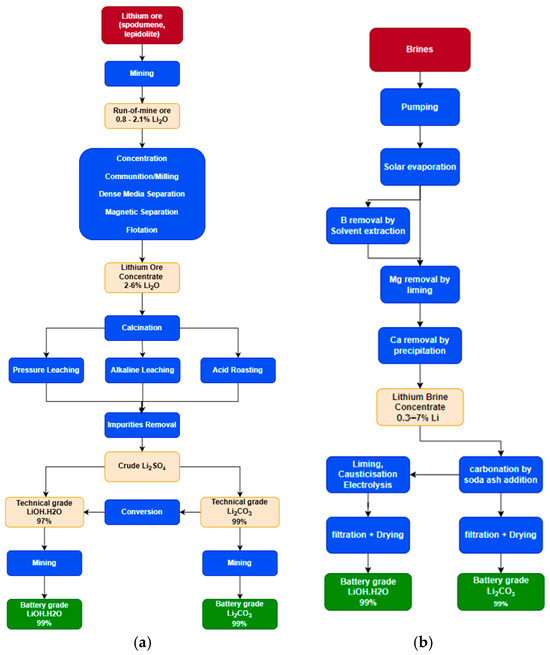
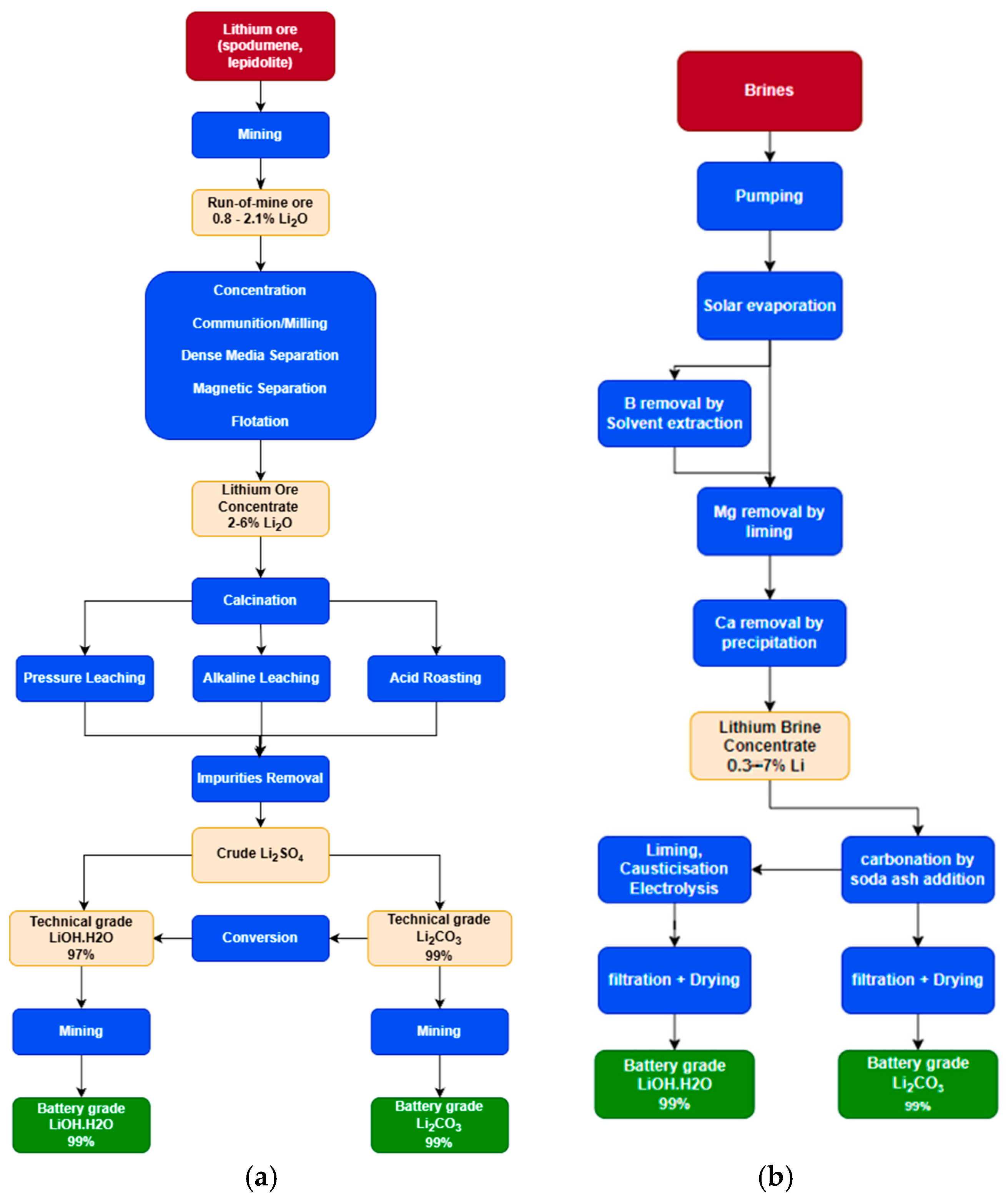
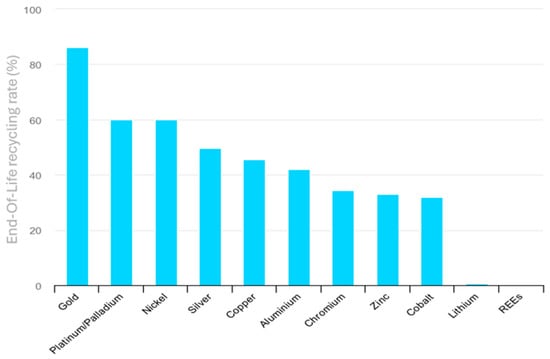
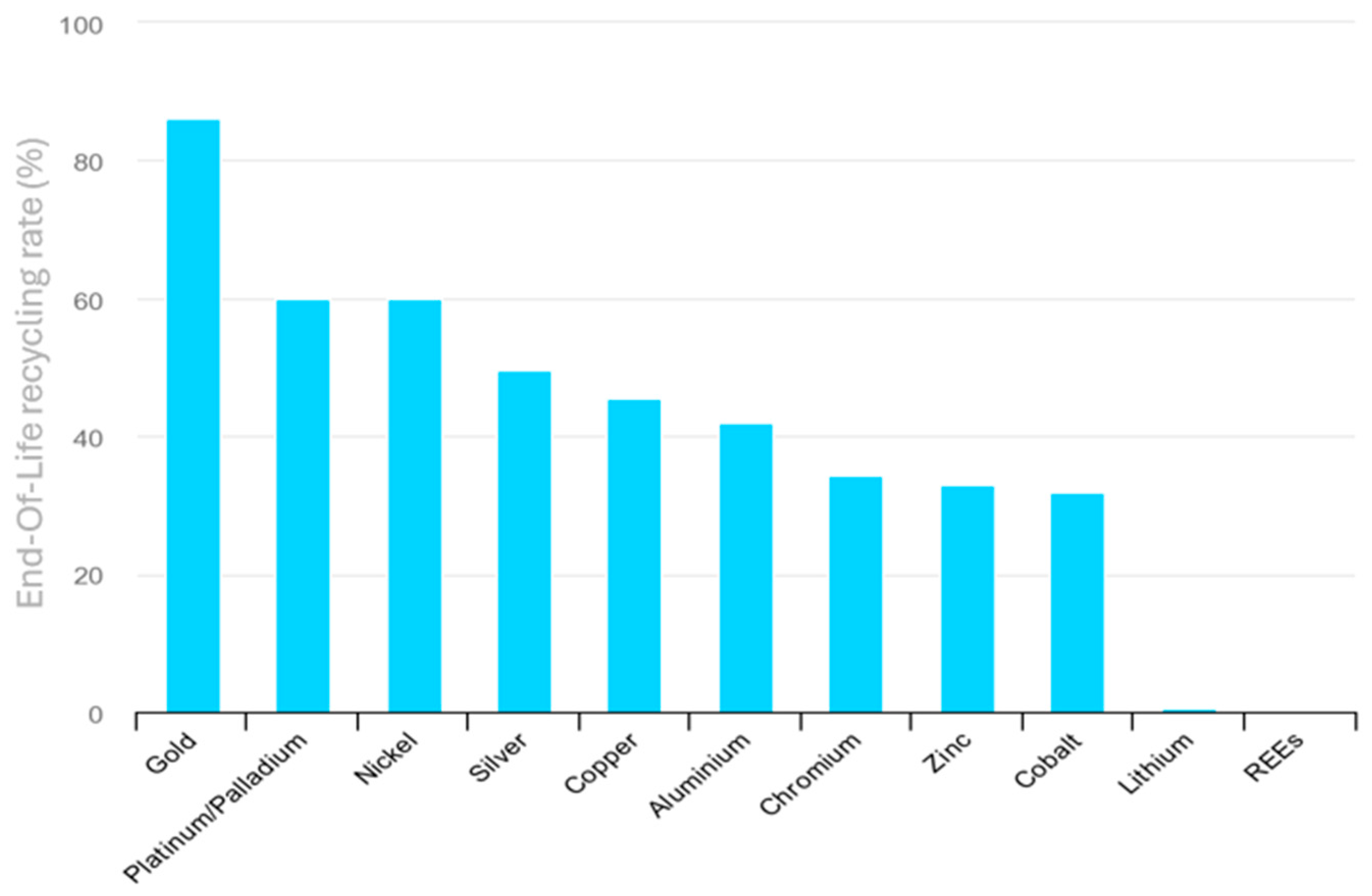
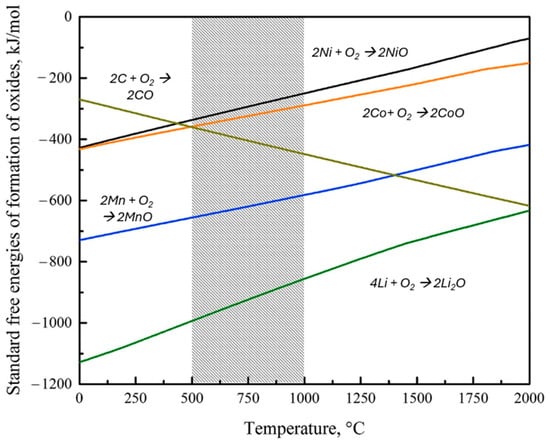
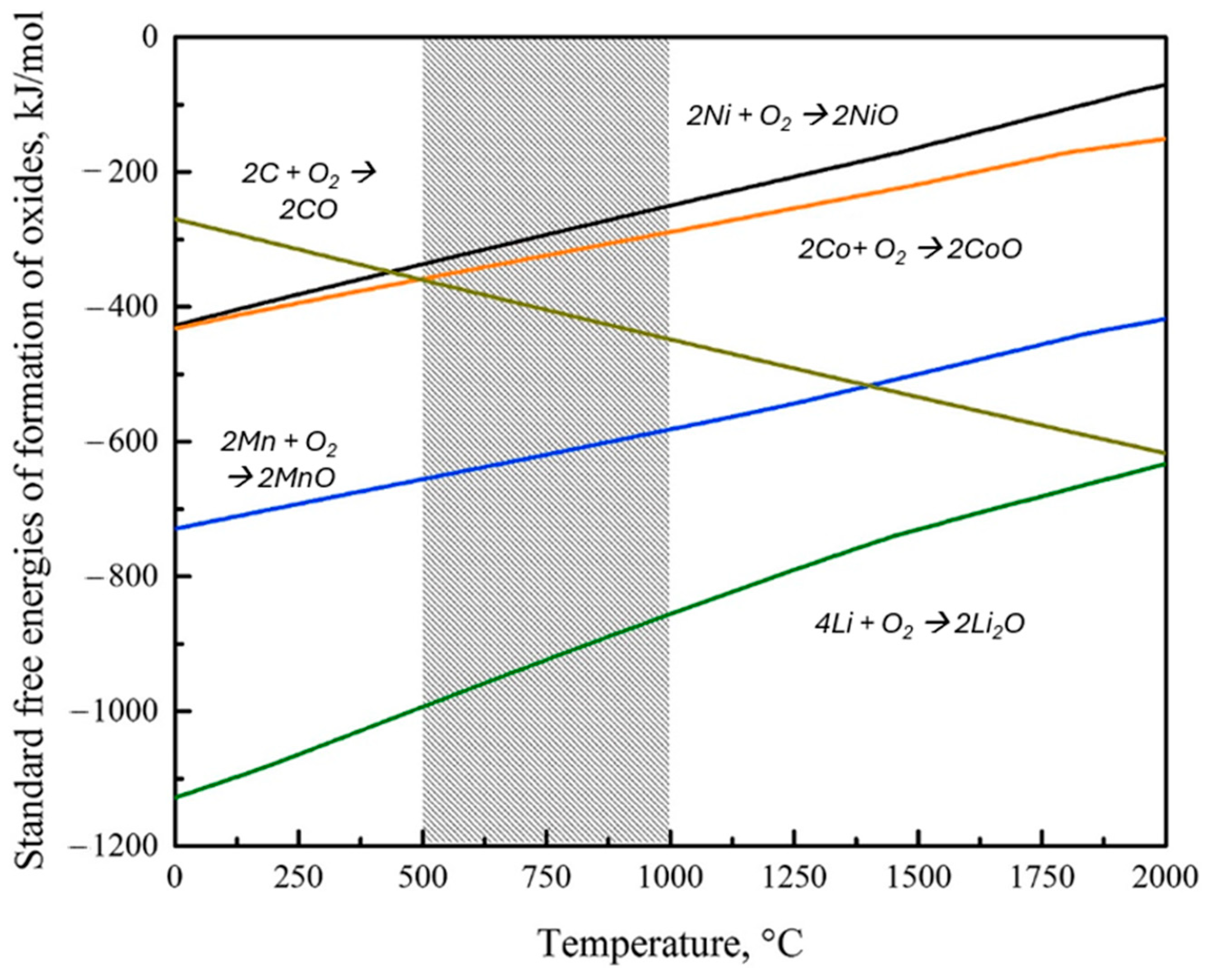
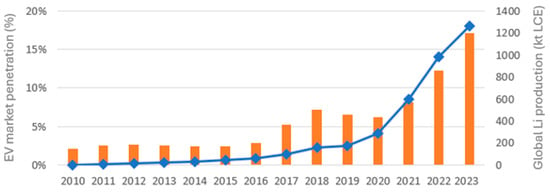
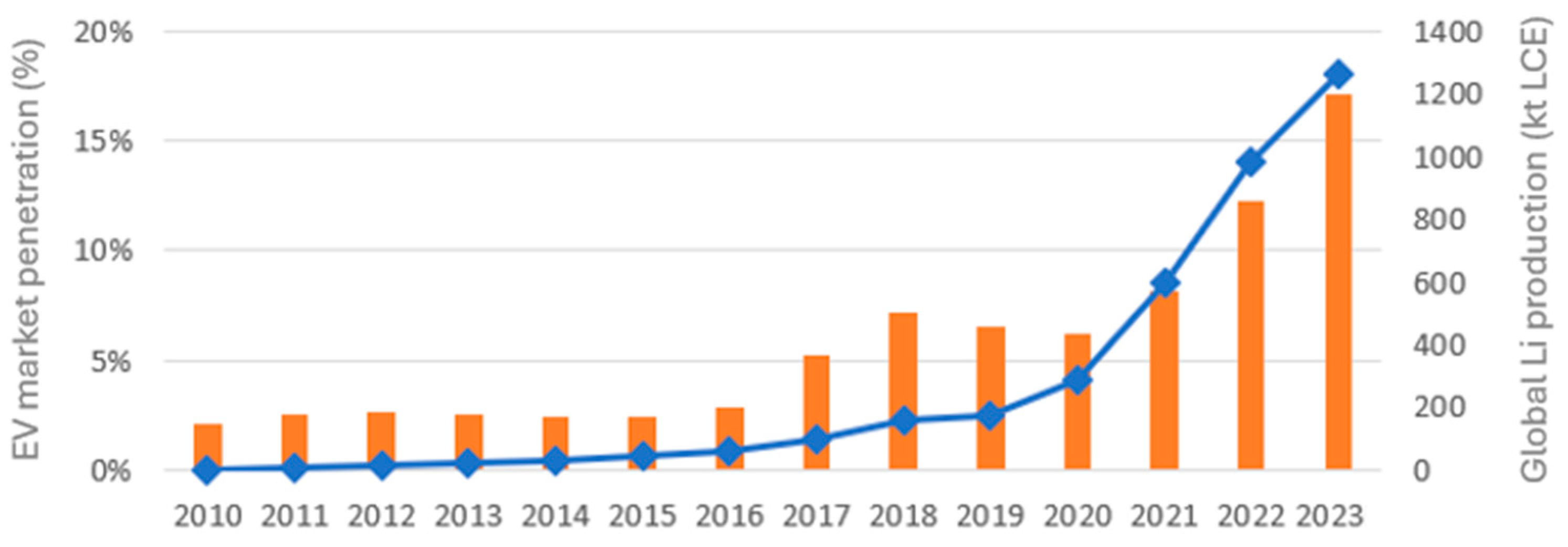
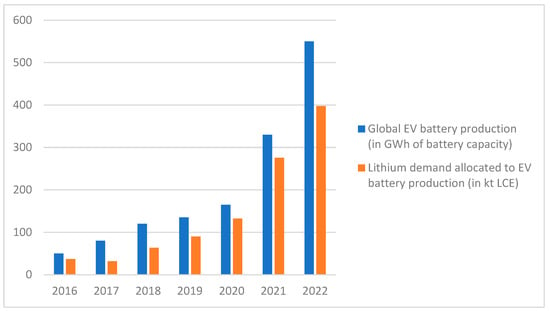
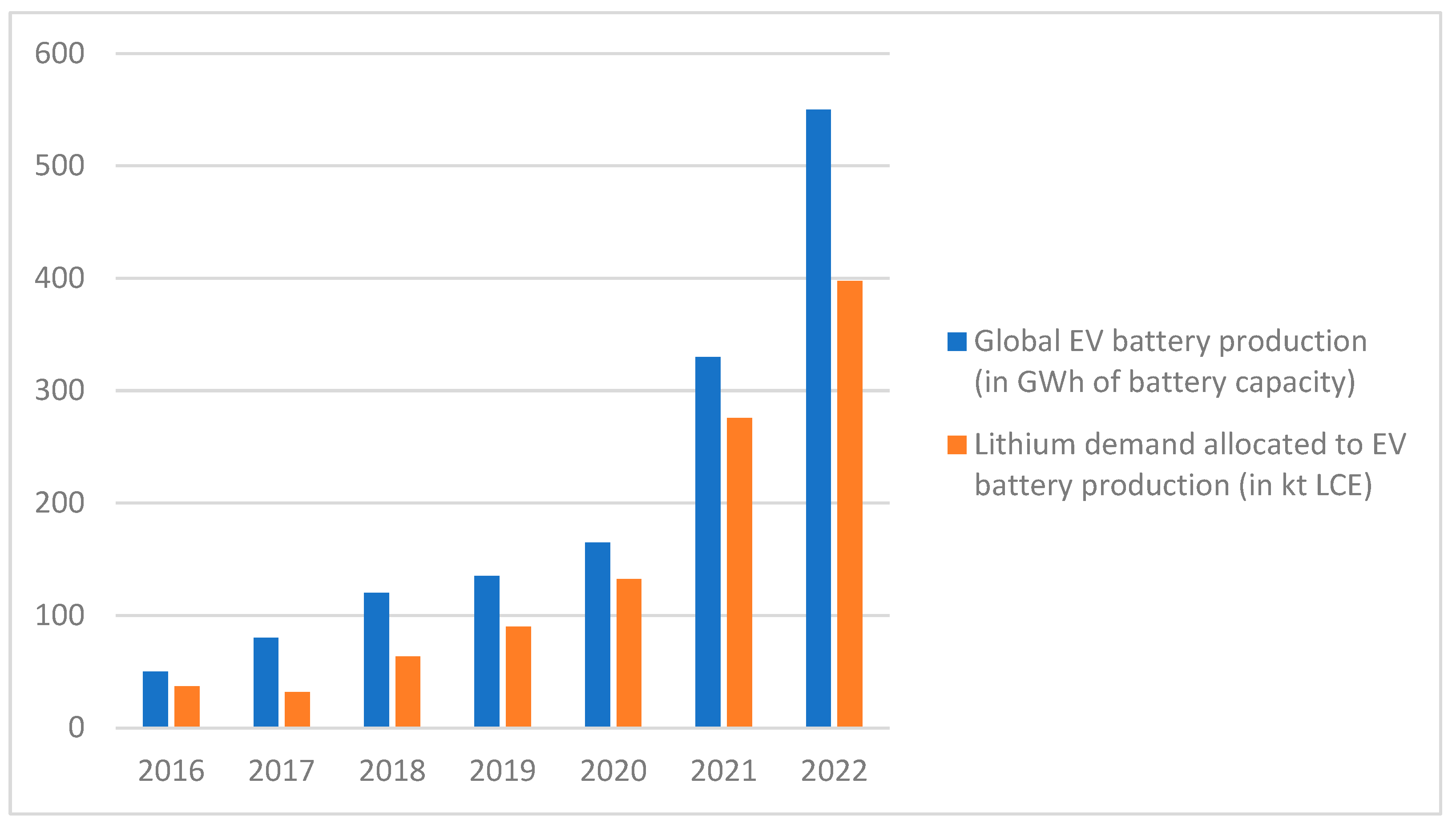
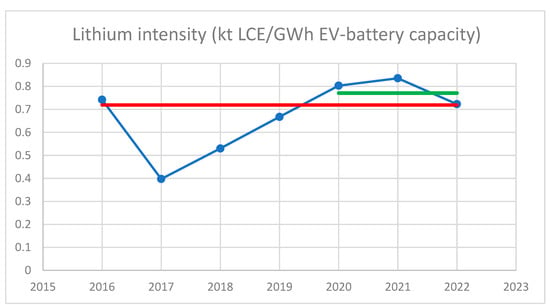
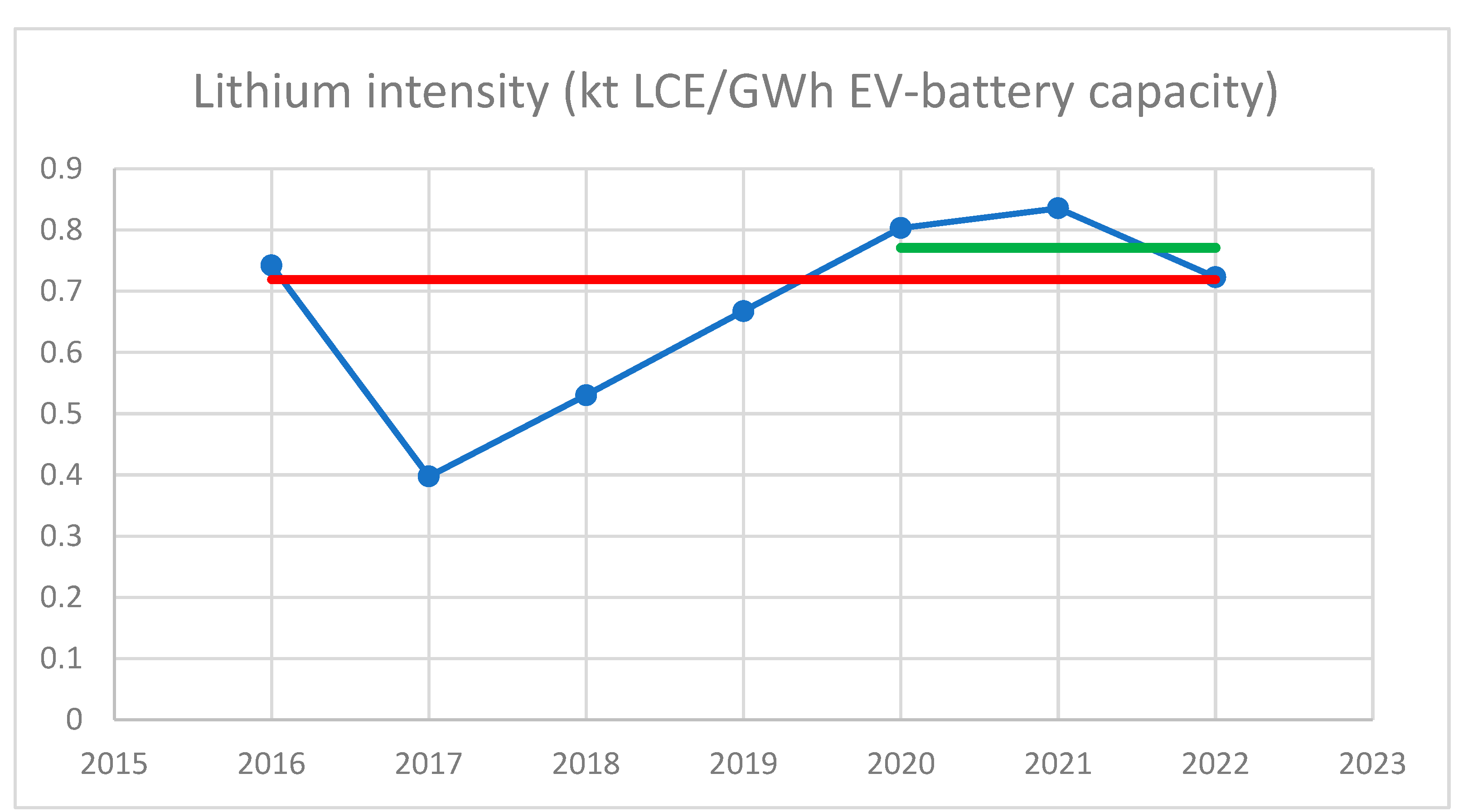
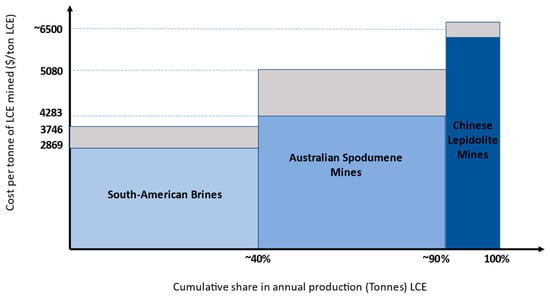
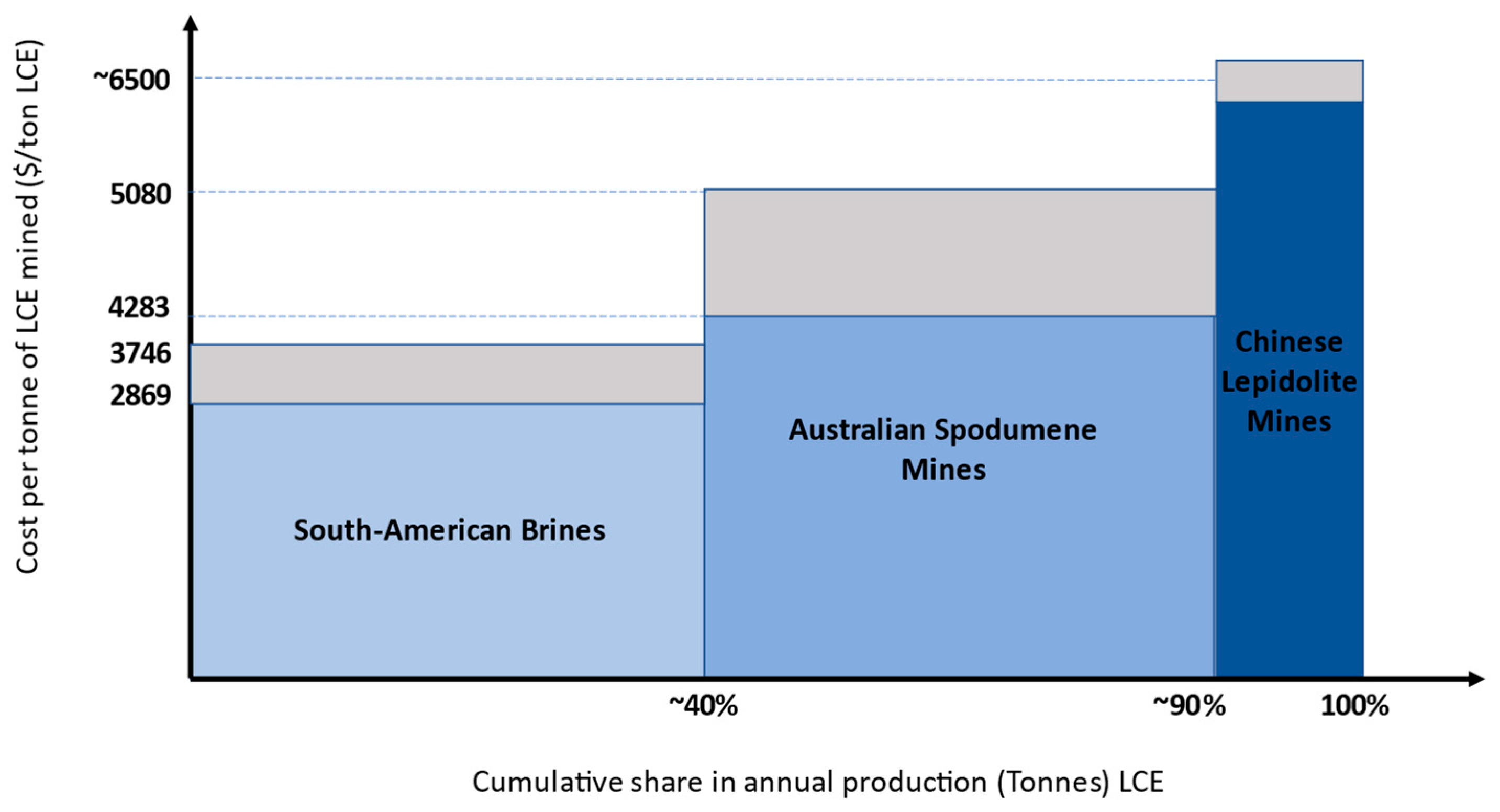
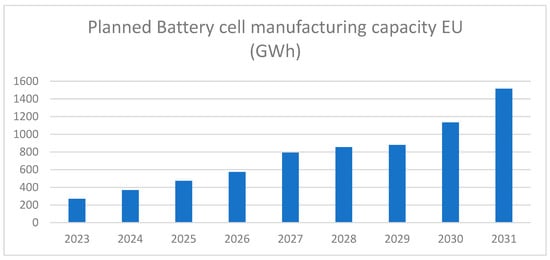
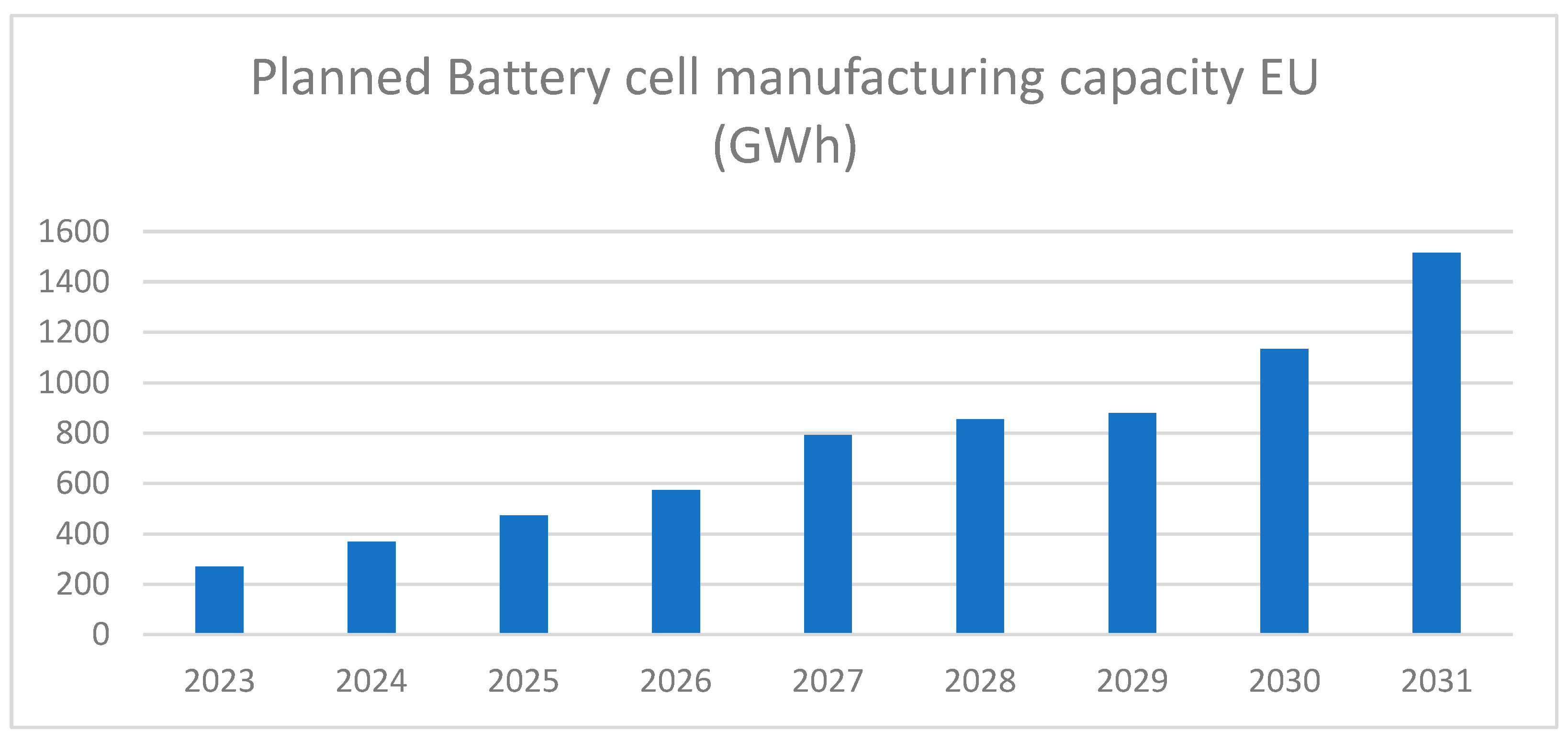
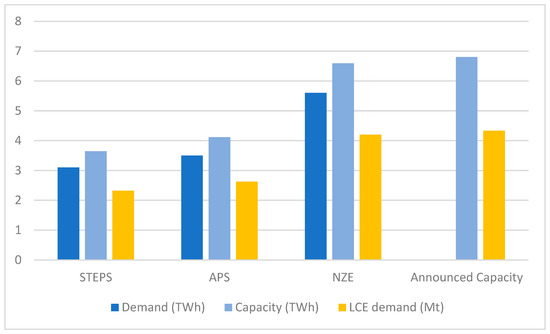
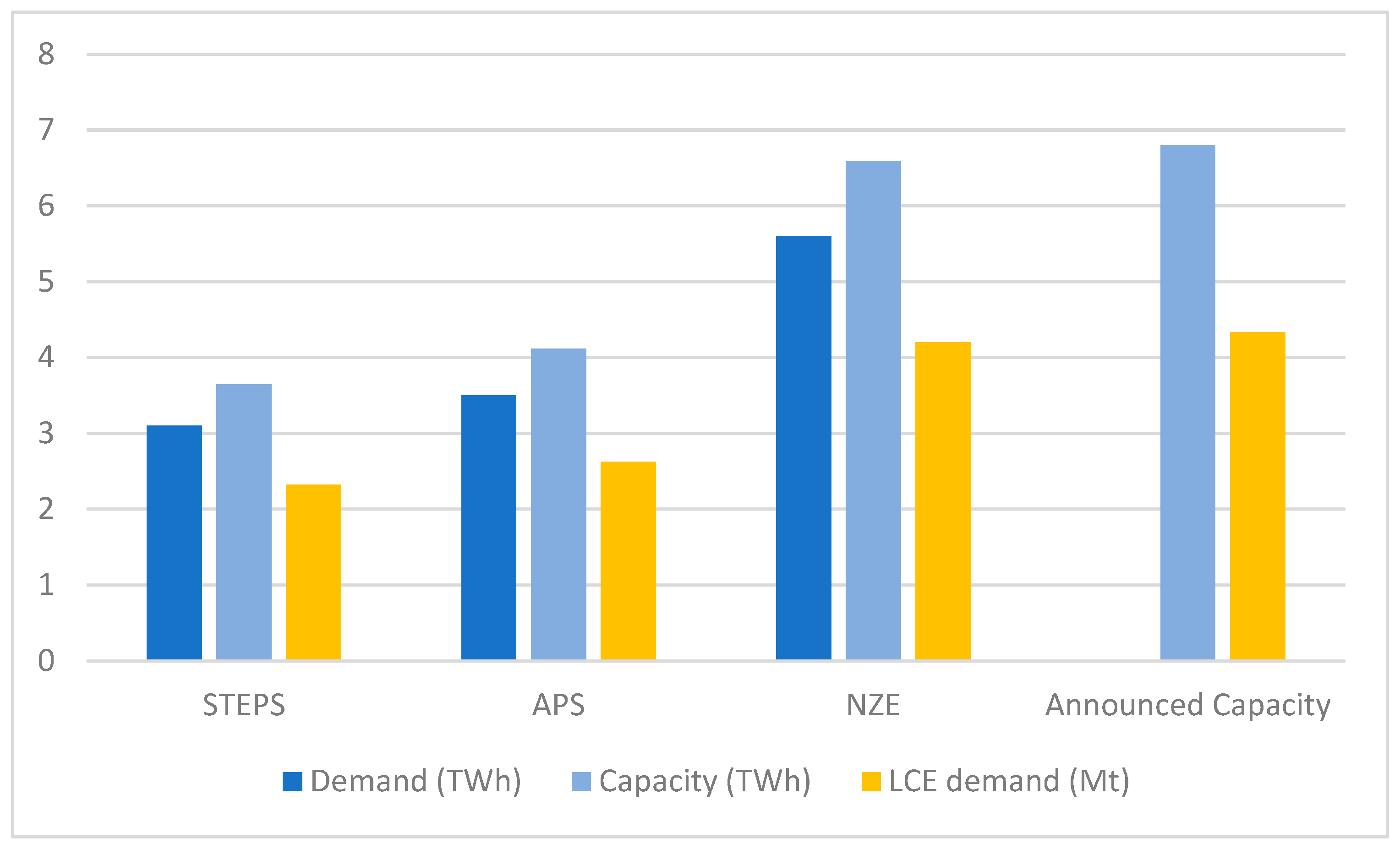
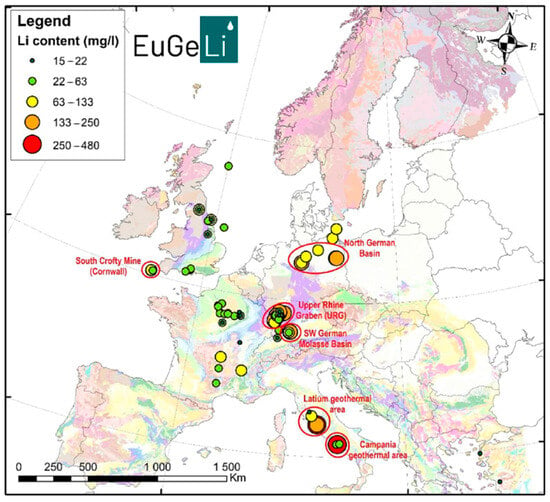
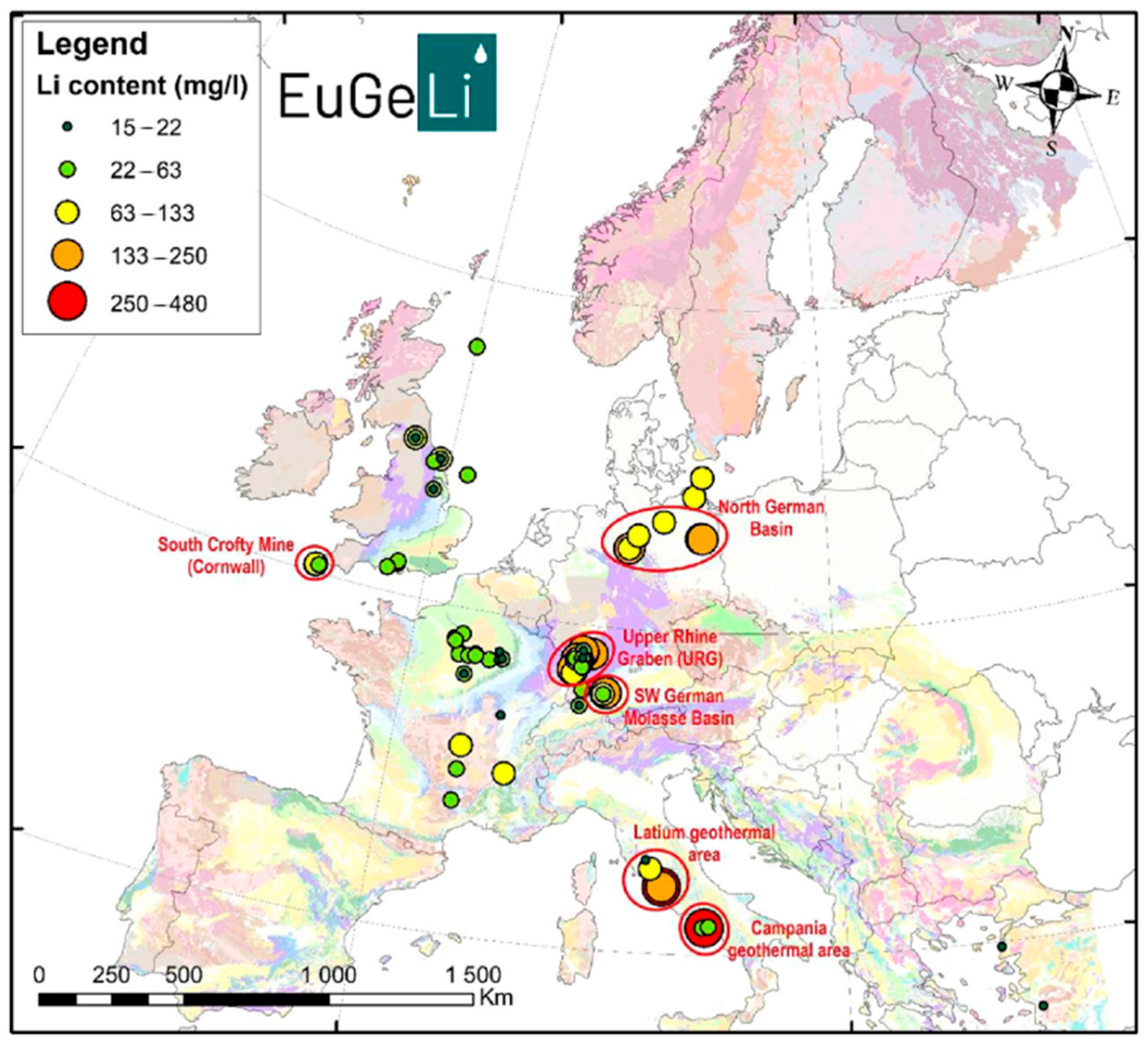
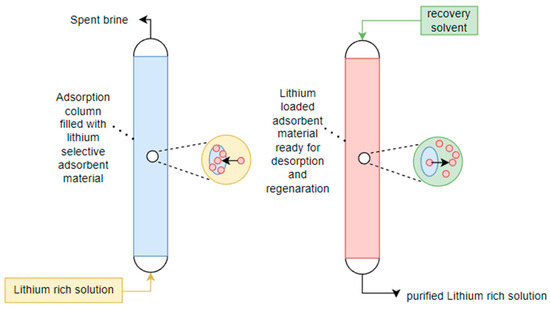
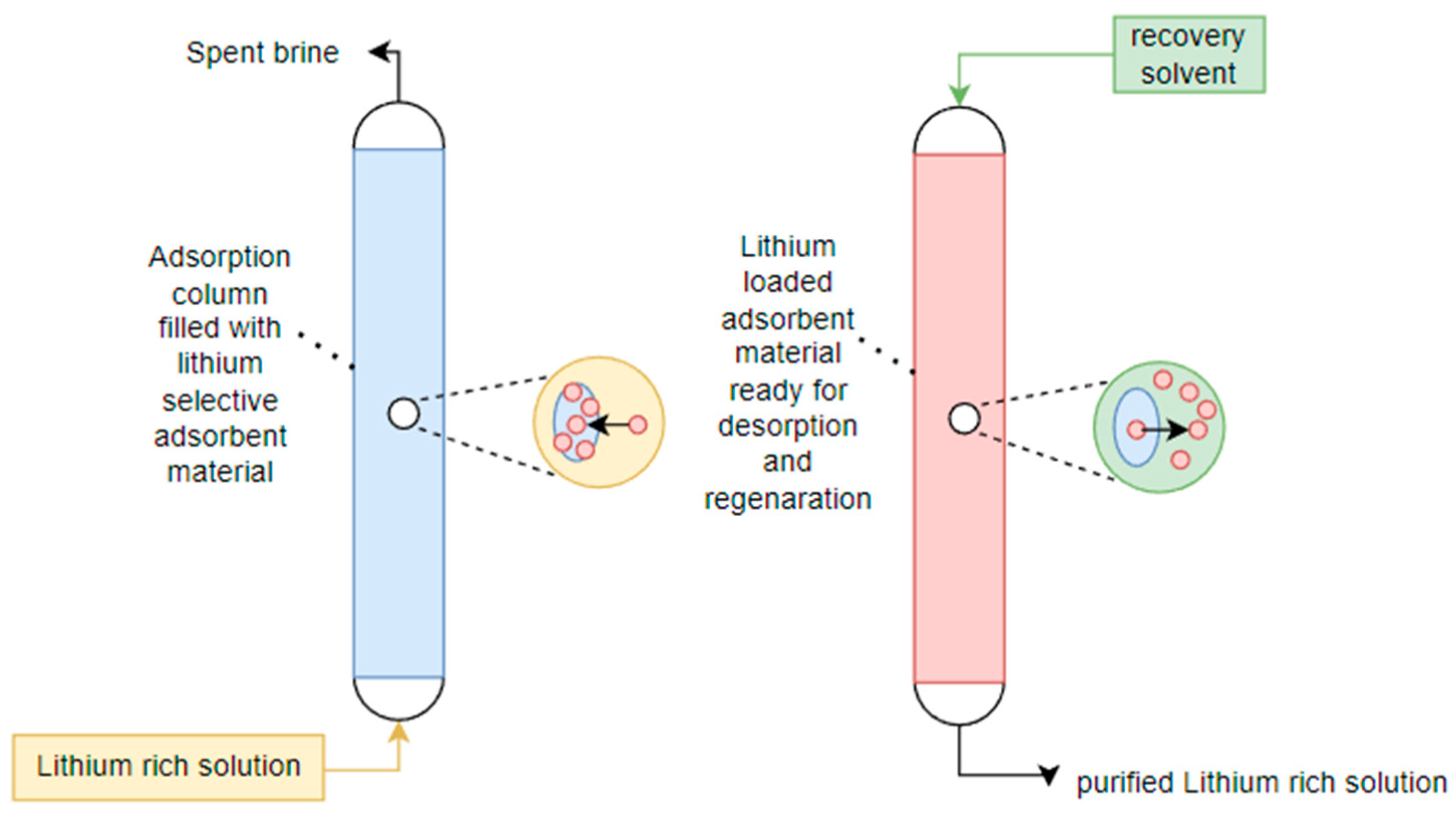
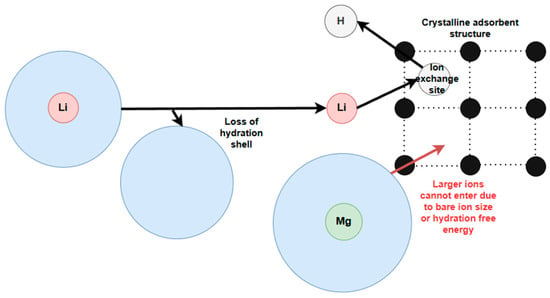
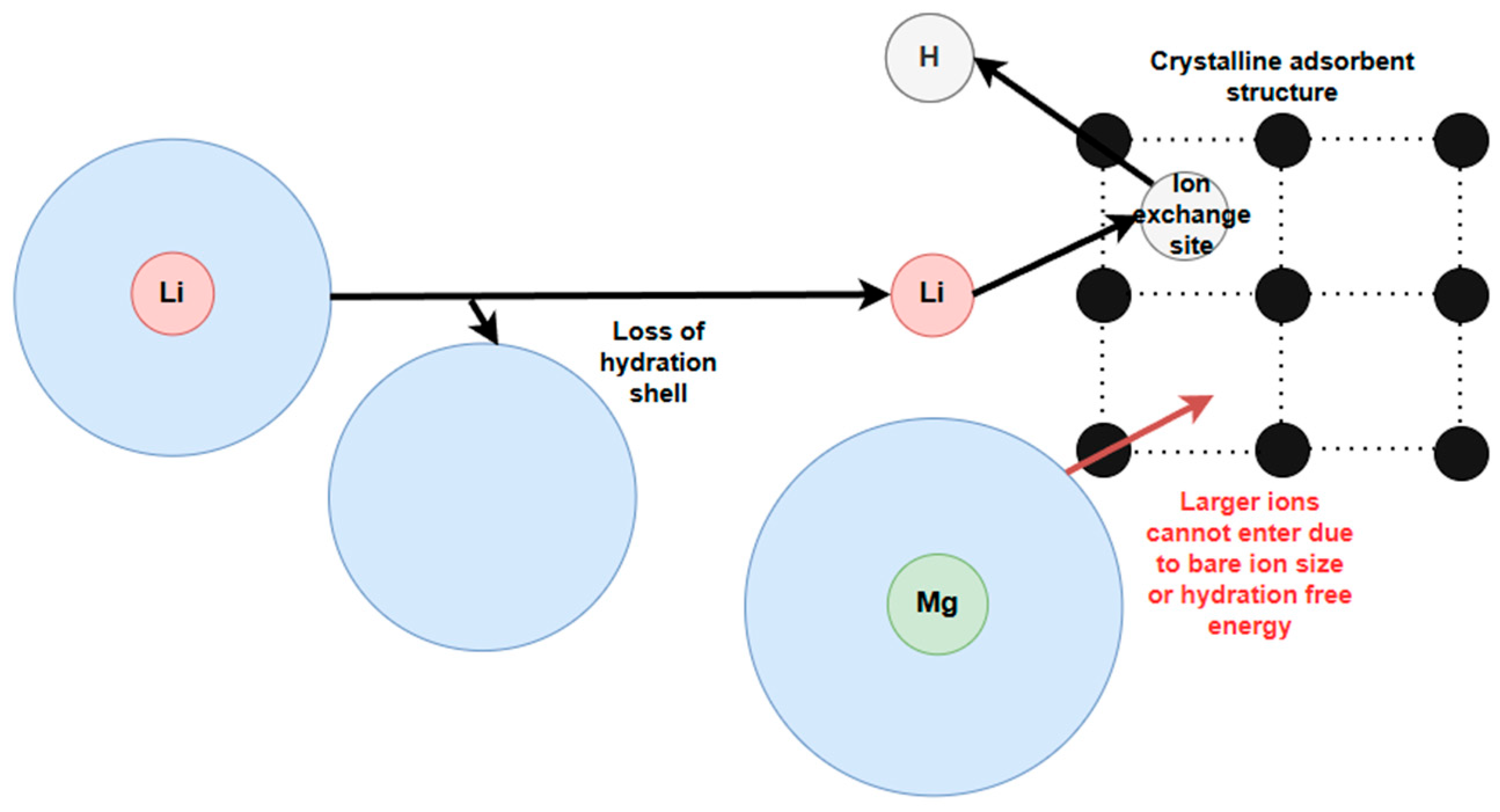
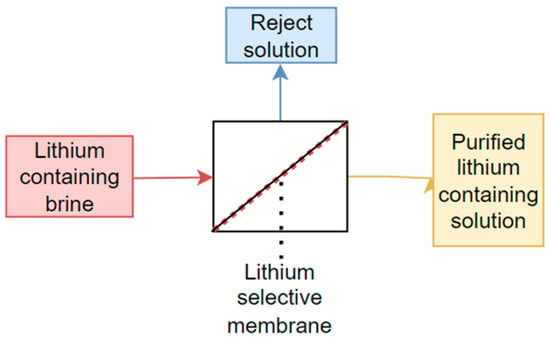
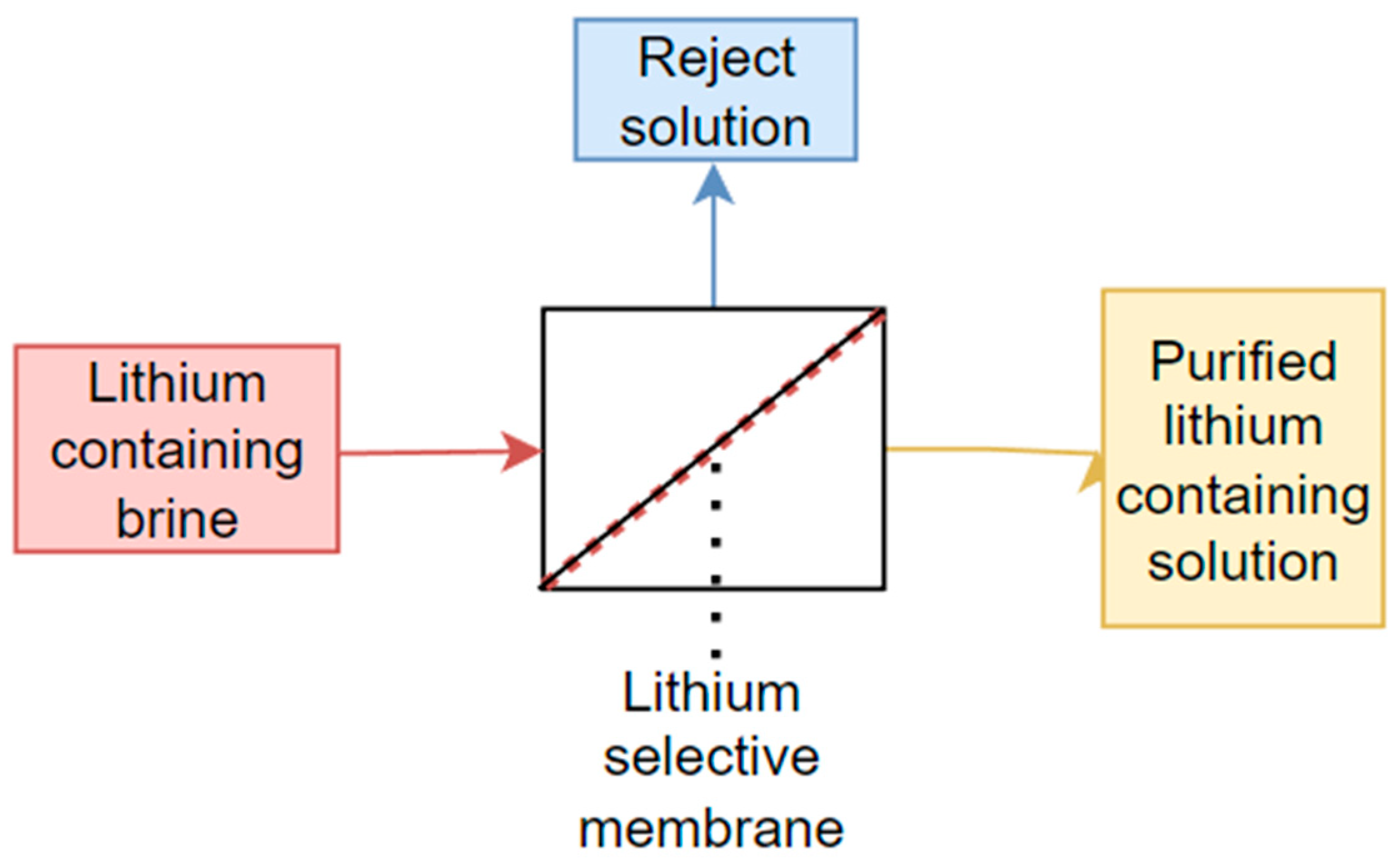
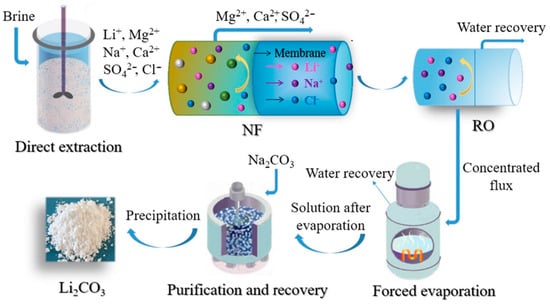
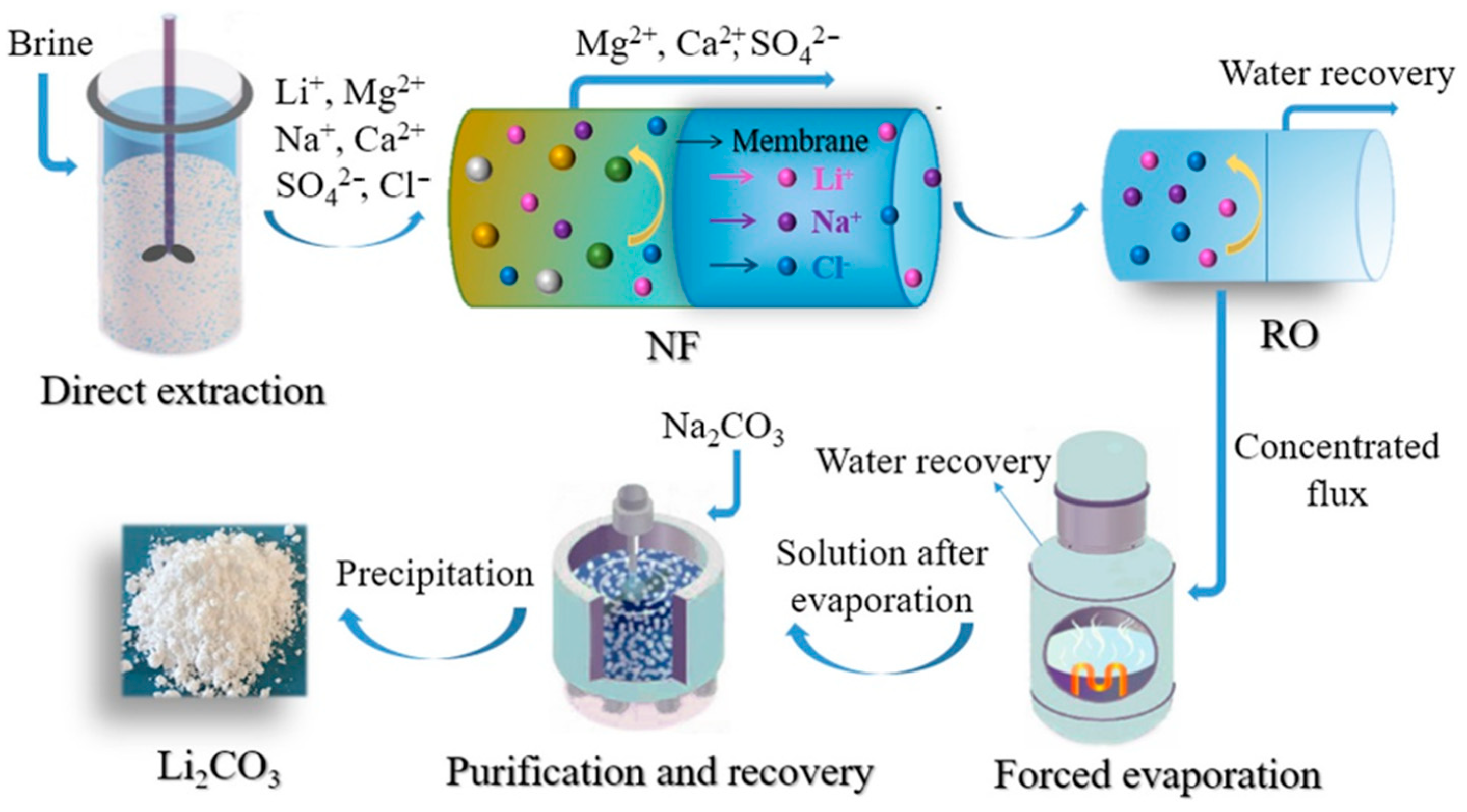

Disclaimer/Publisher’s Note: The statements, opinions and data contained in all publications are solely those of the individual author(s) and contributor(s) and not of MDPI and/or the editor(s). MDPI and/or the editor(s) disclaim responsibility for any injury to people or property resulting from any ideas, methods, instructions or products referred to in the content. |
© 2026 by the authors. Licensee MDPI, Basel, Switzerland. This article is an open access article distributed under the terms and conditions of the Creative Commons Attribution (CC BY) license.