1. Introduction
Through the efforts of the global community, the volume of oil being released into the marine environment has been significantly reduced over the past several decades [
1,
2]. However, oil spills do occur and may result from intentional releases or discharges from marine vessels, chronic releases from drilling platforms, as well as naturally occurring oil seeps from the sea floor [
3]. Due to increased legislative and regulatory oversight, a smaller portion of the total volume of oil released into our oceans comes from large tanker or platform spills [
4,
5]. The effects of these large spills on the local marine and coastal environments can be catastrophic. The severity of the environmental effects depends both on the nature of the spilled oil (chemical and physical properties) and on the type and sensitivity of the spill environment. Weather conditions at the time of the spill often influence the effects on the local environment: high winds and wave energy can enhance natural dispersion or lead to the formation of thick layers of emulsified oil and can drive oil onto sensitive shorelines and marshes areas.
Reasons to conduct oil spill remote sensing and surveillance include: the detection and recurrent monitoring of oil slick location and extent, determination and/or validation of slick trajectories, provision of evidence for prosecution, enforcement of ship discharge laws, direction of oil spill countermeasures, and mapping of oil spills for tactical and strategic response. Oil spill remote sensors are now accepted tools for oil spill response [
6,
7], but to be effective, surveillance data needs to be geospatially integrated. This is often achieved locally within specific incident command posts (ICPs) but can also be part of a national or regional oil spill surveillance system [
8]. Using modern technologies, oil can be detected and monitored on the open sea on a 24 h basis [
9] using sensors as part of oil spill monitoring systems. These systems can obtain, process, and integrate varied surveillance data with real-time environmental data to support oil spill alerting, tracking, and modeling. With the knowledge of slick locations and movement, spill response personnel can more effectively direct countermeasures to lessen the effects of the spilled oil and enhance oil recovery.
At the core of aerial surveillance are the varying remote sensors that must be selected to meet the end use or objective. Oil spill remote sensors used for routine marine surveillance differ from those used for detection on oiled shorelines or land [
10]. One tool does not serve all functions. For a given objective, a number of different sensors or sensor suites might be necessary. Furthermore, it is important to consider the end use of the data. The end use of the data, be it determination of the location of the spill, enforcement, or support to spill response and cleanup, may also dictate the spatial and temporal resolution of the data needed. For spill response, a surveillance plan [
11] is critical to ensure the right remote sensors on the right platforms are tasked to capture data in a manner that meets the stated surveillance objectives [
6]. An additional component of the surveillance plan is to ensure there is a well-established data workflow that can accommodate varied raw surveillance data (i.e., 100 s of still images or hours of video), rapid processing, and extraction of key information from the raw data (i.e., georeferenced and extract key images to meet objectives) to provide analyzed intelligence (i.e., polygons of surface extent of oil, areal extent of oiled shorelines) to the incident commanders. To be operationally employed, these data need to be integrated into a common operating picture (COP) to allow for validated situational awareness from which response decisions can be made.
A full review of oil spill surveillance and remote sensing technologies is beyond the scope of this paper. Several reviews of oil spill remote sensors have been published [
9,
12,
13,
14]. These reviews and other guidance documents show that a variety of sensors and techniques are needed for the many oil spill surveillance tasks at hand [
6,
15]. In 2005, a survey of global oil spill surveillance and remote sensing was conducted [
16] and provided an inventory of the remote sensing aerial platforms used at that time by countries to monitor their water and provide surveillance capabilities for response. Given the advances in sensor technology and the increase in remote sensing for oil spills, it is an appropriate time to revisit the global remote sensor capabilities for response. Since the last global survey of surveillance for oil spills [
16], there is more widespread use of satellite remote sensors, primarily synthetic aperture radar (SAR) but also optical sensors, fixed-wing aircraft many with specialized remote sensors, as well as helicopter with visual observers. Recently, there has been a movement to employ remotely piloted aircraft systems (RPASs) for the surveillance of oil spills. Each of these platforms have tiered and complementary capabilities to operationalize different remote sensors and/or sensor suites to be flown over varying spatial and temporal scales to meet specific surveillance objectives. For a review of operational selection of surveillance platforms and specific remote sensors for marine oil spill surveillance, see the guidance document by the ITOPF [
6].
Following a survey of national and regional safety and response organizations, this paper provides a summary of current and emerging remote sensors operationally employed for detecting and monitoring spilled oil. Survey responses are compiled to provide an inventory of aerial platforms (i.e., satellite, fixed-wing, helicopters, and RPAS), specific remote sensors employed, frequency of use, specific mission systems, software and hardware employed, as well as the most common output products to support oil spill response. I respondents also provide their operational perspective on gaps in current sensor capabilities and future research needs through to operationalization of new surveillance technologies.t is recognized that spatial data integration is a critical component of effective oil spill surveillance, but that specific function is outside the scope of this survey.
2. Materials and Methods
Digital questionnaires were distributed via e-mail in the fall of 2025 targeting national maritime governmental organizations; collaborative regional, national, and global safety and response organizations; petroleum industry responders and tanker operators; as well as sensor surveillance system and mission software developers that are actively engaged in the surveillance, monitoring, and remote sensing of spilled oil. Survey participants were invited to complete the same questionnaire either on Microsoft Forms or Google Forms platforms. The questionnaire included 53 questions focused on four main remote sensing platforms used for oil spill surveillance (i.e., satellites, fixed-wing aircraft, helicopters and RPASs) (
Appendix A). If a respondent indicated they employed a specific surveillance platform type, then subsequent questions inquired specifically about its operational use, including but not limited to:
What remote sensors are employed operationally?
How often are the resources employed (i.e., daily, weekly, monthly, in support of response, for training)?
What type of fixed-wing aircraft/helicopters/RPASs are employed?
What mission systems are used (Fixed-wing, helicopter)?
What software/hardware is used (RPAS)?
Is the platform taskable (satellite)?
What type of oil slick detection/delineation/classification is used?
What deliverables/output products are available in-flight and post-flight?
After the mission, when are deliverables/output products available?
A separate section asked specifically about remote sensors employed operationally for shoreline response to spill incidents, including what platforms and sensors are employed as well as deliverables/output products available. The final section focused questions on surveillance planning, dark-hour operations, and identifying gaps and key research questions that still require further sensor development to enhance operational capability. Most questions provided a list of answers from which the respondents could multi-select their responses. If their response was not listed, they were invited to provide a written answer in an “Other” field. A few questions were long-form text responses only without selectable answers.
After the initial responses were received from countries and response groups, a condensed version of the questionnaire was created and sent to airborne surveillance system developers to obtain more details on their mission systems and sensors. This survey asked 22 questions including:
What sensors are operationally integrated in your sensor suite to detect and document an oil spill?
How many countries are operationally using your sensor suite?
Which platforms are your sensor suites integrated on (i.e., satellite, fixed-wing, helicopter, RPAS) and specific types of each?
What type of oil slick detection/delineation/classification do the sensor suites use?
What deliverables/output products are available in-flight and post-flight?
After the mission, how long until deliverables/output products are available?
Similar questions to those in the global survey were asked about sensor systems used to conduct surveillance of shorelines including: which sensors are employed, are the data terrain compensated, and what deliverables/output products can be created with their system for shoreline response. The concluding five questions were the same as the global survey asked to gain insight into industry perspectives on sensors successfully used for dark-hour spill surveillance, identifying known gaps in operational remote sensors for oil spills and any key research questions that still require further development to enhance operational capability.
Responses to the global survey were compiled into summaries grouped by platform type (i.e., satellites, aircraft, helicopters, remotely piloted aircraft systems) as well as those about shoreline surveillance. All responses to the multi-select questions were plotted on horizontal bar graphs grouping responses from “countries” and “other” organizations. Some bar graphs are included in the results as figures, but most of the questions were summarized in text with a percent total of respondents per answer written beside the answer (e.g., hyperspectral (20%)). Where a distinction is made between respondents from “countries” and “other” response organizations, it is indicated by counts of respondents out of the subset of responses (i.e., 3 of 5).
For each long-form answer, the authors reviewed the text, then identified and grouped similar responses. Summaries of long-form answers were written to highlight the predominant ideas first, followed by concepts that were only stated once or twice. Where possible from the long-form answers, the numbers of respondents have been summarized. Numbers are not included where responses were too diverse to categorize, and all individual inputs are shared.
Of the six companies invited to participate in a sensor developer/integrator survey, two provided responses: PAL Aerospace (St. John’s, NL, Canada) and Optimare Systems GmbH (Bremerhaven, Germany). These responses are summarized in a separate section detailing the capabilities of these surveillance systems.
3. Results
The digital questionnaire was originally sent to roughly 56 authorities within countries that are responsible for environmental protection and 17 “Other” groups, including oil spill response organizations, petroleum producers, and nonprofit groups engaged in regional and/or global spill response. A complete list of all organizations the original questionnaire was sent to can be found in
Appendix B. From this initial release, the survey was forwarded to other like-minded organizations who then responded. Final responses were received and compiled into 13 countries and 12 “Others” for a total of 25 respondents (
Table 1). Some organizations or countries provided more than one response, and they have been combined as follows: a single Canadian response was compiled from 19 separate regional responses from federal departmental spill response partners. The Finnish response was compiled from two responses from the Finnish Environment Institute and Finnish Border Guard. The single response from Shell was compiled from two responders from the same organization. A response from Denmark was provided by the Royal Danish.
Navy Command, indicating that their fixed-wing aerial surveillance is conducted by a contractor on behalf of both Denmark and Norway with the same sensor package. Therefore, the Danish response was a duplicate of the Norwegian response for fixed-wing aircraft; all other sections of the questionnaire were left blank. The response from the United States of America (USA) was from one organization only, the National Environmental Satellite, Data, and Information Service (NESDIS) from the National Oceanic and Atmospheric Administration (NOAA). The other USA departments that were invited to respond (i.e., United States Coast Guard and NOAA’s Office of Restoration and Response) could not do so before the closing of the survey in October 2025; therefore, the other sections in the survey were left blank instead of indicating a negative response (
Table 1).
Responding countries were predominantly European, with three from the Americas as well as Australia (
Table 1). “Other” organizations represent Australia, Canada, the USA, and the UK, while several provide global coverage. With respect to the representativeness of the survey, although there was less response from government authorities in some global regions, we note there was good representation from global oil spill response organizations and petroleum producers who provide scientific and operational support during oil spill emergencies to member states around the world, including Africa, Asia, and South America.
In some cases, there was insufficient detail in the responses to certain questions as respondents indicated a reliance on another organization to engage in and conduct surveillance on their behalf. Many European respondents rely on the European Maritime Safety Agency (EMSA) [
8], which is a European Union (EU) agency charged with reducing the risk of maritime accidents, marine pollution from ships, and the loss of human lives at sea by helping to enforce the pertinent EU legislation. Although EMSA was invited to respond to the questionnaire, they did not provide a response. To provide important context of this organization’s contribution to surveillance for spill response in Europe, their operational support was compiled from their websites [
8].
EMSA provides its member state authorities with Earth observation services that offer a unique view of their oceans, seas, and coastlines. EMSA provides access to a number of satellites and their on-board sensors (synthetic aperture radar (SAR) or optical) to provide wide-area maritime surveillance as well as support in the event of oil spill emergencies at sea. The two main Earth observation services provided by EMSA are CleanSeaNet (CSN) [
17] and the Copernicus Maritime Surveillance (CMS) service [
18]. EMSA also offers maritime surveillance using RPASs to member States. CSN is a European satellite-based oil spill and vessel detection service that offers assistance to participating member states to identify and track oil pollution on the sea surface, monitor accidental pollution during emergencies, and help identify the responsible party (polluter). EMSA employs specific remote sensors within an integrated oil spill monitoring system that provide detection, alerting, forecasting, and monitoring of regional waters and oil spill incidents.
Survey results show satellites are employed by 83% of respondents and fixed-wing aircraft by 84%. Helicopters and RPASs are used by fewer organizations, 57% and 52% respectively, and shoreline surveillance is conducted by 70% of the respondents. The following sections provide the results for each subsection of the questionnaire.
3.1. Satellite
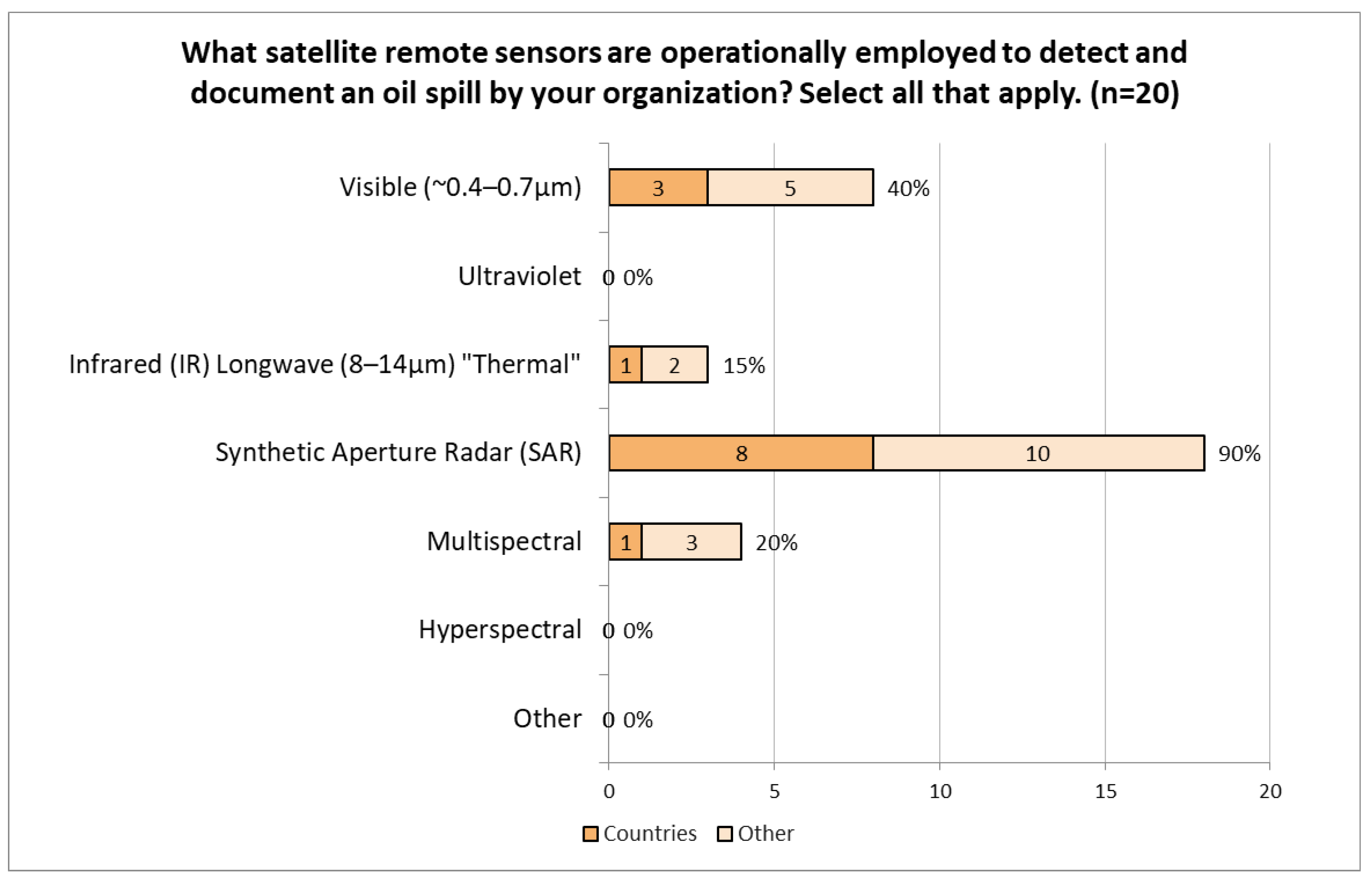
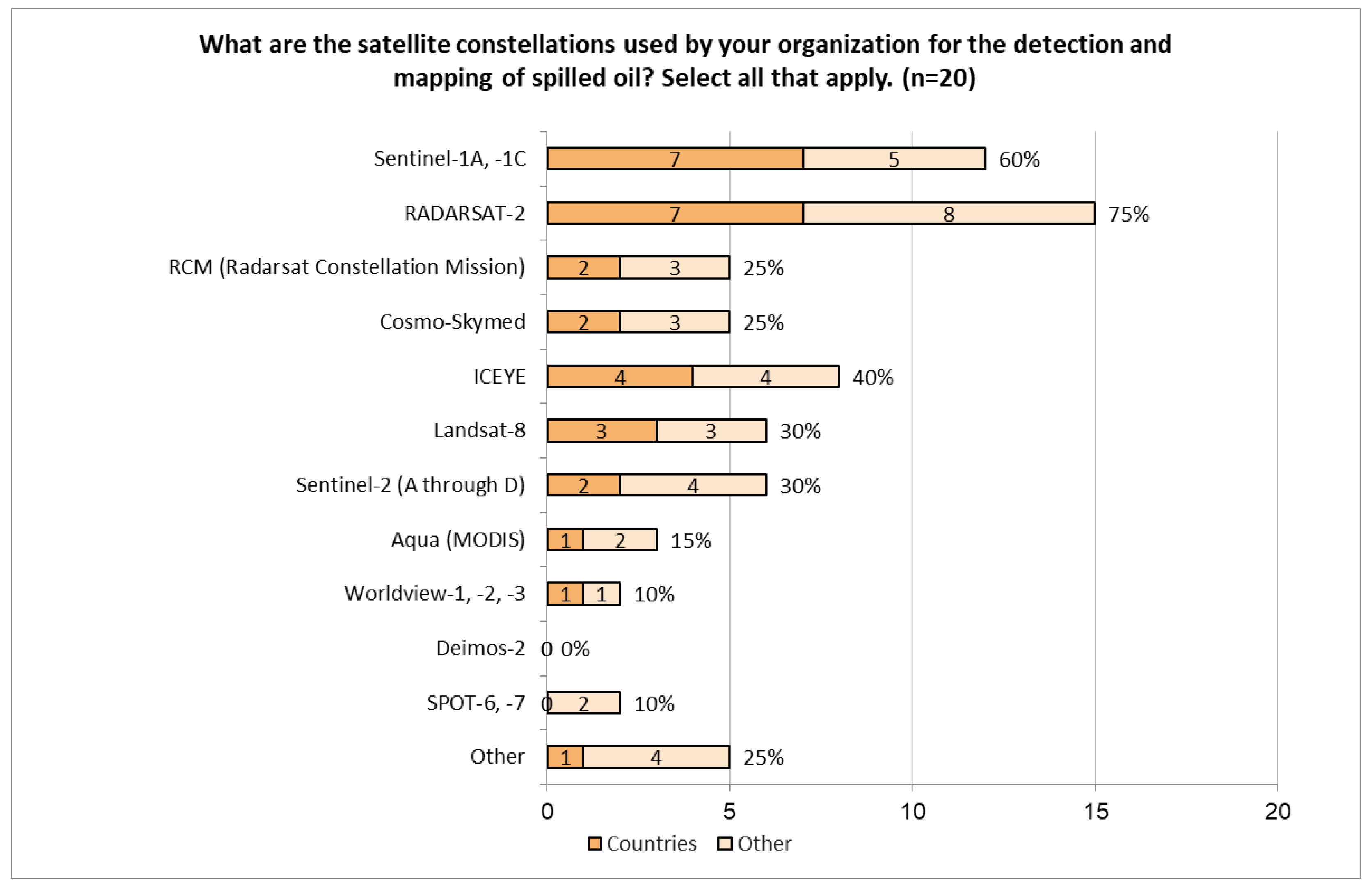
Of the 24 survey respondents to this section, 20 reported using satellites for oil spill surveillance (84%). Of those, ten (50%) were country representatives and ten (50%) were other spill response organizations. The primary remote sensor respondents use from satellites to support oil spill response is synthetic aperture radar (SAR) (90%), followed by sensors in the visible spectrum (40%), longwave IR (15%) and multispectral (20%) (
Figure 1). The satellite constellations used by most organizations are Radarsat (i.e., Radarsat-2) (75%) and Radarsat Constellation Mission (RCM) (25%) and Sentinel-1A, -1C (60%) (
Figure 2).
From the respondents, satellite data for spills is most often used in a “Reactive capacity to support a specific response” (60%), and of those, it is primarily used by other response organizations (9 of 12—75%) and then country representatives (3 of 12—25%), whereas “Daily/near-daily monitoring” (11 or 55%) is conducted more by countries (9 of 11—82%) compared with other organizations (2 of 11—18%). Satellite imagery was also used “In support of training and/or spill exercises” (40%) predominantly by other response organizations (6 of 8—75%). With regards to the ability for organizations to task satellite systems for response, 75% of respondents stated “Yes” and some listed which ones. These are: RADARSAT-2/RCM (33%), ICEYE (20%), Sentinel-1A, -1C (13%). Of note, the supporting organizations that task satellite resources on behalf of response groups include: EMSA CSN (53%), Kongsberg Satellite Service (KSAT) (27%), and OSRL (7%).
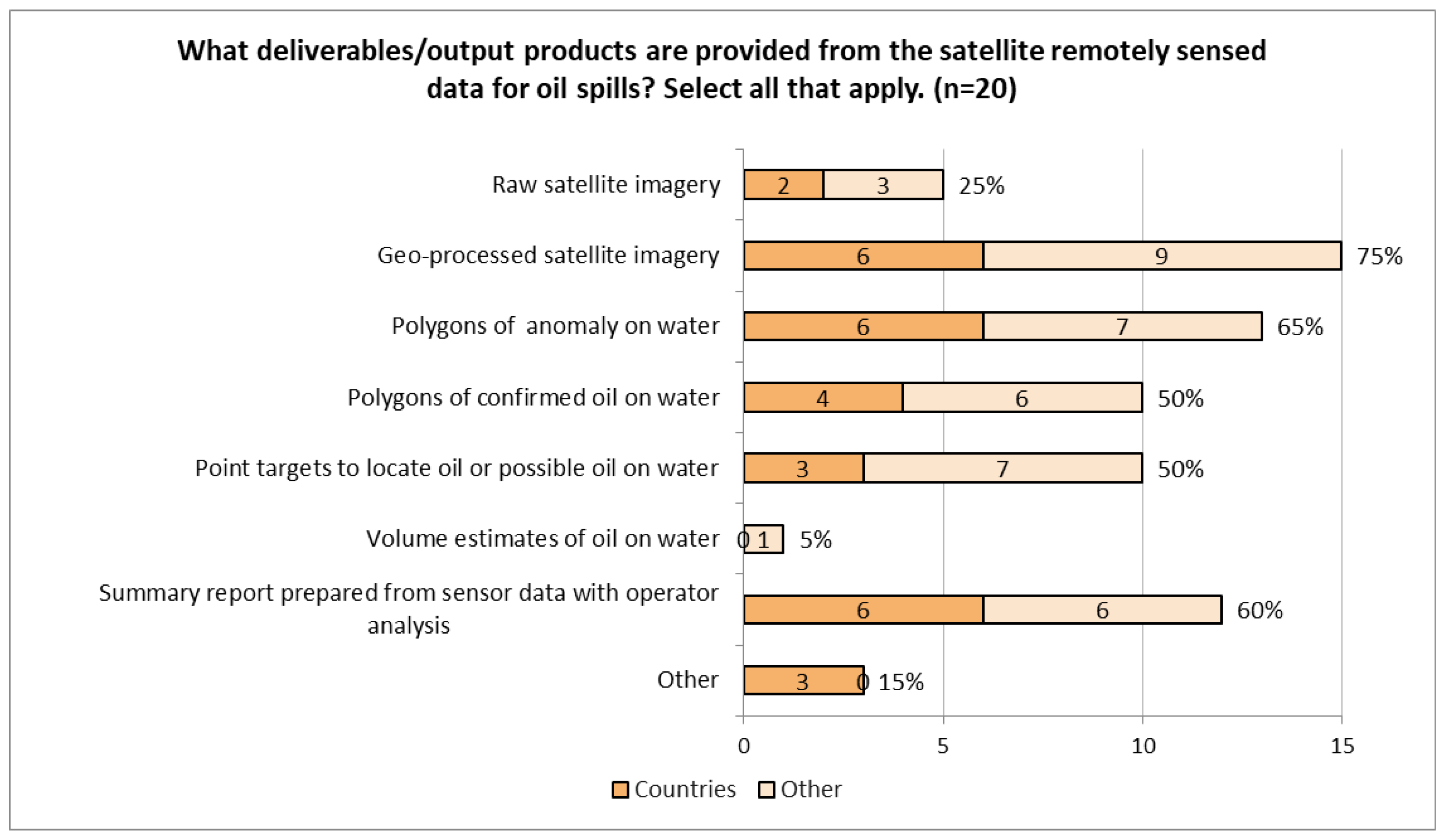
For deliverables/output products from satellite data, respondents multi-selected from a list of options, including: “Geoprocessed satellite imagery”, the highest selected response (75%), followed by “Polygons of anomaly on water” (65%) and “Summary reports from the sensor data processed by an analyst” (60%) (
Figure 3). Three “Other” deliverables not listed are GIS files such as shapefiles and geojsons, “Alert reports”, and statements that “any anomaly (i.e., ice floes, possible oil, or other) is investigated and correlated with known traffic patterns or reported movements.” With regards to automation employed to process satellite data, no groups responded as using “Fully Automated” spill detection/delineation and classification. All responded with predominantly “Semi-Automatic—Operator Supported” (65%) or “Fully Manual—Operator Conducted” detection and data classification (30%). One group responded “EMSA CleanSeaNet service” as an “Other” response.
When asked how long until deliverables/output products are available from satellite data to support spill response, 45% of respondents answered “Near-real-time (within 1 h)” and 60% responded “Some post processing required (data within 6 h)”. The remaining 25% responded with “Post Processing Requirements > 6 h but <24 h”.
3.2. Fixed-Wing Aircraft
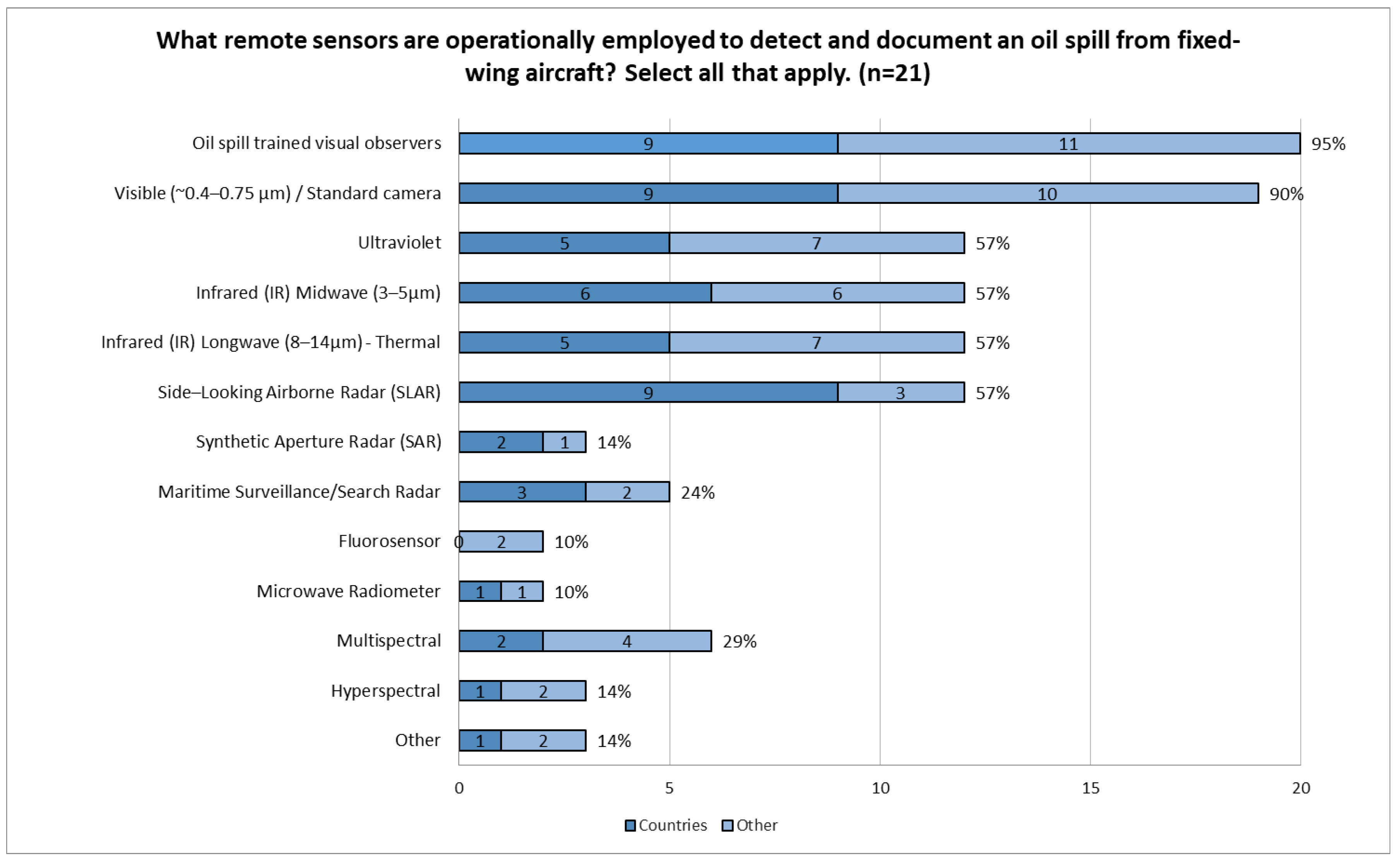
Of the 25 global survey respondents to this section, 21 (83%) replied “Yes” to the use of or obtaining of data from fixed-wing aircraft for oil spill surveillance. Of these, 10 (47%) were countries and 11 (53%) were other spill response organizations. The primary remote sensors that respondents used for oil spill surveillance from fixed-wing aircraft are: “Oil Spill Trained Visual Observers” (95%) and sensors in the “Visible spectrum/Standard cameras” (90%) (
Figure 4). Respondents also employ ultraviolet (UV) (57%), midwave infrared (MWIR) (57%) and longwave infrared (LWIR) (57%). For oil spill surveillance conducted with radar systems, side-looking airborne radar (SLAR) (57%) was the largest proportion of respondents, followed by maritime search radar (24%) and SAR (14%). Additional sensors used by fewer respondents include: multispectral (29%), hyperspectral (14%), radiometer (10%) and fluorosensor (10%), although notes to this question provide further insight that radiometer and fluorosensor were removed from aircraft and one respondent stated that multi- and hyperspectral sensors are tested but not currently installed on board the aircraft. Also of note, multispectral and hyperspectral sensors are used more by other response organizations than countries.
When asked what fixed-wing aircraft and how many of each type are used by their organization for oil spill surveillance, respondents provided written responses that include: Cessna 337 (5); Beechcraft King Air 350 ER (5); DeHavilland Dash 8-100 (4), Dash 8 Q3 (3), and Dash 7 (1); Challenger CL604 (4); and Dornier 228 (4). There are also aircraft models employed by only one respondent, including: Britten-Norman Islander (1); Embraer EMB 110-P1 (1) and EMB 121 (1); Piper Cherokee (1) and Navajo (1); Falcon 50 (1); and Poseidon (1). Also mentioned was the addition of Challenger 650s currently commissioned to be operational in 2027. On board these aircraft, there are several mission management software employed to integrate and operationalize varying remote sensors. These include: AIMS-ISR (14%), L3 Harris (14%), Optimare (14%), ST Airborne Systems (14%), and Seahunter (5%). There are also several respondents who stated no mission management software was used on board or it was unknown.
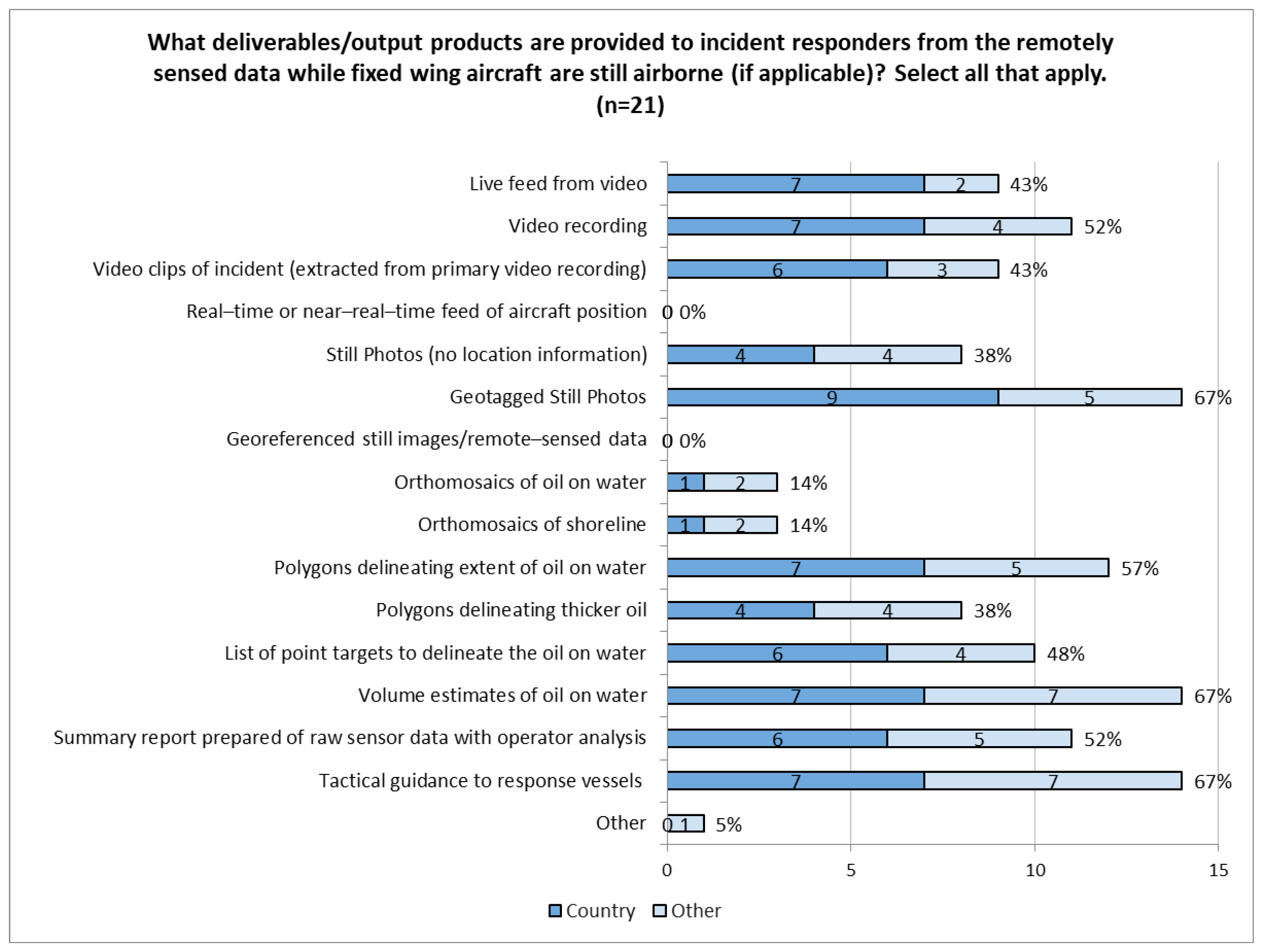
The predominant deliverables/output products provided from fixed-wing aircraft while the plane is still airborne include: “Geotagged still photos” (67%), “Georeferenced remote sensed imagery” (57%), “Polygons delineating extent of oil on water” (57%), “Volume estimates of oil on water” (67%), as well as “Tactical guidance to response vessels” (67%) (
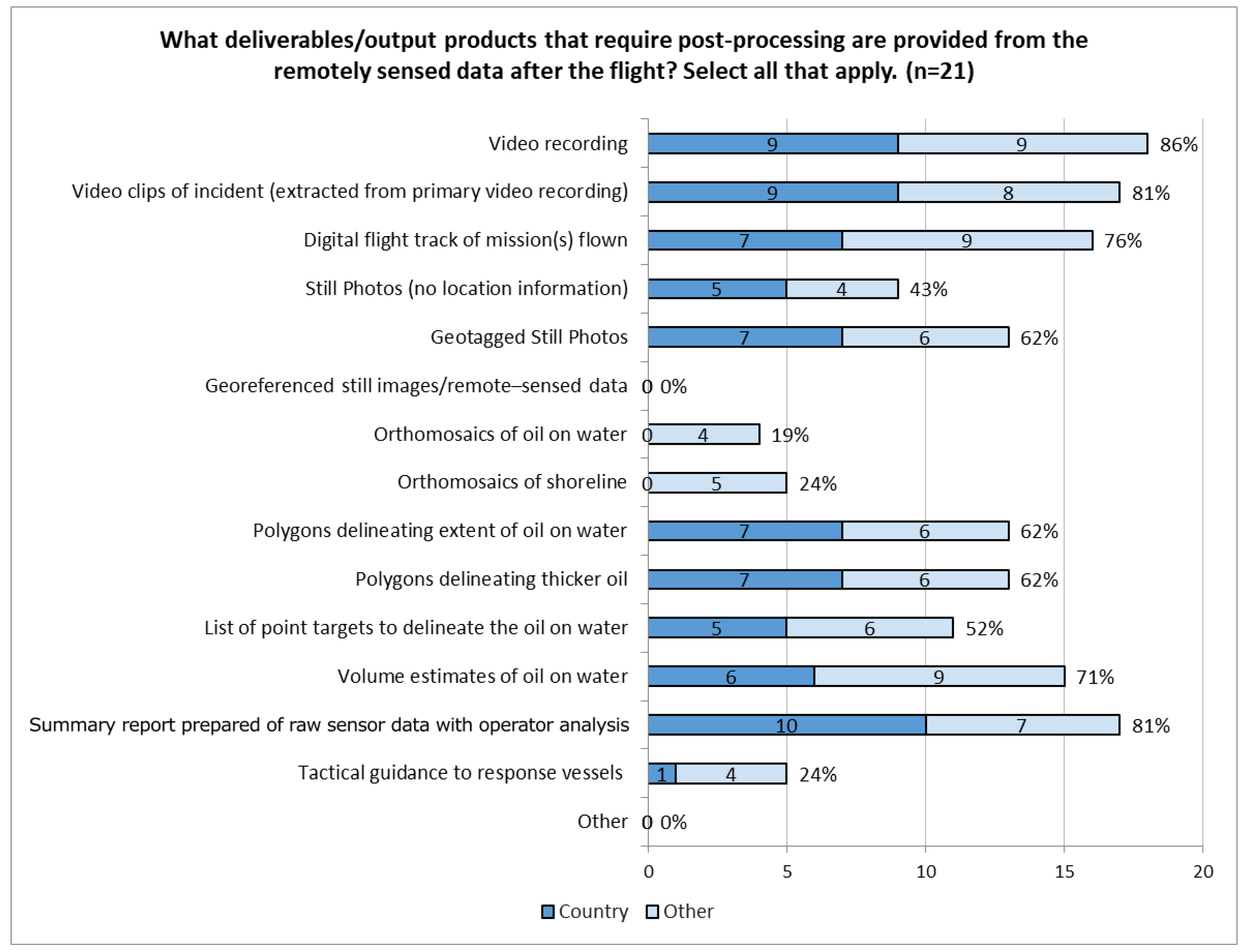
Figure 5). Deliverables/Output products provided by fixed-wing aircraft post-flight include: “Video recordings” (86%) and “Video clips of incidents (extracted from primary video recordings)” (81%), “Summary reports prepared from raw sensor data with operator analysis” (81%), “Digital flight track of the mission(s) flown” (76%), “Volume estimates of oil on water” (71%), and “Georeferenced remote–sensed data” (67%) (
Figure 6).
From the respondents, data from fixed-wing aircraft is used most often in a “Reactive capacity to support a specific response” (67%), and of those instances, they are used more often by other response organizations (10 of 14—71%) than country representatives (4 of 14—29%), whereas “Daily/near daily monitoring” (24%) is conducted by countries (4 of 5—80%) more often than other organizations (1 of 5—20%). Surveillance from fixed-wing aircraft is also used “In support of training and/or spill exercises” (33%). The time required to produce different output products can vary by complexity, but respondents indicated that products from fixed-wing aircraft are provided more rapidly than products from satellite with 67% indicating “Near Real-time (within 1 h)” and 38% indicating “Some Post-Processing Required (<6 h)”. When asked about automation employed to analyze sensor data from fixed-wing aircraft, one organization responded (5%) as using “Fully Automated” spill detection/delineation and classification, but predominantly, organizations replied either “Semi-Automatic—Operator Supported” (48%) or “Fully Manual—Operator Conducted” detection and data classification (48%).
3.3. Helicopters
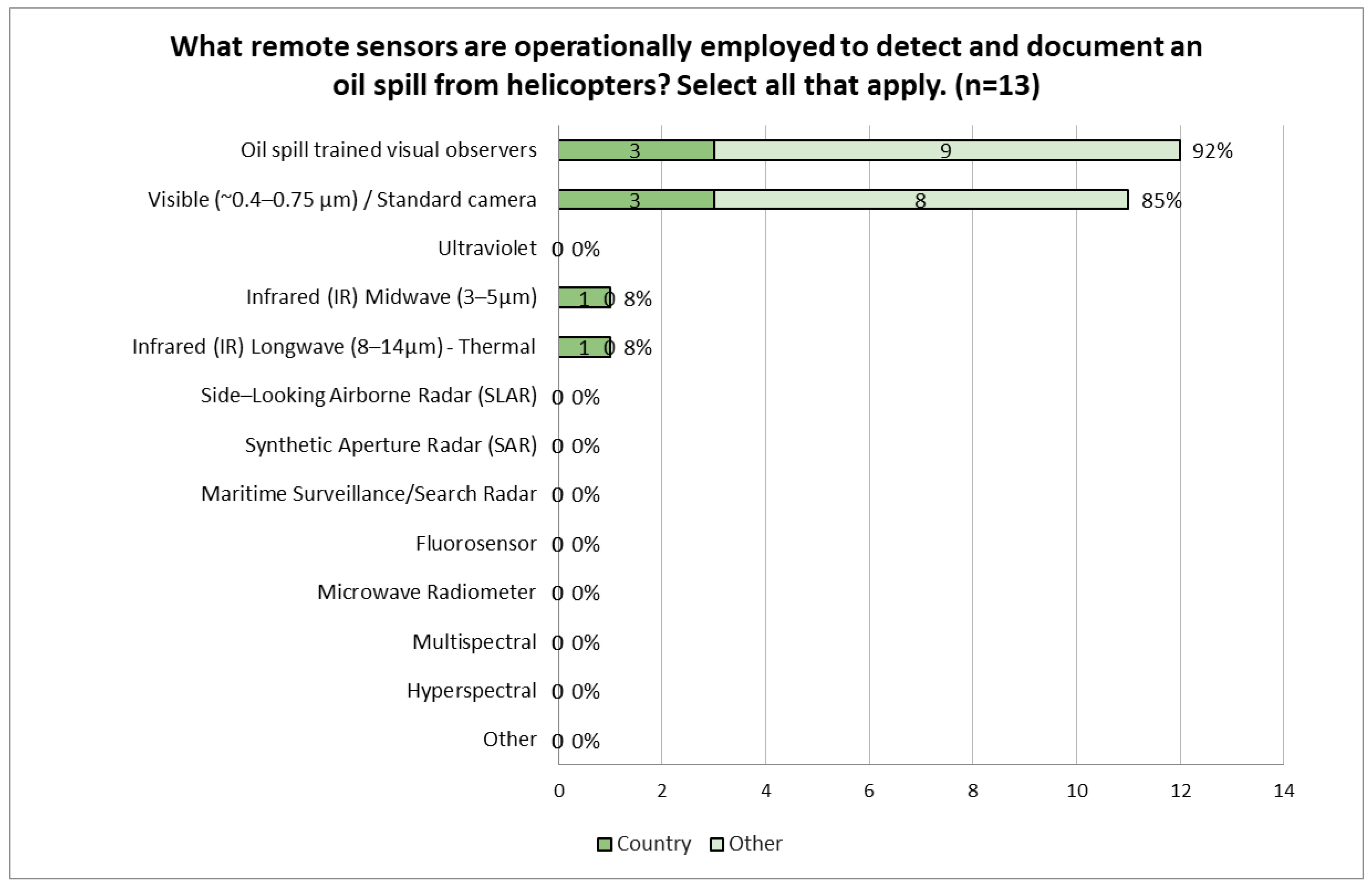
Of the 23 survey respondents for this section, 13 (57%) replied “Yes” to the use of or obtaining of data from helicopters for oil spill surveillance. Of these, 3 (23%) are countries and 10 (77%) are other spill response organizations. The primary remote sensors respondents used for oil spill surveillance from helicopters are: “Oil Spill Trained Visual Observers” (92%) and sensors in the “Visible spectrum/Standard cameras” (85%) (
Figure 7). Respondents also employed midwave infrared (MWIR) (8%) and longwave infrared (LWIR) (8%) sensors. Remotely sensed data from helicopters is used by the majority of respondents “Reactively to support response” (92%), as well as “In support of training and/or spill exercises” (31%). No respondents stated they employ helicopters for routine monitoring, although one respondent did state helicopters are used to conduct aquatic bird and habitat surveys but did not provide details on the frequency of this work.
When asked what types of helicopters are used by their organization for oil spill surveillance, the following were listed: Seahawk MH-60R, Airbus Super Puma/EC225 and H175, Bell Helicopters (i.e., 412, 429); Dauphin, NH90, and Sikorsky S-92. Several respondents stated that helicopters are contracted as a resource of opportunity, and often, crews change helicopters with no specific remote sensors integrated. As such, when asked about mission management software, most responded “Not Applicable—no mission management system is used”, but two respondents listed L3Harris software as well as GPS, recorder, and a software called Spillview as others.
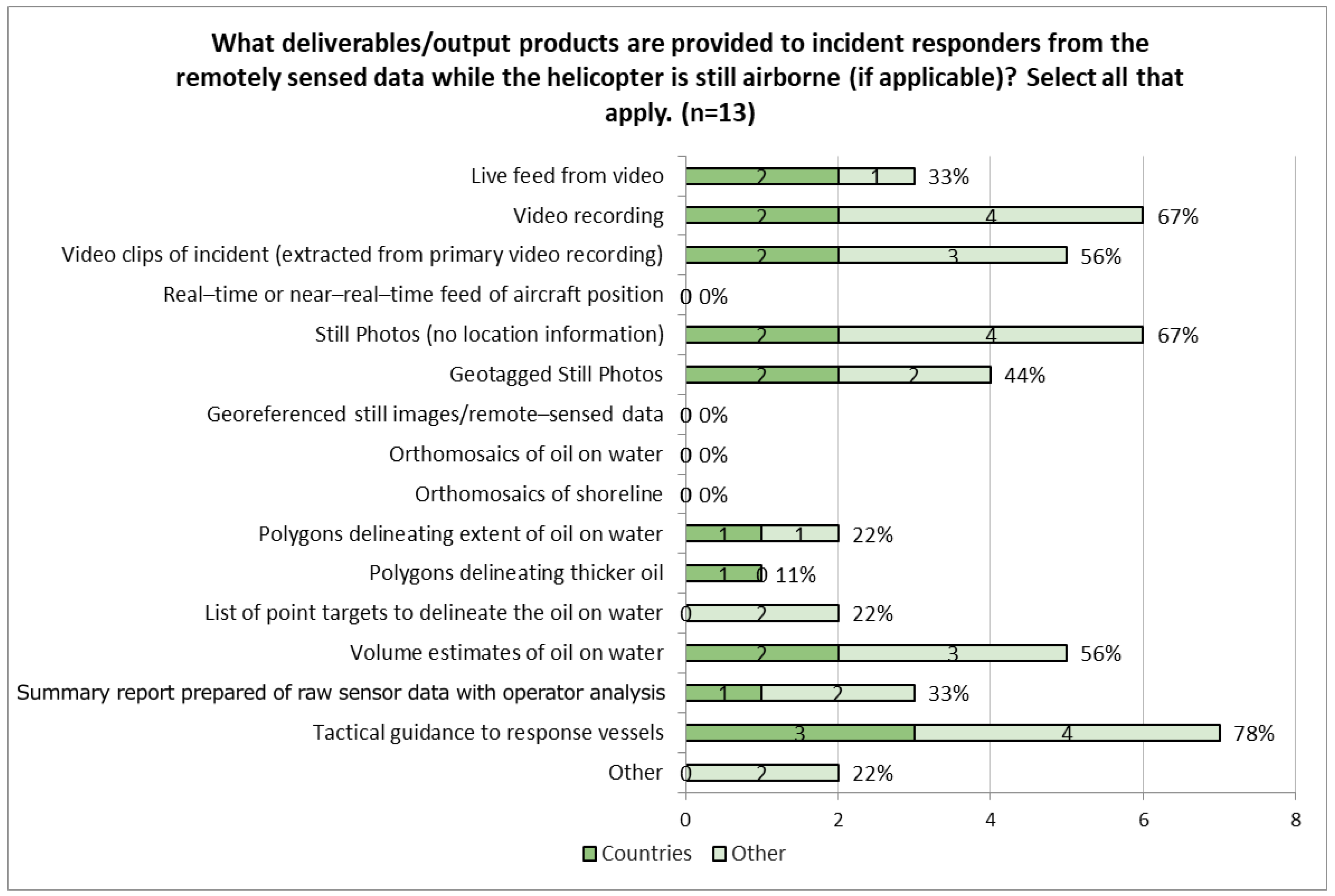
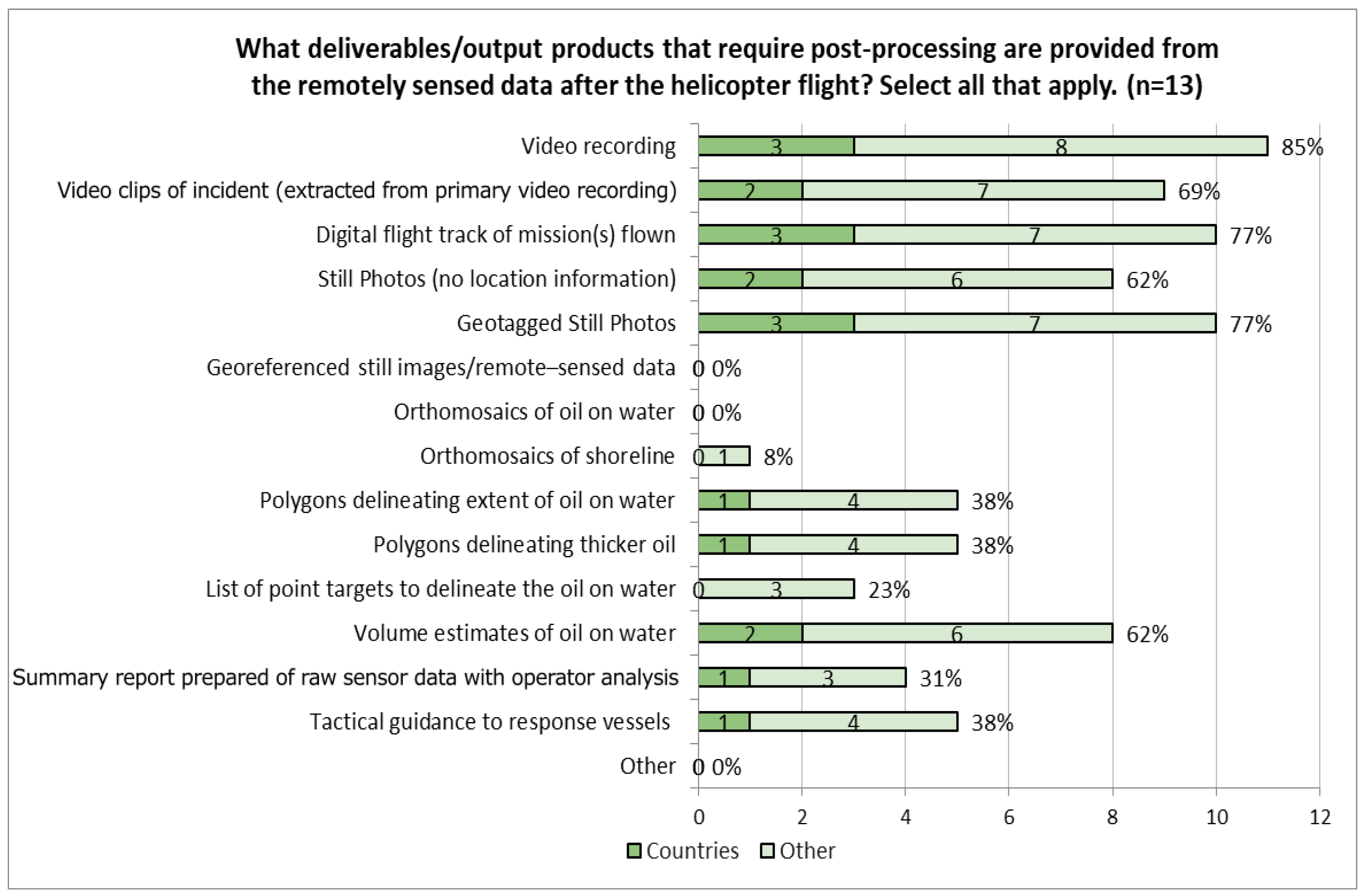
For deliverables/output products from helicopters, fewer respondents selected products provided while the helicopter is still airborne (54%) than those provided post-flight (85%). The predominant deliverables/output products from helicopters while the aircraft is still airborne include: “Tactical guidance to response vessels” (54%), “Still Photos (no location information)” (46%), “Video recordings” (46%), and “Video clips of incident extracted from Primary video recording” (38%) (
Figure 8). Five organizations also stated that surface oil volumes are provided while airborne (38%). Deliverables/Output products provided by helicopters post-flight include: “Video recordings” (85%) and “Video clips of incident extracted from primary video recording” (69%), “Digital flight track of mission(s) flown” (77%), “Geotagged still photos” (77%), and “Still Photos (no location information)” (62%), as well as “Volume estimates of oil on water” (62%) (
Figure 9).
Respondents indicated that data from helicopters is provided rapidly with 92% indicating “Near Real-time (within 1 h)” and 62% indicating “Some Post-Processing Required (<6 h)”. When asked about automation employed to analyze sensor data from helicopters, 85% of organizations replied “Fully Manual—Operator Conducted” detection and data classification while 23% indicated “Not applicable—no spill delineation is conducted”.
3.4. Remotely Piloted Aircraft Systems (RPASs)
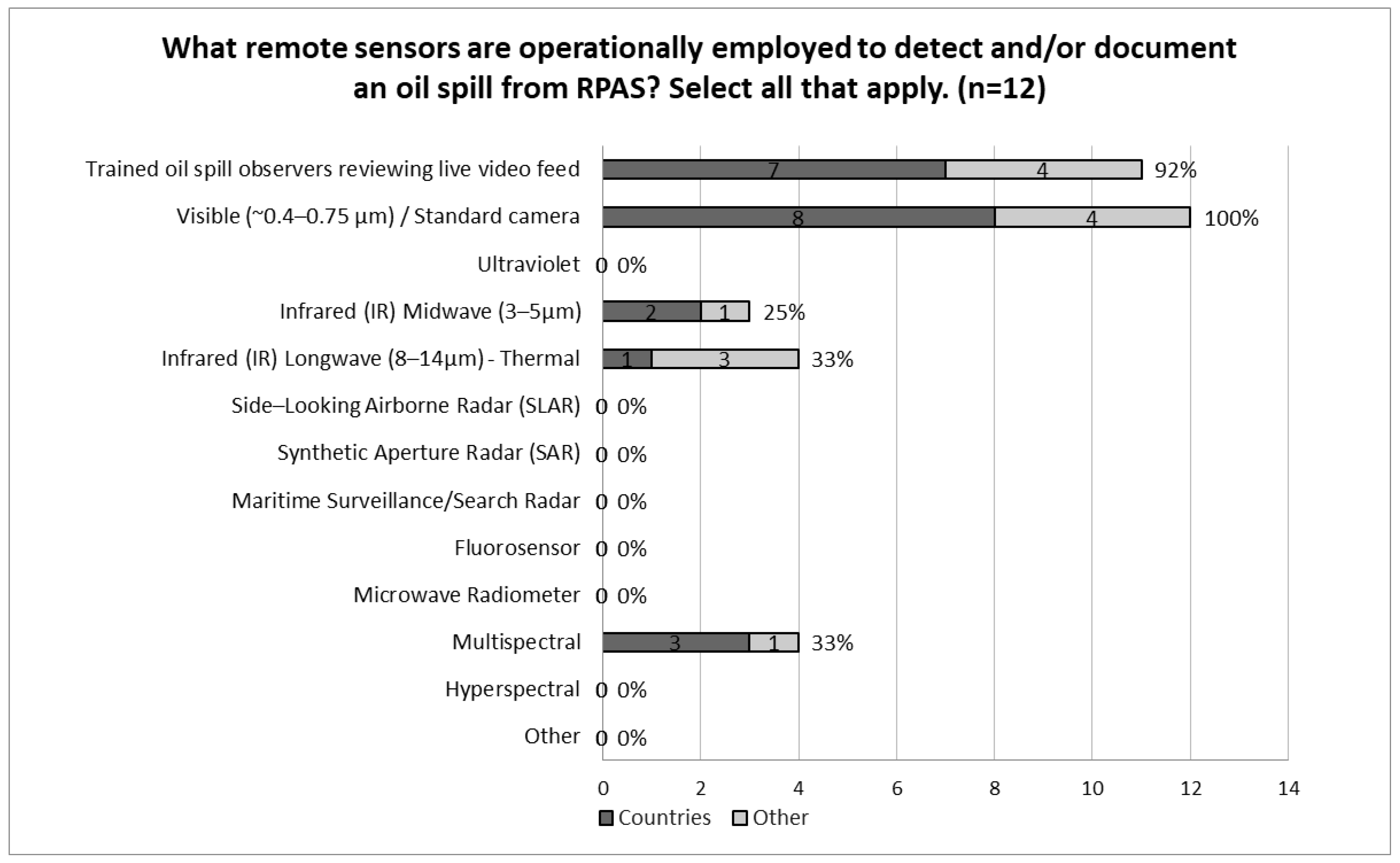
Of the 23 survey respondents for this section, 12 are using or obtaining data from RPASs for oil spill surveillance (52%). Of these, four (33%) are countries and eight (67%) are other organizations. The remote sensors employed on RPASs for spill response included: “Trained oil spill observers reviewing live video feed” (92%), “Visible/Standard Camera” (100%), MWIR (25%), LWIR (33%), and multispectral (33%) (
Figure 10).
When asked about the frequency of use, RPASs are predominately used “In a reactive posture to support a specific incident” (92%) and also “In support of training and/or spill exercises” (42%). While no organizations use RPASs daily, they are used weekly (8%) and monthly (8%), as well as to support baseline data collection of shoreline areas for fish and fish habitat mapping as well as to maintain pilot proficiency monthly.
The RPAS hardware used for oil spill response was divided into fixed-wing and rotary-wing systems. Fixed-wing RPASs are only used by one (8%) responding organization. Wingtra is the type employed, and units available are between 1 and 5. For rotary-wing RPASs, all 12 (100%) respondents stated they use/access them with equipment types including: DJI (10), Autel (2), Skydio (1), Anafi (1), and Skyranger R70 by Teledyne FLIR (1). For rotary-wing RPAS availability for oil spill response, organizations had a range of units 1–5 (2), 6–10 (2), and 11–50 (4), with one group having >50. There were also several organizations that could not specify the total number as it was dependent on specific regions and contracted vendor availability.
RPAS mission planning and data processing provided insight into software employed operationally to support oil spill response, as respondents were able to multi-select from a list of software as well as provide others if theirs was not listed. For mission planning and flight execution, software included: Autel (e.g., Skycommand Center, Mapper, Explorer, Enterprise) (1), DJI (e.g., Pilot 2, FlightHub) (6), Drone Deploy (2), Map Pilot Pro (1), Pix4D (e.g., Capture) (1), Wingtra Cloud (1), Sjöbasis (Swedish sea surveillance system), Norbit Aptomar SeaCOP Stanag 4609/MISB, and ArcGIS FMV (full motion video). For data processing and visualization, software employed by respondents include: Autel (e.g., Explorer) (1), DJI (e.g., Terra) (5), Drone Deploy (2), ESRI (i.e., Sitescan, ArcGIS) (1), Propeller (1), Pix 4D (e.g., Pix4Dmatic, Pix4Dmapper, Pix4DCloud) (3), WebODM (3), and QGIS (4). For both mission planning and data processing software, several respondents stated they were employed but could not specify which ones as it was vendor-/contractor- and region-specific.
When asked about mission execution, predominantly RPAS missions are flown within visual line of sight (VLOS) (83%). However, beyond visual line of sight (BVLOS) operations in support of oil spills are being conducted by Norway and Australia (17%).
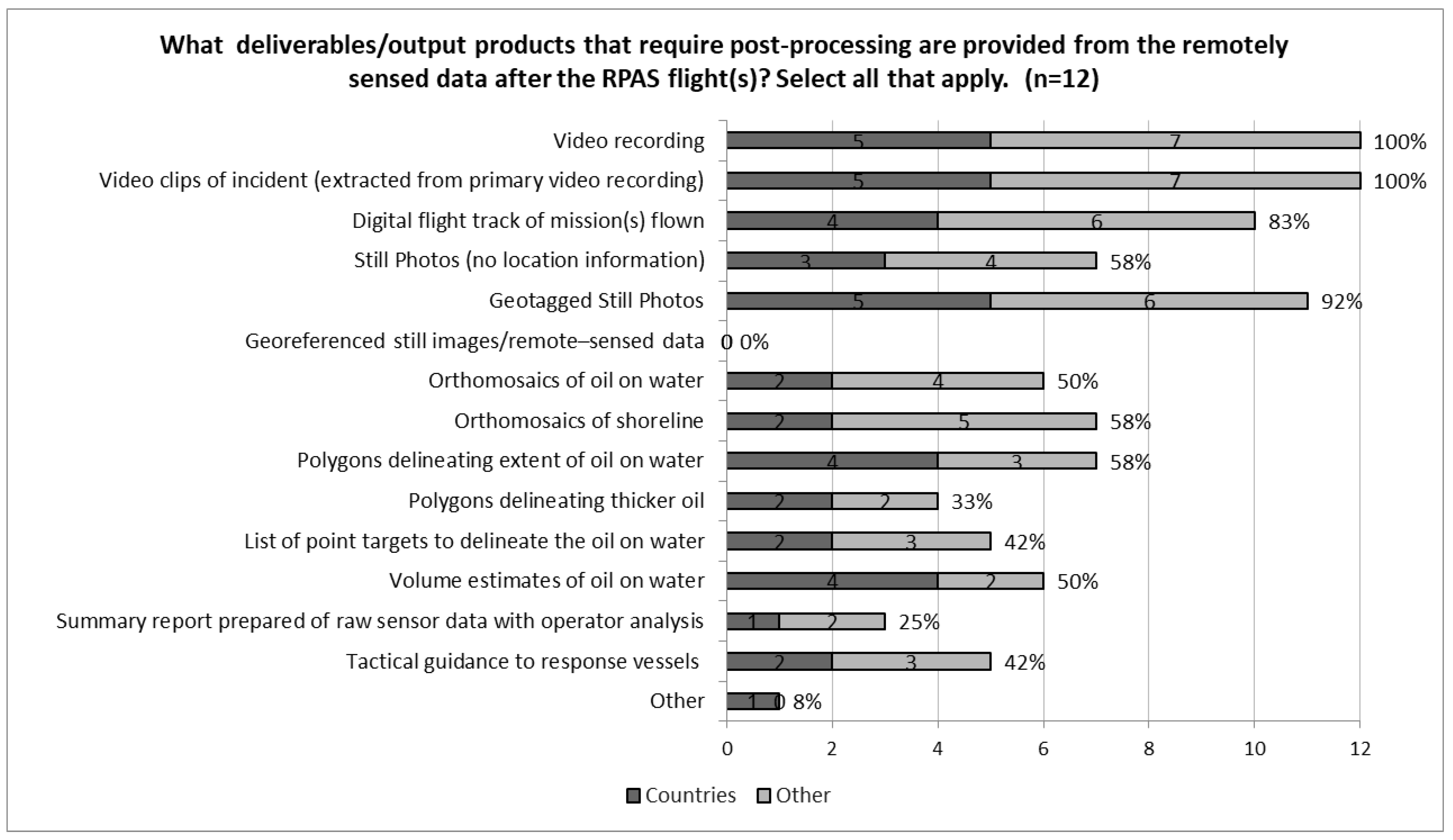
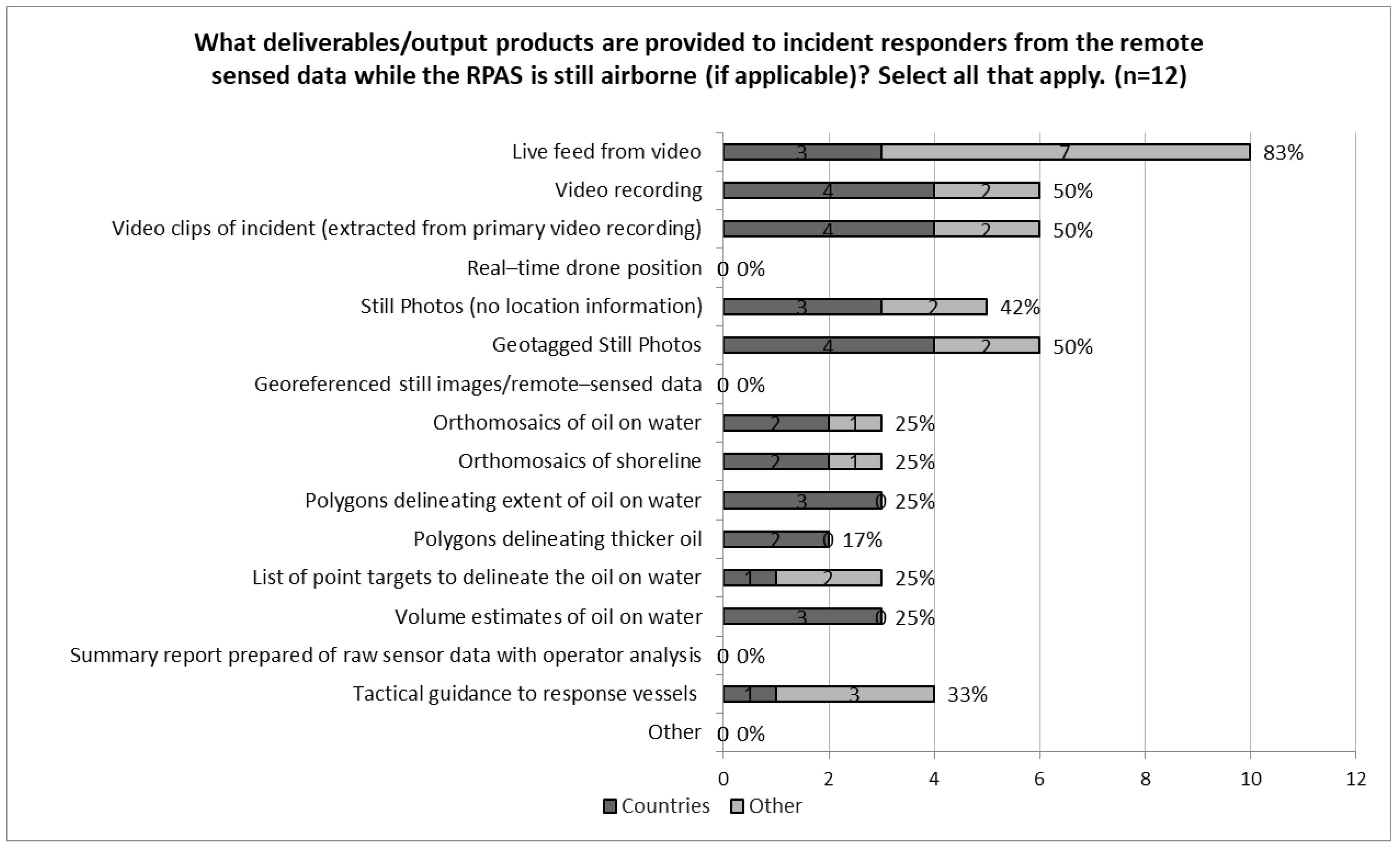
Deliverables or output products provided from RPASs in support of spill response provided diverse responses. Respondents were able to multi-select from a list of possible deliverables/output products provided while the RPAS is still airborne (
Figure 11) and then post-flight after an RPAS flight has been completed (
Figure 12). For real-time or near-real-time deliverables, the predominant deliverable is “Live feed from the video of the RPAS” (83%) and “Real-time drone position” (58%). Other deliverables provided by many organizations include: “Video recordings” (50%) and “Video clips of the incident extracted from the primary video recording” (50%), as well as “Geotagged still photos” (50%) and non-geotagged still images (42%). Four groups (33%) are providing “Tactical support to response vessels in real-time” from RPASs while three (25%) groups are providing real-time spill volume estimates, although no details were provided on how this is conducted.
For deliverables/output products provided from RPAS data after missions are completed (
Figure 12), “Video recordings” (100%) and “Video clips extracted from the primary video” (100%) are deliverables for all respondents. “Geotagged still images” (92%) and “Digital flight tracks” (83%) are also produced for most respondents. Other post-processed products include: “Orthomosaics of oil on water” (50%), “Orthomosaics of shorelines” (58%), “Polygons delineating extent of oil on water” (58%), and “Volume estimates of oil on water” (50%). When asked how long until deliverables/output products are available from RPAS data to support spill response, seven (58%) respondents answered “Near-real-time (within 1 h)” and four (33%) responded “Some post processing required (data within 6 h)”. One (8%) responded with “Post Processing Requirements > 6 h but <24 h”, and another one (8%) with “Post Processing Requirements > 24 h”.
For automation employed to process RPAS data, no groups responded as using “Fully Automated” spill detection/delineation and classification. All responded with either “Semi-Automatic—Operator Supported” (17%) but predominantly “Fully Manual—Operator Conducted” detection and data classification (67%). One (8%) group responded with “Not applicable—no spill delineation is conducted.”
3.5. Airborne Remote Sensing System Developers
Of the six airborne remote sensing system developers identified and invited to participate in the sensor survey, two provided responses: PAL Aerospace, who integrates the AIMS-ISR mission system and Optimare mission systems. Both companies stated they integrate the following remote sensors operationally to meet client mission needs:
Visible (~0.4 to 0.75 µm)/Standard camera;
Ultraviolet (UV);
Infrared (IR) midwave (3–5 µm);
Infrared (IR) longwave (8–14 µm)—thermal;
Side-looking airborne radar (SLAR);
Maritime surveillance/search radar;
Fluorosensor;
Microwave radiometer (MWR).
PAL Aerospace also integrates multispectral and hyperspectral sensors in AIMS-ISR.
Both companies integrate fixed-wing aircraft, with examples provided of De Havilland DHC-8, De Havilland DHC-6, Beechcraft King Air 1900D, Dornier Do228, Casa CN235, C295, Let L-410 Turbojet, and Britten-Norman Islander BN2. PAL Aerospace also integrates on helicopters (e.g., Airbus H-145, Bell Textron 412, Bell Textron 407, etc.) and RPASs (e.g., Schiebel S-100, etc.). Both mission systems can provide the complete list of deliverables/output products both airborne and post-flight:
Live feed from video;
Video recording;
Video clips of incident (extracted from primary video recording);
Real-time or near-real-time feed of aircraft position;
Digital flight track of mission(s) flown;
Still photos (no location information);
Geotagged still photos;
Georeferenced still images/remote-sensed data;
Tactical guidance to response vessels from surveillance operator using remote-sensed data (i.e., guide skimmers to thickest oil);
List of point targets to delineate the oil on water;
Orthomosaics of oil on water;
Orthomosaics of shoreline;
Polygons delineating extent of oil on water;
Polygons delineating thicker oil;
Volume estimates of oil on water;
Summary report prepared of raw sensor data with operator analysis.
Both mission systems use “Semi-automatic—Operator Supported” oil spill detection/delineation/classification, which allows operators using these systems to provide products in near-real time (within 1 h) after overflight.
When asked about surveillance of oiled shorelines, both mission systems are terrain-compensated and can provide a wide range of output products.
3.6. Shorelines
Of the 23 survey respondents to this section, 16 organizations (70%) acquire or obtain remote-sensed data for oiled shorelines during an oil spill incident.
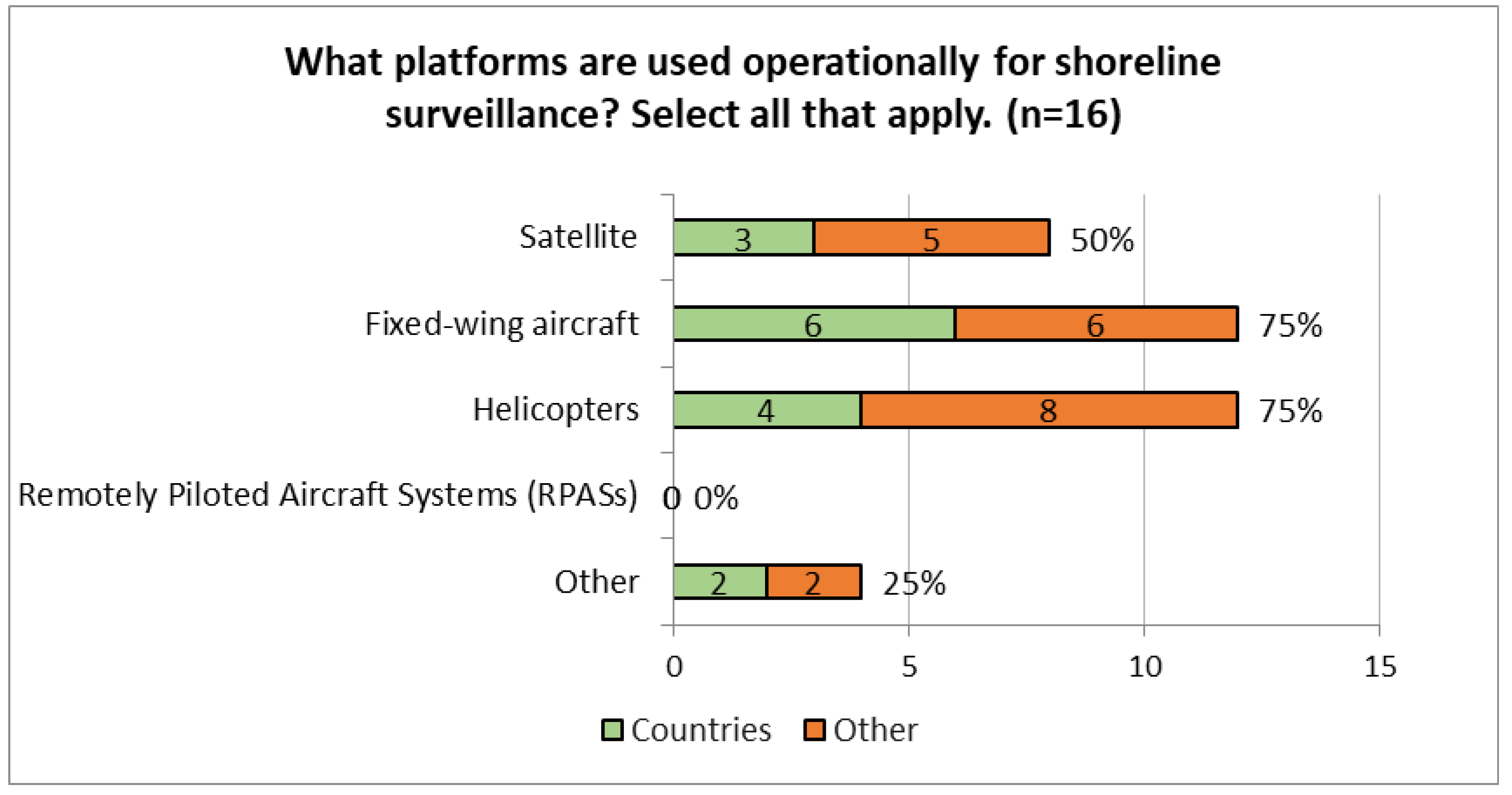
Figure 13 shows platform usage for shoreline response by countries and other organizations. All respondents (100%) stated the use of RPASs for shoreline work; fixed-wing aircraft (75%) and helicopters (75%) are both used by many of the respondents. Satellites are used by fewer organizations (50%).
Respondents provided written answers about remote sensors employed to conduct shoreline surveillance during an oil spill, which are primarily optical/visible sensors (75%) and secondarily IR (44%). There was specific mention of electro-optical infrared (EO/IR) sensors by three respondents (19%). Other sensors employed were explicitly used by other organizations, while country representatives only employed optical and IR. These additional sensors include: multispectral (19%), ultraviolet (13%), hyperspectral (6%), SAR (6%), and fluorosensor (6%). Some respondents also mentioned that sensor and platform availability, and thereby output products, was dependent on the contractor and region in which the incident occurred, so they could not specify.
Deliverables/Output products for shoreline surveillance were provided as written responses and are summarized in
Table 2. These products were stated to support the shoreline cleanup assessment technique (SCAT) operations and were often provided in geospatial data format types, including: GeoTiff, KML, KMZ, MPEG, JPEG, .shp, and TIFF.
3.7. Specific Questions
The final section of the questionnaire asked five specific questions about remote sensors for spilled oil, allowing respondents (24) to provide long-form written responses as well as one multi-select response. The questions and their summarized responses are presented in this section.
3.7.1. If Multiple Platforms Are Used Concurrently to Support an Incident, How Is Surveillance Planning Conducted to Ensure the Right Resources and Sensors Are Used to Meet Surveillance Objectives?
While some respondents provided names of specific organizations that would conduct the surveillance planning, others provided more general descriptions of the surveillance planning process. There were two distinct planning concepts from the responses: the safety of aerial resources, which is distinct from the planning and execution of surveillance to meet incident-specific geospatial data needs. For the safety of aircraft operating in the same airspace, aerial asset deconfliction often happens in the air ops branch for those following the incident command system (ICS). In the absence of a formal air ops branch, these conversations need to occur between the surveillance provider (i.e., varying levels of governmental response partners, response organization) and the incident management. There was specific mention of different branches within a formal incident command post (ICP) in which surveillance planning could occur, including: air ops branch, environmental unit, or a designated surveillance unit, although where that unit would be located within the ICP structure was not provided. The temporal stages of an incident were mentioned where satellites are used as first alert/indication, whereas verification is performed by primarily fixed-wing aircraft as well as helicopters and/or RPASs where available. If needed, this is followed by deployed ships. In some regions response vessels also have spill response remote sensors (i.e., oil spill radar and EO/IR cameras). The spatial scale of an incident was also indicated as a driving factor of the selection of surveillance platforms/sensors ranging from mapping large areas from satellite or fixed-wing aircraft versus the assessment of smaller areas that can be performed from RPASs and/or helicopters if available.
3.7.2. Are Remote Sensing Technologies Used Successfully to Detect and Track Spilled Oil During Dark Hours? Please Provide Details of Current Operational Capabilities
Feedback was provided on remote sensing technologies that can be used successfully to detect and track spilled oil during dark hours. While not all respondents used or conducted dark-hour operations, those that did (18–75%) stated that the most common technologies used were IR (NIR, LWIR) (56%) and radar (SAR (56%), SLAR (22%)). With respect to platforms used at night, there was a combination of satellite (SAR), airborne (SAR, SLAR and IR), RPAS (IR), and vessel-based sensors (MWIR (1), X-band marine radar (2)). With respect to SAR satellites employed; the RCM, Radarsat-2, and KSAT platforms were mentioned. One respondent stated that a fixed-wing aircraft with Optimare GmbH system/sensors was employed. One respondent cautioned that nighttime detection requires a coordinated approach (satellite → thermal IR aerial verification → surface confirmation) and analytical capabilities to reduce false events and define actionable outcomes. It was generally acknowledged that the majority of oil spill response activities take place during daylight hours. Additional information provided through dark-hour surveillance can help inform response decisions for the following morning. Sensor developers/integrators state that both mission systems (i.e., AIMS-ISR and Optimare MEDUSA) have advanced sensors that can track oil during dark hours, including SAR/SLAR and infrared imaging systems as well as MWR and LFS. With MWR, it is possible to detect and locate oil, even through dense cloud cover.
3.7.3. With Respect to the Usefulness of Remote Sensors for Response, What Are Your Operational Oil Spill Response Questions That Cannot Currently Be Answered by Available Technologies?
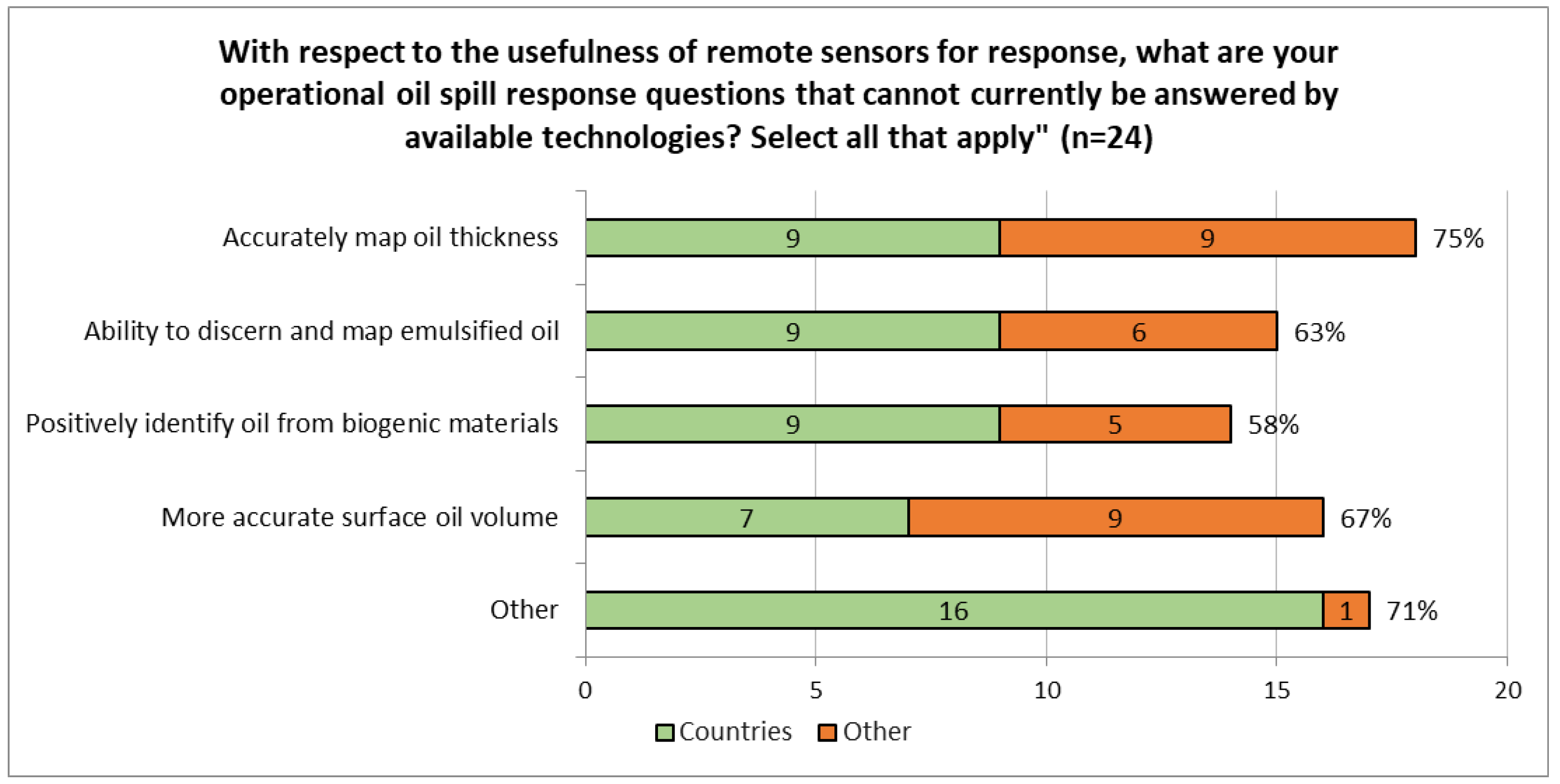
A number of possible questions were provided in the questionnaire that respondents could multi-select. They could also provide “other” questions that have shortcomings from available technologies. “Accurately mapping oil thickness” (75%) and “More accurate surface oil volume” (67%) have the most responses, followed by “Ability to discern and map emulsified oil” (63%) and “Positively identifying oil from biogenic materials” (58%) (
Figure 14). With respect to “other” questions, there were several identified, including: the ability to determine whether the amount of spilled oil in the water column was legal or illegal (related to vessel bilge dumping); the ability to discriminate between petroleum oil and fish oil (related to fish processing on factory ships); detecting oil on the sea floor as well as oil impacts on in-water substrates and submerged aquatic vegetation (fish habitat); and the ability to detect subsurface oil that is buried in sediments or mixed in the water/ice column. Additionally, respondents identified a desire for remote sensors to have the ability to classify shorelines; provide input to drift models; identify red blooms; provide semi-automatic detection of oil; delineate the contour of the slick; and detect atmospheric plumes and explosive or toxic gases.
3.7.4. What Do You Want to See in the Future or Think Is Missing from Remote Sensing Capabilities to Support Oil Spill Response?
The responses to this question were numerous and varied; that being said, there was substantial agreement in some areas. Some of the comments and suggestions are not new and are currently being studied by some researchers; others are more novel and forward-looking.
One of most common responses was the need for better detection, identification, differentiation, and quantification of spilled oil. The need to positively identify petroleum oil and rule out false positives such as biogenic materials was universal. In addition, the ability to quickly, and perhaps automatically, measure oil thickness and estimate the volume of spilled was mentioned. The need to be able to remotely detect and measure the concentration of oil and particulates in the water column was identified. It was also stated that further work is needed in the detection of submerged oil as well as sensors’ continued functionality as oil weathers and its properties and its fate and behaviour change. Some respondents suggested that automatic identification of oil through the use of artificial intelligence (AI) should be investigated. Automated processing via machine learning or AI algorithms could be advantageous in the future to speed up the processing time post or during flight operations. Sensor developers/integrators agree that future work should focus on predictive analytics from sensors rather than reactive. Furthermore, it was suggested that existing approaches are not sufficiently reliable for identifying oil pollution in areas with low wind speeds, nearshore environments, or smaller bodies of water, such as fjords. The question about whether existing technologies are applicable to freshwater environments was also raised. Some respondents mentioned the need for more enhanced sensor systems and sensors for MARPOL annex II detections/alternative new fuels (e.g., liquified natural gas (LNG), ammonia, methanol) and spills of hazardous and noxious substances (HNSs). Consideration was given to the development of sensors to rapidly detect and quantify aquatic birds (non-species-specific), including in low light conditions.
With respect to RPASs, there is a desire to better integrate this new capability into oil spill surveillance operations. The need to facilitate regulatory and legislative changes to allow for BVLOS for RPAS operation has been identified. One respondent identified the need for an advanced communication system dedicated to communication between low Earth orbit (LEO) satellites and long-range RPAS sensors for offshore spills.
Comments specifically about shorelines mention that it would be useful to incorporate multibeam backscatter data of the seabed into spill response planning and operations. Having this information would allow responders to understand the sediment types they are working on, whether they be hard bottom, soft mud, gravel, or mixed, and the associated risks for oil behavior and persistence. This could help inform response decisions, such as the likelihood of oil penetrating into the substrate, resuspension risks, or the effectiveness of mechanical recovery and shoreline protection strategies.
There was a strong desire to improve interoperability and cooperation between regional and global communities. Better coordination between authorities regarding environmental effects of oil spills and more related training was identified. One respondent identified what is lacking and expected in the future is a more precise, continuous, integrated, and independent remote sensing capability that would allow the Maritime Authority to respond in a more timely, efficient, and reliable manner to oil spill incidents in maritime and river waters. An inter-agency standard of communication on oil spills including harmonized data standards, specifications, and deliverables is needed. Collaboration, management software, or a portal where multiple sensing platforms can share data with vessels and or responders in the field is desirable. Published guidelines and best practices for responders and the spill response community also need to be developed and updated on a regular basis.
3.7.5. Please Provide Any Further Comments You Would Like to Share About Surveillance of Spilled Oil That Have Not Been Covered in This Questionnaire
Respondents shared the need for improved sensors operationalized to enhance situational awareness, both in the temporal and spatial distribution of chemical and oil spills through more remote measurements and sampling. The need for continued investment in sensor fusion and AI as well as enhancing ship-based remote sensing systems was flagged. This is also linked to the need to acquire surveillance data in a standard way to support different phases of data usage, including data processing to outputs, sharing, and archiving. The need to use remote sensing across more phases of incidents (i.e., pre-incident and response through to recovery of the environment) was raised. Respondents highlighted the need to strengthen international and regional cooperation mechanisms for monitoring and responding to oil spills including harmonized data standards and deliverables as well as better integration of multiple surveillance platforms and sensors to meet varied objectives. One respondent shared that since oil pollution knows no borders, it is essential to have harmonized information-sharing protocols, timely access to satellite images, and technical support between coastal states. There was mention of the need for on-going training of human talent who operate the sensor systems and then can participate in surveillance planning and decision making by interpreting and applying intelligence from remote sensors in real time.
4. Discussion
In the twenty years since the previous survey of global oil spill surveillance and remote sensing [
16], there have been a number of changes and developments. At that time, all of the eight countries responding to the survey except one employed fixed-wing aircraft, one country employed helicopters with IR sensors, and slightly more than half of the countries used satellite-borne SAR sensors (Envisat and/or Radarsat-1). Sensors used on the fixed-wing aircraft included IR, UV, SLAR, and visible. Two aircraft also employed microwave radiometers, and one employed a laser fluorosensor. The majority of respondents used operator-assisted detection/classification. About half of the countries employed their aircraft on a daily basis; the other half used aircraft only as required in response to an incident.
The current survey (2025) identified the continued widespread use of satellites (83%) and fixed-wing aircraft (84%) for oil spill surveillance, as well as a noted increase in the use of helicopters (57%) and RPASs (52%) by many organizations, but they were not as universally employed. For satellite surveillance, 90% of users rely on SAR sensors, with several using visible sensors (40%) and multispectral (20%) units, and a few are using longwave IR (15%). The ability of SAR sensors to operate in almost all weather conditions including day/night operations is the reason that they are the sensor of choice. Satellite sensors operating in the visible region of the electromagnetic spectrum are also used in daylight hours and when environmental conditions permit. Results show that the standard sensors (i.e., radar, visible, IR) employed by many organizations are able to provide deliverables that support oil spill response decision making. The use of satellites in both the routine surveillance of coastal environments (55%) and in response to marine oil spill incidents (60%) was clearly identified.
There is a strong use of fixed-wing aircraft (84%) in response to oil spills (67%) and some use for routine monitoring (48%). Most respondents confirmed the use of fixed-wing aircraft with trained oil spill visual observers (95%) and optical sensors (90%). Additionally, many aircraft are equipped with multi sensors and/or integrated sensor suites housing radar (i.e., SLAR 57%, SAR 14% or Maritime Search Radar 24%), UV (57%), and infrared sensors (MWIR 57%, LWIR 57%). Less frequently employed sensors include multispectral (29%) or hyperspectral sensors (14%), laser fluorosensors (10%), and microwave radiometers (10%). The types of aircraft employed were varied but included several turbo prop units as well as a number of smaller jet aircraft. The most frequent output products from fixed-wing aircraft while the flight is still airborne are geotagged still photos (67%), volume estimates of oil on water (67%), and tactical guidance to response vessels (67%), while the highest percentage of output products post-flight are video recordings and/or video clips (87%/81%), summary reports prepared from raw data with operator analysis (81%), and digital flight track (76%). Output products from fixed-wing aircraft are also shown to be available in near-real time (<1 h) (67%), more rapidly than with satellite sensors (i.e., 45% of respondents state output products available in less than an hour), while 55% of respondents state output products available between one to six hours from data acquisition.
Helicopters were used by just over half of the respondents (57%), with the majority being used by “other spill response organizations” (75%), primarily in response to a spill incident (100%) but also in support of training or spill exercises (31%). The majority of the output products from helicopters, while aircraft still airborne and post-flight, are videos (67% and 85%), still photographs (67% and 77%) and the provision of tactical guidance to response vessels (78% and 38%), with some providing volume estimates of oil on water (56% and 62%).
The current survey gathered information on the operational use of RPASs for oil spill surveillance globally for the first time. RPASs are primarily used reactively in response to specific spill incidents (92%) but also in support of training and spill exercises (42%). The sensors employed include: live video reviewed by trained oil spill observers (92%), visible cameras (100%), IR (MWIR 25% and LWIR 33%), and multispectral (33%). RPASs are also used to collect baseline data for fish and fish habitats (8%) and for maintaining pilot proficiency (8%). A broad array of small- to medium-sized commercially available rotary-winged RPASs are employed, with respondents identifying that their organizations each have between 1 and 50 units available for use. The vast majority of the RPASs are flown within visual line of sight (83%), with only two groups indicating operations beyond visual line of sight (BVLOS) (17%). Output products available from RPASs after the unit has landed include video clips (100%) and still images (92%), as well as spill volume estimates (50%), with some groups indicating the use of the information for tactical response purposes (42%). RPASs continue to advance rapidly both in platform capabilities and continued improvements and operationalization of sensors. There is already a well-defined operational niche for RPASs in spill response [
6,
19,
20] that continues to be expanded as more response organizations define operational needs and acquire RPASs to meet those surveillance needs.
The majority of respondents across all platforms indicated that oil detection/classification is performed either semi-automatically with operator support or fully manual—operator-conducted, except for one response for a fixed-wing aircraft (
Table 3). This indicates there is still research, field trials, and operationalization of fully automated systems to move them from lab to operations.
With respect to countries and organizations acquiring or obtaining remote-sensed data for oiled shorelines during an oil spill incident, all respondents (100%) identified the use of RPASs for shoreline work, while many others also indicated the use of fixed-wing aircraft (75%) and helicopters (75%). Satellites are used by fewer organizations for shoreline surveillance (50%). Remote sensors used by countries to conduct shoreline surveillance during an oil spill are primarily optical/visible sensors (75%), and to a lesser extent IR (25%). Other response organizations used additional sensors for shoreline, including: multispectral (19%), hyperspectral (6%), UV (6%), SAR (6%), and fluorosensor (6%). Deliverables/Output products for shoreline surveillance included: still images/sensor imagery (69%), video (50%), and flight tracks of the platform (19%). Analyzed output products include shoreline oiling maps (i.e., presence/absence, extent) (44%), wildlife maps (13%), debris maps (6%), and scene mapping for response support (25%) (i.e., pre-incident shoreline map, geomorphic features, access points, logistics planning).
Survey responses highlighted that surveillance is needed for both a tactical and strategic, or synoptic view, and the need to continue to develop sensors for these objectives. Many respondents to the questionnaire identified gaps in the capabilities of current sensors with respect to providing information needed to inform oil spill response decision making (i.e., accurately mapping oil thickness (75%), ability to discern and map emulsified oil (63%), providing more accurate surface oil volume estimates (67%), and positively identifying oil from biogenic materials (58%)) (
Figure 14). Of note, one of the remote sensor developer/integrators responded that “All of these questions can be answered by the existing technologies”, but they continued by saying “improvements can be made to unambiguously distinguish biogenic oil spills from other types of oil”, thus agreeing there is a need to improve capabilities in positively identifying oil from biogenic materials. This statement identifies a gap between the stated capabilities of developed and integrated remote sensors and their operational use by surveillance organizations.
There has been much research conducted over the past few decades to address some of these concerns, and new studies continue to further address these issues. Much of this work has focused on the use of SAR satellites and in some cases exploring the benefits of combining SAR and optical imagery and data to provide answers. The oil spill response and remote sensing research communities are benefiting from access to the vast number of SAR and optical satellite platforms currently in operation. Many of the newer generation satellites can provide SAR data acquired in any combination of horizontal and vertical polarizations (HH, HV, VV, VH) and in a variety of swath sizes and resolutions. In some cases, researchers are able to access satellite data at no charge from a number of commercial data providers so that they can continue their research efforts. Some examples of recent SAR oil spill research that address the identified gaps include: differences in oil detection capabilities between synthetic aperture radar and optical imagery [
21]; the development of an automated algorithm for calculating the ocean contrast (damping ratio) which can provide relative thickness information [
22]; the benefits of remote sensing to feed into and update spill trajectory modelling [
23]; polarimetric SAR advances, texture, emulsions, and ocean currents, etc. [
14]; oil spill type classification [
24]; and oil spill detection using convolutional neural networks and Sentinel-1 SAR imagery [
25,
26,
27].
Survey responses indicated there are some sensor technologies that are currently being used by fewer organizations as they are more recent additions to oil spill surveillance. Although multispectral and hyperspectral sensors are not new sensor technologies, their operational use for spill response is more recent. This survey shows these types of sensors already operationally integrated on each of the surveillance platform types in this survey except helicopters are being used for both oil on water and oiled shoreline surveillance. These sensors support the employment of spectral indices and/or spectral signatures to help identify substances [
28]. One of the challenges for the use of multispectral and hyperspectral data is the amount of data during acquisition as well as the processing time to arrive at usable output products. There is a need to continue to build well-established and accessible spectral libraries of petroleum products in varying environments and states of weathering [
28]. There is also a need to define specific critical response output products and then refine data processing workflows to be conducted with semi- or full automation to meet response timeframes for surveillance intelligence at an operational scale [
29]. Also, if multispectral and hyperspectral imagery is captured earlier in the response timeframe, there is also opportunity to develop and refine products to support recurrent monitoring and measurements of environmental recovery from oil spills [
30].
Although this surveillance questionnaire was structured to obtain insights into the application of specific remote sensors, survey respondents also highlighted the need for effective data integration and a coordinated approach to oil spill monitoring and surveillance. The example of routine monitoring via satellite that triggers the tasking of a deployable asset (i.e., aircraft, helicopter or RPAS) for confirmation and validation along with enhanced analytical capabilities to reduce false positives was raised several times. There have been efforts by organizations such as EMSA to operationalize oil spill monitoring systems that integrate and semi-automate satellite detection of oil spill anomalies, providing automated alerting services allowing asset tasking for verification as well as spill modelling chains [
8]. Over the past 20 years, the European Union has invested in the development of policies and infrastructure to establish an interoperable, data-intensive, and cost-effective digital twin of the ocean (DTO) [
31]. A digital twin is a digital model of an intended or actual real-world physical product, system, or process (a physical twin) that serves as a digital counterpart of it for purposes such as simulation, integration, testing, monitoring, and maintenance [
32]. More recently, researchers have started the development of a near-real-time oil spill detection and forecasting system for the Iliad DTO focused on the Cretan Sea that aims to provide early detection of marine oil spills and operational forecasting of spill trajectories to support rapid response to marine oil spill events [
33]. The DTO uses input from several models including a fate and transport of oil model and particle tracking models, coupled with near-real-time operational, high-resolution numerical weather, hydrodynamic, and sea state models for the Cretan Sea. The Iliad Digital Twins of the Ocean Marketplace is an innovative platform offering a wide range of products, applications, and components covering multiple sectors and catering to diverse needs [
34]. There are similar digital twins being developed in other regions of the world, including one for the Southern African and the Western Indian Ocean regions [
35], and another is being developed in Portugal [
36]. Digital twins are working at a very large and continuous scale, but it is noted that similar spatial data integration is needed for all incidents. Where large-scale infrastructure is not in place, local incident specific data integration and workflows need to be established early in the incident under a surveillance plan to ensure that data capture, processing, display, sharing, and storage are well managed.
In the two decades since the previous remote sensing global questionnaire, there have been remarkable advances in the research to support remote-sensed data processing for oil spills. This is due to several factors including more widely available remote-sensed data, advances in computing power and availability of cloud computing, as well as specific focus on machine learning algorithms [
37]. In their summary, Al-Ruzouq et al. [
37] state one of the on-going challenges for this work is the scarcity of validated, in situ oil spill imagery data. To help address the scarcity of data, a recent paper by Yang et al. [
38] provides access to a comprehensive labeled dataset of oil slicks, look-alikes, and other remarkable oceanic phenomena, derived from Sentinel-1 SAR products, which other researchers can use to evaluate their own oil spill detection models and compare performance with other studies. Another example is De Kerf et al. [
39] segmenting oil on water visible imagery to train an AI by using some field data obtained from their own vessels, but then also having to extract oil spill images from the web. With so many response organizations conducting oil spill surveillance globally, there are likely tens of thousands of validated images of oil on water that could be used. These links between data and research advances are already being employed by organizations like EMSA, who actively monitor large regions with remote sensors and alert national surveillance partners operationally to validate findings [
40].
No single remote sensor can answer all the essential oil spill response questions. Each spectral band and surveillance platform have their own capabilities, advantages, and limitations [
6], and on-going research will continue to allow new capabilities to be operationalized. With these varied sensors, newly developing data workflows, and more complex data requiring specialist analysis to produce output products, there is an enhanced need for intentional surveillance planning for oil spill response. Many respondents stated that surveillance planning operations are often currently conducted in the air ops branch within the operations section if a full incident command system is established. There will always be a critical safety need to have aircraft deconfliction occur in the air ops branch. However, standard air ops branch director training (ICS 470) syllabi do not usually include detailed training on geospatial data and remote sensors. Even with current diverse surveillance platforms and sensors, there is a need for surveillance planning to be conducted intentionally. A published guidance document on surveillance planning by Ipieca [
11] details the critical elements of and how to structure a surveillance unit within an incident command under the situations unit under the planning section. This would allow for all the elements of surveillance planning from identifying surveillance needs, redefining and selecting sensors and associated platforms that can meet the needs and managing these resources with appropriate tasking to obtain data through to data transfer, processing, and storage to allow critical intelligence to reach the incident commanders in an efficient and effective manner [
11]. Surveillance planning should, when able, also include a temporal component, ensuring appropriate data are captured during an initial response in a way that can be used for assessing long-term damage and that can measure environmental recovery [
30]. The need for specialized surveillance planning staffed by geospatially trained technologists and experts will continue to be a challenge as sensing technologies become more capable but also likely more complex. This holds for hydrocarbon spills, which are generally visible products but increasingly critical for spills of HNS that are not visible to the human eye and require specialized sensors for detection and identification.
This questionnaire focused entirely on remote sensing for petroleum oil spills. It is duly noted that although there are many advancements that could still be made in remote sensing for oils, this is a well-established practice used globally to support spill response. Respondents noted that additional work is needed to ensure there are equivalent surveillance capabilities to detect, positively identify, and quantify spills of HNS (i.e., MARPOL annex II substances).
Many respondents stated in several locations of the questionnaire that better coordination is needed between authorities regarding environmental effects of oil spills. They also highlighted the need for on-going training of “human talent” who operate the sensor system and process the data. As the new technologies are operationalized, there is a need to ensure how they are employed and that they can complement and enhance well-established methods while also sharing this new knowledge through the response community. This could also be supported by continued sharing of case studies where new technologies are employed operationally to support a response. Training and educating the response community was also raised in relation to ensuring sensor operators and those with geospatial and remote sensing training are in incident Commands, both in surveillance planning and in providing decision makers with real-time data and intelligence interpretation.