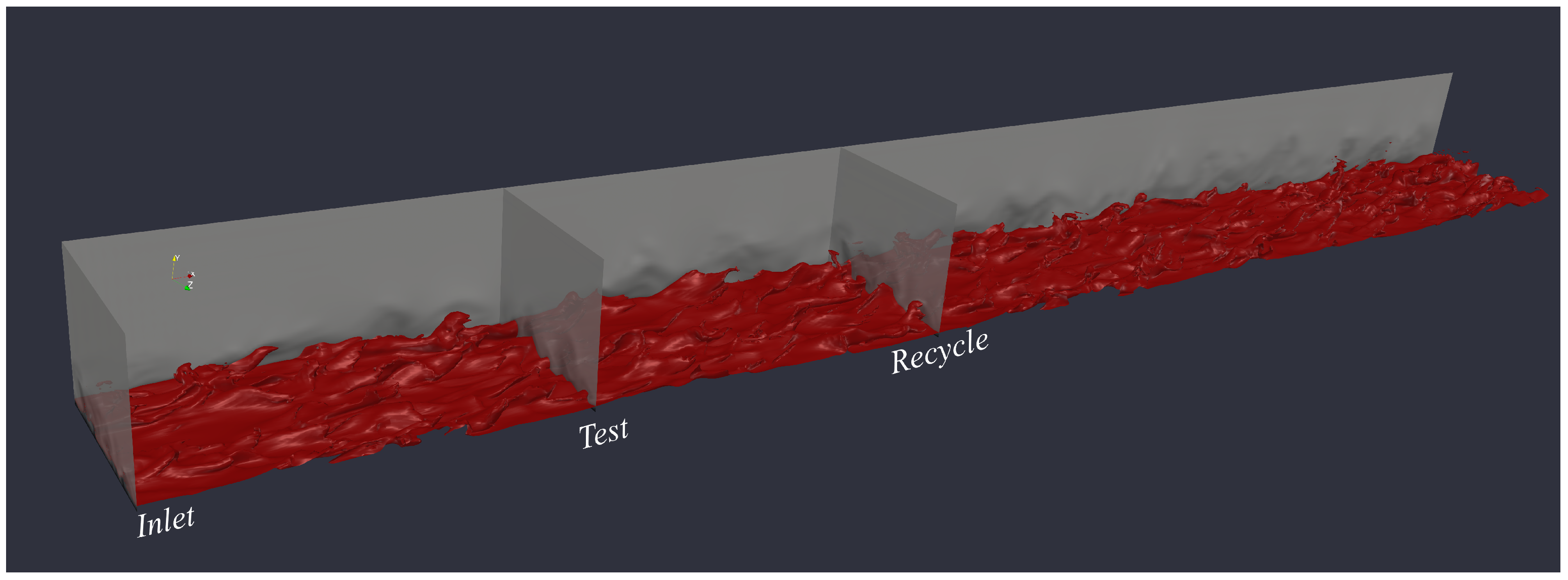
This section presents and discusses the key results from the present proper orthogonal decomposition (POD) and spectral POD (SPOD) analyses. Prior to this, an assessment of the incoming spatially developed turbulent boundary layer (SDTBL) is conducted, along with a convergence study for the POD/SPOD analysis. The convergence is evaluated in terms of both the number of snapshots and the time separation between them.
3.1. Characterization of the Incoming Flow and JICF Statistics
The turbulent boundary layer upstream of the supersonic jet has been rigorously characterized and validated through direct comparison with established DNS datasets at comparable Mach and Reynolds numbers.
Table 2 summarizes the key boundary-layer metrics obtained from the present DNS alongside those reported by Wenzel et al. [
45], who employed a core inflow methodology consisting of a staged initialization procedure: a laminar mean profile, superposition of synthetic turbulent perturbations, and subsequent maintenance of fully developed turbulence via downstream flow recycling. As evidenced in
Table 2, excellent agreement is observed in the local skin friction coefficient [
(
)] and shape factor,
H, with discrepancies around 0.2% and 4.8%, respectively. The Reynolds numbers, specifically
and
, indicate close correspondence between the present and reference simulations by [
45]. Here,
denotes the
boundary-layer thickness;
is the friction velocity;
is the wall kinematic viscosity;
and
are the wall and freestream densities, respectively;
is the compressible momentum thickness;
is the freestream velocity; and
is the wall dynamic viscosity.
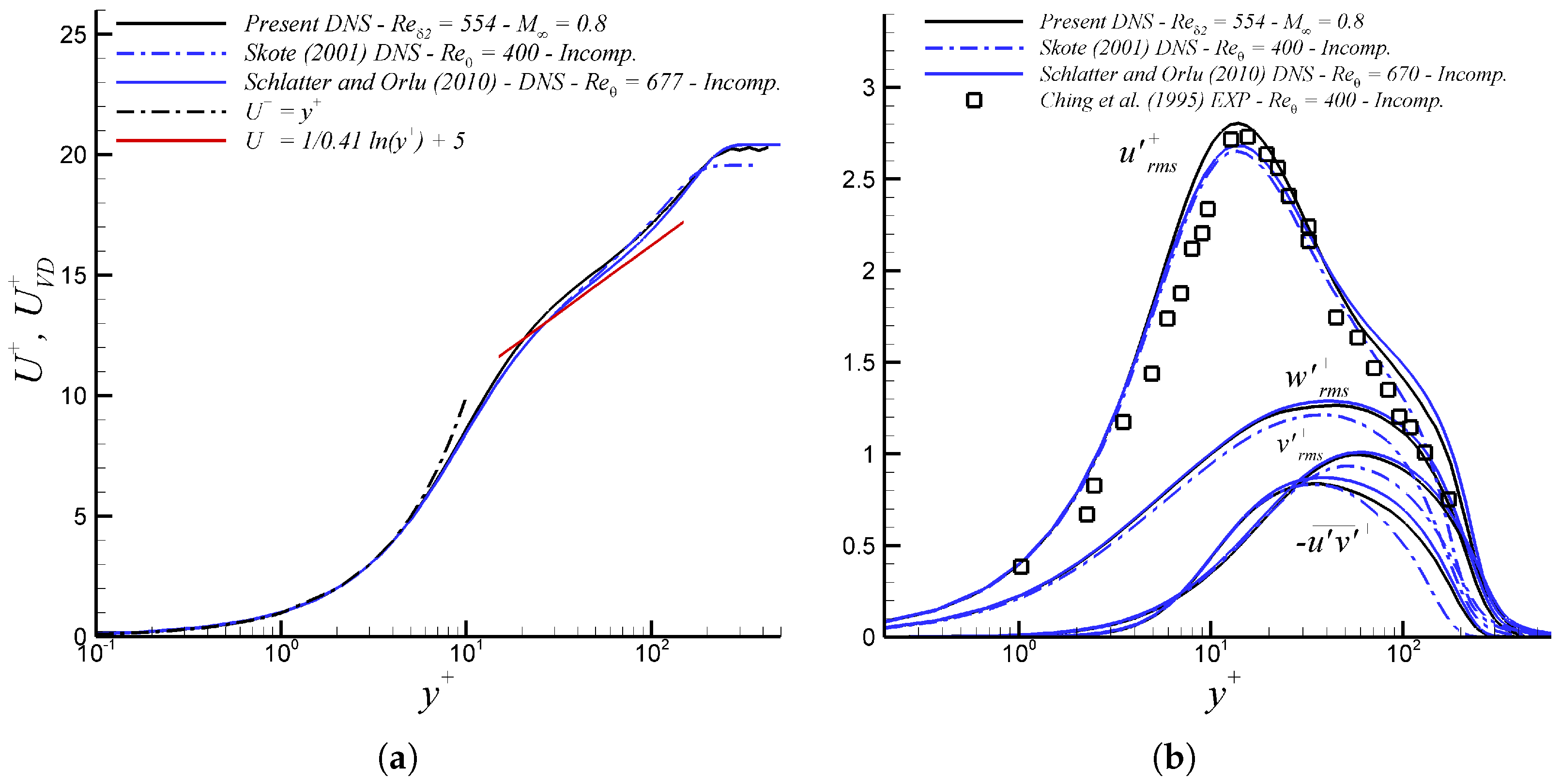
Figure 2a depicts the time-averaged streamwise velocity profile expressed in inner (wall) units for a canonical zero-pressure-gradient (ZPG) subsonic turbulent boundary layer at a freestream Mach number of
. To account for compressibility-induced density variations, the mean velocity has been transformed using the Van Driest formulation (
). For validation and comparative assessment, the incompressible DNS datasets reported in [
46,
47] are also included; these datasets correspond to incompressible SDTBLs at comparable Reynolds numbers. The
+ subscript denotes inner or wall units. The present compressible DNS results demonstrate excellent agreement with the referenced incompressible datasets across the near-wall region. In the viscous sublayer, the canonical linear scaling
or, equivalently,
when expressed in Van Driest variables for compressible flows, is recovered up to
for all cases. This agreement indicates the high numerical fidelity and sufficient spatial resolution of the present simulations in accurately resolving near-wall turbulent motions. The Van Driest transformation effectively collapses the compressible mean velocity profiles onto their incompressible counterparts throughout the buffer layer, up to approximately
. At larger wall-normal distances, within the logarithmic region, a slight deterioration in the collapse is observed; nevertheless, the profiles remain in reasonably close agreement. In this region, the mean velocity profiles exhibit a slope steeper than that predicted by the classical logarithmic law employing the von Kármán constant
and additive constant
, as suggested by White [
48] and typically considered more representative of high–Reynolds-number flows. In the outer wake region, Reynolds-number dependence becomes increasingly evident, with deviations most pronounced in the lower-Reynolds-number dataset reported by [
46].
The turbulence intensities and Reynolds shear stresses are normalized using inner (wall) scaling, i.e., by the friction velocity
and the wall kinematic viscosity
, and are shown in
Figure 2b at a representative streamwise location within the turbulence precursor, where the Reynolds number based on the momentum thickness is approximately
. Note that the vertical axis indicates inner, or wall, units. For validation purposes, the incompressible DNS datasets from [
46,
47] are also included, exhibiting excellent agreement with the present subsonic DNS results. All second-order statistics display a remarkable collapse across datasets in the near-wall region, with close agreement observed up to
. In the outer region, particularly for
, Reynolds-number effects become increasingly evident, most notably in the high-Reynolds-number DNS of [
47] at
. Relative to the external DNS datasets, the present simulations exhibit a modest overprediction of the peak streamwise turbulence intensity
on the order of approximately 4%. Nevertheless, both the wall-normal location and the magnitude of the
peak are in reasonable agreement with the experimental measurements of Ching et al. [
49] obtained at a comparable Reynolds number. It is noteworthy that the location of the inner peak in
, occurring at approximately
, appears to be essentially independent of the Reynolds number. Furthermore, for the present subsonic conditions at
, compressibility effects on the second-order turbulence statistics are also negligible when compared to the relatively small differences in Reynolds numbers.
With respect to the first- and second-order statistics for the jet-in-crossflow (JICF) configurations at the three momentum-flux ratios considered (i.e.,
, 5.6, and 10.2), the statistical database consists of 8000 instantaneous flow-field realizations acquired over a nondimensional sampling interval of
.
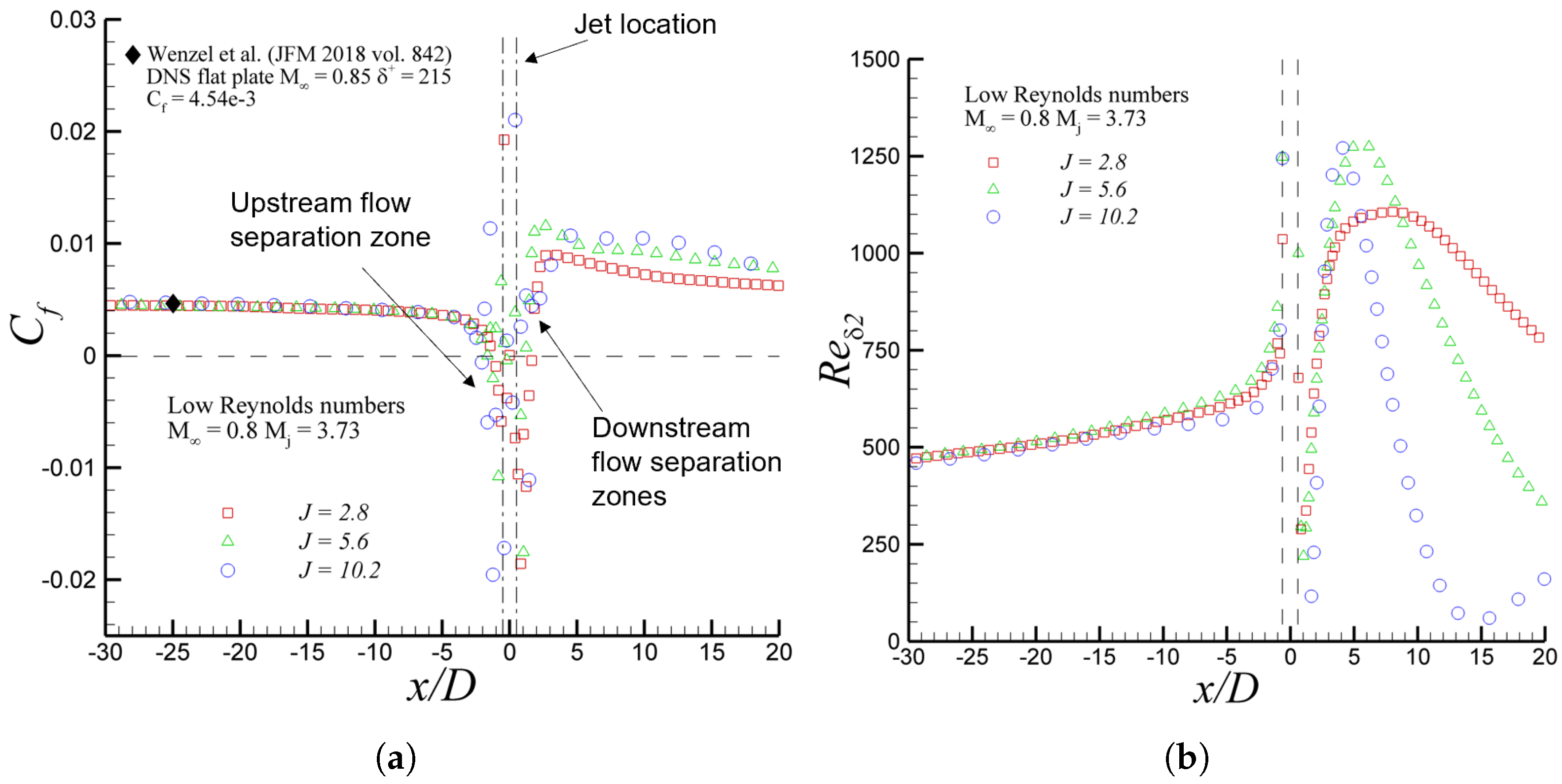
Figure 3a shows the streamwise distribution of the skin-friction coefficient,
, evaluated along the jet centerline plane. Upstream of the jet injection location,
exhibits the characteristic monotonic decrease associated with a canonical flat-plate turbulent boundary layer. For reference, the skin-friction data reported by [
45] at a freestream Mach number of
are also included at a streamwise location corresponding to a comparable Reynolds number. In the vicinity of the jet, strong adverse pressure-gradient (APG) regions are induced both upstream and downstream of the injection location, leading to local flow deceleration and flow recirculation. These effects become increasingly pronounced with increasing momentum-flux ratio. Over the jet, the incoming spatially developing turbulent boundary layer (SDTBL) undergoes a local flow acceleration associated with a favorable pressure gradient (FPG), resulting in a corresponding modification of the wall-shear-stress distribution. Notably, all
profiles at the different
J values tend to converge toward similar values approximately 20 jet diameters downstream of the injection location.
Figure 3b exhibits the streamwise distribution of the compressible momentum-thickness Reynolds number,
. The vertical dash–dot lines indicate the jet location, while the horizontal dashed line denotes the zero value for
. Upstream of the jet, the initially linear profile exhibits an upward curvature due to flow deceleration induced by the approaching jet. The jet acts as a local blockage in the boundary layer, and to satisfy continuity, the incoming flow accelerates around the jet, generating a localized FPG. While this acceleration tends to thin the boundary layer, the momentum thickness may increase slightly owing to the redistribution of momentum within the near-wall velocity profiles. Immediately downstream of the jet, momentum injection into the crossflow produces a recirculation region. In this zone, the boundary layer is subjected to a strong APG, which results in fuller velocity profiles near the wall and a thickening of the momentum boundary layer. This effect is increasingly pronounced at higher jet-to-crossflow momentum-flux ratios.
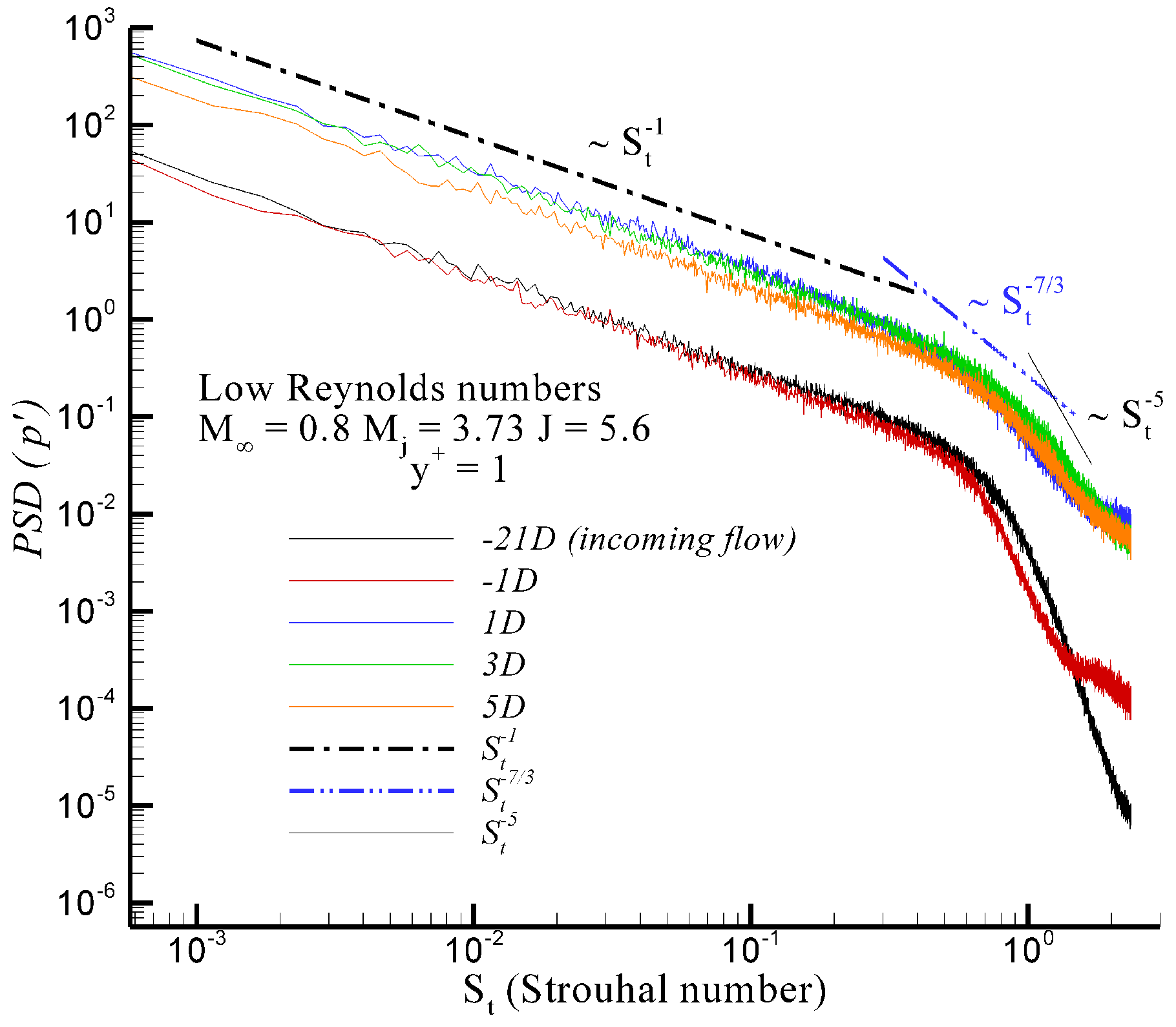
Figure 4 depicts the power spectral density (PSD) of pressure fluctuations, expressed in units of [
], for a jet-to-freestream momentum ratio of
at multiple streamwise locations (
= −21, −1, 1, 3, and 5). The spectra are evaluated within the near-wall region (
), where the root-mean-square pressure fluctuations
attain large values. The frequency content is nondimensionalized using the Strouhal number, defined as
, where
f denotes the frequency,
is the freestream velocity, and
D represents the jet diameter. Reference spectral slopes corresponding to canonical pressure-fluctuation scaling laws are superimposed, including the low-frequency, large-scale regime (
), the mid-frequency inertial subrange (
), and the high-frequency dissipation range (
). In contrast to the classical
inertial-subrange scaling observed in velocity spectra, pressure spectra exhibit steeper decay rates owing to the nonlocal nature of pressure, which reflects integrated contributions from velocity fluctuations across a broad range of scales. Pronounced amplification of high-frequency turbulence (
) is observed in the near-wall region both downstream and upstream of the jet exit. This behavior is indicative of upstream influence associated with flow separation and adverse pressure gradients induced by the jet. Downstream of the nozzle, a broadband enhancement in pressure spectral energy is evident, spanning approximately up to three orders of magnitude relative to the incoming boundary-layer flow, particularly at very high Strouhal numbers, with peak levels occurring within approximately 1–3 jet diameters. Overall, the downstream spectra largely preserve the expected scaling behavior across frequency ranges, with deviations primarily confined to the high-frequency, dissipation-dominated regime.
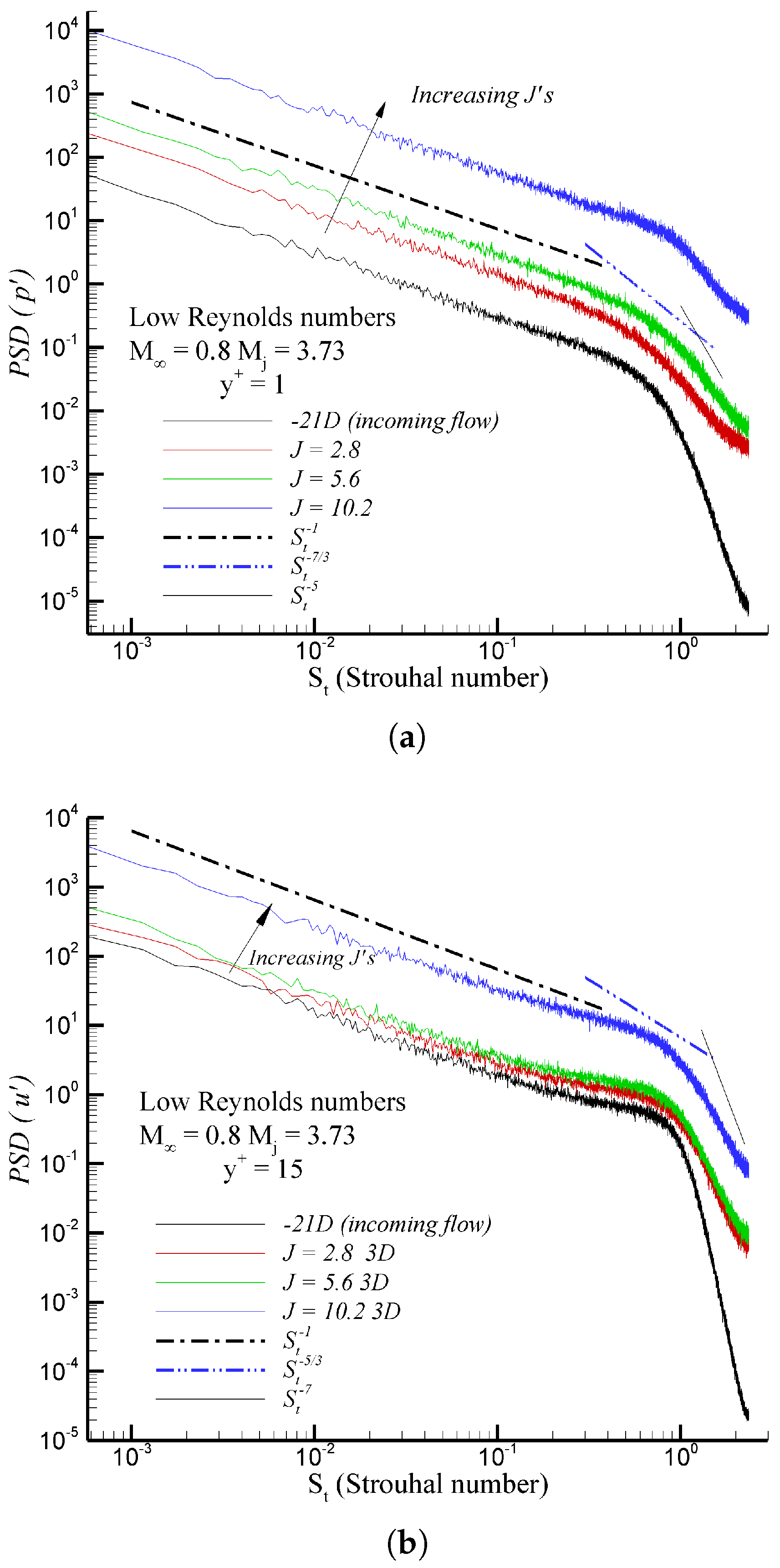
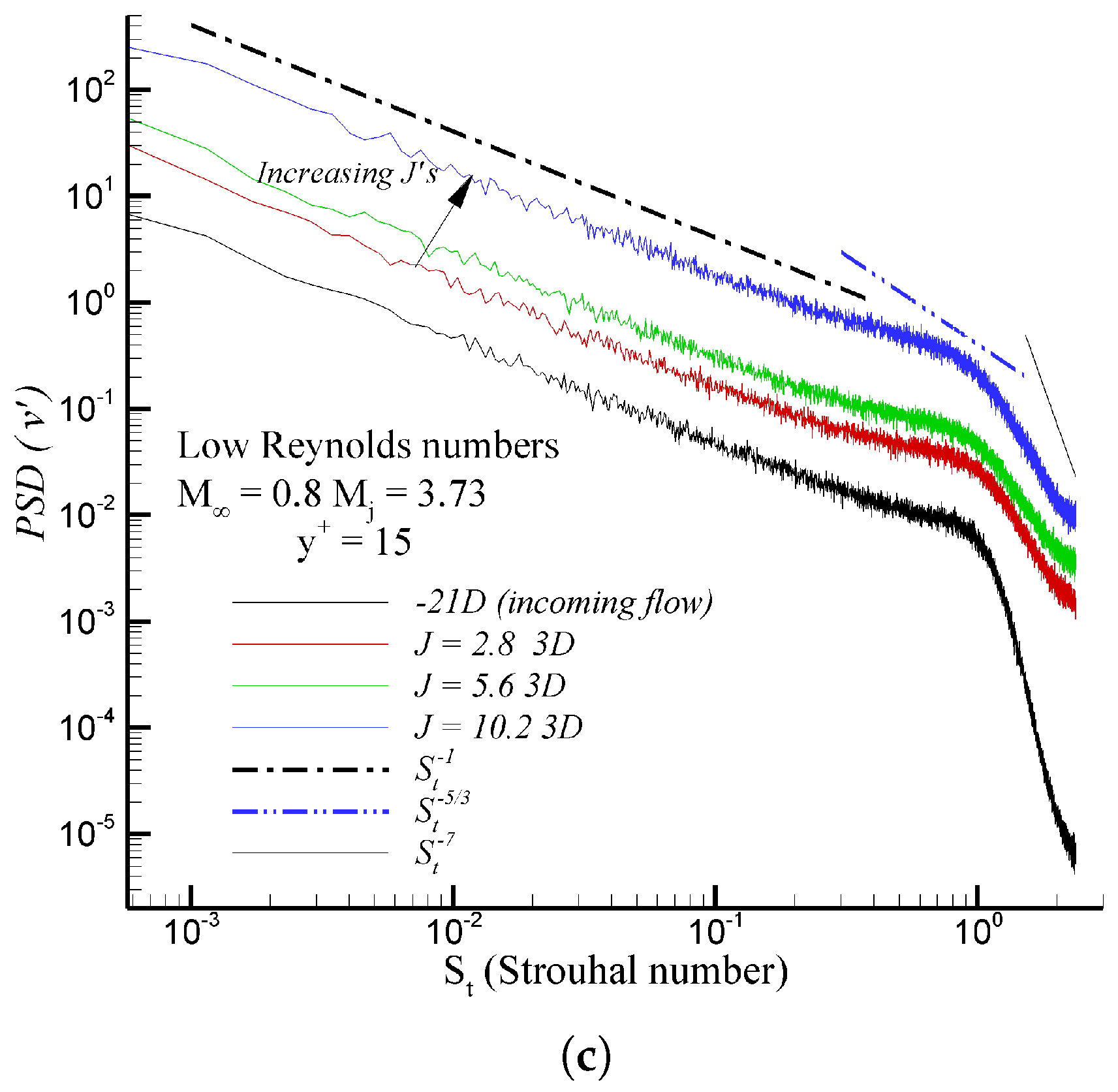
Figure 5 illustrates the power spectral densities of flow fluctuations, namely
,
, and
, for the three configurations investigated in order to assess the influence of the jet-to-freestream momentum-flux ratio. The spectra are extracted at
for the pressure fluctuations
and at
for the streamwise and wall-normal velocity fluctuations,
and
, respectively, corresponding to representative locations within the viscous sublayer and buffer region. The principal findings may be summarized as follows: (i) the pronounced mean shear characterizing the near-wall and buffer-layer regions promotes vigorous production and excitation of small-scale turbulent eddies, leading to elevated spectral energy at high frequencies; (ii) as the momentum-flux ratio
J increases, enhanced jet penetration into the crossflow, together with intensified vortex roll-up, interaction, and subsequent breakdown, gives rise to a broadband amplification of the
,
, and
spectra, with the most significant gains occurring in the high-frequency range; and (iii) the downstream spectra generally conform to the anticipated frequency-scaling laws for both pressure and velocity, with noticeable deviations occurring primarily at high frequencies.
3.3. Impact of Momentum-Flux Ratio on the Energy Distribution of POD/SPOD Modes
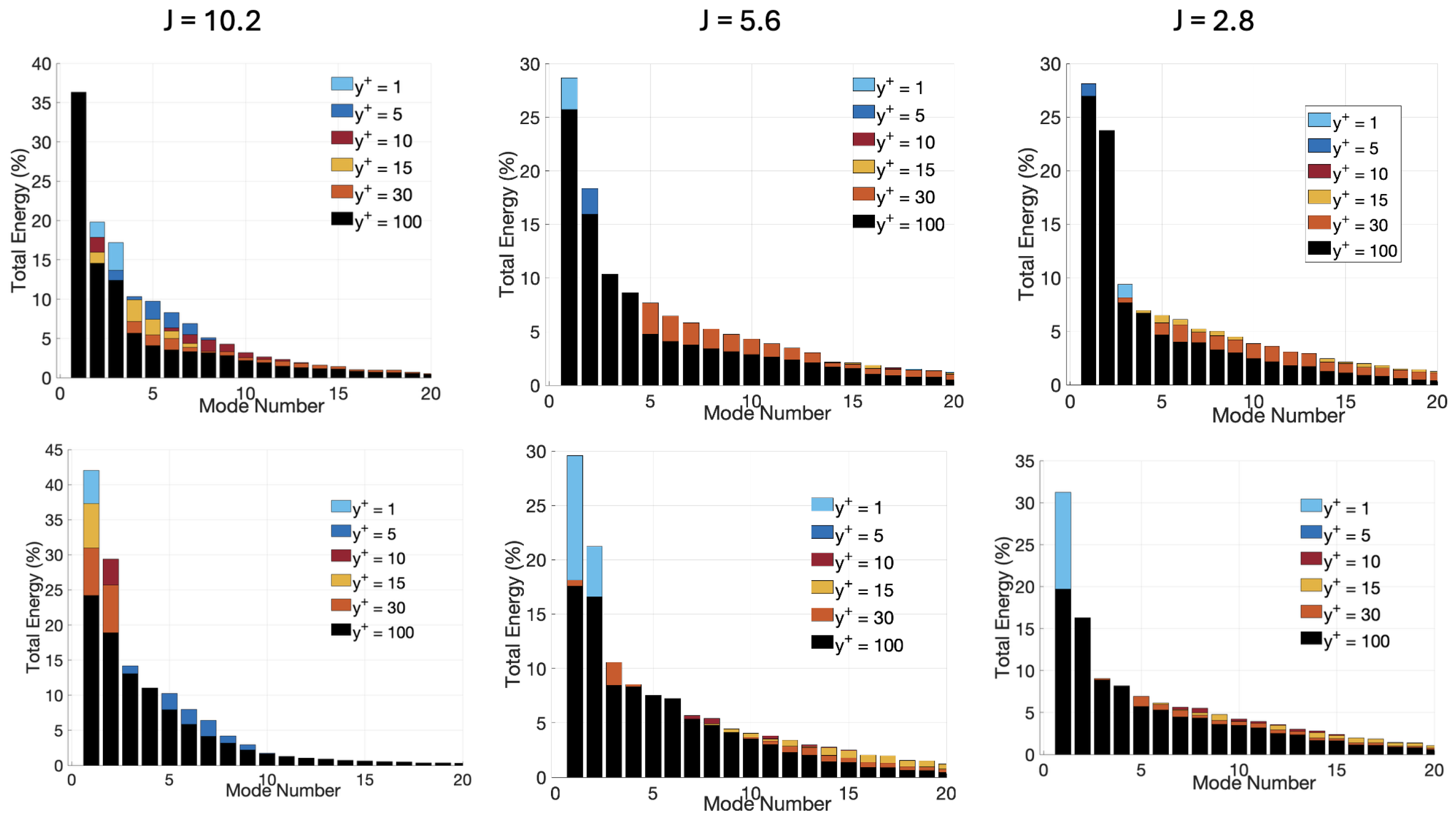
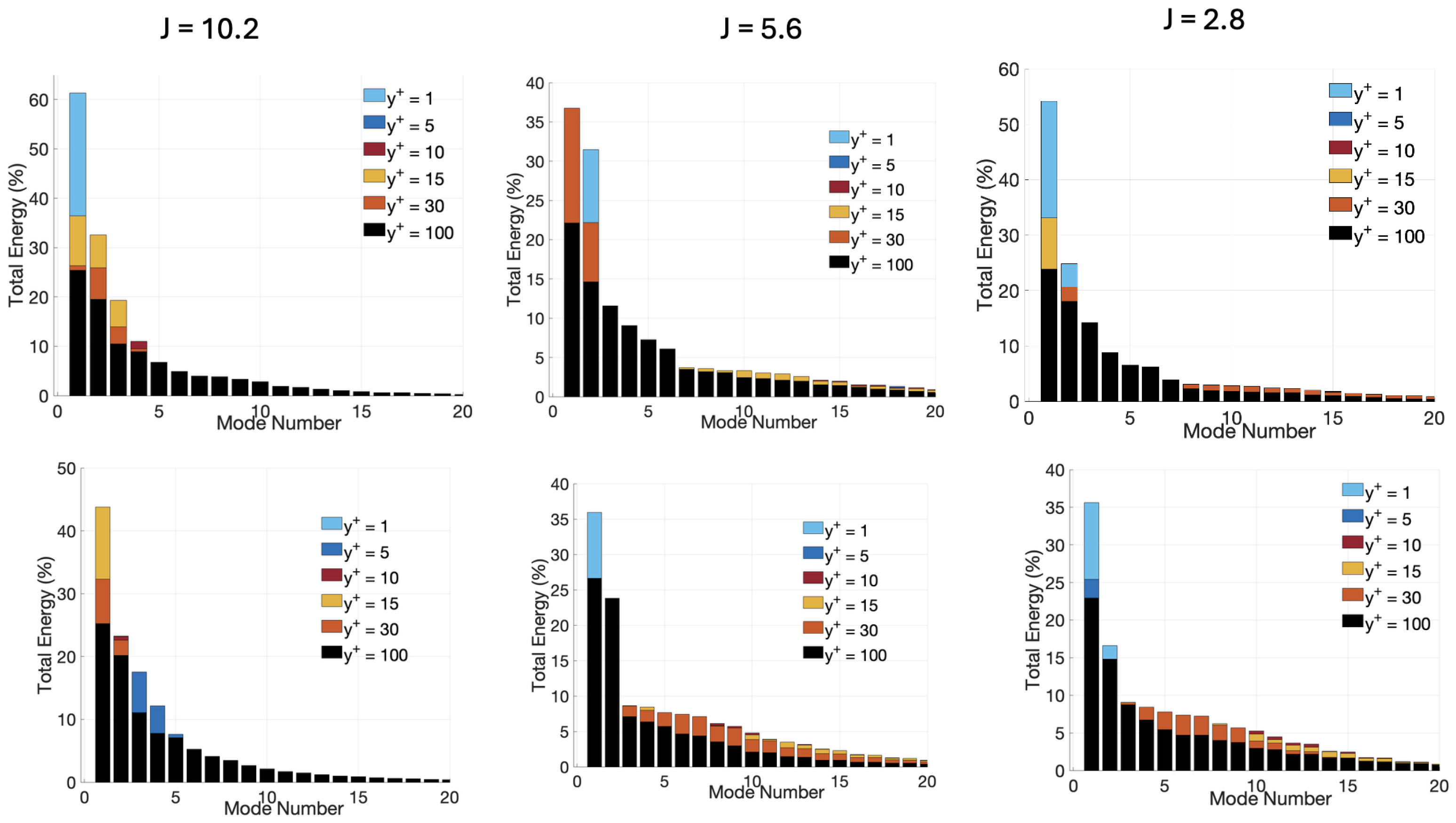
Figure 6 illustrates the proper orthogonal decomposition (POD) energy spectra of the streamwise velocity fluctuations,
, at the three momentum-flux ratios (i.e.,
J = 10.2, 5.6, and 2.8). The modal energy content is shown for the first 20 POD modes at two streamwise locations,
(near-field, top row) and
(far-field, bottom row), and for multiple wall-normal sampling locations spanning the viscous sublayer to the outer flow (
). Each bar represents the percentage contribution of an individual POD mode to the total turbulent kinetic energy, thereby quantifying the relative importance of coherent structures at different scales and flow regions.
At the near-field location, the energy spectra exhibit a strong dominance of the lowest-order POD modes for all momentum ratios, indicating that the flow dynamics are governed by a small number of energetic, large-scale coherent structures. This effect is most pronounced for a highest momentum-flux ratio (J = 10.2), where the first mode alone captures a substantial fraction of the total energy. This behavior reflects the presence of highly organized jet-induced structures, such as the initial shear-layer roll-up, shock–shear-layer interactions, and the formation of large-scale vortical motions associated with jet penetration into the crossflow. As the momentum-flux ratio decreases to J = 5.6 and further to 2.8, the energy contained in the leading modes is reduced and distributed over a larger number of modes, suggesting weaker jet dominance, enhanced crossflow influence, and earlier disruption of coherent structures.
The wall-normal dependence of the modal energy content further highlights the multiscale nature of the jet–crossflow interaction. Near-wall regions () consistently show higher energy contributions in the first few modes, underscoring the strong coupling between the jet-induced structures and the crossflow boundary layer. These modes are associated with near-wall shear amplification, jet-induced streaks, and large-scale vortices that directly interact with the wall. In contrast, at higher wall-normal distances (), the energy is more evenly distributed across modes, indicating increased small-scale activity and reduced coherence in the outer flow. Further downstream at , the POD spectra reveal a systematic redistribution of energy from the lowest modes to higher-order modes for all values of J. The dominance of the first few modes diminishes, and the energy decay with mode number becomes more gradual, reflecting the progressive breakdown of large-scale coherent structures and the onset of more fully developed turbulence. This downstream evolution is particularly evident for the lower momentum-ratio cases, where the jet bends more rapidly under the influence of the crossflow, leading to intensified vortex interaction, enhanced entrainment, and increased three-dimensionality. Consequently, the turbulent kinetic energy is spread over a broader range of modes, consistent with reduced spatial and temporal coherence. The energy distribution trend is physically meaningful and reflects how the dominant coherent vortical structures shift in the wall-normal direction as the momentum-flux ratio J changes. The first POD mode captures the most energetic and spatially coherent vortical motion at each condition; therefore, the wall-normal location where Mode 1 energy peaks indicates where the dominant vortical dynamics reside. For a high momentum-flux ratio (J = 10.2), the jet strongly penetrates the subsonic crossflow and lifts away from the wall, forming a well-developed shear layer and a robust counter-rotating vortex pair (CVP) that resides primarily in the outer flow. As a result, the largest fraction of turbulent kinetic energy associated with coherent vortical motion is concentrated at , where large-scale jet-dominated structures persist with minimal viscous damping. Near the wall, strong shear, compressibility effects, and viscous dissipation rapidly break down coherence, reducing the energy captured by the first mode. At a moderate momentum-flux ratio (J = 5.6), the jet penetration is reduced and the interaction between the jet shear layer and the wall boundary layer becomes significantly stronger. In this regime, the dominant coherent vortical structures—such as jet flapping, near-wall shear-layer roll-up, and CVP initiation—occur close to the wall. Consequently, the first POD mode captures the largest fraction of energy at , indicating that near-wall coherent motions dominate the overall vortical energy budget. This behavior reflects enhanced coupling between the jet and the wall boundary layer, which promotes strong, organized near-wall momentum exchange.
For a low momentum-flux ratio (J = 2.8), the jet remains largely attached to the wall and is rapidly bent over by the crossflow. In this case, the dominant vortical structures are neither fully detached into the outer flow nor confined strictly to the viscous sublayer. Instead, they are concentrated by the end of the linear viscous layer around , where the balance between mean shear production and viscous dissipation favors the persistence of coherent structures. Very close to the wall (), viscous damping suppresses large-scale coherence, while farther from the wall (), the weakened jet lacks sufficient momentum to sustain energetic large-scale vortices. Overall, the shift in the wall-normal location of the most energetic first POD mode reflects a progressive downward migration of dominant vortical dynamics with decreasing momentum-flux ratio. High-J flows are controlled by outer-layer jet-driven vortices, moderate-J flows by near-wall coherent structures, and low-J flows by buffer-layer vortices. This behavior highlights the strong coupling between jet penetration, wall proximity, and coherent momentum transport. With increasing mode number, the energy contribution decays rapidly, and higher-order modes show comparatively larger contributions from outer wall-normal locations (). This indicates a shift from dominant, organized near-wall structures in the lowest mode to smaller-scale, less coherent wall-normal motions away from the wall.
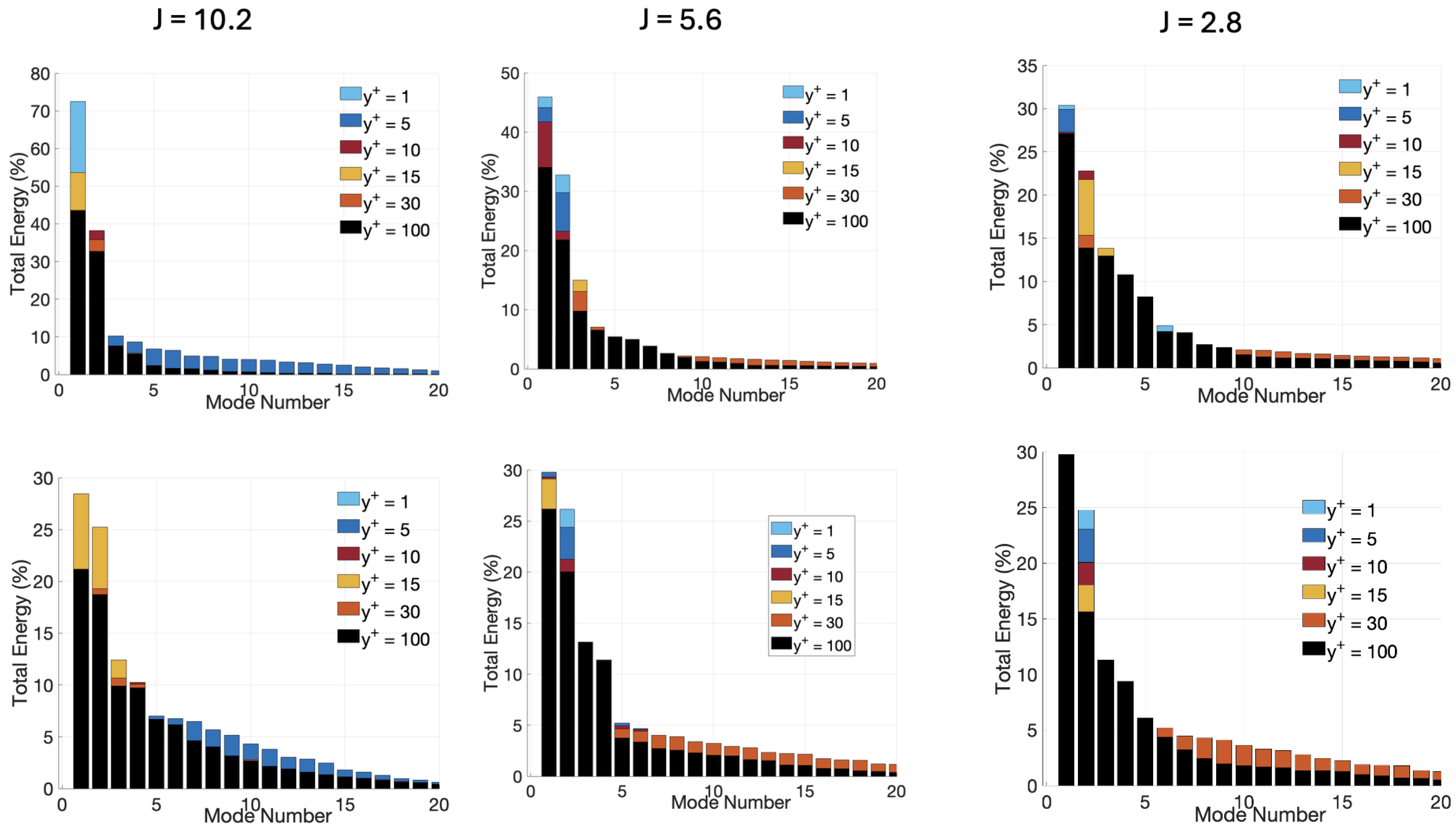
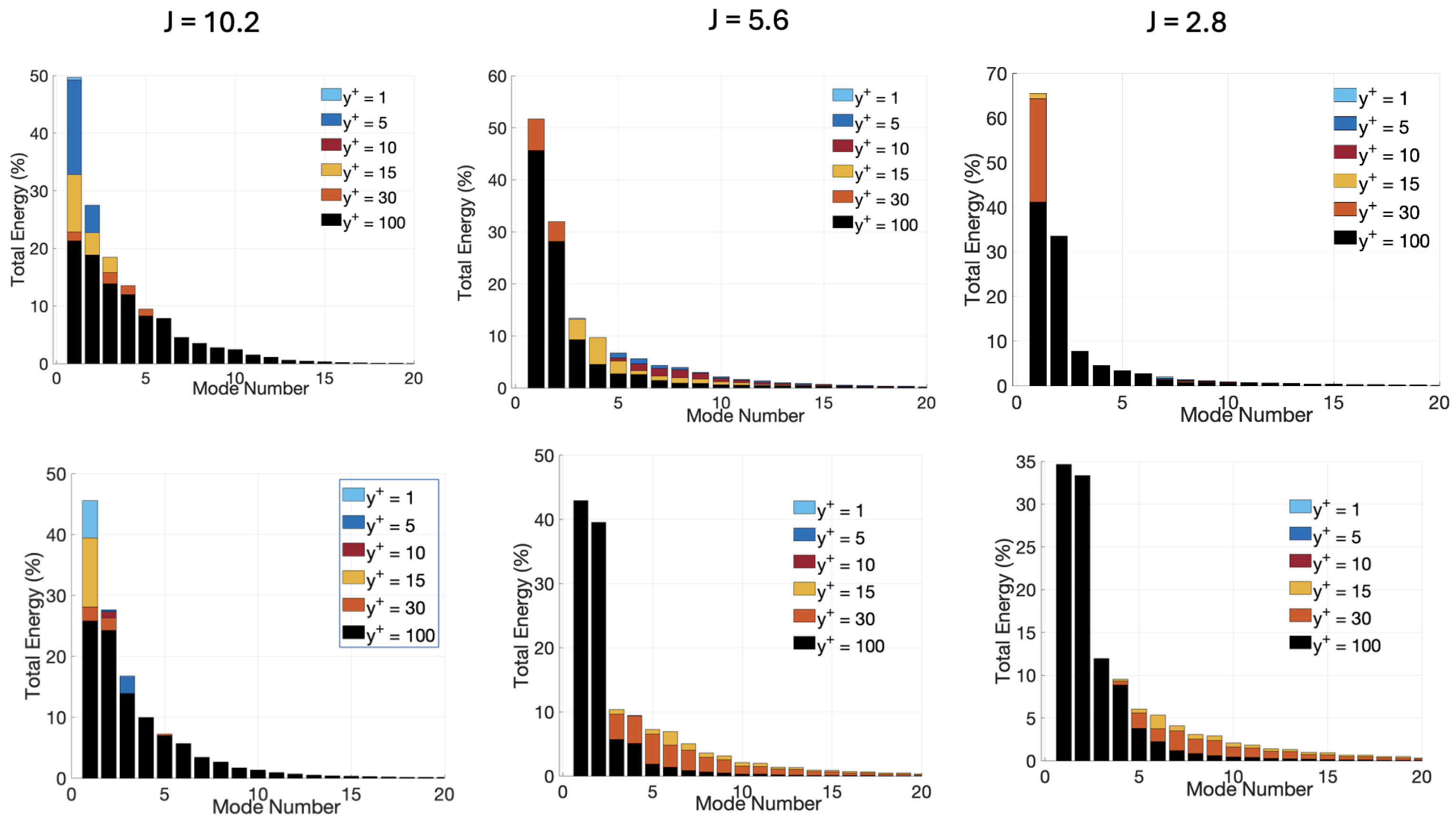
Figure 7 illustrates the POD modal energy distribution of the wall-normal velocity fluctuations (
) as a function of mode number at two downstream locations,
(top row) and
(bottom row), for jet-to-crossflow momentum ratios
J = 10.2, 5.6, and 2.8. The bars indicate the percentage contribution of each POD mode to the total turbulent kinetic energy, while the color-coded segments represent the contributions from different wall-normal locations in viscous units (
. At the near-field location
, the largest fraction of wall-normal fluctuation energy is consistently captured by the first POD mode at the near-wall location
for all three momentum ratios, confirming that wall-adjacent coherent structures dominate wall-normal transport immediately downstream of the jet injection. Importantly, the magnitude of this near-wall contribution is highest for the strongest jet case (
J = 10.2) and decreases progressively as the momentum ratio is reduced to
J = 5.6 and 2.8. This trend reflects the increasing ability of a high-momentum jet to penetrate the crossflow, impinge on the boundary layer, and induce strong wall-normal motions through jet-induced upwash, downwash, and near-wall vortical interactions. As
J decreases, the jet becomes increasingly confined by the crossflow, leading to weaker near-wall vertical motions and reduced energy content at
Further downstream at
, the wall-normal distribution of the leading POD mode for the wall-normal velocity fluctuation exhibits a systematic dependence on the jet-to-crossflow momentum ratio. For the highest momentum ratio (
J = 10.2), the first POD mode attains its maximum energy contribution at
, whereas for the intermediate case (
J = 5.6) the peak shifts closer to the wall at
. In contrast, for the lowest momentum ratio (
J = 2.8), the dominant energy of the first mode is observed in the outer region at
.
This progressive outward shift of the dominant wall-normal location reflects the evolution of jet–crossflow interaction strength and plume development downstream. For J = 10.2, the jet retains sufficient momentum at , to sustain coherent wall-normal motions within the inner and buffer layers. The peak at indicates that energetic vertical motions are primarily associated with near-wall shear-layer structures and the footprint of jet-induced vortices that remain dynamically coupled to the wall. At J = 5.6, the jet momentum is weaker, leading to faster attenuation of plume coherence and reduced vertical penetration. Consequently, the dominant wall-normal fluctuations become confined closer to the wall, with the first mode peaking at . This behavior suggests that near-wall turbulence regeneration and boundary-layer shear increasingly govern the wall-normal velocity dynamics rather than large-scale jet-induced structures. For the lowest momentum-flux ratio J = 2.8, the jet is rapidly bent over by the crossflow and loses coherence within a short downstream distance. As a result, wall-normal fluctuations near the wall are comparatively weak at , and the leading POD mode is dominated by outer-layer motions, peaking at . These outer-region structures are associated with large-scale plume spreading and wake-like dynamics that are largely decoupled from the wall. Overall, the downstream POD results demonstrate that increasing jet momentum sustains coherent wall-normal motions closer to the wall, while lower momentum ratios promote an outward migration of dominant structures, reflecting a transition from wall-coupled jet dynamics to outer-flow–dominated turbulent mixing. The energy distribution for spanwise velocity fluctuation () shows behavior similar to that of and is not reported here for the sake of brevity.
Figure 8 depicts the POD energy distribution of the temperature fluctuations
for three momentum-flux ratios. In the near-field region (
), the temperature fluctuation energy is strongly concentrated in the lowest POD modes for all momentum-flux ratios, indicating that large-scale coherent structures dominate thermal transport immediately downstream of the jet exit. For the highest momentum ratio, the first mode alone captures a remarkably large fraction of the total thermal energy, particularly at near-wall locations (
). This behavior reflects the presence of highly organized thermal structures associated with the jet core, shock-induced compression and expansion, and the initial roll-up of the jet shear layer, which imprint strong, spatially coherent temperature variations. As the momentum-flux ratio decreases to
J = 5.6 and 2.8, the dominance of the leading mode is reduced, and the energy is distributed across a greater number of modes, signifying weaker jet penetration, stronger crossflow influence, and enhanced thermal mixing at smaller scales. For the high momentum-flux ratio case (
J = 10.2), the jet strongly penetrates the crossflow, but the largest temperature gradients—and hence the strongest coherent thermal fluctuations—occur very close to the wall. The energetic first POD mode at
indicates that wall-bounded thermal structures dominate the temperature field. This behavior occurs because the high-momentum jet induces intense near-wall cooling and heating through impingement-induced pressure gradients and strong wall-normal transport, producing a spatially coherent thermal footprint on the surface. While thermal structures also exist in the outer flow, they are more fragmented due to enhanced turbulent mixing, reducing their coherence and lowering the energy captured by the first mode away from the wall.
At a moderate momentum-flux ratio (J = 5.6), the thermal field is controlled by the detached jet plume and shear-layer-driven thermal transport rather than direct wall interaction. In this regime, the jet lifts sufficiently from the wall to form a well-organized thermal plume whose core resides in the outer part of the boundary layer. As a result, the most energetic coherent thermal structure is located at , where scalar advection by large-scale vortices dominates over molecular diffusion and wall damping. Near the wall, thermal fluctuations are weaker and less coherent because the reduced jet impingement limits the direct modulation of wall temperature. For the low momentum-flux ratio case (J = 2.8), the jet is rapidly bent over by the crossflow and remains closely attached to the wall. Consequently, thermal transport is dominated by near-wall scalar advection and diffusion, with strong and persistent temperature gradients forming in the viscous sublayer. The dominance of the first POD mode at indicates that temperature fluctuations are organized primarily by coherent near-wall structures rather than by outer-layer plume dynamics. Away from the wall, thermal fluctuations become weaker and more diffused, leading to reduced modal coherence. Further downstream at , a clear redistribution of thermal energy toward higher-order POD modes is observed for all values of J. The sharp dominance of the first mode diminishes, and the spectra become flatter, reflecting the progressive breakdown of large-scale thermal coherence and the enhanced role of turbulent mixing and entrainment. This downstream evolution is most pronounced for the lower momentum-ratio cases, where the jet bends more rapidly under the crossflow, promoting intensified interaction between hot and cold fluid parcels and accelerating the transfer of thermal energy to smaller scales. Consequently, temperature fluctuations become less organized and more broadband in nature.
Figure 9 presents the POD energy distribution of the pressure fluctuations
for the jet-in-crossflow configuration at three momentum-flux ratios. At the near-field location
, the pressure-fluctuation energy is overwhelmingly dominated by the first POD mode for all momentum-flux ratios, particularly at higher wall-normal locations (
). This strong concentration of energy in the leading mode reflects the presence of highly coherent, large-scale pressure structures induced by the jet shock system. For the highest momentum ratio (
J = 10.2), the leading mode captures a substantial fraction of the total pressure energy near the wall as well, indicating that shock–boundary-layer interactions play a significant role in organizing pressure fluctuations close to the surface. As the momentum-flux ratio decreases to
J = 5.6 and
J = 2.8, the dominance of the first mode remains significant, highlighting the increasingly coherent nature of pressure fluctuations as the jet weakens and aligns more rapidly with the crossflow. The wall-normal distribution of POD energy reveals that pressure fluctuations are more spatially coherent away from the wall than velocity or temperature fluctuations. Further downstream at
, the energy content of the first mode decreases relative to the near-field, and the pressure energy becomes more distributed among higher-order modes, particularly for
J = 10.2 and 5.6. This redistribution indicates the progressive weakening of organized shock structures and the increasing influence of turbulent mixing, vortex–shock interactions, and pressure fluctuations associated with large-scale coherent vortices in the jet wake. Nevertheless, even at this downstream location, the leading modes still capture a significant portion of the total pressure energy, especially for the lowest momentum ratio (
J = 2.8), underscoring the persistence of large-scale pressure coherence in the flow. The energy distribution further downstream (
) for all fluctuating variables is consistent with that at
and is not presented here for brevity.
3.4. Flow Visualization and SPOD/POD Eigenvector Contours
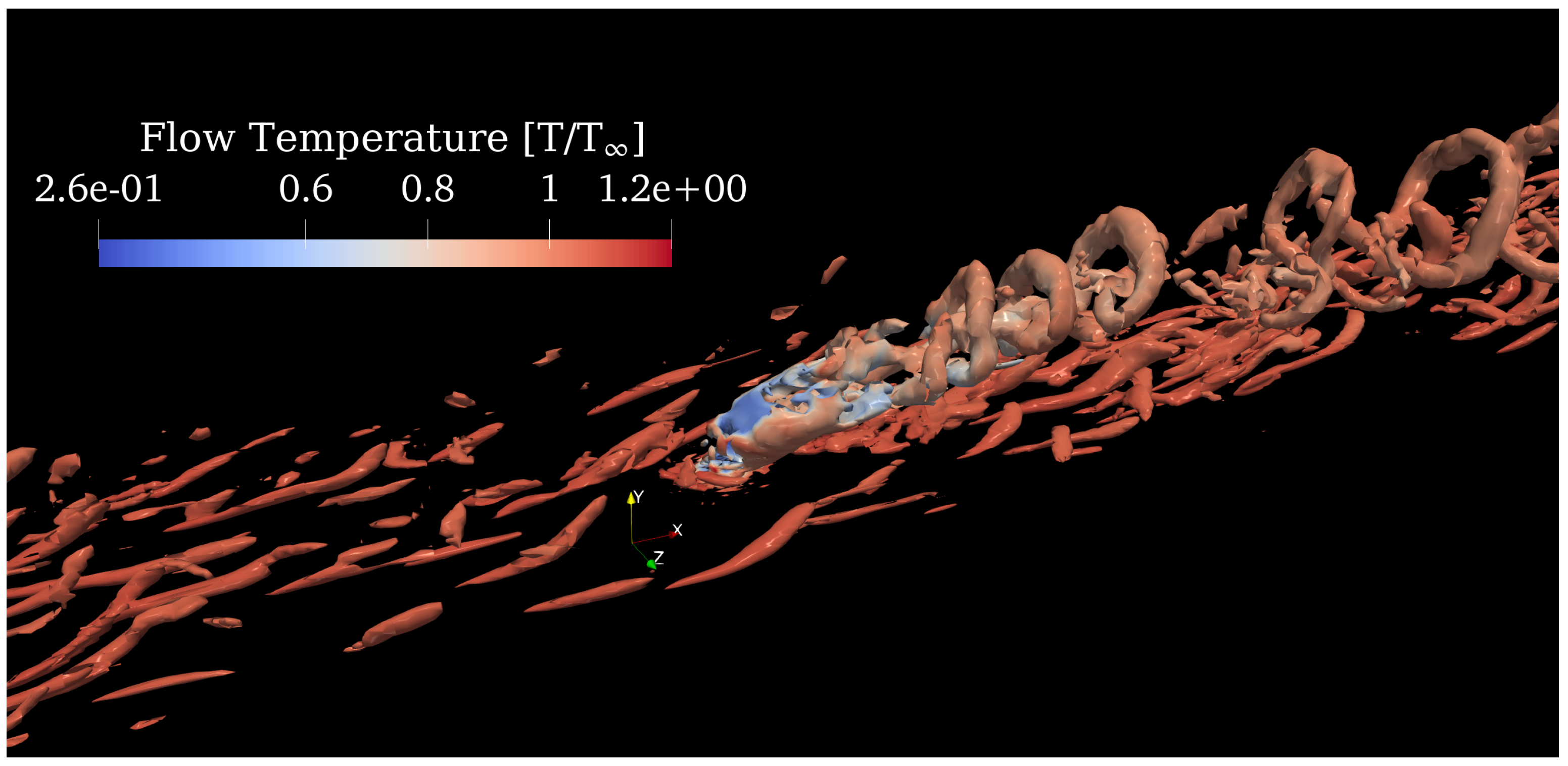
For visualization of the typical vortical structures in JICF, the iso-surfaces of the
Q-criterion were extracted and colored by the instantaneous static temperature field for the
configuration, as shown in
Figure 10. This approach by [
50] enables identification of coherent flow structures arising from jet–crossflow interaction. Canonical features—including the horseshoe vortex enveloping the upstream stagnation region and the counter-rotating vortex pair (CVP) downstream of the injection point—are clearly observed. These structures, which are definitive signatures of supersonic transverse jet penetration in subsonic crossflow, persist along the jet trajectory and confirm that the numerical framework captures the dominant vortical mechanisms governing the flow evolution. The low-temperature jet fluid (characterized by a thermal ratio of
) is rapidly transported downstream by the combined action of forced convection, turbulent mixing, and molecular diffusion. This transport process is evidenced by the presence of blue-colored regions aligned with the vortex cores, indicating the preferential entrainment and redistribution of the colder jet fluid within the coherent turbulent structures.
An overexpanded jet is characterized by a static pressure at the nozzle exit that is lower than the ambient freestream static pressure. For the three jet operating conditions considered in this study, the corresponding exit-to-freestream static pressure ratios were 0.13, 0.26, and 0.47 for momentum ratios
J = 2.8, 5.6, and 10.2, respectively. In an overexpanded jet in crossflow (JICF), the jet exit shock manifests as an attached compression shock anchored at the injector lip. This shock arises because the supersonic jet must undergo an immediate recompression to accommodate the higher static pressure imposed by the crossflow. The resulting oblique compression shock induces a pronounced jet deflection and a rapid reduction in jet total pressure and momentum from the point of discharge. Consequently, the jet is significantly weakened at inception, leading to strongly asymmetric flow development and substantially altered penetration characteristics. This injector-lip-anchored feature, commonly referred to as the lip shock or exit compression shock, elevates the jet static pressure to match the ambient crossflow pressure immediately downstream of the nozzle exit.
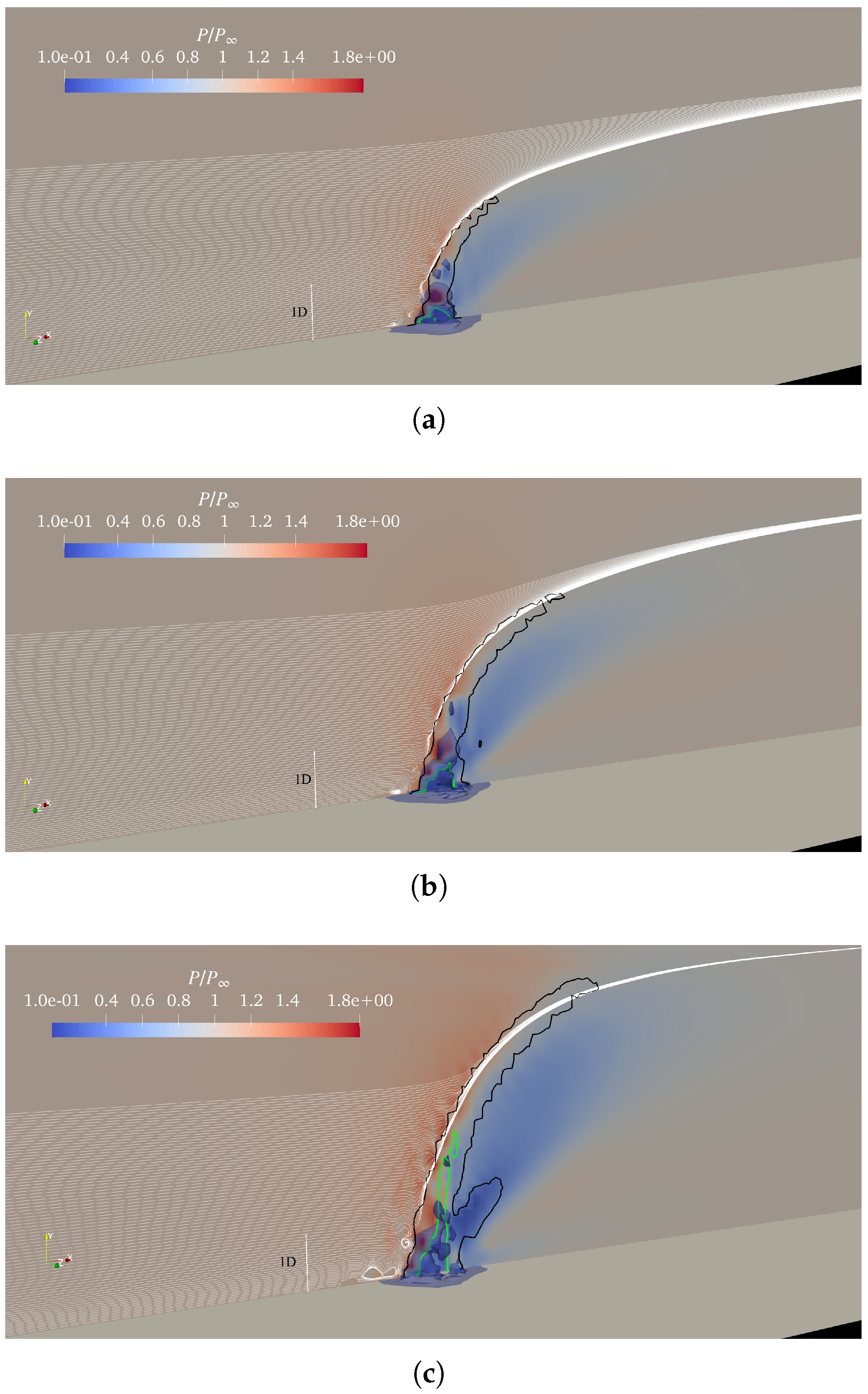
Figure 11 show the jet centerline
plane with static pressure contours, some streamlines, and iso-surfaces of large pressure-gradient magnitudes for momentum-flux ratios,
J, of 2.8, 5.6, and 10.2. In addition, two contour lines are delineated in the central symmetry plane: the sonic contour at Mach = 1, shown as a black line, and the Mach = 3.2 contour, indicated by a green line. Upstream of the jet, the vertical white arrow denotes the characteristic jet diameter length. As the momentum ratio
J increases in an overexpanded JICF, the jet exit (lip) compression shock progressively weakens and is displaced downstream from the injector lip, as observed in
Figure 11. This behavior reflects an increase in the effective jet exit pressure relative to the crossflow static pressure, corresponding to a reduction in the degree of overexpansion. With increasing
J, the magnitude of recompression required across the exit shock diminishes, resulting in a more oblique shock configuration characterized by an increased shock angle relative to the jet axis. Concurrently, the shock strength—quantified by the associated pressure rise (see the intense red spot at
J = 2.8) and rapid reduction in Mach number—decreases, and the shock attachment point exhibits a tendency to migrate slightly downstream of the injector lip. As a consequence, the jet retains greater momentum in the near field and penetrates farther into the crossflow before undergoing significant bending, as observed for
J = 10.2. The sonic contours (black lines) expand markedly along the jet trajectory with increasing
J, indicating an enlarged region of locally sonic flow, particularly for for
J = 10.2. Furthermore, the line contours corresponding to a local Mach number of 3.2 (green lines) are observed to move closer to the jet exit at lower values of
J, thereby corroborating that lower exit-to-freestream static pressure ratios are associated with stronger jet exit compression shocks.
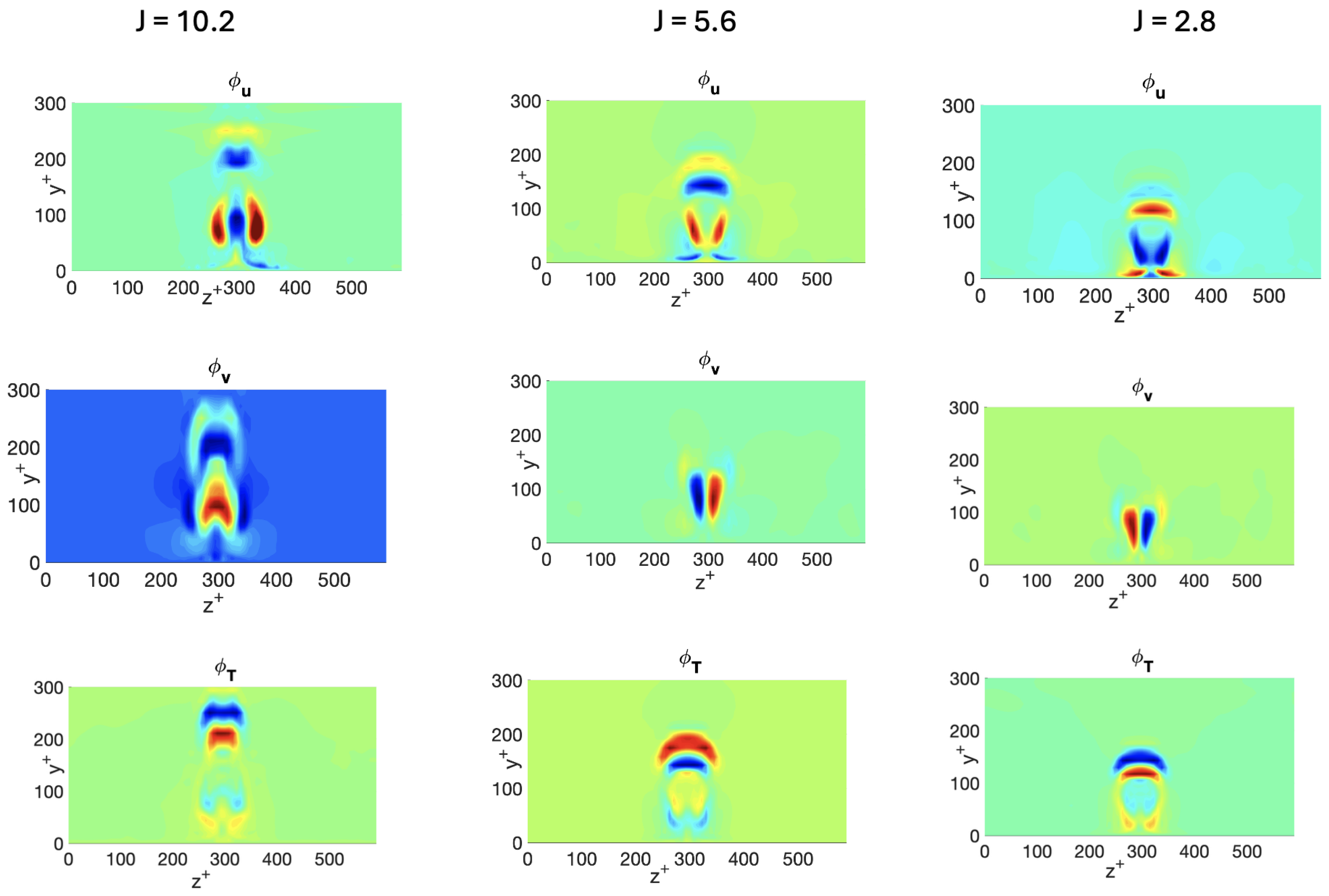
Furthermore, the first POD mode represents the most energetic and spatially coherent structure in the flow.
Figure 12 shows the eigenvector contour plot of the
,
, and
components of the first POD mode for all three momentum-flux ratios. At
, this mode captures the global jet–crossflow interaction, dominated by jet flapping, counter-rotating vortices, and thermal plume motion, whose spatial extent and wall-normal reach depend strongly on the momentum ratio
J. In all plots, red and blue colors indicate regions of opposite phase of the fluctuating quantity (positive and negative amplitudes of the POD eigenfunction). These do not represent instantaneous sign, but rather coherent oscillatory motion of the structure about its mean position. The first POD mode of
exhibits a paired lobe structure about the jet centerline, characteristic of large-scale jet flapping in the crossflow. Red regions represent coherent streamwise acceleration relative to the mean jet, and blue regions represent coherent streamwise deceleration. Together, the red–blue pair indicates an oscillatory lateral and vertical displacement of the jet core, rather than a stationary structure. The mode extends to high wall-normal locations (
) for
J = 10.2, indicating a deeply penetrating jet with a dominant global flapping mode. The broad spatial footprint reflects strong coupling between the jet and the outer crossflow. For
J = 5.6, the structure becomes more compact and shifts downward, showing reduced penetration and increasing confinement of streamwise fluctuations to the shear layer. As the momentum-flux ratio is reduced further, the mode is tightly localized near the wall and jet exit for
J = 2.8, indicating that near-wall shear and wake-type unsteadiness dominate over global jet motion.
The first POD mode of
in
Figure 12 clearly identifies the counter-rotating vortex pair for
J = 5.6 and 2.8, the hallmark structure of jets in crossflow. The antisymmetric red–blue lobe pair corresponds to upwash and downwash motions induced by the CVP legs. This mode represents the vertical breathing motion of the jet, which lifts fluid away from the wall while inducing entrainment on either side. At high momentum ratio (
J = 10.2), the jet strongly penetrates the crossflow and rapidly lifts away from the wall. As a result, the dominant coherent motion captured by the first POD mode is no longer the near-wall CVP upwash–downwash, but rather a global jet-core oscillation. For
J = 10.2, most of the wall-normal kinetic energy resides in a global flapping or breathing motion of the jet core, which appears as a predominantly single-lobed structure in
, overwhelming the classical CVP antisymmetric pattern. The CVP-induced antisymmetric motion still exists for
J = 10.2 but is captured by higher-order POD modes (to be shown later) due to energy redistribution across POD modes, while the first mode extracts the energetically dominant jet-lift and entrainment dynamics. The CVP forms earlier and remains more symmetric and closer to the wall for lower momentum flux due to reduced vertical momentum. The wall-normal velocity fluctuations are dominated by balanced upwash and downwash motions, which leads to the clear antisymmetric red–blue lobe pair in the first POD mode of
for
J = 5.6. On the other hand, the CVP is confined close to the wall for
J = 2.8, indicating suppressed vortex strength and dominance of near-wall shear-driven motion. As further illustrated in
Figure 12, the leading POD mode associated with the temperature fluctuations, denoted
, encapsulates the dominant coherent thermal structure of the flow. This mode is strongly correlated with the underlying jet dynamics and exhibits a pronounced structural similarity to the corresponding streamwise velocity eigenvector,
, indicating a high degree of thermo–kinematic coherence. Red regions indicate coherent hot-fluid excursions, and blue regions indicate coherent cool-fluid intrusions from the crossflow. The red–blue layering indicates an oscillatory thermal plume, synchronized with jet flapping and CVP motion. The thermal structure extends far from the wall for
J = 10.2, indicating strong convective transport of heat by the lifted jet core. For
J = 5.6, the thermal mode is more compact and arch-shaped, reflecting enhanced shear-layer mixing rather than bulk jet lift-off. On the other hand, the thermal structure is confined near the wall for
J = 2.8, showing that wall-adjacent heating and conduction-dominated transport become increasingly important.
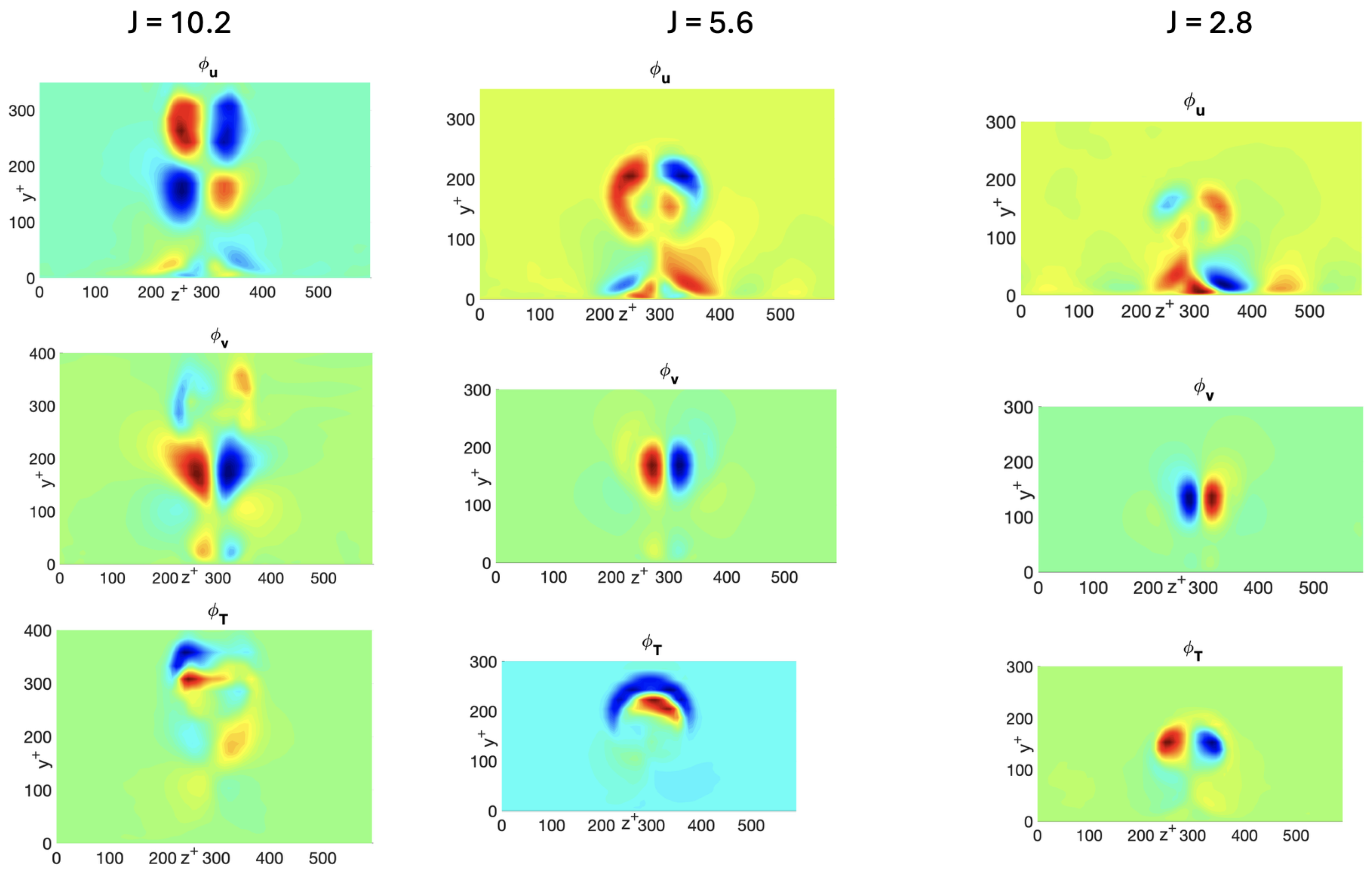
Figure 13 highlights the first POD mode eigenvectors of
and
at
for the three momentum-flux ratios. The flow has evolved beyond the immediate jet exit region, and the dynamics are dominated by large-scale jet meandering, CVP deformation, and thermal plume oscillations, rather than near-wall shear-layer instabilities. The four-lobed red–blue structure of
for
J = 10.2 indicates strong global jet-flapping and lateral-meandering modes. The vertical separation of lobes suggests that the jet core oscillates both laterally and vertically, consistent with a fully lifted jet. The absence of near-wall symmetry implies that the CVP has weakened relative to jet-core dynamics. Here, the first mode of
represents large-scale jet-core oscillation, driven by strong momentum dominance over the crossflow. A more compact, crescent-shaped red–blue pattern is observed in
for
J = 5.6. This corresponds to a coherent lateral flapping mode of the jet column, still influenced by the CVP but less vertically stretched than at
J = 10.2. A mixed mode combining jet flapping and residual CVP-induced entrainment is observed for
J = 5.6. At
J = 2.8 the structure in
is confined closer to the wall with asymmetric red–blue patches, indicating weaker jet penetration and stronger interaction with the crossflow boundary layer. The dominant structures of
at
J = 2.8 reflect near-wall shear-layer oscillations and weak jet meandering. The first POD mode eigenvector of wall-normal velocity fluctuations (i.e.,
) for
J = 10.2 shows a tilted red–blue dipole extending vertically that indicates dominant upward and downward motions associated with jet breathing. The lack of clear antisymmetry about the centerline suggests that CVP-induced upwash/downwash is no longer the leading energetic feature. The first POD mode captures global vertical oscillation of the lifted jet plume, not classical CVP motion. A clean antisymmetric red–blue lobe pair appears for
J = 5.6. This is a textbook signature of CVP-induced upwash and downwash. The CVP remains dynamically important and energetically dominant at this downstream location. For the case
, a comparatively weaker yet still symmetric dipolar structure is observed in
, with its centroid displaced closer to the wall. This behavior indicates a reduction in the strength of the counter-rotating vortex pair (CVP) accompanied by enhanced suppression of vertical transport by the crossflow. Under these conditions, the wall-normal velocity field is primarily governed by attenuated CVP legs that remain embedded within the boundary layer, reflecting diminished vortex-induced vertical transport.
The elongated red–blue structure in
Figure 13 at higher
corresponds to oscillatory thermal plume lift-off for the first POD mode of temperature fluctuations,
, at the highest momentum-flux ratio (i.e.,
J = 10.2). The dominant thermal mode reflects large-scale thermal plume flapping, consistent with strong jet penetration. On the other hand, a well-defined arch-shaped structure appears for
J = 5.6. This corresponds to thermal entrainment by the CVP, with hot fluid lifted and cold fluid entrained downward. The thermal field is strongly coupled to the CVP dynamics. For
, the thermal POD mode remains spatially compact and confined to the near-wall region. The alternating red–blue lobes signify localized heating–cooling oscillations induced by shear-layer mixing processes. In this regime, thermal transport is predominantly controlled by near-wall mixing mechanisms and weak plume oscillations, consistent with the reduced penetration and coherence of the thermal structures.
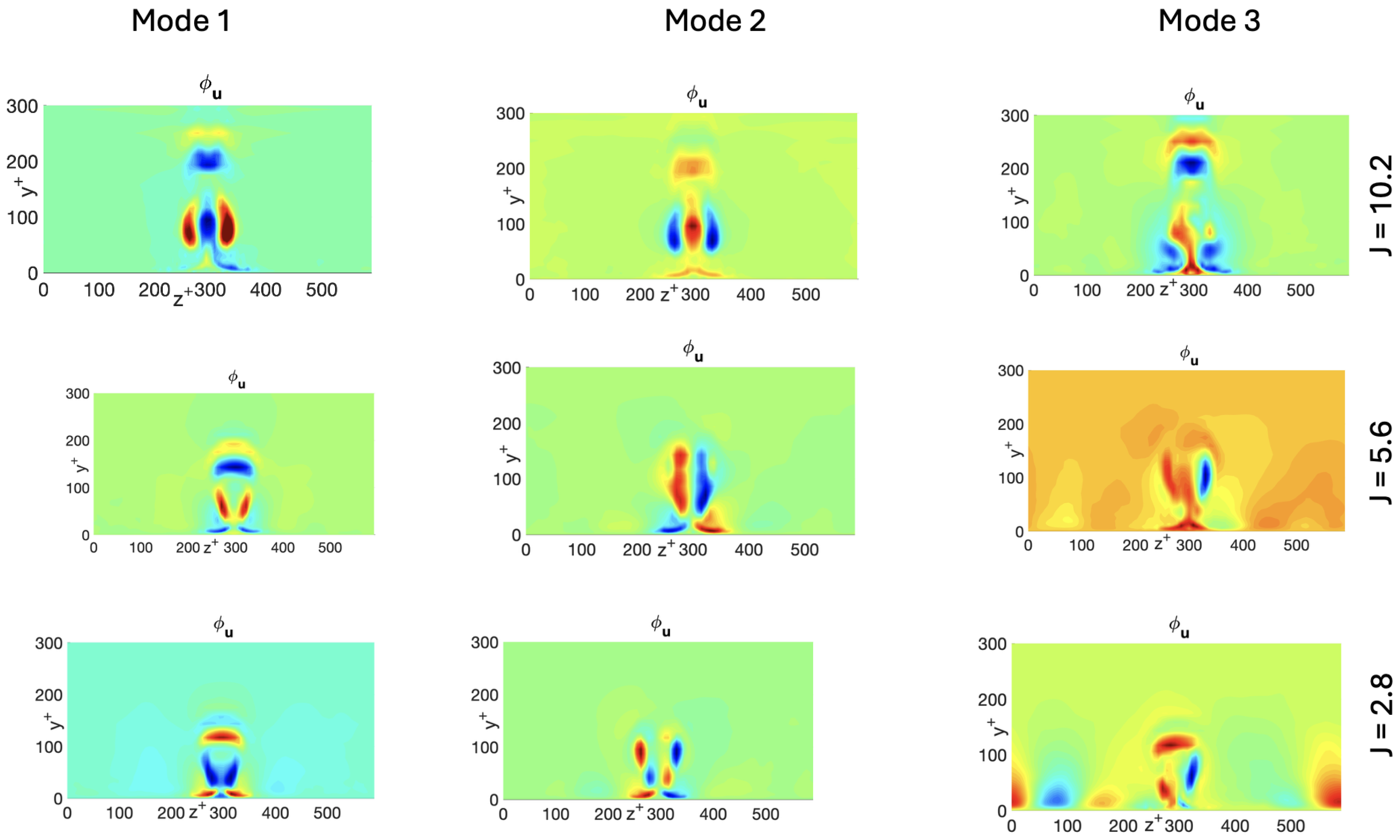
Figure 14 represents the first three POD spatial modes of the streamwise velocity fluctuation
(
) at
for three momentum-flux ratios. The first POD mode for
J = 10.2 shows a strong, symmetric pair of near-wall lobes of opposite sign that straddle the jet centerline at
, with a third lobe aloft at
. The near-wall pair are the kidney footprints of jet lift-off due to the CVP. One lobe corresponds to the sweep side; the opposite lobe corresponds to the ejection side. The upper lobe aligns with the upwash core above the jet, where low- and high-speed fluid are vertically redistributed by the CVP. The same paired near-wall pattern is present for
J = 5.6 but is broader and less vertically extended; the aloft lobe is weaker. The counter-rotating vortex pair (CVP) remains the dominant coherent structure; however, its vertical extent is significantly diminished, indicating reduced wall-normal penetration of the induced vortical motion. At
J = 2.8, the paired footprints for Mode 1 collapse closer to the wall with diminished upper-lobe activity. For weaker jets, the CVP attenuates and remains wall-attached, leading to a dominantly near-wall organization of
. The second POD mode (Mode 2) reveals the persistence of two near-wall lobes for all cases; however, these structures exhibit a lateral phase shift relative to one another. Moreover, the upper lobe in Mode 2 displays a sign inversion with respect to Mode 1, indicating a change in the associated fluctuation phase and underlying modal symmetry. This Mode 2 represents antisymmetric meandering of the jet and shear-layer imbalance, i.e., alternating dominance of the left/right side of the CVP. It corresponds to lateral oscillation of the jet footprint (a common subdominant mode in transverse jets). The meandering pattern of Mode 2 is present but less organized for
J = 5.6, with the lobes showing increased spanwise separation and near-wall concentration. Two small lobes appear for
J = 2.8 at
in Mode 2, with limited vertical reach. The mode reflects near-wall streak modulation rather than a fully developed jet meander; the jet signature is subdued and the wall turbulence plays a larger role. In contrast, the middle lobes for Mode 2, positioned around the jet-core region (
) for
J = 2.8, correspond to antisymmetric oscillations of the jet plume about the centerline. These lobes capture the lateral meandering of the jet caused by the imbalance between jet momentum and crossflow forcing, indicating a flapping-type coherent motion rather than a symmetric core pulsation.
Regarding Mode 3, a pronounced upper lobe at is observed with weaker near-wall counterparts for the J = 10.2 case. This mode highlights shear-layer–Kelvin–Helmholtz-type activity in the upper jet region and its intermittent coupling to the wall footprints. It indicates outer-layer fluctuation energy driven by jet shear dynamics at a high momentum-flux ratio. The background of Mode 3 appears more diffuse with broadened lobes for J = 5.6; near-wall features are visible but less distinct. Mode 3 reflects large-scale outer-layer motions with reduced coherence, consistent with moderate-J jets where the shear-layer rollers are weaker and more intermittent. For the case, Mode 3 distinctly exhibits near-wall turbulent structures. The corresponding modal topology reflects a damped shear-layer signature, primarily governed by outer-layer eddies convected over the jet, as opposed to coherent rollers generated directly by the jet itself.
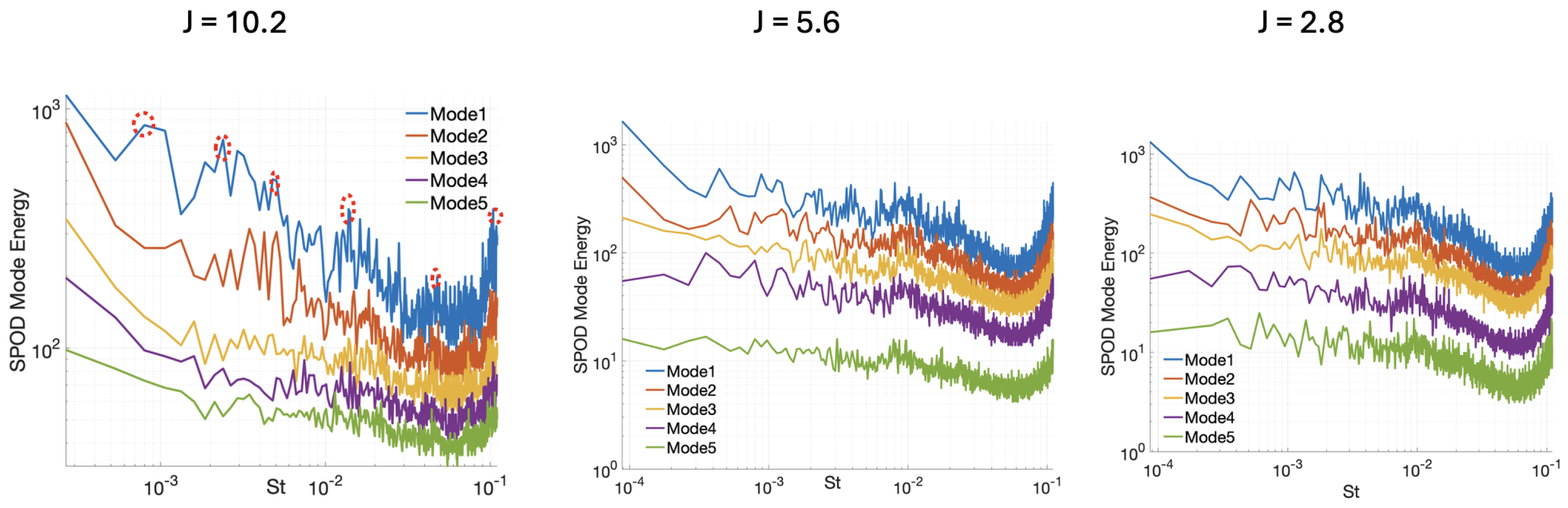
Figure 15 shows the frequency-dependent spectral proper orthogonal decomposition (SPOD) energies of the first five modes of the streamwise velocity fluctuations,
, at
for three momentum-flux ratios, highlighting how the underlying unsteady flow dynamics vary with jet strength. Each curve corresponds to a SPOD eigenvalue
, representing the energy of the
n-th most energetic coherent structure at a given Strouhal number. For the highest momentum ratio,
J = 10.2, the spectra display several well-defined energy peaks in Mode 1 (highlighted by red circles), indicating that the flow contains highly coherent, frequency-selective structures. These narrow-band peaks are characteristic of organized shear-layer instabilities and Kelvin–Helmholtz roll-up, which arise when the strong transverse jet penetrates deeply into the crossflow. The elevated energy in Mode 1 across the entire low- to mid-frequency range, combined with its substantial separation from Modes 2–5, confirms that a single dominant mechanism—the interaction between the jet’s upper shear layer and the CVP—governs the unsteady dynamics at this location. As the momentum ratio decreases to
J = 5.6, the spectra undergo a clear qualitative transition: the sharp Mode-1 peaks disappear, and the modal distribution becomes more broadband, reflecting the weakening of the shear-layer roll-up and reduced vertical penetration of the jet. The smaller spacing between the modal energy levels suggests that no single structure dominates the unsteady field; instead, multiple mechanisms contribute comparable energy as the jet motion becomes more strongly influenced by the surrounding boundary-layer turbulence. At the lowest momentum ratio,
, the modal energy content exhibits an even tighter collapse across all modes. This behavior indicates the absence of pronounced frequency-selective amplification and reflects a largely non-resonant, weakly organized dynamical response. This behavior indicates that the jet produces only weak disturbances that quickly blend into the background turbulence, resulting in unsteady dynamics that are largely dictated by the crossflow rather than jet-driven coherent structures. Overall, the SPOD spectra reveal a progressive shift from strongly coherent, shear-layer-dominated oscillations at high
J to turbulence-dominated, weakly organized motions at lower
J, fully consistent with the spatial POD mode shapes and with the expected physical response of a jet in crossflow as its momentum diminishes.
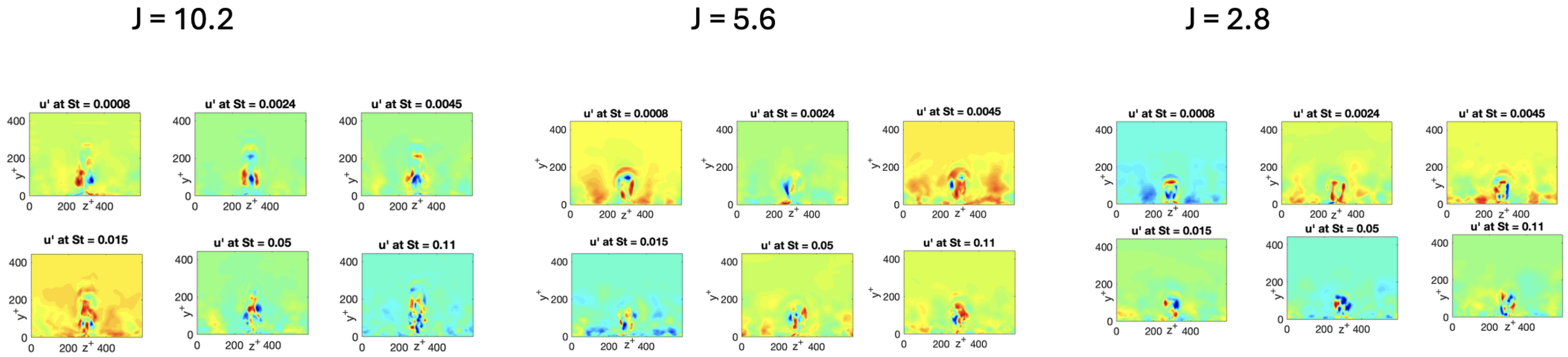
Figure 16 presents the first SPOD mode of the streamwise velocity fluctuations
at selected Strouhal numbers (highlighted by the red circle in
Figure 15) for all three momentum-flux ratios, revealing how distinct coherent structures dominate the supersonic jet-in-subsonic-crossflow at different temporal scales. Each frequency band corresponds to a physically meaningful mechanism, allowing the flow dynamics to be interpreted in terms of large-scale jet motion, shear-layer instabilities, and small-scale turbulent activity. At the lowest Strouhal numbers (
= 0.0008) and
J = 10.2, the dominant structure is a global jet-flapping or breathing mode. The SPOD modes show a broad, vertically elongated footprint centered around the jet core, extending both upward and laterally. This structure reflects slow, large-scale oscillations of the jet trajectory driven by global momentum imbalance between the jet and the crossflow. The coherence across a wide wall-normal extent indicates strong coupling between the jet core, the counter-rotating vortex pair (CVP), and the near-wall region. These low-frequency motions are primarily responsible for unsteady jet penetration and large-amplitude lateral wandering. At slightly higher low frequencies (
= 0.0024–0.0045) for
J = 10.2, the modes become more spatially localized and symmetric about the jet centerline. These structures correspond to CVP oscillation and jet-column wobbling, where the jet core undergoes periodic lateral displacement while maintaining coherence in the near field. The paired positive–negative lobes in the wall-normal direction are characteristic of alternating upwash and downwash induced by the CVP legs. These modes play a critical role in lateral dispersion and near-field mixing. At intermediate frequencies (
= 0.015) for
J = 10.2, the SPOD modes reveal shear-layer roll-up and Kelvin–Helmholtz-type instabilities along the jet–crossflow interface. The structures are more compact, with strong activity concentrated near the jet boundary rather than the core. The reduced spatial extent and increased complexity indicate the transition from global jet motion to instability-driven dynamics. These modes are responsible for enhanced entrainment and rapid breakdown of coherent jet structures downstream. At higher frequencies (
= 0.05) for
J = 10.2, the coherent patterns further fragment and become confined closer to the wall and shear layers. These modes represent secondary shear-layer instabilities and breakdown of large vortices into smaller-scale structures. The diminished spatial coherence and reduced wall-normal penetration indicate increased viscous dissipation and turbulence cascade effects. Their contribution is primarily to local mixing rather than large-scale jet deflection. At the highest frequencies shown (
= 0.11) for
J = 10.2, the SPOD modes are highly localized and irregular, characteristic of small-scale turbulent motions embedded within the jet wake and near-wall region. These structures lack global organization and reflect broadband turbulence rather than coherent jet dynamics. Although individually energetic at local scales, they contribute minimally to global momentum transport or jet penetration.
Another important outcome of
Figure 16 is the shift in the Strouhal number at which the arc-shaped plume structure appears for different momentum-flux ratios. It is a direct consequence of how the dominant global time scale of the jet–crossflow interaction changes with the momentum-flux ratio. The arc-shaped plume observed in the SPOD modes represents a large-scale, low-frequency jet-flapping or plume-meandering mode. This structure is associated with the periodic vertical and lateral displacement of the jet core and the counter-rotating vortex pair (CVP), which together form a curved, plume-like envelope in the cross-plane. The characteristic frequency of this motion is governed by the convective time scale of the jet plume, which depends on jet penetration height, jet velocity, and the strength of jet–crossflow coupling. For the high momentum-flux ratio case (
J = 10.2), the jet penetrates deeply into the crossflow and forms a tall, well-developed plume that is partially detached from the wall. The increased penetration length and higher jet momentum lead to a shorter effective convective time scale, since the jet core convects faster and the global oscillation is influenced by strong shear-layer dynamics and compressibility effects. As a result, the dominant plume-flapping mode shifts to a higher Strouhal number, appearing at
. In this regime, the arc-shaped plume is linked to oscillations of the lifted jet column and CVP system rather than slow wall-anchored motions. In contrast, for moderate and low momentum-flux ratios (
J = 5.6 and 2.8), the jet is more strongly bent by the subsonic crossflow and remains closer to the wall. The plume is shorter, more laterally spread, and more tightly coupled to the near-wall boundary layer. This configuration introduces a longer global time scale, as plume motion is constrained by wall friction, viscous damping, and reduced jet momentum. Consequently, the dominant arc-shaped plume structure appears at a lower Strouhal number,
, reflecting the slower, large-amplitude flapping of the wall-attached jet plume.
Importantly, comparisons with higher Reynolds-number experimental data by Beresh et al. [
9] and large-eddy simulations by Chai et al. [
10] indicate that the same dominant jet–plume flapping mechanism persists across a wide range of Reynolds numbers. In the present simulations, the dominant unsteady mode for
J = 10.2 occurs at
, whereas high–Re experiments and LES report a corresponding peak at
. While the characteristic frequencies differ, the persistence of the same dominant instability mode suggests that the underlying physical mechanism is largely Reynolds-number independent. The observed frequency shift is consistent with increased viscous damping and a reduced turbulence bandwidth at lower Reynolds numbers, which elongate the characteristic time scale of large-scale plume dynamics. Similar Reynolds-number-dependent frequency modulation of transverse jet flapping has been reported in prior studies [
9,
10]. These results indicate that, although the present study operates at a lower Reynolds number (two orders of magnitude lower than the experiment), the dominant flow physics and instability mechanisms remain representative of high-Re transverse jet behavior. A formal quantitative error analysis against experimental measurements is beyond the scope of the present study due to mismatched operating conditions and limited availability of phase-resolved experimental statistics; however, the observed agreement in dominant instability mechanisms and scaling trends supports the broader applicability of the conclusions.
Beyond the spectral differences, the Reynolds number also influences the spatial organization and breakdown of vortical structures in transverse jet flows. At lower Reynolds numbers, thicker jet and crossflow shear layers and enhanced viscous diffusion promote more coherent, extended vortical structures, with a delayed breakdown of the counter-rotating vortex pair and associated shear-layer vortices (
Figure 12,
Figure 13 and
Figure 14). As a result, large-scale motions remain dynamically dominant over longer distances and modes, leading to a reduced separation between energetic scales and a narrower turbulence spectrum. In contrast, high-Reynolds-number experiments and large-eddy simulations report thinner shear layers, stronger velocity gradients, and earlier transition to small-scale turbulence, which accelerate vortex stretching and breakdown. These effects introduce a wider range of interacting spatial scales and redistribute energy across a broader frequency band. Despite these differences in structural scale and breakdown behavior, the primary instability mechanisms governing plume flapping and jet–crossflow interaction remain qualitatively similar, indicating that the Reynolds number primarily modulates the scale and temporal characteristics of the flow rather than the underlying dynamics.
In essence, increasing J shifts the plume dynamics from a slow, wall-controlled flapping regime to a faster, jet-dominated oscillatory regime. The observed frequency shift of the arc-shaped structure therefore reflects a change in the balance between jet momentum, crossflow forcing, and wall influence. This behavior highlights the strong sensitivity of large-scale coherent dynamics to momentum-flux ratio in supersonic jet-in-crossflow configurations. The figure demonstrates a clear scale separation of coherent structures in the jet-in-crossflow system. Low-frequency SPOD modes are dominated by global jet flapping and CVP-driven motion, intermediate frequencies by shear-layer roll-up and instability dynamics, and high frequencies by small-scale turbulence. This hierarchy confirms that unsteady jet penetration and wall interaction are governed primarily by low- to intermediate-frequency coherent structures, while higher-frequency motions mainly contribute to dissipation and fine-scale mixing. These insights are critical for developing reduced-order models and flow-control strategies targeting specific dynamical mechanisms in high-speed jet–crossflow applications.