Article

A Distributed Operational Method for Convex Hull Pricing Based on the Alternating Direction Method of Multipliers with Dantzig–Wolfe and Benders Decomposition


1
Guangxi Key Laboratory of Multimedia Communication and Network Technology, School of Computer Electronics and Information, Guangxi University, Nanning 530004, China
2
School of Electrical Engineering, Guangxi University, Nanning 530004, China
3
Datang Hydropower Science and Technology Research Institute Co., Ltd., Chengdu 610083, China
4
School of Mathematics and Information Science, Guangxi University, Nanning 530004, China
*
Author to whom correspondence should be addressed.
Appl. Sci. 2026, 16(2), 1097; https://doi.org/10.3390/app16021097
Submission received: 21 December 2025 / Revised: 19 January 2026 / Accepted: 19 January 2026 / Published: 21 January 2026

Abstract

Due to the non-convex characteristic of the power system, it may be difficult for power generators to recover costs by following the system operators. Therefore, independent system operators have introduced discriminatory supplementary payments as incentive measures. In this context, convex hull pricing serves as an integrated solution, capable of markedly reducing such additional payouts. For the convex hull pricing problem, we propose a distributed solution method. This algorithm is based on Dantzig–Wolfe decomposition and Benders decomposition. According to the characteristics of different units, the model is decomposed into a master problem and a group of independent subproblems, and the consensus ADMM method is used to solve the master problem. The convex hull pricing problem can still be solved using this method when the data is stored separately or when the independent agents responsible for each unit wish to protect their information privacy. While ensuring the confidentiality of each unit’s information, high-quality solutions can still be obtained with high efficiency. By comparing the numerical results with those of the other three convex hull pricing algorithms, it is evident that our algorithm can obtain high-quality solutions.

1. Introduction

Recently, the US electricity market has gradually introduced the spot pricing mechanism based on marginal cost [1] to improve the efficiency of resource allocation. This mechanism originated from the mathematical modeling of the unit commitment and economic scheduling (UCED) problem [2], in which the optimal solution of the dual variable is used to derive the marginal price (LMP), thereby incorporating various operational constraints of the system. In the actual market operation, power generation enterprises need to report the technical conditions and marginal costs of the units to the independent system operator (ISO) and, at the same time, declare the related expenses (such as the minimum load cost, etc.). ISO will incorporate the above constraints and cost parameters into the UCED model for unified optimization, form dispatching results, and calculate a unified electricity price level based on this. This electricity price reflects the shadow price attribute of the incremental cost of power generation.
However, due to the widespread non-convex factors in the electricity market, the traditional marginal cost pricing method is unable to fully compensate for the startup, shutdown, and no-load expenditures of generating units [3]. In an environment with non-convexity, the ideal electricity price structure may not be constructed at all [4]. Therefore, some scholars have proposed that while maintaining the uniform marginal price mechanism, additional compensation should be provided to the activated units that have suffered losses due to accepting decisions. This part of the compensation should reflect its opportunity cost, that is, the discrepancy between the actual profit gained by the unit in accordance with the ISO arrangement and its optimal available income [3]. The subsidy, which is known as “uplift payments”, varies among different regions and units. Since such payments are usually shared by the entire system, it not only increases the socialization cost but also lacks a financial hedging mechanism, which has adverse effects on both the system operators and market entities. If such information is not transparent, it will cause potential participants to face greater uncertainty when evaluating the return on investment. Therefore, ISO is committed to setting prices that minimize uplift payments.
To enhance the transparency of the electricity market and reduce uplift payments, researchers have proposed approaches such as integer programming pricing, convex hull pricing (CHP), and extended local marginal prices [3]. Among these methods, convex hull pricing has received extensive attention because it can effectively reduce the uplift payments. The core idea is to approximately replace the non-convex cost component in mixed-integer linear programming (MILP) with a convex hull and construct the corresponding linear programming model. Then, with the help of its dual solution, the node electricity price and system dispatching cost are determined [5]. The method can not only ensure that the price is not lower than the marginal cost but also increase the incentive for power generators to participate at a lower cost. However, to accurately obtain the convex hull price, the optimal Lagrange duality model of the UCED [4,6] problem needs to be solved. This model not only has a non-smooth structure but also presents high computational difficulty and a complex solution, posing greater challenges in actual operations [7].
Based on existing research, there are two main types of technical paths used to deal with the convex hull pricing problem. One is the Lagrange duality problem that directly solves the UCED problem, usually combined with non-smooth optimization algorithms, such as the Dantzig–Wolfe (DW) decomposition applied in [8] and the Benders decomposition method proposed in [9]. The second is the level method (LM) established by [10] based on the Kelley algorithm [11]. However, these methods cannot guarantee the attainment of convergent solutions within polynomial time. An alternative method solves the linearly relaxed version of the UCED problem and deduces the convex hull price using the dual vectors corresponding to the system constraints [3]. The key to this path lies in establishing a linear model using the convex hull envelope of the feasible region and the cost function of a single set of convex hulls [12]. However, precisely depicting the convex hull structure of a single generator set often leads to a sharp increase in the model scale and usually poses significant implementation difficulties.
This study proposes a distributed method for solving the convex hull pricing problem. This method improves computational efficiency by distributing the computing tasks in parallel to multiple nodes while ensuring the confidentiality of the nodes’ internal device information. Based on the existing generation algorithms and considering that the Alternating Direction Method of Multipliers (ADMM) [11] has been widely applied in multiple fields in recent years, it exhibits outstanding performance in large-scale distributed convex optimization problems [13]. Especially in the optimization of power systems, ADMM has shown significant potential in solving the problem of large-scale unit commitment [14] and also has considerable advantages in the power market equilibrium model [15]. Theoretically speaking, ADMM can ensure the convergence of convex optimization problems to the global optimal solution. This research scheme integrates the ADMM with the generation algorithm and applies the combined approach to address the convex hull pricing issue in electricity markets. Its core objective is to secure unit information via an efficient parallel computing technique.
The main contributions of this article are as follows:
  • Based on DW decomposition and Benders decomposition, a distributed computing method for solving the convex hull pricing problem is proposed. This method proposes a decomposition framework of ADMM combined with DW decomposition and Benders decomposition. The DW and Benders decomposition completely decouple each subproblem, while ADMM further subdivides and solves the master problem. Such a completely decoupled structure decomposes a large problem into multiple small problems to be solved, which can significantly reduce the amount of calculation and improve the calculation speed.
  • This method can adopt different generation formulas according to the operational complexity of different units. Based on the above decoupling framework, the solution does not affect data security, ensuring the confidentiality of the information of each unit and achieving privacy protection of the unit information.
  • The quantitative findings demonstrate that the presented distributed algorithm can efficiently obtain high-quality solutions while ensuring the confidentiality of the information of each unit. In comparison with the currently common column generation algorithms, the algorithm can obtain solutions of higher quality; in comparison with the ADMM algorithm combined with the convex hull cutting plane, the proposed algorithm demonstrates significant improvements in both computational efficiency and solution quality.
The structure of this article is arranged as follows: Section 2 reviews the issue of convex hull pricing. Section 3 elaborates on the distributed convex hull pricing algorithm based on ADMM with DW decomposition and Benders decomposition. Section 4 presents the experimental results. Finally, Section 5 summarizes the research work. To avoid using the full names of technical terms too many times, which would make the article overly cumbersome, abbreviations of the terms will be used in some parts of the text. The specific abbreviation reference table can be found in the Nomenclature Section at the end of the article.

2. Convex Hull Pricing Problem

First, we introduce the convex hull pricing problem. We formulate an abstract unit commitment (UC) problem model. Leveraging this model, mathematical formulations are developed for both the problem of minimizing uplift payments and the convex hull pricing problem.

2.1. UC Model

Usually, we can abstract the UC problem into the following mathematical model:
F ( b ) = min x i { i G c i T x i }
s . t . i G B i x i b = 0
x i χ i , i G
where x i represents all the variables of the unit i , including scheduling variables, binary variables, state variables, and various auxiliary variables, and c i T x i represent the power generation cost of the unit i . Formula (2) represents the power balance constraint, where χ i represents the feasible decision set of the unit i . It is generally composed of single-unit constraints such as minimum start-stop time and up and down ramp constraints.
In practical production applications, we usually need to select a specific mathematical model to concretely express this abstract unit commitment model, facilitating our decision-making. With the considerable development of solvers, especially MILP solvers, in recent years, approximating complex mixed-integer quadratic programming problems as MILP problems has become the most widely adopted strategy at present. For the convenience of description, the theories and algorithms described in this paper are all based on the basic assumption that the startup cost is constant. The two-period model of the UC problem is selected here, which is represented as “model_2P”. The specific model can be found in [16].
From an economic perspective, the UC problem can actually be regarded as an economic scheduling problem. The purpose of this problem is to obtain greater benefits by minimizing costs or maximizing welfare. The optimal solution of the UC problem can be expressed as x I S O .

2.2. Uplift Payments and Convex Hull Pricing

Under the pricing stipulated by ISO, the self-scheduling maximization problem of each unit is shown in Formulas (4) and (5).
P i ( π ) = max x i { π T B x i c i T x i }
s . t .   x i χ i
where π represents the dual multipliers of equality constraints. If the unit profit is based on the ISO pricing, we use it to represent the revenue of the unit. The calculation formula for the opportunity loss cost of the profit of a single unit i is as follows, where P i I S O ( π ) denotes the profit of unit i .
C i L O C ( π ) = P i ( π ) P i I S O ( π )
Although the decision made by ISO is a feasible solution, there is no guarantee that it is the optimal solution to the problem corresponding to Formula (1). However, it can be determined that the lost opportunity cost (LOC) corresponding to this feasible solution will not be negative. In the actual electricity market, due to the existence of non-convex structures, it is usually difficult to find a unified set of market-clearing electricity prices, which strictly reduces the total LOC (that is, the sum of the LOCs of all generating units) to zero. Therefore, under such circumstances, ISO must provide corresponding “uplift payments” to the relevant generating units to ensure that they are implemented in accordance with the market-clearing dispatching plan. However, this resource-oriented compensation mechanism often affects the openness and transparency of the electricity market. Therefore, a key task of ISO is to optimize the electricity price vector to minimize the total LOC as much as possible, thereby reducing the reliance on uplift payments [17].
The idea of convex hull pricing was proposed in [2], and it was analyzed from two perspectives: graphical interpretation and Lagrange duality. By dualizing the equation constraints in the power balance equation (Formula (2)), the corresponding Lagrange dual function (7) can be derived, providing a theoretical basis for the study of the optimal electricity price.
D ( π ) = min x i χ i [ i G c i T x i + π T ( b i G B i x i ) ]
where π is the Lagrange multiplier with equality constraints. Obviously, since D ( π ) is the relaxed form of F ( b ) , the difference between the two is
F ( b ) D ( π ) = i G c i T x i I S O min x i χ i [ i G c i T x i + π T ( b i G B i x i ) ] = i G c i T x i I S O + i G max x i χ i [ π T B i x i c i T x i ] π T b
Therefore, i G C i L O C ( π ) = F ( b ) D ( π ) can eventually be obtained.
The problem we need to solve is to obtain min i G C i L O C ( π ) ; this problem can be transformed into solving
max D ( π ) = max π   min x χ i [ i G c i T x i + π T ( b i G B i x i ) ]
Let c o n v ( χ i ) = { x i | D i x i d i } , then models (1)–(3) can be relaxed as
F ˜ ( b ) = min x i { i G c i T x i }
s . t .   i G B i x i b = 0
D i x i d i , i G
The Lagrange duality of the above relaxation problem can be written as
max π , λ i ( π T b + i G λ i T d i )
B i T π + D i T λ i = c i , i G
λ i 0

3. A Fully Distributed Method for CHP Based on ADMM with DW and Benders Decomposition

In this section, we will introduce the fully distributed method for convex hull pricing based on consensus ADMM combined with DW decomposition and Benders decomposition that we proposed.

3.1. A Fully Distributed Decomposition Framework of ADMM for CHP with DW and Benders

Suppose there are the following forms of problems:
max x n = 1 N f n ( x )
s . t .   A n x b n ( n = 1 , , N )
where f n : d is a convex and closed function, and A n represents the constrain coefficient matrix on the left side; the objective function of this optimization problem is related to each constraint through the decision variable x. Further, we can rewrite this formula as [18]
max x , x n n = 1 N f n ( x n )
s . t .   A n x n b n ( n = 1 , , N )
x n = x   ( n = 1 , , N )
Let α n d be the Lagrange multiplier of the coupling constraint; then, we can obtain the augmented Lagrange function of this expression, where ρ is the penalty term coefficient of ADMM. It is usually set to ρ > 0 .
max x , x n n = 1 N [ f n ( x n ) + α n T ( x x n ) ρ 2 | | x x n | | 2 ]
s . t .   A n x n b n ( n = 1 , , N )
The basic idea of the ADMM method is to perform two calculation steps alternately: On the one hand, the objective function is maximized with respect to the variable ( x , x 1 , , x n ) ; on the other hand, the minimization operation is performed on the Lagrange multiplier variable. During the maximization process, the algorithm adopts a sequential update approach. Firstly, it solves each one ( x , x 1 , , x n ) separately and then updates the global variables uniformly after completion. This optimization strategy of local first followed by global enables subproblems to be solved independently in parallel, thereby improving the overall computational efficiency.
Based on the DW and Benders decomposition, this method decomposes all the units into disjoint groups G 1 G 3 . We classify the units in the system according to their variable and constraint counts: those with both variable and constraint magnitudes of O ( T ) are assigned to G 1 , whereas units with variable and constraint counts exceeding O ( T ) are further subdivided into G 2 and G 3 based on their operational characteristics. Notably, all units within the same group exhibit similar features. Therefore, (10)–(12) can be expressed as the following master problem:
F M P = min x i , β i j   f G 1 , G 2 , G 3 , K i , κ i ( x i , β i j ) = min x i , β i j ( i G 1 c i T x i + i G 2 j = 1 | K i | c i T x i j β i j + i G 3 c i T x i )
s . t . i G 1 B i x i + i G 2 j = 1 | K i | B i x i j β i j + i G 3 B i x i = b
D i x i d , i G 1
j = 1 | K i | β i j = 1 , i G 2
β i j 0 , j [ 1 , | K i | ] , i G 2
A i x i a i , i G 3
( l i j ) T x i g i j , ( l i j , g i j ) κ i , i G 3
The set of poles of the feasible region is K i . For the units in the set G 3 , the tight slack form of the feasible region can be expressed as { x i | A i x i a i } . On this basis, the constraint ( l i j ) T x i g i j is regarded as an effective cutting plane for the tight-relaxation model. To ensure the modeling accuracy of G 3 , all necessary supplementary constraints will be added to the set κ i . Therefore, the convex hull of the feasible region can be specifically defined as { A i x i a i , ( l i j ) T x i g i j , j κ i } .
Since it is difficult to directly enumerate all the points (for i G 2 ) and construct all the cutting planes (for i G 3 ) in the feasible region, this paper adopts the DW decomposition for the units in G 2 , while the Benders decomposition is used for the units in G 3 . When establishing the restricted master problem (RMP), we replace each K i in the original problem with its subset K i k K i , which is applicable to all the units belonging to G 2 . Meanwhile, for all i G 3 , κ i will be replaced by their subsets κ i k κ i . Under the framework of linear programming, the dual form of this RMP is called DRMP.
Before presenting the mathematical expression of the dual restricted master problem (DRMP), we provide an intuitive interpretation to clarify its role in the proposed decomposition framework.
From an optimization perspective, the dual formulation offers an alternative viewpoint that emphasizes constraint enforcement rather than direct objective minimization. Specifically, the dual variable y can be interpreted as the shadow price associated with the system-wide power balance constraint, reflecting the marginal cost of satisfying the coupling constraint among all units. The variables λ i , δ i , and ω i correspond to the local feasibility constraints of different types of units, quantifying how tightly each unit’s feasible region restricts the overall objective value.
For the units in set G 2 , the dual variables δ i are associated with the convex combination constraints of extreme points, indicating the marginal contribution of each selected extreme point to the system cost. For the units in set G 3 , the dual variables ψ i j represent the effective cutting planes introduced through the Benders decomposition, which iteratively tighten the relaxed feasible region and guide the solution toward the true convex hull.
Under the combined DW and Benders decomposition framework, the DRMP plays a critical role by aggregating the marginal information provided by all subproblems. Through these dual variables, the interactions between different unit groups are coordinated via price-like signals, enabling the algorithm to balance system-level optimality and local feasibility during the iterative process. This interpretation also provides an intuitive explanation for the convergence of the algorithm, as the restricted master problem and its dual share the same optimal objective value under strong duality.
Accordingly, the dual formulation of the RMP is given as follows. F R M P is recorded as the optimal objective value corresponding to the restricted master problem (RMP). According to the strong duality theory in linear programming, it can be deduced that the optimal value of its dual problem, DRMP, is the same as that of the primal problem. That is F R M P = F D R M P , when the algorithm completes the iteration and reaches the convergence condition, the objective function values among each model tend to be consistent, thus F R M P = F D R M P = F M P .
F D R M P = max y , λ i , δ i , ω i , ψ i j ( b T y + i G 1 d i T λ i + i G 2 δ i + i G 3 a i T ω i + i G 3 ( l i j , g i j ) κ i k g i j ψ i j ) = max y , λ i , δ i , ω i , ψ i j θ G 1 , G 2 , G 3 , K i , κ i ( y , λ i , δ i , ω i , ψ i j )
B i T y + D i T λ i = c i , i G 1
δ i + ( B i x i j ) T y c i T x i j , x i j K i k , i G 2
B i T y + A i T ω i + ( l i j , g i j ) κ i k l i j ψ i j = c i , i G 3
λ i 0 ,   i G 1
ω i 0 ,   i G 3
ψ i j 0 ,   i G 3 ,   j [ 1 , | κ i k | ]
where y , λ i , δ i , ω i , ψ i j represent the dual multiplier of the power balance constraint and the local constraint matrices of each type of unit. It can be noted here that the dual form (30)–(36) of the convex hull pricing problem we studied is similar to the form of (16) and (17). Moreover, when all the units are divided into three disjoint groups G 1 G 3 , the subproblems of each group are independent, which is very suitable for combining with ADMM for distributed computing. This can not only reduce the scale of the problem solved in each iteration, but it also ensures the confidentiality of the information of each unit. The model of the DRMP can be equivalently expressed in the following form:
max h ( y )
where h ( y ) = i G h i ( y ) . For each disjoint group G 1 G 3 , the form of the subproblem about each group is as follows, denoted as A D D R i .
For i G 1 , the subproblem model is
h i ( y ) = max λ i 1 N b T y + d i T λ i
s . t .   B i T y + D i T λ i = c i , i G 1
λ i 0 ,   i G 1
For i G 2 , the subproblem model is
h i ( y ) = max δ i 1 N b T y + δ i
s . t .   δ i + ( B i x i j ) T y c i T x i j , x i j K i k , i G 2
For i G 3 , the subproblem model is
h i ( y ) = max ω i 1 N b T y + a i T ω i
s . t .   B i T y + A i T ω i + ( l i j , g i j ) κ i k l i j ψ i j = c i , i G 3
ω i 0 ,   i G 3
ψ i j 0 ,   i G 3 ,   j [ 1 , | κ i k | ]
Based on the consensus-based ADMM theory, in each iteration k of our algorithm, using the α i k and y k obtained in the current iteration, solve the A D D R i of each unit i . In general, the steps can be summarized as follows:
Step 1. Based on the A D D R i problem corresponding to each unit i , solve the corresponding augmented Lagrange functions constructed according to (30)–(36).
Step 2. y k + 1 = 1 N i = 1 N y i k + 1 + 1 N ρ i = 1 N α i k .
Step 3. α i k + 1 = α i k ρ ( y k + 1 y i k + 1 ) , i = 1 , , N .
For each unit i , all types of inequality constraints and equality constraints always hold. This is because the solutions obtained for each type of unit i corresponding to the subproblems are themselves feasible solutions in the k-th iteration. In each iteration, the situations where constraints are violated are due to y k + 1 y i k + 1 , that is, conflicts between the global consensus variables and the local variables obtained from the subproblem solutions. This article defines
r d = i = 1 N | | y k + 1 y i k + 1 | | 2
as the dual residual and defines
r p = ρ | | y k + 1 y k | |
as the original residual. During the process of solving the DRMP using ADMM, steps 1–3 are repeated until the two convergence conditions are met: r d ε d and r p ε p , where ε d and ε p represent the convergence accuracy of the dual and primal residuals, respectively.
After the above convergence criteria are satisfied, we handle the two subordinate subproblems in the generation process, thereby achieving the goal of gradually constructing the updated sets K i and κ i .
Suppose that in each iteration of the generation, ( y l , λ i l , δ i l , ω i l , ( ψ i j ) l ) is an optimal solution to the DRMP, and ( x i * , ( β i j ) * ) is the optimal solution obtained by RMP under the current solution state. After the convergence criterion of ADMM is satisfied in solving the DRMP, each i G 2 will independently solve a pricing subproblem to determine whether a new column vector needs to be introduced to update K i :
r i ( y ) = min x i χ i ( c i T x i y T B i x i )
When y takes the value of y l + 1 obtained during the convergence of the ADMM iteration, the optimal solution is
x i l + 1 = arg min x i χ i ( c i T x i y T B i x i ) , i G 2
If the reduction cost r i ( y l ) corresponding to this extreme point is less than the current dual variable δ i l , it indicates that the current model has not reached the optimal solution. Therefore, the newly generated column x i l + 1 needs to be added to the constrained master problem, that is
K i l + 1 = K i l { x i l + 1 }
To optimize the algorithm and ensure that the algorithm terminates within a limited number of iterations, it is stipulated that the pricing subproblem of each unit i is satisfied precisely when
δ i l + 1 r i ( y l + 1 ) > | | B i x i j | | ε d , x i j K i l
The newly generated column x i l + 1 is then added as a new pole. In the l + 1 iteration of the algorithm, for all i G 2 , we have δ i l + 1 r i ( y l + 1 ) . This indicates that the optimal solution to the convex hull pricing problem of the G 2 type unit has been found.
For i G 3 , the corresponding subordinate subproblem is a cutting plane generation linear programming [19]. By solving this type of subproblem, we can determine whether the solution in the current iteration state is within the set c o n v χ i ; if this point is not within this convex hull, then a cutting plane can be further constructed to remove it from the current feasible region. If at the l + 1 iteration of the algorithm, there is x i * c o n v ( χ i ) for all i G 3 at this time, it indicates that the optimal solution for the convex hull pricing problem of the units of G 3 has been found. The convex hull structure of every single group’s feasible region can be represented as follows [19]:
c o n v χ i = y h k i + , q h k t , i , ϕ h k t , i D [ h , k ] i , q h k t , i , ϕ h k t , i , y h k i d =   { [ h , k ] A i t [ h , k + T off i ] y h k i 1 , t [ 1 , T ]   P _ i y h k i q h k t , i P ¯ i y h k i , t [ h , k ] q   h k h , i P s t a r t i y h k i q h k k , i P s h u t i y h k i q h k t , i q h k t 1 , i P u p i y h k i , t [ h + 1 , k ] q h k t 1 , i q h k t , i P d o w n i y h k i , t [ h + 1 , k ] ϕ h k t , i ( β i + 2 γ i p i i ) q h k t , i + α i γ i ( p i i ) 2 y h k i , t [ h , k ] y h k i + , q h k t , i , ϕ h k t , i , [ h , k ] A i , t [ h , k ] , i G 3 }
Formula (53) represents the convex hull of the feasible region for a single unit in G 3 . Based on this convex hull model, we can construct the following subordinate subproblems for the units of G 3 , which are used to generate cutting planes:
s i * = min s , q h k t i , ϕ h k t i , y h k i s
s . t .   D [ h , k ] i , q h k t , i , ϕ h k t , i , y h k i d + 1 s , [ h , k ] A i ( ε i )
[ h , k ] A i , t [ h , k ] q h k t , i = P t i * , t [ 1 , T ] ( μ i )
[ h , k ] A i , t [ h , k ] ϕ h k t , i = z t i * , t [ 1 , T ] ( ξ i )
[ h , k ] A i , t [ h , k ] y h k i = u t i * , t [ 1 , T ] ( ζ i )
[ h , k ] A i , h = t y h k i = v t i * , t [ 1 , T ] ( η i )
Formulas (54)–(59) are used to generate the subproblems for the cutting planes. If the target function value obtained by solving this minimization problem is s i * = 0 , then it implies that x i * c o n v ( χ i ) . If s i * > 0 , it indicates that x i * c o n v ( χ i ) . In this case, a cutting plane should be introduced to eliminate and tighten the model to prevent the master problem from optimizing in an ineffective direction and ensure the final convergence of the model.
Furthermore, based on the strong duality theory, we can obtain
s i * = ( ε i * ) T d + ( μ i * ) T ( P i ) * + ( ξ i * ) T ( z i ) * + ( ζ i * ) T ( u i ) * + ( η i * ) T ( v i ) *
Therefore, for each unit i G 3 , the corresponding cutting plane can be expressed as
( ε i * ) T d + ( μ i * ) T P i + ( ξ i * ) T z i + ( ζ i * ) T u i + ( η i * ) T v i 0
This formula can be simplified to the form of Formula (62):
( l i k ) T x i g i k
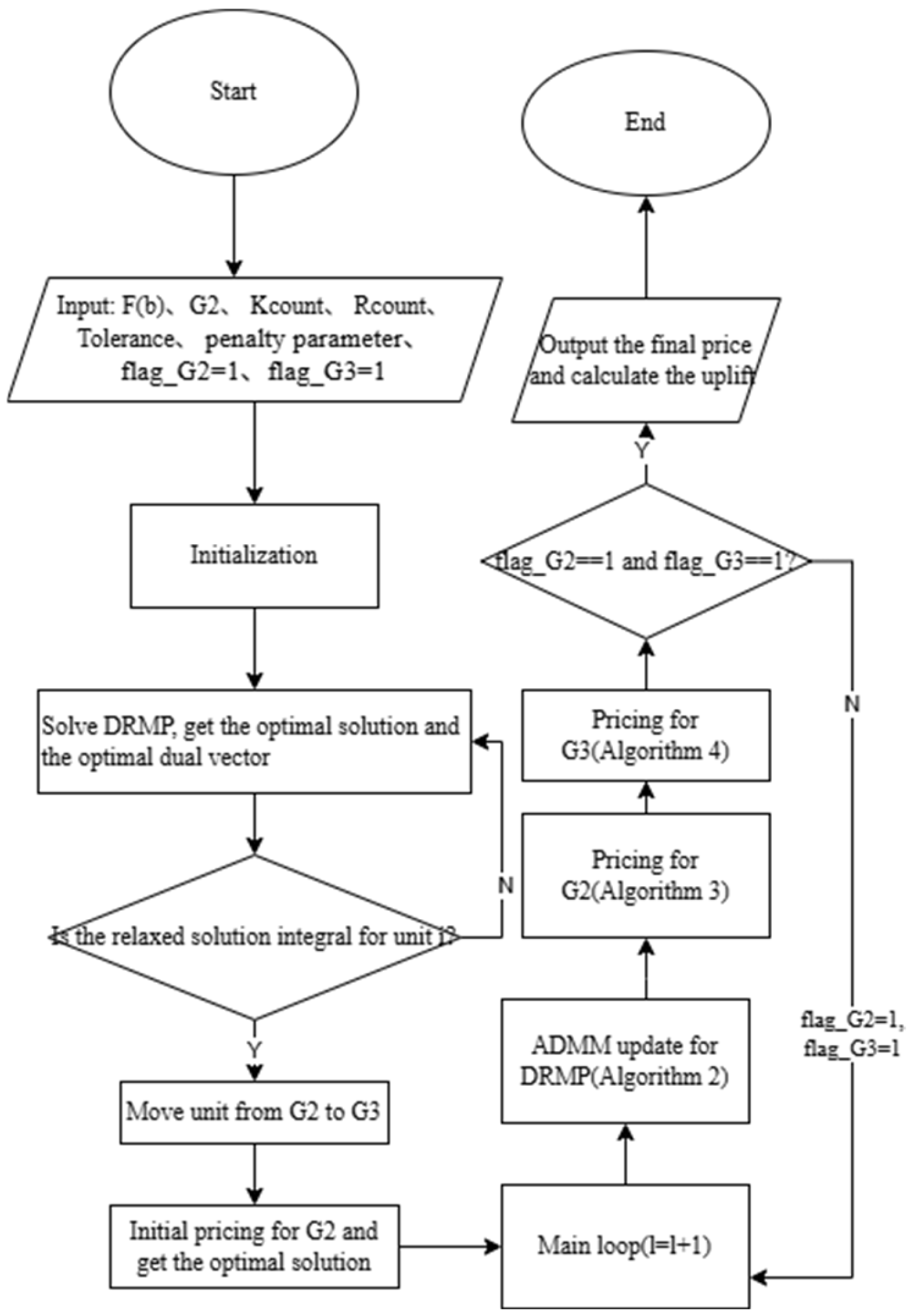
Whenever all the subproblems of the entire group are solved, new columns are added, or new cutting planes are generated, we use y k + 1 , α i k + 1 obtained during the previous ADMM internal iteration convergence as the initial y 1 , α 1 for the next ADMM solution of the constrained master problem. If for all the groups, no new improving columns or effective cutting planes can be obtained for each group, we can terminate the algorithm, output the approximate objective value, and obtain the corresponding uplift price. We systematically summarize this fully distributed decomposition framework of ADMM for CHP with DW and Benders. The main process of the algorithm is shown as Algorithm 1. In Algorithm 1, at the beginning stage of the algorithm, initialization is carried out. For G 2 type units, only the poles corresponding to their initial operating state are retained; for G 3 type units, their continuous relaxation states are initialized. Subsequently, the algorithm solves DRMP to obtain the initial dual price vector. If some G 2 units have already presented integer solutions in the tight-relaxation solution, they are removed from G 2 and transferred to the G 3 set, thereby reducing the scale of subsequent column generation. For the remaining G 2 units, the algorithm solves the pricing subproblem under the initial price, generates the first set of feasible poles, and adds them to the corresponding pole set. In each outer iteration of the main loop of the algorithm, first, the ADMM update step is called, and the system price and dual variables are updated based on the current pole set. Then, for G 2 and G 3 type units, the corresponding pricing subproblem algorithms are called, respectively, to determine whether new columns need to be generated. If the pricing subproblems of G 2 and G 3 have not generated new poles, the algorithm terminates and obtains the final result; otherwise, the next iteration continues to expand the pole set and update the dual variables.
Algorithm 1: The main process of algorithm of ADMM for CHP with DW and Benders
  Input: F ( b ) , G 2 = G G 1 , K c o u n t , R c o u n t , ε p , ε d > 0 ,
  penalty parameter ρ > 0 , flag_G2 = 1, flag_G3 = 1
  Initialize  y 1 , α i 1 for all i G , K i 0 = { x i I S O } for i G 2 , s i 0 = 1 for i G 3 , Β = ϕ , s N u m = 0 , l = 0
  Output: price y * , U p L i f t
  Solve DRMP with c o n v ( χ i ) being replaced by tight relaxation ( χ i ) C R , obtain the optimal solution x i C R and the optimal dual vector y 0
  for  i G 2 :
    if  x i C R   has   binary   ( u i , v i ) :
      G 2 = G 2 { i } , G 3 = G 3 + { i }
   solve   ( 49 )   for   i G 2   with   y = y 0 ,   and   get   the   optimal   solution   x i 0
   K i 1 = K i 0 { x i 0 }
  while true:
     l l + 1
    Initialize primal and dual residuals r p = ,   r d =
     k 0
    Algorithm 2 to get y k + 1  and α i k + 1
    Algorithms 3 and 4 to solve the pricing subproblem
    if flag_G2 = 1 and flag_G3 = 1:
      break
    else:
      flag_G2 = 1, flag_G3 = 1
       l l + 1
    end if
   y l y k + 1 , α i 1 α i k + 1
  end while
   y * = y l , U p L i f t = F ( b ) F D R M P
Through the ADMM algorithm with adaptive penalty term coefficients [20], we can obtain y k + 1 and α i k + 1 , as shown in Algorithm 2. Algorithm 2 describes how to solve DRMP through ADMM iterations when a given set of current poles is available. In each iteration, each subproblem solves its own local dual variables in parallel, updates the system-level price variables by averaging, and accordingly corrects the dual multipliers on the generator side. The algorithm also calculates the original residuals and dual residuals to measure the consistency degree between different subproblems. To accelerate the convergence speed, the penalty parameter is adjusted adaptively according to the size of the residuals; when both the original residuals and dual residuals meet the given tolerance, the ADMM iterations terminate.
Algorithm 2: Solve DRMP with adaptive penalty term coefficient
  Input  μ 1 , μ 2 , η 1 , η 2 > 0
  while  r d > ϵ d and r p > ϵ p do
     k k + 1
    for each i = 1 , , N do
      solve A D D R i
      collect optimal solutions ( y i k + 1 , λ i k + 1 , δ i k + 1 , ω i k + 1 , ( ψ i j ) k + 1 )
    end for
     y k + 1 = 1 N i y i k + 1 + 1 N ρ i α i k
     α i k + 1 = α i k ρ ( y k + 1 y i k + 1 ) , i = 1 , , N
     r d = i = 1 N π k + 1 π i k + 1 2
     r p = ρ ( y k + 1 y i k + 1 )
    if  r p > μ 1 r d
      ρ ρ ( 1 + η 1 )
    elif:  r d > μ 2 r p
      ρ ρ / ( 1 + η 2 )
    else:
      ρ ρ
    end if
  end while
Through Algorithms 3 and 4, we can solve the pricing subproblems of the units belonging to types G 2 and G 3 , respectively. Algorithm 3 describes how to solve the pricing subproblem for G 2 type units under the given current system price to generate new poles. For each unit, the algorithm solves the pricing model under the latest price vector to obtain candidate operation schemes and their corresponding improvement metrics. If the improvement degree exceeds the tolerance threshold related to the current pole size, then this scheme is considered to have a practical contribution to characterizing the convex hull of the unit, and it is added to the pole set without exceeding the upper limit of the pole number. The flag variable flag_G2 is used to indicate whether a new pole has been successfully generated in this round, thereby determining whether the subsequent outer iteration should continue. Algorithm 4 describes the pricing and cut-plane generation process for G 3 type units. This algorithm first uses the existing interval information to determine whether the current operation plan has been covered by the generated intervals. If the coverage is valid, there is no need to further solve the subproblems; otherwise, the algorithm solves the corresponding subordinate problem to evaluate the feasibility under the current price and simultaneously obtains the sensitivity information of the right-hand side terms and the dual multipliers. When a violation of the constraint is detected, the algorithm constructs a new effective cut-plane based on the optimal dual information of the subproblem and adds it to the main problem without exceeding the upper limit of the number of cuts. The flag variable flag_G3 is used to indicate whether a new cutting plane is generated in this round, thereby determining whether the outer algorithm continues to iterate.
Algorithm 3: Solve pricing subproblems of G 2
  for  i G 2 :
    solve (49) with y = y k + 1 , get r i ( y k + 1 ) and solutions x i l + 1 .
    if  δ n k + 1 r i ( y k + 1 ) > max x i j K i l { | | B i x i j | | } ε d :
      if  | K i l | < K c o u n t :
       Add extreme point x i l + 1 , K i l + 1 = K i l { x i l } ; flag_G2 = 0
      else:
        K i l + 1 K i l ;
      end if
    end if
  end for
Algorithm 4: Solve pricing subproblems of G 3
for  i G 3 ,
  If  | B | 0 and there exists j such that ( ( P ˜ t i ) * , ( z t i ) * , ( u t i ) * , ( v t i ) * ) [ L o w i , U p i ] j :
     s i * = 0 ;
     s N u m s N u m + 1
  else:
    solve slave problem (54)–(59), get s i * , right-hand side sensitivity information
     [ L o w i , U p i ] l and the optimal Lagrange multiplier ( ε i k , μ i k , ξ i k , ζ i k , η i k ) .
    if  s i * = 0 :
      B B { [ L o w i , U p i ] l }
    end if
  end if
  if  s i * > 0 :
    if | κ i k | < R c o u n t :
     generate a new cut ( l i l ) T x i g i l ;
      κ i l + 1 κ i l { ( l i l , g i l }
       flag_G3 = 0
    else:
        κ i l + 1 κ i l
    end if
  end if
end for
When solving the dual restricted master problem (DRMP), each ADMM iteration will obtain the current estimate value of y and then solve the subproblem A D D R i based on the current y to obtain the corresponding dual variables of y i for the subproblem. When all the subordinate subproblems of the generating units meet the conditions of no new extreme points and no effective cutting planes being added, the algorithm terminates. To improve efficiency, we execute Algorithm 1 multiple times. Initially, a relatively loose tolerance is used, and then it is gradually tightened until the desired accuracy is achieved. The flowchart with a brief overview of the proposed algorithm is shown in Figure 1.

3.2. Convergence

The quality of the dual solution obtained by the consensus-based ADMM largely affects the quality of the original solution. We use r d to represent the duality feasibility error and use r p = ρ ( y k + 1 y i k + 1 ) to represent the original feasibility error. Under the condition of given tolerances ε d and ε p , we suppose the ADMM algorithm terminates at r d < ε d and r p < ε p . Moreover, we define ε as the optimality gap caused by ADMM; in other words, z D R M P z A D D R ε . Through the following theoretical derivation, it can be well demonstrated that this algorithm converges.
We suppose z D R M P z A D D R ε ; when the algorithm meets δ n k + 1 r i ( y k + 1 ) > max x i j K i l { | | B i x i j | | } ε d , it can terminate. Then, we have ε d n = 1 N | | B i | | F   L i z D R M P z A D D R ε , where L i is a local constraint on the upper bound of the 2-norm of all extreme points. By the sandwich theorem, it can be concluded that this algorithm converges. This derivation is for i G 2 . As for i G 3 , the general derivation process is similar to that of i G 2 , so we will not elaborate on it again.

4. Numerical Experiments

This section aims to evaluate the performance of the algorithm proposed in this paper when dealing with large-scale numerical examples. The adopted test dataset is from the literature [21], and each test case covers 24 time periods. All experiments were completed on a notebook computer configured with an Intel i5-13500H 2.60 GHz CPU and 16 GB of memory. During the experiment, the algorithm was implemented using Python 3.11.3, and Gurobi 11.0.0 was used as the optimization solver. The optimality tolerance of mixed-integer linear programming was set to 1 × 10⁻⁴. It should be noted that all the algorithms in this paper are constructed based on the two-period model (model_2P) to describe the UC problem. The source code for our work is available at https://github.com/linfengYang/ADMM_RGCG (accessed on 28 June 2025).
In the numerical experiment, we classified the 40 instances we used into 8 categories. The specific examples are shown in Table 1. Among them, the eighth type of unit is obtained by replicating the fifth type instance and scaling the corresponding hourly requirements. The “N” column in Table 1 represents the number of units in the corresponding category. In the subsequent experiments, we present the results of all the units of each category.
This study first tested an example of 10 units with a period of 24 h. There was no limit on the algorithm accuracy, allowing the algorithm based on ADMM with DW and Benders to achieve natural convergence. The correctness was verified by comparing the obtained results with those directly obtained using the solver. It has been verified that this algorithm can converge to the global optimal solution. The test results are shown in Table 2, where “N” represents the number of units in the test set used, and “T” represents the number of periods in the test set used. “MIP” represents the optimal target value achieved through the mixed-integer linear programming model of “model_2P”. “OPT” represents the result of using the precise convex hull pricing formula. “Solution” represents the result obtained under natural convergence using the algorithm proposed in this paper, and “Uplift” represents the uplift payments. From Table 2, Table 3, Table 4, Table 5 and Table 6, the columns labeled “N”, “T”, “MIP”, and “Uplift” all have the same meaning. Their explanations will not be repeated here.
To demonstrate the accuracy of the proposed method, we evaluated both (i) optimization accuracy and (ii) economic accuracy against the convex hull pricing solution (OPT). Specifically, we report
  • Objective optimality gap (for cases where OPT is available; cases 1–6):
    G ap Z ( % ) = | Z a l Z O P T | Z O P T × 100 %
    where Z denotes the objective value reported as “Solution” in Table 3, Table 4, Table 5 and Table 6.
  • Uplift deviation (economic accuracy; cases 1–6):
    G ap U ( % ) = | U a l U O P T | Z O P T × 100 %
    where U denotes the uplift payments reported in Table 3, Table 4, Table 5 and Table 6.
In this article, the methods considered in the numerical experiments are denoted as follows:
  • OPT: For all instances in cases 1 to 6, the precise convex hull pricing formula is used to obtain the convex hull price and the uplift payments.
  • Column generation (CG): All instances in cases 1 to 8 adopt the traditional column generation algorithm to solve the approximate convex hull price and the uplift payments.
  • ADMM with cutting plane (ADMM_CP): During the ADMM solution process, the convex hull cutting plane is added to obtain the approximate convex hull price and uplift payments [21].
  • ADMM with DW and Benders (ADMM_DB) (the method proposed in this paper): In the initial stage, some units are grouped into G 1 according to operational characteristics, while the remaining units are placed in G 2 . Then, ADMM combined with DW and Benders decomposition is used to solve the approximate convex hull price and the uplift payments.
Table 3 shows the convex hull prices and the results of uplift payments obtained using the precise convex hull pricing formula for all examples in cases 1 to 6. The reason why only the examples of cases 1 to 6 were solved is that, as the number of generators increases, the time consumption for solving using the precise convex hull pricing formula becomes longer and longer. By solving the first six categories and analyzing the results, the pattern can be roughly summarized. Therefore, no statistical results are provided for cases 7 to 8 in this article. In Table 3, the second column marked as “N” represents the quantity of units for each example in each category. The column marked as “T” represents the period for each example in each category. The column marked as “MIP” represents the optimal target value achieved through the “model_2P”. The “Solution” column displays the optimal objective values derived from various computational approaches. Table 3 presents the optimal target values obtained using the OPT algorithm. The columns marked as “Uplift” represent the uplift payments, while the column marked as “Time” counts the time taken by the algorithm to solve the problems. In Table 3, Table 4, Table 5 and Table 6, the meaning represented by the “Time” column is the same. Therefore, no further elaboration is necessary.
It should be emphasized that since a large number of examples are used in this paper, for statistical convenience, the columns corresponding to “MIP”, “Solution”, and “Uplift” represent the sum of the results for all examples in each case. The statistics for solution time (Time) and the number of iterations (Iter) are all average values. Unless otherwise specified, this statistical standard will be adopted in the subsequent experiments.
Table 4 presents the experimental results of the approximate convex hull price and the uplift payments using the traditional column generation algorithm for all examples in cases 1 to 8. “Solution” represents the optimal target value obtained using the traditional column generation (CG) method, and “Iter” counts the average number of iterations for solving each category of examples in column generation.
Table 5 presents the experimental results of all the examples in cases 1 to 8, which adopt the incorporation of convex hull cutting planes during the ADMM solution process to obtain the approximate convex hull price and the uplift payments. “Solution” represents the optimal target value obtained using ADMM combined with the cutting plane technique, and “Iter” calculates the average number of iterations for each category of examples solved by this algorithm.
Table 6 presents the experimental results of solving the approximate convex hull price and the uplift payments using the proposed method (ADMM_DB) for all examples in cases 1 to 8. “Solution” represents the optimal target value obtained using the ADMM combined with DW and Benders decomposition. In this algorithm, both ADMM and DW decomposition and Benders decomposition will generate iterations in their respective modules, and they complement each other, so it is of little significance to count the number of iterations. Therefore, the number of iterations is not reported in the result of this algorithm.
It can be seen from Table 3 that when the scale of the problem that needs to be solved is not large, that is, when the number of units in the unit is small (such as 10 units or 20 units), the overall operation time of the OPT algorithm is short, and high-quality solutions can be obtained. However, with the increase in the number of units and the extension of the dispatching cycle, the optimization model’s dimensionality increases substantially, the scale of the problems to be solved becomes larger, the solving speed of the OPT algorithm decreases, the solution becomes more difficult, and the computational efficiency is significantly reduced. Therefore, as the number of units increases, the scale of the problems to be solved becomes larger. This is obviously inconsistent with the practical needs of solving the convex hull price and the uplift payments using the OPT algorithm. Therefore, in this paper, we only present the experimental results of the OPT algorithms from case 1 to case 6.
Combining Table 3 and Table 4, we can see that when the scale of the problem to be solved is not large, the column generation algorithm is inferior to the OPT algorithm in terms of computational efficiency, that is, the solution time and the quality of the solution. However, as the scale of the problem gradually expands, the traditional column generation algorithm is significantly better than the OPT algorithm in solution efficiency. However, there is still a gap in the quality of the solution compared with the OPT algorithm. The accuracy of the solution is not high enough.
Since ADMM is very suitable for solving large-scale problems, in this paper, we compare it with the method combining ADMM with the convex hull cutting plane method. It should be noted that the ADMM algorithm exhibits reduced convergence rates when operating under high-precision requirements. To accelerate the iteration and convergence speed of ADMM, the accuracy needs to be appropriately reduced. After appropriate adjustments, as shown in Table 5, the results demonstrate that the proposed method achieves substantially better solution quality than conventional column generation approaches, particularly as problem dimensionality grows. Although the computational efficiency is not as good as that of the traditional column generation algorithm, it is better than the OPT algorithm and can obtain relatively reasonable uplift payments.
Table 6 presents the experimental results of solving the approximate convex hull price and the uplift payments using the proposed algorithm of ADMM combined with DW and Benders decomposition proposed in this paper. It can be observed from Table 6 that this approach combines the advantages of ADMM with those of DW and Benders decomposition. The quality of the solutions obtained in most examples is higher than that obtained by the traditional column generation and the ADMM algorithm combined with the cutting plane, and the computational efficiency is significantly improved compared with ADMM and OPT. Combining Table 6 and Table 3, Table 4 and Table 5, it can be seen that the proposed algorithm achieves significantly better solution quality than the traditional column generation algorithm but is slightly slower. In terms of computational efficiency, the proposed algorithm is significantly better than the ADMM algorithm combined with the cutting plane and the OPT algorithm. In most cases, the quality of the solution is also higher than that of the ADMM algorithm combined with the cutting plane.
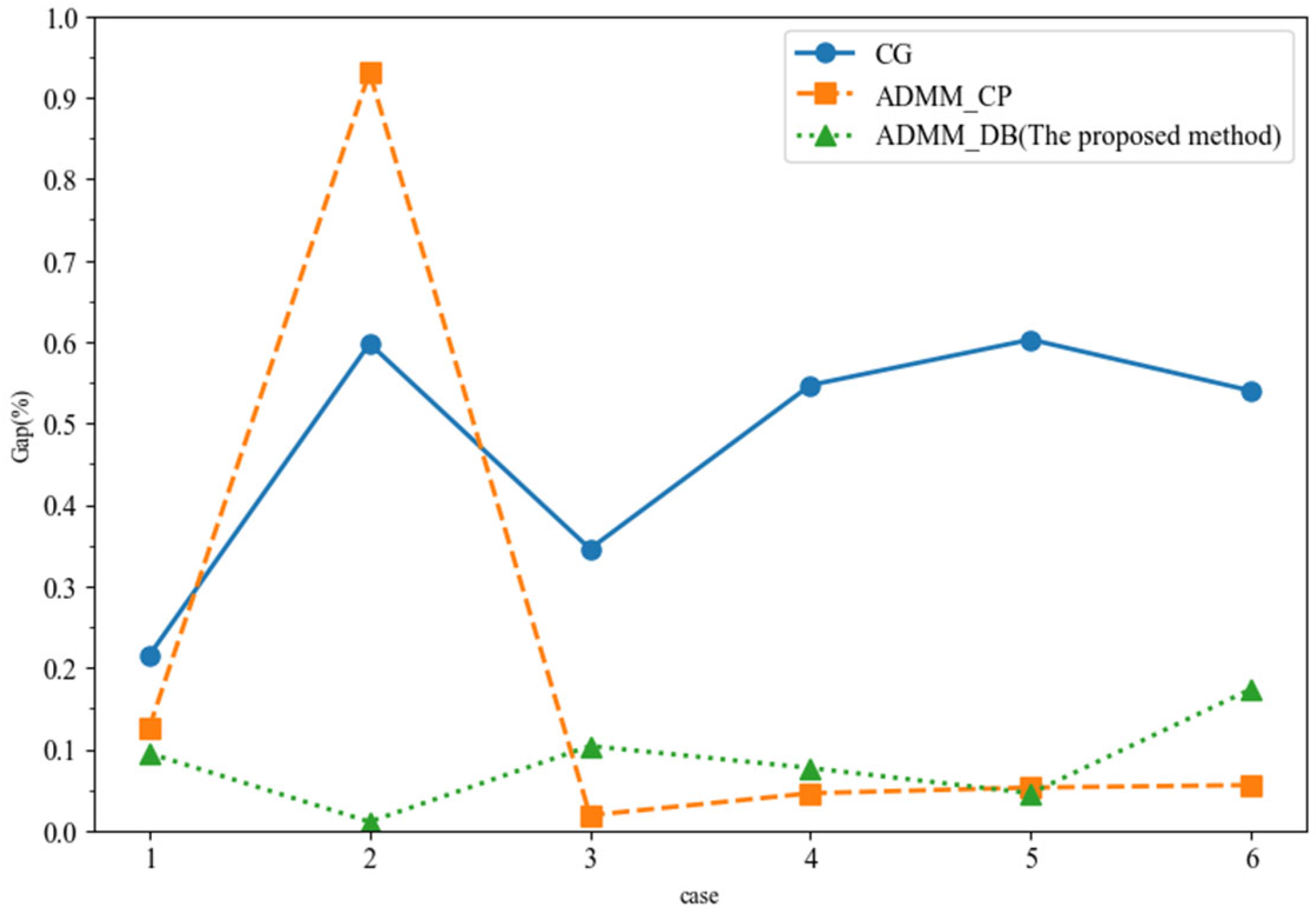
Furthermore, we can consider comparing the column gaps of the three solution algorithms. Furthermore, to quantify optimization accuracy, we compute the objective optimality gap G ap Z ( % ) defined in Section 4. The corresponding experimental results are shown in Figure 2. From Figure 2, we can see that when comparing the gaps obtained from the first six types of examples, in the vast majority of cases, the gap obtained by traditional column generation is the largest; therefore, the quality of the solution obtained by this algorithm is not very high. The gaps obtained by the latter two algorithms are both very low. Further comparison reveals that the ADMM algorithm based on the convex hull cutting plane performs poorly in the example of case 2, while the gap of the column obtained by the algorithm proposed in this paper remains at a very low level in all six categories. Therefore, the quality of the solutions obtained by the algorithm proposed in this paper is relatively good.
To further quantify the accuracy of different algorithms, Table 7 summarizes the objective optimality gap and uplift deviation of each method with respect to the OPT benchmark for cases 1–6.
As shown in Table 7, compared with other methods, the proposed method can achieve the smallest optimization error and economic cost error. The following charts focus on computational efficiency and improvement effects.
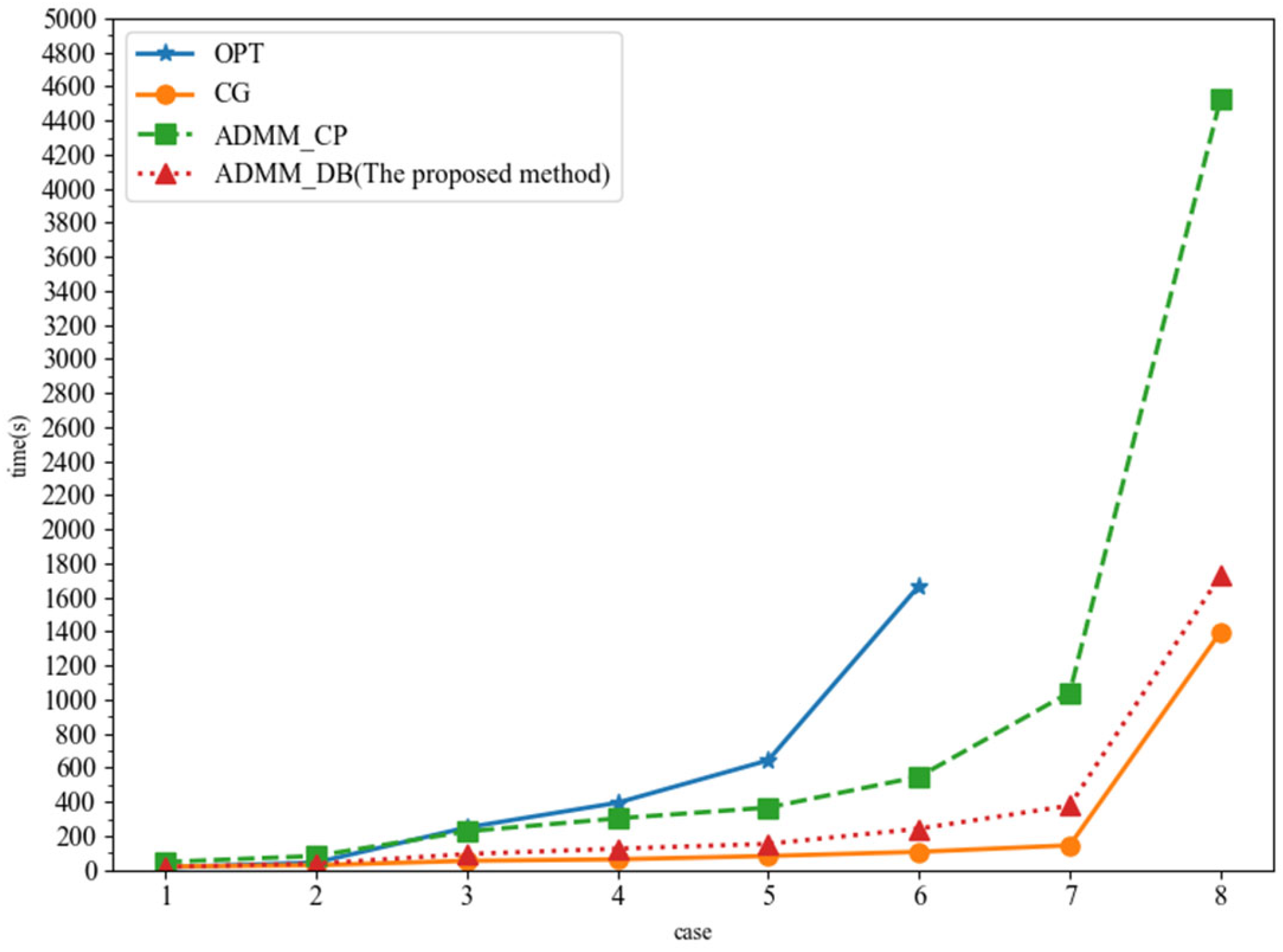
Figure 3 visually presents the computational efficiency of the four algorithms used in this paper to solve the convex hull problem, measured by the solution time. Since the OPT algorithm only calculates the first six categories, only the calculation time of the first six categories is shown in the figure. It can be seen from Figure 3 that as the number of units increases, the scale gradually expands, and the solution times of the four algorithms all increase. The OPT algorithm has the greatest increase in solution time. Starting from the fifth case (100 units), it is significantly higher than the other three algorithms. The computational efficiency of the traditional column generation algorithm also becomes lower as the problem scale increases. The ADMM algorithm, combined with the cutting plane and the proposed method in this paper, has much better computational efficiency in large-scale problems than the traditional column generation and OPT algorithms. The proposed method has better computational efficiency.
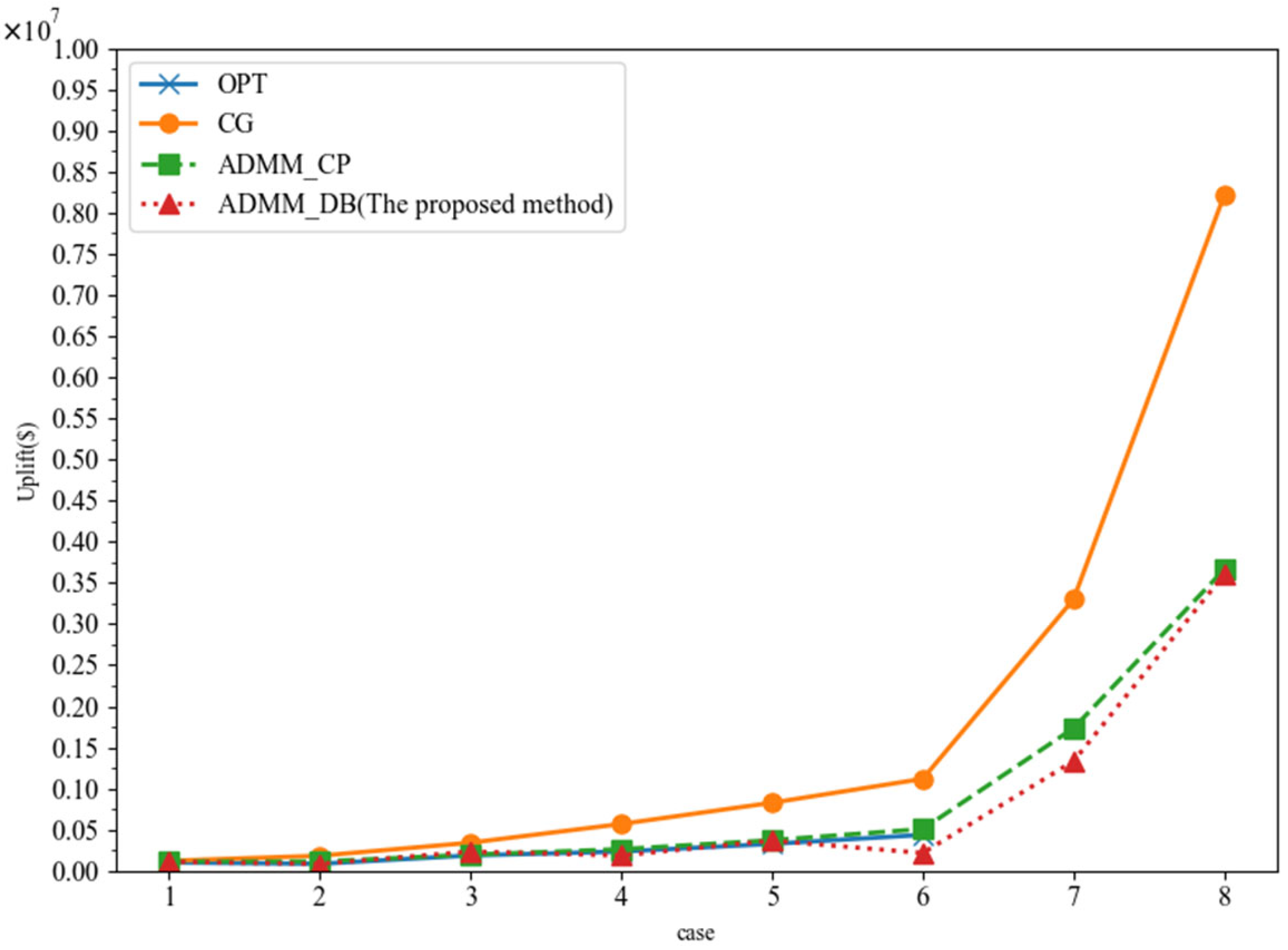
Figure 4 visually presents the uplift payments solved by the four algorithms used in this paper. Since the OPT algorithm only calculates the first six categories, only the uplift payments of the first six cases are shown in the figure. It can be seen from Figure 4 that as the number of units increases, the problem scale gradually expands. There is already a gap in absolute error between the price obtained by the traditional column generation and the result obtained by the OPT algorithm, and the quality of the solution is not good enough. The absolute error of the solutions for the latter two algorithms always maintains a reasonable error range compared with the optimal solution obtained by OPT. Both algorithms can obtain higher-quality solutions, and the method proposed in this paper exhibits the best solution quality. Combined with the intuitive observations in Figure 2, Figure 3 and Figure 4, our method is more effective in terms of comprehensive calculation efficiency and solution quality, demonstrating significantly superior performance. From the perspective of economic accuracy, the proposed method maintains a small uplift deviation G ap U ( % ) from OPT in cases 1, 2, and 5, indicating that the derived convex hull prices lead to uplift outcomes close to the reference solution.
As evidenced by the numerical results presented in Table 3, Table 4, Table 5 and Table 6 and Figure 2, Figure 3 and Figure 4, the computational burden of all evaluated algorithms escalates with increases in both the number of generating units. Specifically, the OPT approach experiences a sharp surge in solution time owing to the exponential expansion of the mixed-integer problem scale, rendering it infeasible for application in large-scale systems. For the traditional column generation method, the primary performance bottleneck stems from the growing volume of generated columns and the concomitant expansion of the master problem. Although ADMM-based approaches demonstrate superior scalability compared with the aforementioned methods, their performance can still be compromised by iteration coordination and communication overhead when the system scale expands further. These findings collectively indicate that while the proposed ADMM_DB framework achieves marked improvements in scalability, additional acceleration strategies are likely required to address extremely large-scale system scenarios.
Although the numerical evaluation mainly focuses on uplift payments and computational time, it is worth noting that the proposed method is communication-efficient in distributed settings. In each ADMM iteration, only low-dimensional dual variables are exchanged between the master problem and subproblems, without sharing primal decision variables or scenario data. Therefore, the communication overhead scales linearly with the number of units and time periods and remains modest in practice. In addition, memory usage is dominated by the storage of generated columns and cuts, which is explicitly capped by predefined limits (e.g., K c o u n t and R c o u n t ).

5. Conclusions

Aiming at the convex hull pricing problem in the electricity market, this paper introduces a fully distributed algorithm for CHP based on ADMM with DW and Benders decomposition to address the computational difficulties inherent in large-scale convex hull pricing optimization. It also compares several different algorithms through 44 practical examples, including the precise convex hull pricing formula (OPT), the traditional column generation algorithm (CG), the ADMM algorithm combined with the cutting plane technique (ADMM_CP), and our fully distributed algorithm for CHP based on ADMM with DW and Benders decomposition (ADMM_DB). After extensive large-scale instance tests, our experimental findings demonstrate the efficacy of the proposed approach, particularly in enhancing computational performance and minimizing uplift payment costs.
In terms of pricing accuracy, compared with the CG method and ADMM_CP method, the method proposed in this paper achieves a cost improvement that is within 0.1% of the precise solution OPT, far below the market tolerance level. The uplift deviation values in cases 1, 2, and 5 were all below 11% of the error. Although it performed relatively poorly in other examples, when evaluated comprehensively based on the objective optimality gap, the proposed method’s effectiveness and accuracy are still evident. The solution quality of the method proposed in this paper is much higher than that of the CG method and comparable to that of the ADMM_CP method. In terms of computational efficiency, compared with the CG method, the solution time of the method proposed in this paper is slightly longer. However, compared with the ADMM_CP method, which has comparable solution quality, the proposed method reduces the total computing time by approximately 54–60%. Although the proposed method has a slight accuracy error (about within 0.1%), the quality of the obtained solution is still very close to the optimal convex hull price, and it achieves an acceleration of 2–2.5 times in large-scale test cases. Therefore, it is more suitable for practical power market applications.
Results show that by adopting the proposed method, the quality of the solution can be improved, and it is superior to the ADMM algorithm using the cutting plane technique in terms of computational efficiency. The algorithm also ensures the confidentiality of the information of each unit. The combination of computational efficiency and the quality of the solution demonstrates the superiority of the algorithm proposed in this paper.
For future research endeavors, further refinements to the row-and-column generation method will be explored to boost the algorithm’s computational efficiency and convergence speed. Additionally, extending the proposed distributed framework to stochastic and renewable-based convex hull pricing models represents a critical and practical research avenue, as it enables the effective incorporation of uncertainties associated with renewable power generation and load demand. While the proposed ADMM_DB algorithm demonstrates strong performance in addressing large-scale day-ahead convex hull pricing problems, its direct application in real-time or near-real-time market environments may still face additional challenges. In real-time operational settings, stringent computational time constraints, high-frequency data updates, and rolling optimization requirements are likely to amplify the impact of iteration overhead and inter-module coordination. To address these challenges, future research may explore warm-start techniques and rolling-horizon implementation schemes, as well as parallel or asynchronous decomposition strategies, to further reduce computational latency. These extensions are expected to improve the practical applicability of the proposed framework in real-time electricity market operations.

Author Contributions

Conceptualization, L.Y. and H.Z.; methodology, L.Y.; software, X.L.; validation, L.Y., X.L.; formal analysis, S.C.; investigation, L.Y.; resources, S.C.; data curation, L.Y.; writing—original draft preparation, X.L.; writing—review and editing, Z.W.; visualization, X.L.; supervision, Z.W.; project administration, L.Y.; funding acquisition, L.Y. All authors have read and agreed to the published version of the manuscript.

Funding

This work was supported by the National Natural Science Foundation of China (72361003) and the Key Research and Development Program of Guangxi (2023AB01242).

Institutional Review Board Statement

Not applicable.

Informed Consent Statement

Not applicable.

Data Availability Statement

The original contributions presented in this study are included in the article. Further inquiries can be directed to the corresponding author.

Conflicts of Interest

Author Zhiding Wu was employed by the company Datang Hydropower Science and Technology Research Institute Co., Ltd. The remaining authors declare that the research was conducted in the absence of any commercial or financial relationships that could be construed as a potential conflict of interest.

Nomenclature

Set:
G Set of generators
Parameters:
T Total number of time periods
α i , β i , γ i The coefficients of the secondary production cost function α i u t i + β i P t i + γ i ( P t i ) 2 of the unit i
P ¯ i , P ¯ i Maximum power output and Minimum power output of unit i
b System load demand.
P u p i , P d o w n i Ramp up and down limit of unit i
P s t a r t i , P s h u t i Startup and shutdown ramp limit of unit i
Variable:
u t i On/off status of unit i in period t
v t i , w t i Startup and shutdown status of unit i in period t
P t i Power output of unit i in period t
z t i Variable approximate of α i u t i + β i P t i + γ i ( P t i ) 2
y h k i if unit i starts up in period h and shuts down in period k + 1 , y h k i = 1
q h k t , i Generation amount of unit i if unit i starts up in period h and shuts down in period k + 1
ϕ h k t , i Production cost of unit i in period t if it starts up in period h and shuts down in period k + 1.
Abbreviations of terms:
CHPConvex hull pricing
ADMMAlternating Direction Method of Multipliers
DWDantzig–Wolfe
OPTThe precise convex hull pricing formula is used to obtain the convex hull price
CGColumn generation
ADMM_CPAlternating Direction Method of Multipliers with a cutting plane. During the ADMM solution process, the convex hull cutting plane is added to obtain the approximate convex hull price.
ADMM_DBAlternating Direction Method of Multipliers with Dantzig–Wolfe and Benders. ADMM combined with DW and Benders decomposition is used to solve the approximate convex hull price.
MIP/MILPMixed-Integer Linear Programming

References

  1. Caramanis, M.C.; Bohn, R.E.; Schweppe, F.C. Optimal spot pricing: Practice and theory. IEEE Trans. Power Appar. Syst. 1982, PAS-101, 3234–3245. [Google Scholar] [CrossRef]
  2. Sioshansi, R.; Oren, S.; O’Neill, R. Three-part auctions versus self-commitment in day-ahead electricity markets. Util. Policy 2010, 18, 165–173. [Google Scholar] [CrossRef]
  3. Wang, C.; Luh, P.B.; Gribik, P.; Peng, T.; Zhang, L. Commitment cost allocation of fast-start units for approximate extended locational marginal prices. IEEE Trans. Power Syst. 2016, 31, 4176–4184. [Google Scholar] [CrossRef]
  4. Hua, B.; Baldick, R. A convex primal formulation for convex hull pricing. IEEE Trans. Power Syst. 2016, 32, 3814–3823. [Google Scholar] [CrossRef]
  5. Carrión, M.; Arroyo, J.M. A computationally efficient mixed-integer linear formulation for the thermal unit commitment problem. IEEE Trans Power Syst 2006, 21, 1371–1378. [Google Scholar] [CrossRef]
  6. Schiro, D.A.; Zheng, T.; Zhao, F.; Litvinov, E. Convex hull pricing in electricity markets: Formulation, analysis, and implementation challenges. IEEE Trans. Power Syst. 2015, 31, 4068–4075. [Google Scholar] [CrossRef]
  7. Yu, Y.; Guan, Y.; Chen, Y. An extended integral unit commitment formulation and an iterative algorithm for convex hull pricing. IEEE Trans. Power Syst. 2020, 35, 4335–4346. [Google Scholar] [CrossRef]
  8. Andrianesis, P.; Bertsimas, D.; Caramanis, M.C.; Hogan, W.W. Computation of convex hull prices in electricity markets with non-convexities using dantzig-wolfe decomposition. IEEE Trans. Power Syst. 2021, 37, 2578–2589. [Google Scholar] [CrossRef]
  9. Knueven, B.; Ostrowski, J.; Castillo, A.; Watson, J.P. A computationally efficient algorithm for computing convex hull prices. Comput. Ind. Eng. 2022, 163, 107806. [Google Scholar] [CrossRef]
  10. Stevens, N.; Papavasiliou, A. Application of the level method for computing locational convex hull prices. IEEE Trans. Power Syst. 2022, 37, 3958–3968. [Google Scholar] [CrossRef]
  11. Nesterov, Y. Introductory Lectures on Convex Optimization: A Basic Course; Springer Science & Business Media: Berlin, Germany, 2013; Volume 87. [Google Scholar]
  12. Hyder, F.; Yan, B.; Bragin, M.; Luh, P. Convex Hull Pricing for Unit Commitment: Survey, Insights, and Discussions. Energies 2024, 17, 4851. [Google Scholar] [CrossRef]
  13. Boyd, S. Convex optimization. In Cambridge UP; Cambridge University Press: Cambridge, UK, 2004. [Google Scholar]
  14. Boyd, S.; Parikh, N.; Chu, E.; Peleato, B.; Eckstein, J. Distributed optimization and statistical learning via the alternating direction method of multipliers. Found. Trends Mach. Learn. 2010, 3, 1–122. [Google Scholar] [CrossRef]
  15. Gribik, P.R.; Hogan, W.W.; Pope, S.L. Market-Clearing Electricity Prices and Energy Uplift; Harvard Electricity Policy Group (HEPG): Cambridge, MA, USA, 2007; pp. 1–46. [Google Scholar]
  16. Yang, L.; Zhang, C.; Jian, J.; Meng, K.; Xu, Y.; Dong, Z. A novel projected two-binary-variable formulation for unit commitment in power systems. Appl. Energy 2017, 187, 732–745. [Google Scholar] [CrossRef]
  17. Hogan, W.W.; Ring, B.J. On Minimum-Uplift Pricing for Electricity Markets; Electricity Policy Group: Bucharest, Romania, 2003; pp. 1–30. [Google Scholar]
  18. El Tonbari, M.; Ahmed, S. Consensus-based Dantzig-Wolfe decomposition. Eur. J. Oper. Res. 2023, 307, 1441–1456. [Google Scholar] [CrossRef]
  19. Knueven, B.; Ostrowski, J.; Wang, J. The ramping polytope and cut generation for the unit commitment problem. INFORMS J. Comput. 2018, 30, 739–749. [Google Scholar] [CrossRef]
  20. Crisci, S.; De Simone, V.; Viola, M. On the adaptive penalty parameter selection in ADMM. Algorithms 2023, 16, 264. [Google Scholar] [CrossRef]
  21. Yang, L.; Qin, Q.; Chen, S.; Jian, J. Fully distributed convex hull pricing based on alternating direction method of multipliers. Comput. Oper. Res. 2025, 173, 106823. [Google Scholar] [CrossRef]
Figure 1. Brief overview of the proposed algorithm.
Applsci 16 01097 g001
Figure 2. The objective optimality gap for different algorithms.
Applsci 16 01097 g002
Figure 3. Time for different algorithms.
Applsci 16 01097 g003
Figure 4. Uplift payments for different algorithms.
Applsci 16 01097 g004
Table 1. The number of cases used and the number of units.
CaseInstancesNCaseInstancesN
11–510521–25100
26–1020626–30150
311–1550731–45200
416–2075846–501000
Table 2. The uplift payments obtained by solving the test dataset.
NTMIPOPTSolution (USD)Uplift (USD)
1024568,120567,741567,741379
Table 3. The results of OPT (cases 1 to 6).
CaseNTMIPSolution (USD)Uplift (USD)Time (s)
110249,019,4628,918,637100,82515.41
2202416,255,52916,170,64484,88544.01
3502444,710,30344,524,194186,109249.66
4752461,228,30360,994,694233,609395.17
51002482,914,83482,587,941326,893644.46
615024125,971,687125,535,082436,6051669.49
Table 4. The instance results of column generation.
CaseNTMIPSolution (USD)Uplift (USD)IterTime (s)
110249,019,4628,899,240120,222102.220.50
2202416,255,52916,073,318182,21178.428.32
3502444,710,30344,369,325340,97853.454.12
4752461,228,30360,659,660568,64347.862.83
51002482,914,83482,087,843826,9914682.72
615024125,971,687124,854,1031,117,58441.8106.87
720024413,736,960410,435,0213,301,93941.58144.99
8100024829,099,257820,878,4238,220,834461397.41
Table 5. The solution results of ADMM combined with adding the convex hull cutting plane.
CaseNTMIPSolution (USD)Uplift (USD)IterTime (s)
110249,019,4628,907,285112,2075847.15
2202416,131,58316,019,233112,36062.882.70
3502444,710,30344,515,431194,87267.6227.12
4752461,228,30360,966,059262,24467.4303.26
51002482,914,83482,543,382371,45267.8366.93
615024132,242,925131,735,449507,47665.8548.32
720024413,736,960412,003,4131,733,54767.11042.91
8100024829,099,257825,433,7453,665,51267.84526.59
Table 6. The result of the algorithm of ADMM with DW and Benders (proposed method) (The results of the bold items are better).
CaseNTMIPSolution (USD)Uplift (USD)Time (s)
110249,019,4628,909,984109,47818.44
2202416,255,52916,172,47883,05137.68
3502444,710,30344,477,383232,92093.97
4752461,228,30361,042,339185,964125.58
51002482,914,83482,549,074365,760153.81
615024125,971,687125,755,469216,218242.88
720024413,736,960412,403,6451,333,315378.29
8100024829,099,257825,493,5253,605,7321730.11
Table 7. Accuracy of different algorithms (The results of the bold items are better).
Case G ap Z ( % ) of CG G ap Z ( % ) of ADMM_CP G ap Z ( % ) of the Proposed Method G ap U ( % ) of CG G ap U ( % ) of ADMM_CP G ap U ( % ) of the Proposed Method
10.210.10.091911.28
20.60.90.01114.632.32.1
30.340.020.183425
40.50.040.08143.41220
50.60.050.051521311
60.50.050.17155.916.950
Disclaimer/Publisher’s Note: The statements, opinions and data contained in all publications are solely those of the individual author(s) and contributor(s) and not of MDPI and/or the editor(s). MDPI and/or the editor(s) disclaim responsibility for any injury to people or property resulting from any ideas, methods, instructions or products referred to in the content.