Exploring the Design, Modeling, and Identification of Beneficial Nonlinear Restoring Forces: A Review


Abstract
1. Introduction
2. Design Methodologies and Their Applications
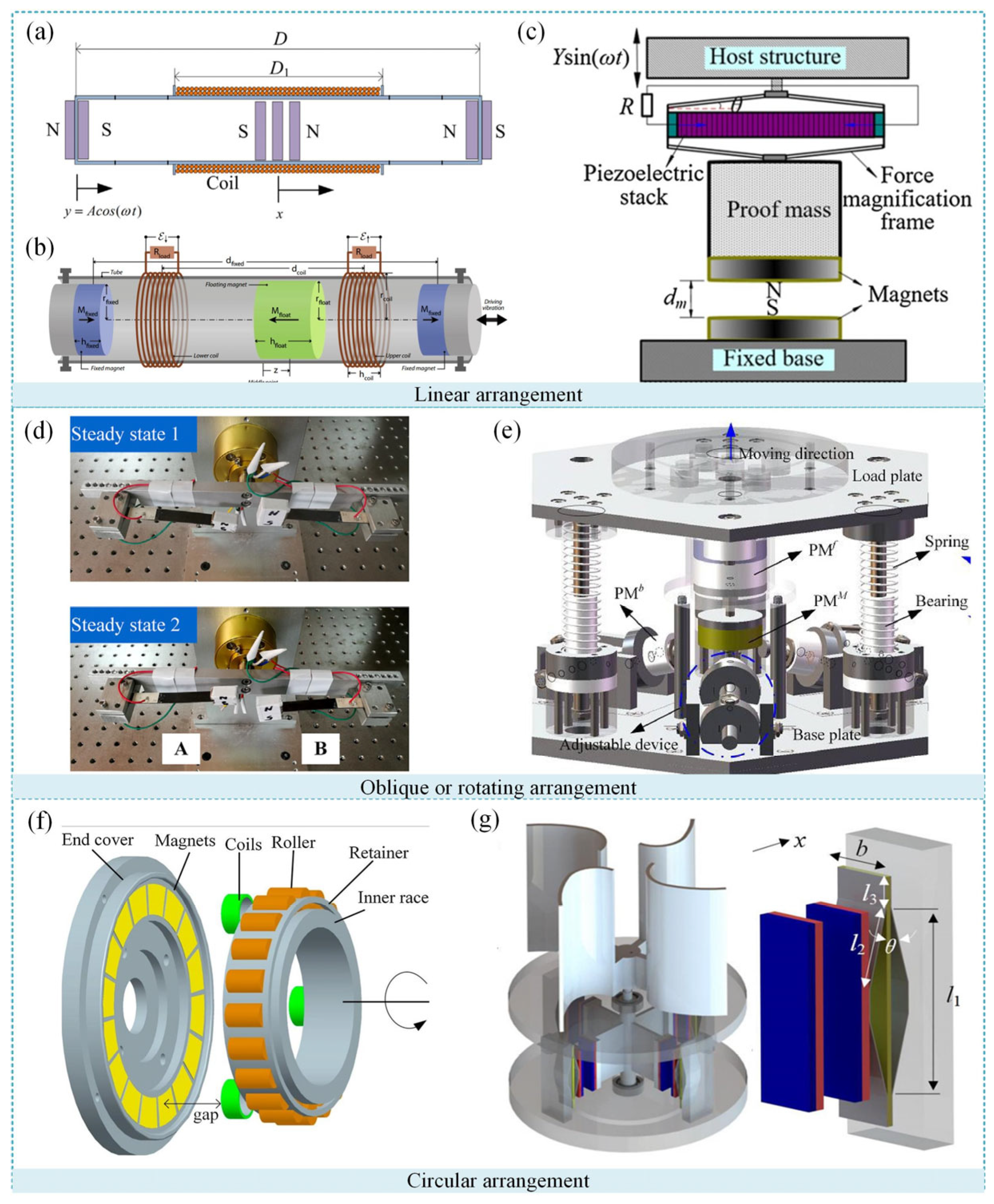
2.1. Magnetic Coupling
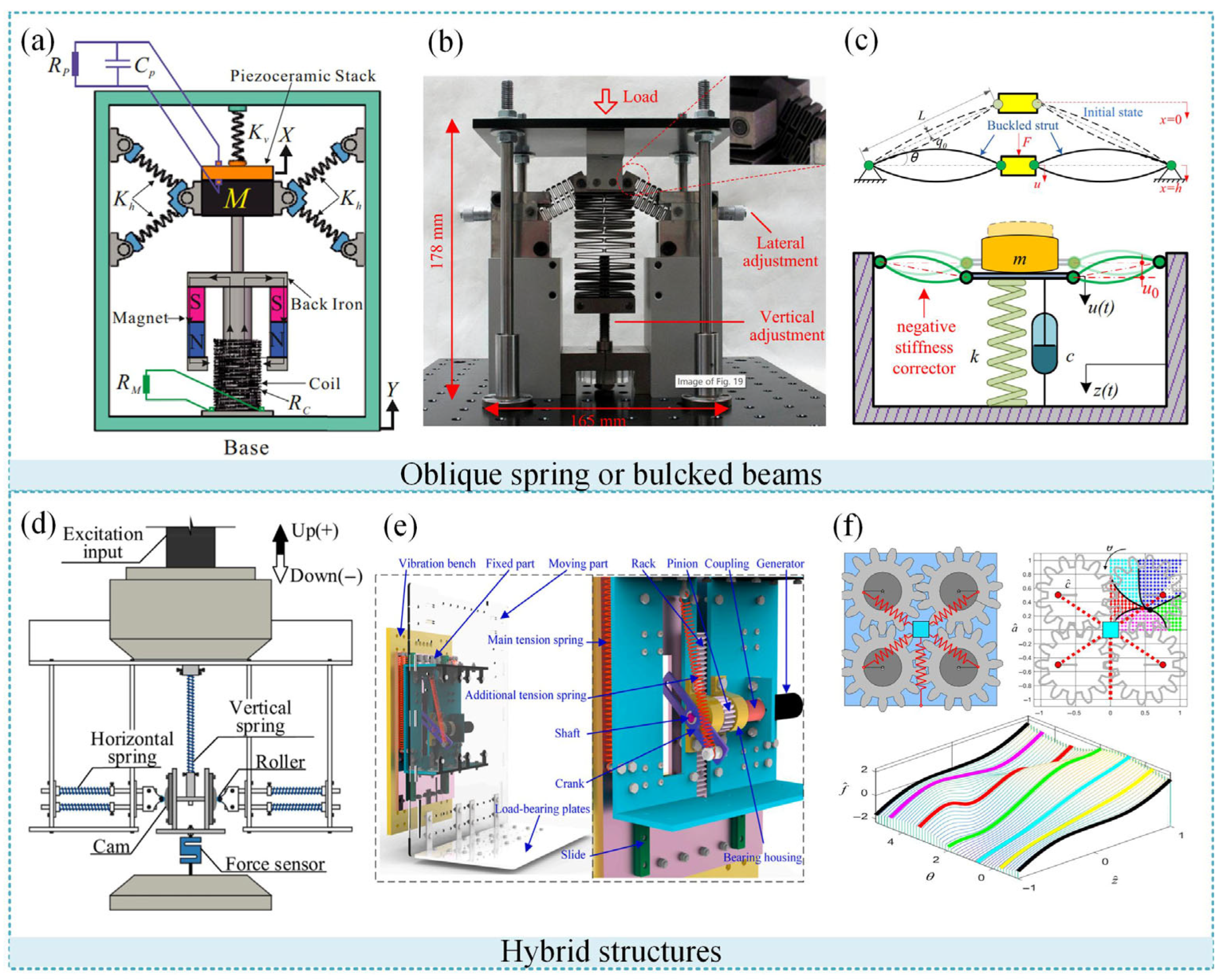
2.2. Oblique Spring Linkages
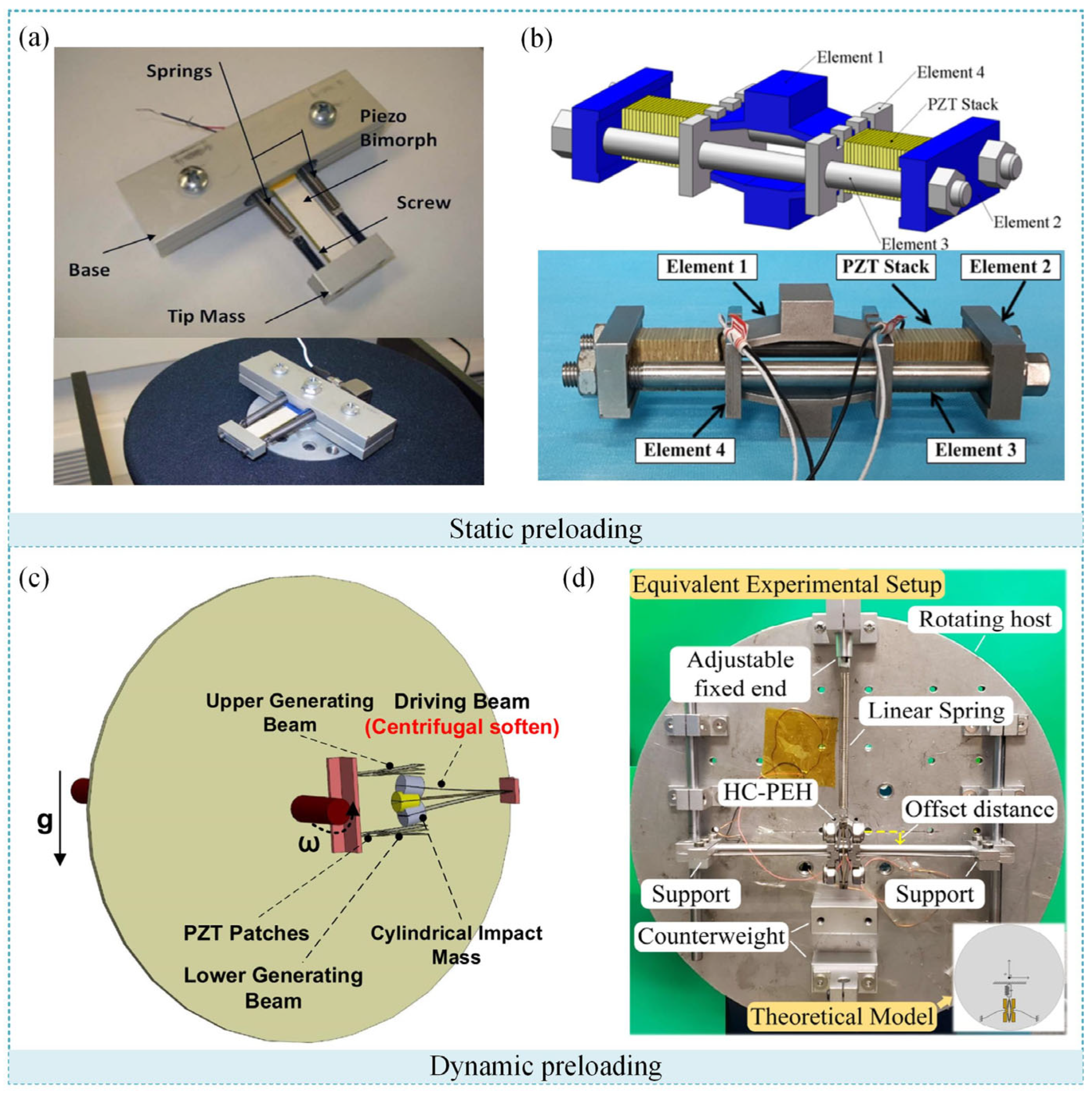
2.3. Static or Dynamic Preloading

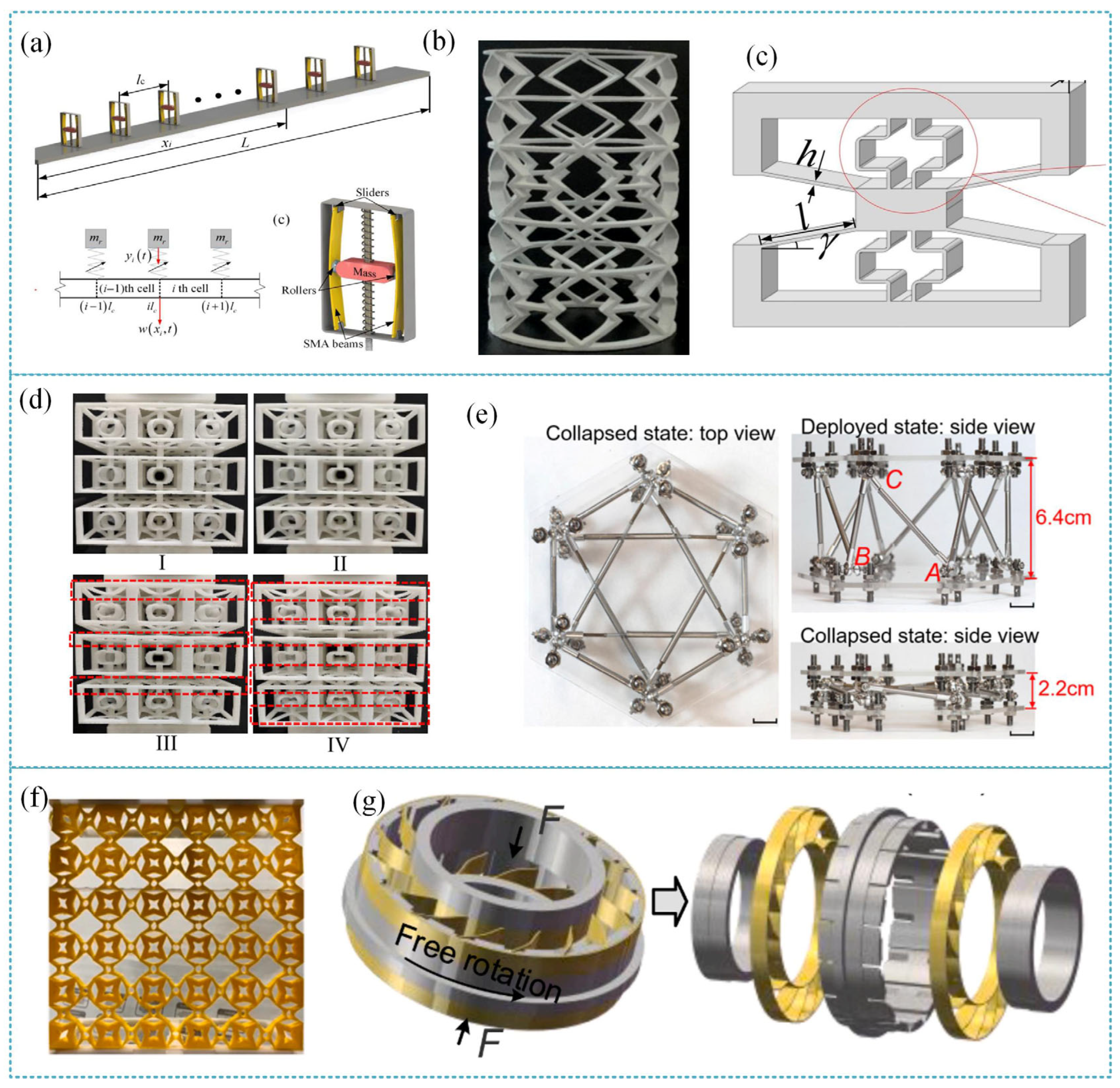
2.4. Metamaterial Structure Design
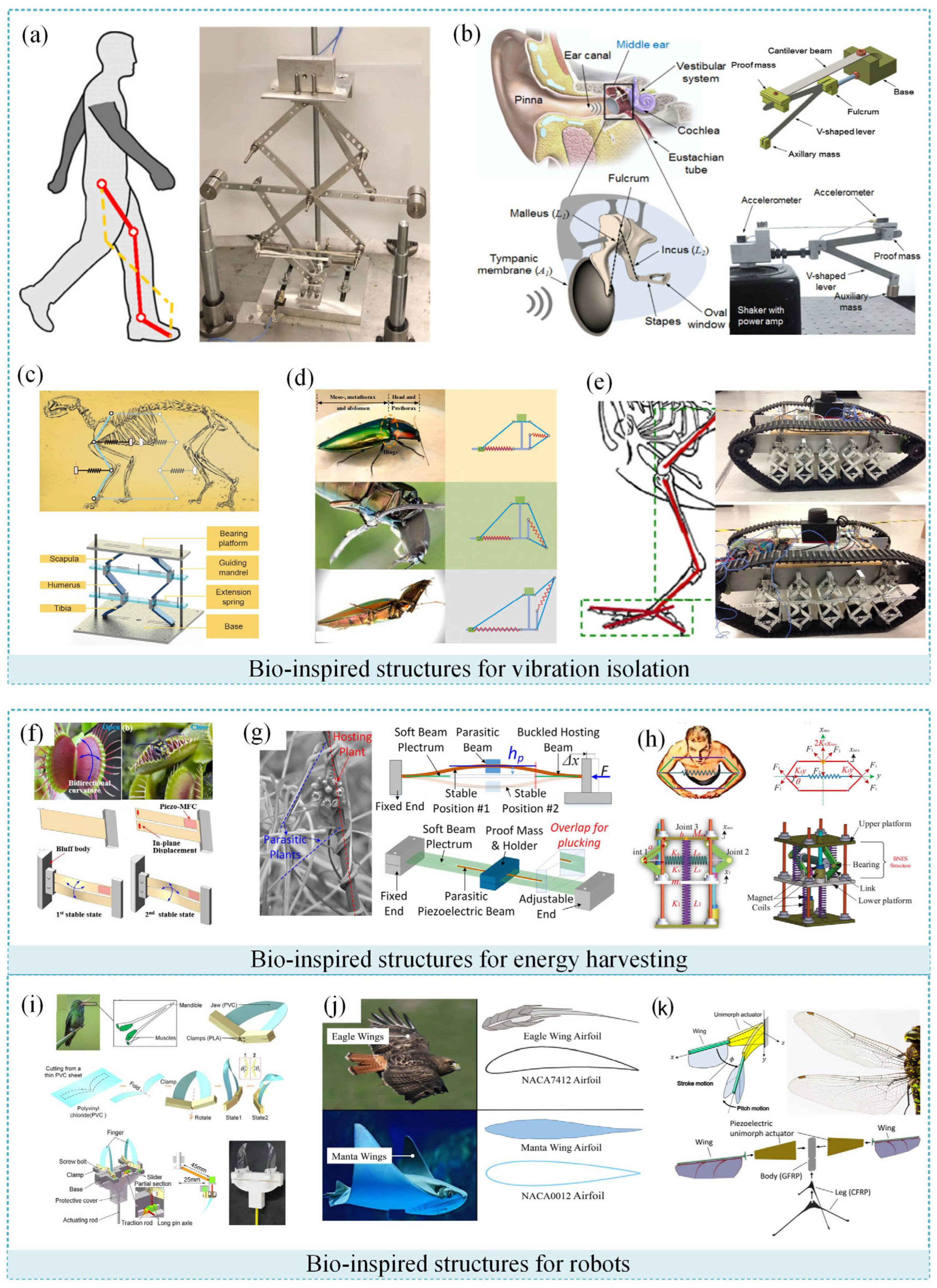
2.5. Geometrically Nonlinear Bio-Inspired Design

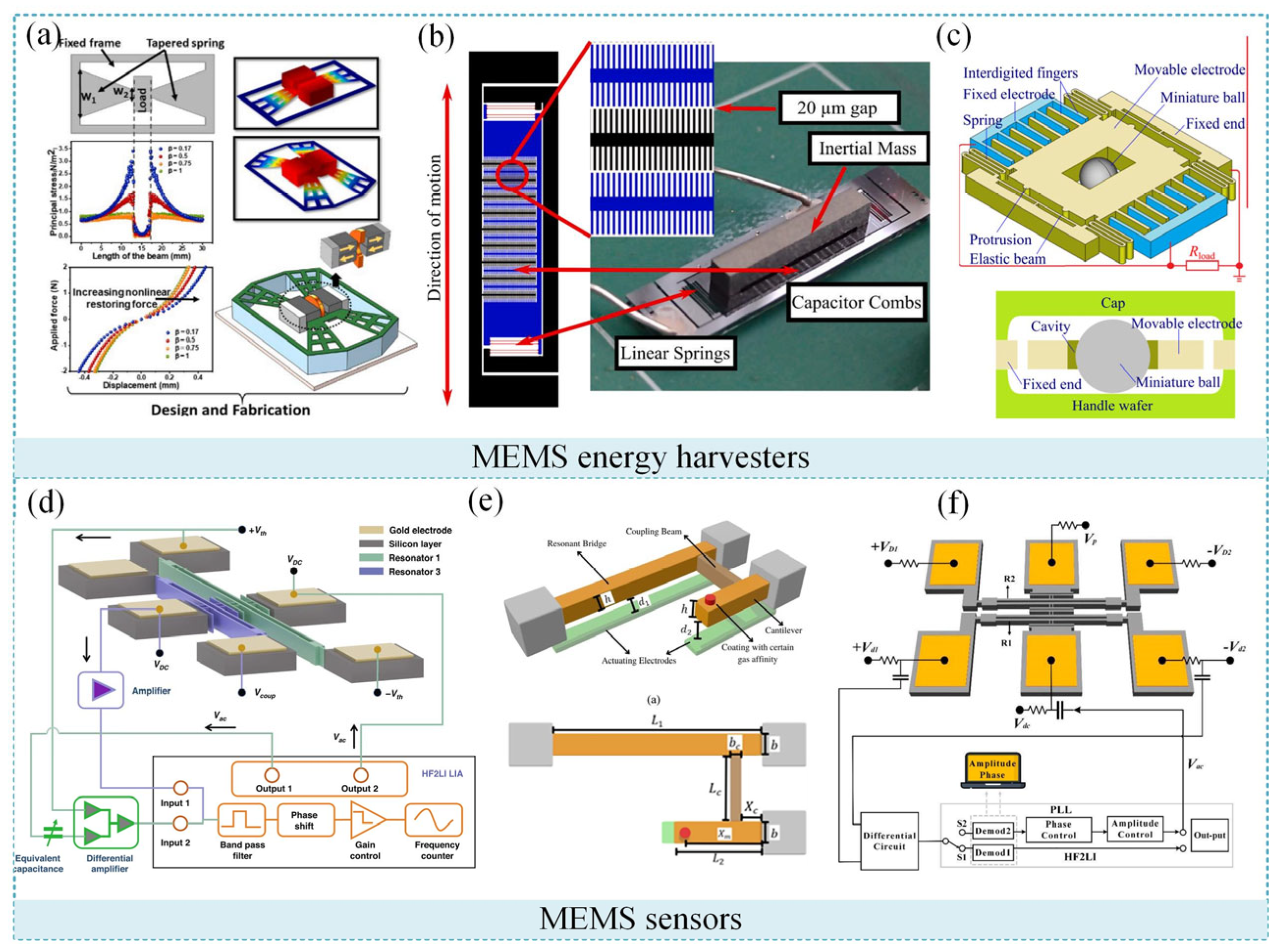
2.6. MEMS Manufacturing

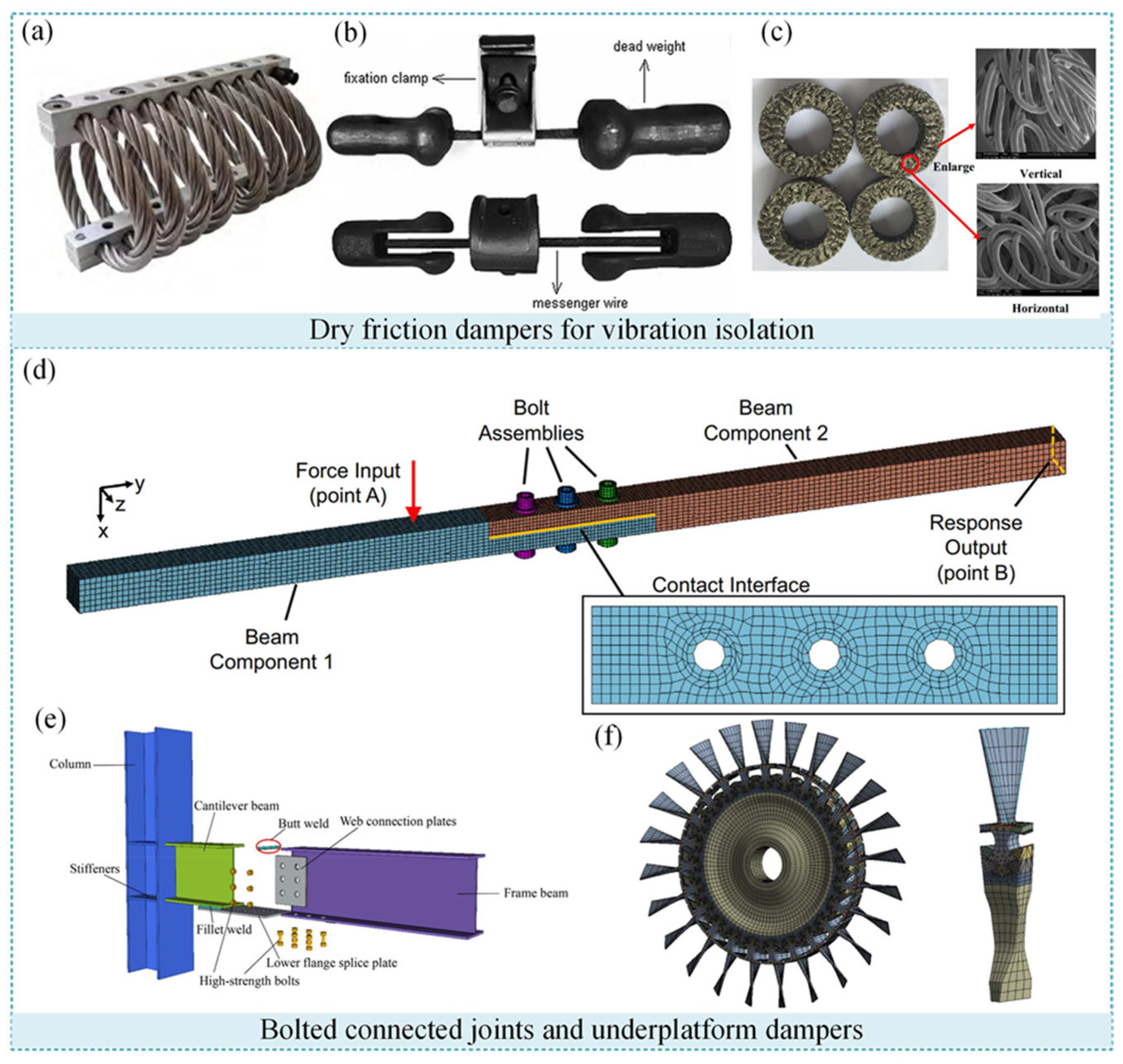
2.7. Dry Friction Applied
2.8. Others
3. Nonlinear Restoring Force Modeling
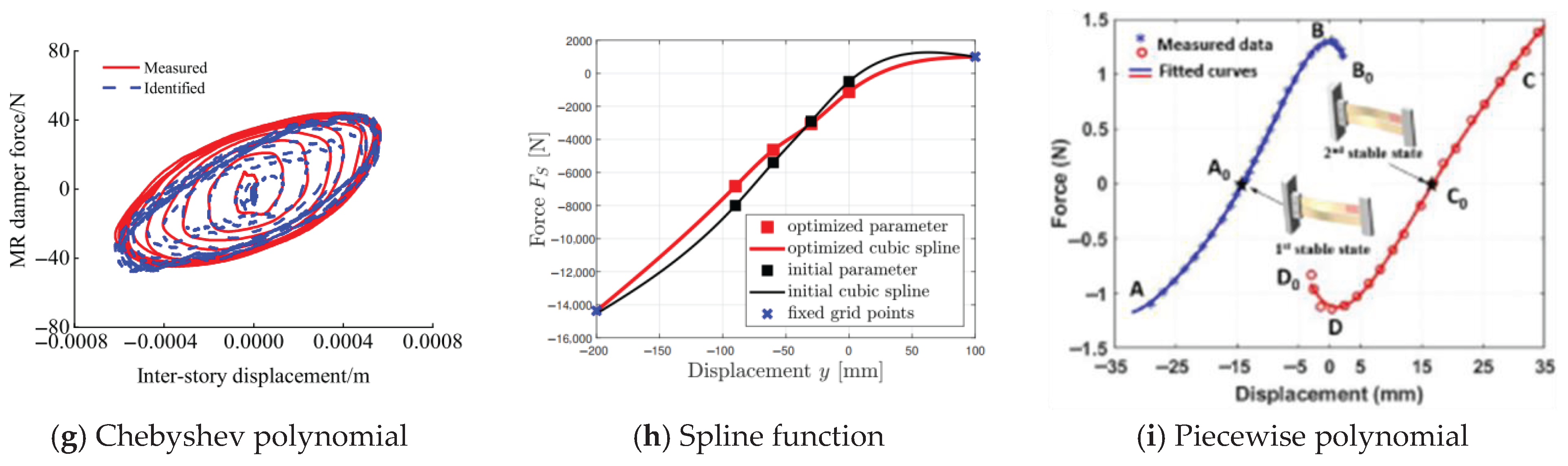
3.1. Various Polynomial-Based Nonlinear Models
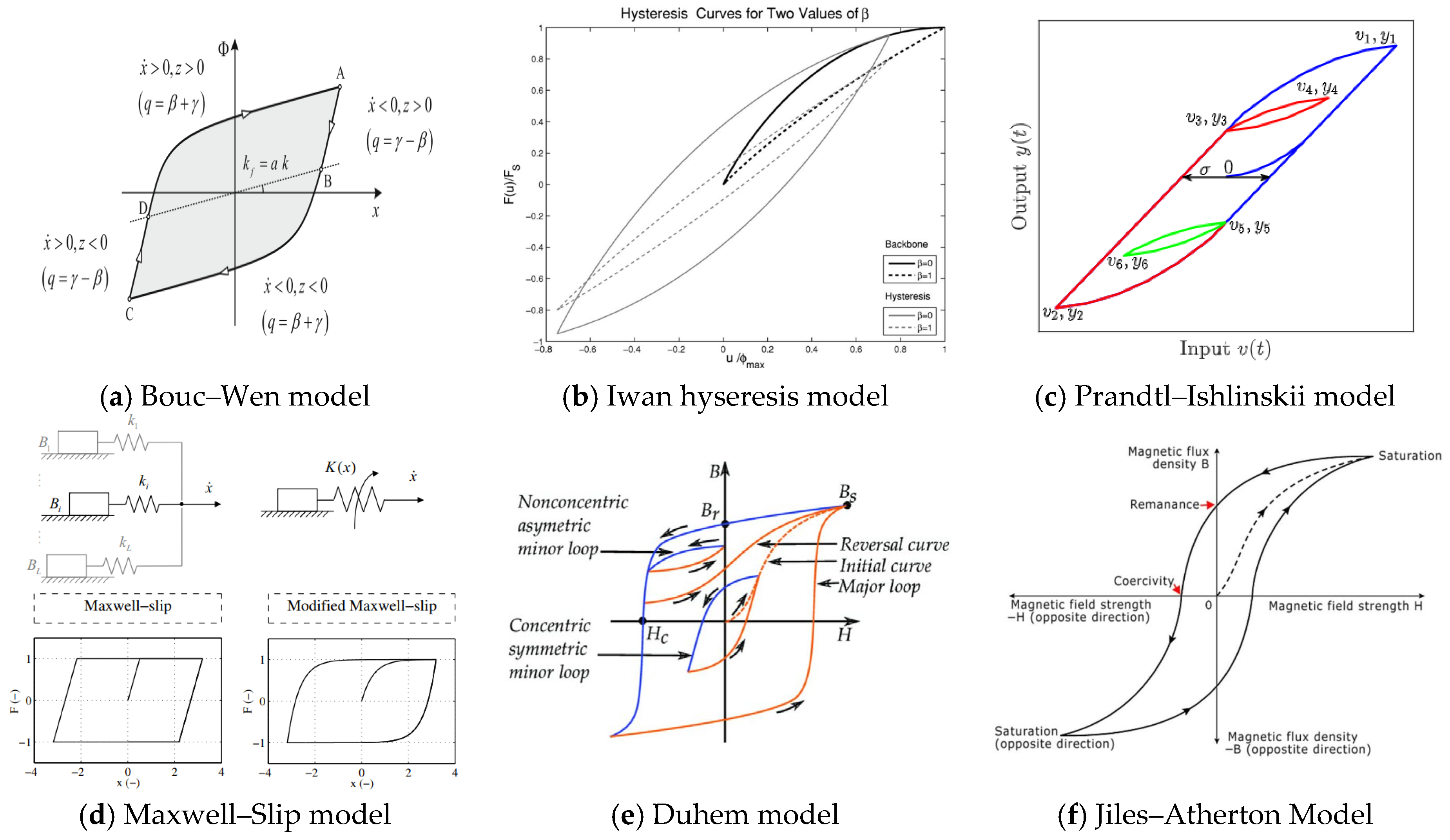
3.2. Hysteretic Models
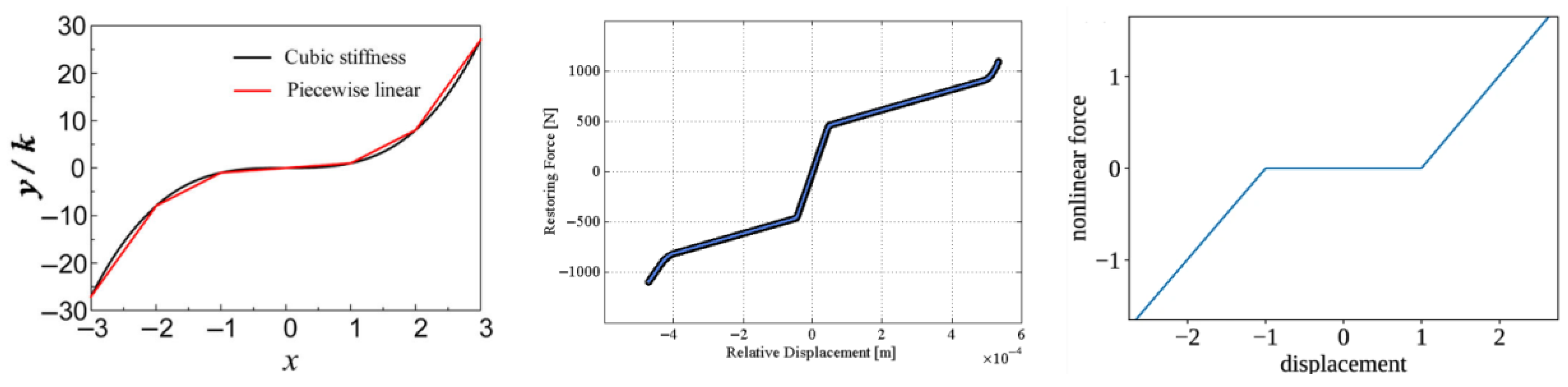
3.3. Piecewise Linear Models
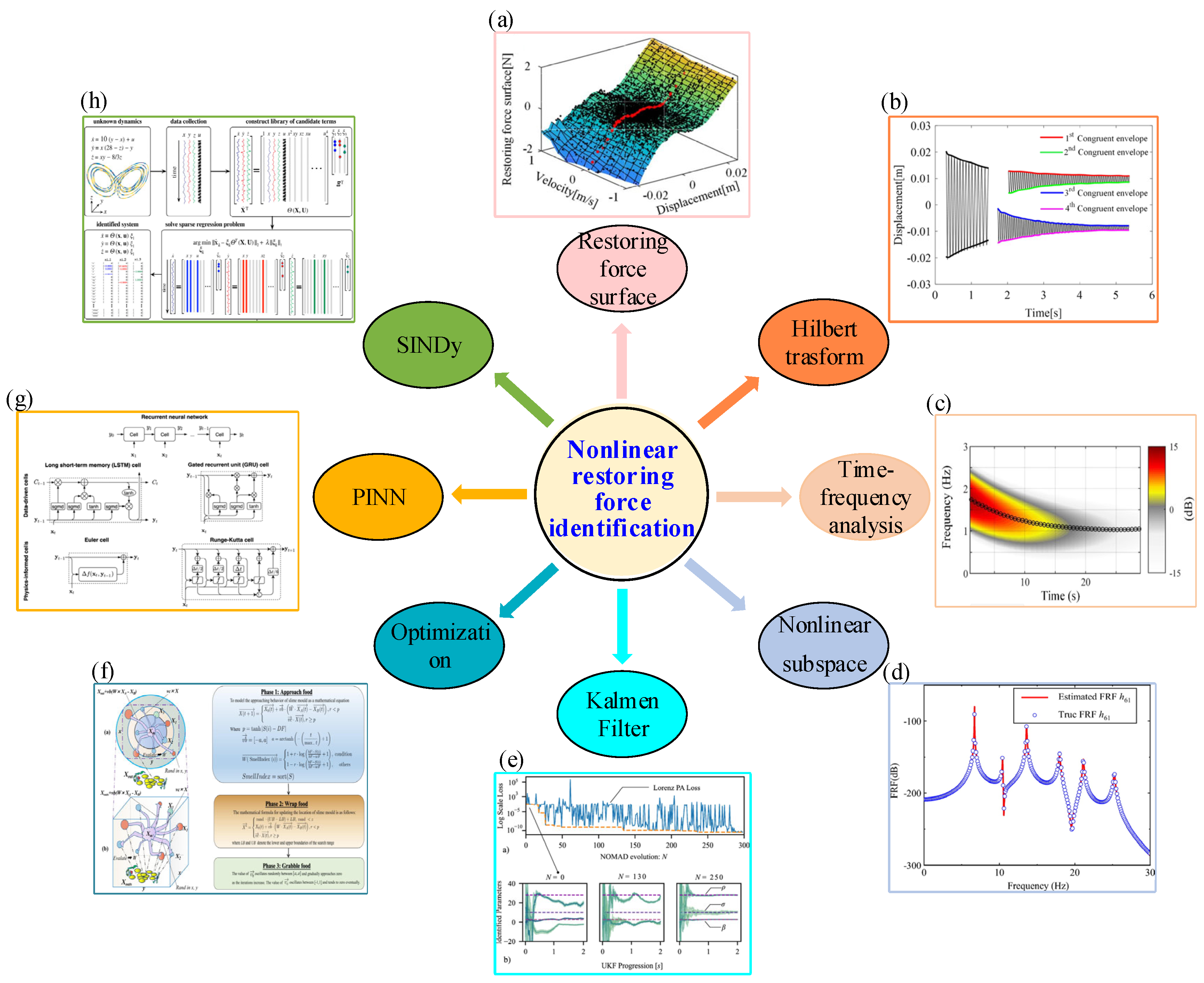
4. Nonlinear Restoring Force Identification: Review
4.1. Typical Restoring Force Identification Applications
4.2. Restoring Force Surface Method
4.3. Hilbert Transform-Based Method
4.4. Time-Frequency Analysis
4.5. Nonlinear Subspace Identification
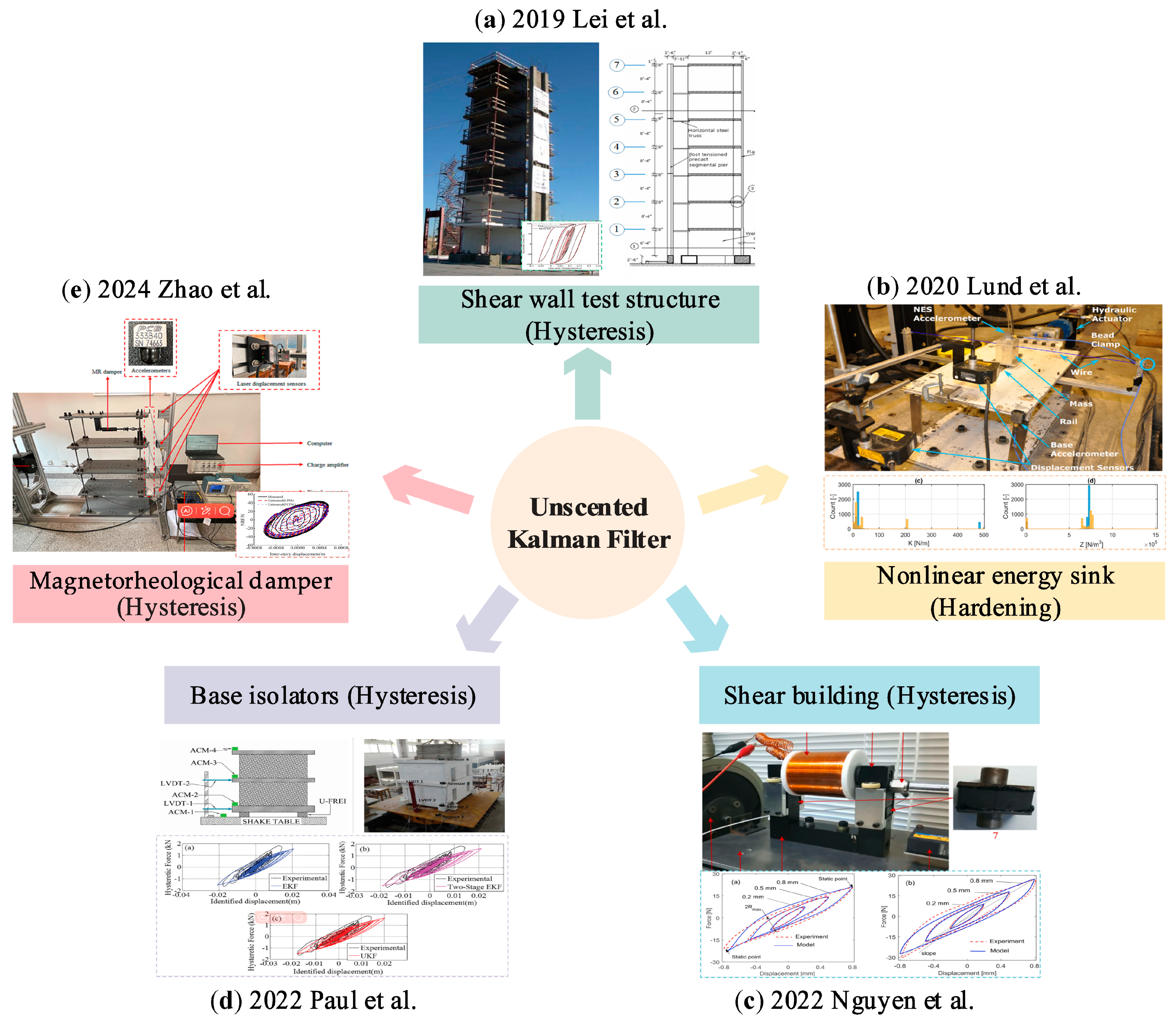
4.6. Unscented Kalman Filter
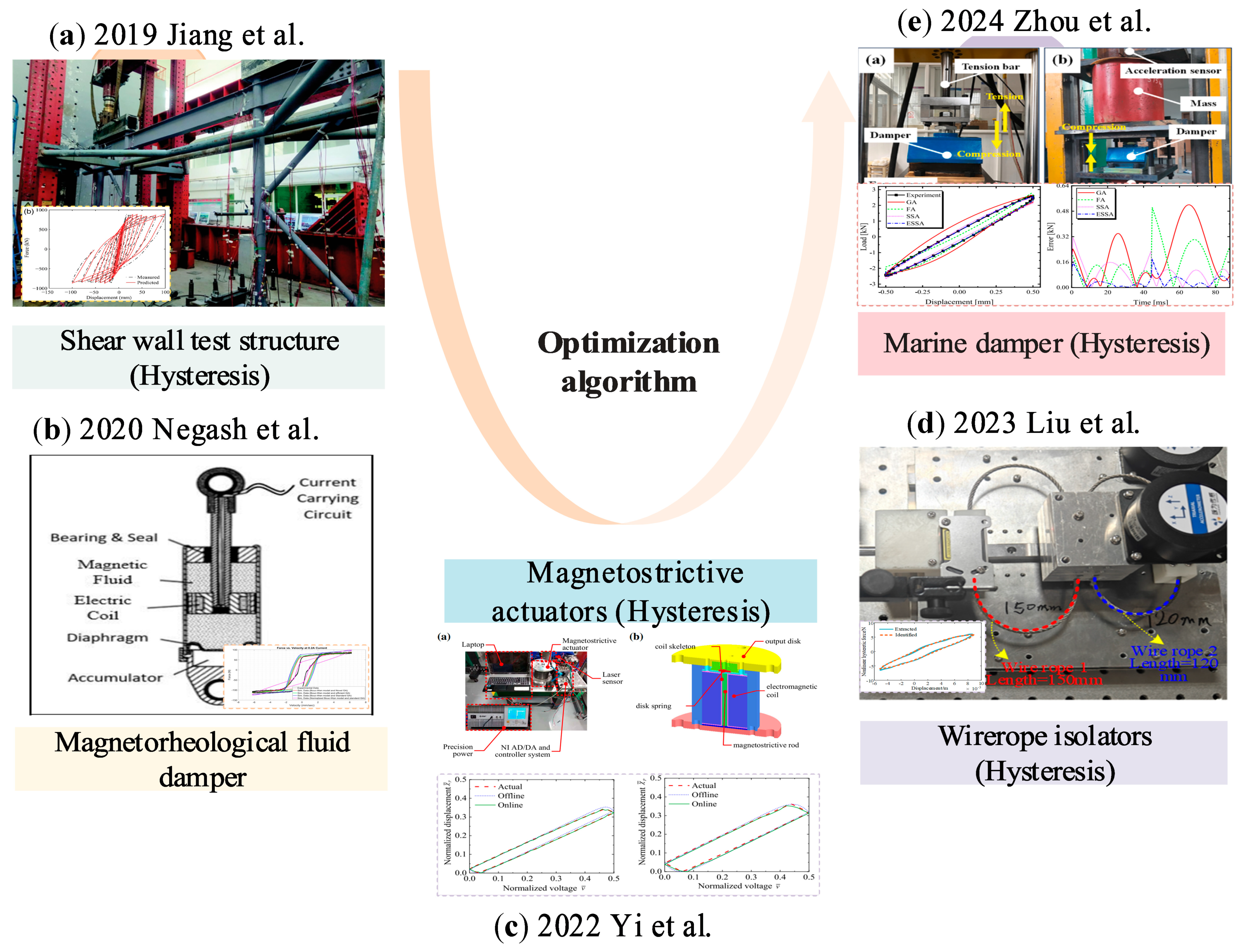
4.7. Optimization Algorithms
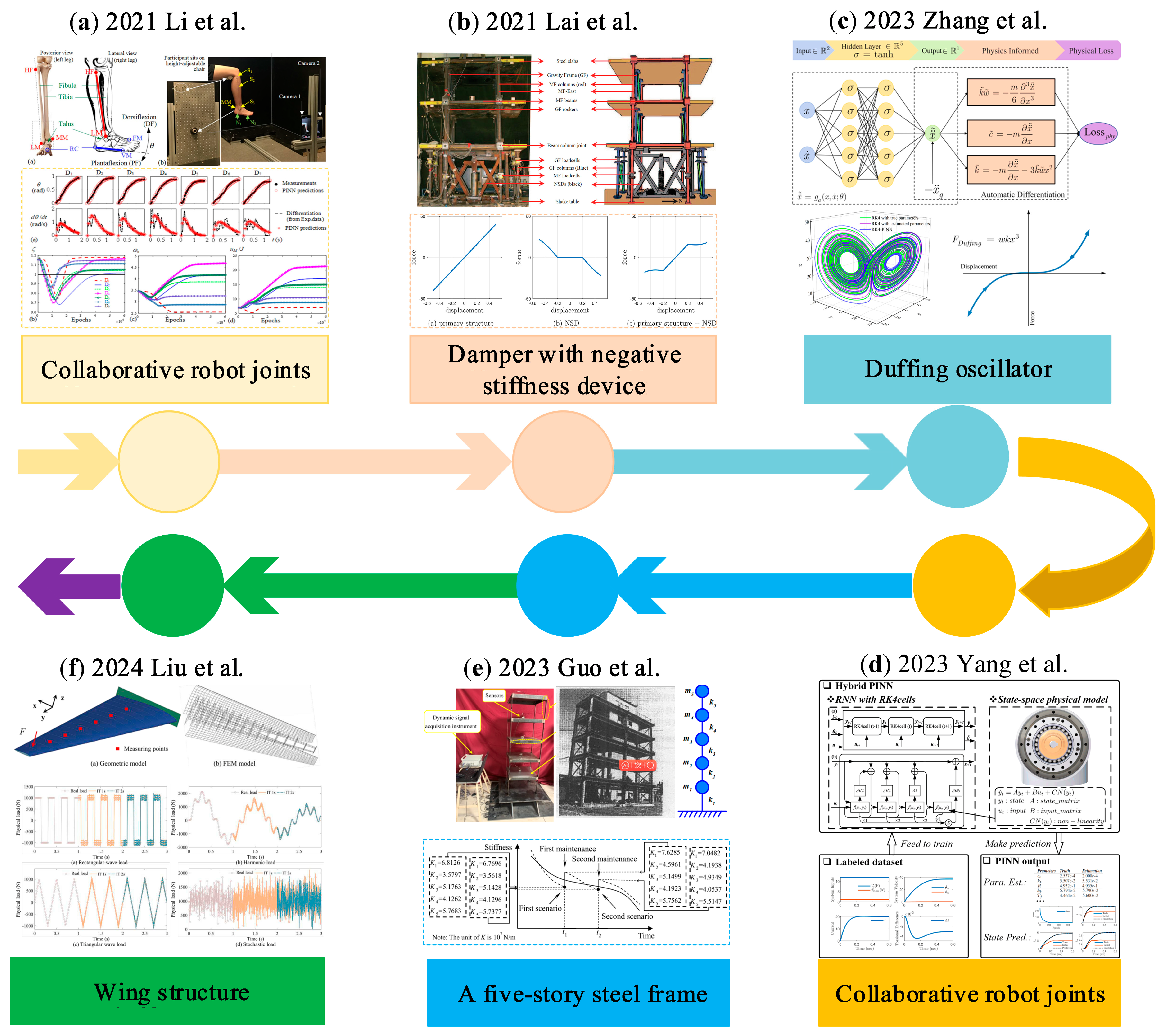
4.8. Physics-Informed Neural Networks
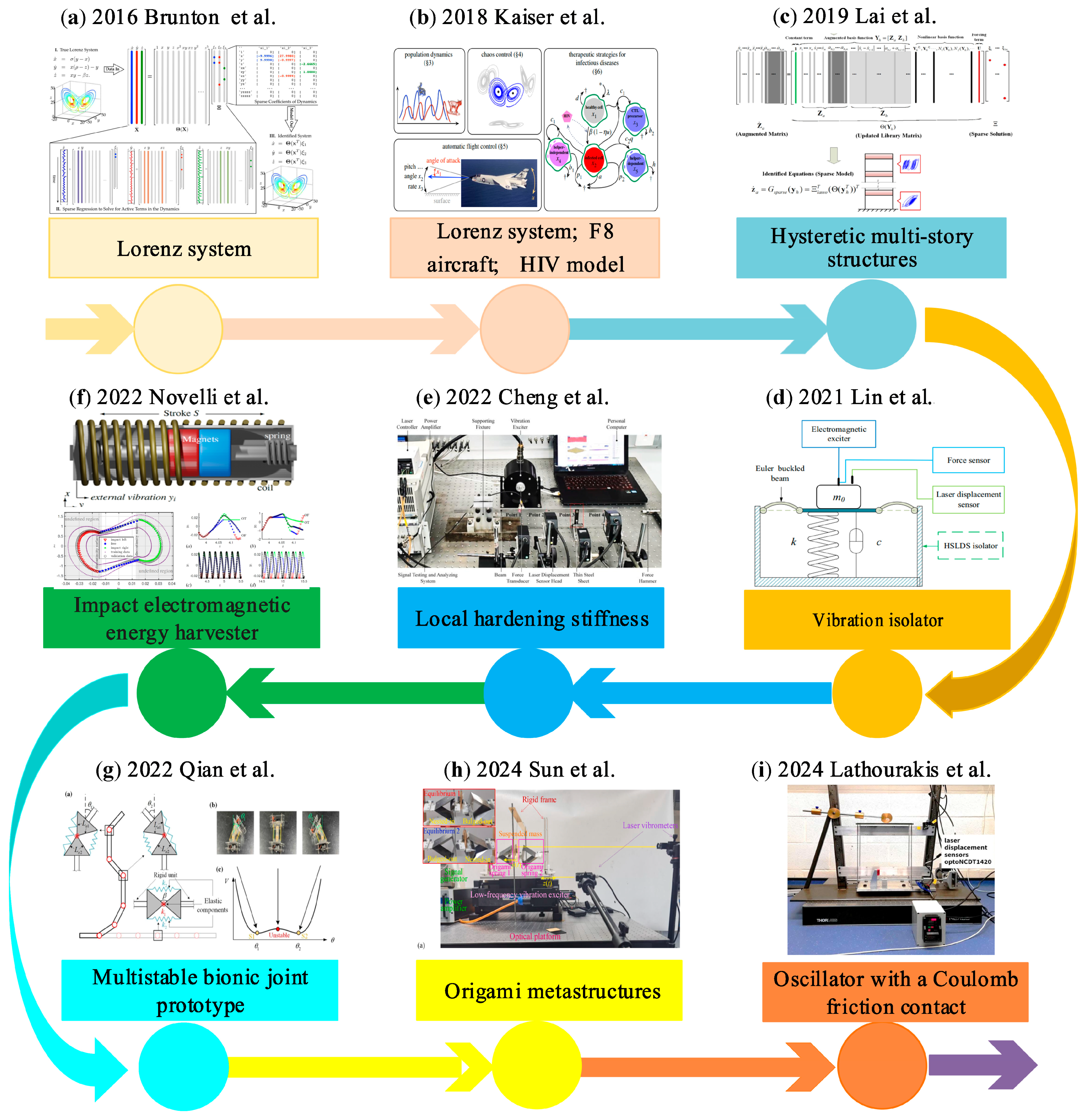
4.9. Data-Driven Sparse Regression
4.10. Comparisons
5. Nonlinear Restoring Force Identification Enhancement Strategies
6. Conclusions and Challenges
- Beneficial nonlinear structures are rarely applied in real engineering situations. For example, the nonlinear energy harvester should have MEMS-scale and high energy output simultaneously, which is a great challenge for nonlinear design and fabrication. The quasi-zero stiffness should be designed to simultaneously exhibit very low natural frequencies and high static load-bearing capacity.
- When considering the benefits brought by nonlinear design, additional negative impacts also need to be considered.
- Several new applications of quasi-zero stiffness and bistable structures require additional attention and development. For instance, the metamaterial structures and bio-inspired smart structures. The high-dimensional, complicated hysteresis loops, multi-degree-of-freedom, multiscale, and non-lumped parameter modeling and identification may continue to be a great challenge.
- The lack of excitation measurement, the time-varying feature, and the strong noise disturbance are usually encountered in real situations. Therefore, when the identification algorithm is applied, the available datasets, the time-varying parameters, and the robustness of noise should be considered first.
- Many advanced machine learning methods have been used for system identification and control. The feasibility of obtaining a large amount of data needs to be considered. Balancing identification accuracy and computing efficiency is very important in data-driven identification methods. Moreover, the physical interpretation of data-driven methods needs further exploration.
Funding
Data Availability Statement
Conflicts of Interest
References
- Harne, R.L.; Wang, K.W. Harnessing Bistable Structural Dynamics: For Vibration Control, Energy Harvesting, and Sensing; Wiley: New York, NY, USA, 2017. [Google Scholar]
- Dalela, S.; Prasad, P.; Balaji, P.S.; Trivedi, S.; Kalam, A. A novel bottom reinforced cosine beam based metastructure with quasi zero stiffness characteristics for vibration isolation applications. Structures 2024, 67, 106950. [Google Scholar] [CrossRef]
- Zhou, H.; Gao, J.; Chen, Y.; Shen, Z.; Lv, H.; Sareh, P. A quasi-zero-stiffness vibration isolator inspired by Kresling origami. Structures 2024, 69, 107315. [Google Scholar] [CrossRef]
- Cao, Y.; Derakhshani, M.; Fang, Y.; Huang, G.; Cao, C. Bistable structures for advanced functional systems. Adv. Funct. Mater. 2021, 31, 2106231. [Google Scholar] [CrossRef]
- Cui, Y.; Yang, T.; Luo, H.; Li, Z.; Jing, X. Jellyfish-inspired bistable piezoelectric-triboelectric hybrid generator for low-frequency vibration energy harvesting. Int. J. Mech. Sci. 2024, 279, 109523. [Google Scholar] [CrossRef]
- Yang, T.; Liu, J.; Luo, H.; Li, Z. Improving the performance of nonlinear isolator through triboelectric nanogenerator damper integrating energy harvesting. Energy 2024, 293, 130722. [Google Scholar] [CrossRef]
- Yan, B.; Yu, N.; Ma, H.; Wu, C. A theory for bistable vibration isolators. Mech. Syst. Signal Process. 2022, 167, 108507. [Google Scholar] [CrossRef]
- Ishida, S.; Uchida, H.; Shimosaka, H.; Hagiwara, I. Design and numerical analysis of vibration isolators with quasi-zero-stiffness characteristics using bistable foldable structures. J. Vib. Acoust. 2017, 139, 031015. [Google Scholar] [CrossRef]
- Rothemund, P.; Ainla, A.; Belding, L.; Preston, D.J.; Kurihara, S.; Suo, Z.; Whitesides, G.M. A soft, bistable valve for autonomous control of soft actuators. Sci. Robot. 2018, 3, 7986. [Google Scholar] [CrossRef]
- Shao, H.; Wei, S.; Jiang, X.; Holmes, D.P.; Ghosh, T.K. Bioinspired electrically activated soft bistable actuators. Adv. Funct. Mater. 2018, 28, 1802999. [Google Scholar] [CrossRef]
- Balaji, P.S.; Rahman, M.E.; Moussa, L.; Lau, H.H. Wire rope isolators for vibration isolation of equipment and structures—A review. IOP conference series. Mater. Sci. Eng. 2015, 78, 1–10. [Google Scholar]
- Tol, S. Dynamic characterization of bolted joints using FRF decoupling and optimization. Mech. Syst. Signal Process. 2015, 54, 124–138. [Google Scholar] [CrossRef]
- Erturk, A.; Inman, D.J. Broadband piezoelectric power generation on high-energy orbits of the bistable Duffing oscillator with electromechanical coupling. J. Sound Vib. 2011, 330, 2339–2353. [Google Scholar] [CrossRef]
- Liu, Q.; Cao, J.; Zhang, Y.; Zhao, Z.; Kerschen, G.; Jing, X. Interpretable sparse identification of a bistable nonlinear energy sink. Mech. Syst. Signal Process. 2023, 193, 110254. [Google Scholar] [CrossRef]
- Carrella, A.; Brennan, M.; Kovacic, I.; Waters, T. On the force transmissibility of a vibration isolator with quasi-zero-stiffness. J. Sound Vib. 2009, 322, 707–717. [Google Scholar] [CrossRef]
- Gatti, G. Effect of Parameters on the Design of a Suspension System with Four Oblique Springs. Shock Vib. 2021, 2021, 5556088. [Google Scholar] [CrossRef]
- Leadenham, S.; Erturk, A. M-shaped asymmetric nonlinear oscillator for broadband vibration energy harvesting: Harmonic balance analysis and experimental validation. J. Sound Vib. 2014, 333, 6209–6223. [Google Scholar] [CrossRef]
- Mariello, M.; Blad, T.; Mastronardi, V.; Madaro, F.; Guido, F.; Staufer, U.; Tolou, N.; De Vittorio, M. Flexible piezoelectric AlN transducers buckled through package-induced preloading for mechanical energy harvesting. Nano Energy 2021, 85, 105986. [Google Scholar] [CrossRef]
- Sun, Y.; Ye, W.; Chen, Y.; Fan, W.; Feng, J.; Sareh, P. Geometric design classification of kirigami-inspired metastructures and metamaterials. Structures 2021, 33, 3633–3643. [Google Scholar] [CrossRef]
- Surjadi, J.U.; Gao, L.; Du, H.; Li, X.; Xiong, X.; Fang, N.X.; Lu, Y. Mechanical metamaterials and their engineering applications. Adv. Eng. Mater. 2019, 21, 1800864. [Google Scholar] [CrossRef]
- Niu, M.-Q.; Chen, L.-Q. Analysis of a bio-inspired vibration isolator with a compliant limb-like structure. Mech. Syst. Signal Process. 2022, 179, 109348. [Google Scholar] [CrossRef]
- Yan, G.; Zou, H.-X.; Wang, S.; Zhao, L.-C.; Wu, Z.-Y.; Zhang, W.-M. Bio-inspired toe-like structure for low-frequency vibration isolation. Mech. Syst. Signal Process. 2022, 162, 108010. [Google Scholar] [CrossRef]
- Guo, Y.; Ma, Z.; Zhang, T.; Zheng, X.; Jin, Z. A stiffness-tunable MEMS accelerometer. J. Micromech. Microeng. 2020, 31, 025005. [Google Scholar] [CrossRef]
- Guilllemet, R.; Basset, P.; Galayko, D.; Cottone, F.; Marty, F.; Bourouina, T. Wideband MEMS electrostatic vibration energy harvesters based on gap-closing interdigited combs with a trapezoidal cross section. In Proceedings of the 2013 IEEE 26th International Conference on Micro Electro Mechanical Systems (MEMS), Taiwan, China, 20–24 January 2013; pp. 817–820. [Google Scholar]
- Jaisee, S.; Yue, F.; Ooi, Y.H. A state-of-the-art review on passive friction dampers and their applications. Eng. Struct. 2021, 235, 112022. [Google Scholar] [CrossRef]
- Donmez, A.; Cigeroglu, E.; Ozgen, G.O. An improved quasi-zero stiffness vibration isolation system utilizing dry friction damping. Nonlinear Dyn. 2020, 101, 107–121. [Google Scholar] [CrossRef]
- Jing, X.; Vakakis, A.F. Exploring nonlinear benefits in engineering. Mech. Syst. Signal Process. 2019, 125, 1–3. [Google Scholar] [CrossRef]
- Yang, T.; Xu, H.; Tang, J.; Zhou, S. Exploring nonlinear degradation benefit of bio-inspired oscillator for engineering applications. Appl. Math. Model. 2023, 119, 736–762. [Google Scholar] [CrossRef]
- Xu, B.; He, J.; Masri, S.F. Data-based Identification of nonlinear restoring force under spatially incomplete excitations with power series polynomial model. Nonlinear Dyn. 2012, 67, 2063–2080. [Google Scholar] [CrossRef]
- Al-Shudeifat, M.A. Nonlinear energy sinks with piecewise-linear nonlinearities. J. Comput. Nonlinear Dyn. 2019, 14, 124501. [Google Scholar] [CrossRef]
- Hassani, V.; Tjahjowidodo, T.; Do, T.N. A survey on hysteresis modeling, identification and control. Mech. Syst. Signal Process. 2014, 49, 209–233. [Google Scholar] [CrossRef]
- Noël, J.-P.; Kerschen, G. Nonlinear system identification in structural dynamics: 10 more years of progress. Mech. Syst. Signal Process. 2017, 83, 2–35. [Google Scholar] [CrossRef]
- Noël, J.-P.; Marchesiello, S.; Kerschen, G. Subspace-based identification of a nonlinear spacecraft in the time and frequency domains. Mech. Syst. Signal Process. 2014, 43, 217–236. [Google Scholar] [CrossRef]
- Noël, J.-P.; Kerschen, G.; Foltête, E.; Cogan, S. Grey-box identification of a non-linear solar array structure using cubic splines. Int. J. Nonlinear Mech. 2014, 67, 106–119. [Google Scholar] [CrossRef]
- Feldman, M. Hilbert transform in vibration analysis. Mech. Syst. Signal Process. 2011, 25, 735–802. [Google Scholar] [CrossRef]
- Zhang, M.; Wei, S.; Peng, Z.; Dong, X.; Zhang, W. A two-stage time domain subspace method for identification of nonlinear vibrating structures. Int. J. Mech. Sci. 2017, 120, 81–90. [Google Scholar] [CrossRef]
- Liu, J.; Li, B.; Miao, H.; Zhang, X.; Li, M. A modified time domain subspace method for nonlinear identification based on nonlinear separation strategy. Nonlinear Dyn. 2018, 94, 2491–2509. [Google Scholar] [CrossRef]
- Anastasio, D.; Marchesiello, S.; Kerschen, G.; Noël, J.P. Experimental identification of distributed nonlinearities in the modal domain. J. Sound Vib. 2019, 458, 426–444. [Google Scholar] [CrossRef]
- Huangfu, N.; Zhang, Y.; Lei, Y.; Liu, Q.; Liao, W.; Zhao, Z.; Cao, J. A dynamic response prediction model of nonlinear hysteretic isolators based on quasi-static characteristics and dynamic compensations. Mech. Syst. Signal Process. 2025, 224, 112170. [Google Scholar] [CrossRef]
- Chen, W.; Jana, D.; Singh, A.; Jin, M.; Cenedese, M.; Kosova, G.; Brake, M.R.; Schwingshackl, C.W.; Nagarajaiah, S.; Moore, K.J.; et al. Measurement and identification of the nonlinear dynamics of a jointed structure using full-field data, Part I: Measurement of nonlinear dynamics. Mech. Syst. Signal Process. 2022, 166, 36–50. [Google Scholar] [CrossRef]
- Bajrić, A.; Høgsberg, J. Estimation of hysteretic damping of structures by stochastic subspace identification. Mech. Syst. Signal Process. 2018, 105, 36–50. [Google Scholar] [CrossRef]
- Yang, T.; Zhou, S.; Fang, S.; Qin, W.; Inman, D.J. Nonlinear vibration energy harvesting and vibration suppression technologies: Designs, analysis, and applications. Appl. Phys. Rev. 2021, 8, 031317. [Google Scholar] [CrossRef]
- Zou, H.-X.; Zhao, L.-C.; Gao, Q.-H.; Zuo, L.; Liu, F.-R.; Tan, T.; Wei, K.-X.; Zhang, W.-M. Mechanical modulations for enhancing energy harvesting: Principles, methods and applications. Appl. Energy 2019, 255, 113871. [Google Scholar] [CrossRef]
- Fu, H.; Mei, X.; Yurchenko, D.; Zhou, S.; Theodossiades, S.; Nakano, K.; Yeatman, E.M. Rotational energy harvesting for self-powered sensing. Joule 2021, 5, 1074–1118. [Google Scholar] [CrossRef]
- Zhang, Y.; Wang, W.; Wu, X.; Lei, Y.; Cao, J.; Bowen, C.; Bader, S.; Yang, B. A comprehensive review on self-powered smart bearings. Renew. Sustain. Energy Rev. 2023, 183, 113446. [Google Scholar] [CrossRef]
- Quaranta, G.; Lacarbonara, W.; Masri, S. A review on computational intelligence for identification of nonlinear dynamical systems. Nonlinear Dyn. 2020, 99, 1709–1761. [Google Scholar] [CrossRef]
- Jin, M.; Brake, M.R.; Song, H. Comparison of nonlinear system identification methods for free decay measurements with application to jointed structures. J. Sound Vib. 2019, 453, 268–293. [Google Scholar] [CrossRef]
- Wagg, D.J. A review of the mechanical inerter: Historical context, physical realisations and nonlinear applications. Nonlinear Dyn. 2021, 104, 13–34. [Google Scholar] [CrossRef]
- Feng, X.; Jing, X.; Xu, Z.; Guo, Y. Bio-inspired anti-vibration with nonlinear inertia coupling. Mech. Syst. Signal Process. 2019, 124, 562–595. [Google Scholar] [CrossRef]
- Zhou, S.; Cao, J.; Erturk, A.; Lin, J. Enhanced broadband piezoelectric energy harvesting using rotatable magnets. Appl. Phys. Lett. 2013, 102, 173901. [Google Scholar] [CrossRef]
- Yang, T.; Cao, Q. Dynamics and performance evaluation of a novel tristable hybrid energy harvester for ultra-low level vibration resources. Int. J. Mech. Sci. 2019, 156, 123–136. [Google Scholar] [CrossRef]
- Dykstra, D.M.J.; Lenting, C.; Masurier, A.; Coulais, C. Buckling Metamaterials for Extreme Vibration Damping. Adv. Mater. 2023, 35, e2301747. [Google Scholar] [CrossRef]
- Chen, T.; Pauly, M.; Reis, P.M. A reprogrammable mechanical metamaterial with stable memory. Nature 2021, 589, 386–390. [Google Scholar] [CrossRef] [PubMed]
- Jiang, G.; Jing, X.; Guo, Y. A novel bio-inspired multi-joint anti-vibration structure and its nonlinear HSLDS properties. Mech. Syst. Signal Process. 2020, 138, 106552. [Google Scholar] [CrossRef]
- Wu, H.; Tao, Z.; Li, H.; Xu, T.; Wang, W.; Sun, J.; Xiao, W.; Li, H. A micro-electromagnetic vibration energy harvester with higher power density and wider bandwidth utilizing 3D MEMS coils. Appl. Phys. Lett. 2021, 119, 213904. [Google Scholar] [CrossRef]
- Wang, Y.-J.; Zhang, Z.-J.; Xue, X.-M.; Zhang, L. Experimental investigation on enhanced mechanical and damping per-formance of corrugated structure with metal rubber. Thin Wall. Struct. 2020, 154, 106816. [Google Scholar] [CrossRef]
- Zhai, Z.; Wang, Y.; Lin, K.; Wu, L.; Jiang, H. In situ stiffness manipulation using elegant curved origami. Sci. Adv. 2020, 6, eabe2000. [Google Scholar] [CrossRef]
- Wang, W.; Cao, J.; Zhang, N.; Lin, J.; Liao, W.-H. Magnetic-spring based energy harvesting from human motions: Design, modeling and experiments. Energy Convers. Manag. 2017, 132, 189–197. [Google Scholar] [CrossRef]
- Jensen, T.W.; Insinga, A.R.; Ehlers, J.C.; Bjørk, R. The full phase space dynamics of a magnetically levitated electromagnetic vibration harvester. Sci. Rep. 2021, 11, 16607. [Google Scholar] [CrossRef]
- Qian, F.; Zhou, S.; Zuo, L. Improving the off-resonance energy harvesting performance using dynamic magnetic pre-loading. Acta. Mech. Sin.-PRC 2020, 36, 624–634. [Google Scholar] [CrossRef]
- Wu, P.; Wang, F.; Xu, S.; Liu, T.; Qi, Y.; Zhao, X.; Zhang, C.; Mu, X. A Highly Sensitive Triboelectric Quasi-Zero Stiffness Vibration Sensor with Ultrawide Frequency Response. Adv. Sci. 2023, 10, e2301199. [Google Scholar] [CrossRef]
- Ma, Z.; Zhou, R.; Yang, Q.; Lee, H.P.; Chai, K. A semi-active electromagnetic quasi-zero-stiffness vibration isolator. Int. J. Mech. Sci. 2023, 252, 108357. [Google Scholar] [CrossRef]
- Zhao, T.-Y.; Yan, G.; Qi, W.-H.; Lu, J.-J.; Zhang, W.-M. Magnetically modulated tetrahedral structure for low frequency vibration isolation with adjustable load capacity. Int. J. Mech. Sci. 2023, 251, 108335. [Google Scholar] [CrossRef]
- Fu, H.; Yeatman, E. Rotational energy harvesting using bi-stability and frequency up-conversion for low-power sensing applications: Theoretical modelling and experimental validation. Mech. Syst. Signal Process. 2018, 125, 229–244. [Google Scholar] [CrossRef]
- Narolia, T.; Gupta, V.K.; Parinov, I. Design and experimental study of rotary-type energy harvester. J. Intell. Mater. Syst. Struct. 2020, 31, 1594–1603. [Google Scholar] [CrossRef]
- Zou, H.-X.; Zhang, W.-M.; Li, W.-B.; Wei, K.-X.; Gao, Q.-H.; Peng, Z.-K.; Meng, G. Design and experimental investigation of a magnetically coupled vibration energy harvester using two inverted piezoelectric cantilever beams for rotational motion. Energy Convers. Manag. 2017, 148, 1391–1398. [Google Scholar] [CrossRef]
- Zhao, L.; Zou, H.; Gao, Q.; Yan, G.; Wu, Z.; Liu, F.; Wei, K.; Yang, B.; Zhang, W. Design, modeling and experimental investigation of a magnetically modulated rotational energy harvester for low frequency and irregular vibration. Sci. China Technol. Sci. 2020, 63, 2051–2062. [Google Scholar] [CrossRef]
- Halima, M.; Rantza, R.; Zhangb, Q.; Gub, L.; Yangb, K.; Roundya, S. An electromagnetic rotational energy harvester using sprung eccentric rotor, driven by pseudo-walking motion. Appl. Energy 2018, 217, 66–74. [Google Scholar] [CrossRef]
- Yan, B.; Ma, H.; Zhao, C.; Wu, C.; Wang, K.; Wang, P. A vari-stiffness nonlinear isolator with magnetic effects: Theoretical modeling and experimental verification. Int. J. Mech. Sci. 2018, 148, 745–755. [Google Scholar] [CrossRef]
- Yao, H.; Wang, Y.; Cao, Y.; Wen, B. Multi-stable nonlinear energy sink for rotor system. Int. J. Non-Linear Mech. 2020, 118, 103273. [Google Scholar] [CrossRef]
- Zhang, Y.; Cao, J.; Zhu, H.; Lei, Y. Design, modeling and experimental verification of circular Halbach electromagnetic energy harvesting from bearing motion. Energy Convers. Manag. 2019, 180, 811–821. [Google Scholar] [CrossRef]
- Wang, Y.-J.; Chen, C.-D.; Sung, C.-K.; Li, C. Natural frequency self-tuning energy harvester using a circular Halbach array magnetic disk. J. Intell. Mater. Syst. Struct. 2012, 23, 933–943. [Google Scholar] [CrossRef]
- Zhou, N.; Zhang, Y.; Bowen, C.; Cao, J. A stacked electromagnetic energy harvester with frequency up-conversion for swing motion. Appl. Phys. Lett. 2020, 117, 163904. [Google Scholar] [CrossRef]
- Yan, L.; Zhu, B.; Jiao, Z.; Chen, C.-Y.; Chen, I.-M. An Orientation Measurement Method Based on Hall-effect Sensors for Permanent Magnet Spherical Actuators with 3D Magnet Array. Sci. Rep. 2014, 4, 6756. [Google Scholar] [CrossRef] [PubMed]
- Mofidian, S.M.M.; Bardaweel, H. Theoretical study and experimental identification of elastic-magnetic vibration isolation system. J. Intel. Mat. Syst. Struct. 2018, 29, 3550–3561. [Google Scholar] [CrossRef]
- Zhang, Y.; Liu, Q.; Lei, Y.; Cao, J.; Liao, W.-H. Halbach high negative stiffness isolator: Modeling and experiments. Mech. Syst. Signal Process. 2023, 188, 110014. [Google Scholar] [CrossRef]
- Liu, B.; Levi, C.; Estefen, S.F.; Wu, Z.; Duan, M. Evaluation of the Double Snap-Through Mechanism on the Wave Energy Converter’s Performance. J. Mar. Sci. Appl. 2021, 20, 268–283. [Google Scholar] [CrossRef]
- Wen, G.; He, J.; Liu, J.; Lin, Y. Design, analysis and semi-active control of a quasi-zero stiffness vibration isolation system with six oblique springs. Nonlinear Dyn. 2021, 106, 309–321. [Google Scholar] [CrossRef]
- Lan, C.-C.; Yang, S.-A.; Wu, Y.-S. Design and experiment of a compact quasi-zero-stiffness isolator capable of a wide range of loads. J. Sound Vib. 2014, 333, 4843–4858. [Google Scholar] [CrossRef]
- Huang, X.; Liu, X.; Sun, J.; Zhang, Z.; Hua, H. Vibration isolation characteristics of a nonlinear isolator using Euler buckled beam as negative stiffness corrector: A theoretical and experimental study. J. Sound Vib. 2014, 333, 1132–1148. [Google Scholar] [CrossRef]
- Tang, J.; Yang, Y.; Li, Y.; Cao, D. A 6-DOF micro-vibration isolation platform based on the quasi-zero-stiffness isolator. Proc. Inst. Mech. Eng. Part C J. Mech. Eng. Sci. 2021, 235, 6019–6035. [Google Scholar] [CrossRef]
- Ye, K.; Ji, J.C. An origami inspired quasi-zero stiffness vibration isolator using a novel truss-spring based stack Miura-ori structure. Mech. Syst. Signal Process. 2022, 165, 108383. [Google Scholar] [CrossRef]
- Zhao, F.; Ji, J.; Ye, K.; Luo, Q. An innovative quasi-zero stiffness isolator with three pairs of oblique springs. Int. J. Mech. Sci. 2021, 192, 106093. [Google Scholar] [CrossRef]
- Zuo, S.; Wang, D.; Zhang, Y.; Luo, Q. Design and testing of a parabolic cam-roller quasi-zero-stiffness vibration isolator. Int. J. Mech. Sci. 2022, 220, 107146. [Google Scholar] [CrossRef]
- Le, T.D.; Ahn, K.K. Experimental investigation of a vibration isolation system using negative stiffness structure. Int. J. Mech. Sci. 2013, 70, 99–112. [Google Scholar] [CrossRef]
- Sun, Y.; Zhou, J.; Thompson, D.; Yuan, T.; Gong, D.; You, T. Design, analysis and experimental validation of high static and low dynamic stiffness mounts based on target force curves. Int. J. Non-Linear Mech. 2020, 126, 103559. [Google Scholar] [CrossRef]
- Zhang, Y.; Wei, G.; Wen, H.; Jin, D.; Hu, H. Design and analysis of a vibration isolation system with cam–roller–spring–rod mechanism. J. Vib. Control 2022, 28, 1781–1791. [Google Scholar] [CrossRef]
- Zhou, J.; Wang, X.; Xu, D.; Bishop, S. Nonlinear dynamic characteristics of a quasi-zero stiffness vibration isolator with cam–roller–spring mechanisms. J. Sound Vib. 2015, 346, 53–69. [Google Scholar] [CrossRef]
- Hou, Z.; Zha, W.; Wang, H.; Liao, W.-H.; Bowen, C.R.; Cao, J. Bistable energy harvesting backpack: Design, modeling, and experiments. Energy Convers. Manag. 2022, 259, 115441. [Google Scholar] [CrossRef]
- Gatti, G. An adjustable device to adaptively realise diverse nonlinear force-displacement characteristics. Mech. Syst. Signal Process. 2022, 180, 109379. [Google Scholar] [CrossRef]
- Li, M.; Li, X.; Gan, C.; Zeng, J.; Zhao, L.; Ding, H.; Wei, K.; Zou, H. Human motion energy harvesting backpack using quasi-zero stiffness mechanism. Energy Convers. Manag. 2023, 288, 117158. [Google Scholar] [CrossRef]
- Leland, E.S.; Wright, P.K. Resonance tuning of piezoelectric vibration energy scavenging generators using compressive axial preload. Smart Mater. Struct. 2006, 15, 1413–1420. [Google Scholar] [CrossRef]
- Wang, X.; Shi, Z.; Wang, J.; Xiang, H. A stack-based flex-compressive piezoelectric energy harvesting cell for large quasi-static loads. Smart Mater. Struct. 2016, 25, 055005. [Google Scholar] [CrossRef]
- Rhimi, M.; Lajnef, N. Tunable Energy Harvesting from Ambient Vibrations in Civil Structures. J. Energy Eng. 2012, 138, 185–193. [Google Scholar] [CrossRef]
- Liao, G.; Luan, C.; Wang, Z.; Liu, J.; Yao, X.; Fu, J. Acoustic metamaterials: A review of theories, structures, fabrication approaches, and applications. Adv. Mater. Technol. 2021, 6, 2000787. [Google Scholar] [CrossRef]
- Xie, Z.; Xiong, J.; Zhang, D.; Wang, T.; Shao, Y.; Huang, W. Design and experimental investigation of a piezoelectric rotation energy harvester using bistable and frequency up-conversion mechanisms. Appl. Sci. 2018, 8, 1418. [Google Scholar] [CrossRef]
- Yong, Y.K. Preloading piezoelectric stack actuators in high-speed nanopositioning systems. Front. Mech. Eng. 2016, 2, 8. [Google Scholar] [CrossRef]
- Yang, S.; Xia, X.; Liu, X.; Qiao, G.; Zhang, X.; Lu, X. Improving velocity of stick-slip piezoelectric actuators with optimized flexure hinges based on SIMP method. IEEE Access 2020, 8, 213122–213129. [Google Scholar] [CrossRef]
- Liu, X.; Huang, X.; Hua, H. On the characteristics of a quasi-zero stiffness isolator using Euler buckled beam as negative stiffness corrector. J. Sound Vib. 2013, 332, 3359–3376. [Google Scholar] [CrossRef]
- Lu, J.-J.; Yan, G.; Qi, W.-H.; Yan, H.; Ma, J.; Shi, J.-W.; Wu, Z.-Y.; Zhang, W.-M. Sliding-boundary-constrained cantilever structure for vibration isolation via nonlinear stiffness modulation. Int. J. Mech. Sci. 2022, 235, 107733. [Google Scholar] [CrossRef]
- Yang, Z.; Zu, J. High-efficiency compressive-mode energy harvester enhanced by a multi-stage force amplification mechanism. Energy Convers. Manag. 2014, 88, 829–833. [Google Scholar] [CrossRef]
- Zhao, L.-C.; Zou, H.-X.; Wu, Z.-Y.; Gao, Q.-H.; Yan, G.; Liu, F.-R.; Wei, K.-X.; Zhang, W.-M. Dynamically synergistic regulation mechanism for rotation energy harvesting. Mech. Syst. Signal Process. 2022, 169, 108637. [Google Scholar] [CrossRef]
- Fang, S.; Wang, S.; Zhou, S.; Yang, Z.; Liao, W.-H. Exploiting the advantages of the centrifugal softening effect in rotational impact energy harvesting. Appl. Phys. Lett. 2020, 116, 063903. [Google Scholar] [CrossRef]
- Wang, Y.; Zhao, Y.; Tian, Y.; Cao, D.; Yang, Z. Improving the gravity-rotation-excited vibration energy harvesting in offset configurations. Int. J. Mech. Sci. 2023, 243, 108033. [Google Scholar] [CrossRef]
- Qin, F.; Chen, Y.; Sun, X.; Wang, Y.; Dai, G.; Du, Y. An adjustable magnetic preloading and stepping controlled piezoelectric traveling-wave ultrasonic micromotor. J. Microelectromech. Syst. 2019, 28, 264–270. [Google Scholar] [CrossRef]
- Zhang, Q.; Guo, D.; Hu, G. Tailored mechanical metamaterials with programmable quasi-zero-stiffness features for full-band vibration isolation. Adv. Funct. Mater. 2021, 31, 2101428. [Google Scholar] [CrossRef]
- Li, Z.; Wang, K.; Chen, T.; Cheng, L.; Xu, D.; Zhou, J. Temperature controlled quasi-zero-stiffness metamaterial beam for broad-range low-frequency band tuning. Int. J. Mech. Sci. 2023, 259, 108593. [Google Scholar] [CrossRef]
- Zolfagharian, A.; Bodaghi, M.; Hamzehei, R.; Parr, L.; Fard, M.; Rolfe, B.F. 3D-printed programmable mechanical metamaterials for vibration isolation and buckling control. Sustainability 2022, 14, 6831. [Google Scholar] [CrossRef]
- Cai, C.; Zhou, J.; Wu, L.; Wang, K.; Xu, D.; Ouyang, H. Design and numerical validation of quasi-zero-stiffness metamaterials for very low-frequency band gaps. Compos. Struct. 2020, 236, 111862. [Google Scholar] [CrossRef]
- Wang, K.; Zhou, J.; Ouyang, H.; Cheng, L.; Xu, D. A semi-active metamaterial beam with electromagnetic quasi-zero-stiffness resonators for ultralow-frequency band gap tuning. Int. J. Mech. Sci. 2020, 176, 105548. [Google Scholar] [CrossRef]
- Guo, S.; Gao, R.; Tian, X.; Liu, S. A quasi-zero-stiffness elastic metamaterial for energy absorption and shock attenuation. Eng. Struct. 2023, 280, 115687. [Google Scholar] [CrossRef]
- Zhai, Z.; Wang, Y.; Jiang, H. Origami-inspired, on-demand deployable and collapsible mechanical metamaterials with tunable stiffness. Proc. Natl. Acad. Sci. USA 2018, 115, 2032–2037. [Google Scholar] [CrossRef]
- Ma, H.; Wang, K.; Zhao, H.; Hong, Y.; Zhou, Y.; Xue, J.; Li, Q.; Wang, G.; Yan, B. Energy dissipation in multistable auxetic mechanical metamaterials. Compos. Struct. 2023, 304, 116410. [Google Scholar] [CrossRef]
- Ma, H.; Wang, K.; Zhao, H.; Zhao, C.; Xue, J.; Liang, C.; Yan, B. Harnessing chiral buckling structure to design tunable local resonance metamaterial for low-frequency vibration isolation. J. Sound Vib. 2023, 565, 117905. [Google Scholar] [CrossRef]
- Tan, T.; Yan, Z.; Zou, H.; Ma, K.; Liu, F.; Zhao, L.; Peng, Z.; Zhang, W. Renewable energy harvesting and absorbing via multi-scale metamaterial systems for Internet of things. Appl. Energy 2019, 254, 113717. [Google Scholar] [CrossRef]
- Bagmanci, M.; Karaaslan, M.; Unal, E.; Akgol, O.; Bakır, M.; Sabah, C. Solar energy harvesting with ultra-broadband metamaterial absorber. Int. J. Mod. Phys. B 2019, 33, 1950056. [Google Scholar] [CrossRef]
- Karaaslan, M.; Bağmancı, M.; Ünal, E.; Akgol, O.; Sabah, C. Microwave energy harvesting based on metamaterial absorbers with multi-layered square split rings for wireless communications. Opt. Commun. 2017, 392, 31–38. [Google Scholar] [CrossRef]
- Rafsanjani, A.; Bertoldi, K.; Studart, A.R. Programming soft robots with flexible mechanical metamaterials. Sci. Robot. 2019, 4, eaav7874. [Google Scholar] [CrossRef]
- Mark, A.G.; Palagi, S.; Qiu, T.; Fischer, P. Auxetic metamaterial simplifies soft robot design. In Proceedings of the 2016 IEEE International Conference on Robotics and Automation (ICRA), Stockholm, Sweden, 16–21 May 2016; pp. 4951–4956. [Google Scholar]
- Pan, Q.; Chen, S.; Chen, F.; Zhu, X. Programmable soft bending actuators with auxetic metamaterials. Sci. China Technol. Sci. 2020, 63, 2518–2526. [Google Scholar] [CrossRef]
- Bonfanti, S.; Guerra, R.; Font-Clos, F.; Rayneau-Kirkhope, D.; Zapperi, S. Automatic design of mechanical metamaterial actuators. Nat. Commun. 2020, 11, 4162. [Google Scholar] [CrossRef]
- Hu, F.; Li, T. An origami flexiball-inspired metamaterial actuator and its in-pipe robot prototype. Actuators 2021, 10, 67. [Google Scholar] [CrossRef]
- Feng, X.; Jing, X. Human body inspired vibration isolation: Beneficial nonlinear stiffness, nonlinear damping & nonlinear inertia. Mech. Syst. Signal Process. 2019, 117, 786–812. [Google Scholar] [CrossRef]
- Kim, G.W.; Kang, J. The V-shaped band-stop vibration isolator inspired by middle ear. Appl. Acoust. 2019, 150, 162–168. [Google Scholar] [CrossRef]
- Wang, Y.; Jing, X.; Dai, H.; Li, F.-M. Subharmonics and ultra-subharmonics of a bio-inspired nonlinear isolation system. Int. J. Mech. Sci. 2019, 152, 167–184. [Google Scholar] [CrossRef]
- Yan, G.; Wang, S.; Zou, H.; Zhao, L.; Gao, Q.; Zhang, W. Bio-inspired polygonal skeleton structure for vibration isolation: Design, modelling, and experiment. Sci. China Technol. Sci. 2020, 63, 2617–2630. [Google Scholar] [CrossRef]
- Ling, P.; Miao, L.; Ye, B.; You, J.; Zhang, W.; Yan, B. Ultra-low frequency vibration isolation of a novel click-beetle-inspired structure with large quasi-zero stiffness region. J. Sound Vib. 2023, 558, 117756. [Google Scholar] [CrossRef]
- Yoon, S.-H.; Roh, J.-E.; Kim, K.L. Woodpecker-inspired shock isolation by microgranular bed. J. Phys. D Appl. Phys. 2008, 42, 035501. [Google Scholar] [CrossRef]
- Deng, T.; Wen, G.; Ding, H.; Lu, Z.-Q.; Chen, L.-Q. A bio-inspired isolator based on characteristics of quasi-zero stiffness and bird multi-layer neck. Mech. Syst. Signal Process. 2020, 145, 106967. [Google Scholar] [CrossRef]
- Dai, H.; Jing, X.; Wang, Y.; Yue, X.; Yuan, J. Post-capture vibration suppression of spacecraft via a bio-inspired isolation system. Mech. Syst. Signal Process. 2018, 105, 214–240. [Google Scholar] [CrossRef]
- Pan, H.; Jing, X.; Sun, W.; Li, Z. Analysis and design of a bioinspired vibration sensor system in noisy environment. IEEE/ASME Trans. Mechatron. 2018, 23, 845–855. [Google Scholar] [CrossRef]
- Sun, B.; Jing, X. A tracked robot with novel bio-inspired passive “legs”. Robot Biomim. 2017, 4, 1–14. [Google Scholar] [CrossRef]
- Jing, X.; Zhang, L.; Feng, X.; Sun, B.; Li, Q. A novel bio-inspired anti-vibration structure for operating hand-held jackhammers. Mech. Syst. Signal Process. 2019, 118, 317–339. [Google Scholar] [CrossRef]
- Qian, F.; Liu, M.; Huang, J.; Zhang, J.; Jung, H.; Deng, Z.D.; Hajj, M.R.; Zuo, L. Bio-inspired bistable piezoelectric energy harvester for powering animal telemetry tags: Conceptual design and preliminary experimental validation. Renew. Energy 2022, 187, 34–43. [Google Scholar] [CrossRef]
- Fu, H.; Sharif-Khodaei, Z.; Aliabadi, F. A bio-inspired host-parasite structure for broadband vibration energy harvesting from low-frequency random sources. Appl. Phys. Lett. 2019, 114, 143901. [Google Scholar] [CrossRef]
- Yang, T.; Zhang, Y.; Zhou, S.; Fan, H.; Zhang, X. Wideband energy harvesting using nonlinear energy sink with bio-inspired hexagonal skeleton structure. Commun. Nonlinear Sci. Numer. Simul. 2022, 111, 106465. [Google Scholar] [CrossRef]
- Ilami, M.; Bagheri, H.; Ahmed, R.; Skowronek, E.O.; Marvi, H. Materials, actuators, and sensors for soft bioinspired robots. Adv. Mater. 2021, 33, e2003139. [Google Scholar] [CrossRef]
- Cai, X.; Tang, B. Mechanically controlled robotic gripper with bistability for fast and adaptive grasping. Bioinspir. Biomim. 2022, 18, 014001. [Google Scholar] [CrossRef]
- Gu, L.; Xiang, Y.; Gong, Z.; Tao, B. Bio-Inspired Wing with Bistable Morphing Airfoils for Aquatic-Aerial Robots. IEEE Robot. Autom. Lett. 2024, 9, 6704–6711. [Google Scholar] [CrossRef]
- Ozaki, T.; Hamaguchi, K. Bioinspired flapping-wing robot with direct-driven piezoelectric actuation and its takeoff demonstration. IEEE Robot. Autom. Lett. 2018, 3, 4217–4224. [Google Scholar] [CrossRef]
- Paul, K.; Amann, A.; Roy, S. Tapered nonlinear vibration energy harvester for powering Internet of Things. Appl. Energy 2021, 283, 116267. [Google Scholar] [CrossRef]
- Andò, B.; Baglio, S.; Trigona, C.; Dumas, N.; Latorre, L.; Nouet, P. Nonlinear mechanism in MEMS devices for energy harvesting applications. J. Micromech. Microeng. 2010, 20, 125020. [Google Scholar] [CrossRef]
- Vysotskyi, B.; Campos, J.-F.A.; Lefeuvre, E.; Brenes, A. Dynamic analysis of a novel two-sided nonlinear MEMS electrostatic energy harvester. Mech. Syst. Signal Process. 2024, 206, 110932. [Google Scholar] [CrossRef]
- Nguyen, D.; Halvorsen, E.; Jensen, G.; Vogl, A. Fabrication and characterization of a wideband MEMS energy harvester utilizing nonlinear springs. J. Micromech. Microeng. 2010, 20, 125009. [Google Scholar] [CrossRef]
- Liu, H.; Qian, Y.; Wang, N.; Lee, C. An in-plane approximated nonlinear MEMS electromagnetic energy harvester. J. Microelectromech. Syst. 2013, 23, 740–749. [Google Scholar] [CrossRef]
- Lu, Y.; Cottone, F.; Boisseau, S.; Marty, F.; Galayko, D.; Basset, P. A nonlinear MEMS electrostatic kinetic energy harvester for human-powered biomedical devices. Appl. Phys. Lett. 2015, 107, 253902. [Google Scholar] [CrossRef]
- Mallick, D.; Amann, A.; Roy, S. High figure of merit nonlinear microelectromagnetic energy harvesters for wideband applications. J. Microelectromech. Syst. 2016, 26, 273–282. [Google Scholar] [CrossRef]
- Tao, K.; Tang, L.; Wu, J.; Lye, S.W.; Chang, H.; Miao, J. Investigation of multimodal electret-based MEMS energy harvester with impact-induced nonlinearity. J. Microelectromech. Syst. 2018, 27, 276–288. [Google Scholar] [CrossRef]
- Podder, P.; Constantinou, P.; Mallick, D.; Amann, A.; Roy, S. Magnetic tuning of nonlinear MEMS electromagnetic vibration energy harvester. J. Microelectromech. Syst. 2017, 26, 539–549. [Google Scholar] [CrossRef]
- Nguyen, S.D.; Halvorsen, E. Nonlinear springs for bandwidth-tolerant vibration energy harvesting. J. Microelectromech. Syst. 2011, 20, 1225–1227. [Google Scholar] [CrossRef]
- Tao, K.; Lye, S.W.; Miao, J.; Tang, L.; Hu, X. Out-of-plane electret-based MEMS energy harvester with the combined nonlinear effect from electrostatic force and a mechanical elastic stopper. J. Micromech. Microeng. 2015, 25, 104014. [Google Scholar] [CrossRef]
- Tian, W.; Ling, Z.; Yu, W.; Shi, J. A review of MEMS scale piezoelectric energy harvester. Appl. Sci. 2018, 8, 645. [Google Scholar] [CrossRef]
- Todaro, M.T.; Guido, F.; Mastronardi, V.; Desmaele, D.; Epifani, G.; Algieri, L.; De Vittorio, M. Piezoelectric MEMS vibrational energy harvesters: Advances and outlook. Microelectron. Eng. 2017, 183, 23–36. [Google Scholar] [CrossRef]
- Qiao, Y.; Shi, Z.; Xu, Y.; Wei, X.; Elhady, A.; Abdel-Rahman, E.; Huan, R.; Zhang, W. Frequency unlocking-based MEMS bifurcation sensors. Microsyst. Nanoeng. 2023, 9, 58. [Google Scholar] [CrossRef] [PubMed]
- Zhang, W.; Baskaran, R.; Turner, K.L. Effect of cubic nonlinearity on auto-parametrically amplified resonant MEMS mass sensor. Sens. Actuators A Phys. 2002, 102, 139–150. [Google Scholar] [CrossRef]
- Fang, Z.; Theodossiades, S.; Ruzziconi, L.; Hajjaj, A.Z. A multi-sensing scheme based on nonlinear coupled micromachined resonators. Nonlinear Dyn. 2023, 111, 8021–8038. [Google Scholar] [CrossRef]
- Liu, Z.; Chen, Y.; Wang, X.; Xu, Y.; Dai, H.; Shi, Z.; Wan, H.; Wei, X.; Huan, R. Nonlinearity enhanced mode localization in two coupled MEMS resonators. Int. J. Mech. Sci. 2024, 271, 109133. [Google Scholar] [CrossRef]
- Rhoads, J.F.; Shaw, S.W.; Turner, K.L. Nonlinear dynamics and its applications in micro-and nanoresonators. In Proceedings of the Dynamic Systems and Control Conference, Boston, MA, USA, 12–15 September 2010; pp. 1509–1538. [Google Scholar]
- Bogue, R. Recent developments in MEMS sensors: A review of applications, markets and technologies. Sens. Rev. 2013, 33, 300–304. [Google Scholar] [CrossRef]
- Balaji, P.; Moussa, L.; Rahman, M.; Vuia, L.T. Experimental investigation on the hysteresis behavior of the wire rope isolators. J. Mech. Sci. Technol. 2015, 29, 1527–1536. [Google Scholar] [CrossRef]
- Carboni, B.; Mancini, C.; Lacarbonara, W. Hysteretic beam model for steel wire ropes hysteresis identification. In Proceedings of the Structural Nonlinear Dynamics and Diagnosis: Selected Papers from CSNDD 2012; Springer: Berlin/Heidelberg, Germany, 2015; pp. 261–282. [Google Scholar]
- Pellecchia, D.; Vaiana, N.; Spizzuoco, M.; Serino, G.; Rosati, L. Axial hysteretic behaviour of wire rope isolators: Experiments and modelling. Mater. Des. 2023, 225, 111436. [Google Scholar] [CrossRef]
- Rashidi, S.; Ziaei-Rad, S. Experimental and numerical vibration analysis of wire rope isolators under quasi-static and dynamic loadings. Eng. Struct. 2017, 148, 328–339. [Google Scholar] [CrossRef]
- Leblouba, M.; Rahman, M.; Barakat, S. Behavior of polycal wire rope isolators subjected to large lateral deformations. Eng. Struct. 2019, 191, 117–128. [Google Scholar] [CrossRef]
- Barbieri, N.; Barbieri, R.; da Silva, R.A.; Mannala, M.J.; Barbieri, L.d.S.A.V. Nonlinear dynamic analysis of wire-rope isolator and Stockbridge damper. Nonlinear Dyn. 2016, 86, 501–512. [Google Scholar] [CrossRef]
- Ma, Y.; Scarpa, F.; Zhang, D.; Zhu, B.; Chen, L.; Hong, J. A nonlinear auxetic structural vibration damper with metal rubber particles. Smart Mater. Struct. 2013, 22, 084012. [Google Scholar] [CrossRef]
- Yang, P.; Bai, H.; Xue, X.; Xiao, K.; Zhao, X. Vibration reliability characterization and damping capability of annular periodic metal rubber in the non-molding direction. Mech. Syst. Signal Process. 2019, 132, 622–639. [Google Scholar] [CrossRef]
- Fu, H.; Hua, Z.; Zou, L.; Wang, Y.; Ye, J. Combined stiffness characteristic of metal rubber material under vibration loads. Proc. Inst. Mech. Eng. Part C J. Mech. Eng. Sci. 2019, 233, 6076–6088. [Google Scholar] [CrossRef]
- Cao, X.; Wei, C.; Liang, J.; Wang, L. Design and dynamic analysis of metal rubber isolators between satellite and carrier rocket system. Mech. Sci. 2019, 10, 71–78. [Google Scholar] [CrossRef]
- Liu, Y.; Liu, J.; Pan, G.; Huang, Q. Modeling and analysis of a metal rubber vibration isolation system considering the nonlinear stiffness characteristics. Rev. Sci. Instrum. 2023, 94, 015105. [Google Scholar] [CrossRef]
- Soleimanian, S.; Petrone, G.; Franco, F.; De Rosa, S.; Kołakowski, P. Application of metal rubber for semi-active vibration control of mechanical transmission systems. J. Vib. Control 2023, 30, 3319–3334. [Google Scholar] [CrossRef]
- Xia, X.; Wu, S.; Sun, S.; Du, Q.; Long, F. Lateral hysteretic behavior of a novel metal rubber bridge bearing. Eng. Struct. 2022, 256, 114051. [Google Scholar] [CrossRef]
- Lacayo, R.; Pesaresi, L.; Groß, J.; Fochler, D.; Armand, J.; Salles, L.; Schwingshackl, C.; Allen, M.; Brake, M. Nonlinear modeling of structures with bolted joints: A comparison of two approaches based on a time-domain and frequency-domain solver. Mech. Syst. Signal Process. 2019, 114, 413–438. [Google Scholar] [CrossRef]
- Li, D.; Xu, C.; Botto, D.; Zhang, Z.; Gola, M. A fretting test apparatus for measuring friction hysteresis of bolted joints. Tribol. Int. 2020, 151, 106431. [Google Scholar] [CrossRef]
- Tan, L.; Wang, C.; Liu, Y.; Sun, W.; Zhang, W. Study on hysteresis and threaded fitting behavior of bolted joint with non-parallel bearing surface. Mech. Syst. Signal Process. 2022, 168, 108655. [Google Scholar] [CrossRef]
- Yu, Y.; Zhang, A.; Pan, W.; Mou, B.; Liu, X. Seismic performance of beam-column connections with welded upper flange and bolted lower flange. J. Constr. Steel Res. 2021, 182, 106697. [Google Scholar] [CrossRef]
- Quaegebeur, S.; Chouvion, B.; Thouverez, F. Nonlinear dynamic analysis of three-dimensional bladed-disks with frictional contact interfaces based on cyclic reduction strategies. Int. J. Solids Struct. 2022, 236, 111277. [Google Scholar] [CrossRef]
- de Oliveira Teloli, R.; Villani, L.G.; da Silva, S.; Todd, M.D. On the use of the GP-NARX model for predicting hysteresis effects of bolted joint structures. Mech. Syst. Signal Process. 2021, 159, 107751. [Google Scholar] [CrossRef]
- Miguel, L.P.; Teloli, R.d.O.; da Silva, S. Bayesian model identification through harmonic balance method for hysteresis prediction in bolted joints. Nonlinear Dyn. 2022, 107, 77–98. [Google Scholar] [CrossRef]
- Li, C.; Jiang, Y.; Qiao, R.; Miao, X. Modeling and parameters identification of the connection interface of bolted joints based on an improved micro-slip model. Mech. Syst. Signal Process. 2021, 153, 107514. [Google Scholar] [CrossRef]
- Fonseca, L.M.; Rodrigues, G.V.; Savi, M.A. An overview of the mechanical description of origami-inspired systems and structures. Int. J. Mech. Sci. 2022, 223, 107316. [Google Scholar] [CrossRef]
- Han, H.; Tang, L.; Wu, J.; Sun, S.; Yin, P.; Cao, D. Origami-Inspired Isolators with Quasi-Zero Stiffness for Coupled Axial-Torsional Vibration. Aerosp. Sci. Technol. 2023, 140, 108438. [Google Scholar] [CrossRef]
- Wang, J.; Wierschem, N.E.; Spencer, B.F., Jr.; Lu, X. Track nonlinear energy sink for rapid response reduction in building structures. J. Eng. Mech. 2015, 141, 04014104. [Google Scholar] [CrossRef]
- Zou, D.; Liu, G.; Rao, Z.; Tan, T.; Zhang, W.; Liao, W.-H. Design of vibration energy harvesters with customized nonlinear forces. Mech. Syst. Signal Process. 2021, 153, 107526. [Google Scholar] [CrossRef]
- Zhang, X.; Li, G.; Wang, W.; Su, S. Study on the energy conversion mechanism and working characteristics of a new energy harvester with magnetic liquid. Sens. Actuators A Phys. 2023, 359, 114409. [Google Scholar] [CrossRef]
- Yu, J.; Li, D.; Li, S.; Xiang, Z.; He, Z.; Shang, J.; Wu, Y.; Liu, Y.; Li, R.-W. Electromagnetic vibration energy harvester using magnetic fluid as lubricant and liquid spring. Energy Convers. Manag. 2023, 286, 117030. [Google Scholar] [CrossRef]
- Yan, G.; Wu, Z.-Y.; Wei, X.-S.; Wang, S.; Zou, H.-X.; Zhao, L.-C.; Qi, W.-H.; Zhang, W.-M. Nonlinear compensation method for quasi-zero stiffness vibration isolation. J. Sound Vib. 2022, 523, 116743. [Google Scholar] [CrossRef]
- Liu, Q.; Hu, F.; Cao, J.; Jing, X. Nonlinear Restoring Force Subspace Identification of Negative Stiffness Nonlinear Oscillators. In Advances in Nonlinear Dynamics: Proceedings of the Second International Nonlinear Dynamics Conference; Springer: Berlin/Heidelberg, Germany, 2021; Volume 2, pp. 379–389. [Google Scholar]
- Zhou, W.; Wang, Y.-Z. Cooperative propagation and directional phase transition of topological solitons in multi-stable mechanical metamaterials. J. Mech. Phys. Solids 2023, 175, 105287. [Google Scholar] [CrossRef]
- Zhou, S.; Cao, J.; Inman, D.J.; Lin, J.; Liu, S.; Wang, Z. Broadband tristable energy harvester: Modeling and experiment verification. Appl. Energy 2014, 133, 33–39. [Google Scholar] [CrossRef]
- Chen, Z.-Y.; Jiang, W.-A.; Chen, L.-Q.; Bi, Q.-S. Bursting analysis of multi-stable nonlinear mechanical oscillator and its application in energy harvesting. Eur. Phys. J. Spec. Top. 2021, 231, 2223–2236. [Google Scholar] [CrossRef]
- Zhou, S.; Lallart, M.; Erturk, A. Multistable vibration energy harvesters: Principle, progress, and perspectives. J. Sound Vib. 2022, 528, 116886. [Google Scholar] [CrossRef]
- Kim, P.; Seok, J. A multi-stable energy harvester: Dynamic modeling and bifurcation analysis. J. Sound Vib. 2014, 333, 5525–5547. [Google Scholar] [CrossRef]
- Zhao, Y.; Xu, B.; Deng, B.; Dyke, S.J.; He, J.; Ge, H. Various damper forces and dynamic excitation nonparametric identification with a double Chebyshev polynomial using limited fused measurements. Measurement 2022, 193, 110940. [Google Scholar] [CrossRef]
- Lauß, T.; Sterl, D.; Oberpeilsteiner, S.; Steiner, W. Identification of a nonlinear spring and damper characteristics of a motorcycle suspension using test ride data. PAMM 2018, 18, e201800005. [Google Scholar] [CrossRef]
- Li, M.; Li, Y.; Liu, X.; Dai, F. A bi-stable nonlinear energy sink using the cantilever bi-stable hybrid symmetric laminate. Mech. Syst. Signal Process. 2023, 186, 109853. [Google Scholar] [CrossRef]
- Chang, C.-M.; Strano, S.; Terzo, M. Modelling of hysteresis in vibration control systems by means of the Bouc-Wen model. Shock Vib. 2016, 2016, 1–14. [Google Scholar] [CrossRef]
- Azraai, M.; Priyandoko, G.; Yusof, A.; Rashid, M. Parametric Optimization of magneto-rheological fluid damper using particle swarm optimization. Int. J. Automot. Mech. Eng. 2015, 11, 2591–2599. [Google Scholar] [CrossRef]
- Li, Y.; Hao, Z. A six-parameter Iwan model and its application. Mech. Syst. Signal Process. 2016, 68, 354–365. [Google Scholar] [CrossRef]
- Wang, X.; Mignolet, M.P. Stochastic Iwan-type model of a bolted joint: Formulation and identification. In Dynamics of Coupled Structures, Volume 1: Proceedings of the 32nd IMAC, A Conference and Exposition on Structural Dynamics; Routledge: London, UK, 2014; pp. 463–472. [Google Scholar]
- Krack, M.; Brake, M.R.W.; Schwingshackl, C.; Gross, J.; Hippold, P.; Lasen, M.; Dini, D.; Salles, L.; Allen, M.S.; Shetty, D.; et al. The Tribomechadynamics Research Challenge: Confronting blind predictions for the linear and nonlinear dynamics of a thin-walled jointed structure with measurement results. Mech. Syst. Signal Process. 2024, 224, 112016. [Google Scholar] [CrossRef]
- Al Janaideh, M.; Al Saaideh, M.; Tan, X. The Prandtl–Ishlinskii Hysteresis Model: Fundamentals of the Model and Its Inverse Compensator. IEEE Contr Syst Mag. 2023, 43, 66–84. [Google Scholar] [CrossRef]
- Rahman, M.A.; Mamun, A.A.; Yao, K. Analysis and compensation of hysteresis of PZT micro–actuator used in high precision dual–stage servo system. Int. J. Mechatron. Autom. 2015, 5, 58–68. [Google Scholar] [CrossRef]
- Gu, G.-Y.; Li, C.-X.; Zhu, L.-M.; Su, C.-Y. Modeling and identification of piezoelectric-actuated stages cascading hysteresis nonlinearity with linear dynamics. IEEE/ASME Trans. Mechatron. 2015, 21, 1792–1797. [Google Scholar] [CrossRef]
- Long, Z.; Wang, R.; Fang, J.; Dai, X.; Li, Z. Hysteresis compensation of the Prandtl-Ishlinskii model for piezoelectric actuators using modified particle swarm optimization with chaotic map. Rev. Sci. Instrum. 2017, 88, 075003. [Google Scholar] [CrossRef]
- Vo-Minh, T.; Tjahjowidodo, T.; Ramon, H.; Van Brussel, H. A new approach to modeling hysteresis in a pneumatic artificial muscle using the Maxwell-slip model. IEEE/ASME Trans. Mechatron. 2010, 16, 177–186. [Google Scholar] [CrossRef]
- Quant, M.; Elizalde, H.; Flores, A.; Ramírez, R.; Orta, P.; Song, G. A comprehensive model for piezoceramic actuators: Modelling, validation and application. Smart Mater. Struct. 2009, 18, 125011. [Google Scholar] [CrossRef]
- Tjahjowidodo, T.; Al-Bender, F.; Van Brussel, H.; Symens, W. Friction characterization and compensation in electro-mechanical systems. J. Sound Vib. 2007, 308, 632–646. [Google Scholar] [CrossRef]
- Ruderman, M. Presliding hysteresis damping of LuGre and Maxwell-slip friction models. Mechatronics 2015, 30, 225–230. [Google Scholar] [CrossRef]
- Mörée, G.; Leijon, M. Review of Hysteresis Models for Magnetic Materials. Energies 2023, 16, 3908. [Google Scholar] [CrossRef]
- Lin, C.-J.; Lin, P.-T. Tracking control of a biaxial piezo-actuated positioning stage using generalized Duhem model. Comput. Math. Appl. 2012, 64, 766–787. [Google Scholar] [CrossRef]
- Du, J.; Feng, Y.; Su, C.-Y.; Hu, Y.-M. On the robust control of systems preceded by Coleman-Hodgdon hysteresis. In Proceedings of the 2009 IEEE International Conference on Control and Automation (ICCA), Christchurch, New Zealand, 9–11 December 2009; pp. 685–689. [Google Scholar]
- Jia, Z.-Y.; Liu, H.-F.; Wang, F.-J.; Ge, C.-Y. Research on a novel force sensor based on giant magnetostrictive material and its model. J. Alloys Compd. 2011, 509, 1760–1767. [Google Scholar] [CrossRef]
- Khemani, V.; Azarian, M.H.; Pecht, M.G. Efficient Identification of Jiles–Atherton Model Parameters Using Space-Filling Designs and Genetic Algorithms. Eng 2022, 3, 364–372. [Google Scholar] [CrossRef]
- Charalampakis, A.E. The response and dissipated energy of Bouc–Wen hysteretic model revisited. Arch. Appl. Mech. 2015, 85, 1209–1223. [Google Scholar] [CrossRef]
- Segalman, D.J. A four-parameter Iwan model for lap-type joints. J. Appl. Mech. 2005, 72, 752–760. [Google Scholar] [CrossRef]
- Yao, H.; Cao, Y.; Zhang, S.; Wen, B. A novel energy sink with piecewise linear stiffness. Nonlinear Dyn. 2018, 94, 2265–2275. [Google Scholar] [CrossRef]
- Dossogne, T.; Noël, J.-P.; Grappasonni, C.; Kerschen, G.; Peeters, B.; Debille, J.; Vaes, M.; Schoukens, J. Nonlinear ground vibration identification of an F-16 aircraft-Part II: Understanding nonlinear behaviour in aerospace structures using sine-sweep testing. In Proceedings of the International Forum on Aeroelasticity and Structural Dynamics, Saint Petersburg, Russia, 28 June–2 July 2015. [Google Scholar]
- Wang, X.; Zheng, G. Two-step transfer function calculation method and asymmetrical piecewise-linear vibration isolator under gravity. J. Vib. Control 2016, 22, 2973–2991. [Google Scholar] [CrossRef]
- Deshpande, S.; Mehta, S.; Jazar, G.N. Optimization of secondary suspension of piecewise linear vibration isolation systems. Int. J. Mech. Sci. 2006, 48, 341–377. [Google Scholar] [CrossRef]
- Fontanela, F.; Vizzaccaro, A.; Auvray, J.; Niedergesäß, B.; Grolet, A.; Salles, L.; Hoffmann, N. Nonlinear vibration localisation in a symmetric system of two coupled beams. Nonlinear Dyn. 2021, 103, 3417–3428. [Google Scholar] [CrossRef]
- Lin, M.-H.; Carlsson, J.G.; Ge, D.; Shi, J.; Tsai, J.-F. A review of piecewise linearization methods. Math. Probl. Eng. 2013, 2013, 1–8. [Google Scholar] [CrossRef]
- Aliukov, S.; Alabugin, A.; Osintsev, K. Review of Methods, Applications and Publications on the Approximation of Piecewise Linear and Generalized Functions. Mathematics 2022, 10, 3023. [Google Scholar] [CrossRef]
- Schoukens, J.; Ljung, L. Nonlinear system identification: A user-oriented road map. IEEE Control Syst. 2019, 39, 28–99. [Google Scholar] [CrossRef]
- Al-Hababi, T.; Cao, M.; Saleh, B.; Alkayem, N.F.; Xu, H. A critical review of nonlinear damping identification in structural dynamics: Methods, applications, and challenges. Sensors 2020, 20, 7303. [Google Scholar] [CrossRef]
- Liu, Q.; Zhang, Y.; Hou, Z.; Qiao, Y.; Cao, J.; Lei, Y. Optimal Hilbert transform parameter identification of bistable structures. Nonlinear Dyn. 2023, 111, 5449–5468. [Google Scholar] [CrossRef]
- Zhu, R.; Jiang, D.; Marchesiello, S.; Anastasio, D.; Zhang, D.; Fei, Q. Automatic nonlinear subspace identification using clustering judgment based on similarity filtering. AIAA J. 2023, 61, 2666–2674. [Google Scholar] [CrossRef]
- Ghorbani, E.; Dollon, Q.; Gosselin, F.P. Physics-aware tuning of the unscented Kalman filter: Statistical framework for solving inverse problems involving nonlinear dynamical systems and missing data. Nonlinear Dyn. 2024, 113, 4301–4323. [Google Scholar] [CrossRef]
- YiFei, L.; MaoSen, C.; Ngoc, H.; Khatir, S.; Wahab, M.A. Multi-parameter identification of concrete dam using polynomial chaos expansion and slime mould algorithm. Comput. Struct. 2023, 281, 107018. [Google Scholar] [CrossRef]
- Nascimento, R.G.; Fricke, K.; Viana, F.A. A tutorial on solving ordinary differential equations using Python and hybrid physics-informed neural network. Eng. Appl. Artif. Intell. 2020, 96, 103996. [Google Scholar] [CrossRef]
- Brunton, S.L.; Proctor, J.L.; Kutz, J.N. Discovering governing equations from data by sparse identification of nonlinear dynamical systems. Proc. Natl. Acad. Sci. USA 2016, 113, 3932–3937. [Google Scholar] [CrossRef] [PubMed]
- Crawley, E.F.; Aubert, A.C. Identification of nonlinear structural elements by force-state mapping. AIAA J. 1986, 24, 155–162. [Google Scholar] [CrossRef]
- Worden, K. Data processing and experiment design for the restoring force surface method, part I: Integration and differentiation of measured time data. Mech. Syst. Signal Process. 1990, 4, 295–319. [Google Scholar] [CrossRef]
- Allen, M.S.; Sumali, H.; Epp, D.S. Piecewise-linear restoring force surfaces for semi-nonparametric identification of nonlinear systems. Nonlinear Dyn. 2008, 54, 123–135. [Google Scholar] [CrossRef]
- Noël, J.P.; Renson, L.; Kerschen, G. Complex dynamics of a nonlinear aerospace structure: Experimental identification and modal interactions. J. Sound Vib. 2014, 333, 2588–2607. [Google Scholar] [CrossRef]
- Liu, J.; Li, B. Theoretical and experimental identification of clearance nonlinearities for a continuum structure. J. Comput. Nonlinear Dyn. 2016, 11, 041019. [Google Scholar] [CrossRef]
- Liu, J.; Li, B.; Miao, H.; He, A.; Zhu, S. Numerical and experimental study of clearance nonlinearities based on nonlinear response reconstruction. J. Comput. Nonlinear Dyn. 2018, 13, 021001. [Google Scholar] [CrossRef]
- Ma, C.; Sun, H.; Nowakowski, G.; Mauer, E.; Bernitsas, M.M. Nonlinear piecewise restoring force in hydrokinetic power conversion using flow induced motions of single cylinder. Ocean Eng. 2016, 128, 1–12. [Google Scholar] [CrossRef]
- Dekemele, K.; Van Torre, P.; Loccufier, M. Design, construction and experimental performance of a nonlinear energy sink in mitigating multi-modal vibrations. J. Sound Vib. 2020, 473, 115243. [Google Scholar] [CrossRef]
- Pei, J.-S.; Carboni, B.; Lacarbonara, W. Mem-models as building blocks for simulation and identification of hysteretic systems. Nonlinear Dyn. 2020, 100, 973–998. [Google Scholar] [CrossRef]
- Liu, Q.; Hou, Z.; Zhang, Y.; Jing, X.; Kerschen, G.; Cao, J. Nonlinear restoring force identification of strongly nonlinear structures by displacement measurement. J. Vib. Acoust. 2022, 144, 031002. [Google Scholar] [CrossRef]
- Pei, J.-S.; Hougen, D.F.; Kanneganti, S.T.; Wright, J.P.; Mai, E.C.; Smyth, A.W.; Masri, S.F.; Derkevorkian, A.; Gay-Balmaz, F.; Komini, L. Interpretable machine learning for function approximation in structural health monitoring. In Structural Health Monitoring Based on Data Science Techniques; Springer: Berlin/Heidelberg, Germany, 2022; pp. 369–388. [Google Scholar]
- Zhu, R.; Marchesiello, S.; Anastasio, D.; Jiang, D.; Fei, Q. Nonlinear system identification of a double-well Duffing oscillator with position-dependent friction. Nonlinear Dyn. 2022, 108, 2993–3008. [Google Scholar] [CrossRef]
- Anastasio, D.; Marchesiello, S.; Svelto, C.; Gatti, G. Experimental characterization of a nonlinear mechanical oscillator with softening behaviour for large displacements. Nonlinear Dyn. 2024, 112, 7817–7830. [Google Scholar] [CrossRef]
- Feldman, M. Nonparametric identification of asymmetric nonlinear vibration systems with the Hilbert transform. J. Sound Vib. 2012, 331, 3386–3396. [Google Scholar] [CrossRef]
- Feldman, M. Considering high harmonics for identification of non-linear systems by Hilbert transform. Mech. Syst. Signal Process. 2007, 21, 943–958. [Google Scholar] [CrossRef]
- Feldman, M.; Bucher, I.; Rotberg, J. Experimental identification of nonlinearities under free and forced vibration using the hilbert transform. J. Vib. Control 2009, 15, 1563–1579. [Google Scholar] [CrossRef]
- Wu, Z.; Yang, N.; Yang, C. Identification of nonlinear multi-degree-of freedom structures based on Hilbert transformation. Sci. China Phys. Mech. Astron. 2014, 57, 1725–1736. [Google Scholar] [CrossRef]
- Feldman, M.; Zimmerman, Y.; Gissin, M.; Bucher, I. Identification and modeling of contact dynamics of precise direct drive stages. J. Dyn. Syst. Meas. Control 2016, 138, 071001. [Google Scholar] [CrossRef]
- Yuan, T.; Yang, J.; Chen, L.-Q. Experimental identification of hardening and softening nonlinearity in circular laminated plates. Int. J. Non-Linear Mech. 2017, 95, 296–306. [Google Scholar] [CrossRef]
- Yuan, T.-C.; Yang, J.; Chen, L.-Q. Nonparametric identification of nonlinear piezoelectric mechanical systems. J. Appl. Mech. 2018, 85, 111008. [Google Scholar] [CrossRef]
- Harduf, Y.; Setter, E.; Feldman, M.; Bucher, I. Modeling additively-manufactured particle dampers as a 2DOF frictional system. Mech. Syst. Signal Process. 2023, 187, 109928. [Google Scholar] [CrossRef]
- Feng, Z.; Liang, M.; Chu, F. Recent advances in time–frequency analysis methods for machinery fault diagnosis: A review with application examples. Mech. Syst. Signal Process. 2013, 38, 165–205. [Google Scholar] [CrossRef]
- Cohen, L. Time-Frequency Analysis; Prentice Hall PTR: Hoboken, NJ, USA, 1995. [Google Scholar]
- Nagarajaiah, S.; Varadarajan, N. Short time Fourier transform algorithm for wind response control of buildings with variable stiffness TMD. Eng. Struct. 2005, 27, 431–441. [Google Scholar] [CrossRef]
- Avargel, Y.; Cohen, I. Modeling and identification of nonlinear systems in the short-time Fourier transform domain. IEEE Trans. Signal Process. 2009, 58, 291–304. [Google Scholar] [CrossRef]
- Allen, M.S.; Mayes, R.L. Estimating the degree of nonlinearity in transient responses with zeroed early-time fast Fourier transforms. Mech. Syst. Signal Process. 2010, 24, 2049–2064. [Google Scholar] [CrossRef]
- Wang, C.; Ren, W.-X.; Wang, Z.-C.; Zhu, H.-P. Instantaneous frequency identification of time-varying structures by continuous wavelet transform. Eng. Struct. 2013, 52, 17–25. [Google Scholar] [CrossRef]
- Yang, Y.; Peng, Z.K.; Dong, X.J.; Zhang, W.-M.; Meng, G. Nonlinear time-varying vibration system identification using parametric time–frequency transform with spline kernel. Nonlinear Dyn. 2016, 85, 1679–1694. [Google Scholar] [CrossRef]
- Bao, Y.; Shi, Z.; Beck, J.L.; Li, H.; Hou, T.Y. Identification of time-varying cable tension forces based on adaptive sparse time-frequency analysis of cable vibrations. Struct. Control Health Monit. 2017, 24, e1889. [Google Scholar] [CrossRef]
- Wang, C.; Ai, D.; Ren, W.-X. A wavelet transform and substructure algorithm for tracking the abrupt stiffness degradation of shear structure. Adv. Struct. Eng. 2019, 22, 1136–1148. [Google Scholar] [CrossRef]
- Meng, Z.; Shi, G.; Wang, F. Vibration response and fault characteristics analysis of gear based on time-varying mesh stiffness. Mech. Mach. Theory 2020, 148, 103786. [Google Scholar] [CrossRef]
- Qu, H.; Li, T.; Wang, R.; Li, J.; Guan, Z.; Chen, G. Application of adaptive wavelet transform based multiple analytical mode decomposition for damage progression identification of Cable-Stayed bridge via shake table test. Mech. Syst. Signal Process. 2021, 149, 107055. [Google Scholar] [CrossRef]
- Katayama, T. Subspace Methods for System Identification; Springer: Berlin/Heidelberg, Germany, 2005. [Google Scholar]
- Moaveni, B.; Asgarieh, E. Deterministic-stochastic subspace identification method for identification of nonlinear structures as time-varying linear systems. Mech. Syst. Signal Process. 2012, 31, 40–55. [Google Scholar] [CrossRef]
- Marchesiello, S.; Fasana, A.; Garibaldi, L. Modal contributions and effects of spurious poles in nonlinear subspace identification. Mech. Syst. Signal Process. 2016, 74, 111–132. [Google Scholar] [CrossRef]
- De Filippis, G.; Noël, J.-P.; Kerschen, G.; Soria, L.; Stephan, C. Model reduction and frequency residuals for a robust es-timation of nonlinearities in subspace identification. Mech. Syst. Signal Process. 2017, 93, 312–331. [Google Scholar] [CrossRef]
- Liu, F.; Zhang, H.; He, X.; Zhao, Y.; Gu, F.; Ball, A.D. Correlation signal subset-based stochastic subspace identification for an online identification of railway vehicle suspension systems. Veh. Syst. Dyn. 2020, 58, 569–589. [Google Scholar] [CrossRef]
- Yukai, S.; Chao, Y.; Zhigang, W.; Liuyue, B. Nonlinear system identification of an all movable fin with rotational freeplay by subspace-based method. Appl. Sci. 2020, 10, 1205. [Google Scholar] [CrossRef]
- Ma, Z.-S.; Pang, Z.-Y.; Liang, J.-X.; Ding, Q. A novel output-only time-domain nonlinear subspace approach for identifying vibrating structures with clearance nonlinearity. J. Sound Vib. 2021, 511, 116332. [Google Scholar] [CrossRef]
- Liu, Q.; Cao, J.; Hu, F.; Li, D.; Jing, X.; Hou, Z. Parameter identification of nonlinear bistable piezoelectric structures by two-stage subspace method. Nonlinear Dyn. 2021, 105, 2157–2172. [Google Scholar] [CrossRef]
- Li, X.L.; Wei, S.; Ding, H.; Chen, L.-Q. A subspace parameter identification method for nonlinear structures under oversampling conditions. J. Sound Vib. 2024, 589, 118590. [Google Scholar] [CrossRef]
- Yao, Y.; Ma, Z.-S.; Ding, Q.; Han, J.; Sui, X.; Liu, B. Stiffness identification of beam structures with elastic foundations through the global mode method and time-domain nonlinear subspace method. Nonlinear Dyn. 2024, 113, 4447–4464. [Google Scholar] [CrossRef]
- Wan, E.A.; Van Der Merwe, R. The unscented Kalman filter for nonlinear estimation. In Proceedings of the IEEE 2000 Adaptive Systems for Signal Processing, Communications, and Control Symposium, Lake Louise, AB, Canada, 4 October 2000; pp. 153–158. [Google Scholar]
- Yuen, K.; Mu, H. Real-time system identification: An algorithm for simultaneous model class selection and parametric identification. Comput. Civ. Infrastruct. Eng. 2015, 30, 785–801. [Google Scholar] [CrossRef]
- Jiang, Z.; Zhou, W.; Li, H.; Mo, Y.; Ni, W.; Huang, Q. A new kind of accurate calibration method for robotic kinematic parameters based on the extended Kalman and particle filter algorithm. IEEE Trans. Ind. Electron. 2017, 65, 3337–3345. [Google Scholar] [CrossRef]
- Lei, Y.; Xia, D.; Erazo, K.; Nagarajaiah, S. A novel unscented Kalman filter for recursive state-input-system identification of nonlinear systems. Mech. Syst. Signal Process. 2019, 127, 120–135. [Google Scholar] [CrossRef]
- Lund, A.; Dyke, S.J.; Song, W.; Bilionis, I. Identification of an experimental nonlinear energy sink device using the unscented Kalman filter. Mech. Syst. Signal Process. 2020, 136, 106512. [Google Scholar] [CrossRef]
- Xu, B.; Li, J.; Dyke, S.J.; Deng, B.-C.; He, J. Nonparametric identification for hysteretic behavior modeled with a power series polynomial using EKF-WGI approach under limited acceleration and unknown mass. Int. J. Non-Linear Mech. 2020, 119, 103324. [Google Scholar] [CrossRef]
- Nguyen, X.B.; Komatsuzaki, T.; Truong, H.T. Adaptive parameter identification of Bouc-wen hysteresis model for a vibration system using magnetorheological elastomer. Int. J. Mech. Sci. 2022, 213, 106848. [Google Scholar] [CrossRef]
- Paul, P.K.; Dutta, A.; Deb, S.K. Comparison of the performance of nonlinear Kalman filter based algorithms for state-parameter identification of base isolated structures. Struct. Control Health Monit. 2022, 29, e3029. [Google Scholar] [CrossRef]
- Zhao, Y.; Xu, B.; Deng, B.; Dyke, S.J. Generality of nonparametric nonlinearity identification approach with improved extended Kalman filter using different polynomial models. Measurement 2024, 227, 114235. [Google Scholar] [CrossRef]
- Jiang, K.; Wen, J.; Han, Q.; Du, X. Identification of nonlinear hysteretic systems using sequence model-based optimization. Struct. Control Health Monit. 2020, 27, e2500. [Google Scholar] [CrossRef]
- Negash, B.A.; You, W.; Lee, J.; Lee, K. Parameter identification of Bouc-Wen model for magnetorheological (MR) fluid damper by a novel genetic algorithm. Adv. Mech. Eng. 2020, 12, 1687814020950546. [Google Scholar] [CrossRef]
- Son, N.N.; Van Kien, C.; Anh, H.P.H. Parameters identification of Bouc–Wen hysteresis model for piezoelectric actuators using hybrid adaptive differential evolution and Jaya algorithm. Eng. Appl. Artif. Intell. 2020, 87, 103317. [Google Scholar] [CrossRef]
- Feng, Y.; Li, Y.; Liang, M. System identification of micro piezoelectric actuators via rate-dependent Prandtl-Ishlinskii hysteresis model based on a modified PSO algorithm. IEEE Trans. Nanotechnol. 2020, 20, 205–214. [Google Scholar] [CrossRef]
- Li, Z.; Noori, M.; Zhao, Y.; Wan, C.; Feng, D.; Altabey, W.A. A multi-objective optimization algorithm for Bouc–Wen–Baber–Noori model to identify reinforced concrete columns failing in different modes. Proc. Inst. Mech. Eng. Part L J. Mater. Des. Appl. 2021, 235, 2165–2182. [Google Scholar] [CrossRef]
- Yi, S.; Zhang, Q.; Xu, L.; Wang, T.; Li, L. Hysteresis online identification approach for smart material actuators with different input signals and external disturbances. Nonlinear Dyn. 2022, 110, 2557–2572. [Google Scholar] [CrossRef]
- Liu, Q.; Cao, J. Identification of Asymmetric Bouc–Wen Hysteresis Under Intense Noise by Only Measuring Acceleration. J. Comput. Nonlinear Dyn. 2023, 18, 1–28. [Google Scholar] [CrossRef]
- Zhou, Y.; Chen, W.; Wang, D.; Chen, K.; Zhu, R. Modeling and identification of hysteresis of marine damper considering shock environment based on evolutionary sparrow search algorithm. Ocean Eng. 2024, 311, 118995. [Google Scholar] [CrossRef]
- Raissi, M.; Perdikaris, P.; Karniadakis, G.E. Physics-informed neural networks: A deep learning framework for solving forward and inverse problems involving nonlinear partial differential equations. J. Comput. Phys. 2019, 378, 686–707. [Google Scholar] [CrossRef]
- Shao, F.; Shen, Z. How can artificial neural networks approximate the brain? Front. Psychol. 2023, 13, 970214. [Google Scholar] [CrossRef]
- Li, W.; Lee, K.-M. Physics informed neural network for parameter identification and boundary force estimation of compliant and biomechanical systems. Int. J. Intell. Robot. Appl. 2021, 5, 313–325. [Google Scholar] [CrossRef]
- Lai, Z.; Mylonas, C.; Nagarajaiah, S.; Chatzi, E. Structural identification with physics-informed neural ordinary differential equations. J. Sound Vib. 2021, 508, 116196. [Google Scholar] [CrossRef]
- Zhang, E.; Dao, M.; Karniadakis, G.E.; Suresh, S. Analyses of internal structures and defects in materials using physics-informed neural networks. Sci. Adv. 2022, 8, eabk0644. [Google Scholar] [CrossRef] [PubMed]
- Yang, X.; Du, Y.; Li, L.; Zhou, Z.; Zhang, X. Physics-Informed Neural Network for Model Prediction and Dynamics Parameter Identification of Collaborative Robot Joints. IEEE Robot. Autom. Lett. 2023, 8, 8462–8469. [Google Scholar] [CrossRef]
- Guo, X.-Y.; Fang, S.-E. Structural parameter identification using physics-informed neural networks. Measurement 2023, 220, 113334. [Google Scholar] [CrossRef]
- Liu, Y.; Wang, L.; Ng, B.F. A hybrid model-data-driven framework for inverse load identification of interval structures based on physics-informed neural network and improved Kalman filter algorithm. Appl. Energy 2024, 359, 122740. [Google Scholar] [CrossRef]
- Kaiser, E.; Kutz, J.N.; Brunton, S.L. Sparse identification of nonlinear dynamics for model predictive control in the low-data limit. Proc. R. Soc. A Math. Phys. Eng. Sci. 2018, 474, 20180335. [Google Scholar] [CrossRef]
- Lai, Z.; Nagarajaiah, S. Sparse structural system identification method for nonlinear dynamic systems with hysteresis/inelastic behavior. Mech. Syst. Signal Process. 2019, 117, 813–842. [Google Scholar] [CrossRef]
- Lin, M.; Cheng, C.; Peng, Z.; Dong, X.; Qu, Y.; Meng, G. Nonlinear dynamical system identification using the sparse regression and separable least squares methods. J. Sound Vib. 2021, 505, 116141. [Google Scholar] [CrossRef]
- Cheng, C.; Zhao, B.; Fu, C.; Peng, Z.; Meng, G. A two-stage sparse algorithm for localization and characterization of local nonlinear structures. J. Sound Vib. 2022, 526, 116823. [Google Scholar] [CrossRef]
- Novelli, N.; Lenci, S.; Belardinelli, P. Boosting the model discovery of hybrid dynamical systems in an informed sparse regression approach. J. Comput. Nonlinear Dyn. 2022, 17, 051007. [Google Scholar] [CrossRef]
- Qian, J.; Sun, X.; Xu, J. A data-driven reconstruction method for dynamic systems with multistable property. Nonlinear Dyn. 2023, 111, 4517–4541. [Google Scholar] [CrossRef]
- Sun, X.; Qian, J.; Xu, J. Compressive-sensing model reconstruction of nonlinear systems with multiple attractors. Int. J. Mech. Sci. 2024, 265, 108905. [Google Scholar] [CrossRef]
- Lathourakis, C.; Cicirello, A. Physics enhanced sparse identification of dynamical systems with discontinuous nonlinearities. Nonlinear Dyn. 2024, 1–28. [Google Scholar] [CrossRef]
- Lu, Y.; Xu, W.; Niu, L.; Zhang, W.; Yuan, M. Joint sparse least squares via generalized fused lasso penalty for identifying nonlinear dynamical systems. Nonlinear Dyn. 2024, 112, 1173–1190. [Google Scholar] [CrossRef]
- Chatterjee, T.; Shaw, A.D.; Friswell, M.I.; Khodaparast, H.H. Sparse Bayesian machine learning for the interpretable identification of nonlinear structural dynamics: Towards the experimental data-driven discovery of a quasi zero stiffness device. Mech. Syst. Signal Process. 2023, 205, 110858. [Google Scholar] [CrossRef]
- Cheng, C.; Bai, E.-W.; Peng, Z. Consistent variable selection for a nonparametric nonlinear system by inverse and contour regressions. IEEE Trans. Autom. Control 2018, 64, 2653–2664. [Google Scholar] [CrossRef]
- van de Schoot, R.; Depaoli, S.; King, R.; Kramer, B.; Märtens, K.; Tadesse, M.G.; Vannucci, M.; Gelman, A.; Veen, D.; Willemsen, J. Bayesian statistics and modelling. Nat. Rev. Method Prime 2021, 1, 1. [Google Scholar] [CrossRef]
- Charalampakis, A.; Dimou, C. Identification of Bouc–Wen hysteretic systems using particle swarm optimization. Comput. Struct. 2010, 88, 1197–1205. [Google Scholar] [CrossRef]
- Prawin, J.; Rao, A.R.M.; Lakshmi, K. Nonlinear parametric identification strategy combining reverse path and hybrid dynamic quantum particle swarm optimization. Nonlinear Dyn. 2016, 84, 797–815. [Google Scholar] [CrossRef]
- Carboni, B.; Lacarbonara, W.; Brewick, P.T.; Masri, S.F. Dynamical response identification of a class of nonlinear hysteretic systems. J. Intel. Mat. Syst. Struct. 2018, 29, 2795–2810. [Google Scholar] [CrossRef]
- Geng, X.-F.; Ding, H. Theoretical and experimental study of an enhanced nonlinear energy sink. Nonlinear Dyn. 2021, 104, 3269–3291. [Google Scholar] [CrossRef]
- Pei, J.-S.; Smyth, A.W. New approach to designing multilayer feedforward neural network architecture for modeling nonlinear restoring forces. I: Formulation. J. Eng. Mech. 2006, 132, 1290–1300. [Google Scholar] [CrossRef]
- Wu, R.-T.; Jahanshahi, M.R. Deep convolutional neural network for structural dynamic response estimation and system identification. J. Eng. Mech. 2019, 145, 04018125. [Google Scholar] [CrossRef]
- Liu, Q.; Li, Q.; Jiang, D. On efficiency and accuracy of sparse identification of bistable nonlinear energy sink chains. Int. J. Dyn. Control 2024, 12, 4413–4422. [Google Scholar] [CrossRef]
- Zhu, R.; Fei, Q.; Jiang, D.; Marchesiello, S.; Anastasio, D. Identification of nonlinear stiffness and damping parameters using a hybrid approach. AIAA J. 2021, 59, 4686–4695. [Google Scholar] [CrossRef]
- Lai, Z.; Nagarajaiah, S. Semi-supervised structural linear/nonlinear damage detection and characterization using sparse identification. Struct. Control Health 2019, 26, e2306. [Google Scholar] [CrossRef]
- Karniadakis, G.E.; Kevrekidis, I.G.; Lu, L.; Perdikaris, P.; Wang, S.; Yang, L. Physics-informed machine learning. Nat. Rev. Phys. 2021, 3, 422–440. [Google Scholar] [CrossRef]
- Chen, Z.; Liu, Y.; Sun, H. Physics-informed learning of governing equations from scarce data. Nat. Commun. 2021, 12, 1–10. [Google Scholar] [CrossRef]
- Worden, K.; Hensman, J. Parameter estimation and model selection for a class of hysteretic systems using Bayesian inference. Mech. Syst. Signal Process. 2012, 32, 153–169. [Google Scholar] [CrossRef]
- Kerschen, G.; Golinval, J.-C.; Hemez, F.M. Bayesian model screening for the identification of nonlinear mechanical structures. J. Vib. Acoust. 2003, 125, 389–397. [Google Scholar] [CrossRef]
- Ben Abdessalem, A.; Dervilis, N.; Wagg, D.; Worden, K. Model selection and parameter estimation of dynamical systems using a novel variant of approximate Bayesian computation. Mech. Syst. Signal Process. 2019, 122, 364–386. [Google Scholar] [CrossRef]
- Rappel, H.; Beex, L.A.A.; Hale, J.S.; Noels, L.; Bordas, S.P.A. A tutorial on Bayesian inference to identify material parameters in solid mechanics. Arch. Comput. Methods Eng. 2020, 27, 361–385. [Google Scholar] [CrossRef]
- Ding, J.; Tarokh, V.; Yang, Y. Model selection techniques: An overview. IEEE Signal Process. Mag. 2018, 35, 16–34. [Google Scholar] [CrossRef]



| Methods | Types of Restoring Force | Noise Resistance | Capability to Handle High-Dimensional Systems | Efficiency |
|---|---|---|---|---|
| Restoring force surface | Quasi-zero stiffness, bistable, multistable, hysteretic restoring force. | low | No | low |
| Hilbert transform | Piecewise linear/nonlinear, softening and hardening | low | ||
| Time-frequency analysis | Piecewise linear/nonlinear, softening and hardening | high | low | |
| Nonlinear subspace identification | Quasi-zero stiffness, bistable, and multistable | Yes | low | |
| Unscented Kalman filter | Any type of nonlinearity (the restoring force model must be defined a priori) | Yes | high | |
| Optimization algorithms | low | No | low | |
| Physics-informed neural networks | Yes | high | ||
| Sparse identification | high | Yes | high |
Disclaimer/Publisher’s Note: The statements, opinions and data contained in all publications are solely those of the individual author(s) and contributor(s) and not of MDPI and/or the editor(s). MDPI and/or the editor(s) disclaim responsibility for any injury to people or property resulting from any ideas, methods, instructions or products referred to in the content. |
© 2025 by the author. Licensee MDPI, Basel, Switzerland. This article is an open access article distributed under the terms and conditions of the Creative Commons Attribution (CC BY) license.
Share and Cite
Liu, Q. Exploring the Design, Modeling, and Identification of Beneficial Nonlinear Restoring Forces: A Review. Appl. Sci. 2026, 16, 413. https://doi.org/10.3390/app16010413
Liu Q. Exploring the Design, Modeling, and Identification of Beneficial Nonlinear Restoring Forces: A Review. Applied Sciences. 2026; 16(1):413. https://doi.org/10.3390/app16010413
Chicago/Turabian StyleLiu, Qinghua. 2026. "Exploring the Design, Modeling, and Identification of Beneficial Nonlinear Restoring Forces: A Review" Applied Sciences 16, no. 1: 413. https://doi.org/10.3390/app16010413
APA StyleLiu, Q. (2026). Exploring the Design, Modeling, and Identification of Beneficial Nonlinear Restoring Forces: A Review. Applied Sciences, 16(1), 413. https://doi.org/10.3390/app16010413