Robust Statistical and Wavelet-Based Time–Frequency Analysis of Static PPP-RTK Errors Using Low-Cost GNSS Correction Services


Abstract
1. Overview of PPP-RTK Correction Services
2. Materials and Methods
3. Data Analysis
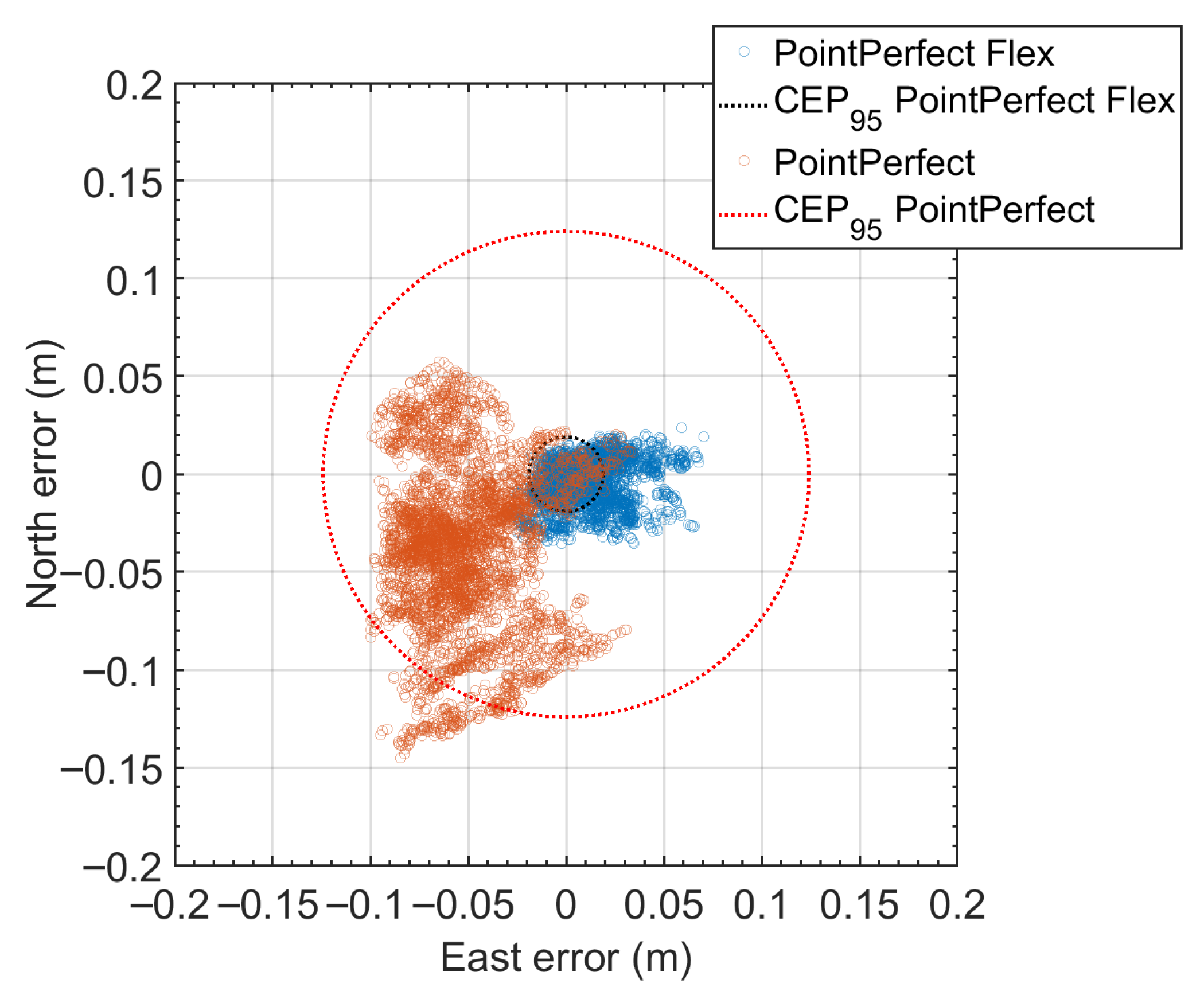
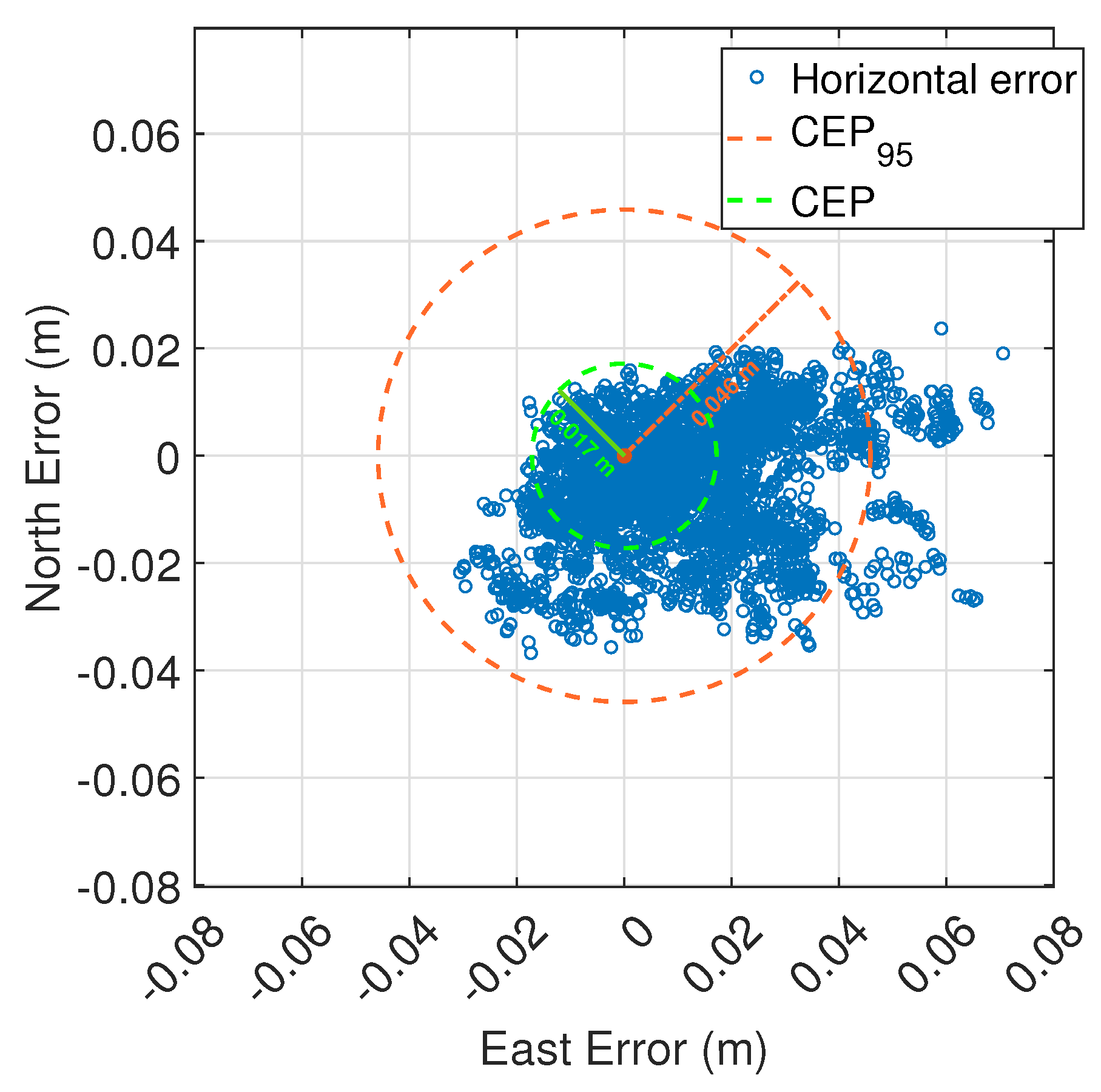
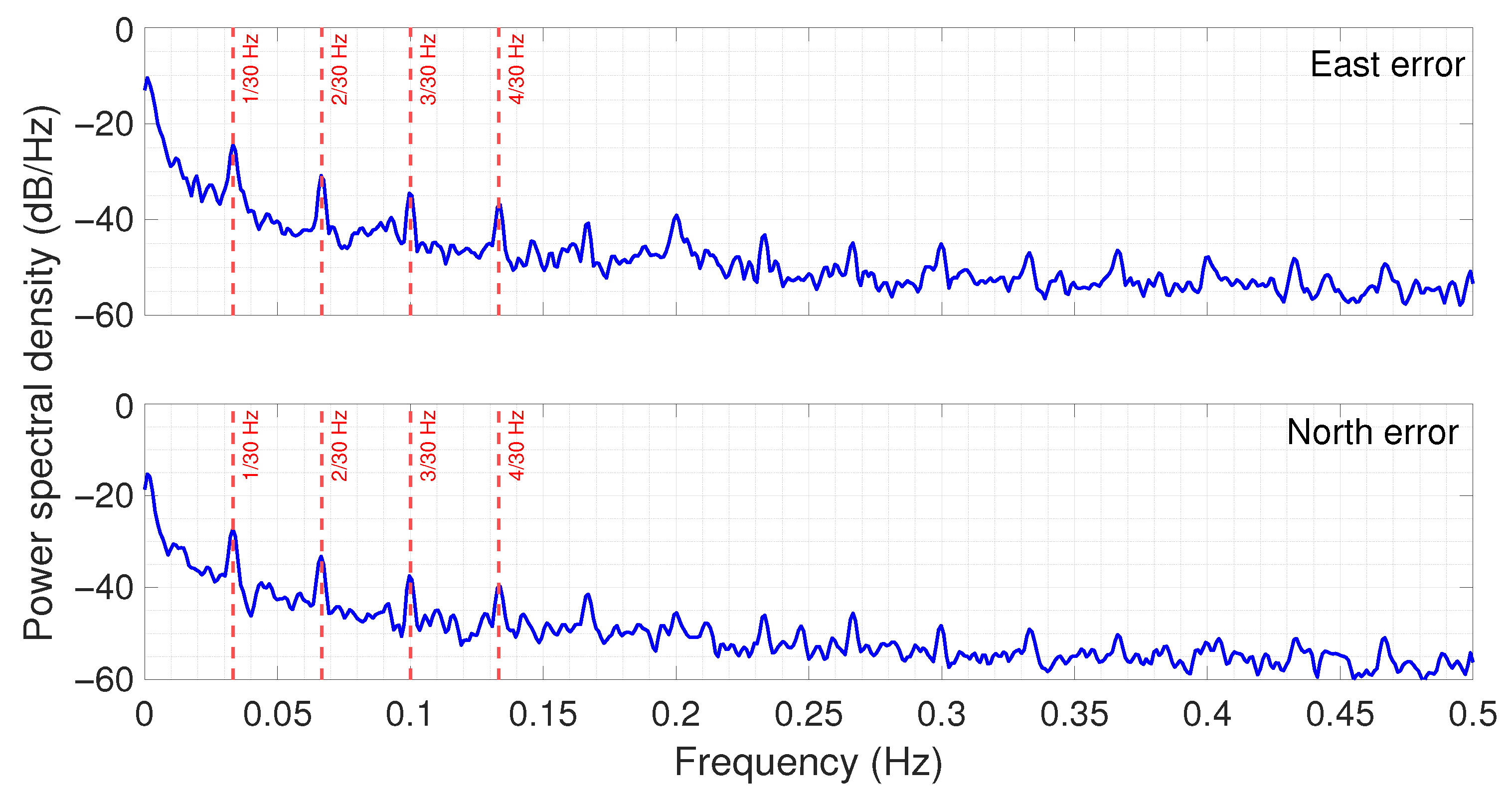
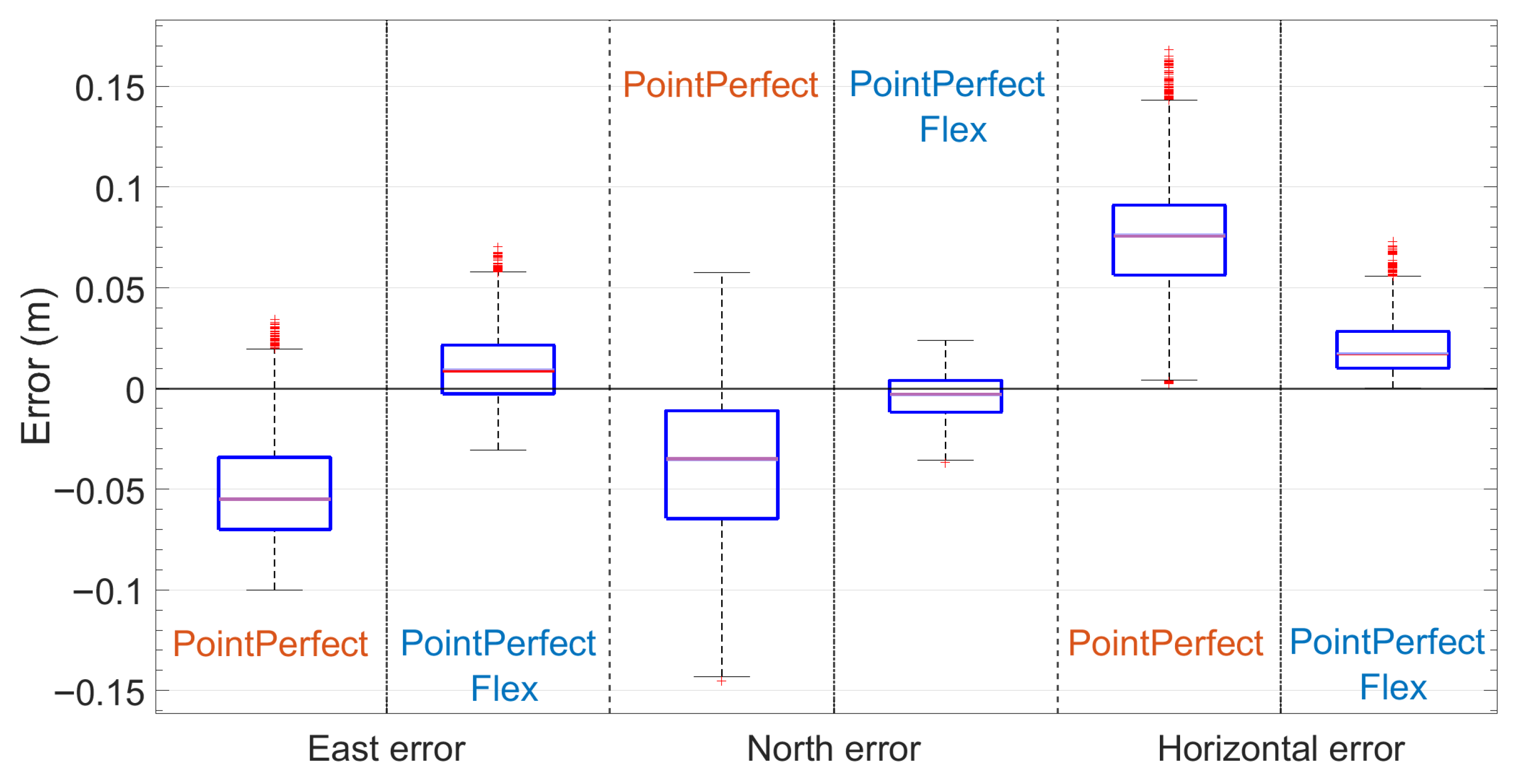
Time-Series and Frequency Domain Analysis
4. Performance Comparison with Previous Service
5. Conclusions and Future Work
Author Contributions
Funding
Data Availability Statement
Conflicts of Interest
Abbreviations
| BCa | Bias-Corrected and Accelerated (bootstrap method) |
| CEP/CEP95 | Circular Error Probable (50%/95%) |
| CLAS | Centimeter-Level Augmentation Service |
| CSSR | Compact State Space Representation |
| CWT | Continuous Wavelet Transform |
| ECTT | ETRF/ITRF Coordinate Transformation Tool |
| EPN | EUREF Permanent GNSS Network |
| ETRF | European Terrestrial Reference Frame |
| ETRS | European Terrestrial Reference System |
| FFT | Fast Fourier Transform |
| GNSS | Global Navigation Satellite System |
| HAS | High-Accuracy Service |
| HPAC | High-Precision Atmosphere Correction |
| IGS | International GNSS Service |
| IP | Internet Protocol |
| IoT | Internet of Things |
| ITRF | International Terrestrial Reference Frame |
| MAD | Median Absolute Deviation |
| MQTT | Message Queuing Telemetry Transport |
| NRTK | Network Real-Time Kinematic |
| OCB | Orbit, Clock, Bias |
| PPP-RTK | Precise Point Positioning Real-Time Kinematic |
| PSD | Power Spectral Density |
| QZSS | Quasi-Zenith Satellite System |
| RINEX | Receiver Independent Exchange Format |
| RMS | Root Mean Square |
| RTCM | Radio Technical Commission for Maritime Services |
| RTK | Real-Time Kinematic |
| SPARTN | Secure Position Augmentation for Real-Time Navigation |
| SSR | State Space Representation |
References
- Teunissen, P.; Montenbruck, O. Springer Handbook of Global Navigation Satellite Systems; Springer: Berlin/Heidelberg, Germany, 2017; Volume 10. [Google Scholar] [CrossRef] [Scilit]
- Alkan, R.M.; Erol, S.; İlçi, V.; Ozulu, İ.M. Comparative analysis of real-time kinematic and PPP techniques in dynamic environment. Measurement 2020, 163, 107995. [Google Scholar] [CrossRef] [Scilit]
- Gurtner, W.; Estey, L. Rinex–The Receiver Independent Exchange Format-Version 3.00; Astronomical Institute, University of Bern and UNAVCO: Bolulder, CO, USA, 2007. [Google Scholar]
- Heo, Y.; Yan, T.; Lim, S.; Rizos, C. International standard GNSS real-time data formats and protocols. In Proceedings of the IGNSS Symposium 2009, Surfers Paradise, Australia, 1–3 December 2009. [Google Scholar]
- Vana, S.; Aggrey, J.; Bisnath, S.; Leandro, R.; Urquhart, L.; Gonzalez, P. Analysis of GNSS correction data standards for the automotive market. Navigation 2019, 66, 577–592. [Google Scholar] [CrossRef] [Scilit]
- Ansari, K.; Corumluoglu, O.; Verma, P.; Pavelyev, V.S. An overview of the international GNSS service (IGS). Grenze Int. J. Comput. Theory Eng. 2017. [Google Scholar] [CrossRef]
- QZSS System Service Inc. Centimeter Level Augmentation Service (CLAS). 2020. Available online: https://qzss.go.jp/en/overview/services/sv06_clas.html (accessed on 10 October 2025).
- Savchuk, S.; Grzegorzewski, M.J.; Gołda, P.; Kerker, V. Positioning using the precision Galileo has service. Annu. Navig. 2024, 29. [Google Scholar] [CrossRef]
- Naciri, N.; Yi, D.; Bisnath, S.; de Blas, F.J.; Capua, R. Assessment of Galileo High Accuracy Service (HAS) test signals and preliminary positioning performance. GPS Solut. 2023, 27, 73. [Google Scholar] [CrossRef] [Scilit] [PubMed]
- Trimble. Trimble Website. 2025. Available online: https://positioningservices.trimble.com/services/rtx/ (accessed on 6 August 2025).
- NovAtel Inc. TerraStar-X Corrections Service. 2024. Available online: https://terrastar.net/ (accessed on 10 October 2025).
- U-blox. U-Blox PointPerfect Flex Webpage. 2025. Available online: https://www.u-blox.com/en/product/pointperfectflex (accessed on 2 May 2025).
- Teria. TeriaSat: La Correction Centimétrique Partout en France. 2024. Available online: https://www.reseau-teria.com/teriasat/ (accessed on 2 May 2025).
- Swift Navigation Inc. Skylark GNSS Cloud Corrections. 2023. Available online: https://www.swiftnav.com/skylark/ (accessed on 3 May 2025).
- Geoscience Australia and LINZ. SouthPAN: Southern Positioning Augmentation Network. 2022. Available online: https://www.ga.gov.au/southpan (accessed on 3 May 2025).
- U-blox. U-Blox ANN-MB Antenna Data Sheet. 2022. Available online: https://content.u-blox.com/sites/default/files/ANN-MB_ProductSummary_UBX-18047741.pdf (accessed on 16 September 2022).
- Robustelli, U.; Cutugno, M.; Paziewski, J.; Pugliano, G. GNSS-SDR pseudorange quality and single point positioning performance assessment. Appl. Geomat. 2023, 15, 583–594. [Google Scholar] [CrossRef]
- Robustelli, U.; Cutugno, M.; Pugliano, G. Low-Cost GNSS and PPP-RTK: Investigating the Capabilities of the u-blox ZED-F9P Module. Sensors 2023, 23, 6074. [Google Scholar] [CrossRef] [Scilit] [PubMed]
- Amalfitano, D.; Cutugno, M.; Robustelli, U.; Pugliano, G. Designing and Testing an IoT low-cost PPP-RTK augmented GNSS Location device. Sensors 2024, 24, 646. [Google Scholar] [CrossRef] [Scilit] [PubMed]
- Ferguson, K.; Urquhart, L.; Leandro, R. SPARTN: The First Open GNSS Data Standard that Enables Safe and Accurate GNSS Localization for Automotive Applications. In Proceedings of the 33rd International Technical Meeting of the Satellite Division of the Institute of Navigation (ION GNSS+ 2020), Virtual, 21–25 September 2020; pp. 2092–2106. [Google Scholar]
- EUREF. ETRF/ITRF Coordinate Transformation Tool (ECTT). 2022. Available online: https://epncb.oma.be/_productsservices/coord_trans/ (accessed on 19 October 2025).
- Lilliefors, H.W. On the Kolmogorov-Smirnov test for normality with mean and variance unknown. J. Am. Stat. Assoc. 1967, 62, 399–402. [Google Scholar] [CrossRef]
- Dallal, G.E.; Wilkinson, L. An analytic approximation to the distribution of Lilliefors’s test statistic for normality. Am. Stat. 1986, 40, 294–296. [Google Scholar] [CrossRef] [Scilit]
- Efron, B.; Tibshirani, R.J. An Introduction to the Bootstrap. In Monographs on Statistics and Applied Probability; Chapman & Hall/CRC: New York, NY, USA, 1993; Volume 57. [Google Scholar]
- Efron, B.; DiCiccio, T. Bootstrap Confidence Intervals. Stat. Sci. 1996, 11, 189–228. [Google Scholar] [CrossRef] [Scilit]
- Davison, A.C.; Hinkley, D.V. Bootstrap Methods and Their Application; Cambridge Series in Statistical and Probabilistic Mathematics; Cambridge University Press: Cambridge, UK, 1997; Volume 1. [Google Scholar]
- Cressie, N.; Wikle, C.K. Statistics for Spatio-Temporal Data; John Wiley & Sons: Hoboken, NJ, USA, 2011. [Google Scholar]
- Pugliano, G.; Robustelli, U.; Santamaria, R. A new method for specular and diffuse pseudorange multipath error extraction using wavelet analysis. GPS Solut. 2016, 20, 499–508. [Google Scholar] [CrossRef] [Scilit]







| Component | Vx (m/year) | Vy (m/year) | Vz (m/year) |
|---|---|---|---|
| MATE00ITA | −0.0029 | −0.0002 | 0.0028 |
| Component | Statistic | Sample | Bias | Corrected | 95% BCa CI |
|---|---|---|---|---|---|
| East | Mean [m] | 0.011 | 0.000 | 0.011 | [0.011, 0.012] |
| Std [m] | 0.018 | −0.000 | 0.018 | [0.017, 0.018] | |
| Median [m] | 0.009 | 0.000 | 0.009 | [0.009, 0.010] | |
| MAD [m] | 0.012 | 0.000 | 0.012 | [0.012, 0.013] | |
| RMS [m] | 0.021 | −0.000 | 0.021 | [0.020, 0.021] | |
| Skewness | 0.527 | −0.010 | 0.528 | [0.460, 0.590] | |
| Kurtosis | 3.041 | −0.001 | 3.043 | [2.914, 3.190] | |
| North | Mean [m] | −0.004 | 0.000 | −0.004 | [−0.005, −0.004] |
| Std [m] | 0.011 | −0.000 | 0.011 | [0.011, 0.012] | |
| Median [m] | −0.003 | 0.000 | −0.003 | [−0.004, −0.002] | |
| MAD [m] | 0.008 | −0.000 | 0.008 | [0.008, 0.008] | |
| RMS [m] | 0.012 | −0.000 | 0.012 | [0.012, 0.012] | |
| Skewness | −0.390 | 0.000 | −0.390 | [−0.441, −0.338] | |
| Kurtosis | 2.491 | 0.000 | 2.491 | [2.408, 2.585] |
| Statistic | Sample Value [m] | Bootstrap Bias | Corrected Value [m] | 95% BCa CI [m] |
|---|---|---|---|---|
| Mean | 0.010 | −0.000 | 0.010 | [0.010, 0.011] |
| Std | 0.005 | −0.000 | 0.005 | [0.005, 0.005] |
| Median | 0.010 | −0.000 | 0.010 | [0.009, 0.010] |
| MAD | 0.003 | 0.000 | 0.003 | [0.003, 0.004] |
| RMS | 0.011 | −0.000 | 0.011 | [0.011, 0.012] |
| Comp. | Statistic | Sample Value [m] | Bootstrap Bias | Corrected Value [m] | 95% BCa CI [m] |
|---|---|---|---|---|---|
| East | Mean | −0.051 | −0.000 | −0.051 | [−0.051, −0.050] |
| Std | 0.026 | −0.000 | 0.026 | [0.025, 0.026] | |
| Median | −0.055 | 0.000 | −0.055 | [−0.056, −0.054] | |
| MAD | 0.017 | 0.000 | 0.017 | [0.017, 0.018] | |
| RMS | 0.057 | −0.000 | 0.057 | [0.056, 0.057] | |
| Skewness | 0.670 | 0.000 | 0.669 | [0.618, 0.721] | |
| Kurtosis | 2.975 | −0.001 | 2.976 | [2.854, 3.109] | |
| North | Mean | −0.038 | 0.000 | −0.038 | [−0.039, −0.036] |
| Std | 0.041 | −0.000 | 0.041 | [0.040, 0.042] | |
| Median | −0.035 | 0.000 | −0.035 | [−0.036, −0.034] | |
| MAD | 0.027 | −0.000 | 0.027 | [0.026, 0.028] | |
| RMS | 0.056 | −0.000 | 0.056 | [0.055, 0.057] | |
| Skewness | −0.177 | −0.000 | −0.177 | [−0.221, −0.134] | |
| Kurtosis | 2.590 | 0.001 | 2.590 | [2.522, 2.666] | |
| Horiz. | Mean | 0.074 | −0.000 | 0.074 | [0.073, 0.075] |
| Std | 0.030 | −0.000 | 0.030 | [0.029, 0.030] | |
| Median | 0.076 | 0.000 | 0.076 | [0.075, 0.075] | |
| MAD | 0.017 | −0.000 | 0.017 | [0.016, 0.018] | |
| RMS | 0.080 | −0.000 | 0.080 | [0.079, 0.080] |
| Statistic | Sample Value [m] | Bootstrap Bias | Corrected Value [m] | 95% BCa CI [m] |
|---|---|---|---|---|
| Mean | 0.020 | −0.000 | 0.020 | [0.020, 0.021] |
| Std | 0.013 | −0.000 | 0.013 | [0.013, 0.013] |
| Median | 0.017 | 0.000 | 0.017 | [0.017, 0.018] |
| MAD | 0.008 | 0.000 | 0.008 | [0.008, 0.009] |
| RMS | 0.024 | −0.000 | 0.024 | [0.024, 0.025] |
Disclaimer/Publisher’s Note: The statements, opinions and data contained in all publications are solely those of the individual author(s) and contributor(s) and not of MDPI and/or the editor(s). MDPI and/or the editor(s) disclaim responsibility for any injury to people or property resulting from any ideas, methods, instructions or products referred to in the content. |
© 2025 by the authors. Licensee MDPI, Basel, Switzerland. This article is an open access article distributed under the terms and conditions of the Creative Commons Attribution (CC BY) license.
Share and Cite
Robustelli, U.; Cutugno, M.; Pugliano, G. Robust Statistical and Wavelet-Based Time–Frequency Analysis of Static PPP-RTK Errors Using Low-Cost GNSS Correction Services. Appl. Sci. 2026, 16, 27. https://doi.org/10.3390/app16010027
Robustelli U, Cutugno M, Pugliano G. Robust Statistical and Wavelet-Based Time–Frequency Analysis of Static PPP-RTK Errors Using Low-Cost GNSS Correction Services. Applied Sciences. 2026; 16(1):27. https://doi.org/10.3390/app16010027
Chicago/Turabian StyleRobustelli, Umberto, Matteo Cutugno, and Giovanni Pugliano. 2026. "Robust Statistical and Wavelet-Based Time–Frequency Analysis of Static PPP-RTK Errors Using Low-Cost GNSS Correction Services" Applied Sciences 16, no. 1: 27. https://doi.org/10.3390/app16010027
APA StyleRobustelli, U., Cutugno, M., & Pugliano, G. (2026). Robust Statistical and Wavelet-Based Time–Frequency Analysis of Static PPP-RTK Errors Using Low-Cost GNSS Correction Services. Applied Sciences, 16(1), 27. https://doi.org/10.3390/app16010027