Integrating SBAS-InSAR and Machine Learning for Enhanced Landslide Identification and Susceptibility Mapping Along the West Kunlun Highway


Abstract
1. Introduction
1.1. Background
1.2. Brief Literature Review and Summary
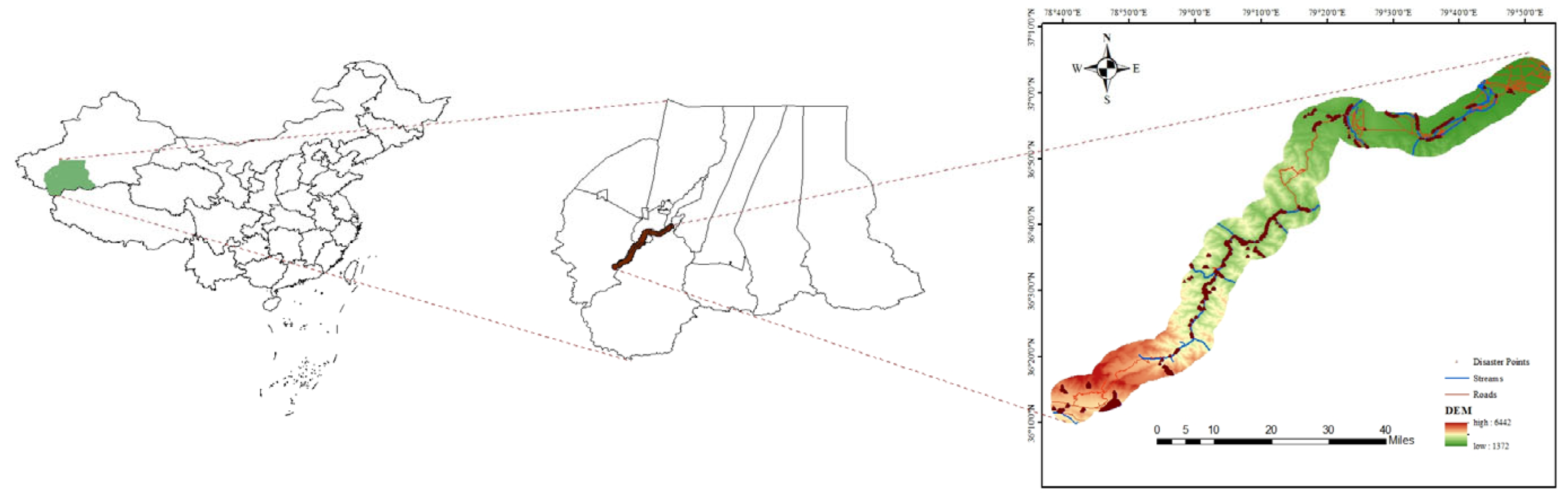
2. Overview of the Study Area
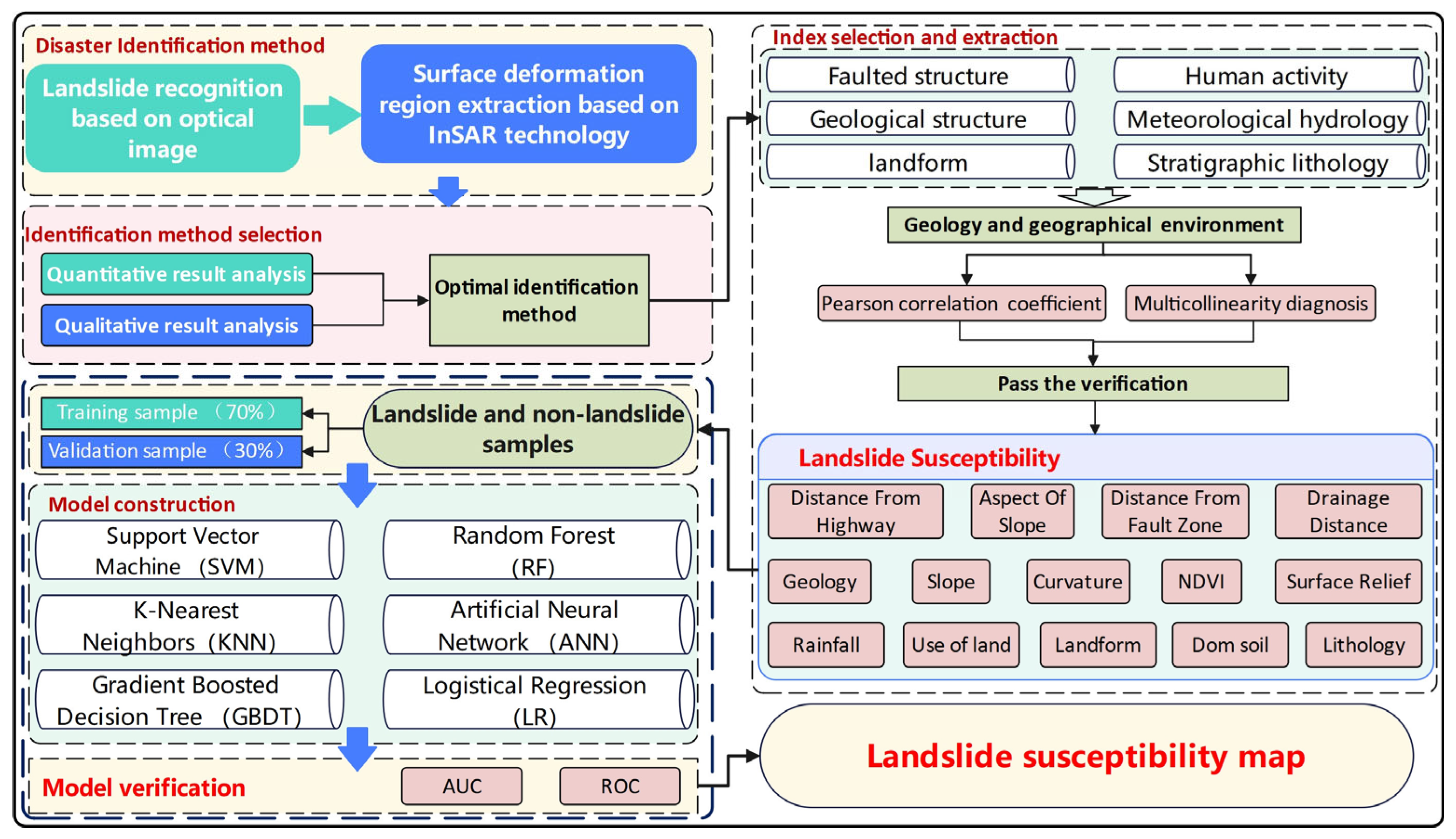
3. Methods
3.1. Establishment of a Landslide Prone Area Evaluation System
3.2. Accuracy of Landslide Hazard Identification
3.3. Method for Correlation Analysis of Conditioning Factors
3.4. Machine Learning Model
3.4.1. Support Vector Machine (SVM)
3.4.2. Random Forest (RF)
3.4.3. K-Nearest Neighbours (KNN)
3.4.4. Artificial Neural Network (ANN)
3.4.5. Gradient Boosting Tree (GBDT)
3.4.6. Logistic Regression (LR)
4. Evaluation Indicator Selection and Analysis
4.1. Data Collection and Processing
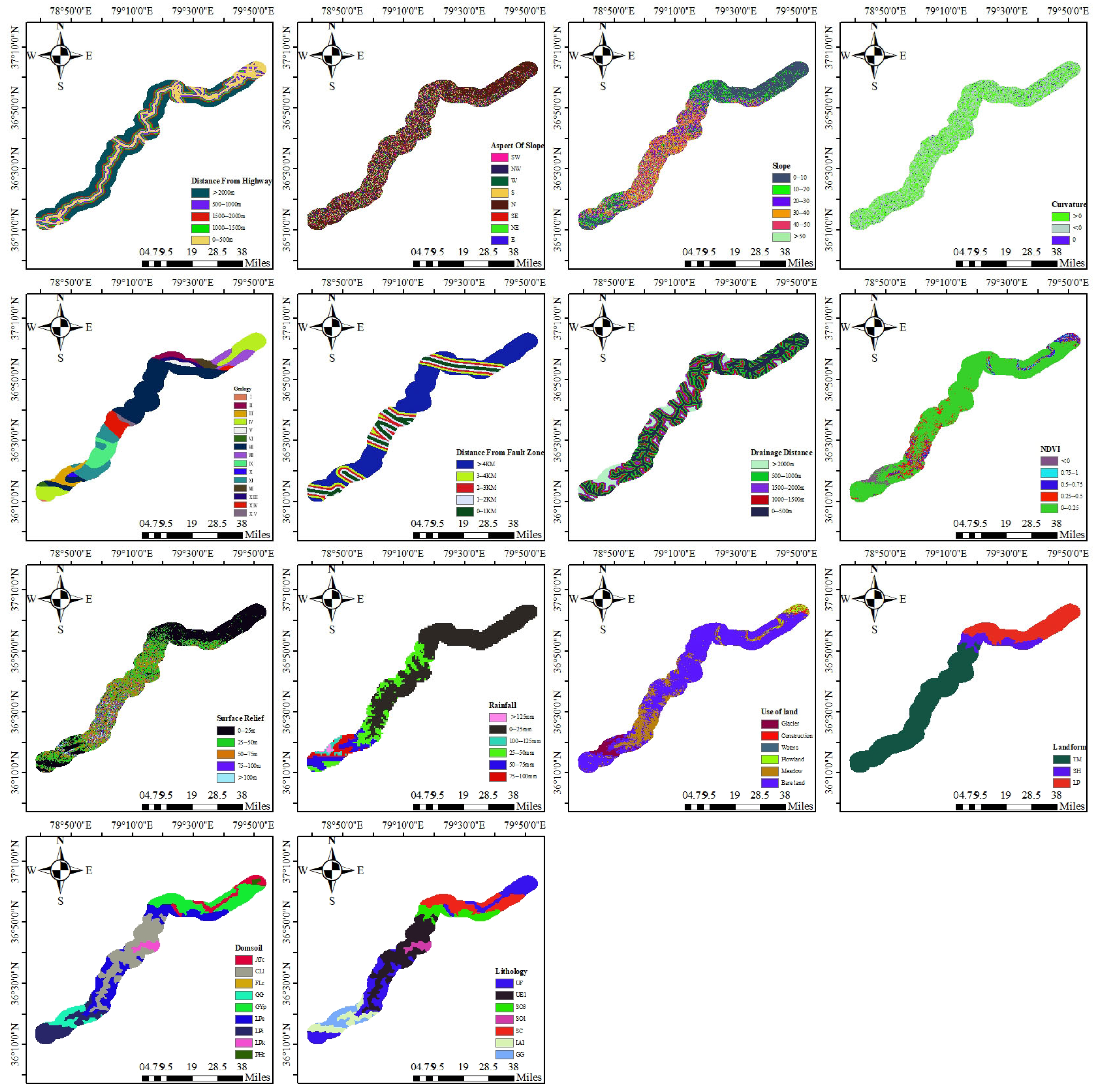
4.2. Selection and Analysis of Evaluation Indicators
4.2.1. Distance from the Road
4.2.2. Gradient
4.2.3. Slope Direction
4.2.4. Curvature
4.2.5. Geology
4.2.6. NDVI
4.2.7. Distance from Fault
4.2.8. Distance from Watercourse
4.2.9. Amplitude
4.2.10. Rainfall
4.2.11. Land Use
4.2.12. Landform
4.2.13. Soil
4.2.14. Rock Type
5. Results
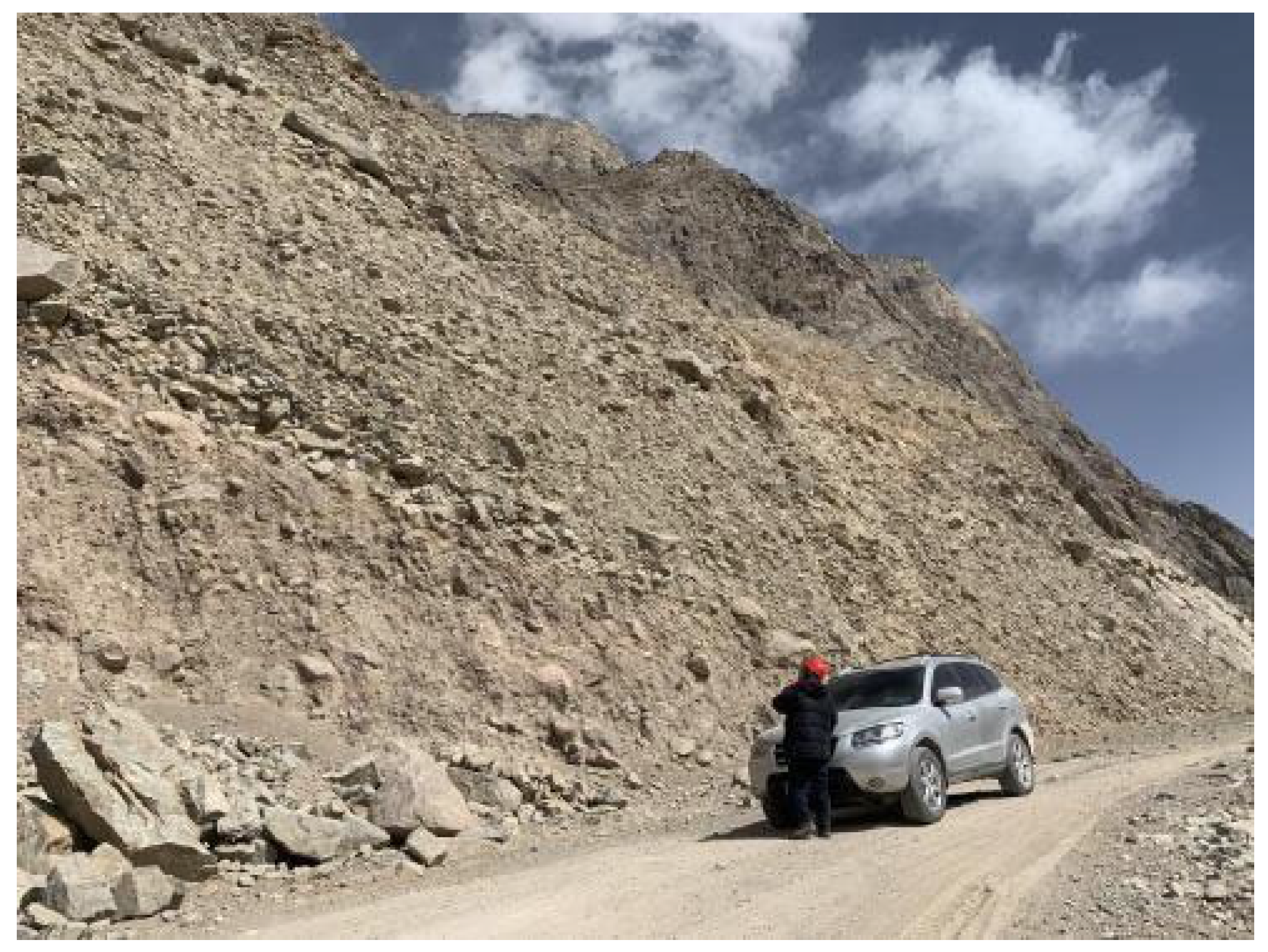
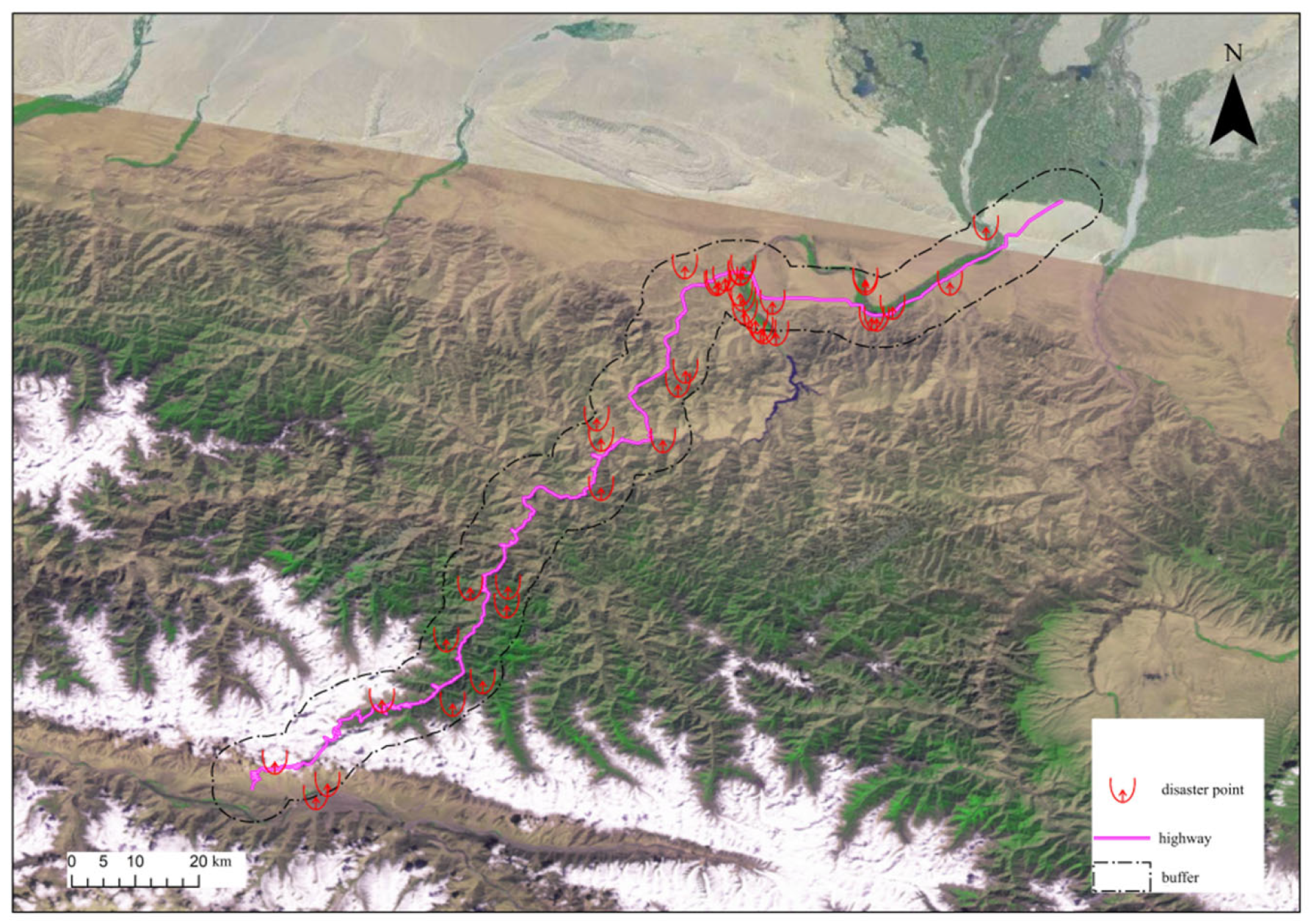
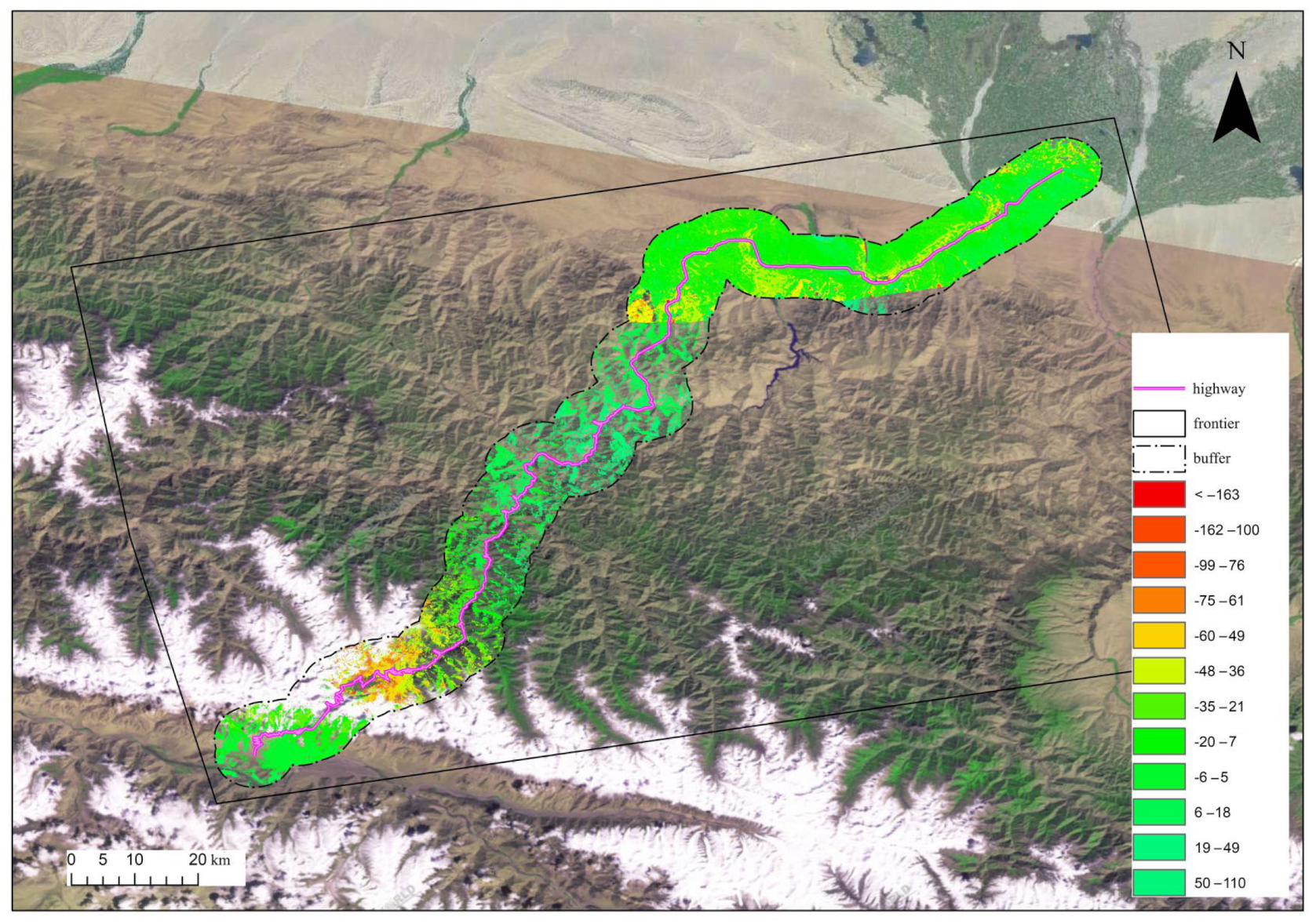
5.1. Landslide Hazard Identification Results
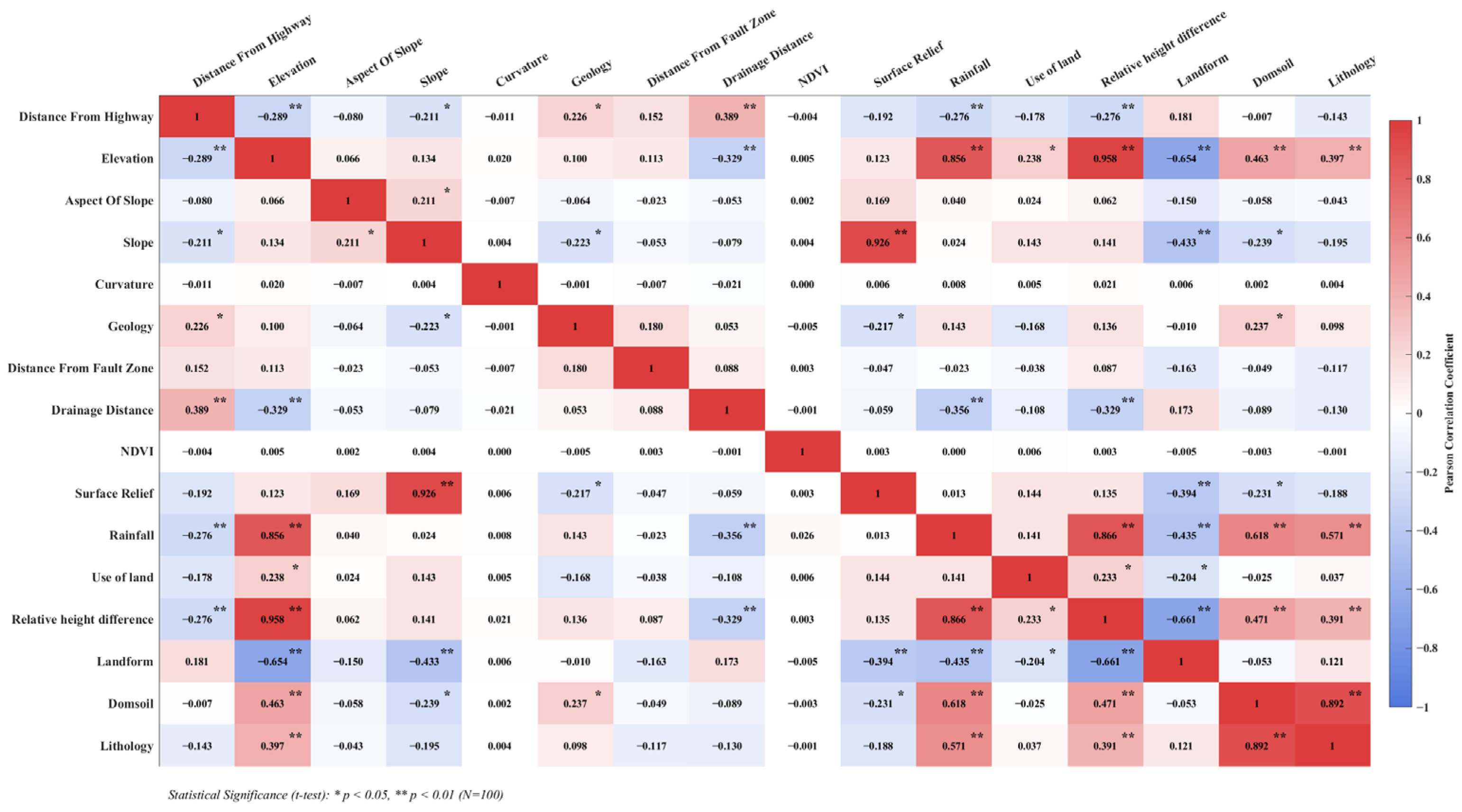
5.2. Correlation Analysis of Conditioning Factors
5.3. Establishment of a Vulnerability Assessment Model and Parameter Determination
5.3.1. Support Vector Machine (SVM)
5.3.2. Random Forest (RF)
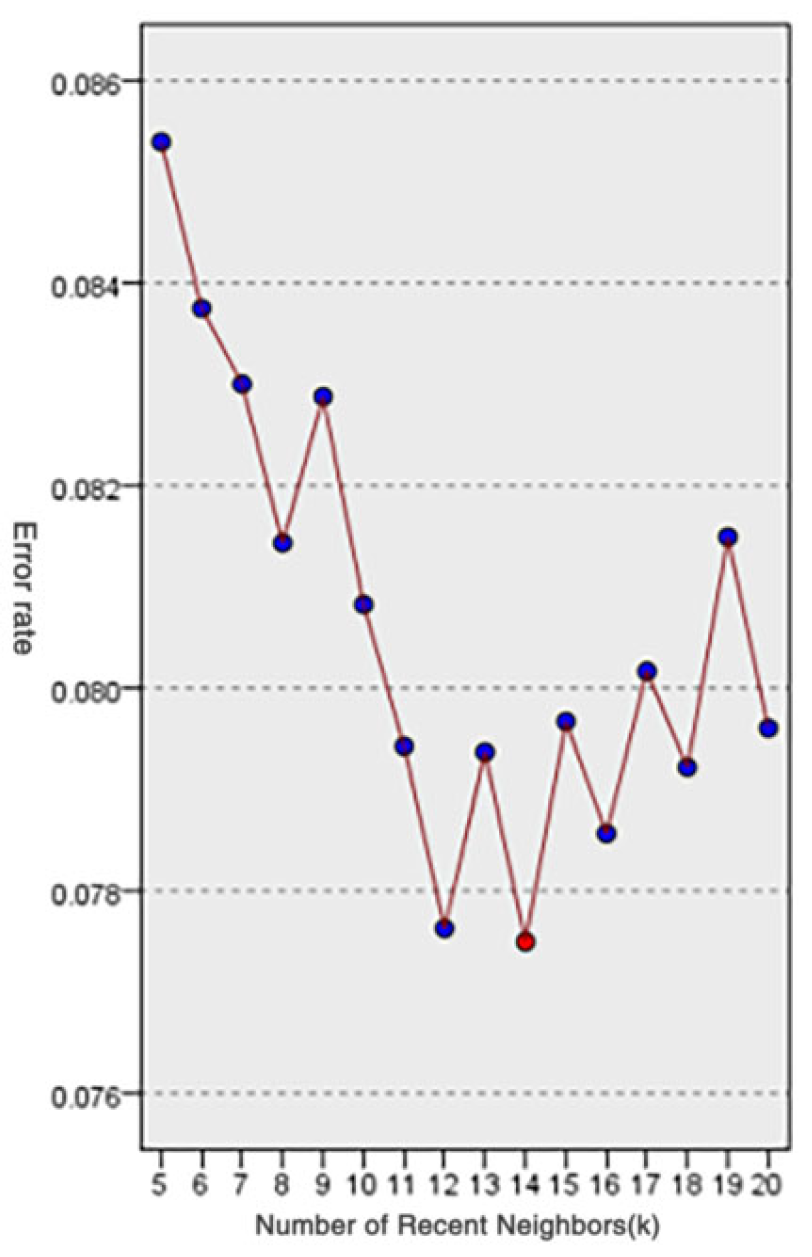
5.3.3. K-Nearest Neighbours (KNN)
5.3.4. Artificial Neural Network (ANN)
5.3.5. Gradient Boosting Decision Tree (GBDT)
5.3.6. Logistic Regression (LR)
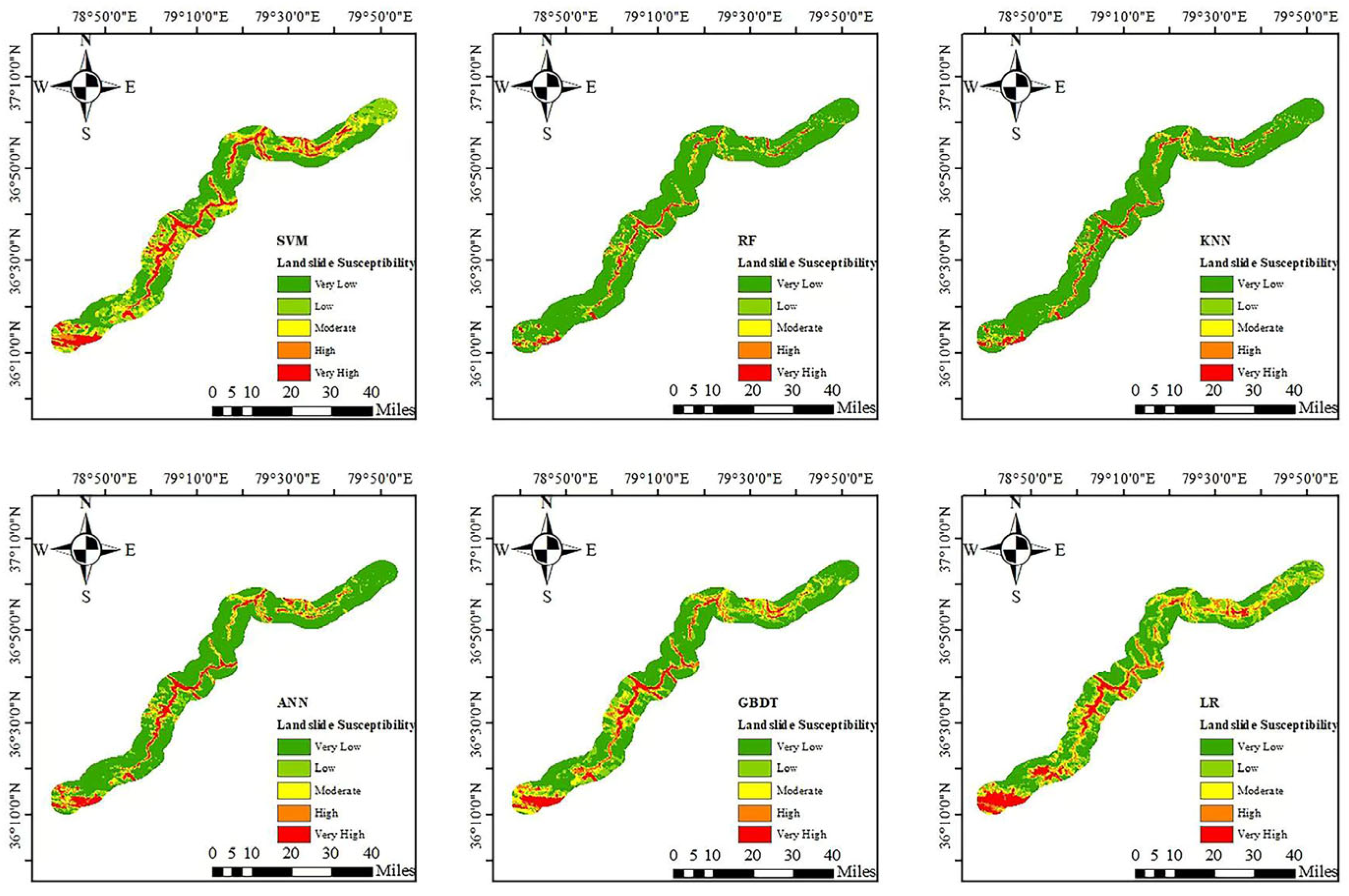
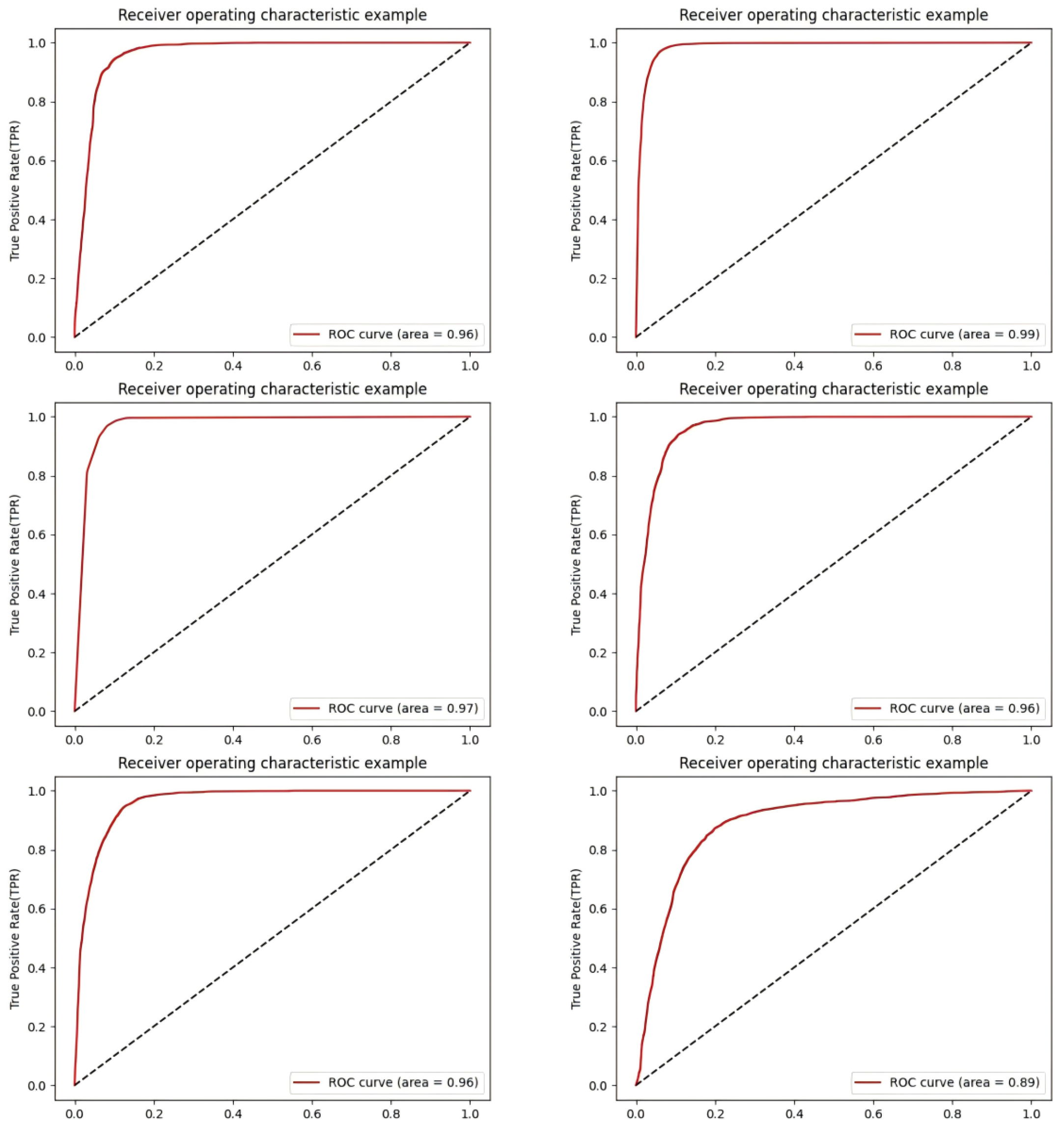
5.4. Results and Accuracy Evaluation of Landslide Susceptibility Assessment
6. Discussion
7. Conclusions
Author Contributions
Funding
Institutional Review Board Statement
Informed Consent Statement
Data Availability Statement
Acknowledgments
Conflicts of Interest
References
- Wang, L.; Xu, S.; Liu, X.; Wu, Z.; Chen, Y.; Wang, W. The characteristics and mechanism of earthquake disasters on permafrost sites induced by the west of Kunlun Mountaion Pass 8.1 earthquake in 2001. Cold Reg. Sci. Technol. 2024, 226, 104267. [Google Scholar] [CrossRef]
- Zhang, Z.; Zhang, T.; Yu, X.; LÜ, Q.; Lai, R.; Jia, J.; Liu, X. Zonation of disaster environments of collapse, landslide and debris flow geologic hazards and their formation mechanisms in Xinjiang. J. Eng. Geol. 2023, 31, 1129–1144. [Google Scholar] [CrossRef]
- Fei, D.; Liu, F.; Zhou, Q.; Chen, Q.; Wu, L. Risk analysis of landslide and debris flow disasters along the Qinghai-Tibet Railway. Arid Zone Geogr. 2016, 39, 345–352. [Google Scholar] [CrossRef]
- Du, J.; Glade, T.; Woldai, T.; Chai, B.; Zeng, B. Landslide susceptibility assessment based on an incomplete landslide inventory in the Jilong Valley, Tibet, Chinese Himalayas. Eng. Geol. 2020, 270, 105572. [Google Scholar] [CrossRef]
- Guo, C.; Xu, Q.; Dong, X.; Li, W.; Zhao, K.; Lu, H.; Ju, Y. Geohazard recognition and inventory mapping using airborne LiDAR data in complex mountainous areas. J. Earth Sci. 2021, 32, 1079–1091. [Google Scholar] [CrossRef]
- Cai, J.; Zhang, L.; Dong, J.; Guo, J.; Wang, Y.; Liao, M. Automatic identification of active landslides over wide areas from time-series InSAR measurements using Faster RCNN. Int. J. Appl. Earth Obs. Geoinf. 2023, 124, 103516. [Google Scholar] [CrossRef]
- Liang, R.; Dai, K.; Xu, Q.; Pirasteh, S.; Li, Z.; Li, T.; Wen, N.; Deng, J.; Fan, X. Utilizing a single-temporal full polarimetric Gaofen-3 SAR image to map coseismic landslide inventory following the 2017 Mw 7.0 Jiuzhaigou earthquake (China). Int. J. Appl. Earth Obs. Geoinf. 2024, 127, 103657. [Google Scholar] [CrossRef]
- Jiang, S.; Li, J.; Ma, G.; Rezania, M.; Huang, J. Stochastic hazard assessment framework of landslide blocking river by depth-integrated continuum method and random field theory. Landslides 2025, 22, 393–411. [Google Scholar] [CrossRef]
- Lin, K.; Jiapaer, G.; Yu, T.; Zhang, L.; Liang, H.; Chen, B.; Ju, T. Identification of potential landslides in the Gaizi Valley section of the Karakorum Highway coupled with TS-InSAR and landslide susceptibility analysis. Remote Sens. 2024, 16, 3653. [Google Scholar] [CrossRef]
- Su, X.; Zhang, Y.; Meng, X.; Yue, D.; Ma, J.; Guo, F.; Zhou, Z.; Rehman, M.; Khalid, Z.; Chen, G.; et al. Landslide mapping and analysis along the China-Pakistan Karakoram Highway based on SBAS-InSAR detection in 2017. J. Mt. Sci. 2021, 18, 2540–2564. [Google Scholar] [CrossRef]
- Chen, X.; Cui, P.; You, Y.; Cheng, Z.; Khan, A.; Ye, C.; Zhang, S. Dam-break risk analysis of the Attabad landslide dam in Pakistan and emergency countermeasures. Landslides 2017, 14, 675–683. [Google Scholar] [CrossRef]
- Kavus, Y.; Taskin, A. Assessment of landslides induced by earthquake risk of Istanbul: A comprehensive study utilizing an integrated DFS-AHP and DFS-EDAS approach. Soil Dyn. Earthq. Eng. 2025, 191, 109285. [Google Scholar] [CrossRef]
- Zhao, B.; Wang, Y.; Li, W.; Su, L.; Lu, J.; Zeng, L.; Li, X. Insights into the geohazards triggered by the 2017 Ms 6.9 Nyingchi earthquake in the east Himalayan syntaxis, China. CATENA 2021, 205, 105467. [Google Scholar] [CrossRef]
- Costache, R.; Tin, T.; Arabameri, A.; Crăciun, A.; Ajin, R.S.; Costache, I.; Towfiqul Islam, A.; Abba, S.I.; Sahana, M.; Avand, M.; et al. Flash-flood hazard using deep learning based on H2O R package and fuzzy-multicriteria decision-making analysis. J. Hydrol. 2022, 609, 127747. [Google Scholar] [CrossRef]
- Paul, G.; Alejandra, H. Landslide susceptibility index based on the integration of logistic regression and weights of evidence: A case study in Popayan, Colombia. Eng. Geol. 2021, 280, 105958. [Google Scholar] [CrossRef]
- Khanna, K.; Martha, T.; Roy, P.; Kumar, K.V. Effect of time and space partitioning strategies of samples on regional landslide susceptibility modelling. Landslides 2021, 18, 2281–2294. [Google Scholar] [CrossRef]
- Guo, Z.; Shi, Y.; Huang, F.; Fan, X.; Huang, J. Landslide susceptibility zonation method based on C5.0 decision tree and K-means cluster algorithms to improve the efficiency of risk management. Geosci. Front. 2021, 12, 101249. [Google Scholar] [CrossRef]
- Guo, Z.; Tian, B.; Zhu, Y.; He, J.; Zhang, T. How do the landslide and non-landslide sampling strategies impact landslide susceptibility assessment?—A catchment-scale case study from China. J. Rock Mech. Geotech. Eng. 2024, 16, 877–894. [Google Scholar] [CrossRef]
- Huang, Y.; Zhao, L. Review on landslide susceptibility mapping using support vector machines. CATENA 2018, 165, 520–529. [Google Scholar] [CrossRef]
- Su, Y.; Chen, Y.; Lai, X.; Huang, S.; Lin, C.; Xie, X. Feature adaptation for landslide susceptibility assessment in “no sample” areas. Gondwana Res. 2024, 131, 1–17. [Google Scholar] [CrossRef]
- Sun, D.; Gu, Q.; Wen, H.; Xu, J.; Zhang, Y.; Shi, S.; Xue, M.; Zhou, X. Assessment of landslide susceptibility along mountain highways based on different machine learning algorithms and mapping units by hybrid factors screening and sample optimization. Gondwana Res. 2023, 123, 89–106. [Google Scholar] [CrossRef]
- Pyakurel, A.; Dahal, B.; Gautam, D. Does machine learning adequately predict earthquake induced landslides? Soil Dyn. Earthq. Eng. 2023, 171, 107994. [Google Scholar] [CrossRef]
- Wei, Y.; Qiu, H.; Liu, Z.; Huangfu, W.; Zhu, Y.; Liu, Y.; Yang, D.; Kamp, U. Refined and dynamic susceptibility assessment of landslides using InSAR and machine learning models. Geosci. Front. 2024, 15, 101890. [Google Scholar] [CrossRef]
- Merghadi, A.; Yunus, A.; Dou, J.; Whiteley, J.; ThaiPham, B.; Bui, D.; Avtar, R.; Abderrahmane, B. Machine learning methods for landslide susceptibility studies: A comparative overview of algorithm performance. Earth Sci. Rev. 2020, 207, 103225. [Google Scholar] [CrossRef]
- Yang, C.; Liu, L.; Huang, F.; Huang, L.; Wang, X. Machine learning-based landslide susceptibility assessment with optimized ratio of landslide to non-landslide samples. Gondwana Res. 2023, 123, 198–216. [Google Scholar] [CrossRef]
- Han, Y.; Semnani, S. Important considerations in machine learning-based landslide susceptibility assessment under future climate conditions. Acta Geotech. 2025, 20, 475–500. [Google Scholar] [CrossRef]
- Feng, H.; Miao, Z.; Hu, Q. Study on the Uncertainty of Machine Learning Model for Earthquake-Induced Landslide Susceptibility Assessment. Remote Sens. 2022, 14, 2968. [Google Scholar] [CrossRef]
- Al-Najjar, H.; Pradhan, B. Spatial landslide susceptibility assessment using machine learning techniques assisted by additional data created with generative adversarial networks. Geosci. Front. 2021, 12, 625–637. [Google Scholar] [CrossRef]
- Meng, S.; Shi, Z.; Li, G.; Peng, M.; Liu, L.; Zheng, H.; Zhou, C. A novel deep learning framework for landslide susceptibility assessment using improved deep belief networks with the intelligent optimization algorithm. Comput. Geotech. 2024, 167, 106106. [Google Scholar] [CrossRef]
- Wang, H.; Wang, L.; Zhang, L. Transfer learning improves landslide susceptibility assessment. Gondwana Res. 2023, 123, 238–254. [Google Scholar] [CrossRef]
- Kong, L.; Feng, W.; Yi, X.; Xue, Z.; Bai, L. Enhanced landslide susceptibility mapping in data-scarce regions via unsupervised few-shot learning. Gondwana Res. 2025, 138, 31–46. [Google Scholar] [CrossRef]
- Hong, H. Landslide susceptibility assessment using locally weighted learning integrated with machine learning algorithms. Expert Syst. Appl. 2024, 237, 121678. [Google Scholar] [CrossRef]
- James, G.; Witten, D.; Hastie, T.; Tibshirani, R. An Introduction to Statistical Learning. In Springer Texts in Statistics; Springer: New York, NY, USA, 2013; Volume 103, pp. 1–426. [Google Scholar] [CrossRef]
- Mukaka, M.M. Statistics corner: A guide to appropriate use of correlation coefficient in medical research. Malawi Med. J. 2012, 24, 69–71. [Google Scholar] [PubMed]
- Hinkle, D.; Wiersma, W.; Jurs, S. Applied Statistics for the Behavioral Sciences, 5th ed.; Houghton Mifflin Harcourt: London, UK, 2003; Available online: http://catalog.hathitrust.org/api/volumes/oclc/50716608.html (accessed on 5 October 2025).
- Intarat, K.; Yoomee, P.; Hussadin, A.; Lamprom, W. Assessment of landslide susceptibility in the intermontane basin area of northern Thailand. Environ. Nat. Resour. J. 2024, 22, 158–170. [Google Scholar] [CrossRef]
- O’brien, R. A Caution Regarding Rules of Thumb for Variance Inflation Factors. Qual. Quant. 2007, 41, 673–690. [Google Scholar] [CrossRef]
- Chen, W.; Yang, Z. Landslide susceptibility modeling using bivariate statistical-based logistic regression, naïve Bayes, and alternating decision tree models. Bull. Eng. Geol. Environ. 2023, 190. [Google Scholar] [CrossRef]
- Fox, J.; Monette, G. Generalized Collinearity Diagnostics. J. Am. Stat. Assoc. 1992, 87, 178–183. [Google Scholar] [CrossRef]
- Zhou, L.; Yan, P.; Li, X.; Liu, T.; Liu, Z.; Jia, W. Research on prediction model of high geothermal tunnels temperature based on CNN-SVM. Energy Build. 2025, 347, 116285. [Google Scholar] [CrossRef]
- Wang, B.; Qiu, W.; Hu, X.; Wang, W. A rolling bearing fault diagnosis technique based on recurrence quantification analysis and Bayesian optimization SVM. Appl. Soft Comput. 2024, 156, 111506. [Google Scholar] [CrossRef]
- Wang, G.; Zhou, H.; Hu, Q. Failure detection for deep-sea mining lifting systems based on a hybrid LSTM-RF model. Ocean Eng. 2025, 335, 121772. [Google Scholar] [CrossRef]
- Zhao, R. Intention recognition method for spatial non-cooperative target based on improved Random Forest. Adv. Space Res. 2025, in press. [Google Scholar] [CrossRef]
- Chen, X.; He, D.; Feng, Q.; Yang, X.; Luo, Q. Robust privacy-preserving KNN for smart healthcare with participant dropout resilience. J. Inf. Secur. Appl. 2025, 94, 104225. [Google Scholar] [CrossRef]
- Akbarpoor, S.; Rezazadeh, M.; Ghiassi, B.; Khayatian, F.; Poologanathan, K.; Sefat, H.; Corradi, M. A new bond-slip model for NSM FRP systems using cement-based adhesives through artificial neural networks (ANN). Constr. Build. Mater. 2024, 427, 136034. [Google Scholar] [CrossRef]
- Pham, B.T.; Pradhan, B.; Bui, D.T.; Prakash, I.; Dholakia, M.B. A Comparative Study of Different Machine Learning Methods for Landslide Susceptibility Assessment: A Case Study of Uttarakhand Area (India). Environ. Model. Softw. 2016, 84, 240–250. [Google Scholar] [CrossRef]
- Lu, F.; Zhang, G.; Wang, T.; Ye, Y.; Zhao, Q. Geographically Weighted Random Forest Based on Spatial Factor Optimization for the Assessment of Landslide Susceptibility. Remote Sens. 2025, 17, 1608. [Google Scholar] [CrossRef]
- Wang, Y.; Ling, Y.; Chan, T.O.; Awange, J. High-Resolution Earthquake-Induced Landslide Hazard Assessment in Southwest China Through Frequency Ratio Analysis and LightGBM. Int. J. Appl. Earth Obs. Geoinf. 2024, 131, 103947. [Google Scholar] [CrossRef]
- Petschko, H.; Brenning, A.; Bell, R.; Goetz, J.; Glade, T. Assessing the quality of landslide susceptibility maps – case study Lower Austria. Nat. Hazards Earth Syst. Sci. 2014, 14, 95–118. [Google Scholar] [CrossRef]
- Yang, Y.; Peng, S.; Huang, B.; Xu, D.; Yin, Y.; Li, T.; Zhang, R. Multi-Scale Analysis of the Susceptibility of Different Landslide Types and Identification of the Main Controlling Factors. Ecol. Indic. 2024, 168, 112797. [Google Scholar] [CrossRef]
- Hassani, H.; Marvian Mashhad, L.; Stewart, S.; MacFeely, S. Integrating GIS and Official Statistics Using GISINTEGRATION. AppliedMath 2025, 5, 166. [Google Scholar] [CrossRef]



| Category | SBAS-InSAR Detection for Landslides | SBAS-InSAR Detection Indicates No Landslide |
|---|---|---|
| Optical remote sensing confirms landslides | 20 | 3 |
| Optical remote sensing confirms no landslide | 5 | 12 |
| Order Number | Disaster Types | Place | Interpret the Sign |
|---|---|---|---|
| 1 | slide | Moyuhe channel in Laiika Township, Hotan County, Xinjiang Province | There are traces of fresh debris flows on the surface, and the channels contain large amounts of mixtures of plant residues and silt mixtures. |
| 2 | hill-creep | Fujicun, Langru Township, Hotan County, Xinjiang Province | The gullies are apparent, and much silt and gravel are piled up in the riverbed. The surface soil is washed away in some areas, and the vegetation coverage is significantly reduced. |
| 3 | hill-creep | Kumarat Village, Langru Township, Hotan County, Xinjiang Province | It was observed that the direction of surface water flow was obvious, the soil was wet, there was sedimentation, and the surface vegetation was eroded. |
| 4 | hill-creep | Kumarat Village, Langru Township, Hotan County, Xinjiang Province | The channel is wide, the soil is loose, there are traces of running water on the surface, and large stones and branches are scattered. |
| 5 | hill-creep | Kumarat Village, Langru Township, Hotan County, Xinjiang Province | The irregular grooves on the surface, mixed with soil and stones, vegetation broken off, and water accumulation in local areas indicate strong surface erosion. |
| 6 | hill-creep | Miti Zi Village, Langru Township, Hotan County, Xinjiang Province | The thick layer of silt on the ground contains large rocks, sparse vegetation and traces of erosion, indicating that this area has experienced a violent debris flow event. |
| 7 | hill-creep | Fujicun, Langru Township, Hotan County, Xinjiang Province | The mountain is obviously exposed, with scattered rocks and developing cracks. The terrain is steep and the surface soil is loose, which is a typical collapse-prone area. |
| 8 | slide | Yingawati Village, Saiybag Township, Moyu County, Xinjiang | It is observed that the slope is exposed in large areas, the rock fault is clearly visible, and a large amount of debris is piled up at the bottom of the slope. The surrounding vegetation is sparse, which makes it easy to further collapse. |
| 9 | slide | Yingawati Village, Saiybag Township, Moyu County, Xinjiang | The terrain is steep, the surface rock has partially loosened and there are signs of new collapse, with the surrounding terrain supporting further material to slide down. |
| 10 | hill-creep | Yingawati Village, Saiybag Township, Moyu County, Xinjiang | There are clear signs of movement on the ground, with topsoil layers washed away and large rocks and tree fragments left behind. |
| 11 | slide | Yingawati Village, Saiybag Township, Moyu County, Xinjiang | There are many fresh cracks on the slope, and some local rock layers have fallen off, indicating that the slope is unstable and may continue to move. |
| 12 | slide | Yingawati Village, Saiybag Township, Moyu County, Xinjiang | Surface cracks are widespread, the soil has shown signs of sliding, vegetation is badly damaged, and the terrain conditions indicate a high risk of landslide. |
| 13 | hill-creep | Yingawati Village, Saiybag Township, Moyu County, Xinjiang | The rock face is exposed, and many of the rocks have loosened. Signs of downward material movement are visible, indicating the potential for continued erosion and collapse. |
| 14 | hill-creep | Yingawati Village, Saiybag Township, Moyu County, Xinjiang | The terrain is steep, with many rock collapses and obvious traces of water flow between the rock layers, which may have exacerbated the collapse. |
| 15 | hill-creep | Puka Village, Saiybag Township, Moyu County, Xinjiang | The recent collapse on the hillside caused a large amount of loose material to accumulate at the foot of the slope, and cracks in the upper rock layer can be seen. |
| 16 | hill-creep | Puka Village, Saiybag Township, Moyu County, Xinjiang | The crack develops, the slope is unstable, some rocks begin to slide, the surface soil is obviously eroded, and the collapse risk is high |
| 17 | hill-creep | Yingawati Village, Saiybag Township, Moyu County, Xinjiang | The cracks between the rock layers have widened, and the local slope has been obviously lowered. The accumulation at the foot of the slope has increased, indicating that there is a potential for further collapse. |
| 18 | hill-creep | Yingawati Village, Saiybag Township, Moyu County, Xinjiang | New cracks and rock slips were observed on the slope, and the steep terrain increased the risk of collapse, requiring continuous monitoring. |
| 19 | hill-creep | Kusui Village, Saiyibag Township, Moyu County, Xinjiang | Surface cracks are widely distributed, the soil has been showing signs of sliding, vegetation damage is serious, and the topographic conditions indicate high risk of landslide. |
| 20 | hill-creep | Urawati Village, Saiybag Township, Moyu County, Xinjiang | In many areas, the ground subsidence occurred, the cracks developed longitudinally along the slope, the soil was loose, and the upper soil was obviously separated from the lower soil. |
| 21 | hill-creep | Urawati Village, Saiyibag Township, Moyu County, Xinjiang | Observe that there are obvious long strip cracks on the surface; the continuous rainy season leads to soil moisture and instability. |
| 22 | hill-creep | Kulamuyiqi Village, Saiybag Township, Moyu County, Xinjiang | Local ground has begun to collapse, indicating the potential risk of high landslide. |
| 23 | hill-creep | Urawati Village, Saiybag Township, Moyu County, Xinjiang | The slope soil has horizontal cracks, some soil blocks have fallen off, and the water flow erosion is serious at the bottom of the slope. |
| Disaster Factor Variables | VIF | TOL |
|---|---|---|
| Distance from the road | 1.46 | 0.685 |
| Slope direction | 1.062 | 0.941 |
| falling gradient | 7.818 | 0.128 |
| curvature | 1.003 | 0.997 |
| geology | 1.274 | 0.785 |
| Crack | 1.165 | 0.858 |
| River system | 1.307 | 0.765 |
| NDVI | 1.000 | 0.998 |
| Relief amplitude | 7.189 | 0.139 |
| Rainfall | 6.2 | 0.161 |
| Land use | 1.158 | 0.864 |
| Landform | 3.735 | 0.268 |
| Soil | 8.07 | 0.124 |
| Lithology | 8.273 | 0.121 |
| Parameter Name | Parameter Value |
|---|---|
| Maximum tree depth | 10 |
| Minimum number of cases in the parent node | 500 |
| Minimum number of cases in a child node | 100 |
| Number of nodes | 193 |
| Number of terminal nodes | 126 |
| Depth | 7 |
| Sample | Actual Measurement | Forecast | Correct Percentage | |
|---|---|---|---|---|
| Training | 0 | 30,727 | 2658 | 92.00% |
| 1 | 2463 | 13,024 | 84.10% | |
| Overall percentage | 67.90% | 32.10% | 89.50% | |
| Inspection | 0 | 7738 | 711 | 91.60% |
| 1 | 583 | 3303 | 85.00% | |
| Overall percentage | 67.50% | 32.50% | 89.50% | |
| Name | Parameter Name | Parameter Value |
|---|---|---|
| Model parameter configuration | Data preprocessing | None |
| Training set proportion | 0.8 | |
| Hidden layer neuron configuration | (100) | |
| Activation function | relu | |
| Weight optimisation method | adam | |
| L2 regularisation coefficient | 1.0 × 10⁻⁴ | |
| Initial learning rate | 0.001 | |
| Learning rate optimisation methods | constant | |
| Minibatch size | auto | |
| Maximum number of iterations | 200 | |
| Optimise tolerance | 1.0 × 10⁻⁴ | |
| Model evaluation performance | Accuracy rate | 90.592% |
| Precision (Overall) | 90.492% | |
| Recall rate (comprehensive) | 90.592% | |
| F1-score | 0.905 |
| Name | Parameter Name | Parameter Value |
|---|---|---|
| Model parameter configuration | Data preprocessing | None |
| Training set proportion | 0.8 | |
| Error term penalty coefficient | 1.0 | |
| kernel | rbf | |
| Kernel function coefficient values | 0.01 | |
| Multi-class decision function | ovr | |
| Model convergence parameters | 0.001 | |
| Maximum number of iterations | 2000 | |
| Model evaluation performance | Accuracy rate | 91.687% |
| Precision (Overall) | 91.921% | |
| Recall rate (comprehensive) | 91.687% | |
| f1-score | 0.918 |
| B | S.E. | Wald | Sig. | |
|---|---|---|---|---|
| Distance from the road | 0.417 | 0.008 | 2628.773 | 0 |
| Slope direction | 0.072 | 0.005 | 252.712 | 0 |
| falling gradient | 0.326 | 0.02 | 254.453 | 0 |
| curvature | −0.084 | 0.011 | 56.475 | 0 |
| geology | 0.103 | 0.004 | 712.282 | 0 |
| Crack | 0.497 | 0.007 | 4826.786 | 0 |
| River system | 0.759 | 0.013 | 3386.304 | 0 |
| NDVI | 0 | 0 | 0.098 | 0.754 |
| Relief amplitude | −0.113 | 0.027 | 16.803 | 0 |
| Rainfall | 0.123 | 0.019 | 42.48 | 0 |
| Land use | −0.037 | 0.014 | 7.374 | 0.007 |
| Landform | −0.327 | 0.019 | 309.228 | 0 |
| Soil | 0.416 | 0.012 | 1111.022 | 0 |
| Lithology | −0.302 | 0.017 | 307.505 | 0 |
| Constant | −8.42 | 0.129 | 4251.67 | 0 |
Disclaimer/Publisher’s Note: The statements, opinions and data contained in all publications are solely those of the individual author(s) and contributor(s) and not of MDPI and/or the editor(s). MDPI and/or the editor(s) disclaim responsibility for any injury to people or property resulting from any ideas, methods, instructions or products referred to in the content. |
© 2025 by the authors. Licensee MDPI, Basel, Switzerland. This article is an open access article distributed under the terms and conditions of the Creative Commons Attribution (CC BY) license.
Share and Cite
Dai, X.; Song, X.; Xing, L.; Han, D.; Li, S. Integrating SBAS-InSAR and Machine Learning for Enhanced Landslide Identification and Susceptibility Mapping Along the West Kunlun Highway. Appl. Sci. 2026, 16, 120. https://doi.org/10.3390/app16010120
Dai X, Song X, Xing L, Han D, Li S. Integrating SBAS-InSAR and Machine Learning for Enhanced Landslide Identification and Susceptibility Mapping Along the West Kunlun Highway. Applied Sciences. 2026; 16(1):120. https://doi.org/10.3390/app16010120
Chicago/Turabian StyleDai, Xiaomin, Xinjun Song, Liuyang Xing, Dongchen Han, and Shuqing Li. 2026. "Integrating SBAS-InSAR and Machine Learning for Enhanced Landslide Identification and Susceptibility Mapping Along the West Kunlun Highway" Applied Sciences 16, no. 1: 120. https://doi.org/10.3390/app16010120
APA StyleDai, X., Song, X., Xing, L., Han, D., & Li, S. (2026). Integrating SBAS-InSAR and Machine Learning for Enhanced Landslide Identification and Susceptibility Mapping Along the West Kunlun Highway. Applied Sciences, 16(1), 120. https://doi.org/10.3390/app16010120