You are currently viewing a new version of our website. To view the old version click .
Applied Sciences
  • Article
  • Open Access

14 March 2025

Sizing the Split DC Link Capacitance in Three-Phase Three-Level Bidirectional AC-DC Converters Operating with Arbitrary Power Factor Under Zero-Sequence Injection Restriction

,
,
,
,
and
1
Applied Energy Laboratory, School of Electrical and Computer Engineering, Ben-Gurion University of the Negev, Beer-Sheva 8410501, Israel
2
Department of Electrical Engineering and Electronics, Ariel University of Samaria, Ariel 40700, Israel
*
Author to whom correspondence should be addressed.
This article belongs to the Special Issue Energy and Power Systems: Control and Management

Abstract

The paper presents a methodology for determining the minimum split DC link capacitance for a family of three-phase, three-level grid-connected bidirectional AC-DC converters operating under arbitrary power factor under restriction of DC-only zero-sequence injection. The approach is based on the recently revealed generalized behavior of split DC link voltages in the above-mentioned converters family while distinguishing between leading and lagging power factors in order to highlight different impacts on split DC link capacitor voltages pulsating components. The minimum capacitance value is derived from the boundary condition, ensuring the mains voltage remains below or equal to the capacitor voltage at all times. It is revealed that operation with the lowest expected leading power factor should be employed as the design operating point. The accuracy of the proposed methodology is validated by simulations and experiments carried out employing a 10 kVA grid-connected T-type converter prototype. The results demonstrate close agreement between theoretical predictions and experiments, confirming the practical applicability of the proposed method.

1. Introduction

The ever-growing demand for high-power on/off-grid bidirectional AC-DC converters underscores their pivotal role in modern power and energy systems. As a result, multi-level converters have emerged as a preferred choice across various applications, owing to their superior performance characteristics [1]. These converters offer notable advantages such as enhanced efficiency, reduced dv/dt stress, and lower output voltage total harmonic distortion, making them indispensable in meeting stringent grid standards [2]. In addition, these converters are often required to operate with non-unity power factors, either to supply (absorb) reactive power to (from) the grid or accommodate loads operating with varying power factor [3]. Multi-level converters are known to be crucial in dual-stage power conversion systems that utilize an intermediate DC voltage link [4,5,6,7,8,9]. In such multi-level conversion systems, the DC link is usually implemented using multiple split capacitors [10,11]. The topology allows power decoupling between conversion stages and permits self-governing converter operation while employing diverse pulse width modulation (PWM) techniques [12,13,14,15,16,17,18]. In fact, 10–100 kVA rated multilevel AC-DC and DC-AC converters have become increasingly prominent across diverse industrial applications [19].
Dual-stage AC-DC and DC-AC converters usually include a short-term energy storage unit (typically realized by a capacitor bank) on the DC side to manage pulsating power components [20], maintain stable operation during power mismatches occurring during transients [21], and comply with hold-up requirements [22]. On the other hand, the capacitance of the DC link is a bottleneck in terms of physical size and reliability [23,24,25]. The DC link capacitance value is typically imposed by the hold-up time constraint. In applications where temporary loss-of-mains is tolerable, hold-up time constraint is absent, and it is possible to reduce the value of required DC link capacitance. Numerous approaches for DC link capacitance reduction have been suggested in the literature, e.g., active capacitance reduction [26,27,28], AC-side current distortion (up to minimum allowed power quality merit) [29,30], permitting DC link voltage ripple increase [31,32], etc. Minimum attainable values of DC link capacitance under active power decoupling, AC-side current distortion, notch-based DC link voltage control, and increased DC link voltage ripple were derived in [32,33,34], respectively.
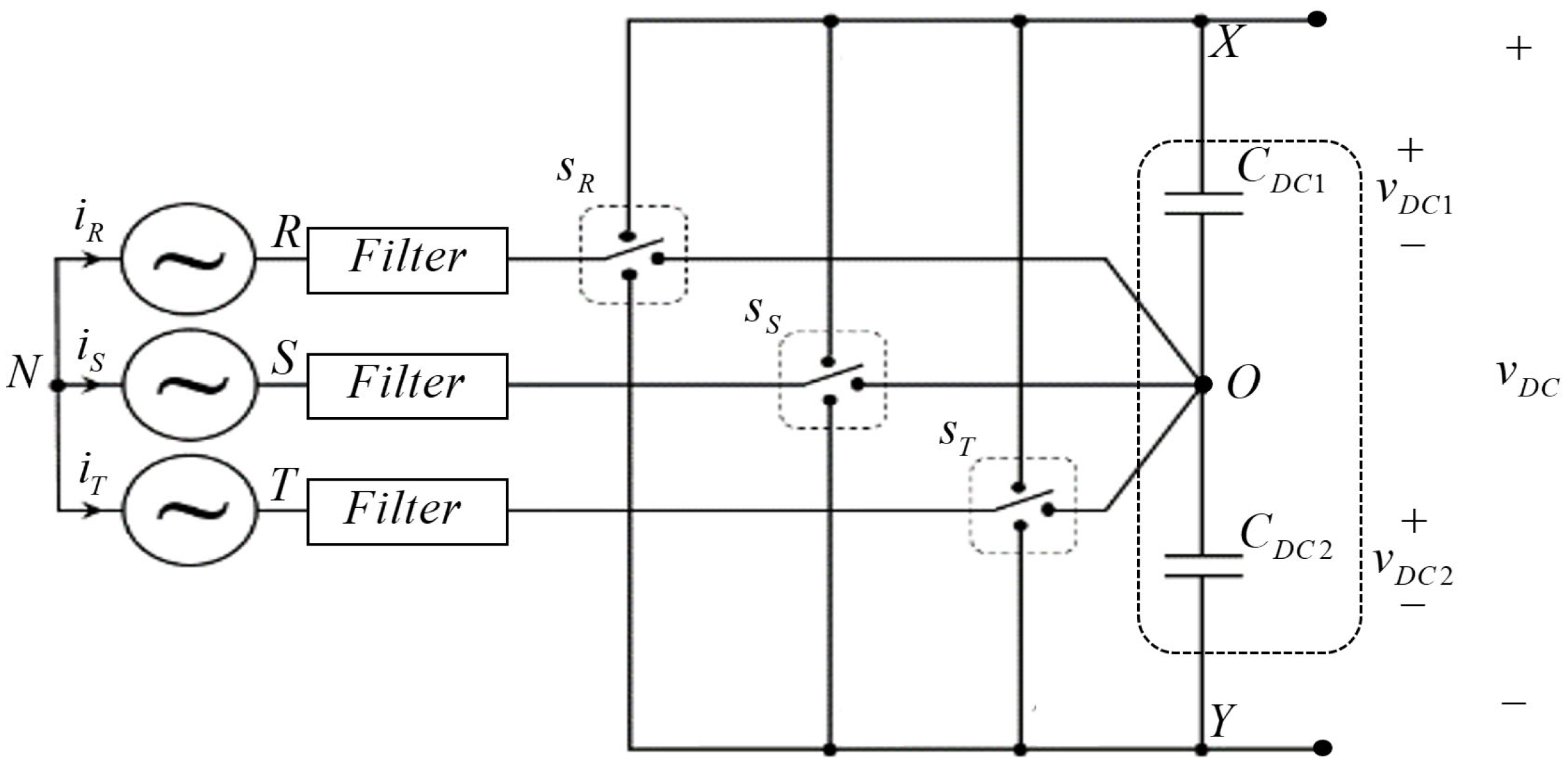
A methodology for establishing a baseline for determining split DC link voltages behavior for a family of three-level, three-phase AC-DC and DC-AC power converters was revealed in [35]. The approach is based on the assumption of the third-harmonic-dominated nature of split DC link voltages ripple. The revealed approach focused on converters operating with a unity power factor and a constrained-to-DC zero-sequence component. A subsequent study [36] utilized the outcomes of [35] to derive the lowest feasible values of split DC link capacitance for the above-mentioned family of converters. The impact of operation with arbitrary power factor on the behavior of split DC link voltages was recently explored in [37]. It was shown that operation under non-unity power factor gives rise to significant high-order harmonic content, which aggregates split DC link voltage ripple magnitudes and displaces them relative to mains voltages. Consequently, the assumption of third-harmonic-only content (shown to be accurate in case of unity power factor operation in [35]) does not hold anymore. As a result, the derivation of corresponding analytical expressions is nearly unmanageable. In order to tackle this gap, a numerical solution was adopted in [37] for the derivation of a general expression for normalized split DC link ripple energy and the angle between split DC link voltages and AC-side voltages as a function of the power factor.
This work proposes a methodology for determining the minimum split DC link capacitance for the above-mentioned family of converters by utilizing the assessment of split DC link voltage behavior carried out in [37]. It is revealed that the operating point corresponding to the minimum expected leading power factor should be employed for capacitance sizing. Experimental results fully support the proposed design methodology.

4. Validation

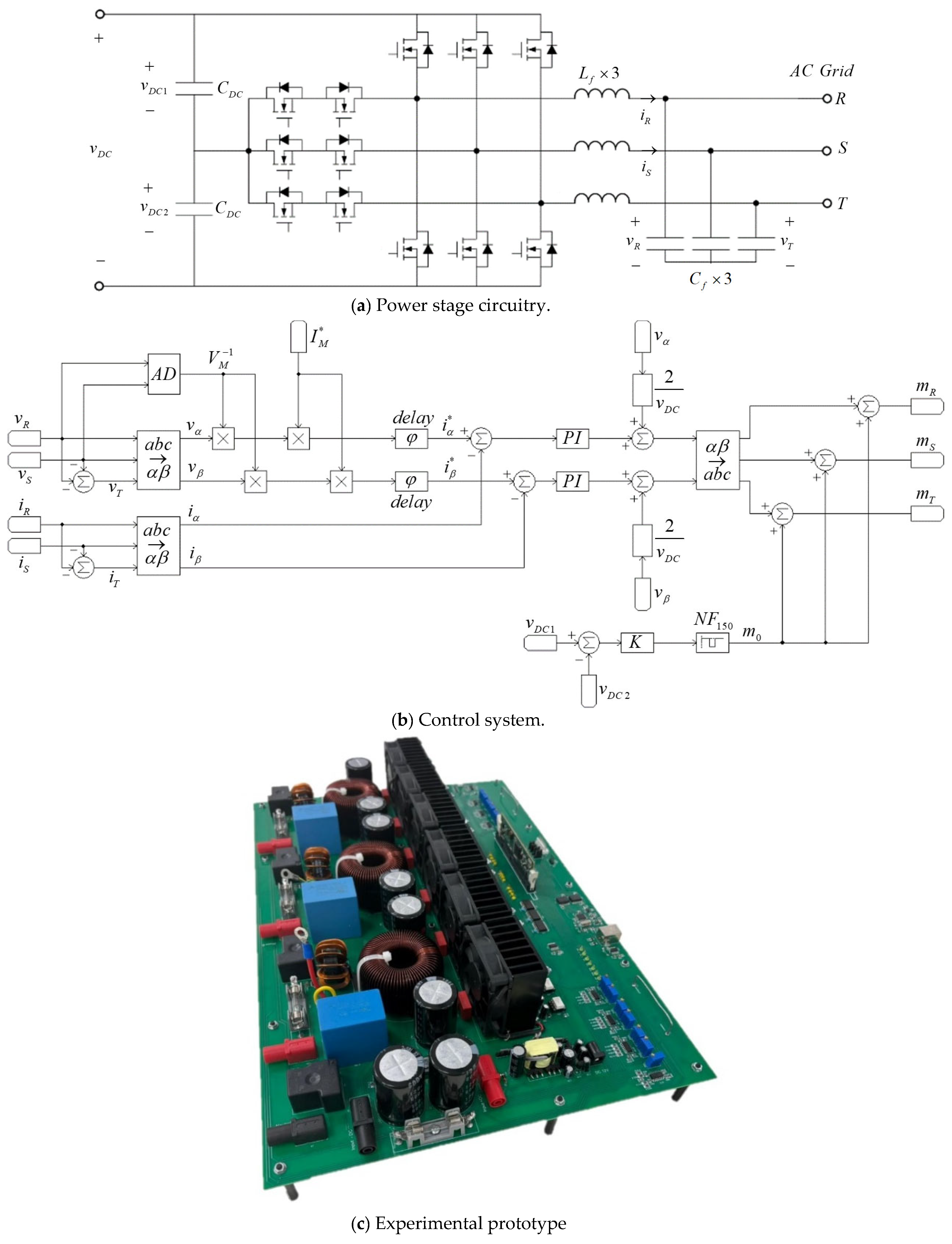
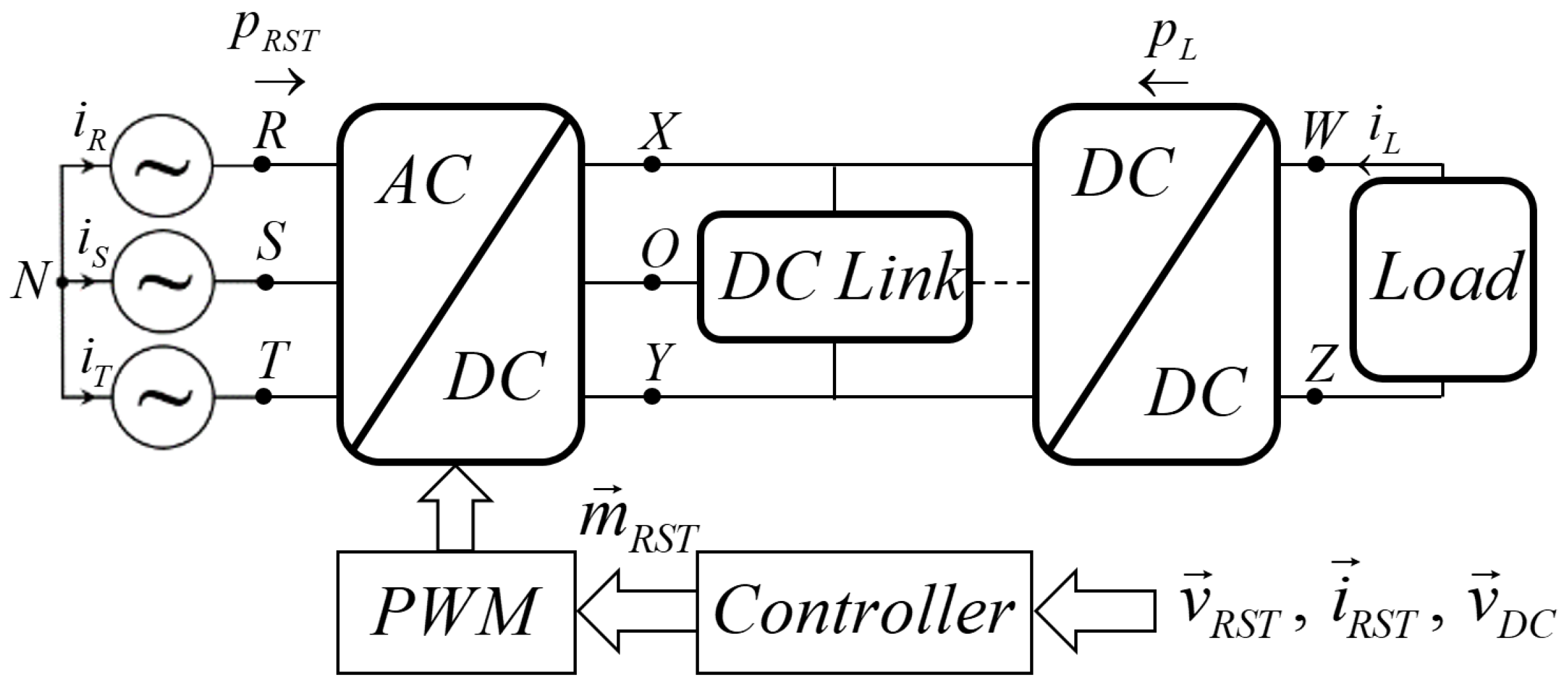
In order to support the developed analytical split DC capacitor sizing framework experimentally, grid-connected LC-filter-based, three-phase three-level T-type AC-DC converter prototype depicted in Figure 4a was employed. Corresponding system parameters are summarized in Table 1. The converter was run at switching/sampling frequency of 50 kHz by means of the Texas Instruments control card based on the TMS320F28335 Digital Signal Processor. During the experimental framework, the T-type AC-DC converter was fed by a DC source (generating a constant-valued DC voltage vDC) while supplying a live three-phase AC grid with a set of balanced three-phase currents (cf. (1)) with controlled magnitudes and phase shifts.
Figure 4. System used for methodology verification.
Table 1. System parameter values.
The corresponding block diagram of the control system is shown in Figure 4b. In order to create in-phase unity-magnitude signal templates, grid voltages are sampled, Clarke-transformed into αβ domain and finally divided by grid voltage vector magnitude VM (obtained using amplitude detection block AD). The resulting unity-magnitude templates are multiplied by the desired grid current magnitude I M * and then delayed in order to impose the desired phase shift φ to create αβ domain current references i α * ,   i β * . On the other hand, grid currents were sampled, Clarke-transformed into αβ domain and subtracted from αβ domain current references i α * ,   i β * . Corresponding tracking errors were then processed by PI controllers. The outputs of αβ domain PI controllers were added to normalized αβ domain voltages (created by dividing αβ domain voltages vα, vβ by 0.5 vDC). The results were inverse-Clarke-transformed to create the first modulation signals term (at the right-hand side of (5)). Zero-sequence term m0 (i.e., the second term at the right-hand side of (5)) was generated by processing the difference between sampled split DC link voltages vDC1, vDC2 by a P + Notch controller employing a constant proportional gain K followed by a 150 Hz centered notch filter NF150 possessing unity DC gain aimed to suppress the triple-mains-frequency ripple (cf. (8)) in order to satisfy the DC-only zero sequence component constraint [35]. The experimental prototype is depicted in Figure 4c. Upon system start-up, the converter is synchronized with the AC grid and then grid-connected with zero-current reference. Then, the desired values of I M * and phase shift φ are imposed by the control system in order to bring the converter to the desired operating point. Measurements are performed when the system settles, and steady-state is attained.
Considering the range of power factors (both leading and lagging) given by
P F 0.5 ,
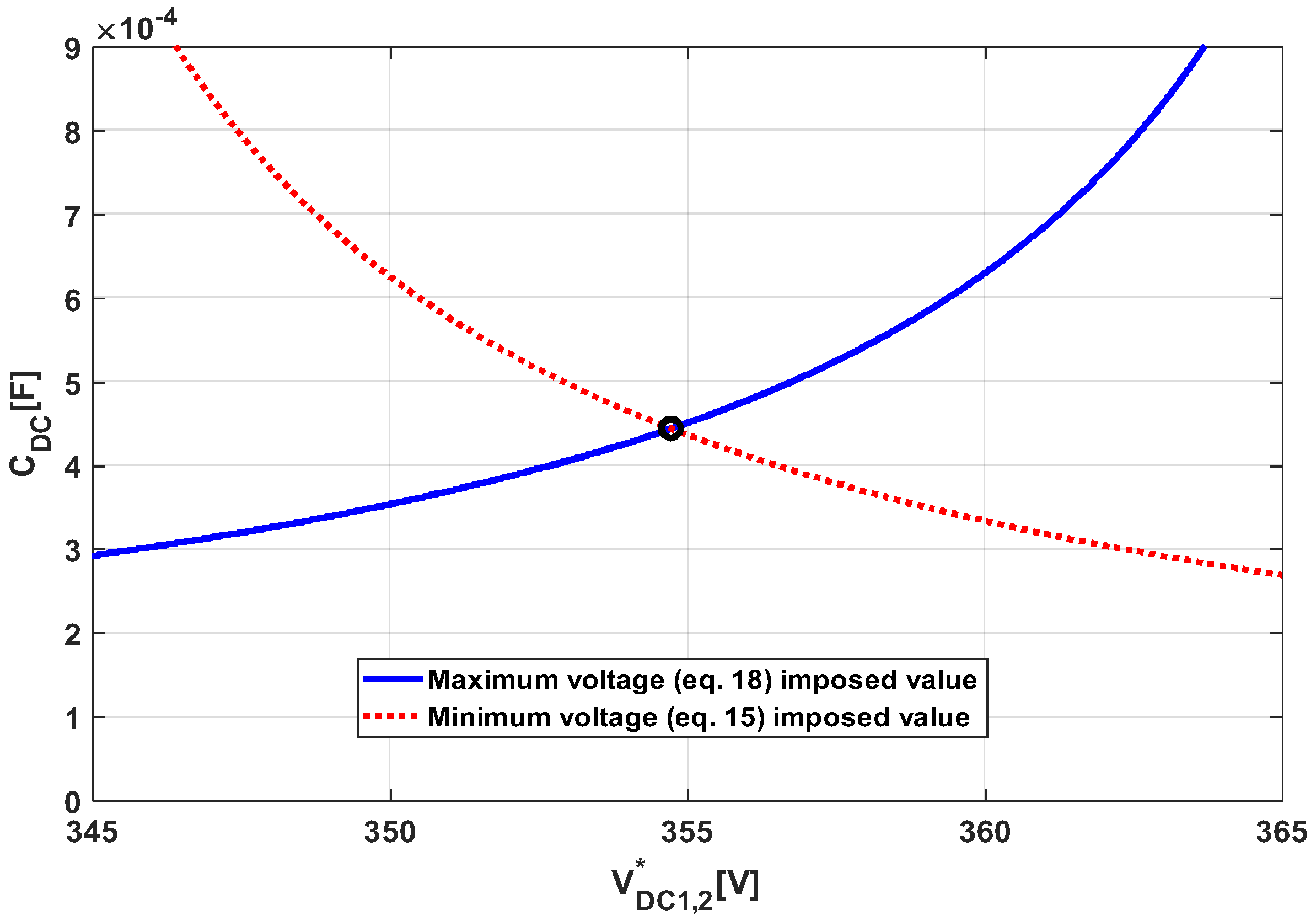
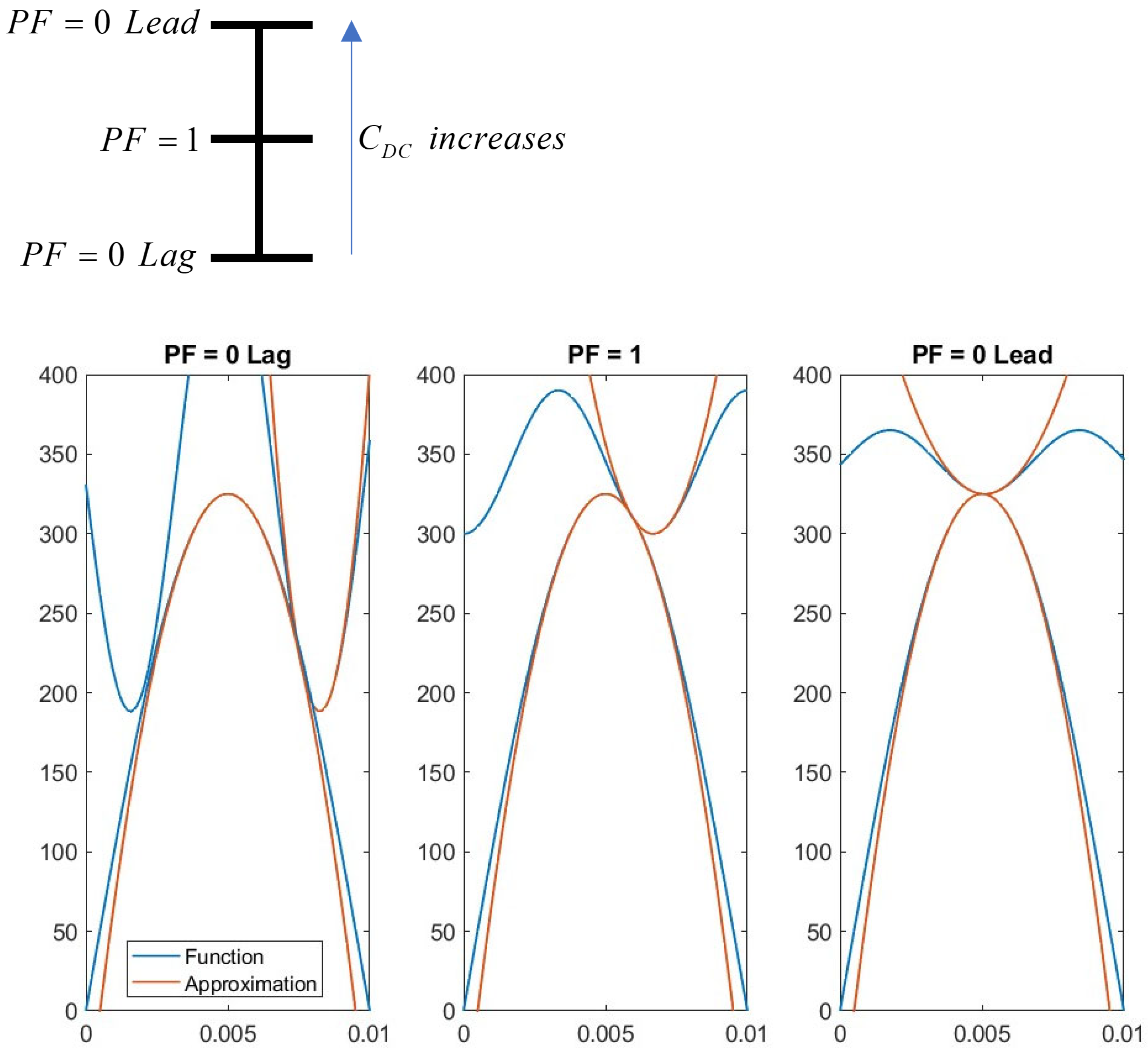
split DC link capacitances must be sized considering the lowest expected leading power factor (namely PF = −0.5 or φ = 60°, as discussed in the previous chapter and shown in Figure 3). Simultaneous solution of (15) and (18) with (9) and (10) (employing the values given in Table 1) yields the following values of split DC link voltage reference (19) and split capacitances, respectively. Corresponding graphical solution is depicted in Figure 5 for demonstration purposes. The ’minimum voltage-imposed value’ curve corresponds to Equation (15), while the ’maximum voltage-imposed value’ curve corresponds to (18). The values obtained in (20) are employed in both simulation and experimental frameworks as follows.
C D C 1 , 2 = 440   [ μ F ] ,     V D C 1 , 2 * = 355 [ V ]
Figure 5. Graphical solution of (15) and (18) to obtain (20).
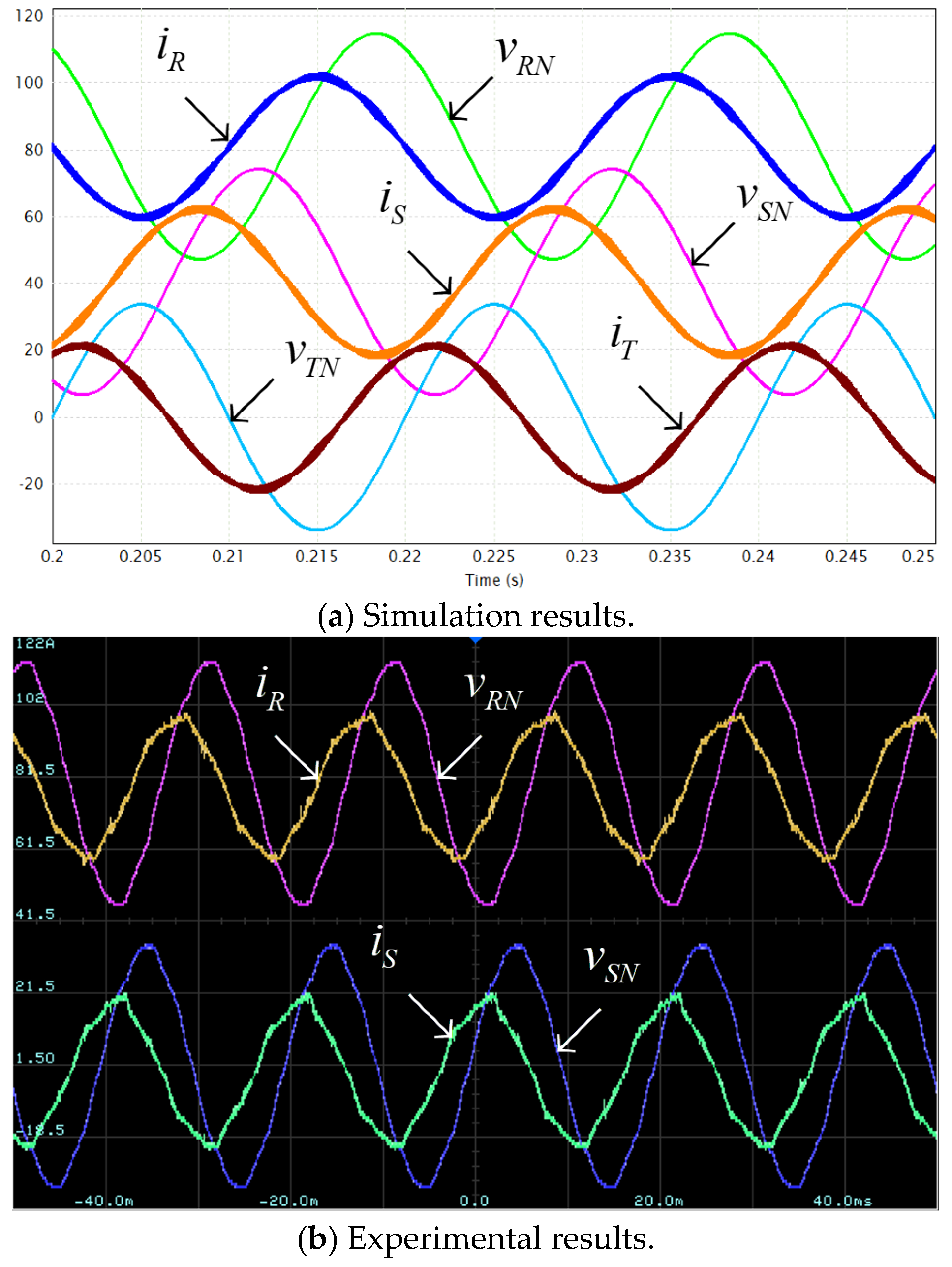
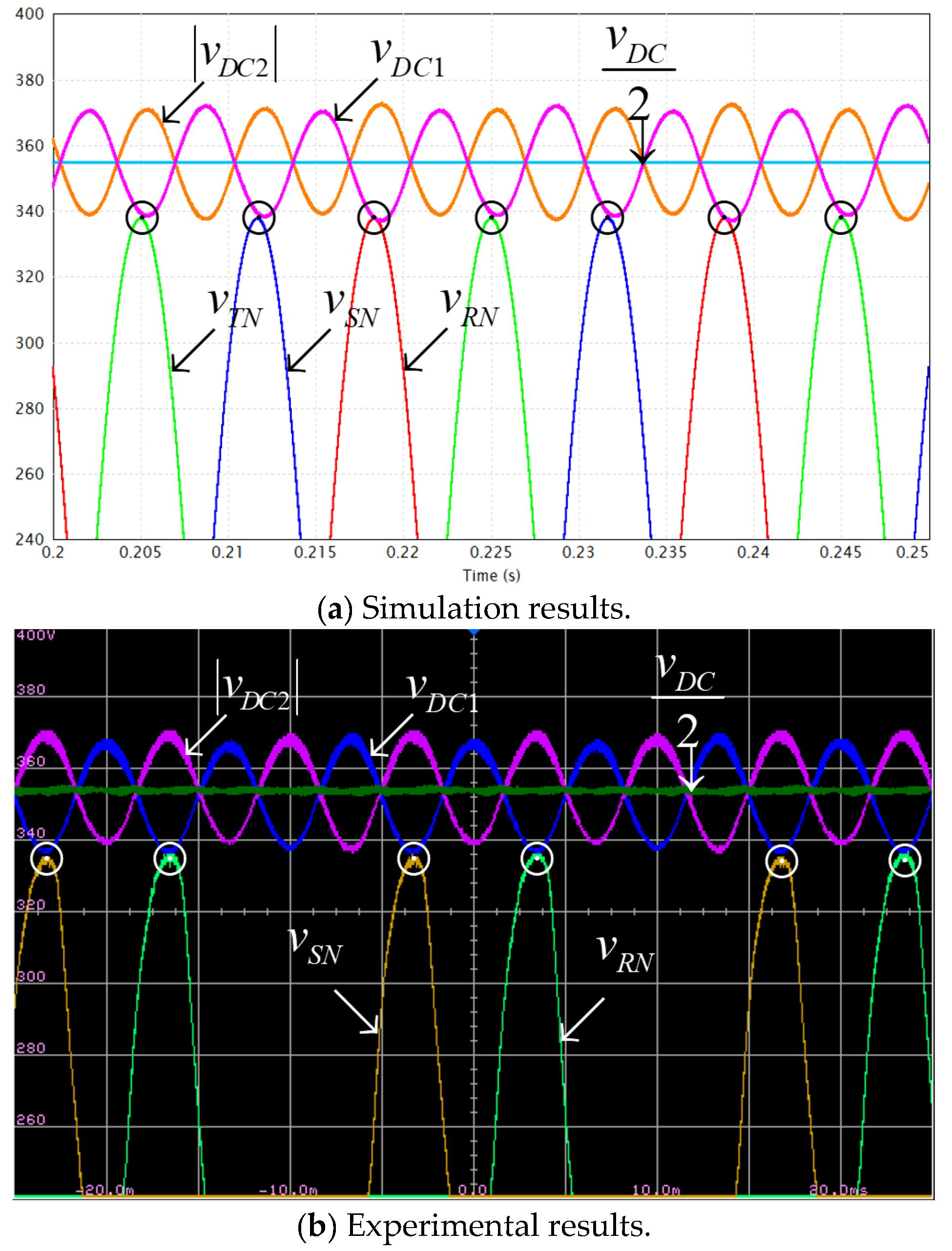
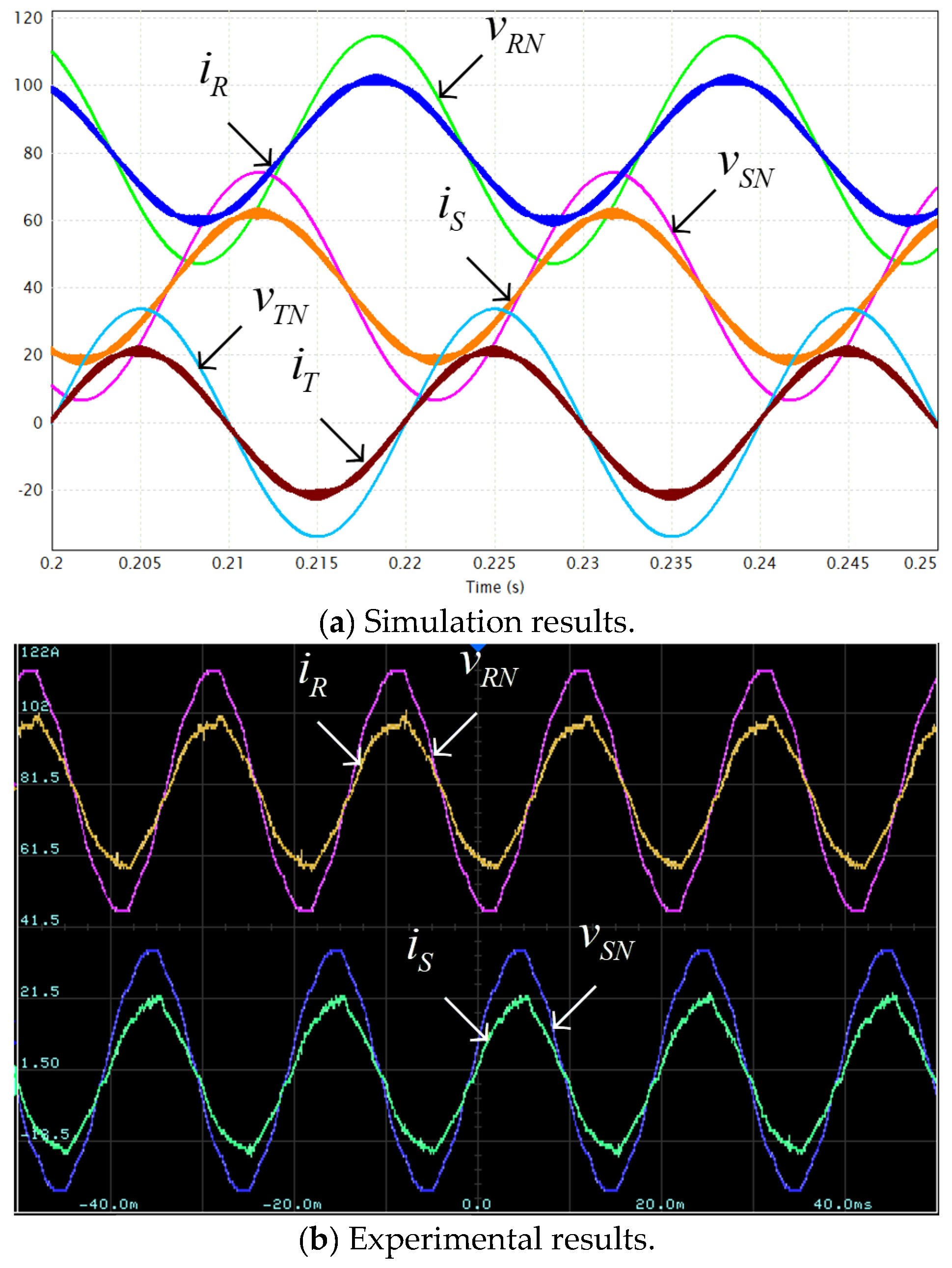
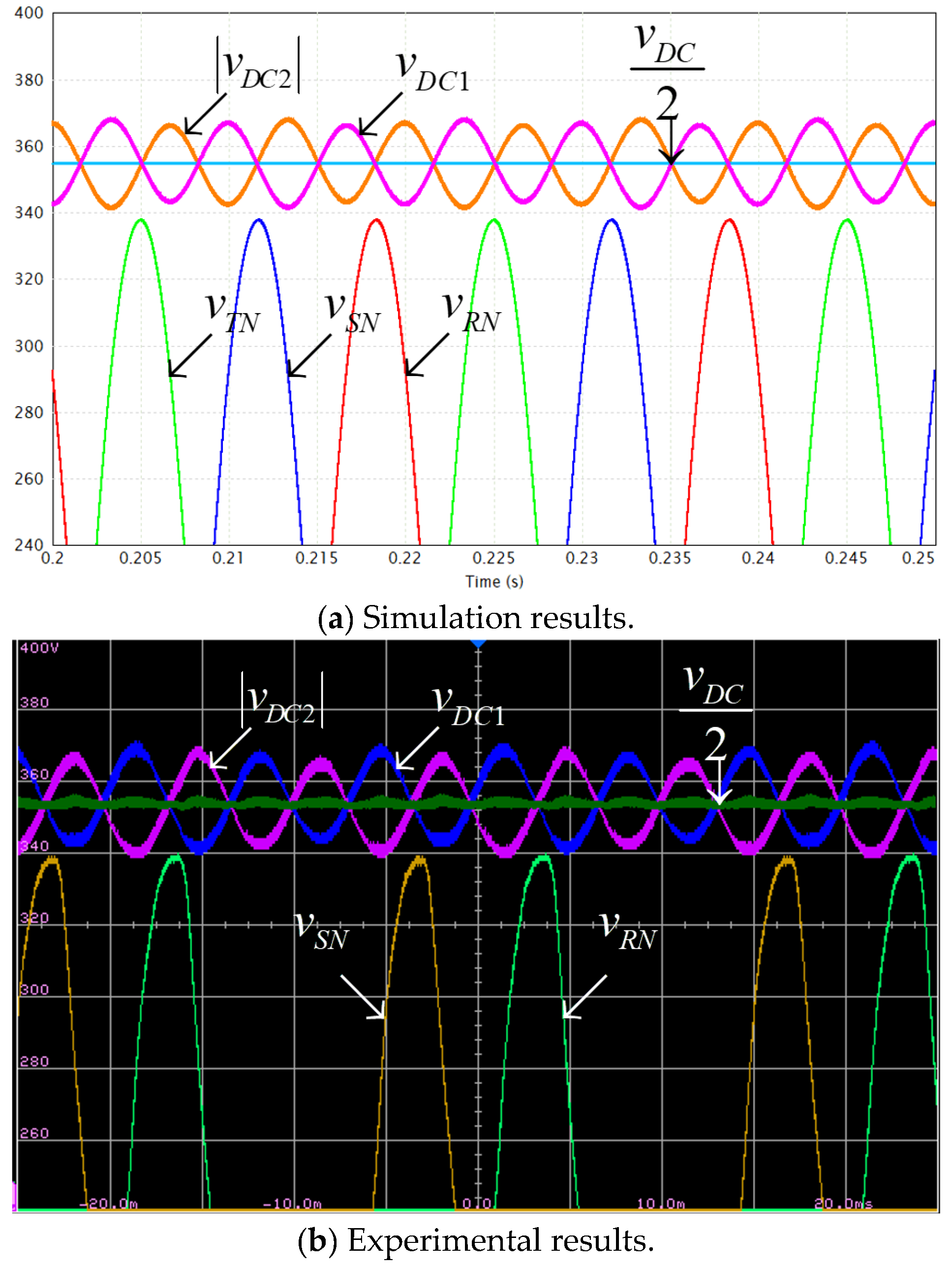
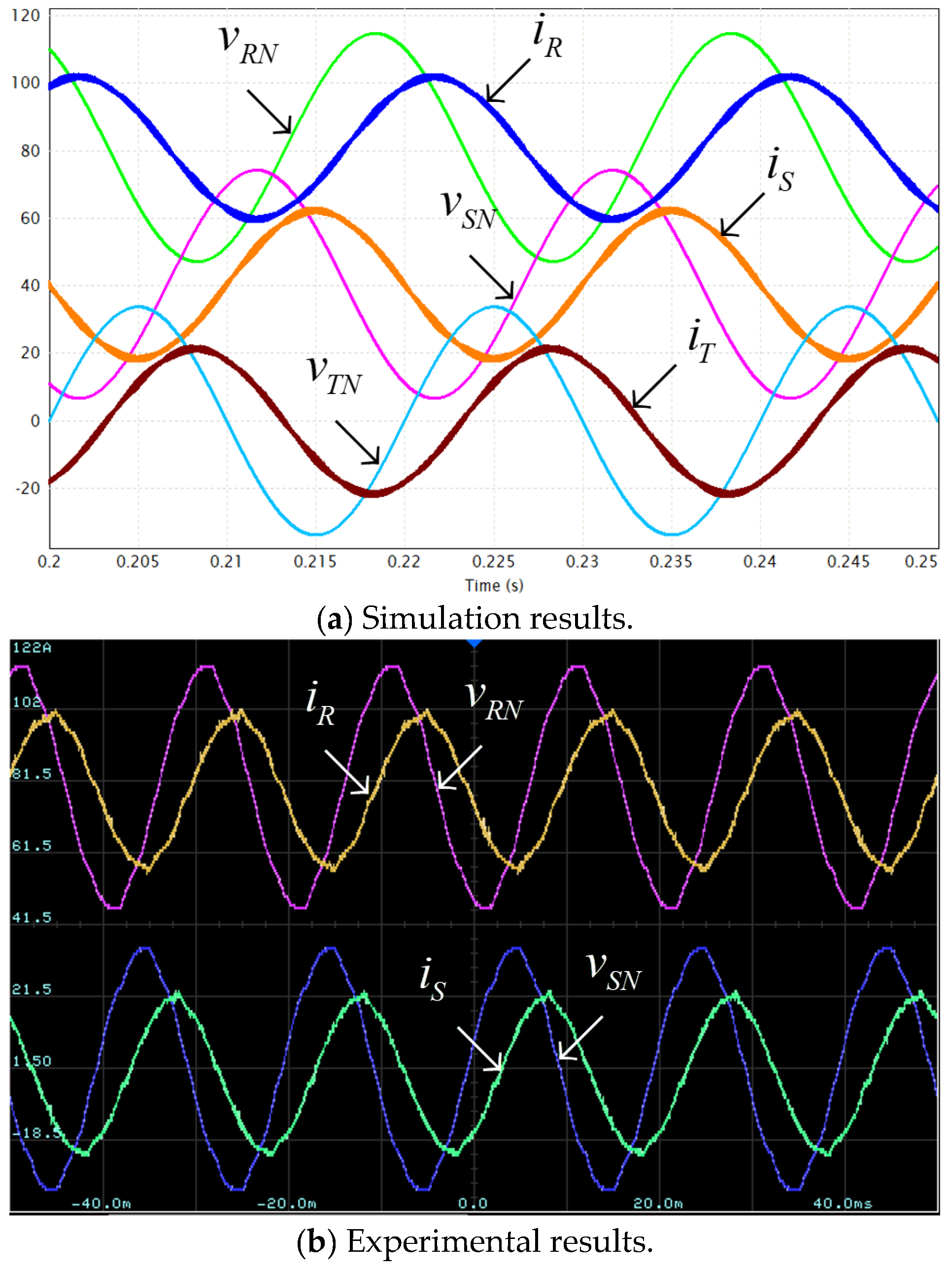
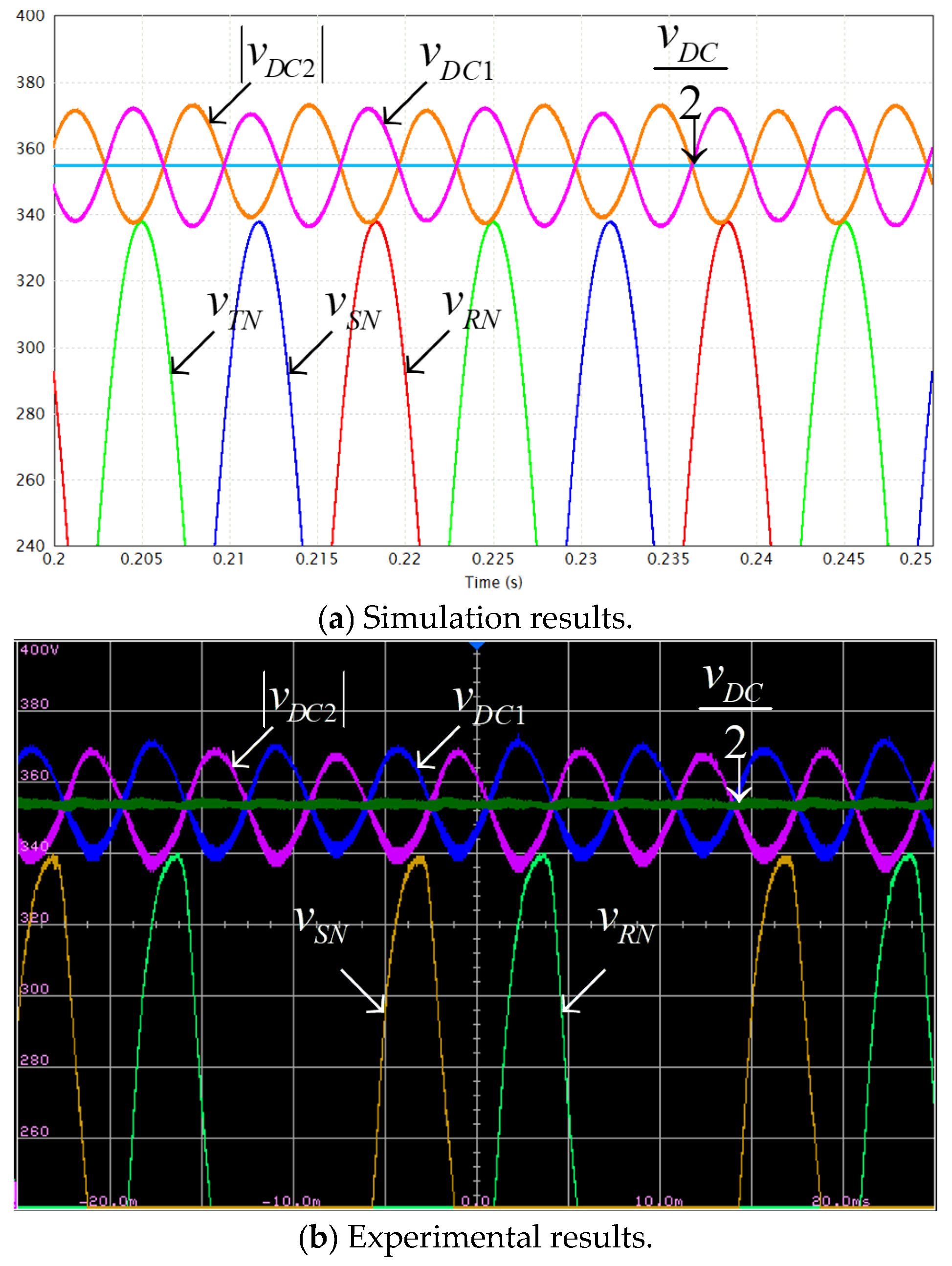
Three simulations (PSIM 2025 software was used) and matching experiments were carried out under rated loading SR (cf. Table 1) under three following power factor values: PF = 0.5 (leading), PF = 1 (unity), PF = 0.5 (lagging) with the former representing the design point (cf. (21)). The results are depicted in Figure 6, Figure 7, Figure 8, Figure 9, Figure 10 and Figure 11. Experimental waveforms were acquired using a 4-channel oscilloscope, hence only two out of three AC-side quantities (i.e., two voltages and two currents) are shown simultaneously while all the three are given in corresponding simulation results. It should also be emphasized that due to the fact that the three-phase mains in the Applied Energy Laboratory (experimental site) is typically polluted with non-negligible harmonic content (well-evident in the experimental waveforms), the currents generated by the inverter also possess noticeable harmonic constituents due to simplified control system adopted (cf. Figure 4b) which does not consider harmonic elimination for brevity. Nevertheless, such characteristics do not affect the proposed methodology feasibility. It is well-evident that all simulation results accurately match their experimental counterparts even though the former consider purely sinusoidal AC-side voltage and currents.
Figure 6. AC-side currents and voltages. Rated load, cos φ = 0.5 (leading). Voltage scale: 200 V/div; Current scale: 20 A/div; Time scale: 5 ms/div.
Figure 7. AC-side and DC-side voltages. Rated load, cos φ = 0.5 (leading). Voltage scale: 20 V/div; Time scale: 5 ms/div.
Figure 8. AC-side currents and voltages. Rated load, cos φ = 1 . Voltage scale: 200 V/div; Current scale: 20 A/div; Time scale: 5 ms/div.
Figure 9. AC-side and DC-side voltages. Rated load, cos φ = 1 . Voltage scale: 20 V/div; Time scale: 5 ms/div.
Figure 10. AC-side currents and voltages. Rated load, cos φ = 0.5 (lagging). Voltage scale: 200 V/div; Current scale: 20 A/div; Time scale: 5 ms/div.
Figure 11. AC-side and DC-side voltages. Rated load, cos φ = 0.5 (lagging). Voltage scale: 20 V/div; Time scale: 5 ms/div.
Figure 6 and Figure 7 demonstrate operational waveforms of the system under rated loading with leading power factor of PF = 0.5 (i.e., AC-side currents lead corresponding AC-side voltages by 60°). It is well-evident that under these conditions, a single tangency point between positive part of grid voltages and positive split DC link voltage vDC1 exists, as indicated by black circles in Figure 7, as expected. On the other hand, split DC link voltages are kept below 376 V (=0.94∙400) at all time. Such a behavior accurately validates the design point (cf. (21)), simultaneously satisfying (15) and (18). Note that even though experimental waveforms of AC-side voltages are slightly distorted (due to harmonic content pollution), split DC link voltages are sinusoidal at triple-grid-frequency. This supports the above-made claim regarding negligible influence of AC-side current harmonic content on split DC-link voltages behavior particular and the proposed methodology feasibility in general. Similar conclusion may be drawn regarding operation under other power factor values as well. It is also evident that positive AC-side voltage peaks and valleys of split DC link voltage vDC1 are slightly shifted due to nonzero PF and are expected to approach each other in case the value of leading power factor is further decreased (cf. Figure 3). Figure 8 and Figure 9 demonstrate operational waveforms of the system under rated loading with unity power factor (here, AC-side currents are in-phase with corresponding AC-side voltages). It is well-evident that under these conditions no tangency point between positive grid voltage parts and the corresponding split DC link voltage vDC1 exists, as expected. On the other hand, split DC link voltages are kept below 376 V (=0.94∙400) at all times, as required. It is also evident that positive AC-side voltage peaks are synchronized with instances where vDC1 = −vDC2 = 0.5 vDC. Such a behavior is well in line with performance previously revealed by the Authors in [36]. Figure 10 and Figure 11 demonstrate operational waveforms of the system under rated loading with lagging power factor of PF = 0.5 (i.e., AC-side currents lag corresponding voltages by 60°). It is well-evident that under these conditions no tangency point between positive grid voltages parts and corresponding split DC link voltage vDC1 exists, as predicted. Split DC link voltages are kept below 376 V (=0.94∙400) at all times, as required. It is also evident that positive AC-side voltage peaks are nearly aligned with those of split DC link voltage vDC1 due to nonzero PF and are expected to approach each other in case the value of lagging power factor is further decreased (cf. Figure 3). Note that tangency between positive grid voltages and the absolute value of the split DC link voltage vDC2 is irrelevant. Consequently, operation under near-zero lagging power factor may be considered as “best case” while operation under near-zero leading power factor may be considered as “best case”.

5. Conclusions

A method for estimating the minimum split DC-link capacitance value required in a family of three-level, three-phase bidirectional AC-DC power converters operating with arbitrary power factor under constrained zero-sequence component was proposed and experimentally validated in the paper. The analysis is based on the previously revealed impact of arbitrary power factor operation on the behavior of split DC link voltages. A detailed examination of the distinction between operation with leading and lagging power factor and the corresponding influence on the capacitance sizing process was carried out. The proposed design approach was validated through closely matching simulations and experiments, confirming the accuracy of the developed analytical framework. Future work on the subject includes analysis of system operation under unbalanced AC-side voltages and/or nonlinear AC-side currents under both restricted and non-constrained zero-sequence injection.

Author Contributions

Conceptualization, A.K. and S.K.; methodology, Y.S., M.S., A.Y. and A.K.; software, Y.S. and V.Y.; validation, Y.S. and V.Y.; formal analysis, A.Y. and A.K.; investigation, Y.S. and M.S.; resources A.K.; data curation, Y.S. and V.Y.; writing—original draft preparation, Y.S.; writing—review and editing, A.Y. and A.K.; visualization, Y.S.; supervision, M.S., A.Y. and A.K.; project administration, S.K. and A.K.; funding acquisition, A.K. All authors have read and agreed to the published version of the manuscript.

Funding

This research was funded in part by the Israel Ministry of Energy.

Data Availability Statement

The original contributions presented in this study are included in the article. Further inquiries can be directed to the corresponding author.

Conflicts of Interest

The authors declare no conflicts of interest.

Nomenclature

v R S T ( t ) vector of grid voltages
V M grid voltages magnitude
φ currents vector angle With Respect To. voltages vector angle
i R S T ( t , φ ) vector of grid currents
I M grid currents magnitude
P F = cos φ power factor
S total apparent power
m R S T ( t ) vector of modulation indices
M ( t ) modulation indices magnitude
m 0 ( t ) zero-sequence modulation component
v D C ( t ) vector of partial DC link voltages
v D C 1 ( t ) , v D C 2 ( t ) individual partial DC link voltages
p R S T ( t , φ ) instantaneous AC-side phase power vector
p R S T ( t , φ ) total instantaneous AC-side power
v A B C ( t ) vector of converter imposed AC-side voltages
V D C * DC link voltage reference value
V D C 1 * , V D C 2 * split DC link set point voltages
C D C 1 , C D C 2 split DC link capacitances

References

  1. Bose, B.K. Multi-Level Converters. Electronics 2015, 4, 582–585. [Google Scholar] [CrossRef]
  2. Franquelo, L.G.; Leonand, J.; Rodriguez, J. The age of multilevel converters arrives. IEEE Ind. Electron. Mag. 2008, 2, 28–39. [Google Scholar] [CrossRef]
  3. Rodriguez, J.; Lai, J.-S.; Peng, F.Z. Multilevel inverters: A survey of topologies, controls, and applications. IEEE Trans. Ind. Electron. 2002, 49, 724–738. [Google Scholar] [CrossRef]
  4. Norões, M.; Jacobina, C.B.; Carlos, G.A. A new three-phase ac–dc–ac multilevel converter based on cascaded three-leg converters. IEEE Trans. Ind. Appl. 2017, 53, 2210–2221. [Google Scholar]
  5. Zhou, D.; Zhao, J.; Li, Y. Model-predictive control scheme of five-leg ac–dc–ac converter-fed induction motor drive. IEEE Trans. Ind. Electron. 2016, 63, 4517–4526. [Google Scholar] [CrossRef]
  6. Lima, M.; Cursino, B.J.; Rocha, N.; Santos, E.C. Ac–dc–ac three-phase converter based on three three-leg converters connected in series. IEEE Trans. Ind. Appl. 2016, 52, 3171–3181. [Google Scholar]
  7. Filho, S.; Cipriano, O.; de Almeida, B.R.; Souza, D.; Fernandes Neto, T.R. High-frequency isolated AC–DC–AC interleaved converter for power quality applications. IEEE Trans. Ind. Appl. 2018, 54, 4594–4602. [Google Scholar] [CrossRef]
  8. Norões, M.; Jacobina, C.B.; Freitas, N.B.; Queiroz, A.; Cabral Silva, E.R. Three-phase four-wire ac–dc–ac multilevel topologies obtained from an interconnection of three-leg converters. IEEE Trans. Ind. Appl. 2018, 54, 4728–4738. [Google Scholar]
  9. Norões, M.; Jacobina, C.B.; Freitas, N.B.; Alves Vitorino, M. Investigation of three-phase ac–dc–ac multilevel nine-leg converter. IEEE Trans. Ind. Appl. 2016, 52, 4156–4169. [Google Scholar]
  10. Kaufhold, E.; Meyer, J.; Schegner, P. Measurement-based identification of DC-link capacitance of single-phase power electronic devices for grey-box modelling. IEEE Trans. Power Electron. 2021, 37, 4544–4552. [Google Scholar]
  11. Khalil, A.; Ahmed, G.; Lee, D.C. DC-link capacitance estimation in AC-DC/AC PWM converters using voltage injection. IEEE Trans. Ind. Appl. 2008, 44, 1631–1637. [Google Scholar] [CrossRef]
  12. Divan, D.; Habetler, T.; Lipo, T. PWM techniques for voltage source inverters. In Proceedings of the IEEE PES Conference, Atlanta, GA, USA, 4–9 February 1990. [Google Scholar]
  13. Laszlo, H.; Kumar, M.; Jovanović, M.M. Performance comparison of three-step and six-step PWM in average-current-controlled three-phase six-switch boost PFC rectifier. IEEE Trans. Power Electron. 2016, 31, 7264–7272. [Google Scholar]
  14. Lu, Y.; Zhao, Z.; Lu, T.; Yang, S. An improved DC-link voltage fast control scheme for a PWM rectifier-inverter system. IEEE Trans. Ind. Appl. 2014, 50, 462–473. [Google Scholar]
  15. Xiong, X.; Zhang, Y.; Wang, J.; Du, H. An improved model predictive control scheme for the PWM rectifier-inverter system based on power-balancing mechanism. IEEE Trans. Ind. Electron. 2016, 63, 5197–5208. [Google Scholar]
  16. Sahraoui, K.; Gaoui, B. Reconfigurable control of PWM AC-DC-DC converter without redundancy leg supplying an ac motor drive. Period. Polytech. Electr. Eng. Comp. Sci. 2021, 65, 74–81. [Google Scholar] [CrossRef]
  17. Yanez-Campos, S.C.; Cerda-Villafana, G.; Lozano-Garcia, J.M. A two-grid interline dynamic voltage restorer based on two three-phase matrix converters. Appl. Sci. 2021, 11, 561. [Google Scholar] [CrossRef]
  18. Iqbal, A.; Lewicki, A.; Morawiec, M. Pulse-Width Modulation of Power Electronic DC–AC Converter. In High Performance Control of AC Drives with MATLAB®/Simulink, 2nd ed.; Wiley: Hoboken, NJ, USA, 2021. [Google Scholar]
  19. Stecca, M.; Soeiro, T.B.; Elizondo, L.R.; Bauer, P.; Palensky, P. Comparison of two and three-level DC-AC converters for a 100 kW battery energy storage system. In Proceedings of the ISIE Symposium, Delft, The Netherlands, 17–19 June 2020; pp. 677–682. [Google Scholar]
  20. Mellincovsky, M.; Yuhimenko, V.; Peretz, M.M.; Kuperman, A. Low-frequency DC-link ripple elimination in power converters with reduced capacitance by multiresonant direct voltage regulation. IEEE Trans. Ind. Electron. 2017, 64, 2015–2023. [Google Scholar] [CrossRef]
  21. Mutovkin, A.; Mellincovsky, M.; Yuhimenko, V.; Schacham, S.; Kuperman, A. Conditions for direct applicability of electronic capacitors to dual-stage grid-connected power conversion systems. IEEE J. Emerg. Sel. Top. Power Electron. 2019, 7, 1805–1814. [Google Scholar] [CrossRef]
  22. Baek, J.; Lee, J.-B.; Kim, J.-K. Effective hold-up time extension method using fan control in server power systems. IEEE Trans. Ind. Electron. 2020, 67, 5820–5824. [Google Scholar] [CrossRef]
  23. Huai, W.; Blaabjerg, F. Reliability of capacitors for DC-link applications in power electronic converters—An overview. IEEE Trans. Ind. Appl. 2014, 50, 3569–3578. [Google Scholar]
  24. Wang, H.; Wang, H.; Zhu, G.; Blaabjerg, F. An overview of capacitive DC links: Topology derivation and scalability analysis. IEEE Trans. Power Electron. 2019, 35, 1805–1829. [Google Scholar] [CrossRef]
  25. Wang, H.; Wang, H. Capacitive DC links in power electronic systems—Reliability and circuit design. Chin. J. Electr. Eng. 2018, 4, 29–36. [Google Scholar]
  26. Mutovkin, A.; Yuhimenko, V.; Schacham, S.E.; Kuperman, A. Simple and straightforward realization of an electronic capacitor. Electron. Lett. 2019, 55, 220–222. [Google Scholar] [CrossRef]
  27. Mutovkin, A.; Yuhimenko, V.; Mellincovsky, M.; Schacham, S.; Kuperman, A. Control of direct voltage regulated active DC-link capacitance reduction circuits to allow plug-and-play operation. IEEE Trans. Ind. Electron. 2019, 66, 6527–6537. [Google Scholar] [CrossRef]
  28. Mutovkin, A.; Yuhimenko, V.; Schacham, S.; Kuperman, A. Nonlinear control of electronic capacitor for enhanced stability and dynamic response. IEEE Trans. Ind. Electron. 2021, 68, 6881–6892. [Google Scholar] [CrossRef]
  29. Lamar, D.G.; Sebastian, J.; Arias, M.; Fernandez, A. On the limit of the output capacitor reduction in power factor correctors by distorting the line input current. IEEE Trans. Power Electron. 2012, 27, 1168–1176. [Google Scholar] [CrossRef]
  30. Hanson, A.J.; Martin, A.F.; Perreault, D.J. Energy and size reduction of grid-interfaced energy buffers through line waveform control. IEEE Trans. Power Electron. 2019, 34, 11442–11453. [Google Scholar] [CrossRef]
  31. Marcos-Pastor, A.; Vidal-Idiarte, E.; Cid-Pastor, A.; Martinez-Salamero, L. Minimum DC-link capacitance for single-phase applications with power factor correction. IEEE Trans. Ind. Electron. 2020, 67, 5204–5208. [Google Scholar] [CrossRef]
  32. Strajnikov, P.; Kuperman, A. On the minimum DC link capacitance in practical PFC rectifiers considering THD requirements and load transients. IEEE Trans. Ind. Electron. 2022, 69, 11067–11075. [Google Scholar] [CrossRef]
  33. Krein, P.T.; Balog, R.S.; Mirjafari, M. Minimum energy and capacitance requirements for single-phase inverters and rectifiers using a ripple port. IEEE Trans. Power Electron. 2012, 27, 4690–4698. [Google Scholar] [CrossRef]
  34. Strajnikov, P.; Kuperman, A. DC link capacitance reduction in PFC rectifiers employing PI+Notch voltage controllers. IEEE Trans. Power Electron. 2023, 38, 977–986. [Google Scholar] [CrossRef]
  35. Siton, Y.; Yuhimenko, V.; Baimel, D.; Kuperman, A. Baseline for split DC-link design in three-phase three-level converters operating with unity power factor based on low-frequency partial voltage oscillations. Machines 2022, 10, 722. [Google Scholar] [CrossRef]
  36. Siton, Y.; Sitbon, M.; Aharon, I.; Lineykin, S.; Baimel, D.; Kuperman, A. On the minimum value of split DC link capacitances in three-phase three-level grid-connected converters operating with unity power factor with limited zero-sequence Injection. Electronics 2023, 12, 1994. [Google Scholar] [CrossRef]
  37. Siton, Y.; Kuperman, A. Generalization of split DC link voltages behavior in three-phase-level converters operating with arbitrary power factor with restricted zero-sequence component. Electronics 2023, 12, 4063. [Google Scholar] [CrossRef]
Disclaimer/Publisher’s Note: The statements, opinions and data contained in all publications are solely those of the individual author(s) and contributor(s) and not of MDPI and/or the editor(s). MDPI and/or the editor(s) disclaim responsibility for any injury to people or property resulting from any ideas, methods, instructions or products referred to in the content.

Article Metrics

Citations

Article Access Statistics

Multiple requests from the same IP address are counted as one view.