Fault Classification in Power Transformers via Dissolved Gas Analysis and Machine Learning Algorithms: A Systematic Literature Review


Abstract
1. Introduction
1.1. Liquid Insulation
1.2. Dissolved Gas Analysis
- Extract a small oil portion from the transformer using a specialized syringe.
- Extract the gases in the oil collected from the transformer in the laboratory.
- Use chromatography to analyze and identify the individual concentrations of the extracted gases.
- Then, use the identified gas concentration to diagnose the incipient faults that may occur in the transformer using the DGA-based interpretation techniques.
1.3. Research Problem
1.4. Research Questions
- What are the primary objectives and research aims that current research addresses on DGA-based transformer fault classification?
- Which research repositories and publication types are commonly used to study DGA-based transformer fault classification?
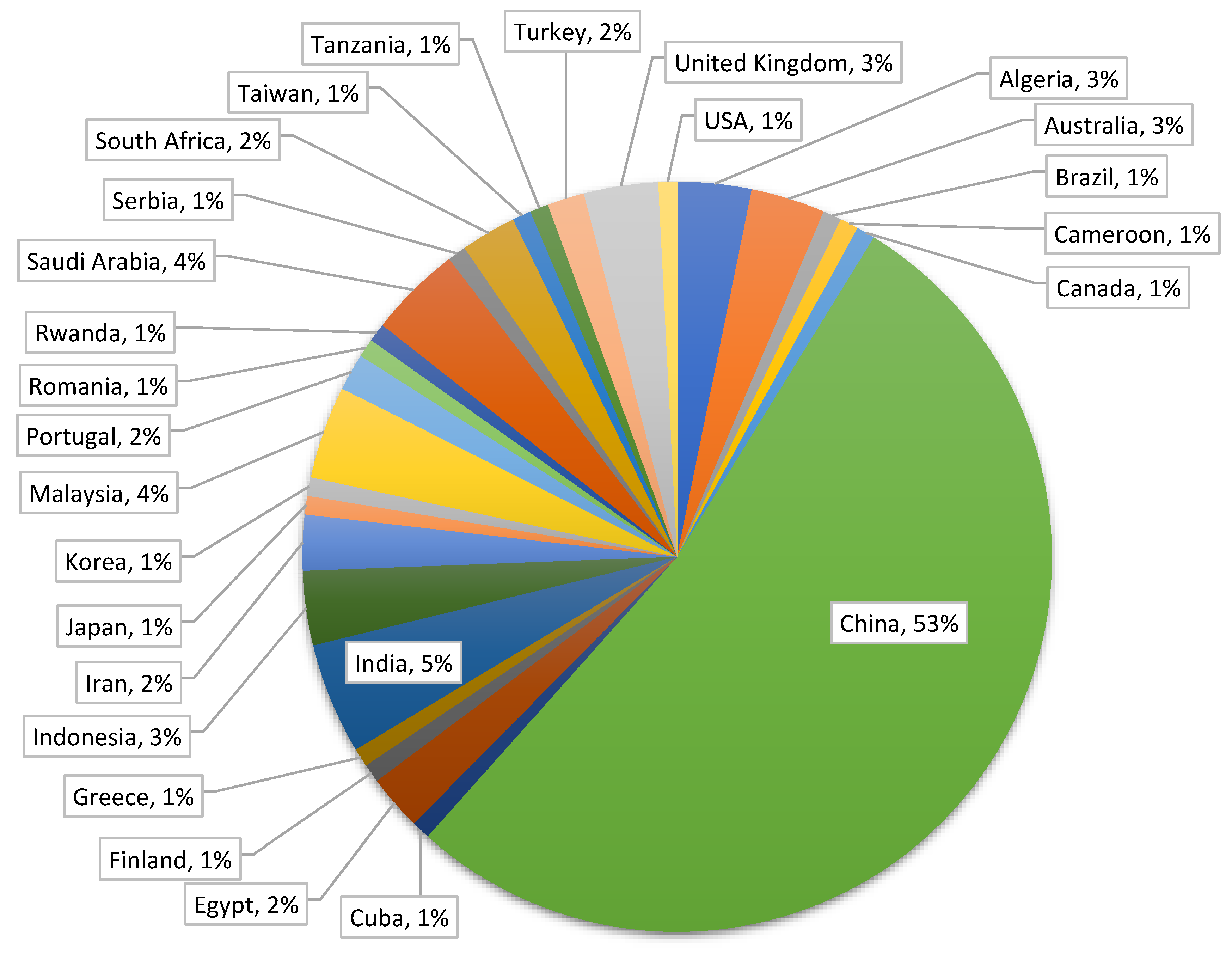
- Which global countries and regions are at the forefront of DGA-based transformer fault classification research?
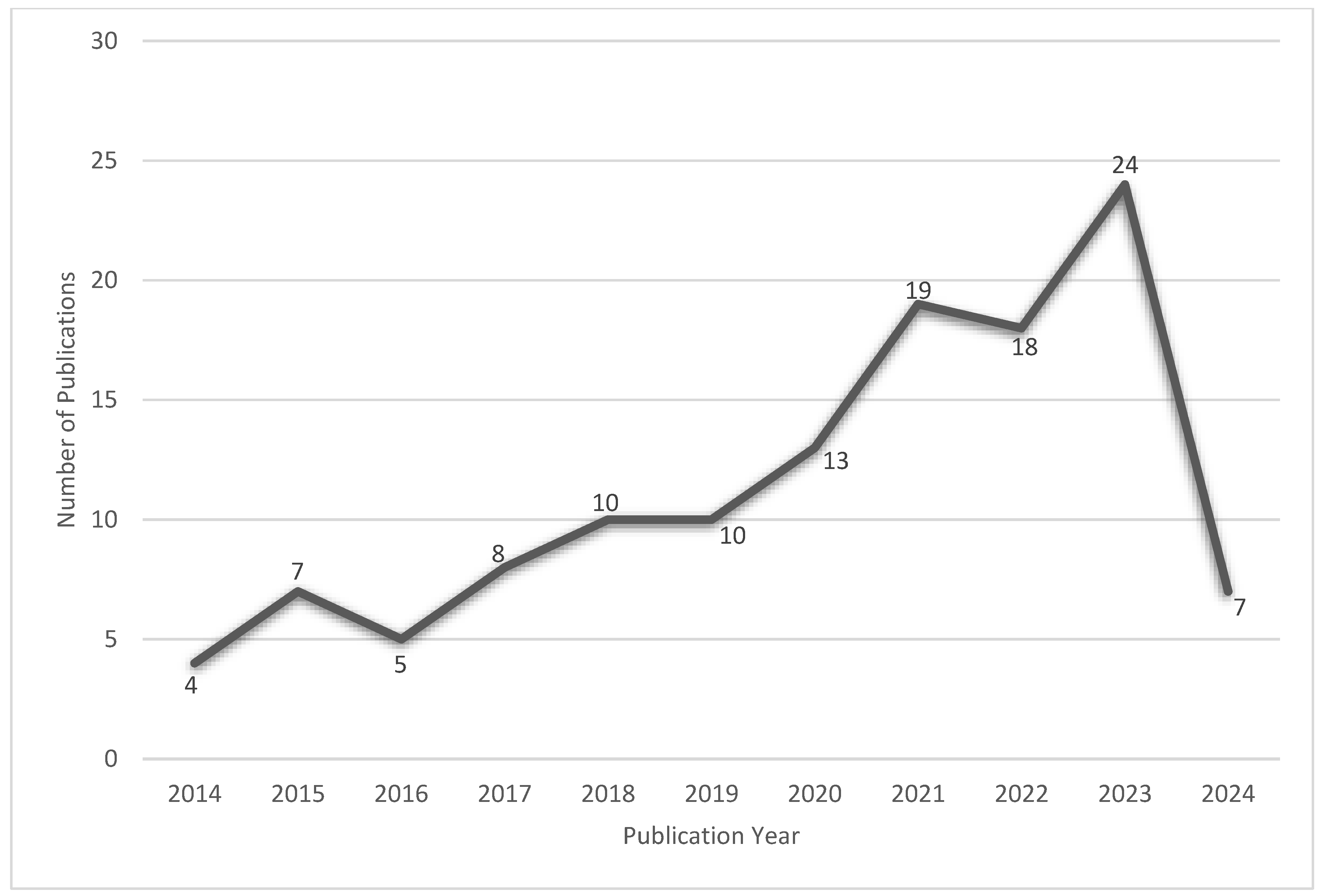
- How has the research in the area of ML application in interpreting transformer faults using DGA evolved over the period 2014–2024?
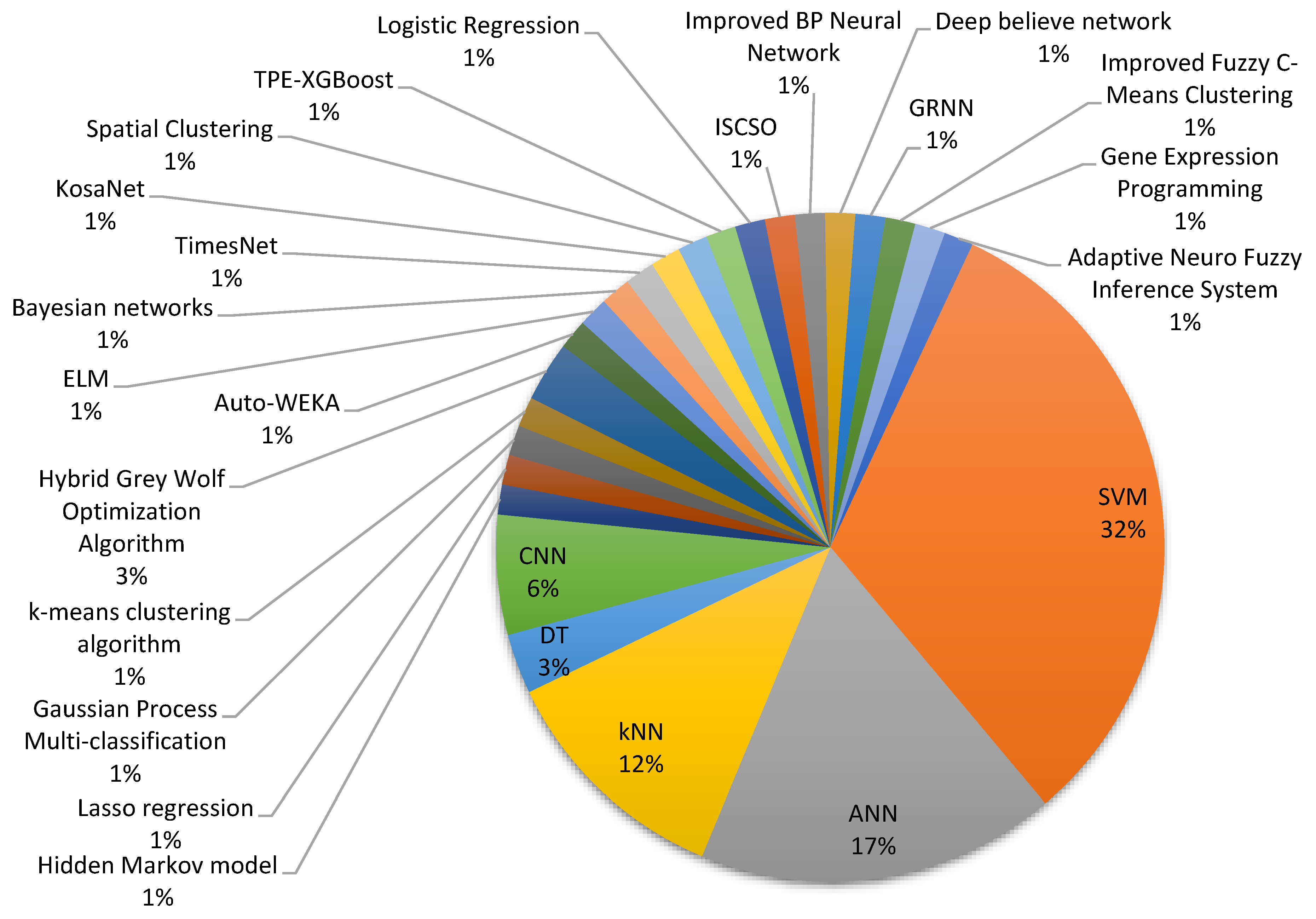
- Which machine learning techniques are employed to investigate DGA-based transformer faults?
- Which software and engineering tools are frequently used to compute and analyze the DGA data?
- Which methods and industrial specifications are utilized for DGA data collection, analysis, and interpretation of the results?
- Which DGA gas components are analyzed?
- What shortcomings and limitations are identified in the literature relating to DGA-based transformer fault classification?
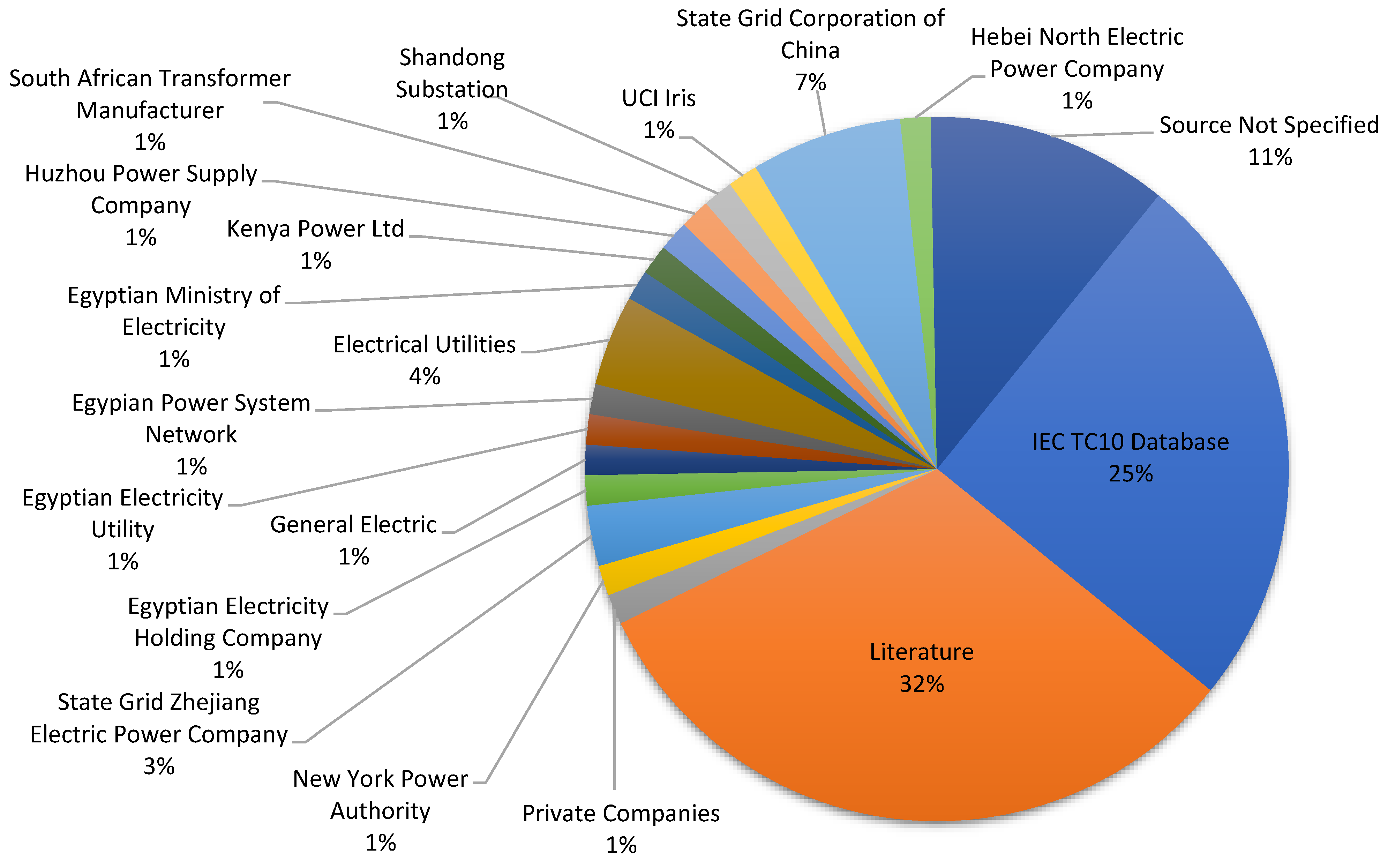
- What are the sources of DGA datasets used in the literature?
1.5. Research Contribution
1.6. Research Novelty
1.7. Limitations of the Study
1.8. Research Organization
2. Materials and Methods
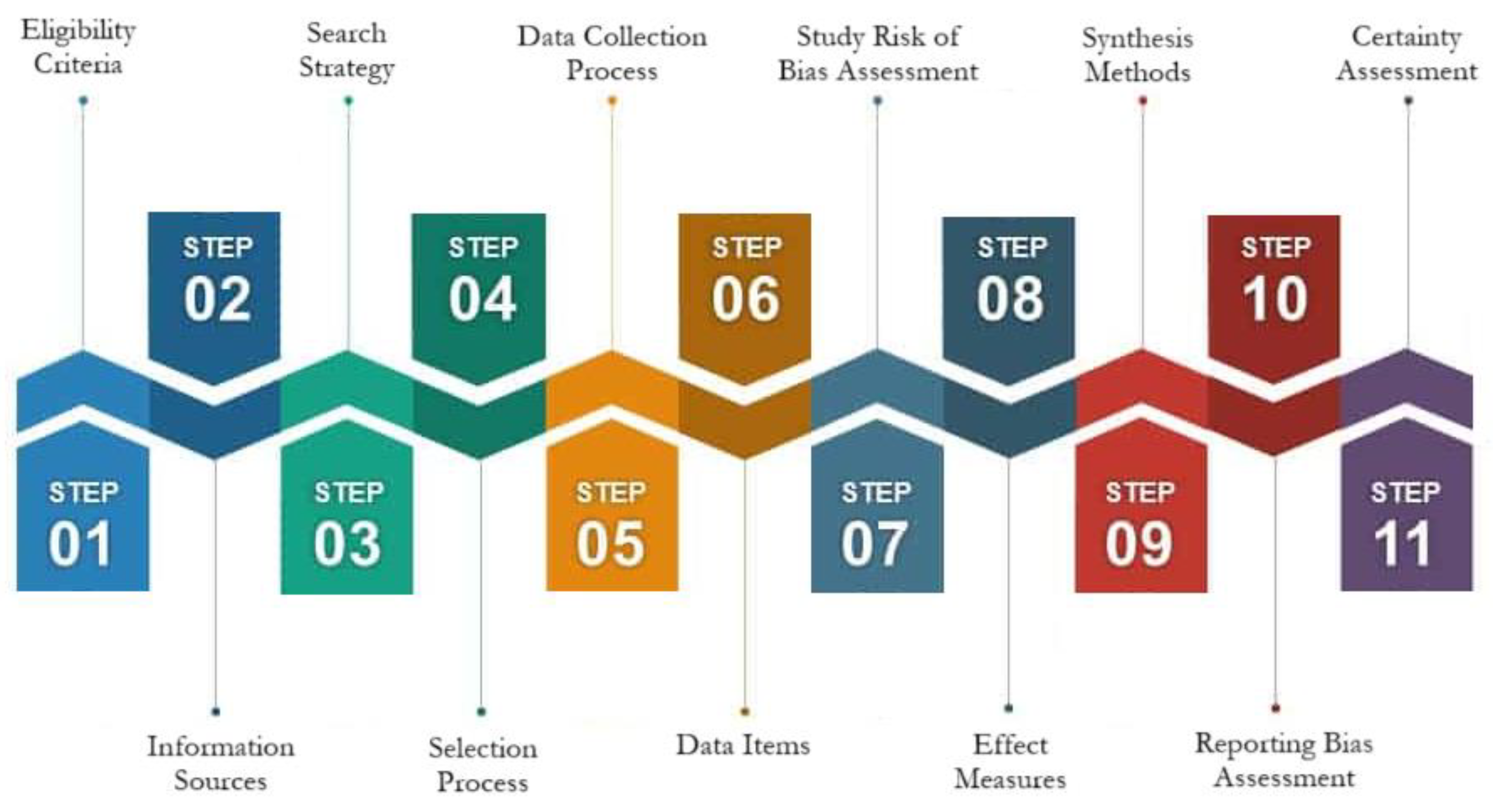
2.1. Eligibility Criteria
2.2. Information Sources
2.3. Search Strategy
2.4. Selection Process
2.5. Data Collection Process
- Q1. Is the research related to both machine learning and the classification of transformer faults based on DGA data?
- Q2. Does the research stipulate the analysis methodology used in the study?
- Q3. Does the research specify the performance accuracy of the methods used for DGA interpretation?
- Q4. Does the research stipulate DGA data sources and data size?
- Q5. Does the research consider DGA applications for transformers only and not tap changers and bushings?
2.6. Data Items
2.7. Study Risk of Bias Assessment
- Q1. Is the research related to both machine learning and the classification of transformer faults based on DGA data?
- Q2. Does the research stipulate the analysis methodology used in the study?
- Q3. Does the research specify the performance accuracy of the methods used for DGA interpretation?
- Q4. Does the research stipulate DGA data sources and data size?
- Q5. Does the research consider DGA applications for transformers only and not tap changers and bushings?
2.8. Effect Measures
2.9. Synthesis Analysis
2.9.1. Criteria for Studies Eligible for Synthesis
2.9.2. Data Preparation
2.9.3. Results Presentation
2.9.4. Methods for Data Synthesis and Meta-Analysis
2.9.5. Exploring Causes of Heterogeneity
2.9.6. Sensitivity Analysis Approach
2.10. Reporting Bias Assessment
2.11. Certainty Assessment
- Q1. Is the research related to both machine learning and the classification of transformer faults based on DGA data?
- Q2. Does the research stipulate the analysis methodology used in the study?
- Q3. Does the research specify the performance accuracy of the methods used for DGA interpretation?
- Q4. Does the research stipulate DGA data sources and data size?
- Q5. Does the research consider DGA applications for transformers only and not tap changers and bushings?
3. Results
3.1. Study Selection
3.2. Study Characteristics
3.3. Results of Individual Studies
3.4. Results of Syntheses
3.4.1. Characteristics and Risk of Bias of Contributing Studies and Their Statistical Results
3.4.2. Causes of Heterogeneity
3.4.3. Sensitivity Analysis
3.5. Reporting Biases
3.6. Certainty of Evidence
4. Discussion
Shortcomings and Limitations Identified in the Literature Relating to DGA-Based Transformer Fault Classification
- Unspecified transformer type and capacity MVA sizes: A great majority of the papers do not specify the transformer type and their capacity; this could have provided indicative insights into which transformer types and sizes are most prone to which transformer fault based on the DGA interpreted results.
- Unspecified oil type of DGA samples: Many of the papers do not provide the type of insulation oil that was used from which the DGA results were extracted. This could have provided valuable insights into which insulation oil between mineral oil, vegetable oil, esters oils, etc., is the most reliable and which ones exhibit high concentrations of gases over a period of usage.
- Transformer age: Very few of the studied papers specified the age of the transformers from which the oil samples were taken; this could have helped provide insight into the relationship between transformer age and its gas concentration performance based on DGA sample results.
- Lack of data preprocessing and feature extraction techniques: Some of the papers do not specify the techniques used for data preprocessing and feature techniques; this could have helped to provide the readers with insights as to which data preprocessing and feature extraction techniques are the most effective in relation with the machine learning algorithms employed. To optimize the performance of machine learning models, before processing raw datasets for training, it is a pre-requisite for them to be thoroughly cleaned by removing as much noise and redundant information as possible so that only useful dataset attributes are evaluated [144,145]. This process is essential to eliminate the inconsistent and unwanted noise often hidden in the input raw data [146,147]. In addition to data preprocessing, another critical step required for data preparation is feature extraction. Feature extraction is a dimension-reduction technique used to scale down datasets by eliminating non-essential features and properties in datasets used to train machine learning models and include only key, important features from the raw datasets to help narrow the focus of the algorithms towards selected features and obtain the final class of the features after eliminating unwanted and non-essential features [144,146,148]. In general, feature extraction identifies the characteristic features that better represent the dataset by minimizing the within-class pattern variability while improving the between-class variability and preventing dimensionality [146,147,148,149]. However, studies have indicated the issues associated with raw data preprocessing and feature extraction inclusion in machine learning models. These issues include navigating around large datasets with many categorized features and expanding feature sets which all serve as stumbling blocks for researchers when designing models as these issues lead to long computational and processing times of models [150]. As a result, researchers refrain from disclosing to what extent data pre-processing and feature extraction were conducted for their trained models to overcome the risk of dimensionality and overfitting.
- Lack of specifications used: A large number of the papers studied do not specify the globally adopted industrial standards used in the analysis. This causes concern as having an accurate depiction of standards would aid in understanding which ones are the most effective and accurate.
- Lack of distinction in the DGA gases studies: The studied papers apply a holistic approach when describing the gases studies, with almost all of them mentioning all gases, i.e., hydrogen (H2), methane (CH4), ethylene (C2H4), ethane (C2H6), acetylene (C2H2), carbon monoxide (CO), and carbon dioxide (CO2).
5. Conclusions
6. Registration and Protocol
6.1. Registration Information
6.2. Protocol Accessibility
6.3. Protocol Amendments
Author Contributions
Funding
Institutional Review Board Statement
Informed Consent Statement
Data Availability Statement
Conflicts of Interest
References
- Oommen, T. Vegetable oils for liquid-filled transformers. IEEE Electr. Insul. Mag. 2002, 18, 6–11. [Google Scholar] [CrossRef]
- Matharage, B.S.H. Ageing Assessment of Transformer Paper Insulation Through Methanol And Ethanol Detection. Ph.D. Thesis, The University of Manchester, Manchester, UK, August 2018. [Google Scholar]
- Matharage, S.Y.; Liu, Q.; Wang, Z.D.; Mavrommatis, P.; Wilson, G.; Jarman, P. Ageing assessment of transformer paper insulation through detection of methanol in oil. In Proceedings of the 2015 IEEE 11th International Conference on the Properties and Applications of Dielectric Materials (ICPADM), Sydney, NSW, Australia, 19–22 July 2015; pp. 392–395. [Google Scholar] [CrossRef]
- Rafiq, M.; Lv, Y.Z.; Zhou, Y.; Ma, K.B.; Wang, W.; Li, C.R.; Wang, Q. Use of vegetable oils as transformer oils—A review. Renew. Sustain. Energy Rev. 2015, 52, 308–324. [Google Scholar] [CrossRef]
- Saha, T.P.; Purkait, P. Transformer Ageing: Monitoring and Estimation Techniques, 1st ed.; John Wiley & Sons: Singapore, 2017; p. 9. [Google Scholar]
- CIGRE. Guide on Transformer Intelligent Condition Monitoring (TICM) Systems; CIGRE: Paris, France, 2015; Volume 603. [Google Scholar]
- de Faria, H.; Costa, J.G.S.; Olivas, J.L.M. A review of monitoring methods for predictive maintenance of electric power transformers based on dissolved gas analysis. Renew. Sustain. Energy Rev. 2015, 46, 201–209. [Google Scholar] [CrossRef]
- Saad, M.; Tenyenhuis, E. On-line gas monitoring for increased transformer protection. In Proceedings of the IEEE Electrical Power and Energy Conference (EPEC), Saskatoon, SK, Canada, 22–25 October 2017. [Google Scholar]
- Alqudsi, A.Y.; ElHag, A.H. A cost effective artificial intelligence based transformer insulation health index. In Proceedings of the 3rd International Conference on Condition Assessment Techniques in Electrical Systems (CATCON), Punjab, India, 16–18 November 2017. [Google Scholar]
- Németh, B.; Vörös, C.; Csépes, G. Health index as one of the best practice for condition assessment of transformers and substation equipments—Hungarian experience. In Proceedings of the CIGRÉ Biennial Session A2-103, Paris, France, 24–29 August 2014. [Google Scholar]
- Sun, H.-C.; Huang, Y.-C.; Huang, C.-M. A Review of Dissolved Gas Analysis in Power Transformers. Energy Procedia 2012, 14, 1220–1225. [Google Scholar] [CrossRef]
- Wani, S.A.; Rana, A.S.; Sohail, S.; Rahman, O.; Parveen, S.; Khan, S.A. Advances in DGA based condition monitoring of transformers: A review. Renew. Sustain. Energy Rev. 2021, 149, 111347. [Google Scholar] [CrossRef]
- Taha, I.B.M.; Ghoneim, S.S.M.; Zaini, H.G. Improvement of Rogers four ratios and IEC Code methods for transformer fault diagnosis based on dissolved gas analysis. In Proceedings of the 2015 North American Power Symposium (NAPS), Charlotte, NC, USA, 4–6 October 2015; pp. 1–5. [Google Scholar]
- CIGRE. New techniques for dissolved gas-in-oil analysis. Electra 2001, 198, 20–27. [Google Scholar]
- CICRE. 771—Advances in DGA Interpretation Technical Brochure. Jt. Work. Group A2/D1. 2019. Available online: https://www.e-cigre.org/publications/detail/771-advances-in-dga-interpretation.html (accessed on 12 November 2024).
- Duval, M. Report on Gas Monitors for Oil-Filled Electrical Equipment. Electra. 2009. Available online: https://www.e-cigre.org/publications/detail/409-report-on-gas-monitors-for-oil-filled-electrical-equipment.html (accessed on 12 November 2024).
- da Silva, I.N.; Imamura, M.M.; de Souza, A.N. Application of neural networks to the analysis of dissolved gases in insulating oil used in transformers. In Proceedings of the IEEE International Conference on Systems, Man and Cybernetics, Nashville, TN, USA, 8–11 October 2000; pp. 2643–2648. [Google Scholar]
- Su, Q.; Mi, C.; Lai, L.; Austin, P. A fuzzy dissolved gas analysis method for the diagnosis of multiple incipient faults in a transformer. IEEE Trans. Power Syst. 2000, 15, 593–598. [Google Scholar] [CrossRef]
- Naresh, R.; Sharma, V.; Vashisth, M. An integrated neural fuzzy approach for fault diagnosis of transformers. IEEE Trans. Power Deliv. 2008, 23, 2017–2024. [Google Scholar] [CrossRef]
- Khan, S.A.; Equbal, D.; Islam, T. A comprehensive comparative study of DGA based transformer fault diagnosis using fuzzy logic and ANFIS models. IEEE Trans. Dielectr. Electr. Insul. 2015, 22, 590–596. [Google Scholar] [CrossRef]
- Zhang, Y.; Li, X.; Zheng, H.; Yao, H.; Liu, J.; Zhang, C.; Peng, H.; Jiao, J. A Fault Diagnosis Model of Power Transformers Based on Dissolved Gas Analysis Features Selection and Improved Krill Herd Algorithm Optimized Support Vector Machine. IEEE Access 2019, 7, 102803–102811. [Google Scholar] [CrossRef]
- Jin, L.; Kim, D.; Chan, K.Y.; Abu-Siada, A. Deep Machine Learning-Based Asset Management Approach for Oil- Immersed Power Transformers Using Dissolved Gas Analysis. IEEE Access 2024, 12, 27794–27809. [Google Scholar] [CrossRef]
- Raghuraman, R.; Darvishi, A. Detecting Transformer Fault Types from Dissolved Gas Analysis Data Using Machine Learning Techniques. In Proceedings of the 2022 IEEE 15th Dallas Circuit And System Conference (DCAS), Dallas, TX, USA, 17–19 June 2022; pp. 1–5. [Google Scholar] [CrossRef]
- Dai, J.; Song, H.; Sheng, G.; Jiang, X. Dissolved gas analysis of insulating oil for power transformer fault diagnosis with deep belief network. IEEE Trans. Dielectr. Electr. Insul. 2017, 24, 2828–2835. [Google Scholar] [CrossRef]
- Jiang, J.; Chen, R.; Chen, M.; Wang, W.; Zhang, C. Dynamic Fault Prediction of Power Transformers Based on Hidden Markov Model of Dissolved Gases Analysis. IEEE Trans. Power Deliv. 2019, 34, 1393–1400. [Google Scholar] [CrossRef]
- Jiang, J.; Chen, R.; Zhang, C.; Chen, M.; Li, X.; Ma, G. Dynamic Fault Prediction of Power Transformers Based on Lasso Regression and Change Point Detection by Dissolved Gas Analysis. IEEE Trans. Dielectr. Electr. Insul. 2020, 27, 2130–2137. [Google Scholar] [CrossRef]
- Ghoneim, S.M.; Mahmoud, K.; Lehtonen, M.; Darwish, M.M.F. Enhancing Diagnostic Accuracy of Transformer Faults Using Teaching-Learning-Based Optimization. IEEE Access 2021, 9, 30817–30832. [Google Scholar] [CrossRef]
- Wang, L.; Littler, T.; Liu, X. Gaussian Process Multi-Class Classification for Transformer Fault Diagnosis Using Dissolved Gas Analysis. IEEE Trans. Dielectr. Electr. Insul. 2021, 28, 1703–1712. [Google Scholar] [CrossRef]
- Nanfak, A.; Eke, S.; Meghnefi, F.; Fofana, I.; Ngaleu, G.M.; Kom, C.H. Hybrid DGA Method for Power Transformer Faults Diagnosis Based on Evolutionary k-Means Clustering and Dissolved Gas Subsets Analysis. IEEE Trans. Dielectr. Electr. Insul. 2023, 30, 2421–2428. [Google Scholar] [CrossRef]
- Hoballah, A.; Mansour, D.-E.A.; Taha, I.B.M. Hybrid Grey Wolf Optimizer for Transformer Fault Diagnosis Using Dissolved Gases Considering Uncertainty in Measurements. IEEE Access 2020, 8, 139176–139187. [Google Scholar] [CrossRef]
- Rao, U.M.; Fofana, I.; Rajesh, K.N.V.P.S.; Picher, P. Identification and Application of Machine Learning Algorithms for Transformer Dissolved Gas Analysis. IEEE Trans. Dielectr. Electr. Insul. 2021, 28, 1828–1835. [Google Scholar] [CrossRef]
- Ghoneim, S.S.M.; Taha, I.B.M.; Elkalashy, N.I. Integrated ANN-based proactive fault diagnostic scheme for power transformers using dissolved gas analysis. IEEE Trans. Dielectr. Electr. Insul. 2016, 23, 1838–1845. [Google Scholar] [CrossRef]
- Li, S.; Wu, G.; Gao, B.; Hao, C.; Xin, D.; Yin, X. Interpretation of DGA for transformer fault diagnosis with complementary SaE-ELM and arctangent transform. IEEE Trans. Dielectr. Electr. Insul. 2016, 23, 586–595. [Google Scholar] [CrossRef]
- Li, J.; Zhang, Q.; Wang, K.; Wang, J.; Zhou, T.; Zhang, Y. Optimal dissolved gas ratios selected by genetic algorithm for power transformer fault diagnosis based on support vector machine. IEEE Trans. Dielectr. Electr. Insul. 2016, 23, 1198–1206. [Google Scholar] [CrossRef]
- Aizpurua, J.I.; Catterson, V.M.; Stewart, B.G.; McArthur, S.D.J.; Lambert, B.; Ampofo, B.; Pereira, G.; Cross, J.G. Power transformer dissolved gas analysis through Bayesian networks and hypothesis testing. IEEE Trans. Dielectr. Electr. Insul. 2018, 25, 494–506. [Google Scholar] [CrossRef]
- Taha, I.B.M.; Ibrahim, S.; Mansour, D.-E.A. Power Transformer Fault Diagnosis Based on DGA Using a Convolutional Neural Network With Noise in Measurements. IEEE Access 2021, 9, 111162–111170. [Google Scholar] [CrossRef]
- Benmahamed, Y.; Teguar, M.; Boubakeur, A. Application of SVM and KNN to Duval Pentagon 1 for transformer oil diagnosis. IEEE Trans. Dielectr. Electr. Insul. 2017, 24, 3443–3451. [Google Scholar] [CrossRef]
- Badawi, M.; Ibrahim, S.A.; Mansour, D.-E.A.; El-Faraskoury, A.A.; Ward, S.A.; Mahmoud, K.; Lehtonen, M.; Darwish, M.M.F. Reliable Estimation for Health Index of Transformer Oil Based on Novel Combined Predictive Maintenance Techniques. IEEE Access 2022, 10, 25954–25972. [Google Scholar] [CrossRef]
- Prasojo, R.A.; Gumilang, H.; Suwarno; Maulidevi, N.U.; Soedjarno, B.A. A Fuzzy Logic Model for Power Transformer Faults’ Severity Determination Based on Gas Level, Gas Rate, and Dissolved Gas Analysis Interpretation. Energies 2020, 13, 1009. [Google Scholar] [CrossRef]
- Zhang, X.; Yang, K.; Zheng, L. Transformer Fault Diagnosis Method Based on TimesNet and Informer. Actuators 2024, 13, 74. [Google Scholar] [CrossRef]
- Odongo, G.; Musabe, R.; Hanyurwimfura, D. A Multinomial DGA Classifier for Incipient Fault Detection in Oil-Impregnated Power Transformers. Algorithms 2021, 14, 128. [Google Scholar] [CrossRef]
- Liu, Y.; Song, B.; Wang, L.; Gao, J.; Xu, R. Power Transformer Fault Diagnosis Based on Dissolved Gas Analysis by Correlation Coefficient-DBSCAN. Appl. Sci. 2020, 10, 4440. [Google Scholar] [CrossRef]
- Wang, T.; Li, Q.; Yang, J.; Xie, T.; Wu, P.; Liang, J. Transformer Fault Diagnosis Method Based on Incomplete Data and TPE-XGBoost. Appl. Sci. 2023, 13, 7539. [Google Scholar] [CrossRef]
- Thango, B.A. Dissolved Gas Analysis and Application of Artificial Intelligence Technique for Fault Diagnosis in Power Transformers: A South African Case Study. Energies 2022, 15, 9030. [Google Scholar] [CrossRef]
- Almoallem, Y.D.; Taha, I.B.M.; Mosaad, M.I.; Nahma, L.; Abu-Siada, A. Application of Logistic Regression Algorithm in the Interpretation of Dissolved Gas Analysis for Power Transformers. Electronics 2021, 10, 1206. [Google Scholar] [CrossRef]
- Lu, W.; Shi, C.; Fu, H.; Xu, Y. A Power Transformer Fault Diagnosis Method Based on Improved Sand Cat Swarm Optimization Algorithm and Bidirectional Gated Recurrent Unit. Electronics 2023, 12, 672. [Google Scholar] [CrossRef]
- Jin, Y.; Wu, H.; Zheng, J.; Zhang, J.; Liu, Z. Power Transformer Fault Diagnosis Based on Improved BP Neural Network. Electronics 2023, 12, 3526. [Google Scholar] [CrossRef]
- Miao, X.; Quan, H.; Cheng, X.; Xu, M.; Huang, Q.; Liang, C.; Li, J. Fault Diagnosis of Oil-Immersed Transformers Based on the Improved Neighborhood Rough Set and Deep Belief Network. Electronics 2024, 13, 5. [Google Scholar] [CrossRef]
- Lin, J.; Sheng, G.; Yan, Y.; Dai, J.; Jiang, X. Prediction of Dissolved Gas Concentrations in Transformer Oil Based on the KPCA-FFOA-GRNN Model. Energies 2018, 11, 225. [Google Scholar] [CrossRef]
- Fang, J.; Zheng, H.; Liu, J.; Zhao, J.; Zhang, Y.; Wang, K. A Transformer Fault Diagnosis Model Using an Optimal Hybrid Dissolved Gas Analysis Features Subset with Improved Social Group Optimization-Support Vector Machine Classifier. Energies 2018, 11, 1922. [Google Scholar] [CrossRef]
- Li, E.; Wang, L.; Song, B.; Jian, S. Improved Fuzzy C-Means Clustering for Transformer Fault Diagnosis Using Dissolved Gas Analysis Data. Energies 2018, 11, 2344. [Google Scholar] [CrossRef]
- Abu-Siada, A. Improved Consistent Interpretation Approach of Fault Type within Power Transformers Using Dissolved Gas Analysis and Gene Expression Programming. Energies 2019, 12, 730. [Google Scholar] [CrossRef]
- Yuan, F.; Guo, J.; Xiao, Z.; Zeng, B.; Zhu, W.; Huang, S. A Transformer Fault Diagnosis Model Based on Chemical Reaction Optimization and Twin Support Vector Machine. Energies 2019, 12, 960. [Google Scholar] [CrossRef]
- Shang, H.; Xu, J.; Zheng, Z.; Qi, B.; Zhang, L. A Novel Fault Diagnosis Method for Power Transformer Based on Dissolved Gas Analysis Using Hypersphere Multiclass Support Vector Machine and Improved D–S Evidence Theory. Energies 2019, 12, 4017. [Google Scholar] [CrossRef]
- Zeng, B.; Guo, J.; Zhu, W.; Xiao, Z.; Yuan, F.; Huang, S. A Transformer Fault Diagnosis Model Based On Hybrid Grey Wolf Optimizer and LS-SVM. Energies 2019, 12, 4170. [Google Scholar] [CrossRef]
- Zhang, Y.; Wang, Y.; Fan, X.; Zhang, W.; Zhuo, R.; Hao, J.; Shi, Z. An Integrated Model for Transformer Fault Diagnosis to Improve Sample Classification near Decision Boundary of Support Vector Machine. Energies 2020, 13, 6678. [Google Scholar] [CrossRef]
- Aciu, A.-M.; Nicola, C.-I.; Nicola, M.; Nițu, M.-C. Complementary Analysis for DGA Based on Duval Methods and Furan Compounds Using Artificial Neural Networks. Energies 2021, 14, 588. [Google Scholar] [CrossRef]
- Benmahamed, Y.; Kherif, O.; Teguar, M.; Boubakeur, A.; Ghoneim, S.S.M. Accuracy Improvement of Transformer Faults Diagnostic Based on DGA Data Using SVM-BA Classifier. Energies 2021, 14, 2970. [Google Scholar] [CrossRef]
- Zhou, Y.; Yang, X.; Tao, L.; Yang, L. Transformer Fault Diagnosis Model Based on Improved Gray Wolf Optimizer and Probabilistic Neural Network. Energies 2021, 14, 3029. [Google Scholar] [CrossRef]
- Baker, E.; Nese, S.V.; Dursun, E. Hybrid Condition Monitoring System for Power Transformer Fault Diagnosis. Energies 2023, 16, 1151. [Google Scholar] [CrossRef]
- Thango, B.A. On the Application of Artificial Neural Network for Classification of Incipient Faults in Dissolved Gas Analysis of Power Transformers. Mach. Learn. Knowl. Extr. 2022, 4, 839–851. [Google Scholar] [CrossRef]
- Rokani, V.; Kaminaris, S.D.; Karaisas, P.; Kaminaris, D. Power Transformer Fault Diagnosis Using Neural Network Optimization Techniques. Mathematics 2023, 11, 4693. [Google Scholar] [CrossRef]
- Ward, S.A.; El-Faraskoury, A.; Badawi, M.; Ibrahim, S.A.; Mahmoud, K.; Lehtonen, M.; Darwish, M.M.F. Towards Precise Interpretation of Oil Transformers via Novel Combined Techniques Based on DGA and Partial Discharge Sensors. Sensors 2021, 21, 2223. [Google Scholar] [CrossRef]
- Tao, L.; Yang, X.; Zhou, Y.; Yang, L. A Novel Transformers Fault Diagnosis Method Based on Probabilistic Neural Network and Bio-Inspired Optimizer. Sensors 2021, 21, 3623. [Google Scholar] [CrossRef] [PubMed]
- Sica, F.C.; Guimarães, F.G.; Duarte, R.d.O.; Reis, A.J. A cognitive system for fault prognosis in power transformers. Electr. Power Syst. Res. 2015, 127, 109–117. [Google Scholar] [CrossRef]
- Abu-Siada, A.; Hmood, S. A new fuzzy logic approach to identify power transformer criticality using dissolved gas-in-oil analysis. Int. J. Electr. Power Energy Syst. 2015, 67, 401–408. [Google Scholar] [CrossRef]
- Hong, L.; Chen, Z.; Wang, Y.; Shahidehpour, M.; Wu, M. A novel SVM-based decision framework considering feature distribution for Power Transformer Fault Diagnosis. Energy Rep. 2022, 8, 9392–9401. [Google Scholar] [CrossRef]
- Han, X.; Huang, S.; Zhang, X.; Zhu, Y.; An, G.; Du, Z. A transformer condition recognition method based on dissolved gas analysis features selection and multiple models fusion. Eng. Appl. Artif. Intell. 2023, 123, 106518. [Google Scholar] [CrossRef]
- Rao, S.; Zou, G.; Yang, S.; Barmada, S. A feature selection and ensemble learning based methodology for transformer fault diagnosis. Appl. Soft Comput. 2024, 150, 111072. [Google Scholar] [CrossRef]
- Žarković, M.; Stojković, Z. Analysis of artificial intelligence expert systems for power transformer condition monitoring and diagnostics. Electr. Power Syst. Res. 2017, 149, 125–136. [Google Scholar] [CrossRef]
- Abdo, A.; Liu, H.; Zhang, H.; Guo, J.; Li, Q. A new model of faults classification in power transformers based on data optimization method. Electr. Power Syst. Res. 2021, 200, 107446. [Google Scholar] [CrossRef]
- Mbembatia, H.; Bakiri, H. A novel approach for oil-based transformer fault identification in electrical secondary distribution networks. Heliyon 2024, 10, e26336. [Google Scholar] [CrossRef] [PubMed]
- Liu, X.; Xie, J.; Luo, Y.; Yang, D. A novel power transformer fault diagnosis method based on data augmentation for KPCA and deep residual network. Energy Rep. 2023, 9 (Suppl. 8), 620–627. [Google Scholar] [CrossRef]
- Li, K.; Li, J.; Huang, Q.; Chen, Y. Data augmentation for fault diagnosis of oil-immersed power transformer. Energy Rep. 2023, 9 (Suppl. 10), 1211–1219. [Google Scholar] [CrossRef]
- Soni, R.; Mehta, B. Diagnosis and prognosis of incipient faults and insulation status for asset management of power transformer using fuzzy logic controller & fuzzy clustering means. Electr. Power Syst. Res. 2023, 220, 109256. [Google Scholar] [CrossRef]
- Zhong, M.; Cao, Y.; He, G.; Feng, L.; Tan, Z.; Mo, W.; Fan, J. Dissolved gas in transformer oil forecasting for transformer fault evaluation based on HATT-RLSTM. Electr. Power Syst. Res. 2023, 221, 109431. [Google Scholar] [CrossRef]
- Zhao, B.; Yang, D.; Karimi, H.R.; Zhou, B.; Feng, S.; Li, G. Filter-wrapper combined feature selection and adaboost-weighted broad learning system for transformer fault diagnosis under imbalanced samples. Neurocomputing 2023, 560, 126803. [Google Scholar] [CrossRef]
- Shahbazi, N.; Bagheri, S.; Gharehpetian, G. Identification and classification of cross-country faults in transformers using K-NN and tree-based classifiers. Electr. Power Syst. Res. 2022, 204, 107690. [Google Scholar] [CrossRef]
- Sutikno, H.A.; Prasojo, R.A.; Abu-Siadad, A. Machine learning based multi-method interpretation to enhance dissolved gas analysis for power transformer fault diagnosis. Heliyon 2024, 10, e25975. [Google Scholar]
- Yu, S.; Zhao, D.; Chen, W.; Hou, H. Oil-immersed Power Transformer Internal Fault Diagnosis Research Based on Probabilistic Neural Network. Procedia Comput. Sci. 2016, 83, 1327–1331. [Google Scholar] [CrossRef]
- Zhong, M.; Yi, S.; Fan, J.; Zhang, Y.; He, G.; Cao, Y.; Feng, L.; Tan, Z.; Mo, W. Power transformer fault diagnosis based on a self-strengthening offline pre-training model. Eng. Appl. Artif. Intell. 2023, 126, 107142. [Google Scholar] [CrossRef]
- Prasojo, R.A.; Putra, M.A.A.; Ekojono; Apriyani, M.E.; Rahmanto, A.N.; Ghoneim, S.S.; Mahmoud, K.; Lehtonen, M.; Darwish, M.M. Precise transformer fault diagnosis via random forest model enhanced by synthetic minority over-sampling technique. Electr. Power Syst. Res. 2023, 220, 109361. [Google Scholar] [CrossRef]
- Zhang, W.; Zeng, Y.; Li, Y.; Zhang, Z. Prediction of dissolved gas concentration in transformer oil considering data loss scenarios in power system. Energy Rep. 2023, 9 (Suppl. 1), 186–193. [Google Scholar] [CrossRef]
- Liu, J.; Zhao, Z.; Zhong, Y.; Zhao, C.; Zhang, G. Prediction of the dissolved gas concentration in power transformer oil based on SARIMA model. Energy Rep. 2022, 8 (Suppl. 5), 1360–1367. [Google Scholar] [CrossRef]
- Zou, D.; Li, Z.; Quan, H.; Peng, Q.; Wang, S.; Hong, Z.; Dai, W.; Zhou, T.; Yin, J. Transformer fault classification for diagnosis based on DGA and deep belief network. Energy Rep. 2023, 9 (Suppl. 12), 250–256. [Google Scholar] [CrossRef]
- Li, Z.; He, Y.; Xing, Z.; Duan, J. Transformer fault diagnosis based on improved deep coupled dense convolutional neural network. Electr. Power Syst. Res. 2022, 209, 107969. [Google Scholar] [CrossRef]
- Ngwenyama, M.K.; Gitau, M.N. Discernment of transformer oil stray gassing anomalies using machine learning classification techniques. Sci. Rep. 2024, 14, 376. [Google Scholar] [CrossRef] [PubMed]
- Guerbas, F.; Benmahamed, Y.; Teguar, Y.; Dahmani, R.A.; Teguar, M.; Ali, E.; Bajaj, M.; Mohammadi, S.A.D.; Ghoneim, S.S.M. Neural networks and particle swarm for transformer oil diagnosis by dissolved gas analysis. Sci. Rep. 2024, 14, 9271. [Google Scholar] [CrossRef] [PubMed]
- Guan, S.; Yang, H.; Wu, T. Transformer fault diagnosis method based on TLR-ADASYN balanced dataset. Sci. Rep. 2023, 13, 23010. [Google Scholar] [CrossRef]
- Singh, H.D.; Singh, J. Enhanced optimal trained hybrid classifiers for aging assessment of power transformer insulation oil. World J. Eng. 2020, 17, 407–426. [Google Scholar] [CrossRef]
- Kukker, A.; Sharma, R.; Malik, H. An Intelligent Genetic Fuzzy Classifier for Transformer Faults. IETE J. Res. 2020, 68, 2922–2933. [Google Scholar] [CrossRef]
- Koroglu, S.; Demircali, A. Diagnosis of Power Transformer Faults Based on Multi-layer Support Vector Machine Hybridized with Optimization Methods. Electr. Power Components Syst. 2016, 44, 2172–2184. [Google Scholar] [CrossRef]
- Teng, W.; Fan, S.; Gong, Z.; Jiang, W.; Gong, M. Fault diagnosis of transformer based on fuzzy clustering and the optimized wavelet neural network. Syst. Sci. Control. Eng. 2018, 6, 359–363. [Google Scholar] [CrossRef]
- Fei, S.-W.; He, C.-X. Prediction of dissolved gases content in power transformer oil using BASA-based mixed kernel RVR model. Int. J. Green Energy 2019, 16, 652–656. [Google Scholar] [CrossRef]
- Ma, H.; Zhang, W.; Wu, R.; Yang, C. A Power Transformers Fault Diagnosis Model Based on Three DGA Ratios and PSO Optimization SVM, Materials Science and Engineering. In Proceedings of the 2017 2nd International Conference on Mechatronics and Electrical Systems (ICMES 2017), Wuhan, China, 15–17 December 2017; Volume 339. [Google Scholar]
- Wang, L.; Littler, T.; Liu, X. Hybrid AI model for power transformer assessment using imbalanced DGA datasets. IET Renew. Power Gener. 2023, 17, 1912–1922. [Google Scholar] [CrossRef]
- Irungu, G.K.; Akumu, A.O.; Munda, J.L. Comparison of IEC 60599 gas ratios and an integrated fuzzy-evidential reasoning approach in fault identification using dissolved gas analysis. In Proceedings of the 2016 51st International Universities Power Engineering Conference (UPEC), Coimbra, Portugal, 6–9 September 2016; pp. 1–6. [Google Scholar] [CrossRef]
- Hechifa, A.; Lakehal, A.; Nanfak, A.; Saidi, L.; Labiod, C. Machine Learning Algorithms Fusion Based on DGA Data for Improving Fault Diagnosis of Electrical Power Transformer. Sci. Bull. Electr. Eng. Fac. 2023, 23, 5–11. [Google Scholar] [CrossRef]
- Sahri, Z.B.; Yusof, R.B. Malaysia Support Vector Machine-Based Fault Diagnosis of Power Transformer Using k Nearest-Neighbor Imputed DGA Dataset. J. Comput. Commun. 2014, 02, 22–31. [Google Scholar] [CrossRef]
- Illias, H.A.; Chai, X.R.; Abu Bakar, A.H.; Mokhlis, H. Transformer Incipient Fault Prediction Using Combined Artificial Neural Network and Various Particle Swarm Optimisation Techniques. PLoS ONE 2015, 10, e0129363. [Google Scholar] [CrossRef] [PubMed]
- Zhang, Y.; Chen, H.C.; Du, Y.; Chen, M.; Liang, J.; Li, J.; Fan, X.; Yao, X. Power transformer fault diagnosis considering data imbalance and data set fusion. High Volt. 2021, 6, 543–554. [Google Scholar] [CrossRef]
- Kari, T.; Gao, W. Power transformer fault diagnosis using FCM and improved PCA. J. Eng. 2017, 2017, 2605–2608. [Google Scholar] [CrossRef]
- Wu, Y.; Sun, X.; Dai, B.; Yang, P.; Wang, Z. A transformer fault diagnosis method based on hybrid improved grey wolf optimization and least squares-support vector machine. IET Gener. Transm. Distrib. 2022, 16, 1950–1963. [Google Scholar] [CrossRef]
- Zhang, X.; Fang, R.; Zhang, G.; Fang, Y.; Zhou, X.; Ma, Y.; Wang, K.; Chen, K. Research on transformer fault diagnosis: Based on improved firefly algorithm optimized LPboost–classification and regression tree. IET Gener. Transm. Distrib. 2021, 15, 2926–2942. [Google Scholar] [CrossRef]
- Islam, M.; Lee, G.; Hettiwatte, S.N. Application of Parzen Window estimation for incipient fault diagnosis in power transformers. High Volt. 2018, 3, 303–309. [Google Scholar] [CrossRef]
- Kari, T.; Gao, W.; Zhao, D.; Abiderexiti, K.; Mo, W.; Wang, Y.; Luan, L. Hybrid feature selection approach for power transformer fault diagnosis based on support vector machine and genetic algorithm. IET Gener. Transm. Distrib. 2018, 12, 5672–5680. [Google Scholar] [CrossRef]
- Fan, J.; Wang, F.; Sun, Q.; Bin, F.; Liang, F.; Xiao, X. Hybrid RVM–ANFIS algorithm for transformer fault diagnosis. IET Gener. Transm. Distrib. 2017, 11, 3637–3643. [Google Scholar] [CrossRef]
- Lu, W.; Shi, C.; Fu, H.; Xu, Y. Research on transformer fault diagnosis based on ISOMAP and IChOA-LSSVM. IET Electr. Power Appl. 2023, 17, 773–787. [Google Scholar] [CrossRef]
- Ding, C.; Ding, Q.; Wang, Z.; Zhou, Y. Fault diagnosis of oil-immersed transformers based on the improved sparrow search algorithm optimized support vector machine. IET Electr. Power Appl. 2022, 16, 985–995. [Google Scholar] [CrossRef]
- Hu, H.; Ma, X.; Shang, Y. A novel method for transformer fault diagnosis based on refined deep residual shrinkage network. IET Electr. Power Appl. 2022, 16, 206–223. [Google Scholar] [CrossRef]
- Wei, C.; Tang, W.; Wu, Q. Dissolved gas analysis method based on novel feature prioritisation and support vector machine. IET Electr. Power Appl. 2014, 8, 320–328. [Google Scholar] [CrossRef]
- Zhang, H.; Sun, J.; Hou, K.; Li, Q.; Liu, H. Improved information entropy weighted vague support vector machine method for transformer fault diagnosis. High Volt. 2022, 7, 510–522. [Google Scholar] [CrossRef]
- Zheng, H.; Shioya, R. A Comparison between Artificial Intelligence Method and Standard Diagnosis Methods for Power Transformer Dissolved Gas Analysis Using Two Public Databases. IEEJ Trans. Electr. Electron. Eng. 2020, 15, 1305–1311. [Google Scholar] [CrossRef]
- Yang, X.; Chen, W.; Li, A.; Yang, C. A Hybrid machine-learning method for oil-immersed power transformer fault diagnosis. IEEJ Trans. Electr. Electron. Eng. 2020, 15, 501–507. [Google Scholar] [CrossRef]
- Wang, Y. Application of improved support vector machine model in fault diagnosis and prediction of power transformers. Adv. Control. Appl. Eng. Ind. Syst. 2023, 6, e170. [Google Scholar] [CrossRef]
- Hu, Q.; Mo, J.; Ruan, S.; Zhang, X. Fault Diagnosis of Oil-Immersed Power Transformers Using SVM and Logarithmic Arctangent Transform. IEEJ Trans. Electr. Electron. Eng. 2022, 17, 1562–1569. [Google Scholar] [CrossRef]
- Noori, M.; Effatnejad, R.; Hajihosseini, P. Using dissolved gas analysis results to detect and isolate the internal faults of power transformers by applying a fuzzy logic method. IET Gener. Transm. Distrib. 2017, 11, 2721–2729. [Google Scholar] [CrossRef]
- Senoussaoui, M.E.A.; Brahami, M.; Fofana, I. Combining and comparing various machine-learning algorithms to improve dissolved gas analysis interpretation. IET Gener. Transm. Distrib. 2018, 12, 3673–3679. [Google Scholar] [CrossRef]
- Illias, H.A.; Chan, K.C.; Mokhlis, H. Hybrid feature selection–artificial intelligence–gravitational search algorithm technique for automated transformer fault determination based on dissolved gas analysis. IET Gener. Transm. Distrib. 2020, 14, 1575–1582. [Google Scholar] [CrossRef]
- Wani, S.A.; Gupta, D.; Farooque, U.; Khan, S.A. Multiple incipient fault classification approach for enhancing the accuracy of dissolved gas analysis (DGA). IET Sci. Meas. Technol. 2019, 13, 959–967. [Google Scholar] [CrossRef]
- Liu, C.; Lin, T.; Yao, L.; Wang, S. Integrated power transformer diagnosis using hybrid fuzzy dissolved gas analysis. IEEJ Trans. Electr. Electron. Eng. 2015, 10, 689–698. [Google Scholar] [CrossRef]
- Dias, L.; Ribeiro, M.; Leitão, A.; Guimarães, L.; Carvalho, L.; Matos, M.A.; Bessa, R.J. An unsupervised approach for fault diagnosis of power transformers. Qual. Reliab. Eng. Int. 2021, 37, 2834–2852. [Google Scholar] [CrossRef]
- Yi, L.; Jiang, G.; Zhang, G.; Yu, W.; Guo, Y.; Sun, T. A Fault Diagnosis Method of Oil-Immersed Transformer Based on Improved Harris Hawks Optimized Random Forest. J. Electr. Eng. Technol. 2022, 17, 2527–2540. [Google Scholar] [CrossRef]
- Han, X.; Ma, S.; Shi, Z.; An, G.; Du, Z.; Zhao, C. A Novel Power Transformer Fault Diagnosis Model Based on Harris-Hawks-Optimization Algorithm Optimized Kernel Extreme Learning Machine. J. Electr. Eng. Technol. 2022, 17, 1993–2001. [Google Scholar] [CrossRef]
- Zhang, K.; Yuan, F.; Guo, J.; Wang, G. A Novel Neural Network Approach to Transformer Fault Diagnosis Based on Momentum-Embedded BP Neural Network Optimized by Genetic Algorithm and Fuzzy c-Means. Arab. J. Sci. Eng. 2015, 41, 3451–3461. [Google Scholar] [CrossRef]
- Kim, Y.; Park, T.; Kim, S.; Kwak, N.; Kweon, D. Artificial Intelligent Fault Diagnostic Method for Power Transformers using a New Classification System of Faults. J. Electr. Eng. Technol. 2019, 14, 825–831. [Google Scholar] [CrossRef]
- Yong, H.J.; Yousof, M.F.M.; Rahman, R.A.; Talib, M.A.; Azis, N. Classification of Fault and Stray Gassing in Transformer by Using Duval Pentagon and Machine Learning Algorithms. Arab. J. Sci. Eng. 2022, 47, 14355–14364. [Google Scholar] [CrossRef]
- Katooli, M.S.; Koochaki, A. Detection and Classification of Incipient Faults in Three-Phase Power Transformer Using DGA Information and Rule-based Machine Learning Method. J. Control. Autom. Electr. Syst. 2020, 31, 1251–1266. [Google Scholar] [CrossRef]
- Elmabrouk, O.M.; Masoud, F.A.; Abdelwanis, N.S. Diagnosis of power transformer faults using fuzzy logic techniques based on IEC ratio method. In Proceedings of the 6th International Conference on Engineering & MIS, Larnaka, Cyprus, 9–11 June 2020; pp. 1–5. [Google Scholar]
- Zou, A.; Deng, R.; Mei, Q.; Zou, L. Fault diagnosis of a transformer based on polynomial neural networks. Clust. Comput. 2019, 22 (Suppl. 4), 9941–9949. [Google Scholar] [CrossRef]
- Hechifa, A.; Lakehal, A.; Nanfak, A.; Saidi, L.; Labiod, C.; Kelaiaia, R.; Ghoneim, S.S.M. Improved intelligent methods for power transformer fault diagnosis based on tree ensemble learning and multiple feature vector analysis. Electr. Eng. 2024, 106, 2575–2594. [Google Scholar] [CrossRef]
- Ekojono; Prasojo, R.A.; Apriyani, M.E.; Rahmanto, A.N. Investigation on machine learning algorithms to support transformer dissolved gas analysis fault identification. Electr. Eng. 2022, 104, 3037–3047. [Google Scholar] [CrossRef]
- Luo, L.; Li, Y.; Shi, Y.; Han, T.; Yang, W.; Jin, X.; Han, D. A Fault Diagnosis Method for Power Transformer Using Canonical Variate Analysis and Support Vector Machine. In Communications, Signal Processing, and Systems; Liang, Q., Wang, W., Liu, X., Na, Z., Zhang, B., Eds.; CSPS 2022; Lecture Notes in Electrical Engineering; Springer: Singapore, 2023; Volume 874. [Google Scholar] [CrossRef]
- Fernández, J.C.; Corrales, L.B.; Hernández, F.H.; Benítez, I.F.; Núñez, J.R. A Fuzzy Logic Proposal for Diagnosis Multiple Incipient Faults in a Power Transformer. In Progress in Artificial Intelligence and Pattern Recognition; Hernández Heredia, Y., Milián Núñez, V., Ruiz Shulcloper, J., Eds.; IWAIPR 2021; Lecture Notes in Computer Science; Springer: Cham, Germany, 2021; Volume 13055. [Google Scholar] [CrossRef]
- Zhu, L.; Rao, W.; Qiao, J.; Pan, S. Diagnosing and Classifying the Fault of Transformer with Deep Belief Network. In Data Science; He, J., Yu, P.S., Shi, Y., Li, X., Xie, Z., Huang, G., Cao, J., Xiao, F., Eds.; ICDS 2019; Communications in Computer and Information Science; Springer: Singapore, 2020; Volume 1179. [Google Scholar] [CrossRef]
- Han, X.; Ma, S.; Shi, Z.; An, G.; Du, Z.; Zhao, C. Fault Diagnosis Method for Transformer Based on KPCA and SSA-SVM. In The proceedings of the 16th Annual Conference of China Electrotechnical Society; He, J., Li, Y., Yang, Q., Liang, X., Eds.; Lecture Notes in Electrical Engineering; Springer: Singapore, 2022; Volume 891. [Google Scholar] [CrossRef]
- Zhou, X.; Liu, Z.; Shi, Z.; Ma, L.; Du, H.; Han, D. Fault Diagnosis of the Power Transformer Based on PSO-SVM. In Communications, Signal Processing, and Systems; Liang, Q., Wang, W., Liu, X., Na, Z., Zhang, B., Eds.; CSPS 2022; Lecture Notes in Electrical Engineering; Springer: Singapore, 2023; Volume 873. [Google Scholar] [CrossRef]
- Xie, M.; Fang, Z.; Luo, W. Fault State Evaluation Method of Transformer Using Genetic Algorithm and Fuzzy C-Means Algorithm. In The Proceedings of the 17th Annual Conference of China Electrotechnical Society; Li, J., Xie, K., Hu, J., Yang, Q., Eds.; ACCES 2022; Lecture Notes in Electrical Engineering; Springer: Singapore, 2023; Volume 1013. [Google Scholar] [CrossRef]
- Zhou, X.; Tian, T.; Zhang, P.; Wang, Y.; Luo, Y.; Ma, Y.; Li, X.; He, N.; Sun, J. Research on Transformer Fault Diagnosis Technology Based on Adaboost-Decision Tree and DGA. In The Proceedings of the 16th Annual Conference of China Electrotechnical Society; Yang, Q., Liang, X., Li, Y., He, J., Eds.; Lecture Notes in Electrical Engineering; Springer: Singapore, 2022; Volume 889. [Google Scholar] [CrossRef]
- Guo, H.; Wei, Z.; Ni, M.; Sun, G.; Sun, Y. Study of Transformer Fault Diagnosis Based on DGA and Coupled HMM. In Proceedings of the 2015 Chinese Intelligent Systems Conference; Jia, Y., Du, J., Li, H., Zhang, W., Eds.; Lecture Notes in Electrical Engineering; Springer: Berlin/Heidelberg, Germany, 2016. [Google Scholar] [CrossRef]
- Guoxiang, C.; Qiaoli, G.; Xinming, G.; Junting, C. Transformer Fault Diagnosis Based on BP Neural Network by Improved Apriori Algorithm. In Green Energy and Networking; Jiang, X., Li, P., Eds.; GreeNets, 2020; Lecture Notes of the Institute for Computer Sciences, Social Informatics and Telecommunications Engineering; Springer: Cham, Germany, 2020; Volume 333. [Google Scholar] [CrossRef]
- Ding, S.; Cheng, Z.; Wu, Q.; Zhang, F.; Yang, Y. Transformer Fault Diagnosis Model Based on Discrete Hopfield Neural Network. In International Conference on Applications and Techniques in Cyber Security and Intelligence ATCI 2018; Abawajy, J., Choo, K.K., Islam, R., Xu, Z., Atiquzzaman, M., Eds.; ATCI 2018; Advances in Intelligent Systems and Computing; Springer: Cham, Switzerland, 2019; Volume 842. [Google Scholar] [CrossRef]
- Li, H.; Wang, F.; Wang, R. Transformer Internal Insulation Fault Diagnosis Based on RBF Neural Network Evolved by Immune Particle Swarm Optimization. In Proceedings of 2016 Chinese Intelligent Systems Conference (CISC 2016); Jia, Y., Du, J., Zhang, W., Li, H., Eds.; Lecture Notes in Electrical Engineering; Springer: Singapore, 2016; Volume 404. [Google Scholar] [CrossRef]
- Cui, Y.; Ma, H.; Saha, T.K. Pattern recognition techniques for power transformer insulation diagnosis—A comparative study. Part 1: Framework, literature, and illustration. Int. Trans. Electr. Energy Syst. 2014, 25, 2247–2259. [Google Scholar] [CrossRef]
- Yang, M.-T.; Hu, L.-S. Intelligent fault types diagnostic system for dissolved gas analysis of oil-immersed power transformer. IEEE Trans. Dielectr. Electr. Insul. 2013, 20, 2317–2324. [Google Scholar] [CrossRef]
- Shih, F.Y. Image Processing and Pattern Recognition: Fundamentals and Techniques; John Wiley & Sons: Hoboken, NJ, USA, 2010. [Google Scholar]
- Leondes, C.T. Image Processing and Pattern Recognition. In Neural Network Systems Techniques and Application; Elsevier: Amsterdam, The Netherlands, 1998; Volume 5. [Google Scholar]
- Büyükkeçecі, M.; Okur, M.C. A Comprehensive Review of Feature Selection and Feature Selection Stability in Machine Learning. GAZI Univ. J. Sci. 2022, 36, 1506–1520. [Google Scholar] [CrossRef]
- Lee, J.C.; Kim, Y.H.; Lee, W.D.; Lee, S.H. A method to find the structure and weights of layered neural networks. In Proceedings of the International World Conference on Neural Networks, Portland, Oregon, 28 March–1 April 1993; Volume 3, pp. 552–555. [Google Scholar]
- Liu, H.; Setiono, R. Some issues on scalable feature selection Fourth World Congress of Expert Systems: Application of Advanced Information Technologies held in Mexico City in March 1998.1. Expert Syst. Appl. 1998, 15, 333–339. [Google Scholar] [CrossRef]
- Dladla, V.M.N.; Thango, B.A. Dissolved Gas Analysis-Based Fault Classification in Power Transformers: A Systematic Literature Review. Study Protocol Registration, Open Science Framework (OSF). Available online: https://osf.io/7hbc3/ (accessed on 12 November 2024).





| Criteria | Inclusion Criteria | Exclusion Criteria |
|---|---|---|
| Research Domain | The research is related to both machine learning and the classification of faults based on transformer oil DGA. | The research is not related to both machine learning and the classification of faults based on transformer oil DGA. |
| Publication period | The publications are within the range of 2014 and 2024 | The publications are not within the range of 2014 and 2024. |
| Methodology | The publications include the methodology used (e.g., algorithms and dataset used). | The publications do include the methodology used (e.g., algorithms and dataset used). |
| Publication Type | The published paper (article or conference proceeding) is from a reputable source. | The published paper (article or conference proceeding) is not from a reputable source. |
| Language used | The communication language is English. | The communication language is not English. |
| Equipment Type | DGA application on transformers only, but excluding tap-changers and bushings. | DGA application on transformers including tap-changers and bushings. |
| Search Keywords |
|---|
| “Dissolved Gas Analysis” or “DGA” or “Transformer faults” or “Transformer anomalies” or “Transformer incipient faults” or “Transformer Fault Classification” or “Transformer fault detection” or “Transformer Maintenance” or “Transformer Condition monitoring” or “Transformer Health Index” or “Transformer Fault Diagnostics” or “Transformer Fault Prognosis” or “Transformer Reliability” or “Transformer Insulation Liquids” or “Transformer Oil” or “DGA Gas components” or “feature selection and extraction” or “Pattern Recognition Algorithms” or “Classification Algorithms” |
| Criteria | Description |
|---|---|
| Paper Title | The title of the paper studied |
| Publication Year | The year in which the paper was published |
| Publication Type | The type of publication of the studied paper: journal or conference paper. |
| Publishing Repository | Which repository was used to collect the papers |
| Publication Country | The country in which the paper was published |
| Primary Condition Monitored | The type of transformer fault that was studied |
| Classification Method | The type of machine learning classification method: binary or multi-classification |
| Algorithm Used | The type of machine learning algorithm used |
| Algorithm Performance | The accuracy performance of the algorithm used |
| Dataset Used and Their Source | The source of the DGA dataset used for analysis |
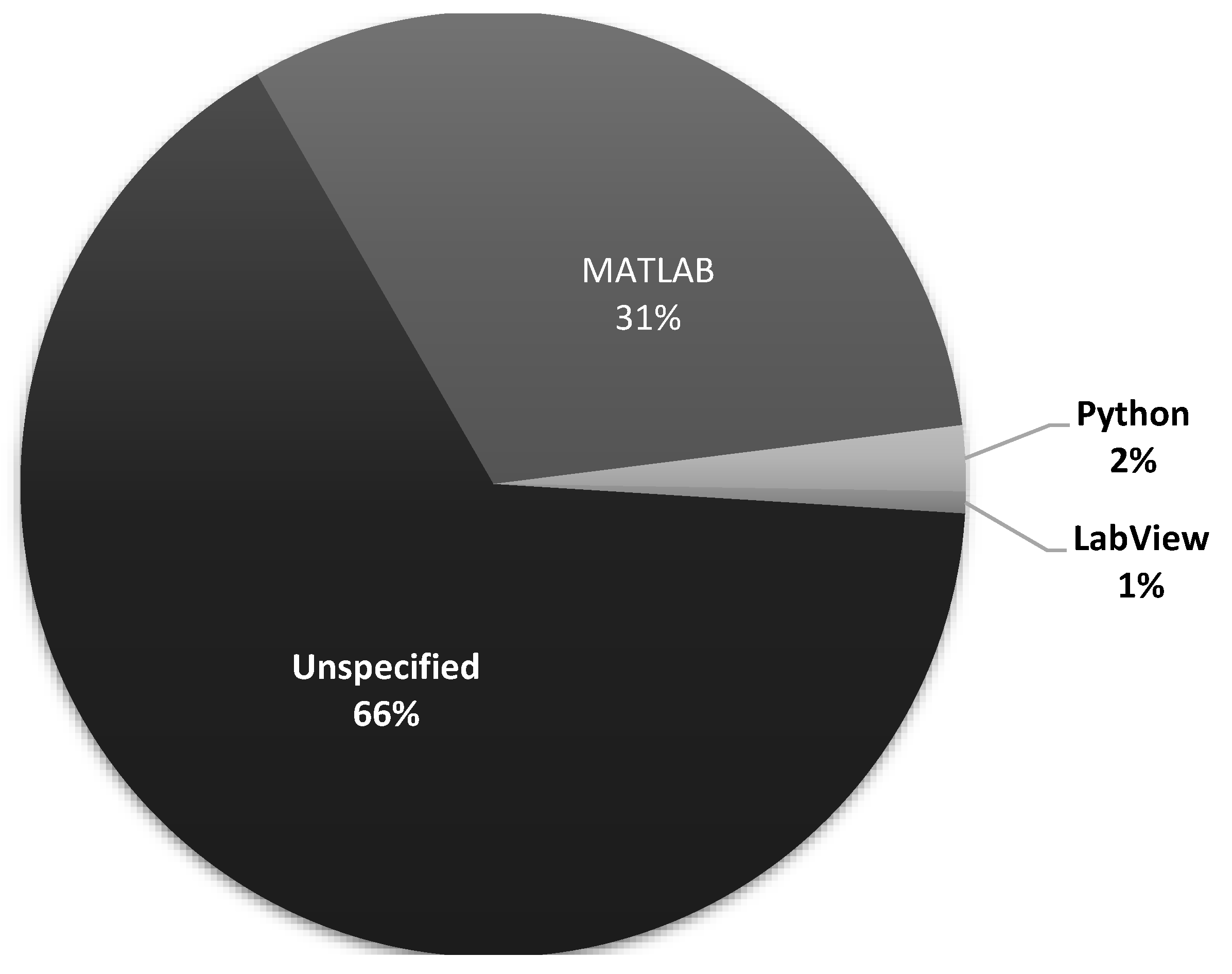
| Algorithm Development Software Used | The software used to develop the machine-learning model |
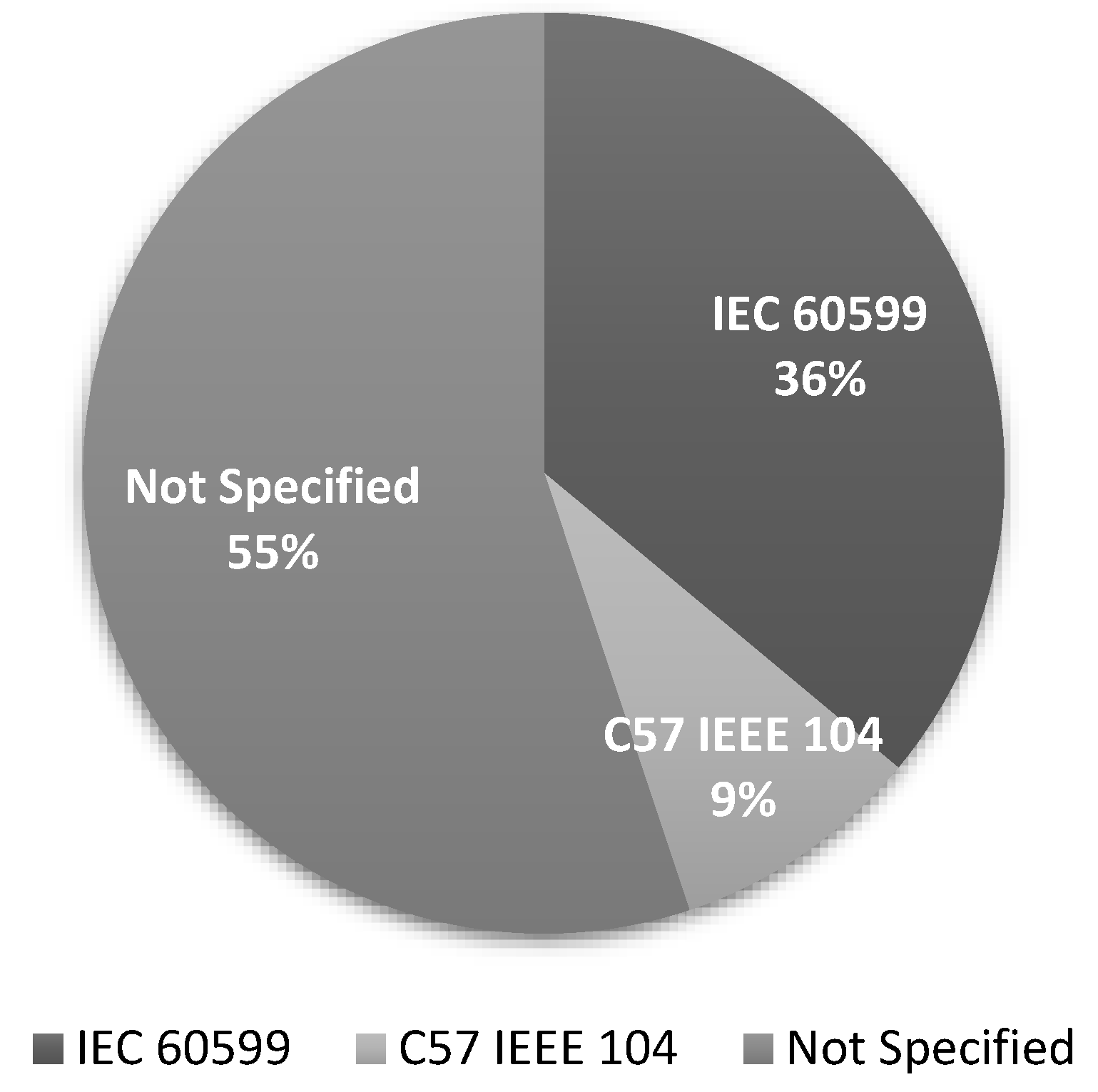
| Industrial Standard/Specification Used | The industrial specification referenced or adhered to |
| Paper ID | Q1 | Q2 | Q3 | Q4 | Q5 | Total | % |
|---|---|---|---|---|---|---|---|
| 1, 2, 4, 5, 6, 7, 9, 10, 11, 12, 13, 14, 15, 16, 17, 18, 19, 20, 21, 22, 23, 24, 25, 29, 30, 31, 32, 34, 35, 36, 37, 38, 39, 40, 41, 42, 44, 45, 46, 47, 48, 49, 50, 52, 53, 54, 55, 60, 62, 66, 67, 68, 70, 71, 72, 73, 76, 78, 79, 81, 82, 83, 85, 86, 88, 90, 91, 92, 93, 94, 95, 97, 98, 100, 102, 104, 105, 106, 107, 108, 110, 111, 112, 115, 116, 119, 121 | 1 | 1 | 1 | 1 | 1 | 5 | 100 |
| 3, 8, 26, 27, 28, 43, 56, 58, 61, 63, 69, 74, 77, 78, 84, 89, 96, 99, 101, 109, 113, 114, 117, 118, 120, 122, 124 | 1 | 1 | 1 | 0.5 | 1 | 4.5 | 90 |
| 33, 51, 57, 59, 64, 65, 80, 87 | 1 | 1 | 1 | 0 | 1 | 4 | 80 |
| 75, 123 | 1 | 1 | 0 | 0.5 | 1 | 3.5 | 70 |
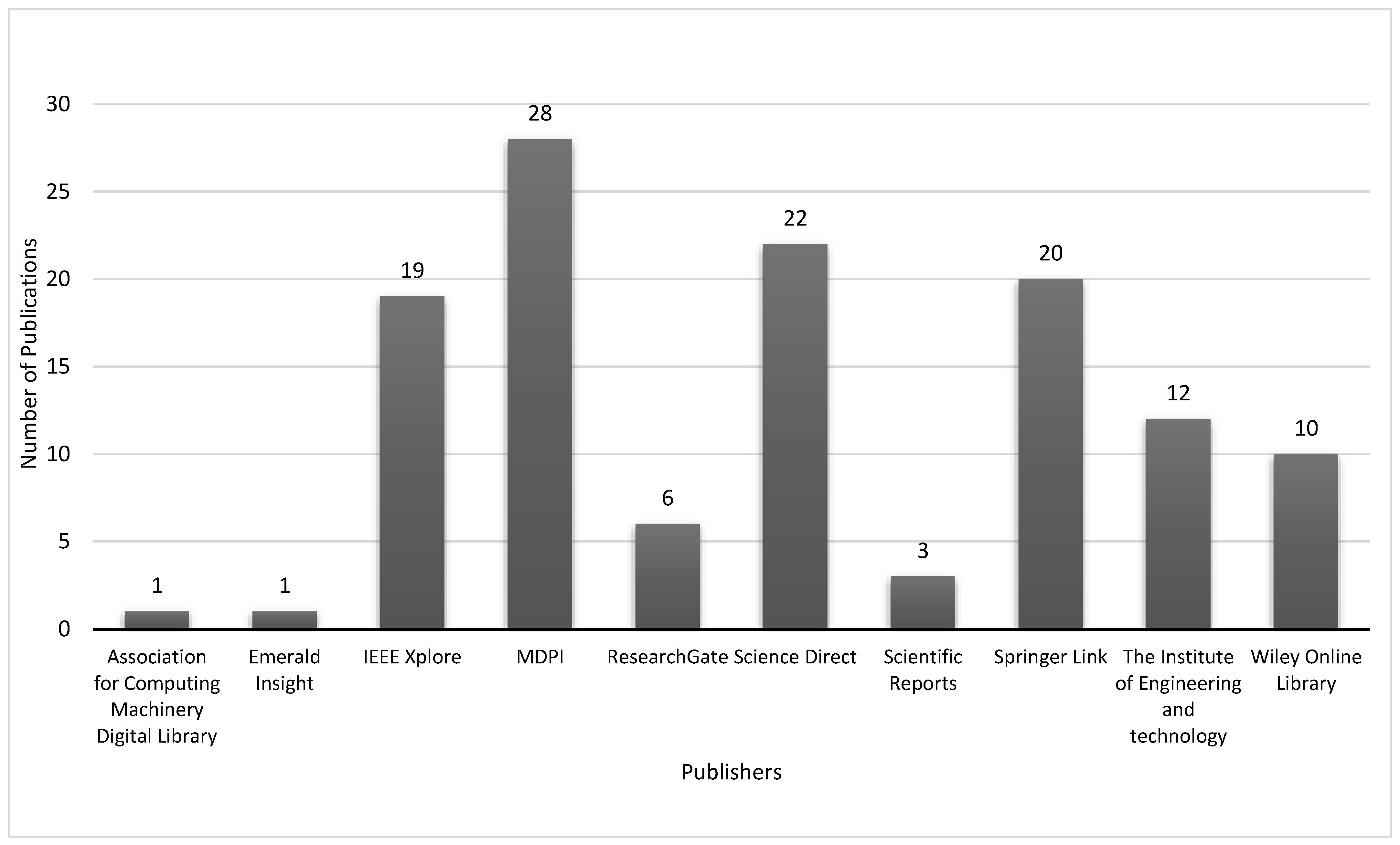
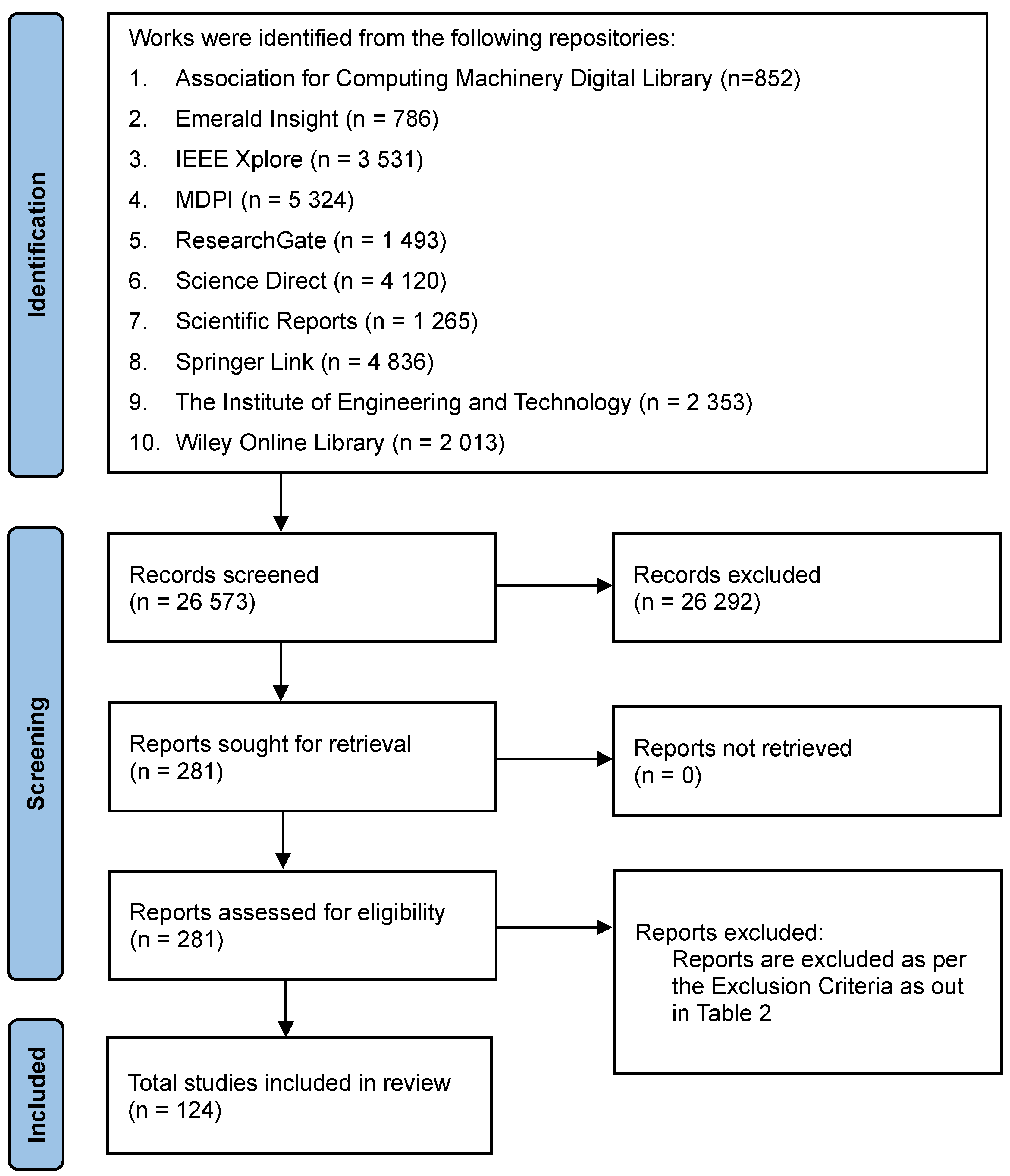
| Research Repositories | Number of Results Obtained from the Initial Search |
|---|---|
| Association for Computing Machinery Digital Library | 852 |
| Emerald Insight | 786 |
| IEEE Xplore | 3531 |
| MDPI | 5324 |
| ResearchGate | 1493 |
| Science Direct | 4120 |
| Scientific Reports | 1265 |
| Springer Link | 4836 |
| The Institute of Engineering and Technology | 2353 |
| Wiley Online Library | 2013 |
| Total | 26,573 |
| Ref. | Cites | Year | ML Algorithm | ML Dataset Source | Contribution |
|---|---|---|---|---|---|
| [20] | 145 | 2014 | Adaptive Neuro-Fuzzy Inference System | IEC TC10 | It develops an Adaptive Neuro-Fuzzy Inference System model to identify transformer incipient faults using DGA. The model achieved an accuracy of 98% when applied to the IEC standard, 97% on the Rogers ratio method, and 99% on the Doernenburg ratio method. |
| [21] | 73 | 2019 | Improved Krill Herd SVM | IEC TC10 and Private Company | It proposes an Improved Krill Herd optimized SVM algorithm based on cross-validation principles to improve fault diagnosis accuracy. The accuracy of the proposed model reaches 85.71%. |
| [22] | 2 | 2024 | Deep CNN | Literature | It presents an asset management technique for classifying incipient faults and predicting the health index of transformers using deep CNN; the model achieves 87% accuracy. |
| [23] | 4 | 2022 | kNN, DT | New York Power Authority | It presents a fault detection model using kNN. It applies the key gas method to detect outliers, and then the Basic Gas Ratio is used to detect faults, the accuracy of this model reaches 88%. |
| [24] | 178 | 2017 | Deep believe network | State Grid Corporation of China and Literature | It presents a fault diagnosis method based on the deep believe networks algorithm which assesses the transformer health index including the impact of discharge and overheating. This model reaches an accuracy of 90%. |
| [25] | 90 | 2019 | Hidden Markov model | State Grid Zhejiang Electric Power Co. Ltd. | It develops a dynamic early prediction and warning model which combines the Gaussian mixture model with the Hidden Markov model. The proposed model achieved an accuracy of 95%. |
| [26] | 34 | 2020 | Lasso regression | State Grid Zhejiang Electric Power Co. Ltd. | It uses the Pearson correlation coefficient to filter and optimize the feature set to reduce the redundancy of the selected features and applies Lasso regression to build a multi-dimensional linear model of the selected features. The proposed model achieved an accuracy of 87.5%. |
| [27] | 66 | 2021 | Teaching-learning based optimization | Egyptian Electricity Holding Company | It develops an efficient teaching–learning-based optimization (TLBO) model to enhance the diagnostic accuracy of the transformer faults based on gas concentration percentages limits and gas ratios. The developed model achieved an accuracy of 86.27%. |
| [28] | 19 | 2021 | Gaussian process multi-classification | General Electric | It proposes a Gaussian process multi-classification model to enhance and produce a probabilistic interpretation of the analysis results. The proposed model achieved an accuracy of 95%. |
| [29] | 5 | 2023 | k-means clustering algorithm | IEC TC10 and Literature | It proposes a two-step hybrid method consisting of a k-Means Clustering algorithm based on the generic algorithm for subset analysis. The proposed model achieved a diagnostic accuracy of 98.29%. |
| [30] | 38 | 2020 | Hybrid gray wolf optimization algorithm | Egyptian Electricity Utility and Literature | It develops a hybrid gray wolf optimization algorithm to produce an efficient diagnostic code matrix based on dissolved gas percentages for accurate fault diagnosis using the fuzzy system to map the limits of gas ratios. The developed model achieved an accuracy of 97.45%. |
| [31] | 39 | 2021 | Auto-WEKA | IEC TC10 and Literature | It adopts the Auto-Weka framework for fault detection by choosing the best configuration and comparing its performance against other existing methods to assess its efficiency. The proposed model achieved an accuracy of 93.08%. |
| [32] | 134 | 2016 | ANN | Egyptian Power System Network | It develops an ANN model which is used to feed inputs to a Smart Fault Diagnostic Approach (SFDA) based on the integration of the conventional DGA interpretation techniques. The developed model achieved an accuracy of 97.3%. |
| [33] | 86 | 2015 | ANN, SVM, ELM, SaE-Elm | Electrical Utilities and Literature | It presents an incipient fault diagnosis method developed using the combination of a multi-classification Self-adaptive Evolutionary Extreme Learning Machine (SaE-ELM) algorithm and arctangent transform (AT). The presented model achieved an accuracy of 93.57%. |
| [34] | 173 | 2015 | SVM | IEC TC10 | It proposes the application of SVM and the optimum dissolved gas ratios obtained using the generic algorithm which also optimizes the SVM parameters. The proposed model achieved a diagnosis accuracy of 87.18%. |
| [35] | 55 | 2017 | Bayesian networks | IEC TC10 | It presents a multi-classification probabilistic diagnosis framework based on Bayesian networks and hypothesis testing for dissolved gas analysis. The presented model achieved a diagnosis accuracy of 88.9%. |
| [36] | 61 | 2021 | CNN | Electrical Utilities and Literature | It proposes a convolutional neural network (CNN) model for predicting transformer fault types under different noise levels in measurements, the proposed model is then applied to conventional ratios, new ratios, and hybrid ratios. The proposed model achieved a diagnosis accuracy of 98.5%. |
| [37] | 68 | 2017 | SVM and kNN | IEC TC10 | It assesses the combination of Particle swarm-optimized SVM and kNN algorithms to Duval’s pentagon 1 method for transformer fault diagnosis. The developed model is then tested against the five faults detectable in transformer oil. The assessed model achieved a diagnosis accuracy of 88%. |
| [38] | 53 | 2022 | ANN | Egyptian Ministry of Electricity and Literature | It aims to detect incipient faults in power transformers using DGA using an integrated method that implements conditional probability, clustering, Duval triangle, Roger’s four ratios refined, and an artificial neural network. The proposed model achieved a diagnosis accuracy of 93.6%. |
| [39] | 35 | 2020 | SVM | Electrical Utilities | It proposes a support vector machine-based Duval pentagon Method to determine the severity of transformer faults by assessing the graphical Duval pentagon method using incorporating gas level, gas rate, and DGA interpretation results into one interpretation method. The proposed model achieved a diagnosis accuracy of 88%. |
| [40] | 1 | 2024 | TimesNet | Literature | It proposes a multi-model fusion transformer fault diagnosis method based on TimesNet and Informer with the adoption of an MCA module to reduce complexity and computational burden. The proposed model achieved a diagnosis accuracy of 88.46%. |
| [41] | 19 | 2021 | KosaNet | Kenya Power Ltd. | It proposes a multinomial KosaNet classification model which is based on the decision tree algorithm, and investigates the application of various machine learning techniques to detect incipient faults and interpret DGA results. The proposed model achieved a diagnosis accuracy of 99.98%. |
| [42] | 33 | 2020 | Spatial Clustering | Huzhou Power Supply Company and IEC TC10 | It proposes a fault diagnosis method based on the correlation coefficient density clustering which extrapolates the correlation coefficient of DGA data using density clustering. The proposed model achieved a diagnosis accuracy of 90%. |
| [43] | 4 | 2023 | TPE-XGBoost | Literature | It proposes an Extreme Gradient Boosting algorithm for fault diagnosis; it utilizes a Random Forest Regression algorithm to determine missing DGA data and hyperparameter optimization of data using a Tree-structured probability density estimator algorithm. The proposed model achieved a diagnosis accuracy of 89.5%. |
| [44] | 9 | 2022 | BCSVM | South African transformer manufacturer | It proposes a binary classification support vector machine with the application of the kernel function for transformer fault prediction; the model accuracy is then compared against the IEC gas ratio and ANN methods and yields an accuracy of 92%. |
| [45] | 16 | 2021 | Logistic Regression | Not Specified | It presents the application of a regularized Logistic Regression Algorithm for improving DGA interpretation accuracy. The model accuracy is then compared against the conventional and intelligent methods and yields an accuracy of 85.6%. |
| [46] | 18 | 2023 | ISCSO | Not Specified | It proposes a power transformer fault diagnosis method based on landmark isometric mapping (L-Isomap) and Improved Sand Cat Swarm Optimization (ISCSO) to optimize the BiGRU (ISCSO-BiGRU). The proposed model achieved an accuracy of 94.8%. |
| [47] | 11 | 2023 | Improved BP neural network | Not Specified | It proposes an improved transformer fault diagnosis method based on a residual BP neural network which uses mapping to extract gas feature information with more significant feature differences after fusion expansion. |
| [48] | 2 | 2023 | Deep believe network | Literature | It applies a non-coding ratio method to generate 35 fault gas ratios based on the 5 fault gases, subsequently refined through correlation analysis to eliminate redundant feature variables, resulting in 15 significantly representative fault gas ratios. The model achieved an accuracy of 90.2%. |
| [49] | 35 | 2018 | GRNN | Shandong Substation | It proposes a kernel principal component analysis and a generalized regression neural network (GRNN) using an improved fruit fly optimization algorithm (FFOA) to select the smooth factor. The proposed model achieved an accuracy of 95%. |
| [50] | 40 | 2018 | ISGOSVM | IEC TC10 | It proposes a fault diagnostic method integrating feature selection and diagnostic model optimization using genetic algorithm SVM feature screen and SVM classifier optimized by improved social group optimization. The proposed model achieved an accuracy of 92.86%. |
| [51] | 35 | 2018 | Improved fuzzy c-means clustering | UCI Iris dataset | It improves the fuzzy c-means clustering algorithm and the resultant dissolved gas data clustering by utilizing an exponential form of the membership function to obtain distance monotony. The proposed model achieved an accuracy of 94.67%. |
| [52] | 30 | 2019 | Gene Expression Programming | Literature | It introduces an improved approach to overcome the limitations of conventional DGA interpretation techniques based on Gene Expression Programming; this approach further automates and standardizes the DGA interpretation process. |
| [53] | 32 | 2019 | TWSVM | State Grid Corporation of China | It presents a fault diagnosis model based on twin support vector, Restricted Boltzmann Machines, and chemical reaction optimization for data preprocessing and improving efficiency and accuracy. The presented model achieved an accuracy of 94.64%. |
| [54] | 27 | 2019 | HMSVM | Hebei North Electric Power Company and Literature | It proposes a fault diagnosis method for solving misdiagnosis problems of conventional methods using hypersphere multiclass support vector machine (HMSVM) and Dempster–Shafer (D–S) Evidence Theory (DET). The proposed model achieved an accuracy of 90%. |
| [55] | 45 | 2019 | Hybrid gray wolf optimizer and LS-SVM | Literature | It proposes and applies a hybrid gray wolf optimized least square support vector machine (HGWO-LSSVM) fault diagnosis method. The proposed model achieved an accuracy of 97.45%. |
| [56] | 10 | 2020 | GAPSVM | State Grid Corporation of China and IEC TC10 | It proposes a genetic algorithm-optimized probabilistic SVM integrated with the fuzzy three-ratio method which judges the decision boundary according to its output probabilities. The proposed model achieved an accuracy of 86.8%. |
| [57] | 26 | 2021 | NN | Laboratories | It presents a method based on the analysis of the gases dissolved and the analysis of furan compounds for identifying different faults using neural networks by extending the diagnosis of the operating conditions of the power transformers by assessing paper degradation. The presented model achieved an accuracy of 95.7%. |
| [58] | 52 | 2021 | SVM-BA | Agilent Chemical Laboratory and Literature | It proposes a fault diagnostic method based on DGA data using a coupled system of support vector machine (SVM)-bat algorithm (BA) and Gaussian classifiers. The proposed model achieved an accuracy of 93.75%. |
| [59] | 39 | 2021 | Improved Gray Wolf Optimizer and PNN | Jiangxi Power Supply Company | It proposes a probabilistic neural network-based fault diagnosis model and utilizes the improved gray wolf optimizer as a smoothing factor of the pattern layer of PNN to improve the classification accuracy. The proposed model achieved an accuracy of 99.71%. |
| [60] | 9 | 2023 | SVM | Turkish Electricity Transmission Company | It designs a hybrid fault diagnosis system based on DGA methods and fuzzy logic and uses a mathematical approach and support vector machines as decision-making methods. The designed model achieved an accuracy of 96.23%. |
| [61] | 6 | 2022 | ANN | South African Independent Power Producer | It proposes a multilayer artificial neural network and gas ratio method for identifying inchoate faults by employing the oil properties of dissolved gas analysis. The proposed model achieved an accuracy of 99.98%. |
| [62] | 7 | 2023 | ANN | Botnet DGA Dataset | It employs an artificial neural network model to enhance the accuracy of the Rogers ratio method by optimizing the hyperparameters of the model to maximize the accuracy and minimize the architectural complexity of an ANN. The proposed model achieved an accuracy of 90.70%. |
| [63] | 55 | 2021 | ANN | Egyptian Electricity Transmission Company | It introduces a combination of conventional DGA techniques (Duval, Roger’s four ratios refined, and IEC refined techniques) which is constructed based on the outputs of each technique, this was further refined using the artificial neural network. The introduced model achieved an accuracy of 84.96%. |
| [64] | 11 | 2021 | PNN and bio-inspired optimizer | Jiangxi Province Power Supply Company | It proposes an artificial intelligence fault diagnosis method based on a probabilistic neural network (PNN) and bio-inspired optimizer, where the PNN is used as a classifier the Improved Salp Swarm Algorithm is used for optimization. The proposed model achieved an accuracy of 97.44%. |
| [65] | 41 | 2015 | ANN | IEC TC10 | It presents a fault prognosis method combining evolutionary and connectionist mechanisms into a hybrid model. The presented model achieved an accuracy of 98%. |
| [66] | 86 | 2014 | Fuzzy logic | Various Industrial Transformers | It introduces a new fuzzy logic approach that aids in standardizing DGA interpretation and identifies transformer critical ranking based on DGA data. The approach relies on incorporating all traditional DGA interpretation techniques (Roger, Doerenburg, IEC, key gas, and Duval triangle methods) into one expert model. The proposed model achieved an accuracy of 88%. |
| [67] | 16 | 2022 | SVM | State Grid Corporation of China and IEC TC10 | It applies the support vector machine algorithm in a transformer fault diagnosis model aimed at improving the accuracy of DGA interpretation methods which are known for militations. The proposed model achieved an accuracy of 97.35%. |
| [68] | 5 | 2023 | SVM, NBC, and BPNN | Literature | It proposes the application of the Artificial Bee Colony algorithm to select the optimum dissolved gas feature for the computation of the model. The proposed model achieved an accuracy of 90.49%. |
| [69] | 5 | 2023 | Intelligent Voting Ensemble Learning | State Grid Corporation of China, IEC TC10, and Literature | It proposes a feature selection and ensemble learning-based methodology for fault diagnosis by selecting efficient features from classifiers and using an Intelligent Voting Ensemble Learning technique to generate a diagnosis model. The proposed model achieved an accuracy of 92.6%. |
| [70] | 92 | 2017 | Fuzzy logic | Not Specified | It presents a model that detects and classifies faults based on the state of transformers based on the Mamdani model and Sugeno model in a fuzzy expert system for fault probability. A fuzzy logic model is then applied in deciding on testing. The presented model achieved an accuracy of 95%. |
| [71] | 22 | 2021 | MCSVM | State Grid of Zibo Power Company and IEC TC10 | It develops a hybrid fault diagnosis model based on the C-set&FCM-MCSVM algorithm, the combination of C-set&FCM optimizes the model by solving issues associated with dataset imbalance and outliers and improves the performance. The developed model achieved an accuracy of 88.9%. |
| [72] | 2 | 2024 | MLANN | Laboratories and Literature | It proposes a hybrid fault detection method based on multilayer neural networks and Expert Knowledge to enhance the performance of the model by assessing the characteristics of DGA datasets. The proposed model achieved an accuracy of 92.8%. |
| [73] | 12 | 2023 | Deep Residual Network | China Power Grid Company | It proposes a fault diagnosis method based on data augmentation with the application of kernel principal component analysis for mapping original data to a high-dimensional feature space to address data imbalance. The proposed model achieved an accuracy of 88%. |
| [74] | 1 | 2023 | CNN | Literature | It proposes a fault diagnosis method based on a Conditional Variational Automatic Encoder composed of full connection layers for expanding datasets. Once datasets are augmented, the convolutional neural network as a classifier due to its superior feature extraction capabilities. The proposed model achieved an accuracy of 90%. |
| [75] | 32 | 2023 | Fuzzy C-means clustering algorithm | Not Specified | It develops a fault diagnosis and prognosis model using fuzzy logic controller (FLC) and fuzzy clustering means (FCM) and simulates it to examine the health status of the insulation. The developed model achieved an accuracy of 97.5%. |
| [76] | 7 | 2023 | HATT-RLSTM | Not Specified | It develops an online monitoring system that combines Hierarchical Attention Network (HATT) and Recurrent Long Short-Term Memory Network (RLSTM) for condition monitoring. The developed model achieved an accuracy of 88.15%. |
| [77] | 9 | 2023 | AdaBoost-WBLS | State Grid Corporation of China and Literature | It proposes a novel transformer fault diagnosis model that utilizes a Filter-Wrapper Combined Feature Selection method and an AdaBoost integrated weighted broad learning system (AdaBoost-WBLS) to select significant features and eliminate redundant ones. The proposed model achieved an accuracy of 95.05%. |
| [78] | 13 | 2021 | kNN, RT, RF | Not Specified | It investigates the application of random tree, random forest, and k-Nearest Neighbors algorithms for classifying cross-country faults from transformer disturbances. The investigated model achieved an accuracy of 98.68%. |
| [79] | 4 | 2024 | RF | IEC TC10 and Literature | It presents a multi-method technique that uses Scoring Index and random forest principles to combine conventional DGA interpretation methods into a multi-method technique. The presented model achieved an accuracy of 92.57%. |
| [80] | 43 | 2016 | PNN | Not Specified | It proposes a fault prediction method using a probabilistic neural network algorithm which applies its non-linear processing capabilities to predict internal faults. The proposed model achieved an accuracy of 80%. |
| [81] | 7 | 2023 | Res-Variational-Auto-Encoder and ensemble learning | Guangzhou Substation | It proposes a hybrid fault diagnosis method comprising Res-Variational-Auto-Encoder and ensemble learning algorithms. This method extracts fault characteristics using a residual convolutional neural network. The proposed model achieved an accuracy of 98%. |
| [82] | 27 | 2023 | RF | Not Specified | It develops a fault identification method based on the combination of Random Forest and SMOTE algorithms to reduce the limitations and complexities associated with implementing graphical DPM. The developed model achieved an accuracy of 96.5%. |
| [83] | 3 | 2022 | BPMF and GRU-NN | Industrial Transfromer | It proposes a transformer oil dissolved gas concentration for data loss scenarios using Bayesian probabilistic matrix factorization (BPMF) and gated recurrent unit (GRU) neural network. |
| [84] | 13 | 2022 | Saerima model | Industrial Transfromer | It presents a time series forecasting model to forecast the dissolved gas concentration based on the Seasonal Autoregressive Integrated Moving Average (SARIMA). |
| [85] | 10 | 2023 | Deep belief network and BPNN | Electric Power Research Institute of Yunnan Power Grid Co., Ltd. | It introduces a deep belief in network-based fault diagnosis methods based on the characteristics of the precipitated gases. The introduced model achieved an accuracy of 90%. |
| [86] | 17 | 2022 | Deep Coupled Dense CNN | IEC TC10 | It reconstructs the transformer oil characteristic gas to improve its features and compare fault types against various gases using the Adaptive Synthetic Oversampling (ADASYN) algorithm. The proposed model achieved an accuracy of 94.05%. |
| [87] | 2 | 2024 | Bagged Trees, kNN, and QSVM | Various South African Substations | It proposes a fault diagnosis model used to analyze oil samples that showed stray gassing characteristics by combining four different classifiers to enhance fault diagnosis accuracy. The proposed model achieved an accuracy of 87.7%. |
| [88] | 1 | 2024 | MLANN | Not Specified | It presents a multilayer artificial neural network model for fault detection which utilizes a meta-heuristic optimizer to improve its accuracy. The presented model achieved an accuracy of 87.8%. |
| [89] | 862 | 2023 | Snake Optimization–random forest | Zhejiang Power Supply Company | It presents a fault diagnosis technique based on TLR-ADASYN balanced data to address the shortcomings associated with DGA sample imbalance and fault misjudgment. The presented model achieved an accuracy of 97.06%. |
| [90] | 0 | 2020 | Deep belief network and ANN | Punjab State Electricity Board | It presents a transformer oil aging assessment model based on an RM-LA-based DBN + NN algorithm with the application of RM-LA-based optimization. The presented model achieved an accuracy of 97.4%. |
| [91] | 14 | 2020 | Genetic algorithm fuzzy Q-learning | HPSEB and Literature | It develops a generic algorithm-tuned fuzzy classifier for fault classification by segregating fault types using DGA samples. The proposed model achieved an accuracy of 97.51%. |
| [92] | 14 | 2016 | MLSVM | Turkish Electricity Transmission Corporation and Literature | It presents a fault diagnosis method based on DGA data using a multilayer support vector machine algorithm which is optimized by a hybrid combination of generic, Differential Evolution, and Particle Swarm Optimization. The presented model achieved an accuracy of 92.00%. |
| [93] | 5 | 2018 | Fuzzy c-means algorithm and WNN | Not Specified | It proposes a fuzzy clustering and Flower Pollination algorithm to address the shortcomings associated with the wavelet neural network by improving the convergence and lowering diagnosis error. The proposed model achieved an accuracy of 88.50%. |
| [94] | 8 | 2019 | BASA-MkRVR | Panzhihua Electric Power Bureau | It presents a hybrid fault prediction method comprising Bettle Antennae Search Algorithm–mixed kernel relevance vector regression to select optimum parameters and to test the superiority of the activation functions. |
| [95] | 4 | 2017 | PSO-SVM | IEC TC10 Database | It proposes a fault diagnosis model based on the three DGA ratios and applies the optimization technique of Particle Swarm Optimization to the support vector machine algorithm. The proposed model achieved an accuracy of 85.71%. |
| [96] | 2 | 2023 | SVM, DT, and kNN | Not Specified | It reviews and compares the support vector machine, decision tree, and k-Nearest Neighbor algorithms utilized to evaluate the performance of diagnostic fault determination by generating reliable data samples for minority and majority classes to balance the diversity and distribution of DGA datasets. The proposed model achieved an accuracy of 95.70%. |
| [97] | 3 | 2016 | Fuzzy logic | Not Specified | It compares the conventional method and artificial intelligence method, IEC 60599 gas ratios, and Fuzzy Evidential for fault detection using DGA. The proposed model achieved an accuracy of 90.60%. |
| [98] | 2 | 2024 | ANN and NB | Literature | It proposes a hybrid method consisting of the artificial neural networks and Naïve Bayes techniques used to obtain statistical parameters accuracy, recall, precision, and F-measure. The proposed model achieved an accuracy of 97.22%. |
| [99] | 55 | 2014 | SVM and kNN | IEC10DB | It proposes the application of the k-Nearest Neighbor imputation method to predict missing DGA dataset values and use these datasets with the predicted values to classify faults using a support vector machine. |
| [100] | 59 | 2015 | CANN-PSO | Electrical Utility | It proposes a hybrid incipient fault prediction method consisting of artificial neural networks and various Particle Swarm Optimization techniques. The proposed model achieved an accuracy of 98.00%. |
| [101] | 17 | 2020 | Self-Paced Ensemble algorithm | IEC TC10 Database, Ministry of Electricity and Energy of Egypt, North China Grid and Zhejiang Grid | It investigates and presents a fault diagnosis method based on a Self-paced Ensemble using classification hardness to improve diagnosis accuracy. The investigated model achieved an accuracy of 95.10%. |
| [102] | 16 | 2018 | Fuzzy c-means clustering algorithm | China Southern Power Grid and IEC TC10 | It presents a fault detection model based on the fuzzy c-means clustering algorithm and the dimensionality reduction techniques Improved Principal Component Analysis. The presented model achieved an accuracy of 95.10%. |
| [103] | 4 | 2022 | Improved Gray Wolf Optimizer and LS-SVM | Not Specified | It proposes a fault diagnosis hybrid support vector machine model with improved gray wolf optimization optimized least squares–support vector machine to address convergence and population diversity shortcomings of traditional support vector machine algorithms. The proposed model achieved an accuracy of 95.85%. |
| [104] | 3 | 2021 | Improved Firefly Algorithm and SVM | IEC TC10 | It proposes a fault diagnosis technique based on Improved Firefly Algorithm–Linear Programming Boosting–Classification and Regression Tree hybrid combination. It adjusts the weights of weak classifiers builds stronger ones and then optimizes them for computation. The proposed model achieved an accuracy of 91.72%. |
| [105] | 20 | 2018 | Parzen Window estimation | Industrial Transformers | It proposes a model to address shortcomings of Roger’s ratios, IEC ratios, and Duval triangles methods based on the Parzen Window Estimation. This model utilizes five gases to compute fault probability. The proposed model achieved an accuracy of 95%. |
| [106] | 56 | 2018 | GA-SVM | IEC TC10 and Local Power Utilities | It investigates the use of a hybrid feature selection technique combined with the generic algorithm and support vector machine. This is further backed by an adaptive synthetic technique and arctangent transformation technique to improve training set properties. |
| [107] | 34 | 2017 | RVM–ANFIS algorithm | IEC TC 10 and Jinliang | It proposes a hybrid technique that combines the Relevant Vector Machine and the Adaptive Neural Fuzzy Inference System to address ambiguous data characteristics related to conventional DGA interpretation methods. The proposed model achieved an accuracy of 95%. |
| [108] | 2 | 2022 | Isomap and IChOA—LSSVM | Not Specified | It presents a fault diagnosis method for improving diagnosis accuracy based on Isomap and IChOA-LSSVM. The model starts by reducing dimensionality and then optimizes the least square support vector machine algorithm to improve the overall model accuracy. The presented model achieved an accuracy of 90.83%. |
| [109] | 5 | 2022 | ISSA—SVM | Shaanxi Province Transformers (China) | It proposes a fault diagnosis method based on the Improved Sparrow Search Algorithm and the optimized support vector machine. Various activation functions are used to enhance the accuracy of the model. The proposed model achieved an accuracy of 91.43%. |
| [110] | 9 | 2021 | Refined Deep Residual Shrinkage Network | IEC TC10, State Grid Hubei Company, and State Grid Shandong Company | It proposes a fault identification model to improve the performance of transformers by coupling a high-dimensional feature map of gas concentrations and associated variables. The proposed model achieved an accuracy of 97.68%. |
| [111] | 49 | 2014 | PSO-SVM | UK National Grid | It presents a feature prioritization and detection model that assesses fault types, specific gas ratios, and statistical characteristics of the DGA data. The presented model achieved an accuracy of 96.50%. |
| [112] | 12 | 2021 | IVSVM | China Southern Power Grid and Literature | It introduces a combined fault diagnosis model based on improved information entropy and a vague support vector machine in which it uses improved information entropy to obtain gas weights from DGA datasets and the trained data to obtain classifiers using a vague support vector machine. The introduced model achieved an accuracy of 90.60%. |
| [113] | 9 | 2020 | MLP | Electric Technology Research Association of Japan and IEC TC10 | It constructs a multilayer perceptron model for fault detection in transformers using the Keras Library, The model is tested using two datasets and it achieved an accuracy of 96.70%. |
| [114] | 17 | 2020 | MVO-PNN | China Electric Power Research Institute | It presents a hybrid model for fault diagnosis based on probability neural network optimized by Multi-Verse Optimizer algorithm which has a strong global convergence from improving fault diagnosis accuracy. The presented model achieved an accuracy of 97.49%. |
| [115] | 0 | 2023 | Improved SVM | Not Specified | It introduces a fault location recognition model based on k-means and constructs a high-precision with fast convergence diagnosis. The proposed model achieved an accuracy of 98.40%. |
| [116] | 0 | 2022 | SVM | IEC TC10 Database and Literature | It proposes an improved hybrid fault diagnosis model comprising the Slime Mold Optimized support vector machine and logarithmic arctangent transform with data transformation and optimization capabilities of this model equipped to improve the diagnosis accuracy. The proposed model achieved an accuracy of 90.10%. |
| [117] | 32 | 2017 | Fuzzy inference system | Iran Power Grid | It studied a large dataset of more than 3000 transformers and applied a fuzzy inference system to validate the state of suspicious transformers by validating the fault detection accuracy. Also, the proposed fuzzy inference system was able to detect the decomposition of the insulation paper. The proposed model achieved an accuracy of 91.20%. |
| [118] | 33 | 2018 | BN, kNN, MPL, and J48 DT | Not Specified | It compares and analyzes various machine learning algorithms used for DGA fault classification, i.e., Bayes network, multilayer perceptron, k-Nearest Neighbor, and J48 decision tree. It further assesses the impact of applying the AdaBoost algorithm and bootstrap aggregation (bagging) on the performances of these algorithms. The J48 decision tree algorithm was the best-performing algorithm and achieved an accuracy of 94.50%. |
| [119] | 16 | 2020 | ANN-GSA and SVM-GSA | Not Specified | It proposes a hybrid feature selection technique for determining fault types from DGA data using a Gravitational Search Algorithm. The proposed model achieved an accuracy of 98%. |
| [120] | 25 | 2019 | Fuzzy inference system and ANN | Literature | It proposes a multiple fault detection technique to improve the conventional interpretation methods to also cater for multiple fault diagnosis in non-binary situations. The proposed model achieved an accuracy of 97%. |
| [121] | 6 | 2015 | Hybrid fuzzy logic | IEC TC10 and Substation Equipment Maintenance and Management Web System of Taiwan Power Company | It utilizes a hybrid fuzzy technology to integrate five conventional dissolved gas analysis interpretation approaches for transformer fault diagnosis. The model achieved an accuracy of 94.36%. |
| [122] | 3 | 2021 | Modified Clustering | Not Specified | It proposes an unsupervised methodology for diagnosing transformer conditions using a modified clustering technique to classify the condition of transformers using DGA datasets. |
| [123] | 3 | 2022 | Improved Harris Hawks Optimized Random Forest | Literature | It proposes a fault diagnosis method based on improved Harris Hawks optimized random forest using logistic chaotic mapping to adjust the key parameters, non-linear energy factor to control the algorithm to transition, and Gaussian Mutation for strengthening the searchability. The proposed model achieved an accuracy of 90.18%. |
| [124] | 13 | 2022 | HHO-KELM | IEC TC10 | It presents a fault diagnosis based on the Harris Hawks optimization algorithm optimized kernel extreme learning machine, this optimization enhances the fault diagnostic performance of the model which achieved an accuracy of 95.70%. |
| [125] | 30 | 2015 | FCM-GA-BPNN | Provincial Power Company of State Grid Corporation | It integrates a combination of the conventional IEC and Doernenburg interpretation techniques with the genetic algorithm and fuzzy c-means clustering algorithm (FCM) optimized BP for improved diagnosis accuracy and generalization ability while overcoming issues associated with data noises, over-fitting, and convergence. The proposed model achieved an accuracy of 89.71%. |
| [126] | 17 | 2019 | SVM and kNN | KEPCO | It presents a classification system of transformer faults and defects based on transformer parts and structures using the gases obtained from the DGA datasets and applied to support vector machine and k-Nearest Neighbors algorithms. The diagnostic performance of this proposed model achieved an accuracy of 88%. |
| [127] | 3 | 2022 | Boosted Trees, RUS Boosted Trees, and Subspace kNN | Local Power Utility | It proposes a fault detection model that is capable of handling imbalanced DGA data while improving the accuracy of predictions using machine learning algorithms Boosted Trees, RUS Boosted Trees, and Subspace k-Nearest Neighbors. The Boosted Trees algorithm was the best-performing algorithm and achieved an accuracy of 82.60%. |
| [128] | 12 | 2019 | ANFIS | Iran-Transfo Company Chemical Laboratory and Damavand Power Substations | It presents a hybrid incipient faults detection method using the DGA information and Adaptive Neuro-Fuzzy Inference System algorithm. It further uses the Association Rules Mining Technique to select features from the DGA dataset. The proposed model achieved an accuracy of 99.64%. |
| [129] | 2 | 2023 | Fuzzy logic and deep learning | Electrical Utility | It proposes a fuzzy logic DGA interpretation technique that combines the use of gas level, gas rate, and the Duval pentagon method with the aim of increasing the reliability of fault detection and performance accuracy. The proposed model achieved an accuracy of 98.80%. |
| [130] | 8 | 2017 | PNN | Literature | It proposes a transformer fault diagnosis technique employing Multi-Input and Multi-Output Polynomial Neural Network. This technique is divided into two parts, the first part single output classification model is trained and the transformer state is divided into binary states normal and abnormal, the results are then used to build a fault diagnosis model. |
| [131] | 5 | 2023 | RF, Tree Ensemble, Gradient Boosted Tree, and Extreme Gradient Tree Algorithms | Literature | It discusses the impact that the feature input vector of traditional diagnostic methods has on the performance of DGA-based artificial intelligent fault diagnosis methods. The algorithms used to assess the performance were the random forest, Tree Ensemble, Gradient Boosted Tree, and Extreme Gradient Tree. The random forest algorithm was the best-performing algorithm and achieved an accuracy of 98.37%. |
| [132] | 16 | 2022 | Decision tree, support vector machine, random forest, neural network, Naïve Bayes, and AdaBoost | Not Specified | It examines machine learning algorithms commonly used for transformer fault identification using DGA data namely decision trees, support vector machine, random forest, neural networks, Naïve Bayes, and AdaBoost as well the traditional DGA fault identification methods DTM1, DTM4, and DTM5. Of all these algorithms and methods, the random forest algorithm was the best-performing method with a performance accuracy of 99.80%. |
| [133] | 0 | CVA-SVM | Not Specified | It proposes a combined fault diagnosis method based on Canonical Variate Analysis and support vector machine with the Canonical Variate Analysis adopted due to its multivariate state space model identification ability using experimental data. The proposed model achieved an accuracy of 88.74%. | |
| [134] | 5 | 2021 | Fuzzy logic | IEC TC10 | It proposes a fault diagnosis method for multiple transformer incipient faults using fuzzy logic based on the concentration of gases obtained from the transformer oil. The proposed model achieved an accuracy of 98.30%. |
| [135] | 1 | 2020 | Deep believe network | Power Grid Corporation and IEC TC10 | It introduces a fault diagnosis and classification technique based on the combination of the Restricted Boltzmann Machine and deep belief network algorithms. The proposed model achieved an accuracy of 93.20%. |
| [136] | 0 | 2022 | SSA-SVM | Not Specified | It proposes a hybrid fault diagnosis method based on the kernel principal component analysis and Sparrow Search Algorithm-support vector machine to integrate the ratio of gas concentration and machine learning capabilities to improve the rate of fault diagnosis accuracy. The proposed model achieved an accuracy of 88.89%. |
| [137] | 0 | 2023 | PSO-SVM | Not Specified | It proposes a fault diagnosis model comprising the support vector machine algorithm and optimization technique Particle Swarm Optimization for enhancing the performance and accuracy of the model by optimizing the support vector machine parameters. The proposed model achieved an accuracy of 82%. |
| [138] | 0 | 2023 | GA-FCM | Literature | It proposes a hybrid fault diagnosis model with improved accuracy using the Genetic Algorithm and fuzzy c-means clustering algorithm algorithms. This model showed the capabilities of distinguishing between different fault types. The proposed model achieved an accuracy of 80%. |
| [139] | 1 | 2022 | AdaBoost–DT | Not Specified | It proposes a fault classification technique based on the continuous iteration of the AdaBoost–decision tree algorithm. This model further addresses inadequate accuracy levels from previous publications using a single learner. The proposed model achieved an accuracy of 97.18%. |
| [140] | 0 | 2015 | Coupled Hidden Markov model | State Grid Corporation of China and Literature | It proposes a coupled hidden Markov model based on dissolved gas analysis for incipient fault detection using the theory of scalar quantization to preprocess the gas concentrations. The proposed model achieved an accuracy of 92%. |
| [141] | 0 | 2020 | BPNN–Improved Apriori Algorithm | Not Specified | It presents improved association rules and a BP neural network model for incipient fault detection and prediction. The model combines the rough algorithm with the association rules where the rough set of data is reduced and the BP neural network is used to train and predict the operation state of the transformer. The proposed model achieved an accuracy of 86.30%. |
| [142] | 0 | 2018 | Discrete Hopfield Neural Network | Not Specified | It presents a discrete Hopfield neural network for identifying the condition of transformers by diagnosing it for the five possible states observable using gas concentrations. The improved Rogers three-ratio technique is then used to obtain the input vectors required for model establishment. |
| [143] | 2 | 2016 | PSO-RBFNN | Not Specified | It proposes a fault diagnosis model based on the RBF network algorithm optimized using Immune Particle Swarm Optimization for improving the diagnosis accuracy of incipient internal insulation faults. The proposed model achieved an accuracy of 90%. |
| Bias Type | Challenge |
|---|---|
| Research domain investigated | Only research related to both machine learning and the classification of faults based on transformer oil DGA may be included. |
| Publication period | Some studies falling outside the defined timeframe may have better results than the ones within the defined timeframe. |
| Methodology | Only studies with high accuracies may be published leaving the opportunity to compare the performance of another study. |
| Publication type | Publications from the identified reputable sources may not be the best-performing ones. |
| Language used | Good and eligible papers published in other native languages may be unfairly omitted from this study. |
Disclaimer/Publisher’s Note: The statements, opinions and data contained in all publications are solely those of the individual author(s) and contributor(s) and not of MDPI and/or the editor(s). MDPI and/or the editor(s) disclaim responsibility for any injury to people or property resulting from any ideas, methods, instructions or products referred to in the content. |
© 2025 by the authors. Licensee MDPI, Basel, Switzerland. This article is an open access article distributed under the terms and conditions of the Creative Commons Attribution (CC BY) license (https://creativecommons.org/licenses/by/4.0/).
Share and Cite
Dladla, V.M.N.; Thango, B.A. Fault Classification in Power Transformers via Dissolved Gas Analysis and Machine Learning Algorithms: A Systematic Literature Review. Appl. Sci. 2025, 15, 2395. https://doi.org/10.3390/app15052395
Dladla VMN, Thango BA. Fault Classification in Power Transformers via Dissolved Gas Analysis and Machine Learning Algorithms: A Systematic Literature Review. Applied Sciences. 2025; 15(5):2395. https://doi.org/10.3390/app15052395
Chicago/Turabian StyleDladla, Vuyani M. N., and Bonginkosi A. Thango. 2025. "Fault Classification in Power Transformers via Dissolved Gas Analysis and Machine Learning Algorithms: A Systematic Literature Review" Applied Sciences 15, no. 5: 2395. https://doi.org/10.3390/app15052395
APA StyleDladla, V. M. N., & Thango, B. A. (2025). Fault Classification in Power Transformers via Dissolved Gas Analysis and Machine Learning Algorithms: A Systematic Literature Review. Applied Sciences, 15(5), 2395. https://doi.org/10.3390/app15052395