


Abstract
In nonlocal elasticity, the constitutive equation for the stress tensor is written in an integral form, with the weight function, referred to as the nonlocality kernel, often being the Green’s function for the partial differential equation. In this paper, we obtain solutions to elasticity problems for a concentrated couple in a plane and on the boundary of a half-plane within framework of a new theory of nonlocal elasticity, where the nonlocal kernel is the Green’s function of the Cauchy problem for the fractional diffusion equation. The obtained solutions are free from nonphysical singularities that appear in the classical local elasticity solutions.
1. Introduction
The main weakness of solutions derived within the framework of classical elasticity theory is the appearance of nonphysical singularities at the points of application of concentrated loads. This has resulted in approaches that improve classical elastic solutions and eliminate nonphysical singularities; in particular, there have been great advances using nonlocal elasticity.The foundations of nonlocal theories, based on different schemes, were laid down by Kröner [1], Podstrigach [2], Krumhansl [3], Eringen [4,5], and Kunin [6,7]. In nonlocal elasticity, the constitutive equation for the stress tensor is written in the integral form, with the weight function referred to as the nonlocality kernel. Starting from Eringen’s investigations on nonlocal elasticity [8,9,10], the nonlocal kernels were often chosen as Green’s functions for partial differential operators (see also [11,12,13], where additional references can be found).
The fractional calculus has numerous applications in different branches of science (see, for example, refs. [14,15,16,17,18,19,20,21,22] among many others) as well as recent books on this subject [23,24,25,26]. Fractional calculus was also used in various approaches to nonlocal theories [27,28,29,30,31,32,33,34,35]. Fractional nonlocal elasticity theory with the kernel being the Green’s function of the Cauchy problem for the fractional diffusion equation was elaborated in [36]. In the present paper, this theory is used to obtain solutions for a concentrated couple in a plane and on the boundary of a half-plane. Concentrated couples as fundamental solutions for different elasticity theories were considered in [37,38,39].
A system of the basic equations for a linear isotropic nonlocal elastic solid [4,5,8,9,10] consists of the equilibrium equation
the constitutive equation for the nonlocal stress tensor
the constitutive equation for the local stress tensor
and geometrical relations
Here and are the classical and nonlocal stress tensors, and are the running and reference points, is the displacement vector, is the linear strain tensor, and denote the Lamé constants, ∇ and stand for the gradient operators with respect to and , is the unit tensor.
The nonlocal kernel is a function of the distance between the reference and running points, and includes the parameter associated with a characteristic length ratio , where is an internal characteristic length and l is an external characteristic length [9,10]. The nonlocal kernel is a delta sequence and in the classical elasticity limit, tends to the Dirac delta function .
Eringen considered the nonlocal modulus as the Green function of the Cauchy problem for the diffusion operator [8,10]:
with the solution
for one spatial variable in Cartesian coordinates;
in polar coordinates in the axisymmetric case;
in spherical coordinates in the central symmetric case.
In this instance, the corresponding nonlocal stress tensor is a solution to the associated Cauchy problem
It should be emphasized that though the parameter in Equations (5) and (10) looks like time in the standard diffusion equation, in fact, it has quite different physical meaning: this is the parameter describing the spatial nonlocality. The parameter is proportional to the characteristic length ratio [9,10] and is nondimensional. The coefficient a in Equations (5) and (10) has the physical dimension . This is also consistent with the nondimensional quantities introduced by Equation (39). The limit does not mean the transition to the initial time value, but describes the transition from the nonlocal to local stress tensor.
In the fractional nonlocal elasticity theory proposed in the paper [36], the nonlocal kernel is introduced as the Green’s function of the Cauchy problem for the fractional diffusion operator with the fractional derivative with respect to the nonlocality parameter
under the assumption .
Here, is the Caputo fractional derivative [40,41]
for which the following Laplace transform rule is valid:
where is the gamma function, the asterisk marks the Laplace transform, s is the transform variable.
In the framework of fractional nonlocal elasticity, the nonlocality kernel is expressed as [36,42]
for one spatial variable in Cartesian coordinates;
in polar coordinates in the axisymmetric case;
in spherical coordinates in the central symmetric case.
Here
is the Mittag-Leffler function (ML function) in one parameter [40,41];
is the Mainardi function [16,40];
is the Wright function [43].
Equations (7)–(9) are particular cases of Equations (16)–(18), respectively, when . For , we have
for one spatial variable in Cartesian coordinates;
in polar coordinates in the axisymmetric case, where is the modified Bessel function;
in spherical coordinates in the central symmetric case.
2. Concentrated Couple in a Plane
We consider a concentrated clockwise couple M applied at the origin of coordinates in a plane. In polar coordinates , the components of classical (local) stress tensor are [44]
where
According to (27) and Equations (A1) and (A2) from Appendix A, we obtain that components of the nonlocal stress tensor
From key equations of the theory (25) and (26), taking into account Equation (29) and Equations (A3) and (A4) from Appendix A in the axisymmetric case with , it follows that the component is determined from the Cauchy problem
The Laplace transform with respect to the nonlocality parameter and the Hankel transform of the second order with respect to the radial coordinate r result in the solution in the transform domain
where the hat marks the Hankel transform, is the transform variable, and Equation (A5) from Appendix B has been used.
Using the inverse Laplace transform formula [40,41]
where is the ML function in one parameter (19), we get
For ,
and taking into account Equation (A9) from Appendix B, we have
The classical elasticity solution (see Equation (27)) follows from Equation (36) when . As the ML function , in the general case described by the solution (34), the classical elasticity solution is obtained using the integral (A7) from Appendix B.
Another particular case of the solution (34) is obtained for when
Evaluating the corresponding integral (see Equation (A11) from Appendix B), we arrive at
Figure 1 shows the dependence of the nondimensional stress component on the nondimensional distance for different values of the order of fractional derivative . The following nondimensional quantities are introduced:
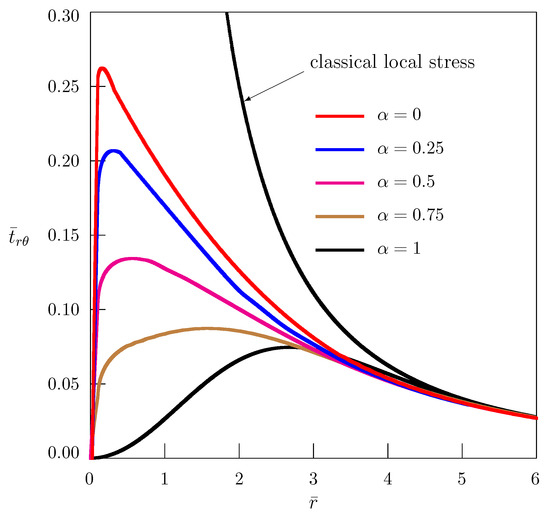
Figure 1.
Concentrated couple in a plane. Dependence of the nonlocal stress component on the distance. The nondimensional stress and nondimensional distance (similarity variable) are defined by Equation (39).
3. Concentrated Couple on the Boundary of a Half-Plane
Next, we consider a half-plane loaded by a counterclockwise couple M applied at the origin of coordinates. In the polar coordinate system , the components of the classical (local) stress tensor are [44]
where
We assume that
According to Equations (A1)–(A4) from Appendix A, for the part of the stress tensor component , we obtain the Cauchy problem
The Cauchy problem of such a type was considered in Section 2. The solution reads
In compliance with the assumption (42)–(44) and Equations (A1)–(A4) from Appendix A, the coefficients , and satisfy the equations
The system of coupled Equations (48)–(53) can be splitted into independent equations by introducing the following new sought-for functions:
Hence,
For the auxiliary functions , and , we obtain a splitted system of the Cauchy problems
The Laplace transform with respect to the nonlocality parameter and the Hankel transform (of the second order for the function and of the fourth order for the function ) with respect to the radial coordinate r with taking into account Equations (A5) and (A6) from Appendix B give the expressions in the transform domain
and after inverting the integral transforms, we get
The components of the nonlocal stress tensor take the form:
The particular case of the solution (71)–(73) corresponding to is obtained using the integrals (A9) and (A10) from Appendix B and reads:
Figure 2 presents the dependence of the nondimensional stress coefficient on the nondimensional distance for different values of the order of fractional derivative . The nondimensional distance is the same as in Equation (39), the nondimensional is introduced as
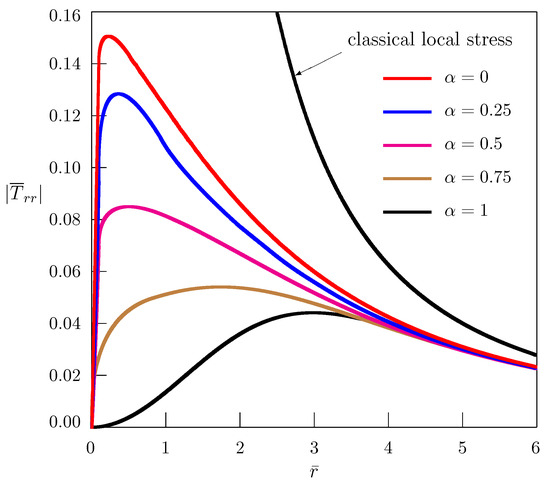
Figure 2.
Concentrated couple on the boundary of a half-plane. Dependence of the nonlocal stress on the distance. The nondimensional distance (similarity variable) is defined by Equation (39).
4. Concluding Remarks
We have investigated the nonlocal stress fields caused by a concentrated couple in a plane and by a concentrated couple acting on the boundary of a half-plane in the framework of the new theory of fractional nonlocal elasticity in which the nonlocal kernel in the stress constitutive equation is the Green’s function of the Cauchy problem for the fractional diffusion operator.
The obtained solutions are free from nonphysical singularities appearing in the classical local elasticity solutions. The nonlocal stress equals zero at the point of application of the couple, achieves maximum at some distance from this point and approaches the classical local stress at a large distance from the point of application. The nonlocal solutions for concentrated forces and concentrated couples are important for stress analysis in nanostructures and composite materials (see, for example, [45]). The fractional nonlocal elasticity used in the present paper allows better matching of results at macro- and micro- (nano-) structural levels with different scale lengths. The impotance of such matching was accented in [9,10,46].
It should be emphasized that Figure 1 presents the nonlocal stress component , whereas Figure 2 shows only the coefficient (see Equation (42)). As the ML function , from Equations (71)–(73) with taking into account integrals (A7) and (A8) from Appendix B it is evident that the solution (71)–(73) satisfies the conditions (40) for It should be noted that though in the case of a concentrated couple on the boundary of a half-plane the local stress component , the nonlocal stress component and tends to zero when the nonlocality parameter .
Author Contributions
Conceptualization, Y.P. and T.K.; methodology, Y.P. and T.K.; validation, B.W.-S., I.S. and A.Y.; formal analysis, I.S. and A.Y.; investigation, Y.P. and T.K.; software, B.W.-S., I.S. and A.Y.; supervision, B.W.-S.; writing—original draft preparation, T.K. and A.Y; writing—review and editing, Y.P. All authors have read and agreed to the published version of the manuscript.
Funding
This research received no external funding.
Institutional Review Board Statement
Not applicable.
Informed Consent Statement
Not applicable.
Data Availability Statement
Data are contained within the article.
Conflicts of Interest
The authors declare no conflict of interest.
Appendix A
The components of the Laplacian of the symmetric tensor in polar coordinates are expressed as [47]
where
Appendix B
Here we present integrals used in the paper.
is the modified Bessel function of the second kind.
References
- Kröner, E. Elasticity theory of materials with long range cohesive forces. Int. J. Solids Struct. 1967, 3, 731–742. [Google Scholar] [CrossRef]
- Podstrigach, Y.S. On a nonlocal theory of solid body deformation. Sov. Appl. Mech. 1967, 3, 44–46. [Google Scholar] [CrossRef]
- Krumhansl, J.A. Some considerations of the relation between solid state physics and generalized continuum mechanics. In Mechanics of Generalized Continua; Springer: Berlin/Heidelberg, Germany, 1968; pp. 298–311. [Google Scholar]
- Eringen, A.C. Linear theory of nonlocal elasticity and dispersion of plane waves. Int. J. Eng. Sci. 1972, 10, 425–435. [Google Scholar] [CrossRef]
- Eringen, A.C. Nonlocal polar field theories. In Continuum Physics, vol. 4, Polar and Nonlocal Field Theories; Academic Press: New York, NY, USA, 1976; pp. 205–267. [Google Scholar]
- Kunin, I.A. Elastic Media with Microstructure I. One-Dimensional Models; Springer: Berlin/Heidelberg, Germany, 1982. [Google Scholar]
- Kunin, I.A. Elastic Media with Microstructure II. Three-Dimensional Models; Springer: Berlin/Heidelberg, Germany, 1983. [Google Scholar]
- Eringen, A.C. On differential equations of nonlocal elasticity and solutions of screw dislocation and surface waves. J. Appl. Phys. 1983, 54, 4703–4710. [Google Scholar] [CrossRef]
- Eringen, A.C. Vistas on nonlocal continuum physics. Int. J. Eng. Sci. 1992, 30, 1551–1565. [Google Scholar] [CrossRef]
- Eringen, A.C. Nonlocal Continuum Field Theories; Springer: New York, NY, USA, 2002. [Google Scholar]
- Lazar, M.; Maugin, G.A.; Aifantis, E.C. On a theory of nonlocal elasticity of bi-Helmholtz type and some applications. Int. J. Solids Struct. 2006, 43, 1404–1421. [Google Scholar] [CrossRef]
- Romano, G.; Barretta, R. Nonlocal elasticity in nanobeams: The stress-driven integral model. Int. J. Eng. Sci. 2017, 115, 14–27. [Google Scholar] [CrossRef]
- Apuzzo, A.; Barretta, R.; Faghidian, S.A.; Luciano, R.; Marotti de Sciarra, F. Free vibrations of elastic beams by modified nonlocal strain gradient theory. Int. J. Eng. Sci. 2018, 133, 99–108. [Google Scholar] [CrossRef]
- Magin, R.L. Fractional Calculus in Bioengineering; Begell House Publishers: Redding, CA, USA, 2006. [Google Scholar]
- Tarasov, V.E. Fractional Dynamics: Applications of Fractional Calculus to Dynamics of Particles, Fields and Media; Springer: Berlin/Heidelberg, Germany, 2010. [Google Scholar]
- Mainardi, F. Fractional Calculus and Waves in Lnear Viscoelasticity: An Introduction to Mathematical Models; Imperial College Press: London, UK, 2010. [Google Scholar]
- Uchaikin, V.V. Fractional Derivatives for Physicists and Engineers; Springer: Berlin/Heidelberg, Germany, 2013. [Google Scholar]
- Atanacković, T.M.; Pilipovć, S.; Stanković, B.; Zorica, D. Fractional Calculus with Applications in Mechanics: Vibrations and Diffusion Processes; John Wiley & Sons: Hoboken, NJ, USA, 2014. [Google Scholar]
- Herrmann, R. Fractional Calculus: An Introduction for Physicists, 2nd ed.; World Scientific: Singapore, 2014. [Google Scholar]
- Povstenko, Y. Fractional Thermoelasticity; Springer: New York, NY, USA, 2015. [Google Scholar]
- Chu, J.; Liu, Y. Coupling model of a generalized second grade fluid flow and fractional Cattaneo heat transfer with magnetic field and radiation. Results Phys. 2024, 57, 107409. [Google Scholar] [CrossRef]
- Seadway, A.R.; Ali, A.; Bekir, A.; Cevikel, A.C. Analysis of the(3+1)-dimensional fractional Kadomtsev– Petviashvili–Boussinesq equation: Solitary, bright, singular, and dark solitons. Fractal Fract. 2024, 8, 515. [Google Scholar] [CrossRef]
- Singh, D.; Srivastava, H.M.; Nieto, J.J. (Eds.) Handbook of Fractional Calculus for Engineering and Science; CRC Press: Boca Raton, FL, USA, 2022. [Google Scholar]
- Zhou, Y. Fractional Diffusion and Wave Equations; Springer: Cham, Switzerland, 2024. [Google Scholar]
- Kevrekidis, P.G.; Cuevas-Maraver, J. (Eds.) Fractional Dispersive Models and Applications: Recent Developments and Future Perspectives; Springer: Cham, Switzerland, 2024. [Google Scholar]
- Sun, H.G.; Li, Z.; Nie, S. Fractional and Fractal Derivative Models for Anomalous Sediment Transport; De Gruyter: Berlin/Heidelberg, Germany, 2025. [Google Scholar]
- Di Paola, M.; Zingales, M. Long-range cohesive interactions of non-local continuum faced by fractional calculus. Int. J. Solids Struct. 2008, 45, 5642–5659. [Google Scholar] [CrossRef]
- Challamel, N.; Zorica, D.; Atanacković, T.M.; Spasić, D.T. On the fractional generalization of Eringen’s nonlocal elasticity for wave propagation. C. R. Mec. 2013, 341, 298–303. [Google Scholar] [CrossRef]
- Carpinteri, A.; Cornetti, P.; Sapora, A. Nonlocal elasticity: An approach based on fractional calculus. Meccanica 2014, 49, 2551–2569. [Google Scholar] [CrossRef]
- Povstenko, Y. Generalized theory of diffusive stresses associated with the time-fractional diffusion equation and nonlocal constitutive equations for the stress tensor. Comput. Math. Appl. 2019, 78, 1819–1825. [Google Scholar] [CrossRef]
- Autuori, G.; Cluni, F.; Gusella, V.; Pucci, P. Effects of the fractional Laplacian order on the nonlocal elastic rod response. ASME J. Risk Uncertain. Part B 2017, 3, 030902. [Google Scholar] [CrossRef]
- Evgrafov, A.; Bellido, J.C. From non-local Eringen’s model to fractional elasticity. Math. Mech. Solids 2019, 24, 1935–1953. [Google Scholar] [CrossRef]
- Alotta, G.; Di Paola, M.; Pinnola, F.P. An unified formulation of strong non-local elasticity with fractional order calculus. Meccanica 2022, 57, 793–805. [Google Scholar] [CrossRef]
- Challamel, N.; Atanacković, T.; Zhang, Y.P.; Wang, C.M. A fractional nonlocal elastic model for lattice wave analysis. Mech. Res. Commun. 2022, 126, 103999. [Google Scholar] [CrossRef]
- Challamel, N.; Atanacković, T.; Zhang, Y.P.; Wang, C.M. Fractional nonlocal elastic rod, beam, and plate models applied to lattice structural mechanics. In Nanomechanics of Structures and Materials; Żur, K.K., Faghidian, S.A., Eds.; Elsevier: Amsterdam, The Netherlands, 2024; pp. 335–360. [Google Scholar]
- Povstenko, Y. Fractional nonlocal elasticity and solutions for straight screw and edge dislocations. Phys. Mesomech. 2020, 23, 547–555. [Google Scholar] [CrossRef]
- Hadjesfandiari, A.R.; Dargush, G.F. Fundamental solutions for isotropic size-dependent couple stress elasticity. Int. J. Solids Struct. 2013, 50, 1253–1265. [Google Scholar] [CrossRef]
- Hattoria, G.; Trevelyana, J.; Gourgiotis, P.A. An isogeometric boundary element formulation for stress concentration problems in couple stress elasticity. Comput. Meth. Appl. Mech. Eng. 2023, 407, 115932. [Google Scholar] [CrossRef]
- Gourgiotis, P.; Rizzi, G.; Lewintan, P.; Bernardini, D.; Sky, A.; Madeo, A.; Neff, P. Green’s functions for the isotropic planar relaxed micromorphic model – Concentrated force and concentrated couple. Int. J. Solids Struct. 2024, 292, 112700. [Google Scholar] [CrossRef]
- Podlubny, I. Fractional Differential Equations; Academic Press: San Diego, CA, USA, 1999. [Google Scholar]
- Kilbas, A.A.; Srivastava, H.M.; Trujillo, J.J. Theory and Applications of Fractional Differential Equations; Elsevier: Amsterdam, The Netherlands, 2006. [Google Scholar]
- Povstenko, Y. Some applications of the Wright function in continuum physics: A survey. Mathematics 2021, 9, 198. [Google Scholar] [CrossRef]
- Erdéelyi, A.; Magnus, W.; Oberhettinger, F.; Tricomi, F. Higher Transcendental Functions; McGraw-Hill: New York, NY, USA, 1955; Volume 3. [Google Scholar]
- Kachanov, M.; Shafiro, B.; Tsukrov, I. Handbook of Elasticity Solutions; Springer: Dordrecht, The Netherlands, 2003. [Google Scholar]
- Ghavanloo, E.; Fazelzadeh, S.A.; Marotti de Sciarra, F. (Eds.) Size-Dependent Continuum Mechanics Approaches: Theory and Applications; Springer: Cham, Switzerland, 2021. [Google Scholar]
- Panin, V.E.; Egorushkin, V.E.; Panin, A.V. Physical mesomechanics of a deformed solid as a multilevel system. I. Physical fundamentals of the multilevel approach. Phys. Mesomech. 2006, 9, 9–20. (In Russian) [Google Scholar]
- Povstenko, Y. Straight disclinations in nonlocal elasticity. Int. J. Eng. Sci. 1995, 33, 575–582. [Google Scholar] [CrossRef]
Disclaimer/Publisher’s Note: The statements, opinions and data contained in all publications are solely those of the individual author(s) and contributor(s) and not of MDPI and/or the editor(s). MDPI and/or the editor(s) disclaim responsibility for any injury to people or property resulting from any ideas, methods, instructions or products referred to in the content. |
© 2025 by the authors. Licensee MDPI, Basel, Switzerland. This article is an open access article distributed under the terms and conditions of the Creative Commons Attribution (CC BY) license (https://creativecommons.org/licenses/by/4.0/).