The Influence of Three-Dimensional Cone Beam Computed Tomography (CBCT) Data on Decision-Making for Maxillary Impacted Canines


Abstract
1. Introduction
2. Materials and Methods
2.1. Study Samples
2.2. Survey
2.3. Statistics
3. Results
4. Discussion
5. Conclusions
Author Contributions
Funding
Institutional Review Board Statement
Informed Consent Statement
Data Availability Statement
Conflicts of Interest
References
- Ng, W.L.; Cunningham, A.; Pandis, N.; Bister, D.; Seehra, J. Impacted maxillary canine: Assessment of prevalence, severity anlocation of root resorption on maxillary incisors: A retrospective CBCT study. Int. Orthod. 2024, 22, 100890. [Google Scholar] [CrossRef]
- Dekel, E.; Nucci, L.; Weill, T.; Flores-Mir, C.; Becker, A.; Perillo, L.; Chaushu, S. Impaction of maxillary canines and its effect on the position of adjacent teeth and canine development: A cone-beam computed tomography study. Am. J. Orthod. Dentofac. Orthop. 2021, 159, 135–147. [Google Scholar] [CrossRef] [PubMed]
- Dewel, B.F. The upper cuspid: Its development and impaction. Angle Orthod. 1947, 119, 79–90. [Google Scholar]
- Qali, M.; Li, C.; Chung, C.H.; Tanna, N. Periodontal and orthodontic management of impacted canines. Periodontol 2000 2024. early view. [Google Scholar] [CrossRef]
- Bedoya, M.; Park, J.H. A review of the diagnosis and management of impacted maxillary canines. J. Am. Dent. Assoc. 2009, 140, 1485–1493. [Google Scholar] [CrossRef] [PubMed]
- Dinu, S.; Todor, L.; Zetu, I.N.; Păcurar, M.; Porumb, A.; Milutinovici, R.A.; Popovici, R.A.; Brad, S.; Sink, B.A.; Popa, M. Radiographic methods for locating impacted maxillary canines. Rom. J. Morphol. Embryol. 2022, 63, 599–606. [Google Scholar]
- Chaushu, S.; Vryonidou, M.; Becker, A.; Leibovich, A.; Dekel, E.; Dykstein, N.; Nucci, L.; Perillo, L. The labiopalatal impacted canine: Accurate diagnosis based on the position and size of adjacent teeth: A cone-beam computed tomography study. Am. J. Orthod. Dentofac. Orthop. 2023, 163, 690–699. [Google Scholar] [CrossRef]
- Kaasalainen, T.; Ekholm, M.; Siiskonen, T.; Kortesniemi, M. Dental cone beam CT: An updated review. Phys. Med. 2021, 88, 193–217. [Google Scholar] [CrossRef]
- Venkatesh, E.; Venkatesh, E.S. Cone beam computed tomography: Basics and applications in dentistry. J. Istanb. Univ. Fac. Dent. 2017, 51, 102–121. [Google Scholar] [CrossRef]
- Farha, P.; Nguyen, M.; Karanth, D.; Dolce, C.; Arqub, S.A. Orthodontic localization of impacted canines: Review of the cutting-edge evidence in diagnosis and treatment planning based on 3D CBCT Images. Turk. J. Orthod. 2023, 36, 261–269. [Google Scholar] [CrossRef]
- Becker, A.; Chaushu, S. Surgical Treatment of Impacted Canines What the Orthodontist Would Like the Surgeon to Know. Oral Maxillofac. Surg. Clin. N. Am. 2015, 27, 449–458. [Google Scholar] [CrossRef]
- Durack, C.; Patel, S.; Davies, J.; Wilson, R.; Mannocci, F. Diagnostic accuracy of small volume cone beam computed tomography and intraoral periapical radiography for the detection of simulated external inflammatory root resorption. Int. Endod. J. 2011, 44, 136–147. [Google Scholar] [CrossRef]
- Ren, H.; Chen, J.; Deng, F.; Zheng, L.; Liu, X.; Dong, Y. Comparison of cone-beam computed tomography and periapical radiography for detecting simulated apical root resorption. Angle Orthod. 2013, 83, 189–195. [Google Scholar] [CrossRef]
- Eslami, E.; Barkhordar, H.; Abramovitch, K.; Kim, J.; Masoud, M.I. Cone-beam computed tomography vs conventional radiography in visualization of maxillary impacted-canine localization: A systematic review of comparative studies. Am. J. Orthod. Dentofac. Orthop. 2017, 151, 248–258. [Google Scholar] [CrossRef]
- Keener, D.J.; de Oliveira Ruellas, A.C.; Aliaga-Del Castillo, A.; Arriola-Guillén, L.E.; Bianchi, J.; Oh, H.; Gurgel, M.L.; Benavides, E.; Soki, F.; Rodríguez-Cárdenas, Y.A.; et al. Three-dimensional decision support system for treatment of canine impaction. Am. J. Orthod. Dentofac. Orthop. 2023, 164, 491–504. [Google Scholar] [CrossRef]
- Stoustrup, P.; Videbæk, A.; Wenzel, A.; Matzen, L.H. Will supplemental cone beam computed tomography change the treatment plan of impacted maxillary canines based on 2D radiography? A prospective clinical study. Eur. J. Orthod. 2024, 46, cjad062. [Google Scholar] [CrossRef]
- Baidas, L.F.; Alshihah, N.; Alabdulaly, R.; Mutaieb, S. Severity and treatment difficulty of impacted maxillary canine among orthodontic patients in Riyadh, Saudi Arabia. Int. J. Environ. Res. Public Health 2022, 19, 10680. [Google Scholar] [CrossRef] [PubMed]
- Bjerklin, K.; Ericson, S. How a computerized tomography examination changed the treatment plans of 80 children with retained and ectopically positioned maxillary canines. Angle Orthod. 2006, 76, 43–51. [Google Scholar] [CrossRef] [PubMed]
- Salerno, C.; Grazia Cagetti, M.; Cirio, S.; Esteves-Oliveira, M.; Wierichs, R.J.; Kloukos, D.; Campus, G. Distribution of initial caries lesions in relation to fixed orthodontic therapy: A systematic review and meta-analysis. Eur. J. Orthod. 2024, 46, cjae008. [Google Scholar] [CrossRef] [PubMed]
- Pinto, A.S.; Alves, L.S.; Maltz, M.; Susin, C.; Zenkner, J.E.A. Does the duration of fixed orthodontic treatment affect caries activity among adolescents and young adults? Caries Res. 2018, 52, 463–467. [Google Scholar] [CrossRef]
- Kim, H.J.; Park, H.S.; Kwon, O.W. Evaluation of potency of panoramic radiography for estimating the position of maxillary impacted canines using 3D CT. Korean J. Orthod. 2008, 38, 265–274. [Google Scholar] [CrossRef]
- Philipp, R.G.; Hurst, R.V. The cant of the occlusal plane and distortion in the panoramic radiograph. Angle Orthod. 1978, 48, 317–323. [Google Scholar]
- Touati, R.; Sailer, I.; Marchand, L.; Ducret, M.; Strasding, M. Communication tools and patient satisfaction: A scoping review. J. Esthet. Restor. Dent. 2022, 34, 104–116. [Google Scholar] [CrossRef]
- Kim, J.Y.; Jung, S.Y.; Lee, K.J.; Yu, H.S.; Park, W.S. Forced eruption in impacted teeth: Analysis of failed cases and outcome of re-operation. BMC Oral Heath 2024, 24, 254. [Google Scholar] [CrossRef] [PubMed]
- Signorelli, L.; Patcas, R.; Peltomäki, T.; Schätzle, M. Radiation dose of cone-beam computed tomography compared to conventional radiographs in orthodontics. J. Orofac. Orthop. 2016, 77, 9–15. [Google Scholar] [CrossRef] [PubMed]
- Berkhout, W.E. The ALARA-principle. Backgrounds and enforcement in dental practices. Ned. Tijdschr. Tandheelkd. 2015, 122, 263–270. [Google Scholar] [CrossRef]
- De Felice, F.; Di Carlo, G.; Saccucci, M.; Tombolini, V.; Polimeni, A. Dental Cone Beam Computed Tomography in Children: Clinical Effectiveness and Cancer Risk due to Radiation Exposure. Oncology 2019, 96, 173–178. [Google Scholar] [CrossRef] [PubMed]
- Ludlow, J.B.; Timothy, R.; Walker, C.; Hunter, R.; Benavides, E.; Samuelson, D.B.; Scheske, M.J. Effective dose of dental CBCT—A meta analysis of published data and additional data for nine CBCT units. Dentomaxillofac. Radiol. 2015, 44, 20140197. [Google Scholar] [CrossRef]
- Interrante, V.; Ries, B.; Lindquist, J.; Kaeding, M.; Anderson, L. Elucidating factors that can facilitate veridical spatial perception in immersive virtual environments. Presence Teleoperators Virtual Environ. 2008, 17, 176–198. [Google Scholar] [CrossRef]
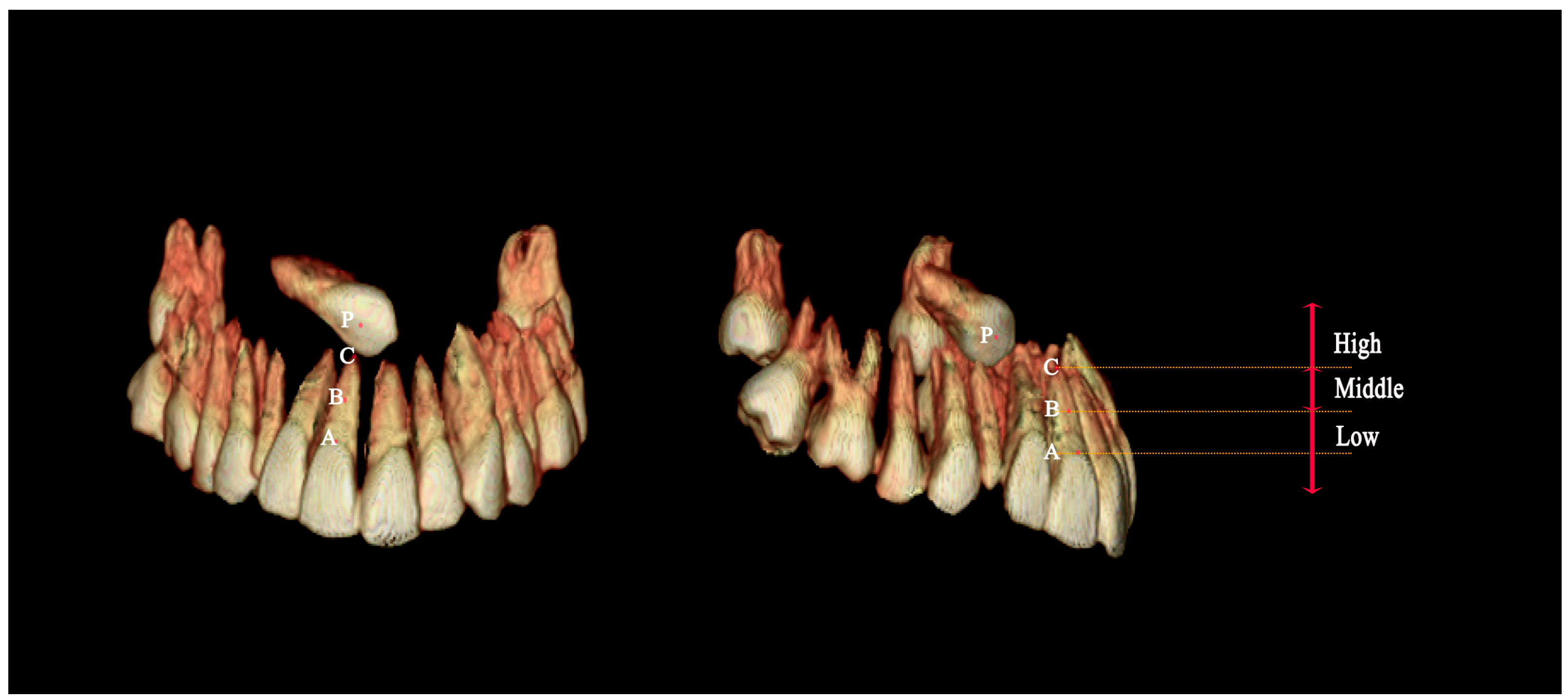



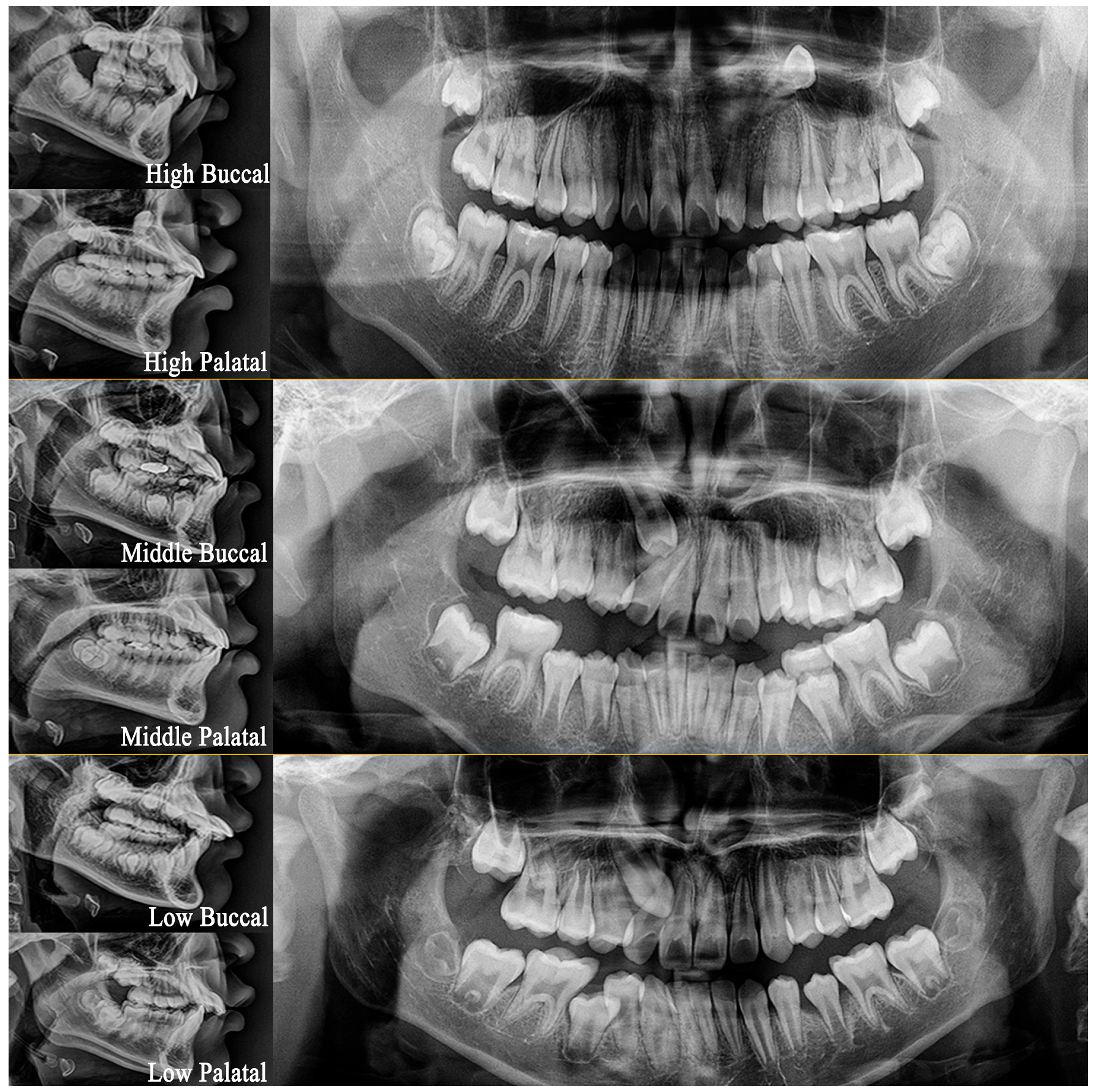
| Case Number | Impacted Canine Position | Adjacent Tooth Root Resorption | ||
|---|---|---|---|---|
| Height | Antero-Posterior | Vertical/Horizontal | ||
| 1 | High | Buccal | Horizontal | Yes (MD) |
| 2 | High | Buccal | Vertical | No |
| 3 | High | Buccal | Horizontal | Yes (MD) |
| 4 | High | Palatal | Vertical | Yes (AP) |
| 5 | High | Palatal | Horizontal | No |
| 6 | Middle | Buccal | Horizontal | No |
| 7 | Middle | Palatal | Horizontal | No |
| 8 | Low | Buccal | Vertical | Yes (AP) |
| 9 | Low | Buccal | Horizontal | Yes (AP) |
| 10 | Low | Palatal | Vertical | Yes (MD) |
| Key Concept | Answers | ||||
|---|---|---|---|---|---|
| Treatment plan for impacted canine | Extraction | Orthodontic traction | |||
| Extraction | |||||
| -Reason for extraction | Impossible to treat | High possibility of failure | Advancing root resorption | Long treatment duration | Substitute of premolar extraction |
| Orthodontic traction | |||||
| -Surgical opening | Buccal | Palatal | |||
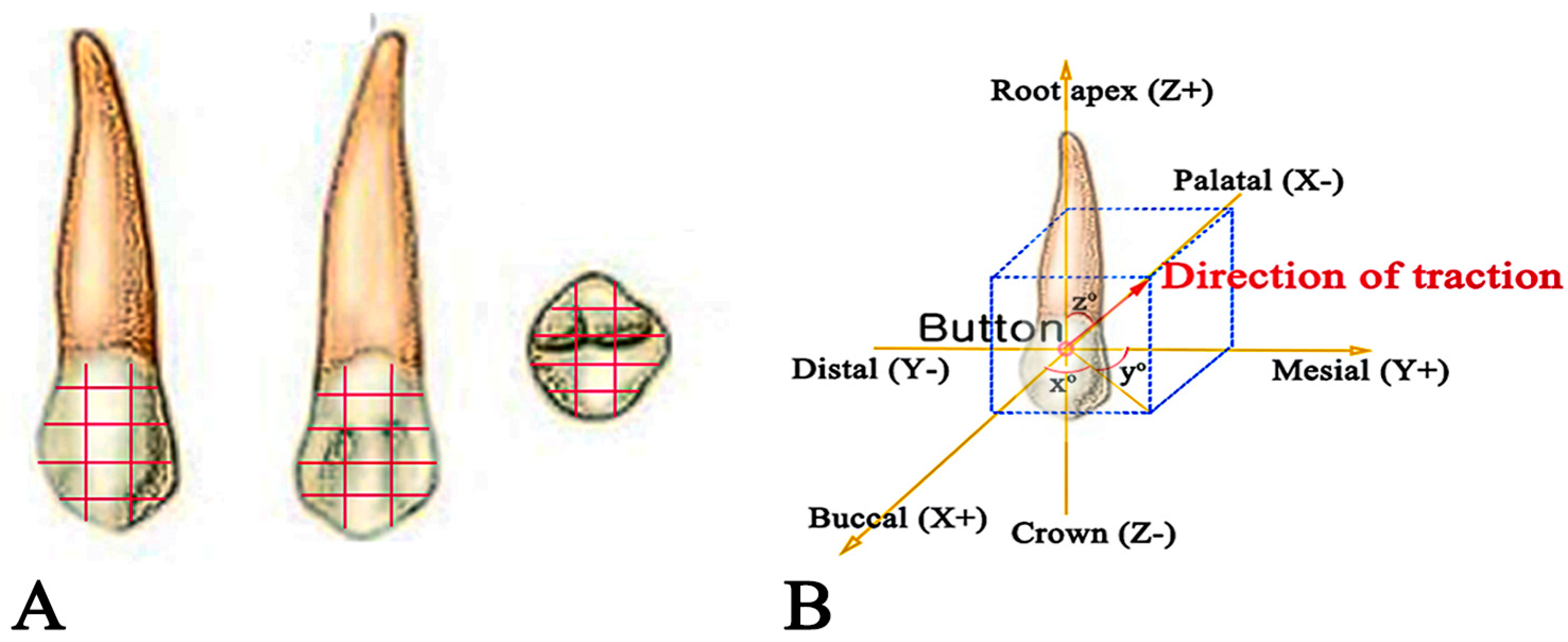
| -The bonding position of a button | Short answers | ||||
| -Traction direction & angle | Short answers | ||||
| -Number of changed in traction direction | Short answers | ||||
| -Predicted collisions during traction | Short answers | ||||
| -Appliance design for traction | Trans-Palatal Arch | Nance appliance | Etc. (draw design) | ||
| -Predicted traction duration | Within 3 months | Within 6 months | Within 1 year | Within 2 years | 3 years or more |
| Treatment difficulty | |||||
| -Level of treatment difficulty (LTD) | Visual analog scale (VAS) | ||||
| -Factors affecting LTD | Age | Sex | Root dilaceration | Position of impacted canine | Transposition |
| Diagnosis of impacted canine | |||||
| -Angle to the occlusal plane | Short answers | ||||
| -Angle to the midsagittal plane | Short answers | ||||
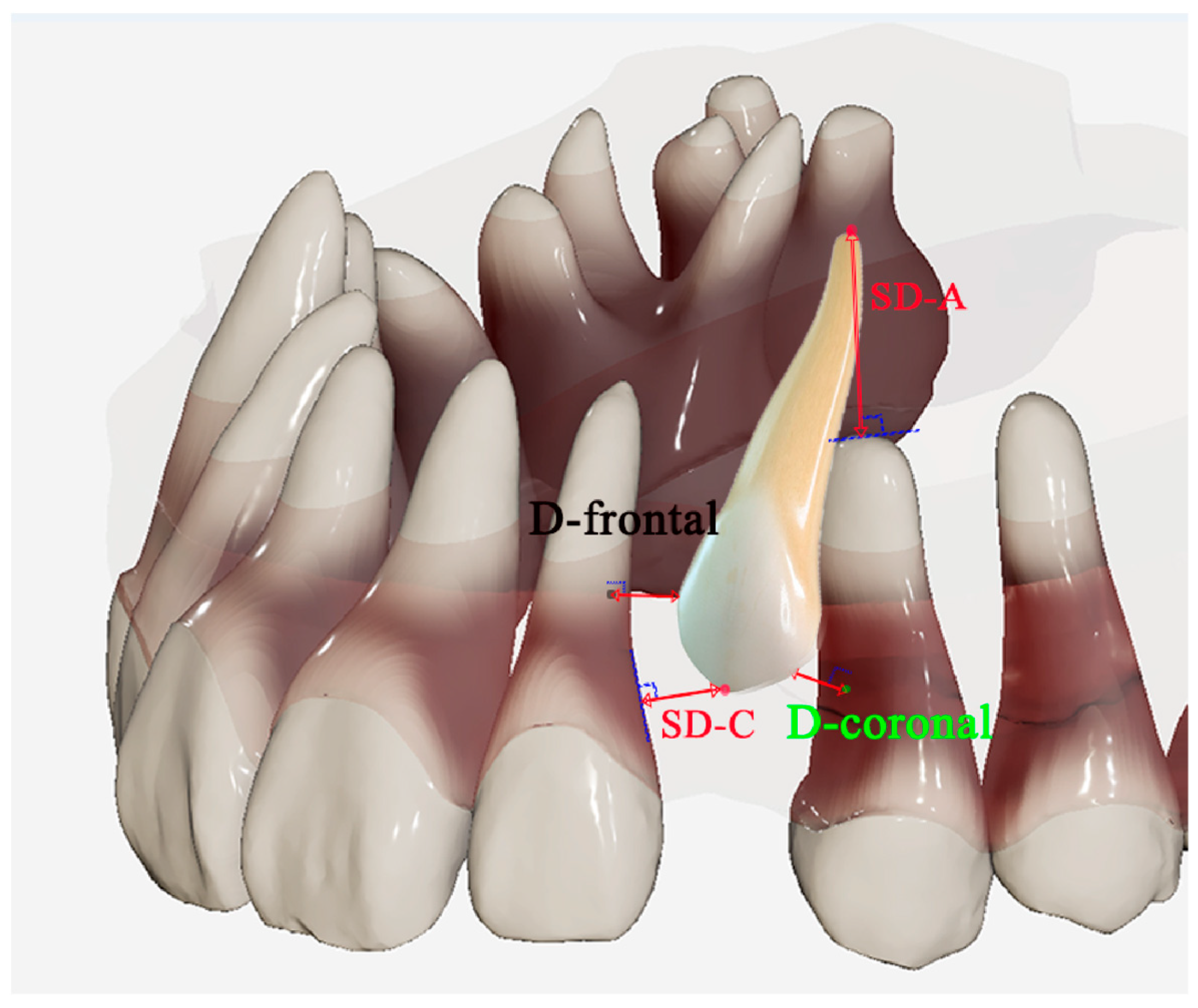
| -SD-C | Contact | within 1 mm | 1~2 mm | 3~4 mm | Over 5 mm |
| -SD-A | Contact | within 1 mm | 1~2 mm | 3~4 mm | Over 5 mm |
| -D-coronal | Contact | within 1 mm | 1~2 mm | 3~4 mm | Over 5 mm |
| -D-frontal | Contact | within 1 mm | 1~2 mm | 3~4 mm | Over 5 mm |
| 2D vs. 3D | |||||
| -Change in treatment plan | Yes | No | |||
| -Reason for changing treatment plan | PPER | Location of impacted tooth | Relationship with surrounding | Etc. | |
| -Changes in orthodontic traction direction | |||||
| -Necessity of CT when diagnosing impacted tooth | Short answers | ||||
| External root resorption | |||||
| -PPER | 5% interval (0~50%) | ||||
| Variable | 2D | 3D | 2D & 3D |
|---|---|---|---|
| Treatment plan for impacted canine | 0.924 | 0.954 | 0.938 |
| Reason for extraction | 0.838 | 0.879 | 0.849 |
| Surgical opening | 0.952 | 0.962 | 0.956 |
| The bonding position of a button | 0.938 | 0.935 | 0.936 |
| Traction direction and angle on the X-axis | 0.858 | 0.714 | 0.788 |
| Traction direction and angle on the Y-axis | 0.900 | 0.866 | 0.893 |
| Traction direction and angle on the Z-axis | 0.914 | 0.906 | 0.907 |
| Number of changes in traction direction | 0.802 | 0.873 | 0.887 |
| Predicted collisions during traction | 0.901 | 0.809 | 0.897 |
| Appliance design for traction | 0.904 | 0.759 | 0.878 |
| Predicted traction duration | 0.917 | 0.790 | 0.899 |
| Level of treatment difficulty (LTD) | 0.976 | 0.952 | 0.969 |
| Factors affecting LTD | 0.931 | 0.753 | 0.903 |
| Angle to the occlusal plane | 0.922 | 0.940 | 0.930 |
| Angle to the midsagittal plane | 0.900 | 0.925 | 0.913 |
| SD-C | 0.942 | 0.977 | 0.974 |
| SD-A | 0.964 | 0.980 | 0.971 |
| D-coronal | 0.970 | 0.977 | 0.972 |
| D-frontal | 0.979 | 0.983 | 0.980 |
| PPER | 0.944 | 0.965 | 0.957 |
| Variable | 2D Estimation | 3D Estimation | p Value |
|---|---|---|---|
| Mean ± SD | Mean ± SD | ||
| The rate of extraction (%) | 30 ± 24 | 16 ± 12 | 0.000 *** |
| Number of changes in traction direction | 0.69 ± 0.62 | 1.1 ± 0.97 | 0.000 *** |
| First traction angle X-axis | 135.78 ± 51.42 | 137.64 ± 59.28 | 0.720 |
| First traction angle Y-axis | 145.50 ± 64.03 | 140.69 ± 64.85 | 0.425 |
| First traction angle Z-axis | 163.68 ± 82.28 | 146.79 ± 79.49 | 0.260 |
| Second traction angle X-axis | 127.16 ± 50.52 | 117.22 ± 40.89 | 0.690 |
| Second traction angle Y-axis | 167.66 ± 48.06 | 161.29 ± 46.88 | 0.260 |
| Second traction angle Z-axis | 129.12 ± 65.66 | 133.58 ± 69.80 | 0.580 |
| Predicted collisions during traction | 0.78 ± 0.54 | 0.42 ± 0.49 | 00.009 ** |
| Predicted traction duration (month) | 17.03 ± 7.57 | 12.18 ± 7.65 | 0.000 *** |
| Level of treatment difficulty (LTD) | 63.12 ± 20.29 | 52.74 ± 19.20 | 0.000 *** |
| Angle to the occlusal plane | 43.72 ± 26.38 | 41.50 ± 23.34 | 0.370 |
| Angle to the midsagittal plane | 47.44 ± 23.26 | 49.30 ± 21.67 | 0.400 |
| SD-C | 1.12 ± 2.03 | 2.80 ± 3.74 | 0.000 *** |
| SD-A | 3.42 ± 3.21 | 5.47 ± 3.66 | 0.000 *** |
| D-coronal | 1.83 ± 1.77 | 1.95 ± 1.92 | 0.460 |
| D-frontal | 1.69 ± 1.76 | 1.98 ± 1.84 | 0.043 * |
| PPER | 11.21 ± 15.10 | 18.78 ± 21.75 | 0.000 *** |
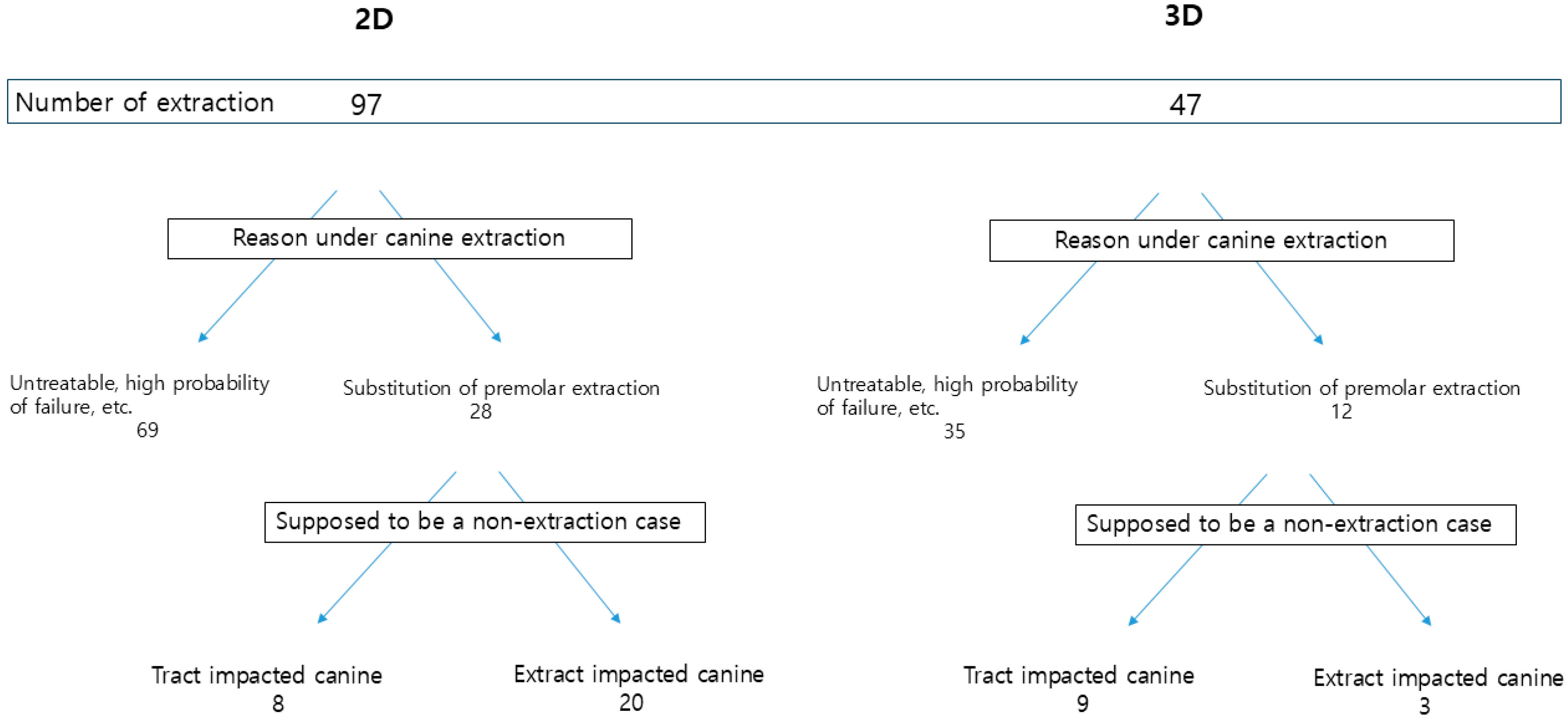
| Variable | 2D | 3D | Change Rate (%) |
|---|---|---|---|
| Total Number | Total Number | ||
| Extraction | 97 | 47 | 51.5 |
| Orthodontic traction | 213 | 263 | 23.4 |
| Predicted collisions during traction | 125 | 67 | 46.4 |
| Variables | High | Middle | Low | Buccal | Palatal | ||||||||||
|---|---|---|---|---|---|---|---|---|---|---|---|---|---|---|---|
| 2D (n = 155) | 3D (n = 155) | p-Value | 2D (n = 62) | 3D (n = 62) | p-Value | 2D (n = 93) | 3D (n = 93) | p-Value | 2D (n = 186) | 3D (n = 186) | p-Value | 2D (n = 124) | 3D (n = 124) | p-Value | |
| Angle to the occlusal plane | −9.86 ± 22.97 | 1.10 ± 13.04 | 0.000 *** | −8.72 ± 18.19 | 2.46 ± 8.42 | 0.003 ** | −5.17 ± 24.23 | 2.3 ± 17.07 | 0.059 | −3.42 ± 21.79 | 1.49 ± 12.99 | 0.099 | −8.55 ± 18.75 | 3.04 ± 11.97 | 0.000 *** |
| Angle to the midsagittal plane | −9.04 ± 22.23 | 2.16 ± 13.97 | 0.001 ** | −9.72 ± 13.98 | 2.39 ± 7.82 | 0.000 *** | −4.08 ± 13.79 | 3.30 ± 12.90 | 0.138 | −3.68 ± 20.12 | 2.40 ± 14.27 | 0.565 | −14.28 ± 16.27 | 1.81 ± 10.59 | 0.000 *** |
| SD-C | 1.68 ± 3.87 | 0.51 ± 1.44 | 0.001 ** | 1.12 ± 2.97 | 0.49 ± 1.64 | 0.049 * | −0.61 ± 3.86 | −0.30 ± 2.84 | 0.756 | 1.30 ± 3.85 | 0.51 ± 2.08 | 0.046 * | 1.21 ± 3.25 | 0.30 ± 2.45 | 0.014 * |
| SD-A | 1.16 ± 3.86 | 0.33 ± 2.58 | 0.027 * | 1.16 ± 3.12 | 0.40 ± 2.42 | 0.129 | 1.30 ± 2.29 | 0.80 ± 3.85 | 0.535 | 0.69 ± 3.89 | 0.40 ± 2.47 | 0.485 | 1.01 ± 3.30 | 0.03 ± 3.00 | 0.013 * |
| D-coronal | 1.38 ± 2.35 | 0.67 ± 1.28 | 0.001 ** | 0.74 ± 1.92 | 0.25 ± 1.73 | 0.205 | 0.53 ± 1.04 | −0.33 ± 0.82 | 0.389 | 1.01 ± 2.24 | 0.94 ± 1.33 | 0.485 | 1.47 ± 2.61 | 0.05 ± 1.36 | 0.000 *** |
| D-frontal | 1.14 ± 2.27 | 0.35 ± 1.39 | 0.000 *** | 0.53 ± 1.61 | 0.40 ± 2.42 | 0.417 | 0.42 ± 1.09 | 0.19 ± 0.82 | 0.144 | 1.87 ± 2.23 | 0.98 ± 1.20 | 0.003 ** | 1.63 ± 1.84 | 0.30 ± 1.36 | 0.001 ** |
| Predicted traction duration (month) | −5.77 ± 6.95 | 0.43 ± 6.03 | 0.006 ** | −4.85 ± 7.29 | 0.53 ± 6.41 | 0.004 ** | −1.38 ± 7.54 | −0.63 ± 5.13 | 0.360 | −3.25 ± 7.36 | 0.63 ± 6.84 | 0.000 ** | −6.23 ± 6.95 | 0.61 ± 4.03 | 0.000 ** |
| Variable | Buccal-High | Buccal-Low | Palatal-High | Palatal-Low | ||||||||
|---|---|---|---|---|---|---|---|---|---|---|---|---|
| 2D (n = 93) | 3D (n = 93) | p-Value | 2D (n = 62) | 3D (n = 62) | p-Value | 2D (n = 62) | 3D (n = 62) | p-Value | 2D (n = 31) | 3D (n = 31) | p-Value | |
| The rate of extraction (%) | 58 ± 17 | 18 ± 6 | 0.000 *** | 19 ± 10 | 12 ± 8 | 0.058 | 32 ± 15 | 15 ± 7 | 0.001 ** | 16 ± 11 | 10 ± 9 | 0.043 * |
| Predicted collisions during traction | 1.26 ± 1.05 | 0.44 ± 0.66 | 0.000 *** | 1.36 ± 1.00 | 0.70 ± 0.64 | 0.000 *** | 1.38 ± 1.10 | 0.81 ± 0.65 | 0.000 *** | 1.30 ± 0.97 | 0.80 ± 0.69 | 0.001 ** |
| Predicted traction duration (month) | −4.08 ± 6.65 | 0.84 ± 7.27 | 0.001 ** | −1.20 ± 6.95 | −0.80 ± 7.10 | 0.429 | −4.69 ± 7.35 | −0.73 ± 7.27 | 0.004 ** | −4.22 ± 8.34 | 0.74 ± 6.90 | 0.001 ** |
| Angle to the occlusal plane | −8.37 ± 23.00 | 1.94 ± 20.51 | 0.000 *** | −2.65 ± 17.44 | 0.35 ± 16.13 | 0.364 | −8.70 ± 11.93 | −2.13 ± 13.90 | 0.005 ** | −4.68 ± 15.90 | −0.29 ± 6.73 | 0.047 * |
| Angle to the midsagittal plane | −4.98 ± 18.03 | 1.02 ± 9.40 | 0.003 ** | −3.20 ± 13.28 | 0.34 ± 13.93 | 0.192 | −7.84 ± 10.99 | 1.93 ± 11.59 | 0.009 ** | −3.69 ± 6.75 | −0.68 ± 6.86 | 0.023 * |
| SD-C | 0.99 ± 3.88 | −0.86 ± 4.61 | 0.000 *** | 0.16 ± 1.38 | 0.32 ± 1.40 | 0.148 | 2.85 ± 3.88 | 1.24 ± 3.05 | 0.024 * | 1.21 ± 0.71 | 0.46 ± 0.61 | 0.000 *** |
| SD-A | 2.02 ± 1.75 | 0.57 ± 2.04 | 0.000 *** | 1.27 ± 5.05 | 0.82 ± 3.99 | 0.231 | 2.47 ± 3.30 | 1.44 ± 2.50 | 0.022 * | 2.35 ± 1.64 | 1.03 ± 1.58 | 0.001 ** |
| D-coronal | 1.34 ± 2.30 | 0.77 ± 2.75 | 0.044 * | −0.03 ± 1.40 | 0.07 ± 1.52 | 0.813 | 1.98 ± 2.59 | 0.68 ± 2.34 | 0.006 ** | −1.85 ± 2.56 | 0.37 ± 1.90 | 0.038 * |
| D-frontal | 1.14 ± 2.37 | 0.50 ± 2.47 | 0.024 * | 0.12 ± 1.35 | 0.28 ± 1.32 | 0.461 | 2.42 ± 2.54 | 0.90 ± 2.11 | 0.004 ** | −1.92 ± 2.76 | 0.19 ± 1.32 | 0.036 * |
| 2D | 3D | |||||
|---|---|---|---|---|---|---|
| Y-CT (M ± SD) | N-CT (M ± SD) | p-Value | Y-CT (M ± SD) | N-CT (M ± SD) | p-Value | |
| The rate of extraction (%) | 33 ± 17 | 38 ± 15 | 0.369 | 7 ± 3 | 26 ± 8 | 0.000 *** |
| Predicted collisions during traction | 0.55 ± 0.49 | 0.61 ± 0.48 | 0.407 | 0.20 ± 0.15 | 0.42 ± 0.23 | 0.002 ** |
| Predicted traction duration (month) | 20.22 ± 6.37 | 19.70 ± 5.19 | 0.216 | 11.43 ± 6.38 | 16.75 ± 9.62 | 0.000 *** |
| Level of treatment difficulty (LTD) | 62.5 ± 18.41 | 63.76 ± 22.16 | 0.593 | 44.65 ± 16.26 | 57.10 ± 21.09 | 0.000 *** |
| Number of changes in traction direction | 0.67 ± 0.68 | 0.72 ± 0.53 | 0.610 | 1.56 ± 1.13 | 0.92 ± 0.67 | 0.000 *** |
| SD-C | 2.39 ± 3.67 | 1.84 ± 2.07 | 0.1.05 | 2.77 ± 4.14 | 2.75 ± 3.19 | 0.953 |
| SD-A | 4.67 ± 3.79 | 3.83 ± 3.10 | 0.036 * | 5.59 ± 3.97 | 5.36 ± 3.29 | 0.580 |
| PPER | 8.73 ± 16.77 | 7.17 ± 13.87 | 0.372 | 19.20 ± 25.20 | 10.07 ± 19.72 | 0.006 ** |
Disclaimer/Publisher’s Note: The statements, opinions and data contained in all publications are solely those of the individual author(s) and contributor(s) and not of MDPI and/or the editor(s). MDPI and/or the editor(s) disclaim responsibility for any injury to people or property resulting from any ideas, methods, instructions or products referred to in the content. |
© 2025 by the authors. Licensee MDPI, Basel, Switzerland. This article is an open access article distributed under the terms and conditions of the Creative Commons Attribution (CC BY) license (https://creativecommons.org/licenses/by/4.0/).
Share and Cite
Lee, J.-N.; Kim, H.-J.; Park, H.-S. The Influence of Three-Dimensional Cone Beam Computed Tomography (CBCT) Data on Decision-Making for Maxillary Impacted Canines. Appl. Sci. 2025, 15, 13061. https://doi.org/10.3390/app152413061
Lee J-N, Kim H-J, Park H-S. The Influence of Three-Dimensional Cone Beam Computed Tomography (CBCT) Data on Decision-Making for Maxillary Impacted Canines. Applied Sciences. 2025; 15(24):13061. https://doi.org/10.3390/app152413061
Chicago/Turabian StyleLee, Jae-Nam, Ho-Jin Kim, and Hyo-Sang Park. 2025. "The Influence of Three-Dimensional Cone Beam Computed Tomography (CBCT) Data on Decision-Making for Maxillary Impacted Canines" Applied Sciences 15, no. 24: 13061. https://doi.org/10.3390/app152413061
APA StyleLee, J.-N., Kim, H.-J., & Park, H.-S. (2025). The Influence of Three-Dimensional Cone Beam Computed Tomography (CBCT) Data on Decision-Making for Maxillary Impacted Canines. Applied Sciences, 15(24), 13061. https://doi.org/10.3390/app152413061