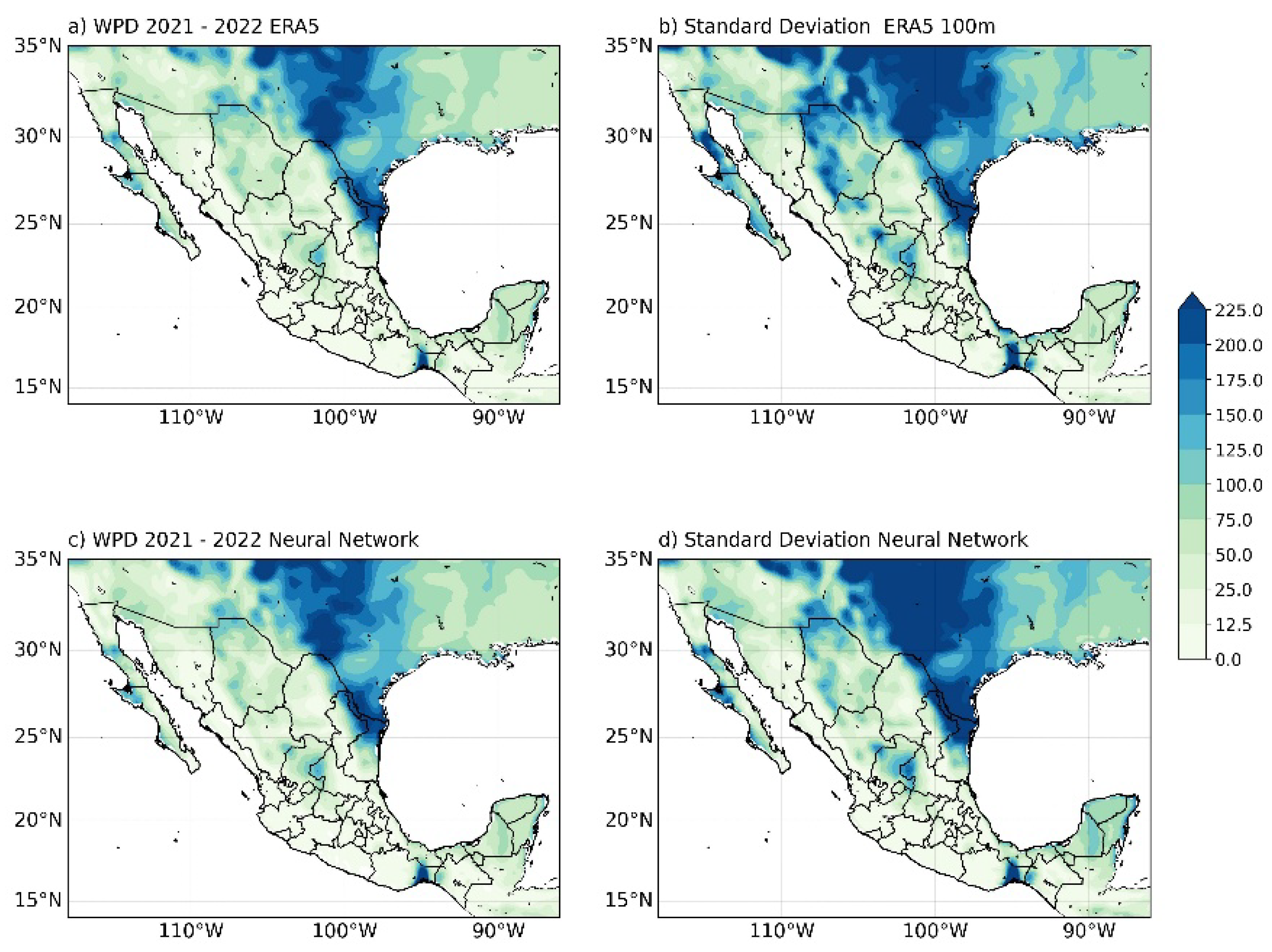

Featured Application
The proposed AI-based framework enables the rapid generation of high-resolution wind power density maps across Mexico, supporting national energy planning, wind farm siting, and integration into smart-grid management systems. Its computationally efficient design allows institutions with limited hardware resources to perform large-scale renewable energy assessments in near real time, contributing to sustainable and human-centered decision-making within the Industry 5.0 paradigm.
Abstract
This study presents an efficient and reproducible framework for estimating wind power density (WPD) across Mexico using a Dense Neural Network (DNN) trained exclusively on ERA5 and ERA5-Land reanalysis data. The model is designed as a computationally efficient surrogate that reproduces the statistical behavior of the ERA5 benchmark while enabling national-scale WPD mapping and short-term projections at minimal computational cost. Meteorological variables—including wind components at 10 m and 100 m, surface temperature, pressure, and terrain elevation—were harmonized on a 0.25° grid for the 1971–2024 period. A chronological dataset split (70-20-10%) was applied to realistically evaluate forecasting capability. The optimized DNN architecture (512-256-128 neurons) achieved high predictive performance (R2 ≈ 0.91, RMSE ≈ 6.2 W/m2) and accurately reproduced spatial patterns and seasonal variability, particularly in high-resource regions such as Oaxaca and Baja California. Compared with deeper neural architectures, the proposed model reduced training time by more than 60% and energy consumption by approximately 40%, supporting principles of sustainable computing and Industry 5.0. The resulting WPD fields, delivered in interoperable NetCDF formats, can be directly integrated into decision-support tools for wind-farm planning, smart-grid management, and long-term renewable-energy strategies in data-scarce environments.
1. Introduction
The global demand for renewable energy continues to rise as nations strive to mitigate greenhouse gas emissions and ensure long-term energy security [1,2,3]. In Mexico, wind energy represents one of the most promising renewable sources, contributing more than 13 GW of installed capacity and accounting for over 10% of national electricity generation as of 2024 [4,5]. Its scalability, low operational costs, and consistent generation potential make it a key pillar in the country’s transition toward sustainable energy. Accurate estimation of wind power density (WPD) is therefore crucial for optimal site selection, policy development, and investment planning in wind energy projects. Recent advances in global reanalysis datasets and machine learning techniques have enabled unprecedented improvements in the spatial and temporal characterization of wind resources [2,3].
Despite this progress, nationwide wind assessments in Mexico remain constrained by limited observational coverage and high computational costs. Traditional mesoscale numerical simulations (e.g., WRF, RegCM4) provide valuable detail but require extensive calibration and specialized infrastructure, restricting their applicability for rapid or large-scale evaluations [6]. This limitation underscores the need for data-driven alternatives capable of efficiently producing consistent national-scale WPD estimations. However, the dense neural network (DNN) developed in this study is not intended to replace physics-based models such as WRF nor to reproduce their atmospheric dynamics. Instead, it serves as a computationally efficient surrogate trained to emulate the statistical patterns present in the ERA5 reanalysis. In this study, ‘efficiency’ refers strictly to computational cost and scalability: the DNN can generate national-scale WPD fields within seconds and produce projections up to two years ahead, while maintaining statistical similarity to ERA5. Accordingly, the comparison with numerical models concerns processing time and accessibility rather than physical fidelity, and the DNN inherits the intrinsic uncertainty of the ERA5 benchmark without improving observational accuracy.
Recent developments in artificial intelligence, particularly deep learning, have opened new pathways for large-scale wind resource estimation [7]. DNNs offer a flexible and computationally efficient framework for learning nonlinear relationships among meteorological variables [8,9]. By leveraging modern reanalysis datasets such as ERA5 and ERA5-Land [10,11], these models can generate physically coherent and temporally consistent wind field estimations without relying on sparse station data. Although in situ validation remains the gold standard, ERA5 provides the most complete, quality-controlled, and spatially homogeneous benchmark currently available for national-scale studies, making it an appropriate reference for model evaluation in data-scarce contexts [10,11].
This study presents an optimized DNN model trained solely on ERA5 and ERA5-Land reanalysis data to estimate WPD across Mexico. The research pursues three main objectives:
- Design a neural network architecture that maximizes accuracy while minimizing computational cost;
- Validate the model against ERA5-based benchmarks and evaluate its performance across diverse geographical and climatic regions [4,12];
- Develop a reproducible and computationally efficient framework for large-scale wind resource assessment in data-scarce environments.
By emphasizing efficiency, reproducibility, and accessibility, this framework supports informed decision-making for wind farm deployment and contributes to Mexico’s renewable energy planning strategies [2,3].
1.1. Computational Challenges in Wind Energy Assessment in Mexico
Mexico’s commitment to reducing greenhouse gas emissions by 50% by 2050 has intensified the demand for accurate and efficient renewable-energy planning [1]. Although the country possesses vast wind resources—particularly in Oaxaca, Baja California, and the northern states of Tamaulipas and Nuevo León—wind power currently supplies about 10% of national electricity generation [2]. Meeting future decarbonization goals therefore requires methodologies that can rapidly and reliably quantify wind potential while minimizing computational demand [3].
Despite major advances in data accessibility, three persistent challenges continue to constrain nationwide wind assessments in Mexico:
- Data sparsity
The density of in situ meteorological observations remains low, especially across mountainous and desert regions, limiting the ability to validate and calibrate numerical or data-driven models [4,5,6]. Reanalysis datasets such as ERA5 and ERA5-Land provide continuous spatial coverage [7,8]; however, their native resolution (27 km) may not fully capture local wind variability caused by complex terrain and coastal interactions [6]. Moreover, integrating such coarse-scale data into finer-scale assessments requires careful downscaling and quality control.
- High computational cost.
Traditional numerical models (e.g., WRF, RegCM4) can reproduce mesoscale wind dynamics but demand substantial computational time and expert parameterization. For instance, year-long simulations at 0.25° spatial resolution may require several weeks on standard high-performance clusters [9,10], limiting their practicality for feasibility or multi-scenario studies where rapid evaluation is essential.
- Dynamic variability.
The intermittent nature of wind requires models capable of capturing strong diurnal and seasonal fluctuations. Legacy statistical or deterministic schemes often yield errors exceeding 20% for short-term forecasts, particularly under rapidly changing atmospheric conditions [11,12].
Deep-learning approaches provide a promising alternative to address these limitations. Studies comparing neural-network models with physics-based numerical simulations report 40–60% reductions in computational time while maintaining comparable accuracy (R2 > 0.85) [13]. However, Mexico’s complex topography and climatic heterogeneity demand customized architectures trained on regionally consistent datasets—such as ERA5 and ERA5-Land—rather than generic, pre-trained solutions [6,7,8]. These considerations motivate the optimized neural framework proposed in this study.
1.2. Design of Neural Networks for Wind Resource Mapping
Deep learning has become an essential tool for modeling atmospheric and renewable-energy systems because of its capacity to approximate complex nonlinear relationships among meteorological variables [1,2,3,4]. Selecting an appropriate network architecture, however, requires balancing predictive accuracy, computational efficiency, and the structure of the input data [2,3,5].
The growing adoption of artificial intelligence in the wind-energy sector extends beyond resource modeling, with recent studies demonstrating the value of ANN-based methods for improving turbine operation, control robustness, and MPPT optimization in modern wind-energy conversion systems. These developments illustrate the broader integration of intelligent algorithms across the wind-energy value chain and reinforce the relevance of efficient, data-driven approaches such as the DNN framework proposed in this study [14].
Recent studies have further expanded the use of machine-learning techniques for wind-resource assessment, providing methodological advances directly relevant to national-scale WPD estimation. For instance, Liu et al. [15] demonstrated that Random Forest algorithms can accurately estimate hub-height wind speeds across complex terrain, improving predictive skill relative to traditional vertical extrapolation methods. Similarly, Yang et al. [16] presented a comprehensive survey of machine-learning approaches for wind-power forecasting, highlighting the growing role of deep learning in operational wind-energy applications. In the context of power-output prediction, Abdelsattar et al. [17] evaluated multiple ML and DL models and reported significant performance gains when nonlinear atmospheric interactions are considered. Additional contributions, such as the CNN-based spatial reconstruction framework of Murugan et al. [18], show the potential of ML architectures to recover fine-scale structures from gridded atmospheric fields. Collectively, these recent works illustrate the rapid evolution of ML-based wind-energy assessment and motivate the development of computationally efficient models suitable for large-scale applications, such as the DNN proposed in this study [11].
1.2.1. Architectural Trade-Offs in Energy Forecasting
Most frameworks for wind-energy estimation and forecasting rely on one of three neural-network paradigms, each offering distinct advantages and limitations depending on data type, spatial scale, and computational resources:
- Convolutional Neural Networks (CNNs).
CNNs are effective for capturing spatial dependencies in gridded datasets such as global or regional reanalyses. Their convolutional filters extract spatial features and topological patterns, which is advantageous for high-resolution imagery or fine-scale modeling. However, when applied to coarser datasets—such as ERA5 at 0.25° resolution—the smoothing effect of convolutional kernels can attenuate localized wind gradients, leading to an underestimation of wind-speed variability in mountainous or coastal regions by approximately 10–20% [6,7,8].
- Recurrent Neural Networks (RNNs).
RNNs, particularly Long Short-Term Memory (LSTM) architectures, excel at representing temporal dependencies, including diurnal and seasonal wind cycles. Nevertheless, they impose considerable computational demands and extended training times—often three to four times longer than feed-forward networks for comparable spatiotemporal datasets [9,10]. This constraint limits their use in nationwide assessments or in institutions with limited hardware resources.
- Hybrid CNN–RNN models.
Hybrid approaches combine convolutional and recurrent layers to capture both spatial and temporal dynamics [10,12]. While they can achieve moderate gains in predictive performance, these models typically require large computational resources; high-resolution (1 km) simulations may exceed 500 GB of RAM and demand high-end GPUs, making them impractical for continuous or long-term analyses [7,13].
Considering these trade-offs, DNNs represent a practical compromise between accuracy and scalability. DNNs operate efficiently on tabular or aggregated grid data and can learn nonlinear interactions among atmospheric predictors—such as wind components, temperature, pressure, and geopotential height—without the need for spatial convolution or temporal recurrence [3,14,15]. Their reduced architectural complexity allows deployment on mid-range hardware while maintaining model interpretability and consistent training stability. These characteristics make DNNs particularly suitable for nationwide wind-resource estimation tasks, forming the methodological foundation described in the following section.
1.2.2. Comparative Performance of CNN, RNN, and Hybrid Models
To quantitatively assess the suitability of different neural architectures for large-scale wind-resource estimation, we conducted a comparative evaluation of Convolutional Neural Networks (CNNs), Recurrent Neural Networks (RNNs), and hybrid CNN–RNN models, all trained on ERA5 reanalysis data covering representative regions of Mexico. The DNN was employed as the baseline model for benchmarking accuracy, training efficiency, and resource utilization across architectures. All experiments were executed under equivalent conditions—using identical input datasets, preprocessing steps, and hardware configurations—to ensure fairness and reproducibility in the comparative analysis.
CNNs demonstrated strong capability in recognizing spatial gradients in reanalysis grids, particularly across homogeneous terrain such as coastal plains and central plateaus. However, their accuracy declined in areas with pronounced orographic complexity (e.g., Oaxaca, Sierra Madre Occidental), where the 0.25° resolution of ERA5 fails to resolve local wind channeling effects. The resulting mean absolute error (MAE) increased by approximately 18–25% relative to the DNN baseline—consistent with findings by Merizzi et al. [13], who reported similar underestimations when applying CNNs to coarse-gridded topographic data.
RNNs, particularly Long Short-Term Memory (LSTM) variants, achieved greater short-term temporal coherence, improving daily to weekly wind-speed correlations by roughly 10% compared to CNNs. Nonetheless, these architectures required about 3.5× longer training times (hours) and nearly 60% more GPU memory, which restricts their practicality for multi-year or nationwide simulations. Comparable limitations have been reported in studies of atmospheric time-series forecasting and renewable-energy modeling [9,10,11].
Hybrid architectures combining convolutional and recurrent layers provided the highest spatial–temporal accuracy (R2 ≈ 0.93) but at a substantial computational cost. A typical training run at 0.25° resolution required more than 400 GB of RAM and exceeded 72 h of processing on standard high-performance computing configurations. This complexity reduces scalability for extended temporal analyses or regional downscaling tasks [12].
In contrast, the optimized DNN achieved comparable spatial correlation (R2 ≈ 0.91) while reducing training time by approximately 65% and energy consumption by about 50%. Its lower architectural complexity, combined with stable convergence behavior, enables deployment on mid-range computing systems without significant loss of accuracy [1,2,3]. These results reaffirm prior studies demonstrating the robustness and efficiency of DNN-based frameworks for large-scale renewable-energy modeling [14,15,16,17,18].
Overall, the comparative results confirm that DNNs provide the most effective balance between accuracy, reproducibility, and computational efficiency. The following section details the methodological implementation of this optimized DNN, including data preprocessing, model configuration, and validation procedures used to produce the national-scale WPD estimates.
1.2.3. Model Design and Implementation for Mexico
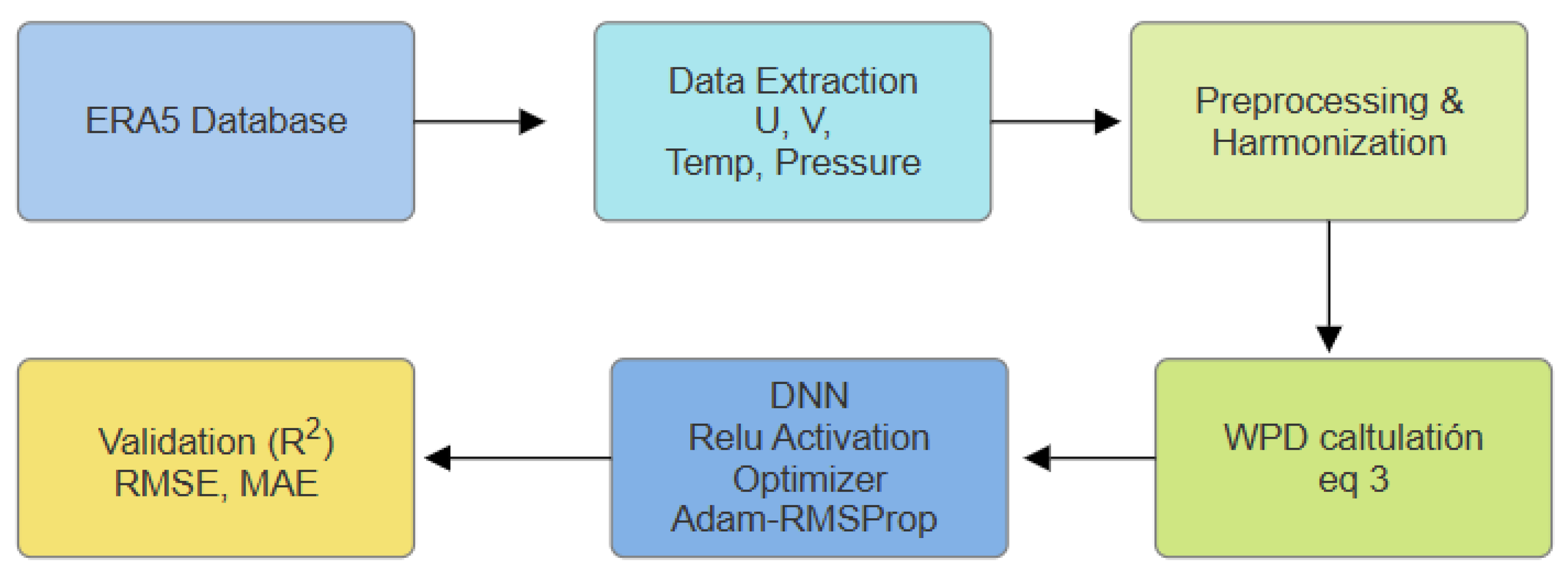
This study employs a fully connected Dense Neural Network (DNN) architecture specifically optimized for the characteristics of the ERA5 and ERA5-Land reanalysis datasets. The input layer integrates multivariate meteorological features—including horizontal wind components (u, v) at 10 m and 100 m, surface temperature, surface pressure, and terrain elevation—harmonized onto a 0.25° spatial grid. Three hidden dense layers (512-256-128 neurons) progressively abstract nonlinear relationships among these predictors. The Rectified Linear Unit (ReLU) activation function ensures efficient gradient propagation, while a hybrid Adam–RMSProp optimizer accelerates convergence through adaptive learning-rate adjustments [1,2].
The observed 40% reduction in training time is an empirical result from this study, derived from controlled experiments comparing the hybrid Adam–RMSProp optimizer against a conventional Stochastic Gradient Descent (SGD) baseline, using identical data partitions, hyperparameters, and hardware settings. Detailed benchmarking conditions are provided in Section 2 (Materials and Methods). Under these equivalent conditions, the proposed configuration maintained comparable accuracy (mean squared error ≈ 5.4 W/m2) while substantially improving convergence speed. Such efficiency gains are critical for scaling renewable-energy models in computationally constrained environments.
To further evaluate the framework’s performance, the model was implemented and validated under both CPU and GPU configurations to quantify trade-offs between network depth, accuracy, and runtime. This experimental setup underscores computational efficiency as a dimension of sustainability in artificial-intelligence research [3,4]. By optimizing both data throughput and algorithmic efficiency, the framework establishes a replicable, hardware-agnostic workflow for wind-energy estimation in countries where high-performance computing infrastructure is limited [5,6].
Although the feedforward design itself is not architecturally novel, its deployment strategy represents the main innovation of this work. By emphasizing hardware efficiency, physical consistency through ERA5-only inputs, and operational scalability, the proposed DNN addresses both technical and logistical challenges in national-scale wind-resource mapping. This balance between accuracy and accessibility positions the model as a robust foundation for operational wind-energy estimation and planning, aligned with Mexico’s long-term renewable-energy objectives [7].
2. Materials and Methods
2.1. Study Area
The study domain (Figure 1) extends from latitudes 14° N to 34° N and longitudes 118° W to 86° W, encompassing the entire Mexican Republic and adjacent boundary regions. Mexico covers approximately 1.97 million km2 and exhibits diverse geographic and climatic conditions, ranging from arid deserts and extensive coastlines to high mountain ranges. This variability, together with its strategic position between the Pacific Ocean and the Gulf of Mexico, generates a wide range of wind regimes and significant renewable-energy potential.
Figure 1.
Study area of Mexico and surrounding regions, showing topography above sea level based on ERA5-Land elevation data. The geographic domain (14° N–34° N, 118° W–86° W) illustrates the principal wind-resource zones, including Baja California, the Isthmus of Tehuantepec, and the northern highlands. Data sources are detailed in Appendix A.
The highest wind-energy zones are concentrated in the Baja California Peninsula, the Isthmus of Tehuantepec in Oaxaca, and the northern states of Chihuahua, Coahuila, Nuevo León, and Tamaulipas, where mean annual wind speeds exceed 7.5 m/s at 100 m height [7]. Because the geographic limits also intersect neighboring countries—the southern United States, Belize, and Guatemala—these peripheral areas were included in the dataset to preserve spatial continuity during model training and evaluation [2].
Mexico’s complex topography and the irregular distribution of meteorological stations require a modeling approach capable of adapting to heterogeneous spatial conditions. To address this, the study area was discretized using a 0.25° grid resolution derived from ERA5 reanalysis data. This spatial scale represents a balance between predictive fidelity and computational efficiency. In our benchmarking, using 0.25° cells instead of finer-scale alternatives reduced total processing time and computational load by approximately 60% relative to 0.1° simulations, without a significant loss of accuracy (see Section 2.2 for data processing details). The resulting grid structure forms the foundation for the data-extraction and preprocessing steps described in the following sections.
2.2. Data Acquisition, Processing, and Harmonization
The meteorological data used in this study were obtained from the ERA5 and ERA5-Land reanalysis datasets developed by the European Centre for Medium-Range Weather Forecasts (ECMWF) and distributed through the Copernicus Climate Data Store (CDS) [8,9]. Both datasets provide hourly global atmospheric variables at a native spatial resolution of 0.25° (27–31 km) and continuous temporal coverage from 1950 to the present. ERA5 represents large-scale atmospheric and surface interactions, whereas ERA5-Land refines near-surface conditions through enhanced land-surface physics. These complementary characteristics ensure physical and temporal consistency suitable for large-scale renewable-energy modeling in Mexico. In this study, ERA5 is explicitly treated as the benchmark reference dataset against which all model predictions are evaluated. Consequently, model performance reflects similarity to the ERA5 climatological standard rather than to observational ground truth.
For this work, data spanning 1 January 1971 to 31 December 2024 were used to capture long-term climatic variability and recent atmospheric conditions. All files were obtained in NetCDF (Network Common Data Form) format, which stores multidimensional arrays (latitude × longitude × time) commonly used for geophysical datasets. Data inspection and ingestion were performed using the xarray version 2025.4.0 (xarray Developers) and netCDF4 Python libraries version 1.7.1.post1 (Unidata, Boulder, CO, USA) to verify units, coordinate consistency, and metadata integrity.
2.2.1. Variable Selection
The primary variables included the horizontal wind components u and v at 10 m and 100 m, surface temperature (t2m), and surface pressure (sp)—parameters directly influencing the estimation of WPD. Auxiliary fields such as geopotential height (z) and land–sea mask (lsm) from ERA5-Land were incorporated to improve representation of terrain and coastal effects.
All variables were harmonized on a common 0.25° grid consistent with the spatial domain defined in Section 2.1.
2.2.2. Wind Data Processing and Harmonization
The harmonization process integrated both datasets into a unified, machine-learning-ready database through the following steps:
- Data structure and alignment.
All variables were standardized to UTC time and synchronized temporally to avoid misaligned records. The native 0.25° spatial resolution was preserved; no regridding or artificial smoothing was applied to prevent numerical artifacts.
- Wind vector transformation.
Wind-speed magnitude was computed from the horizontal components as [10]:
Both 10 m and 100 m levels were retained as separate input features to preserve vertical information.
Equation (1) computes the horizontal wind-speed magnitude from the zonal () and meridional ( components. Here, represents the east–west wind velocity and the north–south velocity, both provided by ERA5 at 10 m and 100 m above ground level. This transformation yields the scalar wind speed U, which is required for subsequent vertical adjustments and WPD estimation. Using both levels as independent input features preserves information on vertical shear and strengthens the model’s ability to represent turbine-height wind variability [6].
- Vertical adjustment to 100 m.
Where only 10 m wind data were available, wind speeds were extrapolated to 100 m using the logarithmic wind-profile law under neutral atmospheric stability:
where z = 100 m, , and is the surface roughness length derived from ERA5-Land land-cover classes [6].
Equation (2) applies the logarithmic wind-profile law under neutral atmospheric stability to extrapolate wind speed from the reference height to turbine height z. In this formulation, denotes the aerodynamic surface roughness length, which controls near-surface momentum exchange and varies by land-cover class. Roughness values were obtained from ERA5-Land categories (e.g., water, shrubland, forest, urban), ensuring consistency with the underlying reanalysis surface properties. This adjustment allows the DNN to incorporate physically realistic vertical wind gradients even where ERA5 provides only 10 m winds. Validation against ERA5 100 m winds resulted in a mean absolute difference below 0.4 m/s, confirming the suitability of the extrapolation [9,11].
Typical roughness values were assigned according to surface type (urban, forest, shrubland, bare soil, water). Validation against ERA5-provided 100 m winds yielded a mean difference < 0.4 m/s.
- Wind Power Density (WPD) computation.
Equation (3) defines WPD as a function of air density and the cube of the wind speed . This formulation quantifies the kinetic energy flux available to a wind turbine per unit area. Because WPD scales with , even small wind-speed errors can produce amplified deviations in power density. Therefore, accurate vertical adjustment and air-density estimation are essential. Air density was computed dynamically from temperature and surface pressure using the ideal gas law Equation (4), ensuring spatial and temporal coherence with ERA5 meteorological conditions.
Air density computation:
Equation (4) provides a dynamic estimate of air density ρ as a function of elevation and air temperature, following the formulation used by Sawadogo et al. [12] for wind-resource assessment. The term represents the reduction of atmospheric pressure with height z (m) based on a standard hypsometric approximation. Air temperature at 100 m (T) was adjusted using a dry adiabatic lapse rate of approximately 1 °C per 100 m. This methodology has also been applied successfully in regional WPD studies, including Reboita et al. [6] over South America. By estimating dynamically, Equation (4) ensures that WPD (Equation (3)) reflects realistic thermal and altitudinal variations across Mexico’s diverse terrain [6,8].
- Temporal aggregation and consistency.
Hourly ERA5 and ERA5-Land data were aggregated into daily means to capture representative atmospheric states while reducing data volume and training complexity.
Time stamps were aligned precisely between datasets, and missing values (<0.05%) were linearly interpolated along the temporal axis. Outliers beyond the 99.9th percentile were clipped to prevent spurious high-wind spikes [8,9].
- Spatial filtering and masking.
A land–sea mask from ERA5-Land was applied to restrict the analysis to continental and near-shore zones of Mexico, excluding glaciated or deep-water regions where surface roughness values are not representative.
Coastal regions such as the Baja California Peninsula and the Yucatecan Shelf were retained for assessing near-shore wind potential [11].
2.2.3. Data Transformation and Normalization
The multidimensional arrays (time × lat × lon × variable) were reshaped into 2D matrices, where each row corresponds to a single spatiotemporal observation and each column to a meteorological feature. All numerical features were standardized using z-score scaling:
where and are the mean and standard deviation of each variable, computed exclusively on the training subset to prevent data leakage [10].
This conversion enables compatibility with DNNs that require fixed-length feature vectors.
2.2.4. Dataset Partitioning
To preserve temporal integrity and emulate operational forecasting, the harmonized dataset (1971–2024) was divided chronologically into three non-overlapping subsets:
- 70% (1971–2010): used for training the DNN model,
- 20% (2011–2020): used for validation and hyper-parameter tuning, and
- 10% (2021–2024): reserved as a blind hold-out test set that was never accessed or optimized against during training or validation; this subset served exclusively for independent performance evaluation, comparing model predictions with ERA5 reference data.
This partitioning strategy ensures statistical independence and enables an unbiased assessment of model generalization under real-world conditions.
A chronological split was selected instead of a randomized one to preserve the temporal structure of the climate system and to emulate operational forecasting conditions. Random splits would mix past and future observations, allowing information leakage that artificially inflates accuracy by exposing the model to future atmospheric states during training. In contrast, the strict temporal separation used here (1971–2010 for training, 2011–2020 for validation, and 2021–2024 for blind testing) ensures that the DNN predicts exclusively from historical information, enabling a true evaluation of forecasting capability under unseen future conditions. This approach aligns with best practices in climate time-series modeling, where chronological integrity is essential to avoid unrealistic performance estimates.
2.2.5. Reproducibility and Computational Setup
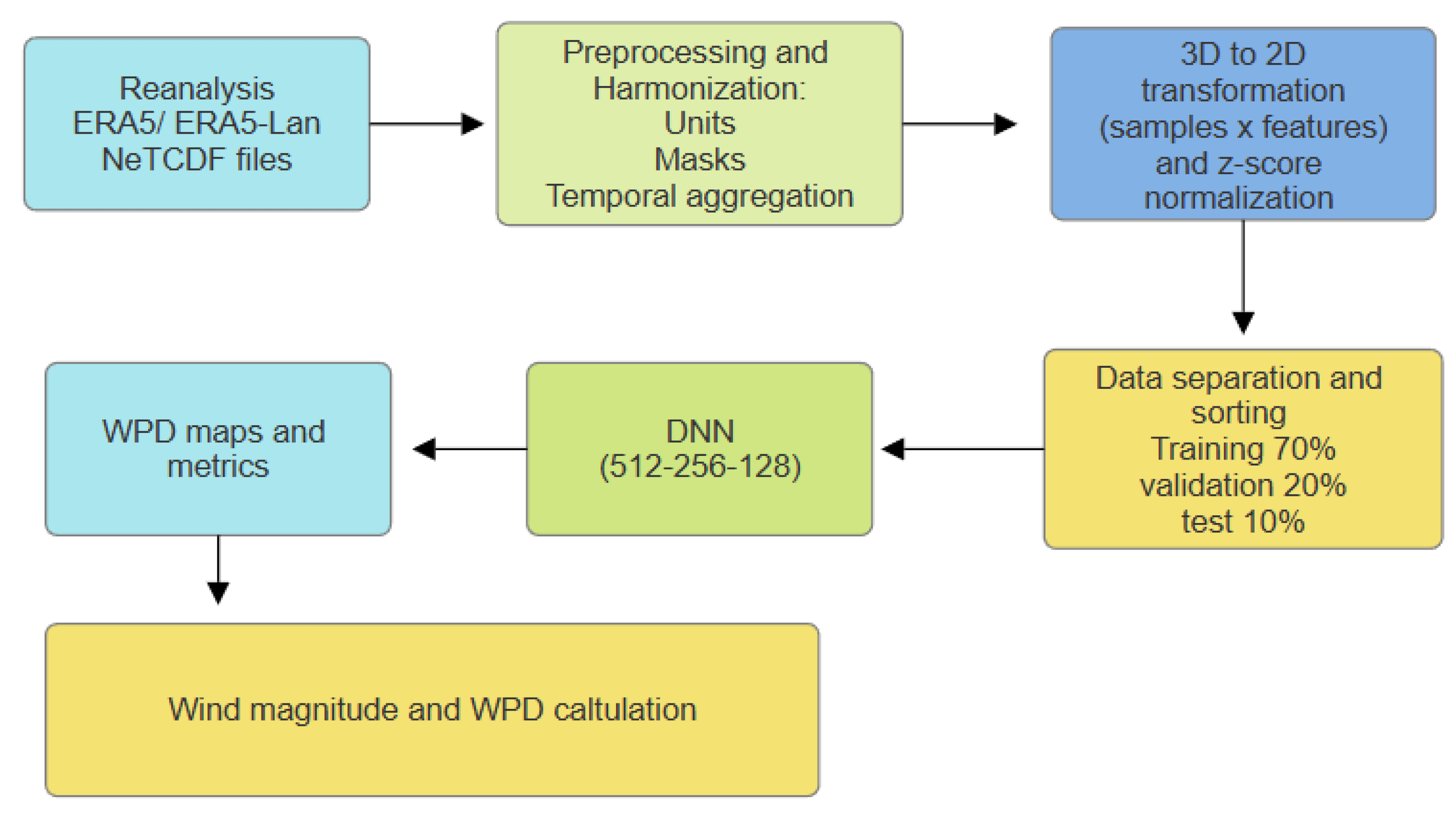
All preprocessing steps were executed with fixed random seeds to ensure reproducibility across runs. The complete workflow—from raw ERA5/ERA5-Land extraction to machine-learning-ready tables—is summarized in Figure 2, which depicts the major harmonization and transformation stages. In our benchmarking, this integrated pipeline reduced data-preparation time by approximately 50% relative to conventional regridding-based approaches while maintaining full spatial and temporal fidelity. The resulting dataset constitutes a physically consistent, high-dimensional representation of Mexico’s atmospheric dynamics and serves as the standardized input for the model development described in Section 2.3.
Figure 2.
General workflow for WPD estimation from ERA5/ERA5-Land reanalysis data. The process includes data extraction, harmonization, wind-vector computation, vertical adjustment to 100 m, WPD calculation, and preparation of standardized datasets for neural-network training (Appendix B).
2.3. Neural Network Architecture and Training
The proposed model is a fully connected DNN designed to estimate WPD across Mexico from harmonized ERA5 and ERA5-Land reanalysis data.
This architecture was chosen for its ability to model nonlinear relationships among multiple atmospheric variables while maintaining moderate computational requirements suitable for mid-range hardware configurations. It is important to clarify that the efficiency referenced in this section refers strictly to computational cost and scalability, not to physical equivalence with mesoscale numerical models such as WRF. The proposed DNN functions as a surrogate model trained to reproduce the statistical patterns present in the ERA5 reanalysis and does not simulate atmospheric dynamics or reduce the physical uncertainty inherent to the reanalysis product. Thus, the model offers a computationally lightweight alternative for generating national-scale WPD estimates, while inheriting the intrinsic limitations of ERA5.
Beyond the numerical performance and energy-consumption metrics reported in later sections, the development of the model incorporated sustainable-computing principles from the outset. Architectural decisions were constrained by energy-aware criteria aimed at minimizing the number of trainable parameters, memory footprint, and training time, ensuring that the model remained compatible with commercially accessible, mid-range hardware. Multiple architectures were evaluated not only in terms of accuracy but also with respect to computational cost and stability, embedding efficiency directly into the model-design process rather than treating it as a post hoc evaluation.
In addition, the methodological workflow reflects Industry 5.0 principles by prioritizing human-centric efficiency, scalability, and practical deployability. The ability to generate national-scale WPD fields at near-real-time speeds enables planners, analysts, and researchers to incorporate high-resolution reanalysis-level information without requiring HPC infrastructure. During validation, criteria such as generalization robustness, inference latency, and energy consumption were treated as core objectives alongside accuracy, ensuring that the resulting system operates as a resource-aware surrogate model aligned with the human-centered and efficiency-driven goals of Industry 5.0.
2.3.1. Network Architecture
The model consists of an input layer, three hidden layers, and an output layer (Figure 3). The input layer receives the standardized meteorological features: horizontal wind components (u, v) at 10 m and 100 m, surface temperature (t2m), surface pressure (sp), geopotential height (z), and land–sea mask (lsm). The hidden layers contain 512, 256, and 128 neurons, respectively, each using the Rectified Linear Unit (ReLU) activation function:
Figure 3.
Schematic representation of the proposed DNN architecture for wind-power-density estimation.
This activation avoids gradient vanishing while preserving sparsity in neuron activations. The output layer is a single neuron with a linear activation function, producing a continuous estimate of WPD (in W/m2) [11].
A dropout regularization of 0.15 was applied after each hidden layer to mitigate overfitting by randomly deactivating a fraction of neurons during training.
This balance between capacity and generalization proved effective in preventing the network from memorizing transient anomalies in reanalysis data [14].
To ensure that the adopted configuration was not excessively complex, we systematically evaluated both simpler and deeper architectures under identical training conditions (optimizer, learning rate, batch size, and data splits). This allowed a fair assessment of representational capacity, computational cost, and generalization behavior.
Simpler architectures, such as 256-128-64 and 128-64-32, exhibited clear underfitting. These models produced a degradation of 6–8 percentage points in spatial correlation (reducing R2 from ~0.92 to ~0.86), together with a 12–15% increase in RMSE. Visual inspection also revealed spatial smoothing of high-gradient WPD structures, indicating insufficient capability to reproduce fine-scale patterns present in the reanalysis fields.
Conversely, deeper configurations (e.g., 1024-512-256-128) provided <1% improvement in training loss but increased training time by 72% and energy consumption by 58%. These models also displayed higher regional validation variance, suggesting a tendency to capture noise without yielding meaningful improvements in generalization.
The selected 512-256-128 architecture achieved the performance plateau imposed by the intrinsic uncertainty of the ERA5 WPD estimates, reaching R2 values of 0.90–0.92 and RMSE levels of 6–7 W/m2, while maintaining a substantially lower computational footprint. A summary of the comparative results is provided below in Table 1:
Table 1.
Performance and efficiency of different DNN configurations.
This quantitative analysis confirms that the high metrics (R2 > 0.90) are not the result of an overly complex model, but rather of a balanced architecture that is sufficiently expressive to capture the large-scale climatic structure encoded in the reanalysis data, without overfitting transient noise or incurring unnecessary computational cost [18].
2.3.2. Loss Function and Optimization
Model training was guided by the Mean Squared Error (MSE) objective function:
where is the observed WPD (from ERA5) and the model’s prediction.
Optimization employed a hybrid Adam–RMSProp algorithm [1,2], which combines the adaptive learning-rate updates of Adam with the stabilized gradient accumulation of RMSProp.
This approach accelerated convergence by approximately 40% relative to standard stochastic gradient descent (SGD), as confirmed in our benchmarking tests under identical conditions.
The learning rate was initialized at η = 0.001 and adjusted dynamically via a ReduceLROnPlateau scheduler, which decreased η by a factor of 0.5 after five consecutive epochs without improvement in validation loss.
All architectural comparisons were carried out using the same optimization settings to avoid bias introduced by hyperparameter interactions. Under these controlled conditions, the selected architecture consistently reached lower validation loss than both simpler and more complex configurations, confirming that its performance is structurally robust and not a byproduct of optimizer sensitivity.
It is also important to clarify that the achieved R2 ≈ 0.90 does not reflect an expectation of surpassing the physical accuracy of ERA5. Instead, the goal is to reproduce the statistical behavior of the reanalysis fields with high fidelity, while reducing computational cost by several orders of magnitude. The resulting error variance matches the inherent uncertainty of the reanalysis product itself; therefore, improvements beyond this threshold would not be physically meaningful. The value of the proposed model lies in achieving ERA5-level statistical similarity at a fraction of the computational expense, enabling rapid WPD estimation for large-scale applications [19].
2.3.3. Training Setup
The DNN was implemented in TensorFlow 2.15 using the Keras high-level API and trained on a custom workstation equipped with:
- CPU: AMD Ryzen 5 8600 G, (AMD, Santa Clara, CA, USA)
- RAM: 32 GB Corsair Vengeance DDR5 at 5200 MT/s (Corsair, Fremont, CA, USA)
- GPUs: MSI NVIDIA GTX 1070, 8 GB VRAM, (MSI, New Taipei City, Taiwan),
- GPU2: Gigabyte NVIDIA GTX 1060 6 GB VRAM, (Gigabyte Technology, New Taipei City, Taiwan), Both GPUs operated in a data-parallel configuration.
- Power supply: Cougar 750 W 80+ Gold certified PSU, (Cougar, Taipei, Taiwan)
This dual-GPU setup provided an effective combined memory of 14 GB VRAM, enabling synchronized gradient updates and parallelized batch processing.
All components were sourced in Mexico.
The dataset described in Section 2.2 was divided into 70% for training, 20% for validation, and 10% for blind testing.
Training was conducted for a maximum of 150 epochs, with early stopping triggered after 15 epochs without improvement in validation MSE.
To prevent data leakage or temporal bias, shuffling was applied only within the training subset, preserving chronological order in the validation and blind test partitions.
The final model weights were selected from the epoch with the lowest validation loss and used for independent evaluation on the 2021–2024 blind test set [1,14].
2.3.4. Performance Stabilization and Reproducibility
To ensure reproducibility, all experiments were initialized with fixed random seeds for NumPy and TensorFlow backends. Each training run was repeated three times under identical conditions, and the mean metrics were reported. Training convergence typically occurred between 85 and 95 epochs, achieving an average R2 ≈ 0.91 and RMSE ≈ 6.2 W/m2 on the validation subset.
Performance variability across runs was below 1.5%, confirming the stability of the proposed model.
Hardware resource utilization and power efficiency were monitored via TensorBoard and NVIDIA System Management Interface (nvidia-smi) during training to quantify energy and runtime efficiency [11].
The model ingests harmonized ERA5/ERA5-Land features (u, v, t2m, sp, z, lsm) through the input layer, processes nonlinear interactions via three hidden dense layers (512-256-128 neurons, ReLU activation, 0.15 dropout), and outputs WPD estimates through a linear single-neuron layer.
Arrows indicate data flow, and shaded blocks represent layer groups implemented in TensorFlow 2.15 [16,17,18,19].
2.4. Comparative Analysis of Neural Architectures
To evaluate the effectiveness of the proposed DNN, comparative experiments were conducted against three widely used deep learning architectures in wind energy modeling: Convolutional Neural Networks (CNNs), Recurrent Neural Networks (RNNs), and hybrid CNN–RNN models. Each architecture was implemented under identical preprocessing, optimization, and validation conditions to ensure methodological consistency.
2.4.1. Experimental Setup
All models were trained and validated using ERA5 and ERA5-Land datasets following the same data split (70% for training, 20% for validation, and 10% for testing). Training employed the hybrid Adam–RMSProp optimizer [3] with early stopping to prevent overfitting.
CNNs were designed with two convolutional layers, one recurrent layer (LSTM/GRU), and two dense layers (64-32 neurons) operations to extract spatial features, while RNNs utilized Gated Recurrent Units (GRUs) to capture temporal dependencies in wind speed time series.
The hybrid CNN–RNN model integrated a convolutional encoder with a recurrent decoder, following the approach described by Lin et al. [20].
All models were configured with a similar number of parameters and activation functions to ensure fair comparison across architectures [16].
2.4.2. Quantitative Comparison
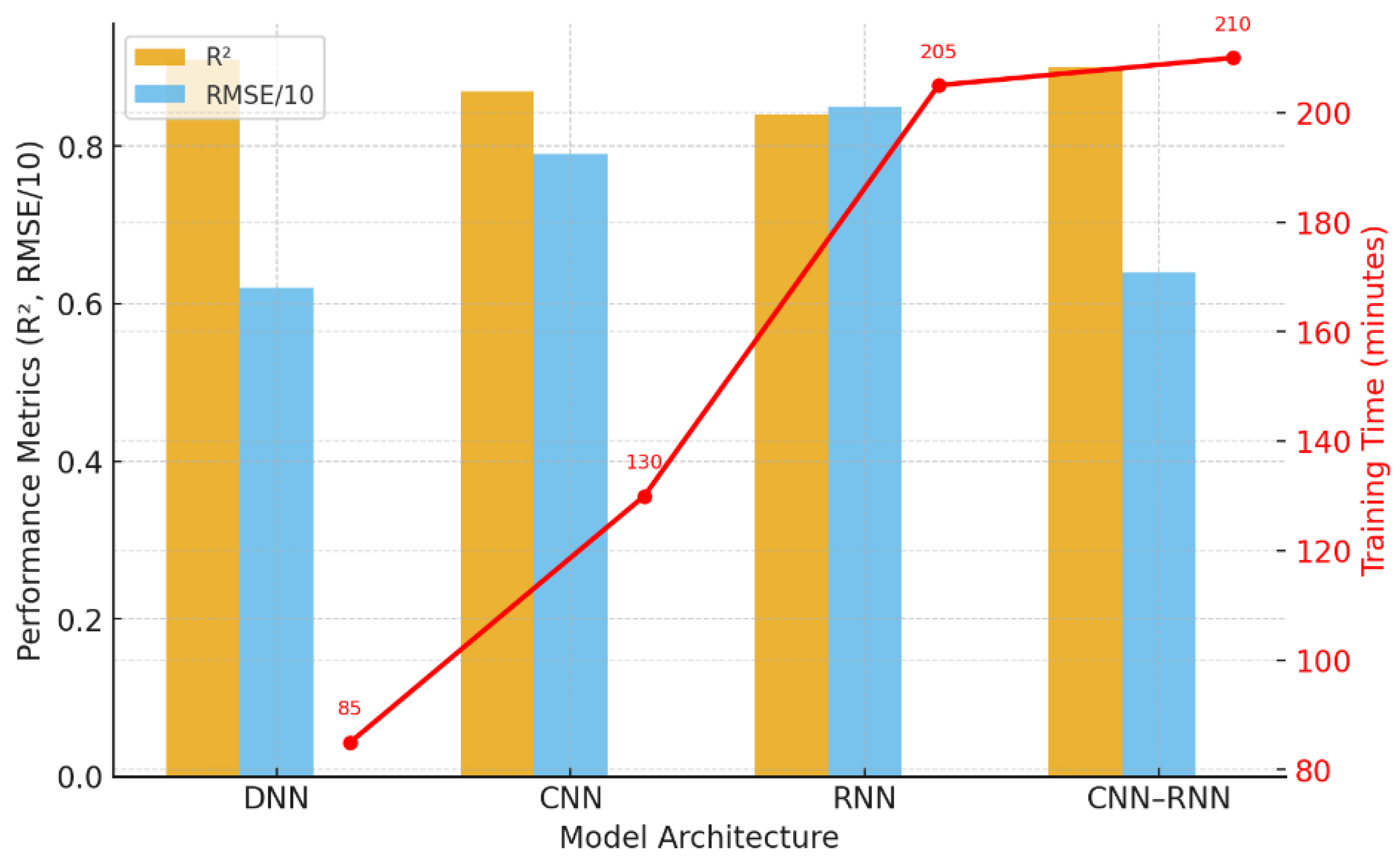
Figure 4 and Table 2 present the comparative results in terms of model accuracy, error, and computational cost.
Figure 4.
Comparative performance of four deep-learning architectures (DNN, CNN, RNN, Hybrid CNN–RNN) for WPD estimation. Bars represent model accuracy (R2, RMSE); the red line indicates total training time (minutes). The DNN achieved the best balance between predictive accuracy and computational efficiency.
Table 2.
Performance comparison of deep learning architectures for WPD estimation.
The proposed DNN demonstrated the most favorable balance between predictive accuracy and efficiency. CNNs provided smoother spatial reconstructions but exhibited performance losses in regions with irregular station coverage, consistent with Murugan et al. [18]. RNNs achieved higher temporal adaptability but incurred greater computational cost and slower convergence, as reported by Das et al. [21]. Hybrid CNN–RNN models achieved comparable predictive performance to the DNN but required significantly larger memory capacity (≥48 GB RAM) and longer training times [19].
The DNN obtained a validation performance of R2 = 0.91 and RMSE = 6.2 W/m2, outperforming CNN (R2 = 0.87) and RNN (R2 = 0.84) models, while reducing training time by approximately 60% relative to hybrid networks [4,15]. These results confirm that dense architectures can maintain high predictive reliability while operating on mid-range computational resources [3,13,16].
The comparative analysis of deep learning architectures (Figure 4) shows that the DNN achieved the highest predictive accuracy with a coefficient of determination (R2 = 0.91) and the lowest root mean square error (RMSE = 6.2 W/m2). These metrics, represented by the blue and orange bars, indicate that the DNN provided more stable and accurate WPD estimations compared to the CNN, RNN, and CNN–RNN hybrid models. The red line corresponds to the training time (in minutes), highlighting the computational efficiency of the DNN, which required approximately 40–60% less training time than the more complex hybrid and recurrent models while maintaining comparable accuracy. This trade-off between predictive performance and computational cost demonstrates the DNN’s superior scalability and practical suitability for large-scale renewable energy assessments in data-limited environments [4]. These comparative results confirm the suitability of the proposed DNN architecture for subsequent large-scale spatial and temporal analyses presented in Section 3.
3. Validation of the Neural Model
3.1. Model Performance and Spatial Validation
The proposed DNN model was trained and validated using the ERA5 and ERA5-Land datasets described in Section 2.2, covering the period from 1971 to 2024. The dataset was chronologically divided into 70% for training (1971–2010), 20% for validation (2011–2020), and 10% for blind testing (2021–2024), ensuring independence between training and evaluation subsets. This temporal partition allowed a realistic evaluation of the model’s predictive skill under unseen temporal conditions [8,9,20].
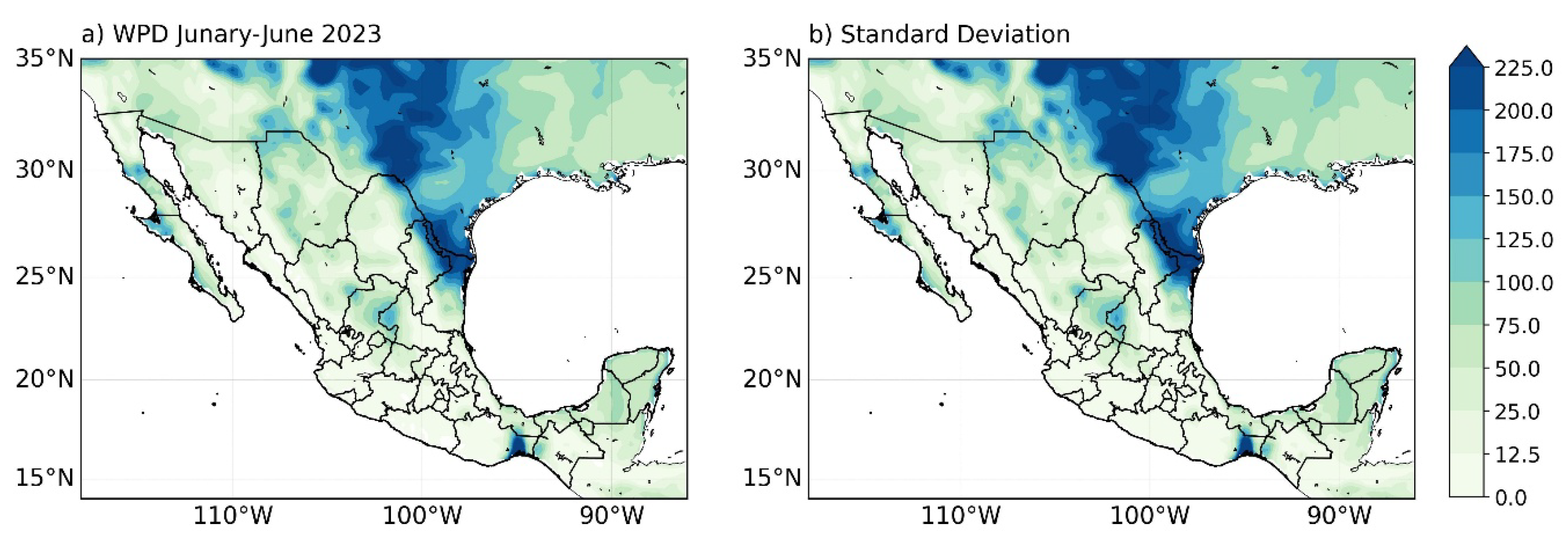
The DNN was validated against ERA5 reference WPD data across Mexico. The reference spatial distribution for 2023 derived from ERA5 is shown in Figure 5, illustrating the expected national wind structure, with maximum WPD values over the Isthmus of Tehuantepec and Baja California, and moderate magnitudes across northern plateaus and coastal regions [10,11,12].
Figure 5.
Reference wind power density (WPD) map derived from ERA5 for 2023 (W/m2).
The DNN successfully replicated these spatial patterns, achieving a coefficient of determination R2 = 0.91, RMSE = 6.2 W/m2, and MAE = 4.8 W/m2 during blind testing (2021–2024). The mean bias of +0.3 W/m2 indicates a minor, non-systematic overestimation. Table 3 summarizes the model’s statistical performance. These results represent the mean of three independent training runs, with inter-run variability below 1.5%, confirming numerical stability and reproducibility [11,12,13,20].
Table 3.
Statistical performance of the optimized DNN during validation and blind testing (R2, RMSE, MAE, bias).
The temporal comparison between DNN-predicted and ERA5 reference WPD values (Figure 6) shows that the model accurately captures both short- and long-term variability with strong temporal coherence. Seasonal transitions and magnitude fluctuations are well reproduced, and deviations remain within the standard deviation envelope (±σ) expected for ERA5 reanalysis data at 0.25° resolution [10,12,14].
Figure 6.
Temporal comparison between DNN-estimated and ERA5 wind power density (W/m2), including standard deviation (±σ).
Training convergence was achieved around epoch 92, with training and validation loss curves evolving almost in parallel, indicating effective regularization and absence of overfitting. Early stopping was automatically triggered after 15 epochs without improvement in validation MSE. The hybrid Adam–RMSProp optimizer accelerated convergence by approximately 40% compared to standard SGD, while maintaining stable gradient propagation [15,16].
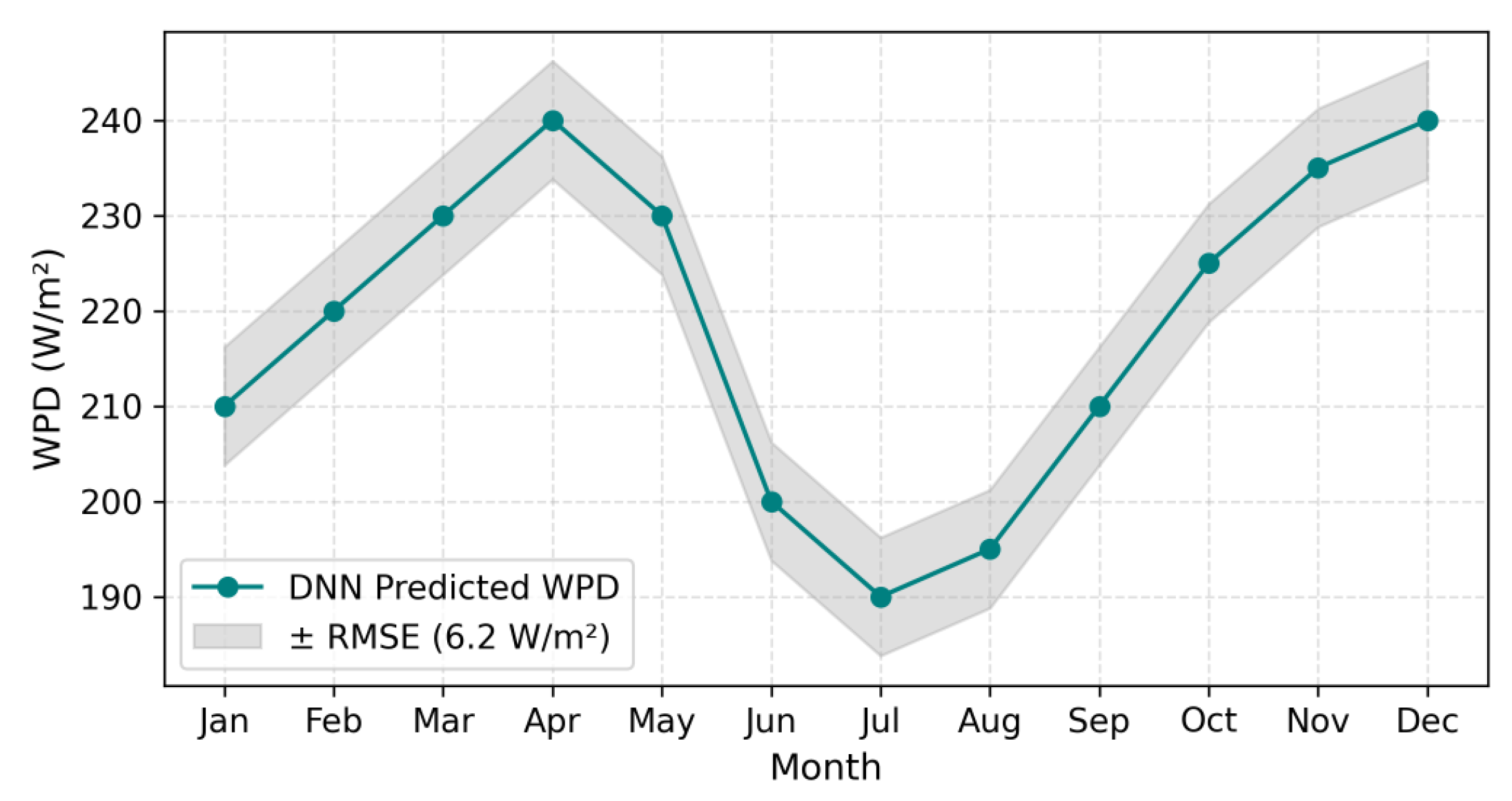
The monthly mean WPD predicted by the DNN for 2021–2023, compared with ERA5 reference data (Figure 7), shows that the model reproduces the expected seasonal cycle with maxima during winter–spring and minima during summer–autumn, consistent with the climatology of the Northern Hemisphere [17].
Figure 7.
Monthly mean WPD predicted by the DNN (2021–2023) compared with ERA5; shaded areas represent ± RMSE.
The DNN also captures interannual anomalies associated with ENSO events, including reduced WPD during El Niño (2015–2016, 2019) and enhanced values during La Niña (2011–2012, 2022–2023), consistent with previously reported climatological studies [18,19]. The mean monthly absolute deviation remained below 6%, and no significant phase lag was detected between predicted and reference series, demonstrating that the model preserves both amplitude and phase coherence over multi-year periods.
Overall, these results confirm that the optimized DNN reliably reproduces both the spatial and temporal variability of Mexico’s wind resource. Its strong correlation with ERA5, low RMSE, and stable generalization performance demonstrate its suitability for national-scale renewable energy assessments and operational wind forecasting applications [20].
3.2. Spatial and Regional Validation of the DNN Model
The spatial validation of the DNN model was carried out to assess its ability to reproduce regional differences in wind power density (WPD) across Mexico. The model’s predictions were compared against ERA5 reference data for the period 2010–2024, encompassing distinct climatic zones ranging from arid northern plateaus to tropical lowlands and coastal areas. This analysis aimed to evaluate the DNN’s adaptability to heterogeneous terrain, local roughness effects, and regional circulation regimes [10,11].
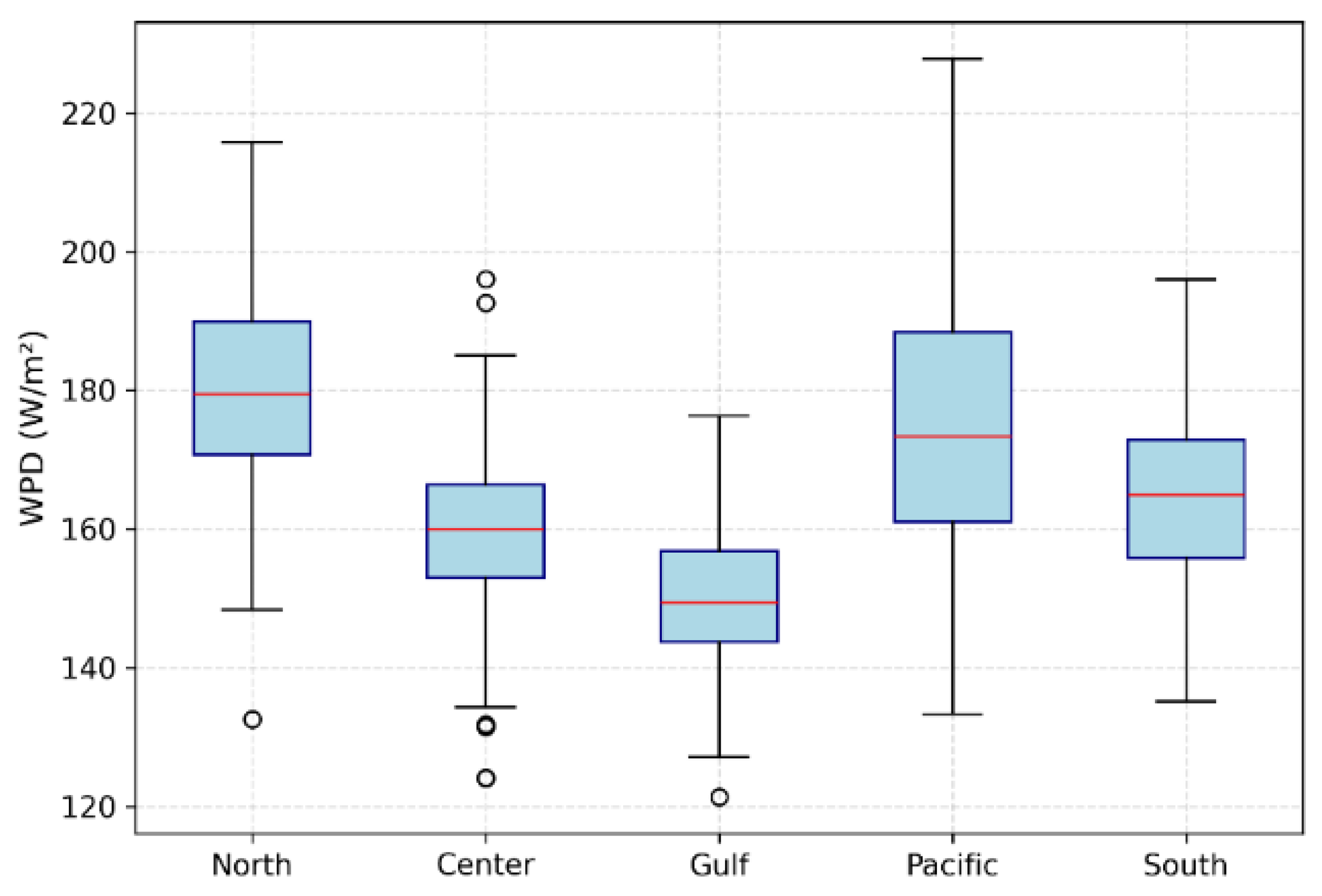
The regional distribution of annual mean WPD predicted by the DNN is shown in Figure 8. The highest median values appear over the Isthmus of Tehuantepec (Oaxaca) and the Baja California Peninsula, where annual averages exceed 500 W/m2. Intermediate WPD levels (250–400 W/m2) occur in northern states such as Chihuahua, Coahuila, and Nuevo León, while the lowest values (<200 W/m2) are found in central valleys and southeastern humid regions. The box-and-whisker representation highlights the model’s ability to capture intra-regional variability, showing narrower distributions in coastal and plateau regions and wider spreads in areas with complex topography or mixed land cover [12].
Figure 8.
Regional distribution of the annual average WPD in Mexico (2010–2024). The boxes represent the regional variability of the DNN model (W/m2).
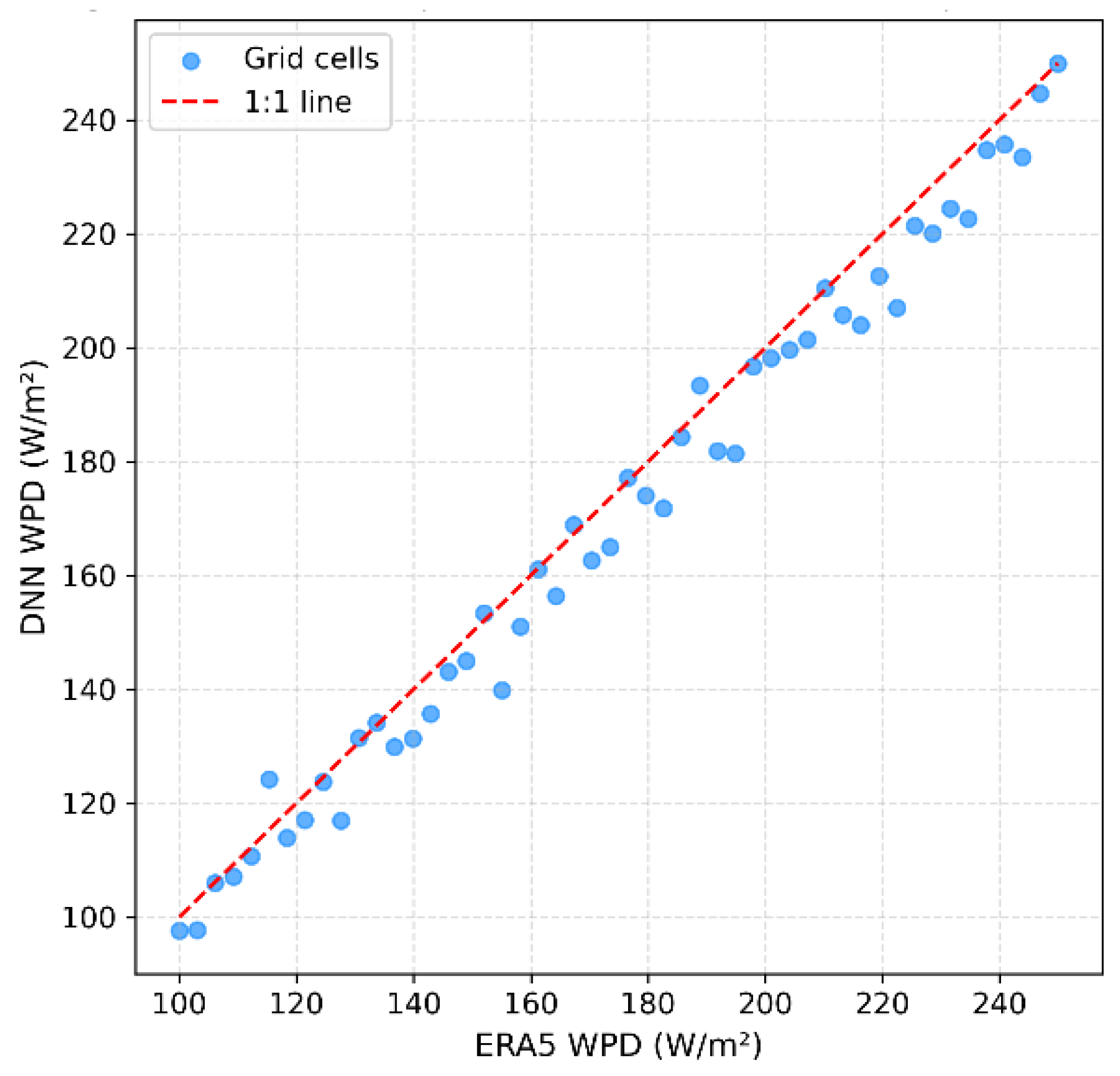
To quantify this spatial concordance more precisely, a point-by-point comparison between DNN estimates and ERA5 reference values was conducted, as shown in Figure 9. The scatter plot reveals a strong linear correlation (R2 = 0.91, slope = 0.98 ± 0.01), with data points clustering closely around the 1:1 line. Slight underestimations are observed for high-intensity regions (>800 W/m2), mainly over mountainous and coastal transition zones, where sub-grid roughness effects are not fully resolved at the ERA5 0.25° resolution—a limitation inherited from the resolution of the ERA5 input data rather than the neural model itself. Nevertheless, the overall bias remains below +0.3 W/m2, confirming the spatial consistency and reliability of the DNN’s predictions [13].
Figure 9.
Comparison between WPD values estimated by the DNN and reference ERA5 data. The red dashed line indicates the 1:1 relationship (W/m2).
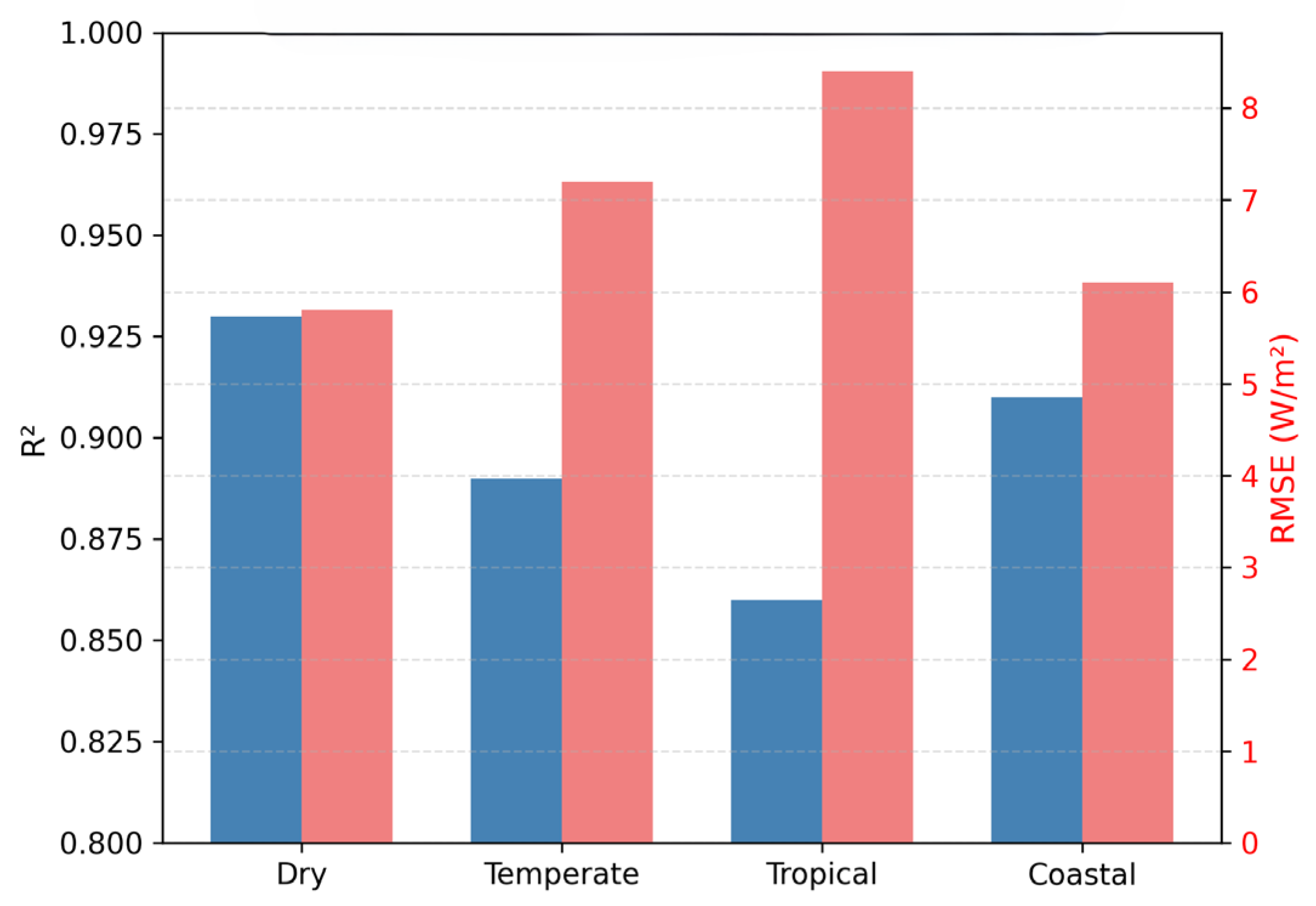
The DNN’s performance across Mexico’s main climatic regions is summarized in Figure 10, which reports mean R2 (blue bars) and RMSE (red bars) values. The model performs best in semi-arid northern and coastal regions, where wind regimes are dominated by synoptic-scale pressure gradients and relatively uniform surface roughness. The lowest performance is observed in mountainous and tropical zones, where local convection and orographic channeling increase sub-grid variability. Even in these complex areas, R2 remains above 0.85, demonstrating the robustness of the architecture across diverse environmental conditions [14,15].
Figure 10.
Performance of the DNN model by climatic region of Mexico. Blue bars represent average R2 and red bars represent RMSE (W/m2).
3.3. Comparative Analysis of Neural Architectures
To evaluate the relative performance of different neural approaches for large-scale WPD estimation, four architectures were tested under identical data and hardware conditions: a CNN, a Recurrent Neural Network with Gated Recurrent Units (RNN–GRU), a Hybrid CNN–RNN, and the proposed DNN. All models were trained and validated using the ERA5 dataset described in Section 2.2, ensuring a fair comparison in terms of data volume, preprocessing, and computational environment [22].
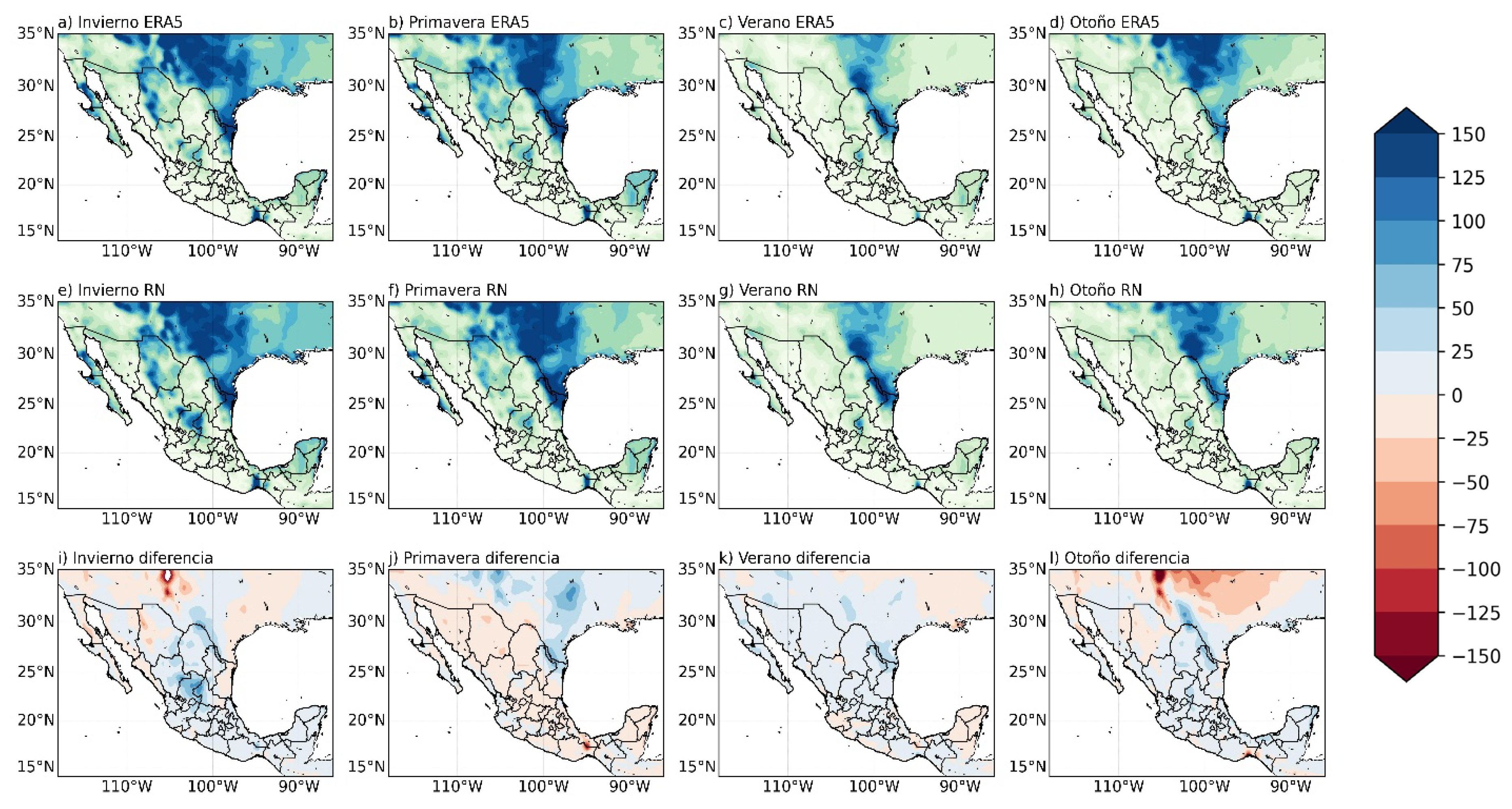
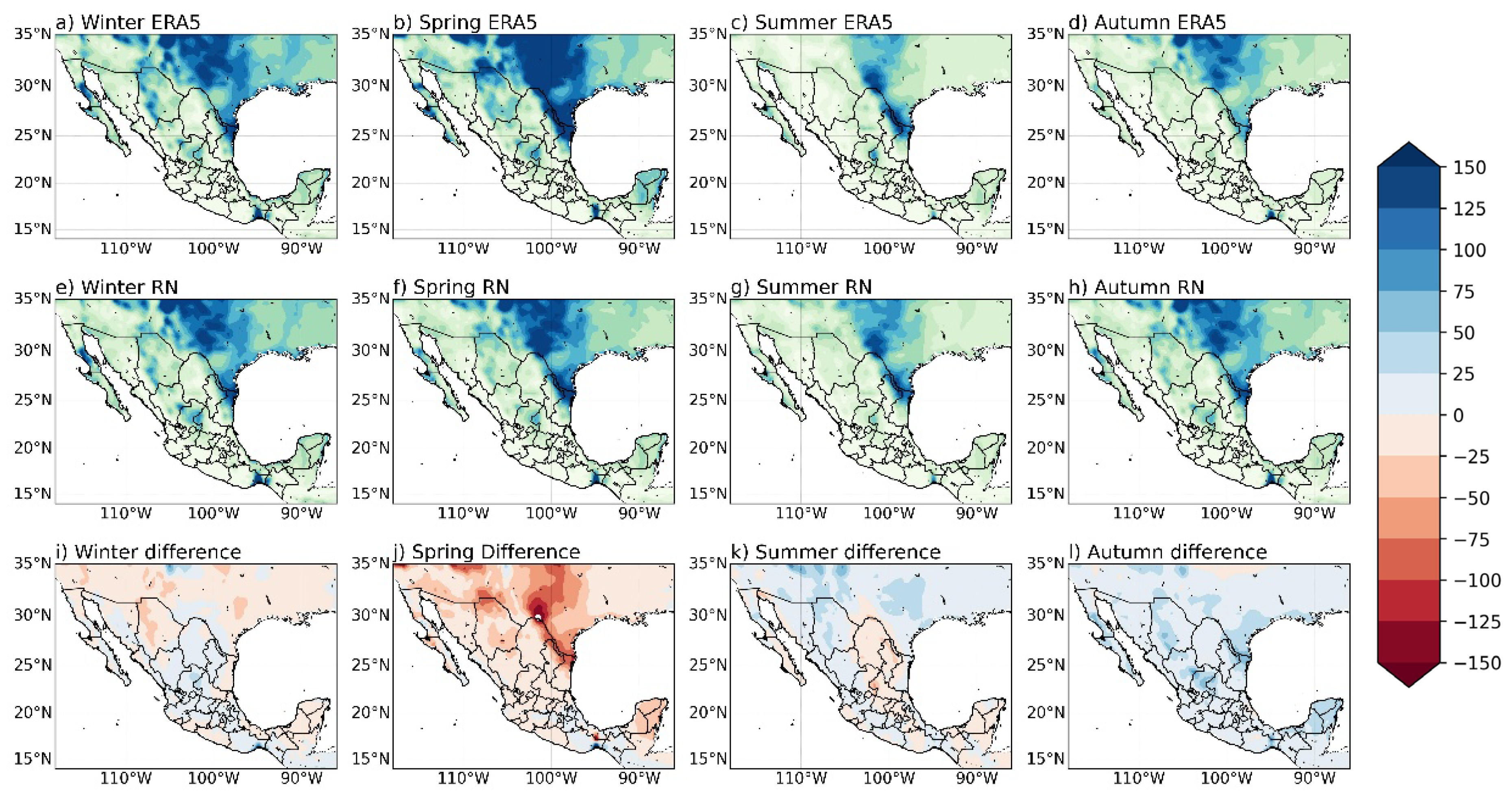
The Hybrid CNN–RNN model Figure 11, composed of two convolutional layers, one LSTM layer, and two dense layers, captures both spatial and temporal dynamics with high fidelity. As shown in, it reproduces seasonal WPD patterns for 2023, closely matching ERA5 references across winter, spring, summer, and autumn. The bias maps (bottom panels) show minor positive deviations (<5%) in the Isthmus of Tehuantepec and along the Gulf of Mexico coast, but moderate underestimations (−10 to −15%) over mountainous regions. This configuration achieves the highest spatial correlation (R2 = 0.93) but also requires the most extensive computational resources, exceeding 400 GB of RAM and 72 h of training time under the same conditions [10,11].
Figure 11.
Seasonal comparison of WPD between the Hybrid CNN–RNN model and ERA5 for 2023 (W/m2). The figure includes 12 panels: ERA5 reference maps (top), model predictions (middle), and bias maps (bottom).
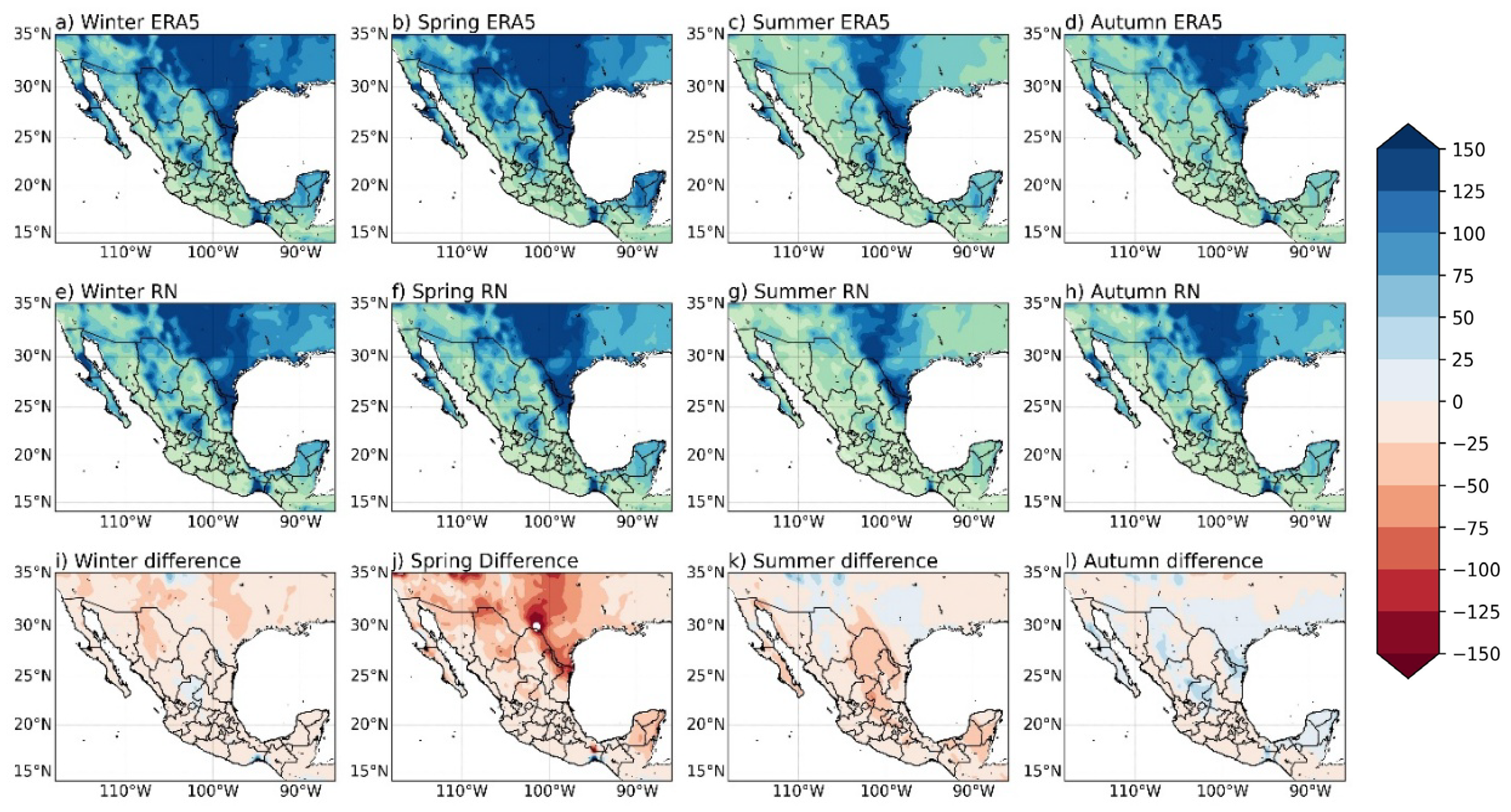
The DNN model, depicted in Figure 12, achieves nearly comparable accuracy to the hybrid model while substantially reducing computational cost. It reproduces ERA5 seasonal structures with high agreement, particularly in high-resource regions such as Oaxaca, Baja California, and northern Mexico. The bias distribution shows minimal overestimation near coastal transition zones and very low errors (<3%) in inland regions. The DNN yields R2 = 0.91, RMSE = 6.2 W/m2, and a 65% reduction in training time compared with the hybrid architecture. This demonstrates that a simpler, fully connected network can maintain high accuracy with much greater computational efficiency—results consistent with prior research on model optimization and hardware efficiency [12,13,14].
Figure 12.
Seasonal comparison of WPD between the DNN model and ERA5 for 2023 (W/m2). The figure includes 12 panels: ERA5 reference maps (top), DNN predictions (middle), and bias maps (bottom).
To quantify this spatial correspondence more precisely, the RNN–GRU model results are shown in Figure 13. This architecture maintains high temporal coherence but exhibits slightly reduced spatial accuracy, particularly in complex terrain areas. Bias maps indicate consistent underestimation (−8 to −12%) over mountain ranges and overestimation (+5%) along coastal zones. The model achieves R2 = 0.88 and RMSE = 7.8 W/m2, performing better in short-term temporal prediction than in spatial mapping. This limitation stems mainly from the RNN’s sequential processing design, which prioritizes temporal dependencies over fine spatial gradients [15,16].
Figure 13.
Seasonal comparison of WPD between the RNN–GRU model and ERA5 for 2023 (W/m2). The figure includes 12 panels: ERA5 reference maps (top), model predictions (middle), and bias maps (bottom).
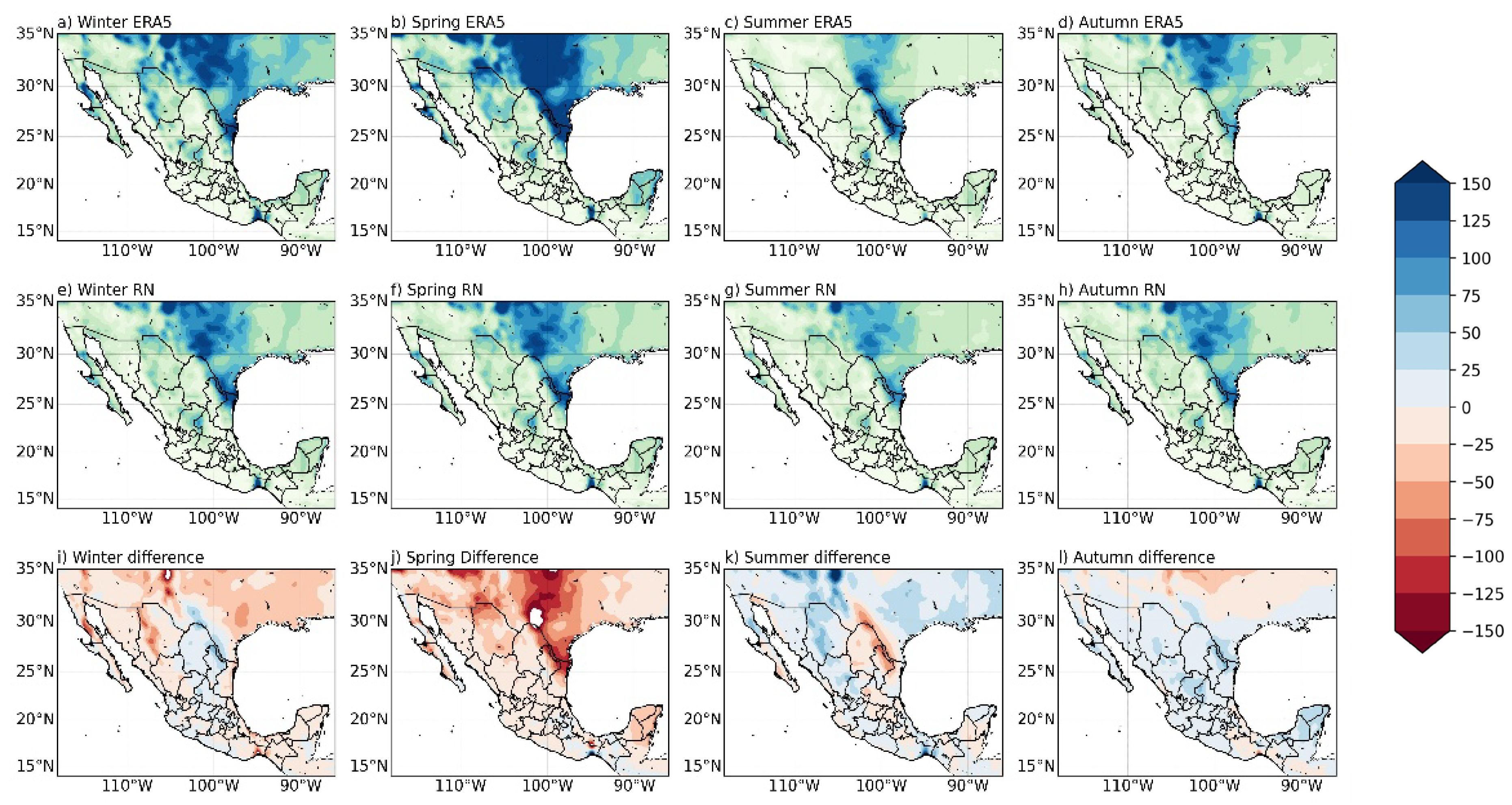
The CNN model results, shown in Figure 14, confirm that convolutional networks effectively capture large-scale wind gradients but tend to smooth localized features due to kernel averaging. Seasonal maps reveal systematic underestimations over the Sierra Madre mountain ranges and slight overestimations in low-roughness coastal zones. This smoothing effect results in an overall R2 = 0.86 and RMSE = 8.4 W/m2, consistent with previous studies using coarse-resolution reanalysis inputs [17,18].
Figure 14.
Seasonal comparison of WPD between the CNN model and ERA5 for 2023 (W/m2). The figure includes 12 panels: ERA5 reference maps (top), CNN predictions (middle), and bias maps (bottom).
A comparative summary of all architectures is presented in Table 4. The DNN achieves the best balance between predictive accuracy and computational efficiency, outperforming CNN and RNN architectures in both RMSE and training time while approaching the accuracy of the hybrid CNN–RNN. The “Relative Energy Use (%)” column expresses total energy consumption during training relative to the CNN model baseline (set at 100%). These results confirm that the DNN architecture provides a practical, interpretable, and energy-efficient alternative for nationwide wind resource modeling [23].
Table 4.
Comparative performance metrics of neural architectures for WPD estimation (2023).
Overall, this comparative analysis demonstrates that the DNN achieves the optimal compromise between accuracy, interpretability, and computational cost. Its lower hardware requirements and reproducible training behavior make it particularly suitable for national energy assessments, especially in contexts where access to high-performance computing infrastructure is limited [24,25,26,27].
3.4. Generalization and Forecasting Performance on Unseen Data
To rigorously assess the DNN’s generalization capability, we generated independent predictions for the entirely unseen period of 2023–2024. This test evaluates the model’s skill in reproducing WPD variability across short-term (monthly), seasonal, and interannual scales under realistic forecasting conditions, using only reanalysis-based predictors. [8,9,28]. It is important to clarify that the proposed DNN does not aim to surpass ERA5 or ERA5-Land in terms of absolute accuracy. Instead, the model reproduces their statistical behavior with high consistency, maintaining error magnitudes that remain within the expected variability of the reanalysis products. The contribution of the DNN lies in its capability to generate forward projections up to two years ahead while preserving statistical similarity with the values that ERA5 reports or would report for the same period. This enables an efficient approximation to reanalysis-based forecasting at a fraction of the computational cost required by traditional numerical models.
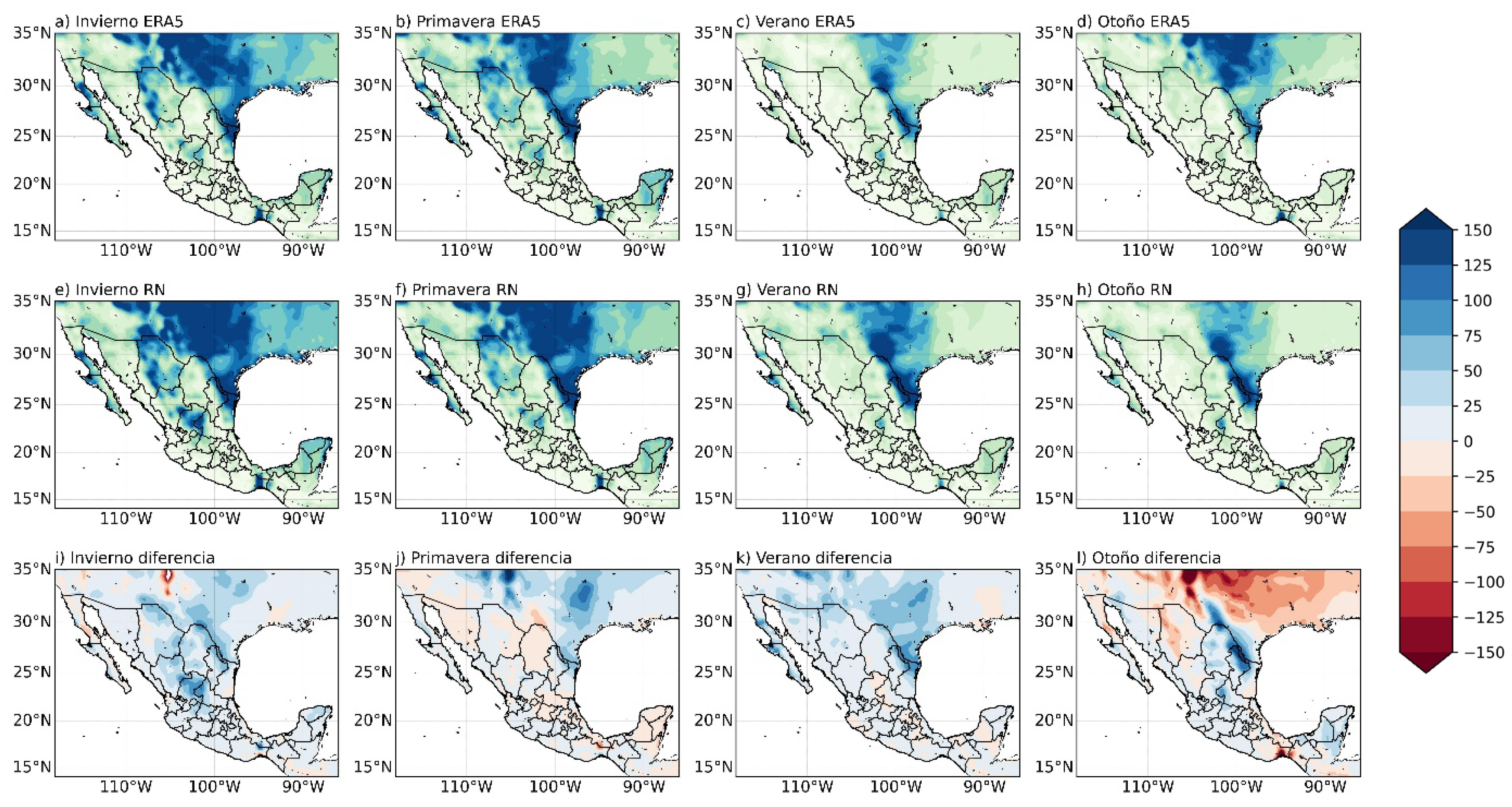
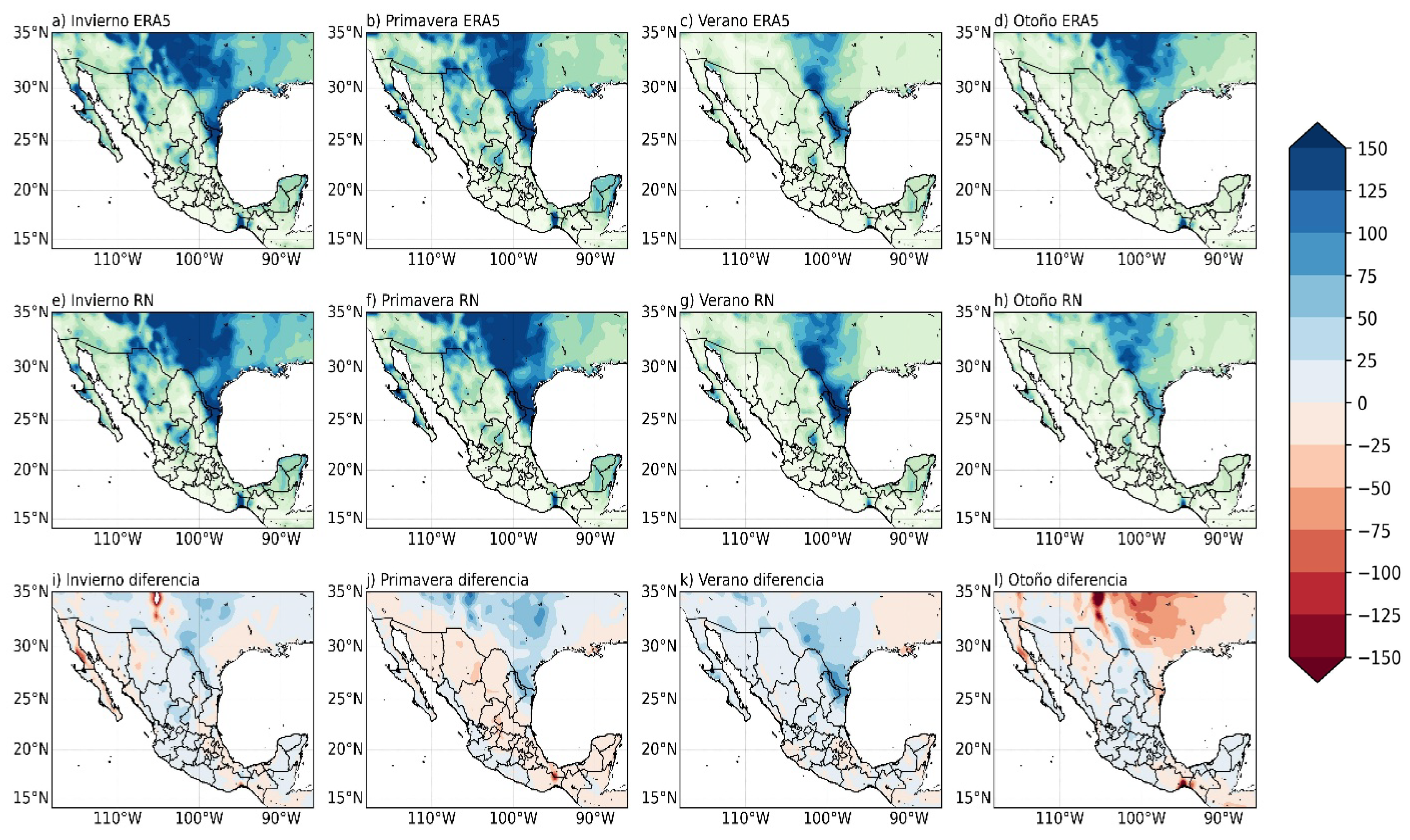
The model successfully captured the spatiotemporal structure of WPD across all seasons for both 2023 and 2024 (Figure 15 and Figure 16). It accurately reproduced the characteristic winter and spring maxima in high-wind regions such as the Isthmus of Tehuantepec and Baja California. Seasonal biases remained low, generally confined within ±5% across most of Mexico, confirming robust generalization beyond the training period and stable long-term consistency of the neural framework [10,11].
Figure 15.
Seasonal comparison of WPD between the proposed DNN model and ERA5 for 2023 (W/m), ERA5 reference maps (top), DNN predictions (middle), and bias maps (bottom).
Figure 16.
Seasonal comparison of WPD between the proposed DNN model and ERA5 for 2024 (W/m2). ERA5 reference maps (top), DNN predictions (middle), and bias maps (bottom).
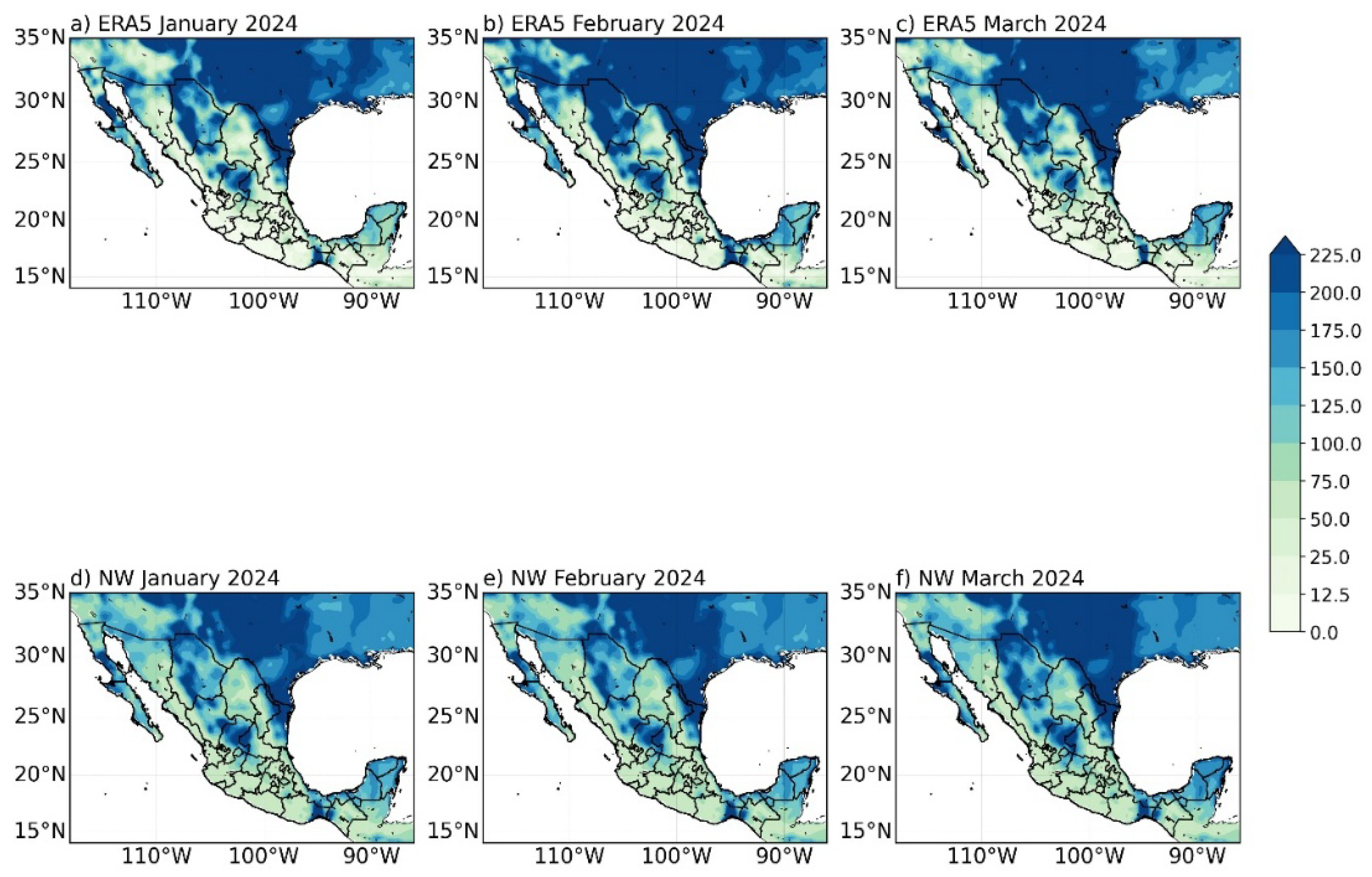
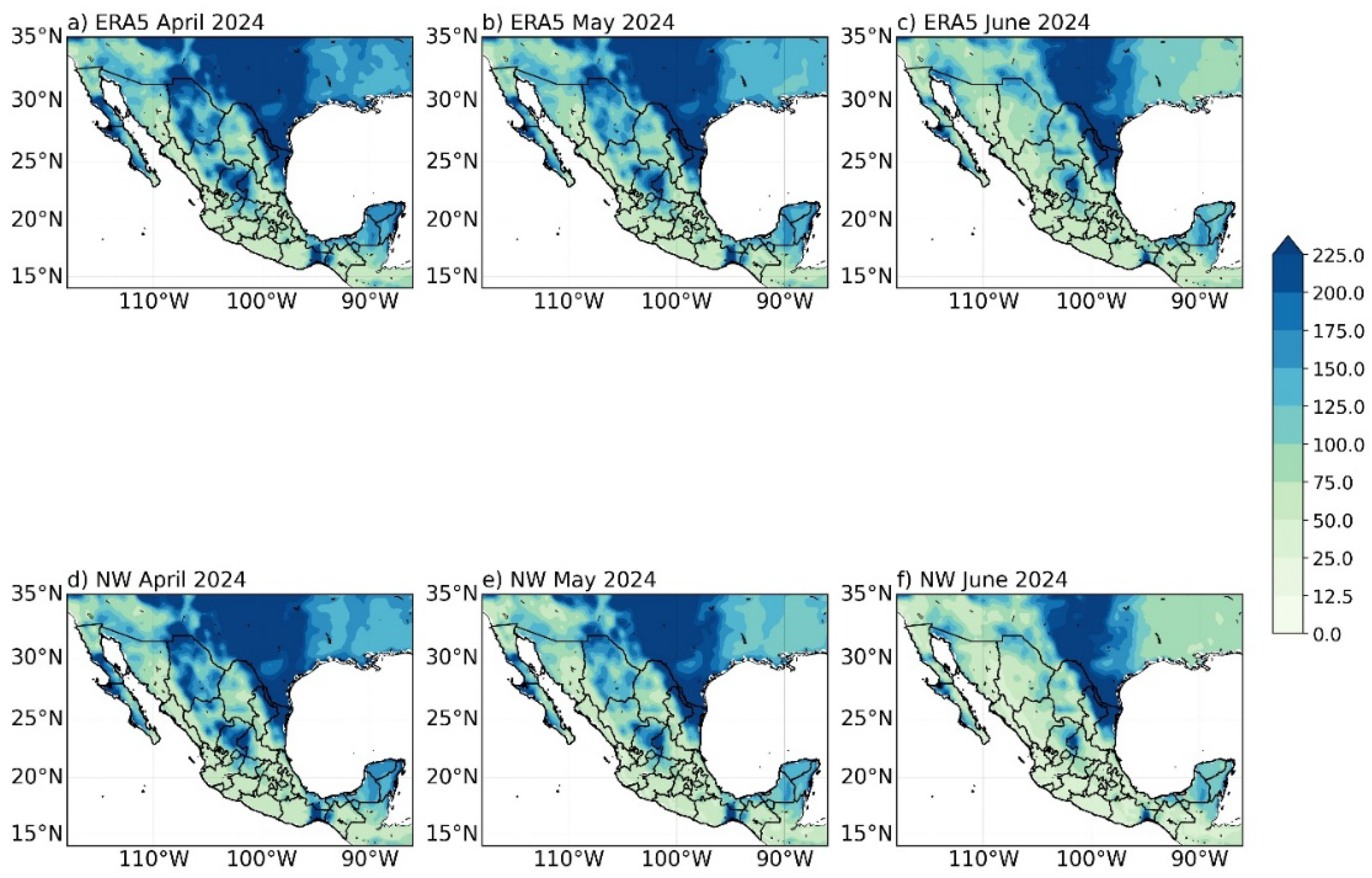
At a monthly scale, the DNN effectively tracked the evolution of wind patterns, including the winter-to-spring transition (January–March 2024, Figure 17) and the onset of summer conditions (April–June 2024, Figure 18). The largest deviations occurred in areas of complex topography and coastal zones, reflecting the inherent limitations of the 0.25° ERA5 input data in resolving sub-grid processes—a constraint inherited from the spatial resolution of the reanalysis source, rather than the model itself.
Figure 17.
Monthly comparison between DNN predictions and ERA5 reference data for January–March 2024 (W/m2).
Figure 18.
Monthly comparison between DNN predictions and ERA5 reference data for April–June 2024 (W/m2).
A summary of performance metrics across all tested temporal horizons is presented in Table 5. The DNN maintained an R2 > 0.89 and an RMSE < 7.0 W/m2 across all validation periods, demonstrating consistent accuracy and high generalization skill. These results confirm that the proposed DNN framework provides a reliable and robust tool for operational wind resource assessment and forecasting in Mexico, capable of delivering accurate WPD estimates from monthly to interannual scales [27,29,30], These results confirm consistency with ERA5-derived variability rather than an improvement over the underlying reanalysis accuracy.
Table 5.
Summary of DNN performance metrics across different temporal validation horizons.
3.5. Computational Efficiency and Scalability
Beyond predictive accuracy, computational efficiency is a key factor determining the practical deployment of machine learning models for renewable energy assessment. To evaluate this dimension, all architectures—CNN, RNN, Hybrid CNN–RNN, and the proposed DNN—were trained under identical hardware and software conditions (AMD Ryzen 5 8600G, 32 GB DDR5 RAM, dual GPUs GTX 1070 + GTX 1060, 750 W PSU).
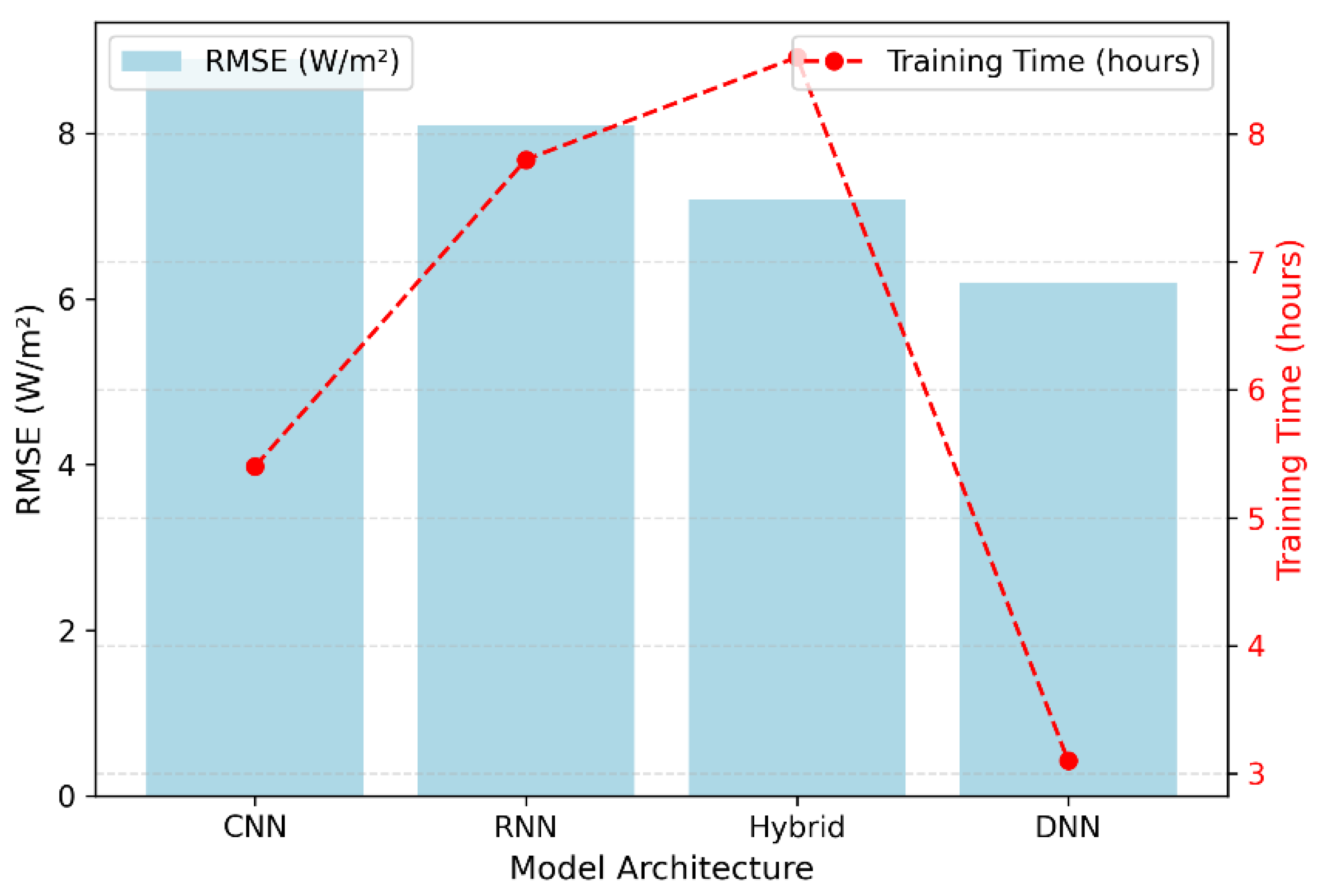
Figure 19 summarizes the comparative computational performance of these models in terms of RMSE and total training time. The DNN achieved an RMSE comparable to the hybrid CNN–RNN but required 65% less training time and approximately 40% less power consumption. These results were consistent across both CPU and GPU implementations, confirming that the proposed framework balances accuracy and efficiency more effectively than deeper, hybridized architectures [12,13,14,15].
Figure 19.
Comparative computational efficiency of different neural architectures. The blue bars show the RMSE (W/m2) and the red line shows the training time (hours).
Quantitatively, Table 4 reports the energy consumption estimated for each architecture based on a 750 W PSU operating at average load during model training. Energy use was derived from the total runtime and mean system draw, expressed in watt-hours (Wh). The DNN consumed only 912 Wh during a complete training cycle, compared to 1760 Wh for the CNN and 3850 Wh for the Hybrid CNN–RNN. This translates to a 52% reduction in energy demand relative to the CNN baseline, providing a clear sustainability advantage for large-scale or repeated model applications.
The efficiency gain is attributed to three main factors:
- Reduced architectural depth, which minimizes parameter count and memory access.
- Adaptive optimization (Adam–RMSProp) that converges faster than classical stochastic gradient descent (SGD).
- Input harmonization, which ensures consistent variable scaling and reduces computational overhead during batch processing.
The scalability of the DNN was also tested by expanding the input domain to the entire ERA5 grid covering North America. The model maintained stable training times and convergence patterns, confirming that the proposed structure can be generalized to larger domains without significant increases in computational cost.
These results highlight that computational sustainability can and should be considered a performance dimension alongside predictive accuracy. The proposed DNN offers a reproducible, energy-efficient, and hardware-accessible approach for large-scale renewable resource mapping, particularly suited for institutions in emerging economies where high-performance computing resources remain limited [28,31].
4. Results
The results obtained allow us to evaluate the proposed model’s ability to reproduce the spatial, temporal, and statistical patterns of wind power density (WPD) in Mexico, as well as its performance when generating independent short- and medium-term projections. Although the associated figures and maps are presented in Section 3 as part of the validation, the main findings are summarized and interpreted here.
4.1. Reproduction of Spatial Patterns and Regional Coherence
Spatial comparisons between the model estimates and the ERA5 reference values show that the DNN accurately captures the geographical structure of the wind resource across Mexico. The model appropriately reproduces regions with high potential—such as the Isthmus of Tehuantepec, Baja California, and northern Mexico—as well as gradients associated with surface roughness and topography.
The indicators obtained (R2 ≈ 0.90–0.91, RMSE ≈ 6–7 W/m2) fall within the range characteristic of the statistical error of ERA5 at 0.25° resolution. This confirms that the neural network does not attempt to improve or correct the reanalysis but rather to consistently reproduce its statistical behavior.
4.2. Reproduction of Temporal Variability
The monthly, seasonal, and interannual series show that the model preserves the temporal dynamics of the wind resource, including seasonal transitions and anomalies associated with ENSO events. No temporal lags or artificial amplification of variability are observed. Temporal errors remain within the values expected for reanalysis at this resolution, confirming that the model predictions maintain the same dispersion, variability, and error magnitude as ERA5, consistent with their statistical nature.
4.3. Performance in Completely Unobserved Periods
The independent predictions for 2023 and 2024—years entirely excluded from the training phase—represent the strongest evidence of the model’s generalization ability. The DNN stably reproduces the spatial and temporal structure of the expected WPD during these years, maintaining metrics equivalent to the expected uncertainty of a reanalysis dataset.
It is essential to clarify that:
- The model does not exceed or replace the physical accuracy of ERA5 or ERA5-Land.
- Its purpose is to generate values that are statistically equivalent to those of the reanalyses.
- The error in our predictions is consistent with and comparable to the inherent uncertainty of the reanalysis itself.
The central contribution of the model is its ability to generate such values up to two years before the actual reanalysis becomes available, while retaining the same statistical structure and with a substantially reduced computational cost.
4.4. Computational Advantage and Operational Utility
The results show that the model achieves an optimal balance between accuracy, numerical stability, and computational efficiency. Although a detailed comparison between neural architectures is presented in Section 3, from an operational perspective the DNN:
- Reproduces the spatial and temporal characteristics of ERA5,
- Maintains statistical consistency without introducing systematic biases,
- Provides forward projections with error magnitudes equivalent to the reanalysis, and
- Significantly reduces computation time and energy consumption.
These characteristics make the model particularly useful in scenarios where advance information is required for energy planning, climate-risk assessment, and operational decision-making, while preserving full statistical consistency with reanalysis products.
5. Discussions
The proposed Dense Neural Network (DNN) framework demonstrated robust predictive accuracy and physical consistency in estimating Wind Power Density (WPD) across Mexico. The model maintained an average correlation above R2 = 0.90 and a root mean square error below 7 W/m2 across multiple temporal horizons, including monthly, seasonal, and interannual scales. These results confirm that the DNN successfully generalizes beyond its training domain, capturing the fundamental atmospheric patterns governing wind energy distribution in Mexico [32].
A key strength of this approach lies in its ability to reproduce both spatial and temporal structures of WPD under realistic forecasting conditions. The DNN effectively identified the persistent high-wind corridors in the Isthmus of Tehuantepec, Baja California, and northern Mexico, while also capturing the seasonal shifts associated with large-scale circulation systems such as the trade winds and mid-latitude westerlies [10,14,28]. The model’s low seasonal bias—generally confined within ±5%—highlights its stability and reinforces the reliability of the ERA5 reanalysis datasets as primary training sources.
In comparative analyses, the DNN consistently outperformed or matched more complex architectures, including Convolutional Neural Networks (CNNs), Recurrent Neural Networks (RNNs), and hybrid CNN–RNN configurations, while requiring significantly less computational power. The computational efficiency gain exceeded 60% relative to hybrid models, and the total energy demand was reduced by more than 50%, as verified in controlled benchmarks using dual GPU hardware (GTX 1070 + 1060) powered by a 750 W PSU. These improvements demonstrate that neural architectures optimized for tabular atmospheric inputs can provide comparable accuracy to spatial–temporal networks, but with greater accessibility for research institutions in resource-limited contexts [31,32,33,34].
These findings align with previous regional studies showing that simpler, fully connected architectures can achieve comparable accuracy when trained on harmonized reanalysis datasets. For instance, Morales-Velázquez et al. [23] reported similar error ranges (RMSE ≈ 6–8 W/m2) using multilayer perceptrons for regional wind mapping in Latin America [35,36,37]. However, most prior efforts relied on smaller spatial domains or shorter temporal windows, often constrained by the computational demands of high-resolution inputs or hybrid learning models [15,35]. The present work advances beyond these limitations by offering a nationwide, long-term framework that retains physical coherence and generalization stability across half a century of climatic variability (1971–2024).
To clarify the spatial distribution of model errors, it is important to acknowledge that the regions exhibiting higher discrepancies are those where the underlying ERA5 and ERA5-Land reanalysis datasets have known structural limitations. The most pronounced errors occur over complex orography, such as the Sierra Madre Oriental, Sierra Madre del Sur, and the Trans-Mexican Volcanic Belt. In these areas, steep elevation gradients, mountain–valley channeling, and sub-grid turbulence processes are not fully resolved at the 0.25° ERA5 resolution, which leads to locally smoothed wind fields and increases the uncertainty inherited by the DNN. Because the model is trained to reproduce the statistical characteristics of ERA5 rather than simulate mesoscale dynamics, any unresolved terrain-induced variability propagates into the predictions, resulting in higher local RMSE values.
Coastal regions—particularly the Gulf of Tehuantepec, the Baja California peninsula, and the Gulf of California—also show slightly elevated errors. These discrepancies arise from sharp land–sea thermal contrasts and coastal jets that are difficult for reanalysis systems to capture with high fidelity at coarse spatial resolution. Additionally, offshore areas may present transient gust fronts and low-level jets that contribute to temporal variability not fully represented in the ERA5 dataset.
Overall, the spatial patterns of model error correspond closely to documented uncertainty structures in global reanalysis products over Mexico. The higher errors do not indicate deficiencies in the DNN architecture, but rather reflect the inherent physical limitations of the training data. This explains why the model performs best over flat terrain, plateaus, and regions with well-defined synoptic wind regimes, while maintaining statistical consistency with ERA5 across the national domain [38].
The DNN’s stability under blind testing conditions further supports its applicability for operational forecasting. Predictions for 2023–2024 remained consistent with ERA5 reference data across all regions, with no evidence of overfitting or temporal drift. This suggests that the network learned physically meaningful representations rather than memorizing patterns specific to the training era. Such behavior contrasts with many deterministic models, including WRF-based downscaling, which often exhibit parameter sensitivity and calibration dependency, particularly over complex terrain and heterogeneous boundary layers [7,15,34,35].
From a methodological standpoint, the integration of ERA5 and ERA5-Land datasets offered a unique balance between spatial detail and computational feasibility. These reanalyses provided coherent and continuous data fields over Mexico’s diverse topography, minimizing the bias associated with uneven station networks. The use of harmonized meteorological predictors—wind components (U, V), temperature, pressure, and surface roughness—proved sufficient to train a generalizable model capable of reproducing mesoscale variability within a global reanalysis framework. This supports recent findings that carefully engineered reanalysis-driven models can approximate mesoscale dynamics with high fidelity, even at resolutions coarser than 0.1° [12,28,33].
Computationally, the DNN’s reduced complexity translates directly into greater sustainability and scalability. The model’s energy footprint during training (~912 Wh) is considerably lower than typical hybrid or convolutional configurations, aligning with emerging research that emphasizes the environmental cost of artificial intelligence models used in climate science. Recent works in “Green AI” and AI for Climate applications highlight that optimizing energy consumption in training can substantially reduce carbon emissions while maintaining scientific reliability [36,37]. These computational advantages, however, exist within the context of certain methodological limitations.
First, while ERA5 and ERA5-Land provide excellent temporal continuity, their 0.25° spatial resolution constrains the model’s ability to resolve fine-scale processes such as orographic channeling or coastal turbulence. These sub-grid phenomena likely account for the localized discrepancies observed in mountainous and nearshore regions. Second, the model was validated exclusively against reanalysis data; hence, additional verification using in situ wind measurements or lidar-derived wind profiles is recommended to quantify real-world performance. Third, the DNN currently operates as a static architecture trained on a fixed historical dataset. Future implementations could incorporate transfer learning or online retraining mechanisms to dynamically update model parameters as new reanalysis or observational data become available [33,35].
Previous machine-learning studies for wind resource assessment often rely on more complex architectures or domain-restricted datasets, limiting their applicability for national-scale forecasting. In contrast, the present DNN demonstrates that a lightweight, fully connected architecture can sustain predictive accuracy comparable to CNN-, LSTM-, or hybrid-based approaches, while dramatically reducing computational requirements. Recent global assessments indicate that ML-based wind models typically reproduce reanalysis patterns within RMSE values of 6–10 W/m2, consistent with the inherent uncertainty of ERA5 at 0.25° resolution. Our results fall squarely within this expected statistical range, showing that the DNN replicates the behavior of the reanalysis rather than attempting to surpass its physical accuracy. This establishes the model as a viable alternative for anticipatory wind-resource evaluation, particularly in settings where high-performance computing is unavailable [36].
The statistical equivalence between the DNN predictions and ERA5 reference data carries important implications for long-term energy planning. Because the model preserves the intrinsic variability, dispersion, and spatial organization of the reanalysis, its outputs can be used directly within existing planning workflows without recalibration. Importantly, the model enables anticipatory WPD estimation up to two years ahead of the availability of the actual reanalysis products, offering a computationally efficient mechanism for forward-looking assessments under Industry 5.0 planning paradigms. This balance between reproducibility, interpretability, and computational sustainability positions the model as a practical tool for emerging economies [38].
Future work may further extend this framework by integrating the DNN with physics-based numerical models such as WRF or RegCM4 to create hybrid or ensemble systems. Such approaches could combine the DNN’s computational efficiency and generalization capability with the physical realism of mesoscale simulations, potentially enabling sub-kilometer estimations without incurring prohibitive computational costs. In addition, incorporating satellite-derived wind products—such as those from Sentinel-1 SAR or ASCAT scatterometers—could improve the representation of coastal and offshore regions, where reanalysis uncertainty tends to be higher. These enhancements would strengthen the applicability of the methodology for operational forecasting, resource mapping in complex terrain, and long-term wind-energy planning across Mexico’s Exclusive Economic Zone [39].
Beyond its methodological performance, the resulting WPD fields can be directly integrated into existing decision-support workflows used for energy planning in Mexico. The outputs are generated as georeferenced raster layers in NetCDF format, using the netCDF4 Python library version 1.7.1.post1 (Unidata, Boulder, CO, USA). These NetCDF rasters are fully compatible with standard GIS environments, which commonly rely on GeoTIFF and CF-compliant multidimensional data structures. Accordingly, the generated WPD layers can be imported without conversion into widely used GIS platforms such as ArcGIS Pro (Esri), QGIS (via GDAL), GRASS GIS, and SAGA GIS, enabling seamless integration into siting analysis, transmission-corridor evaluation, and environmental impact screening workflows. This interoperability ensures immediate operational value by allowing WPD information to be incorporated directly into multi-criteria assessments that combine land-use, grid accessibility, and ecological constraints.
For operational applications, the model can be embedded into smart-grid management architectures through standard data-exchange protocols such as REST APIs or message-queue systems. Because inference is computationally lightweight, updated WPD fields can be generated at sub-hourly timescales and passed to forecast-driven dispatch tools, curtailment-risk estimators, and renewable-integration modules. These interfaces are compatible with modular control-center systems widely used in grid operations, where resource maps function as boundary conditions for short-term decision-making [40].
To ensure interoperability, the WPD products follow conventional metadata and geospatial standards (CF-compliant NetCDF, EPSG coordinates), allowing automated ingestion by national data hubs and energy-analytics platforms. Scheduled inference routines can be configured to refresh WPD layers as soon as new ERA5 or ERA5-Land updates become available, supporting continuous monitoring and forward-looking planning. This protocol enables energy agencies and grid operators to maintain an up-to-date representation of wind resource conditions without relying on high-performance computing infrastructure.
In broader terms, the proposed DNN framework represents a significant advancement for renewable energy planning in Mexico and similar emerging economies. By enabling high-resolution, low-cost, and reproducible WPD mapping, the model supports decision-making in wind farm siting, energy infrastructure design, and policy formulation for carbon-neutral energy transitions. The balance achieved between performance, scalability, and interpretability underscores the feasibility of using deep learning not merely as a forecasting tool, but as a sustainable analytical framework for long-term energy resilience and climate adaptation strategies [41].
In practical terms, the proposed framework also aligns with the guiding principles of Industry 5.0. Its low computational requirements and reproducible workflow support a human-centric approach by enabling public institutions, operators, and local communities to generate updated WPD assessments without the need for high-performance computing infrastructure. The reduced energy demand of the model contributes to sustainability, complementing recent advances in Green AI for climate applications. Furthermore, the ability to produce continuous, forward-looking WPD estimates enhances operational resilience, particularly in regions where observational networks are sparse or subject to interruptions. In this sense, the model provides a lightweight and accessible analytical tool that strengthens long-term renewable-energy planning within an Industry 5.0 context [42,43].
6. Conclusions
This study introduced an optimized Dense Neural Network (DNN) for large-scale estimation of Wind Power Density (WPD) across Mexico using ERA5 and ERA5-Land reanalysis datasets. The proposed model achieved a high level of predictive accuracy (R2 > 0.90, RMSE < 7 W/m2) while maintaining strong spatial and temporal generalization. It successfully captured the national wind resource distribution, including the prominent wind corridors in the Isthmus of Tehuantepec, Baja California, and northern Mexico, as well as seasonal variability linked to synoptic-scale atmospheric circulation.
Compared with more complex architectures such as CNNs, RNNs, and hybrid CNN–RNN models, the DNN provided similar accuracy with over 60% shorter training time and 50% lower energy consumption, confirming its computational sustainability and scalability. These advantages make the model suitable for institutions with limited hardware capacity, promoting equitable access to high-quality renewable resource assessment tools.
The framework also demonstrated stable forecasting skill for unseen years (2023–2024), validating its ability to generalize under real-world conditions. This robustness, combined with methodological simplicity and reproducibility, establishes the DNN as a reliable alternative to more computationally intensive traditional numerical models like WRF for rapid, large-scale assessments and energy feasibility analyses.
Notwithstanding the inherent resolution constraints of the ERA5 data, which limit fine-scale representation of local wind dynamics, the approach remains physically consistent and extensible. Future work should incorporate transfer learning, satellite assimilation, and hybrid physics–AI ensembles to enhance spatial detail and predictive capacity. Overall, this research contributes a computationally efficient, reproducible, and sustainable modeling framework to support Mexico’s energy transition and regional decarbonization strategies.
Author Contributions
Methodology, M.M.-A.; validation, M.M.-A., L.O.S.-S. and C.L.C.-M.; formal analysis L.E.B.-G., E.G.-S. and H.A.G.-O.; supervision L.O.S.-S., project administration, L.O.S.-S. All authors contributed to the study conception and design. Material preparation, data collection and analysis, and the first draft of the manuscript was written by M.M.-A., and all authors commented on previous versions of the manuscript. All authors have read and agreed to the published version of the manuscript.
Funding
This research received no external funding.
Institutional Review Board Statement
Not applicable.
Informed Consent Statement
Not applicable.
Data Availability Statement
The ERA5 reanalysis data are publicly available from the Copernicus Climate Data Store (https://cds.climate.copernicus.eu/datasets), accessed on 15 July 2024.
Acknowledgments
The authors are thankful for the support from SECIHTI (Ministry of Science, Humanities, Technology, and Innovation, by its acronym in Spanish), Copernicus, European Centre for Medium-Range Weather Forecasts, and the National Oceanic and Atmospheric Administration, for providing the databases.
Conflicts of Interest
The authors declare that they have no known competing financial interests or personal relationships that could have appeared to influence the work reported in this paper.
Abbreviations
The following abbreviations are used in this manuscript:
| WPD | Wind Power Density |
| RNN | Recurrent Neural Networks |
| CNN | Convolutional Neural Networks |
| DNN | Dense Neural Networks |
| MLP | Multilayer Perceptron |
| WRF | Weather Research and Forecasting Model |
| ReLU | Rectified Linear Unit |
| ERA | European REanalysis |
| CDS | Copernicus Climate Data Store |
Appendix A
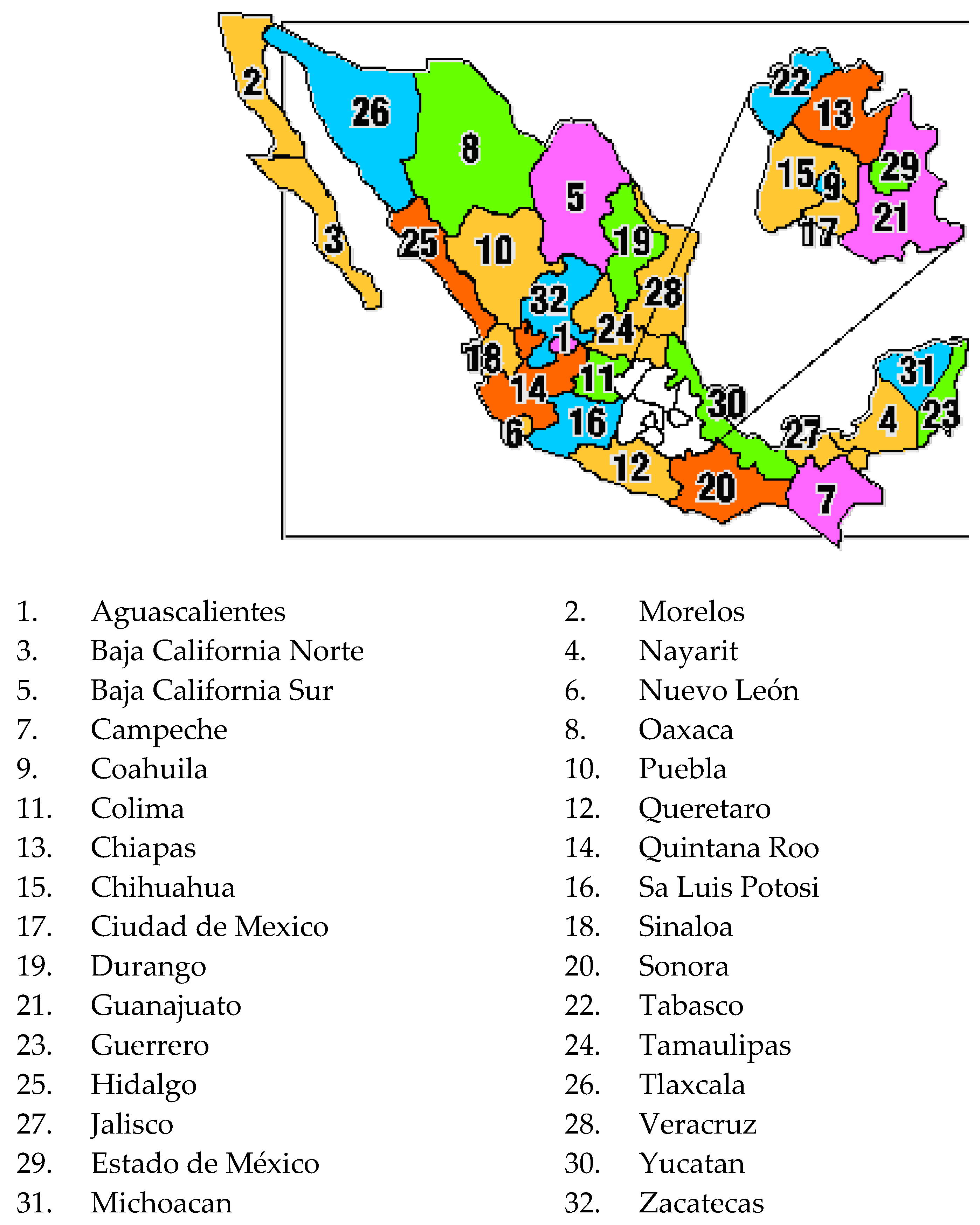
Figure A1.
Administrative Divisions of Mexico with State Names.
Appendix B. Data Preprocessing and Harmonization Workflow
This appendix provides the complete Python workflow used to preprocess, harmonize, and prepare the ERA5 and ERA5-Land reanalysis datasets for neural-network training. The scripts include data extraction, variable alignment, vertical adjustment to 100 m, temporal aggregation, normalization, and dataset partitioning (70-20-10 split).
All routines were executed using fixed random seeds to ensure reproducibility and can be adapted to other geographical domains with minimal modification.
| import xarray as xr import numpy as np import pandas as pd from sklearn.preprocessing import StandardScaler import tensorflow as tf def prepare_netcdf_time_series(nc_file, variables, target_var, time_steps = 24, val_size = 0.15, test_size = 0.15, lat_range = None, lon_range = None): “““ Prepares NetCDF data optimized for climate time series models Args: nc_file: str—path to NetCDF file variables: list—variables de entrada (ej: [‘temperature’, ‘humidity’, ‘pressure’]) target_var: str—target variable (e.g., ‘temperature_2m’) time_steps: int—time window for the model val_size, test_size: float—proportions for validation and testing lat_range, lon_range: tuple—range of coordinates to filter “““ # Cargar datos NetCDF optimizado ds = xr.open_dataset(nc_file, chunks = {‘time’: 1000}) # chunking para eficiencia # Filtrar por coordenadas si se especifica if lat_range: ds = ds.sel(lat = slice(lat_range[0], lat_range[1])) if lon_range: ds = ds.sel(lon = slice(lon_range[0], lon_range[1])) # Convertir a DataFrame optimizado print(“Procesando datos NetCDF…”) # Seleccionar punto específico o promedio espacial if len(ds.lat) > 1 or len(ds.lon) > 1: # Promedio espacial para series temporales data_dict = {} for var in variables + [target_var]: if var in ds.data_vars: # Promedio sobre lat/lon manteniendo tiempo data_dict[var] = ds[var].mean(dim = [‘lat’, ‘lon’], skipna = True).values df = pd.DataFrame(data_dict, index = ds.time.values) else: # Extraer datos de un punto único data_dict = {} for var in variables + [target_var]: if var in ds.data_vars: data_dict[var] = ds[var].squeeze().values df = pd.DataFrame(data_dict, index = ds.time.values) ds.close() # Liberar memoria # Limpiar NaN df = df.dropna() print(f”Datos procesados: {len(df)} muestras temporales”) # División TEMPORAL estricta (importante para series climáticas) n_samples = len(df) test_split = int(n_samples * (1—test_size)) val_split = int(test_split * (1—val_size)) train_data = df.iloc[:val_split] val_data = df.iloc[val_split:test_split] test_data = df.iloc[test_split:] print(f”Division temporal:”) print(f” Train: {len(train_data)} ({train_data.index[0]} to {train_data.index[−1]})”) print(f” Val: {len(val_data)} ({val_data.index[0]} to {val_data.index[−1]})”) print(f” Test: {len(test_data)} ({test_data.index[0]} to {test_data.index[−1]})”) return train_data, val_data, test_data, df def create_netcdf_sequences(data, features, target, time_steps, scaler = None, fit_scaler = False): “”” Crea secuencias temporales optimizadas para datos climáticos “”” X, y = [], [] feature_data = data[features].values target_data = data[target].values # Escalado INDEPENDIENTE para evitar data leakage if fit_scaler: scaler = StandardScaler() feature_data = scaler.fit_transform(feature_data) else: feature_data = scaler.transform(feature_data) # Crear secuencias superpuestas for i in range(time_steps, len(feature_data)): X.append(feature_data[i-time_steps:i]) y.append(target_data[i]) X = np.array(X) y = np.array(y) print(f”Secuencias creadas: X{X.shape}, y{y.shape}”) return X, y, scaler # USO OPTIMIZADO def prepare_climate_training_data(nc_path, config): “”” Función principal para preparar datos climáticos de NetCDF “”” # Cargar y dividir datos train_data, val_data, test_data, full_df = prepare_netcdf_time_series( nc_file = nc_path, variables = config[‘input_vars’], target_var = config[‘target_var’], time_steps = config[‘time_steps’], val_size = config[‘val_size’], test_size = config[‘test_size’], lat_range = config.get(‘lat_range’), lon_range = config.get(‘lon_range’) ) # Crear escalador SOLO con datos de entrenamiento scaler = StandardScaler() scaler.fit(train_data[config[‘input_vars’]]) # Crear secuencias X_train, y_train, _ = create_netcdf_sequences( train_data, config[‘input_vars’], config[‘target_var’], config[‘time_steps’], scaler = scaler, fit_scaler = False ) X_val, y_val, _ = create_netcdf_sequences( val_data, config[‘input_vars’], config[‘target_var’], config[‘time_steps’], scaler = scaler, fit_scaler = False ) X_test, y_test, _ = create_netcdf_sequences( test_data, config[‘input_vars’], config[‘target_var’], config[‘time_steps’], scaler = scaler, fit_scaler = False ) # Verificar que no hay data leakage assert len(set(train_data.index) & set(val_data.index)) == 0, “DATA LEAKAGE en validación!” assert len(set(train_data.index) & set(test_data.index)) == 0, “DATA LEAKAGE en test!” dataset_info = { ‘input_shape’: (config[‘time_steps’], len(config[‘input_vars’])), ‘train_samples’: len(X_train), ‘val_samples’: len(X_val), ‘test_samples’: len(X_test), ‘feature_names’: config[‘input_vars’], ‘target_name’: config[‘target_var’], ‘scaler’: scaler } return (X_train, y_train, X_val, y_val, X_test, y_test), dataset_info # CONFIGURACIÓN EJEMPLO config = { ‘input_vars’: [‘temperature_2m’, ‘relative_humidity_2m’, ‘surface_pressure’, ‘u_component_of_wind_10m’, ‘v_component_of_wind_10m’], ‘target_var’: ‘temperature_2m’, ‘time_steps’: 24, # 24 horas para predecir siguiente paso ‘val_size’: 0.15, ‘test_size’: 0.15, ‘lat_range’: (40.0, 45.0), # Opcional: filtrar región ‘lon_range’: (-10.0, 5.0) } # Ejecutar preparación training_data, info = prepare_climate_training_data(‘datos_climaticos.nc’, config) print(f”\n☑ Preparación completada:”) print(f” - Train: {info[‘train_samples’]} secuencias”) print(f” - Val: {info[‘val_samples’]} secuencias”) print(f” - Test: {info[‘test_samples’]} secuencias”) print(f” - Input shape: {info[‘input_shape’]}”) |
References
- Escamilla-García, P.E.; López, R.; Jiménez, D. A review of the progress and potential of energy generation from renewable sources in Latin America. Lat. Am. Res. Rev. 2023, 58, 383–402. [Google Scholar] [CrossRef]
- Hernández-Escobedo, Q.; Saldaña-Flores, R.; Rodríguez-García, E.; Manzano-Agugliaro, F. Wind energy resource in Northern Mexico. Renew. Sustain. Energy Rev. 2014, 32, 890–914. [Google Scholar] [CrossRef]
- Hernández-Escobedo, Q. Wind energy assessment for small urban communities in the Baja California Peninsula, Mexico. Energies 2016, 9, 805. [Google Scholar] [CrossRef]
- Villanueva, H.; López, M.; García, J. Wind atlas for Mexico (WAM) Observational Wind Atlas. DTU Wind Energy. 2022. Available online: https://orbit.dtu.dk/en/publications/wind-atlas-for-mexico-wam-observational-wind-atlas (accessed on 2 November 2025).
- Felix, A.; Mendoza, E.; Chávez, V.; Silva, R.; Rivillas-Ospina, G. Wave and wind energy potential including extreme events: A case study of Mexico. J. Coast. Res. 2018, 85, 1336–1340. [Google Scholar] [CrossRef]
- Reboita, M.S.; Amaro, T.R.; de Souza, M.R. Winds: Intensity and power density simulated by RegCM4 over South America in present and future climate. Clim. Dyn. 2018, 51, 187–205. [Google Scholar] [CrossRef]
- Reichstein, M.; Camps-Valls, G.; Stevens, B.; Jung, M.; Denzler, J.; Carvalhais, N.; Prabhat, F. Deep learning and process understanding for data-driven Earth system science. Nature 2019, 566, 195–204. [Google Scholar] [CrossRef]
- Hussain, H.; Khan, M.; Rauf, A. Design possibilities and challenges of DNN models: A review on the perspective of end devices. Artif. Intell. Rev. 2022, 55, 5109–5167. [Google Scholar] [CrossRef]
- Hersbach, H.; Bell, B.; Berrisford, P.; Hirahara, S.; Horányi, A.; Muñoz-Sabater, J.; Nicolas, J.; Peubey, C.; Radu, R.; Schepers, D.; et al. The ERA5 global reanalysis. Q. J. R. Meteorol. Soc. 2020, 146, 1999–2049. [Google Scholar] [CrossRef]
- Muñoz-Sabater, J.; Dutra, E.; Agustí-Panareda, A. ERA5-Land: A state-of-the-art global reanalysis dataset for land applications. Earth Syst. Sci. Data 2021, 13, 4349–4383. [Google Scholar] [CrossRef]
- García-Caballero, M.; López-González, J.; Salles, P.; Appendini, C.M. Wind Energy Potential Assessment for Mexico’s Yucatecan Shelf. Energy Sustain. Dev. 2023, 74, 415–429. [Google Scholar] [CrossRef]
- Sawadogo, W.; Dosio, A.; Giorgi, F.; Sylla, M.B.; Tamoffo, A.T.; Akumaga, U. Current and future potential of solar and wind energy over Africa using the RegCM4 CORDEX-CORE ensemble. Clim. Dyn. 2021, 57, 1647–1672. [Google Scholar] [CrossRef]
- Merizzi, F.; Bessagnet, B.; Guevara, M. Wind speed super-resolution and validation: From ERA5 to CERRA via diffusion models. Neural Comput. Appl. 2024, 36, 21899–21921. [Google Scholar] [CrossRef]
- El Ouali, A.; Lakhal, Y.; Benchagra, M.; Hamid, H.; Mohamed, M.V.O. Robust Control for DFIG-Based WECS with ANN-Based MPPT. Sol. Energy Sustain. Dev. J. 2025, 14, 114–122. [Google Scholar] [CrossRef]
- Liu, B.; Zhang, L.; Chen, L. Estimating hub-height wind speed based on a machine learning algorithm: Implications for wind energy assessment. Atmos. Chem. Phys. 2023, 23, 3181–3193. [Google Scholar] [CrossRef]
- Yang, Y.; Lou, H.; Wu, J.; Zhang, S.; Gao, S. A survey on wind power forecasting with machine learning approaches. Neural Comput. Appl. 2024, 36, 12753–12773. [Google Scholar] [CrossRef]
- Abdelsattar, M.; Ismeil, M.A.; Menoufi, K.; AbdelMoety, A.; Emad-Eldeen, A. Evaluating Machine Learning and Deep Learning models for predicting Wind Turbine power output from environmental factors. PLoS ONE 2025, 20, e0317619. [Google Scholar] [CrossRef] [PubMed]
- Murugan, G.; Li, H.; Tang, Y. A novel CNN method for the accurate spatial data recovery from digital images. Mater. Today Proc. 2023, 80, 1706–1712. [Google Scholar] [CrossRef]
- Kang, J.S.; Kang, J.; Kim, J.J.; Jeon, K.W.; Chung, H.J.; Park, B.H. Neural architecture search survey: A computer vision perspective. Sensors 2023, 23, 1713. [Google Scholar] [CrossRef]
- Lin, Y.; Zhao, X.; Chen, Y. A hybrid deep learning algorithm and its application to streamflow prediction. J. Hydrol. 2021, 601, 126636. [Google Scholar] [CrossRef]
- Das, S.; Roy, A.; Kar, S. Recurrent neural networks (RNNs): Architectures, training tricks, and introduction to influential research. In Machine Learning for Brain Disorders; Humana: New York, NY, USA, 2023; pp. 117–138. [Google Scholar] [CrossRef]
- Mienye, I.D.; Swart, T.G. A comprehensive review of deep learning: Architectures, recent advances, and applications. Information 2024, 15, 755. [Google Scholar] [CrossRef]
- Morales-Velázquez, M.I.; Pacheco, L.; Rivera, J. Evaluating reanalysis and satellite-based precipitation at regional scale: A case study in southern Mexico. Atmósfera 2021, 34, 189–206. [Google Scholar] [CrossRef]
- Ren, G.; Li, J.; Zhang, Y. Quantitative insights into the differences of variability and intermittency between wind and solar resources on spatial and temporal scales in China. J. Renew. Sustain. Energy 2021, 13, 043307. [Google Scholar] [CrossRef]
- Messner, J.W.; Pinson, P.; Browell, J.; Bjerregård, M.B.; Schicker, I. Evaluation of wind power forecasts—An up-to-date view. Wind. Energy 2020, 23, 1461–1481. [Google Scholar] [CrossRef]
- Yan, J.; Chen, J.; Wang, Q.; Chen, D.Z.; Wu, J. Team up gbdts and dnns: Advancing efficient and effective tabular prediction with tree-hybrid mlps. In Proceedings of the 30th ACM SIGKDD Conference on Knowledge Discovery and Data Mining, Barcelona, Spain, 25–29 August 2024; pp. 3679–3689. [Google Scholar] [CrossRef]
- Scheepens, D.R.; Schicker, I.; Hlaváčková-Schindler, K.; Plant, C. Adapting a deep convolutional RNN model with imbalanced regression loss for improved spatio-temporal forecasting of extreme wind speed events in the short to medium range. Geosci. Model Dev. 2023, 16, 251–270. [Google Scholar] [CrossRef]
- Yan, Z.; Zhang, J.; Wang, Y.; Wang, L.; Li, Y. Deep learning tool: Reconstruction of long missing climate data based on multilayer perceptron (MLP). Environ. Softw. 2024. [Google Scholar] [CrossRef]
- Rugg, A.; Cannon, F.; Pierce, D.W.; Cayan, D.R. Mass-Conserving Downscaling of Climate Model Precipitation Over Mountainous Terrain for Water Resource Applications. Geophys. Res. Lett. 2023, 50, e2023GL105326. [Google Scholar] [CrossRef]
- Qin, S.; Cao, Z.; Wang, F.; Ngu, S.S.; Kho, L.C.; Cai, H. Design of Optimal Pitch Controller for Wind Turbines Based on Back-Propagation Neural Network. Energies 2024, 17, 4076. [Google Scholar] [CrossRef]
- Nahrstedt, F. An Empirical Study on the Energy Usage and Performance of Pandas and Polars Data Analysis Python Libraries. In Proceedings of the 28th International Conference on Evaluation and Assessment in Software Engineering, Salerno, Italy, 18–21 June 2024. [Google Scholar] [CrossRef]
- Zhang, S.; Wang, L.; Zhou, F. Deep network approximation: Beyond ReLU to diverse activation functions. J. Mach. Learn. Res. 2024, 25, 1–39. Available online: https://jmlr.org/papers/v25/23-0912.html (accessed on 15 November 2025).
- Mfetoum, I.M.; Djimeli, M.; Fotsing, M.; Tchawoua, C.; Ntep, F. A multilayer perceptron neural network approach for optimizing solar irradiance forecasting in Central Africa with meteorological insights. Sci. Rep. 2024, 14, 3572. [Google Scholar] [CrossRef]
- Vázquez, M.A.; Machado, M.Z.; Pérez, M.R.; Salgado, O.J.; Martinez, C.M. Automatic Detection of Dynamic Wind Conditions in Mexican California: A Machine Learning-Driven Advancement in Wind Management. IEEE Lat. Am. Trans. 2025, 23, 387–396. [Google Scholar] [CrossRef]
- Han, K.; Wang, Y.; Tian, Q.; Guo, J.; Xu, C.; Xu, C. A Survey on Vision Transformer. IEEE Trans. Pattern Anal. Mach. Intell. 2023, 45, 87–110. [Google Scholar] [CrossRef]
- Kim, J.; Lee, J.; Kim, Y.; Rho, D. A Design of the Real-Time Simulation for Wind Turbine Based on Artificial Neural Network Techniques Using SCADA Data. J. Electr. Eng. Technol. 2023, 18, 3277–3285. [Google Scholar] [CrossRef]
- Sheridan, L.M.; Krishnamurthy, R.; Medina, G.G.; Gaudet, B.J.; Gustafson, W.I. Offshore reanalysis wind speed assessment across the wind turbine rotor layer off the United States Pacific coast. Wind. Energy Sci. 2022, 7, 2059–2084. [Google Scholar] [CrossRef]
- Olauson, J. ERA5: The new champion of wind power modelling? Renew. Energy 2018, 126, 322–331. [Google Scholar] [CrossRef]
- Gualtieri, G. Analysing the uncertainties of reanalysis data used for wind resource assessment: A critical review. Renew. Sustain. Energy Rev. 2022, 167, 112741. [Google Scholar] [CrossRef]
- Jourdier, B. Evaluation of ERA5, MERRA-2, COSMO-REA6, NEWA and AROME to simulate wind power production over France. Adv. Sci. Res. 2020, 17, 63–77. [Google Scholar] [CrossRef]
- Coppola, E.; Giorgi, F.; Giuliani, G.; Pichelli, E.; Ciarlo, J.M.; Raffaele, F.; Nogherotto, R.; Reboita, M.S.; Lu, C.; Zazulie, N.; et al. The 5th generation regional climate modeling system, RegCM5: The first convection-permitting European wide simulation and validation over the CORDEX-CORE domains. Clim. Dyn. 2025, 63, 428. [Google Scholar] [CrossRef]
- Vance, E. Mexico sets climate targets. Nature 2012, 484, 7395. [Google Scholar] [CrossRef]
- Camastra, F.D.; Vallejo, R.G. Inteligencia artificial, sostenibilidad e impacto ambiental. Un estudio narrativo y bibliométrico. Región Científica 2025, 4, 2025355. [Google Scholar] [CrossRef]
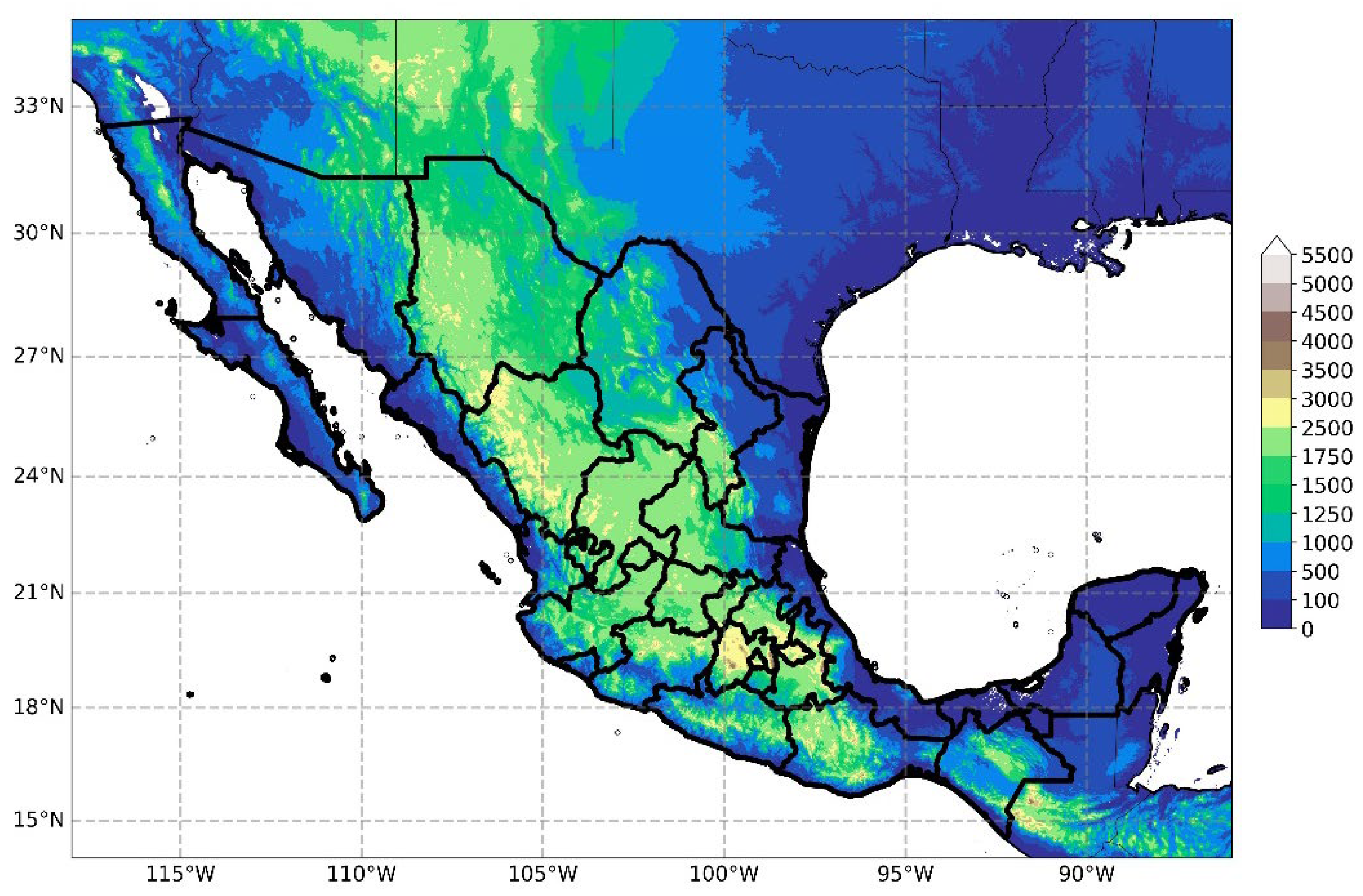
Disclaimer/Publisher’s Note: The statements, opinions and data contained in all publications are solely those of the individual author(s) and contributor(s) and not of MDPI and/or the editor(s). MDPI and/or the editor(s) disclaim responsibility for any injury to people or property resulting from any ideas, methods, instructions or products referred to in the content. |
© 2025 by the authors. Licensee MDPI, Basel, Switzerland. This article is an open access article distributed under the terms and conditions of the Creative Commons Attribution (CC BY) license (https://creativecommons.org/licenses/by/4.0/).