Investigating the Regulatory Mechanism of the Baffle Geometric Parameters on the Lubrication Transmission of High-Speed Gears


Abstract
1. Introduction
2. Mathematical Analysis Model of High-Speed Gear Lubricating Oil Field
2.1. Mathematical Model of Gear Lubrication Based on LBM
2.2. LBM-LES Coupled Model
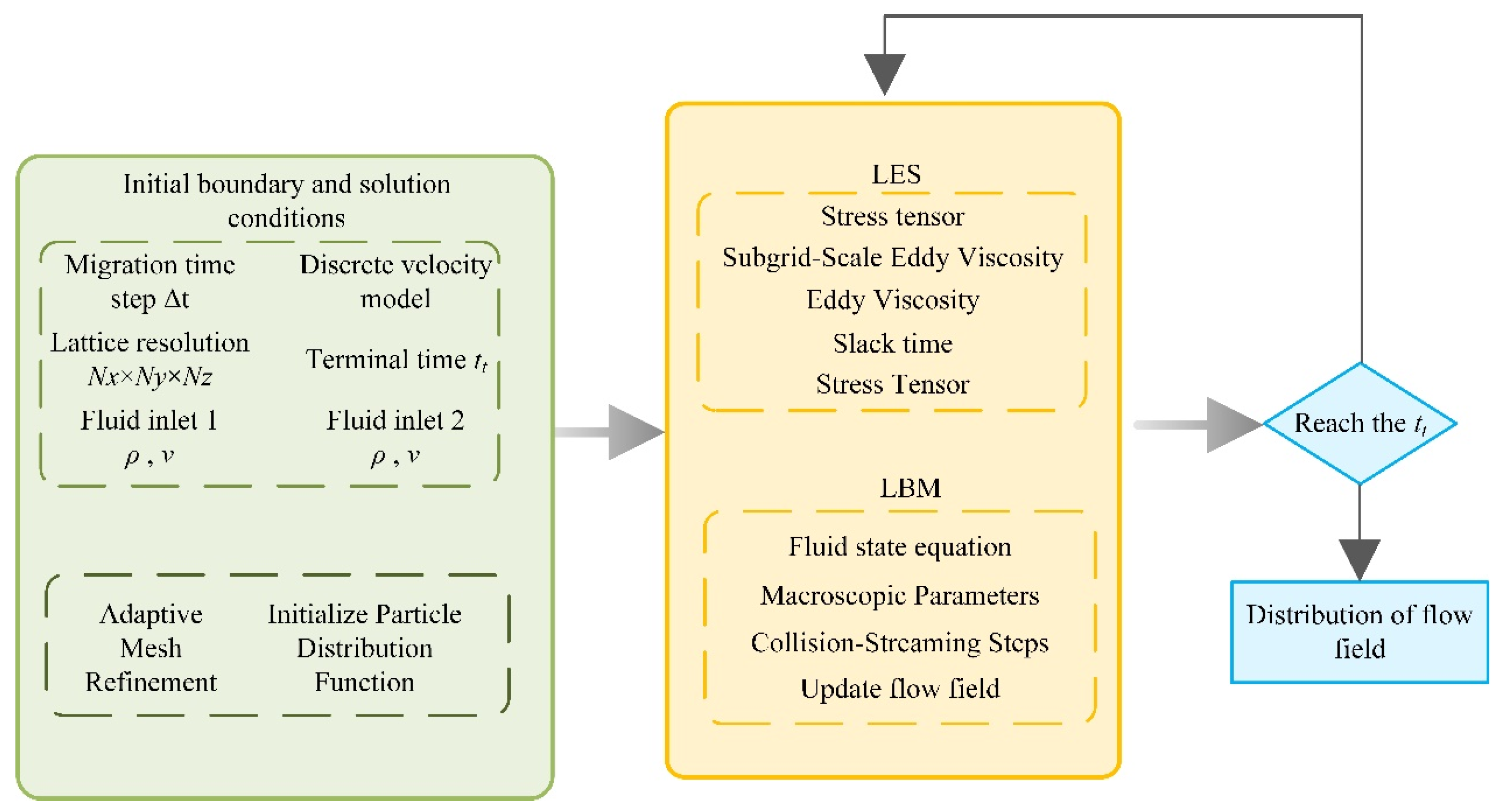
2.3. Numerical Simulation Based on LBM-LES Coupling
3. Numerical Model of High-Speed Gear Lubrication Oil Field
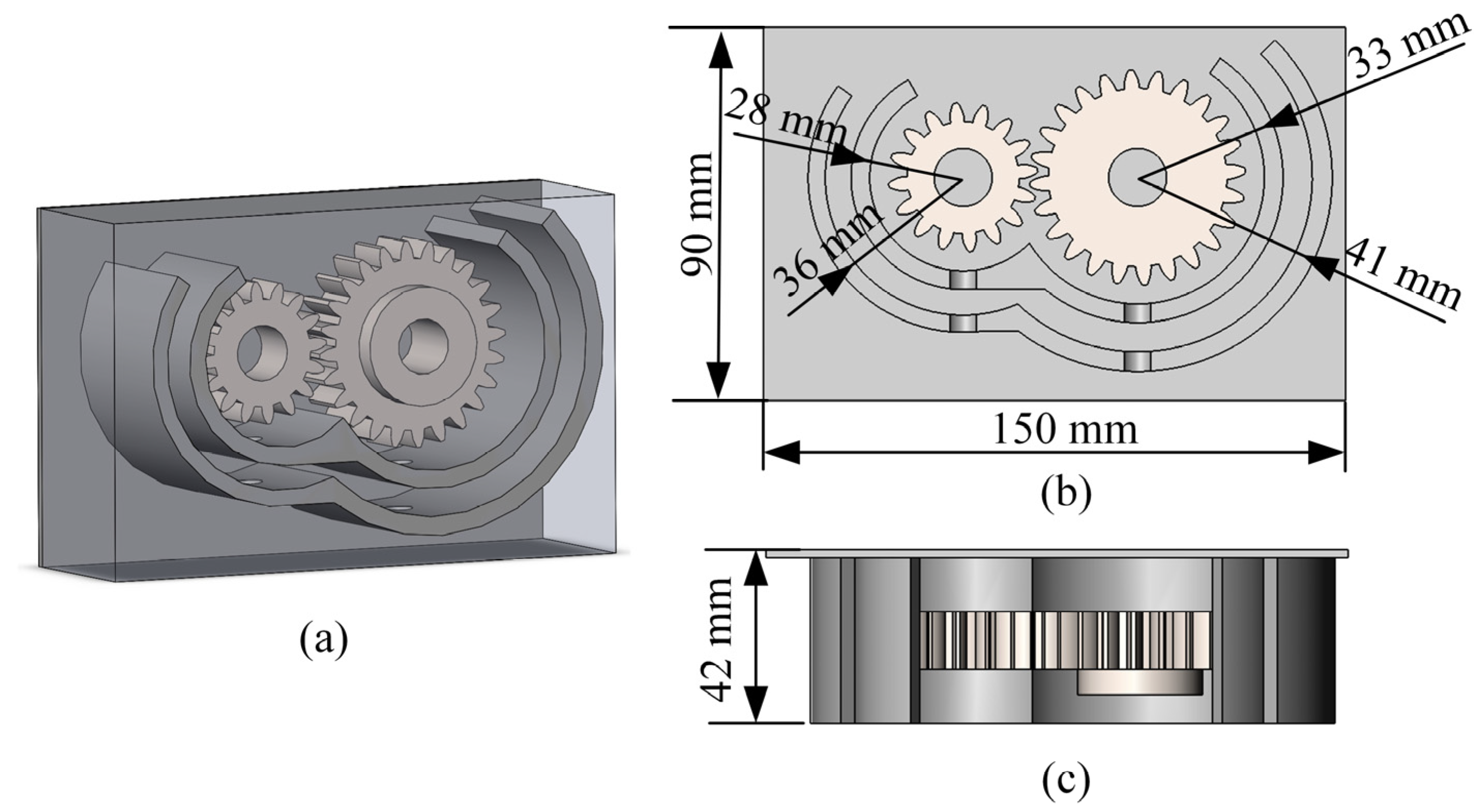
3.1. Geometric Model and Numerical Model
3.2. Model Boundary Conditions and Initial Conditions
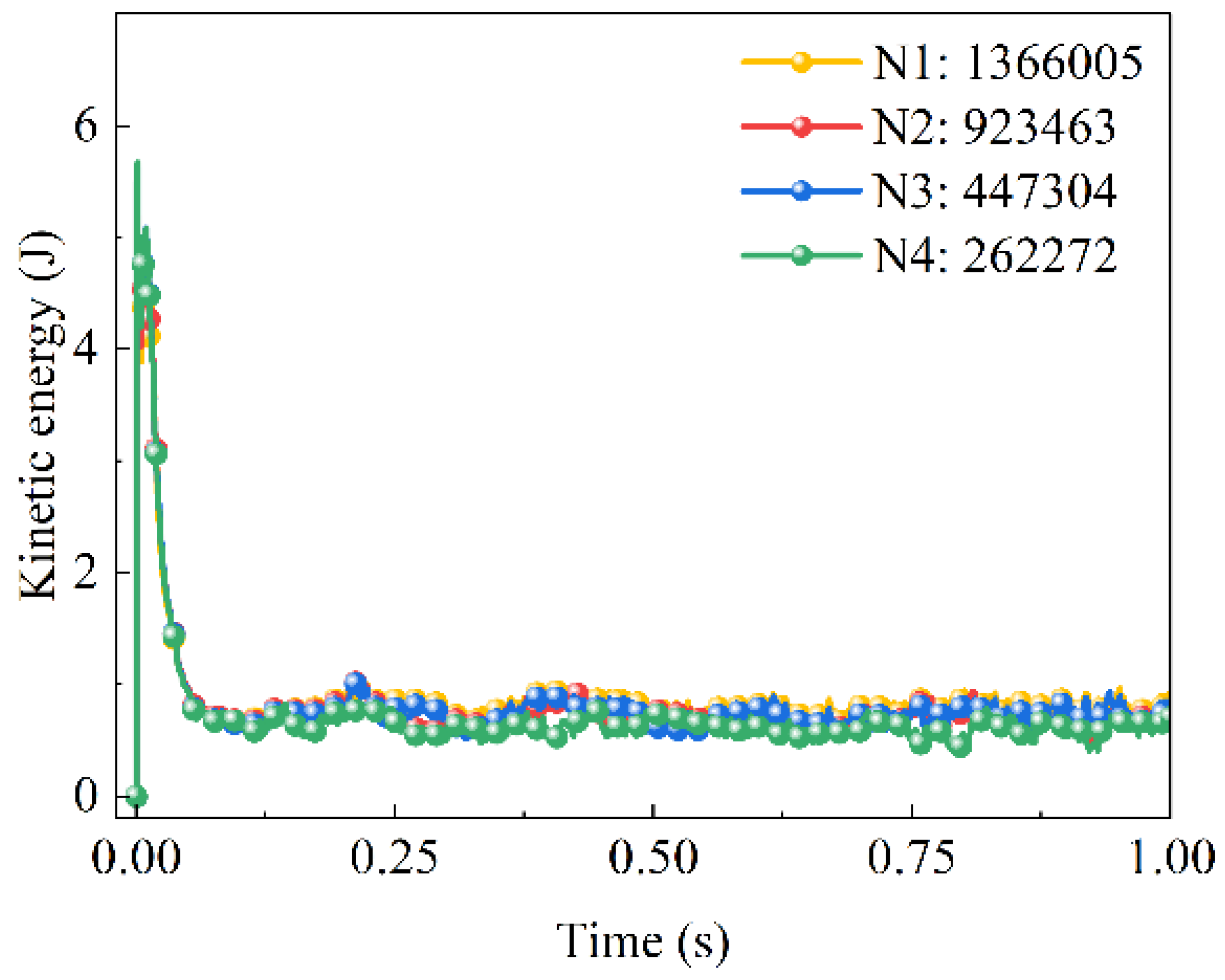
3.3. Lattice Independence Verification
4. Discussion
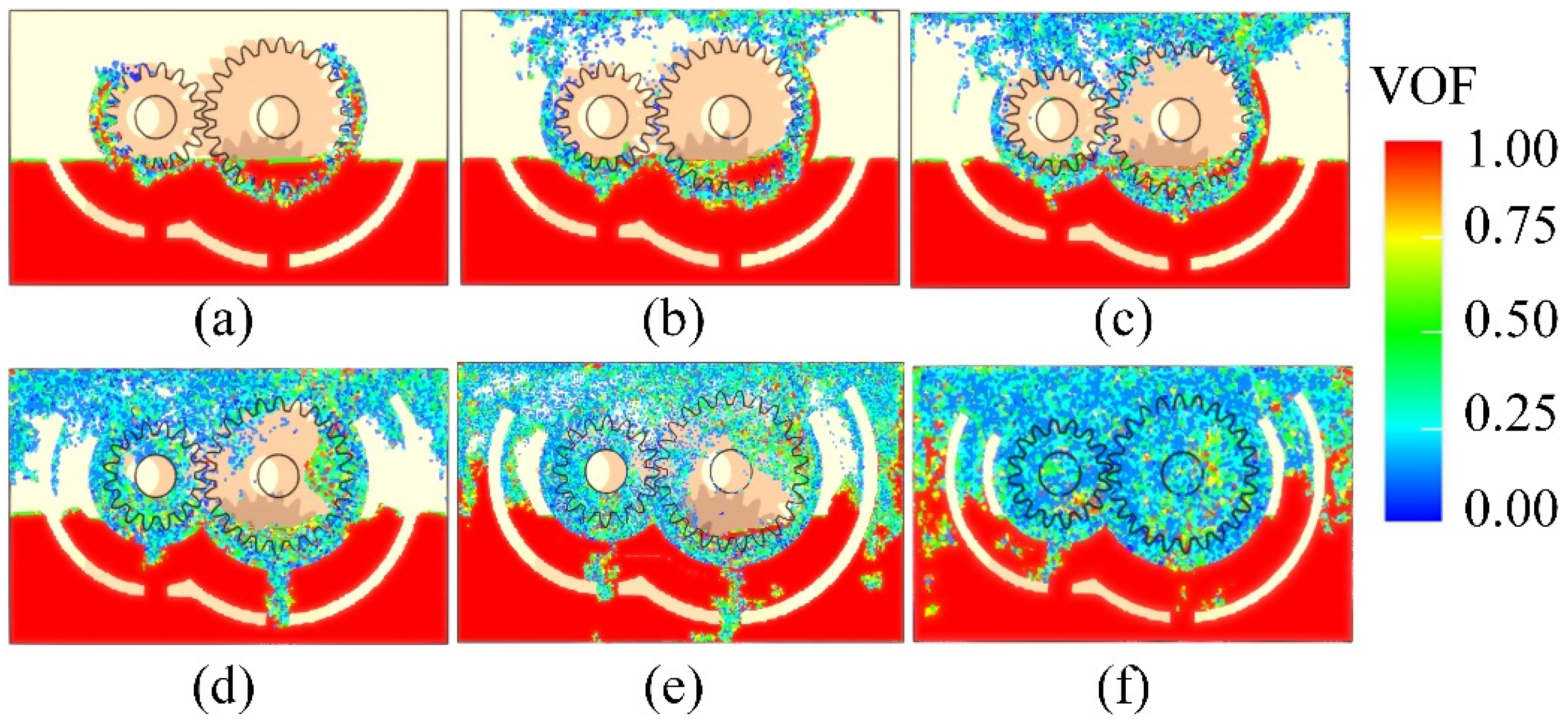
4.1. Distribution Mechanism of Lubricating Oil in High-Speed Gearbox
4.2. Mechanism of Influence of Baffle Geometric Parameters
5. Conclusions
- (1)
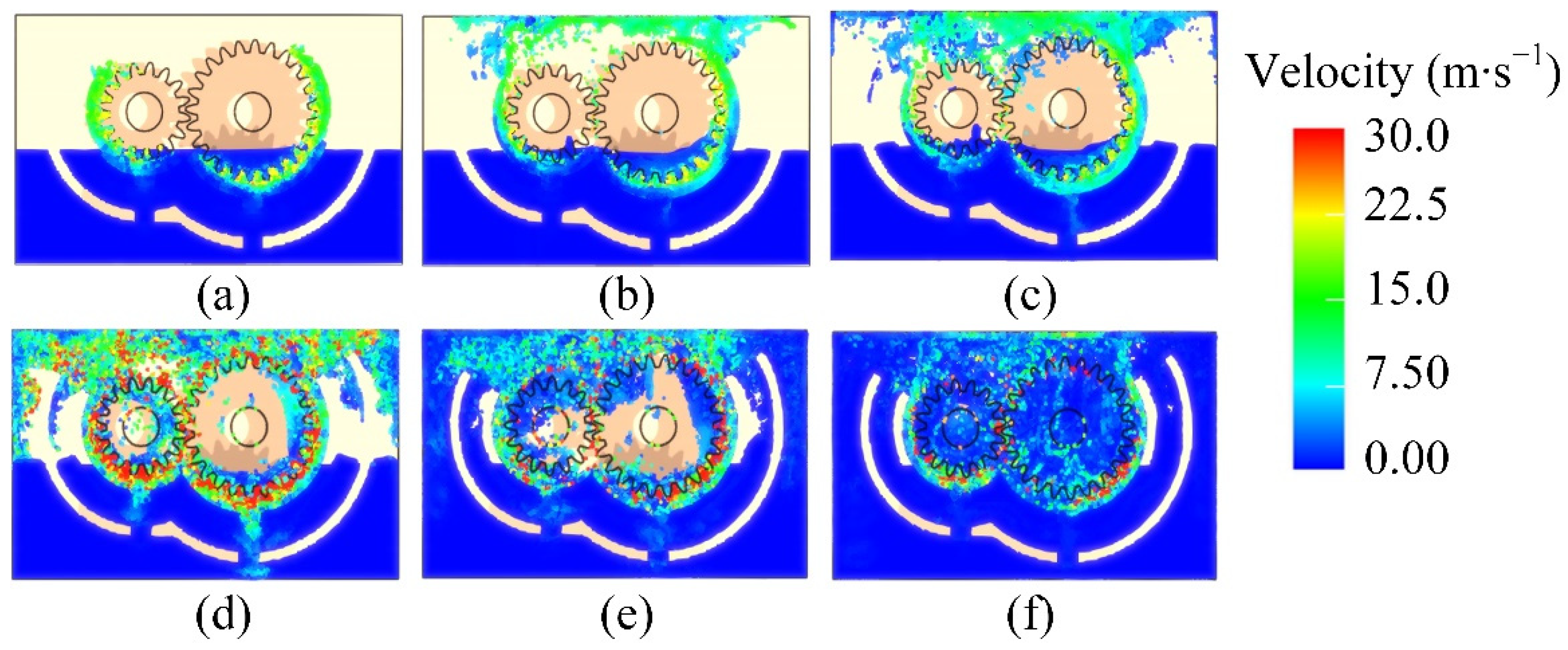
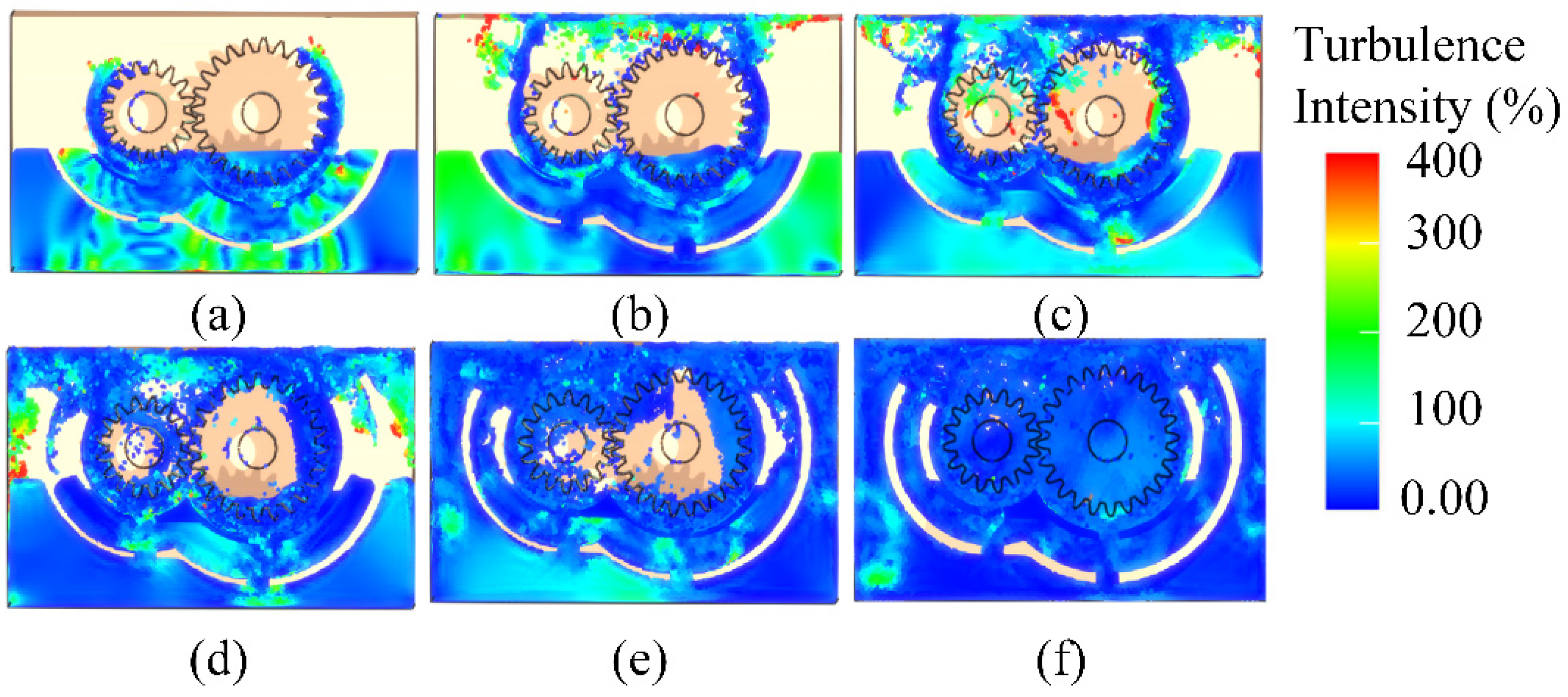
- Based on the LBM-LES cross-scale coupled framework, a multiphase-coupled transport dynamics model was developed. This model characterizes the collaborative evolution of enstrophy, kinetic energy, and enthalpy. It reveals the nonlinear dynamic features within the flow field of the gearbox lubrication system. The rotation of the gears drives the fluid toward the top of the housing, forming a dynamic distribution. The fluid velocity in the gear meshing zone is significantly higher than in other regions. Its flow pattern is regulated by both the gear tooth profile and surface roughness, exhibiting complex nonlinear characteristics. In the top region, turbulence is markedly enhanced due to the combined effects of centrifugal force and wall constraints. In the bottom region, turbulence fluctuations are concentrated along both sides of the baffles. This leads to a flow field distribution with clear nonlinear dynamic features.
- (2)
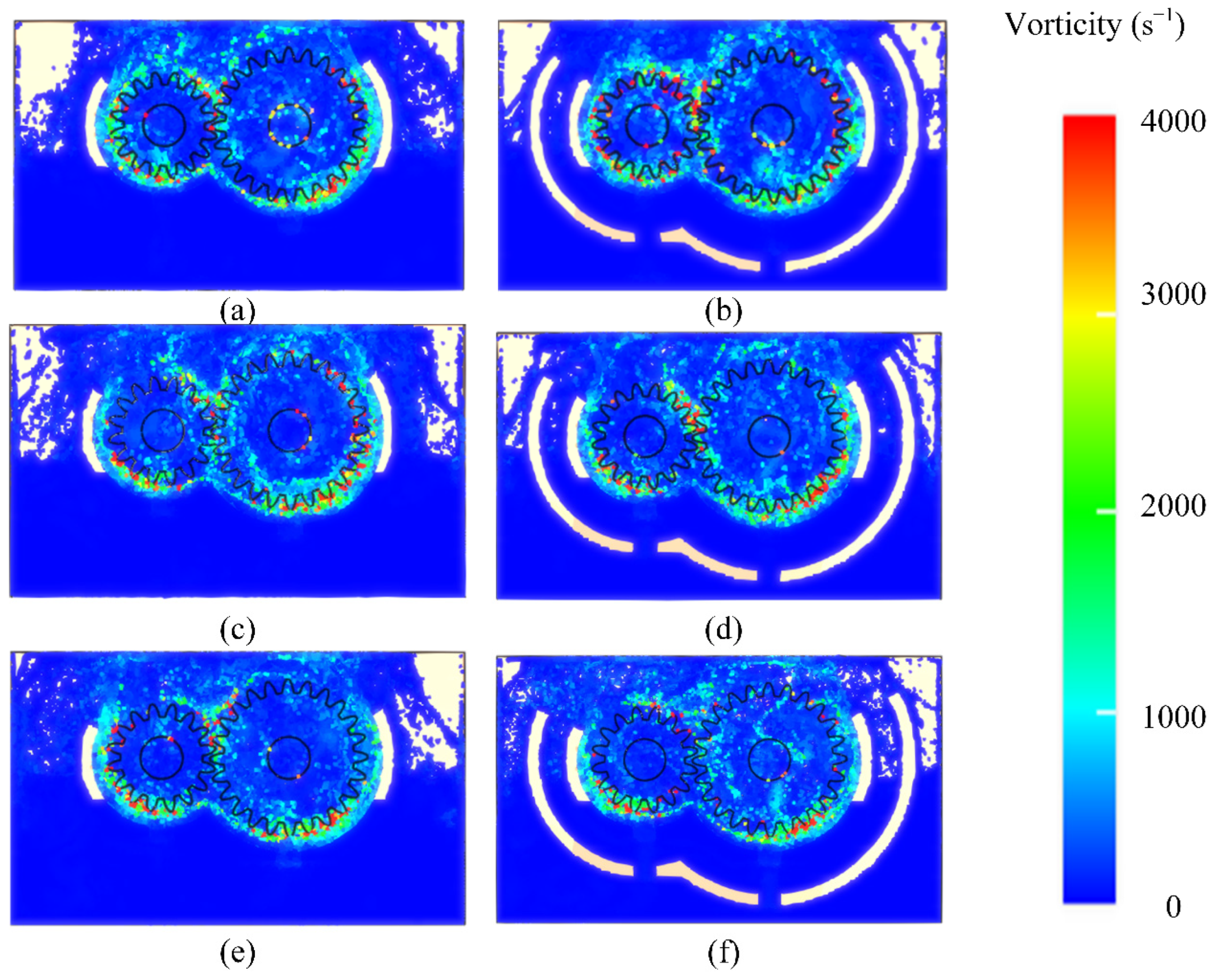
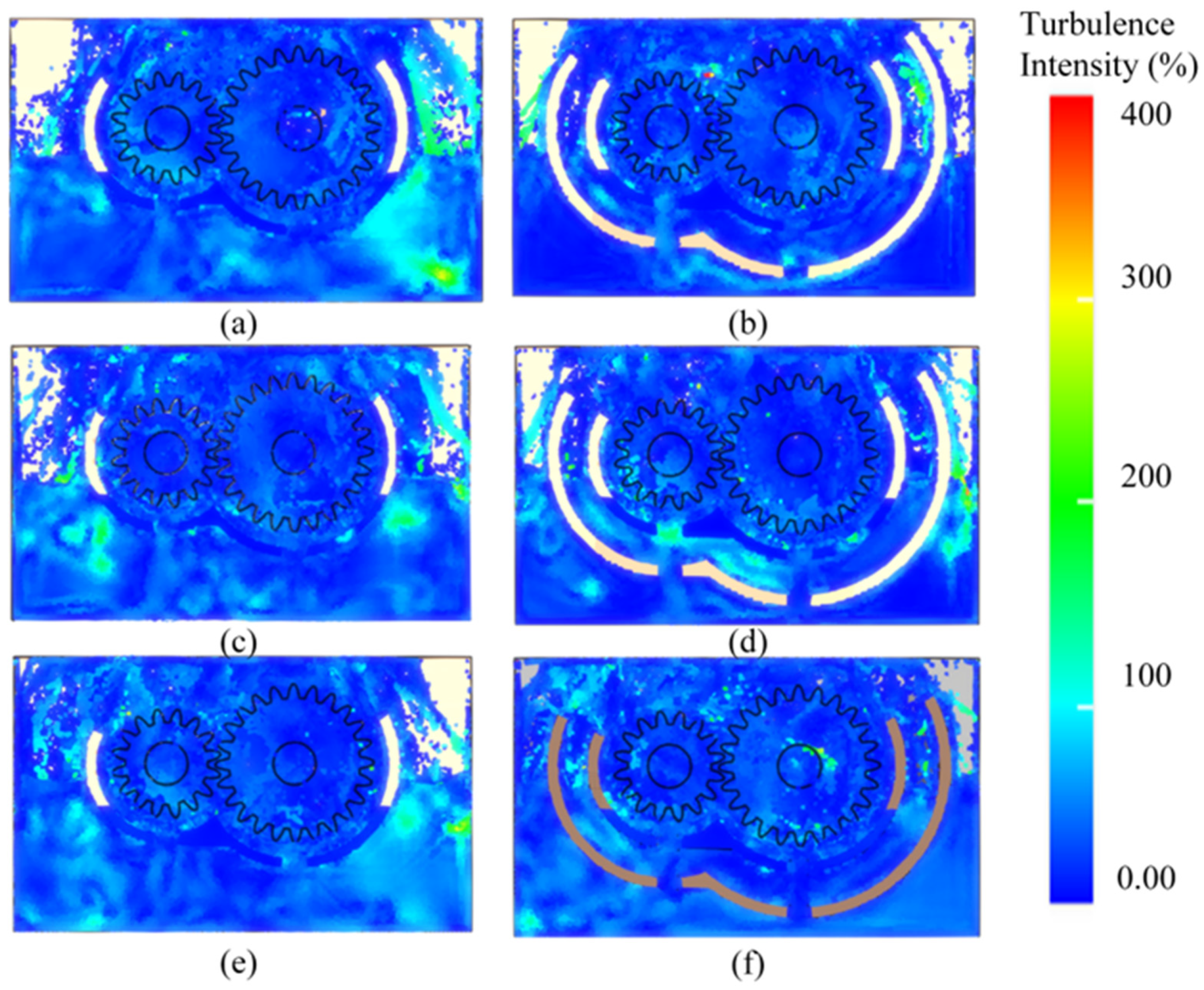
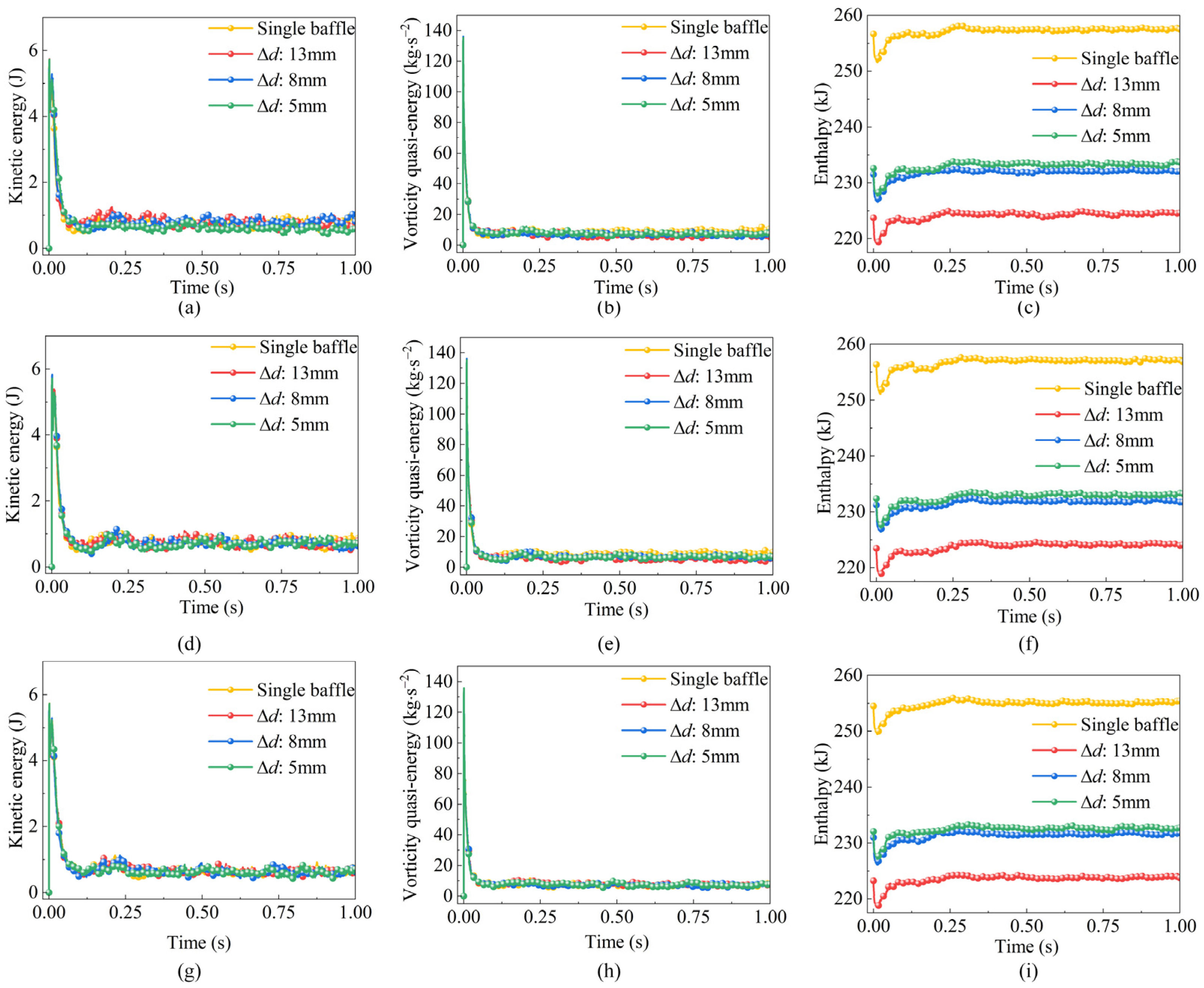
- Changes in the cutoff-end angle of the baffle significantly affect the distribution of enstrophy in the flow field. A decrease in the angle enhances the confinement effect on the fluid, thereby suppressing the generation and development of enstrophy. The dual-baffle configuration optimizes the flow field structure by constraining the fluid pathways, effectively inhibiting disordered fluid motion. The distribution of turbulence intensity is closely related to the baffle configuration. The dual-baffle design, through alternate shedding of vortex structures, enhances radial momentum transport. This reduces both the turbulence intensity in the gear meshing zone and the associated oil stirring losses.
- (3)
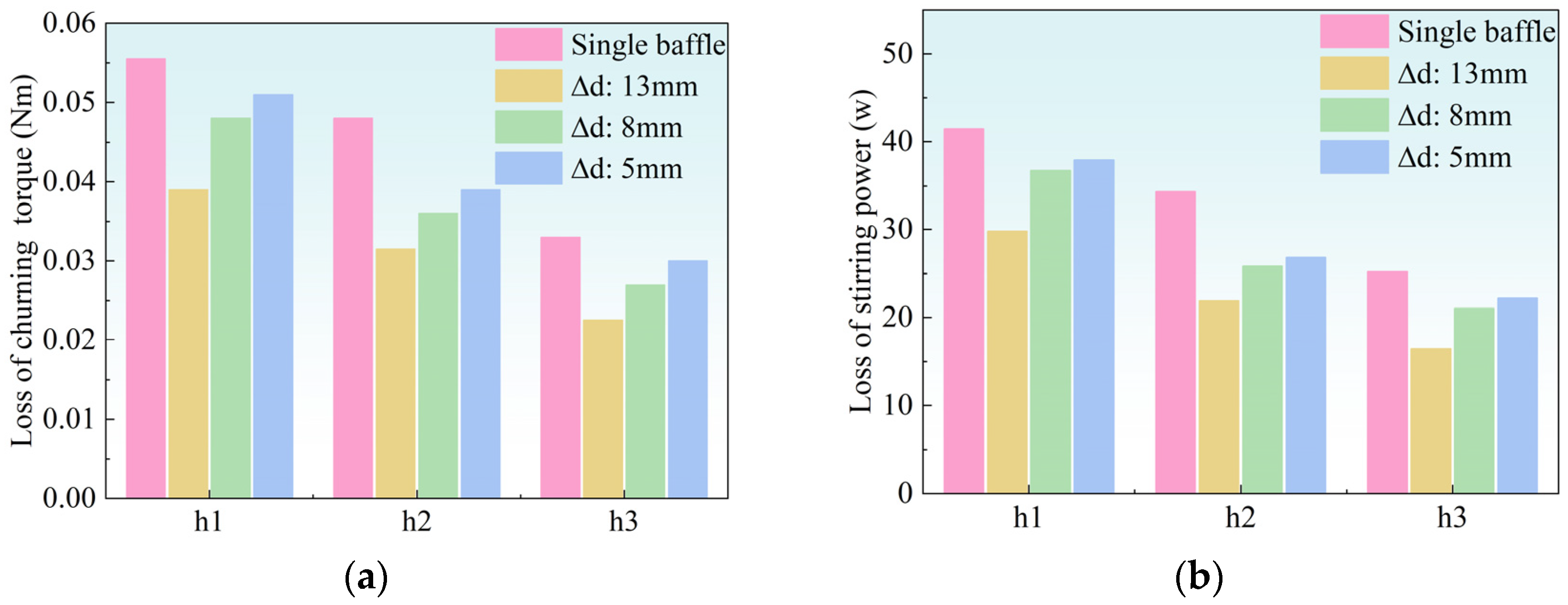
- The dual-baffle configuration reduces localized high-momentum impacts and energy dissipation by optimizing the energy transfer pathways within the flow channel. This results in lower system enthalpy compared to the single-baffle system. Reducing baffle height effectively decreases stirring torque and power losses by optimizing the flow path and suppressing the formation of local vortices. However, a smaller gap between the baffles intensifies axial backflow and exacerbates energy losses. The study confirms that by optimizing the combination of baffle parameters, it is possible to maintain an effective oil film thickness while keeping stirring losses within an acceptable range. This approach achieves a global optimum in lubrication performance and energy efficiency.
Author Contributions
Funding
Institutional Review Board Statement
Informed Consent Statement
Data Availability Statement
Conflicts of Interest
Nomenclature
| fi(x,t) | density distribution function of the i-th component |
| x | discrete spatial position |
| t | time |
| ξ | molecular velocity vector |
| F(x,t) | external force term |
| Ωi | collision operator |
| c | lattice speed |
| u | macroscopic velocity of the fluid |
| ρ | fluid density |
| p | pressure |
| cs | Lattice Speed of Sound |
| α | coordinate directions |
| wi | total particle distribution function |
| F(Ξ) | generating function obtained by mapping the density distribution function |
| Ξ | frequency space |
| Y | wavenumber variables in frequency space |
| kαβγ | cumulant |
| ωαβγ | relaxation rate |
| β | coordinate directions |
| γ | coordinate directions |
| cumulant in equilibrium state | |
| Re | Reynolds number |
| vsgs | subgrid-scale motion viscosity |
| Sαβ | strain rate tensors |
| Gαβ | strain rate tensors |
| Δ | filter width |
| τiαβ | subgrid stress closure tensor |
| v | total viscosity |
| τ | relaxation time |
Abbreviations
| LBM | lattice Boltzmann method |
| LES | large eddy simulation |
| MPS | moving particle semi-implicit |
| SGS | subgrid stress model |
| WALE | Wall-Adapting Local Eddy-viscosity |
| VOF | Volume of Fluid |
References
- Bao, H.; Huang, W.; Lu, F. Investigation of engagement characteristics of a multi-disc wet friction clutch. Tribol. Int. 2021, 159, 106940. [Google Scholar] [CrossRef] [Scilit]
- Hu, X.; Li, P.; Quan, C.; Wang, J. CFD investigation on oil injection lubrication of meshing spur gears via Lattice Boltzmann Method. Lubricants 2022, 10, 184. [Google Scholar] [CrossRef] [Scilit]
- Ruan, D.; Chen, G.; Luo, X.; Cheng, L.; Wu, H.; Liu, A. Bionic octopus-like flexible three-dimensional force sensor for meticulous handwriting recognition in human-computer interactions. Nano Energy 2024, 123, 109357. [Google Scholar] [CrossRef] [Scilit]
- Quiban, R.; Changenet, C.; Marchesse, Y.; Ville, F.; Belmonte, J. Churning losses of spiral bevel gears at high rotational speed. Proc. Inst. Mech. Eng. Part J J. Eng. Tribol. 2020, 234, 172–182. [Google Scholar] [CrossRef] [Scilit]
- Qiu, Y.; Wang, F.-N.; Zhang, Z.; Shi, K.-Q.; Song, Y.; Lu, J.-T.; Xu, M.-J.; Qian, M.-Y.; Zhang, W.-A.; Wu, J.-X.; et al. Quantitative softness and texture bimodal haptic sensors for robotic clinical feature identification and intelligent picking. Sci. Adv. 2024, 10, eadp0348. [Google Scholar] [CrossRef] [Scilit] [PubMed]
- Mastrone, M.N.; Concli, F. Simulation of fluid’s aeration: Implementation of a numerical model in an open source environment. Adv. Fluid Dyn. 2021, 132, 27. [Google Scholar]
- Hurrell, M.; Sawicki, J. Pumping loss of shrouded meshed spur gears. ASME J. Eng. Gas Turbines Power 2020, 142, 111003. [Google Scholar] [CrossRef] [Scilit]
- Qi, H.; Zhang, Z.; Huang, M.; Song, C.; Yang, X.; Tang, H. Enhancing the Mechanical Behaviors of 18Ni300 Steel through Microstructural Evolution in Electron Beam Powder Bed Fusion. J. Mater. Res. Technol. 2025, 36, 4215–4228. [Google Scholar] [CrossRef] [Scilit]
- Concli, F.; Mastrone, M.N. Latest advancements in the lubricant simulations of geared systems: A technology ready for industrial applications. Forsch. Ingenieurwesen 2023, 87, 1181–1191. [Google Scholar] [CrossRef] [Scilit]
- Wang, L.; Hong, B.; Chen, H.; Qi, H.; Zhang, J.; Hang, W.; Han, Y.; Wang, J.; Ren, K.; Lyu, B. Enhancing Tungsten Machinability via Laser Pretreatment for Abrasive Particles-based Shear Rheological Polishing. Powder Technol. 2025, 455, 120758. [Google Scholar] [CrossRef] [Scilit]
- Li, L.; Xu, P.; Li, Q.H.; Yin, Z.C.; Zheng, R.Y.; Wu, J.F.; Bao, J.J.; Qi, H.; Tan, D.P. Multi-field coupling particle flow dynamic behaviors of the microreactor and ultrasonic control method. Powder Technol. 2025, 454, 120731. [Google Scholar] [CrossRef] [Scilit]
- Handschuh, M.; Guner, A.; Kahraman, A. An experimental investigation of windage and oil churning power losses of gears and discs. Proc. Inst. Mech. Eng. Part J J. Eng. Tribol. 2023, 237, 163–177. [Google Scholar] [CrossRef] [Scilit]
- Changenet, C.; Vel, P. Housing influence on churning losses in geared transmissions. J. Mech. Des. 2008, 130, 681–688. [Google Scholar] [CrossRef] [Scilit]
- Arisawa, H.; Nishimura, M.; Imai, H.; Goi, T. CFD simulation for reduction of oil churning loss and windage loss on aeroengine transmission gears. In ASME TurboExpo 2009: Power for Land, Sea, and Air; American Society of Mechanical Engineers: New York, NY, USA, 2009; pp. 63–72. [Google Scholar]
- Arisawa, H.; Nishimura, M.; Imai, H.; Goi, T. Computational fluid dynamics simulations and experiments for reduction of oil churning loss and windage loss in aeroengine transmission gears. J. Eng. Gas Turbines Power 2014, 136, 092604. [Google Scholar] [CrossRef] [Scilit]
- Hildebrand, L.; Dangl, F.; Sedlmair, M.; Thomas, L.; Karsten, S. CFD analysis on the oil flow of a gear stage with guide plate. Forsch. Ingenieurwesen 2022, 86, 395–408. [Google Scholar] [CrossRef] [Scilit]
- Liu, H.; Jurkshat, T.; Lohner, T.; Stahl, K. Detailed investigations on the oil flow in dip-lubricated gearboxes by the finite volume CFD method. Lubricants 2018, 6, 47. [Google Scholar] [CrossRef] [Scilit]
- Liu, H.; Jurkshat, T.; Lohner, T.; Stahl, K. Determination of oil distribution and churning power loss of gearboxes by finite volume CFD method. Tribol. Int. 2017, 109, 346–354. [Google Scholar] [CrossRef] [Scilit]
- Atencio, B.N.; Yao, H.D.; Chernoray, V. Experiments and Lattice-Boltzmann simulation of flow in a vertically aligned gearbox. J. Tribol. 2023, 145, 114103. [Google Scholar] [CrossRef] [Scilit]
- Concli, F.; Mastrone, M.N. Advanced lubrication simulations of an entire test rig: Optimization of the nozzle orientation to maximize the lubrication capability. Lubricants 2023, 11, 300. [Google Scholar] [CrossRef] [Scilit]
- Liu, Y.; Shao, S.; Zhang, K.; Yuan, Y.; Wang, X. Investigation of characteristics of splash lubrication and churning power loss in gearboxes with a guide plate. Tribol. Int. 2024, 198, 109875. [Google Scholar] [CrossRef] [Scilit]
- Liang, Y.; Huang, H.; Yan, C.; Yuan, X.; Tang, Y.; Bai, J.; Zhang, S. An efficient aluminum gradient mesh wick for enhancing boiling heat transfer performance. Int. Commun. Heat Mass Transf. 2024, 152, 107320. [Google Scholar] [CrossRef] [Scilit]
- Vikhansky, A. An engineering model of a turbulent liquid film flow. Eur. J. Mech. -B Fluids 2021, 90, 15–17. [Google Scholar] [CrossRef] [Scilit]
- Wei, C.; Wu, W.; Hou, X.; Nelias, D.; Yuan, S. Research on flow pattern of low temperature lubrication flow field of rotating disk based on MPS method. Tribol. Int. 2023, 180, 108221. [Google Scholar] [CrossRef] [Scilit]
- Hou, X.; Wu, W.; Gui, P.; Zou, T.; Zhang, J. Investigation of churning torque for hydraulic torque converter based on CFD. Tribol. Int. 2022, 174, 107722. [Google Scholar] [CrossRef] [Scilit]
- Ge, J.Q.; Lin, Y.H.; Qi, H.; Li, Y.T.; Li, X.L.; Li, C.; Li, Z.A.; Xu, K.Q. The impact of ultrasonic-induced jet morphology on polishing efficiency. Int. J. Mech. Sci. 2024, 284, 109764. [Google Scholar] [CrossRef] [Scilit]
- Zheng, G.; Xu, P.; Wang, T.; Yan, Q. Study on the bubble collapse characteristics and heat transfer mechanism of the microchannel reactor. Processes 2025, 13, 281. [Google Scholar] [CrossRef] [Scilit]
- Maccioni, L.; Chernoray, V.; Bohnert, C.; Concli, F. Particle Image velocimetry measurements inside a tapered roller bearing with an outer ring made of sapphire: Design and operation of an innovative test rig. Tribol. Int. 2022, 165, 107313. [Google Scholar] [CrossRef] [Scilit]
- Hong, C.; Xunmei, W.; Mengtao, H.; Zhang, Y. Impacts of solid wall boundary conditions in the lattice Boltzmann method on turbulent outdoor flow: A case study of a single 1:1:2 building model. Build. Environ. 2022, 226, 109708. [Google Scholar] [CrossRef] [Scilit]
- Tan, Y.F.; Ni, Y.S.; Xu, W.X.; Xie, Y.S.; Li, L.; Tan, D.P. Key technologies and development trends of the soft abrasive flow finishing method. J. Zhejiang Univ.-Sci. A 2023, 24, 1043–1064. [Google Scholar] [CrossRef] [Scilit]
- Marlow, F.; Jacon, J.; Sagaut, P. A multidisciplinary model coupling Lattice-Boltzmann-based CFD and a social force model for the simulation of pollutant dispersion in evacuation situations. Build. Environ. 2021, 205, 108212. [Google Scholar] [CrossRef] [Scilit]
- Geier, M.; Schönherr, M.; Pasquali, A.; Krafczyk, M. The cumulant lattice Boltzmann equation in three dimensions: Theory and validation. Comput. Math. Appl. 2015, 70, 507–547. [Google Scholar] [CrossRef] [Scilit]
- Das, S.; Eldho, T.I. A meshless weak strong form method for the groundwater flow simulation in an unconfined aquifer. Eng. Anal. Bound. Elem. 2022, 137, 147–159. [Google Scholar] [CrossRef] [Scilit]
- Rao, X.; Zhan, W.; Zhao, H.; Xu, Y.; Liu, D.; Dai, W.; Gong, R.; Wang, F. Application of the least-square meshless method to gas-water flow simulation of complex-shape shale gas reservoirs. Eng. Anal. Bound. Elem. 2021, 129, 39–54. [Google Scholar] [CrossRef] [Scilit]
- Lashkariani, M.R.; Firoozjaee, A.R. An improved node moving technique for adaptive analysis using collocated discrete least squares meshless method. Eng. Anal. Bound. Elem. 2021, 130, 322–331. [Google Scholar] [CrossRef] [Scilit]
- Tong, W.J.; Li, L. Analysis of Flow Field and Machining Parameters in RUREMM for High-precision Micro-texture Fabrication on SS304 Surfaces. Processes 2025, 13, 2326. [Google Scholar] [CrossRef] [Scilit]
- Krafczyk, M.; Tölke, J.; Luo, L. Large-eddy simulations with a multiple-relaxation-time LBE model. Int. J. Mod. Phys. B 2003, 17, 33–39. [Google Scholar] [CrossRef] [Scilit]
- Chai, Z.; Shi, B. Multiple-relaxation-time lattice Boltzmann method for the Navier-Stokes and nonlinear convection-diffusion equations: Modeling, analysis, and elements. Phys. Rev. E 2020, 102, 023306. [Google Scholar] [CrossRef] [Scilit]
- Li, L.; Xu, P.; Li, Q.H.; Zheng, R.Y.; Xu, X.M.; Wu, J.F.; He, B.Y.; Bao, J.J.; Tan, D.P. A coupled LBM-LES-DEM particle flow modeling for microfluidic chip and ultrasonic-based particle aggregation control method. Appl. Math. Model. 2025, 143, 116025. [Google Scholar] [CrossRef] [Scilit]
- Lin, H.; Ma, M.; Qi, H.; Wang, X.; Xing, Z.; Alowasheeir, A.; Tang, H.; Jun, S.C.; Yamauchi, Y.; Liu, S. 3D-Printed photocatalysts for revolutionizing catalytic conversion of solar to chemical energy. Prog. Mater. Sci. 2025, 151, 101427. [Google Scholar] [CrossRef] [Scilit]
- Ni, Y.; Li, Q.; Tan, Y.; Yu, J.; Lin, L.; Yuan, J.; Tan, D. Multi-physical coupling modeling and ultrasonic crack detection mechanism analysis for underwater steel structures. Ocean Eng. 2025; in press.
- Fu, S.; Wang, L. GPU-based unresolved LBM-DEM for fast simulation of gas–solid flows. Chem. Eng. J. 2023, 465, 142898. [Google Scholar] [CrossRef] [Scilit]
- Li, Q.; Tang, R.; Wang, S.; Zou, Z. A coupled LES-LBM-IMB-DEM modeling for evaluating pressure drop of a heterogeneous alternating-layer packed bed. Chem. Eng. J. 2022, 433, 133529. [Google Scholar] [CrossRef] [Scilit]
- Aniello, A.; Schuster, D.; Werner, P.; Boussuge, J.F.; Gatti, M.; Mirat, C.; Rude, U. Comparison of a finite volume and two Lattice Boltzmann solvers for swirled confined flows. Comput. Fluids 2022, 241, 105463. [Google Scholar] [CrossRef] [Scilit]
- Chen, H.; Liu, W.; Chen, Z.; Zheng, Z. A numerical study on the sedimentation of adhesive particles in viscous fluids using LBM-LES-DEM. Powder Technol. 2021, 391, 467–478. [Google Scholar] [CrossRef] [Scilit]
- Li, Z.; Wang, C.Y.; Li, L. Mechanism of multiphase flow transport in laterally-compressed cathode channels with fin-type obstacles for PEMFC. Appl. Therm. Eng. 2025; in press.
- Lin, H.; Shen, Q.; Ma, M.; Ji, R.; Guo, H.; Qi, H.; Xing, W.; Tang, H. 3D Printing of Porous Ceramics for Enhanced Thermal Insulation Properties. Adv. Sci. 2024, 12, 2412554. [Google Scholar] [CrossRef] [Scilit]
- Li, X.; Wang, S.; Wen, R.; Ma, X.; Yang, R. Liquid film boiling enabled ultra-high conductance and high flux heat spreaders. Cell Rep. Phys. Sci. 2022, 3, 100746. [Google Scholar] [CrossRef] [Scilit]
- Xu, P.; Li, Q.H.; Wang, C.Y.; Li, L.; Tan, D.P.; Wu, H.P. Interlayer healing mechanism of multipath deposition 3D printing models and interlayer strength regulation method. J. Manuf. Process. 2025, 141, 1031–1047. [Google Scholar] [CrossRef] [Scilit]
- Shen, L.; Zhu, Y.; Shao, S.; Zhou, H.; Wang, Z. Research on splash lubrication characteristics of a spiral bevel gearbox based on the mps method. Lubricants 2023, 11, 520. [Google Scholar] [CrossRef] [Scilit]
- Chen, H.; Liu, W.; Li, S. A fully-resolved LBM-LES-DEM numerical scheme for adhesive and cohesive particle-laden turbulent flows in three dimensions. Powder Technol. 2024, 440, 119800. [Google Scholar] [CrossRef] [Scilit]
- Sun, Z.; Yao, Q.; Jin, H.; Xu, Y.; Hang, W.; Chen, H.; Li, K.; Shi, L.; Gu, J.; Zhang, Q.; et al. A novel in-situ sensor calibration method for building thermal systems based on virtual samples and autoencoder. Energy 2024, 297, 131314. [Google Scholar] [CrossRef] [Scilit]
- Kim, N.S.; Jeong, Y.H. An investigation of pressure build-up effects due to check valve’s closing characteristics using dynamic mesh techniques of CFD. Ann. Nucl. Energy 2021, 152, 107996. [Google Scholar] [CrossRef] [Scilit]
- Zhang, Y.K.; Li, Z.; Li, L.; Wang, C.Y.; Wu, J.F.; Xie, Y.S.; Yin, Z.C.; Tan, D.P. Deposition Mechanism of Microscopic Impacting Droplets on Flexible Porous Substrates. Int. J. Mech. Sci. 2025, 288, 110050. [Google Scholar] [CrossRef] [Scilit]
- Velásquez, L.; Rubio-Clemente, A.; Chica, E. Numerical and Experimental Analysis of Vortex Profiles in Gravitational Water Vortex Hydraulic Turbines. Energies 2024, 17, 3543. [Google Scholar] [CrossRef] [Scilit]
- Sun, Z.; Yao, Q.; Shi, L.; Jin, H.; Xu, Y.; Yang, P.; Xiao, H.; Chen, D.; Zhao, P.; Shen, X. A virtual sample diffusion generation method guided by LLM-generated knowledge for enhancing information completeness and zero-shot fault diagnosis in building thermal systems. J. Zhejiang Univ.-Sci. A, 2025; in press.
- Xing, J.T. Theoretical investigations on lattice Boltzmann method: An amended MBD and improved LBM. Acta Mech. Sin. 2021, 37, 1659–1682. [Google Scholar] [CrossRef] [Scilit]
- Lin, Q.; Li, Q.H.; Xu, P.; Zheng, R.Y.; Bao, J.J.; Li, L.; Tan, D.P. Transport mechanism and optimization design of the LBM-LES coupling-based two-phase flow in static mixers. Processes 2025, 13, 1666. [Google Scholar] [CrossRef] [Scilit]
- Gu, Y.H.; Li, L.; Zheng, G.A. Study on the dynamic characteristics of the gear lubrication flow field with baffles and optimization design strategies. Lubricants 2025, 13, 143. [Google Scholar] [CrossRef] [Scilit]
- Chen, H.; Wang, L.; Peng, F.; Xu, Q.; Xiong, Y.; Zhao, S.; Tokunaga, K.; Wu, Z.; Ma, Y.; Chen, P.; et al. Hydrogen retention and affecting factors in rolled tungsten: Thermal desorption spectra and molecular dynamics simulations. Int. J. Hydrogen Energy 2023, 48, 30522–30531. [Google Scholar] [CrossRef] [Scilit]
- Li, C.; Zhao, Y.; Ai, D.; Wang, Q.; Peng, Z.; Li, Y. Multi-component LBM-LES model of the air and methane flow in tunnels and its validation. Phys. A Stat. Mech. Its Appl. 2021, 553, 124279. [Google Scholar] [CrossRef] [Scilit]
- Xue, X.; Yao, H.-D.; Davidson, L. Synthetic turbulence generator for lattice Boltzmann method at the interface between RANS and LES. Phys. Fluids 2022, 34, 055118. [Google Scholar] [CrossRef] [Scilit]
- Li, Q.H.; Xu, P.; Li, L.; Xu, W.X.; Tan, D.P. Investigation on the Lubrication Heat Transfer Mechanism of the Multilevel Gearbox by the Lattice Boltzmann Method. Process 2024, 12, 381. [Google Scholar] [CrossRef] [Scilit]
- Lin, L.; Li, L.; Pu, X.; Zheng, R.; Yin, Z.; Bao, J.; Yang, Y.; Tan, D. Multiscale heat transfer mechanism and dynamic regulation of free-surface swirling flow based on LBM-LES coupling. Appl. Therm. Eng. 2025; in press.
- Lee, S.; Devahdhanush, V.S.; Mudawer, I. Investigation of subcooled and saturated boiling heat transfer mechanisms, instabilities, and transient flow regime maps for large length-to-diameter ratio micro-channel heat sinks. Int. J. Heat Mass Transf. 2018, 123, 172–191. [Google Scholar] [CrossRef] [Scilit]
- Lallemand, P.; Luo, L.S.; Krafczyk, M. The lattice Boltzmann method for nearly incompressible flows. J. Comput. Phys. 2021, 431, 109713. [Google Scholar] [CrossRef] [Scilit]
- Zhu, X.; Bian, J.; Dai, Y. A quasi-analytical prediction method for gear load independent power losses for shroud approaching. Eng. Sci. Technol. Int. J. 2023, 48, 101562. [Google Scholar] [CrossRef] [Scilit]
- Hosseini, S.A.; Boivin, P.; Thévenin, D.; Karlin, I. Lattice Boltzmann methods for combustion applications. Prog. Energy Combust. Sci. 2024, 102, 101140. [Google Scholar] [CrossRef] [Scilit]
- Park, H.S.; Linton, D.; Thornber, B. Rotorcraft fuselage and ship airwakes simulations using an immersed boundary method. Int. J. Heat Fluid Flow 2022, 93, 108916. [Google Scholar] [CrossRef] [Scilit]
- Liu, L.; Meng, Z.; Zhang, Y.; Sun, Y. Simulation of High-Viscosity Generalized Newtonian Fluid Flows in the Mixing Section of a Screw Extruder Using the Lattice Boltzmann Model. ACS Omega 2023, 8, 47991–48018. [Google Scholar] [CrossRef] [Scilit]



| Parameter | Value |
|---|---|
| Lubricating oil density (kg/m3) | 880 |
| Lubricating oil dynamic viscosity (Pa·s) | 0.06 |
| Lubricating oil height h (mm) | 40 |
| Small gear radius (mm) | 16 |
| Large gear radius (mm) | 24 |
| Gear modulus | 2 |
| Air density (kg/m3) | 1.225 |
| Standard atmospheric pressure (Pa) | 101,325 |
| Angular velocity of small gear (rpm) | 3600 |
| Aerodynamic viscosity (Pa·s) | 1.7894 × 10⁻⁵ |
| Time step ∆t (s) | 2 × 10⁻⁵ |
Disclaimer/Publisher’s Note: The statements, opinions and data contained in all publications are solely those of the individual author(s) and contributor(s) and not of MDPI and/or the editor(s). MDPI and/or the editor(s) disclaim responsibility for any injury to people or property resulting from any ideas, methods, instructions or products referred to in the content. |
© 2025 by the authors. Licensee MDPI, Basel, Switzerland. This article is an open access article distributed under the terms and conditions of the Creative Commons Attribution (CC BY) license (https://creativecommons.org/licenses/by/4.0/).
Share and Cite
Tan, Y.; Li, Q.; Li, L.; Tan, D. Investigating the Regulatory Mechanism of the Baffle Geometric Parameters on the Lubrication Transmission of High-Speed Gears. Appl. Sci. 2025, 15, 11080. https://doi.org/10.3390/app152011080
Tan Y, Li Q, Li L, Tan D. Investigating the Regulatory Mechanism of the Baffle Geometric Parameters on the Lubrication Transmission of High-Speed Gears. Applied Sciences. 2025; 15(20):11080. https://doi.org/10.3390/app152011080
Chicago/Turabian StyleTan, Yunfeng, Qihan Li, Lin Li, and Dapeng Tan. 2025. "Investigating the Regulatory Mechanism of the Baffle Geometric Parameters on the Lubrication Transmission of High-Speed Gears" Applied Sciences 15, no. 20: 11080. https://doi.org/10.3390/app152011080
APA StyleTan, Y., Li, Q., Li, L., & Tan, D. (2025). Investigating the Regulatory Mechanism of the Baffle Geometric Parameters on the Lubrication Transmission of High-Speed Gears. Applied Sciences, 15(20), 11080. https://doi.org/10.3390/app152011080