Relationship Between Skin Temperature and Pressure Injuries: A Systematic Review


Abstract
1. Introduction
2. Materials and Methods
- Population (P): Humans at risk of pressure injuries or exposed to sustained external pressure at classical high-risk sites
- Intervention/Exposure (I): Skin temperature assessment using various thermal measurement methods.
- Comparison (C): Within-person comparators, including adjacent/contralateral skin, non-loaded sites, or pre- vs. post-unloading measures; between-person comparators when applicable.
- Outcome (O): Primary: presence, onset/incidence, progression, or staging of pressure injuries (PIs) and their relationship with skin temperature.Secondary: within-patient ΔT thresholds, reference ranges by anatomical region, studies on prevention and standardization, and analogous evidence on cutaneous lesions with shared mechanisms (mechanical loading, microclimate, and microvasculature).
3. Results
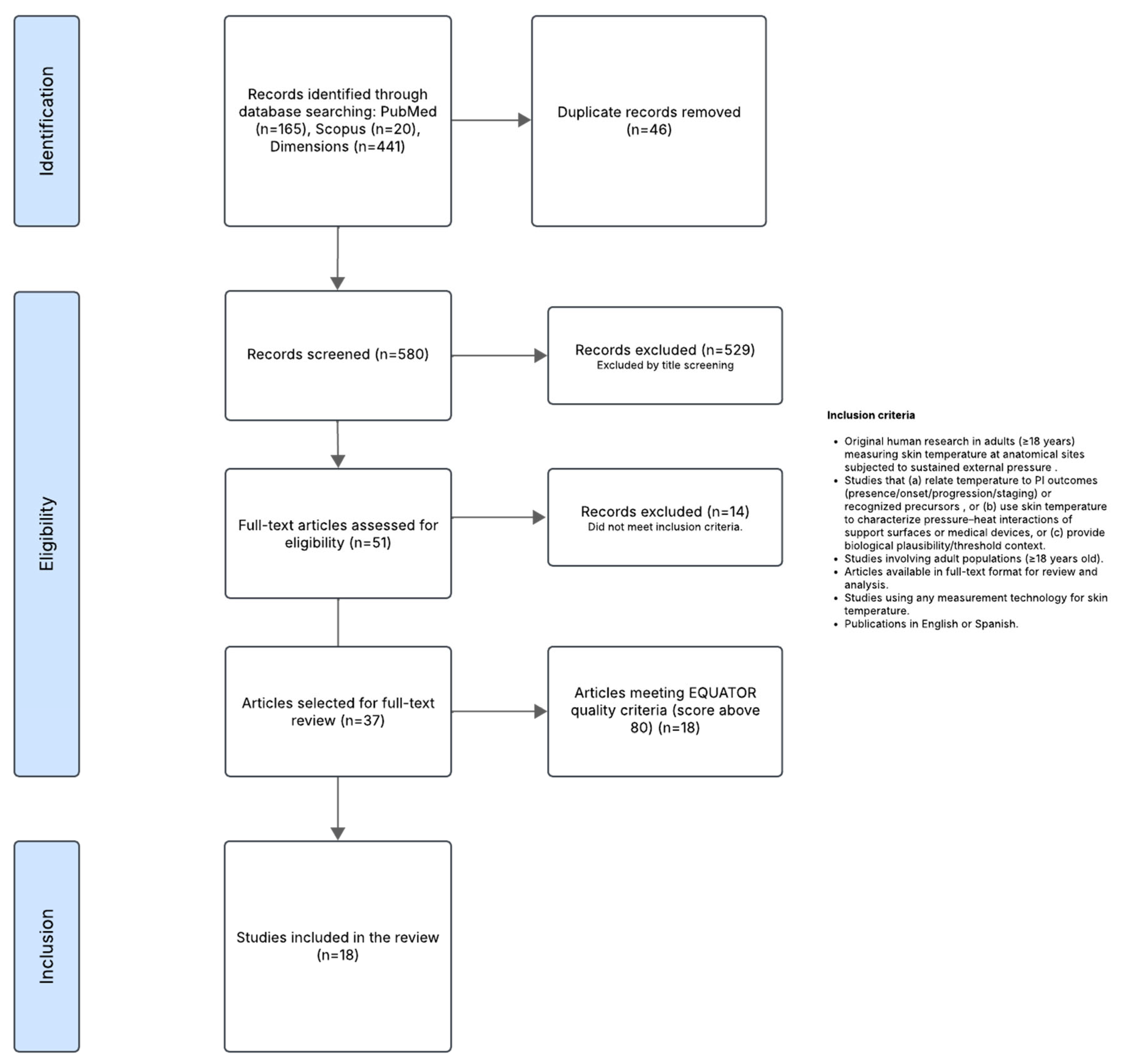
3.1. Study Selection
General Context of the Included Studies
3.2. Methodological Quality
3.2.1. Study Design
3.2.2. Risk of Bias

| Author(s) | Year | Study Type | Reporting Guideline (EQUATOR) | Compliance (%) | Risk of Bias Tool |
|---|---|---|---|---|---|
| Lin et al. [32] | 2021 | Longitudinal observational | STROBE | 81.8% | ROBINS-E |
| García-Molina et al. [33] | 2021 | Randomized clinical trial | CONSORT | 94.0% | RoB 2 |
| Cai et al. [13] | 2021 | Prospective cohort observational | STROBE | 81.8% | ROBINS-E |
| Leenen et al. [34] | 2020 | Randomized clinical trial | CONSORT | 98.0% | RoB 2 |
| Kanazawa et al. [35] | 2016 | Cross-sectional observational | STROBE | 96.1% | ROBINS-E |
| Bilska et al. [36] | 2020 | Randomized trial | CONSORT | 98.0% | RoB 2 |
| Yilmaz et al. [37] | 2019 | Prospective observational | STROBE | 86.4% | ROBINS-E |
| Soares et al. [38] | 2019 | Cross-sectional descriptive-correlational | STROBE | 95.5% | ROBINS-E |
| Yavuz et al. [39] | 2018 | Retrospective observational | STROBE | 77.3% | ROBINS-E |
| Mayrovitz et al. [40] | 2018 | Prospective cohort observational | STROBE | 77.3% | ROBINS-E |
| Lachenbruch et al. [41] | 2015 | Crossover experimental pilot study | CONSORT-PILOT | 98.1% | JBI |
| Kanazawa et al. [42] | 2016 | Retrospective cohort observational | STROBE | 86.4% | ROBINS-E |
| Cox et al. [43] | 2016 | Prospective observational | STROBE | 90.9% | ROBINS-E |
| Staffa et al. [44] | 2016 | Case study | CARE | 96.1% | JBI |
| Källman et al. [45] | 2015 | Longitudinal descriptive observational | STROBE | 86.4% | ROBINS-E |
| Lachenbruch et al. [17] | 2013 | Experimental pilot study | CONSORT-PILOT | 100% | ROBINS-I |
| Jiang et al. [46] | 2020 | Prospective observational | STROBE | 86.4% | ROBINS-E |
| Lupiáñez-Pérez et al. [47] | 2021 | Quasi-experimental | STROBE | 95.5% | ROBINS-I |
3.2.3. Data Extraction and Synthesis
- Early detection and risk stratification (n = 4). Prospective cohort studies in ICU with infrared thermography that define ΔT thresholds and diagnostic performance, plus descriptive studies with spot IR thermometry/thermography that explore temporal sensitivity and intrapatient comparators.
- Follow-up of evolution and prognosis (n = 4). Observational studies were included in cohorts with established pressure injuries, periinjury-bed gradients, retrospective series that relate cold edge with scour, and longitudinal studies with heat maps during treatments.
- Prevention and standardization (n = 8). Laboratory studies with combined loads (pressure–shear–temperature) and hyperemia models, clinical studies of positioning/perfusion (30° supine/lateral), comparisons of support surfaces (cushions), tests with devices (cervical collars), feasibility/reference values of IR thermometry, and works proposing protocols/SOPs for thermal capture and visualization were included.
- Analogous evidence (n = 2) included studies on skin lesions with shared load-microvasculature mechanisms informing thermal interpretation in LP, which included cross-sectional cohort studies with elevated absolute plantar temperatures in diabetic neuropathy and prolonged thermographic follow-up of a case with pre-ulceration and post-revascularization changes.
- Predictive/analytical models (n = 5). Of the studies grouped into the previous categories, those that mentioned relative ROC thresholds of ΔT, multivariate models (Cox) that integrate hemodynamic/metabolic variables, thermal edge-bed-perilesion rules, and experimental regressions that quantified the weight of temperature vs. pressure; basis for AI and automated monitoring were reviewed.
4. Discussion
- Relative thresholds and operational classification. In ICU, Cai et al. established a sacral relative cut-off point of −0.1 °C (colder risk region than control) that anticipated LP ~48 h before visual inspection and with AUC ~0.90, surpassing Braden; the probability of LP was higher when the relative temperature ≤ −0.1 °C [13]. Kanazawa (2016b) showed that a colder wound edge (edge < bed/perilesional) quadrupled the risk of undermining at 1 week (high sensitivity/specificity and kappa), proposing a simple rule applicable to the patient’s bedside [42].
- Multivariable risk models. Jiang et al. used Cox to combine relative temperature, DBP, and glycemia, with optimal cut-off points (DBP 63.5 mmHg; glucose 9.9 mmol/L; relative temperature −0.1 °C); the group with relative temperature ≤ −0.1 °C had HR ~6.36, with increased risk around days 4–5 of hospitalization [46].
- Mechanistic modelling of ischemia. In the laboratory with healthy volunteers, Lachenbruch et al. used fixed-effect regressions to predict the magnitude of reactive hyperemia (ischemia index) from pressure and temperature (shear was not significant in superficial skin with the protocols used). They found that +1 °C contributes ~8–14× more to ischemia than +1 mmHg, and that the effect of temperature is more marked between 32–36 °C; they concluded that lowering skin temperature could mitigate ischemia and the risk of LP, and that managing pressure + temperature is a better predictor of risk than pressure alone [17,41].
- Towards AI and automation. In addition to thresholds and regressions, advanced thermal analysis approaches (e.g., machine learning on thermograms) for risk classification have been explored, opening the door to decision support systems that can be integrated into nursing routines. The validity of portable smartphone-type cameras for standardized relative reading also facilitates bedside flows and telemonitoring, although their use was more of validation than prediction in itself [42].
5. Conclusions
Supplementary Materials
Author Contributions
Funding
Conflicts of Interest
Abbreviations
| Abbreviation | Full Term |
| °C | Degrees Celsius |
| CARE | Case Report Guidelines |
| CONSORT | Consolidated Standards of Reporting Trials |
| EQUATOR | Enhancing the QUAlity and Transparency Of health Research |
| AI | Artificial Intelligence |
| DRSL | Dependency-Related Skin Lesions |
| PI | Pressure Injuries |
| JBI | Joanna Briggs Institute |
| PICO | Patient, Intervention, Comparison, Outcome |
| PRISMA | Preferred Reporting Items for Systematic Reviews and Meta-Analyses |
| RoB 2 | Risk of Bias 2.0 |
| ROBINS-E | Risk of Bias in Non-randomized Studies—Exposure |
| ROBINS-I | Risk of Bias in Non-randomized Studies of Interventions |
| STROBE | Strengthening the Reporting of Observational Studies in Epidemiology |
| SOP | Standard Operative Procedures |
Appendix A
| Database | Search Strategy |
|---|---|
| PubMed | (“pressure injury” [Title] OR “pressure ulcer” [Title]) AND (“skin temperature” [Title] OR “temperature” [Title]) AND (english [lang] OR spanish [lang]) AND (“2013” [Date-Publication]: “2023” [Date-Publication]) AND (humans [MeSH Terms]) |
| Scopus | TITLE(“pressure injury” OR “pressure ulcer”) AND TITLE(“skin temperature” OR “temperature”) AND (LIMIT-TO(LANGUAGE, “English”) OR LIMIT-TO(LANGUAGE, “Spanish”)) AND (PUBYEAR > 2012 AND PUBYEAR < 2024) |
| Dimensions | search publications where title contains “pressure injury” or “pressure ulcer” and title contains “skin temperature” or “temperature” and language in [“en”, “es”] and year in [2013:2023] |
References
- European Pressure Ulcer Advisory Panel; National Pressure Injury Advisory Panel; Pan Pacific Pressure Injury Alliance. Prevention and Treatment of Pressure Ulcers/Injuries: Clinical Practice Guideline. In The International Guideline; National Pressure Injury Advisory Panel: Schaumburg, IL, USA, 2019. [Google Scholar]
- Gefen, A.; Brienza, D.M.; Cuddigan, J.; Haesler, E.; Kottner, J. Our contemporary understanding of the aetiology of pressure ulcers/pressure injuries. Int. Wound J. 2022, 19, 692–704. [Google Scholar] [CrossRef] [Scilit]
- National Pressure Injury Advisory Panel. Pressure Injury Staging System: Updated; National Pressure Injury Advisory Panel: Schaumburg, IL, USA, 2016. [Google Scholar]
- Haesler, E. International Review: Pressure Injury Prevention: A Global Perspective; Wounds International: London, UK, 2019. [Google Scholar]
- Smith, D.M.; Guihan, M.; LaVela, S.L.; Garber, S.L. Factors predicting pressure ulcer occurrence in veterans with spinal cord injury. Am. J. Phys. Med. Rehabil. 2008, 87, 749–757. [Google Scholar] [CrossRef] [Scilit]
- Pancorbo-Hidalgo, P.L.; García-Fernández, F.P.; Pérez-López, C.; Soldevilla Agreda, J.J. Prevalencia de lesiones por presión y otras lesiones cutáneas relacionadas con la dependencia en población adulta en hospitales españoles: Resultados del 5º Estudio Nacional de 2017. Gerokomos 2019, 30, 76–86. Available online: http://scielo.isciii.es/scielo.php?script=sci_arttext&pid=S1134-928x2019000200076&lng=es (accessed on 1 March 2024).
- Stekelenburg, A.; Oomens, C.W.J.; Strijkers, G.J.; Nicolay, K.; Bader, D.L.; Baaijens, F.P.T. Displacement-induced strain and strain rate distributions in skeletal muscle surrounding an ischial tuberosity under compressive load. J. Biomech. 2007, 40, 283–291. [Google Scholar]
- Salcido, R.; Donofrio, J.G.; Fisher, S.B.; LeGrand, E.K.; Dickey, K.; Carney, J.M.; Schosser, R.; Liang, R. Histopathology of pressure ulcers as a result of sequential computer-controlled pressure sessions in a fuzzy rat model. Adv. Wound Care 1994, 7, 23–28. [Google Scholar] [PubMed]
- Bouten, C.V.; Oomens, C.W.; Baaijens, F.P.; Bader, D.L. The etiology of pressure ulcers: Skin deep or muscle bound? Arch. Phys. Med. Rehabil. 2003, 84, 616–619. [Google Scholar] [CrossRef] [Scilit] [PubMed]
- Shabarchin, A.A.; Barbeau, H.; Lamontagne, M.; Gagnon, D. Tissue ischemia and recovery from ischemia during sitting in individuals with paraplegia. J. Rehabil. Res. Dev. 2014, 51, 1051–1058. [Google Scholar]
- Mifsud, T.; Modestini, C.; Mizzi, A.; Falzón, O.; Cassar, K.; Mizzi, S. Los efectos de los cambios de temperatura de la piel sobre la integridad del tejido cutáneo: Una revisión sistemática. Adv. Skin Wound Care 2022, 35, 555–565. (In Spanish) [Google Scholar] [CrossRef] [Scilit]
- Wang, Y.P.; Cheng, R.H.; He, Y.; Mu, L.Z. Thermal Analysis of Blood Flow Alterations in Human Hand and Foot Based on Vascular-Porous Media Model. Front. Bioeng. Biotechnol. 2022, 9, 786615. [Google Scholar] [CrossRef] [Scilit] [PubMed] [PubMed Central]
- Cai, F.; Jiang, X.; Hou, X.; Wang, D.; Wang, Y.; Deng, H.; Guo, H.; Wang, H.; Li, X. Application of infrared thermography in the early warning of pressure injury: A prospective observational study. J. Clin. Nurs. 2021, 30, 3257–3266. [Google Scholar] [CrossRef] [Scilit]
- Rosell-Diago, M.P.; Izquierdo-Renau, M.; Julian-Rochina, I.; Arrébola, M.; Miralles, M. Thermography, Temperature, Pressure Force Distribution and Physical Activity in Diabetic Foot: A Systematic Review. Appl. Sci. 2024, 14, 8726. [Google Scholar] [CrossRef] [Scilit]
- Brienza, D.M.; Karg, P. Seat cushion design for elderly wheelchair users based on minimization of soft tissue deformation using FE modeling. IEEE Trans. Neural Syst. Rehabil. Eng. 2010, 18, 610–618. [Google Scholar]
- Luboz, V.; Promayon, E.; Payan, Y. Linear elastic finite element models for computer-based simulation of soft tissue compression. Comput. Methods Biomech. Biomed. Eng. 2014, 17, 1–10. [Google Scholar]
- Lachenbruch, C.; Tzen, Y.T.; Brienza, D.M.; Karg, P.E.; Lachenbruch, P.A. The relative contributions of interface pressure, shear stress, and temperature on tissue ischemia: A cross-sectional pilot study. J. Tissue Viability 2013, 22, 14–22. [Google Scholar]
- Moher, D.; Liberati, A.; Tetzlaff, J.; Altman, D.G.; PRISMA Group. Preferred reporting items for systematic reviews and meta-analyses: The PRISMA Statement. PLoS Med. 2009, 6, e1000097. [Google Scholar] [CrossRef] [Scilit]
- EQUATOR Network. Enhancing the Quality and Transparency of Health Research [Internet]. Available online: http://www.equator-network.org (accessed on 12 November 2024).
- Von Elm, E.; Altman, D.G.; Egger, M.; Pocock, S.J.; Gøtzsche, P.C.; Vandenbroucke, J.P.; STROBE Initiative. The Strengthening the Reporting of Observational Studies in Epidemiology (STROBE) statement: Guidelines for reporting observational studies. PLoS Med. 2007, 4, e296. [Google Scholar] [CrossRef] [Scilit]
- Schulz, K.F.; Altman, D.G.; Moher, D.; CONSORT Group. CONSORT 2010 Statement: Updated guidelines for reporting parallel group randomized trials. Ann. Intern. Med. 2010, 152, 726–732. [Google Scholar] [CrossRef] [Scilit]
- Riley, D.S.; Barber, M.S.; Kienle, G.S.; Aronson, J.K.; von Schoen-Angerer, T.; Tugwell, P.; Kiene, H.; Helfand, M.; Altman, D.G.; Sox, H.; et al. CARE guidelines for case reports: Explanation and elaboration document. J. Clin. Epidemiol. 2017, 89, 218–235. [Google Scholar] [CrossRef] [Scilit]
- Higgins, J.P.T.; Thomas, J.; Chandler, J.; Cumpston, M.; Li, T.; Page, M.J.; Welch, V.A. (Eds.) Cochrane Handbook for Systematic Reviews of Interventions, version 6.2; Cochrane: London, UK, 2021. [Google Scholar]
- Centre for Evidence-Based Medicine. University of Oxford. PICO Framework [Internet]. Available online: https://www.cebm.net/2014/06/pico-framework/ (accessed on 18 February 2025).
- Sterne, J.A.; Savović, J.; Page, M.J.; Elbers, R.G.; Blencowe, N.S.; Boutron, I.; Cates, C.J.; Cheng, H.Y.; Corbett, M.S.; Eldridge, S.M.; et al. RoB 2: A revised tool for assessing risk of bias in randomised trials. BMJ 2019, 366, l4898. [Google Scholar] [CrossRef] [Scilit]
- Sterne, J.A.; Hernán, M.A.; Reeves, B.C.; Savović, J.; Berkman, N.D.; Viswanathan, M.; Henry, D.; Altman, D.G.; Ansari, M.T.; Boutron, I.; et al. ROBINS-I: A tool for assessing risk of bias in non-randomised studies of interventions. BMJ 2016, 355, i4919. [Google Scholar] [CrossRef] [Scilit]
- Moola, S.; Munn, Z.; Tufanaru, C.; Aromataris, E.; Sears, K.; Sfetcu, R.; Currie, M.; Qureshi, R.; Mattis, P.; Lisy, K.; et al. Chapter 7: Systematic reviews of etiology and risk. In JBI Manual for Evidence Synthesis; Aromataris, E., Munn, Z., Eds.; JBI: Adelaide, Australia, 2020; Available online: https://synthesismanual.jbi.global (accessed on 18 February 2025).
- Wolff, R.F.; Moons, K.G.; Riley, R.D.; Whiting, P.F.; Westwood, M.; Collins, G.S.; Reitsma, J.B.; Kleijnen, J.; Mallett, S.; PROBAST Group. PROBAST: A Tool to Assess Risk of Bias and Applicability of Prediction Model Studies. Ann. Intern. Med. 2019, 170, 51–58. [Google Scholar] [CrossRef] [Scilit] [PubMed]
- Haidich, A.B. Meta-analysis in medical research. Hippokratia 2010, 14 (Suppl. S1), 29–37. [Google Scholar] [PubMed]
- Borenstein, M.; Hedges, L.V.; Higgins, J.P.T.; Rothstein, H.R. Introduction to Meta-Analysis; John Wiley & Sons: Hoboken, NJ, USA, 2009. [Google Scholar]
- Higgins, J.P.T.; Green, S. Cochrane Handbook for Systematic Reviews of Interventions, version 5.1.0; Cochrane Collaboration: London, UK, 2011. [Google Scholar]
- Lin, Y.H.; Chen, Y.C.; Cheng, K.S.; Yu, P.J.; Wang, J.L.; Ko, N.Y. Higher Periwound Temperature Associated with Wound Healing of Pressure Ulcers Detected by Infrared Thermography. J. Clin. Med. 2021, 10, 2883. [Google Scholar] [CrossRef] [Scilit] [PubMed]
- García-Molina, P.; Casasus, S.R.; Sanchis-Sánchez, E.; Balaguer-López, E.; Ruescas-López, M.; Blasco, J.M. Evaluation of interface pressure and temperature management in five wheelchair seat cushions and their effects on user satisfaction. J. Tissue Viability 2021, 30, 337–344. [Google Scholar] [CrossRef] [Scilit]
- Leenen, J.P.L.; Ham, H.W.; Leenen, L.P.H. Indentation marks, skin temperature and comfort of two cervical collars: A single-blinded randomized controlled trial in healthy volunteers. PLoS ONE 2020, 15, e0227055. [Google Scholar] [CrossRef] [Scilit]
- Kanazawa, T.; Nakagami, G.; Goto, T.; Noguchi, H.; Oe, M.; Miyagaki, T.; Hayashi, A.; Sasaki, S.; Sanada, H. Use of smartphone attached mobile thermography assessing subclinical inflammation: A pilot study. J. Wound Care 2016, 25, S6–S14. [Google Scholar] [CrossRef] [Scilit]
- Bilska, A.; Stangret, A.; Pyzlak, M.; Wojdasiewicz, P.; Szukiewicz, D. Skin surface infrared thermography in pressure ulcer outcome prognosis. Adv. Clin. Exp. Med. 2020, 29, 871–876. [Google Scholar] [CrossRef] [Scilit]
- Yilmaz, İ.; Günes, Ü.Y. Sacral Skin Temperature and Pressure Ulcer Development: A Descriptive Study. Ostomy Wound Manag. 2019, 65, 22–28. [Google Scholar] [CrossRef] [Scilit]
- Soares, R.S.; Lima, S.B.; Eberhardt, T.D.; Rodrigues, L.R.; Martins, R.S.; Silveira, L.B.; Alves, P.J. Skin temperature as a clinical parameter for nursing care: A descriptive correlational study. Rev. Bras. Enferm. 2019, 72 (Suppl. S2), 193–199. [Google Scholar] [CrossRef] [Scilit]
- Yavuz, M.; Ersen, A.; Hartos, J.; Lavery, L.A.; Wukich, D.K.; Hirschman, G.B.; Armstrong, D.G.; Quiben, M.U.; Adams, L.S. Temperature as a Causative Factor in Diabetic Foot Ulcers: A Call to Revisit Ulceration Pathomechanics. J. Am.Podiatr. Med. Assoc. 2018, 108, 212–216. [Google Scholar] [CrossRef] [Scilit]
- Mayrovitz, H.N.; Spagna, P.E.; Taylor, M.C. Sacral Skin Temperature Assessed by Thermal Imaging. Adv. Skin Wound Care 2018, 31, 222–228. [Google Scholar] [CrossRef] [Scilit] [PubMed]
- Lachenbruch, C.; Tzen, Y.T.; Brienza, D.M.; Karg, P.E.; Lachenbruch, P.A. Relative contributions of interface pressure, shear stress, and temperature on ischemic-induced, skin-reactive hyperemia in healthy volunteers: A repeated measures laboratory study. J. Tissue Viability 2015, 24, 95–101. [Google Scholar]
- Kanazawa, T.; Kitamura, A.; Nakagami, G.; Goto, T.; Miyagaki, T.; Hayashi, A.; Sasaki, S.; Mugita, Y.; Iizaka, S.; Sanada, H. Lower temperature at the wound edge detected by thermography predicts undermining development in pressure ulcers: A pilot study. Int. Wound J. 2016, 13, 1441–1447. [Google Scholar] [CrossRef] [Scilit] [PubMed]
- Cox, J.; Kaes, L.; Martinez, M.; Moles, D. A Prospective, Observational Study to Assess the Use of Thermography to Predict Progression of Discolored Intact Skin to Necrosis Among Patients in Skilled Nursing Facilities. Ostomy Wound Manag. 2016, 62, 14–26. [Google Scholar]
- Staffa, E.; Bernard, V.; Kubíček, L.; Vlachovský, R.; Vlk, D.; Mornstein, V.; Staffa, R. Using Noncontact Infrared Thermography for Long-term Monitoring of Foot Temperatures in a Patient with Diabetes Mellitus. J. Am. Podiatr. Med. Assoc. 2016, 106, 364–368. [Google Scholar]
- Källman, U.; Engström, M.; Bergstrand, S.; Ek, A.C.; Fredrikson, M.; Lindberg, L.G.; Lindgren, M. The effects of different lying positions on interface pressure, skin temperature, and tissue blood flow in nursing home residents. Clin. Biomech. 2015, 30, 737–742. [Google Scholar] [CrossRef] [Scilit]
- Jiang, X.; Hou, X.; Dong, N.; Deng, H.; Wang, Y.; Ling, X.; Guo, H.; Zhang, L.; Cai, F. Skin temperature and vascular attributes as early warning signs of pressure injury. J. Tissue Viability 2020, 29, 15–21. [Google Scholar] [CrossRef] [Scilit]
- Lupiáñez-Pérez, I.; Gómez-González, A.J.; Marfil-Gómez, R.M.; Morales-Asencio, J.M.; García-Mayor, S.; León-Campos, Á.; Kaknani-Uttumchandani, S.; Moya-Suárez, A.B.; Aranda-Gallardo, M.; Morilla-Herrera, J.C. Tissue temperature, flux and oxygen of sacral and trochanteric area under pressure of healthy subjects: A quasi-experimental study. Int. Wound J. 2021, 18, 461–471. [Google Scholar] [CrossRef] [Scilit]

| Authors | Year | Title | Objective | Methods | Results | Conclusions |
|---|---|---|---|---|---|---|
| Lin YH, Chen YC, Cheng KS, Yu PJ, Wang JL, Ko NY. [32] | 2021 | Higher Periwound Temperature Associated with Wound Healing of Pressure Ulcers Detected by Infrared Thermography [32] | To evaluate the relationship between the temperature of the area around the wound, measured by infrared thermography, and the healing processes in pressure ulcers. | 50 pressure ulcers were studied in 37 patients, infrared measurements were performed for 3 to 10 days per ulcer. 248 measurements were reached. Ambient temperature and relative humidity were controlled. The region of interest was the gluteal area, images were captured with a thermal image. | It was evidenced that the higher the perilesional temperature, the better healing the patients had and that lower temperatures around the wound were associated with poor prognosis and/or wound evolution. | Infrared thermography allows the detection of thermal changes useful for anticipating prognosis and supporting early intervention. |
| García-Molina P, Casasus SR, Sanchis-Sánchez E, Balaguer-López E, Ruescas-López M, Blasco JM. [33] | 2021 | Evaluation of interface pressure and temperature management in five wheelchair seat cushions and their effects on user satisfaction [33]. | The pressure-temperature interface was evaluated on five wheelchair cushions, considering the pressure redistribution effect, temperature, and user-perceived comfort. | A total of 22 patients were evaluated, and data were collected in a controlled environment of temperature and relative humidity. A thermal imaging camera was used. To evaluate pressure redistribution, a pressure mat (XSensor®) was used. | No significant differences in basal temperatures were observed between interfaces. The pressure redistribution did show significant differences on all surfaces, with the exception of the pressure index or maximum peak in the sacral zone. | Cushions made with open-cell polyurethane foam blocks of varying hardness and the horseshoe cushion (also made of open-cell polyurethane foam) manage to provide or generate a much more effective pressure redistribution effect than those injected with foam and polyurethane gel. |
| Cai, Fuman; Jiang, Xiaoqiong; Hou, Xiangqing; Wang, Duolao; Wang, Yu; Deng, Haisong; Guo, Hailei; Wang, Haishuang; Li, Xiaomei [13] | 2021 | Application of infrared thermography in the early warning of pressure injury: A prospective observational study [13] | To validate the ability of infrared thermography to objectively identify pressure injuries and understand the value of its use in the early detection of pressure injuries. | 415 patients from adult intensive care units were included and followed for 10 days. The Braden scale was used to assess the risk of pressure injuries and thermographic images of the sacral area were obtained once daily. The optimal value of skin temperature to predict pressure injuries was determined. | The relative temperature of the sacral region showed a negative correlation with the risk of pressure injury, that is, as the temperature decreases, the risk of pressure injury increases. Thermography was better able to detect the risk of injury than Braden. It was evidenced that the incidence of pressure injuries in patients with relative temperature below −0.1 °C was higher than in the group with relative temperature greater than −0.1 °C. | Infrared thermography allows for the objective and accurate detection of areas of local hypothermia associated with pressure injuries, even before clinical signs can be detected by visual observation. Including the use of infrared thermography in daily pressure injury risk assessment improves this timeliness and makes it a reliable method for professionals. |
| Leenen JPL, Ham HW, Leenen LPH. [34] | 2020 | Indentation marks, skin temperature and comfort of two cervical collars: A single-blinded randomized controlled trial in healthy volunteers [34] | To determine and compare the occurrence and severity of indentation marks (pressure injuries) and the comfort of use of two cervical collars in healthy, immobile adult patients. | A single-blind randomized controlled trial was conducted to compare two groups of patients immobilized supine for a period of 20 min. 60 participants were included. | Participants generated indentation marks at least one location in the neck or shoulder area. The total occurrence was higher in the Stifneck® cervical collar group than in the Philadelphia® group. The temperature increased significantly with 1.0 °C in the Stifneck® group and 1.3 °C in the Philadelphia® group. Regarding the evaluation of comfort and/or convenience, it was rated as 3 on a scale of 1 to 5. | The presence and incidence of indentation marks or pressure injuries was high in both groups. Fewer and less severe marks were observed with the Stifneck® collar than with the Philadelphia® collar. Skin temperature increased after use of both collars; however, no clinical differences were found between them. The results highlight the need for improved cervical collar design to reduce the possibility of pressure injuries in areas in contact with the collar edges. |
| Kanazawa, T; Nakagami, G; Goto, T; Noguchi, H; Oe, M; Miyagaki, T; Hayashi, A; Sasaki, S; Sanada, H [35] | 2016 | Use of smartphone attached mobile thermography assessing subclinical inflammation: a pilot study [35] | To verify the reliability and validity of the FLIR ONE smartphone-connected thermal imaging camera and compare temperature results with commonly used thermal imaging cameras in the assessment of pressure injuries and diabetic foot. | The Kappa coefficient with 95% confidence intervals was used to evaluate the validity and reliability of the intra-rater for the thermographic images obtained. To assess clinical validity, a high-end portable thermography device was used, two evaluators reviewed the images, to evaluate intra-rater reliability the same evaluator evaluated the images twice. | 16 thermographic images were obtained from 8 patients, the kappa coefficients were as follows: for the predetermined range and the automatically established range, respectively, the validity related to the clinical criterion was 1.00 and 1.00; Inter-rater reliability was 1.00 and 1.00 and intra-rater reliability was 1.00 and 1.00, all with 95% confidence intervals. | This pilot study demonstrated that the FLIR ONE device can serve as an alternative for assessing inflammation in pressure injuries and diabetic foot in clinical settings. |
| Bilska A, Stangret A, Pyzlak M, Wojdasiewicz P, Szukiewicz D. [36] | 2020 | Skin surface infrared thermography in pressure ulcer outcome prognosis [36] | To evaluate the usefulness of infrared thermography at the skin surface as a tool to determine the prognosis during the treatment of pressure injuries in stages III and IV, in two groups, one treated with hydrocolloid/hydrogel dressings and more than 20 low-level laser therapies, compared with another group of patients treated with hydrocolloid dressings without laser therapy who had received long-term care. | Participants were randomly assigned to the treatment group, imaging was performed before baseline and after 3 to 4 weeks of treatment initiation. The images were processed to compare differences in temperature distribution in different regions of interest. | With a total of 43 participants, a classification was made according to the type of scarring. Analyses of the thermographic images related to the use of lasers revealed their dependence on the healing process. The first group had a scarring percentage of 79.2% vs. 73.7% in group II. The dominant type of scarring for the first group was pure scarring with minimal granulation, while in the second group pure scarring with minimal granulation and scarring with hypergranulation had the same frequency of presentation. | The use of thermal imaging allowed for the identification and comparison of temperature differences between groups within the areas of interest. Laser treatment significantly improved healing; this remains to be confirmed in larger studies; however, infrared thermography may be useful in determining the prognosis for healing. |
| Yilmaz İ, Günes ÜY. [37] | 2019 | Sacral Skin Temperature and Pressure Ulcer Development: A Descriptive Study [37] | To evaluate the relationship between skin temperature in the sacral region and the development of pressure injuries in patients in intensive care. | Patients over 18 years of age who were hospitalized in an intensive care unit were included in the study. Sacral skin temperature was measured from day 1 and then every day until day 22. The measurements were then taken for 120 min in the supine position and after 30 min in the lateral position. Sociodemographic and clinical data were collected. The measurements were made with an infrared thermometer. | Of the 37 patients included, 56.8% developed pressure injuries. No statistically significant differences were found in supine sacral skin temperature on days 1 and 5 between those who developed lesions and those who did not. There was also no difference in lateral recumbent measurements on day 5 between the groups. However, significant differences in temperature were found according to age groups, being greater in patients between 75 and 90 years of age compared to younger groups. | No statistically significant relationship was found between sacral skin temperature and the development of pressure injuries, and skin temperature measurement was not considered a viable tool for predicting the development of pressure injuries in intensive care patients. |
| Soares, Rhea SA; Lima, Suzinara BS; Eberhardt, Thaís D; Rodrigues, Liane R; Martins, Robson S; Silveira, Lidiana BTD; Alves, Paulo JP [38] | 2019 | Skin temperature as a clinical parameter for nursing care: a descriptive correlational study [38]. | Identify skin temperature in different anatomical areas of patients hospitalized in a surgical unit, without risk of developing pressure injuries | The temperature of bony prominences (scapulae, elbows, trochanters, heels, occipital and sacral region) on both sides of the body was evaluated in patients hospitalized in a surgical unit of a university hospital in southern Brazil. A digital thermohygrometer was used to measure room temperature and humidity. A single-point laser infrared thermometer was used to measure skin temperature, measured only once. | A total of 230 patients participated. Temperature differences were observed between all measured anatomical regions. The sacral region presented the highest values (34.2 ± 0.1 °C). Young patients showed higher skin temperatures in the sacral region compared to older patients. The correlation between skin temperature, age, temperature and environmental humidity was low in some regions. | The study established average skin temperature values by anatomical region in patients at no risk of pressure ulcers. These values can be used as a clinical reference to support pressure ulcer prevention. |
| Yavuz, Metin; Ersen, Ali; Hartos, Jessica; Lavery, Lawrence A.; Wukich, Dane K.; Hirschman, Gordon B.; Armstrong, David G.; Quiben, Myla U.; Adams, Linda S. [39] | 2018 | Temperature as a Causative Factor in Diabetic Foot Ulcers: A Call to Revisit Ulceration Pathomechanics [39] | To explore plantar temperature as a biomarker and contributing factor in the development of foot lesions in people with diabetes. | 37 people with diabetes were evaluated. Resting plantar temperatures were recorded using an infrared thermal camera, in four anatomical zones: hallux, medial forefoot, central forefoot, and lateral forefoot. Linear models were applied to compare temperature differences between groups, adjusting for group characteristics | Mean temperatures were greater than 30.0 °C in all segments of the foot in the Diabetic Neuropathy with Previous Ulcers and the Diabetic Neuropathy without Ulcers group, while in the group without neuropathy they were below that threshold. Differences were observed between the neuropathy group with previous ulcers and without neuropathy. | Increased plantar temperature in people with a history of ulcers may be related to acute mechanical stress, chronic inflammation, or autonomic dysfunction. Plantar temperatures in diabetic feet can reach levels considered risky according to previous studies. Further research is needed on the role of temperature in the pathophysiology of diabetic ulceration. |
| Mayrovitz, Harvey N.; Spagna, Paige E.; Taylor, Martha C. [40] | 2018 | Sacral Skin Temperature Assessed by Thermal Imaging [40] | To assess whether temperature differences between the sacral region and a remote skin site, as measured by thermal imaging, can identify critically ill patients with significant vascular disease and risk of pressure injury in the sacral area. | Simultaneous infrared and photographic thermal imaging was used, including the buttocks and a remote skin region, after pressure withdrawal for 4 min. Temperatures were compared between the two areas. A ΔT equal to or greater than −1.5 °C was considered high-risk, based on previous studies in healthy subjects with a normal ΔT of −0.75 °C. Thermal results were contrasted with the clinical vascular status of the patients | Thirty-two patients exceeded the threshold, with an average ΔT of −1.92 °C ± 0.62 °C. Six patients had a positive ΔT greater than +1.5°C. The remaining 63 patients had an average ΔT of 0.13 °C ± 0.58 °C. No statistically significant differences were found in the relationship between vascular status and the thermal threshold exceeded. | Although infrared thermal imaging can provide visually striking information, this study does not support the use of thermal differences to identify patients at increased risk for pressure injury due to local blood flow disturbances. |
| Lachenbruch, Charlie; Tzen, Yi-Ting; Brienza, David; Karg, Patricia E; Lachenbruch, Peter A [41]. | 2015 | Relative contributions of interface pressure, shear stress, and temperature on ischemic-induced, skin-reactive [41]. hyperemia in healthy volunteers: a repeated measures laboratory study. | To validate and extend previous research on the relative impact of interface pressure, shear stress, and skin temperature on tissue ischemia. | Tests were conducted on 10 healthy volunteers aged 40 to 75 years, subjected to 18 experimental conditions that combined three levels of temperature, two levels of pressure, and three levels of shear. In total, 360 tests were carried out. Post-load reactive hyperemia, as a marker of ischemia, was measured by laser Doppler flow. | Pressure and temperature were statistically significant predictors of the magnitude of reactive hyperemia, while shear stress showed no significance. Hyperemia increased with higher temperatures, with the difference between 32 °C and 36 °C being more marked than between 28 °C and 32 °C | Under laboratory conditions, skin temperature is a key factor in the development of tissue ischemia. Although shear stress did not significantly contribute to ischemia in superficial tissues, it is suggested that its impact on deeper layers be investigated. Furthermore, actively reducing temperature could attenuate ischemia and reduce the risk of pressure injuries. |
| Kanazawa T, Kitamura A, Nakagami G, Goto T, Miyagaki T, Hayashi A, Sasaki S, Mugita Y, Iizaka S, Sanada H. [42] | 2016 | Lower temperature at the wound edge detected by thermography predicts undermining development in pressure ulcers: a pilot study [42]. | To evaluate whether a lower temperature at the wound edge, compared to the wound bed and periwound skin, can predict the progression of pressure ulcers using thermography. | A total of 22 patients with PUs in category III, IV or unclassifiable PUs were analyzed. All were assessed by an interdisciplinary team and followed for at least two consecutive weeks. Thermal patterns of the wound edge were compared. | No undermining was observed in 9 of 11 pressure injuries with no edge temperature decrease, while 8 of 11 pressure injuries with lower edge temperature did develop undermining. The relative risk was 4.00 (95% CI: 1.08–14.7). | Identifying a reduced temperature pattern at the wound edge using thermography may be useful in anticipating the development of undermining in pressure ulcers. |
| Cox, Jill; Kaes, Loretta; Martinez, Miguel; Moles, Daniel [43]. | 2016 | A Prospective, Observational Study to Assess the Use of Thermography to Predict Progression of Discolored Intact Skin to Necrosis Among Patients in Skilled Nursing Facilities [43]. | To assess whether skin temperature measured by infrared thermography can predict the progression of discolored and intact skin to necrosis, and to determine whether nurses can effectively integrate thermography into the clinical setting. | Patients with areas of discolored skin attributable to pressure were included. Skin temperature was measured at the time of evaluation and at 7 and 14 days, with follow-up by trained nurses. Clinical, demographic, and affected area characteristics data were collected. | A total of 67 patients participated, with the heel being the most common site of discoloration. The mean temperature in the bleached area was 33.6 °C, and in the adjacent skin 33.5 °C. 45% completely resolved the discoloration; however, 16% had necrosis on day 7 and 32% on day 14. Necrosis was significantly associated with hospitalization in the subacute unit and negative capillary filling. Colder temperatures in the center of the bleached area were associated with increased risk of necrosis. | A lower temperature in the discolored skin area was associated with a higher risk of progression to necrosis. Although thermography showed potential, nurses expressed uncertainty about its integration into clinical practice. Larger prospective studies are needed to validate its use. |
| Staffa, Erik; Bernard, Vladan; Kubíček, Luboš; Vlachovský, Robert; Vlk, Daniel; Mornstein, Vojtěch; Staffa, Robert [44] | 2016 | Using Noncontact Infrared Thermography for Long-term Monitoring of Foot Temperatures in a Patient with Diabetes Mellitus [44]. | To describe the longitudinal findings obtained using infrared thermography and the general clinical outcomes in a patient with type 2 diabetes mellitus and peripheral vascular disease. | Plantar temperatures were monitored using infrared thermography more than one year before and just after endovascular intervention in a 76-year-old male patient with type 2 diabetes mellitus, hypertension, and ischemic heart disease with arrhythmia. During follow-up, a thermal difference of 2.3 °C was detected between the two feet. Subsequently, he developed a traumatic injury to his left foot and an increase in temperature was identified in that area. He was diagnosed with rectosigmoid adenocarcinoma, treated with surgery and chemotherapy, and then evaluated for peripheral vascular disease. Prior to angioplasty, infrared thermography showed an area of high temperature in the left heel. | After endovascular treatment, the temperature difference between the two feet decreased to 0.2 °C, but a stage I pressure ulcer had already formed. Two months later, progression of the lesion was observed, which continued to increase in size and depth. The patient died shortly thereafter due to oncological complications | Thermal imaging revealed a possible correlation between skin temperature, blood circulation, and lesion/ulcer formation. Infrared thermography allows real-time measurement of surface temperature without direct skin contact. However, its sensitivity requires prospective clinical studies to validate its accuracy and usefulness in monitoring patients at risk of vascular disease or plantar ulcers. |
| Källman U, Engström M, Bergstrand S, Ek AC, Fredrikson M, Lindberg LG, Lindgren M. [45] | 2015 | The effects of different lying positions on interface pressure, skin temperature, and tissue blood flow in nursing home residents [45] | To evaluate how different recumbent positions influence interface pressure, skin temperature, and tissue blood flow in older adults residing in nursing homes. | Interface pressure, skin temperature, and blood flow at three depths over the sacrum and greater trochanter were evaluated for 1 h in 25 older adults. The supine positions at 0° and 30°, and lateral decubitus at 30° and 90° were compared. Pressure was measured with a pneumatic transmitter connected to a digital pressure gauge, temperature with a thermal sensor, and flow with optical plethysmography and laser Doppler flowmetry. | Higher interface pressure was found in the supine at 0° and lateral at 90° positions, compared to the 30° positions. Mean skin temperature increased in all positions. Blood flow was significantly higher in the supine position at 30°, and a post-pressure hyperemic response was also observed at almost all tissue levels and postures. | The 30° supine position reduced interface pressure and improved tissue perfusion, indicating that this position may be the most appropriate to minimize the risk of pressure injury. |
| Lachenbruch C, Tzen YT, Brienza DM, Karg PE, Lachenbruch PA. [17] | 2013 | The relative contributions of interface pressure, shear stress, and temperature on tissue ischemia: a cross-sectional pilot study [17]. | To quantify the relative contribution of temperature, pressure, and shear stress to tissue ischemia by assessing their influence on the postload reactive hyperemia response. | A repeated-measures design was applied with 21 experimental combinations of temperature, pressure and shear stress. Each combination was evaluated twice (168 trials in total). Laser Doppler flowmetry was used to measure postload reactive hyperemia as an indirect indicator of cutaneous ischemia. | Pressure and temperature were highly significant predictors of the magnitude of reactive hyperemia, while shear stress showed no significant effects. The P values for shear stress were >0.5 in all the flow variables evaluated (perfusion area, peak flow minus basal, and peak normalized flow). | Coefficient analysis indicated that a 1 °C increase in temperature had an effect comparable to a 12 to 15 mm Hg increase in interface pressure on the hyperemic response. This suggests that temperature plays a relevant role in protective vasodilation to mild compression, particularly under high-pressure conditions. |
| Jiang, Xiaoqiong; Hou, Xiangqing; Dong, Ning; Deng, Haisong; Wang, Yu; Ling, Xiangwei; Guo, Hailei; Zhang, Liping; Cai, Fuman [46] | 2020 | Skin temperature and vascular attributes as early warning signs of pressure injury [46]. | To validate sacral skin temperature and vascular attributes as early warning signs for pressure injuries | A prospective study was conducted with 415 patients hospitalized in an adult intensive care unit. For 10 consecutive days, blood pressure, blood glucose and relative skin temperature in the sacral region were measured daily. | No statistically significant interactions were found between blood pressure, glycemia, and relative temperature. The optimal threshold values were 63.5 mmHg for blood pressure, 9.9 mmol/L for glycemia, and −0.1 °C for relative temperature. The incidence of pressure injuries peaked between the fourth and fifth day of hospitalization. Patients classified as high-risk based on skin temperature were more likely to develop pressure lesions compared to groups defined by blood pressure or blood glucose. | Accurate measurement of skin temperature and vascular indicators is essential to prevent pressure injuries. Nursing interventions should be guided by these warning signs to reduce their incidence. |
| Lupiáñez-Pérez I, Gómez-González AJ, Marfil-Gómez RM, Morales-Asencio JM, García-Mayor S, León-Campos Á, Kaknani-Uttumchandani S, Moya-Suárez AB, Aranda-Gallardo M, Morilla-Herrera JC. [47] | 2021 | Tissue temperature, flux and oxygen of sacral and trochanteric area under pressure of healthy subjects: A quasi-experimental study [47]. | To evaluate changes in perfusion, oxygenation, and local skin temperature in the sacral and trochanteric regions after application of direct pressure for 2 h | Doppler laser systems were used to measure local temperature and oxygenation, and near-infrared spectroscopy for perfusion. The applied pressure was measured using a capacitive pressure sensor. | The study sample included 18 participants. The comparative analysis of the parameters recorded in the skin of the sacrum and trochanter, as a function of the elapsed time, showed a statistically significant increase in temperature and applied pressure. | The observed changes in temperature and pressure should be considered when planning personalized repositioning strategies, taking into account the biomechanical and biological differences between anatomical areas. |
Disclaimer/Publisher’s Note: The statements, opinions and data contained in all publications are solely those of the individual author(s) and contributor(s) and not of MDPI and/or the editor(s). MDPI and/or the editor(s) disclaim responsibility for any injury to people or property resulting from any ideas, methods, instructions or products referred to in the content. |
© 2025 by the authors. Licensee MDPI, Basel, Switzerland. This article is an open access article distributed under the terms and conditions of the Creative Commons Attribution (CC BY) license (https://creativecommons.org/licenses/by/4.0/).
Share and Cite
Jimenez Cerquera, C.; Zambrano Bermeo, R.N.; Manrique Julio, J.E. Relationship Between Skin Temperature and Pressure Injuries: A Systematic Review. Appl. Sci. 2025, 15, 9537. https://doi.org/10.3390/app15179537
Jimenez Cerquera C, Zambrano Bermeo RN, Manrique Julio JE. Relationship Between Skin Temperature and Pressure Injuries: A Systematic Review. Applied Sciences. 2025; 15(17):9537. https://doi.org/10.3390/app15179537
Chicago/Turabian StyleJimenez Cerquera, Catalina, Rosa Nury Zambrano Bermeo, and Jorge Eliecer Manrique Julio. 2025. "Relationship Between Skin Temperature and Pressure Injuries: A Systematic Review" Applied Sciences 15, no. 17: 9537. https://doi.org/10.3390/app15179537
APA StyleJimenez Cerquera, C., Zambrano Bermeo, R. N., & Manrique Julio, J. E. (2025). Relationship Between Skin Temperature and Pressure Injuries: A Systematic Review. Applied Sciences, 15(17), 9537. https://doi.org/10.3390/app15179537