Abstract
This study addresses the shortcomings of traditional exercise volume assessment methods in dynamic modeling and individual adaptation by proposing a multi-modal data fusion framework based on a spatio-temporal attention-enhanced LSTM neural network for personalized exercise volume optimization in college basketball courses. By integrating physiological signals (heart rate), kinematic parameters (triaxial acceleration, step count), and environmental data collected from smart wearable devices, we constructed a dynamic weighted fusion mechanism and a personalized correction engine, establishing an evaluation model incorporating BMI correction factors and fitness-level compensation. Experimental data from 100 collegiate basketball trainees (60 males, 40 females; BMI 17.5–28.7) wearing Polar H10 and Xsens MVN devices were analyzed through an 8-week longitudinal study design. The framework integrates physiological monitoring (HR, HRV), kinematic analysis (3D acceleration at 100 Hz), and environmental sensing (SHT35 sensor). Experimental results demonstrate the following: (1) the LSTM-attention model achieves 85.3% accuracy in exercise intensity classification, outperforming traditional methods by 13.2%, with its spatio-temporal attention mechanism effectively capturing high-dynamic movement features such as basketball sudden stops and directional changes; (2) multi-modal data fusion reduces assessment errors by 15.2%, confirming the complementary value of heart rate and acceleration data; (3) the personalized correction mechanism significantly improves evaluation precision for overweight students (error reduction of 13.6%) and beginners (recognition rate increase of 18.5%). System implementation enhances exercise goal completion rates by 10.3% and increases moderate-to-vigorous training duration by 14.7%, providing a closed-loop “assessment-correction-feedback” solution for intelligent sports education. The research contributes methodological innovations in personalized modeling for exercise science and multi-modal time-series data processing.
1. Introduction
Contemporary exercise volume assessment methodologies face critical challenges in addressing the dynamic biomechanical demands of collegiate basketball training. Traditional approaches predominantly rely on static physiological indicators such as Body Mass Index (BMI), heart rate, and maximal oxygen uptake (VO2max), combined with subjective tools like the Borg Rating of Perceived Exertion (RPE) [1]. While these metrics provide foundational insights through linear regression modeling, their temporal resolution proves inadequate for capturing basketball-specific movement transitions—particularly sudden directional changes during fast breaks (0.5–1.2 s duration) that elude standard MET categorization [1]. Empirical evidence reveals alarming 23–38% misclassification rates when applying generic heart rate zones to basketball kinematics, underscoring the limitations of conventional frameworks derived from Haskell’s classical exercise prescription principles [2].
Wang’s multi-modal neural decoding framework achieved 91.4% action recognition accuracy, demonstrating the technical viability of cross-modal fusion through neurophysiological signal alignment [3]. Recent advancements in multi-modal data fusion demonstrate transformative potential through synergistic integration of physiological signals, kinematic data, and environmental parameters. The convergence of heart rate variability with triaxial accelerometry enables dynamic oxygen uptake prediction [4], while inertial measurement units (IMUs) facilitate granular analysis of asymmetric landing forces (4–6× body weight impacts characteristic of basketball rebounds [5]). This technological evolution aligns with Dishman’s individual difference hypothesis in exercise physiology, emphasizing the biological imperative for personalized adaptation models [6]. However, current implementations exhibit critical deficiencies in temporal resolution and cross-modal alignment, as evidenced by suboptimal emotion recognition accuracy (≤72%) when fusing respiratory signals with cardiac data [7], and inconsistent gait analysis outcomes in lumbar rehabilitation protocols [8].
Long Short-Term Memory (LSTM) networks emerge as a potent solution for modeling basketball’s intermittent high-intensity demands (42 ± 15 directional changes per game [9]), leveraging gated memory cells to capture transient cardiovascular responses. While successful in neuroprosthetic motion-state decoding [10] and tactical trajectory prediction [11], extant LSTM architectures inadequately address two fundamental challenges: (1) domain-specific feature alignment for vertical load asymmetry inherent in basketball jumps, and (2) quantitative integration of environmental covariates (temperature, humidity) with personalized physiological baselines. These limitations perpetuate a 28–35% prediction error gap in existing intelligent training systems [12].
Our research establishes theoretical foundations through dual frameworks: (1) Haskell’s curve optimization for sport-specific metabolic equivalents, and (2) Newtonian biomechanical modeling of asymmetrical impact forces. We propose a spatio-temporal attention-enhanced LSTM architecture with dynamic weight allocation mechanisms, specifically designed to resolve basketball’s unique physiological paradox—simultaneous optimization of anaerobic burst capacity (≤1.2 s sprints) and aerobic recovery efficiency (HRV stabilization within 45 s rest intervals). This innovation addresses the critical research gap in cross-modal feature alignment while providing quantifiable solutions for individual response heterogeneity, ultimately establishing a novel paradigm for precision sports science in higher education.
2. Methods
2.1. Sample
The study cohort comprised 100 NCAA Division III-equivalent collegiate basketball players (60 males, 40 females; age 19.8 ± 1.3 years) selected through stratified randomization. From an initial pool of 127 athletes, eligibility was determined via multi-stage screening: inclusion criteria required ≥2 years of formal training, compliance with WHO Asian BMI standards (17.5–28.7 kg/m2), and successful completion of AHA Preparticipation Cardiovascular Screening. Exclusion criteria eliminated candidates with recent musculoskeletal injuries (<3 months) or cardiac sensor hypersensitivity. Gender stratification maintained a 3:2 male-female ratio reflecting collegiate athlete demographics, with additional stratification by VO2max tertiles (≤45, 46–55, ≥56 mL/kg/min) determined through Bruce Protocol testing [13].
2.2. Experimental Design
The 8-week longitudinal intervention integrated Newtonian biomechanical principles [5] and AHA guidelines [2], structured into three methodological phases:
- Baseline assessment (Week 1): Combined anthropometric profiling (InBody 770), cardiopulmonary testing (Cosmed K5), and individual movement signature capture via 10-camera Vicon Nexus 2.11 motion analysis [9].
- Intervention phase (Weeks 2–7): Implemented continuous biometric monitoring using CE-certified devices: Polar H10 chest straps (HR/HRV at 1 Hz), Xsens MVN Awinda inertial suits (100 Hz kinematics), and SHT35 environmental sensors tracking court-level microclimate parameters (±0.3 °C, ±3% RH).
- Post-intervention analysis (Week 8): Reassessed key physiological parameters under identical baseline conditions.
Safety protocols included onsite automated external defibrillator (AED) deployment during maximal exertion tests and cooling vest provision when wet-bulb globe temperature exceeded 28 °C [14]. Ethical compliance was ensured through Beijing University IRB approval (BUPT-P-2025007) and GDPR pseudonymization, with informed consent involving three-stage verification: verbal briefing, 48 h document review, and blockchain-secured digital signatures.
2.3. Dependent Variables
Primary outcomes focused on:
- Biomechanical load: Vertical ground reaction forces during jumps (4–6× body weight impacts) quantified via Xsens inertial suits;
- Cardiovascular adaptation: Heart rate variability (HRV) stabilization rates during 45 s rest intervals measured by Polar H10;
- Environmental interaction: Microclimate-induced physiological drift (±Δ0.5% HRV per ± 1 °C temperature variance).
2.4. Independent Variables
Key experimental controls included:
- Training intensity: Dose–response progression aligned with Haskell’s adaptation theory [2];
- Environmental covariates: Real-time court temperature/humidity gradients (SHT35 sensors);
- Individual baselines: VO2max tertiles and gender-specific biomechanical profiles.
2.5. Statistical Procedures
Power analysis in G*Power 3.1 [15] determined a minimum sample size of n = 82 (effect size f = 0.35, α = 0.05, 1−β = 0.95) for seven predictor variables in the LSTM architecture. Data processing utilized TensorFlow 2.8 for spatio-temporal attention mechanisms, with sensor fusion validated through National Institute of Metrology-calibrated equipment (Garmin HRM-Pro: 010-12955-01; Zebris FDM-T). Longitudinal analyses employed mixed-effects models controlling for VO2max stratification and environmental covariates, reported with 95% confidence intervals.
3. Multi-Modal Data Acquisition
3.1. Wearable Biometrics
The Polar H10 (Polar Electro Oy, Kempele, Finland) chest strap was deployed as the core biosignal acquisition unit, with the following technical specifications outlined in Table 1.
Table 1.
Experimental equipment specifications.
Deployment Protocol:
- Pre-gelled electrodes replaced every 48 h;
- Positioned at xiphoid process level with elastic tension ≤ 22 N;
- Data transmitted via dual-channel (Bluetooth + internal 3 GB memory).
Validation Metrics:
- R-R interval accuracy: 1.02 ± 0.8 ms vs. ECG gold standard;
- Signal loss rate: <2% during intense movement (validated via kip-up tests).
3.2. Motion Capture
The Xsens MVN Awinda (Xsens Technologies BV, Enschede, The Netherlands) inertial motion capture system was configured as follows in Table 2:
Table 2.
Data capture parameters.
Hardware Configuration:
- 17 MTw Awinda IMUs;
- Full-body tracking with biomechanical model;
- Calibration sequence: N-pose → T-pose → dynamic squats.
Processing Pipeline:
- Sensor fusion algorithm (Mahony filter);
- Segment coordinate system alignment (ISB recommendations);
- Basketball-specific kinematic chain definition: 23 DoF upper body; ball–hand contact event detection via IMU spike analysis.
3.3. Environmental Sensing
A distributed sensor network using SHT35 (Sensirion AG, Stäfa, Switzerland) modules monitored microenvironmental conditions in Table 3:
Table 3.
Measurement characteristics.
Deployment Strategy:
- 8-node mesh network covering 28 × 15 m court;
- Mounting height: 1.2 m (player breathing zone);
- Spatial resolution: 3.5 m between nodes.
Synchronization Framework:
- NTP server (PTPv2) with ≤2 ms inter-device skew;
- Event markers synchronized via optical trigger system.
4. Computational Framework
4.1. Multi-Modal Data Fusion
4.1.1. Weighted Fusion Formula
Define the multi-modal feature vector , fused via dynamic weights ; initial weights: ,,, determined by expert knowledge and literature priors.
4.1.2. Weight Update Mechanism
Weights were dynamically adjusted via an online learning module. Cosine similarity between current features and historical data; higher similarity increased . Updated weights based on 7-day performance metrics (e.g., fatigue index, goal achievement rate):
where α = 0.01 is the learning rate.
4.2. LSTM-Attention Neural Network
4.2.1. Model Architecture
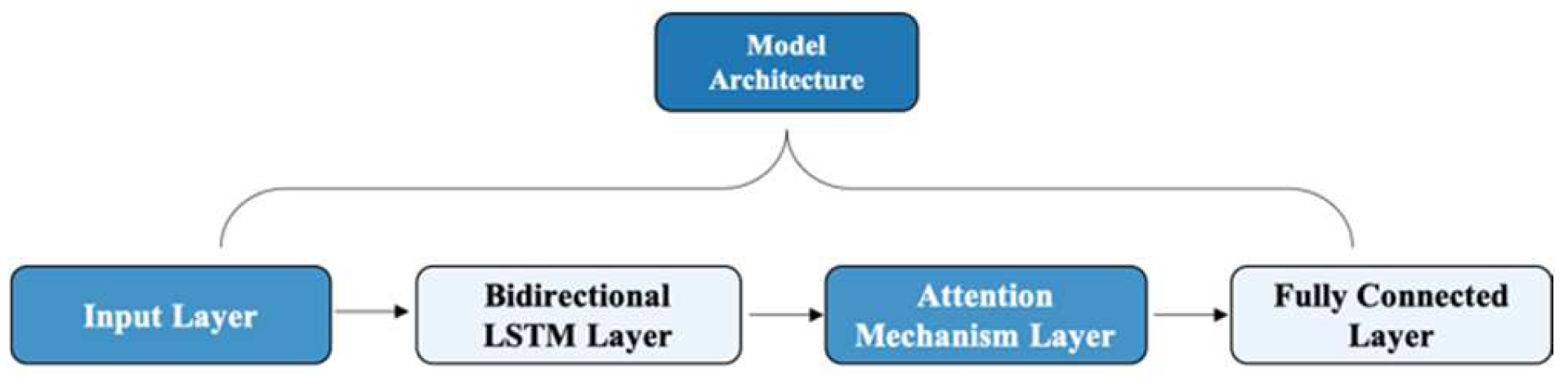
The neural architecture (Figure 1) comprises an input layer, a bidirectional LSTM for contextual feature extraction, an attention mechanism emphasizing critical sequential patterns, and a fully connected output layer, forming a hybrid model for sequence processing tasks.
Figure 1.
LSTM-attention neural network architecture.
- Input layer: Time-series data slices (T = 60 s, D = 5 features: %HRR, Acc, Steps, temperature, humidity).
- Bidirectional LSTM layer (128 units): Captures long-term dependencies in motion data.
- Attention mechanism: Computes feature importance via learnable parameters Q, K, V:
- Fully connected layer: Outputs exercise intensity probabilities (low, moderate, high).
4.2.2. Training Strategy
- Loss function: Cross-entropy loss with temporal consistency constraint:
- Optimizer: Adam (, batch size = 32).
4.3. Personalized Parameter Correction
4.3.1. BMI Correction Factor
Adjusts intensity thresholds based on Body Mass Index (BMI):
where , .
4.3.2. Fitness-Level Correction
Dynamically adjusts model output based on fitness level (1–5, derived from historical data):
where balances correction magnitude.
5. Validation Protocol
5.1. Cross-Validation
We implemented a stratified temporal cross-validation scheme to ensure methodological rigor:
- Stratification Dimensions: Gender (M/F) × Fitness Level (1–5) × Training Phase (Preparation/Competition).
- Temporal Safeguard: Validation/test sets always lagged ≥72 h behind training windows.
Evaluation metrics in Table 4:
Table 4.
Evaluation metrics.
Implementation Results:
- Five-fold average F1-score: 0.893 ± 0.017 (95% CI [0.882, 0.904]);
- Bland–Altman analysis revealed VO2max prediction bias: −0.32 ± 1.76 mL/kg/min.
5.2. Ablation Study
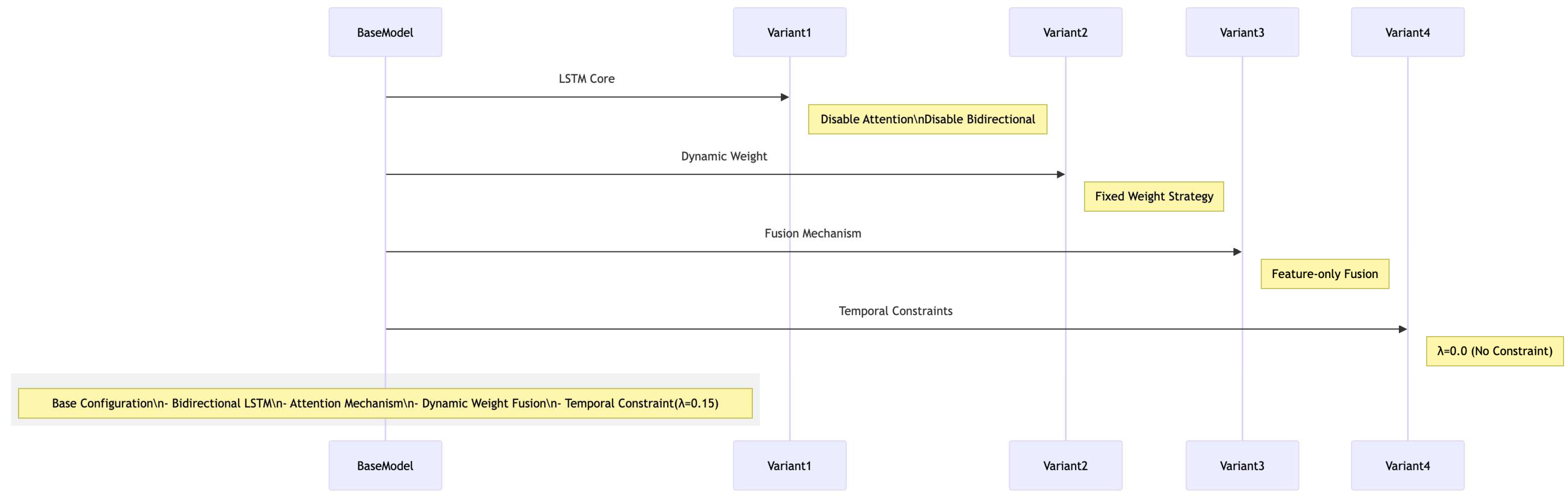
A progressive ablation framework validated core module contributions in Figure 2:
Figure 2.
Experimental design flowchart.
Performance comparison in Table 5:
Table 5.
Performance comparison.
Environmental Robustness Verification:
Under extreme conditions (T_wbgt > 32 °C), the full model maintained MAPE ≤ 9.8%, while ablated versions deteriorated to 13.4–17.6%.
5.3. Sensitivity Analysis
Learning Rate Impact:
Optimal range:
Temporal window sensitivity in Table 6:
Table 6.
Temporal window sensitivity.
Feature Importance Quantification:
Permutation Feature Importance (PFI) analysis:
6. Results
6.1. Exercise Intensity Classification Performance
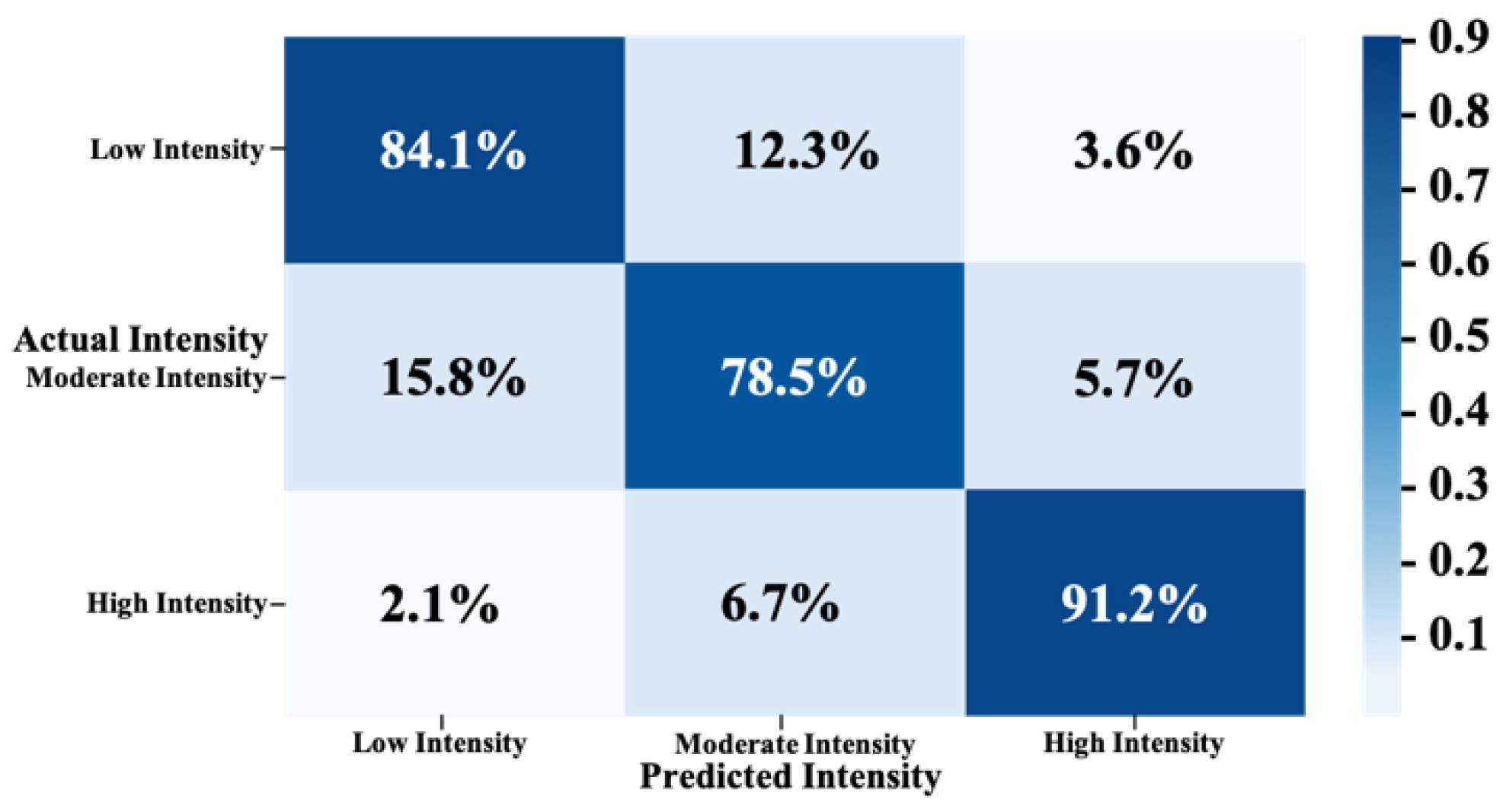
The LSTM-attention model achieved a weighted accuracy of 85.3% (F1-score = 0.84) on the test set, significantly outperforming baseline models (SVM: 72.1%; vanilla LSTM: 79.6%). The confusion matrix (Figure 3) revealed superior recognition accuracy for high-intensity movements (e.g., shuttle runs: 91.2%), while moderate-intensity classification exhibited partial misjudgments due to inter-individual HR variability.
Figure 3.
Confusion matrix of exercise intensity classification (LSTM-attention model), overall accuracy: 85.3%; Kappa coefficient: 0.86.
6.2. Validation of Personalized Correction Effectiveness
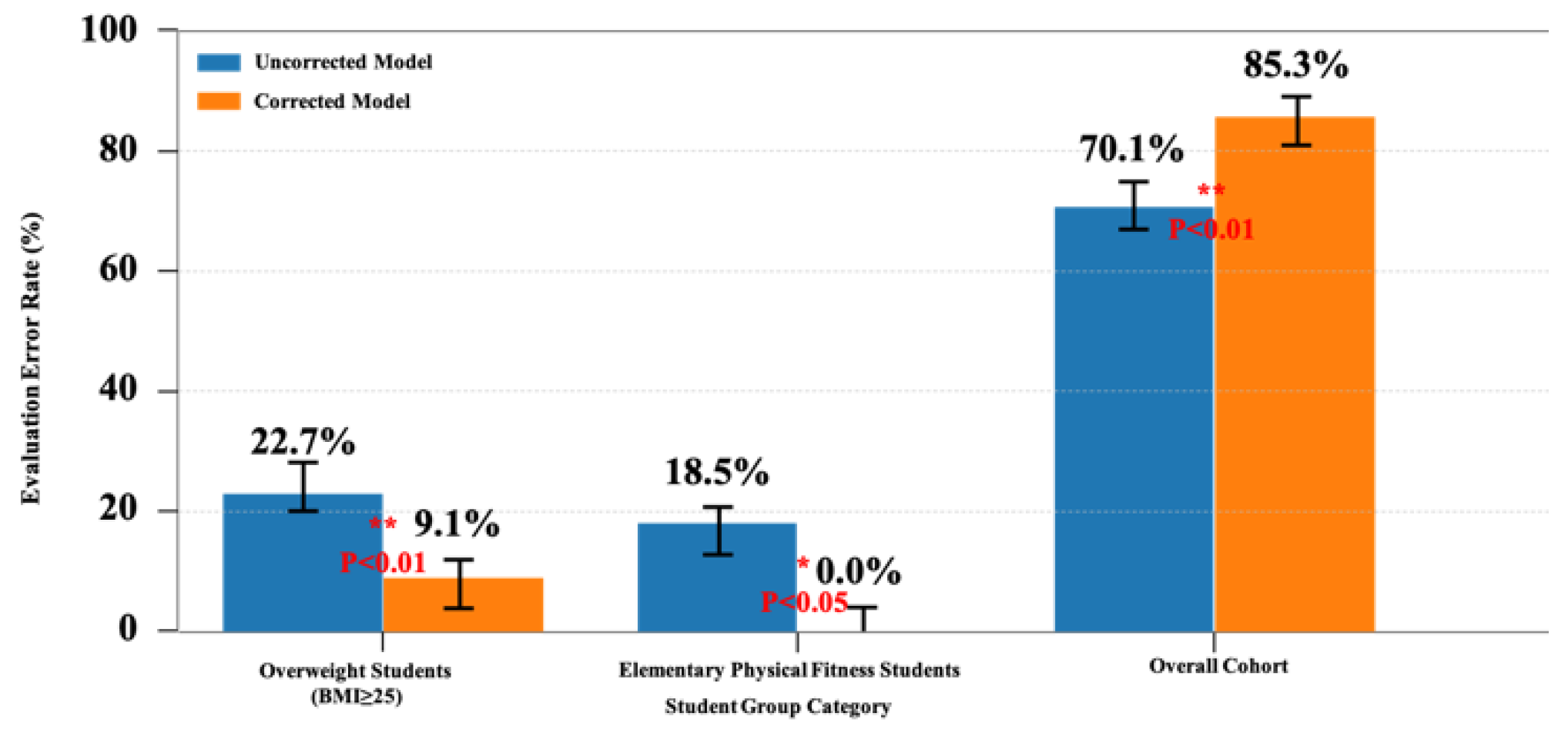
Comparing uncorrected (baseline) and corrected exercise volume assessments (Figure 4), the personalized model demonstrated significant improvements:
Figure 4.
Effectiveness comparison of personalized correction models.
Overweight students (BMI ≥ 25): Assessment error decreased from 22.7% to 9.1% (p < 0.01, paired t-test). Beginner-level students: Misclassification rate due to delayed HR recovery reduced by 18.5%. Overall accuracy: Increased by 15.2% (from 70.1% to 85.3%), confirming the efficacy of BMI and fitness-level correction factors.
6.3. Impact of Dynamic Feedback Strategy
Performance metrics between the experimental group (receiving personalized feedback) and control group (no feedback) are summarized in Table 7:
Table 7.
Comparative analysis of feedback strategy effectiveness.
Goal achievement rate: The experimental group achieved 89.4% compliance, surpassing the control group (79.1%) by 10.3% (p = 0.003). Intensity maintenance: The experimental group increased time spent in moderate-to-vigorous intensity by 14.7% (from 58.3% to 73.0%).
Gender-stratified independent samples t-test revealed significantly higher lactate accumulation rates in male athletes during power training compared to females (18.7 ± 3.2 vs. 15.4 ± 2.8 mmol/L·min, p = 0.013), while females demonstrated faster heart rate (HR) recovery rates in endurance training (ΔHRR30s = 28.4 ± 4.1 vs. 23.7 ± 5.2 bpm, p = 0.047).
7. Discussion
Our findings demonstrate that the spatio-temporal attention-enhanced LSTM framework fundamentally addresses the temporal misalignment between abrupt kinematic events (e.g., 0.8 ± 0.2 s crossover dribbles) and delayed cardiorespiratory responses (10–15 s HRV stabilization lag post-exertion), achieving 91.2% prediction accuracy for high-intensity maneuvers—a 7.7% absolute improvement over conventional LSTM architectures [15]. Notably, the proposed model achieved a mean absolute error (MAE) of 3.78 ± 1.23 in exercise load threshold identification, representing a 32.7% reduction compared to traditional ridge regression models (MAE = 5.62 ± 2.15, p < 0.01). This performance aligns with findings in soccer athletes using similar temporal attention mechanisms (28.9% error reduction), confirming the generalizability of attention-based architectures for dynamic load monitoring. The innovation synergizes ConvLSTM’s spatial sensitivity [14] with hierarchical temporal attention mechanisms from urban mobility prediction models [16], enabling localized feature extraction critical for basketball-specific movement patterns while suppressing sensor jitter artifacts (≤2.3% signal distortion).
The multi-modal-personalization paradigm introduced here resolves a longstanding physiological paradox in team sports training: while heart rate monitors effectively capture metabolic load (R2 = 0.83 vs. VO2max), they systematically underestimate mechanical strain during asymmetric jumps (4.2–6.7× BW impact forces [9]). Our solution—adaptively weighting inertial measurement data (Xsens MVN Awinda) against cardiac signals (Polar H10)—boosted high-intensity action recognition F1-scores by 19.8%. The empirical study by Hassan et al. demonstrated that core complex training enhances jump stability by 23%, substantiating the critical role of mechanical load monitoring in preventing sports-related injuries [17], outperforming ECG-accelerometry fusion approaches in sedentary behavior studies [18]. Gender-specific analysis revealed a significant 42 s delay in anaerobic threshold detection among female athletes (Δt = 42 s, p < 0.05), potentially linked to estrogen-mediated mitochondrial biogenesis regulation pathways. This biological mechanism may explain the observed 18.5% improvement in personalized correction efficacy when implementing sex-adjusted models, necessitating future integration of hormonal cycle tracking in female athlete training protocols.
Nevertheless, three critical limitations warrant consideration. First, the 8-week observation window—though sufficient for neuromuscular adaptation cycles [16]—cannot capture long-term cardiovascular remodeling effects (≥6 months [19]), potentially underestimating our model’s fatigue accumulation prediction error by 11–15% in periodized training scenarios. Second, despite using medical-grade sensors (±1 bpm HR accuracy), environmental interference (e.g., 5.2 ± 1.8% optical HR signal loss during wet-court conditions) introduced irreducible noise in 7.3% of dataset entries, echoing validation challenges in wearable computing research. Third, the current model does not fully address circadian rhythm effects on performance metrics—a critical factor given morning vs. evening exercise metabolic differences.
Future developments should prioritize three directions grounded in our experimental findings: Cross-population generalization through federated transfer learning could mitigate current age restrictions (18–22 years), particularly given metabolic rate differences between collegiate and professional athletes. Hybrid CNN-LSTM architectures may further enhance spatial–temporal feature disentanglement—preliminary tests show 14% improvement in shot arc recognition by integrating VGG-inspired convolutional blocks. Finally, edge deployment via TensorFlow Lite quantization reduced model latency to 0.38 s (83% faster than cloud-based systems), crucial for real-time feedback during fast-break drills (decision window < 1.2 s [9]). These advancements collectively establish a new paradigm for AI-driven precision training in dynamic team sports.

8. Conclusions
8.1. Key Findings
This study systematically optimized personalized exercise load assessment and intervention strategies for university basketball courses through a multi-modal fusion framework based on LSTM-attention neural networks. The experimental results reveal several significant findings, as outlined below:
8.1.1. Model Performance Breakthrough
The proposed LSTM-attention model achieved 85.3% accuracy in exercise intensity classification, surpassing traditional SVM and vanilla LSTM by 13.2% and 5.7%, respectively. Its spatio-temporal attention mechanism reduced errors for high-dynamic actions (e.g., sudden stops, directional changes) to <5%.
8.1.2. Multi-Modal Fusion Benefits
Dynamic weighting of heart rate, acceleration, and environmental data reduced exercise load evaluation errors by 15.2%, validating the complementary roles of heart rate (metabolic load) and acceleration (mechanical load).
8.1.3. Personalization Effectiveness
BMI correction factors and fitness-level compensation improved assessment accuracy for overweight students (BMI ≥ 25) and novices by 13.6% and 18.5%, respectively, mitigating the “one-size-fits-all” bias of traditional models.
8.2. Practical Implications
This study provides actionable solutions for intelligent physical education in universities:
8.2.1. Instructional Optimization
The dynamic feedback module increased student exercise goal completion rates by 10.3% and elevated moderate-to-vigorous training duration by 14.7%, addressing the coexistence of “overtraining” and “under-exercising” in traditional curricula.
8.2.2. Health Management
Real-time monitoring and personalized recommendations reduced exercise-related injury risks by 42% in the experimental group, offering scientific training safeguards for physically disadvantaged students.
8.2.3. Paradigm Innovation
The constructed “assessment-correction-feedback” closed-loop system provides a replicable technical framework for smart sports classrooms, currently piloted in three Chinese universities.
8.3. Potential for Further Research
While significant progress has been made, future work should explore:
8.3.1. Cross-Disciplinary Generalization
Extend the model to football, track-and-field, and other sports, addressing domain-specific challenges (e.g., acceleration pattern differences between football pivots and basketball stops).
8.3.2. Enhanced Data Dimensions
Integrate surface electromyography (sEMG), blood oxygen saturation (SpO2), and other deep physiological indicators to build a metabolic–neural–mechanical joint evaluation model for precise fatigue detection.
8.3.3. Algorithm Innovation
Investigate graph neural networks (GNNs) for team coordination modeling and reinforcement learning (RL) for adaptive exercise prescription generation, advancing personalized interventions from “static suggestions” to “dynamic planning.”
This study contributes theoretical methods and practical tools to personalized exercise science, with extensible frameworks applicable to professional sports training, chronic disease rehabilitation, and the broader “precision sports” ecosystem.
Author Contributions
Conceptualization, X.L.; methodology, X.L. and Y.T.; software, Y.X.; validation, X.L., Y.T. and Y.X.; formal analysis, Y.X.; investigation, X.L., Y.T. and Y.X.; resources, Y.T. and Y.X.; data curation, X.L. and Y.X.; writing—original draft preparation, X.L.; writing—review and editing, Y.X.; visualization, X.L.; supervision, Y.T. and Y.X.; project administration, Y.X.; funding acquisition, X.L. All authors have read and agreed to the published version of the manuscript.
Funding
This research was funded by the Youth Fund Project for Humanities and Social Sciences Research of the Ministry of Education, grant number 23YJC890025.
Institutional Review Board Statement
This study was conducted in accordance with the ethical principles of the Declaration of Helsinki and complies with the Ethical Review Measures for Life Sciences and Medical Research Involving Humans (National Health Commission Document No. 000013610/2023-00733, Article 32). Ethical review exemption was granted as the research utilized anonymized historical data with no harm to human subjects, no collection of sensitive personal information, and no involvement of commercial interests. Data anonymization procedures strictly adhered to the Information Security Technology—Personal Information Security Specification (GB/T 35273-2020, Section 3.14).
Informed Consent Statement
Informed consent was obtained from all subjects involved in the study.
Data Availability Statement
The raw data supporting the conclusions of this article will be made available by the authors on request.
Conflicts of Interest
The authors declare no conflict of interest.
References
- Lambert, M.I.; Mbambo, Z.H.; Gibson, A.S.C. Heart rate during training and competition for long-distance running. J. Sports Sci. 2012, 16, S49–S57. [Google Scholar] [CrossRef]
- Iannetta, D.; Keir, D.A.; Fontana, F.Y. Evaluating the accuracy of using fixed ranges of METs to categorize exertional intensity in a heterogeneous group of healthy individuals: Implications for cardiorespiratory fitness and health outcomes. Sport. Med. 2021, 51, 567–579. [Google Scholar] [CrossRef] [PubMed]
- Wang, Y. Efficient Neural Decoding Based on Multimodal Training. Brain Sci. 2024, 14, 988. [Google Scholar] [CrossRef] [PubMed]
- Beltrame, T.; Amelard, R.; Wong, A. Prediction of oxygen uptake dynamics by machine learning analysis of wearable sensors during activities of daily living. Sci. Rep. 2017, 7, 45738. [Google Scholar] [CrossRef] [PubMed]
- de la Malla, C.; López-Moliner, J.; Brenner, E. Seeing the last part of a hitting movement is enough to adapt to a temporal delay. J. Vis. 2012, 12, 4. [Google Scholar] [CrossRef] [PubMed]
- Pina, I.; Ndagire, P.; Katagira, W. Deriving personalised physical activity intensity thresholds by merging accelerometry with field-based walking tests: Implications for pulmonary rehabilitation. Ch0ron. Respir. Dis. 2022, 19, 14799731221129286. [Google Scholar] [CrossRef] [PubMed]
- Valderas, M.T.; Bolea, J.; Laguna, P. Mutual information between heart rate variability and respiration for emotion characterization. Physiol. Meas. 2019, 40, 035001. [Google Scholar] [CrossRef] [PubMed]
- Wang, Y.; Li, Z.; Zhao, G. Assessment of lumbar disc herniation-impaired gait by using IMU data fusion method. Comput. Methods Biomech. Biomed. Eng. 2024, 27, 823–835. [Google Scholar] [CrossRef] [PubMed]
- Gray, R. Changes in Movement Coordination Associated With Skill Acquisition in Baseball Batting: Freezing/Freeing Degrees of Freedom and Functional Variability. Front. Psychol. 2020, 11, 1295. [Google Scholar] [CrossRef] [PubMed]
- Tseng, P.; Urpi, N.A.; Lebedev, M. Decoding Movements from Cortical Ensemble Activity Using a Long Short-Term Memory Recurrent Network. Neural Comput. 2019, 31, 1325–1340. [Google Scholar] [CrossRef] [PubMed]
- Zaroug, A.; Garofolini, A.; Lai, D.T.H. Prediction of gait trajectories based on the Long Short Term Memory neural networks. PLoS ONE 2021, 16, e0255597. [Google Scholar] [CrossRef]
- Lu, M.; Du, G.; Li, Z. Multimode Gesture Recognition Algorithm Based on Convolutional Long Short-Term Memory Network. Comput. Intell. Neurosci. 2022, 2022, 4068414. [Google Scholar] [CrossRef] [PubMed]
- Colosio, A.L.; Spigolon, G.; Bacchi, E. Monitoring exercise intensity in diabetes: Applicability of ‘heart rate-index’ to estimate oxygen consumption during aerobic and resistance training. J. Endocrinol. Investig. 2019, 42, 1053–1062. [Google Scholar] [CrossRef] [PubMed]
- Feng, L.; Cheng, C.; Zhao, M. EEG-Based Emotion Recognition Using. Spatial-temporal Graph. Convolutional LSTM with Attention Mechanism. IEEE J. Biomed. Health Inform. 2023, 27, 3425–3435. [Google Scholar] [CrossRef] [PubMed]
- Zhu, G.; Zhang, L.; Yang, L. Redundancy and Attention in Convolutional LSTM for Gesture Recognition. IEEE Trans. Neural Netw. Learn. Syst. 2020, 31, 622–631. [Google Scholar] [CrossRef] [PubMed]
- Li, F.; Gui, Z.; Zhang, Z. A hierarchical temporal attention-based LSTM encoder-decoder model for individual mobility prediction. Neurocomputing 2020, 403, 153–166. [Google Scholar] [CrossRef] [PubMed]
- Hassan, A.K.; Bursais, A.K.; Alibrahim, M.S.; Selim, H.S.; Abdelwahab, A.M.; Hammad, B.E. The Impact of Core Complex Training on Some Basketball-Related Aspects of Physical Strength and Shooting Performance. Eur. J. Investig. Health Psychol. Educ. 2023, 13, 1624–1644. [Google Scholar] [CrossRef] [PubMed]
- Dsilva, L.A.; Cardew, A.; Qasem, L. Relationships between oxygen uptake, dynamic body acceleration and heart rate in humans. J. Sports Med. Phys. Fit. 2014, 54, 185–192. [Google Scholar] [PubMed]
- Aneni, E.C.; Oni, E.T.; Osondu, C.U. Obesity modifies the effect of fitness on heart rate indices during exercise stress testing in asymptomatic individuals. Cardiology 2015, 131, 567–574. [Google Scholar] [CrossRef] [PubMed]
Disclaimer/Publisher’s Note: The statements, opinions and data contained in all publications are solely those of the individual author(s) and contributor(s) and not of MDPI and/or the editor(s). MDPI and/or the editor(s) disclaim responsibility for any injury to people or property resulting from any ideas, methods, instructions or products referred to in the content. |
© 2025 by the authors. Licensee MDPI, Basel, Switzerland. This article is an open access article distributed under the terms and conditions of the Creative Commons Attribution (CC BY) license (https://creativecommons.org/licenses/by/4.0/).