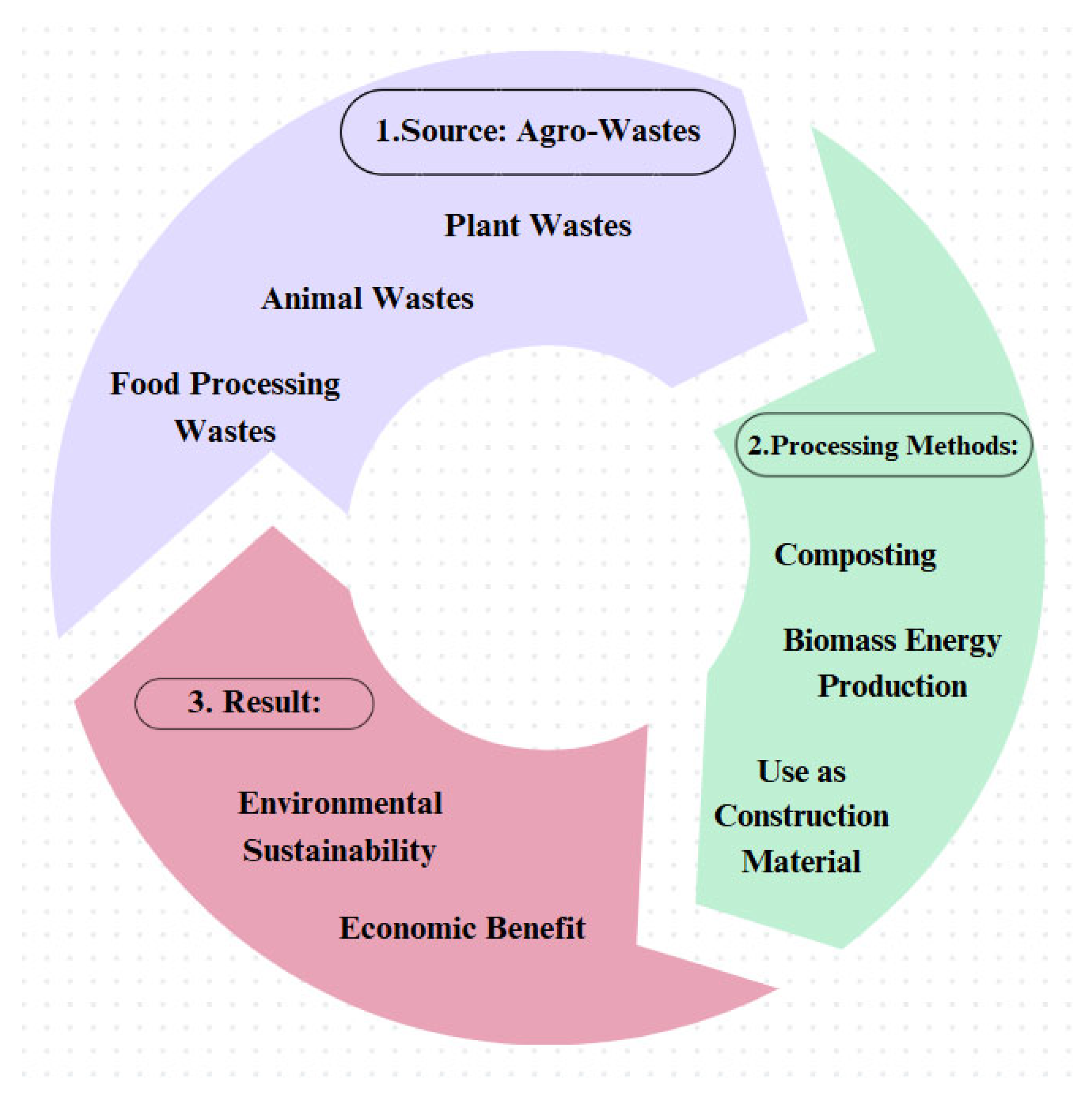
Applicability of Agro-Waste Materials in Structural Systems for Building Construction: A Scoping Review



Abstract
1. Introduction
2. Definition, Classification, and Potential Applications of Agro-Wastes
3. The Use of Agro-Wastes in Concrete Production
3.1. Use of Coconut Shells and Fibers
3.2. Contributions of Palm Oil Fuel and Rice Husk Ash
3.3. Use of Wheat Straw in Concrete Production
3.4. Other Agro-Wastes and Lightweight Concrete Applications
3.5. Durability and Long-Term Performance of Agro-Wastes in Concrete
- CSs and fibers: Although these materials improve mechanical properties, tensile strength, and ductility, their behavior under long-term exposure to moisture, freeze-thaw cycles, and chemical attacks is not well understood. Further studies are required to assess their degradation rates and overall stability in structural applications.
- WS and ash: Research has highlighted their contributions to thermal insulation and mechanical properties. However, the long-term durability of WS-based composites, particularly their resistance to biodegradation and thermal stress, requires further investigation.
- Other AWs: Materials such as PO clinker and other lightweight agro-based aggregates have shown promise in enhancing mechanical properties, but their performance in varying environmental conditions has not been comprehensively studied.
- Conducting lifecycle analyses (LCA) to evaluate the full environmental impact of AWs in concrete, including production, usage, and end-of-life stages.
- Investigating the degradation rates of AW-based concrete under diverse environmental conditions, such as humidity, freeze-thaw cycles, chemical exposure, and thermal variations.
- Developing standardized durability testing protocols to ensure the consistent evaluation of AW materials in structural applications.
4. Feasibility of Agro-Waste Utilization in Reinforced Concrete (RC) Elements
4.1. Potential of Agro-Wastes for Use in Reinforced Concrete Elements
4.2. Agro-Waste Types Used in RC Elements
4.3. Effects of Agro-Wastes on RC Elements
4.3.1. Mechanical Properties and Structural Performance
4.3.2. Density and Insulation Properties of Concrete
4.3.3. Ductility and Cracking Behavior
4.3.4. The Impact of Agro-Waste on Energy Absorption and Torsional Strength
4.3.5. Performance of Coconut Shell and Banana Fiber-Reinforced Concrete
4.4. Limitations of Using Agro-Wastes in RC Elements
- Long-Term Durability: The inclusion of AWs in concrete may influence long-term mechanical strength and environmental resistance. This highlights the need for considering unaddressed parameters in existing standards and conducting durability tests to evaluate their long-term effects [34].
- Lack of Standards: The absence of comprehensive international standards regulating the use of AWs in RC elements restricts their widespread adoption. Existing standards such as BS8110, ASTM C330, and ACI-318 need to be expanded to address the potential applications and performance of AWs [25,37,72].
4.5. Future Research Directions
- Fire Resistance: The fire behavior of AW-based concretes, particularly CS-based concrete, should be examined to evaluate its potential for improving fire safety in structural applications.
- Innovative Reinforcement Techniques: Novel reinforcement methods should be developed to enhance the durability of RC elements. These innovations can support the sustainable use of materials in both existing RC elements and new constructions.
- Economic and Environmental Impacts: The economic advantages and contributions of AWs to environmental sustainability as construction materials should be analyzed in detail. Life cycle assessments can provide valuable insights into these impacts.
- Applied Research: Field studies and practical experiments in real structural environments are essential. Such research would provide a deeper understanding of the long-term durability, load-bearing capacity, and other structural properties of AW-based concretes.
5. International Standards and Current Regulations
5.1. Overview of Relevant Standards
5.2. Challenges in Standard Adaptation
- Durability Concerns: Long-term performance under environmental exposure, such as carbonation and freeze-thaw cycles, is insufficiently addressed in existing standards [34]. For instance, the absence of provisions for bio-based material degradation in codes such as BS8110 and ACI 318 limits their application [25,72].
- Force-Based Evaluations: Standards like ACI 318 [72] rely on force-based design principles, which assume isotropic and homogenous material properties. However, AW materials often deviate from these assumptions, leading to discrepancies in predicted versus observed behaviors [69]. For example, PO shell concrete beams exhibited deviations of up to 25% in shear force predictions under force-based methods [69].
- Displacement-Based Methods: Advanced assessment techniques, such as displacement-based design, can better account for the ductility and cracking patterns observed in AW-modified concretes [26,80]. Coconut aggregate beams, for instance, demonstrated high ductility under displacement-controlled loading conditions, challenging the current reliance on force-based metrics [26].
- Seismic Performance Considerations: The absence of guidelines for displacement-based seismic design using AW-based concretes is a critical gap. Experimental results, such as those from banana fiber-reinforced beams, suggest significant energy dissipation potential, yet these characteristics are not reflected in existing seismic design codes [91].
- Calibration for Bio-Based Materials: Standards like ASTM C330 [37] focus on lightweight aggregates but do not account for bio-based material properties such as moisture absorption and fiber-matrix bonding. Studies on palm kernel shell concretes have revealed the importance of these factors in predicting shear capacity [77].
- The development of material-specific calibration factors for force- and displacement-based methods.
5.3. Comparison of Experimental and Theoretical Results
- Coconut aggregate beams [26] showed up to a 10% deviation in failure load predictions, highlighting the need for further refinement in theoretical models for natural aggregate replacements.
- PO shell foamed concrete beams [69] exhibited variations in shear force prediction depending on reinforcement type and ratio, with deviations ranging between 5% and 15%.
- Rice straw ash-RC beams [88] demonstrated deviations in flexural strength predictions, with experimental values being approximately 10% higher than theoretical predictions for certain reinforcement ratios.
- Palm kernel shell concrete without shear reinforcement [77] displayed deviations in shear force prediction, with experimental results nearly 25% higher than theoretical estimates, suggesting the need for incorporating material-specific calibration factors in theoretical equations.
- PO concrete beams with steel fibers [83] demonstrated deviations in predicted crack torque values of up to 15%, underscoring the importance of accurately modeling fiber-concrete interactions.
5.4. Recommendations for Standard Evolution
- Calibration Factors: Introduce material-specific calibration factors to align experimental and theoretical predictions. For example, Vexp/VFEA ratios for palm kernel shell concretes highlight the need for adjustments [77].
- Waste Management Strategies: Encourage policies that link waste management and construction industries to ensure a steady supply of AW for concrete production [83].
- Incentives: The cost-effectiveness of AW materials, coupled with their environmental benefits, such as reduced carbon emissions and energy savings, presents significant opportunities for market adoption. For example, the use of CS concrete has been shown to reduce production costs by up to 20% compared to conventional aggregates [26,75]. Additionally, alignment with circular economy goals and sustainability targets encourages the use of alternative materials.
- Barriers: Despite these advantages, several challenges hinder market adoption. These include regional disparities in AW availability, high processing and transportation costs, and a lack of standardized economic evaluations. Furthermore, the absence of awareness and policies promoting the use of AWs limits their acceptance in mainstream construction practices.
- Future Directions: To overcome these barriers, future research should focus on developing comprehensive cost-benefit analyses, pilot projects for validating economic and technical feasibility, and policies that incentivize the use of AW materials in construction. Addressing these aspects will facilitate broader acceptance and scalability of AW-based concrete in the market.
5.5. Integration with Sustainability Goals
- Resource Efficiency: AW enables resource-efficient practices by replacing non-renewable aggregates and reducing reliance on finite raw materials [80].
- Volume Reduction: Large-scale use of AW in RC elements can significantly reduce AW volumes and related disposal issues [83].
- Goal 13 (Climate Action): Reduced carbon emissions and sustainable material use directly support climate change mitigation efforts [71].
- Cost Savings: The availability and cost-effectiveness of AW materials offer economic advantages for construction projects [83].
6. Economic and Environmental Benefits of Agro-Wastes
7. Conclusions and Recommendations
- Structural Performance: The use of agricultural wastes as aggregates or reinforcement materials in RC elements, especially beams, has demonstrated positive impacts on strength, ductility, and energy absorption. For instance, materials such as CSs and banana fibers have improved durability and optimized ductility behavior. However, these materials exhibit greater variability compared to conventional concrete materials.
- Economic and Environmental Benefits: Agricultural wastes reduce costs and contribute to environmental sustainability. These materials have the potential to lower carbon emissions, facilitate waste management, and enable energy savings.
- Lack of Standardization: The review revealed gaps in international standards related to the use of agricultural wastes in concrete structures. Existing standards need to be updated to encourage the adoption of these novel materials.
- Implementation Constraints: More data are needed on the mechanical performance and long-term durability of agricultural wastes. Additionally, the effects of these materials on mix design and homogeneity require further testing through practical field studies.
- Research and Development (R&D): Experimental and theoretical studies aimed at optimizing the behavior of agricultural wastes in RC elements should be encouraged. Future research should focus on fire resistance, environmental impacts, and long-term durability.
- Standardization Efforts: New standards that include testing protocols and performance criteria for agricultural wastes in RC elements should be developed. Existing standards, such as ACI 318 and ASTM C330, should be revised to accommodate the specific needs of these materials.
- Field Applications: Pilot projects are critical for evaluating the performance of agricultural wastes in real-world structural conditions. Such projects can validate the applicability and scalability of these materials.
- Education and Awareness: Awareness campaigns should target the construction industry and local communities to promote the use of agricultural wastes. Developing countries, in particular, should be informed about the economic and environmental advantages of these materials.
- Alignment with Sustainability Goals: The integration of agricultural wastes into RC elements should align with circular economy principles and sustainability objectives. Strategies should include waste management practices and carbon reduction targets.
- Challenges in Uniformity and Durability: Highlighted the variability in raw AW materials and its impact on mechanical performance and durability. The discussion emphasizes the importance of standardized processing methods to ensure uniformity and reliability under various environmental conditions.
- Environmental Impact and Lifecycle Analysis: Critically analyzed the potential of AWs to reduce costs and enhance environmental sustainability. The section underscores gaps in lifecycle assessments and the need for comprehensive studies on long-term ecological benefits.
- Economic Feasibility and Regional Challenges: Detailed the challenges related to the absence of international standards for AW usage in RC elements. Recommendations for addressing these gaps through innovative supply chain solutions and robust economic models were included.
Author Contributions
Funding
Data Availability Statement
Conflicts of Interest
Appendix A

| Ref. No. | Beam Specimen | Initial Shear Crack (kN) | Yield Shear Force (kN) | Ultimate Shear Force (kN) | Yield Displacement (mm) | Ultimate Displacement (mm) | Ductile Ratio (mm/mm) | Energy Absorption Capacity (kN-mm) | Failure Mode |
|---|---|---|---|---|---|---|---|---|---|
| [21] | Conventional Concrete | 27.00 | 135.00 | 10.44 | 7.91 | 704.70 | |||
| Steel Fiber Reinforced Wheat Straw Ash C1 | 36.00 | 149.00 | 12.67 | 7.28 | 943.91 | ||||
| Steel Fiber Reinforced Wheat Straw Ash C2 | 38.00 | 153.00 | 15.87 | 8.40 | 1214.06 | ||||
| Steel Fiber Reinforced Wheat Straw Ash C3 | 44.00 | 160.00 | 17.08 | 7.94 | 1366.40 | ||||
| Steel Fiber Reinforced Wheat Straw Ash C4 | 41.00 | 156.00 | 16.97 | 8.20 | 1323.66 | ||||
| Lathe Fiber Reinforced Wheat Straw Ash C1 | 33.00 | 138.00 | 12.60 | 7.37 | 869.40 | ||||
| Lathe Fiber Reinforced Wheat Straw Ash C2 | 35.00 | 141.00 | 15.83 | 9.05 | 1116.02 | ||||
| Lathe Fiber Reinforced Wheat Straw Ash C3 | 40.00 | 147.00 | 17.01 | 8.18 | 1250.24 | ||||
| Lathe Fiber Reinforced Wheat Straw Ash C4 | 38.00 | 144.00 | 16.89 | 9.13 | 1216.08 | ||||
| [22] | Control Concrete Beam | 11.50 | 68.00 | 2.90 | 2037.00 | ||||
| 25% Epoxy Adhesive + Palmiye Fuel Ash Beam | 17.80 | 119.50 | 4.85 | 3390.00 | |||||
| 25% Epoxy Adhesive + Normal Mortar Beam | 17.30 | 117.00 | 3.90 | 3370.00 | |||||
| 50% Epoxy Adhesive + Palmiye Fuel Ash Beam | 19.30 | 124.00 | 4.50 | 3560.00 | |||||
| 50% Epoxy Adhesive + Normal Mortar Beam | 18.80 | 119.00 | 4.25 | 3485.00 | |||||
| 75% Epoxy Adhesive + Palmiye Fuel Ash Beam | 20.60 | 127.00 | 4.05 | 3660.00 | |||||
| 75% Epoxy Adhesive + Normal Mortar Beam | 20.80 | 128.00 | 3.90 | 3520.00 | |||||
| 100% Epoxy Adhesive Prepared Beam | 25.80 | 130.50 | 3.35 | 3800.00 | |||||
| [26] | Coconut Aggregate Beam | 13.28 | 4.90 | 328.99 | |||||
| Coconut Shell + 0.25% Steel Fiber Beam | 13.88 | 4.30 | 362.70 | ||||||
| Coconut Shell + 0.50% Steel Fiber Beam | 14.90 | 3.70 | 394.84 | ||||||
| Coconut Shell + 0.75% Steel Fiber Beam | 15.67 | 3.50 | 420.29 | ||||||
| Coconut Shell + 1% Steel Fiber Beam | 17.04 | 3.20 | 476.13 | ||||||
| [69] | Shear Reinforced Palm Oil Shell Foamed Concrete | 12.00 | 40.00 | 47.10 | 14.90 | 50.00 | 3.40 | Local Yielding | |
| Shear Reinforced Palm Oil Shell Foamed Concrete | 12.00 | 32.00 | 46.70 | 15.00 | 63.00 | 4.20 | Bending | ||
| Shear Reinforced Normal Concrete | 12.00 | 31.00 | 51.10 | 13.70 | 35.00 | 2.60 | Bending | ||
| Shear Reinforced Normal Concrete | 14.00 | 30.00 | 48.80 | 14.00 | 25.00 | 1,80 | Bending | ||
| Palm Oil Shell Foamed Plain Concrete | 12.00 | 31.00 | 43.00 | 15.50 | 62.00 | 4.00 | Shearing/Anchoring | ||
| Palm Oil Shell Foamed Plain Concrete | 14.00 | 35.00 | 44.50 | 13.60 | 73.00 | 5.40 | Shearing/Anchoring | ||
| Normal Concrete Without Shear Reinforcement | 16.00 | 32.00 | 40.10 | 14.10 | 44.00 | 3.10 | Shearing | ||
| Normal Concrete Without Shear Reinforcement | 20.00 | 31.00 | 37.20 | 14.00 | 45.00 | 3.20 | Shearing/Anchoring | ||
| [70] | Palm Oil Shell Beam 1 | 9.05 kNm | 15.60 kNm | 11.40 | 70.15 | 6.15 | |||
| Palm Oil Shell Beam 2 | 10.80 kNm | 21.40 kNm | 11.70 | 71.15 | 6.08 | ||||
| Palm Oil Shell Beam 3 | 16.10 kNm | 32.20 kNm | 11.90 | 74.80 | 6.28 | ||||
| [71] * | Control Concrete Beam Section 1 | 7.43 | 0.0728 | ||||||
| Control Concrete Beam Section 2 | 5.74 | 0.0728 | |||||||
| Black Gram Pod Ash Concrete Beam Section 1 | 6.35 | 0.0905 | |||||||
| Black Gram Pod Ash Concrete Beam Section 2 | 6.56 | 0.0905 | |||||||
| Green Gram Pod Ash Concrete Beam Section 1 | 5.73 | 0.0978 | |||||||
| Green Gram Pod Ash Concrete Beam Section 2 | 5.04 | 0.0978 | |||||||
| Horse Gram Pod Ash Concrete Beam Section 1 | 4.83 | 0.0858 | |||||||
| Horse Gram Pod Ash Concrete Beam Section 2 | 5.36 | 0.0858 | |||||||
| Pigeon Pea Stalk Ash Concrete Beam Section 1 | 4.96 | 0.1088 | |||||||
| Pigeon Pea Stalk Ash Concrete Beam Section 2 | 5.07 | 0.1088 | |||||||
| [73] | Single Strengthened Beam CC (S1) | 9.17 | |||||||
| Single Strengthened Beam CC (S2) | 4.44 | ||||||||
| Single Strengthened Beam CC (S3) | 2.97 | ||||||||
| Single Strengthened Beam CSC (S1) | 4.35 | ||||||||
| Single Strengthened Beam CSC (S2) | 4.02 | ||||||||
| Single Strengthened Beam CSC (S3) | 4.50 | ||||||||
| Double Strengthened Beam CC (D1) | 5.33 | ||||||||
| Double Strengthened Beam CC (D2) | 7.47 | ||||||||
| Double Strengthened Beam CC (D3) | 5.03 | ||||||||
| Double Strengthened Beam CSC (D1) | 7.34 | ||||||||
| Double Strengthened Beam CSC (D2) | 7.21 | ||||||||
| Double Strengthened Beam CSC (D3) | 5.00 | ||||||||
| [74] | Single Strengthened Beam (S1) | 4.34 | |||||||
| Single Strengthened Beam (S2) | 4.20 | ||||||||
| Single Strengthened Beam (S3) | 3.55 | ||||||||
| Double Strengthened Beam (D1) | 3.14 | ||||||||
| Double Strengthened Beam (D2) | 2.65 | ||||||||
| Double Strengthened Beam (D3) | 2.49 | ||||||||
| [75] | AD-3 ((a/d) = 3) | 23.00 | 27.50 | Shear Anchorage | |||||
| AD-1 ((a/d) = 1) | 16.00 | 19.50 | Shear Anchorage | ||||||
| WC-1 ((M-3) = 20.3 Mpa) | 13.00 | 21.50 | Shear Anchorage | ||||||
| WC-3 ((M-1) = 39.8 Mpa) | 14.00 | 25.00 | Shear Anchorage | ||||||
| SR-1 ((ρ) = 3.4) | 14.00 | 30.50 | Shear Anchorage | ||||||
| SR-3 ((ρ) = 0.3) | 7.00 | 12.50 | Shear Anchorage | ||||||
| AD/WC/SR-2 ((a/d) = 2; (M-1) = 31.5 Mpa; (ρ) = 1) | 10.00 | 23.00 | Shear Anchorage | ||||||
| [76] | Steel Reinforced Concrete Beam | 27.10 | 20.40 | 347.50 | |||||
| Coir Fiber Reinforced Concrete Beam with Steel Bar | 30.40 | 36.30 | 856.40 | ||||||
| 2-Layer Linen Reinforced Tube Bordered Plain CB | 27.20 | 8.40 | 122.30 | ||||||
| 4-Layer Linen Reinforced Tube Bordered Plain CB | 29.70 | 9.40 | 184.20 | ||||||
| 2-Layer Linen Reinforced Tube Bordered Coir Fiber RC-B | 78.90 | 14.30 | 645.30 | ||||||
| 4-Layer Linen Reinforced Tube Bordered Coir Fiber RC-B | 84.70 | 16.80 | 793.60 | ||||||
| [77] | Palm Seed Shell Concrete with Stirrups 1 | 45.00 | 115.00 | 15.00 | 18.00 | Shear | |||
| Palm Seed Shell Concrete with Stirrups 2 | 40.00 | 110.00 | 17.00 | 22.00 | Shear | ||||
| Reference Concrete with Stirrups 1 | 50.00 | 106.00 | 11.00 | NA | Flexure | ||||
| Reference Concrete with Stirrups 2 | 40.00 | 115.00 | 14.00 | NA | Shear Compression | ||||
| Palm Seed Shell Concrete without Stirrups 1 | 27.00 | 67.00 | 23.00 | 49.00 | Shear/Anchorage | ||||
| Palm Seed Shell Concrete without Stirrups 2 | 28.00 | 59.00 | 23.00 | 35.00 | Shear | ||||
| Reference Concrete without Stirrups 1 | 32.00 | 46.00 | NA | NA | Shear Anchorage | ||||
| Reference Concrete without Stirrups 2 | 27.00 | 55.00 | 18.00 | NA | Shear | ||||
| [78] | Palm Kernel Shell Concrete 1 | 5.41 | Flexural | ||||||
| Palm Kernel Shell Concrete 2 | 4.20 | Flexural | |||||||
| Control Concrete 1 | 2.83 | Flexural | |||||||
| Control Concrete 2 | 2.76 | Flexural | |||||||
| [79] | Banana Fiber Concrete 1 | 20.00 | 0.88 | Brittle | |||||
| Banana Fiber Concrete 2 | 26.00 | 1.09 | Flexure | ||||||
| Banana Fiber Concrete 3 | 26.80 | 1.00 | Flexure | ||||||
| Banana Fiber Concrete 4 | 27.30 | 1.08 | Flexure | ||||||
| Banana Fiber Concrete 5 | 27.80 | 1.20 | Flexure | ||||||
| Banana Fiber Concrete 6 | 27.00 | 1.09 | Flexure | ||||||
| Banana Fiber Concrete 7 | 27.50 | 1.08 | Flexure | ||||||
| [80] | Unreinforced Reference Concrete | 11.00 | - | - | |||||
| 3 × 8 mm Reinforced Reference Concrete | 10.00 | - | - | ||||||
| 3 × 12 mm Reinforced + Banana Fiber Concrete | 12.50 | 26.00 | 1.08 | ||||||
| 3 × 12 mm Reinforced Concrete | 12.00 | 26.00 | 1.08 | ||||||
| 3 × 14 mm Reinforced + Banana Fiber Concrete | 10.00 | 26.00 | 1.08 | ||||||
| 3 × 14 mm Reinforced Concrete | 14.00 | 26.00 | 1.08 | ||||||
| 3 × 16 mm Reinforced + Banana Fiber Concrete | - | 95.00 | 1.15 | ||||||
| 3 × 16 mm Reinforced Concrete | - | 95.00 | 1.15 | ||||||
| 3 × 18 mm Reinforced + Banana Fiber Concrete | - | 95.00 | 1.15 | ||||||
| 3 × 18 mm Reinforced Concrete | - | 95.00 | 1.15 | ||||||
| [82] | Single-Layer Reinforced Beam 1 | 52.36 | 81.60 | 6.87 | 18.63 | 2.71 | |||
| Single-Layer Reinforced Beam 2 | 73.70 | 100.90 | 13.92 | 24.22 | 1.74 | ||||
| Single-Layer Reinforced Beam 3 | 78.44 | 115.40 | 9.00 | 22.75 | 2.53 | ||||
| Single-Layer Reinforced Beam 4 | 83.30 | 138.06 | 12.07 | 29.96 | 2.48 | ||||
| Double-Layer Reinforced Beam 1 | 169.13 | 201.20 | 12.07 | 19.77 | 1.64 | ||||
| Double-Layer Reinforced Beam 2 | 184.52 | 228.60 | 11.24 | 18.37 | 1.64 | ||||
| Double-Layer Reinforced Beam 3 | 210.74 | 240.70 | 11.84 | 16.24 | 1.37 | ||||
| Double-Layer Reinforced Beam 4 | 234.29 | 265.80 | 13.35 | 16.64 | 1.25 | ||||
| [84] * | Control Concrete Beam 1 | 3.04 | |||||||
| Control Concrete Beam 2 | 2.06 | ||||||||
| Control Concrete Beam3 | 2.19 | ||||||||
| Control Concrete Beam 4 | 2.10 | ||||||||
| Coconut Shell Concrete Beam 1 | 3.22 | ||||||||
| Coconut Shell Concrete Beam 2 | 2.54 | ||||||||
| Coconut Shell Concrete Beam 3 | 2.62 | ||||||||
| Coconut Shell Concrete Beam 4 | 2.97 | ||||||||
| [85] | 3% Coir Fiber Reinforced CB | - | - | ||||||
| Linen Reinforced 1% Coir Fiber Reinforced CB1 | 31.10 | 5.21 | |||||||
| Linen Reinforced 1% Coir Fiber Reinforced CB2 | 34.81 | 8.01 | |||||||
| Linen Reinforced 1% Coir Fiber Reinforced CB3 | 47.85 | 62.69 | |||||||
| Linen Reinforced 3% Coir Fiber Reinforced CB1 | 32.62 | 5.53 | |||||||
| Linen Reinforced 3% Coir Fiber Reinforced CB2 | 43.00 | 8.90 | |||||||
| Linen Reinforced 3% Coir Fiber Reinforced CB3 | 52.30 | 71.80 | |||||||
| Linen Reinforced 5% Coir Fiber Reinforced CB1 | 31.92 | - | |||||||
| Linen Reinforced 5% Coir Fiber Reinforced CB2 | 37.20 | 6.21 | |||||||
| Linen Reinforced 5% Coir Fiber Reinforced CB3 | 46.90 | 55.4 | |||||||
| [86] | Palm Shell Aggregate Concrete 1 | 7.00 | 28.50 | 1.13 | 15.22 | ||||
| Palm Shell Aggregate Concrete 2 | 6.20 | 35.60 | 1.26 | 15.58 | |||||
| Palm Shell Aggregate Concrete 3 | 6.00 | 32.60 | 1.41 | 15.88 | |||||
| [87] | Control Concrete | 25.00 | 70.00 | 3.37 | 13.82 | 4.10 | |||
| 0.5% Banana Fiber Concrete | 35.00 | 90.00 | 3.08 | 20.22 | 6.56 | ||||
| 1% Banana Fiber Concrete | 46.00 | 100.00 | 3.38 | 26.00 | 7.69 | ||||
| 1.5% Banana Fiber Concrete | 32.00 | 85.00 | 3.12 | 17.89 | 5.73 | ||||
| 2% Banana Fiber Concrete | 30.00 | 80.00 | 3.44 | 16.85 | 4.90 | ||||
| 0.5% Coconut Fiber Concrete | 33.00 | 85.00 | 3.06 | 16.91 | 5.53 | ||||
| 1% Coconut Fiber Concrete | 42.00 | 95.00 | 3.38 | 22.58 | 6.68 | ||||
| 1.5% Coconut Fiber Concrete | 30.00 | 80.00 | 2.94 | 15.11 | 5.14 | ||||
| 2% Coconut Fiber Concrete | 27.00 | 75.00 | 3.54 | 15.78 | 4.46 | ||||
| [88] | Reference Specimen (OCM) 1 | 9.00 | 2.40 | 3.20 | 1.33 | ||||
| 15% Wheat Straw Ash (WSA) 1 | 15.00 | 2.31 | 2.90 | 1.25 | |||||
| 15% Rice Straw Ash (RSA) 1 | 17.00 | 2.10 | 2.50 | 1.20 | |||||
| Reference Sample (OCM) 2 | 13.00 | 1.58 | 2.30 | 1.45 | |||||
| 15% Wheat Straw Ash (WSA) 2 | 19.00 | 1.65 | 2.30 | 1.40 | |||||
| 15% Rice Straw Ash (RSA) 2 | 22.00 | 1.56 | 2.10 | 1.35 | |||||
| Reference Sample (OCM) 3 | 10.00 | 2.00 | 2.80 | 1.40 | |||||
| 15% Wheat Straw Ash (WSA) 3 | 17.00 | 2.00 | 2.70 | 1.35 | |||||
| 15% Rice Straw Ash (RSA) 3 | 19.00 | 1.81 | 2.35 | 1.30 | |||||
| [91] | Plain Concrete | - | 20.00 | Brittle | |||||
| Banana Fiber Concrete 1 | 11.00 | 26.00 | Flexure | ||||||
| Banana Fiber Concrete 2 | 12.50 | 26.80 | Flexure | ||||||
| Banana Fiber Concrete 3 | 12.00 | 27.30 | Flexure | ||||||
| Banana Fiber Concrete 4 | 10.00 | 28.00 | Flexure | ||||||
| Banana Fiber Concrete 5 | 14.00 | 27.00 | Flexure | ||||||
| Banana Fiber Concrete 6 | 13.80 | 27.00 | Flexure |
| Ref. No. | Beam Specimen | Crack Torque (kNm) | Crack Twist (rad/m) | Ultimate Torque (kNm) | Ultimate Twist (rad/m) | Failure Torque (kNm) | Failure Twist (rad/m) | Torsion Stiffness (kNm2) | Crack Torsion Stiffness (kNm2) |
|---|---|---|---|---|---|---|---|---|---|
| [71] | Control Concrete Beam Section 1 | 12.75 | 0.0014 | 22.75 | 0.0104 | 2188.22 | |||
| Control Concrete Beam Section 2 | 12.75 | 0.0019 | 22.75 | 0.0109 | 2085.65 | ||||
| Black Gram Pod Ash Concrete Beam Section 1 | 17.50 | 0.0017 | 31.50 | 0.0108 | 2910.57 | ||||
| Black Gram Pod Ash Concrete Beam Section 2 | 17.50 | 0.0018 | 31.50 | 0.0118 | 2665.72 | ||||
| Green Gram Pod Ash Concrete Beam Section 1 | 15.75 | 0.0022 | 26.25 | 0.0126 | 2090.78 | ||||
| Green Gram Pod Ash Concrete Beam Section 2 | 15.75 | 0.0026 | 26.25 | 0.0131 | 2006.80 | ||||
| Horse Gram Pod Ash Concrete Beam Section 1 | 14.00 | 0.0023 | 24.50 | 0.0111 | 2205.89 | ||||
| Horse Gram Pod Ash Concrete Beam Section 2 | 14.00 | 0.0022 | 24.50 | 0.0118 | 2073.34 | ||||
| Pigeon Pea Stalk Ash Concrete Beam Section 1 | 15.75 | 0.0026 | 28.00 | 0.0129 | 2178.43 | ||||
| Pigeon Pea Stalk Ash Concrete Beam Section 2 | 15.75 | 0.0027 | 28.00 | 0.0137 | 2047.24 | ||||
| [83] | Steel Fiber Palm Oil Shell Concrete 1 | 5.27 | 0.0680 | 5.28 | 0.0680 | 2.38 | 0.1330 | 183.99 | - |
| Steel Fiber Palm Oil Shell Concrete 2 | 6.93 | 0.0670 | 6.98 | 0.0720 | 3.71 | 0.1640 | 197.37 | 9.75 | |
| Steel Fiber Palm Oil Shell Concrete 3 | 7.23 | 0.0780 | 7.32 | 0.0850 | 4.13 | 0.2190 | 171.81 | 11.51 | |
| Steel Fiber Palm Oil Shell Concrete 4 | 7.73 | 0.0780 | 7.85 | 0.0870 | 3.48 | 0.2350 | 181.97 | 13.98 | |
| Steel Fiber Palm Oil Shell Concrete 5 | 8.84 | 0.0770 | 8.50 | 0.0890 | 3.28 | 0.2400 | 167.91 | 14.05 | |
| [84] | Control Concrete Beam 1 | 8.09 | 0.0194 | 11.77 | 0.0589 | 199.83 | |||
| Control Concrete Beam 2 | 10.30 | 0.0282 | 15.01 | 0.0582 | 257.68 | ||||
| Control Concrete Beam3 | 11.04 | 0.0262 | 18.03 | 0.0575 | 313.56 | ||||
| Control Concrete Beam 4 | 12.51 | 0.0270 | 19.50 | 0.0568 | 343.30 | ||||
| Coconut Shell Concrete Beam 1 | 7.36 | 0.0201 | 13.54 | 0.0647 | 209.27 | ||||
| Coconut Shell Concrete Beam 2 | 9.56 | 0.0252 | 17.66 | 0.0641 | 275.50 | ||||
| Coconut Shell Concrete Beam 3 | 9.86 | 0.0242 | 19.50 | 0.0633 | 308.05 | ||||
| Coconut Shell Concrete Beam 4 | 11.77 | 0.0362 | 20.25 | 0.0601 | 336.94 |
References
- Mısır, A.; Arıkan, O. Circular economy and zero waste management in the European Union (EU) and Turkey. Environ. Clim. Sustain. 2022, 23, 69–78. [Google Scholar]
- Khalife, E.; Sabouri, M.; Kaveh, M.; Szymanek, M. Recent Advances in the Application of Agricultural Waste in Construction. Appl. Sci. 2024, 14, 2355. [Google Scholar] [CrossRef]
- Kayahan, N.; Çarman, K. Determination of Waste Potential and Emissions in Crop and Animal Production in Konya Province. Turk. J. Agric. -Food Sci. Technol. 2023, 11, 1215–1221. [Google Scholar] [CrossRef]
- Öner, M.N.K. Recycling of Agricultural Waste: Agricultural Waste Management in Yalova Province. In New Approaches Engineering; Öner, M.N.K., Uzun, R.O., Eds.; Berikan Publishing House: Ankara, Turkey, 2019; pp. 97–109. (In Turkish) [Google Scholar]
- Sim, Y.L.; Putuhena, F.J. Green building technology initiatives to achieve construction quality and environmental sustainability in the construction industry in Malaysia. Manag. Environ. Qual. Int. J. 2015, 26, 233–249. [Google Scholar] [CrossRef]
- Pero, M.; Moretto, A.; Bottani, E.; Bigliardi, B. Environmental collaboration for sustainability in the construction industry: An exploratory study in Italy. Sustainability 2017, 9, 125. [Google Scholar] [CrossRef]
- Mariamma, T.R.; Nair, H.S. Popularization of Agrowaste Fibres—Banana and Areca Nut Fibre—A Sustainable Approach. In Sustainable Approaches in Textiles and Fashion: Fibres, Raw Materials and Product Development; Springer Nature Singapore: Singapore, 2022; pp. 81–99. [Google Scholar] [CrossRef]
- Singh, N.; Gautam, S.B.; Sawood, G.M.; Yadav, V.L.; Mishra, G.; Dixit, S.; Gupta, S.K. Bioenergy from Agro-waste: A Sustainable Solution for Energy Needs. In Sustainable Clean Energy Production Using Waste Biomass: Sustainable Energy Production and Utilization; Springer Nature Singapore: Singapore, 2024; pp. 207–249. [Google Scholar] [CrossRef]
- Shahzad, H.M.A.; Asim, Z.; Khan, S.J.; Almomani, F.; Mahmoud, K.A.; Mustafa, M.R.U.; Rasool, K. Thermochemical and biochemical conversion of agricultural waste for bioenergy production: An updated review. Discov. Environ. 2024, 2, 134. [Google Scholar] [CrossRef]
- Tekin, O.F.; Esit, M.; Varınca, K.B. Proposed Solutions to Environmental Concerns in the Construction Industry: Sustainability and Green Building. In Proceedings of the 2nd International Symposium on Environment and Morality, Adıyaman, Turkey, 24–26 October 2014; Volume 12, pp. 651–661. (In Turkish). [Google Scholar]
- Lam, P.T.; Chan, E.H.; Chau, C.K.; Poon, C.S.; Chun, K.P. Environmental management system vs green specifications: How do they complement each other in the construction industry? J. Environ. Manag. 2011, 92, 788–795. [Google Scholar] [CrossRef]
- Taji, I.; Ghorbani, S.; De Brito, J.; Tam, V.W.; Sharifi, S.; Davoodi, A.; Tavakkolizadeh, M. Application of statistical analysis to evaluate the corrosion resistance of steel rebars embedded in concrete with marble and granite waste dust. J. Clean. Prod. 2019, 210, 837–846. [Google Scholar] [CrossRef]
- Bahoria, B.V.; Parbat, D.K.; Nagarnaik, P.B. XRD analysis of natural sand, quarry dust, waste plastic (ldpe) to be used as a fine aggregate in concrete. Mater. Today Proc. 2018, 5, 1432–1438. [Google Scholar] [CrossRef]
- Hasan, M.R.; Siddika, A.; Akanda, M.P.A.; Islam, M.R. Effects of waste glass addition on the physical and mechanical properties of brick. Innov. Infrastruct. Solut. 2021, 6, 36. [Google Scholar] [CrossRef]
- Siddika, A.; Amin, M.R.; Rayhan, M.A.; Islam, M.S.; Mamun, M.A.A.; Alyousef, R.; Amran, Y.H. Performance of sustainable green concrete incorporated with fly ash, rice husk ash, and stone dust. Acta Polytech. 2021, 61, 279–291. [Google Scholar] [CrossRef]
- Feng, W.; Li, Z.; Long, Q.; Tang, S.; Zhao, Y. Study on the properties of autoclaved aerated concrete with high content concrete slurry waste. Dev. Built Environ. 2024, 17, 100338. [Google Scholar] [CrossRef]
- Liao, Y.; Cai, Z.; Deng, F.; Ye, J.; Wang, K.; Tang, S. Hydration behavior and thermodynamic modelling of ferroaluminate cement blended with steel slag. J. Build. Eng. 2024, 97, 110833. [Google Scholar] [CrossRef]
- Li, Y.; Zhang, H.; Zhang, Z.; Li, Y.; Fang, H.; Yuan, J.; Tang, S. The early-age cracking sensitivity, shrinkage, hydration process, pore structure and micromechanics of cement-based materials containing alkalis with different metal ions. Dev. Built Environ. 2024, 18, 100454. [Google Scholar] [CrossRef]
- Blount, W.H. Economic Evaluation of the Lightweight Aggregate Industry. Master’s Thesis, Faculty and the Board of Trustees of the Colorado School of Mines, Golden, CO, USA, 1974. [Google Scholar]
- Alqahtani, F.K.; Abotaleb, I.S.; Harb, S. LEED study of green lightweight aggregates in construction. Sustainability 2021, 13, 1395. [Google Scholar] [CrossRef]
- El-Sayed, T.A.; Shaheen, Y.B. Flexural performance of recycled wheat straw ash-based geopolymer RC beams and containing recycled steel fiber. Structures 2020, 28, 1713–1728. [Google Scholar] [CrossRef]
- Hosen, M.A.; Jumaat, M.Z.; Alengaram, U.J.; Sulong, N.R.; Alsubari, B. Sustainable palm oil fuel ash mortar used as partial adhesive replacement in flexurally strengthened RC beams. Constr. Build. Mater. 2019, 226, 507–523. [Google Scholar] [CrossRef]
- Shafigh, P.; Mahmud, H.; Jumaat, M.Z. Effect of steel fiber on the mechanical properties of oil palm shell lightweight concrete. Mater. Des. 2011, 32, 3926–3932. [Google Scholar] [CrossRef]
- IS 456; Plain and Reinforced Concrete-Code of Practice, Fourth Revision. Bureau of Indian Standards: New Delhi, India, 2000.
- BS811O-1997; Structural Use of Concrete, Part 1: Code of Practice for Design and Construction. British Standards Institution: London, UK, 1997.
- Prakash, R.; Divyah, N.; Srividhya, S.; Avudaiappan, S.; Amran, M.; Naidu Raman, S.; Guindos, P.; Vatin, N.I.; Fediuk, R. Effect of Steel Fiber on the Strength and Flexural Characteristics of Coconut Shell Concrete Partially Blended with Fly Ash. Materials 2022, 15, 4272. [Google Scholar] [CrossRef]
- Zhou, Y.; Li, W.; Peng, Y.; Tang, S.; Wang, L.; Shi, Y.; Li, Y.; Wang, Y.; Geng, Z.; Wu, K. Hydration and fractal analysis on Low-heat Portland cement pastes by thermodynamic-based methods. Fractal Fract. 2023, 7, 606. [Google Scholar] [CrossRef]
- Scrivener, K.L.; John, V.M.; Gartner, E.M. Eco-efficient cements: Potential economically viable solutions for a low-CO2 cement-based ma terials industry. Cem. Concr. Res. 2018, 114, 2–16. [Google Scholar] [CrossRef]
- Ganesan, K.; Rajagopal, K.; Thangavel, K. Rice husk ash blended cement: Assessment of optimal level of replacement for strength and permeability properties of concrete. Constr. Build. Mater. 2008, 22, 1675–1683. [Google Scholar] [CrossRef]
- Hwang, C.L.; Tran, V.A.; Hong, J.W.; Hsieh, Y.C. Effects of short coconut fiber on the mechanical properties, plastic cracking behavior, and impact resistance of cementitious composites. Constr. Build. Mater. 2016, 127, 984–992. [Google Scholar] [CrossRef]
- Steinfeld, H.; Gerber, P.; Wassenaar, T.; Castel, V.; Rosales, M.; de Haan, C. Livestock’s Long Shadow: Environmental Issues and Options; Food and Agriculture Organization: Rome, Italy, 2006; Available online: http://www.fao.org/docrep/010/a0701e/a0701e00.HTM (accessed on 17 October 2024).
- Wandee, Y.; Uttapap, D.; Mischnick, P. Yield and structural composition of pomelo peel pectins extracted under acidic and alkaline conditions. Food Hydrocoll. 2019, 87, 237–244. [Google Scholar] [CrossRef]
- Pacheco-Torgal, F. Eco-efficient construction and building materials research under the EU Framework Programme Horizon 2020. Constr. Build. Mater. 2014, 51, 151–162. [Google Scholar] [CrossRef]
- Sonu; Rani, G.M.; Pathania, D.; Abhimanyu; Umapathi, R.; Rustagi, S.; Huh, Y.S.; Gupta, V.K.; Kaushik, A.; Chaudhary, V. Agro-waste to sustainable energy: A green strategy of converting agricultural waste to nano-enabled energy applications. Sci. Total Environ. 2023, 875, 162667. [Google Scholar] [CrossRef]
- Ranatunga, K.S.; del Rey Castillo, E.; Toma, C.L. Evaluation of the optimal concrete mix design with coconut shell ash as a partial cement replacement. Constr. Build. Mater. 2023, 401, 132978. [Google Scholar] [CrossRef]
- Tomar, R.; Kishore, K.; Parihar, H.S.; Gupta, N. A comprehensive study of waste coconut shell aggregate as raw material in concrete. Mater. Today Proc. 2021, 44, 437–443. [Google Scholar] [CrossRef]
- ASTM C330/C330-17; Standard Specification for Lightweight Aggregates for Structural Concrete. American Society for Testing and Materials (ASTM) Standards: West Conshohocken, PA, USA, 2017.
- Bui, H.; Sebaibi, N.; Boutouil, M.; Levacher, D. Determination and review of physical and mechanical properties of raw and treated coconut fibers for their recycling in construction materials. Fibers 2020, 8, 37. [Google Scholar] [CrossRef]
- Sekar, A.; Kandasamy, G. Optimization of coconut fiber in coconut shell concrete and its mechanical and bond properties. Materials 2018, 11, 1726. [Google Scholar] [CrossRef]
- Hasan, N.M.; Sobuz, M.H.; Shaurdho, N.M.; Basit, M.A.; Paul, S.C.; Meraz, M.M.; Saha, A.; Miah, M.J. Investigation of lightweight and green concrete characteristics using coconut shell aggregate as a replacement for conventional aggregates. Int. J. Civ. Eng. 2024, 22, 37–53. [Google Scholar] [CrossRef]
- Awoyera, P.O.; Odutuga, O.L.; Effiong, J.U.; De Jesus Silvera Sarmiento, A.; Mortazavi, S.J.; Hu, J.W. Development of fibre-reinforced cementitious mortar with mineral wool and coconut fibre. Materials 2022, 15, 4520. [Google Scholar] [CrossRef] [PubMed]
- Sagar, T.S.; Paluri, Y.; Krishna, Y.M.; Ravi, B.; Ravi, Y. Utilization of Fly Ash and Coconut Shell as Sustainable Alternatives in M30 Grade Concrete: A Feasibility Study. IOP Conf. Ser. Earth Environ. Sci. 2023, 1280, 012020. [Google Scholar] [CrossRef]
- Bhoj, S.; Manoj, A.; Bhaskar, S. Usage potential and benefits of processed coconut shells in concrete as coarse aggregates. Mater. Today Proc. 2023, in press. [Google Scholar] [CrossRef]
- Santhosh, K.G.; Subhani, S.M.; Bahurudeen, A. Recycling of palm oil fuel ash and rice husk ash in the cleaner production of concrete. J. Clean. Prod. 2022, 354, 131736. [Google Scholar] [CrossRef]
- Sata, V.; Jaturapitakkul, C.; Kiattikomol, K. Utilization of Palm Oil Fuel Ash in High-Strength Concrete. J. Mater. Civ. Eng. 2004, 16, 623–628. [Google Scholar] [CrossRef]
- Muthadhi, A.; Kothandaraman, S. Experimental investigations of performance characteristics of rice husk ash–blended concrete. J. Mater. Civ. Eng. 2013, 25, 1115–1118. [Google Scholar] [CrossRef]
- Zareei, S.A.; Ameri, F.; Dorostkar, F.; Ahmadi, M. Rice husk ash as a partial replacement of cement in high strength concrete containing micro silica: Evaluating durability and mechanical properties. Case Stud. Constr. Mater. 2017, 7, 73–81. [Google Scholar] [CrossRef]
- Teo, D.C.L.; Mannan, M.A.; Kurian, V.J.; Ganapathy, C. Lightweight concrete made from oil palm shell (OPS): Structural bond and durability properties. Build. Environ. 2007, 42, 2614–2621. [Google Scholar] [CrossRef]
- Shafigh, P.; Jumaat, M.Z.; Mahmud, H. Oil palm shell as a lightweight aggregate for production high strength lightweight concrete. Constr. Build. Mater. 2011, 25, 1848–1853. [Google Scholar] [CrossRef]
- Alsubari, B.; Shafigh, P.; Ibrahim, Z.; Alnahhal, M.F.; Jumaat, M.Z. Properties of eco-friendly self-compacting concrete containing modified treated palm oil fuel ash. Constr. Build. Mater. 2018, 158, 742–754. [Google Scholar] [CrossRef]
- Ahmmad, R.; Alengaram, U.J.; Jumaat, M.Z.; Sulong, N.R.; Yusuf, M.O.; Rehman, M.A. Feasibility study on the use of high volume palm oil clinker waste in environmental friendly lightweight concrete. Constr. Build. Mater. 2017, 135, 94–103. [Google Scholar] [CrossRef]
- Karim, M.R.; Hashim, H.; Razak, H.A.; Yusoff, S. Characterization of palm oil clinker powder for utilization in cement-based applications. Constr. Build. Mater. 2017, 135, 21–29. [Google Scholar] [CrossRef]
- Alsubari, B.; Shafigh, P.; Ibrahim, Z.; Jumaat, M.Z. Heat-treated palm oil fuel ash as an effective supplementary cementitious material originating from agriculture waste. Constr. Build. Mater. 2018, 167, 44–54. [Google Scholar] [CrossRef]
- Shafigh, P.; Mahmud, H.B.; Jumaat, M.Z.B.; Ahmmad, R.; Bahri, S. Structural lightweight aggregate concrete using two types of waste from the palm oil industry as aggregate. J. Clean. Prod. 2014, 80, 187–196. [Google Scholar] [CrossRef]
- Ranjbar, N.; Behnia, A.; Alsubari, B.; Birgani, P.M.; Jumaat, M.Z. Durability and mechanical properties of self-compacting concrete incorporating palm oil fuel ash. J. Clean. Prod. 2016, 112, 723–730. [Google Scholar] [CrossRef]
- Ahmmad, R.; Jumaat, M.Z.; Alengaram, U.J.; Bahri, S.; Rehman, M.A.; bin Hashim, H. Performance evaluation of palm oil clinker as coarse aggregate in high strength lightweight concrete. J. Clean. Prod. 2016, 112, 566–574. [Google Scholar] [CrossRef]
- Thomas, B.S.; Kumar, S.; Arel, H.S. Sustainable concrete containing palm oil fuel ash as a supplementary cementitious material—A review. Renew. Sustain. Energy Rev. 2017, 80, 550–561. [Google Scholar] [CrossRef]
- Abraham, H.B.; Alengaram, U.J.; Alnahhal, A.M.; Haddadian, A.; Karthick, S.; Deboucha, W. Performance evaluation of cellular lightweight concrete using palm oil industrial waste as cement and fine aggregate replacement materials. Mater. Today Proc. 2021, 10, 301. [Google Scholar] [CrossRef]
- Mydin, M.A.O. Mechanical and Durability Properties of Foamed Concrete with the Addition of Oil Palm Trunk Fibre. Int. J. Sustain. Constr. Eng. Technol. 2022, 13, 9–24. [Google Scholar]
- Alsubari, B.; Shafigh, P.; Jumaat, M.Z. Development of self-consolidating high strength concrete incorporating treated palm oil fuel ash. Materials 2015, 8, 2154–2173. [Google Scholar] [CrossRef]
- Yap, S.P.; Alengaram, U.J.; Jumaat, M.Z.; Khaw, K.R. Torsional and cracking characteristics of steel fiber-reinforced oil palm shell lightweight concrete. J. Compos. Mater. 2016, 50, 115–128. [Google Scholar] [CrossRef]
- Ismail, B.; Belayachi, N.; Hoxha, D. Hygric properties of wheat straw biocomposite containing natural additives intended for thermal insulation of buildings. Constr. Build. Mater. 2022, 317, 126049. [Google Scholar] [CrossRef]
- Platt, S.L.; Maskell, D.; Shea, A.; Walker, P. Impact of fibre orientation on the hygrothermal properties of straw bale insulation. Constr. Build. Mater. 2022, 349, 128752. [Google Scholar] [CrossRef]
- Ahmadi, R.; Souri, B.; Ebrahimi, M. Evaluation of wheat straw to insulate fired clay hollow bricks as a construction material. J. Clean. Prod. 2020, 254, 120043. [Google Scholar] [CrossRef]
- Ahmad, J.; Arbili, M.M.; Alqurashi, M.; Althoey, F.; Deifalla, A.F. Concrete made with partial substitutions of wheat straw ash: A review. Int. J. Conc. Struct. Mater. 2023, 17, 61. [Google Scholar] [CrossRef]
- Hussien, N.T.; Oan, A.F. The use of sugarcane wastes in concrete. J. Eng. Appl. Sci. 2022, 69, 31. [Google Scholar] [CrossRef]
- Kamal, I.; Sherwani, A.; Ali, A.; Khalid, A.; Saadi, I.; Harbi, A. Walnut Shell for Partial Replacement of Fine Aggregate in Concrete: Modeling and Optimization. J. Civ. Eng. Res. 2017, 7, 109–119. [Google Scholar]
- Kueh, A.B.H.; Razali, A.W.; Lee, Y.Y.; Hamdan, S.; Yakub, I.; Suhaili, N. Acoustical and mechanical characteristics of mortars with pineapple leaf fiber and silica aerogel infills–Measurement and modeling. Mater. Today Commun. 2023, 35, 105540. [Google Scholar] [CrossRef]
- Jumaat, M.Z.; Alengaram, U.J.; Mahmud, H. Shear strength of oil palm shell foamed concrete beams. Mater. Des. 2009, 30, 2227–2236. [Google Scholar] [CrossRef]
- Teo, D.C.L.; Mannan, M.A.; Kurian, V.J. Structural concrete using oil palm shell (OPS) as lightweight aggregate. Turk. J. Eng. Environ. Sci. 2006, 30, 251–257. [Google Scholar]
- Krishnan, A.; Subramanian, S.S. Torsional strength of reinforced concrete beams with incorporating agricultural waste ash. J. Build. Path. Rehab. 2024, 9, 96. [Google Scholar] [CrossRef]
- ACI-318-08; Building Code Requirements for Structural Concrete. American Concrete Institute: Farmington Hills, MI, USA, 2008.
- Gunasekaran, K.; Annadurai, R.; Kumar, P. Study on reinforced lightweight coconut shell concrete beam behavior under flexure. Mater. Des. 2013, 46, 157–167. [Google Scholar] [CrossRef]
- Teo, D.C.L.; Mannan, M.A.; Kurian, J.V. Flexural behaviour of reinforced lightweight concrete beams made with oil palm shell (OPS). J. Adv. Concr. Technol. 2006, 4, 459–468. [Google Scholar] [CrossRef]
- Mohammed, B.S.; Foo, W.L.; Hossain, K.M.A.; Abdullahi, M. Shear strength of palm oil clinker concrete beams. Mater. Des. 2013, 46, 270–276. [Google Scholar] [CrossRef]
- Yan, L.; Chouw, N. A comparative study of steel reinforced concrete and flax fibre reinforced polymer tube confined coconut fibre reinforced concrete beams. J. Reinf. Plast. Compos. 2013, 32, 1155–1164. [Google Scholar] [CrossRef]
- Alengaram, U.J.; Jumaat, M.Z.; Mahmud, H.; Fayyadh, M.M. Shear behaviour of reinforced palm kernel shell concrete beams. Constr. Build. Mater. 2011, 25, 2918–2927. [Google Scholar] [CrossRef]
- Alengaram, U.J.; Jumaat, M.Z.; Mahmud, H. Ductility behaviour of reinforced palm kernel shell concrete beams. Eur. J. Sci. Res. 2008, 23, 406–420. [Google Scholar]
- Elbehiry, A.; Elnawawy, O.; Kassem, M.; Zaher, A.; Uddin, N.; Mostafa, M. Performance of Concrete Beams Reinforced Using Banana Fiber Bars. Case Stud. Constr. Mater. 2020, 13, e00361. [Google Scholar] [CrossRef]
- Elbehiry, A.; Elnawawy, O.; Kassem, M.; Zaher, A.; Mostafa, M. FEM Evaluation of Reinforced Concrete Beams by Hybrid and Banana Fiber Bars (BFB). Case Stud. Constr. Mater. 2021, 14, e00479. [Google Scholar] [CrossRef]
- García, G.; Cabrera, R.; Rolon, J.; Pichardo, R.; Thomas, C. Natural fibers as reinforcement of mortar and concrete: A systematic review from Central and South American regions. J. Build. Eng. 2024, 98, 111267. [Google Scholar] [CrossRef]
- Mohammed, B.S.; Foo, W.L.; Abdullahi, M. Flexural strength of palm oil clinker concrete beams. Mater. Des. 2014, 53, 325–331. [Google Scholar] [CrossRef]
- Yap, S.P.; Alengaram, U.J.; Jumaat, M.Z.; Khaw, K.R. Torsional behaviour of steel fibre-reinforced oil palm shell concrete beams. Mater. Des. 2015, 87, 854–862. [Google Scholar] [CrossRef]
- Gunasekaran, K.; Ramasubramani, R.; Annadurai, R.; Chandar, S.P. Study on reinforced lightweight coconut shell concrete beam behavior under torsion. Mater. Des. 2014, 57, 374–382. [Google Scholar] [CrossRef]
- Ahmed, E.; Sobuz, H.R. Flexural and time-dependent performance of palm shell aggregate concrete beam. KSCE J. Civ. Eng. 2011, 15, 859–865. [Google Scholar] [CrossRef]
- El-Sayed, T.A.; AErfan, M.; El-Naby, R. Flexural behavior of RC beams by using agricultural waste as a cement reinforcement materials. J. Eng. Res. Rep. 2019, 7, e01739. [Google Scholar] [CrossRef]
- Elbehiry, A.; Mostafa, M. Finite Element Analysis of Beams Reinforced with Banana Fiber Bars. Fibers 2020, 8, 52. [Google Scholar] [CrossRef]
- Wang, W.; Chouw, N. Flexural behaviour of FFRP wrapped CFRC beams under static and impact loadings. Int. J. Impact Eng. 2017, 111, 46–54. [Google Scholar] [CrossRef]
- Ngui, F.; Muhammed, N.; Mutunga, F.M.; Marangu, J.; Kınotı, I.K. A review on selected durability parameters on performance of geopolymers containing industrial by-products, agro-wastes and natural pozzolan. J. Sustain. Constr. Mater. Technol. 2022, 7, 375–400. [Google Scholar] [CrossRef]
- Mohamad, N.; Lakhiar, M.T.; Samad, A.A.A.; Mydin, A.O.; Jhatial, A.A.; Sofia, S.A.; Goh, W.I.; Ali, N. Innovative and sustainable green concrete—A potential review on utilization of agricultural waste. IOP Conf. Ser. Mater. Sci. Eng. 2019, 601, 012026. [Google Scholar] [CrossRef]
- Chandar, S.P.; Ravichandran, P.T. Flexural Performance of HSC beams containing natural fibers. J. Build. Path. Rehab. 2024, 9, 71. [Google Scholar] [CrossRef]
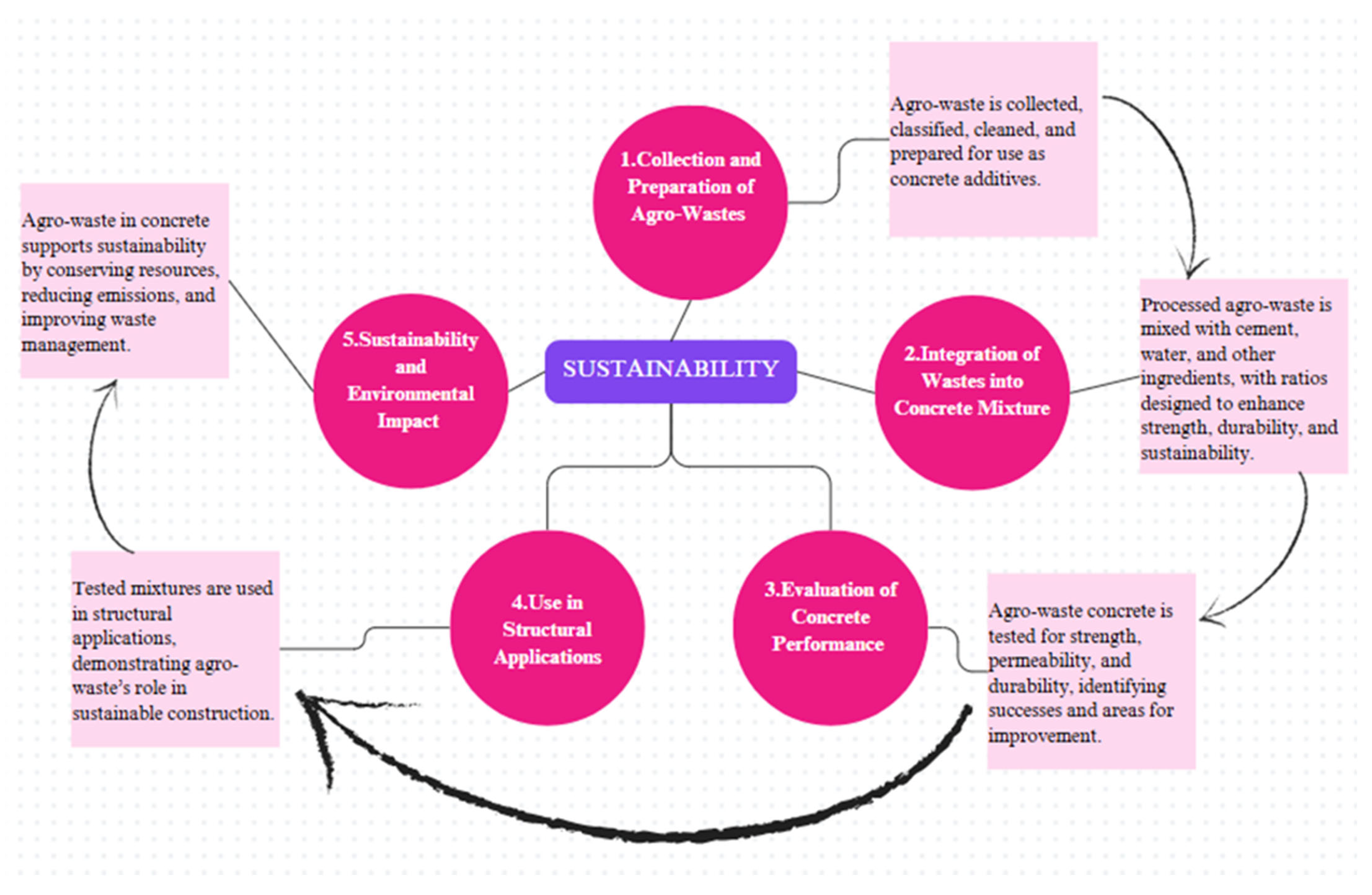

| Agro-Wastes | Potential Advantages | Challenges | Sample Applications |
|---|---|---|---|
| Rice Husk Ash |
|
|
|
| Coconut Shell |
|
|
|
| Palm Oil Ash |
|
|
|
| Wheat Straw Ash |
|
|
|
| Hazelnut shells |
|
|
|
| Agro-Wastes | Samples | Field of Usage | Environmental Benefits | Related References |
|---|---|---|---|---|
| Plant Wastes | Wheat straw, rice husk, coconut shell | Lightweight concrete, composite materials | Low density, strength enhancement, permeability control | [2,15,22,29,30] |
| Animal Wastes | Manure, bone, blood | Organic fertilizer, biomass energy | Waste conversion, sustainable energy | [3,31] |
| Food Processing Wastes | Fruit peels, fruit juice pulp | Manure, pyrolysis energy | Chemical fertilizer reduction, carbon footprint reduction | [5,32] |
| Wood and Fiber Wastes | Wood chips, corn cobs | Insulation material, filling material | Sustainable construction material production | [1,10] |
| Agricultural Industry By-products | Cotton fiber, corn husk | Reinforcement material | Strength enhancer, lightweight construction material | [23,26] |
| Other Agro-Wastes | Palm oil ash, wheat straw ash | Lightweight concrete, RC elements | Increasing the flexibility and durability of structural elements | [13,21,22] |
| Agro-Waste Type | Concrete Additive Purpose | Impact Fields | Featured Features | Environmental Sustainability Contribution | Economic Benefits | Related References |
|---|---|---|---|---|---|---|
| Coconut Shell | Partial replacement of coarse aggregate | Compressive strength, lightness, water absorption resistance | Lightweight concrete production, low specific gravity | Reduction of natural resource use, waste management | Low-cost alternative for lightweight concrete production | [30,35,37,42,43] |
| Coconut Fiber | Reinforcement in cement matrix | Mechanical strength, thermal conductivity | Increase in tensile and flexural strength, increase in ductility | Recycling of fibers and waste management | Production of low-density building materials | [26,30,35,36] |
| Palm Oil Fuel Ash | Partial replacement of cement | Compressive strength, lightness, environmental contribution | Strength increases with heat treatment, low density | Use of waste ash as an alternative to cement | Cost reduction by reducing cement | [44,45,46,47] |
| Rice Husk Ash | Partial replacement of cement | Compressive strength, durability | Increased strength with optimal 20% replacement | Reduction of industrial waste, lower carbon footprint | Low-cost binder material | [44,45,46,47] |
| Wheat Straw and Ash | Insulation material, cement replacement | Thermal insulation, compressive strength, mechanical strength | Energy saving, cost reduction | Natural insulation alternative and energy saving | Reduction in energy costs, low-cost insulation | [62,63,64,65] |
| Agro-Waste Type | Experimental Research | Beam Geometry | Main Findings | References |
|---|---|---|---|---|
| Coconut Shells | The performance of steel fiber reinforced concrete with Class F fly ash was tested. | Standard dimensions | Ultimate moment capacity increased by 5–14%; ductility ratio is at an acceptable level. | [26,73,84] |
| Palm Oil Shells | The mechanical and insulation properties of lightweight concrete were investigated. | Comparative with conventional dimensions | The density and insulation properties of lightweight concrete are better; crack widths are acceptable. | [70,74,85] |
| Wheat Straw Ash | Different mixtures were tested under static loading. | The bending strength of the beams was tested. | 15% ash ratio improved the bending behavior, increased the load carrying capacity. | [71,86] |
| Banana Fibers | Effects on the flexural strength of reinforced concrete beams were studied. | Compared with conventional beams. | Flexural strength increased by 25%; crack propagation is less. | [79,80,87] |
| Palm Kernel Shells | Cracking and reinforcement stresses were analyzed. | Standard dimensions | Smaller crack widths and spacing, high ductility and low modulus of rupture were observed. | [77,78] |
| Palm Oil Fuel Ashes | Energy absorption and strength of concrete reinforced with adhesive additives were investigated. | It was compared with conventional beams. | It was found that it increased strength, contributed to zero waste targets, and improved structural integrity. | [21,22,83] |
| Flax Fiber Reinforced Coconut Fibers | Flexural strength and energy absorption were analyzed. | Tested with different fiber contents. | Specimens with 3% coconut fiber content absorbed the highest energy. | [76,88] |
| Palm Oil Clinker | Ductility ratio and crack formation were analyzed. | Standard dimensions | As the steel reinforcement ratio increased, a decrease in ductility ratio was observed. | [75,82] |
| Coconut Shell (Torsion Test) | The behavior of concrete under torsion was analyzed. | Comparison with control beams | Improvement in torsion reinforcement and ductility ratio; crack widths are smaller than control concretes. | [69,88] |
| Ref. No. | Beam Specimen | Compressive Strength (MPa) | Rupture Modulus (Mpa) | Splitting Tensile Modulus (MPa) | Elasticity Modulus (GPa) | Flexural Strength (MPa) | Bond Strength (MPa) |
|---|---|---|---|---|---|---|---|
| Palm Oil-Based Concrete: | |||||||
| [22] | Conventional Concrete | 72 | 4.75 | 34.77 | 5.09 | ||
| Palm Oil Ash Concrete | 79 | 4.97 | 35.86 | 5.33 | |||
| [69] | Palm Kernel Shell Concrete 1 | 31.83 | 30.71 | 4.21 | |||
| Palm Kernel Shell Concrete 2 | 33.04 | 31.08 | 4.42 | ||||
| Reference Concrete 1 | 37.41 | 10.71 | 3.83 | ||||
| Reference Concrete 2 | 36.70 | 10.02 | 3.50 | ||||
| [70] | Palm Oil Shell Concrete | 28.12 | 5.31 | 7.18–9.36 | |||
| [74] | Single-Layer Reinforced Palm Oil Shell Concrete | 26.30 | 4.93 | 1.82 | 5.28 | ||
| Double-Layer Reinforced Palm Oil Shell Concrete | 25.30 | 4.89 | 1.67 | 5.05 | |||
| [75] | Palm Oil Clinker Concrete 1 | 39.8 | 2.7 | 26.8 | |||
| Palm Oil Clinker Concrete 2 | 31.5 | 2.3 | 16.9 | ||||
| Palm Oil Clinker Concrete 3 | 20.3 | 1.8 | 9.7 | ||||
| [76] | 2-Layer Flax Reinforced Tube Bordered Plain CB | 8.7 | 106 | 6.0 | 109 | ||
| 4-Layer Flax Reinforced Tube Bordered Plain CB | 9.5 | 134 | 8.7 | 144 | |||
| [77] | Palm Seed Shell Concrete with Stirrups 1 | 35.0 | 4.1 | 2.5 | 11.4 | ||
| Palm Seed Shell Concrete with Stirrups 2 | 34.4 | 3.9 | 2.4 | 10.9 | |||
| Reference Concrete with Stirrups 1 | 29.3 | 5.1 | 2.9 | 26.2 | |||
| Reference Concrete with Stirrups 2 | 30.8 | 4.9 | 3.0 | 28.1 | |||
| Palm Seed Shell Concrete without Stirrups 1 | 37.9 | 4.2 | 2.6 | 13.8 | |||
| Palm Seed Shell Concrete without Stirrups 2 | 35.7 | 4.0 | 2.4 | 11.7 | |||
| Reference Concrete without Stirrups 1 | 31.7 | 5.1 | 3.2 | 27.3 | |||
| Reference Concrete without Stirrups 2 | 28.5 | 5.0 | 3.1 | 26.2 | |||
| [78] | Palm Kernel Shell Concrete 1 | 37.41 | 10.71 | 3.83 | |||
| Palm Kernel Shell Concrete 2 | 36.70 | 10.02 | 3.50 | ||||
| Control Concrete 1 | 31.83 | 30.71 | 4.21 | ||||
| Control Concrete 2 | 33.04 | 31.08 | 4.42 | ||||
| [82] | Palm Oil Clinker Concrete | 27.15 | 4.01 | 2.26 | 16.87 | ||
| [83] | Steel Fiber Palm Oil Shell Concrete 1 | 33.9 | 2.59 | 13.87 | 3.26 | ||
| Steel Fiber Palm Oil Shell Concrete 2 | 39.3 | 3.73 | 15.67 | 4.28 | |||
| Steel Fiber Palm Oil Shell Concrete 3 | 41.2 | 4.17 | 16.11 | 5.38 | |||
| Steel Fiber Palm Oil Shell Concrete 4 | 45.9 | 4.95 | 16.29 | 6.70 | |||
| Steel Fiber Palm Oil Shell Concrete 5 | 47.3 | 5.47 | 15.50 | 8.16 | |||
| [86] | Palm Shell Aggregate Concrete 1 | 19.9 | 2.6 | 2.5 | 17.1 | ||
| Palm Shell Aggregate Concrete 2 | 17.7 | 2.5 | 2.3 | 16.3 | |||
| Palm Shell Aggregate Concrete 3 | 15.4 | 2.4 | 2.1 | 13.4 | |||
| Banana Fiber-Based Concrete: | |||||||
| [79] | Banana Fiber Concrete 1 | 25.30–25.80 | |||||
| Banana Fiber Concrete 2 | 25.30–25.80 | ||||||
| Banana Fiber Concrete 3 | 25.30–25.80 | ||||||
| Banana Fiber Concrete 4 | 25.30–25.80 | ||||||
| Banana Fiber Concrete 5 | 25.30–25.80 | ||||||
| Banana Fiber Concrete 6 | 35.32–35.65 | ||||||
| Banana Fiber Concrete 7 | 44.95–45.23 | ||||||
| [80] | Unreinforced Reference Concrete | 25 | |||||
| 3 × 8 mm Reinforced Reference Concrete | 25 | ||||||
| 3 × 12 mm Reinforced + Banana Fiber Concrete | 25 | ||||||
| 3 × 12 mm Reinforced Concrete | 25 | ||||||
| 3 × 14 mm Reinforced + Banana Fiber Concrete | 25 | ||||||
| 3 × 14 mm Reinforced Concrete | 25 | ||||||
| 3 × 16 mm Reinforced + Banana Fiber Concrete | 25 | ||||||
| 3 × 16 mm Reinforced Concrete | 25 | ||||||
| 3 × 18 mm Reinforced + Banana Fiber Concrete | 25 | ||||||
| 3 × 18 mm Reinforced Concrete | 25 | ||||||
| [87] | Control Concrete | 74.4 | |||||
| 0.5% Banana Fiber Concrete | 75.6 | ||||||
| 1% Banana Fiber Concrete | 77.2 | ||||||
| 1.5% Banana Fiber Concrete | 74.8 | ||||||
| 2% Banana Fiber Concrete | 73.3 | ||||||
| 0.5% Coconut Fiber Concrete | 74.9 | ||||||
| 1% Coconut Fiber Concrete | 76.1 | ||||||
| 1.5% Coconut Fiber Concrete | 73.0 | ||||||
| 2% Coconut Fiber Concrete | 72.6 | ||||||
| [91] | Plain Concrete | 25 | |||||
| Banana Fiber Concrete 1 | 25 | ||||||
| Banana Fiber Concrete 2 | 25 | ||||||
| Banana Fiber Concrete 3 | 25 | ||||||
| Banana Fiber Concrete 4 | 25 | ||||||
| Banana Fiber Concrete 5 | 35 | ||||||
| Banana Fiber Concrete 6 | 45 | ||||||
| Coconut-Based Concrete: | |||||||
| [26] | Coconut Aggregate Concrete | 35.6 | |||||
| Coconut Shell + 0.25% Steel Fiber Concrete | 40.8 | ||||||
| Coconut Shell + 0.50% Steel Fiber Concrete | 43.1 | ||||||
| Coconut Shell + 0.75% Steel Fiber Concrete | 47.8 | ||||||
| Coconut Shell + 1.00% Steel Fiber Concrete | 49.5 | ||||||
| [73] | Coconut Shell Concrete | 26.70 | 2.70 | ||||
| Control Concrete | 27.20 | - | |||||
| [84] | Control Concrete | 27.00 | |||||
| Coconut Shell Concrete | 26.40 | ||||||
| [85] | Non-Flax Reinforced 3% Coconut Fiber RC | 4.92 | |||||
| Flax Reinforced 1% Coconut Fiber RC | 13.70 | ||||||
| Flax Reinforced 3% Coconut Fiber RC | 13.22 | ||||||
| Flax Reinforced 5% Coconut Fiber RC | 13.20 | ||||||
| Other Agro-Waste Concrete: | |||||||
| [21] | Conventional Concrete | 51.7 | 3.32 | ||||
| Steel Fiber Reinforced Wheat Straw Ash Concrete | 56.1 | 4.21 | |||||
| Lathe Fiber Reinforced Wheat Straw Ash Concrete | 55.5 | 3.96 | |||||
| [71] | Conventional Concrete | 35.13 | 2.85 | ||||
| 2% Black Gram Pod Ash Concrete | 34.34 | 2.78 | |||||
| 4% Black Gram Pod Ash Concrete | 35.88 | 2.90 | |||||
| 6% Black Gram Pod Ash Concrete | 36.75 | 2.98 | |||||
| 8% Black Gram Pod Ash Concrete | 38.57 | 3.13 | |||||
| 10% Black Gram Pod Ash Concrete | 35.60 | 2.50 | |||||
| 2% Green Gram Pod Ash Concrete | 32.80 | 2.56 | |||||
| 4% Green Gram Pod Ash Concrete | 33.75 | 2.63 | |||||
| 6% Green Gram Pod Ash Concrete | 34.33 | 2.78 | |||||
| 8% Green Gram Pod Ash Concrete | 36.63 | 2.97 | |||||
| 10% Green Gram Pod Ash Concrete | 34.39 | 2.62 | |||||
| 2% Horse Gram Pod Ash Concrete | 33.14 | 2.87 | |||||
| 4% Horse Gram Pod Ash Concrete | 34.47 | 2.93 | |||||
| 6% Horse Gram Pod Ash Concrete | 35.51 | 2.98 | |||||
| 8% Horse Gram Pod Ash Concrete | 39.64 | 3.15 | |||||
| 10% Horse Gram Pod Ash Concrete | 36.72 | 3.02 | |||||
| 2% Pigeon Pea Stalk Ash Concrete | 33.21 | 3.31 | |||||
| 4% Pigeon Pea Stalk Ash Concrete | 29.58 | 2.94 | |||||
| 6% Pigeon Pea Stalk Ash Concrete | 33.78 | 3.01 | |||||
| 8% Pigeon Pea Stalk Ash Concrete | 35.51 | 3.12 | |||||
| 10% Pigeon Pea Stalk Ash Concrete | 26.16 | 3.30 | |||||
| [88] | Reference Specimen (OCM) 1 | 30 | |||||
| 15% Wheat Straw Ash (WSA) 1 | 30 | ||||||
| 15% Rice Straw Ash (RSA) 1 | 30 | ||||||
| Reference Sample (OCM) 2 | 45 | ||||||
| 15% Wheat Straw Ash (WSA) 2 | 45 | ||||||
| 15% Rice Straw Ash (RSA) 2 | 45 | ||||||
| Reference Sample (OCM) 3 | 60 | ||||||
| 15% Wheat Straw Ash (WSA) 3 | 60 | ||||||
| 15% Rice Straw Ash (RSA) 3 | 60 | ||||||
| Aspect | Challenges/Insights | Relevant Standards and References | Recommendations | Potential Applications | Estimated Impact |
|---|---|---|---|---|---|
| Material Homogeneity | Variability in physical and chemical properties of agro-waste materials [6,11]. | ACI 318 [72], ASTM C330 [37] | Develop specific characterization protocols and material classification systems. | Mix design, quality control | Improved consistency in material properties. |
| Mechanical Properties | Agro-waste impacts compressive strength, flexural performance, and ductility [26,88]. | BS 8110 [25], ACI Equality 11-3 | Update standards to include waste-specific mechanical property benchmarks. | Structural elements: beams, slabs | Enhanced material performance. |
| Durability | Uncertainty in long-term performance under environmental and mechanical stress [34,77]. | ACI 318 [72] | Conduct long-term exposure and accelerated aging tests for agro-waste-based materials. | Outdoor and marine structures | Increased reliability and lifespan. |
| Thermal Performance | Enhanced thermal insulation properties noted for materials like palm oil shell foamed concrete [69]. | ASTM C330 [37] | Introduce thermal property evaluation as a standard criterion for alternative materials. | Insulation layers, lightweight concrete | Reduced energy consumption. |
| Economic Viability | Cost-effectiveness and local availability of agro-waste materials [83]. | Not explicitly covered in current standards | Promote regional sourcing and economic analyses to validate cost-benefit aspects. | Low-cost housing, rural infrastructure | Cost reduction in construction. |
| Sustainability Alignment | Supports SDGs, including Goals 11, 12, and 13 [26,77]. | ISO 21930 (Sustainability in Construction) | Align material use with sustainability certifications and lifecycle assessments. | Certification schemes, green buildings | Global alignment with sustainability goals. |
| Field Validation | Limited pilot projects and real-world applications [73,80]. | None | Encourage pilot projects to validate laboratory findings under real-world conditions. | Bridges, roads, community buildings | Better adoption in real-world construction. |
| Standard Gaps | Existing standards do not address agro-waste materials explicitly [37,72]. | ACI 318 [72], BS 8110 [25] | Expand standards to explicitly include agro-waste materials and their performance thresholds. | All RC elements | Broader acceptance of novel materials. |
| Predictive Models | Theoretical models (e.g., FEA, ACI Equality 11-5) show deviations from experimental results [26,69]. | ACI 318 [72] | Integrate advanced predictive models into design guidelines to improve accuracy. | Research and development, design optimization | Greater confidence in material performance. |
Disclaimer/Publisher’s Note: The statements, opinions and data contained in all publications are solely those of the individual author(s) and contributor(s) and not of MDPI and/or the editor(s). MDPI and/or the editor(s) disclaim responsibility for any injury to people or property resulting from any ideas, methods, instructions or products referred to in the content. |
© 2024 by the authors. Licensee MDPI, Basel, Switzerland. This article is an open access article distributed under the terms and conditions of the Creative Commons Attribution (CC BY) license (https://creativecommons.org/licenses/by/4.0/).
Share and Cite
Kumbasaroglu, H.; Kumbasaroglu, A. Applicability of Agro-Waste Materials in Structural Systems for Building Construction: A Scoping Review. Appl. Sci. 2025, 15, 71. https://doi.org/10.3390/app15010071
Kumbasaroglu H, Kumbasaroglu A. Applicability of Agro-Waste Materials in Structural Systems for Building Construction: A Scoping Review. Applied Sciences. 2025; 15(1):71. https://doi.org/10.3390/app15010071
Chicago/Turabian StyleKumbasaroglu, Hediye, and Atila Kumbasaroglu. 2025. "Applicability of Agro-Waste Materials in Structural Systems for Building Construction: A Scoping Review" Applied Sciences 15, no. 1: 71. https://doi.org/10.3390/app15010071
APA StyleKumbasaroglu, H., & Kumbasaroglu, A. (2025). Applicability of Agro-Waste Materials in Structural Systems for Building Construction: A Scoping Review. Applied Sciences, 15(1), 71. https://doi.org/10.3390/app15010071