Optimizing Sustainability in Bridge Projects: A Framework Integrating Risk Analysis and BIM with LCSA According to ISO Standards


Abstract
1. Introduction
How can the integration of Building Information Modeling (BIM) and risk management strategies with the Lifecycle Sustainability Assessment (LCSA) be utilized in bridge projects to enhance sustainability? Specifically, how can these tools aid in identifying, optimizing, and developing targeted guidelines and strategic measures for the most impactful processes, in alignment with ISO standards, throughout the bridge’s lifespan?
2. Literature Review
2.1. Risks in Bridge Projects
2.2. Application of Building Information Modeling (BIM) in Bridge Projects
2.3. Application of Life Cycle Sustainability Assessment (LCSA) in Bridge Projects
2.4. Quality Management System (ISO 9001:2015)
- -
- Clause 1 describes the scope;
- -
- Clause 2 covers references;
- -
- Clause 3 deals with terms and definitions;
- -
- Clause 4 pertains to the context of the organization, which includes understanding the organization and its surroundings, comprehending the requirements and expectations of stakeholders, determining the scope of the quality management system, and evaluating the system and its processes;
- -
- Clause 5 discusses leadership, including leadership and commitment, quality policy, organizational roles, responsibilities, and authorities;
- -
- Clause 6 focuses on planning for the quality management system, including actions to address risks and opportunities, quality objectives, planning to achieve them, and planning for changes;
- -
- Clause 7 deals with support, including resources, competence, awareness, communication, and documented information;
- -
- Clause 8 focuses on operations, including operational planning and control, requirements for products and services, design and development, control of externally provided processes, products, and services, production and service provision, release of products and services, and control of nonconforming outputs, products, and services;
- -
- Clause 9 covers performance evaluation, including monitoring, measurement, analysis, evaluation, internal audit, and management review;
- -
- Clause 10 addresses improvement, including general improvement, nonconformity, corrective action, and continual improvement.
3. Methodology
3.1. Identifying Significant Risks Associated with Bridge Projects
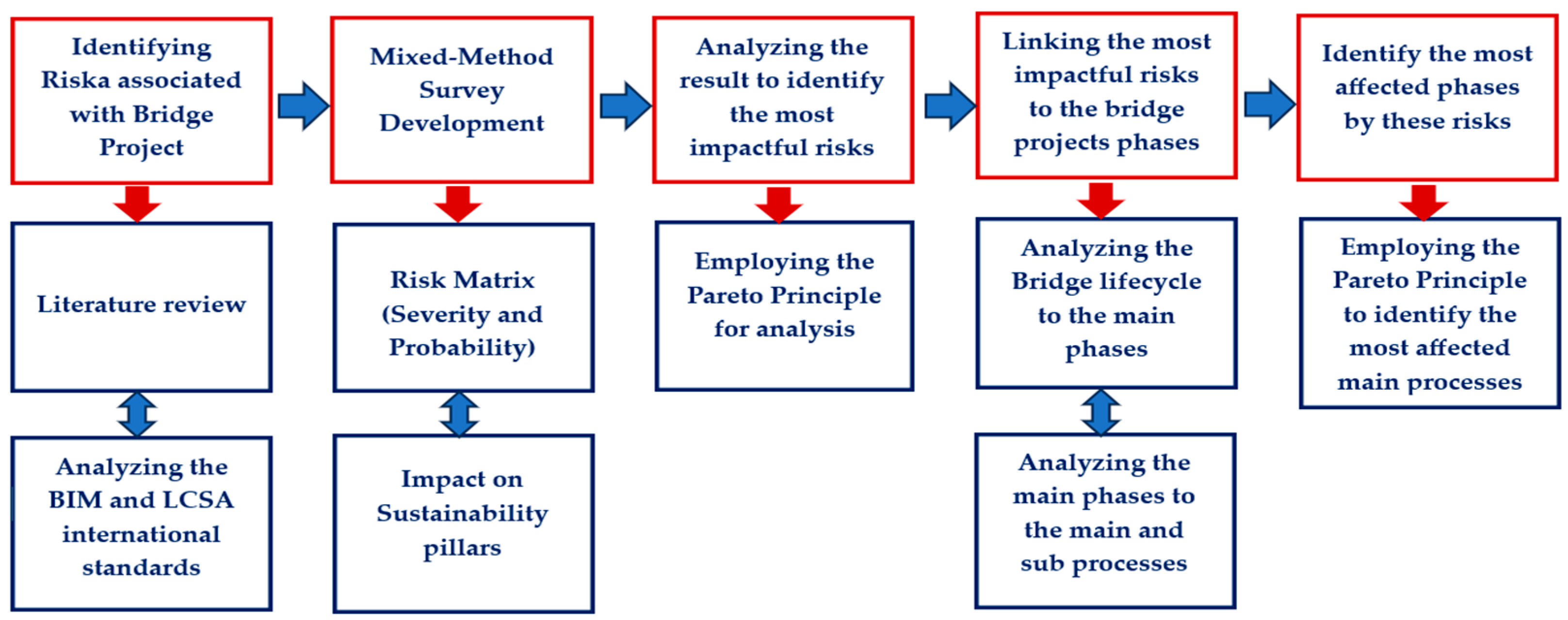
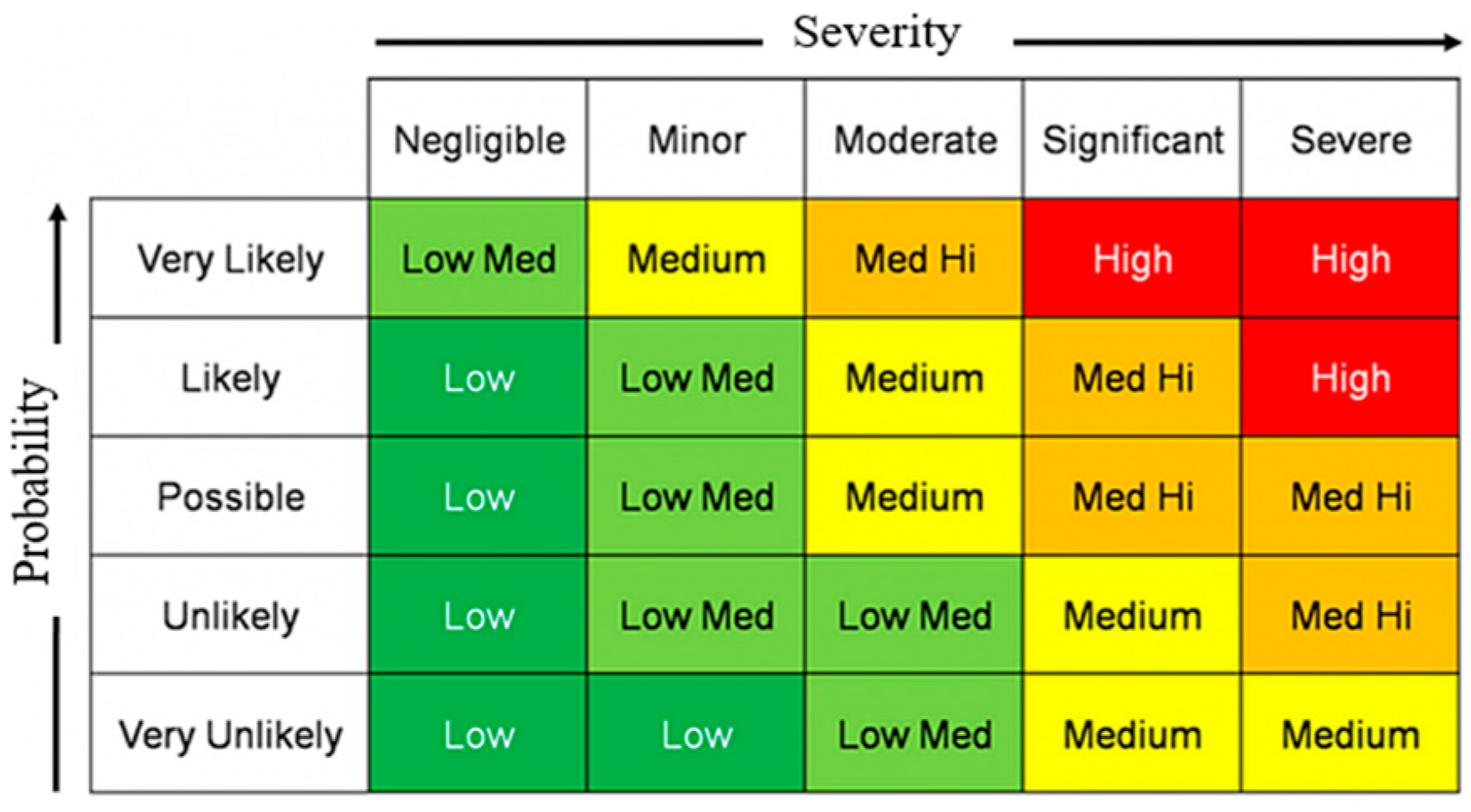
3.2. Mixed-Method Survey Development
3.3. The Results of the Survey
3.4. Linking the Risks to the Processes of a Bridge Project Lifecycle
- 1-
- Risk-Process Relevance Assessment: For each subprocess, the nature of the task was analyzed, and the critical aspects or objectives that each subprocess aims to achieve were identified (e.g., accuracy in financial analysis for cost–benefit analysis or environmental protection in Environmental Impact Assessment). Each risk from the vital list was then reviewed to determine how it might impact or threaten these specific objectives of the subprocesses. This ensured that risks were only assigned to subprocesses where their influence was logically relevant and significant;
- 2-
- Risk Impact Analysis: Each risk’s potential to directly or indirectly influence the success of each subprocess was evaluated. Both direct risks (those impacting subprocess outcomes directly) and indirect risks (those affecting resources, scheduling, stakeholder engagement, or other supportive aspects) were considered. For instance, financial risks (R20) were inherently linked to processes like cost–benefit analysis and budgeting, as these risks directly affect financial stability and planning. Similarly, Environmental Compliance Risks (R43) and Pollution and Waste Management Issues (R22) were linked to Environmental Impact Assessments due to their direct relationship with assessing and mitigating environmental impacts;
- 3-
- Cross-Referencing for Completeness: The scope of each risk was used to cross-check its relevance to multiple subprocesses where applicable. For example, Project Scope Creep (R33), while directly impacting budgeting, was also found to affect traffic and demand analysis and cost–benefit analysis due to potential misalignments between scope and demand or budget. This ensured comprehensive coverage of risks across all applicable subprocesses;
- 4-
- Risk-Context Matching: Each risk was matched to its specific context within the project lifecycle phase to ensure relevance and clarity. For example, ’Supply Chain Disruptions’ (R29), while primarily associated with Procurement and Construction, was also linked to Maintenance because disruptions in the availability of replacement parts or materials could affect maintenance schedules and outcomes. Worker safety and health risks (R24) were linked to site selection due to the potential safety hazards of certain locations, while data management challenges (R28) were linked to traffic and demand analysis because of the data-intensive nature of these analyses. Similarly, Lifecycle Emission Assessment Issues (R30) were primarily linked to the Planning and Construction phases, where material selection and operational planning directly influence emissions. However, limited relevance was also noted for the Maintenance and Decommissioning phases to account for emissions generated during maintenance activities and end-of-life processes, such as demolition and material recycling. Some risks, such as Information Management Issues (R5) and Data Management Challenges (R28), may appear similar but were linked to different phases to reflect their distinct roles. For instance, (R5) pertains to challenges in organizing and accessing data during early project phases like Planning and Design, whereas R28 emphasizes interoperability and integration issues that arise during collaborative phases such as Operation and Maintenance. Also, Resource Planning Issues (R6) focus on inefficiencies in resource allocation during early phases like Procurement, while Inefficient Resource Utilization (R38) highlights suboptimal use of resources during later phases like Construction and Operation. This differentiation ensures that risks are mapped to their most relevant contexts, avoiding redundancy while providing actionable insights for targeted mitigation;
- 5-
- Final Validation for Accuracy and Completeness: After risks were assigned, each linkage was reviewed and validated by industry professionals with expertise in bridge lifecycle management. This step ensured that the assignments were practical, consistent, and reflective of real-world conditions, with particular attention given to critical subprocesses such as geotechnical studies, which involve complex conditions and require consideration of various risk factors (e.g., climate, geology, and technology).
- 1-
- High-Risk Phases: The Construction and Supervision phase is notably high-risk, with 100% of its main processes affected by vital risks. This result indicates that every aspect of this phase requires close management due to the dynamic nature of on-site activities, resource demands, and regulatory compliance. Additionally, the procurement and contracting, operation, and maintenance phases each have 83.33% of their processes impacted by vital risks. The significant risk exposure during these phases shows the necessity for effective risk management measures;
- 2-
- Phases Affected Moderately: Each of the Planning and Design as well as Testing and Commissioning phases exhibit 80% process impact, emphasizing the criticality of early risk mitigation during these foundational stages. The rehabilitation and retrofit phase affects 60% of processes, indicating a concentration of vital risks in specific areas, likely due to its narrower scope compared to other phases like construction and maintenance;
- 3-
- Lower-Risk Phase: The decommissioning and end-of-life phase shows the lowest percentage of affected processes, with only 33.33% impacted. This lower percentage suggests that this phase, being terminal, involves fewer operational or construction-related risks.
3.5. Developing the Essential Guidelines and Strategic Measures
4. Conclusions and Recommendations
Author Contributions
Funding
Institutional Review Board Statement
Informed Consent Statement
Data Availability Statement
Acknowledgments
Conflicts of Interest
References
- Costin, A.; Adibfar, A.; Hu, H.; Chen, S.S. Building Information Modeling (BIM) for Transportation Infrastructure—Literature Review, Applications, Challenges, and Recommendations. Autom. Constr. 2018, 94, 257–281. [Google Scholar] [CrossRef]
- Hang, H.W. Analysis of the Sustainability of Bridges. In IOP Conference Series: Earth and Environmental Science, Proceedings of the 2nd International Conference on Geology, Mapping and Remote Sensing, Zhangjiajie, China, 23–25 April 2021; IOP Publishing Ltd.: Bristol, UK, 2021; Volume 783. [Google Scholar] [CrossRef]
- Ahmad, D.M.; Gáspár, L.; Bencze, Z. BIM and LCSA Applications for Managing Bridge Projects to Achieve Sustainability: A Literature Review. In Proceedings of the Congress of Finance and Tax, Konya, Türkiye, 10–11 March 2023; pp. 389–405. [Google Scholar]
- Ahmad, D.M.; Gáspár, L.; Bencze, Z.; Maya, R.A. The Role of BIM in Managing Risks in Sustainability of Bridge Projects: A Systematic Review with Meta-Analysis. Sustainability 2024, 16, 1242. [Google Scholar] [CrossRef]
- Huang, Z.; Tu, C.; Li, G. Application of BIM Technology in Bridge Engineering and Obstacle Research. IOP Conf. Ser. Earth Environ. Sci. 2021, 798, 012013. [Google Scholar] [CrossRef]
- Jeong, Y.; Kim, W.; Lee, I.; Lee, J. Bridge Inspection Practices and Bridge Management Programs in China, Japan, Korea, and U.S. J. Struct. Integr. Maint. 2018, 3, 126–135. [Google Scholar] [CrossRef]
- Larsen, V.G.; Tollin, N.; Sattrup, P.A.; Birkved, M.; Holmboe, T. What Are the Challenges in Assessing Circular Economy for the Built Environment? A Literature Review on Integrating LCA, LCC, and S-LCA in Life Cycle Sustainability Assessment, LCSA. J. Build. Eng. 2022, 50, 104203. [Google Scholar] [CrossRef]
- Liu, W.; Guo, H.; Li, H.; Li, Y. Using BIM to Improve the Design and Construction of Bridge Projects: A Case Study of a Long-Span Steel-Box Arch Bridge Project. Int. J. Adv. Robot. Syst. 2014, 11, 125. [Google Scholar] [CrossRef]
- Liu, Y.; Wang, Y.; Shi, C.; Zhang, W.; Luo, W.; Wang, J.; Li, K.; Yeung, N.; Kite, S. Assessing the CO2 Reduction Target Gap and Sustainability for Bridges in China by 2040. Renew. Sustain. Energy Rev. 2022, 154, 111811. [Google Scholar] [CrossRef]
- Nizwa, F.; Kassim, E.R.; Philip, S. Risk Analysis in Bridge Construction. In Proceedings of the International Conference on Structural Engineering and Construction Management, Angamaly, India, 7–9 June 2023. [Google Scholar]
- Penadés-Plà, V.; García-Segura, T.; Martí, J.V.; Yepes, V. A Review of Multi-Criteria Decision-Making Methods Applied to the Sustainable Bridge Design. Sustainability 2016, 8, 1295. [Google Scholar] [CrossRef]
- United Nations. Report of the World Commission on Environment and Development: Resolution/Adopted by the General Assembly. 42nd Session, 1987–1988. Available online: https://www.un.org/en/ga/cpc/dec42450.pdf (accessed on 9 August 2024).
- Wan, C.; Zhou, Z.; Li, S.; Ding, Y.; Xu, Z.; Yang, Z.; Xia, Y.; Yin, F. Development of a Bridge Management System Based on the Building Information Modeling Technology. Sustainability 2019, 11, 4583. [Google Scholar] [CrossRef]
- Zhao, R.; Yuan, Y.; Wei, X.; Shen, R.; Zheng, K.; Qian, Y.; Pu, Q.; Zhang, Q.; Liao, H.; Li, X.; et al. Review of Annual Progress of Bridge Engineering in 2019. Adv. Bridge Eng. 2020, 1, 11. [Google Scholar] [CrossRef]
- Zhao, Z.; Gao, Y.; Hu, X.; Zhou, Y.; Zhao, L.; Qin, G.; Guo, J.; Liu, Y.; Yu, C.; Han, D. Integrating BIM and IoT for Smart Bridge Management. In IOP Conference Series: Earth and Environmental Science; Institute of Physics Publishing: Bristol, UK, 2019; Volume 371, p. 022034. [Google Scholar] [CrossRef]
- Kaewunruen, S.; Sresakoolchai, J.; Zhou, Z. Sustainability-Based Lifecycle Management for Bridge Infrastructure Using 6D BIM. Sustainability 2020, 12, 2436. [Google Scholar] [CrossRef]
- Zhang, W. Research on Risk Management of Cross-Sea Bridges Based on Analytic Hierarchy Process—Taking Hangzhou Bay Bridge as an Example. World J. Eng. Technol. 2021, 9, 624–636. [Google Scholar] [CrossRef]
- Du, G.; Karoumi, R. Life Cycle Assessment of a Railway Bridge: Comparison of Two Superstructure Designs. Struct. Infrastruct. Eng. 2013, 9, 1149–1160. [Google Scholar] [CrossRef]
- Ongkowijoyo, C.S.; Gurmu, A.; Andi, A. Investigating Risk of Bridge Construction Project: Exploring Suramadu Strait-Crossing Cable-Stayed Bridge in Indonesia. Int. J. Disaster Resil. Built Environ. 2021, 12, 127–142. [Google Scholar] [CrossRef]
- Fang, Z.; Yan, J.; Lu, Q.; Chen, L.; Yang, P.; Tang, J.; Jiang, F.; Broyd, T.; Hong, J. Systematic Literature Review of Carbon Footprint Decision-Making Approaches for Infrastructure and Building Projects. Appl. Energy 2023, 335, 120768. [Google Scholar] [CrossRef]
- Nahangi, M.; Guven, G.; Olanrewaju, B.; Saxe, S. Embodied Greenhouse Gas Assessment of a Bridge: A Comparison of Pre-construction Building Information Model and Construction Records. J. Clean. Prod. 2021, 295, 126388. [Google Scholar] [CrossRef]
- American Society of Civil Engineers (ASCE). American Infrastructure Report Card; American Society of Civil Engineering: Reston, VA, USA, 2021; 172p, Available online: https://infrastructurereportcard.org/ (accessed on 9 August 2024).
- Canadian Infrastructure Report Card. Monitoring the State of Canada’s Core Public Infrastructure. 2019. Available online: http://canadianinfrastructure.ca/en/municipal-roads.html (accessed on 7 July 2024).
- Federal Statistical Office of Germany (Statistischen Bundesamt). 2021. Available online: https://www.destatis.de/EN/Press/2021/07/PE21_N048_61.html (accessed on 7 July 2024).
- Ministry of Transport of China. Number of Road Bridges in China from 2010 to 2022 (in 1,000s) [Graph]. In Statista. 2023. Available online: https://www.statista.com/statistics/258358/number-of-road-bridges-in-china/ (accessed on 1 April 2024).
- Wang, J.; Pan, K.; Wang, C.; Liu, W.; Wei, J.; Guo, K.; Liu, Z. Integrated Carbon Emissions and Carbon Costs for Bridge Construction Projects Using Carbon Trading and Tax Systems—Taking Beijing as an Example. Appl. Sci. 2022, 12, 10589. [Google Scholar] [CrossRef]
- Navarro, I.; Yepes, V.; Marti, J. Sustainability Life Cycle Design of Bridges in Aggressive Environments Considering Social Impacts. Int. J. Comput. Methods Exp. Meas. 2021, 9, 93–107. [Google Scholar] [CrossRef]
- Raeisi, F.; Algohi, B.; Mufti, A.; Thomson, D. Reducing Carbon Dioxide Emissions through Structural Health Monitoring of Bridges. J. Civ. Struct. Health Monit. 2021, 11, 679–689. [Google Scholar] [CrossRef]
- Shim, C.; Yun, N.; Song, H. Application of 3D Bridge Information Modeling to Design and Construction of Bridges. Procedia Eng. 2011, 14, 95–99. [Google Scholar] [CrossRef]
- Saback de Freitas Bello, V.; Popescu, C.; Blanksvärd, T.; Täljsten, B. Framework for Bridge Management Systems (BMS) Using Digital Twins. In Proceedings of the 1st Conference of the European Association on Quality Control of Bridges and Structures (EURO-STRUCT 2021); Pellegrino, C., Faleschini, F., Zanini, M.A., Matos, J.C., Casas, J.R., Strauss, A., Eds.; Lecture Notes in Civil Engineering; Springer: Cham, Switzerland, 2022; Volume 200, pp. 687–694. [Google Scholar] [CrossRef]
- Marzouk, M.M.; Hisham, M.; Ismail, S.; Youssef, M.; Seif, O. On the Use of Building Information Modeling in Infrastructure Bridges. In Proceedings of the 27th International Conference-Applications of IT in the AEC Industry (CIB W78), Cairo, Egypt, 16–18 November 2010; Volume 136, pp. 1–10. [Google Scholar]
- Marzouk, M.M.; Hisham, M. Bridge Information Modeling in Sustainable Bridge Management. In Proceedings of the ASCE International Conference on Sustainable Design and Construction (ICSDC 2011), Kansas City, MO, USA, 23–25 March 2011; pp. 457–466. [Google Scholar] [CrossRef]
- Marzouk, M.M.; Hisham, M. Implementing Earned Value Management Using Bridge Information Modeling. KSCE J. Civ. Eng. 2014, 18, 1302–1313. [Google Scholar] [CrossRef]
- Itoh, Y.; Kitagawa, T. Using CO2 Emission Quantities in Bridge Lifecycle Analysis. Eng. Struct. 2003, 25, 565–577. [Google Scholar] [CrossRef]
- Keoleian, G.A.; Kendall, A.; Dettling, J.E.; Smith, V.M.; Chandler, R.F.; Lepech, M.D.; Li, V.C. Life Cycle Modeling of Concrete Bridge Design: Comparison of Engineered Cementitious Composite Link Slabs and Conventional Steel Expansion Joints. J. Infrastruct. Syst. 2005, 11, 51. [Google Scholar] [CrossRef]
- Du, G.; Safi, M.; Pettersson, L.; Karoumi, R. Life Cycle Assessment as a Decision Support Tool for Bridge Procurement: Environmental Impact Comparison Among Five Bridge Designs. Int. J. Life Cycle Assess. 2014, 19, 1948–1964. [Google Scholar] [CrossRef]
- Hammervold, J.; Reenaas, M.; Brattebø, H. Environmental Life Cycle Assessment of Bridges. J. Bridge Eng. 2013, 18, 153–161. [Google Scholar] [CrossRef]
- Ma, M.; Li, Z.; Xue, K.; Liu, M. Exergy-Based Life Cycle Assessment Model for Evaluating the Environmental Impact of Bridge: Principle and Case Study. Sustainability 2021, 13, 11804. [Google Scholar] [CrossRef]
- Eisinger, B.; Németh, A.; Major, Z.; Kegyes-Brassai, O. Comparative Life Cycle Analyses of Regular and Irregular Maintenance of Bridges with Different Support Systems and Construction Technologies. Chem. Eng. Trans. 2022, 94, 571–576. [Google Scholar] [CrossRef]
- Hwang, B.; Chen, M. Sustainable Risk Management in the Construction Industry: Lessons Learned from the IT Industry. Technol. Econ. Dev. Econ. 2015, 21, 216–231. [Google Scholar] [CrossRef]
- Renault, B.Y.; Agumba, J.N.; Ansary, N. A Theoretical Review of Risk Identification: Perspective of Construction Industry. In Proceedings of the 5th Applied Research Conference in Africa (ARCA), Cape Coast, Ghana, 25–27 August 2016; pp. 773–782. [Google Scholar]
- ISO 31000; Risk Management–Guidelines, 2nd ed. The International Organization for Standardization: Geneva, Switzerland, 2018; 16p.
- Okate, A.; Kakade, V. Risk Management in Road Construction Projects: High Volume Roads. In Proceedings of the Sustainable Infrastructure Development & Management (SIDM), Nagpur, India, 20 January 2019; 4p. [Google Scholar] [CrossRef]
- Srinives, K. Process of Risk Management. In Perspectives on Risk, Assessment, and Management Paradigms; IntechOpen: London, UK, 2019; Available online: https://www.intechopen.com/chapters/64630 (accessed on 11 August 2024).
- Hayashi, Y.; Kamei, K. Risk Management. In Science of Societal Safety. Trust; Abe, S., Ozawa, M., Kawata, Y., Eds.; Springer: Singapore, 2019; Volume 2, pp. 121–128. [Google Scholar] [CrossRef]
- Lemos, F. On the Definition of Risk. J. Risk Manag. Financ. Inst. 2020, 13, 266–278. [Google Scholar] [CrossRef]
- Iten, R.; Wagner, J.; Röschmann, A.Z. On the Identification, Evaluation, and Treatment of Risks in Smart Homes: A Systematic Literature Review. Risks 2021, 9, 113. [Google Scholar] [CrossRef]
- Project Management Institute (PMI). Guide to Project Management Body of Knowledge (PMBOK® Guide), 7th ed.; Project Management Institute: Upper Darby, PA, USA, 2021; 370p, ISBN 978-1-62825-664-2. [Google Scholar]
- Hemant, G.; Mishra, A.K.; Aithal, P.S. Risk Management Practice Adopted in Road Construction Project. Int. J. Manag. Technol. Soc. Sci. 2022, 7, 21–36. [Google Scholar] [CrossRef]
- Krysiak, F. Risk Management as a Tool for Sustainability. J. Bus. Ethics 2009, 85, 483–492. [Google Scholar] [CrossRef]
- Bahamid, R.A.; Doh, S.I. A Review of Risk Management Process in Construction Projects of Developing Countries. IOP Conf. Ser. Mater. Sci. Eng. 2017, 271, 012042. [Google Scholar] [CrossRef]
- Bayraktar, O. Risk Management in Construction Sector. World J. Adv. Res. Rev. 2020, 8, 237–243. [Google Scholar] [CrossRef]
- Shan, Z.; Liang, Y.; Yu, Z.; Chen, H. Research on the Correlation of Safety Risk of Railway Bridge Construction Based on Meta-Analysis. Appl. Sci. 2024, 14, 3155. [Google Scholar] [CrossRef]
- Nugroho, D.T.; Nur, M.; Purba, H.H. Bridge Project Development Risk Management: A Literature Review. EPRA Int. J. Multidiscip. Res. 2020, 6, 1–7. [Google Scholar] [CrossRef]
- Autodesk. Building Information Modeling. What Is BIM. Available online: https://www.autodesk.eu/solutions/bim (accessed on 3 September 2024).
- Eastman, C.; Teicholz, P.; Sacks, R.; Liston, K. BIM Handbook: A Guide to Building Information Modeling for Owners, Managers, Designers, Engineers, and Contractors, 2nd ed.; Wiley: Hoboken, NJ, USA, 2008. [Google Scholar] [CrossRef]
- Sun, C.; Jiang, S.; Skibniewski, M.; Man, Q.; Shen, L. A Literature Review of the Factors Limiting the Application of BIM in the Construction Industry. Technol. Econ. Dev. Econ. 2015, 23, 764–779. [Google Scholar] [CrossRef]
- Wei, J.; Chen, G.; Huang, J.; Xu, L.; Yang, Y.; Wang, J.; Sadick, A.-M. BIM and GIS Applications in Bridge Projects: A Critical Review. Appl. Sci. 2021, 11, 6207. [Google Scholar] [CrossRef]
- Xu, C.; Zheng, Y. Application of BIM in Bridge Engineering and Its Risk Analysis. IOP Conf. Ser. Earth Environ. Sci. 2020, 526, 012223. [Google Scholar] [CrossRef]
- Zhang, K.; Wang, C.; Liu, X. Research on Construction of Highway Bridge Quality Engineering Based on BIM Technology. IOP Conf. Ser. Earth Environ. Sci. 2020, 510, 052092. [Google Scholar] [CrossRef]
- Warren, L.; Saad, T. Building Information Modeling for Highway Bridges Projects. Manual for Quality Control for Plants and Production of Structural Precast Concrete Products, 5th ed.; MNL (116-21); Precast/Prestressed Concrete Institute: Chicago, IL, USA, 2021; pp. 68–69. [Google Scholar]
- Gao, J.; Fischer, M. Framework and Case Studies Comparing Implementations and Impacts of 3D/4D Modeling across Projects; Stanford University: Stanford, CA, USA, 2008; 101p. [Google Scholar]
- Luo, Y.; Liu, Y. BIM for Bridge Design. IABSE Symp. Rep. 2016, 106, 343–350. [Google Scholar] [CrossRef]
- Elmualim, A.; Gilder, J. BIM: Innovation in Design Management, Influence, and Challenges of Implementation. Archit. Eng. Des. Manag. 2014, 10, 183–199. [Google Scholar] [CrossRef]
- Ullah, K.; Lill, I.; Witt, E. An Overview of BIM Adoption in the Construction Industry: Benefits and Barriers. In Proceedings of the 10th Nordic Conference on Construction Economics and Organization, Tallinn, Estonia, 7–8 May 2019; Emerald Publishing Limited: Bingley, UK, 2019; Volume 2, pp. 297–303. [Google Scholar] [CrossRef]
- Hoang, G.; Vu, D.; Le, N.; Nguyen, T. Benefits and Challenges of BIM Implementation for Facility Management in Operation and Maintenance Phase of Buildings in Vietnam. IOP Conf. Ser. Mater. Sci. Eng. 2020, 869, 022032. [Google Scholar] [CrossRef]
- Georgiadou, M. An Overview of Benefits and Challenges of Building Information Modelling (BIM) Adoption in UK Residential Projects. Constr. Innov. 2019, 19, 298–320. [Google Scholar] [CrossRef]
- Hire, S.; Sandbhor, S.; Ruikar, K.; Amarnath, C. BIM Usage Benefits and Challenges for Site Safety Application in the Indian Construction Sector. Asian J. Civ. Eng. 2021, 22, 1249–1267. [Google Scholar] [CrossRef]
- Rolfsen, C.N.; Lassen, A.K.; Han, D.; Hosamo, H.; Ying, C. The Use of the BIM-Model and Scanning Quality Assurance of Bridge Constructions. In ECPPM 2021–eWork and eBusiness in Architecture, Engineering and Construction, 1st ed.; Taylor & Francis Group: Abingdon, UK, 2021; 4p. [Google Scholar]
- Pan, X.; Mateen Khan, A.; Eldin, S.M.; Aslam, F.; Kashif Ur Rehman, S.; Jameel, M. BIM Adoption in Sustainability, Energy Modelling, and Implementation Using ISO 19650: A Review. Ain Shams Eng. J. 2023, 15, 102252. [Google Scholar] [CrossRef]
- Ibrahim, M.Y.; Al-Kazzaz, D.A. A Comparative Analysis of BIM Standards and Guidelines Between UK and USA. J. Phys. Conf. Ser. 2021, 1973, 012176. [Google Scholar] [CrossRef]
- Dawood, M. BIM-Based Bridge Management System. In Proceedings of the 8th International Conference on Engineering, Project, and Product Management (EPPM 2017), Amman, Jordan, 20–22 September 2017; Şahin, S., Ed.; Lecture Notes in Mechanical Engineering. Springer: Cham, Switzerland, 2018. [Google Scholar] [CrossRef]
- Chan, B.; Guan, H.; Hou, L.; Jo, J.; Blumenstein, M.; Wang, J. Defining a Conceptual Framework for the Integration of Modelling and Advanced Imaging for Improving the Reliability and Efficiency of Bridge Assessments. J. Civ. Struct. Health Monit. 2016, 6, 703–714. [Google Scholar] [CrossRef]
- Zhu, J.; Tan, Y.; Wang, X.; Wu, P. BIM/GIS Integration for Web GIS-Based Bridge Management. Ann. GIS 2021, 27, 99–109. [Google Scholar] [CrossRef]
- Zhou, Z. An Intelligent Bridge Management and Maintenance Model Using BIM Technology. Mob. Inf. Syst. 2022, 2022, 7130546. [Google Scholar] [CrossRef]
- Li, S.; Zhang, Z.; Lin, D.; Zhang, T.; Han, L. Development of a BIM-Based Bridge Maintenance System (BMS) for Managing Defect Data. Sci. Rep. 2023, 13, 846. [Google Scholar] [CrossRef] [PubMed]
- Ciccone, A.; Suglia, P.; Asprone, D.; Salzano, A.; Nicolella, M. Defining a Digital Strategy in a BIM Environment to Manage Existing Reinforced Concrete Bridges in the Context of Italian Regulation. Sustainability 2022, 14, 11767. [Google Scholar] [CrossRef]
- Chang, Y.J.; Neugebauer, S.; Lehmann, A.; Scheumann, R.; Finkbeiner, M. Life Cycle Sustainability Assessment Approaches for Manufacturing. In Sustainable Manufacturing; Springer: Cham, Switzerland, 2017; pp. 221–237. [Google Scholar] [CrossRef]
- Kloepffer, W. Life Cycle Sustainability Assessment of Products. Int. J. Life Cycle Assess. 2008, 13, 89. [Google Scholar] [CrossRef]
- Schramm, A.; Richter, F.; Götze, U. Life Cycle Sustainability Assessment for Manufacturing—Analysis of Existing Approaches. Procedia Manuf. 2020, 43, 712–719. [Google Scholar] [CrossRef]
- UNEP/SETAC. Towards a Lifecycle Sustainability Assessment: Making Informed Choices on Products; United Nations Environment Programme (UNEP): Nairobi, Kenya; Society of Environmental Toxicology and Chemistry (SETAC): Pensacola, FL, USA, 2011; Available online: https://www.lifecycleinitiative.org/ (accessed on 3 September 2024).
- Valdivia, S.; Ugaya, C.M.; Hildenbrand, J.; Traverso, M.; Mazijn, B.; Sonnemann, G. A UNEP/SETAC Approach Towards a Life Cycle Sustainability Assessment—Our Contribution to Rio+20. Int. J. Life Cycle Assess. 2013, 18, 1673–1685. [Google Scholar] [CrossRef]
- Lin, R.; Ren, J. Life Cycle Decision Support Framework: Methods and Case Study. In Life Cycle Sustainability Assessment for Decision-Making; ScienceDirect: Amsterdam, The Netherlands, 2020; pp. 175–204. [Google Scholar]
- Pradip, P.K.; Deepjyoti, D. Advancing Life Cycle Sustainability Assessment Using Multiple Criteria Decision Making. In Life Cycle Sustainability Assessment for Decision-Making; ScienceDirect: Amsterdam, The Netherlands, 2020; 23p. [Google Scholar]
- Mondello, G.; Salomone, R. Assessing Green Processes through Life Cycle Assessment and Other LCA-Related Methods. Stud. Surf. Sci. Catal. 2020, 179, 159–185. [Google Scholar] [CrossRef]
- Ghisellini, P.; Cialani, C.; Ulgiati, S. A Review on Circular Economy: The Expected Transition to a Balanced Interplay of Environmental and Economic Systems. J. Clean. Prod. 2016, 114, 11–32. [Google Scholar] [CrossRef]
- Anastasiades, K.; Blom, J.; Buyle, M.; Audenaert, A. Translating the Circular Economy to Bridge Construction: Lessons Learnt from a Critical Literature Review. Renew. Sustain. Energy Rev. 2020, 117, 109522. [Google Scholar] [CrossRef]
- Balasbaneh, A.T.; Marsono, A.K.B. Applying Multi-Criteria Decision-Making on Alternatives for Earth-Retaining Walls: LCA, LCC, and S-LCA. Int. J. Life Cycle Assess. 2020, 25, 2140–2153. [Google Scholar] [CrossRef]
- Finkbeiner, M.; Schau, E.M.; Lehmann, A.; Traverso, M. Towards Life Cycle Sustainability Assessment. Sustainability 2010, 2, 3309–3322. [Google Scholar] [CrossRef]
- Global Reporting Initiative (GRI). Sustainability Reporting Guidelines; Global Reporting Initiative (GRI): Boston, MA, USA, 2002; 104p. [Google Scholar]
- Xie, H.; Wu, W.; Wang, Y. Life-Time Reliability-Based Optimization of Bridge Maintenance Strategy Considering LCA and LCC. J. Clean. Prod. 2018, 176, 36–45. [Google Scholar] [CrossRef]
- Cadenazzi, T.; Dotelli, G.; Rossini, M.; Nolan, S.; Nanni, A. Cost and Environmental Analyses of Reinforcement Alternatives for a Concrete Bridge. Struct. Infrastruct. Eng. 2019, 16, 787–802. [Google Scholar] [CrossRef]
- Kim, H.; Tae, S.; Ahn, Y.; Yang, J. Scenarios for Life Cycle Studies of Bridge Concrete Structure Maintenance. Sustainability 2020, 12, 9557. [Google Scholar] [CrossRef]
- Muñoz, D.; Martí, V.; Yepes, V. Steel-Concrete Composite Bridges: Design, Life Cycle Assessment, Maintenance, and Decision-Making. Adv. Civ. Eng. 2020, 2020, 8823370. [Google Scholar] [CrossRef]
- Kerman, A. Developing a Quality Assurance System in the Management of Construction Companies. Master’s Thesis, Faculty of Civil Engineering, University of Aleppo, Aleppo, Syria, 2011. [Google Scholar]
- ISO 9001:2015; Quality Management Systems—Requirements, 5th ed. International Organization for Standardization: Geneva, Switzerland, 2015; 29p.
- Górecki, J.; Núñez-Cacho, P. Decision-Making Problems in Construction Projects Executed under the Principles of Sustainable Development—Bridge Construction Case. Appl. Sci. 2022, 12, 6132. [Google Scholar] [CrossRef]
- Nizwa, F.; Kassim, R.; Philip, S. Risk Analysis in Bridge Construction. In Proceedings of SECON’23. SECON 2023; Springer: Cham, Switzerland, 2023; 5p. [Google Scholar] [CrossRef]
- Ahmad, D.M.; Gáspár, L.; Bencze, Z.; Saleh, A. Risk Management in Road Project Sustainability: A Syrian Case Study. In Proceedings of the 7th International Izmir Economics & Business Administration Congress, Izmir, Turkey, 17–18 May 2023; pp. 573–589, ISBN 978-625-367-129-7. [Google Scholar]
- Yao, B.; Wang, L.; Gao, H.; Ren, L. Bridge Construction Risk Assessment Based on Variable Weight Theory and Cloud Model. Buildings 2024, 14, 576. [Google Scholar] [CrossRef]
- Wu, Y.; Lu, P. Comparative Analysis and Evaluation of Bridge Construction Risk with Multiple Intelligent Algorithms. Math. Probl. Eng. 2022, 2022, 2638273. [Google Scholar] [CrossRef]



| Title | Purpose |
|---|---|
| ISO 19650-1:2018 | Organization and digitization of information about buildings and civil engineering works, including building information modelling (BIM): Information management using building information modelling. Part 1: Concepts and principles |
| ISO 19650-2:2018 | Organization and digitization of information about buildings and civil engineering works, including building information modelling (BIM): Information management using building information modelling. Part 2: Delivery phase of the assets |
| ISO 19650-3:2020 | Organization and digitization of information about buildings and civil engineering works, including building information modelling (BIM): Information management using building information modelling. Part 3: Operational phase of the assets. |
| ISO 19650-4:2022 | Organization and digitization of information about buildings and civil engineering works, including building information modelling (BIM): Information management using building information modelling. Part 4: Information exchange |
| ISO 19650-5:2022 | Organization and digitization of information about buildings and civil engineering works, including building information modelling (BIM): Information management using building information modelling. Part 5: Security-minded approach to information management |
| ISO 23386:2020 | Building information modelling and other digital processes used in construction—Methodology to describe, author and maintain properties in interconnected data dictionaries. |
| ISO 23387:2020 | Building information modelling (BIM)—Data templates for construction objects used in the life cycle of built assets—Concepts and principles. |
| Title | Purpose |
|---|---|
| ISO 14040:2006 | Environmental management—Life Cycle Assessment—Principles and framework |
| ISO 14040:2006/Amd 1:2020 | Environmental management—Life Cycle Assessment—Principles and framework: Amendment 1 |
| ISO 14044:2006 | Environmental management—Life Cycle Assessment—Requirements and guidelines |
| ISO 14044:2006/Amd 2:2020 | Environmental management—Life Cycle Assessment—Requirements and guidelines: Amendment 2 |
| ISO 14067:2018 | Greenhouse gases—Carbon footprint of products—Requirements and guidelines for quantification |
| ISO 14020:2022 | Environmental statements and programmes for products—Principles and general requirements |
| ISO 14025:2006 | Environmental labels and declarations—Type III environmental declarations—Principles and procedures |
| ISO 14026:2017 | Environmental labels and declarations—Principles, requirements and guidelines for communication of footprint information |
| ISO 21930:2017 | Sustainability in buildings and civil engineering works—Core rules for environmental product declarations of construction products and services |
| Standard | Clause/Section | Sustainability Requirements | Associated Risks |
|---|---|---|---|
| ISO 19650-1: 2018 | 1, 3.2.6, 3.3.15 | Collaborative working environments, structured information management, integration of environmental considerations | - Information Management Issues - Data Integrity Issues - Contractor Management Problems |
| 3.2.10, 3.3.16 | Risk management and reduction through clear information protocols | - Poor Communication and Stakeholder Engagement - Risk of Rework - Scheduling Conflicts | |
| 3.3.12, 3.3.13 | Quality and consistency of data, supporting asset traceability | - Data Integrity Issues - Information Management Challenges | |
| 1 | Adaptability and scalability of information management for sustainability in diverse project scales | - Inflexible Project Management - Inefficient Resource Utilization | |
| 3.2.10, 3.2.12 | Lifecycle perspective and end-of-life considerations | - Lifecycle Emission Assessment Issues - Maintenance Challenges - End-of-Life Impacts |
| Standard | Clause/Section | Sustainability Requirements | Associated Risks |
|---|---|---|---|
| ISO 19650-2:2018 | 0.1, 1, 3.1.3.2, 3.1.3.3 | Efficient information exchange processes to reduce waste and minimize rework | - Information Management Issues - Data Management Challenges - Inefficient Resource Utilization |
| 0.5 | Collaborative and transparent working environment | - Poor Communication and Stakeholder Engagement - Contractor Management Problems - Scheduling Conflicts | |
| 0.1, 3.1.3.1 | Standardized information management processes adaptable for complex and diverse project scales | - Inflexible Project Management - Project Scope Creep - Data Use in BIM Processes | |
| 0.4 | Value realization for organizations by focusing on sustainable asset management and resource optimization | - Budgeting for Future Maintenance - Maintenance Challenges - Financial Risks | |
| 0.2 | Inclusion of national standards and localized requirements for tailored sustainability and regulatory adherence | - Regulatory Compliance Delays - Environmental Compliance Risks - Cultural Considerations | |
| 0.1, 0.4 | Reduction in wasteful activities through digital information management to improve resource efficiency | - Inefficient Resource Utilization - Data Management Challenges - Data Integrity Issues |
| Standard | Clause/Section | Sustainability Requirements | Associated Risks |
|---|---|---|---|
| ISO 14040:2006 | 4, 5, 6 | Life Cycle Inventory Analysis (LCI), quantifying inputs and outputs for lifecycle stages | - Data Management Challenges - Lifecycle Emission Assessment Issues - Material Quality and Supply Risks |
| 5, 6 | Life Cycle Impact Assessment (LCIA), evaluating environmental impacts of inputs and outputs | - Environmental Compliance Risks - Impact of Climate Change - Pollution and Waste Management Issues | |
| 7 | Interpretation of results to inform sustainable decision-making | - Inadequate Training for Staff - Poor Communication and Stakeholder Engagement - Resource Planning Issues | |
| 4.2, 4.3 | Transparency and documentation of assumptions and limitations | - Information Management Issues - Data Integrity Issues - Regulatory Compliance Delays | |
| 4, 6, 7 | Application of LCA across project phases, including design, construction, maintenance, and decommissioning | - Maintenance Challenges - Budgeting for Future Maintenance - End-of-Life Impacts | |
| 4.2, 6.2 | Use of relevant environmental indicators to guide sustainability decisions | - Environmental Monitoring Needs - Pollution and Waste Management Issues - Data Use in BIM Processes |
| Standard | Clause/Section | Sustainability Requirements | Associated Risks |
|---|---|---|---|
| ISO 14044:2006 | 4.1, 4.2 | Goal and Scope Definition: Define functional unit, system boundaries, and assumptions | - Project Scope Creep - Data Integrity Issues - Poor Communication and Stakeholder Engagement |
| 4.3 | Life Cycle Inventory Analysis: Data collection and quantification for accurate lifecycle assessment | - Data Management Challenges - Material Quality and Supply Risks - Resource Planning Issues | |
| 4.4 | Life Cycle Impact Assessment: Assessment of environmental impacts such as pollution, climate change, water use | - Environmental Compliance Risks - Pollution and Waste Management Issues - Impact of Climate Change | |
| 4.5 | Interpretation of Results: Generate actionable insights for sustainability improvements | - Inadequate Training for Staff - Information Management Issues - Lifecycle Emission Assessment Issues | |
| 4.6 | Data Quality and Reporting: Ensure data is precise, complete, consistent, and representative | - Data Integrity Issues - Data Management Challenges - Information Management Issues | |
| 4.2, 4.3.4 | Allocation and System Boundaries: Allocation methods and boundary definitions for lifecycle stages | - Project Scope Creep - Inefficient Resource Utilization - Data Use in BIM Processes | |
| 4.7, 4.8 | Critical Review and Transparency: Ensure external review and transparent documentation for credibility | - Reputational Risks - Regulatory Compliance Delays - Data Integrity Issues |
| Risks | S | P | RI | Impact on Sustainability Pillars | ||
|---|---|---|---|---|---|---|
| EN | EC | SO | ||||
| R1—Community resistance and Negative public opinion: When local communities are against the project or have a negative view of it, this can reduce overall support for the project. | 2.5 | 3.4 | 8.5 | Low | Moderate | High |
| R2—Construction Disruptions: Construction activities causing noise, dust, or traffic disruptions impacting residents’ daily lives. | 2.8 | 4.2 | 11.76 | High | Moderate | High |
| R3—Poor Communication and Stakeholder Engagement: Ineffective communication can lead to misunderstandings and misaligned expectations. | 4.1 | 3.9 | 15.99 | Low | High | High |
| R4—Maintenance Challenges: Inadequate maintenance can result in structural issues impacting safety and longevity. | 3.8 | 3.7 | 14.06 | Moderate | High | Moderate |
| R5—Information Management Issues: Difficulties with fragmented data across project phases can lead to inefficiencies and errors (challenges in organizing, accessing, and efficiently utilizing project data to support decision-making.) | 4.8 | 4.6 | 22.08 | Low | High | Moderate |
| R6—Resource Planning Issues: Poor planning can result in resource underuse or overuse, affecting efficiency. | 4.7 | 4.4 | 20.68 | Moderate | High | Moderate |
| R7—Cost and Schedule Planning Issues: Imprecise cost and schedule planning can lead to delays and budget overruns | 4.8 | 5 | 24 | Low | High | Moderate |
| R8—Progress Tracking Difficulties: Delayed implementation Complex data requirements can hinder timely corrective actions. | 4 | 3 | 12 | Low | High | Moderate |
| R9—Design and Construction Errors: Errors requiring revisions can waste time, resources, and increase costs. | 5 | 4.5 | 22.5 | High | High | Moderate |
| R10—Productivity and Organization Issues: Poor team organization can negatively impact productivity. | 3.8 | 3 | 11.4 | Low | High | Moderate |
| R11—Outdated Technologies: Using outdated technologies may hinder project efficiency and quality. | 3.6 | 3.1 | 11.16 | High | High | Moderate |
| R12—Construction Quality Issues: Poor quality construction methods can compromise project outcomes. | 4.3 | 4 | 17.2 | High | High | Moderate |
| R13—Contractor Management Problems: Inadequate site management by contractors can lead to various issues (focuses on managerial inefficiencies, which can indirectly cause errors). | 4.2 | 4 | 16.8 | Moderate | High | Moderate |
| R14—Labor Disputes and Strikes: Labor conflicts can disrupt project timelines. | 2.5 | 3.1 | 7.75 | Low | High | High |
| R15—Inclusivity in Stakeholder Decision-Making: Lack of inclusivity can lead to conflicts and disengagement. | 3.9 | 2 | 7.8 | Low | Moderate | High |
| R16—Cybersecurity Risks: Cyberattacks or data breaches can compromise project data integrity. | 2.9 | 2.9 | 8.41 | Low | High | Moderate |
| R17—Equipment Quality and Maintenance Issues: Poor equipment quality can impact project performance. | 3.8 | 3.7 | 14.06 | Moderate | High | Moderate |
| R18—Data Use in BIM Processes: Inadequate Lifecycle Data Integration within BIM can lead to misaligned decisions | 4 | 3.9 | 15.6 | Moderate | High | Moderate |
| R19—Environmental Impact Assessments: Flawed assessments can miss significant environmental impacts. | 4.1 | 4 | 16.4 | High | Moderate | Moderate |
| R20—Financial Risks: Challenges in securing funding and fluctuations in costs can affect project viability. | 5 | 5 | 25 | Low | High | Moderate |
| R21—Regulatory Compliance Delays: The challenge of aligning BIM models with regulatory standards for environmental labels and compliance with international information management protocols | 4.4 | 3 | 13.2 | Low | High | Moderate |
| R22—Pollution and Waste Management Issues: Construction pollution and waste can harm the environment. | 3.8 | 4 | 15.2 | High | Moderate | Moderate |
| R23—Cultural Heritage Risks: Potential damage to cultural heritage sites during construction. | 2.5 | 2.1 | 5.25 | Moderate | Low | High |
| R24—Worker Safety and Health Risks: Inadequate safety measures and training can pose risks to workers and the public. | 4 | 4.2 | 16.8 | Low | High | High |
| R25—Natural Disaster Risks: Risks from natural disasters like earthquakes can impact project safety. | 4.4 | 4.1 | 18.04 | High | High | High |
| R26—Environmental Monitoring Needs: Insufficient data validation and quality assurance for environmental claims affect the lifecycle of the project. | 3.6 | 3.2 | 11.52 | High | Moderate | Low |
| R27—Weather and Geological Risks: Adverse weather and geological conditions can complicate project execution. | 4.5 | 4.1 | 18.45 | High | High | High |
| R28—Data Management Challenges: Lack of data integration and Interoperability Issues can hinder decision-making (emphasizes interoperability issues and lack of data integration, particularly in collaborative decision-making). | 4.3 | 3.7 | 15.91 | Low | High | Moderate |
| R29—Supply Chain Disruptions: Misinterpreting Environmental Product Declaration (EPD) Standards for Imported Materials can lead to delays and inefficiencies. | 3.9 | 4.1 | 15.99 | Moderate | High | Moderate |
| R30—Lifecycle Emission Assessment Issues: Incomplete Carbon Footprint Data Management can compromise sustainability. | 3.8 | 3.1 | 11.78 | High | Moderate | Low |
| R31—Material Quality and Supply Risks: Environmental product quality and transparency and supply shortages can affect construction. | 4.2 | 4.1 | 17.22 | High | High | Moderate |
| R32—Technological Integration Issues: Challenges in integrating new technologies can hinder project efficiency. | 3.9 | 3.5 | 13.65 | Moderate | High | Moderate |
| R33—Project Scope Creep: Uncontrolled changes or continuous growth in project scope can lead to resource strain. | 3.7 | 3.5 | 12.95 | Low | High | Moderate |
| R34—Reputational Risks: Negative media coverage or public perception can damage stakeholder relations. | 3.1 | 4 | 12.4 | Low | High | High |
| R35—Inadequate Training for Staff: Insufficient training can lead to safety and performance issues. | 3.5 | 2.9 | 10.15 | Low | High | High |
| R36—Inflexible Project Management: Complexity in ensuring continuity of digital models across the lifecycle | 4 | 3.7 | 14.8 | Low | High | Moderate |
| R37—Budgeting for Future Maintenance: Inadequate budgeting can affect long-term maintenance and sustainability. | 3.9 | 4 | 15.6 | Low | High | Moderate |
| R38—Inefficient Resource Utilization: Inefficient resource optimization can lead to increased waste (emphasizes the operational inefficiencies that result in increased waste or suboptimal use of resources). | 3.8 | 4 | 15.2 | Moderate | High | Moderate |
| R39—Risk of Current Technologies Becoming Outdated: Rapid technological advancements can render current technologies less effective. | 3.7 | 3.5 | 12.95 | Low | High | Moderate |
| R40—Impact of Climate Change: Climate change impacts can create new risks for bridge projects. | 4.1 | 3.9 | 15.99 | High | Moderate | Low |
| R41—Data Integrity Issues: Inconsistent data reporting formats can hinder effective decision-making (risks related to the accuracy, reliability, and consistency of data inputs and outputs used across project processes). | 4.1 | 3.6 | 14.76 | Low | High | Moderate |
| R42—Unforeseen Soil Conditions: Unexpected soil conditions can complicate construction. | 3.9 | 3 | 11.7 | High | High | Moderate |
| R43—Environmental Compliance Risks: Non-compliance with environmental regulations can lead to legal issues. | 3.7 | 3.9 | 14.43 | High | Moderate | Moderate |
| R44—Inadequate Emergency Response Planning: Lack of emergency planning can exacerbate risks during crises. | 2.9 | 3 | 8.7 | Low | High | High |
| R45—Financial Impacts from Design Changes: Unanticipated design changes can lead to financial strain. | 4.5 | 4.6 | 20.7 | Low | High | Moderate |
| R46—Limited Access to Advanced Construction Technologies: Barriers to accessing modern technologies can hinder efficiency. | 3.7 | 3.9 | 14.43 | Moderate | High | Moderate |
| R47—Erosion and Sedimentation Risks: Risks related to erosion and sedimentation during construction. | 3.8 | 2.6 | 9.88 | High | Moderate | Low |
| R48—Conflicts in Contract Documents: Ambiguities in contracts can lead to disputes and delays. | 4.6 | 4.1 | 18.86 | Low | High | Moderate |
| R49—Heat Effect: Increased temperatures in urban areas can affect bridge performance. | 3.4 | 3.1 | 10.54 | High | Moderate | Low |
| R50—Risks from Energy-Intensive Processes: High energy consumption during construction can increase costs and environmental impact. | 3.5 | 4 | 14 | High | Moderate | Low |
| R51—Regulatory Changes: Changes in laws or regulations during the project could introduce new risks. | 3.7 | 3.4 | 12.58 | Low | High | Moderate |
| R52—Political Factors: Shifts in political support or policy priorities may impact project funding or community support. | 3.7 | 3.7 | 13.69 | Low | High | High |
| R53—Technological Advances: New technologies emerging during the project could affect existing plans or introduce new risks. | 3.6 | 3.2 | 11.52 | Low | High | Moderate |
| R54—Stakeholder Dynamics: Changes in key stakeholders or their interests might create unforeseen challenges. | 3.8 | 2.9 | 11.02 | Low | Moderate | High |
| R55—Cultural Considerations: Failing to address cultural sensitivities in the area can increase community opposition. | 3.1 | 3 | 9.3 | Low | Low | High |
| Risk | Risk Impact (RI) | Cumulative Impact | Cumulative Percentage |
|---|---|---|---|
| R20—Financial Risks | 25.00 | 25.00 | 3.20% |
| R7—Cost and Schedule Planning Issues | 24.00 | 49.00 | 6.26% |
| R9—Design and Construction Errors | 22.50 | 71.50 | 9.14% |
| R5—Information Management Issues | 22.08 | 93.58 | 11.96% |
| R45—Financial Impacts from Design Changes | 20.70 | 114.28 | 14.61% |
| R6—Resource Planning Issues | 20.68 | 134.96 | 17.25% |
| R48—Conflicts in Contract Documents | 18.86 | 153.82 | 19.66% |
| R27—Weather and Geological Risks | 18.45 | 172.27 | 22.02% |
| R25—Natural Disaster Risks | 18.04 | 190.31 | 24.33% |
| R31—Material Quality and Supply Risks | 17.22 | 207.53 | 26.53% |
| R12—Construction Quality Issues | 17.20 | 224.73 | 28.73% |
| R13—Contractor Management Problems | 16.80 | 241.53 | 30.87% |
| R24—Worker Safety and Health Risks | 16.80 | 258.33 | 33.02% |
| R19—Environmental Impact Assessments | 16.40 | 274.73 | 35.12% |
| R3—Poor Communication and Stakeholder Engagement | 15.99 | 290.72 | 37.16% |
| R29—Supply Chain Disruptions | 15.99 | 306.71 | 39.21% |
| R40—Impact of Climate Change | 15.99 | 322.70 | 41.25% |
| R28—Data Management Challenges | 15.91 | 338.61 | 43.28% |
| R18—Data Use in BIM Processes | 15.60 | 354.21 | 45.28% |
| R37—Budgeting for Future Maintenance | 15.60 | 369.81 | 47.27% |
| R22—Pollution and Waste Management Issues | 15.20 | 385.01 | 49.21% |
| R38—Inefficient Resource Utilization | 15.20 | 400.21 | 51.16% |
| R36—Inflexible Project Management | 14.80 | 415.01 | 53.05% |
| R41—Data Integrity Issues | 14.76 | 429.77 | 54.94% |
| R43—Environmental Compliance Risks | 14.43 | 444.20 | 56.78% |
| R46—Limited Access to Advanced Technologies | 14.43 | 458.63 | 58.63% |
| R4—Maintenance Challenges | 14.06 | 472.69 | 60.42% |
| R17—Equipment Quality and Maintenance Issues | 14.06 | 486.75 | 62.22% |
| R50—Risks from Energy-Intensive Processes | 14.00 | 500.75 | 64.01% |
| R52—Political Factors | 13.69 | 514.44 | 65.76% |
| R32—Technological Integration Issues | 13.65 | 528.09 | 67.50% |
| R21—Regulatory Compliance Delays | 13.20 | 541.29 | 69.19% |
| R33—Project Scope Creep | 12.95 | 554.24 | 70.85% |
| R39—Risk of Current Technologies Becoming Outdated | 12.95 | 567.19 | 72.50% |
| R51—Regulatory Changes | 12.58 | 579.77 | 74.11% |
| R34—Reputational Risks | 12.40 | 592.17 | 75.70% |
| R8—Progress Tracking Difficulties | 12.00 | 604.17 | 77.23% |
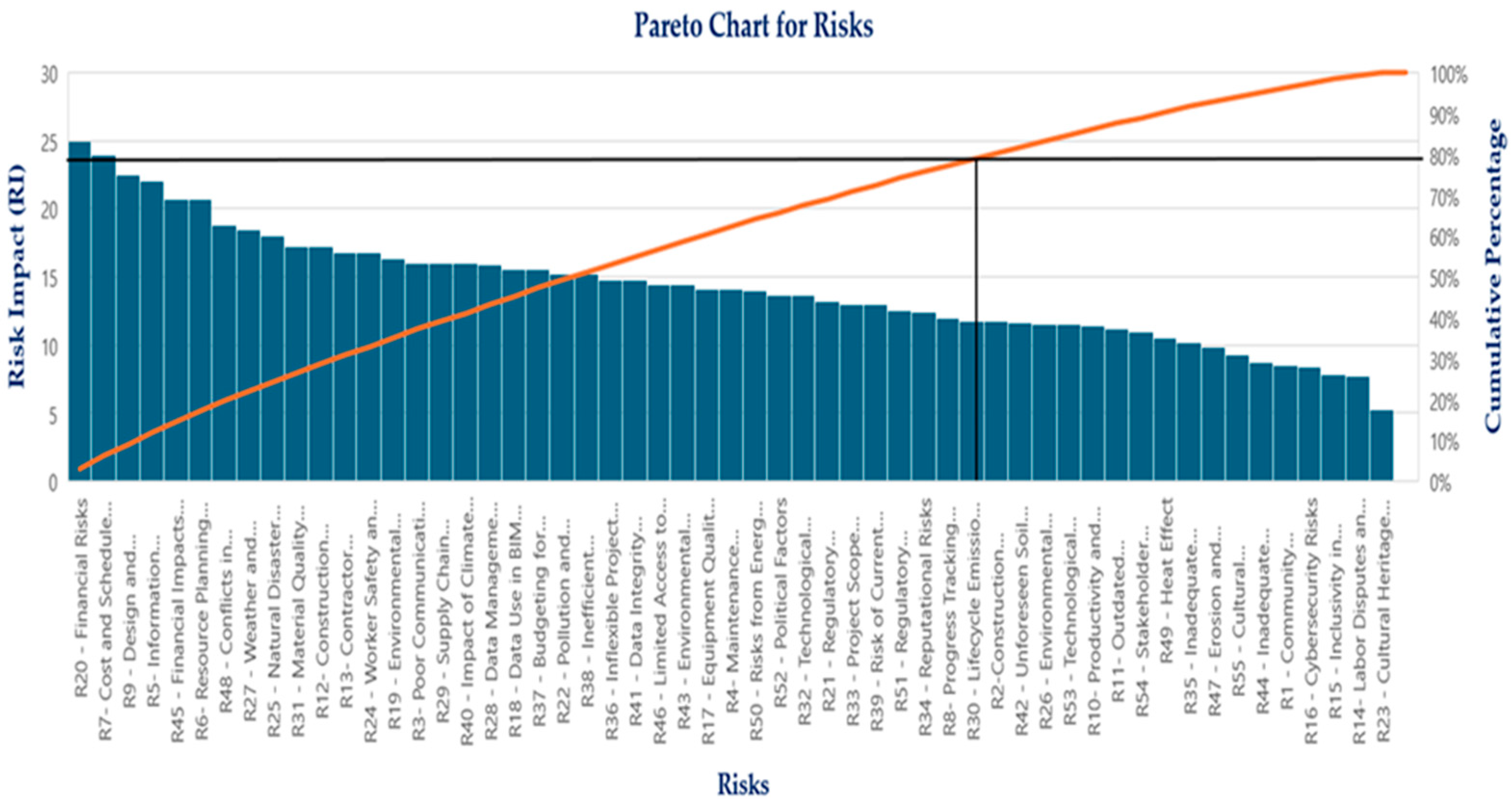
| R30—Lifecycle Emission Assessment Issues | 11.78 | 615.95 | 78.73% |
| R2—Construction Disruptions | 11.76 | 627.71 | 80.24% |
| R42—Unforeseen Soil Conditions | 11.70 | 639.41 | 81.73% |
| R26—Environmental Monitoring Needs | 11.52 | 650.93 | 83.21% |
| R53—Technological Advances | 11.52 | 662.45 | 84.68% |
| R10—Productivity and Organization Issues | 11.40 | 673.85 | 86.14% |
| R11—Outdated Technologies | 11.16 | 685.01 | 87.56% |
| R54—Stakeholder Dynamics | 11.02 | 696.03 | 88.97% |
| R49—Heat Effect | 10.54 | 706.57 | 90.32% |
| R35—Inadequate Training for Staff | 10.15 | 716.72 | 91.62% |
| R47—Erosion and Sedimentation Risks | 9.88 | 726.60 | 92.88% |
| R55—Cultural Considerations | 9.30 | 735.90 | 94.07% |
| R44—Inadequate Emergency Response Planning | 8.70 | 744.60 | 95.18% |
| R1—Community Resistance and Negative Public Opinion | 8.50 | 753.10 | 96.27% |
| R16—Cybersecurity Risks | 8.41 | 761.51 | 97.34% |
| R15—Inclusivity in Stakeholder Decision-Making | 7.80 | 769.31 | 98.34% |
| R14—Labor Disputes and Strikes | 7.75 | 777.06 | 99.33% |
| R23—Cultural Heritage Risks | 5.25 | 782.31 | 100.00% |
| The Planning and Design Phase | ||
|---|---|---|
| Main Process | Sub Process | Associated Risks |
| Feasibility Studies | - Cost–benefit analysis | R20, R7, R45, R38, R52, R3, R8, R33, R29, R34 |
| - Environmental Impact Assessment (EIA) | R19, R43, R40, R22, R52, R3, R25, R30, R41, R34 | |
| - Traffic and demand analysis | R7, R3, R36, R32, R29, R8, R33, R28 | |
| - Site selection studies | R27, R25, R31, R52, R40, R19, R22, R6, R24, R46 | |
| - Budgeting and financial planning | R20, R6, R45, R37, R29, R7, R33, R8, R52, R34 | |
| - Geotechnical studies | R27, R25, R31, R32, R9, R6, R40, R17, R36 | |
| Preliminary Design | - Initial design modeling | R9, R3, R45, R33, R36, R32 |
| - Structural design and analysis | R9, R31, R6, R20, R27, R25, R17, R40 | |
| - BIM modeling and simulation | R5, R18, R28, R41, R32, R39 | |
| - Material selection and specification | R31, R6, R29, R22, R38, R46, R20 | |
| - Design optimization for sustainability (LCA, LCSA) | R30, R40, R22, R43, R19, R37, R38 | |
| - Sustainability goal setting | R40, R19, R22, R43, R34, R52 | |
| - Cost estimation | R20, R7, R45, R33, R8, R3, R52 | |
| - Safety and compliance checks. | R24, R41, R43, R36, R52, R3, R25 | |
| - Sustainability goal setting | R40, R19, R22, R43, R34, R52 | |
| Risk Identification and Analysis | - Hazard identification | R3, R5, R9, R25, R27, R40, R24, R31 |
| - Preliminary risk assessment | R20, R6, R7, R9, R28, R36, R32, R43 | |
| - Risk prioritization | R20, R7, R33, R29, R30, R34, R52 | |
| - Development of mitigation strategies | R6, R19, R22, R40, R41, R46, R43, R24 | |
| - Climate Change Impact Assessment | R40, R19, R22, R43, R30, R27, R25, R52 | |
| Stakeholder Engagement | - Public consultations | R3, R24, R34, R52, R29, R19 |
| - Regulatory approvals (permitting and compliance) | R43, R21, R51, R52, R7, R40, R19 | |
| - Community impact studies | R3, R34, R19, R22, R52, R25, R27, R40 | |
| - Stakeholder communication. | R3, R5, R8, R33, R34, R52, R28 | |
| Sustainability Assessment | - Energy impact calculations | R50, R22, R40, R38, R37, R30 |
| - Carbon footprint evaluation | R40, R30, R22, R43, R19 | |
| - Lifecycle cost analysis (LCA) | R20, R37, R30, R45, R7, R38, R31 | |
| - Sustainability reporting | R43, R41, R28, R19, R34, R52 | |
| The Procurement and Contracting Phase | ||
|---|---|---|
| Main Process | Sub Process | Associated Risks |
| Tendering and Bidding | - Invitation to tender | R3, R52, R34, R48, R43, R29 |
| - Bid preparation and submission | R20, R7, R6, R45, R33, R28, R29 | |
| - Bid evaluation and scoring | R5, R9, R33, R48, R52, R20, R41 | |
| Contract Drafting and Negotiation | - Contract scope development | R3, R48, R33, R52, R34, R29 |
| - Negotiation of terms (cost, timelines, penalties) | R20, R7, R6, R45, R9, R52, R41 | |
| - Risk-sharing clauses | R20, R43, R45, R6, R9, R13, R29 | |
| Legal and Regulatory Compliance | - Developed procedures for compliance with laws and standards | R21, R43, R52, R51, R19, R40, R24, R41, R25, R22, R28 |
| Supplier Selection and Qualification | - Supplier pre-qualification | R31, R3, R48, R13, R29, R24 |
| - Supplier performance assessment | R12, R13, R41, R9, R29, R33 | |
| - Sustainability criteria evaluation | R40, R19, R22, R43, R28, R50 | |
| Budget Estimation | - Detailed cost estimation | R20, R7, R45, R6, R29, R33, R3 |
| - Contingency planning | R20, R37, R52, R29, R25, R40 | |
| - Risk-adjusted budget allocation | R20, R7, R45, R6, R41, R43, R34 | |
| Risk Allocation in Contracts | - Assignment of risks to stakeholders (e.g., owner, contractor) | R3, R6, R20, R48, R52, R13, R29 |
| - Development of risk-sharing mechanisms (insurance) | R20, R43, R45, R6, R9, R41, R52 | |
| Phase | Main Processes | Impact of Vital Risks (Average) | Cumulative Risk Impact | Cumulative Percentage |
|---|---|---|---|---|
| P&C | Risk Allocation in Contracts | 18.13 | 18.13 | 2.31% |
| C&S | On-Site Risk Management | 18.13 | 36.26 | 4.62% |
| P&C | Tendering and Bidding | 18 | 54.26 | 6.92% |
| M | Budgeting for Future Maintenance Needs | 17.86 | 72.12 | 9.19% |
| C&S | Procurement and Supply Chain Management | 17.82 | 89.94 | 11.47% |
| P&C | Contract Drafting and Negotiation | 17.77 | 107.71 | 13.73% |
| O | Asset Management and Lifecycle Cost Analysis | 17.55 | 125.26 | 15.97% |
| C&S | Quality Control and Assurance | 17.52 | 142.78 | 18.20% |
| O | Traffic and Load Management | 17.45 | 160.23 | 20.43% |
| T&C | Handover to Operational Teams | 17.29 | 177.52 | 22.63% |
| O | Risk Monitoring and Reassessment | 17.29 | 194.81 | 24.84% |
| R&R | Stakeholder Communication and Approval | 17.22 | 212.03 | 27.03% |
| P&C | Budget Estimation | 17.16 | 229.19 | 29.22% |
| T&C | Structural and Material Testing | 17.15 | 246.34 | 31.41% |
| R&R | Risk Reassessment | 17.15 | 263.49 | 33.59% |
| M | Preventive Maintenance | 17.03 | 280.52 | 35.76% |
| C&S | Construction Scheduling and Planning | 17 | 297.52 | 37.93% |
| O | Performance Monitoring and Inspection | 16.98 | 314.5 | 40.10% |
| M | Safety Upgrades and Retrofitting | 16.94 | 331.44 | 42.265 |
| C&S | Health, Safety, and Environment (HSE) Management | 16.92 | 348.36 | 44.41% |
| C&S | Site Preparation and Groundwork | 16.91 | 365.27 | 46.57% |
| M | Corrective Maintenance | 16.83 | 382.1 | 48.72% |
| P&D | Risk Identification and Analysis | 16.8 | 398.9 | 50.86% |
| M | Documentation of Maintenance Activities | 16.8 | 415.7 | 53.00% |
| T&C | System Functionality Checks | 16.63 | 432.33 | 55.12% |
| T&C | Documentation and Reporting | 16.61 | 448.94 | 57.24% |
| C&S | Labor Management | 16.58 | 465.52 | 59.35% |
| O | Emergency Response Planning | 16.54 | 482.06 | 61.46% |
| D&E | Dismantling and Demolition Planning | 16.5 | 498.56 | 63.56% |
| P&D | Feasibility Studies | 16.47 | 515.03 | 65.66% |
| P&D | Preliminary Design | 16.43 | 531.46 | 67.76% |
| C&S | Monitoring and Reporting | 16.42 | 547.88 | 69.85% |
| P&D | Sustainability Assessment | 16.39 | 564.27 | 71.94% |
| R&R | Structural Assessments | 16.34 | 580.61 | 74.02% |
| P&C | Supplier Selection and Qualification | 16.31 | 596.92 | 76.10% |
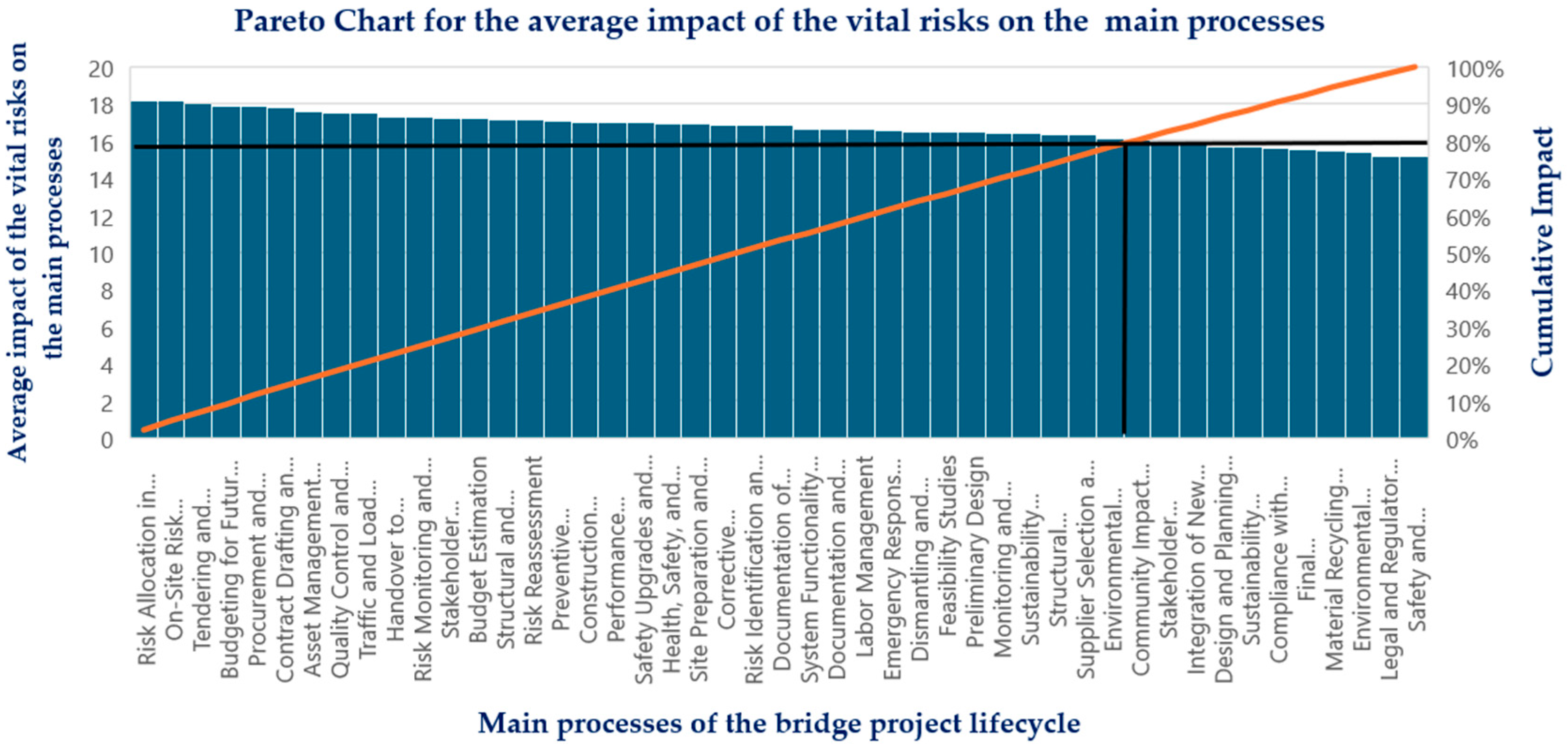
| D&E | Environmental Restoration | 16.09 | 613.01 | 78.16% |
| D&E | Community Impact Management | 16.05 | 629.06 | 80.20% |
| P&D | Stakeholder Engagement | 15.89 | 644.95 | 82.23% |
| R&R | Integration of New Technologies | 15.84 | 660.79 | 84.25% |
| R&R | Design and Planning for Retrofit | 15.68 | 676.47 | 86.25% |
| O | Sustainability Reporting | 15.64 | 692.11 | 88.24% |
| D&E | Compliance with Regulations | 15.57 | 707.68 | 90.23% |
| D&E | Final Decommissioning Reports | 15.55 | 723.23 | 92.21% |
| D&E | Material Recycling and Disposal | 15.44 | 738.67 | 94.18% |
| M | Environmental Compliance | 15.35 | 754.02 | 96.13% |
| P&C | Legal and Regulatory Compliance | 15.18 | 769.2 | 98.07% |
| T&C | Safety and Performance Certifications | 15.15 | 784.35 | 100.00% |
| Phases | Number of Main Processes | Number of Affected Main Processes | Affected Main Processes as a Percentage |
|---|---|---|---|
| Planning and Design | 5 | 4 | 80% |
| Procurement and contracting | 6 | 5 | 83.33% |
| Construction and Supervision | 8 | 8 | 100% |
| Testing and Commissioning | 5 | 4 | 80% |
| Operation | 6 | 5 | 83.33% |
| Maintenance | 6 | 5 | 83.33% |
| Rehabilitation and retrofit | 5 | 3 | 60% |
| Decommissioning and End-of-Life | 6 | 2 | 33.33% |
| Sum = 47 | Sum = 36 |
| Phase | The Most Impactful Risks | RI | Their Impact on Sustainability Pillars | ||
|---|---|---|---|---|---|
| EN | EC | SO | |||
| Construction and Supervision | R20—Financial Risks | 25.00 | Low | High | Moderate |
| R7—Cost and Schedule Planning Issues | 24.00 | Low | High | Moderate | |
| R9—Design and Construction Errors | 22.50 | High | High | Moderate | |
| R5—Information Management Issues | 22.08 | Low | High | Moderate | |
| R45—Financial Impacts from Design Changes | 20.70 | Low | High | Moderate | |
| R6—Resource Planning Issues | 20.68 | Moderate | High | Moderate | |
| R48—Conflicts in Contract Documents | 18.86 | Low | High | Moderate | |
| R27—Weather and Geological Risks | 18.45 | High | High | High | |
| R25—Natural Disaster Risks | 18.04 | High | High | High | |
| R31—Material Quality and Supply Risks | 17.22 | High | High | Moderate | |
| R12—Construction Quality Issues | 17.20 | High | High | Moderate | |
| R13—Contractor Management Problems | 16.80 | Moderate | High | Moderate | |
| R24—Worker Safety and Health Risks | 16.80 | Low | High | High | |
| R19—Environmental Impact Assessments | 16.40 | High | Moderate | Moderate | |
| R3—Poor Communication and Stakeholder Engagement | 15.99 | Low | High | High | |
| R29—Supply Chain Disruptions | 15.99 | Moderate | High | Moderate | |
| R40—Impact of Climate Change | 15.99 | High | Moderate | Low | |
| R28—Data Management Challenges | 15.91 | Low | High | Moderate | |
| R18—Data Use in BIM Processes | 15.60 | Moderate | High | Moderate | |
| R37—Budgeting for Future Maintenance | 15.60 | Low | High | Moderate | |
| R22—Pollution and Waste Management Issues | 15.20 | High | Moderate | Moderate | |
| R38—Inefficient Resource Utilization | 15.20 | Moderate | High | Moderate | |
| R36—Inflexible Project Management | 14.80 | Low | High | Moderate | |
| R41—Data Integrity Issues | 14.76 | Low | High | Moderate | |
| R43—Environmental Compliance Risks | 14.43 | High | Moderate | Moderate | |
| R46—Limited Access to Advanced Technologies | 14.43 | Moderate | High | Moderate | |
| R4—Maintenance Challenges | 14.06 | Moderate | High | Moderate | |
| R17—Equipment Quality and Maintenance Issues | 14.06 | Moderate | High | Moderate | |
| R50—Risks from Energy-Intensive Processes | 14.00 | High | Moderate | Low | |
| R52—Political Factors | 13.69 | Low | High | High | |
| R32—Technological Integration Issues | 13.65 | Moderate | High | Moderate | |
| R21—Regulatory Compliance Delays | 13.20 | Low | High | Moderate | |
| R33—Project Scope Creep | 12.95 | Low | High | Moderate | |
| R39—Risk of Current Technologies Becoming Outdated | 12.95 | Low | High | Moderate | |
| R51—Regulatory Changes | 12.58 | Low | High | High | |
| R34—Reputational Risks | 12.40 | Low | High | Moderate | |
| R8—Progress Tracking Difficulties | 12.00 | Low | High | Moderate | |
| R30—Lifecycle Emission Assessment Issues | 11.78 | High | Moderate | Low | |
| Clause | Section | Objective | On-Site Risk Management Focus with BIM and LCSA | Related Risks and Suggested Actions |
|---|---|---|---|---|
| Clause 4: Context of the Organization | Clause 4.1: Understanding the Organization and Its Context | Identify internal and external factors that affect quality and risk management on-site. | BIM: Use BIM to model site-specific conditions, weather scenarios, and constraints. LCSA: Evaluate the environmental and economic impacts of materials and processes under varying conditions. | R36 (Inflexible Project Management): BIM enables adaptable project modeling. R40 (Impact of Climate Change): BIM simulates climate impacts; LCSA tracks sustainability risks in different scenarios. |
| Clause 4.2: Understanding the Needs and Expectations of Interested Parties | Identify stakeholders and understand their needs as they directly affect on-site activities. | BIM: Use BIM for real-time collaboration and progress updates. LCSA: Assess sustainability expectations and align project decisions with stakeholder values. | R3 (Poor Communication and Stakeholder Engagement): BIM centralizes communication and updates. R52 (Political Factors): Use LCSA to ensure alignment with political and environmental priorities. | |
| Clause 4.3: Determining the Scope of the Quality Management System (QMS) | Define the QMS scope to cover specific On-Site Risk Management needs. | BIM: Define scope for BIM usage on-site (e.g., tracking progress, identifying conflicts). LCSA: Include LCSA for assessing lifecycle sustainability impacts in processes. | R5 (Information Management Issues): BIM improves data accessibility. R29 (Supply Chain Disruptions): Use BIM for supply chain tracking and LCSA to evaluate alternative sustainable materials. | |
| Clause 4.4: Quality Management System and Its Processes | Establish and manage processes within the QMS to ensure alignment with on-site quality objectives. | BIM: Integrate BIM into process planning for real-time monitoring and risk mitigation. LCSA: Incorporate LCSA to assess the long-term sustainability of processes and materials. | R7 (Cost and Schedule Planning Issues): BIM provides accurate scheduling and cost forecasting. R20 (Financial Risks): LCSA assesses lifecycle costs while BIM optimizes on-site resource use. | |
| Clause 5: Leadership | Clause 5.1: Leadership and Commitment | Leadership demonstrates commitment to quality, safety, and sustainability using BIM and LCSA. | BIM: Leaders promote BIM for risk visualization and conflict detection. LCSA: Commitment to LCSA metrics for evaluating energy use, emissions, and long-term impacts. | R24 (Worker Safety and Health Risks): Leadership supports safety initiatives and training. R40 (Impact of Climate Change): BIM evaluates weather scenarios; LCSA measures long-term environmental impacts. |
| Clause 5.2: Quality Policy | Establish a quality policy that reflects commitments to BIM and LCSA for quality and sustainability. | BIM: Ensure policy includes BIM for collaboration, coordination, and quality improvement. LCSA: Commit to using LCSA for assessing material impacts and sustainability metrics. | R43 (Environmental Compliance Risks): BIM tracks environmental compliance; LCSA measures impacts. R5 (Information Management Issues): BIM centralizes data to address fragmented information flow. | |
| Clause 5.3: Organizational Roles, Responsibilities, and Authorities | Define roles for BIM and LCSA implementation to enhance risk management and sustainability. | BIM: Assign a BIM manager for model updates, error reduction, and quality control. LCSA: Designate roles for conducting lifecycle sustainability assessments. | R9 (Design and Construction Errors): BIM reduces errors through real-time model updates. R29 (Supply Chain Disruptions): BIM tracks material logistics; LCSA evaluates alternatives for sustainability in disruptions. | |
| Clause 6: Planning for the Quality Management System (QMS) | Clause 6.1: Actions to Address Risks and Opportunities | Identify and address risks and opportunities to enhance QMS performance. | BIM: Use BIM to simulate on-site scenarios, identifying potential risks (e.g., safety hazards, material delays) and opportunities (e.g., process optimizations). LCSA: Evaluate opportunities to reduce environmental and lifecycle costs through sustainable material selection. | R27 (Weather and Geological Risks): Use BIM to simulate adverse weather impacts on construction timelines. R29 (Supply Chain Disruptions): Develop supply chain contingency plans with BIM logistics tracking and LCSA assessments of material alternatives. |
| Clause 6.2: Quality Objectives and Planning to Achieve Them | Set measurable quality objectives aligned with organizational goals. | BIM: Establish on-site objectives such as zero rework and real-time progress tracking through BIM dashboards. LCSA: Include sustainability metrics (e.g., reduced emissions, optimized energy use) in quality objectives. | R7 (Cost and Schedule Planning Issues): Use BIM to create measurable milestones for tracking progress and costs. R20 (Financial Risks): Link financial objectives to LCSA metrics, ensuring long-term economic viability of processes. | |
| Clause 6.3: Planning of Changes | Ensure that changes to processes are managed systematically to avoid disruptions. | BIM: Use BIM for visualizing and managing changes in construction sequences, resource allocations, and design updates. LCSA: Assess the sustainability impacts of proposed changes to ensure alignment with long-term goals. | R9 (Design and Construction Errors): BIM provides real-time feedback on design changes to minimize errors. R40 (Impact of Climate Change): Use BIM and LCSA to evaluate the impact of climate-related changes on construction plans and materials. | |
| Clause 7: Support | Clause 7.1: Resources | Ensure availability of resources needed for the QMS. | BIM: Provide hardware, software, and skilled personnel for BIM implementation to manage on-site risks effectively. LCSA: Allocate resources for lifecycle sustainability assessments and environmental monitoring on-site. | R5 (Information Management Issues): Ensure BIM tools and platforms are integrated for centralized data sharing. R27 (Weather and Geological Risks): Use BIM-based resources to simulate and mitigate weather-related challenges. |
| Clause 7.2: Competence | Ensure personnel are competent to perform their roles effectively. | BIM: Train staff on BIM tools and techniques for managing risks like design errors and scheduling conflicts. LCSA: Provide training on using LCSA tools to assess material and process sustainability. | R9 (Design and Construction Errors): Train teams on using BIM for early error detection. R13 (Contractor Management Problems): Train contractors on both BIM usage and LCSA principles to improve on-site decision-making and reduce risks. | |
| Clause 7.3: Awareness | Ensure personnel are aware of their role in achieving QMS objectives. | BIM: Use BIM visualizations to increase awareness of site risks and quality objectives among team members. LCSA: Promote awareness of how lifecycle sustainability goals influence on-site activities and decisions. | R24 (Worker Safety and Health Risks): Increase awareness of safety risks and mitigation strategies through BIM models. R40 (Impact of Climate Change): Use LCSA to raise awareness about long-term environmental impacts of construction decisions. | |
| Clause 7.4: Communication | Establish and implement effective communication processes. | BIM: Use BIM platforms for real-time updates and collaboration among on-site teams and stakeholders. LCSA: Share sustainability data and reports generated by LCSA to keep stakeholders informed about progress and compliance. | R3 (Poor Communication and Stakeholder Engagement): BIM ensures consistent and centralized communication to reduce misunderstandings. R43 (Environmental Compliance Risks): Use LCSA reports to communicate compliance with environmental regulations. | |
| Clause 7.5: Documented Information | Create, update, and control information necessary for the QMS. | BIM: Use BIM to store and manage real-time data, ensuring information accuracy and accessibility. LCSA: Maintain lifecycle sustainability records for future assessments and regulatory compliance. | R41 (Data Integrity Issues): Ensure BIM models are updated and managed to maintain data accuracy. R52 (Political Factors): Document LCSA metrics to demonstrate sustainability efforts, aligning with policy or political priorities. | |
| Clause 8: Operation | Clause 8.1: Operational Planning and Control | Plan and control processes to meet QMS requirements, including addressing risks and opportunities. | BIM: Use BIM for construction sequencing, conflict resolution, and real-time monitoring to control operations effectively. LCSA: Integrate sustainability assessments into planning to align operations with environmental and lifecycle goals. | R7 (Cost and Schedule Planning Issues): Use BIM to visualize construction timelines and identify bottlenecks. R20 (Financial Risks): LCSA evaluates lifecycle costs to ensure cost-effective operations. |
| Clause 8.2: Requirements for Products and Services | Determine and meet customer and stakeholder requirements for the project. | BIM: Use BIM to visualize and validate designs against stakeholder expectations. LCSA: Align sustainability metrics (e.g., emissions, energy use) with stakeholder requirements for environmentally responsible practices. | R3 (Poor Communication and Stakeholder Engagement): Use BIM to enhance stakeholder understanding of project designs. R43 (Environmental Compliance Risks): Use LCSA to demonstrate compliance with environmental standards to stakeholders. | |
| Clause 8.3: Design and Development of Products and Services | Plan and manage design and development processes to ensure quality and mitigate risks. | BIM: Use 3D and 4D BIM models for design visualization and development. LCSA: Evaluate design alternatives based on lifecycle impacts and sustainability criteria. | R9 (Design and Construction Errors): BIM reduces design errors by visualizing and simulating designs. R40 (Impact of Climate Change): LCSA helps select design options that mitigate climate risks and promote sustainability. | |
| Clause 8.4: Control of Externally Provided Processes, Products, and Services | Ensure control over outsourced processes, products, and services. | BIM: Use BIM for tracking materials, monitoring supplier performance, and ensuring quality. LCSA: Assess the sustainability impacts of materials and suppliers to ensure alignment with project goals. | R29 (Supply Chain Disruptions): BIM tracks supply chain logistics, and LCSA evaluates sustainable material alternatives. R31 (Material Quality and Supply Risks): Use BIM and LCSA to ensure quality and sustainability in material procurement. | |
| Clause 8.5: Production and Service Provision | Implemented controlled production and service provision processes. | BIM: Use BIM to manage and monitor construction progress, resource allocation, and quality checks. LCSA: Incorporate lifecycle assessments into production processes to optimize sustainability outcomes. | R12 (Construction Quality Issues): Use BIM for on-site quality checks and inspections. R24 (Worker Safety and Health Risks): BIM visualizations improve safety planning; LCSA tracks resource efficiency to reduce environmental and safety risks. | |
| Clause 8.6: Release of Products and Services | Verify that products and services meet requirements before release or delivery. | BIM: Validate on-site progress and quality against project requirements using BIM models. LCSA: Ensure that lifecycle sustainability metrics meet predefined objectives before releasing deliverables. | R43 (Environmental Compliance Risks): Use LCSA to confirm that environmental standards are met. R41 (Data Integrity Issues): Use BIM to ensure accurate and updated information for final verifications. | |
| Clause 8.7: Control of Nonconforming Outputs | Identify and control nonconforming outputs to prevent unintended use or delivery. | BIM: Detect and rectify construction errors early using BIM models and visualizations. LCSA: Assess the sustainability impacts of nonconforming outputs and adjust to minimize waste and environmental harm. | R9 (Design and Construction Errors): Use BIM for error identification and correction. R22 (Pollution and Waste Management Issues): Use LCSA to manage the disposal or repurposing of nonconforming outputs responsibly. | |
| Clause 9: Performance Evaluation | Clause 9.1: Monitoring, Measurement, Analysis, and Evaluation | Determine what needs to be monitored, how, and how frequently to ensure QMS objectives are met. | BIM: Use BIM to monitor on-site progress, identify deviations, and track key performance indicators (KPIs). LCSA: Measure sustainability impacts, including emissions, energy usage, and lifecycle costs. | R7 (Cost and Schedule Planning Issues): Use BIM to track project timelines and identify delays. R22 (Pollution and Waste Management Issues): Use LCSA metrics to evaluate and manage environmental performance. |
| Clause 9.2: Internal Audit | Conduct internal audits to ensure the QMS is effectively implemented and maintained. | BIM: Use BIM data and models to validate the accuracy and consistency of processes during audits. LCSA: Integrate lifecycle sustainability criteria into audit checklists to assess compliance with environmental goals. | R12 (Construction Quality Issues): Audit construction quality using BIM-generated reports. R43 (Environmental Compliance Risks): Conduct audits to verify adherence to sustainability standards using LCSA evaluations. | |
| Clause 9.3: Management Review | Review the QMS at planned intervals to ensure it remains suitable, adequate, and effective. | BIM: Present BIM-based progress reports and visualizations to highlight achievements and challenges. LCSA: Provide LCSA results to demonstrate sustainability performance and long-term viability. | R20 (Financial Risks): Use LCSA to report on lifecycle cost management during reviews. R29 (Supply Chain Disruptions): Highlight supply chain performance and risks using BIM data during management reviews. | |
| Clause 10: Improvement | Clause 10.1: General | Identify and implement opportunities for improvement to enhance the QMS. | BIM: Use BIM analytics to identify inefficiencies, errors, or delays on-site. LCSA: Highlight opportunities to reduce lifecycle costs and environmental impacts through data analysis and evaluation. | R7 (Cost and Schedule Planning Issues): Use BIM to identify inefficiencies in scheduling and resource use. R40 (Impact of Climate Change): Use LCSA to develop improvements that mitigate environmental impacts. |
| Clause 10.2: Nonconformity and Corrective Action | Address nonconformities to prevent recurrence and ensure continuous improvement. | BIM: Detect and correct design or construction errors using BIM models to prevent cascading issues. LCSA: Assess and mitigate sustainability impacts of nonconforming outputs, such as waste or excess emissions. | R9 (Design and Construction Errors): Use BIM to trace and rectify errors quickly, minimizing rework. R22 (Pollution and Waste Management Issues): Use LCSA to address the environmental impact of nonconforming waste and implement corrective measures. | |
| Clause 10.3: Continual Improvement | Enhance the QMS to improve processes, products, and services over time. | BIM: Monitor long-term trends in performance and implement changes to optimize processes. LCSA: Regularly update sustainability assessments to reflect new data, technologies, or methods that improve lifecycle performance. | R20 (Financial Risks): Use LCSA to optimize lifecycle costs over time. R36 (Inflexible Project Management): Use BIM to identify areas of inflexibility and implement adaptive measures for future improvements. |
Disclaimer/Publisher’s Note: The statements, opinions and data contained in all publications are solely those of the individual author(s) and contributor(s) and not of MDPI and/or the editor(s). MDPI and/or the editor(s) disclaim responsibility for any injury to people or property resulting from any ideas, methods, instructions or products referred to in the content. |
© 2025 by the authors. Licensee MDPI, Basel, Switzerland. This article is an open access article distributed under the terms and conditions of the Creative Commons Attribution (CC BY) license (https://creativecommons.org/licenses/by/4.0/).
Share and Cite
Ahmad, D.M.; Gáspár, L.; Maya, R.A. Optimizing Sustainability in Bridge Projects: A Framework Integrating Risk Analysis and BIM with LCSA According to ISO Standards. Appl. Sci. 2025, 15, 383. https://doi.org/10.3390/app15010383
Ahmad DM, Gáspár L, Maya RA. Optimizing Sustainability in Bridge Projects: A Framework Integrating Risk Analysis and BIM with LCSA According to ISO Standards. Applied Sciences. 2025; 15(1):383. https://doi.org/10.3390/app15010383
Chicago/Turabian StyleAhmad, Dema Munef, László Gáspár, and Rana Ahmad Maya. 2025. "Optimizing Sustainability in Bridge Projects: A Framework Integrating Risk Analysis and BIM with LCSA According to ISO Standards" Applied Sciences 15, no. 1: 383. https://doi.org/10.3390/app15010383
APA StyleAhmad, D. M., Gáspár, L., & Maya, R. A. (2025). Optimizing Sustainability in Bridge Projects: A Framework Integrating Risk Analysis and BIM with LCSA According to ISO Standards. Applied Sciences, 15(1), 383. https://doi.org/10.3390/app15010383