


Abstract
Recently, end-to-end light field image compression methods have been explored to improve compression efficiency. However, these methods have difficulty in efficiently utilizing multi-domain features and their correlation, resulting in limited improvement in compression performance. To address this problem, a novel multi-domain feature learning-based light field image compression network (MFLFIC-Net) is proposed to improve compression efficiency. Specifically, an EPI-based angle completion module (E-ACM) is developed to obtain a complete angle feature by fully exploring the angle information with a large disparity contained in the epipolar plane image (EPI) domain. Furthermore, in order to effectively reduce redundant information in the light field image, a spatial-angle joint transform module (SAJTM) is proposed to reduce redundancy by modeling the intrinsic correlation between spatial and angle features. Experimental results demonstrate that MFLFIC-Net achieves superior performance on MS-SSIM and PSNR metrics compared to public state-of-the-art methods.
1. Introduction
With the development of light field imaging technology, light field images have been widely used in many fields, including depth estimation [1], view synthesis [2], and free viewpoint rendering [3]. However, the dense viewpoints and high-resolution characteristics of light field images pose huge challenges to transmission. Consequently, many compression methods have been researched to improve the compression efficiency of light field images.
Traditionally, many light field image compression methods based on standard video codecs have been studied, which perform specific processing on light field images and compress them using existing video codecs [4,5]. Specifically, the sub-aperture images (SAIs) of the light field are first organized into pseudo video sequences with a specific order. Subsequently, existing video codecs are applied to compress these pseudo video sequences. Finally, the reconstructed pseudo video sequences are rearranged to recover the original light field SAIs. Although these methods can effectively reduce the redundancy of light field images, the effect becomes limited when the number of SAIs increases. Considering the similarity among views in light field images, some researchers have studied compression frameworks based on view synthesis, which encode sparse views and synthesizes the remaining views based on the disparity relationship at the decoder [6,7,8]. Since existing standard video codecs are not specifically tailored for light field images, it is difficult for the above methods to achieve optimal coding efficiency.
Recently, deep learning technology has developed rapidly and achieved impressive success in various tasks, such as quality enhancement [9,10], content generation [11,12], and object detection [13,14]. Inspired by this, researchers have explored many deep learning-based video coding methods [15,16,17]. For light field image coding, some end-to-end coding frameworks have also been proposed, and preliminary results have been achieved [18,19,20,21]. Specifically, the first step involves the extraction of light field image features. Subsequently, a nonlinear transform is applied to light field image features to obtain a compact latent representation for efficient entropy coding. Therefore, the coding performance of end-to-end light field image compression methods mainly depends on the complete extraction of light field image features and the efficient compression of image features.
In order to completely extract light field image features, several methods have been proposed, such as data structure adaptive 3D convolution (DSA-3D) [18], space-angle decoupling mechanism [19], and disparity-aware model [20]. However, the aforementioned methods mainly extract spatial feature and angle feature within a limited disparity range and ignore the exploitation of the large disparity angle information in the EPI domain. As a result, this problem generally hinders the efficient compression of light field images with large disparity.
Meanwhile, some technologies have been designed for the efficient compression of light field image features by reducing unnecessary redundancy. For example, Jia et al. [21] introduced generative adversarial networks (GANs) into light field image compression, which utilize decoded sparse sampling SAIs to generate remaining light field SAIs at specific locations, thus effectively reducing the transmission of redundant information. Tong et al. [19] decoupled the spatial feature and angle feature in the light field image and reduced the redundancy of the spatial and angle features, respectively. However, these methods usually focus on reducing the redundancy within a single domain and ignoring correlations among multi-domain features, which leads to the insufficient reduction of redundancy.
To address the above problems, a novel multi-domain feature learning-based light field image compression network (MFLFIC-Net) is proposed in this paper. In the MFLFIC-Net, the complete angle feature is obtained by exploring the large disparity angle information in the EPI domain. In addition, the correlation between the spatial feature and complete angle feature is explored to effectively reduce redundancy, thereby further improving the compression efficiency. The contributions are summarized as follows:
- (1)
- A novel multi-domain feature learning-based light field image compression network is proposed to improve compression efficiency by effectively utilizing multi-domain features and their correlation to obtain a complete angle feature and reduce the redundancy among multi-domain features.
- (2)
- An EPI-based angle completion module is developed to obtain a complete angle feature by fully exploring the large disparity angle information contained in the EPI domain.
- (3)
- A spatial-angle joint transform module is proposed to reduce redundancy by modeling the intrinsic correlation between spatial and complete angle features.
- (4)
- Experimental results on the EPFL dataset demonstrate that MFLFIC-Net achieves superior performance on MS-SSIM and PSNR metrics compared to public state-of-the-art methods.
The remaining sections of this paper are organized as follows. Section 2 briefly reviews the related works on light field image compression. Section 3 provides an introduction to the details of the proposed method. The experimental setup and experimental results are introduced in Section 4. Finally, the paper is summarized in Section 5.
2. Related Works
2.1. Traditional Light Field Image Compression
Traditional methods typically explore compression techniques suitable for light field images based on existing video codecs [22,23,24]. For example, Liu et al. [22] arranged the light field SAIs into pseudo-video sequences and compressed sequences using the standard video codec. Dai et al. [25] arranged all SAIs into two scan orders, i.e., the spiral order and the zigzag order, and encoded them with the video codec, thereby effectively reducing spatial redundancy in light field images. Different from the fixed arrangement order, Porto et al. [23] designed a context-adaptive coding scheme that calculates the sum of absolute differences (SADs) among SAIs, and then dynamically arranges SAIs according to the minimum SAD, thus effectively reducing inter-frame prediction residual. To further improve the prediction accuracy, Liu et al. [24] divided the prediction unit (PU) into three different categories based on the content attributes, and designed a Gaussian process regression-based prediction method to improve compression efficiency. However, the effect becomes limited when the number of SAIs increases, making it difficult to further improve compression efficiency.
The recent standard Joint Photographic Experts Group Pleno (JPEG Pleno) only encodes selected SAIs and uses disparity information at the decoder to reconstruct unselected SAIs, which could significantly reduce the encoding bitrate and provide a new direction. Inspired by JPEG Pleno, Huang et al. [6] transmitted half of the SAIs and their corresponding disparity maps, which improves the reconstruction quality with the cost of more bit consumption. To further reduce bit consumption, Huang et al. [7] proposed a low-bitrate compression method with geometry and content consistency that achieves low-bitrate light field image compression while ensuring reconstruction quality. However, existing video codecs are not tailored for the unique characteristics of light field images, making it challenging to attain optimal compression efficiency.
2.2. Learning-Based Light Field Image Compression
With the rapid development of deep learning, deep learning technology has been widely applied to various image processing tasks and has achieved significant success. Inspired by this, some researchers have devoted to studying learning-based light field image compression methods [26,27,28]. The learning-based compression methods can be divided into two categories: using deep learning tools to enhance the traditional light field image compression framework and using deep learning frameworks to perform end-to-end compression of light field images.
In terms of deep learning tools, these methods have achieved impressive coding performance improvements by embedding deep learning tools into traditional light field image compression frameworks. Bakir et al. [26] proposed a light field image compression method based on view synthesis, using Versatile Video Coding (VVC) to compress the sparsely sampled SAIs, and introduced the efficient dual discriminator GAN model to generate the remaining SAIs at the decoding side. Zhao et al. [27] introduced a multi-view joint enhancement network to suppress compression artifacts, thereby improving coding performance. To further reduce bit consumption, Van et al. [28] proposed a downsampling-based light field image encoding framework that downsamples the light field image at the encoder and introduces a super-resolution network at the decoder. However, these methods only enhance a single module using deep learning tools, lacking the capability to achieve comprehensive optimization of the compression framework.
In recent years, end-to-end image compression methods have been extensively studied and achieved impressive performance. As a key component, entropy coding plays a vital role in the encoding and decoding stages of data. Researchers continue to optimize the use of entropy coding to improve compression efficiency and image quality while reducing data transmission and storage costs. For example, Ballé et al. [29] proposed a hyperprior entropy model based on side information, which assists in the parameter generation of the entropy model by capturing the hidden information of the latent representation. On the basis, Minnen et al. [30] proposed an autoregressive context model that accurately capture the correlation between pixels in an image by fully utilizing contextual information, thereby achieving more effective image compression. These end-to-end methods usually adopt a compression autoencoder framework, which is overall optimized by the rate-distortion (RD) function. Inspired by this, some researchers have devoted themselves to developing end-to-end light field image compression methods. For instance, Singh et al. [20] proposed a novel learning-based disparity assist model to compress four-dimensional light field images, which ensures the structural integrity of reconstructed light field images by introducing disparity information. Zhong et al. [18] introduced a data structure adaptive 3D-convolutional autoencoder, which effectively remove artifacts generated during the compression process and achieve better compression efficiency. Tong et al. [19] proposed a spatial-angle decoupling network that reduces redundancy in spatial and angle features, respectively, thereby improving the compression efficiency. However, the above light field image compression methods cannot effectively exploit multi-domain features and their correlation, which prevents further improvement in compression efficiency.
3. Method
3.1. Architecture of MFLFIC-Net
To enhance the compression efficiency of light field images, a MFLFIC-Net is proposed, which exploits multi-domain features and their correlation to obtain a complete angle feature and reduce the redundancy among multi-domain features. Specifically, the large disparity angle information contained in the EPI domain is explored to obtain a complete angle feature, which contains angle information on the complete disparity range. In addition, the intrinsic correlation between spatial and complete angle features is further exploited to reduce redundant information in features.
As shown in Figure 1, the proposed network consists of three parts: an encoder, an entropy coding, and a decoder. The encoder is employed to generate a latent representation from the original image. In the entropy coding phase, the latent representation is compressed into a bitstream for transmission. Finally, the decoder, which consists of a spatial-angle joint transform module and reconstruction module, is utilized to reconstruct the image from the reconstructed latent representation. In detail, the feature extractors are first used to map the original light field image x to the feature space for obtaining spatial feature , angle feature , and EPI feature . Subsequently, the E-ACM is designed to obtain the complete angle feature . Then, the SAJTM is designed to effectively reduce the redundant information between and , and obtain the compact spatial feature and the compact angle feature . After that, and are channel-concatenated and pass through a convolution layer to obtain the latent representation y. Then, y is entropy encoded and decoded by the entropy coding. Finally, the reconstructed latent representation passes through the decoder to obtain the reconstructed light field image .
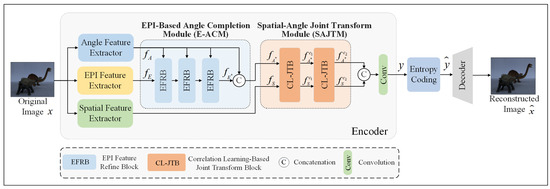
Figure 1.
Architecture of MFLFIC-Net. The original image x first passes through the encoder, which consists of a series of feature extractors, E-ACM, and SAJTM, to obtain a compact latent representation y. Specifically, the E-ACM consists of three EPI feature refine blocks (EFRBs), and the SAJTM consists of two correlation learning-based joint transform blocks (CL-JTBs). After obtaining the reconstructed latent representation from entropy coding, the reconstructed light field image is finally generated through the decoder.
3.2. EPI-Based Angle Completion Module
The angle domain feature obtained by feature extractor only contains angle information within a limited disparity range. To improve the coding performance of large disparity light field images, an E-ACM is designed by fully exploiting the large disparity angle information contained in the EPI domain. This module takes the angle feature and the EPI domain feature as inputs, and obtains a complete angle feature , containing angle information on the complete disparity range.
As shown in Figure 1, the E-ACM consists of three EPI feature refine blocks (EFRBs) and a concatenation operation. Specifically, the EFRB is designed to obtain the complementary feature from . Then, and the input are concatenated in the channel dimension to obtain the complete angle feature . The specific calculation process is as follows:
where consists of three EPI feature refine blocks, and ⊕ denotes the channel-wise concatenation.
The architecture of the proposed EFRB is shown in Figure 2. Taking an EFRB as an example, the input angle domain feature and the EPI domain feature are first fed into two residual blocks to generate features and . Then, a mutual attention mechanism is applied to model the similarity relationship between and . Subsequently, nonlinear transform is performed after channel-wise concatenation to obtain the common feature . The above process can be formulated as
where denotes the mutual attention function [31]. consists of two convolution layers and an activation layer, and ⊕ denotes the channel-wise concatenation. is composed of two residual blocks. Finally, the complementary feature with large disparity angle information is extracted from . The specific calculation process is as follows:
where consists of a convolution layer and an activation layer.
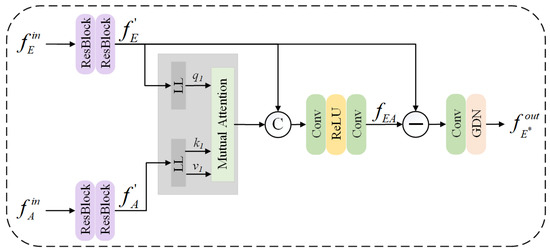
Figure 2.
Illustration of EPI feature refine block.
As described above, is obtained after and pass through E-ACM. Benefiting from the proposed E-ACM, the large disparity angle information contained in the EPI domain is fully explored, thereby improving the compression efficiency of large disparity light field images.
3.3. Spatial-Angle Joint Transform Module
To effectively reduce redundant information in light field images, a SAJTM is proposed to reduce redundancy by modeling the intrinsic correlation between spatial and complete angle features. The proposed SAJTM takes spatial feature and complete angle feature as inputs, and the outputs are the compact spatial feature and compact angle feature .
As shown in Figure 1, the proposed SAJTM is composed of two correlation learning-based joint transform blocks (CL-JTBs). Two CL-JTBs are sequentially connected to reduce redundant information in and . Taking a CL-JTB as an example, its architecture is illustrated in Figure 3. To obtain a more compact spatial feature, the inputs and are first processed through a residual block, two convolution layers, and an activation layer to generate spatial feature and angle feature with the same size, respectively. Subsequently, the spatial predictive feature , which is the predicted redundant information that can be obtained through prediction, is obtained by modeling the intrinsic correlation between and . Finally, is subtracted from to obtain the more compact spatial feature . The above process can be expressed as
where and both consist of a residual block layer, an activation layer, and two convolution layers. is composed of an activation layer and a convolution layer, and ⊕ denotes the channel-wise concatenation.
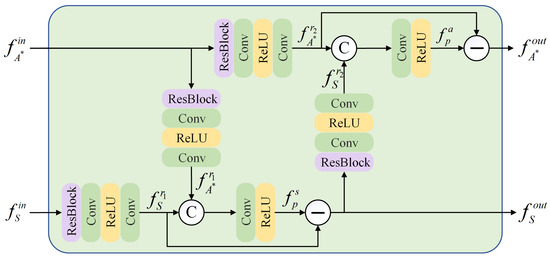
Figure 3.
Illustration of correlation learning-based joint transform block.
The process of obtaining the compact angle feature is similar to the above description. The specific process can be expressed as
As mentioned above, after the input spatial feature and complete angle feature pass through two CL-JTBs, compact spatial feature and compact angle feature are obtained. In this way, the proposed SAJTM effectively reduces redundant information by utilizing the inherent correlation among features, thus improving compression efficiency.
3.4. Implementation Details
We adopt the same rate-distortion loss function L as [19] to train MFLFIC-Net:
where R represents the bits consumed for encoding, and D denotes the reconstruction distortion computed by the mean square error (MSE). Following [19], the hyperparameter is configured with values from the set {0.0001, 0.0003, 0.0006, 0.001, 0.002, 0.004}, ensuring that the rates of all experimental results can be in the same range for fair comparison. In addition, we use the same variable code rate training strategy as SADN [19], which is divided into three phases. In the first stage, the initial network is trained for 30 epochs to obtain a single rate point model of 0.002. In the second stage, the single rate point model of 0.002 is fine-tuned using noisy quantization into a variable rate model that can be tested at multiple code rates. In the third stage, the coding performance is further improved by changing the noise quantization of the entropy model to a straight-through estimator quantization, finally obtaining a different variable code rate model.
4. Experiments
4.1. Experimental Settings
The model is trained on the PINet dataset [19], which is a large-scale natural dataset consisting of 7549 images taken by the light field camera named Lytro Illum. These images contain 178 categories, such as cats, camels, fans, bottles, etc. Each image in the PINet dataset is randomly cropped into patches of size 832 × 832 for training. The MFLFIC-Net is implemented using PyTorch and optimized with the Adam optimizer [32]. The training of the model requires approximately 21 days on a PC equipped with 4 NVIDIA GeForce RTX 3090 GPUs. In addition, it is worth noting that model training is divided into three stages, and the initial learning rate for each stage is different. The initial learning rates for the three stages are set to 1 × , 1 × , and 1 × , respectively. To ensure the fairness and impartiality of the experimental comparison, all methods are tested on the commonly used EPFL dataset [33] with 12 light field images using an NVIDIA GeForce GTX 1080Ti GPU.
4.2. Comparison Results
A quantitative evaluation is performed to demonstrate the effectiveness of the proposed MFLFIC-Net, which compares MFLFIC-Net with an end-to-end light field image compression method SADN [19] and some traditional light field image compression methods, including GPR [24], HEVC reference software HM 16.9 [34], and VVC reference software VTM 10.0 [35]. It is worth mentioning that these comparison methods were selected because they have been widely used in previous related research and have achieved remarkable results. In addition, this selection covers the main methods and strategies in this field to ensure the reliability of the experimental results. Since our experimental settings are consistent with SADN [19], the experimental results of GPR [24] are obtained from the results of SADN [19]. For a fair comparison, the end-to-end light field compression method SADN [19] is retrained on the same experiment equipment as the proposed method. To objectively evaluate the compression performance, the BD-PSNR and BD-rate are utilized as the objective metrics, where HM 16.9 [34] is set as the baseline to calculate the BD-PSNR and BD-rate. As shown in Table 1, MFLFIC-Net achieves a 2.149 dB BD-PSNR increase and a 65.585% BD-rate reduction. Compared with the SADN [19], MFLFIC-Net further obtains a 0.354 dB BD-PSNR increase and a 21.329% BD-rate reduction. In addition, compared with VTM 10.0 [35], MFLFIC-Net further obtains a 1.128 dB BD-PSNR increase and a 30.028% BD-rate reduction. As shown in Table 1, the experimental results demonstrate that MFLFIC-Net achieves the highest rate-distortion performance, which verifies its effectiveness.

Table 1.
Comparison results of BD-rate and BD-PSNR on the EPFL dataset when using HM 16.9 as baseline.
Furthermore, the rate-distortion curves of the MS-SSIM and PSNR metrics are shown in Figure 4. In terms of PSNR metrics, MFLFIC-Net outperforms the other methods, demonstrating the effectiveness of MFLFIC-Net. Regarding the MS-SSIM metric, as shown in Figure 4, the MFLFIC-Net also exhibits optimal performance when compared to the other methods. In addition, since the images in the test dataset do not overlap with the training set and the images are different, the test experimental results are able to verify the generalization ability of the method. Experimental results show that the proposed method has better performance than the comparative methods, which further proves that our method has stronger generalization ability.
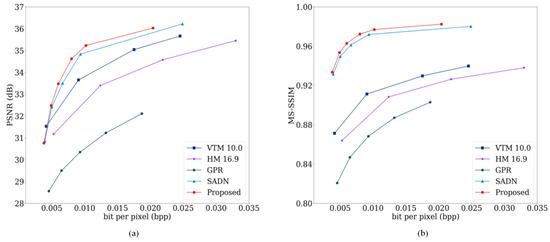
Figure 4.
Rate-distortion curves. (a) Comparison of PSNR on the EPFL dataset. (b) Comparison of MS-SSIM on the EPFL dataset.
To visually verify the efficiency of the proposed MFLFIC-Net, the reconstruction results generated by SADN [19] and the proposed MFLFIC-Net are shown in Figure 5. It is worth noting that, in the visual comparison, MFLFIC-Net is only compared with SADN [19]. This is because SADN [19] significantly outperforms the other compared methods. From the visualization results, it can clearly observe that the reconstruction texture of the proposed method is clearer than SADN [19]. This is because the proposed E-ACM provide angle information with a large disparity range, which is beneficial in reconstructing light field images. At the same time, the proposed MFLFIC-Net has a lower bit consumption, which indicates that SAJTM effectively reduce redundancy and improve performance.
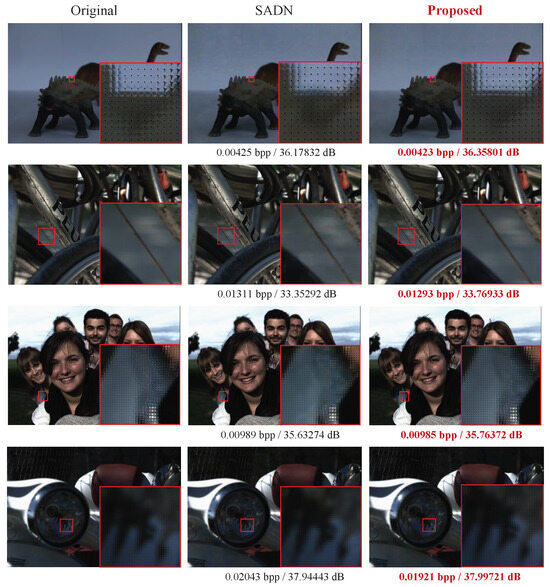
Figure 5.
Visual comparison of reconstruction results generated by SADN and the proposed MFLFIC-Net. The reconstruction quality is measured by bpp/PSNR (dB).
4.3. Ablation Study
In order to verify the effectiveness of the SAJTM and E-ACM, they are successively removed from the proposed MFLFIC-Net. First, the SAJTM is replaced by the interactive module of SADN [19], which is denoted as “w/o SAJTM”. Then, E-ACM is further removed from the MFLFIC-Net, which means that only utilize spatial features and angle features within a limited disparity range, denoted as “w/o E-ACM and w/o SAJTM”. To ensure the fairness of the experiment, the results of the ablation experiment are tested by the third-stage training model. The comparison results are shown in Table 2 and Figure 6.
Table 2.
Ablation results of BD-PSNR and BD-rate on the EPFL dataset.
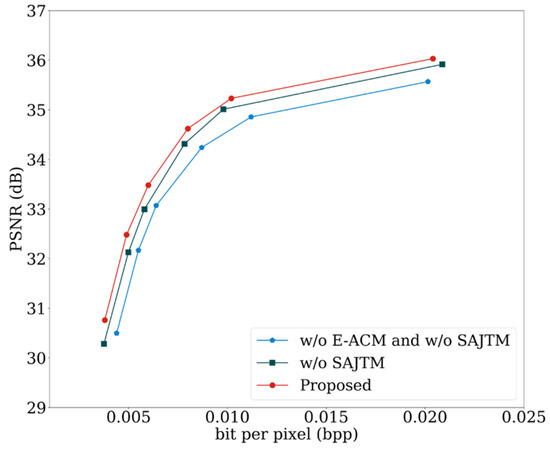
Figure 6.
Ablation study on the EPFL dataset.
The SAJTM is proposed to effectively reduce redundancy between spatial and complete angle features. As shown in Table 2 and Figure 6, with the replacement of the SAJTM, the proposed network achieves a 0.231 dB BD-PSNR reduction and a 10.615% BD-rate increase. This is because the proposed SAJTM can effectively utilize the correlation between features to reduce redundant information, thereby achieving further improvement in compression performance. Meanwhile, the E-ACM is designed to obtain a complete angle feature, containing angle information on the complete disparity range. As shown in Table 2 and Figure 6, the “w/o E-ACM and w/o SAJTM” achieves a 0.377 dB BD-PSNR reduction and a 6.803% BD-rate increase compared with the “w/o SAJTM”. This is because the proposed E-ACM fully utilizes the large disparity angle information contained in the EPI domain.
4.4. Complexity Analysis
In order to assess the computational complexity of MFLFIC-Net, MFLFIC-Net and the end-to-end method SADN [19] are tested to record their encoding and decoding times. The encoding and decoding times for SADN [19] are 449.441 s and 1107.301 s, respectively, while those for the proposed MFLFIC-Net are 996.422 s and 1482.784 s. Compared with SADN [19], MFLFIC-Net has a higher complexity. The increase in time can be attributed to the computational complexity of the mutual attention mechanism applied in the network, which is acceptable compared to the improvement in compression efficiency. In addition, it can be observed that the increase in encoding time is larger than the increase in decoding time. The reason is that, compared with the decoding time, the increase in the encoding time is more reliant on exploring the large disparity angle information contained in the EPI domain.
5. Conclusions
This paper proposes a novel multi-domain feature learning-based light field image compression network. In particular, an EPI-based angle completion module is developed to obtain a complete angle feature by fully exploring the large disparity angle information contained in the EPI domain. In addition, a spatial-angle joint transform module is proposed to reduce redundancy in features by modeling the intrinsic correlation between spatial and complete angle features. Experimental results demonstrate that MFLFIC-Net achieves superior performance on PSNR and MS-SSIM metrics compared to public state-of-the-art methods. In future work, it will be worthwhile to research the optimization of the algorithm structure and explore more lightweight networks for lower computational complexity, such as simpler and more effective feature extraction methods. At the same time, it is necessary to study possible trade-offs, such as maintaining the stability and accuracy of compression performance while reducing network complexity. In addition, there is a need to balance the relationship between compression ratio and image quality to ensure that complexity is reduced while still maintaining sufficiently high compression efficiency.
Author Contributions
Conceptualization, K.Y. and Y.L.; methodology, K.Y.; software, K.Y. and G.L.; investigation, D.J. and B.Z.; resources, Y.L.; data curation, G.L.; writing—original draft preparation, K.Y.; writing—review and editing, K.Y., Y.L., G.L., D.J. and B.Z.; supervision, Y.L., D.J. and B.Z.; project administration, Y.L. All authors have read and agreed to the published version of the manuscript.
Funding
This work was supported in part by the Science and Technology Major Project of Tibetan Autonomous Region of China under Grant XZ202201ZD0006G03.
Institutional Review Board Statement
Not applicable.
Informed Consent Statement
Not applicable.
Data Availability Statement
Data are contained within the article.
Conflicts of Interest
The authors declare no conflicts of interest.
References
- Liu, F.; Hon, G. Depth estimation from a hierarchical baseline stereo with a developed light field camera. Appl. Sci. 2024, 14, 550. [Google Scholar] [CrossRef]
- Lei, J.; Liu, B.; Peng, B.; Cao, X.; Ling, N. Deep gradual-conversion and cycle network for single-view synthesis. IEEE Trans. Emerge. Top. Comput. 2023, 7, 1665–1675. [Google Scholar] [CrossRef]
- Ai, X.; Wang, Y. The cube surface light field for interactive free-viewpoint rendering. Appl. Sci. 2022, 12, 7212. [Google Scholar] [CrossRef]
- Amirpour, H.; Guillemot, C.; Ghanbari, M. Advanced scalability for light field image coding. IEEE Trans. Image Process. 2022, 31, 7435–7448. [Google Scholar] [CrossRef] [PubMed]
- Gu, J.; Guo, B.; Wen, J. High efficiency light field compression via virtual reference and hierarchical MV-HEVC. In Proceedings of the International Conference on Multimedia and Expo, Shanghai, China, 8–12 July 2019. [Google Scholar]
- Huang, X.; An, P.; Shan, L.; Ma, R. LF-CAE: View synthesis for light field coding using depth estimation. In Proceedings of the International Conference on Multimedia and Expo, San Diego, CA, USA, 23–27 July 2018. [Google Scholar]
- Huang, X.; An, P.; Chen, D.; Liu, D.; Shen, L. Low bitrate light field compression with geometry and content consistency. IEEE Trans. Multimed. 2022, 24, 152–165. [Google Scholar] [CrossRef]
- Liu, D.; Huang, X.; Zhan, W. View synthesis-based light field image compression using a generative adversarial network. Inf. Sci. 2021, 545, 118–131. [Google Scholar] [CrossRef]
- Peng, B.; Zhang, X.; Lei, J.; Zhang, Z.; Ling, N.; Huang, Q. LVE-S2D: Low-light video enhancement from static to dynamic. IEEE Trans. Circuits Syst. Video Technol. 2022, 32, 8342–8352. [Google Scholar] [CrossRef]
- Shi, X.; Lin, J.; Jiang, D.; Nian, C.; Yin, J. Recurrent network with enhanced alignment and attention-guided aggregation for compressed video quality enhancement. In Proceedings of the International Conference on Visual Communications and Image Processing, Suzhou, China, 13–16 December 2022. [Google Scholar]
- Lei, J.; Song, J.; Peng, B.; Li, W.; Pan, Z.; Huang, Q. C2FNet: A coarse-to-fine network for multi-view 3D point cloud generation. IEEE Trans. Image Process. 2022, 31, 6707–6718. [Google Scholar] [CrossRef] [PubMed]
- Shen, X.; Li, X.; Elhoseiny, M. MoStGAN-V: Video generation with temporal motion styles. In Proceedings of the IEEE Conference on Computer Vision and Pattern Recognition, Vancouver, BC, Canada, 17–24 June 2023. [Google Scholar]
- Jung, H.K.; Choi, G.S. Improved yolov5: Efficient object detection using drone images under various conditions. Appl. Sci. 2022, 12, 7255. [Google Scholar] [CrossRef]
- Yu, C.; Peng, B.; Huang, Q. PIPC-3Ddet: Harnessing perspective information and proposal correlation for 3D point cloud object detection. IEEE Trans. Circuits Syst. Video Technol. 2023, accepted. [Google Scholar] [CrossRef]
- Peng, B.; Chang, R.; Pan, Z. Deep in-loop filtering via multi-domain correlation learning and partition constraint for multiview video coding. IEEE Trans. Circuits Syst. Video Technol. 2022, 33, 1911–1921. [Google Scholar] [CrossRef]
- Li, H.; Wei, G.; Wang, T. Reducing video coding complexity based on CNN-CBAM in HEVC. Appl. Sci. 2023, 13, 10135. [Google Scholar] [CrossRef]
- Zhang, J.; Hou, Y.; Pan, Z. SWGNet: Step-wise reference frame generation network for multiview video coding. IEEE Trans. Circuits Syst. Video Technol. 2023, accepted. [Google Scholar] [CrossRef]
- Hu, Y.; Yang, W.; Liu, J. 3D-CNN autoencoder for plenoptic image compression. In Proceedings of the International Conference on Visual Communications and Image Processing, Macau, China, 1–4 December 2020. [Google Scholar]
- Tong, K.; Jin, X.; Wang, C.; Jiang, F. SADN: Learned light field image compression with spatial-angular decorrelation. In Proceedings of the International Conference on Acoustics, Speech and Signal Processing, Singapore, 23–27 May 2022. [Google Scholar]
- Singh, M.; Rameshan, R.M. Learning-based practical light field image compression using a disparity-aware model. In Proceedings of the Picture Coding Symposium, Speech and Signal Processing, Bristol, UK, 29 June–2 July 2021. [Google Scholar]
- Jia, C.; Zhang, X.; Wang, S.; Wang, S.; Ma, S. Light field image compression using generative adversarial network-based view synthesis. J. Emerg. Sel. Top. Power Electron. 2018, 9, 177–189. [Google Scholar] [CrossRef]
- Liu, D.; Wang, L.; Li, L.; Xiong, Z.; Wu, F. Pseudo-sequence-based light field image compression. In Proceedings of the International Conference on Multimedia & Expo Workshops, Seattle, WA, USA, 11–15 July 2016. [Google Scholar]
- Conceição, R.; Porto, M.; Zatt, B.; Agostini, L. LF-CAE: Context-adaptive encoding for lenslet light fields using HEVC. In Proceedings of the International Conference on Image Processing, Athens, Greece, 7–10 October 2018. [Google Scholar]
- Liu, D.; An, P.; Ma, R.; Zhan, W.; Huang, X. Content-based light field image compression method with gaussian process regression. IEEE Trans. Multimed. 2020, 22, 846–859. [Google Scholar] [CrossRef]
- Dai, F.; Zhang, J.; Ma, Y.; Zhang, Y. Lenselet image compression scheme based on subaperture images streaming. In Proceedings of the International Conference on Image Processing, Quebec, QC, Canada, 27–30 September 2015. [Google Scholar]
- Bakir, N.; Hamidouche, W.; Fezza, S.A.; Samrouth, K. Light field image coding using dual discriminator generative adversarial network and VVC temporal scalability. In Proceedings of the International Conference on Multimedia and Expo, London, UK, 6–10 July 2020. [Google Scholar]
- Zhao, Z.; Wang, S.; Jia, C.; Zhang, X.; Ma, S.; Yang, J. Light field image compression based on deep learning. In Proceedings of the International Conference on Multimedia and Expo, San Diego, CA, USA, 23–27 July 2018. [Google Scholar]
- Van, V.; Huu, T.N.; Yim, J.; Jeon, B. Downsampling based light field video coding with restoration network using joint spatio-angular and epipolar information. In Proceedings of the International Conference on Image Processing, Bordeaux, France, 16–19 October 2022. [Google Scholar]
- Ballé, J.; Minnen, D.; Singh, S. Variational image compression with a scale hyperprior. In Proceedings of the International Conference on Learning Representations, Vancouver, BC, Canada, 30 April–3 May 2018. [Google Scholar]
- Minnen, D.; Ballé, J.; Toderici, G.D. Joint autoregressive and hierarchical priors for learned image compression. In Proceedings of the Advances in Neural Information Processing Systems, Montreal, QC, Canada, 4–6 December 2018.
- Cheng, Z.; Sun, H.; Takeuchi, M. Learned image compression with discretized gaussian mixture likelihoods and attention modules. In Proceedings of the IEEE Conference on Computer Vision and Pattern Recognition, Seattle, WA, USA, 13–19 June 2020. [Google Scholar]
- Kingma, D.P.; Ba, J. Adam: A method for stochastic optimization. arXiv 2017, arXiv:1412.6980. [Google Scholar]
- Rerabek, M.; Ebrahimi, T. New light field image dataset. In Proceedings of the International Conference on Quality of Multimedia Experience, Lisbon, Portugal, 6–8 June 2016. [Google Scholar]
- HEVC Official Test Model. Available online: https://vcgit.hhi.fraunhofer.de/jvet/HM/-/tags (accessed on 27 January 2024).
- VVC Official Test Model. Available online: https://vcgit.hhi.fraunhofer.de/jvet/VVCSoftware_VTM (accessed on 27 January 2024).
Disclaimer/Publisher’s Note: The statements, opinions and data contained in all publications are solely those of the individual author(s) and contributor(s) and not of MDPI and/or the editor(s). MDPI and/or the editor(s) disclaim responsibility for any injury to people or property resulting from any ideas, methods, instructions or products referred to in the content. |
© 2024 by the authors. Licensee MDPI, Basel, Switzerland. This article is an open access article distributed under the terms and conditions of the Creative Commons Attribution (CC BY) license (https://creativecommons.org/licenses/by/4.0/).