Innovative Learning in a Digital Forensics Laboratory: Tools and Techniques for Data Recovery


Abstract
1. Introduction
2. Related Work
2.1. Data Extraction from NAND Flash Memories
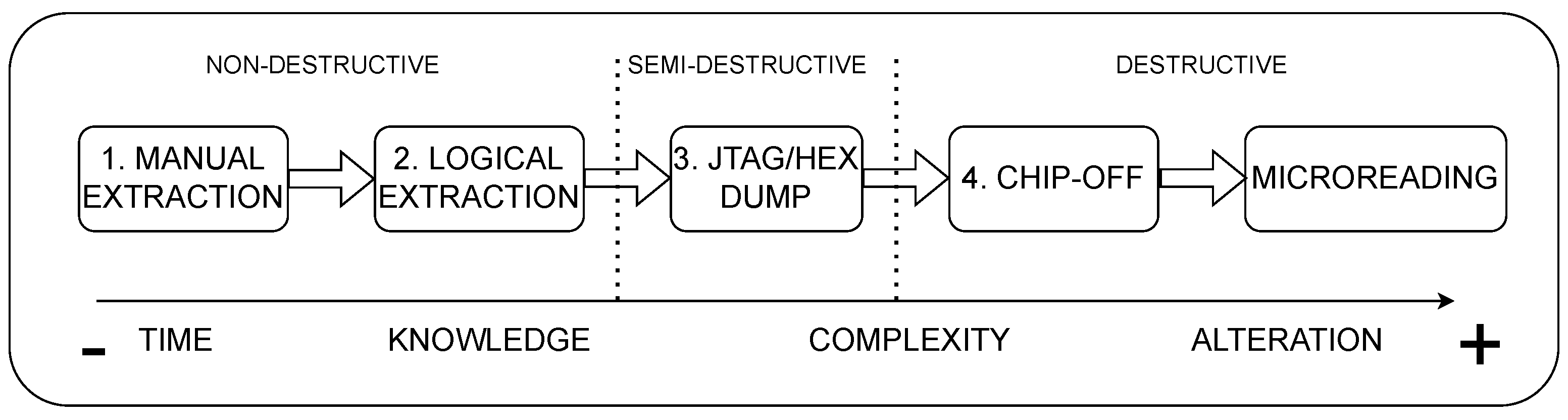
- Level 1. Manual extraction. This involves a low−complexity, non−destructive, and thorough search for evidence. A locked device is its primary limitation. Additionally, manually navigating through evidence sources may affect data integrity. Tools such as ZRT Screen Capture [12] and Eclipse 3 Pro−Kit [13] can be used at this level.
- Level 2. Logical extraction. This is performed by connecting the device to a forensic workstation for data extraction using Oxygen Forensic Detective (OFD), Cellebrite, or OpenText EnCase Forensic (EnCase) software [14]. As a limitation, not all log files and data from analyzed devices are accessible.
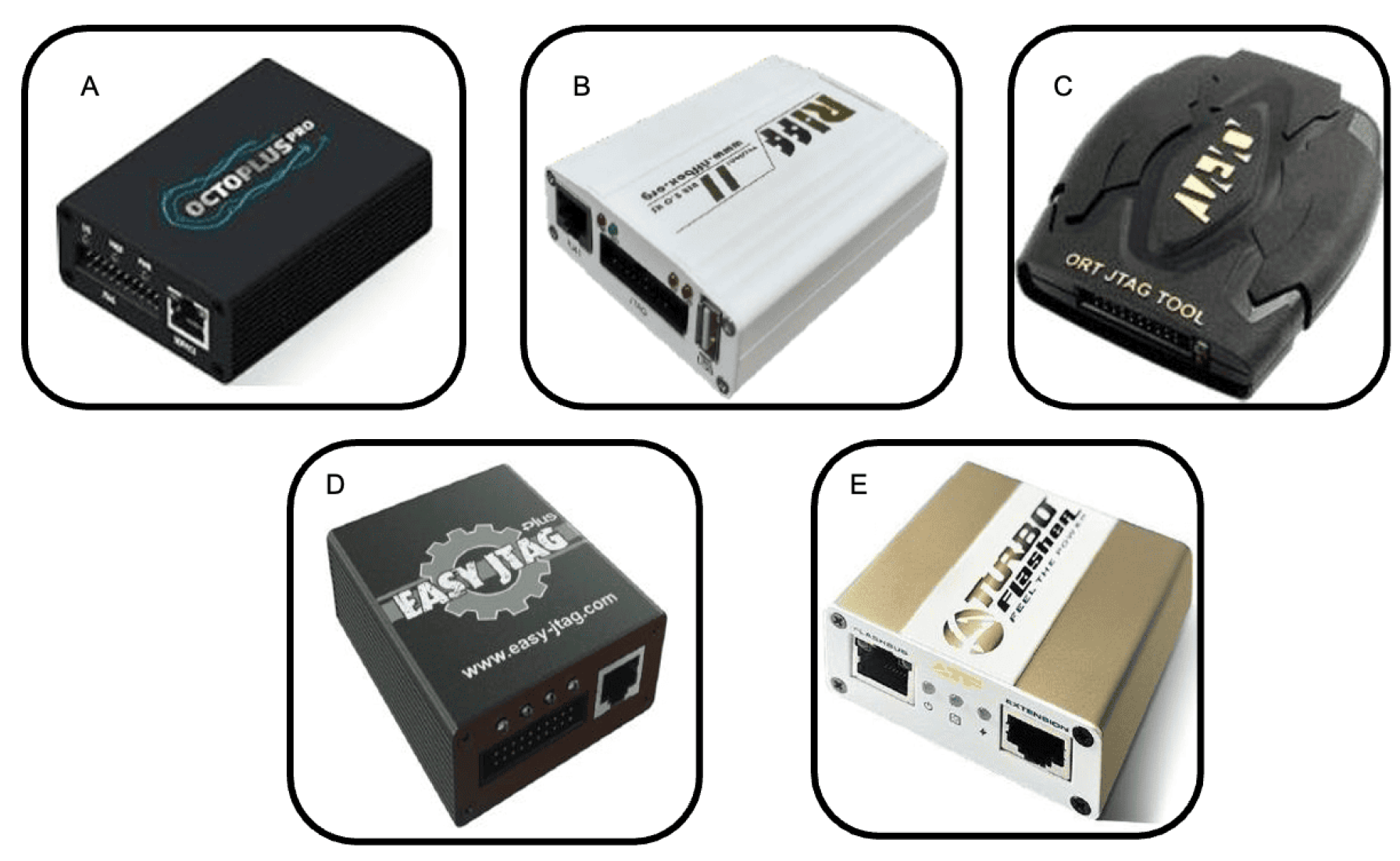
- Level 3. JTAG and HEX dump. This involves testing the circuits of memory cards, USB drives, SSDs, or eMMC devices and requires tools to disassemble devices and access their JTAG ports. The method is semi−destructive as it uses TAPs located on motherboards for functionality testing. Figure 2 shows various available commercial models. Although JTAG is primarily used in smartphone manufacture, it can also be employed to bypass OS−imposed access restrictions.
- Level 4. Chip−off. This complex destructive technique involves physically extracting the device memory chip for reading using specialized equipment, e.g., RT809H, sourced from Shenzhen Sintech Electronic Co., Shenzhen, China. It is crucial not to damage the chip during extraction, as this could cause irreversible bit or even byte failures; this approach is therefore only recommended when less invasive methods cannot be used.
2.2. Data Analysis Tools
- Oxygen Forensic Detective (OFD). This is used for logical and physical extractions, including data analysis and visualization in forensic image formats and in different types of electronic devices. OFD generates judicially admissible reports directly from the application and offers extensive support for Android devices and brute−force decryption of 7−Zip files. The main drawbacks are that it is an expensive and complex software [19].
- OpenText EnCase Forensic (EnCase). This software, which performs memory acquisition, data extraction, forensic report generation, and password recovery, is widely recognized by judicial departments and forensic research agencies. It supports a large number of mobile device and tablet models, and its latest version features EnCase Media Analyzer, which uses artificial intelligence and machine learning to identify and categorize the content of forensic images based on datasets. The generated reports employ a format admitted in judicial processes and also preserve the chain of custody for all the examined sources [20].
- Cellebrite Inseyets, Cellebrite UFED, and Cellebrite Digital Collector. These enable the recovery of deleted data, information decryption, and password extraction. Supporting a wide range of devices, including Android and Apple mobile devices, they can unlock devices and acquire logical and physical data. Inseyets integrates Universal Forensics Extraction Device (UFED) services with autonomy and quick−view technologies, which enable electronic device content to be viewed before creating forensic images, while novel capabilities allow for the simultaneous automation of multiple processes [21,22,23].
- Passware Kit Forensic (PKF). This enables the acquisition and processing of disk images and password recovery through brute−force, dictionary, and pattern attacks. PKF, useful when encrypted or locked data need to be accessed without using more invasive techniques, includes a resource manager that maximizes the performance of the analysis machine and an improved bootable memory imager mode, which creates memory images during computer startup. PKF does not include report generation suitable for judicial procedures, and support for mobile device processing is only included in the Ultimate edition [24,25].
- Belkasoft X Forensic (BXF). This enables the acquisition and authentication of NAND memory images through various analytical tasks (e.g., timelines and advanced searches). BXF, which supports numerous types of electronic devices and dump formats, can examine messaging applications, web browsing data, email inboxes, documents, images, video and audio files, file systems, and mobile applications. Processing times can be reduced through task automation and the use of specific search approaches. Additionally, BXF provides bit−level analysis through its HEX viewer and file system window, and BelkaCarving can recover and validate deleted, hidden, or corrupted information in databases [26].
- SANS Investigative Forensic Toolkit (SIFT). Available as a downloadable virtual machine, SIFT, a workstation designed for forensic analysis, uses key functionalities that include the Rekall Framework, Sleuth Kit, and Volatility. It offers extensive support for file systems and disk images, and comprehensive step−by−step documentation is available online [27].
- Sleuth Kit and Autopsy. Used to recover information and reconstruct scenarios, Sleuth Kit facilitates forensic image examination, file and directory analyses, keyword and file type searches, data recovery, and metadata verification. Autopsy, an open−source digital forensics platform that serves as a graphical interface for the Sleuth Kit functions, generates reports in various formats, such as HTML, Google Earth, KML, and Excel. However, it requires the use of additional tools for memory image acquisition [28].
- Toolsley. Designed to find hashes, identify file types, and analyze binary images using effective and straightforward tools, Toolsley’s simplicity is particularly advantageous for cases requiring urgent or remote investigation. However, notable drawbacks are that certain functions are outdated or formats may be incompatible [29].
- Forensic Tool Kit Imager Lite (FTK−IL). This is mainly used for data extraction and authentication from computers, mobile devices, and networks. Additional features are available under license, including password recovery and digital evidence integrity evaluation. It is widely used by judicial agents and administrative entities [30].
2.3. Practical Learning Context
3. Methods
3.1. Data Recovery
3.1.1. MicroSD Card Data Extraction
3.1.2. NAND Memory Reading and Writing Capabilities
3.1.3. Information Extraction from Commercial Devices
4. Results
Discussion
5. Conclusions
Funding
Institutional Review Board Statement
Informed Consent Statement
Data Availability Statement
Conflicts of Interest
Abbreviations
| 3D | Three dimensional |
| ATF | Advanced Turbo Flasher |
| BGA | Ball Grid Array |
| BXF | Belkasoft X Forensic |
| eMMC | Embedded Multi-Media Card |
| EnCase | OpenText EnCase Forensic |
| FTK-IL | Forensic Tool Kit Imager Lite |
| GPU | Graphics Processing Unit |
| HEX | Hexadecimal |
| HTML | HyperText Markup Language |
| JTAG | Joint Test Action Group |
| KML | Keyhole Markup Language |
| NAND | Not AND |
| OFD | Oxygen Forensic Detective |
| OS | Operating System |
| PCB | Printed Circuit Board |
| PKF | Passware Kit Forensic |
| RAM | Random-Access Memory |
| ROM | Read-Only Memory |
| SD | Secure Digital |
| SIFT | SANS Investigative Forensic Toolkit |
| SIM | Subscriber Identity Module |
| SSD | Solid-State Drive |
| TAP | Test Access Point |
| TSOP | Thin Small Outline Package |
| UFED | Universal Forensics Extraction Device |
| USB | Universal Serial Bus |
References
- Beebe, N. Digital Forensic Research: The Good, the Bad and the Unaddressed. In IFIP Advances in Information and Communication Technology; Springer: New York, NY, USA, 2009; pp. 17–36. [Google Scholar] [CrossRef]
- Malik, A.; Bhatti, D.; Park, T.; Ishtiaq, H.; Ryou, J.; Kim, K. Cloud Digital Forensics: Beyond tools, techniques, and challenges. Sensors 2024, 24, 433. [Google Scholar] [CrossRef] [PubMed]
- Pollitt, M. A history of digital forensics. In IFIP Advances in Information and Communication Technology; Springer: New York, NY, USA, 2010; pp. 3–15. [Google Scholar] [CrossRef]
- Armoogum, S.; Khonje, P.; Li, X. Digital Forensics of Cyber Physical Systems and the Internet of Things; CRC Press eBooks: Boca Raton, FL, USA, 2021; pp. 117–148. [Google Scholar] [CrossRef]
- Nizami, S.M. Introduction to digital forensics and commonly used technologies. Int. J. Electron. Crime Investig. 2018, 2, 8. [Google Scholar] [CrossRef]
- Tamma, R.; Skulkin, O.; Mahalik, H.; Bommisetty, S. Practical Mobile Forensics, 3rd ed.; O’Reilly Online Learning: Sebastopol, CA, USA, 2018. [Google Scholar]
- Sindhu, K.; Meshram, B. Digital Forensic Investigation Tools and Procedures. Int. J. Comput. Netw. Inf. Secur. 2012, 4, 39–48. [Google Scholar] [CrossRef]
- Reith, M.; Carr, C.; Gunsch, G. An examination of digital forensic models. Int. J. Digit. Evid. 2002, 1, 3. [Google Scholar]
- Fagbola, F.; Venter, H. Smart Digital Forensic Readiness model for shadow IoT devices. Appl. Sci. 2022, 12, 730. [Google Scholar] [CrossRef]
- Hawthorne, E.; Shumba, R. Teaching digital forensics and cyber investigations online: Our experiences. Eur. Sci. J. ESJ 2014, 10, 3986. [Google Scholar]
- Kumar, M. Mobile phone forensics—A systematic approach, tools, techniques and challenges. Int. J. Electron. Secur. Digit. Forensics 2021, 13, 64. [Google Scholar] [CrossRef]
- Infosecinstitute. 2024. Available online: https://www.infosecinstitute.com/resources/digital-forensics/common-mobile-forensics-tools-techniques/ (accessed on 25 November 2024).
- Sumuri. Sumuri Eclipse 3 Kit. 2024. Available online: https://sumuri.com/product/eclipse-3-kit/ (accessed on 18 March 2024).
- Oxygenforensics. Oxygen Forensics Website. 2024. Available online: https://oxygenforensics.com/en/ (accessed on 18 March 2024).
- Razdan, V. Chip-Off Technique in Mobile Forensics. Acad. J. Forensic Sci. 2022, 5, 49–52. [Google Scholar]
- Savoldi, A.; Gubian, P. Data Recovery from Windows CE Based Handheld Devices. In Advances in Digital Forensics IV; Springer: New York, NY, USA, 2008; Volume 285, pp. 219–230. [Google Scholar] [CrossRef]
- Wang, P.; Rosenberg, M.; D’Cruze, H. Integration of mobile forensic tool capabilities. In Information Technology—New Generations; Springer: New York, NY, USA, 2018; Volume 738, pp. 81–87. [Google Scholar] [CrossRef]
- da Silveira, C.M.; de Sousa, R.T., Jr.; de Oliveira Albuquerque, R.; Amvame Nze, G.D.; De Oliveira Júnior, G.A.; Sandoval Orozco, A.L.; García Villalba, L.J. Methodology for Forensics Data Reconstruction on Mobile Devices with Android Operating System Applying In-System Programming and Combination Firmware. Appl. Sci. 2020, 10, 4231. [Google Scholar] [CrossRef]
- Forensics, O. Oxygen Forensic Detective Release Notes 16.2. 2024. Available online: https://oxygenforensics.com/uploads/press_kit/OFDv162ReleaseNotes.pdf (accessed on 18 March 2024).
- Opentext. Opentext EnCase Forensic. 2024. Available online: https://www.opentext.com/file_source/OpenText/en_US/PDF/opentext-po-encase-forensic-en.pdf (accessed on 20 March 2024).
- Ahmed Alyas, A.; Kumar, V. Lawfully Data Collection Techniques in Mobile Forensic & Analysis Using Cellebrite Physical Analyzer. 2023. Available online: https://papers.ssrn.com/sol3/papers.cfm?abstract_id=4483864 (accessed on 24 March 2024).
- Caballero, M.; Cilleros Serrano, D. Análisis Forense; Anaya Multimedia: Madrid, Spain, 2022; pp. 692–711. [Google Scholar]
- Cellebrite. Cellebrite Inseyets. 2024. Available online: https://cellebrite.com/en/cellebrite-inseyets (accessed on 20 March 2024).
- Passware. Passware Kit Forensic. 2024. Available online: https://www.passware.com/files/passware_kit_forensic_datasheet.pdf (accessed on 20 March 2024).
- Azam, H.; Dulloo, M.; Majeed, M.; Wan, J.; Xin, L.; Sindiramutty, S. Cybercrime Unmasked: Investigating cases and digital evidence. Int. J. Emerg. Multidiscip. Comput. Sci. Artif. Intell. 2023, 2, 1. [Google Scholar] [CrossRef]
- Belkasoft. Belkasoft X Forensic. 2024. Available online: https://belkasoft.com/x (accessed on 18 March 2024).
- SANS. SIFT Workstation. 2024. Available online: https://www.sans.org/tools/sift-workstation/ (accessed on 20 March 2024).
- Labs, S.K. Autopsy—Digital Forensics. 2024. Available online: https://www.autopsy.com/ (accessed on 21 March 2024).
- Toolsley. Browser tools for the modern web. 2016. Available online: https://www.toolsley.com/ (accessed on 20 March 2024).
- Exterro. Create Forensic Images with Exterro FTK Imager. 2024. Available online: https://www.exterro.com/digital-forensics-software/ftk-imager (accessed on 18 March 2024).
- Parth, C.; Tamanna, J.; Kumar, A. Comparative analysis of mobile forensic proprietary tools: An application in forensic investigation. J. Forensic Sci. Res. 2022, 6, 77–82. [Google Scholar] [CrossRef]
- Tara, H.; Mishra, A. A comparative study of digital forensic tools for data extraction from electronic devices. J. Punjab Acad. Forensic Med. Toxicol. 2021, 21, 97–104. [Google Scholar] [CrossRef]
- Riadi, I.; Yudhana, A.; Inngam Ganani, G. Comparative Analysis of Forensic Software on Android-based MiChat. J. Resti 2023, 7, 86–292. [Google Scholar] [CrossRef]
- Dogan, S.; Akbal, E. Analysis of mobile phones in digital forensics. In Proceedings of the 2017 40th International Convention on Information and Communication Technology, Electronics and Microelectronics (MIPRO), Opatija, Croatia, 22–26 May 2017; pp. 1241–1244. [Google Scholar] [CrossRef]
- Waluyo, A.; Cahyono, M.; Mahfud, A. Digital forensic analysis on caller ID spoofing attack. In Proceedings of the International Workshop on Big Data and Information Security (IWBIS), Depok, Indonesia, 1–3 October 2022; pp. 95–100. [Google Scholar] [CrossRef]
- Shortall, A.; Azhar, M. Forensic acquisitions of WhatsApp data on popular mobile platforms. In Proceedings of the International Conference on Emerging Security Technologies (EST), Washington, DC, USA, 3–5 September 2015; pp. 13–17. [Google Scholar] [CrossRef]
- Chamberlain, A.; Hannan Bin Azhar, M. Comparisons of Forensic Tools to Recover Ephemeral Data from iOS Apps Used for Cyberbullying. In Proceedings of the 4th International Conference on Cyber-Technologies and Cyber-Systems (CYBER 2019), Porto, Portugal, 22–26 September 2019; pp. 22–26. [Google Scholar]
- Singh, S.; Singh, V. Digital Forensic Investigation: Ontology, Methodology, and Technological Advancement; Apple Academic Press: Cambridge, MA, USA, 2023; pp. 137–160. [Google Scholar]
- Alexander, B. Evaluation of Open-Source & Proprietary Forensic Software Tools. Comput. Forensics 2022. [Google Scholar] [CrossRef]
- Moric, Z.; Redzepagic, J.; Gatti, F. Enterprise Tools for Data Forensics 2021. In Proceedings of the DAAAM International Symposium, Vienna, Austria, 28–29 October 2021; pp. 98–105. [Google Scholar]
- Rehman Javed, A.; Ahmed, W.; Alazab, M.; Jalil, Z.; Kifayat, K.; Gadekallu, T. A comprehensive survey on computer forensics: State-of-the-Art, tools, techniques, challenges, and future directions. IEEE Access 2022, 10, 11065–11089. [Google Scholar] [CrossRef]
- Padmanabhan, R.; Lobo, K.; Ghelani, M.; Sujan, D.; Shirole, M. Comparative analysis of commercial and open source mobile device forensic tools. In Proceedings of the International Conference on Contemporary Computing (IC3), Noida, India, 11–13 August 2016; pp. 1–6. [Google Scholar] [CrossRef]
- Dyson, J.; Zargari, S. Memory Forensics. Lat. Am. J. Comput. 2022, 9, 36–51. [Google Scholar]
- Parekh, M.; Jani, S. Memory forensic: Acquisition and analysis of memory and its tools comparison. Commun. Integr. Netw. Signal Process. 2018, 5, 90–95. [Google Scholar] [CrossRef]
- Al-Sabaawi, A. Digital forensics for infected computer disk and memory: Acquire, analyse, and report. In Proceedings of the IEEE Asia-Pacific Conference on Computer Science and Data Engineering (CSDE), Gold Coast, QLD, Australia, 16–18 December 2020. [Google Scholar] [CrossRef]
- Dubey, H.; Bhatt, S.; Negi, L. Digital Forensics Techniques and Trends: A Review. Int. Arab. J. Inf. Technol. 2023, 20, 644–654. [Google Scholar] [CrossRef]
- Casino, F.; Dasaklis, T.; Spathoulas, G.; Anagnostopoulos, M.; Ghosal, A.; Borocz, I.; Patsakis, C. Research trends, challenges, and emerging topics in digital forensics: A review of reviews. IEEE Access 2022, 10, 25464–25493. [Google Scholar] [CrossRef]
- Johnson, C.; Davies, R.; Reddy, M. Using digital forensics in higher education to detect academic misconduct. Int. J. Educ. Integr. 2022, 18, 12. [Google Scholar] [CrossRef]
- Palmer, I.; Wood, E.; Nagy, S.; Garcia, G.; Bashir, M.; Campbell, R. Digital Forensics Education: A Multidisciplinary Curriculum Model. In Proceedings of the International Conference on Digital Forensics and Cyber Crime, Seoul, Republic of Korea, 6–8 October 2015; pp. 3–15. [Google Scholar] [CrossRef]
- Flores, R.; Namin, A.; Tavakoli, N.; Siami-Namini, S.; Jones, K. Using experiential learning to teach and learn digital forensics: Educator and student perspectives. Comput. Educ. Open 2021, 2, 100045. [Google Scholar] [CrossRef]
- Leung, W.; Blauw, F. An augmented reality approach to delivering a connected digital forensics training experience. In Proceedings of the Information Science and Applications: ICISA 2019, Singapore, 16–18 December 2019; Volume 621, pp. 353–361. [Google Scholar] [CrossRef]
- Lewis, L.; Williams, C. Experiential learning: Past and present. New Dir. Adult Contin. Educ. 1994, 62, 5–16. [Google Scholar] [CrossRef]
- Ho, S.; Hsu, Y.; Lai, C.; Chen, F.; Yang, M. Applying Game-Based Experiential Learning to Comprehensive Sustainable Development-Based Education. Sustainability 2022, 14, 1172. [Google Scholar] [CrossRef]
- Gentry, J. What is Experiential Learning; Nichols Pub. Co.: New York, NY, USA, 1990; Volume 9, p. 20. [Google Scholar]
- Morris, T. Experiential learning–a systematic review and revision of Kolb’s model. Interact. Learn. Environ. 2020, 28, 1064–1077. [Google Scholar] [CrossRef]
- University of Alcalá. Teaching Guide of Electronic Forensic; University of Alcalá: Madrid, Spain, 2024. [Google Scholar]
- Raza, S.; Anwar, A.; Khan, A. Current Issues and Challenges with Scientific Validation of Digital Evidence. Rev. Comput. Eng. Stud. 2022, 9, 111–115. [Google Scholar] [CrossRef]
- Fakhouri, H.; AlSharaiah, M.; Alkalaileh, M.; Dweikat, F. Overview of Challenges Faced by Digital Forensic. In Proceedings of the International Conference on Cyber Resilience (ICCR), Dubai, United Arab Emirates, 26–28 February 2024; pp. 1–8. [Google Scholar] [CrossRef]



| Software | Features | OS | Literature | ||||||
|---|---|---|---|---|---|---|---|---|---|
| License | Extraction | Analysis | Report | Windows | MacOS | Linux | Android | ||
| OFD | ✓ | ✓ | ✓ | ✓ | ✓ | ✓ | ✓ | ✓ | [6,17,21,22,31,32,33,34,35,36,37] |
| EnCase | ✓ | ✓ | ✓ | ✓ | ✓ | ✓ | ✓ | ✓ | [7,17,22,38,39,40,41] |
| Cellebrite | ✓ | ✓ | ✓ | ✓ | ✓ | ✓ | ✓ | ✓ | [6,21,22,31,32,34,36,41,42] |
| PKF | ✓ | ✓ | ! | X | ✓ | ✓ | ✓ | ✓ | [7,25,43] |
| BXF | ! | ✓ | ✓ | ✓ | ✓ | ✓ | ✓ | ✓ | [6,41,44] |
| SIFT | X | ✓ | ✓ | X | ! | ! | ! | ! | [22,25,38,41,42] |
| Autopsy | X | X | ✓ | ✓ | ✓ | ✓ | ✓ | ✓ | [7,21,22,25,38,39,40,41] |
| Toolsley | ! | X | ✓ | ✓ | ✓ | ✓ | ✓ | ✓ | [29] |
| FTK−IL | ✓ | X | ✓ | ✓ | ✓ | ✓ | ✓ | ✓ | [22,25,32,35,36,38,41,45,46,47] |
| Advantages | Disadvantages |
|---|---|
| Practical experience: The method provides students with hands-on experience and enables them to apply theoretical knowledge to real-world scenarios, essential for understanding the complexities of digital forensics. | Scope limitations: The impact of the method may be limited in scope by the number of students. |
| Comprehensive learning: In covering a wide range of topics such as data extraction, processing techniques, and evidence authentication, students gain an understanding of digital forensic practices. | Resource intensive: The method requires significant resources for laboratory sessions, including specialized equipment and materials, which may be costly and difficult to scale. |
| Skill development: The focus on assembling electronic circuits and using forensic tools helps students develop essential technical skills that are directly applicable to the job market. | Time-consuming: The practical and reflective components may require more time than traditional lecture-based methods, possibly resulting in slower coverage of the syllabus. |
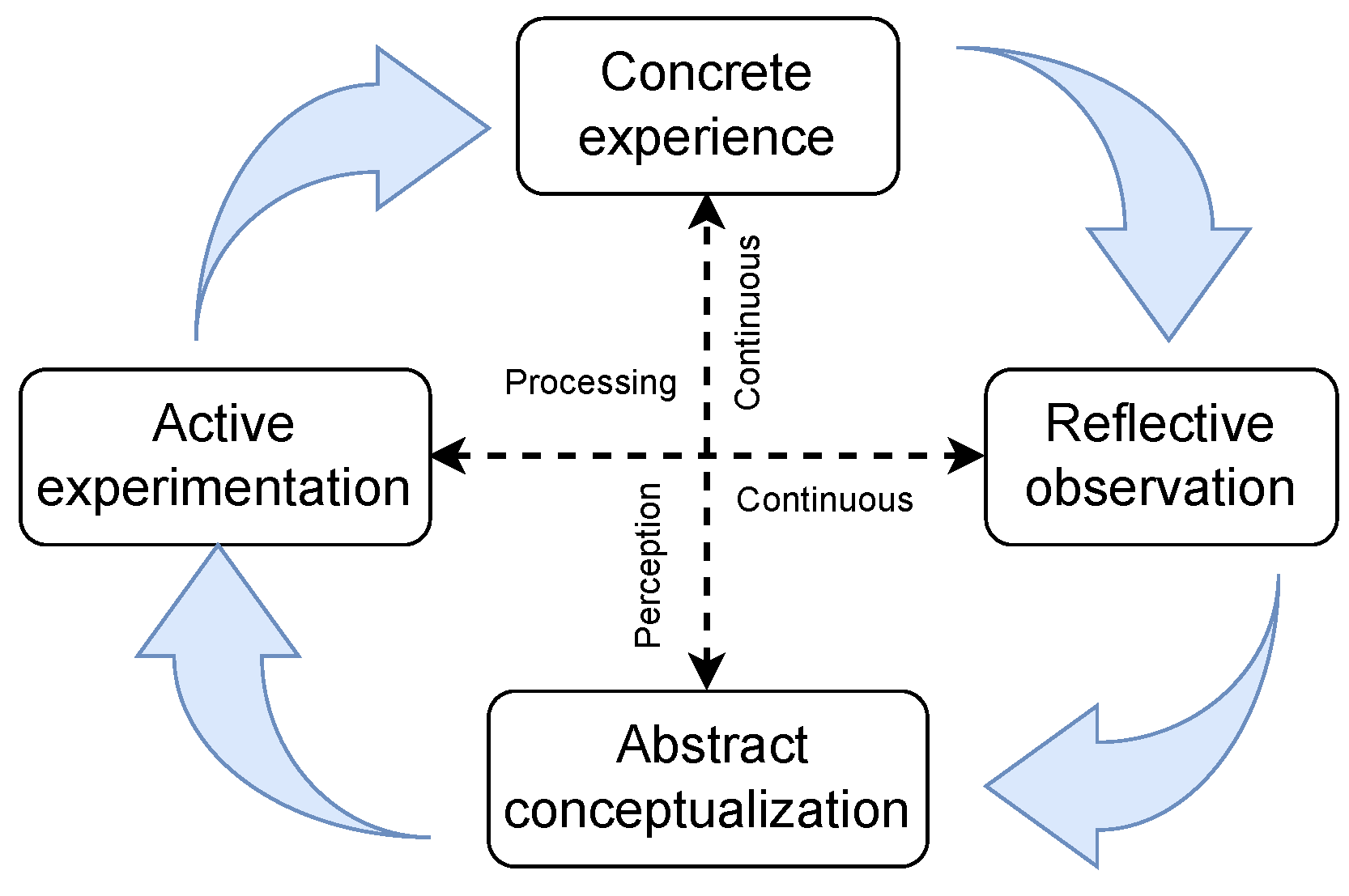
| Reflective learning: The combination of concrete experiences with reflective observation and abstract conceptualization leads to deeper learning and a better understanding of underlying principles. | Complexity: The technical nature of the tasks might be challenging for students without a background in electronics or digital technologies, potentially leading to difficulties in comprehension and execution. |
| Exposure to cutting-edge technologies: The inclusion of forensic tools and techniques (i.e., data recovery from NAND memories and mobile devices) ensures students are trained in up-to-date methodologies. | Dependence on instructor expertise: The effectiveness of the method relies on the instructor’s digital forensics expertise and practical teaching skills, potentially affecting the quality of the learning experience. |
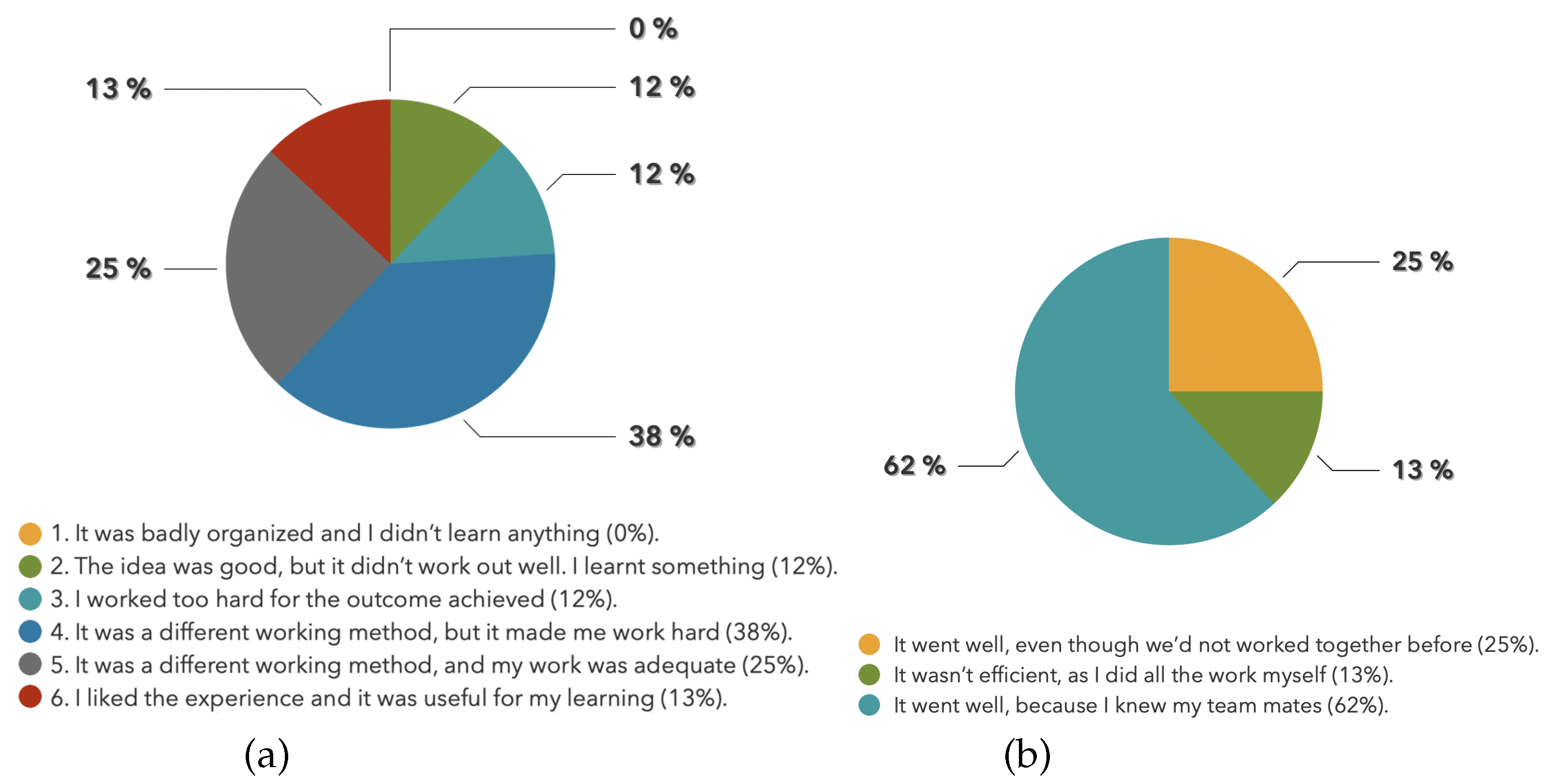
| 1. It was badly organized and I didn’t learn anything. |
| 2. The idea was good, but it didn’t work out well. I learnt something. |
| 3. I worked too hard for the outcome achieved. |
| 4. It was a different working method, but it made me work hard. |
| 5. It was a different working method, and my work was adequate. |
| 6. I liked the experience and it was useful for my learning. |
| Survey Questions | 1 | 2 | 3 | 4 | 5 | Average |
|---|---|---|---|---|---|---|
| 1. Did the laboratory increase your motivation to learn new content? | 0% | 0% | 9% | 63% | 28% | 4.19 |
| 2. Did you receive the necessary guidelines to carry out the laboratory activities? | 0% | 36% | 36% | 28% | 0% | 2.92 |
| 3. Did the laboratory activities consolidate your learning? | 0% | 18% | 18% | 36% | 27% | 3.69 |
| 4. Did the team work improve your learning? | 9% | 9% | 18% | 0% | 63% | 3.96 |
| 5. To what extent did you include a discussion and conclusions in your reports? | 9% | 0% | 45% | 27% | 9% | 2.97 |
| 6. To what extent did you include criticisms and final comments in your reports? | 9% | 9% | 45% | 27% | 9% | 3.15 |
| 7. Do you feel that the laboratory activities were optimally designed? | 0% | 0% | 18% | 27% | 54% | 4.32 |
| 8. Did you like how the course was designed? | 0% | 18% | 45% | 36% | 0% | 3.15 |
| 9. Did you like how the course was organized? | 9% | 18% | 45% | 18% | 9% | 2.97 |
| 10. Has your understanding of digital forensic techniques improved? | 9% | 18% | 36% | 25% | 9% | 3.06 |
| 11. Are reinforcement tasks necessary for the laboratory activities? | 18% | 0% | 36% | 18% | 27% | 3.33 |
| 12. Did you feel you needed to work harder with this course? | 18% | 27% | 36% | 9% | 0% | 2.16 |
| 13. Was your learning with this course more enjoyable? | 0% | 9% | 9% | 54% | 27% | 3.96 |
| 14. Did you find the laboratory practice sessions useful? | 0% | 9% | 27% | 54% | 9% | 3.60 |
| 15. Did you feel capable of learning and understanding the content? | 0% | 18% | 18% | 27% | 36% | 3.78 |
| 16. Should additional material/equipment be acquired for the activities? | 18% | 0% | 9% | 9% | 63% | 3.96 |
| 17. Did the laboratory practice sessions meet your expectations? | 0% | 27% | 63% | 27% | 9% | 3.96 |
Disclaimer/Publisher’s Note: The statements, opinions and data contained in all publications are solely those of the individual author(s) and contributor(s) and not of MDPI and/or the editor(s). MDPI and/or the editor(s) disclaim responsibility for any injury to people or property resulting from any ideas, methods, instructions or products referred to in the content. |
© 2024 by the author. Licensee MDPI, Basel, Switzerland. This article is an open access article distributed under the terms and conditions of the Creative Commons Attribution (CC BY) license (https://creativecommons.org/licenses/by/4.0/).
Share and Cite
Cruz, C. Innovative Learning in a Digital Forensics Laboratory: Tools and Techniques for Data Recovery. Appl. Sci. 2024, 14, 11095. https://doi.org/10.3390/app142311095
Cruz C. Innovative Learning in a Digital Forensics Laboratory: Tools and Techniques for Data Recovery. Applied Sciences. 2024; 14(23):11095. https://doi.org/10.3390/app142311095
Chicago/Turabian StyleCruz, Carlos. 2024. "Innovative Learning in a Digital Forensics Laboratory: Tools and Techniques for Data Recovery" Applied Sciences 14, no. 23: 11095. https://doi.org/10.3390/app142311095
APA StyleCruz, C. (2024). Innovative Learning in a Digital Forensics Laboratory: Tools and Techniques for Data Recovery. Applied Sciences, 14(23), 11095. https://doi.org/10.3390/app142311095