


Abstract
Handball is a team sport that involves fourteen players who are attempting to score more goals than their opponent within two thirty-minute halves. A biomechanical analysis based on measuring the kinematics of jump throws could provide us with information on the ball’s velocity, the maximal internal rotation of the trunk, and the trunk’s flexion, as well as the angular velocity of the ball during shoulder rotation. The main aim of this study was to determine the wrist velocity during jump throws and standing throws without a run-up. The trunk, arm rotation, and wrist velocity will influence the speed of the ball during throwing. This case study included a senior-grade male handball player aged 18.75 years with a body mass index (BMI) of 25.5. The biomechanical evaluation was carried out using a three-dimensional Vicon system. The biomechanical analysis consisted of an evaluation of angular trunk velocity, angular arm rotation velocity, and wrist velocity during two types of throwing: jump throws and standing throws without a run-up. The data were recorded for standing throws without a run-up (S1) and jump throws (S2). For each situation, we measured two phases due to the great variation in the kinematic parameters. Phase 1 (F1) occurred when the elbow angle was 90°, up to the moment when the wrist had an inflection of its trajectory, and Phase 2 (F2) finished when the wrist’s velocity reached its maximum. The results regarding the angular velocity of the trunk torsion showed a high value of this parameter during Phase F2 compared to Phase F1 for both types of throws (S1 and S2). The angular velocity of the arm rotation achieved its maximum value in F2 during S2, and the wrist velocity was highest during Phases F2 and S2. The correlation analysis demonstrated that there was a good correlation between the angular velocity of the trunk torsion and the angular velocity of the arm rotation for S1 in Phase F1; however, in Phase F2, we found a good correlation between the angular velocity of the trunk torsion and wrist velocity. For S2, we found that in Phase F1, there was a good correlation between the angular velocity of the trunk torsion and wrist velocity; however, for Phase F2, there was a good correlation between the angular velocity of the arm’s rotation and wrist velocity. Therefore, the results from this case study indicate that the wrist velocity is influenced by the other two kinematic parameters, especially the angular velocity of the arm’s rotation. This means that the development of explosive force in the muscles of the trunk and arm could improve the wrist’s velocity and also increase the optimization of throwing in handball.
1. Introduction
The action of throwing is central to handball. In this context, a player’s throw must be fast because the faster a player throws the ball, the less time the goalkeeper has to stop it, and the throw must be accurate in order to place the ball in the desired area, where it will also be harder for the goalkeeper to stop [1]. During the match, players must be very adaptable, and they must be able to execute a wide range of passing and throwing types, including standing throws, with or without a run-up; off-axis throws; jump throws; hip throws; long-range throws; and diving throws. These throw types are fired at hip height or above the shoulders [2].
The literature [2,3] has provided us with considerable information on the importance of key performance indicators, including shoulder torque, elbow torque, arm rotation, and trunk rotation, as well as the mechanics of the lower limb. Biomechanical analysis focuses on the biomechanics of throwing based on an evaluation of the coordination of the trunk and the upper arm’s behavior, but the lower arm and wrist are also important to achieve optimal throwing performance.
Kinematics, which is a branch of biomechanics, is correlated with changes in positions, velocity, and acceleration, but it does not consider forces. One of the main objectives of sports is to achieve maximum efficiency and the minimum consumption of energy; this could be achieved by a specific biomechanical evaluation. Moreover, this could be used to determine a set of biomechanical parameters and obtain the optimal movement structure for athletes [3].
Among the various types of throws, Wagner et al. [4] indicated that the ones most used in competitions are jump throws (73–75% of all throws during the game) and standing throws with a run-up (14–18%). Indeed, according to Wagner et al. [4], these two types of throws generate an increase in the horizontal velocity of the player while creating difficulty for the opponent.
A biomechanical analysis of the kinematics of jump throws [5] could provide information on the ball’s velocity, the maximal internal rotation of the trunk, and the trunk’s flexion, as well as the angular velocity of the ball during shoulder rotation. The description and analysis of the upper limb’s function in different types of throwing can be assisted by studies using the principles of biomechanics [6].
According to Wagner [7], for a throw to be more likely to succeed, the ball must achieve maximum velocity and accuracy. This is why, due to the greater ease of measurement, a large proportion of studies concerning the optimization of handball throws view the velocity of the ball as a performance parameter [8,9,10]. The type of throw has a direct influence on the velocity of the ball, as shown by several studies, such as Wagner [5], which highlighted the fact that the velocity of the ball on release is higher for an over-shoulder throw than for a hip throw. This explains why the latter form is less used in the game (constituting 38% of all throws, according to Wagner [7]).
Because of their greater efficiency (measured by the ball’s velocity at release) and more frequent use in play [4], it is interesting to focus on the differences and similarities in the biomechanical parameters of the standing throw and the jump throw. Numerous studies have already demonstrated the important correlation between the ball’s velocity at release and the velocity of the internal rotation of the upper arm, such as [8,11,12]. Wagner et al. [8] suggested that working on the angular velocity of the internal rotation of the shoulder could improve the ball’s velocity, and [11] confirmed this by revealing a significant relationship between the time taken to reach the maximum angular velocity of the shoulder and the elbow at the moment of the ball’s release. This importance of timing was also supported by [13,14].
However, as pointed out by [15], the number of articles measuring and comparing the kinematic parameters between standing and jump throws is small compared to those studying a single type of throw. Additionally, these comparative studies, such as [9], have not focused exclusively on a kinematic study of the shoulder; rather, they consider the entire range of the upper limbs.
Game performance is based on ball speed and coordination. This research hypothesis is based on the relationship between trunk rotation (torsion), exo/endorotation (external/internal rotation), and wrist velocity. This relationship could influence wrist velocity, depending on the type of throw. It is assumed that there are biomechanical differences between two types of throwing concerning the relationship between the angular velocity of the trunk torsion, the angular velocity of the arm rotation, and wrist velocity.
The objectives of this research were to develop an algorithm for analyses of handball throwing based on two phases of throwing; to evaluate the role of trunk rotations in the throwing velocity; and to analyze the kinematic parameters of the upper limb angular velocity of the trunk rotation, the angular velocity of the arm rotation, and wrist velocity in two types of throwing: standing throws without a run-up and jump throws.
We expected to find differences in timing (due to the presence or absence of ground support causing compensation in the arm’s movements) and angular velocity.
The main purpose of this study was to determine the kinematic and temporal differences between the shoulder and the trunk during jump throws and standing throws without a run-up. The information gathered will allow us to assess the biomechanical behavior during throwing in handball, and the results could be useful for future research regarding how to design a training program and optimize it. This is a case study, and its aim is to identify how the kinematics parameters (speed angle rotation of the trunk, of the arm, and wrist speed) influence each other in both types of throwing. This topic was chosen as it has not been well studied in the greater literature.
Based on our results, we could develop new studies, experimental or observational, to conduct a biomechanics analysis of the shoulder and the coordination between upper limb segments and trunk movement in correlation with different throwing techniques.
This study is focused on how to improve throwing in the context of handball [2,3]. In this context, the lower arm and wrist biomechanical assessments are also important to achieve optimal throwing performance. This research was undertaken in accordance with the Declaration of Helsinki and was also approved by the ethical committee of the University of Craiova (No. 25/22 February 2023).
2. Materials and Methods
2.1. Study Design
(1) Recruitment and participant: For this research, we recruited one participant who was a senior-grade male handball player, aged 19 years, who weighed 87 kg, was 1.85 cm tall, and had a body mass index (BMI) of 25.5. Inclusion criteria were the practice of handball for no less than 5 years; participants must engage in 5 training sessions/week. The subject is Tier 2: trained/developmental.
2.2. Evaluation
(2) Instrumentation: The biomechanical evaluation was carried out using a three-dimensional Vicon system. Kinematic data were captured using a 14-infrared camera T40S in the Vicon MX F20 system at 600 Hz, FOV 56° (Vicon® Peak, Oxford, UK). The three-dimensional trajectories of the markers were reconstructed, and the gaps were filled in using the Vicon Nexus 1.8.2 software and ProCalc (Figure 1).
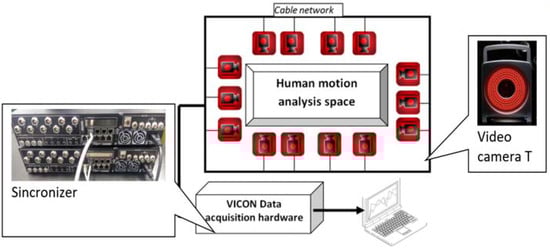
Figure 1.
Vicon camera system (the volume of the human motion space is 9 m × 5 m × 4 m).
(3) Procedures: The subject used the specific Vicon clothing (with 39 markers according to the Vicon system procedure), and anthropometric measurements were made. Based on these measurements, the Nexus software created a Vicon skeleton.
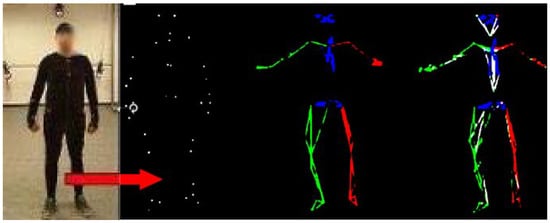
Figure 2.
Vicon suit and exoskeleton of the human body generated by the Vicon system.
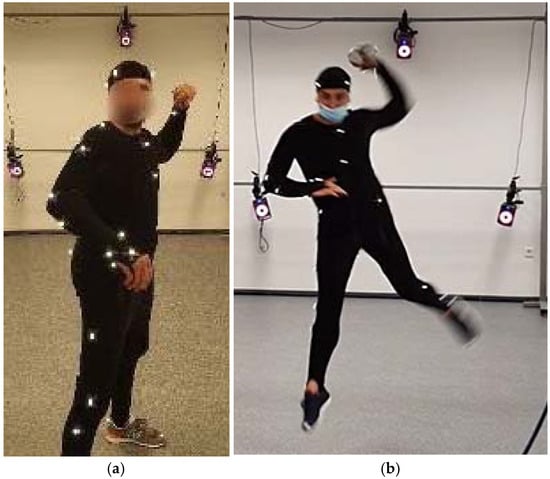
Figure 3.
(a) Standing throw without a run-up (S1); (b) jump throw (S2).
The subject performed two different types of throwing. The subject began with warm-up exercises (e.g., stretching, running) for 20 min. After this period, he performed a series of specific exercises from handball and simulated throwing. Before data collection using the Vicon system, he performed three trials for each type of throw. Each session of Vicon system data collection included three recordings, and for the kinematic analysis, all markers were visible, meaning that whole movements were captured.
The biomechanical analysis consisted of an evaluation of the angular velocity of trunk rotation, the angular velocity of arm rotation, and wrist velocity during two types of throwing: jump throws and standing throws without a run-up. This study proposes a correlation between the angular velocity of the trunk rotation, the angular velocity of the arm rotation, and wrist velocity.
Trunk rotation Euler angles were defined as Cartesian angles between the trunk reference frame and the pelvis reference frame in the order of flexion/extension, left/right lateroflexion, and endo/exorotation.
The experimental procedure was carried out at the Laboratory of Technics and Innovative Processes at the INCESA Research Institute (INCESA www.incesa.ro accessed 23 April 2022).
Statistical analyses were carried out using XLStat (part of the Excel package) [16].
The first step in data collection is to mark the model points in the centers of the joints of the human body, according to Zhang et al. [17]. For this, we used the Vicon marker position and Vicon suit, according to Merriaux et al. [18] (Figure 2).
Before recording the measurements, we created an exoskeleton for the human body (Figure 2).
The testing session included the following:
- A warm-up of 10 min;
- An evaluation of the S1 throwing position;
- An evaluation of the S2 throwing position.
We created three testing sessions.
(4) Data reduction and analysis. After recording the movements and collecting the data (the trajectories of the marked points), we used ProCalc software (part of Vicon system) to obtain the joints’ amplitude and a graphic representation of the kinematic parameters. The data were filtered using the Butterworth filter. This filter was only applied for trajectories, and we did not filter the velocities. We did not filter the velocities because we did not want to eliminate the peak values of the velocities, which are important for our study. The filter process was constructed using different filter frequencies. We chose the optimal frequency that corresponds to eliminating the noise generated by filming, and we maintained the trajectory after filtering. Data were recorded for standing throws without a run-up (S1) (Figure 3a) and jump throws (S2) (Figure 3b). For each situation, we measured two phases because of the great variation in the kinematic parameters.
Several phases were marked as follows.
Phase 1 (F1) began when the elbow angle was 90 degrees and continued to the moment when the wrist had an inflection of its trajectory. The wrist’s trajectory was an arc of a spatial curve that had an inflection point (Figure 4). This point was the border between Phase 1 (F1) and Phase 2 (F2), which finished when the wrist’s velocity reached its maximum (Figure 5). Based on arm trajectories in the orthogonal system, at the moment of inflection, the arm is on an external rotation (Figure 4). This position of the arm has biomechanical significance because it makes delimitations between the phases. This is the moment when the upper limb, with respect to the trunk, generates an explosive force and reduces the risk of shoulder injuries [15].
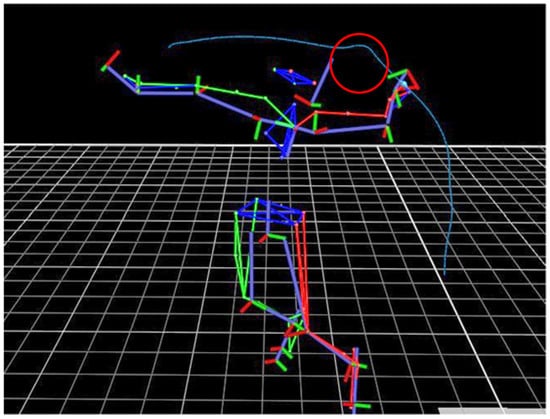
Figure 4.
Phase F1: the inflection point of the wrist’s trajectory (red circle).
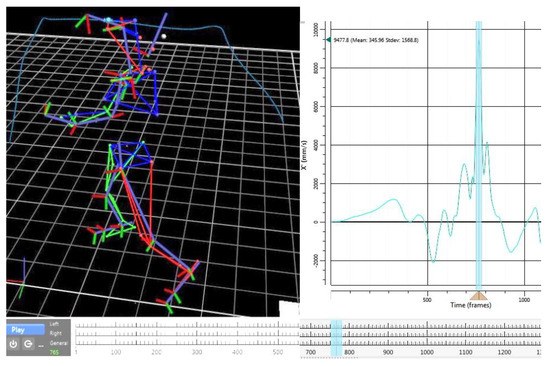
Figure 5.
Phase F2: the point of maximal wrist velocity.
We introduced a two-phase separation of the throwing motion based on a thorough analysis of the wrist trajectory (Figure 4). We identified a quasi-circular wrist trajectory exhibiting a distinct inflection point (as illustrated in Figure 4 and Figure 5) to guide our decision. This inflection point notably coincides with the phase of the arm’s external rotation, a critical biomechanical event in the throwing sequence. This alignment underscores the biomechanical relevance of the separation and supports a more refined representation of the throwing motion.
Our decision to adopt a two-phase approach was also informed by a comprehensive review of the relevant literature [5,8]. Notably, prior studies have advocated for the segmented analysis of handball throwing phases, which aligns with our research objective. Drawing from this literature, we devised our own design method to effectively capture the intricacies of each phase while addressing the potential limitations that are inherent in single-phase analyses.
We carried out a statistical analysis of wrist velocity for one athlete, comparing S1 and S2 for each phase (F1 and F2) because this parameter plays a key role in optimizing the throwing of the ball.
In summary, our approach integrates insights from wrist trajectory analysis, biomechanical alignment, and the existing literature to justify the two-phase division. Additionally, our own innovative design builds upon prior research to enhance the precision and depth of our analysis, thereby contributing to a more comprehensive understanding of the handball throwing motion.
While the decision to bifurcate the skill into two phases is rooted in the analysis of wrist trajectory (as depicted in Figure 4), the rationale behind and execution of this approach warrant further elaboration. The identification of a quasi-circular wrist trajectory with a discernible inflection point (evident in Figure 4 and Figure 5) offers a potential basis for skill division. This observed point of inflection notably coincides with the arm’s external rotation, a key biomechanical event within the throwing motion. However, the justification for utilizing this specific trajectory feature as the basis for phase separation could be more explicitly linked to its significance in the context of handball throwing mechanics.
Furthermore, while the incorporation of distinct phases aligns with research that advocates for segmented analyses of handball throwing, the decision’s rationale could be strengthened by providing a succinct summary of the key insights gained from these prior studies.
As stated previously, the angular velocity of the trunk rotation, the angular velocity of the arm rotation, and the angular rotation of wrist velocity were analyzed. The torsion angle of the trunk was between the transverse axis of the pelvis and the shoulders (Figure 6).
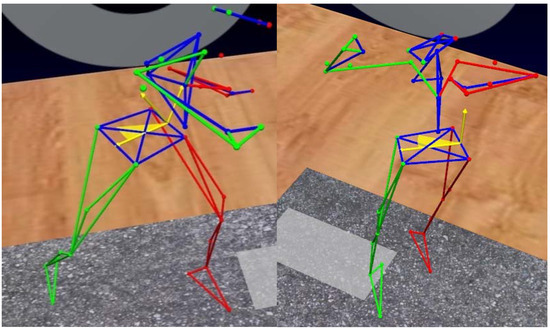
Figure 6.
Torsion angle of the trunk.
The arm’s angle of rotation was between the line of the clavicle and the sternum and the longitudinal axis of the arm (Figure 7).
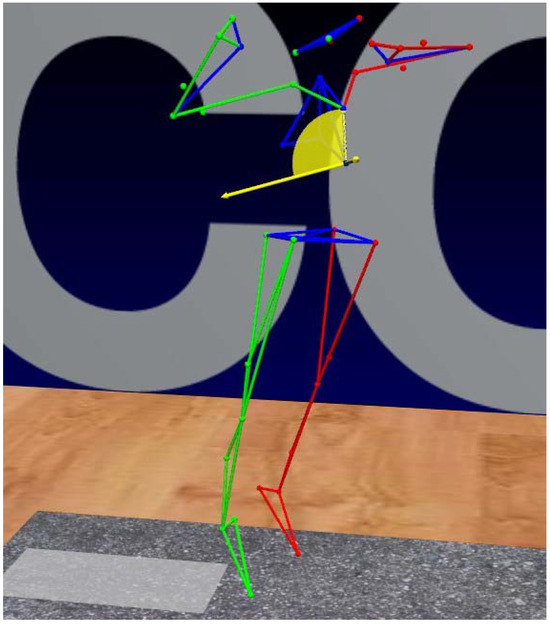
Figure 7.
Rotational angle of the arm.
3. Results
The results represent a comparative analysis of the kinematic parameters, as described above (angular velocity of the trunk torsion, angular velocity of the arm rotation, and wrist velocity), between two types of throws (standing throws without a run-up (S1) and jump throws (S2)) for each phase (F1 and F2).
In Table 1, the variations in wrist velocity for each type of throw and each phase for one athlete are presented.

Table 1.
Values of wrist velocity.
The results demonstrated that wrist velocity was higher during Phase F2 and S2.
In Table 2, the variations in the angular velocity of the trunk torsion for each type of throw and each phase for one athlete are presented.
Table 2.
Angular velocity of trunk torsion.
The results regarding the angular velocity of the trunk torsion demonstrate the high value of this parameter during Phase F2 compared to Phase F1 for both types of throws (S1 and S2).
In Table 3, the variations in the angular velocity of the arm rotation for each type of throw and each phase for one athlete are presented.
Table 3.
Angular velocity of arm rotation.
Regarding the angular velocity of the arm rotation, the maximum value was in F2 during S2.
3.1. Statistical Analysis
The variations in wrist velocity, angular velocity of the trunk torsion, and angular velocity of the arm rotation and the statistical results for one athlete are presented in Table 4.
Table 4.
Statistical indicators of variation of kinematic parameters in phases F1 and F2.
In the statistical analysis for Phase F1 and both throws, we observed a moderate effect size, and the t-test highlighted a statistically significant difference between S1 and S2 (p = 0.026 < 0.05; tobs = −2.296; and df = 45).
In the statistical analysis for Phase F2 and both throws, we observed a large effect size, and the t-test highlighted a statistically significant difference between S1 and S2 (p = 0.0001 < 0.05; tobs = −4.89; and df = 35).
In the statistical analysis of Phase F1 and both throws, we observed a large effect size, and the t-test highlighted a significant statistical difference between S1 and S2 (p = 0.0001 < 0.05; tobs = −3.72; and df = 75).
In the statistical analysis for Phase F2 and both throws, we observed a large effect size effect, and the t-test highlighted a statistically significant difference between S1 and S2 (p = 0.0001 < 0.05; tobs = −19.79; and df = 55).
In the statistical analysis for Phase F1 and both throws, we observed a moderate effect size, and the t-test highlighted a statistically significant difference between S1 and S2 (p = 0.008 < 0.05; tobs = −2.72; and df = 75).
In the statistical analysis for Phase F2 and both throws, we observed a large effect size, and the t-test highlighted a statistically significant difference between S1 and S2 (p = 0.007 < 0.05; tobs = −2.84; and df = 55).
We analyzed the correlation between the kinematic parameters for S1 and S2 and Phases F1 and F2 using Pearson’s correlation coefficient, and the results are presented in Table 5.
Table 5.
(a) Correlation between kinematic parameters for S1 in Phase F1. (b) Correlation between kinematic parameters for S1 in Phase F2. (c) Correlation between kinematic parameters for S2 in Phase F1. (d) Correlation between kinematic parameters for S2 in Phase F2.
The Pearson correlation demonstrated that for S1 in Phase F1, there was a good correlation between the angular velocity of the trunk torsion and the angular velocity of the arm rotation; however, in Phase F2, we found a good correlation between the angular velocity of the trunk torsion and wrist velocity.
For S2 in Phase F1, there was a good correlation between the angular velocity of the trunk torsion and wrist velocity; however, for Phase F2, there was a good correlation between the angular velocity of the arm rotation and wrist velocity.
In conclusion, wrist velocity is influenced by the other two kinematic parameters, especially the angular velocity of the arm rotation. This means that the development of explosive forces in the muscles of the trunk and arm could improve the wrist’s velocity and also increase the optimization of throwing in handball.
3.2. MANOVA Test
In our study, we used the MANOVA test to analyze the dependence between the kinematic parameters and the throwing phases F1 and F2 during S1 and S2. The test also demonstrated how the parameters varied within a phase depending on the type of throw. In other words, this highlighted that the type of throw could influence the kinematic parameters of each phase of throwing. Additionally, we used Wilks’ lambda test. The null hypothesis for this test (Rao’s approximation) excluded any effect of the variables (throw types S1 and S2) on the kinematic parameters. The results of the MANOVA test regarding the influence of the type of throw (S1 or S2) on the kinematic parameters for both phases and the results of the lambda test are presented in Table 6.
Table 6.
Average values of the kinematic parameters and Wilks’ lambda, Phases F1 and F2.
For Phase 1, we observed that lambda (0.506) was associated with a small value of p (<0.05). Therefore, we rejected the null hypothesis.
For Phase 2, we observed that lambda (0.085) was associated with a small value of p (<0.05). Therefore, we rejected the null hypothesis.
4. Discussion
This research began with the question of how upper limb biomechanical behavior could influence the optimization of throwing. Within the relevant literature, many researchers debate the difference between different types of throwing in handball. In our study, we proposed a two-phase throwing design and evaluated the role of trunk rotations in throwing velocity based on analyzing the kinematic parameters of the upper limb angular velocity of the trunk rotation, the angular velocity of the arm rotation, and wrist velocity in two types of throwing: standing throws without a run-up and jump throws. Our results demonstrate a variability in the kinematic parameters that could be explained by anthropometric aspects, the possibility of developing different strategies for optimizing throwing, and also some different movement patterns. Our results demonstrate a relationship between the movement of the trunk, the movement of the arm, and the wrist velocity during throwing, which was more obvious due to the two-phase analysis of throwing.
Regarding trunk torsion, these results indicate that exo- and endorotation have variability. Their variability could be explained by the fact that in Phase F1, the pre-stretch of the abdominal muscles and the exorotation were strong, and this increased explosive movement in the trunk during endorotation. In Phase 2, the angular velocity of trunk torsion increased, and there was also an increase in the wrist velocity in Phase F2. This aspect aligns with the results of Wagner et al. [4], who also found a large correlation of 0.78 between trunk torsion and wrist velocity.
Another aspect is arm rotation, which had a great range of motion in terms of exorotation based on a pre-stretch of the pectoralis major and the subscapular muscles in Phase F1. This contributed to an increase in the throwing velocity of the ball. This finding demonstrates a good correlation between the angular velocity of the arm rotation and wrist velocity. The same result was found by Wagner et al. [7] and van den Tillaar et al. [19].
These two aspects conclude that wrist velocity depends on angular arm rotation velocity and trunk torsion. Therefore, the development of explosive force in the muscles in the trunk and arm can improve wrist velocity and ball velocity, which optimizes throwing. An explanation for this could be that the biomechanical principles were reliable and enabled the athlete to have a high throwing velocity.
Therefore, the ball’s velocity is the result of complex movements based on disto-proximal activation, which is a specific phenomenon because distal joints have a short delay in their response.
In conclusion, training specific muscles, such as core training, could increase the flexibility and explosive muscle force of the shoulder and trunk. This confirms the importance of the shoulder and arm in throwing movements because the rotator cuff muscles generate acceleration and deceleration after throwing.
One of the strengths of this paper is its ability to provide a more nuanced understanding of the throwing mechanisms in handball by highlighting the distinct contributions of different phases. By specifically delineating the preparatory and propulsive stages, our study seeks to reveal insights that might have been obscured in a single-phase analysis.
A biomechanical analysis of the upper limbs could be used for the development of specific training addressing the trunk and upper limbs in terms of plyometric training.
Some limitations of this study are that our research was focused on one subject and that the experiment was conducted in a laboratory.
5. Conclusions
One unique feature of handball compared with other throwing sports is the large variation in how the ball is thrown. Variations in the length of the run-up and throwing while jumping greatly influence how the ball is thrown. Understanding the biomechanics behind throwing and developing biomechanical research for each segment of the upper limb will allow us to develop a training strategy to optimize the movement.
The higher velocity of exorotation in the preparation phase (F1) could prompt implementation of the strategy of pre-stretching the abdominal muscles, leading to a more explosive endorotation of the trunk.
Separating the throwing in two phases enabled us to analyze the trunk and upper limb behavior and develop a trunk muscle training strategy to increase the explosive force and wrist velocity.
In the first phase of throwing, trunk exorotation generates and increases energy accumulation, which will be cleared in the second phase during trunk endorotation.
The correlation between the angular velocity of the arm rotation and wrist velocity is also based on the pre-stretching of the pectoralis major and subscapular muscles in the first phase of throwing.
The information gathered here will allow us to assess the biomechanical behavior during throwing in handball, and the results will contribute towards the design and optimization of a training program.
Future research should focus on a large number of subjects and study lower limb behavior.
Author Contributions
Conceptualization, L.R.; concept design, M.I.M.; methodology, M.I.M.; resource, S.R.; writing, L.R. and R.E.S.; original draft preparation, R.M.R. All authors have read and agreed to the published version of the manuscript.
Funding
This research received no external funding.
Institutional Review Board Statement
The study was conducted in accordance with the Declaration of Helsinki, and approved by the Institutional Review Board (or Ethics Committee) of University of Craiova, (No. 25/22 February 2023).” for studies involving humans.
Informed Consent Statement
Informed consent was obtained from all subjects involved in the study.
Data Availability Statement
Data are contained within the article.
Acknowledgments
INCESA by the author.
Conflicts of Interest
The authors declare no conflict of interest.
References
- Rivilla-García, J.; Grande, I.; Chirosa, L.J.; Gómez, M.J.; Sampedro, J. Differences and relationship between standards and specific throwing test in handball according to the competitive and professional level. J. Sport Health Sci. 2011, 3, 143–152. [Google Scholar]
- Rivilla-Garcia, J.; Grande, I.; Sampedro, J.; van Den Tillaar, R. Influence of opposition on ball velocity in the handball jump throw. J. Sports Sci. Med. 2011, 10, 534–539. [Google Scholar] [PubMed]
- Garcia, J.A.; Sabido, R.; Barbado, D.; Moreno, F.J. Analysis of the relation between throwing speed and throwing accuracy in team-handball according to instruction. Eur. J. Sport Sci. 2013, 13, 149–154. [Google Scholar] [CrossRef]
- Wagner, H.; Pfusterschmied, J.; Duvillard, S.P.; Müller, E. Performance and kinematics of various throwing techniques in team-handball. J. Sports Sci. Med. 2011, 10, 73–80. [Google Scholar] [PubMed]
- Wagner, H.; Michael Buchecker, S.P.; Müller, E. Kinematic Comparison of Team Handball Throwing With Two Different Arm Positions. Int. J. Sports Physiol. Perform. 2010, 5, 469–483. [Google Scholar] [CrossRef] [PubMed]
- Wagner, H.; Müller, E. The effects of differential and variable training on the quality paramters of a handball throw. Sports Biomech. 2008, 7, 54–71. [Google Scholar] [CrossRef] [PubMed]
- Wagner, H.; Kainrath, S.; Müller, E. Koordinative und taktische Anforderungen beim Torwurf im Handball. Der Zusammenhang von Leistungsniveau, Qualität der Wurfbewergung und ausgewählten technisch-taktischen Parametem. Leistungssport 2008, 5, 35–42. [Google Scholar]
- Wagner, H.; Buchecker, M.; Duvillard, S.P.; Müller, E. Kinematic description of elite vs. low level players in team-handball jump throw. J. Sports Sci. Med. 2010, 9, 15–23. [Google Scholar] [PubMed]
- Wagner, H.; Pfusterschmied, J.; Klous, M.; Duvillard, S.P.; Müller, E. Movement variability and skill level of various throwing techniques. Hum. Mov. Sci. 2012, 31, 78–90. [Google Scholar] [CrossRef] [PubMed]
- Fradet, L. Analyse Biomécanique, Modélisation ET Simulation du Tir AU Handball. Thèse Pour Les Sciences de la Vie- Sciences ET Techniques Des Activités Physiques ET Sportives. Ph.D. Thesis, Université de Rennes II—UFR-STAPS, Rennes, France, 2003. [Google Scholar]
- Piscitelli, F.; Milanese, C.; Sandri, M.; Cavedon, V.; Zancanaro, C. Investigating predictors of ball-throwing velocity in team handball: The role of sex, anthropometry, and body composition. Sport Sci. Health 2016, 12, 11–20. [Google Scholar] [CrossRef]
- Vandelle, V. Analyse Biomécanique et Cinématique du tir au Handball pour L’amélioration de la Performance. Mémoire Et Entraînement 2013/2014. Available online: http://frederic.duclos.free.fr/Digitalisation/Prestations_APS_files/Memoire_Vincent_Vandelle.pdf (accessed on 5 January 2024).
- van den Tillaar, R.V.; Ettema, G. A comparison of overarm throwing with the dominant and nondominant arm in experienced team handball players. Percept. Mot. Ski. 2009, 109, 315–326. [Google Scholar] [CrossRef] [PubMed]
- van den Tillaar, R.V.; Cabri, J.M. Gender differences in the kinematics and ball velocity of overarm throwing in elite team handball players. J. Sports Sci. 2012, 30, 807–813. [Google Scholar] [CrossRef] [PubMed]
- Skejo, S.D.; Moller, M.; Bencke, J.; Sorensen, H. Shoulder kinematics and kinetics of team handball throwing: A scoping review. Hum. Mov. Sci. 2019, 64, 203–212. [Google Scholar] [CrossRef] [PubMed]
- Addinsoft. XLSTAT Statistical and Data Analysis Solution. New York, USA. 2023. Available online: https://www.xlstat.com/en (accessed on 1 September 2021).
- Zhang, J.; Sorby, H.; Clement, J.; Thomas, C.D.L.; Hunter, P.; Nielsen, P.; Lloyd, D.; Taylor, M. The MAP client: User-friendly musculoskeletal modelling workflows. In Proceedings of the International Symposium on Biomedical Simulation, Strasbourg, France, 16–17 October 2014; Springer: Strasbourg, France, 2014; pp. 182–192. [Google Scholar]
- Merriaux, P.; Dupuis, Y.; Boutteau, R.; Vasseur, P.; Savatier, X. A Study of Vicon System Positioning Performance. Sensors 2017, 17, 1591. [Google Scholar] [CrossRef] [PubMed]
- Van den Tillaar, R.; Ettema, G. A force-velocity relationship and coordination patterns in overarm throwing. J. Sports Sci. Med. 2004, 3, 211–219. [Google Scholar] [PubMed]
Disclaimer/Publisher’s Note: The statements, opinions and data contained in all publications are solely those of the individual author(s) and contributor(s) and not of MDPI and/or the editor(s). MDPI and/or the editor(s) disclaim responsibility for any injury to people or property resulting from any ideas, methods, instructions or products referred to in the content. |
© 2024 by the authors. Licensee MDPI, Basel, Switzerland. This article is an open access article distributed under the terms and conditions of the Creative Commons Attribution (CC BY) license (https://creativecommons.org/licenses/by/4.0/).