Fuzzy Comprehensive Evaluation of Collapse Risk in Mountain Tunnels Based on Game Theory


Abstract
1. Introduction
2. The Index System for Evaluating the Risk of Collapse in Highway Mountain Tunnel and the Standard for Classifying the Levels
2.1. Identification of Risk Assessment Factors of Mountain Tunnel Collapse
2.2. Classification Standard for Risk Collapse of Mountain Tunnels
3. Theoretical Analysis
3.1. Subjective Empowerment Based on the Improved D-Number Hierarchy Analysis Method
3.1.1. D-Number Theory
3.1.2. D-AHP Theory
3.2. Objective Empowerment Based on the CRITIC Method
3.3. Comprehensive Weight Calculation Based on Game Theory
3.4. Fuzzy Comprehensive Decision-Making
4. Application Instances
4.1. Project Overview
4.2. Weight Calculation
4.2.1. Subjective Weight Calculation Based on D-AHP
4.2.2. Objective Weight Calculation Based on the CRITIC Method
4.2.3. Weight Optimization Using the Game Theory Combined Empowerment Method
4.3. Membership Function Determination
4.4. Comprehensive Decision-Making
5. Discussion
6. Limitations
7. Conclusions
- (1)
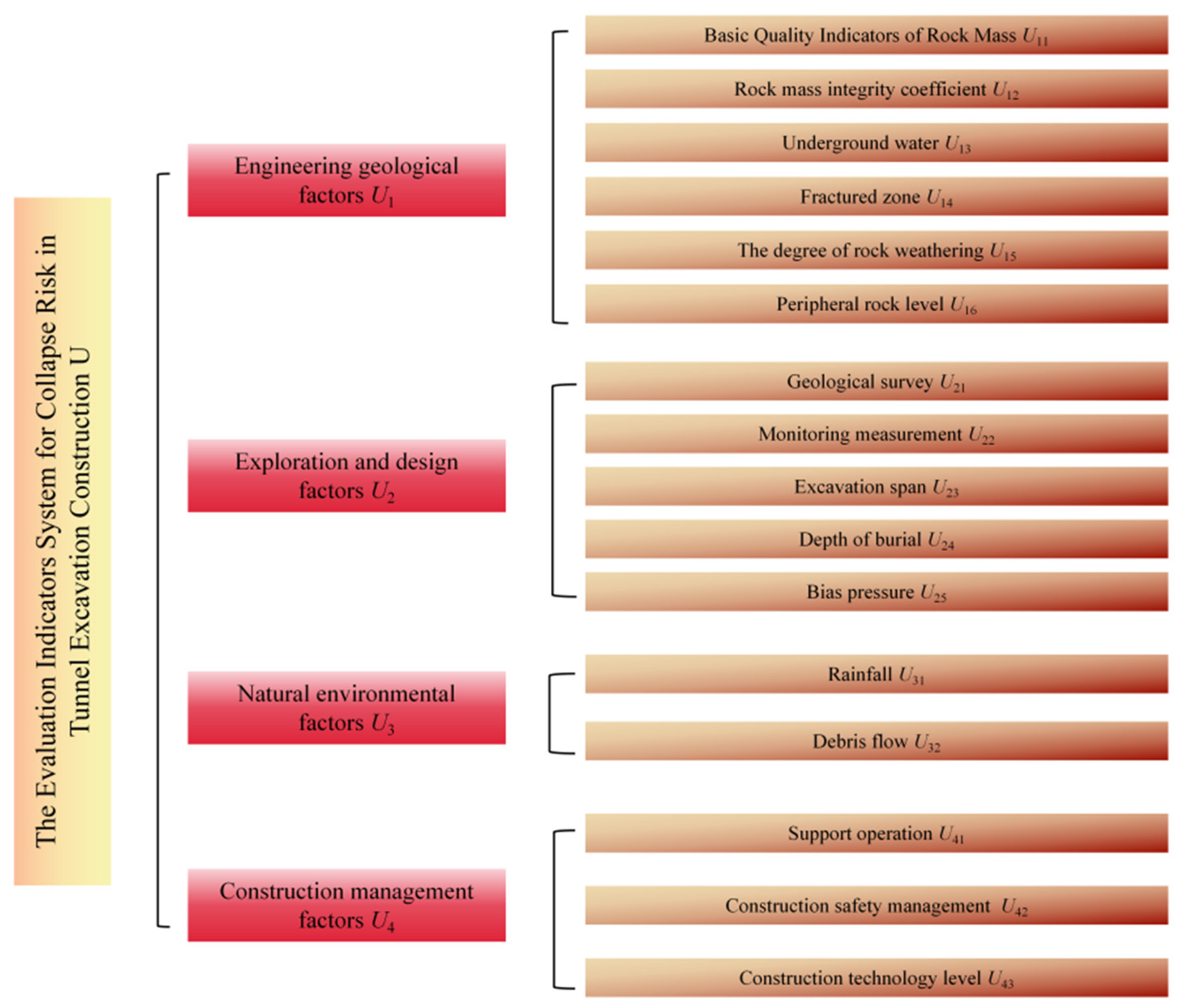
- Based on the actual construction conditions of the project, this paper comprehensively considers four aspects: engineering geology, exploration and design, construction management, and natural environment, and deeply analyzes the subjective and objective factors that may affect the risk of tunnel collapse. On the basis of fully considering the operability, comprehensiveness, and representativeness of the evaluation index, a scientific evaluation system including 16 secondary indexes for tunnel collapse risk assessment is constructed.
- (2)
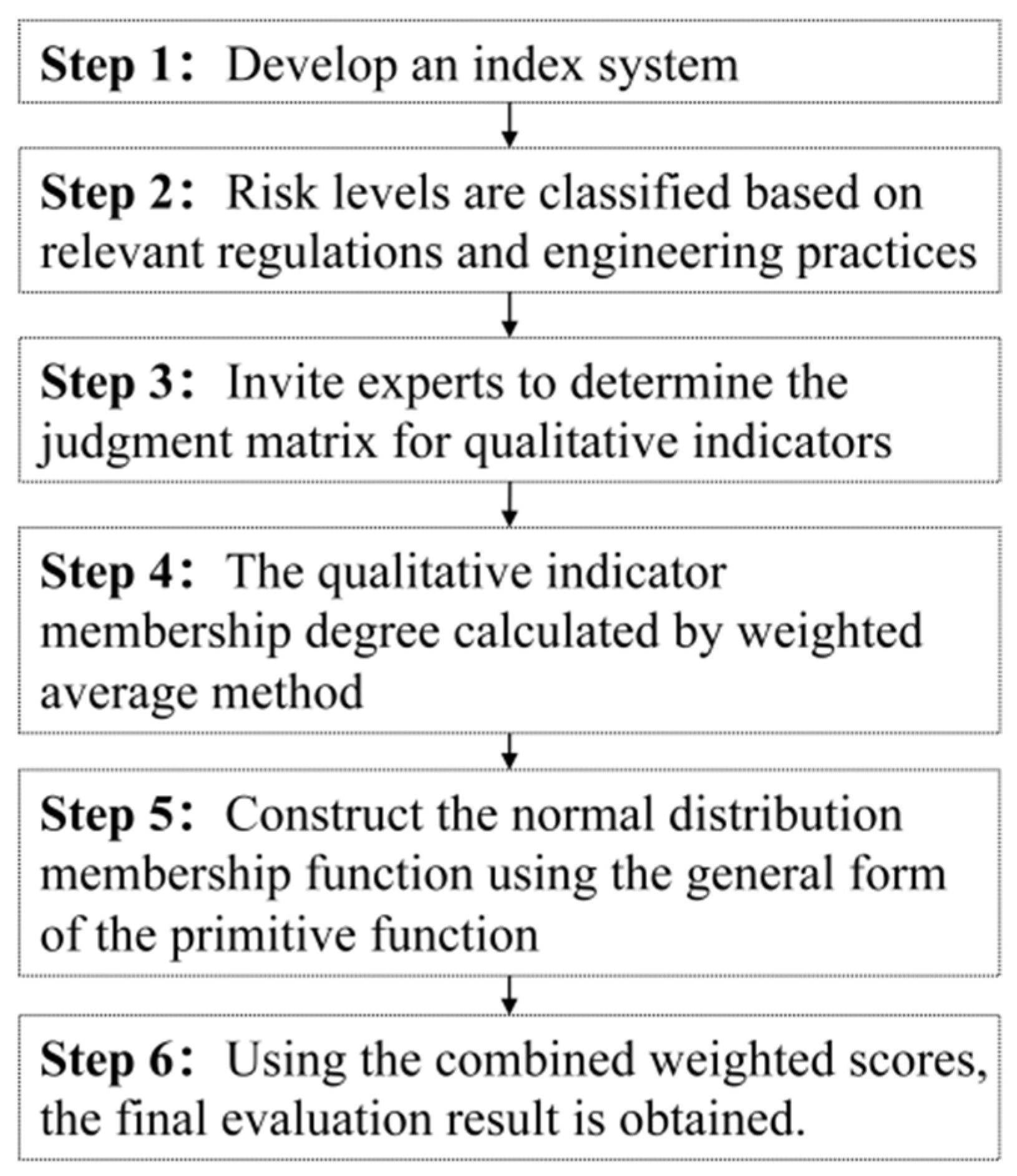
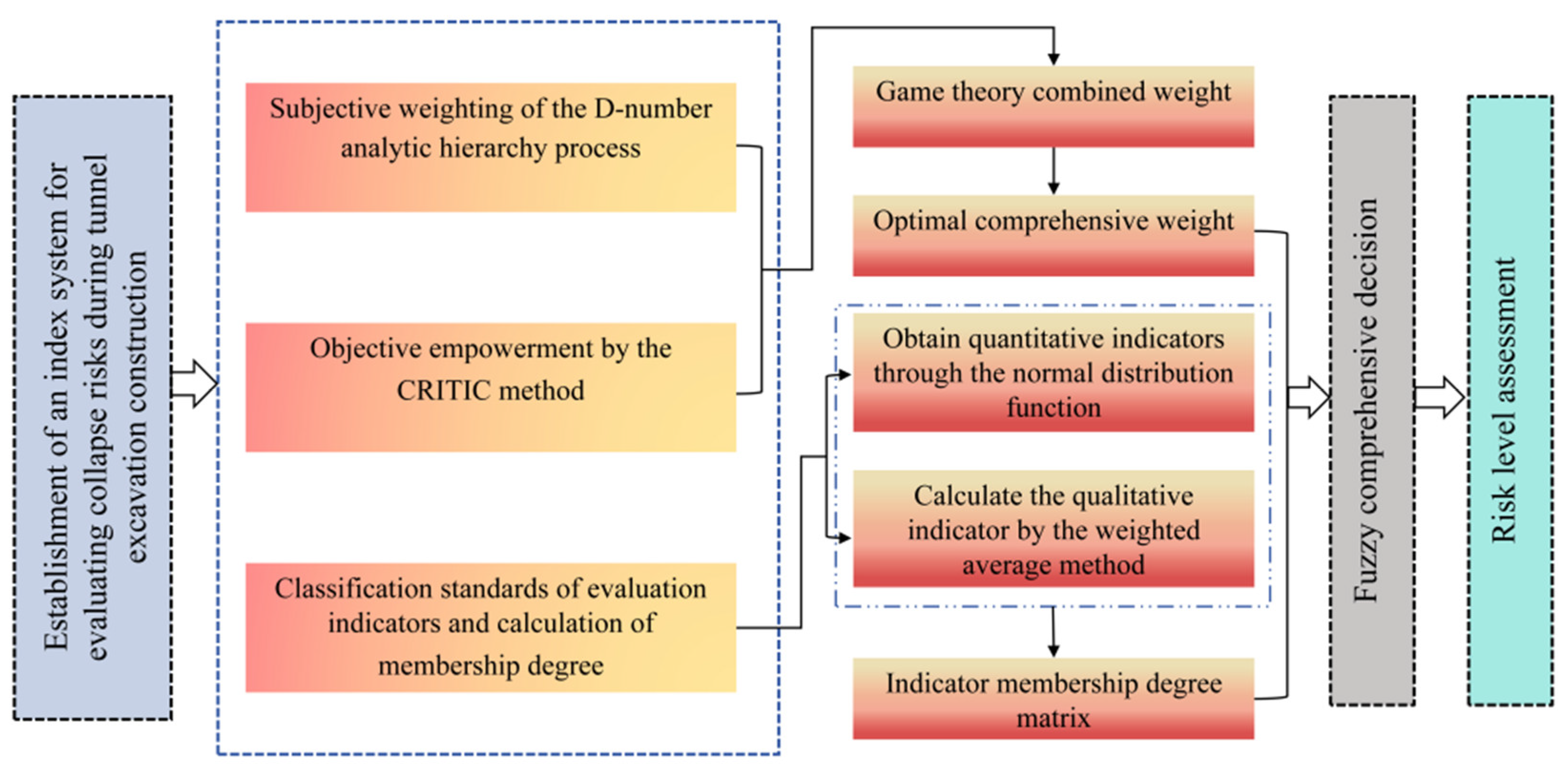
- The subjective weighting by improving the traditional analytic hierarchy process based on the D-number theory can increase the accuracy of the evaluation and reduce the impact of the uncertainty environment on the evaluation result. The objective weighting of the indicators by the CRITIC method can comprehensively consider the correlation and difference between the indicators. Performing the weight combination optimization through the game theory avoids the singleness and absoluteness of the weight calculation method and can also strengthen the rationality of the weight distribution coefficient, making the evaluation result more accurate.
- (3)
- By combining with the actual data of the project, the risk indicators are distinguished and calculated by using both qualitative and quantitative methods, and the obtained evaluation results have higher accuracy. Through the analysis based on the process example, it can be known that the risk level of each section of the tunnel is between level 3 and level 4, and the overall risk of the tunnel is between medium and higher risk. The evaluation results are consistent with the actual situation of the tunnel, indicating that this evaluation model can be promoted and applied.
- (4)
- The findings presented in this article can contribute to the identification of potential collapse risks during the tunnel design phase. Moreover, the risk assessment framework employed in this study can effectively guide maintenance schedules and procedures, ensuring that areas with higher risks are subjected to more frequent review and reinforcement. By integrating fuzzy logic and game theory with other analytical methods, more comprehensive risk assessment models for diverse engineering challenges can be developed.
Author Contributions
Funding
Institutional Review Board Statement
Informed Consent Statement
Data Availability Statement
Conflicts of Interest
References
- Wang, X.; Lai, J.; Qiu, J.; Xu, W.; Wang, L.; Luo, Y. Geohazards, Reflection and Challenges in Mountain Tunnel Construction of China: A Data Collection from 2002 to 2018. Geomat. Nat. Hazards Risk 2020, 11, 766–785. [Google Scholar] [CrossRef]
- Pérez, Á.M.R.; Rodríguez, C.A.; Rodríguez, L.O.; Mancera, J.J.C. Revitalizing the Canal de Castilla: A Community Approach to Sustainable Hydropower Assessed through Fuzzy Logic. Appl. Sci. 2024, 14, 1828. [Google Scholar] [CrossRef]
- Zhang, Y.J.; Yang, X.B.; Ren, M.D.; Zhang, J.W.; Liu, T.; Zhang, H.G. Static and dynamic risk assessment method of mountain tunnel during construction period and its application. J. Railw. Sci. Eng. 2020, 17, 2703–2710. [Google Scholar] [CrossRef]
- Lu, Q.; Huo, Z.; Zhao, B.; Xiang, J.; He, J. Risk Assessment of Tunnel Collapse Based on Fuzzy Hierarchy and Consequences Equivalent Method. Tunn. Constr. 2018, 38, 31–38. [Google Scholar]
- Chen, W.; Zhang, G.; Wang, H.; Chen, L. Risk assessment of mountain tunnel collapse based on rough set and conditional information entropy. Rock Soil Mech. 2019, 40, 3549–3558. [Google Scholar] [CrossRef]
- Wu, B.; Huang, W.; Chen, H.; Xu, J.; Wu, B. Risk assessment of gas tunnel construction based on entropy method and extension theory. China Sci. Pap. 2022, 17, 99–104. [Google Scholar]
- Zhang, C.; Wu, S.; Wu, J. Study on risk assessment model of collapse during construction of mountain tunnel and its application. J. Saf. Sci. Technol. 2019, 15, 128–134. [Google Scholar]
- Pérez, Á.M.R.; Rodríguez, C.A.; Rodríguez, A.M.; Mancera, J.J.C. Viability Analysis of Tidal Turbine Installation Using Fuzzy Logic: Case Study and Design Considerations. Axioms 2023, 12, 778. [Google Scholar] [CrossRef]
- Hencher, S.R. The Glendoe Tunnel Collapse in Scotland. Rock Mech. Rock Eng. 2019, 52, 4033–4055. [Google Scholar] [CrossRef]
- Wu, B.; Chen, H.; Meng, G.; Huang, W.; Cai, J.; Li, Y.; Zhang, Y. A Dynamic Assessment Method on Collapse Risk of Small Spacing Tunnels Based on Attribute Interval Recognition Model. Arab. J. Geosci. 2021, 14, 2545. [Google Scholar] [CrossRef]
- Yu, Y.; He, X.; Wan, F.; Bai, Z.; Fu, C. Dynamic Risk Assessment of Karst Tunnel Collapse Based on Fuzzy-AHP: A Case Study of the LianHuaShan Tunnel, China. Adv. Civ. Eng. 2022, 2022, 4426318. [Google Scholar] [CrossRef]
- Guo, K.; Zhang, L. Multi-Source Information Fusion for Safety Risk Assessment in Underground Tunnels. Knowl.-Based Syst. 2021, 227, 107210. [Google Scholar] [CrossRef]
- Sun, J.; Liu, B.; Chu, Z.; Chen, L.; Li, X. Tunnel Collapse Risk Assessment Based on Multistate Fuzzy Bayesian Networks. Qual. Reliab. Eng. Int. 2018, 34, 1646–1662. [Google Scholar] [CrossRef]
- Song, T.; Zeng, J.; Ma, J.; Ma, C.; Li, T.; Xia, T. Water Inrush Risk Assessment Based on AHP and Advance Forecast Approach: A Case Study in the Micangshan Tunnel. Adv. Civ. Eng. 2021, 2021, 9750447. [Google Scholar] [CrossRef]
- Li, P.; Che, L.; Wan, L.; Fei, L. A MULTIMOORA-Based Risk Evaluation Approach for CCUS Projects by Utilizing D Numbers Theory. Axioms 2022, 11, 204. [Google Scholar] [CrossRef]
- Peng, D.; Wei, T.; Zhao, H.; Yao, J.; Wang, W. Cyber security risk assessment of power plant control system based on D-AHP and TOPSIS. Control Decis. 2019, 34, 2445–2451. [Google Scholar] [CrossRef]
- Hou, K.; Wang, L. Research on site selection of maritime transit pilot platform based on PCA relative entropy model. J. Saf. Environ. 2021, 21, 2443–2451. [Google Scholar] [CrossRef]
- Wu, B.; Wei, Y.; Meng, G.; Xu, S.; Wang, Q.; Cao, D.; Zhao, C. Multi-Source Monitoring Data Fusion Comprehensive Evaluation Method for the Safety Status of Deep Foundation Pit. Sustainability 2023, 15, 11809. [Google Scholar] [CrossRef]
- Rodríguez, C.A.; Rodríguez-Pérez, Á.M.; López, R.; Hernández-Torres, J.A.; Caparrós-Mancera, J.J. A Finite Element Method Integrated with Terzaghi’s Principle to Estimate Settlement of a Building Due to Tunnel Construction. Buildings 2023, 13, 1343. [Google Scholar] [CrossRef]
- Su, Y. Constructing method of fuzzy membership function of geotechnical parameters and its application. Chin. J. Geotech. Eng. 2007, 29, 1772–1779. [Google Scholar]



| Category | Index | Indicator | ||||
|---|---|---|---|---|---|---|
| Rank 1 | Rank 2 | Rank 3 | Rank 4 | Rank 5 | ||
| Geotechnical geology | Basic quality index of rock mass | >550 | 451–550 | 351–450 | 251–350 | <250 |
| Rock mass integrity coefficient | >0.75 | >0.55–0.75 | >0.35–0.55 | >0.15–0.35 | <0.15 | |
| Underground water (m3·d−1·m−1) | <0.15 | 0.15–0.3 | 0.3–0.45 | 0.45–0.6 | >0.6 | |
| Fault broken belt/m | <10 | 10–20 | 3 | 4 | 5 | |
| The degree of rock weathering | 1 (Unweathered) | 2 (Slightly effloresced) | 3 (Medium weathering) | 4 (Strong weathering) | 5 (Full weathering) | |
| Surrounding rock level | 1, 2 | 3 | 4 | 5 | 6 | |
| Exploration and design | Geological survey | 1 (Careful geological survey, data survey is fully complete | 2 (The geological survey is more careful, and the data survey is more complete) | 3 (Geological survey is general, and data survey is general) | 4 (The geological survey is rough, and the data survey is incomplete) | 5 (Geological survey is rough, but the data survey is incomplete) |
| Monitoring measurement | 1 (The measurement frequency is reasonable, the data collected is complete, and the information is timely feedback) | 2 (The measurement frequency is reasonable, the data collection is complete, and some timely feedback) | 3 (Measurement frequency is general, data collection is general, information feedback is general) | 4 (The measurement frequency is low, the data collection intersection is poor, and the information feedback is poor) | 5 (Low frequency of measurement, less data collection, and poor information feedback) | |
| Excavation span/m | <7 | 7–10 | 10–12 | 12–15 | >15 | |
| Buried depth/m | >60 | 40–60 | 20–40 | 10–20 | <10 | |
| Bias/° | <10 | 10–20 | 20–30 | 30–40 | >40 | |
| Natural environment | Annual mean precipitation /mm | <400 | 400–800 | 800–1200 | 1200–1600 | >1600 |
| Seismic intensity | <3 | 3–5 | 5–7 | 7–9 | 9–12 | |
| Construction and management | Support operation | 1 (Support operation is timely and reasonable, and the parameters and quality meet the design requirements) | 2 (The support operation is reasonable, and the parameter quality basically meets the design requirements) | 3 (Support operation is general, parameters, quality) | 4 (Support operation is unreasonable, and the parameter quality is poor) | 5 (Support operation is unreasonable, poor parameter quality, does not meet the design requirements) |
| Construction safety management | 1 (Strong safety and quality awareness, strict compliance with the construction specifications, and reasonable construction operations) | 2 (Strong safety, quality awareness, more compliance with the construction specifications, the construction work is more reasonable) | 3 (Safety, quality awareness is general, and the construction operation is general) | 4 (Safety and quality awareness is weak, and the construction operation is poor) | 5 (Safety and quality awareness is weak, do not comply with the construction specifications, poor construction work) | |
| Construction technology level | 1 (Rich construction experience and good technical level) | 2 (Rich construction experience, good technical level) | 3 (General construction experience, general technical level) | 4 (Less construction experience and poor technical level) | 5 (Less construction experience, poor technical level) | |
| Rank | Risk Comments |
|---|---|
| Low risk | |
| Relatively low risk | |
| Medium risk | |
| Relatively high risk | |
| High risk |
| Sample Section | Geological Factor | Design Factors | Natural Factor | Construction Factors | ||||||||||||
|---|---|---|---|---|---|---|---|---|---|---|---|---|---|---|---|---|
| Basic Quality Indica-tors of Rock Mass | Rock Mass Integrity Coefficient | Underground Water | Fractured Zone | The Degree of Rock Weathering | Peripheral Rock Level | Geological Survey | Monitoring Measurement | Excavation Span | Depth of Burial | Bias Pressure | Rainfall | Debris Flow | Support Operation | Construction Safety Management | Construction Technology Level | |
| The value of the imported section | 297 | 0.49 | 0.38 | 32 | 4 | 4 | 4 | 4 | 14.75 | 131 | 22 | 1450 | 3 | 3 | 3 | 2 |
| Tunnel entrance section, exit part and main part of the tunnel (K242 + 815-K242 + 875) | 316 | 0.51 | 0.37 | 31 | 3 | 4 | 4 | 3 | 14.55 | 182 | 23 | 1530 | 3 | 4 | 4 | 3 |
| Take the value of the exit section | 322 | 0.56 | 0.42 | 34 | 4 | 3 | 3 | 4 | 14.75 | 152 | 25 | 1470 | 4 | 4 | 3 | 4 |
| Target Layer | Firstly Indicators | Weight | Secondary Indicators | Weight | Comprehensive Weight |
|---|---|---|---|---|---|
| The evaluation indicators system for collapse risk in tunnel excavation construction | Engineering geological factors | 0.375 | Basic quality index of rock mass | 0.255 | 0.096 |
| Rock mass integrity coefficient | 0.045 | 0.017 | |||
| Underground water | 0.335 | 0.126 | |||
| Fractured zone | 0.155 | 0.058 | |||
| The degree of rock weathering | 0.015 | 0.006 | |||
| Peripheral rock level | 0.195 | 0.073 | |||
| Exploration and design factors | 0.275 | Geological survey | 0.114 | 0.031 | |
| Monitoring measurement | 0.104 | 0.029 | |||
| Excavation span | 0.335 | 0.092 | |||
| Depth of burial | 0.324 | 0.089 | |||
| Bias pressure | 0.123 | 0.034 | |||
| Natural environmental factors | 0.155 | Rainfall | 0.56 | 0.087 | |
| Debris flow | 0.44 | 0.068 | |||
| Construction management factors | 0.195 | Support operation | 0.362 | 0.071 | |
| Construction safety management | 0.274 | 0.053 | |||
| Construction technology level | 0.364 | 0.071 |
| Qualitative Indicators | Comments Set | ||||
|---|---|---|---|---|---|
| 1 | 2 | 3 | 4 | 5 | |
| The degree of rock weathering | 0 | 0.204 | 0.414 | 0.382 | 0 |
| Peripheral rock level | 0 | 0.134 | 0.583 | 0.283 | 0 |
| Geological survey | 0 | 0.012 | 0.512 | 0.476 | 0 |
| Monitoring measurement | 0 | 0.133 | 0.311 | 0.556 | 0 |
| Debris flow | 0.102 | 0.221 | 0.503 | 0.174 | 0 |
| Support operation | 0 | 0.172 | 0.593 | 0.235 | 0 |
| Construction safety management | 0 | 0.113 | 0.503 | 0.384 | 0 |
| Construction technology level | 0 | 0.163 | 0.242 | 0.595 | 0 |
| Category | Basic Quality Index of Rock Mass | Rock Mass Integrity Coefficient | Underground Water | Fractured Zone | Excavation Span | Depth of Burial | Bias Pressure | Rainfall | ||||||||
|---|---|---|---|---|---|---|---|---|---|---|---|---|---|---|---|---|
| c | c | c | c | c | c | c | c | |||||||||
| Rank 1 | 825 | 331.33 | 1.125 | 0.45 | 0.075 | 0.09 | 5 | 6.02 | 3.5 | 4.22 | 140 | 36.14 | 5 | 6.02 | 200 | 240.96 |
| Rank 2 | 500 | 60.24 | 0.65 | 0.12 | 0.225 | 0.09 | 15 | 6.02 | 8.5 | 1.81 | 50 | 12.05 | 15 | 6.02 | 600 | 240.96 |
| Rank 3 | 400 | 60.24 | 0.45 | 0.12 | 0.375 | 0.09 | 25 | 6.02 | 11 | 1.2 | 30 | 12.05 | 25 | 6.02 | 1000 | 240.96 |
| Rank 4 | 300 | 60.24 | 0.25 | 0.12 | 0.525 | 0.09 | 35 | 6.02 | 13.5 | 1.81 | 15 | 6.02 | 35 | 6.02 | 1400 | 240.96 |
| Rank 5 | 125 | 150.6 | 0.075 | 0.09 | 10.05 | 0.36 | 45 | 24.1 | 23 | 9.04 | 5 | 6.02 | 45 | 24.1 | 2000 | 963.86 |
| Quantitative Indicators | Each Level of Membership | ||||
|---|---|---|---|---|---|
| 1 | 2 | 3 | 4 | 5 | |
| Basic quality index of rock mass | 0 | 0 | 0 | 0.271 | 0.729 |
| Rock mass integrity coefficient | 0 | 0 | 0.895 | 0.105 | 0 |
| Underground water | 0 | 0 | 0.734 | 0.266 | 0 |
| Fractured zone | 0 | 0 | 0.220 | 0.780 | 0 |
| Depth of burial | 1 | 0 | 0 | 0 | 0 |
| Bias pressure | 0 | 0.220 | 0.780 | 0 | 0 |
| Rainfall | 0 | 0 | 0 | 0.958 | 0.042 |
Disclaimer/Publisher’s Note: The statements, opinions and data contained in all publications are solely those of the individual author(s) and contributor(s) and not of MDPI and/or the editor(s). MDPI and/or the editor(s) disclaim responsibility for any injury to people or property resulting from any ideas, methods, instructions or products referred to in the content. |
© 2024 by the authors. Licensee MDPI, Basel, Switzerland. This article is an open access article distributed under the terms and conditions of the Creative Commons Attribution (CC BY) license (https://creativecommons.org/licenses/by/4.0/).
Share and Cite
Zheng, W.; Xu, S.; Wang, Z. Fuzzy Comprehensive Evaluation of Collapse Risk in Mountain Tunnels Based on Game Theory. Appl. Sci. 2024, 14, 5163. https://doi.org/10.3390/app14125163
Zheng W, Xu S, Wang Z. Fuzzy Comprehensive Evaluation of Collapse Risk in Mountain Tunnels Based on Game Theory. Applied Sciences. 2024; 14(12):5163. https://doi.org/10.3390/app14125163
Chicago/Turabian StyleZheng, Weiqiang, Shixiang Xu, and Zecheng Wang. 2024. "Fuzzy Comprehensive Evaluation of Collapse Risk in Mountain Tunnels Based on Game Theory" Applied Sciences 14, no. 12: 5163. https://doi.org/10.3390/app14125163
APA StyleZheng, W., Xu, S., & Wang, Z. (2024). Fuzzy Comprehensive Evaluation of Collapse Risk in Mountain Tunnels Based on Game Theory. Applied Sciences, 14(12), 5163. https://doi.org/10.3390/app14125163