1. Introduction
In recent years significant research efforts have been made in the field of Environmental Sound Classification (ESC) [
1], allowing significant results to be obtained in practical sound classification applications. This initiative has been enabled by the use of Convolutional Neural Networks (CNNs), which allowed a superior performance in image processing problems [
2] to be obtained. In order to extend the use of CNNs to the field of audio processing, the audio input signal is usually transformed into suitable bi-dimensional image-like representations, such as spectrograms, mel-scale spectrograms, and other similar methods [
3,
4].
Recently, the approaches employed in ESC have been transferred to advancing the construction domain by converting vision-based work monitoring and management systems into audio-based ones [
5,
6,
7]. In fact, audio-based systems not only are more cost-effective than video-based ones, but they also work more effectively in a construction field when sources are far from the light of sight of sensors, making these systems very flexible and appropriate for combining other sensor-based applications or Artificial Intelligence (AI)-based technologies [
7]. Furthermore, the amount of memory and data flow needed to handle audio data is much smaller than the one needed for video data. In addition, audio-based systems outperform accelerometer-based ones since there is no need to place sensors onboard, thus promoting 360-degree-based activity detection and surveillance without having an illumination issue [
8].
Such audio-based systems can be successfully used as Automatic Construction Site Monitoring (ACSM) tools [
7,
9,
10,
11], which can represent an invaluable instrument for project managers to promptly identify severe and urgent problems in fieldwork and quickly react to unexpected safety and hazard issues [
12,
13,
14,
15,
16].
ACSM systems are usually implemented by exploiting both machine learning (ML) and deep learning (DL) techniques [
17]. Specifically, several ML approaches, including Support Vector Machines (SVMs), the k-Nearest Neighbors (k-NN) algorithm, the Multilayer Perceptron (MLP), random forests, Echo State Networks (ESN), and others, have already demonstrated their effectiveness in properly performing activity identification and detection in a construction site [
5,
16]. However, DL approaches generally outperform ML-based solutions providing much improved results [
6]. We expect that DL techniques including CNNs, Deep Recurrent Neural Networks (DRNNs) implemented with the Long Short-Term Memory (LSTM) cell, Deep Belief Networks (DBNs), Deep ESNs, and others can produce more suitable and qualified performances than ML ones for robustly managing construction work and safety issues.
Approaches based on CNNs have demonstrated good flexibility and considerably convincing performance in these applications. In fact, CNNs exhibit advanced accuracy in image classification [
18]. In order to meet the bi-dimensional format of images, the audio waveform can be transformed into a bi-dimensional representation by a proper time–frequency transformation. The main time–frequency representation used in audio applications is the spectrogram, i.e., the squared magnitude of the Short Time Fourier Transform (STFT) [
19,
20]. The spectrogram is very rich in peculiar information that can be successfully exploited by CNNs. Instead of using the STFT spectrogram, in audio processing, it is very common to use some well-known variants, such as the constant-Q spectrogram, which uses a log-frequency mapping, and the mel-scale spectrogram, which uses the mel-scale of frequency to better capture the intrinsic characteristic of the human ear. Similarly, the Bark and/or ERB scales can be used, producing other variants of the spectrogram [
21].
Although the spectrogram representation and its variants provide an effective way to extract features from audio signals, they entail some limitations due to the unavoidable trade-off between the time and frequency resolutions. Unfortunately, it is hard to provide an adequate resolution in both domains: a shorter time window provides a better time resolution, but it reduces the frequency resolution, while using longer time windows improves the frequency resolution but obtains a worse time resolution. Even if some solutions have been proposed to mitigate such an unwanted effect (such as the time–frequency reassignment and synchrosqueezing approach [
22]), the problem can still affect the performance of deep learning methods. Moreover, the issue is also complicated by the fact that sound information is usually available at different time scales that cannot be captured by the STFT.
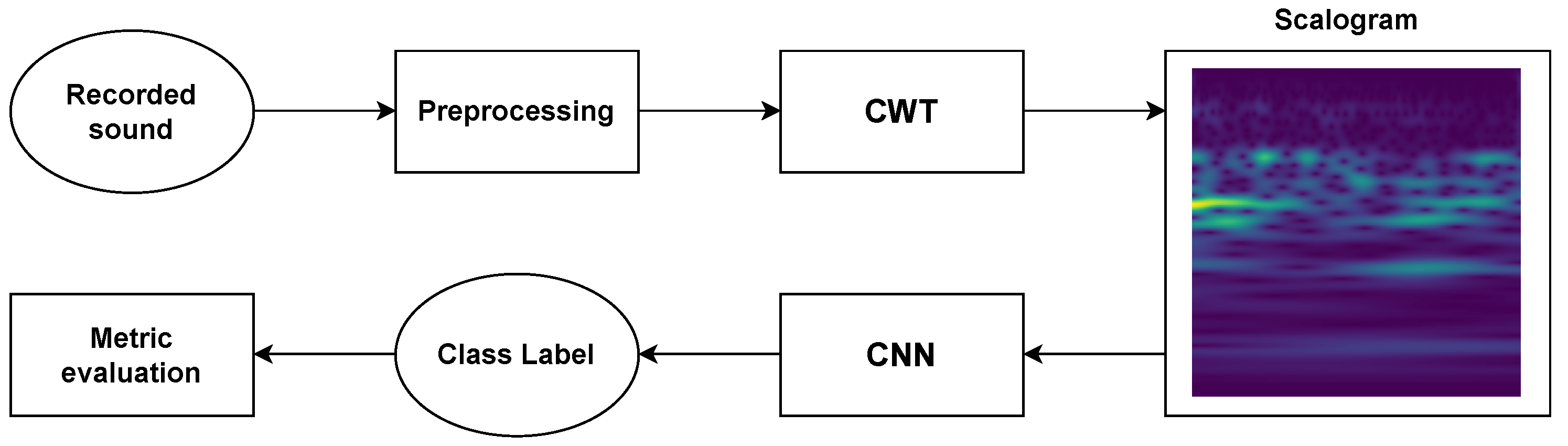
Motivated by these considerations, in this paper, we propose a new approach for the automatic monitoring of construction sites based on CNNs and scalograms. The scalogram was defined as the squared magnitude of the Continuous Wavelet Transform (CWT) [
23]. By overcoming the intrinsic time–frequency trade-off, the scalogram is expected to offer an advanced and robust tool to improve the overall accuracy and performance of ACSM systems. In addition, the wavelet transform allows to it work at different time scales, which is a useful characteristic for the processing of audio data. Hence, the main idea of the paper is to use the scalogram instead of the spectrogram as the input to a CNN-based deep learning model. Although the methodology is not new, the proposed idea has been extensively tested on real data acquired in construction sites and, compared to most popular state-of-the-art methodologies, shows clear and significant improvements.
The rest of this paper is organized as follows.
Section 2 shows the related work.
Section 3 introduces the CWT, while
Section 4 describes the proposed approach. Then,
Section 5 explains the adopted experimental setup.
Section 6 describes some implementation aspects, while
Section 7 shows the obtained numerical results and confirms the effectiveness of the proposed idea. Finally,
Section 8 concludes the work and outlines some hints for future research.
2. Related Work
In the digital era, great and increasing attention has been devoted to research on automated methods for real-time monitoring of activities in construction sites [
15,
24,
25]. These modern approaches are able to offer better performance with respect to the most traditional techniques, which are typically based on manual collection of on-site work data and human-based construction project monitoring. In fact, these activities are typically time-consuming, inaccurate, costly, and labor-intensive [
13]. In the last years, the literature related to applications of deep learning techniques to the construction industry has been continuously increasing [
26,
27]. In particular, many works have been published describing proper exploitation of audio data [
5,
16].
The work of Cao et al. in [
28] was one of the first attempts in this direction. They introduced an algorithm based on the processing of acoustic data for the classification of four representative excavators. This approach is based on some acoustic statistical features. Namely, for the first time the short frame energy ratio, concentration of spectrum amplitude ratio, truncated energy range, and interval of pulse (i.e., the time interval between two consecutive peaks) were developed in order to characterize acoustic signals. The obtained results were quite effective for this kind of source; however, no other types of equipment were considered.
Paper [
29] proposed the construction of a dataset of four classes of equipment and tested several ML classifiers. The results obtained in this work were aligned to those shown in [
5], which compared and assessed the accuracy of 17 classifiers on nine classes of equipment. These two papers work on both temporal and spectral features extracted from audio signals. Similarly, Ref. [
30] compared some ML approaches on five input classes by using a single in-pocket smartphone, obtaining similar numerical results.
Akbal et al. [
14] proposed an SVM classifier. After an iterative neighborhood component analysis selector chooses the most significant features extracted from audio signals, this classifier produces an effective accuracy on two experimental scenarios. Moreover, Kim et al. [
7] proposed a sound localization framework for construction site monitoring able to work in both indoor and outdoor scenarios.
Maccagno et al. [
31] proposed a deep CNN-based approach for the classification of five pieces of construction site machinery and equipment. This customized CNN is fed by the STFT spectrograms extracted from different-sized audio chunks. Similarly, Sherafat et al. [
32] proposed an approach for multiple-equipment activity recognition using CNNs, tested on both synthetic and real-world equipment sound mixtures. Different from [
31], this work implements a data augmentation method to enlarge the used dataset. Moreover, this model uses a moving mode function to find the most frequent labels in a period ranging from 0.5 to 2 s, which generates an acceptable output accuracy. The idea to join different output labels inside a short time period was also exploited in [
33,
34], which implement a Deep Belief Network (DBN) classifier and an Echo State Network (ESN), respectively.
Kim et al. in [
35] applied CNNs and RNNs to spectrograms for monitoring concrete pouring work in construction sites, while Xiong et al. in [
6] used a convolutional RNN (CRNN) for activity monitoring. Moreover, Peng et al. in [
36] used a similar DL approach for a denoising application in construction sites. On the other hand, Akbal et al. [
37] proposed an approach, called DesPatNet25, which extracts 25 feature vectors from audio signals by using the data encryption standard cipher and adopts a k-NN and an SVM classifier to identify seven classes.
Additionally, some other approaches also fused information from two different modalities. For example, the work in [
38] used an SVM classifier by combining both auditory and kinematics features, showing an improvement of about 5% when compared to the use of only individual sources of data. Similarly, Ref. [
39] exploited visual and kinematic features, while [
40] utilized location data from a GPS and a vision-based model to detect construction equipment. Finally, a multimodal audio–video approach was presented in [
41], based on the use of different correlations of visual and auditory features, which has shown an overall improvement in detection performance.
In addition, Elelu et al. in [
42] exploited CNN architectures to automatically detect collision hazards between construction equipment. Similarly, the work in [
43] presented a critical review of recent DL approaches for fully embracing construction workers’ awareness of hazardous situations in construction sites by the employment of auditory systems.
Most of the DL approaches described in this section work on the spectrogram extracted from audio signals or some variants, such as the mel-scaled spectrogram. However, the idea of exploiting different time scales (which is an intrinsic property of audio signals) can be used to improve the overall accuracy of such methodologies. For this purpose, the use of scalograms can be recommended. In fact, while spectrograms are suitable for the analysis of stationary signals providing a uniform resolution, the scalogram is able to localize transients in non-stationary signals. Recently, in fact, Ref. [
44] introduced a wavelet filter bank for the audio scene modeling task. A deep CNN fed by the scalogram of data outperformed the results provided by the mel spectrogram. However, differently from our approach, the work in [
44] considers a scalogram of smaller size and a simpler CNN architecture. The work in [
45] adopted scalograms for removing background noise in the fault diagnosis of rotating machinery, obtaining excellent experimental results. However, differently from our approach, given the specific nature of the considered sounds, the authors used a low sampling frequency and frame size, resulting in a very small scalogram size (
pixels). Interestingly enough, [
45] considers three different methods to obtain the scalograms, including the CWT. No significant statistical differences have been observed between such methods. In addition, a couple of papers used scalograms also for audio scene classification purposes [
46,
47]. Both of these works showed very good results when compared to previous solutions. As a matter of fact, the use of the scalogram results in a general improvement in performance as highlighted in all these works. Specifically, the work in [
46] exploits a pre-trained CNN to extract, at a specific architecture-dependent layer, useful features to be used by a subsequent linear SVM classifier for the identification of ten environmental categories. This work also uses AlexNet but, differently from our approach, it does not train the CNN layers and does not adopt fully connected layers as a classifier. The work in [
47] again uses a pre-trained AlexNet or VGG16/19 nets to extract meaningful features, but, differently, it exploits a Bidirectional Gated Recurrent Neural Network followed by a highway layer to classify fifteen classes. Differently from our approach, the authors of [
47] adopt an early data fusion technique by feeding the proposed model with a three-channel image composed of a spectrogram, a scalogram extracted with the Bump wavelet, and a scalogram obtained with the Morse wavelet. However, the high computational cost of this approach, compared with the proposed one, makes it not very suitable for working with the construction site sounds, where only a small number of classes are present.
3. The Continuous Wavelet Transform (CWT) and the Scalogram
In order to overcome the trade-off between the time and frequency resolution in STFT, the Continuous Wavelet Transform (CWT) was introduced [
23]. The CWT acts as a “mathematical” microscope in the sense that different parts of the signal may be examined by adjusting the focus.
Given a stationary signal
, the CWT is defined as the product of
with the following basis function family:
where
is a scaling factor (also known as dilation parameter) and
is the time delay, i.e.,
is a scaled and translated version of the mother wavelet function
. Hence, the CWT of signal
is formulated as:
where
represents the complex conjugation operator. The delay parameter
provides the time position of the wavelet
, while the scaling factor
a rules its frequency content. For
, the wavelet
is a very concentrated and narrow version of the mother wavelet
, with a frequency content mainly condensed at high frequencies. On the other hand, for
, the wavelet
is much more broadened and concentrated towards low frequencies.
In the wavelet analysis, the similarity between the signal and the wavelet is measured as and a vary. Dilation by a factor results in different enlargements of the signal with distinct resolutions. Specifically, the properties of the time–frequency resolution of the CWT are summarized as follows:
The temporal resolution varies inversely to the carrier frequency of the wavelet ; therefore, it can be made arbitrarily small at high frequencies.
The frequency resolution varies linearly with the carrier frequency of the wavelet ; therefore, it can be made arbitrarily small at low frequencies.
Hence, the CWT is well suited for the analysis of non-stationary signals containing high-frequency transients superimposed on long-lasting low-frequency components [
23].
The CWT implements the signal analysis at various time scales. For this reason, the squared absolute value of the CWT is called a scalogram, and it is defined as:
The scalogram
provides a bi-dimensional graphical representation of the signal energy at the specific scale parameter
a and time location
.
In general, the mother wavelet
can be any band-pass function [
23]. The Haar wavelet is the simplest example of a wavelet, while the Daubechies one is a more sophisticated example. Both of these wavelets have a finite (and compact) support in time. The Daubechies wavelet has a longer length than the Haar wavelet and is therefore less localized than the latter. However, the Daubechies wavelet is continuous and has a better frequency resolution than the Haar one [
23]. Other famous wavelet families are the Mexican Hat wavelet (which is proportional to the second derivative function of the Gaussian probability density function), the Bump wavelet, the generalized Morse wavelet, and the Morlet one, also known as the Gabor wavelet. This last wavelet is composed of a complex exponential multiplied by a Gaussian window, and it is very suitable for audio and vision applications since it is closely related to human perception. For this purpose, we remark that it is strongly related to the short-time analysis performed by the peripheral auditory system and to the mechanical spectral analysis performed by the basilar membrane in the human ear [
48]. As a matter of fact, the Morlet wavelet is the most widely used wavelet for audio applications [
49], and its effectiveness has been shown in analyzing machine sounds [
50]. Motivated by these considerations, in the rest of the paper, we use the Morlet wavelet, which is defined as:
where
is a normalization factor used to meet the admissibility condition,
is the central frequency of the mother wavelet (the carrier), and
is the variance of the Gaussian window equal to:
. The parameter
n, called the number of wavelet cycles and set in this paper to
, defines the time–frequency precision trade-off.
6. Implementation Aspects
In this section, we provide some important remarks about the implementation aspects of the proposed idea.
The computation of the CWT can be memory and computationally demanding. For this reason, we recommend not exceeding the chunk size; 30 ms or 50 ms represents a good compromise between the efficiency and tracking performance of the classifier due to the intrinsic non-stationarity of audio signals.
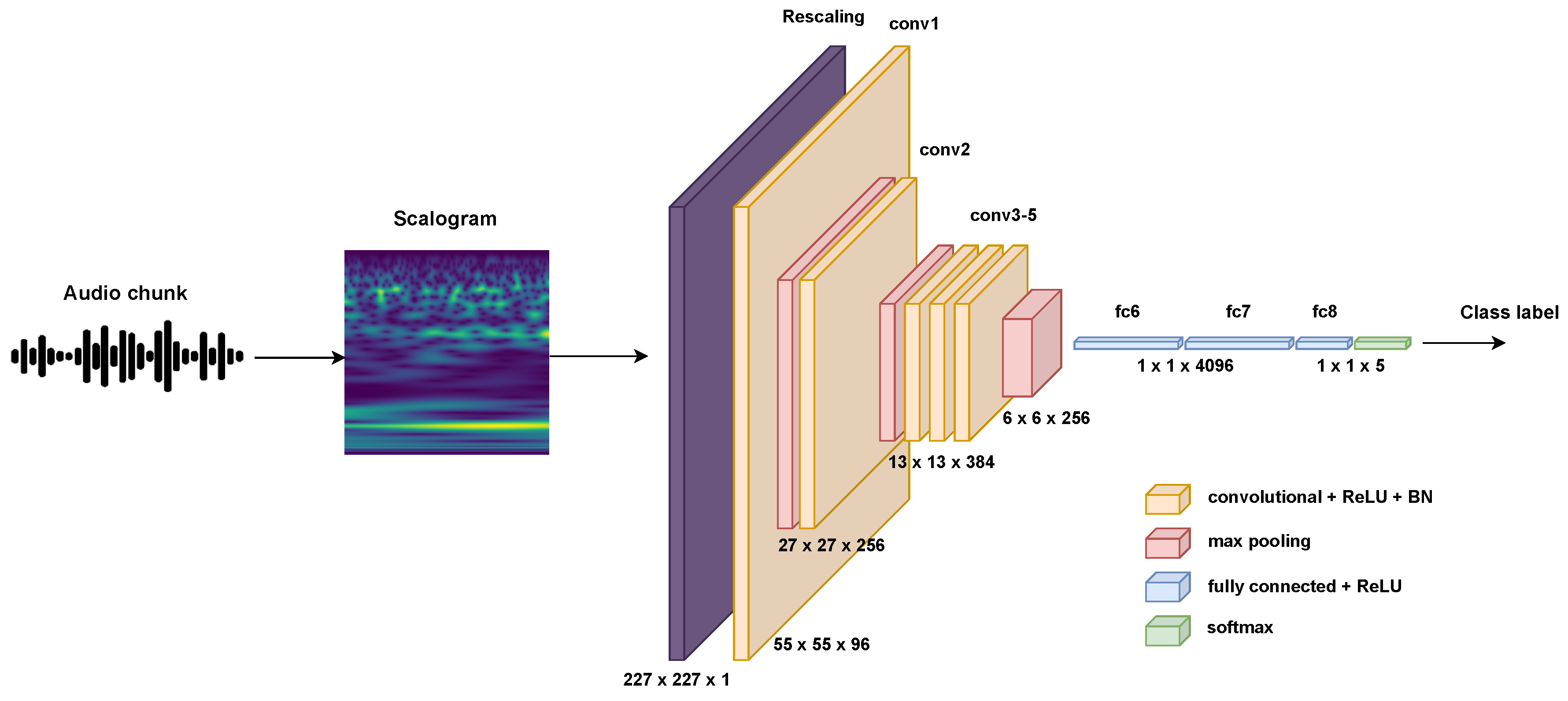
The CWT applied to a 30 ms chunk returns a matrix of the size . In view of using such data as the input to a state-of-the-art CNN, it is convenient to resize the matrix to a commonly used size. Generally, (for AlexNet) or (for GoogLeNet, ResNet, and similar architectures) are adequate choices.
However, saving more than 150,000 (see
Table 1) floating-point matrices of
entries requires a large amount of disk space and a consistent quantity of RAM memory to load and process the dataset. For this purpose, after the resize, these matrices have been scaled to the interval
, converted to integer numbers, and saved as images. In this way, it is possible to work with this dataset on a normal office PC while avoiding memory explosion.
Finally, to deal with such data, an additional Rescaling layer has been used in the customized version of AlexNet. This layer converts the integer input data back into the float interval .
7. Experimental Results
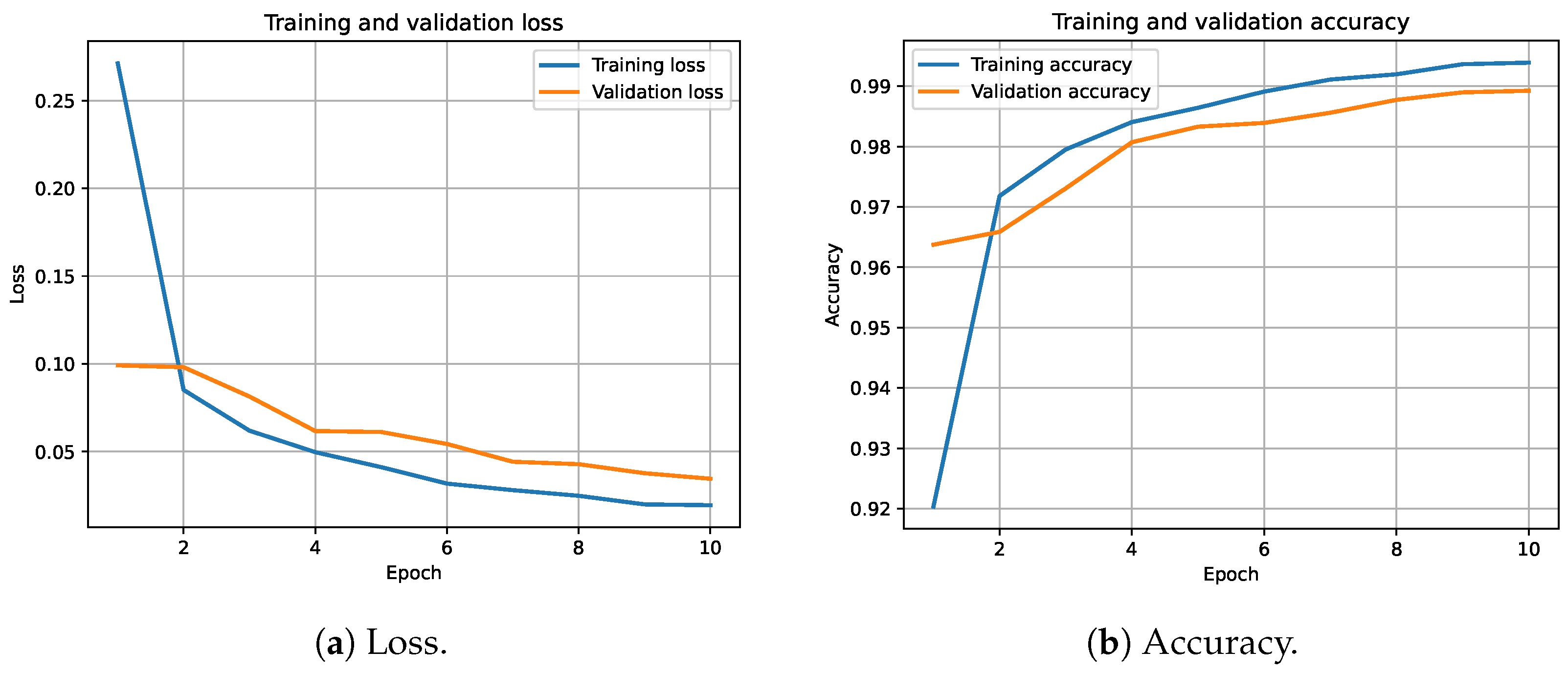
The proposed model has been trained on the considered dataset for 10 epochs by using 10% of the training set as the validation set (Python 3.10 source code can be downloaded from:
https://github.com/mscarpiniti/CS-scalogram, accessed on 20 November 2023). The training and validation losses obtained during the training phase are shown in
Figure 4a, while
Figure 4b shows the corresponding training and validation accuracy. These figures demonstrate the effectiveness of the training, showing that the training procedure is quite stable after about seven epochs.
Figure 4b also shows that, at convergence, the training accuracy is about 99.5%, while the validation one is about 99%.
To evaluate the proposed approach, we have also used the overall accuracy, the per-class precision, the per-class recall, and the per-class F1-score, as well as their weighted averages [
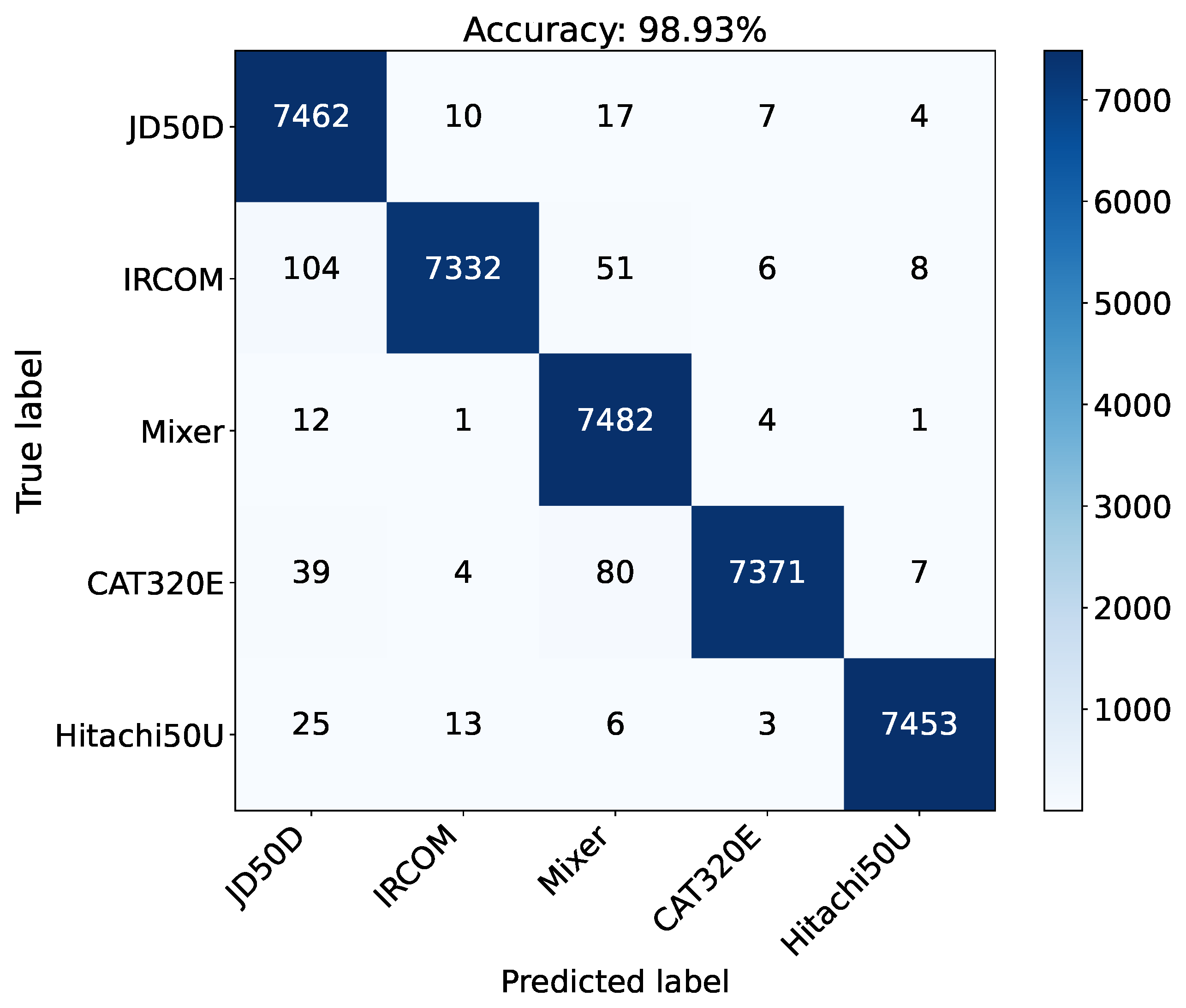
53], computed on the test set. Moreover, the confusion matrix is shown in
Figure 5. The confusion matrix clearly shows that the proposed approach is able to provide very good results for the classification of real-world signals recorded in construction sites. In fact, most of the instances are in the main diagonal of the matrix. There is a little confusion between the compactor (IRCOM), which has been confused with the JD50D excavator and the concrete mixer, and the CAT320E excavator, which is, again, mainly confused with the JD50D excavator and the concrete mixer. This behavior is due to the fact that all of these pieces of equipment have similar engines.
The results in terms of the precision, recall, and F1-score of the proposed approach are summarized in
Table 3. In addition, this table confirms the conclusion drawn from the confusion matrix in
Figure 5: the JD50D and Concrete Mixer classes have lower precision, while the compactor (IRCOM) and CAT320E excavator show lower recall. However, the F1-score is quite stable among all classes. The Hitachi 50U excavator performs the best in between the five considered classes. Despite this slight variability in performance, the weighted averages of the considered metrics are very good and settled at 0.989.
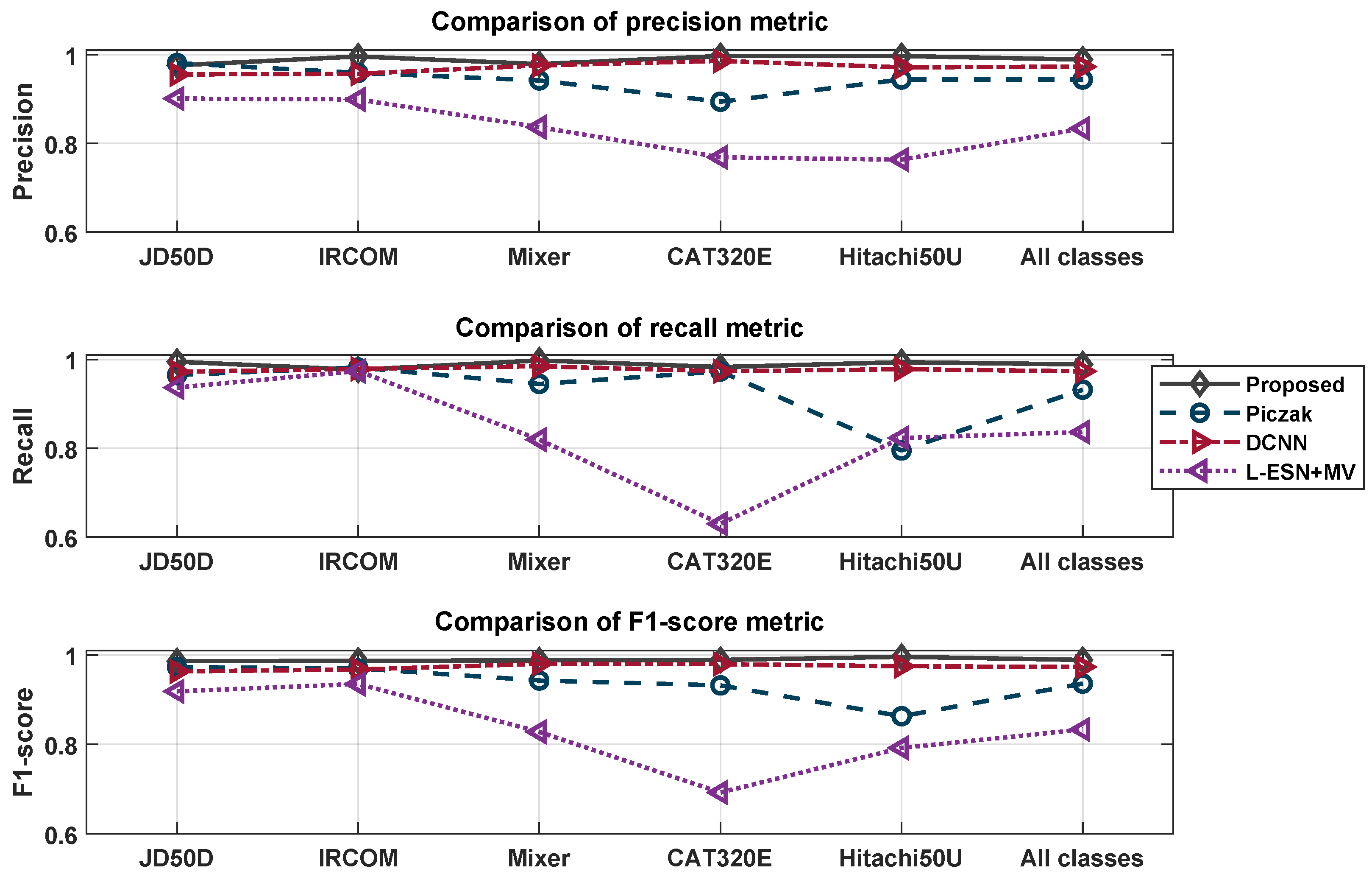
The proposed approach was compared with similar state-of-the-art solutions. Specifically, we compared our approach to the one proposed by Piczak in [
4], based on a CNN fed by the spectrograms with corresponding deltas (i.e., the difference of the feature among two consecutive time instants); the approach proposed by Maccagno et al. in [
31], based on a custom deep CNN (DCNN) fed by the spectrograms; and the approach proposed by Scarpiniti et al. in [
34], based on an ESN working on several spectral features and a majority voting between adjacent chunks. The results obtained by these state-of-the-art approaches in terms of precision, recall, F1-score, and their weighted averages are shown in
Table 4,
Table 5, and
Table 6, respectively. The results presented in these tables confirm that the approach proposed in this paper (see
Table 3) performs better than the state of the art for all of the considered metrics.
Figure 6 summarizes all of the considered metrics for these compared approaches.
In addition,
Table 7 and
Table 8 show the results of the works proposed by [
44,
46], which use scalogram-based approaches for acoustic scene classification. We adapt these approaches to work with the scalograms extracted from the construction site sounds. These tables show that, although the works proposed in [
44,
46] provide good results, the performance is slightly lower than the proposed approach reported in
Table 3.
Although the Morlet wavelet in (
4) is the most used and effective wavelet family in nonstationary audio analysis, we have also tested two other well-known and well-used wavelet families: the generalized Morse and the Bump wavelets [
47], respectively. The results in terms of per-class precision, recall, and F1-score, and their related weighted averages, are shown in
Table 9. From this table, we can argue that results of the generalized Morse wavelet are quite similar to those obtained by using the Morlet one (see
Table 3). On the other hand, the results related to the Bump wavelet are slightly worse, even if they are quite good. The overall accuracies of these two approaches were 98.50% and 97.45%, respectively. These considerations confirm the effectiveness of the Morlet wavelet for analyzing audio signals in general and engine sounds in particular.
Finally, in
Table 10, we summarize the previous results of the proposed approach (last row) and the compared ones by considering some additional machine learning and deep learning approaches. Specifically,
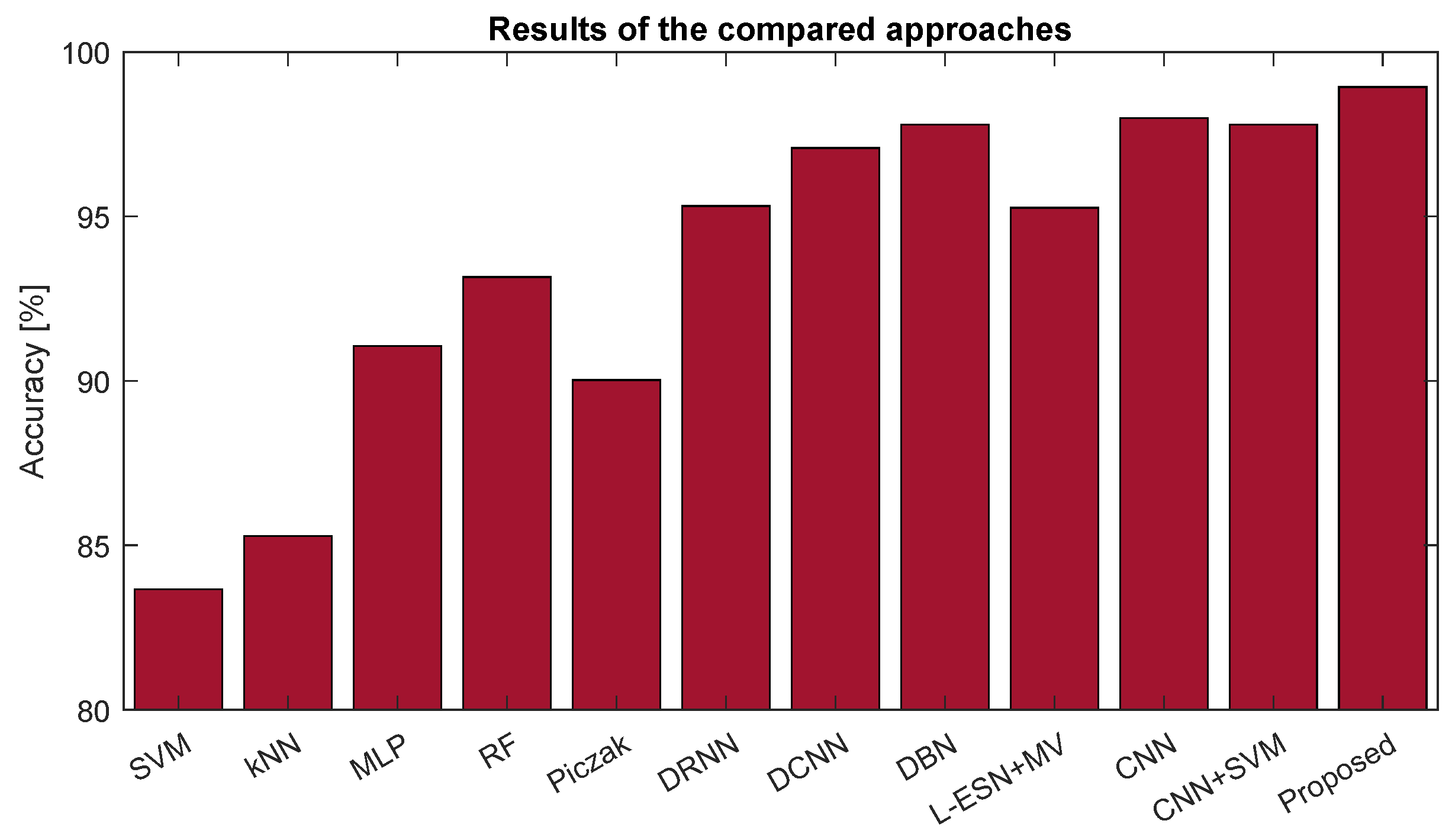
Figure 7 shows the accuracy of the compared approaches as a bar plot. Among the machine learning techniques, we considered the results obtained by using a Support Vector Machine (SVM), the k-Nearest Neighbors (k-NN), the Multilayer Perceptron (MLP), and a random forest. All of these approaches provided reasonable results [
5], though the results were worse than those provided by deep learning techniques. Among these last methods, we also considered an approach based on a Deep Recurrent Neural Network (DRNN) that exploits different spectral features [
54] and one based on a Deep Belief Network (DBN) that works on a statistical ensemble of different spectral features [
33]. For the implementation details, we refer to the related references. The results reported in
Table 10 and
Figure 7 clearly show once again the effectiveness of the proposed idea, which can be considered an effective and reliable approach for classifying real-world signals recorded in construction sites.
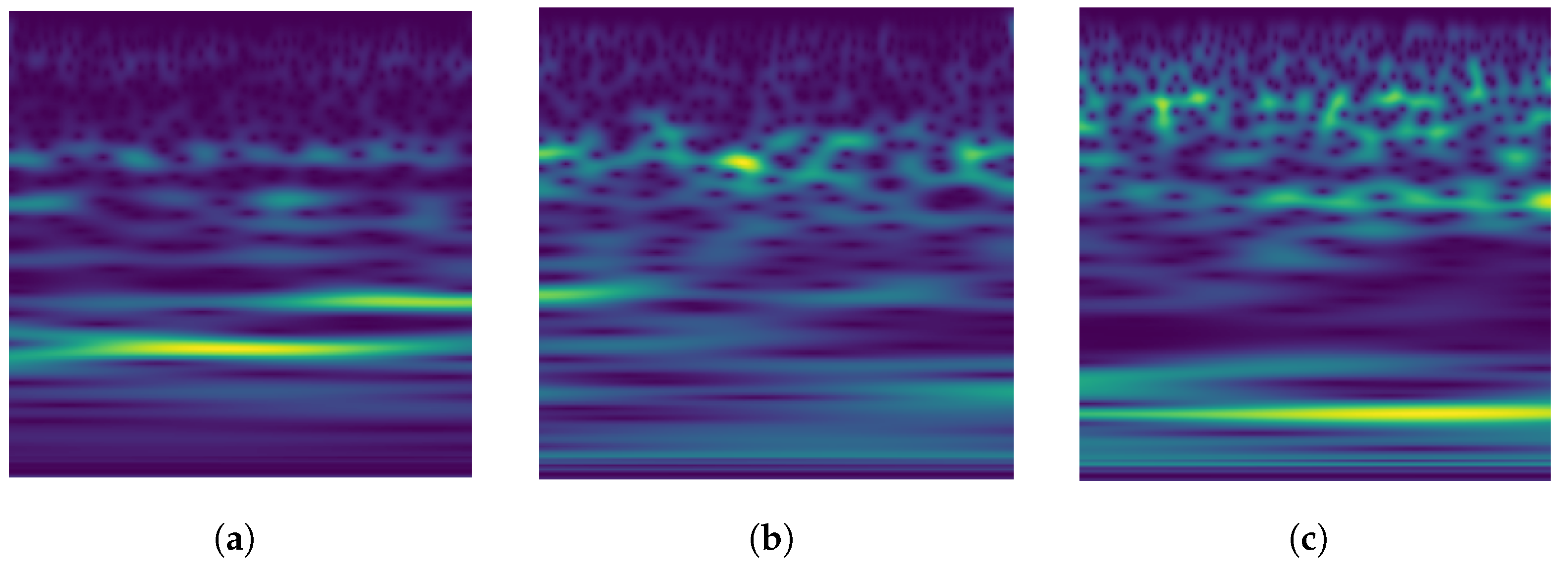
As a discussion, we can observe that scalograms generally capture salient localized events in sound frames, as shown by the horizontal lines or cloud-like points in
Figure 3. In addition, the convolutional layers of the CNN are able to learn discriminative features, as shown in
Figure 8, which, for example, shows the 256 feature maps of the fifth and last convolutional layer of the used architecture. Although single plots in the figure are quite small, it is clear that feature maps in the final layer are more specialized in detecting specific time scales. In fact, the scalogram in
Figure 8 shows clear horizontal lines localized at a specific scale. This kind of scale localization is typical of engines, a fundamental part of the machines considered in our dataset. This behavior justifies the better performance of the proposed approach for the classification of equipment sounds in construction sites.