1. Introduction
For the vibration suppression of eccentric rotors, the passive balancing devices that are more widely applied and researched currently are Automatic Ball Balancers (ABBs) at present. The main components are composed of a circular orbit mechanism, mounted perpendicular to the spindle of the rotor and revolving with the rotor, and several balls that can freely move inside the track. In 1975, Sharp [
1] established an ideally mounted two-ball balancer of a plane rotor system from the 2D viewpoint and derived the equations of motion to analyze stability. Lee [
2] in 1996, Green [
3] in 2006, and Lu [
4] in 2009, etc., have explored the problems and phenomena of ABBs’ suppressing vibration in the model without assembly deviations.
However, when assembling the ABBs and eccentric rotor system, assembly deviations may include the deviations of the vertical and horizontal positions of the ABBs’ centroid and the centroid of the eccentric rotor as well as the deflections of the mounted angle. Regarding the discussions of vertical position deviation, Kim [
5] in 2005 and Chao [
6] in 2007 investigated the dynamic behavior of the system when the ABB is mounted at a small distance below the centroid of the plane eccentric rotor theoretically and experimentally, respectively. Numerical analysis and experimental results show that the system can still the approximate ideal-mounted (ABB is coplanar with the planar rotor) balance approach. The radial residual vibration under steady-state operation and the tilting angle during rotor balancing can be effectively reduced by positioning the balls at appropriate angular positions [
5], where the radial amplitude can almost be suppressed, yet the tilting angle during balancing exists in a finite amount [
6]. Furthermore, regarding the discussions of horizontal position deviation, Bykov in 2014 [
7] and 2018 [
8] proposed that the ABB and the planar rotor are coplanar, but the orbital center of the mounted ABB deviates horizontally from the rotor centroid along the rotor plane. In cases where the working speed is greater than the critical speed of the system, there are two types of incomplete balanced steady-state modes. Take the double ball ABB as an example, one is that two balls are gathered on the opposite side of the mass center of the rotor, and the other is half-balanced mode [
7] or called almost balanced mode [
8]. The second one is that two balls are spread by an appropriate amplitude spread angle to suppress (but not completely suppress) the eccentric imbalance of the planar rotor. As for the deflection of the mounting angle, in 2022, Huang [
9] first established an angular deviation model between the plane of ABBs’ track and the plane of the eccentric rotor within the vibration suppression system. The examination principle of the skew-mounted ABB is proposed, comparing the differences in vibration suppression efficiency between skew-mounted and ideal-mounted systems, as well as the conditions of perfect balance.
For the research on ABBs’ vibration control system, across the past decade, many studies have proposed using springs or partitions along the track circumference to improve the ABBs’ performance or reduce the system amplitude at low speeds. Researchers such as Rezaee [
10,
11], Kim [
12], and Haidar [
13], etc., take into account the tangential force along the track, which in turn limits the movement of the balls in the track. However, in most of the literature, it is still assumed that the balls can rotate freely in the track except for viscous damping, and the balls in dynamic balance without any external forces acting along the tangential direction of the track. Additionally, the self-weight of the balls and friction in the track are ignored. Based on these assumed premises, which include single track [
3,
4,
5,
14,
15,
16,
17], double track [
18], radial spring [
19], multiple balls [
20,
21], mounting offset [
7,
8], and mounting deflection [
9] studies, there are various discussions regarding the dynamic characteristics and stability analysis of ABBs’ vibration suppression system. In these studies, the set of the dynamic equilibrium equations of the balls or their balance positions may seem to be different, but the balance mechanisms behind them are consistent.
Commonly seen in the derivation of the dynamic equilibrium equations of the vibration suppression system of the rotor, most use the Euler–Lagrangian method to obtain the governing equations of the system. Only under the condition that their differential terms are zero can we obtain the dynamic equilibrium equations of the system [
1,
2,
3,
4,
5,
6,
9]. Pakuła (2022) [
22] used 2D dynamics to deduce the equilibrium equations under the simultaneous action of multiple ABBs on the same plane and formulated the optimization of the vibration suppression of the system by the assembly locations of the ABBs. In 2023, Mirsaidov et al. presented two studies [
23,
24] on the subject of mounting an eccentric rotor tilted around the horizontal axis on a vertical rotor axis and an ABB with the angular deflection mounted on the eccentric rotor. The effect of two variables on the vibration suppression of the system, such as the amount of eccentricity of the rotor and the deflection angle of the ABB, is considered. The effect is proportional to the angular error of the ABB.
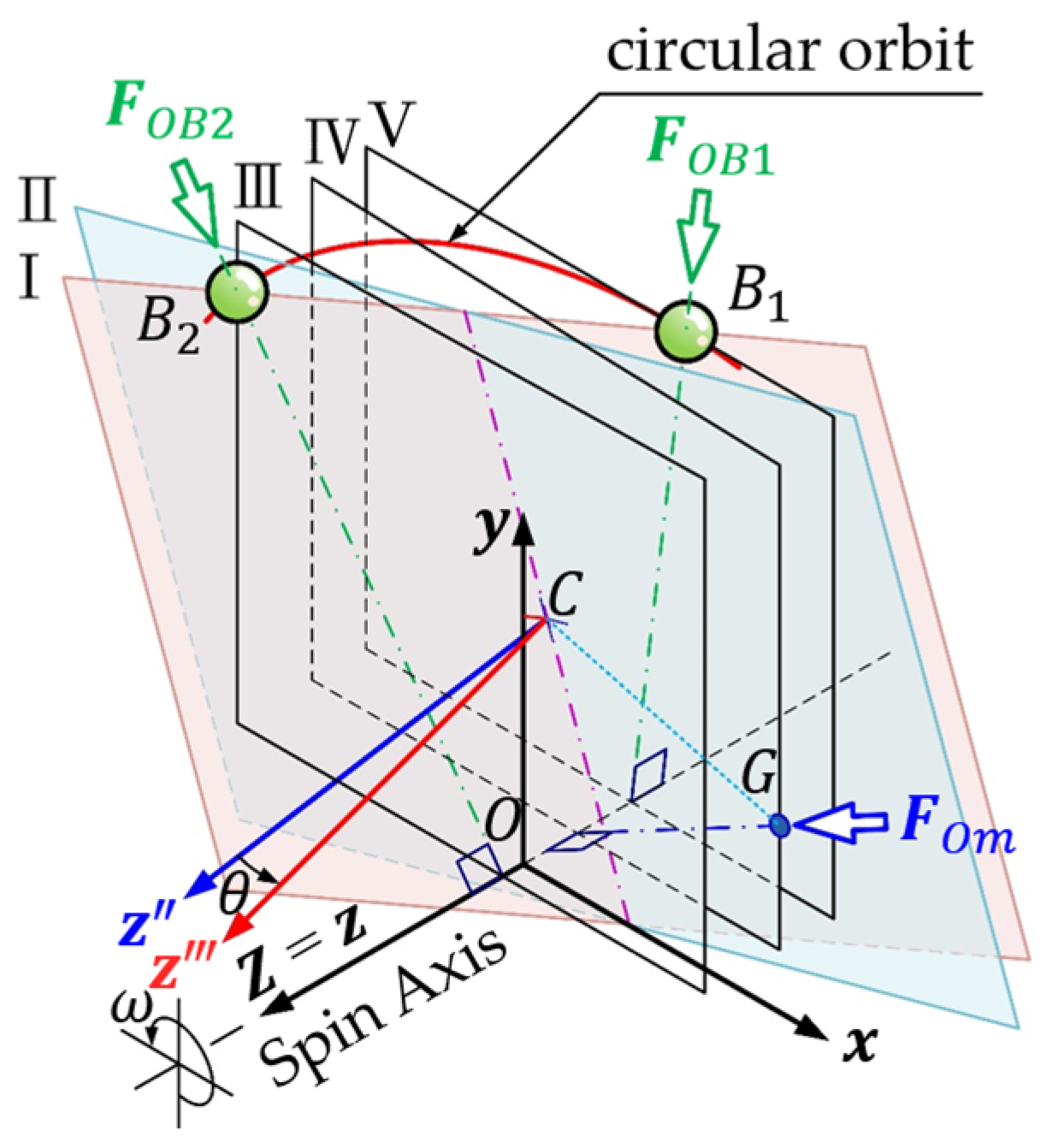
In this paper, in order to verify the dynamic equilibrium equations of the skew-mounted ABB eccentric rotor system, we utilize the 3D dynamics approach for derivation and mutual validation of the results with the Euler–Lagrangian method [
9]. The process aids in finding out the spatial characteristics of the balance positions of the balls in space. Then the mechanical problem of the dynamic balance is converted into a spatial geometric problem for study, and the geometric characteristics of the dynamic balance positioning of the balls in an arbitrary curved track in space are proposed. Finally, the spatial and geographical presentation and numerical analysis are used to verify that the dynamic balance positioning of the balls should actually have a consistent balancing mechanism.
2. System Model
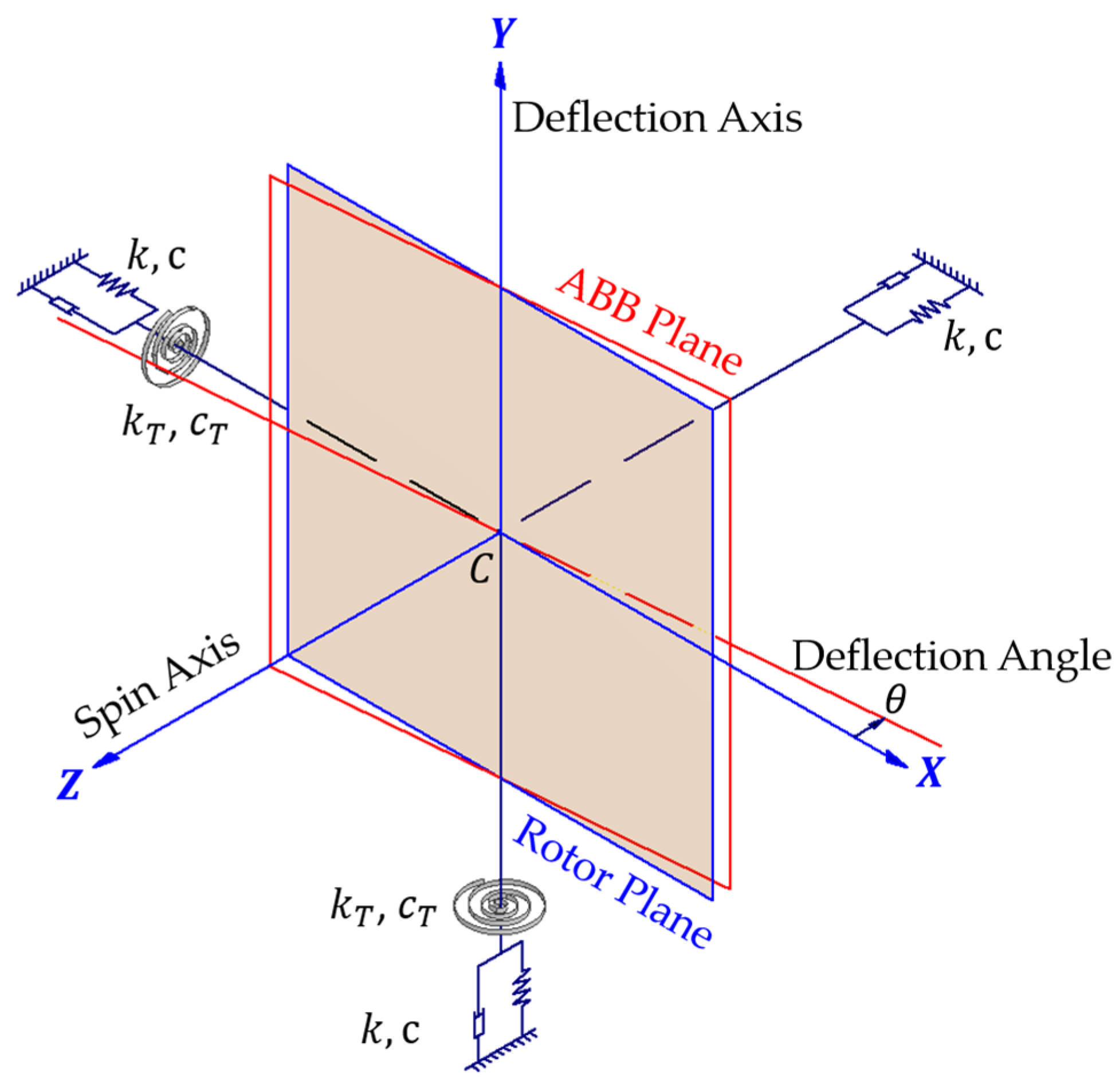
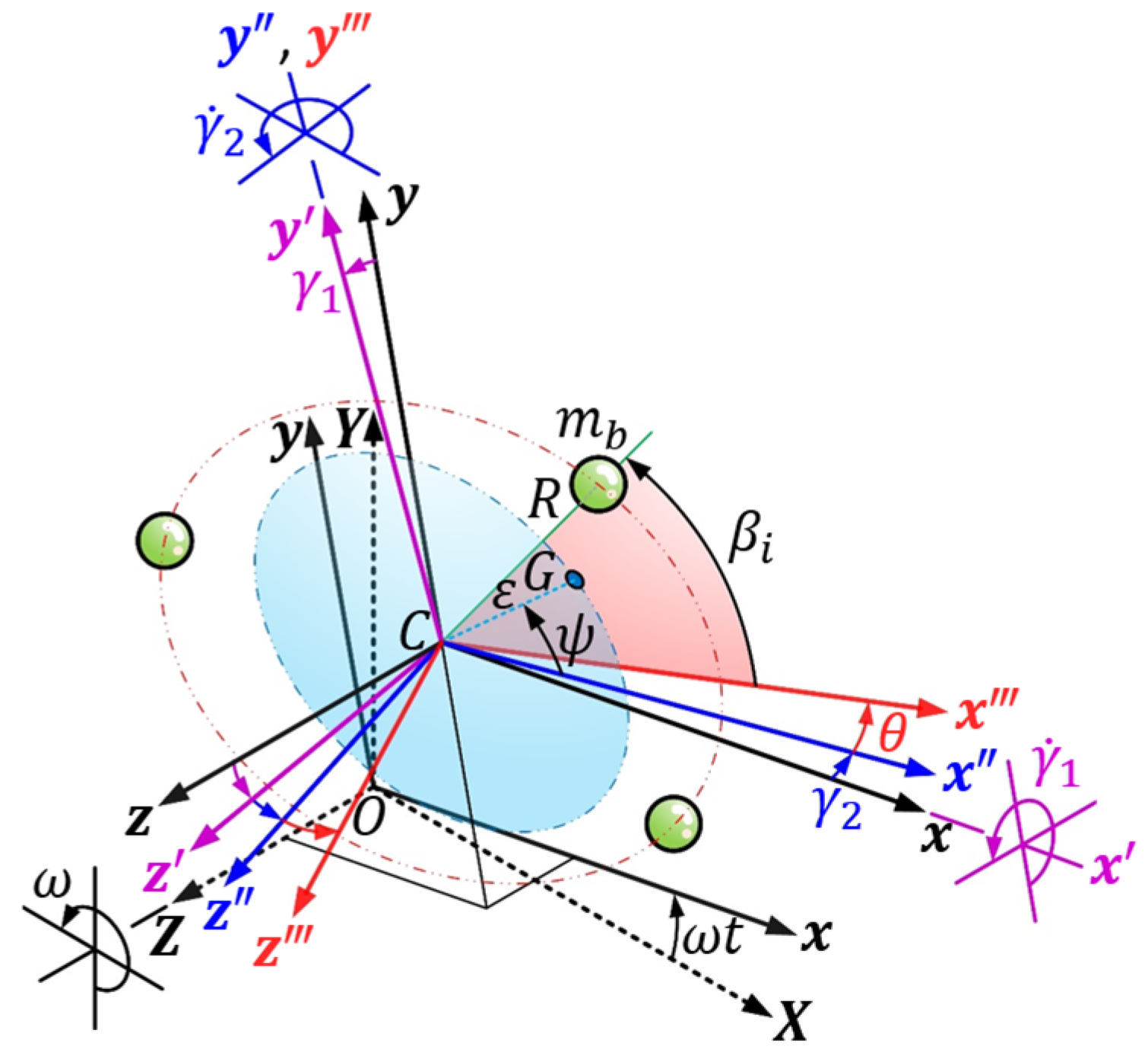
Figure 1 shows the skew-mounted model of the angular deviation between the plane of the balls moving in the ABB track and the rotor plane when the spindle speed is zero. The plane formed by the blue frame in
Figure 1 is the plane where the eccentric rotor is located and
C is its centroid, while the red frame represents the orbital plane of ABB. The ABB plane does not coincide with the rotor plane that is perpendicular to the spin axis of the system at rest. The deflection angle is shown as
. Suppose the skew-mounted ABB is only the angle deflection of the orbital plane without the position deviation of the centroid, then the ABB’s centroid coincides with the centroid
C of the planar rotor at static. The intersection line of two planes should pass through the centroid
C. As shown, the coordinate system
is a space-fixed reference frame of the planar rotor, with the origin defined at the position of its centroid. The intersection line of two planes lies on the
-axis.
When the system operates as stable, due to the deflection of the orbital plane of ABB and the rotor plane, although the centrifugal forces acting on their respective planes both pass through the rotation axis, the intersection of each with the rotation axis is not necessarily the same, which may generate torques for the whole assembly system. In this paper, the spin axis (-axis) of the system is defined as the roll axis in a tri-axial system, and the pitch and yaw angles of the system should be considered for the phenomenon of torque. Therefore, in addition to the tri-axial isotropic linear spring k and viscous damper c, the elastic supports of the system should also consider the roles of the torsion spring and torsion damper in the other two axes except for the spin axis, as shown. The dynamic balance of this 3D model will be analyzed using spatial dynamics.
4. Verification of Spatial Geometric Characteristic
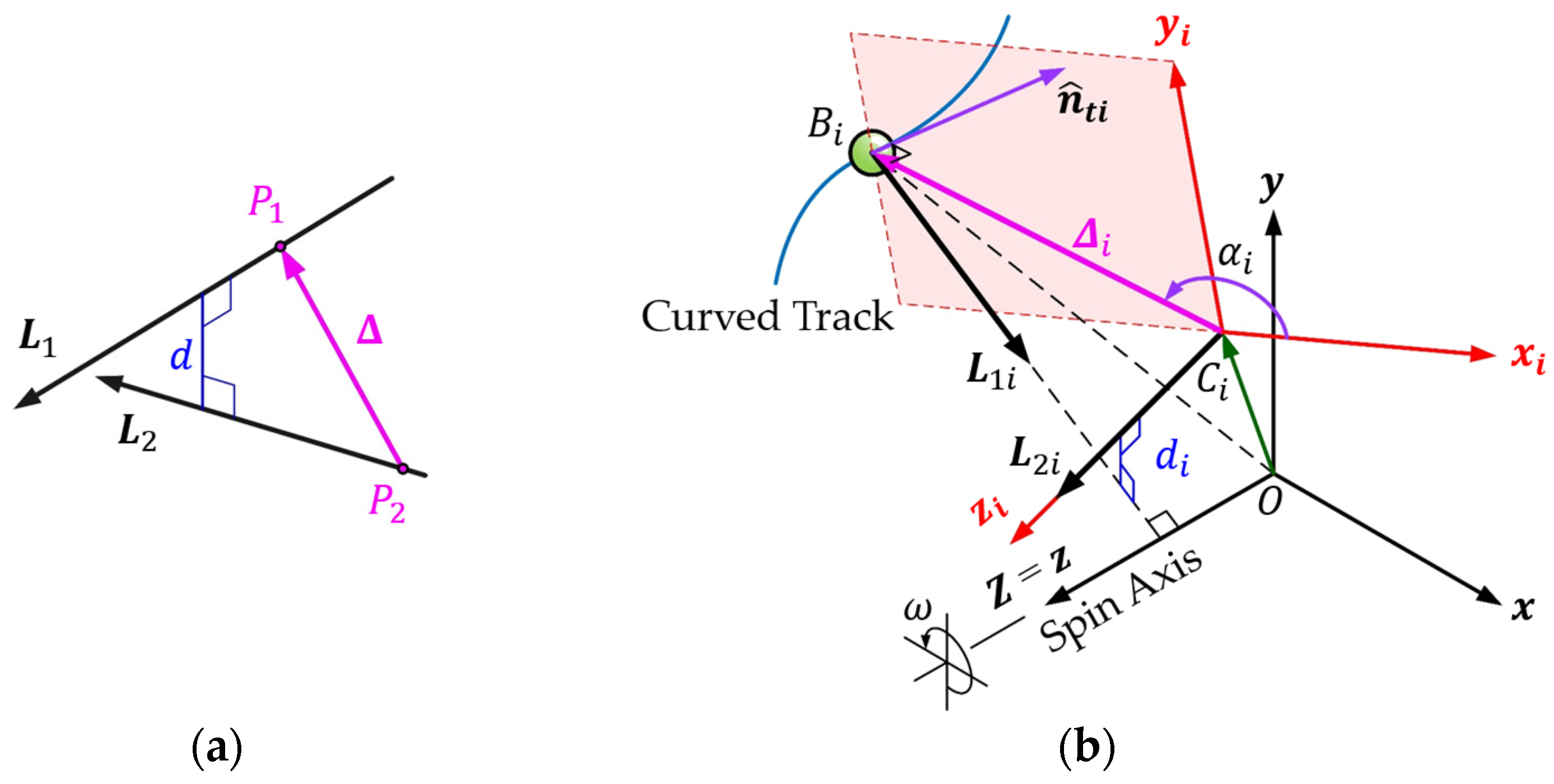
In
Section 3.4, the characteristic of ball positioning in the dynamic equilibrium state is stated. For rigor, the geometric relationship of the space vector is used to examine and verify it. As shown in
Figure 5a, any two vectors
and
in space, where
and
are arbitrary points on the
and
vectors, respectively, and the displacement of point
relative to point
is the vector
. When the shortest distance
between
and
is zero, it means that vector
and vector
intersect in 3D space, where
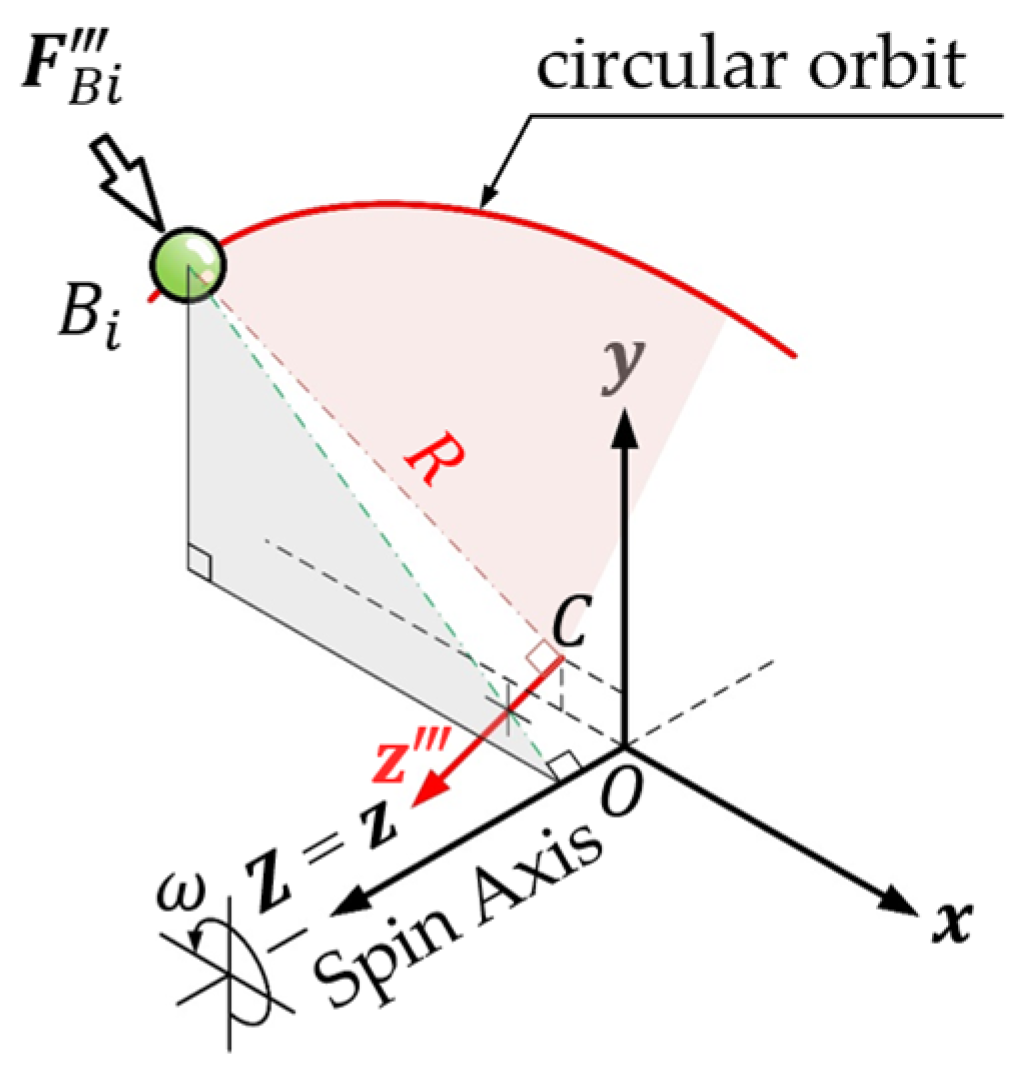
Consider an arbitrary curved track in space rotating around a fixed
-axis in space at constant angular velocity
, and the
coordinate synchronized with the spin axis is selected as the reference coordinate system, as shown in
Figure 5b. First, the perpendicular line from the
i-th ball
to the spin
-axis (
) is described as the spatial vector
. The curvature radius of the curved track at
is
, the curvature center is
and its unit tangent vector is
. Define the vector pointing from
to
as
, and the coordinate system
with
as the origin. The
is the plane formed by the two vectors
and
, and the angular position of the vector
relative to the
-axis is denoted as
. For the equilibrium position
in the space-curved track, the vector
is perpendicular to
. The
-axis is the central axis of curvature perpendicular to the
plane, the unit vector of
-axis is represented by the spatial vector
.
Next, use the Euler coordinate transformation as in
Section 3.1. Taking the
-axis as the roll axis,
as the pitch angle, and
as the yaw angle. The forms of matrices
and
are shown in Equation (1). Denote the vectors
and
in the
coordinate system as, respectively:
In the
coordinate system, the position vector of
is described as
and the position vector of
is described as
.
can be obtained from
and the unit vector
of the
-axis.
Substitute Equations (29) and (30) into Equation (28), the shortest distance between
and
is
In general, it is impossible for the perpendicular of any position in the track to the spin axis of the system to be parallel to or coincide with its curvature center axis. So,
, calculate
to get
For the research of the ABB vibration suppression system, most of the assumptions are that the balls in the track can freely rotate except for viscous damping and that the balls are in dynamic balance without any external forces acting in the tangential direction of the track. At the same time, the self-weight of the balls and the friction within the track are ignored. This study uses Equation (32) to examine various previous research on ABB under the aforementioned assumptions, confirming that the equilibrium positions of the balls in each system all satisfy Equation (32) equal to zero. This means that after any ball in the track is balanced and positioned, the radial vector of its stable rotation intersects with the vector of the curvature center axis of that position in the track. In other words, the balance positioning of the balls in the track must satisfy the spatial–geometric relationship of “the perpendicular from the ball stationing position to the system spin axis intersects with the curvature center axis of the track at that position”. The establishment of this geometric relationship helps to understand and predict the possible positioning of ABB balls.
4.1. Track and Rotor Coplanar
The dynamic balance system can be simplified into a two-dimensional system if the plane of the ABB’s track coincides with the rotor plane. It means that the central axis of the track and the spin axis of the system are always parallel or coincident, i.e.,
. Organize Equation (32) into
4.1.1. Ideal Installation
In addition to the track and the rotor coplanar, if the track center and the rotor centroid coincide with each other, ABB can be regarded as an ideal installation. First, to discuss under ideal installation conditions, the research into ABB with single track [
3,
4,
5,
14,
15,
16,
17], multiple tracks [
18], multiple balls [
20,
21], or radial springs [
19]. After coordinate conversion and careful comparison of the equilibrium equations for ball positioning, we can confirm that each paper can reach the same conclusion and that the results shown can ensure that Equation (34) is satisfied. The geometric properties are described as follows:
- (i)
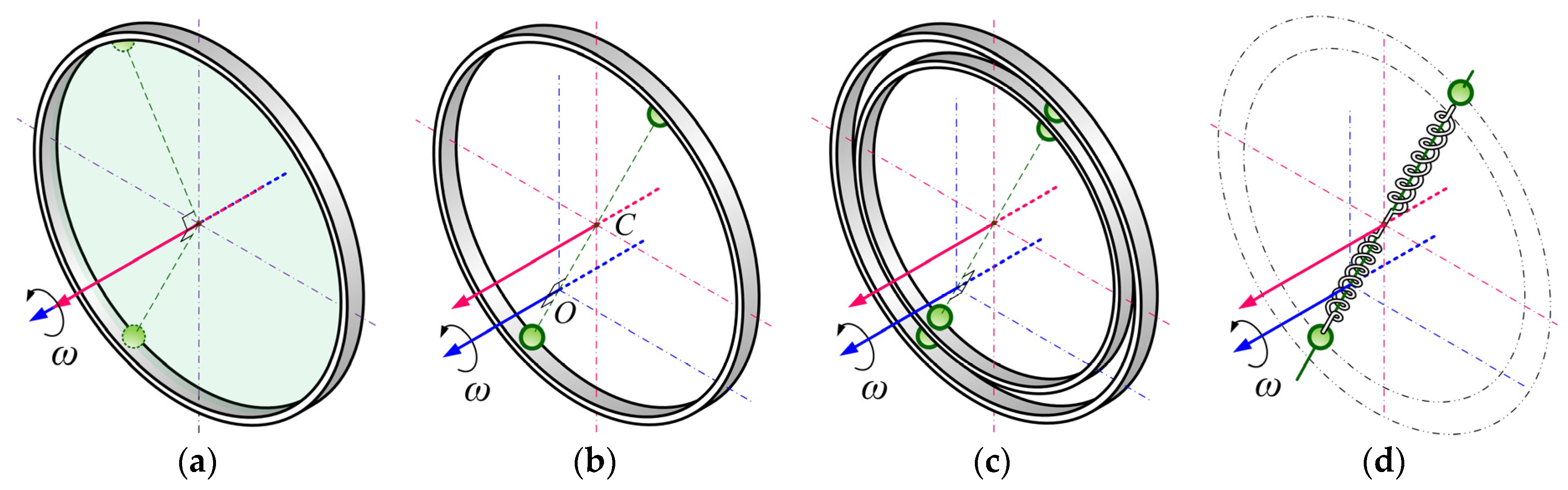
When ABB can completely suppress the vibration of the rotor system, as shown in
Figure 6a, where
, Equation (33) is necessarily satisfied. At this time, the central axis of the track completely coincides with the spin axis of the system, and the balls can be balanced to park at any position within the track. Therefore, regardless of the number of balls, track radius, and the number of tracks, the balls can balance at various corresponding positions in response to different rotor eccentricities.
- (ii)
Regardless of whether the system is operating below or above the critical speed, if ABB cannot completely suppress the vibration of the rotor system, as shown in
Figure 6b, the track center axis is parallel to but not coincident with the spin axis of the system. Equation (34) can be obtained by describing
in Equation (33) in polar coordinate form
. Only if either
or
can the solution satisfy Equation (34).
Discussed from the view of plane geometry, if one wants to make the perpendicular from the ball balance stationing point to the spin axis to intersect with the track center axis, as shown in
Figure 6b, then the straight line passing through points O and C, which intersect the track at two points, can be both the possible and exclusive stationing positions for the balls. The phenomenon also applies to the ball positioning of ABB with multiple balls or multiple tracks or radial springs, as shown in
Figure 6c,d.
4.1.2. Offset Installation
The mounting is offset along the rotor plane when mounting the ABB, then the center of the ABB track does not coincide with the rotor centroid. However, the orbital plane is still coplanar with the rotor plane, and the system in dynamic balance can also be simplified to a two-dimensional system. The equilibrium solutions of the system are as if the balanced steady-state mode described in [
7] or the stationary balanced mode discussed in [
8]. The rotor centroid, when balanced, is located on the spin axis and the balls are only balanced in the direction of the offset installation of the track center. Testing the results of the above two studies, the axis that is perpendicular from the ball to the rotation does intersect with the track center axis, and the geometric relationship inferred in this study is established. The balance positions of the balls are also shown in
Figure 6b.
4.2. Track and Rotor Non-Coplanar (Skew-Mounted or Deflection Installation)
When the track and the rotor are not coplanar, the track center axis and the spin axis of the system are not parallel in space. Compare equilibrium Equation (27) of the system of the skew-mounted ABB and the spatial geometry Equation (32) of arbitrarily curved track: neither the system speed nor the ball mass is zero. If it is a circular orbit, the curvature radius at each equilibrium position in the track is the radius of the orbit, and the curvature center is located at the center of the orbit. Furthermore, if the Euler coordinate transformation and the ball phase angle variables are the same, i.e., =, =, and =, then the two equations are identical. The spatial geometry inference can be fully suited to describe the balance positions of the balls.
4.2.1. Balance Positions Based on Spatial Geometry
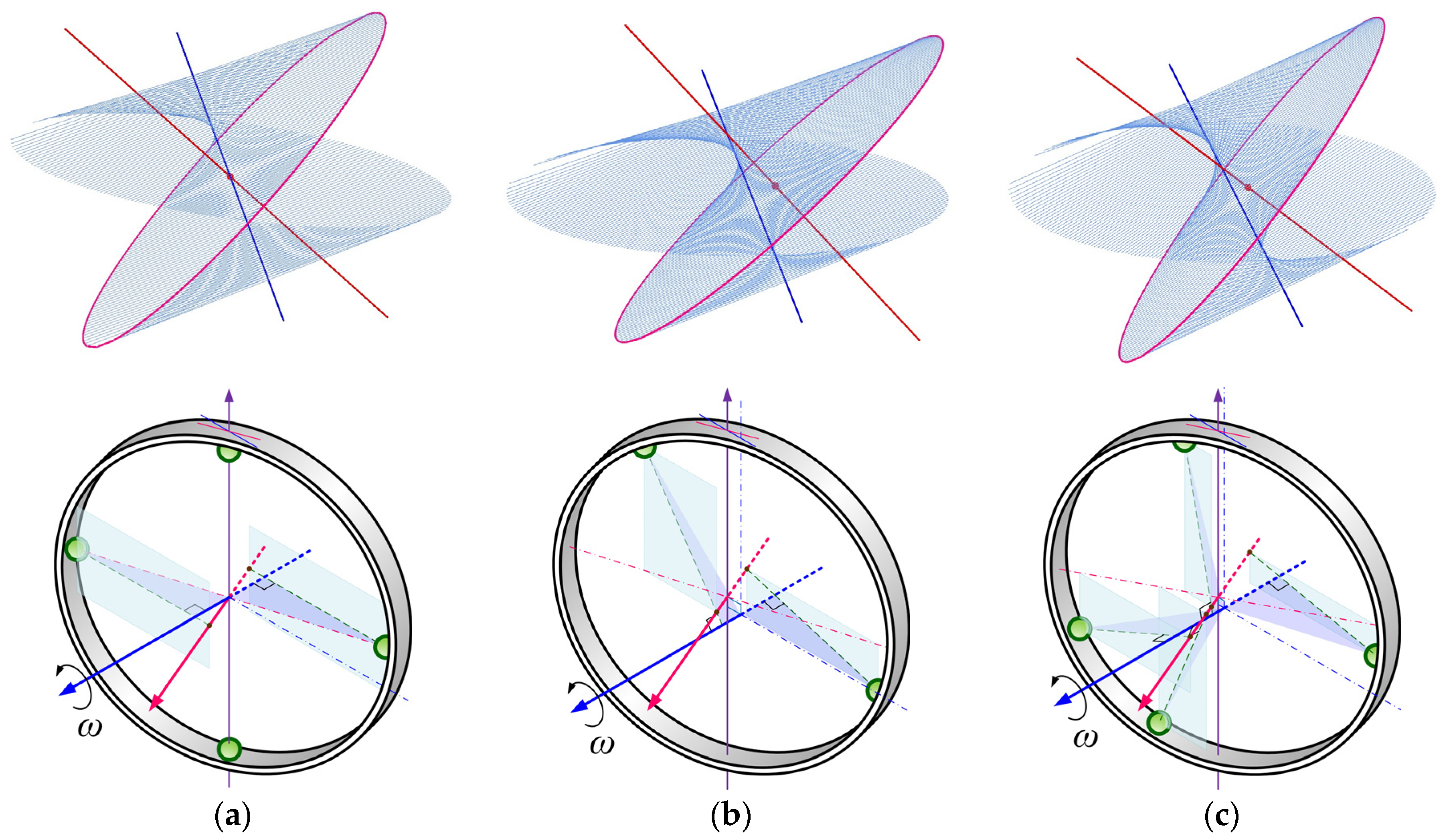
First, draw perpendiculars from each point in the track circumference to the spin axis of the system. It can be presented by the drawing to confirm the balance positions of ABB balls and know whether to satisfy the spatial geometry characteristic. When the system is in dynamic balance, Equation (14) shows that the orbit center is located on the
plane. In the inference of spatial geometry, the
plane is used to describe the orbital plane. For the sake of discussion, the
axis is chosen as the intersection line between the orbital plane and the
plane when the system is dynamically balanced. Let
further simplify Equation (32) as follows:
- (i)
When the spin axis passes through the track center, due to the ABB installation deflection, the perpendiculars of each point on the circumference to the rotary axis intersect with the track center axis at only four positions
, π and ±π/2, as shown in
Figure 7a. This phenomenon aligns with the findings of the examination principle discussed in [
9].
- (ii)
If the spin axis does not pass through the track center, as long as the position of the track center (
) and its equilibrium angle
can be determined, the intersections of the curved surface obtained by drawing perpendiculars to the spin axis at each point on the circumference of the track and the track center axis can be found. For two examples, (1)
= 1,
= −0.1,
= 0.06 and
= 25° and (2)
= 1,
= −0.05,
= 0.05 and
= 30° are shown in
Figure 7b and
Figure 7c, respectively, there may be two (
= −12.77° and
= 111.87°) or four (
= −165.91°,
= 102.58°,
= −9.79° and
= 98.28°) equilibrium positions of the balls.
4.2.2. Numerical Verification
For numerical verification, the dimensionless parameters used are defined as follows:
Under the conditions of system parameters
= 5°,
= 30°,
= 3,
= 0.2,
= 0.1,
= 0.2 and
=
= 0.1, the relationship between
and the ball balance positioning numerically, as shown in
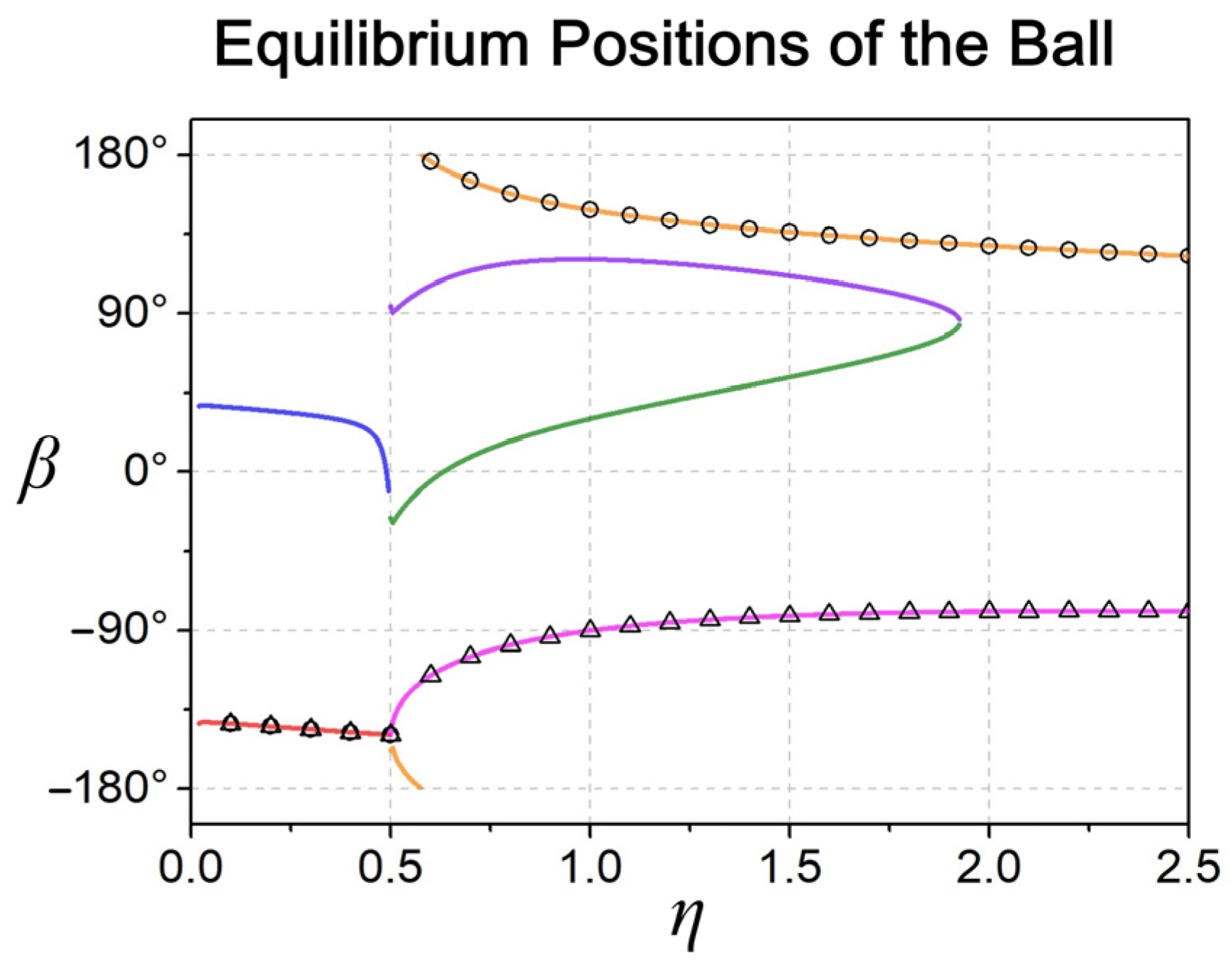
Figure 8. The solid line is the solution obtained by satisfying the spatial-geometric relationship of the axis that is perpendicular to the balls and the track center axis. The part with
η < 0.5 has two real solutions (and a pair of conjugate complex solutions). Starting from
η ≥ 0.5, four real solutions appear, and as the value of
gradually increases (about 1.93), two real solutions remain still. The hollow marked points in the figure are the ball balance positions obtained through numerical integration using the governing equation listed in [
9]. It is worth noting that among the two equilibrium solutions in the
η < 0.5 interval, only one is a stable solution, so the two balls gather together. When
η = 0.5, although there are four equilibrium solutions, only one of them is stable. Two of the four equilibrium solutions in the interval 0.5 <
η < 1.93 are stable. When
η > 1.93, the only two equilibrium solutions are stable.
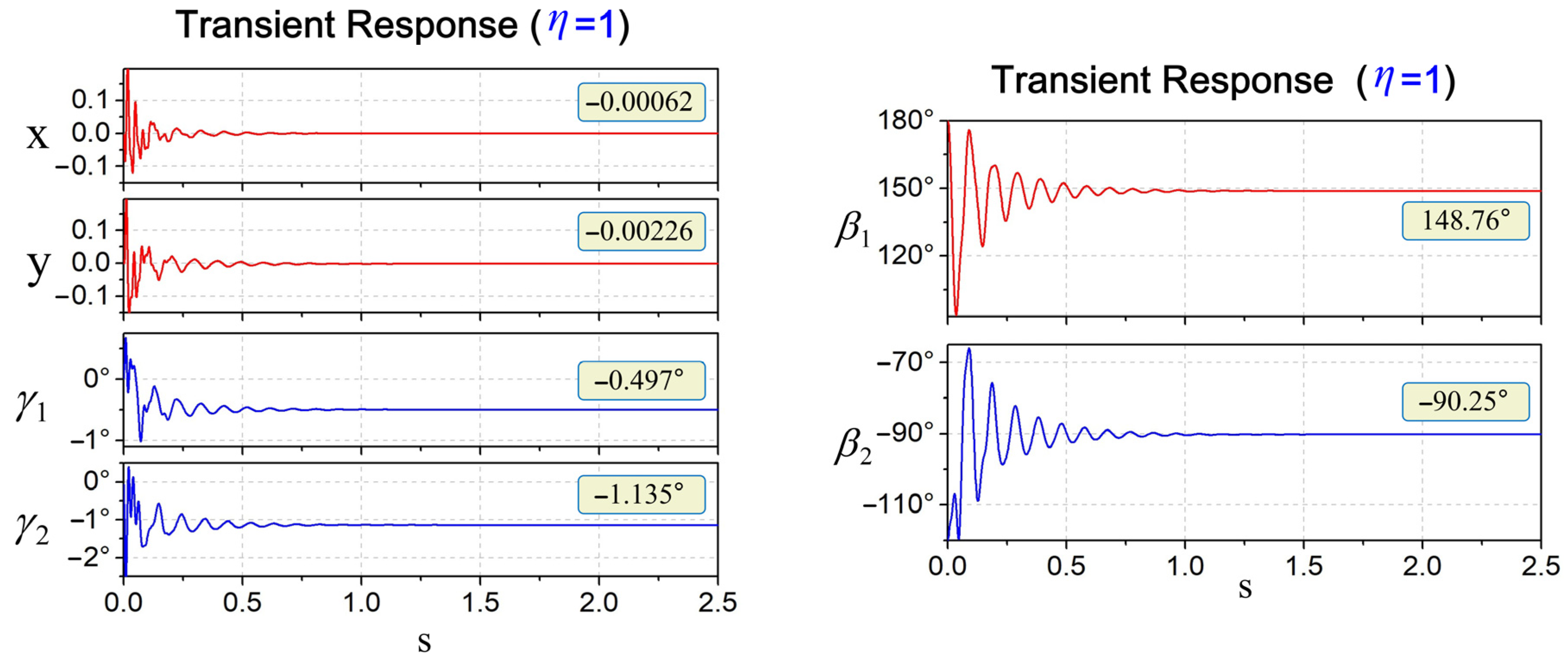
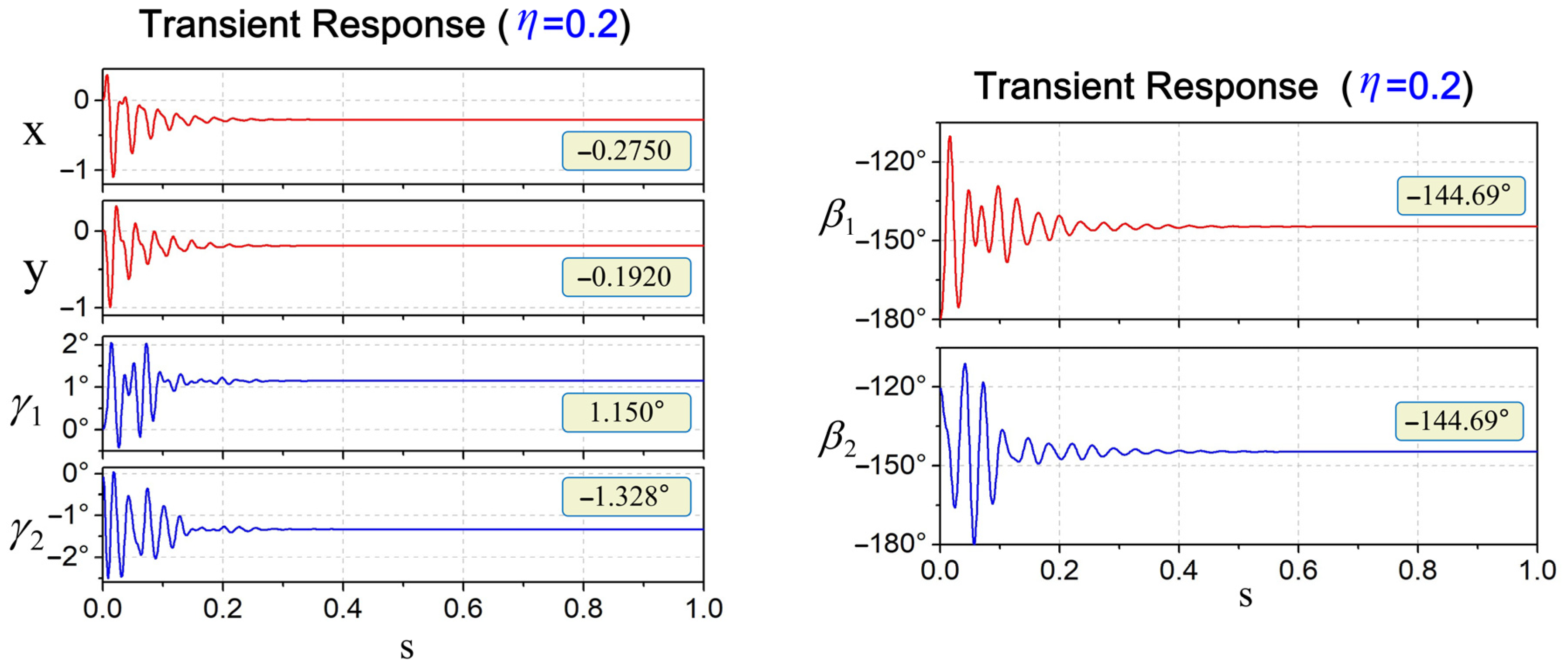
In addition, take
= 0.2 and
= 1 in
Figure 8 for numerical examination. Plot the transient responses of the system and label their steady-state equilibrium values, as illustrated in
Figure 9 and
Figure 10, respectively.
Taking
= 0.2 as an example, the numerical results when the system is in a steady state are described in the spatial coordinates mentioned in
Section 4, it can be seen that the radius of curvature
, the positional coordinates of the curvature center (
,
,
), the pitch angle
and the yaw angle
of the ball track are
= 1,
= −0.275,
= −0.192,
= 0,
= 1.15° and
= 3.672°, respectively. By using the spatial geometric characteristic
= 0 of the ball positioning, the possible equilibrium positions of the balls can be found at 34.57° and −144.69°. Similarly, when
η = 1, the possible equilibrium positions of the ball are found to be 30.10°, 120.70°, 148.76°, and −90.25°. Through comparison, it can be seen that the results derived from the spatial geometry can indeed denote the balls’ possible balance positions.
5. Conclusions
To explore the geometric characteristics of the dynamic balance positions of the balls in the ABB track for the eccentric rotor vibration suppression system with skew-mounted ABB, this paper analyzes the system model via 3D dynamics. All of the results verify complete consistency with the dynamic equilibrium equations derived from the Euler–Lagrange equation [
9]. In particular, from the dynamic moment balance around the central axis of the orbit perpendicular to the orbital plane of the balls, list the
dynamic equilibrium equations represented by the angular position of each ball’s balance positioning Equation (27). This helps to understand that the balls in dynamic balance do not rotate around the center axis of their tracks, but each rotate around the spindle of the system on different planes.
Through the discussion of 3D dynamics, it is especially important to analyze the dynamic equilibrium equations of ball positioning as this can help deduce the positioning conditions of the balls in dynamic balance. That is, the axis that is perpendicular from the balls to the rotating spindle of the system must pass through the central axis of the orbit perpendicular to the ABB plane. Upon the mathematical verification of the space geometry, we can confirm, with an arbitrary curved track, that the spatial geometric characteristic of ball balance positioning in broad terms of the ABB track is perpendicular from any balance positioning of the balls to the spin axis of the system intersects with the curvature center axis of the track at that position. Based on the ideal assumptions of ignoring the gravity of the balls, the friction of the track and the free moving of the balls without any external peripheral force except viscous damping, since the positioning characteristic of the balls in three-dimensional space during the dynamic balancing is only related to the relative position of the ball track to the spindle and the position of the curvature center of the track, the dynamic balanced positioning of the balls should comply with this spatial geometrical characteristic regardless of any spindle rotational speed, any rotor eccentricity, and whether the ABB has assembly deviations. This study applied this characteristic to the relevant research examples previously published on the stable balance positioning of the balls and obtained consistent results. Therefore, this characteristic is a necessary but insufficient condition for balanced positioning of the balls and can serve as a general rule.
The dynamic balanced positioning characteristic of the balls in the track of the ABB is completed in this study, based on some ideal assumptions. This could be used to explain the equilibrium positions of the balls in an arbitrary 3D curved track of the ABB. Further studies will find out the geometric relationship between the positioning of the ball and the peripheral constraints.